Luke 12:33

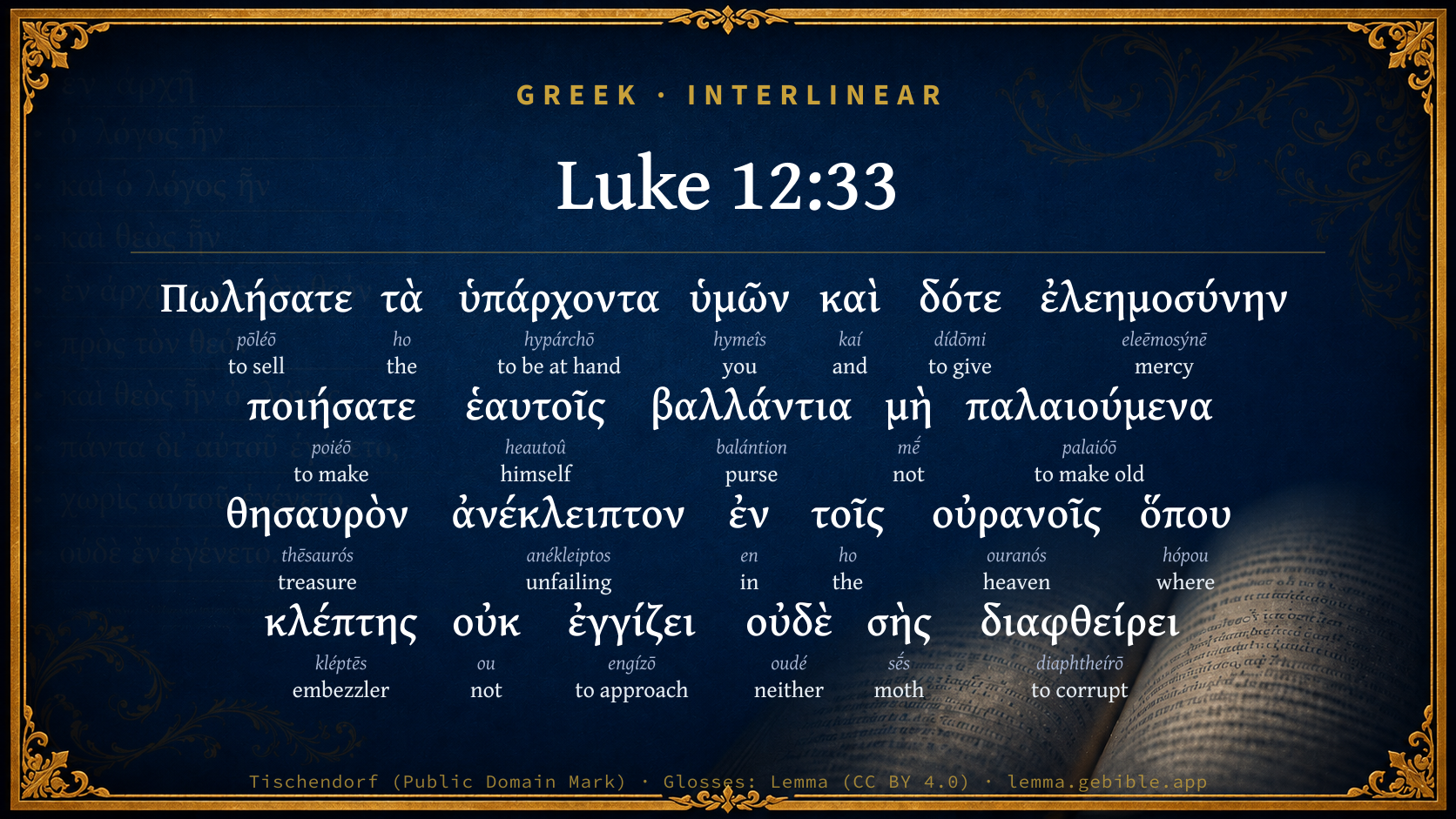
Greek (Tischendorf 8th ed.) Luke 12:33 appears in the Greek New Testament. The text above is from the Tischendorf 8th edition. Each word links to its Strong’s number and a concise gloss. Click any word for its full Thayer’s Greek Lexicon entry.
Download image
Cite this verse

Luke 12:33 (World English Bible). Public Domain. Lemma interlinear Bible study tool, https://lemma.gebible.app/v/luke/12/33.

Show BibTeX & RIS
BibTeX
RIS
English Translation
Sell that which you have, and give gifts to the needy. Make for yourselves purses which don't grow old, a treasure in the heavens that doesn't fail, where no thief approaches, neither moth destroys.
World English Bible · Public Domain
Highlights
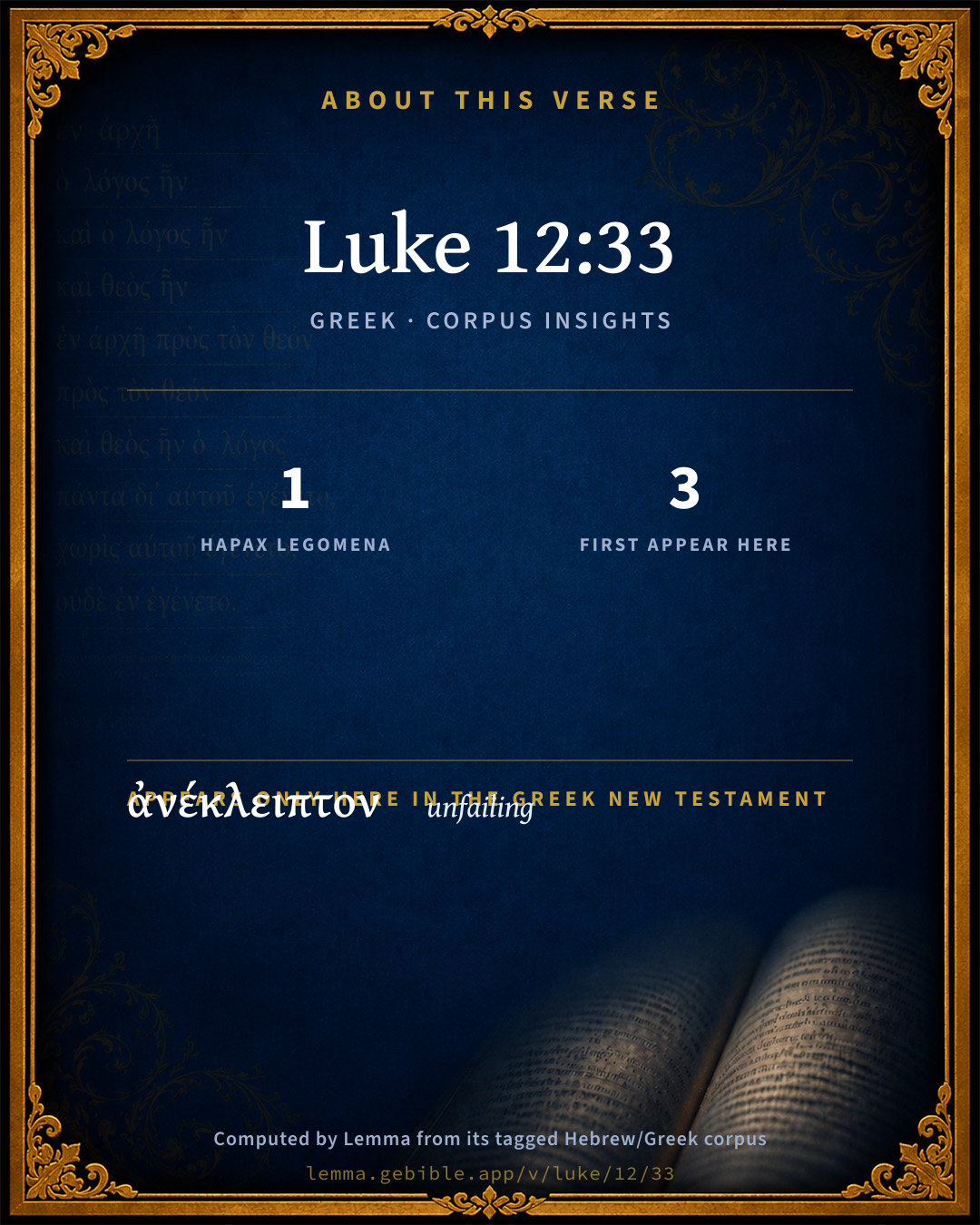
  • 1 hapax legomenon — only here in the Greek New Testament
  • 3 first appearances in the Greek New Testament
Full analysis ↓
Download a study sheet

One document with this verse’s original text, its word-by-word gloss line, the meaning frame, cross-references with their text, attributed commentary, and full source and license credits — printable, and it pastes into notes with its structure intact.

This verse Autodidact and up

Study sheet (.html) Plain text (.txt)

A passage Seminary Student

Up to 50 verses in one chapter. A passage sheet keeps up to 6 commentary sources and 12 cross-references per verse, in the order this page ranks them, and says so on the sheet whenever that leaves anything out. Ask for a single verse and you get the Autodidact verse sheet above.

Everything on this page stays free to read, with no account — the sheet is a download of what is already on screen, not access to it.

Want to remove ads? Support Godless Engineer
Compare translations 3

The same verse in 3 English versions, stacked beneath the original-language interlinear above. Click any original word for its lexicon entry.

Each is an independent rendering of the whole verse — the interlinear is not word-aligned to these translations.

Highlighted words mark where these versions differ — a whole-verse word diff, not a word-by-word alignment.

  • World English Bible Public Domain
    Sell that which you have, and give gifts to the needy. Make for yourselves purses which don't grow old, a treasure in the heavens that doesn't fail, where no thief approaches, neither moth destroys.
  • King James Version Public Domain
    Sell that ye have, and give alms; provide yourselves bags which wax not old, a treasure in the heavens that faileth not, where no thief approacheth, neither moth corrupteth.
  • unfoldingWord Literal Text CC BY-SA 4.0
    Sell your possessions and give alms. Make for yourselves purses that do not wear out—unfailing treasure in the heavens, where thief does not come near, nor moth destroy.

unfoldingWord Literal Text — © unfoldingWord, licensed CC BY-SA 4.0. Word-aligned USFM3 via Door43 (git.door43.org/unfoldingWord/en_ult).

Versions to compare (up to 4)

3 of 4 selected

Show all 19 translations

Every available English version of this verse, each an independent rendering of the whole verse.

  • World English Bible Public Domain
    Sell that which you have, and give gifts to the needy. Make for yourselves purses which don't grow old, a treasure in the heavens that doesn't fail, where no thief approaches, neither moth destroys.
  • Berean Standard Bible Public Domain
    Sell your possessions and give to the poor. Provide yourselves with purses that will not wear out, an inexhaustible treasure in heaven, where no thief approaches and no moth destroys.
  • Majority Standard Bible Public Domain
    Sell your possessions and give to the poor. Provide yourselves with purses that will not wear out, an inexhaustible treasure in heaven, where no thief approaches and no moth destroys.
  • King James Version Public Domain
    Sell that ye have, and give alms; provide yourselves bags which wax not old, a treasure in the heavens that faileth not, where no thief approacheth, neither moth corrupteth.
  • American Standard Version (1901) Public Domain
    Sell that which ye have, and give alms; make for yourselves purses which wax not old, a treasure in the heavens that faileth not, where no thief draweth near, neither moth destroyeth.
  • Revised Version (1885) Public Domain
    Sell that ye have, and give alms; make for yourselves purses which wax not old, a treasure in the heavens that faileth not, where no thief draweth near, neither moth destroyeth.
  • Geneva Bible (1599) Public Domain
    Sell that ye haue, and giue almes: make you bagges, which waxe not old, a treasure that can neuer faile in heauen, where no theefe commeth, neither mothe corrupteth.
  • Douay-Rheims (1899) Public Domain
    Sell what you possess and give alms. Make to yourselves bags which grow not old, a treasure in heaven which faileth not: where no thief approacheth, nor moth corrupteth.
  • Young's Literal Translation Public Domain
    sell your goods, and give alms, make to yourselves bags that become not old, a treasure unfailing in the heavens, where thief doth not come near, nor moth destroy;
  • Literal Standard Version CC BY-SA 4.0
    sell your goods, and give alms, make to yourselves bags that do not become old, a treasure unfailing in the heavens, where thief does not come near, nor moth destroy;
  • Unlocked Literal Bible CC BY-SA 4.0
    Sell your possessions and give to the poor. Make for yourselves purses which will not wear out—treasure in the heavens that does not run out, where no thief comes near, and no moth destroys.
  • unfoldingWord Literal Text CC BY-SA 4.0
    Sell your possessions and give alms. Make for yourselves purses that do not wear out—unfailing treasure in the heavens, where thief does not come near, nor moth destroy.
  • Darby Bible Public Domain
    Sell what ye possess and give alms; make to yourselves purses which do not grow old, a treasure which does not fail in the heavens, where thief does not draw near nor moth destroy.
  • World Messianic Bible Public Domain
    Sell what you have and give gifts to the needy. Make for yourselves purses which don’t grow old, a treasure in the heavens that doesn’t fail, where no thief approaches and no moth destroys.
  • Webster's Bible Public Domain
    Sell what ye have, and give alms: provide yourselves bags which become not old, a treasure in the heavens that faileth not, where no thief approacheth, neither moth corrupteth.
  • Free Bible Version CC BY-SA 4.0
    Sell what you have, and give the money to the poor. Get yourselves purses that don't wear out: treasure in heaven that will never run out, where no thief can steal it and no moth can destroy it.
  • Bible in Basic English Public Domain
    Give what property you have in exchange for money, and give the money to the poor; make for yourselves money-bags which will not get old, wealth stored up in heaven which will be yours for ever, where thieves will not come nor worms put it to destruction.
  • Text-Critical English NT CC BY 4.0
    Sell your possessions and give to the needy. Make yourselves moneybags that do not wear out, an inexhaustible treasure in heaven, where no thief comes near and no moth destroys.
  • Tyndale New Testament (1534) Public Domain
    Sell that ye have and geve almes. And make you bagges which wexe not olde and treasure that fayleth not in heaven where noo these commeth nether moth corrupteth.

Literal Standard Version (2020), Covenant Press — licensed CC BY-SA 4.0. Text via the HelloAO Bible API (eBible.org). Unlocked Literal Bible (unfoldingWord) — licensed CC BY-SA 4.0. Text via the HelloAO Bible API (eBible.org). unfoldingWord Literal Text — © unfoldingWord, licensed CC BY-SA 4.0. Word-aligned USFM3 via Door43 (git.door43.org/unfoldingWord/en_ult). Free Bible Version, Dr. Jonathan Gallagher — licensed CC BY-SA 4.0. Text via the HelloAO Bible API (eBible.org).

Word by word

More ways to search: Search by grammar → Find every occurrence → Compare this word →

Practice this passage: Drill this verse → Learn its vocabulary →

ἀνέκλειπτον
anékleiptos
G413
“unfailing”
Adjective, Accusative, Singular, Masculine
Part of Speech
Adjective
Case
Accusative
Number
Singular
Gender
Masculine
Full Thayer's Definition

Origin: from G1 (as a negative particle) and a presumed derivative of G1587

TDNT: None

1. unfailing
  1. Πωλήσατε pōléō G4453 “to sell” Verb, Aorist, Active, Imperative, 2nd person, Plural
  2. τὰ ho G3588 “the” Article, Accusative, Plural, Neuter
  3. ὑπάρχοντα hypárchō G5225 “to be at hand” Verb, Present, Active, Participle, Accusative, Plural, Neuter
  4. ὑμῶν hymeîs G5210 “you” Personal pronoun, 2nd person, Genitive, Plural
  5. καὶ kaí G2532 “and” Conjunction
  6. δότε dídōmi G1325 “to give” Verb, Aorist, Active, Imperative, 2nd person, Plural
  7. ἐλεημοσύνην eleēmosýnē G1654 “mercy” Noun, Accusative, Singular, Feminine
  8. ποιήσατε poiéō G4160 “to make” Verb, Aorist, Active, Imperative, 2nd person, Plural
  9. ἑαυτοῖς heautoû G1438 “himself” Reflexive pronoun, 2nd person, Dative, Plural, Masculine
  10. βαλλάντια balántion G905 “purse” Noun, Accusative, Plural, Neuter
  11. μὴ mḗ G3361 “not” Particle, Negative
  12. παλαιούμενα palaióō G3822 “to make old” Verb, Present, Passive, Participle, Accusative, Plural, Neuter
  13. θησαυρὸν thēsaurós G2344 “treasure” Noun, Accusative, Singular, Masculine
  14. ἐν en G1722 “in” Preposition
  15. τοῖς ho G3588 “the” Article, Dative, Plural, Masculine
  16. οὐρανοῖς ouranós G3772 “heaven” Noun, Dative, Plural, Masculine
  17. ὅπου hópou G3699 “where” Adverb
  18. κλέπτης kléptēs G2812 “embezzler” Noun, Nominative, Singular, Masculine
  19. οὐκ ou G3756 “not” Particle, Negative
  20. ἐγγίζει engízō G1448 “to approach” Verb, Present, Active, Indicative, 3rd person, Singular
  21. οὐδὲ oudé G3761 “neither” Conjunction, Negative
  22. σὴς sḗs G4597 “moth” Noun, Nominative, Singular, Masculine
  23. διαφθείρει diaphtheírō G1311 “to corrupt” Verb, Present, Active, Indicative, 3rd person, Singular

About this verse

These counts appear in no published source. They are computed here, from the morphology-tagged text and Lemma’s own curated glosses. What Lemma adds →

24
words
23
distinct lemmas
Gospels
section

Notable vocabulary

1 hapax legomenon — a word that appears only here in the entire Greek New Testament:

  • ἀνέκλειπτον unfailing G413

First appearance in Scripture

These words make their first canonical appearance in the Greek New Testament here:

  • παλαιούμενα to make old G3822
  • ἀνέκλειπτον unfailing G413
  • διαφθείρει to corrupt G1311

Shared distinctive vocabulary

σὴς moth G4597 occurs in 3 verses of the Greek New Testament. Also found in:

Repetition

A word recurs within this verse:

Cross-references

13

Topical passages linked to Luke 12:33 in the Treasury of Scripture Knowledge — connected by theme and wording, ordered by reader-vote popularity; previews shown in the World English Bible.

  • Matthew 19:21 Jesus said to him, "If you want to be perfect, go, sell what you have, and give to the poor, and you will have treasure in heaven; and come, follow me."
  • Acts 4:34–35 For neither was there among them any who lacked, for as many as were owners of lands or houses sold them, and brought the proceeds of the things that were sold,
  • Luke 18:22 When Jesus heard these things, he said to him, "You still lack one thing. Sell all that you have, and distribute it to the poor. You will have treasure in heaven. Come, follow me."
  • Acts 2:45 They sold their possessions and goods, and distributed them to all, according as anyone had need.
  • Matthew 6:19–21 "Don't lay up treasures for yourselves on the earth, where moth and rust consume, and where thieves break through and steal;
  • Luke 16:9 I tell you, make for yourselves friends by means of unrighteous mammon, so that when you fail, they may receive you into the eternal tents.
  • Luke 12:21 So is he who lays up treasure for himself, and is not rich toward God."
  • 1 Timothy 6:17–19 Charge those who are rich in this present world that they not be haughty, nor have their hope set on the uncertainty of riches, but on the living God, who richly provides us with everything to enjoy;
  • Haggai 1:6 You have sown much, and bring in little. You eat, but you don't have enough. You drink, but you aren't filled with drink. You clothe yourselves, but no one is warm, and he who earns wages earns wages to put them into a bag with holes in it."
  • 2 Corinthians 8:2 how that in much proof of affliction the abundance of their joy and their deep poverty abounded to the riches of their liberality.
  • James 5:1–3 Come now, you rich, weep and howl for your miseries that are coming on you.
  • Luke 11:41 But give for gifts to the needy those things which are within, and behold, all things will be clean to you.
  • John 12:6 Now he said this, not because he cared for the poor, but because he was a thief, and having the money box, used to steal what was put into it.

Cross-references courtesy of OpenBible.info (CC BY 4.0).

Commentary

Notes on Luke 12:33 from classic Christian and Jewish commentators (each source and its license shown beneath its notes). The classic Christian expositions comment on the surrounding passage and are grouped to its opening verse, so a note may address several verses; the Jewish commentaries on the Tanakh (Rashi and others) are per-verse, so they appear only where the commentator wrote on this verse.

Lemma curates 59 commentaries, every one of them public domain or Creative Commons licensed, each selected and text-cleaned for this edition rather than reprinted as found. About our sources →

Matthew Poole's English Annotations

The immutable purpose of the Divine Being to glorify the disciples of Christ, the freedom of the Divine will in the gift of heaven and glory, are neither of them exclusive of, but include and suppose, their duty to use such due means as he hath directed them, in the use of which they shall obtain what he hath purposed for them, and promised to them; some of which are here directed and prescribed.

Sell that ye have, and give alms, & c. It is a precept of the same import with that, Mat 19:21; Mar 10:21. Though possibly the precept here given to the disciples of Christ generally is not to be interpreted so strictly as seemeth to be our Saviour’s meaning in those texts, as to the young man. For it seems to have been a special precept to him, laying an obligation upon him to make a present actual sale of all he had, and it is plain that he so understood it. To this Christians are not obliged generally by this precept: but to be ready at the call and command of God to part with all, for such uses as God should show them: not to set their heart on riches, Psa 62:10; to be ready to distribute, and willing to communicate, 1Ti 6:18; remembering that God loveth mercy rather than sacrifice, Hos 6:6; Mat 9:13. To give of our superfluities, Luk 3:11. To make friends of our mammon of unrighteousness, Luk 16:9. Nay, if the necessities of the people of God be such as requires it, for the subsistence of Christians, to sell what we have, rather than others of God’s people should starve, calling nothing our own in such a case; which Christians did in the primitive state of the church, Act 4:34-37. For the other part of Luk 12:33,34, See Poole on "Mat 6:20-21".

Matthew Poole's English Annotations on the Holy Bible (1683–1685) — public domain. Text from a community e-Sword/MySword module.

The Biblical Illustrator

Joseph S. Exell

Luk_12:33

Sell that ye have, and give alms

Sell all

Do not hoard it for yourself; do not, like the rich fool, call them your fruits.

Do not consider yourselves proprietors of your goods. Regard them not as yours, but as Gods. Sell them to God, and dispose of them in mercy for the wants of others. This is not a command that no money be kept for our own use, but that righteousness should not be neglected through fear of poverty. They make the best of bargains, who secure eternal life. They obtain the best of treasures who carry them through the grave. Self-righteous, lazy, mendicant friars, a burlesque on the text. Men may part with all, only to be more covetous than before. The command was given in good earnest to the young man. It demands the soul to be unfettered of earth-born weights. It requires a consecration of all our means to God. Mariners save the vessel by throwing the cargo into the sea. Possessions cease to be harmless the moment they acquire the mastery. Esteem it no loss if your all is destroyed for Christs sake. No sacrifice of treasure meritorious in purchasing heaven. Some give their all to the poor, and still lose heaven (1Co_13:3). (Van Doren.)

Noble self-sacrifice

The present Queen of Sweden, in a spirit of the noblest self-sacrifice, sold her jewels to provide for her people hospitals, orphanages, and convalescent homes, such as we possess in this country. Visiting on one occasion in person a convalescent home of her own founding, a poor bed-ridden woman thanked her for her kindness and her care. As she spoke one or more tears of gratitude fell on the queens hand, who was sitting by her side. The queen sweetly said, as she saw the glittering tokens of a thankful heart, God is sending me my jewels back again.

The Biblical Illustrator, edited by Joseph S. Exell (c. 1880s–1900s) — public domain. Text from a community e-Sword module.

Tyndale Open Study Notes

Tyndale Open Resources

12:33 Sell your possessions and give to those in need: This is not a command to liquidate all personal possessions, since elsewhere in the Bible it is assumed that believers will own property. It means recognizing that everything we have is God’s and should be used to serve him and his people (see Acts 2:44-45; 4:32-34). Believers are responsible for meeting the needs of the poor, especially in the church (Gal 6:10). • treasure for you in heaven: See Luke 16:1-13; Matt 6:19-21. When God gives wealth, he also gives a ministry to help the unfortunate.

Tyndale Open Study Notes — © Tyndale Open Resources, licensed CC BY-SA 4.0. Text via the HelloAO Bible API.

Bengel's Gnomon

Johann Albrecht Bengel

Luk 12:33. [Ἑαυτοῖς, for yourselves) Laying out your money at the highest interest, Heb 10:34.—V. g.]—πωλήσατε, sell) This the Lord said, not to the crowds [Luk 12:1; Luk 12:54], to whom however He was showing the way of salvation in a manner appropriate to that very time, Luk 12:54; Luk 12:56; nor to the apostles, who had left their all previously, and therefore had nothing to ‘sell:’ but to the rest of the disciples: see Luk 12:22; Luk 12:41. His departure from Galilee, ch. Luk 13:32, and his Passion itself, were at hand: and He was now already preparing His disciples, that they might be thenceforth as lightly equipped (with as few encumbrances) as possible. For these were they, of whom Luke makes mention in Act 1:15; Act 2:44, etc.: so that there is no doubt but that soon after this discourse they sold their possessions in Galilee. Otherwise the indiscriminate sale of all one’s resources is not enjoined on all, so as to require that they should convert them into alms, and that themselves, as well as their families should either seek or re-seek [seek to get in their turn] from others the alms which they had once given. Nevertheless spiritual prudence makes men, from being mercenary, even though they have not the most abundant supply of goods, to become liberal, and disposed to sell in order to have wherewith to give, especially when the exigency requires it. See Ecc 11:2; Jas 5:1.—βαλάντια, purses) Plural. He who sells after the manner of the world, fills his purse: but this kind of purse waxes old, even as the natural heaven itself doth.[122]—θησαυρὸν ἀνέκλειπτον, a treasure that faileth not) The treasure, as opposed to the purse, is the abundance of articles of food, which are very soon spent or spoiled [consumed or corrupted].—ἐν) namely [purses and a treasure] in the heavens. This appertains to both of the preceding clauses.

[122] Opposed to the spiritual τοῖς οὐρανοῖς, which do not wax old.—ED. and TRANSL.

Bengel's Gnomon of the New Testament — English translation (T&T Clark, Edinburgh, 1860) — public domain. Text from a community e-Sword module.

Meyer's Critical & Exegetical Commentary

Heinrich August Wilhelm Meyer

Luk_12:33-34. Comp. Mat_6:19-21. This end is so important that, in order to strive thereafter with your whole interest (Luk_12:34), ye must renounce your earthly possessions, etc. This selling and giving up of the proceeds as alms (ἐλεημοσ., as Luk_11:41) is not required of all Christians (Luk_12:22), as de Wette will have it, but of the disciples, who, in the discharge of their office, needed perfect release from what is temporal. All the less do the words furnish a basis for the consilium evangelicum and the vow of poverty (Bisping).

ἑαυτοῖς] while ye give to others.

βαλλάντια (Luk_10:4) μὴ παλαιούμενα is explained by the following θησαυρὸν … οὐρανοῖς.[158] As to this θησαυρός, comp. on Luk_12:21.

[158] To refer the βαλλάντ. μὴ παλ. to the everlastingly fresh power of apprehension in respect of the eternal possessions, was a fancy of Langes opposed to the context (L. J. II. 2, p. 851).

Meyer — Critical and Exegetical Commentary on the New Testament — English translation by Peter Christie, edited by Frederick Crombie (T&T Clark, 1880) — public domain. Text from a community e-Sword module.

Expositor's Greek Testament

ed. W. Robertson Nicoll

Luk 12:33 counsels a heroic mood for which apprehension as to future temporal want has become an impossibility, such want being now viewed as a means of ensuring the one object of desire, eternal riches. πωλήσατε , etc.: the special counsel to the man in quest of eternal life generalised ( cf. Luk 18:22 ). βαλάντια , purses: continens pro contento (De Wette). παλαιούμενα : in Heb 8:13 applied to the Sinaitic covenant. Covenants, religions, wax old as well as purses . ἀνέκλειπτον , unfailing. Cf. ἐκλίπῃ , Luk 16:9 , in reference to death: “vox rara, sed paris elegantiae cum altera ἀνεκλιπὴς , quam adhibet auctor libri Sapient., vii. 4, viii. 18, ubi habes θησαυρὸς ἀνεκλιπὴς et πλοῦτος ἀνεκλιπής ,” Wolf. There is poetry in this verse, but also some think asceticism , turning the poetry of Jesus into ecclesiastical prose. I prefer to believe that even Lk. sees in the words not a mechanical rule, but a law for the spirit.

The Expositor's Greek Testament, edited by W. Robertson Nicoll (1897–1910) — public domain. Text from a community e-Sword module.

Geneva Bible (1599)

Geneva Bible translators

This is the figure Metonymy, for by this word, Alms, is meant that compassion and friendliness of an heart that tendereth the misery and poor estate of man, and showeth forth itself by some gift, and hath the name given it in the Greek tongue, of mercy and compassion: and therefore he is said to give alms, who parteth with some thing to another, and giveth to the poor, showing thereby, that he pitieth their poor estate.

A godly bountifulness is a ready way to get true riches.

Geneva Bible (1599) marginal notes — public domain. Text via Bolls.life.

Jamieson, Fausset & Brown

Robert Jamieson, A. R. Fausset & David Brown

Sell, &c.--This is but a more vivid expression of Mat 6:19-21 (see on Mat 6:19-21).

Jamieson, Fausset & Brown — Commentary Critical and Explanatory on the Whole Bible (1871) — public domain (CC PDM 1.0). Text via the HelloAO Bible API.

Adam Clarke's Commentary

Verse 33. Sell that ye have] Dispose of your goods. Be not like the foolish man already mentioned, who laid up the produce of his fields, without permitting the poor to partake of God's bounty: turn the fruits of your fields (which are beyond what you need for your own support) into money, and give it in alms; and the treasure thus laid out, shall be as laid up for yourselves and families in heaven. This purse shall not grow old, and this treasure shill not decay. Ye shall by and by find both the place where you laid up the treasure, and the treasure itself in the place; for he who hath pity on the poor lendeth unto the Lord; and he may rest assured, that whatever, for Christ's sake, he thus lays out, it will be paid him again.

Adam Clarke's Commentary on the Bible (1810–1826) — public domain. Text from a community e-Sword/MySword module.

Ellicott's Commentary for English Readers

(33) Sell that ye have.—In its generalised form the precept is peculiar to St. Luke, but it has its parallel in the command given to the young ruler. (See Note on Mat_19:21.) It was clearly one of the precepts which his own characteristic tendencies led him to record (see Introduction), and which found its fulfilment in the overflowing love that showed itself in the first days of the Church of the Apostles (Act_2:45). Subsequent experience may have modified the duty of literal obedience, but the principle implied in it, that it is wise to sit loose to earthly possessions, possessing them as though we possessed not (1Co_7:30), is one which has not lost its force.

Provide yourselves bags . . .—The Greek word for bags (elsewhere “purse,” Luk_22:35), may be noticed as peculiar to St. Luke. Of the three words used in the New Testament for “purse” or “bag” it was the most classical.

Where no thief approacheth.—See Note on Mat_6:20. The form is in some respects briefer here, but “the treasure that faileth not” is a touch peculiar to St. Luke. The adjective which he uses is a rare one, and not found elsewhere in the New Testament; but one from the same root, in Wis_7:14; Wis_8:18, describes wisdom as “a treasure that never faileth.”

A Bible Commentary for English Readers, edited by Charles John Ellicott (1878–1897) — public domain. Text from a community e-Sword module.

The Cambridge Bible for Schools and Colleges

gen. ed. J. J. S. Perowne

33. Sell that ye have] This command was taken very literally by the early Church, Act_2:44-45. Comp. Luk_16:9; Mat_19:21.

The Cambridge Bible for Schools and Colleges (gen. ed. J. J. S. Perowne; Cambridge University Press, 1878–1918) — public domain. Text from a community e-Sword module.

John Gill's Exposition

Sell that ye have, and give alms,.... Since they had a kingdom bequeathed them by their heavenly Father, they should be so far from indulging an anxious care about food and raiment, that when there was a call in providence for it, and rather than the poor should go without a supply, it became them to sell their houses and lands, and whatever possessions they had, and relieve them; and so they did not long after; for some of those who sold their estates, and brought the money to the apostles, Act 4:34, might be now present; and the more readily and cheerfully do what they did, remembering these words of Christ:

provide yourselves bags which wax not old; as do the bags of misers: their bag is, , "a bag pierced through", or that has a hole in it, which lets the money out as it is put in, Hag 1:6 and which the Targum renders by, "for a curse"; as money hoarded up in bags by covetous persons generally is: Christ would have his followers put their money up in other bags; not in such which rot through age, or are worn out, and are full of holes through use; but into the hands and bellies of the poor, the fruit and reward of which will always abide;

a treasure in the heavens that faileth not: whereas treasure on earth does, being either taken away from the possessors of it by various ways, or they from that:

where no thief approacheth; can come near to steal it away, which is often the case here on earth:

neither moth corrupteth; as it does the best of garments, wore by men: but the robes of glory and immortality can never be corrupted: See Gill on Mat 6:20.

John Gill's Exposition of the Whole Bible (1746–1763) — public domain (CC PDM 1.0). Text via the HelloAO Bible API.

Trapp's Complete Commentary

John Trapp

33 Sell that ye have, and give alms; provide yourselves bags which wax not old, a treasure in the heavens that faileth not, where no thief approacheth, neither moth corrupteth.

Ver. 33. A treasure in the heavens] As a merchant being to travel into a far country, doth deliver his money here upon the exchange that so he may be sure to receive it again at his arrival in that country; so let us that are passing into another country lay up something that may stand us in stead in that day.

John Trapp, A Commentary or Exposition upon All the Books of the Old and New Testament (1647–1656) — public domain. Text from a community e-Sword module.

Albert Barnes' Notes on the Bible

Sell that ye have - Sell your property. Exchange it for that which you can use in distributing charity. This was the condition of their being disciples. Their property they gave up; they forsook it, or they put it into common stock, for the sake of giving alms to the poor, Act 2:44; Act 4:32; Joh 12:6; Act 5:2.

Bags which wax not old - The word “bags,” here, means “purses,” or the bags attached to their girdles, in which they carried their money. See the notes at Mat 5:38. By bags which wax not old Jesus means that we should lay up treasure in heaven; that our aim should be to be prepared to enter there, where all our wants will be forever provided for. Purses, here, grow old and useless. Wealth takes to itself wings. Riches are easily scattered, or we must soon leave them; but that wealth which is in heaven abides forever. It never is corrupted; never flies away; never is to be left.

Wax - This word is from an old Saxon word, and in the Bible means to “grow.”

Albert Barnes' Notes on the Bible (1834–1885) — public domain. Text from a community e-Sword/MySword module.

Haydock's Catholic Bible Commentary

Be not solicitous that whilst you are fighting for the kingdom of heaven, the necessities of this life will be wanting to you, on account of his command. Sell what you possess, that you may bestow charity; which those do, who having left all things, nevertheless labour with their hands for their livelihood, and to bestow the rest in charity. (Ven. Bede)

George Leo Haydock (1774–1849), Haydock's Catholic Family Bible and Commentary, 1859 edition — public domain. Excludes Psalms (Douay-Rheims chapter numbering differs from Protestant) and Deuterocanonical books (Catholic canon only).

Whedon's Commentary on the Bible

Daniel D. Whedon

33. Sell that ye have—For you will be rich as kings by Such a surrender.

And give alms—For this will be the richest investment.

Provide yourself bags—Purses, out of the proceeds of your sales.

Wax not old—As the purses will which contain your earthly funds.

A treasure in the heavens—In lieu of that ye have. There is a beautiful little allegory contained in this verse.

Daniel D. Whedon (gen. ed.), Commentary on the Old and New Testaments (1874–1909) — public domain. Text from a community e-Sword module.

The Pulpit Commentary

Sell that ye have, and give alms; provide yourselves bags which wan not old, a treasure in the heavens that faileth not. "Those of you who have riches, see, this is what I counsel you to do with them." In considering these much-disputed words of the Master, we must remember

(1) to whom they were spoken: they were addressed to men and women who, if they would follow him, must set themselves free from all worldly possessions; they must literally forsake all to follow him.

(2) We must bear in mind

(a) that the only community which attempted, as a community, to obey this charge literally was the Church of Jerusalem, and the result was that for long years this Church was plunged into the deepest poverty, so that assistance had to be sent even from far-distant Churches to this deeply impoverished Jerusalem community. This we learn from Paul, the real compiler of this very Gospel, where the charge is reported. See many passages in his letters, notably the Second Epistle to the Corinthians, passim.

(b) The mendicant orders in the Middle Ages, with no little bravery and constancy, likewise attempted to carry out to the letter this direction. The impartial student of mediaeval history, while doing all justice to the aims and work of these often devoted men, can judge whether or no these mendicant orders can be reckoned among the permanently successful agencies of the cross. We conclude, then, that these words had a literal meaning only for those to whom they were specially addressed, viz. the disciples. While to the Church generally they convey this deep, far-reaching lesson, a lesson all would-be servants of Christ would do well to take to heart it is the Master"s will that his followers should sit loose to all earthly possessions, possessing them as though they possessed not. Thus living, the heart will be free from all inordinate care for earthly treasure, and will, in real earnest, turn to that serene region where its real and abiding riches indeed are even to heaven.

The Pulpit Commentary (1880–1919), ed. H.D.M. Spence-Jones & Joseph S. Exell — public domain. Text from a community e-Sword module.

John Wesley's Explanatory Notes

Sell what ye have - This is a direction, not given to all the multitude: (much less is it a standing rule for all Christians:) neither to the apostles; for they had nothing to sell, having left all before: but to his other disciples, (mentioned chap. xii, 22, and Acts i, 15, ) especially to the seventy, that they might be free from all worldly entanglements. Matt. vi, 19.

John Wesley, Explanatory Notes Upon the Whole Bible (1754–1765) — public domain. Text via the GEBible commentary corpus.

Burkitt's Expository Notes on the New Testament

William Burkitt

The next duty which our Saviour exhorts his disciples to, is the duty of alms-giving; that they should be so far from distrusting God’s provisions for themselves, that they should be always forward to a ready distribution towards others; yea, in cases of necessity, to be willing to sell their goods to relieve others: yet this precept is not to be taken as if it concerned all persons, at all times, and in all places; but respects only cases of extreme necessity; or if it concerns all, it is only as to the readiness and preparation of the mind; that when necessity calls for it, we be found willing to part with any thing we have for the relief of Christ in his members.

Observe also, the argument used to excite to this duty of alms-giving: hereby we lay up our treasure in a safe hand, even in God’s, who will reward us openly. The bellies of the poor are bags that wax not old; what is lodged there is laid up securely out of the reach of danger. We imitate the wise merchant in transmitting our estates into another world, by bills of exchange, where we are sure to receive our own with usury.

William Burkitt's Expository Notes on the New Testament (1700–1703) — public domain. Text from a community e-Sword module.

The People's New Testament

B. W. Johnson

33. Sell what ye have. Lay up treasure in heaven. The true way of investing wealth is to consecrate it to good purposes. Better to sell in order to have wherewith to give, than to hoard like the rich fool. See notes on Matt. 6:19–21.

B. W. Johnson's The People's New Testament with Notes (1889–1891) — public domain. Electronic text from the Christian Classics Ethereal Library (CCEL) ThML edition.

unfoldingWord translationNotes

Door43 World Missions Community

give to the poor

It may be helpful to state what they receive. AT: "give to poor people the money you earn from the sales" (See: Ellipsis)

Make for yourselves purses ... treasure in the heavens

The purses and treasure in the heavens are the same thing. They both represent God's blessing in heaven. (See: Metaphor)

Make for yourselves

This is the result of giving to the poor. AT: "In this way you will make for yourselves"

purses which will not wear out

"money bags that will not get holes in them"

does not run out

"does not diminish" or "does not become less"

no thief comes near

"thieves do not come near"

no moth destroys

"moths do not destroy"

moth

A "moth" is a small insect that eats holes in fabric. You may need to use a different insect, such as an ant or termite.

where your treasure is, there your heart will be also

"your heart will be focused on where you store your treasure"

your heart

Here "heart" refers to a person's thoughts. (See: Metonymy)

translationWords

possess

heaven

heart

thief

unfoldingWord translationNotes — © Distant Shores Media and the Door43 World Missions Community, licensed CC BY-SA 4.0. Source: git.door43.org/Door43/en_tn.

Cambridge Greek Testament for Schools and Colleges

33. πωλήσατε τὰ ὑπάρχοντα ὑμῶν. This command was taken very literally by the early Church, Act 2:44-45. Comp. Luk 16:9; Mat 19:21.

βαλλάντια. See on Luk 10:4.

διαφθείρει. ‘Destroyeth.’ Vulg[266] corrumpit, whence the A.V[267] “corrupteth.”

[266] Vulg. Vulgate.

[267] A.V. Authorised Version.

Cambridge Greek Testament for Schools and Colleges (Cambridge University Press, 1896; 21 vols, various authors incl. Carr, Maclear, Plummer, Farrar, Lumby, Moule, M. R. James, Simcox) — public domain. Text from a community e-Sword module.

Alford’s Greek Testament

Henry Alford

33.] Meyer endeavours to evade the force of this, by supposing it addressed only to the Apostles and then existing disciples. But it is said to the μικρὸν ποίμνιον, who are all the elect people of God.

πωλ.] This is the true way of investing worldly wealth:—‘He that giveth to the poor, lendeth to the Lord.’ See on Mat 6:19-21.

Henry Alford, The Greek Testament (1849–1861) — public domain. Text from a community e-Sword module.

International Critical Commentary

33. The first half of this verse (to παλαιούμενα) has no parallel in Mt. As in 6:29, 30, we have a rule given, not that it may be kept literally, but that it may illustrate a principle. So far as attachment to our possessions is concerned, we must be ready to part with them (1Co 7:30). Our fondness for them is not our justification for keeping them. But there is no Ebionism here, no condemnation of possessions as sinful.1 As Bede points out, Christians are not commanded to retain nothing for their own use (for Christ Himself had a purse out of which He gave alms), but to take care that fear of poverty does not interfere with benevolence. Almsgiving is not to be a mere giving of what we can spare. Nor is it merely for the sake of the receiver. It is also for the good of the giver, that his heart may be freed from covetousness. The attempt to keep the letter of the rule here given (Act 2:44, Act 2:45) had disastrous effects on the Church of Jerusalem, which speedily became a Church of paupers, constantly in need of alms (Rom 15:25, Rom 15:26; 1Co 16:3; 2Co 8:4, 2Co 9:1). For τὰ ὑπάρχοντα see on 8:3; and for βαλλάντια see on 10:4.

ἀνέκλειπτον. Not elsewhere in N.T. or LXX. Comp. 16:9, 22:32; and, for the command, Mar 10:41. Heaven is not to be bought with money; but, by almsgiving, what would be a hindrance is made a help.2 In σής the reference perhaps is to costly garments, which are a favourite form of wealth in the East. The word occurs Isa 50:9, 51:8; Job 4:19, 27:18; Pro 14:30; but in N.T. only here and Mat 6:19.

International Critical Commentary — older volumes (1896–1929), various authors — public domain. Text from a community e-Sword module.

Vincent's Word Studies in the New Testament

Marvin R. Vincent

Bags [βαλλαντια] . From ballw, to throw. Something into which money and other things are cast. Rev., purses. See on ch. Luk 10:4. Wyc., satchels.

Moth. Compare Jas 5:2.

Marvin R. Vincent, Word Studies in the New Testament (1887–1900) — public domain. Text from a community e-Sword/MySword module.

Lesson kit

Teaching starters — assembled from the data on this page, not authored interpretation. Every prompt links to the verse data it draws on. Edit before teaching.

Luke, in the Gospels, opens this verse with 24 words (23 distinct Greek lemmas). Its most distinctive word is anékleiptos (“unfailing”). A historical commentator’s framing appears above. Read the whole chapter for the surrounding context.

Discussion questions

  1. What does “unfailing” (anékleiptos) contribute to the verse as a whole?
  2. This verse holds 1 word here found nowhere else in the Greek New Testament. What might the rare word draw attention to?
  3. 3 words here appear for the first time in Scripture. What is being introduced at this debut?
  4. Matthew 6:19 shares the word «moth» with this verse. How do the two illuminate each other?
  5. “the” occurs 2× in this one verse. What is the effect of the repetition?
  6. These translations render this verse differently; the difference is in the English rendering, not the original. What questions does that raise?
  7. Reading how Matthew Poole's English Annotations and The Biblical Illustrator read this verse, where do the two commentators agree and where do they part?

Things to notice

  • 1 word in this verse appears nowhere else in the Greek New Testament.
  • 3 words make their first canonical appearance in Scripture here.
  • These translations choose different wording for 30 words in this verse.
  • “the” occurs 2× in this single verse.
  • 23 distinct Greek lemmas span 24 words in this verse.

Reading settings

Reading text

Shown beneath each verse's original-language words.

Old Testament
Old Testament edition

Read the OT as the Masoretic Hebrew (MT) or the Greek Septuagint (LXX).

English shown for the Greek Septuagint (in the Hebrew ↔ Greek comparison).

Comparing translations? Open the Compare panel on any verse page to stack up to four side by side.