Matthew 5:10

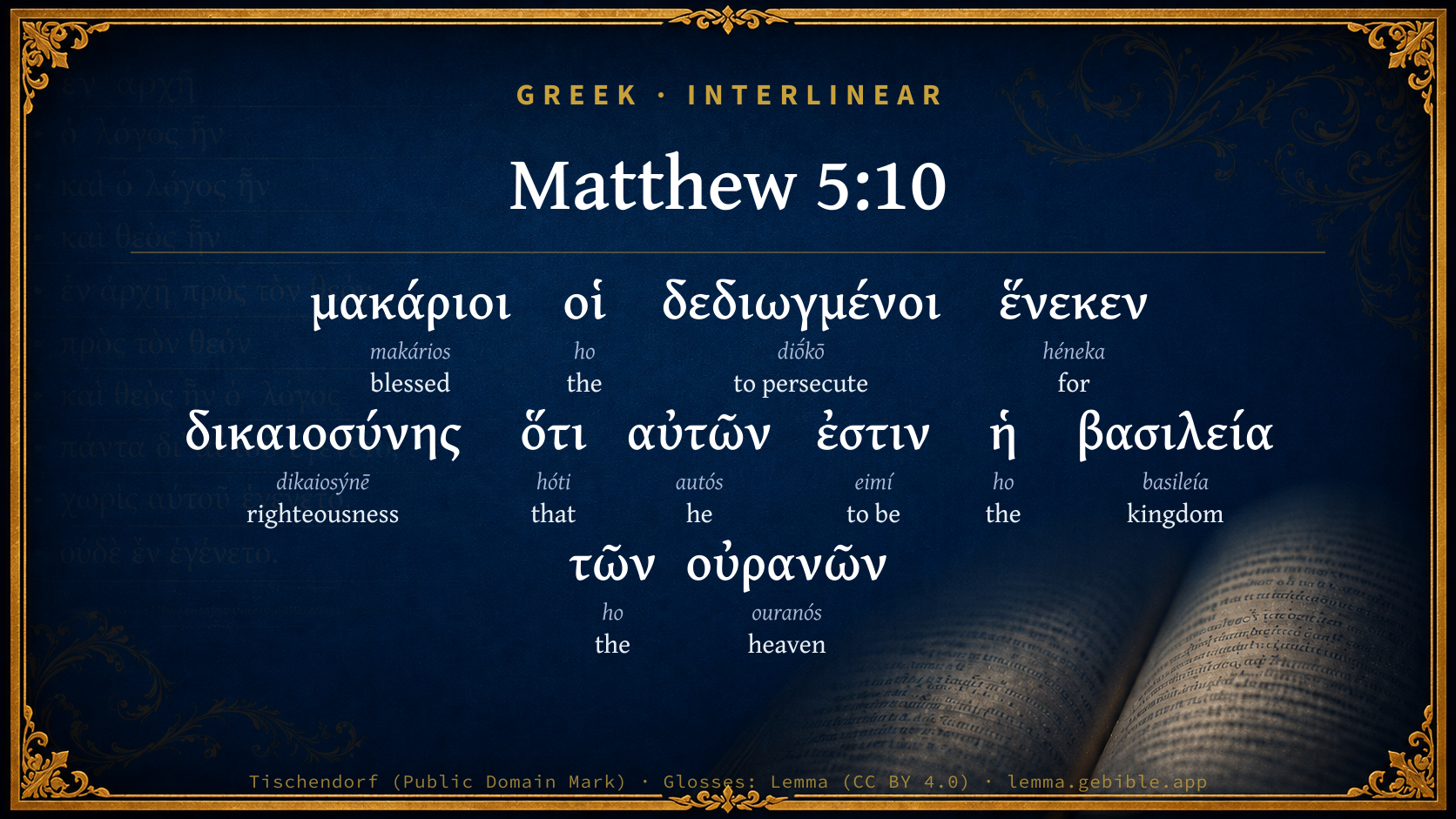
Greek (Tischendorf 8th ed.) Matthew 5:10 appears in the Greek New Testament. The text above is from the Tischendorf 8th edition. Each word links to its Strong’s number and a concise gloss. Click any word for its full Thayer’s Greek Lexicon entry.
Download image
Cite this verse

Matthew 5:10 (World English Bible). Public Domain. Lemma interlinear Bible study tool, https://lemma.gebible.app/v/matthew/5/10.

Show BibTeX & RIS
BibTeX
RIS
English Translation
Blessed are those who have been persecuted for righteousness' sake, For theirs is the Kingdom of Heaven.
World English Bible · Public Domain
Highlights
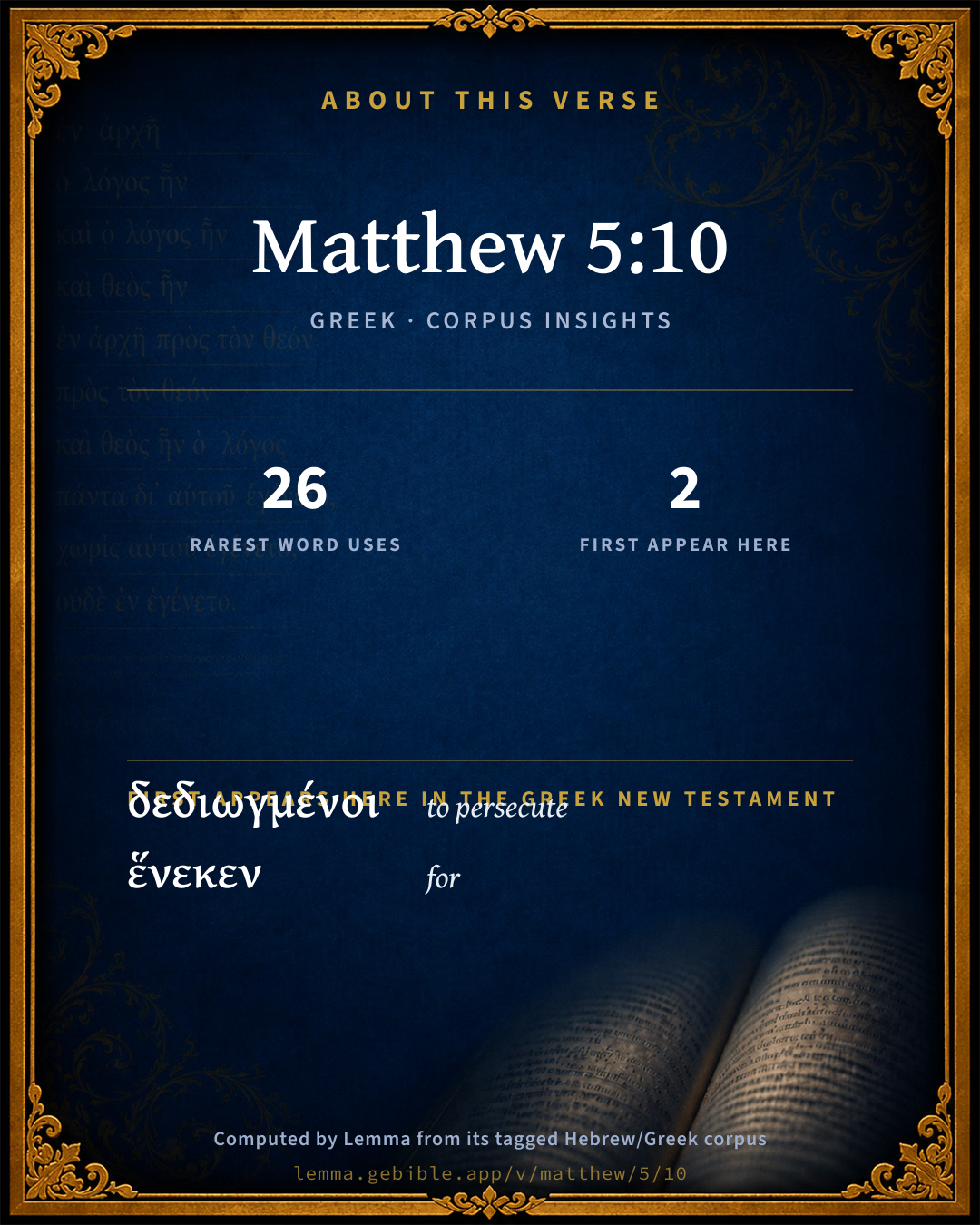
  • 2 first appearances in the Greek New Testament
Full analysis ↓
Download a study sheet

One document with this verse’s original text, its word-by-word gloss line, the meaning frame, cross-references with their text, attributed commentary, and full source and license credits — printable, and it pastes into notes with its structure intact.

This verse Autodidact and up

Study sheet (.html) Plain text (.txt)

A passage Seminary Student

Up to 50 verses in one chapter. A passage sheet keeps up to 6 commentary sources and 12 cross-references per verse, in the order this page ranks them, and says so on the sheet whenever that leaves anything out. Ask for a single verse and you get the Autodidact verse sheet above.

Everything on this page stays free to read, with no account — the sheet is a download of what is already on screen, not access to it.

Want to remove ads? Support Godless Engineer
Compare translations 3

The same verse in 3 English versions, stacked beneath the original-language interlinear above. Click any original word for its lexicon entry.

Each is an independent rendering of the whole verse — the interlinear is not word-aligned to these translations.

Highlighted words mark where these versions differ — a whole-verse word diff, not a word-by-word alignment.

  • World English Bible Public Domain
    Blessed are those who have been persecuted for righteousness' sake, For theirs is the Kingdom of Heaven.
  • King James Version Public Domain
    Blessed are they which are persecuted for righteousness' sake: for theirs is the kingdom of heaven.
  • unfoldingWord Literal Text CC BY-SA 4.0
    Blessed the ones persecuted for the sake of righteousness, for theirs is the kingdom of the heavens.

unfoldingWord Literal Text — © unfoldingWord, licensed CC BY-SA 4.0. Word-aligned USFM3 via Door43 (git.door43.org/unfoldingWord/en_ult).

Versions to compare (up to 4)

3 of 4 selected

Show all 19 translations

Every available English version of this verse, each an independent rendering of the whole verse.

  • World English Bible Public Domain
    Blessed are those who have been persecuted for righteousness' sake, For theirs is the Kingdom of Heaven.
  • Berean Standard Bible Public Domain
    Blessed are those who are persecuted because of righteousness, for theirs is the kingdom of heaven.
  • Majority Standard Bible Public Domain
    Blessed are those who are persecuted because of righteousness, for theirs is the kingdom of heaven.
  • King James Version Public Domain
    Blessed are they which are persecuted for righteousness' sake: for theirs is the kingdom of heaven.
  • American Standard Version (1901) Public Domain
    Blessed are they that have been persecuted for righteousness' sake: for theirs is the kingdom of heaven.
  • Revised Version (1885) Public Domain
    Blessed are they that have been persecuted for righteousness’ sake: for theirs is the kingdom of heaven.
  • Geneva Bible (1599) Public Domain
    Blessed are they which suffer persecution for righteousnes sake: for theirs is the kingdome of heauen.
  • Douay-Rheims (1899) Public Domain
    Blessed are they that suffer persecution for justice' sake: for theirs is the kingdom of heaven.
  • Young's Literal Translation Public Domain
    `Happy those persecuted for righteousness' sake -- because theirs is the reign of the heavens.
  • Literal Standard Version CC BY-SA 4.0
    Blessed those persecuted for righteousness’ sake—because theirs is the kingdom of the heavens.
  • Unlocked Literal Bible CC BY-SA 4.0
    Blessed are those who have been persecuted for righteousness' sake, for theirs is the kingdom of heaven.
  • unfoldingWord Literal Text CC BY-SA 4.0
    Blessed the ones persecuted for the sake of righteousness, for theirs is the kingdom of the heavens.
  • Darby Bible Public Domain
    Blessed they who are persecuted on account of righteousness, for *theirs* is the kingdom of the heavens.
  • World Messianic Bible Public Domain
    Blessed are those who have been persecuted for righteousness’ sake, for theirs is the Kingdom of Heaven.
  • Webster's Bible Public Domain
    Blessed are they who are persecuted for righteousness' sake: for theirs is the kingdom of heaven.
  • Free Bible Version CC BY-SA 4.0
    Blessed are those persecuted for what is right, for the kingdom of heaven is theirs.
  • Bible in Basic English Public Domain
    Happy are those who are attacked on account of righteousness: for the kingdom of heaven will be theirs.
  • Text-Critical English NT CC BY 4.0
    Blessed are those who are persecuted for righteousness' sake, for theirs is the kingdom of heaven.
  • Tyndale New Testament (1534) Public Domain
    Blessed are they which suffre persecucion for rightwesnes sake: for theirs ys the kyngdome of heuen.

Literal Standard Version (2020), Covenant Press — licensed CC BY-SA 4.0. Text via the HelloAO Bible API (eBible.org). Unlocked Literal Bible (unfoldingWord) — licensed CC BY-SA 4.0. Text via the HelloAO Bible API (eBible.org). unfoldingWord Literal Text — © unfoldingWord, licensed CC BY-SA 4.0. Word-aligned USFM3 via Door43 (git.door43.org/unfoldingWord/en_ult). Free Bible Version, Dr. Jonathan Gallagher — licensed CC BY-SA 4.0. Text via the HelloAO Bible API (eBible.org).

Word by word

More ways to search: Search by grammar → Find every occurrence → Compare this word →

Practice this passage: Drill this verse → Learn its vocabulary →

About this verse

These counts appear in no published source. They are computed here, from the morphology-tagged text and Lemma’s own curated glosses. What Lemma adds →

12
words
10
distinct lemmas
Gospels
section

First appearance in Scripture

These words make their first canonical appearance in the Greek New Testament here:

  • δεδιωγμένοι to persecute G1377
  • ἕνεκεν for G1752

Shared distinctive vocabulary

ἕνεκεν for G1752 occurs in 23 verses of the Greek New Testament. Also found in:

Repetition

A word recurs within this verse:

Cross-references

25

Topical passages linked to Matthew 5:10 in the Treasury of Scripture Knowledge — connected by theme and wording, ordered by reader-vote popularity; previews shown in the World English Bible.

  • James 1:12 Blessed is the man who endures temptation, for when he has been approved, he will receive the crown of life, which the Lord promised to those who love him.
  • 1 Peter 3:13–14 Now who is he who will harm you, if you become imitators of that which is good?
  • 2 Corinthians 4:17 For our light affliction, which is for the moment, works for us more and more exceedingly an eternal weight of glory;
  • Matthew 5:3 "Blessed are the poor in spirit, For theirs is the Kingdom of Heaven.
  • James 1:2–5 Count it all joy, my brothers, when you fall into various temptations,
  • Luke 6:22 Blessed are you when men shall hate you, and when they shall exclude and mock you, and throw out your name as evil, for the Son of Man's sake.
  • 2 Timothy 2:12 If we endure, We will also reign with him. If we deny him, He also will deny us.
  • 2 Corinthians 4:8–12 We are pressed on every side, yet not crushed; perplexed, yet not to despair;
  • Philippians 1:28 and in nothing frightened by the adversaries, which is for them a proof of destruction, but to you of salvation, and that from God.
  • Luke 21:12 But before all these things, they will lay their hands on you and will persecute you, delivering you up to synagogues and prisons, bringing you before kings and governors for my name's sake.
  • 1 Peter 4:12–16 Beloved, don't be astonished at the fiery trial which has come upon you, to test you, as though a strange thing happened to you.
  • Revelation 2:10 Don't be afraid of the things which you are about to suffer. Behold, the devil is about to throw some of you into prison, that you may be tested; and you will have oppression for ten days. Be faithful to death, and I will give you the crown of life.
  • John 15:20 Remember the word that I said to you: 'A servant is not greater than his lord.' If they persecuted me, they will also persecute you. If they kept my word, they will keep yours also.
  • 2 Thessalonians 1:4–7 so that we ourselves boast about you in the assemblies of God for your patience and faith in all your persecutions and in the afflictions which you endure.
  • 2 Timothy 3:11 persecutions, and sufferings: those things that happened to me at Antioch, Iconium, and Lystra. I endured those persecutions. Out of them all the Lord delivered me.
  • Psalms 37:12 The wicked plots against the just, And gnashes at him with his teeth.
  • Matthew 25:34 Then the King will tell those on his right hand, 'Come, blessed of my Father, inherit the Kingdom prepared for you from the foundation of the world;
  • Mark 10:30 but he will receive one hundred times more now in this time, houses, brothers, sisters, mothers, children, and land, with persecutions; and in the age to come eternal life.
  • Romans 8:35–39 Who shall separate us from the love of Christ? Could oppression, or anguish, or persecution, or famine, or nakedness, or peril, or sword?
  • 1 Corinthians 4:9–13 For, I think that God has displayed us, the apostles, last of all, like men sentenced to death. For we are made a spectacle to the world, both to angels and men.
  • Luke 6:20 He lifted up his eyes to his disciples, and said, "Blessed are you who are poor, For yours is the Kingdom of God.
  • Matthew 10:23 But when they persecute you in this city, flee into the next, for most assuredly I tell you, you will not have gone through the cities of Israel, until the Son of Man has come.
  • Acts 8:1 Saul was consenting to his death. A great persecution arose against the assembly which was in Jerusalem in that day. They were all scattered abroad throughout the regions of Judea and Samaria, except for the apostles.
  • Acts 5:40 They agreed with him. Summoning the apostles, they beat them and charged them not to speak in the name of Jesus, and let them go.
  • 1 John 3:12 unlike Cain, who was of the evil one, and killed his brother. Why did he kill him? Because his works were evil, and his brother's righteous.

Cross-references courtesy of OpenBible.info (CC BY 4.0).

Commentary

Notes on Matthew 5:10 from classic Christian and Jewish commentators (each source and its license shown beneath its notes). The classic Christian expositions comment on the surrounding passage and are grouped to its opening verse, so a note may address several verses; the Jewish commentaries on the Tanakh (Rashi and others) are per-verse, so they appear only where the commentator wrote on this verse.

Lemma curates 59 commentaries, every one of them public domain or Creative Commons licensed, each selected and text-cleaned for this edition rather than reprinted as found. About our sources →

The Biblical Illustrator

Joseph S. Exell

Mat_5:10

Persecuted for righteousness.

Persecution

I. In what religious persecution consists.

1. Negative persecution which falls short of violence.

2. Domestic persecution.

3. Private persecution.

4. Public persecution.

II. The folly and wickedness of those who inflict persecution.

1. It is contrary to mound reason.

2. It is contrary to sound policy.

3. It is contrary to Scripture.

4. Persecution for righteousness is virtually aimed at Christ.

III. The happiness of those who endure it.

1. They are furnished with satisfactory evidence of the sincerity of their religion.

2. They are blessed in the enjoyment of those consolations which are generally administered under circumstances of persecution.

3. They largely share the sympathy of the children of God.

4. They are encircled with high associations, so persecuted they the prophets which were before you.

5. They are blessed in extensive usefulness.

6. Great reward in heaven.

7. Let us be thankful that we are happily exempted, in a great measure, from the evil of persecution.

8. Let us not go out of our way to provoke persecution.

9. Support those who suffer persecution. (E. Clagton.)

I. The nature of true religion.

1. Its principles-These are spiritual-unpopular-present. Not something without a man, but within. Not of earth, but from above. They are: poverty of spirit, docility of mind, intense aspirations after God, purity of heart.

2. Its practice. Penitential sorrow, mercy, peaceableness, endurance.

II. The blessedness of those who possess true religion. They have peace, true satisfaction. They enjoy all spiritual blessings they are children of God-then all things are theirs.

1. Have you in possession the principles of true religion?

2. Do you daily reduce them to practice? (Good Seed for the Lords Sowers.)

Persecution for righteousness sake.

I. What persecution is. It is more than affliction. It is cruel and unjust.

II. The subjects of persecution. Many suffer for their own peculiarities.

III. The promise belonging to it-Great is your reward in heaven. (W. Reeve, M. A.)

Persecution.

I. The persecutions which attend the followers of Christ.

1. It is seen in marked disrespect.

2. In the Christians company being avoided.

3. In ridicule and slander.

II. The causes of persecution.

1. The degenerate state of the world.

2. The influence which Satan exercises over the minds of men.

3. The conduct of Christians in the world.

III. The manner in which we are called to suffer persecution. Rejoice, etc.

1. Because the terra of our suffering at most can be but short.

2. Because we suffer in a righteous cause.

3. Because we have the most illustrious example.

4. Because if we suffer with Christ we shall also reign with Him.

IV. The encouragement afforded.

1. So persecuted they the Prophets.

2. They possess the kingdom of heaven.

3. Great is their reward in heaven. (J. Jordan.)

I. The grounds of persecution.

II. The times.

1. In heathen lands.

2. When its professors are despised, and in a minority.

3. When their doctrines strongly clash with reigning maxims and controlling interests.

III. The ways.

1. Reviling.

2. Slandering.

3. Injuring.

4. Destroying:

IV. The extent.

1. Upon property.

2. Upon relatives.

3. Upon good name.

4. Upon life.

V. The rewards. (L. O. Thompson.)

The blessedness of persecution.

I. The fact that true spiritual Christianity exposes to persecution.

1. See this illustrated.

2. The form of the persecution. Reviling, injurious treatment, slander.

3. The ground of it. Because righteous.

4. The source of it. Enmity against God.

II. To view persecution as a ground of rejoicing.

1. As an attestation of Christian goodness.

2. It connects you with the Prophets.

3. It brings great reward in heaven. Expect persecution; bear it; profit by it. (T. G. Horton.)

I. True godliness is usually attended with persecution.

1. Christ died to take the curse from us, not the cross.

2. Piety will not shield us from suffering.

3. The way to heaven, though full of roses in regard of the comforts of the holy, is full of thorns in regard of persecutions.

4. Before Israel reached Canaan, a land flowing with milk and honey, they must go through a wilderness of serpents and a Red Sea.

5. So, the children of God in their passage to the Holy Land, must meet with fiery serpents and a Red Sea of persecution.

II. Christianity is sanctity joined with suffering.

1. Saints carry Christ in their hearts, and the cross on their shoulders.

2. Christ and His cross are never parted.

3. It is too much for a Christian to have two heavens-one here and one hereafter.

4. What is the meaning of the shield of faith, the helmet of hope, the breastplate of patience, but to imply that we must encounter with sufferings?

III. Was Christs head crowned with thorns, and do we think to be crowned with roses?

1. If we are Gods gold, it is not strange to be cast into the fire.

2. Persecutions are pledges of Gods love, badges of honour.

3. In the sharpest trial there is sweetest comfort; Gods fanning His wheat is but to make it purer. (Thomas Watson.)

I. What is persecution?

1. An abuse of power employed to the harm of another, with something of eagerness, pursuit, and perseverance.

2. No mortal is so weak, so wholly destitute of power, but that he has wherewithal to be some way or other upon the offensive; so there is no one in his turn is not some way or other capable of persecution.

3. The meanest vassals upon earth can have the insolence to say, With our tongue we will prevail! our lips are our own, who is lord over us?

II. Persecution for righteousness sake. Men may be said to suffer persecution for righteousness sake when they suffer for doing the duties of their stations, not in those acts alone which respect the faith and worship of God (though these more especially), but throughout the whole stage of Christian virtue, as princes, magistrates, subjects, or Christians.

1. When a prince is made uneasy by potent factions in the government, when designs for public good are directly opposed, or artificially frustrated, then is he persecuted.

2. When a magistrate finds a weight thrown in the scales of justice, and the furious power of parties bears heavy on his hands, then is he persecuted.

3. When a faithful subjects good deeds are lessened and undervalued or skillfully ascribed to ill ends: in a word, whenever he suffers in his goods or good name for adhering unmovably to an even course of duty, then is he persecuted.

4. When a mans sobriety and conscientiousness are traduced as preciseness; his firm adherence to well-established principles, as stiffness, bigotry, and narrowness of mind; his moderation disputed-then is he persecuted. (Lancelot Blackburn.)

Persecution, in the Scriptural use of the term, is evil treatment on a religious account.

I. It is the infliction of an injury, or the withholding of a right, because the person thus persecuted renders what he regards a duty to his God.

(1) Every person who suffers in his name, person, or family, for the faithful discharge of what he considers to be his duty to God, and who is actuated,

(2) not by a spirit of pride, or affected singularity, but by a

(3) commendable regard to Divine authority, and a

(4) sincere intention of promoting the interests of Christianity, and the good of man, is persecuted for righteousness sake.

II. There are other modes of persecution.

1. The carnal mind in its enmity against God has devised crafty and cruel schemes for the vexation and embarrassment of the servants of Christ.

(1) There is persecution by speech.

(2) Men shall revile you. (J. E. Good.)

Mean things dignified

It is said of Joan, Countess of Shrewsbury, that in the midst of court festivities, she let her garter fall unawares; and, upon her blushing at the accident, the king took it up in his hand, whereat the nobility smiled. Well, said the king, I will make this an honourable ornament ere long. Upon that came the Order of the Knights of the Garter, the garter thus becoming an ornament of the highest order. If man can put honour on such mean things, then God much more. He ennobleth reproaches, and sanctifieth afflictions to His children, and maketh the sufferings of His servants as so many ensigns of heavenly nobility. If men had but the true skill of Christianity, they would be ambitious of the crown of martyrdom, and look upon it as a blessed thing when men speak all manner of evil of them. (Spencer.)

The Biblical Illustrator, edited by Joseph S. Exell (c. 1880s–1900s) — public domain. Text from a community e-Sword module.

Joseph Benson's Commentary

Mat 5:10. For righteousness’ sake — Or for the sake of Christ and a good conscience; that Isaiah , 1 st, for their steady belief and profession of, and adherence to any article of Christian faith; 2d, for their performance of any duty, which they owe to God, their neighbour, or themselves, or for their obedience to the commands of God; 3d, because they cannot be prevailed on to own that to be an article of the Christian faith, or any part of Christian duty, which God hath not declared to be such; for, since this cannot be done without making profession of a lie, or pretending to believe what we see no reason to believe, to suffer on this account is evidently to suffer because we will not play the hypocrite, and give the lie to our own consciences; and therefore this, in Peter’s language, is to suffer from conscience toward God. Yea, since this cannot be done, but we must own another teacher, lawgiver, and author of our faith, besides the Lord Jesus, our sufferings for refusing to do this are truly sufferings for Christ’s sake, and such as make us happy sufferers. Theirs is the kingdom of heaven —

In a peculiar sense, as hell belongs especially to hypocrites, Mat 24:51. And they shall receive an eminently great reward there, on account of their sufferings, and in proportion to them, Luk 6:23. And no wonder, for as their state on earth, under these persecutions, renders them conformable to their Head, and to the holy prophets and apostles, so shall they hereafter be conformed to them in glory.

Joseph Benson's Commentary on the Old and New Testaments (1811–1818) — public domain. Text from a community e-Sword module.

Tyndale Open Study Notes

Tyndale Open Resources

5:10-11 Jesus’ first disciples were persecuted by hostile Jewish leaders who were offended by Jesus’ new and authoritative revelation (see 10:17-23; 11:2-6; 12:1-8; 15:1-20; 23:34-36). Since then, doing right by associating with Jesus and obeying his teachings has often been a source of persecution (10:24-25; 2 Tim 3:12).

Tyndale Open Study Notes — © Tyndale Open Resources, licensed CC BY-SA 4.0. Text via the HelloAO Bible API.

Bengel's Gnomon

Johann Albrecht Bengel

Mat 5:10. οἱ δεδιωγμένοι, they who endure persecution) In the next verse, δεδιωγμένοι signifies, Those who have offered themselves to undergo persecution. Our Lord already announces the treatment which He and His followers will receive from the world. He unfolds this truth, however, gradually. He speaks of His yoke in ch. Mat 11:29; of His cross in Mat 16:24. By comparing Mar 8:34, and Mat 10:38, it appears that He speaks of His cross to His disciples alone.—ἕνεκεν δικαιοσύνης, for righteousness’ sake) In the next verse, He says, for My sake; cf. ch. Mat 10:39; Mat 10:42, Mat 16:25, Mat 18:5, Mat 19:12; Mat 19:29.

Bengel's Gnomon of the New Testament — English translation (T&T Clark, Edinburgh, 1860) — public domain. Text from a community e-Sword module.

Meyer's Critical & Exegetical Commentary

Heinrich August Wilhelm Meyer

Mat_5:10. Comp. 1Pe_3:14; 1Pe_4:14.

δικαιοσύν., as in Mat_5:6 ἕνεκ. δικ., is, as to substance, not different from ἕνεκεν ἐμοῦ, Mat_5:11. In communion with Christ there is righteousness, and in this ἕνεκεν ἐμοῦ is expressed the full Messianic consciousness,[396] the certain holy self-feeling of which for the persecuted begins (Act_9:4).

To take the αὐτῶν ἐστιν ἡ βασιλ. τ. οὐρ. differently from Mat_5:3 (Kienlen in d. Stud. u. Krit. 1848, p. 678: Mat_5:5 is the entrance into the kingdom of God; Mat_5:10, the consummation in the same, comp. Lange) is purely arbitrary. See rather the preceding remark.

[396] This putting forward the person as Lord and Master is, in Weizsäckers view, p. 151, a reason for regarding ver. 11 f. as a later explanation to the original text. But even in the whole train of the discourse that follows from ver. 17 onwards, such a personal assertion comes out strongly enough; comp. especially the constant symmetrical recurrence of ἐγὼ δὲ λέγω ὑμῖν, and immediately in ver. 17 the expression of the Messianic consciousness, ἦλθον, κ.τ.λ.

Meyer — Critical and Exegetical Commentary on the New Testament — English translation by Peter Christie, edited by Frederick Crombie (T&T Clark, 1880) — public domain. Text from a community e-Sword module.

Expositor's Greek Testament

ed. W. Robertson Nicoll

Mat 5:10-12 being regarded as a transition to a new topic. his seems arbitrary. Delitsch, anxious to establish an analogy with the Decalogue, makes out ten seven from Mat 5:3 to Mat 5:9 , Mat 5:10 one, Mat 5:11 one, and Mat 5:12 , though lacking the μακάριοι , the tenth; its claim resting on the exulting words, χαίρετε καὶ ἀγαλλιᾶσθε . This savours of Rabbinical pedantry.

Mat 5:10-12 . οἱ δεδιωγμένοι ε . δικ . The original form of the Beatitude was probably: Blessed the persecuted. The added words only state what is a matter of course. No one deserves to be called a persecuted one unless he suffers for righteousness. οἱ δεδιωγ . (perf. part.): the persecuted are not merely men who have passed through a certain experience, but men who bear abiding traces of it in their character . They are marked men, and bear the stamp of trial on their faces. It arrests the notice of the passer-by: commands his respect, and prompts the question, Who and whence? They are veteran soldiers of righteousness with an unmistakable air of dignity, serenity, and buoyancy about them. αὐτῶν ἐστὶν ἡ β . τ . οὐρ . The common refrain of all the Beatitudes is expressly repeated here to hint that theirs emphatically is the Kingdom of Heaven. It is the proper guerdon of the soldier of righteousness. It is his now, within him in the disciplined spirit and the heroic temper developed by trial.

The Expositor's Greek Testament, edited by W. Robertson Nicoll (1897–1910) — public domain. Text from a community e-Sword module.

Jamieson, Fausset & Brown

Robert Jamieson, A. R. Fausset & David Brown

Blessed are they which are persecuted for righteousness' sake, &c.--How entirely this final beatitude has its ground in the Old Testament, is evident from the concluding words, where the encouragement held out to endure such persecutions consists in its being but a continuation of what was experienced by the Old Testament servants of God. But how, it may be asked, could such beautiful features of character provoke persecution? To this the following answers should suffice: "Every one that doeth evil hateth the light, neither cometh to the light, lest his deeds should be reproved." "The world cannot hate you; but Me it hateth, because I testify of it, that the works thereof are evil." "If ye were of the world, the world would love his own: but because ye are not of the world, but I have chosen you out of the world, therefore the world hateth you." "There is yet one man (said wicked Ahab to good Jehoshaphat) by whom we may inquire of the Lord: but I hate him; for he never prophesied good unto me, but always evil" (Joh 3:20; Joh 7:7; Joh 15:19; Ch2 18:7). But more particularly, the seven characters here described are all in the teeth of the spirit of the world, insomuch that such hearers of this discourse as breathed that spirit must have been startled, and had their whole system of thought and action rudely dashed. Poverty of spirit runs counter to the pride of men's heart; a pensive disposition, in the view of one's universal deficiencies before God, is ill relished by the callous, indifferent, laughing, self-satisfied world; a meek and quiet spirit, taking wrong, is regarded as pusillanimous, and rasps against the proud, resentful spirit of the world; that craving after spiritual blessings rebukes but too unpleasantly the lust of the flesh, the lust of the eye, and the pride of life; so does a merciful spirit the hard-heartedness of the world; purity of heart contrasts painfully with painted hypocrisy; and the peacemaker cannot easily be endured by the contentious, quarrelsome world. Thus does "righteousness" come to be "persecuted." But blessed are they who, in spite of this, dare to be righteous.

for theirs is the kingdom of heaven--As this was the reward promised to the poor in spirit--the leading one of these seven beatitudes--of course it is the proper portion of such as are persecuted for exemplifying them.

Jamieson, Fausset & Brown — Commentary Critical and Explanatory on the Whole Bible (1871) — public domain (CC PDM 1.0). Text via the HelloAO Bible API.

Adam Clarke's Commentary

Verse 10. They which are persecuted] δεδιωγμενοι, they who are hard pressed upon and pursued with repeated acts of enmity. Parkhurst. They are happy who suffer, seems a strange saying: and that the righteous should suffer, merely because they are such, seems as strange. But such is the enmity of the human heart to every thing of God and goodness, that all those who live godly in Christ Jesus shall suffer persecution in one form or other. As the religion of Christ gives no quarter to vice, so the vicious will give no quarter to this religion, or to its professors.

For theirs is the kingdom of heaven.] That spiritual kingdom, explained Mt 3:2, and that kingdom of glory which is its counterpart and consequence.

Adam Clarke's Commentary on the Bible (1810–1826) — public domain. Text from a community e-Sword/MySword module.

Ellicott's Commentary for English Readers

(10) Persecuted for righteousness sake.—Here again there is a profound significance in the order. The work of the peacemakers is not a light and easy work. Often, as of old, when we “labour for peace,” men “make them ready for battle” (Psa_120:7); but not the less is the blessing sure to follow. Amid seeming failure or seeming success, those who are persecuted, not for opinions, but for right conduct, the true martyrs and confessors of righteousness, attain their reward at last. There is something suggestive in the fact that the last promise is the same as the first. We end, as we began, with “the kingdom of heaven;” but the path by which we have been led leads us to see that that includes all the intermediate blessings, of which at first it seemed but the prelude and beginning.

A Bible Commentary for English Readers, edited by Charles John Ellicott (1878–1897) — public domain. Text from a community e-Sword module.

The Cambridge Bible for Schools and Colleges

gen. ed. J. J. S. Perowne

10, 11. for righteousness’ sake.… for my sake] Observe these limitations. The cause in which a man suffers is everything. Many Galilæan zealots who had been persecuted, reviled, traduced, when they rose against Herod or the Roman power had no share in this blessedness.

The Cambridge Bible for Schools and Colleges (gen. ed. J. J. S. Perowne; Cambridge University Press, 1878–1918) — public domain. Text from a community e-Sword module.

John Gill's Exposition

Blessed are they which are persecuted,.... Not for any crimes they have done, for unrighteousness and iniquity, as murderers, thieves, and evildoers, but

for righteousness sake: on account of their righteous and godly conversation, which brings upon them the hatred and enmity of the men of the world: for saints, by living righteously, separate themselves from them, and profess themselves not to belong to them; their religious life sets a brand upon, and distinguishes other persons; yea, it reproves and condemns their wicked lives and practices; and this fills them with wrath against them, and puts them on persecuting them: or by "righteousness" may be meant, a righteous cause, the cause of Christ and his Gospel; for by making a profession of Christ, showing a concern for his interest, and by engaging in a vindication of his person and truths, saints expose themselves to the rage and persecution of men: and particularly, they are persecuted for preaching, maintaining, or embracing, the doctrine of justification by the righteousness of Christ; because it is not of man, nor agreeable to the carnal reason of man; it is opposite to the way of justification, which men naturally receive; it excludes boasting, and is contrary to their carnal and selfish principles: persecution is either verbal with the tongue, by cruel mockings and reproachful language; or real, by deeds, such as confiscation of goods, banishment, imprisonment of body, and innumerable sorts of death: the latter seems here more especially designed, and both are expressed in the following verse; and yet the saints, though thus used, or rather abused, are happy;

for theirs is the kingdom of heaven: the same blessedness is predicated of these as of the poor in spirit, ver. 3.

John Gill's Exposition of the Whole Bible (1746–1763) — public domain (CC PDM 1.0). Text via the HelloAO Bible API.

Trapp's Complete Commentary

John Trapp

10 Blessed are they which are persecuted for righteousness’ sake: for theirs is the kingdom of heaven.

Ver. 10. Blessed are they that are persecuted] To be persecuted (as simply considered) is no blessed thing; for then it were to be desired and prayed for. But let a man love a quiet life, and labour to see good days, said those two great champions, David and Peter, Psa 34:12; 1Pe 3:10, who themselves had endured a world of persecution, and paid for their learning. The like counsel gives St Paul and the author to the Hebrews, 1Ti 2:2; 1Th 4:11; Heb 12:11; for they felt by experience how unable they were to bear crosses when they fell upon them. It was this Peter that denied his Master upon the sight of a silly wench that questioned him; and this David that changed his behaviour before Abimelech, and thereupon gave this advice to all that should come after him.

For righteousness’ sake] This it is that makes the martyr a good cause and a good conscience. Martyrem facit causa, non supplicium, saith Augustine: not the suffering, but the cause makes a martyr. And Multum interest, et qualia quis, et qualis quisque patiatur, saith Gregory: it greatly skilleth, both what it is a man suffereth, and what a one he is that suffereth. If he suffer as an evildoer, he hath his mends in his own hands, Talia quisque luat, qualia quisque facit; but if for righteousness’ sake, as here, and if men say and do all manner of evil against you (falsely and lyingly, ψευδομενοι) for my sake, as in the next verse, and for the gospel’s sake, as Mark hath it, this is no bar to blessedness: nay, it is a high preferment on earth, Php 1:20, and hath a crown abiding it in heaven, beyond the which mortal men’s wishes cannot extend. Ultra cuius excellentiam mortalium vota non extenduntur. (Scult.) But let all that will have share in these comforts, see that they be able to say with the Church, Psa 44:21-22 "Thou knowest, Lord, the secrets of the hearts, that for thy sake we are slain continually." Upon which words excellently St Austin, Quid est, inquit, novit occulta? quae occulta, &c. What secrets of the heart, saith he, are those that God is here said to know? Surely these, that for thy sake are we slain, &c.; slain thou mayest see a man, but wherefore or for whose sake he is slain, thou knowest not, God only knoweth. Potes videre hominem morte affici; quare mortificctur nescis, Res in occulto est. Sunt qui causa humanae gloriae paterentur, as that Father goeth on. There want not those that would suffer death (and seemingly for rightousness’ sake) only for applause of the world and vain glory: as Lucian telleth of Peregrinus the philosopher, that merely for the glory of it he would have been made a martyr. ως επι τουτω δοξαν απολιποι, et propterea ab Asiae proconsule dimissus est, tanquam ea gloria indignus. The Circumcelliones (a most pernicious branch of the heresy of the Donatists) were so desirous to obtain (by suffering) the praise of martyrdom, that they would seem to throw themselves down headlong from high places, or cast themselves into fire or water. Alexander the coppersmith was near martyrdom, Act 19:33, who yet afterward made shipwreck of the faith, and became a bitter enemy to the truth that he had professed, 1Ti 1:19-20; 1Ti 4:14-15. Felix Mauzius, an Anabaptist of Helvetia, being put to death for his obstinace and ill practices at Tigere, praised God that had called him to the sealing up of his truth with his blood, was animated to constancy by his mother and brother, and ended his life with these words, "Lord, into thy hands I commend my spirit." What could any hearty Hooper, trusty Taylor, or sincere Saunders have said or done more in such a case? It is not then the suffering, but the suffering for righteousness’ sake, that proverb a man blessed and entitleth him to heaven. The Philistines died by the fall of the house, as well as Samson; sed diverso fine, ac fato, as Bucholcer saith. Christ and the thieves were in the same condemnation. Similis poena, sed dissimilis causa, saith Austin: their punishment was all alike, but not their cause. Baltasar Gerardus the Burgundian that slew the Prince of Orange, June 30th, 1584, endured very grievous torments: but it was pertinace in him rather than patience; stupidity of sense, not a solidity of faith; a reckless disposition, not a confident resolution. Therefore no heaven followed upon it, because he suffered not as a martyr, but as a malefactor.

For theirs is the kingdom of heaven] "Surely if there be any way to heaven on horseback, it is by the cross," said that martyr, Bradford, that was hasting thither in a fiery chariot. The Turks account all them whom the Christians kill in battle, Mahometan saints and martyrs; assigning them a very high place in Paradise. In some parts of the West Indies there is an opinion in gross, that the soul is immortal, and that there is a life after this life, where beyond certain hills (they know not where) those that died in defence of their country should remain after death in much blessedness; which opinion made them very valiant in their fights. Should not the assurance of heaven make us valiant for the truth? Jer 9:3; should we not suffer with joy the spoiling of our goods, Heb 10:34, yea, the loss of our lives for life eternal? should we not look up to the recompense of reward? to Christ the author and finisher of our faith, who stands over us in the encounter, as once over Stephen, with a crown on his head, and another in his hand, and saith, Vincenti dabo, to him that overcometh will I give this, Act 7:56; Rev 3:11. Surely this Son of David will shortly remove us from the ashes of our forlorn Ziklag, to the Hebron of our peace and glory, 1Sa 30:26; 1Sa 30:31. This Son of Jesse will give every one of us, not fields and vineyards, but crowns, sceptres, kingdoms, glories, beauties, &c. The expectation of this blessed day, this nightless day (as one calleth it, ανεσπερος ημερα. Naz.), must (as it did with David’s soldiers all the time of their banishment) digest all our sorrows, and make us in the midst of miseries for Christ to over abound exceedingly with joy, as Paul did. υπερπερισσευομαι τη χαρα, 2Co 7:4. Queen Elizabeth’s government was so much the more happy and welcome, because it ensued upon the stormy times of Queen Mary. She came as a fresh spring after a sharp winter; and brought the ship of England from a troublous and tempestuous sea to a safe and quiet harbour. So will the Lord Christ do for all his persecuted people. "Ye see" (said Bilney the martyr, and they were his last words, to one that exhorted him to be constant and take his death patiently)-"ye see," saith he, "when the mariner is entered his ship to sail on the troublous sea, how he, for a while, is tossed in the billows of the same; but yet in hope that he shall once come to the quiet haven, he beareth in better comfort the troubles that he feeleth. So am I now towards this failing: and whatsoever storms I shall feel, yet shortly after shall my ship be in the haven, as I doubt not thereof by the grace of God," &c. Lo, this was that which held the good man’s head above water-the hope of heaven. And so it did many others, whom it were easy to instance. Elizabeth Cooper, martyr, being condemned, and at the stake with Simon Miller, when the fire came unto her, she a little shrank thereat, crying once, Ha. When Simon heard the same, he put his hand behind him toward her, and willed her to be strong and of good cheer. "For, good sister," said he, "we shall have a joyful and sweet supper." Whereat she being strengthened, stood as still and as quiet as one most glad to finish that good course. "Now I take my leave of you" (writeth William Tims, martyr, in a letter to a friend of his, a little before his death) "till we meet in heaven: and hie you after. I have tarried a great while for you; and seeing you be so long in making ready, I will tarry no longer for you. You shall find me merrily singing, ‘Holy, holy, holy, Lord God of Sabaoth,’ at my journey’s end," &c. (Acts and Mon.) And I cannot here let slip that golden paraclesis, wherewith those forty martyrs (mentioned by St Basil) comforted one another, when they were cast out naked all night in the winter and were to be burned the next morrow: "Sharp is the winter," said they, "but sweet is paradise; painful is the frost, but joyful the fruition that followeth it. Wait but a while, and the patriarch’s bosom shall cherish us. After one night we shall lay hold upon eternal life. Let our feet feel the fire for a season, that we may for ever walk arm in arm with angels. Let our hands fall off, that they may for ever be lifted up to the praise of the Almighty," &c. Δριμυς χειμων, αλλα γλυκυς ο παραδεισος, αλγεινη η πηξις, αλλ’ ηδεια η απολαυσις μικρον αναμενωμεν, και ο κολπος ημας θαλψει του πατραιρχου μιας νυκτος ολον τον αιωνα ανταλλαξωμεθα..

John Trapp, A Commentary or Exposition upon All the Books of the Old and New Testament (1647–1656) — public domain. Text from a community e-Sword module.

Albert Barnes' Notes on the Bible

Blessed are they which are persecuted - To persecute means literally to pursue; follow after, as one does a flying enemy. Here it means to vex, or oppress one, on account of his religion. They persecute others who injure their names, reputation, property, or who endanger or take their life, on account of their religious opinions.

For righteousness’ sake - Because they are righteous, or are the friends of God. We are not to seek persecution. We are not to provoke it by strange sentiments or conduct; by violating the laws of civil society, or by modes of speech that are unnecessarily offensive to others. But if, in the honest effort to be Christians, and to live the life of Christians, others persecute and revile us, we are to consider this as a blessing. It is an evidence that we are the children of God, and that he will defend us. “All that live godly in Christ Jesus shall suffer persecution,” 2Ti 3:12.

Theirs is the kingdom of heaven - They have evidence that they are Christians, and that they will be brought to heaven.

Albert Barnes' Notes on the Bible (1834–1885) — public domain. Text from a community e-Sword/MySword module.

Haydock's Catholic Bible Commentary

Heretics and malefactors suffer occasionally, but they are not on this account blessed, because they suffer not for justice. For, says St. Augustine they cannot suffer for justice, who have divided the Church; and where sound faith or charity is wanting, there cannot be justice. (Cont. epis. Parm. lib. i. chap. 9. ep. 50. ps. 4. conc. 2.) (Bristow) --- By justice here we understand virtue, piety, and the defence of our neighbour. To all who suffer on this account, he promises a seat in his heavenly kingdom. We must not think that suffering persecution only, will suffice to entitle us to the greatest promises. The persecutions we suffer must be inflicted on us on his account, and the evils spoken of us must be false and contradicted by our lives. If these are not the causes of our sufferings, so far from being happy, we shall be truly miserable, because then our irregular lives would be the occasion of the persecutions we suffer. (St. John Chrysostom, hom. xv.)

George Leo Haydock (1774–1849), Haydock's Catholic Family Bible and Commentary, 1859 edition — public domain. Excludes Psalms (Douay-Rheims chapter numbering differs from Protestant) and Deuterocanonical books (Catholic canon only).

Matthew Poole's English Annotations

The men of the world judge those men very unhappy and miserable whom their rulers make the objects of their wrath and malice, and pursue violently to the loss of their estates, liberties, or lives, never considering the cause for which they are so pursued: but they are quite mistaken; for that man who is pursued by such violence, and hunted upon this account, because to please men he durst not sin against God, but labours to keep a conscience void of offence toward God, and toward men, Act 24:16, is a blessed man; and if he be hunted out of the kingdoms of the earth, yet he shall be hunted but to heaven, for to such men belongeth the kingdom of God in glory, Jam 1:12; 1Pe 3:14; 4:13.

Matthew Poole's English Annotations on the Holy Bible (1683–1685) — public domain. Text from a community e-Sword/MySword module.

Whedon's Commentary on the Bible

Daniel D. Whedon

10. Persecuted for righteousness — Let us not suppose, however, that peacemakers in this world will always enjoy peace from men. In maintaining truth and right, and all those principles which truly make for the peace and blessing of the world, they will find room for the most heroic firmness, and for the bravest activity. They will find they have blows to take, and sufferings to endure. The scourge, the prison, and the stake have been their fate. But here is a benediction that can pay them for all And doubtless these simple words have, in all ages, consoled the sufferers for Christ in dungeons, under the rack, and amid the flame. Theirs is the kingdom of heaven — To the persecutor belongs the kingdom of hell, but to the true sufferers for Christ belongs the kingdom of heaven. The persecution named in this eighth benediction seems to consist rather of bodily tortures and martyrdoms. Hence the reward is the glorified kingdom of God. In benediction first, the kingdom of God below — a present reward for a present want — is promised; but in benediction eighth, the kingdom of glory is the martyr’s reward.

Daniel D. Whedon (gen. ed.), Commentary on the Old and New Testaments (1874–1909) — public domain. Text from a community e-Sword module.

The Pulpit Commentary

Which are persecuted; which have been persecuted (Revised Version); oi dediwgmenoi . "Those who are harassed, hunted, spoiled. The term is properly used of wild beasts pursued by hunters, or of an enemy or malefactor in flight" (Wetstein). Our Lord, by the use of the perfect, wishes to indicate

(1) the fact that they have endured persecution, and still stand firm; and probably

(2) the condition of temporal loss to which they have been reduced by such persecution. They have "suffered the loss," possibly, "of all things," but they are "blessed." For righteouness" sake (eneken dikaiosunhv ). No article (contrast ver. 6), either as indicating that for even a part of righteousness persecution can be undergone, or, and more probably, simply dwelling on the cause of persecution without idealizing it. St. Peter also says, perhaps with a reference to our Lord"s words, that they who suffer dia dikaiosunhn are makarioi . (1Pe_3:14) For theirs is the kingdom of heaven. The same promise that was given to "the poor in spirit" (ver. 3) is here given to the persecuted for righteousness" sake. In the former case, poverty in the sphere of the spirit obtains the fullest possessions; here the same promise is given to temporal loss produced by faithfulness to the cause of righteousness. In ver. 3 our Lord removed all occasion for intellectual and spiritual pride. Here he comforts for temporal and social losses. (cf. especially 2Co_6:10; further see ver. 3, note) Clement of Alexandria, Strom. ," 4:6 (p. 582, Potter)

(1) confuses this and the preceding Beatitude;

(2) gives a curious reading of some who alter the Gospels: "Blessed are they who have been persecuted through righteousness (upo thv dikaiosunhv), for they shall be perfect; and blessed are they who have been persecuted for my sake, for they shall have a place where they shall not be persecuted" (cf. Westcott, "Introd. Gospp.," Appendix C).

The Beatitude of persecution.

"Blessed are they which are persecuted for righteousness" sake: for theirs is the kingdom of heaven." This eighth Beatitude joins hands with the first in that part which may be called the "sanction" of the Beatitude, i.e. its promise, or the authoritative assurance attached to it. It also may be looked upon as closing the number of the general Beatitudes; for we find that the only remaining one, the ninth, turns from the use of the third person to a gracious personal address to those who were the listening company: "Blessed are ye, when men shall revile you" etc. On the other hand, it is possible that the explanation of this lies in the juxtaposition of these two Beatitudes, making one by antithesis , as suggested by the stricter rendering of the Revised Version, e.g. , "Blessed are they who have suffered persecution: for theirs is the kingdom of heaven. Blessed (in like manner) are ye when... Rejoice... for great is your reward in heaven." Under any view, this present Beatitude may well be held to have been itself to a large degree a reminiscence. Persecution for righteousness" sake could be no absolute novelty for the time of the promulgating of Christ"s religion, for the great Captain himself or for his apostles and first servants. None the less true, however, was it that a fresh force of goodness, and the greatest force that could be, must avail to stir up direr opposition on the part of the powers of darkness. The Beatitude stands like a repromulgation of one great law of suffering, with its attendant "great reward." And it had its special call at the time. Notice

I THE BOLD FORMULATING OF THIS GREAT HUMAN PRESENT FACT, VIZ. THAT RIGHTEOUSNESS SHALL DRAW UPON ITSELF THE WORLD"S PERSECUTION. The thing has of a truth been known; but it has been partly disguised, partly accounted for, by merely side issues, and as far as possible has been minimized, e.g. by methods (analogies to which are now not. unfamiliar to us) such as this, that "it must be confessed there were faults on both sides;" or this, that the right side was not perfect; or this, that it was a shade too uncompromising, or unnecessarily trenchant and thereby gratuitously provocative; with much else. In all such instances the end has not sanctified the means, even though the end was as genuinely as it gave itself out to be, the desire to shield the fair fame of the right, which it might antecedently have been supposed could not get its votaries into harm"s way. All these cobwebs and this shallow sophistry the unconcealing voice of the utterer of this Beatitude blows away. This world is not yet the habitat of righteousness. Righteousness is not yet so at home in it that all men are its friends, or anything like all, or anything like the majority. Envy, jealousy, dislike of standing reproof in the shape of that condemning contrast, which stands stationary as a statue, if silent as a statue, as well as such hatreds as come of the more active witnesses and zeal of righteousness all these are sworn foes to it and its devout followers. "In the world ye shall have tribulation." "What glory is it, if, when ye be buffeted for your faults, ye take it patiently? but if, when ye do well and suffer for it, ye take it patiently, this is acceptable with God." The untoward fact has got its footing in the world and made its place here, and Righteousness does not on that account hide her face or lower her flag. She accepts it all as another task to do, another war to wage, another usurpation to overthrow. But there shall be no disguise about facts, nor shall the sufferer be left without help of promise, without fair consolation. Christ asks none to join his ranks ignorant of his claim, or without cautioning them to count the cost.

II THE EQUALLY UNQUALIFIED CONDITIONING OF THE BEATITUDE THAT PROFFERS THE ANSWER TO THAT DISASTROUS FACT. The Beatitude is definitely for those who, through their fidelity to righteousness, become the objects of persecution. The scope of the Beatitude would be easily enlarged to the degree of latitudinarianism. It should easily become vague, and its value dissipated in a dubious comprehensiveness; or it might be made to put its most royal stamp on what should least deserve it. The two leading and determining words of the Beatitude are easily susceptible of being wrested from their just application. Righteousness must not be claimed to be a synonym with mere rightness, or what each and any individual may assert to be such by the so-called light of his "own conscience." It is, in point of fact, this very latitude that has been persecution"s charter, and the plea for an incredible amount of cruelty and outpouring of blood, which still cries from the ground to Heaven! Righteousness must mean fidelity to moral right or law, or, as we might now more pronouncedly word it, to revealed spiritual law, and to the Revealer of it. It may be quite true that there is other very real rightness, very praiseworthy adherence to it, and very cruel persecution, incurred by and on account of that adherence. Only this is not what is here spoken off Uncovenanted blessing shall alight on this, or blessings covenanted on other promises. Note also that the Beatitude did not in its day mean something more exclusive than already was; on the contrary, while something more clearly defined indeed, its grand point of view was so high that it was vastly larger and more comprehending. The Beatitude is for this very reason most catholic, because its promise is to the citizens of the kingdom ever on the growth, the kingdom in which "dwelleth righteousness." Note also the caution necessary respecting the application of the word "persecution." It must not count in those occasions of suffering due to a variety of very mingled cause, which have really been largely the result of individual fault perhaps as much so as of the animus of persecution and the persecutor. In corresponding manner, the work of great reformers has sometimes been grievously tarnished by the personal faults of the reformers. The clear significance of the closing verses of the eleventh chapter of the Epistle to the Hebrews guides us well in the discrimination required here.

CONCLUSION. Dwell again (as under first Beatitude) upon what lies in and under the pronouncement, "for theirs is the kingdom of heaven." By such suffering men are, so to say, made baptized members of that kingdom. Because they are humbly in sympathy with it, they may throw themselves back upon all the sympathy it has to offer, and most effectually to give to them. And they are entitled to remember and to prize the faithful saying, "If we suffer with him, we shall also reign with him." And this is indeed the very essence and glory of all "kingdom. B.

Vers. 10-12. The blessedness of persecution.

Between this subject and that presented in the verse preceding there is the relation of sequence.

I VIRTUE PROVOKES THE RESENTMENT OF WICKEDNESS.

1. This is exemplified in Christ.

(1) He was the incarnation of perfect virtue. Innocent without fault. The Truth itself. And he came to bless.

(2) But how was he received by the wicked? They could not endure the rebukes of his purity. They were maddened by the rebukes of his goodness. Their mortified pride stirred their passions. They murdered him.

(3) Yet he made peace in his death. Peace with God by vicarious sacrifice. Thus a way of mercy was opened for his murderers through his blood. Peace with men, subduing them by the Spirit of his love.

(4) This is our pattern.

2. It is exemplified in the Church.

(1) When it first appeared in the family of Adam. Cain slew Abel. Wherefore? "Because his own works were evil, and his brother"s righteous". (1Jn_3:12)

(2) When it appeared in the family of Abraham. Ishmael, born after the flesh, persecuted Isaac, born after the Spirit. (Gal_4:29)

(3) As it appears in the family of Jesus. The history of Abel is an allegory. So is that of Isaac. Persecution against the Christian Church was first organized by the Jewish antichrist. It was continued by the pagan Roman tyranny. Then appeared under Papal, Mohammedan, and infidel forms.

3. It is exemplified in every saint.

(1) Our Lord taught his disciples to expect persecution. The text is his first clear intimation. Afterwards speaking of his yoke. (Mat_11:29) Then of his cross. (Mat_16:24) Finally of himself. (Joh_15:18)

(2) The suffering of persecution is in the Christian vocation. We are predestinated to be thus conformed to the image of the Son of God. (cf. Rom_8:18-39 1Th_3:3 2Ti_3:12)

(3) It comes in various forms. The reviling tongue, insulting to the face. The persecuting hand. The evil speech uttered in your absence where you cannot contradict it.

(4) Why do we not suffer more? Do we so coquette with the world that we can scarcely be distinguished from it? "The world will love its own." Do we faithfully witness for Christ? In the workshop. In the railway car. In the highway.

II SUFFERING THUS ENTAILED SHOULD OCCASION JOY.

1. Because associated with the noblest sympathies.

(1) It is "for righteousness" sake." Because of the hatred of our enemies to righteousness. By the Divine permission, because the temptation strengthens righteousness in the faithful. (cf. Rom_5:3 Jam_1:2) Suffering for righteousness" sake should occasion joy for the opposite reason to that which should cause the felon grief and shame. To rejoice in adversity is the highest proof of Christian patience.

(2) It is for Christ"s sake. "For my sake." Love to a Person. Not simply to righteousness, but to its perfect impersonation. What a blessed honour to be counted worthy to suffer in his cause, and for him! The Lord dwells in us; and the virtues which provoke the resentment of wickedness are his. So are we persecuted for his sake; and he is persecuted in us.

(3) Joy is not only a Christian feeling; it is Christian duty. (Php_4:4)

2. Because associated with the best company.

(1) With the prophets. "So persecuted they the prophets which were before you." Witness those of Ahab"s reign. Jeremiah. Daniel. They suffered for the testimony of Jesus. (see Act_7:52)

(2) With the apostles. These were immediately addressed by our Lord as those who were to have the honour of suffering with the prophets. "Which were before you." The apostles were in a grand succession. But the words of Christ are not limited to them.

(3) With the martyrs. Truly a "noble army.

(4) Above all, with Christ. He was the greatest of the prophets. The grandest Apostle. The most illustrious Martyr. Infinitely more. There is even something vicarious in Christian suffering. (cf. Php_1:29 1Co_1:24)

3. Because associated with a great reward.

(1) There is the present blessedness of suffering in the best of causes. "Blessed are ye." We rejoice that righteousness is so dear to us that we are willing to suffer for its sake. And that we are counted worthy to suffer in the best company.

(2) "Theirs is the kingdom of heaven." Here: in the principles of righteousness and the consequent favour of God, which are the very elements of heaven. Hereafter: the perfecting of this spiritual bliss.

(3) The greatness of the reward here promised to those whose principles bear the test of persecution suggests the different degrees of reward in the heavenly state. Fellowship with prophets and apostles in glory. Fellowship with Christ. "If we suffer with him, that we may be also glorified together. J.A.M.

The Pulpit Commentary (1880–1919), ed. H.D.M. Spence-Jones & Joseph S. Exell — public domain. Text from a community e-Sword module.

John Wesley's Explanatory Notes

For righteousness' sake - That is, because they have, or follow after, the righteousness here described. He that is truly a righteous man, he that mourns, and he that is pure in heart, yea, all that will live godly in Christ Jesus, shall suffer persecution, 2 Tim. iii, 12. The world will always say, Away with such fellows from the earth. They are made to reprove our thoughts. They are grievous to us even to behold. Their lives are not like other men's; their ways are of another fashion.

John Wesley, Explanatory Notes Upon the Whole Bible (1754–1765) — public domain. Text via the GEBible commentary corpus.

Scofield Reference Notes

C. I. Scofield

kingdom

(See Scofield "Mat 3:2").

The Scofield Reference Bible (1917 edition), notes by C. I. Scofield — public domain. Text from a community e-Sword module.

Kretzmann's Popular Commentary

Paul E. Kretzmann

It is inevitable that the reproach of Christ will strike the disciples in their endeavor to follow these rules, and so Jesus adds:

v. 10. Blessed are they which are persecuted for righteousness’ sake; for theirs is the kingdom of heaven.

In living these principles of Jesus and thus confessing Christ before men, the righteousness of the Christians’ lives tends to make them conspicuous before men, to make them seem different from, morally cleaner than, the others. And therefore the children of the world will resent this aloofness, construing their attitude as a criticism of their own behavior. The hatred of the world because of this belief results in persecution, Joh 15:19. The consolation of the followers of Christ, in that case, is that the various evidences of hatred which they must endure will be more than outweighed by their heritage, the kingdom heaven.

Paul E. Kretzmann, Popular Commentary of the Bible (1921–1924) — public domain. Text from a community e-Sword module.

Burkitt's Expository Notes on the New Testament

William Burkitt

Note here, 1. That all the disciples and followers of Christ, live they ever so holily and inoffensively in the world, yet must they expect suffering and persecution.

2. That the keenest and sharpest edge of persecution is usually turned against the ministers of Christ, and falls heaviest on the prophets of God.

3. That such sufferings and such persecutions as will afford a man solid comfort, and intitle him to real blessedness, must be endured and undergone for righteousness-sake.

4. That it is the will and command of Christ, that those which suffer for him, and for righteousness-sake, should not only be meek and patient, but joyous and cheerful: rejoice, and be exceeding glad.

5. That such a patient and cheerful suffering of persecution for Christ in this life, shall certainly be rewarded with the glory and blessedness of the life that is to come. Great is your reward, &c.

William Burkitt's Expository Notes on the New Testament (1700–1703) — public domain. Text from a community e-Sword module.

The People's New Testament

B. W. Johnson

10. Blessed are they which are persecuted for righteousness' sake. The Jews expected a conquering kingdom, and its citizens to be lords among the nations, but Christ pronounces a blessing on those who are persecuted, not for misdeeds, but for righteousness. These shall have the kingdom. Doubtless these words have sustained and cheered many a martyr.

B. W. Johnson's The People's New Testament with Notes (1889–1891) — public domain. Electronic text from the Christian Classics Ethereal Library (CCEL) ThML edition.

Cambridge Greek Testament for Schools and Colleges

10. οἱ δεδιωγμένοι. ‘Those who have been persecuted,’ not as in A.V. ‘they which are persecuted’. The tense brings the past action into close relation with the present, and implies either (1) generally Blessed are the prophets and other servants of God, who in all past time have been persecuted, i.e. the results of persecution are good, or persecution is a test of good: or (2) specially and with direct reference to the present hour, Blessed are my followers who have already suffered such persecution for my sake as is indicated in Mat 5:11, see next note. According to the second view (2) Jesus after enumerating the excellencies of the kingdom of God turns to His own followers, comforting them with the thought that their very troubles have already given them a claim to the title of ‘Blessed.’

The turn to the passive is very beautiful in this connection, the quality itself is veiled but the result is given; not blessed are the δίκαιοι, but blessed are those that have been persecuted ἕνεκεν δικαιοσύνης. Persecution is the seal of perfect δικαιοσύνη.

Cambridge Greek Testament for Schools and Colleges (Cambridge University Press, 1896; 21 vols, various authors incl. Carr, Maclear, Plummer, Farrar, Lumby, Moule, M. R. James, Simcox) — public domain. Text from a community e-Sword module.

Alford’s Greek Testament

Henry Alford

10.] ‘Martyres non facit pœna, sed causa. Nam si pœna martyres faceret, omnia metalla martyribus plena essent, omnes catenæ martyres traherent: omnes qui gladio feriuntur, coronarentur. Nemo ergo dicat, Quia patior Justus sum. Quia ipse qui primo passus est, pro justitia passus est, ideo magnam exceptionem addidit. Beati qui persecutionem patiuntur propter justitiam.’ (Aug. Enarr. in Psa 34:13, vol. iv.) See 1Pe 3:14; 1Pe 4:14, which probably refers to this verse. The repetition of the promise in ver. 3 is a close of the string of promises as it began. See the remarkable variation in the var. readd.

Henry Alford, The Greek Testament (1849–1861) — public domain. Text from a community e-Sword module.

International Critical Commentary

(L) 10. Blessed are they who have suffered persecution for righteousness’ sake: because theirs is the kingdom of the heavens.]

The preceding eight blessings seem to form a complete paragraph begun and ended with the same promise, “because theirs is the kingdom of the heavens.” It is clear that this phrase contains in itself all the blessings promised in the six intermediate clauses. It seems clear also that the kingdom is regarded as a condition of things still in the future. When it comes, those whose spirit is poor, i.e. those who humbly rely upon God, or, as originally spoken without τῷ πνεύματι, those who are poor, i.e. the oppressed godly people, will be its citizens. Then those who mourn for the sin which now delays its coming, will receive consolation when they see righteousness triumphant. Then, too, the humble minded, i.e. those who feel their need of God, will inherit the earth. It seems best to suppose that this clause should be understood literally in spite of the fact that it is a quotation from the Psalter. The earth purified from sin and purged of the ungodly, who now oppress the “poor” and meek godly people, will then be coextensive with the kingdom. Then, too, those who hunger and thirst after the divine righteousness, will be satisfied when they find it to be the ruling principle in their own lives and in those of other people. The merciful, i.e. those who show mercy and compassion to be the ruling principle of their lives, will obtain mercy at the great day of judgement, which divides the present age from the establishment of the kingdom. The pure in heart will then see God. The peacemakers will be openly proclaimed as God’s sons. Those who have been persecuted for their devotion to religion will become its citizens.

International Critical Commentary — older volumes (1896–1929), various authors — public domain. Text from a community e-Sword module.

Lesson kit

Teaching starters — assembled from the data on this page, not authored interpretation. Every prompt links to the verse data it draws on. Edit before teaching.

Matthew, in the Gospels, opens this verse with 12 words (10 distinct Greek lemmas). Its most distinctive word is héneka (“for”). A historical commentator’s framing appears above. Read the whole chapter for the surrounding context.

Discussion questions

  1. The word héneka carries the sense “for.” How does it shape the verse?
  2. 2 words here appear for the first time in Scripture. What is being introduced at this debut?
  3. Matthew 5:11 shares the word «for» with this verse. How do the two illuminate each other?
  4. “the” occurs 3× in this one verse. What is the effect of the repetition?
  5. The translations on this page render this verse differently — a whole-verse word diff, not a word-by-word alignment. What might account for the different wordings?
  6. Reading how The Biblical Illustrator and Joseph Benson's Commentary read this verse, where do the two commentators agree and where do they part?

Things to notice

  • 2 words make their first canonical appearance in Scripture here.
  • These translations choose different wording for 7 words in this verse.
  • “the” occurs 3× in this single verse.
  • 10 distinct Greek lemmas span 12 words in this verse.

Reading settings

Reading text

Shown beneath each verse's original-language words.

Old Testament
Old Testament edition

Read the OT as the Masoretic Hebrew (MT) or the Greek Septuagint (LXX).

English shown for the Greek Septuagint (in the Hebrew ↔ Greek comparison).

Comparing translations? Open the Compare panel on any verse page to stack up to four side by side.