Ephesians 4:10

Greek (Tischendorf 8th ed.) Ephesians 4:10 appears in the Greek New Testament. The text above is from the Tischendorf 8th edition. Each word links to its Strong’s number and a concise gloss. Click any word for its full Thayer’s Greek Lexicon entry.
Download image
Cite this verse

Ephesians 4:10 (World English Bible). Public Domain. Lemma interlinear Bible study tool, https://lemma.gebible.app/v/ephesians/4/10.

Show BibTeX & RIS
BibTeX
RIS
English Translation
He who descended is the one who also ascended far above all the heavens, that he might fill all things.
World English Bible · Public Domain
Download a study sheet

One document with this verse’s original text, its word-by-word gloss line, the meaning frame, cross-references with their text, attributed commentary, and full source and license credits — printable, and it pastes into notes with its structure intact.

This verse Autodidact and up

Study sheet (.html) Plain text (.txt)

A passage Seminary Student

Up to 50 verses in one chapter. A passage sheet keeps up to 6 commentary sources and 12 cross-references per verse, in the order this page ranks them, and says so on the sheet whenever that leaves anything out. Ask for a single verse and you get the Autodidact verse sheet above.

Everything on this page stays free to read, with no account — the sheet is a download of what is already on screen, not access to it.

Want to remove ads? Support Godless Engineer
Compare translations 3

The same verse in 3 English versions, stacked beneath the original-language interlinear above. Click any original word for its lexicon entry.

Each is an independent rendering of the whole verse — the interlinear is not word-aligned to these translations.

Highlighted words mark where these versions differ — a whole-verse word diff, not a word-by-word alignment.

  • World English Bible Public Domain
    He who descended is the one who also ascended far above all the heavens, that he might fill all things.
  • King James Version Public Domain
    He that descended is the same also that ascended up far above all heavens, that he might fill all things.)
  • unfoldingWord Literal Text CC BY-SA 4.0
    The one having descended is also himself the one having ascended far above all the heavens, so that he might fill all things.

unfoldingWord Literal Text — © unfoldingWord, licensed CC BY-SA 4.0. Word-aligned USFM3 via Door43 (git.door43.org/unfoldingWord/en_ult).

Versions to compare (up to 4)

3 of 4 selected

Show all 19 translations

Every available English version of this verse, each an independent rendering of the whole verse.

  • World English Bible Public Domain
    He who descended is the one who also ascended far above all the heavens, that he might fill all things.
  • Berean Standard Bible Public Domain
    He who descended is the very One who ascended above all the heavens, in order to fill all things.
  • Majority Standard Bible Public Domain
    He who descended is the very One who ascended above all the heavens, in order to fill all things.
  • King James Version Public Domain
    He that descended is the same also that ascended up far above all heavens, that he might fill all things.)
  • American Standard Version (1901) Public Domain
    He that descended is the same also that ascended far above all the heavens, that he might fill all things.)
  • Revised Version (1885) Public Domain
    He that descended is the same also that ascended far above all the heavens, that he might fill all things.)
  • Geneva Bible (1599) Public Domain
    Hee that descended, is euen the same that ascended, farre aboue all heauens, that hee might fill all things)
  • Douay-Rheims (1899) Public Domain
    He that descended is the same also that ascended above all the heavens, that he might fill all things.
  • Young's Literal Translation Public Domain
    he who went down is the same also who went up far above all the heavens, that He may fill all things --
  • Literal Standard Version CC BY-SA 4.0
    He who went down is the same who also went up far above all the heavens, that He may fill all things—
  • Unlocked Literal Bible CC BY-SA 4.0
    He who descended is the same person who also ascended far above all the heavens, that he might fill all things.
  • unfoldingWord Literal Text CC BY-SA 4.0
    The one having descended is also himself the one having ascended far above all the heavens, so that he might fill all things.
  • Darby Bible Public Domain
    He that descended is the same who has also ascended up above all the heavens, that he might fill all things;
  • World Messianic Bible Public Domain
    He who descended is the one who also ascended far above all the heavens, that he might fill all things.
  • Webster's Bible Public Domain
    He that descended is the same also that ascended far above all heavens, that he might fill all things.
  • Free Bible Version CC BY-SA 4.0
    The one that descended is the same one who also ascended to the highest heaven in order that he could make the whole universe complete.)
  • Bible in Basic English Public Domain
    He who went down is the same who went up far over all the heavens so that he might make all things complete.)
  • Text-Critical English NT CC BY 4.0
    He who descended is the very one who ascended far above all the heavens, so that he might fill all things.)
  • Tyndale New Testament (1534) Public Domain
    He that descended is even the same also that ascended vp even above all hevens to fulfill all thinges.

Literal Standard Version (2020), Covenant Press — licensed CC BY-SA 4.0. Text via the HelloAO Bible API (eBible.org). Unlocked Literal Bible (unfoldingWord) — licensed CC BY-SA 4.0. Text via the HelloAO Bible API (eBible.org). unfoldingWord Literal Text — © unfoldingWord, licensed CC BY-SA 4.0. Word-aligned USFM3 via Door43 (git.door43.org/unfoldingWord/en_ult). Free Bible Version, Dr. Jonathan Gallagher — licensed CC BY-SA 4.0. Text via the HelloAO Bible API (eBible.org).

Word by word

More ways to search: Search by grammar → Find every occurrence → Compare this word →

Practice this passage: Drill this verse → Learn its vocabulary →

ὑπεράνω
hyperánō
G5231
“above”
Adverb
Part of Speech
Adverb
Full Thayer's Definition

Origin: from G5228 and G507

TDNT: None

1. above a. above a thing b. of a place c. of rank or power
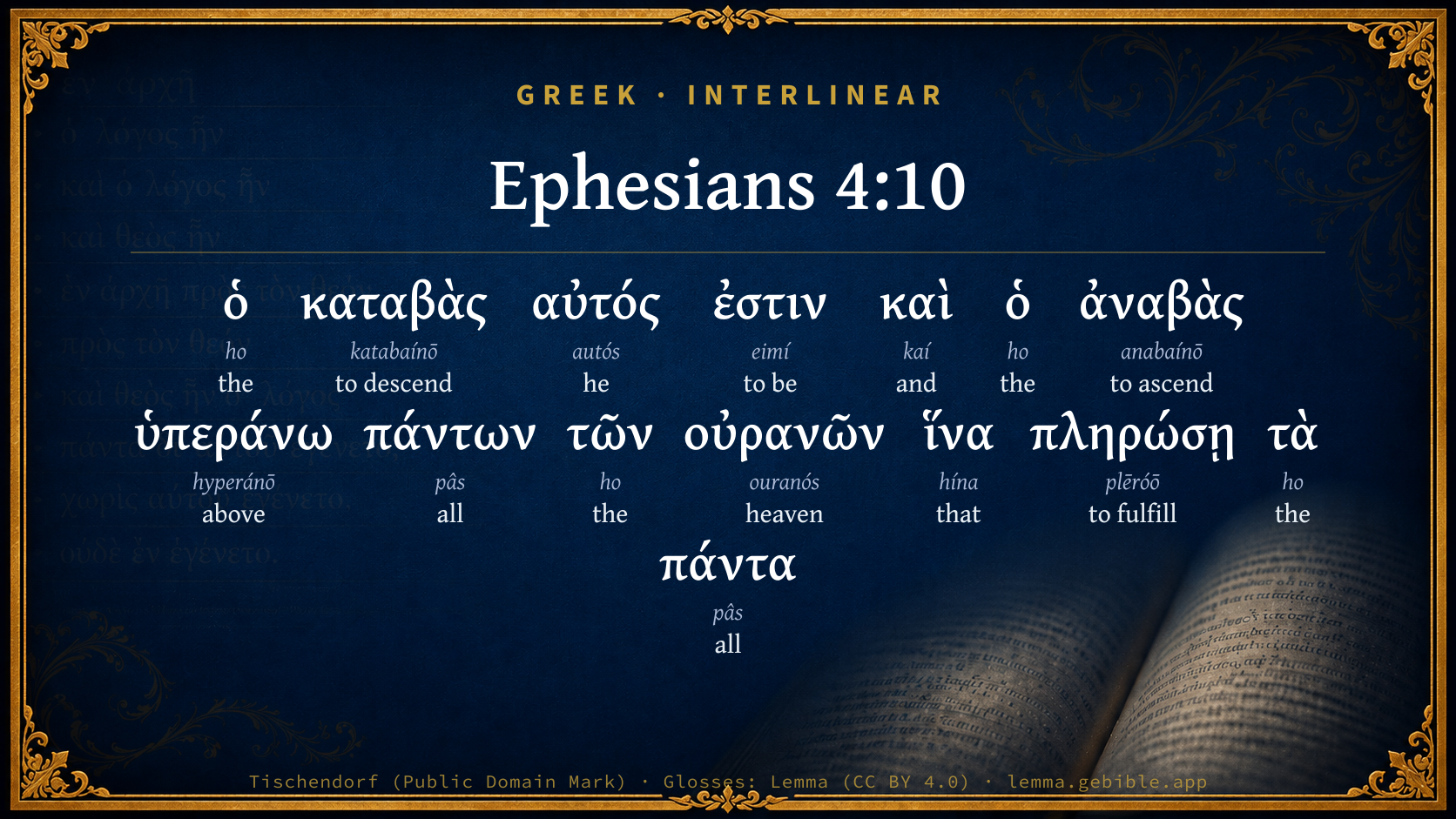
  1. ὁ ho G3588 “the” Article, Nominative, Singular, Masculine
  2. καταβὰς katabaínō G2597 “to descend” Verb, Aorist, Active, Participle, Nominative, Singular, Masculine
  3. αὐτός autós G846 “he” Personal pronoun, Nominative, Singular, Masculine
  4. ἐστιν eimí G1510 “to be” Verb, Present, Active, Indicative, 3rd person, Singular
  5. καὶ kaí G2532 “and” Conjunction
  6. ὁ ho G3588 “the” Article, Nominative, Singular, Masculine
  7. ἀναβὰς anabaínō G305 “to ascend” Verb, Aorist, Active, Participle, Nominative, Singular, Masculine
  8. πάντων pâs G3956 “all” Adjective, Genitive, Plural, Masculine
  9. τῶν ho G3588 “the” Article, Genitive, Plural, Masculine
  10. οὐρανῶν ouranós G3772 “heaven” Noun, Genitive, Plural, Masculine
  11. ἵνα hína G2443 “that” Conjunction
  12. πληρώσῃ plēróō G4137 “to fulfill” Verb, Aorist, Active, Subjunctive, 3rd person, Singular
  13. τὰ ho G3588 “the” Article, Accusative, Plural, Neuter
  14. πάντα pâs G3956 “all” Adjective, Accusative, Plural, Neuter

About this verse

These counts appear in no published source. They are computed here, from the morphology-tagged text and Lemma’s own curated glosses. What Lemma adds →

15
words
11
distinct lemmas
Pauline Epistles
section

Notable vocabulary

The rarest word here is ὑπεράνω above G5231 — appearing just 3 times in the whole Greek New Testament.

Shared distinctive vocabulary

ὑπεράνω above G5231 occurs in 3 verses of the Greek New Testament. Also found in:

Repetition

Words recur within this verse:

Cross-references

23

Topical passages linked to Ephesians 4:10 in the Treasury of Scripture Knowledge — connected by theme and wording, ordered by reader-vote popularity; previews shown in the World English Bible.

  • Hebrews 7:26 For such a high priest was fitting for us: holy, guiltless, undefiled, separated from sinners, and made higher than the heavens;
  • Hebrews 4:14 Having then a great high priest, who has passed through the heavens, Jesus, the Son of God, let us hold tightly to our confession.
  • Ephesians 1:20–23 which he worked in Christ, when he raised him from the dead, and made him to sit at his right hand in the heavenly places,
  • Colossians 2:9 For in him all the fullness of the Godhead dwells bodily,
  • Hebrews 9:23–24 It was necessary therefore that the copies of the things in the heavens should be cleansed with these; but the heavenly things themselves with better sacrifices than these.
  • Matthew 24:34 Most assuredly I tell you, this generation will not pass away, until all these things are accomplished.
  • Colossians 1:19 For all the fullness was pleased to dwell in him;
  • 1 Timothy 3:16 Without controversy, the mystery of godliness is great: God was revealed in the flesh, Justified in the spirit, Seen by angels, Preached among the nations, Believed on in the world, And received up in glory.
  • Acts 1:9 When he had said these things, as they were looking, he was taken up, and a cloud received him out of their sight.
  • Romans 15:9–13 and that the Gentiles might glorify God for his mercy. As it is written, "Therefore will I give praise to you among the Gentiles, And sing to your name."
  • Ephesians 3:19 and to know Christ's love which surpasses knowledge, that you may be filled with all the fullness of God.
  • Luke 24:44 He said to them, "This is what I told you, while I was still with you, that all things which are written in the law of Moses, the prophets, and the psalms, concerning me must be fulfilled."
  • John 1:16 From his fullness we all received grace upon grace.
  • John 19:24 Then they said to one another, "Let's not tear it, but cast lots for it to decide whose it will be," that the Scripture might be fulfilled, which says, "They parted my garments among them. For my cloak they cast lots." Therefore the soldiers did these things.
  • John 19:28 After this, Jesus, seeing that all things were now finished, that the Scripture might be fulfilled, said, "I am thirsty."
  • John 19:36 For these things happened, that the Scripture might be fulfilled, "A bone of him will not be broken."
  • Acts 1:11 who also said, "You men of Galilee, why do you stand looking into the sky? This Jesus, who was received up from you into the sky will come back in the same way as you saw him going into the sky."
  • Acts 2:33 Being therefore exalted by the right hand of God, and having received from the Father the promise of the Holy Spirit, he has poured out this, which you now see and hear.
  • Acts 3:18 But the things which God announced by the mouth of all his prophets, that Christ should suffer, he thus fulfilled.
  • Acts 13:32–33 We bring you good news of the promise made to the fathers,
  • Romans 16:25–26
  • Hebrews 8:1 Now in the things which we are saying, the main point is this. We have such a high priest, who sat down on the right hand of the throne of the Majesty in the heavens,
  • Romans 9:25–30 As he says also in Hosea, "I will call them 'my people,' which were not my people; And her 'beloved,' who was not beloved."

Cross-references courtesy of OpenBible.info (CC BY 4.0).

Commentary

Notes on Ephesians 4:10 from classic Christian and Jewish commentators (each source and its license shown beneath its notes). The classic Christian expositions comment on the surrounding passage and are grouped to its opening verse, so a note may address several verses; the Jewish commentaries on the Tanakh (Rashi and others) are per-verse, so they appear only where the commentator wrote on this verse.

Lemma curates 59 commentaries, every one of them public domain or Creative Commons licensed, each selected and text-cleaned for this edition rather than reprinted as found. About our sources →

Bengel's Gnomon

Johann Albrecht Bengel

Eph 4:10. Αὐτὸς) He, not another.—ὑπεράνω πάντων τῶν οὐρανῶν, far above all heavens) A very sublime expression. Christ not only ascended into heaven, Mar 16:19, but through the heavens, Heb 4:14, note; above all heavens; the heaven [heavens] of heavens, Deu 10:14.—πληρώσῃ, might fill) by His presence and operations, with Himself.—τὰ πάντα) all things, the lowest and the highest; comp. Jer 23:24, where also the LXX. use the word πληροῦν.

Bengel's Gnomon of the New Testament — English translation (T&T Clark, Edinburgh, 1860) — public domain. Text from a community e-Sword module.

Meyer's Critical & Exegetical Commentary

Heinrich August Wilhelm Meyer

Eph_4:10. Result from Eph_4:9, without οὖν, but thereby coming in the more vividly and with a certain triumph; alio gravi dicto antecedentia complectitur aut absolvit (Dissen, ad Pind. Exc. II. p. 278).

The prefixed ὁ καταβάς has the emphasis, which is further augmented by αὐτός:[212] The one who descended, just He, He precisely (identity of the person), is also the one who ascended on high above all heavens.

ὁ ἀναβὰς ὑπεράνω πάντων τῶν οὐραν.] points back to that ἈΝΑΒᾺς ΕἸς ὝΨΟς, Eph_4:8, more precisely defining this ΕἸς ὝΨΟς as the region highest of all. The expression above all heavens has its basis in the conception of seven heavens, which number is not to be diminished to three (Harless: ἀήρ, ΑἸΘΉΡ, ΤΡΊΤΟς ΟὐΡΑΝΌς; comp. Grotius, Meier, and others). See on 2Co_12:2. The ὙΠΕΡΆΝΩ (in the N.T. only here and Eph_1:21; Heb_9:5) describes the exaltation of Christclearly to be maintained as localas the highest of all (comp. ὙΠΕΡΎΨΩΣΕ, Php_2:9), in such wise that He, having ascended through all heavens (ΔΙΕΛΗΛΥΘΌΤΑ ΤΟῪς ΟὐΡΑΝΟΎς, Heb_4:14), has seated Himself above in the highest heaven, as the ΣΎΝΘΡΟΝΟς of the Father, at the right hand of God. Comp. Heb_7:26 : ὙΨΗΛΌΤΕΡΟς ΤῶΝ ΟὐΡΑΝῶΝ ΓΕΝΌΜΕΝΟς. The spiritualistic impoverishing of this concrete conception to a mere denial of all enclosure within the world (Hofmann, II. 1, p. 535) is nothing but a rationalistic invention. Comp. Act_7:56; Act_3:21; Act_1:9-11.

ἽΝΑ ΠΛΗΡΏΣῌ ΤᾺ ΠΆΝΤΑ] points back to the bestowal of grace expressed in Eph_4:7, and prophetically confirmed in Eph_4:8, and that as expressing the universal relation into which Christ has entered towards the whole world by His exaltation from the lowest depth to the loftiest height; in which universal relation is also of necessity contained, as a special point, that bestowal of grace on all individuals. As intended aim, however (ἵνα), this ΠΛΗΡΟῦΝ ΤᾺ ΠΆΝΤΑ stands related to the previous ascension of Christ from the uttermost depth, into which He had descended, to the uttermost height of heaven; because He had first, like a triumphing conqueror (see Eph_4:8), to take possession of His whole domain, i.e. the whole world from Hades to the highest heaven, in order now to wield His kingly sway over this domain, by virtue of which He was to fill the universe with His activity of sustaining and governing, and especially of providing all bestowal of grace. This was to be the all-embracing task of His kingly office, until the consummation indicated at 1Co_15:28. It is according to this view, and from Eph_1:23, self-evident that we have to explain πληρ. τὰ πάντα, neither with Koppe (following Anselm and others), de vaticiniorum complemento, nor with Rückert and Matthies, of the completion of the redeeming work; nor yet possibly to limit τὰ πάντα to the whole Christian community (Beza, Grotius, Morus, Flatt, Schenkel, and others). Comp. rather on Eph_1:23, and observe that in our passage that ἑνὶ δὲ ἑκάστῳ ἡμῶν ἐδόθη κ.τ.λ. of Eph_4:7 stands to this ἽΝΑ ΠΛΗΡΏΣῌ ΤᾺ ΠΆΝΤΑ in the same relation of the species to the genus, as in Eph_1:23 ΤῸ ΠΛΉΡΩΜΑ (ΧΡΙΣΤΟῦ) does to ΤΟῦ ΤᾺ ΠΆΝΤΑ ἘΝ ΠᾶΣΙ ΠΛΗΡΟΥΜΈΝΟΥ. The ubiquity of the body of Christ (Faber Stapulensis, Hunnius, and others; specially contended for by Calovius) is not here, any more than at Eph_1:23 or elsewhere, spoken of;[213] although, with Philippi, Hoelemann has still found it here, holding the conception of the purely dynamic πληροῦν τὰ πάντα as unrealizable, because Christ is in a glorified body. If this reason were valid, an absolute bodily omnipresence would result: it proves too much, and leads to a contradictio in adjecto, which could only receive a Docetic solution.

[212] οὐ γὰρ ἄλλος κατελήλυθε καὶ ἄλλος ἀνελήλυθεν, Theodoret.

[213] Wrongly are Oecumenius and Theophylact adduced as favouring this explanation. They, forsooth, very correctly refer the filling to the dominion and operation of Christ (comp. also Chrysostom), and observe with equal justice that Christ, after He had already before His incarnation filled all things by His purely divine nature, now, after having, as the Incarnate One, descended and ascended, does the filling of the universe μετὰ σαρκός (Oecumenius), i.e. so that in doing so He is in a different state than before, namely, clothed with a body, consequently as God-man.

Meyer — Critical and Exegetical Commentary on the New Testament — English translation by Peter Christie, edited by Frederick Crombie (T&T Clark, 1880) — public domain. Text from a community e-Sword module.

Expositor's Greek Testament

ed. W. Robertson Nicoll

Eph 4:10 . ὁ καταβάς , αὐτός ἐστι καὶ ὁ ἀναβάς : he that descended, he it is that also ascended (or, he himself also ascended ). It was the first thought of every Christian mind that Christ had come down from heaven to live and work among men on earth for their salvation. Founding on this Paul declares that He who descended, whom all knew to be Christ, He and no other was also the Person who ascended. So he reminds his readers of the source of all the gifts in operation in the Church or enjoyed by individual Christians the ascended Christ. A peculiar force is claimed by some (Von Soden, Abb., Bruston) for the καί in καὶ κατέβη . It is argued that it represents the descent as subsequent to the ascent, and contemporaneous with the giving of the gifts. So the point is taken to be this that the ascent would have been without a purpose unless it had been followed by a descent. This, it is thought, is the reason why Paul pauses to say that the ascending implied also a descending and that the Person in view not only ascended but also descended. Hence what is in the writer’s mind here is held not to be the incarnation or humiliation of the pre-existent Christ, but the descent of the exalted Christ to His Church, supposed to be referred to also in such passages as Eph 2:17 , Eph 3:17 , Eph 5:31-32 . But it is nowhere taught in the Pauline Epistles that a descent or a departure from heaven after the exaltation was necessary in order that the ascended Lord might bestow gifts upon His Church. The passages cited do not bear out any such idea. The first (Eph 2:17 ) does not refer to a coming of the glorified Christ; the second (Eph 3:17 ) speaks only of the spiritual presence of Christ in the heart; and the third (Eph 5:31-32 ) deals obviously with a “mystery” of relations , and has nothing to do with any coming of Christ out of heaven following on His ascension or required for the bestowal of His gifts. Nor is there any reason why the καί should have more than the familiar additive force. ὑπεράνω πάντων τῶν οὐρανῶν : up above all the heavens . So in Heb 7:27 our High Priest is described as ὑψηλότερος τῶν οὐρανῶν γενόμενος . There may be. an allusion here to the Jewish ideas of a gradation of heavens, a series of three or, as the case rather appears to stand, seven heavens, with which the Pauline τρίτος οὐρανός (2Co 12:2 ) may also be connected; on the conceptions of a plurality of heavens which prevailed among the Jews, the Babylonians and other ancient peoples, see the writer’s article on “Heaven” in Hastings’ Dictionary of the Bible . But the point of the phrase as we have it here is simply this that whatever heavens there are or may be, Christ is above them all. So high has His ascension carried Him. It means the highest possible exaltation the supremacy of One who shares in the sovereignty of God. For the term ὑπεράνω see on Eph 1:21 . ἵνα πληρώσῃ τὰ πάντα : that He might fill all things . The use of the conj. with ἵνα after a past tense may be due to the fact that the “filling” is to be viewed as a continuous action (Ell., Alf.; cf. Klotz, Devar. , ii., p. 618), if it is not to be explained simply by the laxer employment of the conj. in NT Greek. The sense of fulfilling or completing hat been given by many to the πληρώσῃ . Thus the idea has been taken by some to be that of the fulfilling of prophecy (Anselm, etc.), the accomplishment of all things that Christ had to do in His redeeming mission (Rück.), the making of all perfect (Oltr.), etc. But, as in Eph 1:23 , the verb has the sense of filling , and τὰ πάντα is to be taken again in its widest application, and is not to be restricted to the world of believers or to the Church of Jew and Gentile (Grot., Schenk., etc.). Nor is there anything to suggest that the ubiquity of Christ’s body is in view, as some Lutherans have argued (Hunn., Calov., etc.). The idea that is in the paragraph is not that of a “diffused and ubiquitous corporeity,” as Ellicott well expresses it, but that of a “pervading and energising omnipresence”. The thought is the larger one that the object of Christ’s ascension was that He might enter into regal relation with the whole world and in that position and prerogative bestow His gifts as He willed and as they were needed. He was exalted in order that He might take kingly sway, fill the universe with His activity as its Sovereign and Governor, and His Church with His presence as its Head, and provide His people with all needful grace and gifts. In OT prophecy to “fill heaven and earth” is the note of Deity (Jer 23:24 ). We may be in a position now to determine Paul’s object in introducing the passage from Psa 68 . and in applying it as he does. The general connection is clear enough. He bids his readers study lowliness, forbearance and unity, because there is one faith, one baptism, etc. They are not to be vexed or divided because one may have more of the gift of grace than another. All receive from Christ, each in his own way and measure as Christ wills; for, as the Psalm shows, all gifts come from Him. Now some take the point of the quotation to be this He who is the subject of the Psalm is One whose seat is in heaven, a Sovereign Giver of gifts (Ell.). Others are of opinion that the words are cited in order to bring out the fact that Christ’s bestowal of gifts “stands in necessary connection with His general position of filling the whole universe” (Mey.). But the case appears to be less involved than that, and to turn simply on the identification of the Person who is the source of the gifts. Paul has spoken of the grace as given ( ἐδόθη , Eph 4:7 ), and he has quoted the words of the Psalm which say that “he gave gifts” ( ἔδωκεν δόματα , Eph 4:8 ). But he has not named the Giver. Now he explains that the Giver is Christ; and that this is indicated by the Psalm itself, because it sings of One who went up on high, and of an ascent which presupposed a previous descent. Thus he identifies the subject of the Psalm with Christ; as elsewhere the Jehovah of the Prophets and the Psalms is identified with the Christ of the Apostles, and what is affirmed of the former in the OT is ascribed to the latter in the NT.

The Expositor's Greek Testament, edited by W. Robertson Nicoll (1897–1910) — public domain. Text from a community e-Sword module.

Hodge's Commentary on Romans, Ephesians & First Corinthians

Charles Hodge

Eph_4:9, Eph_4:10

Now that he ascended, what is it but that he also descended first into the lower parts of the earth? He that descended is the same also that ascended up far above all heavens, that he might fill all things.

The obvious design of these verses is to show that the passage quoted from the Psalmist refers to Christ. The proof lies in the fact that ascension in the case of a divine person, a giver of spiritual gifts to men, implies a previous descent. It was Christ who descended, and therefore, it is Christ who ascended. It is true the Old Testament often speaks of Gods descending, and therefore, they may speak of his ascending. But according to the apostle, the divine person intended in those representations was the Son, and no previous descent or ascent, no previous triumph over his enemies, included all that the Spirit of prophecy intended by such representations. And, therefore, the Psalmist must be understood as having included in the scope of his language the most conspicuous and illustrious of Gods condescensions and exaltations. All other comings were but typical of his coming in the flesh, and all ascensions were typical of his ascension from the grave.

The apostle, therefore, here teaches that God, the subject of the sixty-eighth Psalm, descended into the lower parts of the earth; that he ascended up above all heavens, and that this was with the design that he might fill all things.

The Hebrew phrase תַחְתִּיוֹת אֶרֶץ to which the apostles τὰ κατώτερα μέρη τῆς γῆς, (the lower parts of the earth), answers, is used for the earth in opposition to heaven, Isa_44:23; probably for the grave in Psa_63:10; as a poetical designation for the womb in Psa_139:15; and for Hades or the invisible world, Eze_32:24. Perhaps the majority of commentators take this last to be the meaning of the passage before us. They suppose the reference is to the descensus ad inferos, or to Christs descending into hell. But in the first place this idea is entirely foreign to the meaning of the passage in the Psalm on which the apostle is commenting. In the second place, there as here, the only descent of which the context speaks is opposed to the ascending to heaven. He that ascended to heaven is he who first descended to earth. In the third place, this is the opposition so often expressed in other places and in other forms of expression, as in Joh_3:13, No man hath ascended up to heaven, but he that came down from heaven, even the Son of Man who is in heaven. Joh_6:38, I came down from heaven. Joh_8:14, I know whence I came and whither I go. Joh_16:28, I came forth from the Father, and am come into the world; again, I leave the world, and go to the Father. The expression of the apostle therefore means, the lower parts, viz. the earth. The genitive τῆς γῆς is the common genitive of apposition. Compare Act_2:19, where the heaven above is opposed to the earth beneath; and Joh_8:23.

He that descended to earth, who assumed our nature, is the same also that ascended up far above all heavens. Ὑπεράνω, longe supra, expressing the highest exaltation. As the Hebrew word for heaven is in the plural form, the New Testament writers often use the plural even when the heavens are considered as one, as in the phrase βασιλεία τῶν οὐπανῶν. But often there is a reference to a plurality of heavens, as when the expression all heavens is used. The Jews reckoned seven heavens, and Paul, 2Co_12:2, speaks of the third heavens; the atmosphere, the region of the stars, and above all the abode of God. Above all heavens plainly means above the whole universe; above all that is created visible and invisible; above thrones, principalities, and powers. All things, all created things, are subject to the ascended Redeemer.

He is thus exalted ἵνα πληρώσῃ τὰ πάντα, that he might fill all things. As the word πληρόω signifies to fill, to fulfill, to render perfect, and to accomplish, these words may mean

1. That he might fill all things, i.e. the universe with his presence and power.

2. That he might fulfill all the predictions and promises of God respecting his kingdom.

3. That he might render all perfect, replete with grace and goodness.

4. That he might accomplish all things necessary to the consummation of his work.

The first interpretation is greatly to be preferred. Τὰ πάντα properly means the universe; and if taken to mean anything else, it must be because the context demands it, which is not the case here. Secondly, this passage is evidently parallel with Eph_1:21, where also it is said of Christ as exalted, that he fills the universe in all its parts. Thirdly, the analogy of Scripture is in favor of this interpretation. The omnipresence and universal dominion of God are elsewhere expressed in a similar way. Do I not fill heaven and earth, saith the Lord. Jer_23:24. The same grand idea is expressed in Mat_28:18, All power is given unto me in heaven and upon earth; and in Phi_2:9, Phi_2:10, and in many other places. It is not of the ubiquity of Christs body of which the apostle speaks, as the Lutherans contend, but of the universal presence and power of the ascended Son of God. It is God clothed in our nature, who now exercises this universal dominion; and, therefore, the apostle may well say of Christ, as the incarnate God, that he gives gifts unto men.

Charles Hodge — Commentary on Romans (1835), First Corinthians (1857), and Ephesians (1856) — public domain. Text from a community e-Sword module.

Geneva Bible (1599)

Geneva Bible translators

The Church.

Fill with his gifts.

Geneva Bible (1599) marginal notes — public domain. Text via Bolls.life.

Jamieson, Fausset & Brown

Robert Jamieson, A. R. Fausset & David Brown

all heavens--Greek, "all the heavens" (Heb 7:26; Heb 4:14), Greek, "passed through the heavens" to the throne of God itself.

might fill--In Greek, the action is continued to the present time, both "might" and "may fill," namely, with His divine presence and Spirit, not with His glorified body. "Christ, as God, is present everywhere; as glorified man, He can be present anywhere" [ELLICOTT].

Jamieson, Fausset & Brown — Commentary Critical and Explanatory on the Whole Bible (1871) — public domain (CC PDM 1.0). Text via the HelloAO Bible API.

Adam Clarke's Commentary

Verse 10. He that descended] And he who descended so low is the same who has ascended so high. He came to the lower parts of the earth-the very deepest abasement; having emptied himself; taken upon him; the form of a servant, and humbled himself unto death, even the death of the cross; now he is ascended far above all heavens-higher than all height; he has a name above every name. Here his descending into the lower parts of the earth is put in opposition to his ascending far above all heavens. His abasement was unparalleled; so also is his exaltation.

That he might fill all things.] That he might be the fountain whence all blessings might flow; dispensing all good things to all his creatures, according to their several capacities and necessities; and, particularly, fill both converted Jews and Gentiles with all the gifts and graces of his Holy Spirit. Hence it follows: Eph 4:11

Adam Clarke's Commentary on the Bible (1810–1826) — public domain. Text from a community e-Sword/MySword module.

John Calvin's Commentaries

10. That ascended up far above all heavens; that is, beyond this created world. When Christ is said to be in heaven, we must not view him as dwelling among the spheres and numbering the stars. Heaven denotes a place higher than all the spheres, which was assigned to the Son of God after his resurrection. Not that it is literally a place beyond the world, but we cannot speak of the kingdom of God without using our ordinary language. Others, again, considering that the expressions, above all heavens, and ascension into heaven, are of the same import, conclude that Christ is not separated from us by distance of place. But one point they have overlooked. When Christ is placed above the heavens, or in the heavens, all that surrounds the earth — all that lies beneath the sun and stars, beneath the whole frame of the visible world — is excluded.

That he might fill all things. To fill often signifies to Finish, and it might have that meaning here; for, by his ascension into heaven, Christ entered into the possession of the authority given to him by the Father, that he might rule and govern all things. But a more beautiful view, in my opinion, will be obtained by connecting two meanings which, though apparently contradictory, are perfectly consistent. When we hear of the ascension of Christ, it instantly strikes our minds that he is removed to a great distance from us; and so he actually is, with respect to his body and human presence. But Paul reminds us, that, while he is removed from us in bodily presence, he fills all things by the power of his Spirit. Wherever the right hand of God, which embraces heaven and earth, is displayed, Christ is spiritually present by his boundless power; although, as respects his body, the saying of Peter holds true, that

“the heaven must receive him until the times of restitution of all things, which God hath spoken by the mouth of all his holy prophets since the world began.” (Acts 3:21.)

By alluding to the seeming contradiction, the apostle has added not a little beauty to his language. He ascended; but it was that he, who was formerly bounded by a little space, might fill all things But did he not fill them before? In his divine nature, I own, he did; but the power of his Spirit was not so exerted, nor his presence so manifested, as after he had entered into the possession of his kingdom.

“The Holy Ghost was not yet given, because Jesus was not yet glorified.” (John 7:39.)

And again,

“It is expedient for you that I go away; for, if I go not away, the Comforter will not come to you.” (John 16:7.)

In a word, when he began to sit at the right hand of the Father, he began also to fill all things.

John Calvin's Commentaries (1540-1563) — public domain. Text from the Calvin Translation Society English edition (1840s-50s) via the Christian Classics Ethereal Library (ccel.org). Calvin's coverage is partial (roughly two-thirds of the Bible); uncommented books and verses are honest gaps, never fabricated. The 19th-century editor's footnotes and remarks are omitted so the notes are faithfully Calvin's own voice.

Ellicott's Commentary for English Readers

(10) That he might fill all things.—Compare the description in Eph_1:23 of the Lord as “filling all in all.” In both cases the reference is more particularly to the gift of the fulness of His grace, flowing from His glorified humanity to all His members. But the words are too wide for any limitation. In heaven and earth, and the realms under the earth, His presence and sovereignty extends, by whatever means and over whatever beings He wills. In Rev_5:13, accordingly, we read the ascription by “every creature in heaven, and on the earth, and under the earth . . ., of blessing, honour, glory, and power to . . . the Lamb for ever and ever.”

A Bible Commentary for English Readers, edited by Charles John Ellicott (1878–1897) — public domain. Text from a community e-Sword module.

The Cambridge Bible for Schools and Colleges

gen. ed. J. J. S. Perowne

10. He that descended, &c.] As if to say, “Yes, He once descended, as a step in the process, a means to the great end; but now we have to dwell on the result; this Descender has now become by consequence the Ascended One, giving gifts from the Throne.” Both parts of the statement are emphatic, the fact and wonder of the Descent, and the triumph and result of the Ascent; and they are in deep connexion. But the main stress is on the latter.

far above all heavens] Lit., all the heavens. Cp. Heb_4:14; Heb_7:26; where the ascended High Priest is revealed as “having passed through the heavens,” and as “become loftier than the heavens.”—Scripture gives no precise revelation as to the number or order of regions or spheres of the upper world, the unseen universe of life and bliss. But its frequent use of the plural in regard of it, as here, whatever the origin of the usage, sanctions the thought that the Blessed (angels and glorified men), while from other points of view eternally concentrated and in company, and doubtless able, under their spiritual conditions of existence, to realize and act upon their unity to a degree unimagined by us, are yet distributed, classed, and ordered. “The Rabbis spoke of two heavens, or seven” (Smith’s Dict. of the Bible, under the word Heaven; and see Wetstein on 2Co_12:2). St Paul himself speaks (2Co_12:2) of a “third heaven,” meaning, apparently, the immediate presence of God; possibly with a reference to the twofold division mentioned just above, and which, if so, is to some degree favoured by Scripture. The plain meaning of the present passage, in any case, is that the Lord passed through and beyond all regions of created blessedness into the region of the Throne. That Throne (we can only use the language of figure, permitted by the Scriptures,) is as truly “far above” the highest sphere of created life as it is “far above” the lowest. To both it stands in the mysterious relation of the uncreated to the created. Cp. Psa_113:5-6. See further above, note on Eph_1:21.—From another point of view, He who is “far above” the heavens is (like His Father) “in heaven” (below, Eph_6:9). In this view, heaven includes the whole state of blessed existence, uncreated and created alike.

that he might fill] Possibly, “fulfil”; i.e. every prophecy, of humiliation and glory. But St Paul’s usage favours the other version. He ascended that He might, not only in possibility but in act, “fill all things,” “with His presence, His sovereignty, His working by the Spirit; not with His glorified body, as some have thought” (Alford). “There is here no reference to a diffused and ubiquitous corporeity, but to a pervading and energizing omnipresence … Christ is perfect God, and perfect and glorified Man; as the former He is present everywhere, as the latter He can be present anywhere” (Bp Ellicott).

The Cambridge Bible for Schools and Colleges (gen. ed. J. J. S. Perowne; Cambridge University Press, 1878–1918) — public domain. Text from a community e-Sword module.

John Gill's Exposition

He that descended is the same also that ascended,.... It was the same divine Person, the Son of God, who assumed human nature, and suffered in it, which is meant by his descent, who in that nature ascended up to heaven: this proves that Christ existed before he took flesh of the virgin; and that though he has two natures, yet he is but one person; and disproves the Popish notion of the descent of Christ's soul into Limbus or hell, locally taken: and this ascension of his was,

up far above all heavens: the visible heavens, the airy and starry heavens; Christ ascended far above these, and went into the third heaven, the holiest of all; and this is expressive of the exaltation of Christ, who is made higher than the heavens; and the end of his ascension was,

that he might fill all things, or "fulfil all things"; that were types of him, or predicted concerning him; that as he had fulfilled many things already by his incarnation doctrine, miracles, obedience, sufferings, death, and resurrection from the dead; so he ascended on high that he might accomplish what was foretold concerning his ascension to heaven, and session at the right hand of God, and answer to the type of the high priest's entering once a year into the holiest of all: or that he might complete, perfect, and fill up all his offices; as the remainder of his priestly office, his intercession for his people; and more finally his prophetic office by the effusion of his Spirit; and more visibly his kingly office, by sending forth the rod of his strength out of Zion, and subduing the people under him: or that he might fill all places; as God he fills all places at once being infinite, immense, and omnipresent; as man, one after another; at his incarnation he dwelt with men on earth at his crucifixion he was lifted up between heaven and earth; at his death he descended into the lower parts of the earth, into hell, "Hades", or the grave; and at his resurrection stood upon the earth again, and had all power in heaven and in earth given him; and at his ascension he went through the airy and starry heavens, into the highest heaven; and so successively was in all places: or rather that he might fill all persons, all his elect, both Jews and Gentiles; and so the Arabic version renders it, "that he might fill all creatures"; as the Gentiles were called; particularly that he might fill each and everyone of his people with his grace and righteousness, with his Spirit, and the fruits of it, with spiritual knowledge and understanding, with food and gladness, with peace, joy and comfort; and all his churches with his gracious presence, and with officers and members, and all with gifts and graces suitable to their several stations and work.

John Gill's Exposition of the Whole Bible (1746–1763) — public domain (CC PDM 1.0). Text via the HelloAO Bible API.

Trapp's Complete Commentary

John Trapp

10 He that descended is the same also that ascended up far above all heavens, that he might fill all things.)

Ver. 10. Far above all heavens] That is, above all visible heavens, into the third heaven; not in the Utopia of the Ubiquitaries.

That he might fill all things] viz. With the gifts of his Holy Spirit; for the further he is from us in his flesh, the nearer by his Spirit; he is more efficacious absent than present.

John Trapp, A Commentary or Exposition upon All the Books of the Old and New Testament (1647–1656) — public domain. Text from a community e-Sword module.

Albert Barnes' Notes on the Bible

He that descended is the same also that ascended - The same Redeemer came down from God, and returned to him. It was not a different being, but the same.

Far above all heavens - see the notes on Eph 1:20-23; compare Heb 7:26. He is gone above the visible heavens, and has ascended into the highest abodes of bliss; see the notes on 2Co 12:2.

That he might fill all things - Margin, “fulfil.” The meaning is, “that he might fill all things by his influence, and direct and overrule all by his wisdom and power.” Doddridge. See the notes on Eph 1:23.

Albert Barnes' Notes on the Bible (1834–1885) — public domain. Text from a community e-Sword/MySword module.

Matthew Poole's English Annotations

He that descended is the same also that ascended: he saith not, he that ascended is the same that descended, lest it should not be thought that Christ brought his body with him from heaven; but, on the contrary, he that descended is the same that ascended, to show that the Son of God did not by his descent become other than what he was, nor the assumption of the human nature add any thing to his person, as a man is not made another person by the clothes he puts on. Christ descended without change of place as being God, but ascended by changing place as man, yet, by communication of properties, whole Christ is said to have ascended.

Far above all heavens; all visible heavens, into the third heaven, or paradise. Act 3:21; Heb 9:24.

That he might fill all things; all the members of his church, with gifts and graces. This began to be fulfilled, Act 2:1-47, and still will be fulfilling to the end of the world: see Joh 7:39; 16:7.

Matthew Poole's English Annotations on the Holy Bible (1683–1685) — public domain. Text from a community e-Sword/MySword module.

Whedon's Commentary on the Bible

Daniel D. Whedon

10. For the purpose of identifying the Jehovah of the psalmist with Christ, Paul in Eph_4:9 notes that the psalmist’s ascender must have previously been a descender; now, for the purpose of showing Christ’s exaltation, he argues that the descender is the ascender. He—In the Greek emphatic, the identical he.

Above all the heavens—With the article in the Greek, the threefold heavens of the Old Testament. Note on 2Co_12:2-4. As the psalmist’s Jehovah ascends Zion, so the apostle’s Christ ascends from the depth of hades to even above the heavens. For God is truly above all heavens.

Fill all things—The Highest is omnipotent, and he takes the highest position that he may pour himself down, over and into all things, natural and supernatural. But while he fills all other things with presence and power, he fills his Church with special plenitudes and endowments.

To the questions of modern astronomy, Where are heaven, paradise, hades? we may, (in addition to our notes on 2Co_12:2-4,) give this further answer: Dr. Dawson, in his Bible and Nature, suggests that heaven, the third heaven, may be supposably located beyond the astral heaven. Assuming our starry universe to be finite, then there is a circumambient pure space, encompassing our whole starry system with its ethereal belt. There God may for us specially dwell, in the third or highest heaven, and in supremacy enthroned above all the heavens, binding the system with his power and sending his volitions as perpetual laws through and to the centre. Paradise we might then identify with the second, lower, or “astral heavens;” but the texts suggest a more limited region. Hence Byron’s conception, though sublime, is too cold and indefinite for the biblical view of the blessed abode of sainted spirits:—

“When coldness wraps this suffering clay,

Ah! whither strays the immortal mind?

It cannot die, it cannot stray.

But leaves its darkened dust behind.

Then, unembodied, doth it trace

By steps each planet’s wand’ring way?

Or fill at once the realms of space,

A thing of eyes, that all survey?”

But from the use of the word air in Eph_2:2, and Eph_6:12, (where see notes,) we should infer that the lowest, or “aerial heaven,” is the border region where the forces of paradise and lower hades blend and struggle. And thence descending, we are led to find the darker and darkest hades in the lower parts of the earth, that is, towards and in the subterranean regions. We should be inclined, therefore, to find the normal paradise in the upper margin of the aerial stratum, undivided yet distinct from the lower hades, and unexcluded from the “astral heavens.” Paradise we should view as a broad, overlying margin of pure ethereal glory, underlaid with shade, deepening to denser and still denser darkness, even, perhaps, to the subterranean centre. That centre is the lowest hades. As to the ouranos, heaven, and the gehenna, hell, beyond the resurrection, see note on 1Th_4:17.

That the ancient and biblical idea, which located hades in the interior of the earth, finds nothing in the earth’s solidity nor in any fact of science to contradict it, is well shown in the following passage from the Unseen Universe, p. 160:—

“The deservedly famous Dr. Thomas Young has the following passage in his Lectures on Natural Philosophy: “Nor is there any thing in the unprejudiced study of physical philosophy that can induce us to doubt the existence of immaterial substances; on the contrary, we see analogies that lead us almost directly to such an opinion. The electrical fluid is supposed to be essentially different from common matter; the general medium of light and heat, according to some, or the principle of caloric, according to others, is equally distinct from it. We see forms of matter, differing in subtilty and mobility, bearing the names of solids, liquids, and gases; above these are the semi-material existences, which produce the phenomena of electricity and magnetism, and either caloric or a universal ether. Higher still, perhaps, are the causes of gravitation, and the immediate agents in attractions of all kinds, which exhibit some phenomena apparently still more remote from all that is compatible with material bodies. And of these different orders of beings the more refined and immaterial appear to pervade the grosser. It seems, therefore, natural to believe that the analogy may be continued still further until it rises into existences absolutely immaterial and spiritual. We know not but that thousands of spiritual worlds may exist unseen forever by human eyes; nor have we any reason to suppose that even the presence of matter, in a given spot, necessarily excludes these existences from it. Those who maintain that nature always teems with life, wherever living beings can be placed, may therefore speculate with freedom on the possibility of independent worlds; some existing in different parts of space, others pervading each other unseen and unknown, in the same space, and others again to which space may not be a necessary mode of existence.”

Daniel D. Whedon (gen. ed.), Commentary on the Old and New Testaments (1874–1909) — public domain. Text from a community e-Sword module.

The Pulpit Commentary

He that descended is the same also that ascended far above all the heavens. There was a proportion between the descent and the ascent. His descent was deep into the lower parts of earth; but his ascent was more glorious than his descent had been humbling. The Hebrew idea of various heavens is brought in; the ascent was not merely to the third heaven, but far above all heavens. That he might fill all things. A very sublime view of the purpose for which Christ reigns on high. The specific idea with which the apostle started to give gifts to men is swallowed up for the moment by a view far grander and more comprehensive, to fill all things." Jesus has gone on high to pour his glory and excellence over every creature in the universe who is the subject of grace, to be the Light of the world, the one Source of all good. As in the solar system it is from one sun that all the supplies of light and heat come, all the colors that beautify earth, sea, and sky, all the influences that ripen the grain and mature the fruit, all the chemical power that transforms and new-creates; so the ascended Jesus is the Sun of the universe; all healing, all life, all blessing are from him. It is quite in the manner of the apostle, when he introduces the mention of Christ, to be carried, in the contemplation of his person, far above the immediate occasion, and extol the infinite perfection and glory that distinguish him.

The Pulpit Commentary (1880–1919), ed. H.D.M. Spence-Jones & Joseph S. Exell — public domain. Text from a community e-Sword module.

John Wesley's Explanatory Notes

He that descended - That thus amazingly humbled himself. Is the same that ascended - That was so highly exalted. That he might fill all things - The whole church, with his Spirit, presence, and operations.

John Wesley, Explanatory Notes Upon the Whole Bible (1754–1765) — public domain. Text via the GEBible commentary corpus.

The People's New Testament

B. W. Johnson

10. Above all heavens. The one who descended is now exalted to the right hand of God. God's throne is represented above the heavens, as God is above all. Compare Heb. 4:14; 7:26. That he might fill all things. And hence reach every place with his grace and glory.

B. W. Johnson's The People's New Testament with Notes (1889–1891) — public domain. Electronic text from the Christian Classics Ethereal Library (CCEL) ThML edition.

Cambridge Greek Testament for Schools and Colleges

10. ὁ καταβὰς αὐτός ἐστιν καὶ ὁ ἀναβὰς. The personal identity of the subject of these contrasted experiences is the condition of His power. St Paul is led to lay stress upon it in order that all who are working for the perfecting of the Body might realize that there was no condition so low that the power at their disposal would not enable them to raise a soul out of it, no height of sanctity that they need despair of helping another to attain. In other words, there is no polemic underlying the phrase, though it does no doubt protest in advance against the Cerinthian division of the Christ from Jesus.

ὑπεράνω πάντων τῶν οὐρανῶν. Cf. Heb 4:14; Heb 7:26.

ἵνα πληρώσῃ τὰ πάντα. ‘To bring the universe to its consummation.’ See Additional Note on πλήρωμα; cf. Eph 1:10; Eph 1:23.

Cambridge Greek Testament for Schools and Colleges (Cambridge University Press, 1896; 21 vols, various authors incl. Carr, Maclear, Plummer, Farrar, Lumby, Moule, M. R. James, Simcox) — public domain. Text from a community e-Sword module.

Alford’s Greek Testament

Henry Alford

10.] He that descended, He (and no other: οὐ γὰρ ἄλλος κατελήλυθεν κ. ἄλλος ἀνελήλυθεν, Thdrt. αὐτός is the subject, and not the predicate (ὁ αὐτός)) is also he that ascended (see again Joh 3:13) up above (reff.) all the heavens (cf. Heb 7:26, ὑψηλότερος τῶν οὐρανῶν γενόμενος: and ib. 4:14, διεληλυθότα τοὺς οὐρανούς. It is natural that one who, like St. Paul, had been brought up in the Jewish habits of thought, should still use their methods of speaking, according to which the heaven is expressed in the plural, ‘the heavens.’ And from such an usage, πάντες οἱ οὐρανοί would naturally flow. See, on the idea of a threefold, or sevenfold division of the heavens, the note on 2Co 12:2. Ellicott quotes from Bishop Pearson,—‘whatsoever heaven is higher than all the rest which are called heavens, into that place did he ascend.’ Notice the subjunctive after the aorist participle, giving the present and enduring sense to the verb: used, when “res ita comparata est, ut actione præterita tamen eventus noudmn expletus sit, sed etiam nunc duret: … Eur. Med. 215, Κορίνθιαι γυναῖκες, ἐξῆλθον δόμων, μή μοί τι μέμφησθʼ.” Klotz, Devar. ii. 618), that He may fill (not as Anselm, al., ‘fulfil’) all things (the whole universe: see ch. 1:23, note: with His presence, His sovereignty, His working by the Spirit: not, with His glorified Body, as some have thought. “Christ is perfect God, and perfect and glorified man: as the former He is present every where, as the latter He can be present any where.” Ellicott).

Henry Alford, The Greek Testament (1849–1861) — public domain. Text from a community e-Sword module.

International Critical Commentary

10. ὁ καταβὰς αὐτός ἐστιν καὶ ὁ ἀναβὰς ὑπεράνω πάντων τῶν οὐρανῶν ἵνα πληρώσῃ τὰ πάντα. “He Himself that descended is also He that ascended high above all the heavens, that He might fill all things.”

αὐτός is not “the same,” which would be ὁ αὐτός, but emphatic. οὐ γὰρ ἄλλος κατελήλυθε καὶ ἄλλος ἀνελήλυθεν, Theodoret.

“All the heavens” is probably an allusion to the seven heavens of the Jews. Cf. 2Co 12:2, τρίτος οὐρανός, and Heb 4:14, διεληλυθότα τοὺς οὐρανούς, “that He might fill all things.”

This has sometimes been understood to mean “that He might fill the universe,” as when we read in Jer 23:24, μὴ οὐχὶ τὸν οὐρανὸν καὶ τὴν γῆν ἐγὼ πληρῶ; But how can the occupation of a special place in heaven have for its object presence throughout the universe? Moreover, this does not agree with the context, which refers to the gifts to men. In fact, in order to explain this connexion, the omnipresence is resolved by some commentators into the presence everywhere of His gifts (Harless), or else of His government (Chrys, al.). A similar result is reached by others, who take πληρώσῃ as meaning directly “fill with His gifts” (De Wette, Bleek, al.), τὰ πάντα being either the universe, or men, or members of the Church. But πληροῦν by itself can hardly mean “fill with gifts.” Rückert explains, “accomplish all,” viz. all that He had to accomplish. But the words must clearly be interpreted in accordance with 1:23, τὰ πάντα ἐν πᾶσιν πληρουμένου, which they obviously repeat. Oltramare interprets, “that He might render all perfect, and (in conformity with this purpose), He gave,” etc.

International Critical Commentary — older volumes (1896–1929), various authors — public domain. Text from a community e-Sword module.

Vincent's Word Studies in the New Testament

Marvin R. Vincent

Fill all things. Compare ch. 1 23.

Marvin R. Vincent, Word Studies in the New Testament (1887–1900) — public domain. Text from a community e-Sword/MySword module.

Lesson kit

Teaching starters — assembled from the data on this page, not authored interpretation. Every prompt links to the verse data it draws on. Edit before teaching.

Ephesians, in the Pauline Epistles, opens this verse with 15 words (11 distinct Greek lemmas). Its most distinctive word is hyperánō (“above”). A historical commentator’s framing appears above. Read the whole chapter for the surrounding context.

Discussion questions

  1. How does “above” (hyperánō) shape what this verse is saying?
  2. How does Ephesians 1:21, which shares the word «above», read alongside this verse?
  3. What does the repetition of “all” (2× in this one verse) do in this verse?
  4. These translations render this verse differently. What is at stake in choosing one wording over another?
  5. Compare how Bengel's Gnomon and Meyer's Critical & Exegetical Commentary read this verse. Where do they agree or differ?

Things to notice

Reading settings

Reading text

Shown beneath each verse's original-language words.

Old Testament
Old Testament edition

Read the OT as the Masoretic Hebrew (MT) or the Greek Septuagint (LXX).

English shown for the Greek Septuagint (in the Hebrew ↔ Greek comparison).

Comparing translations? Open the Compare panel on any verse page to stack up to four side by side.