

Matthew 11:23
Greek (Tischendorf 8th ed.) Matthew 11:23 appears in the Greek New Testament. The text above is from the Tischendorf 8th edition. Each word links to its Strong’s number and a concise gloss. Click any word for its full Thayer’s Greek Lexicon entry.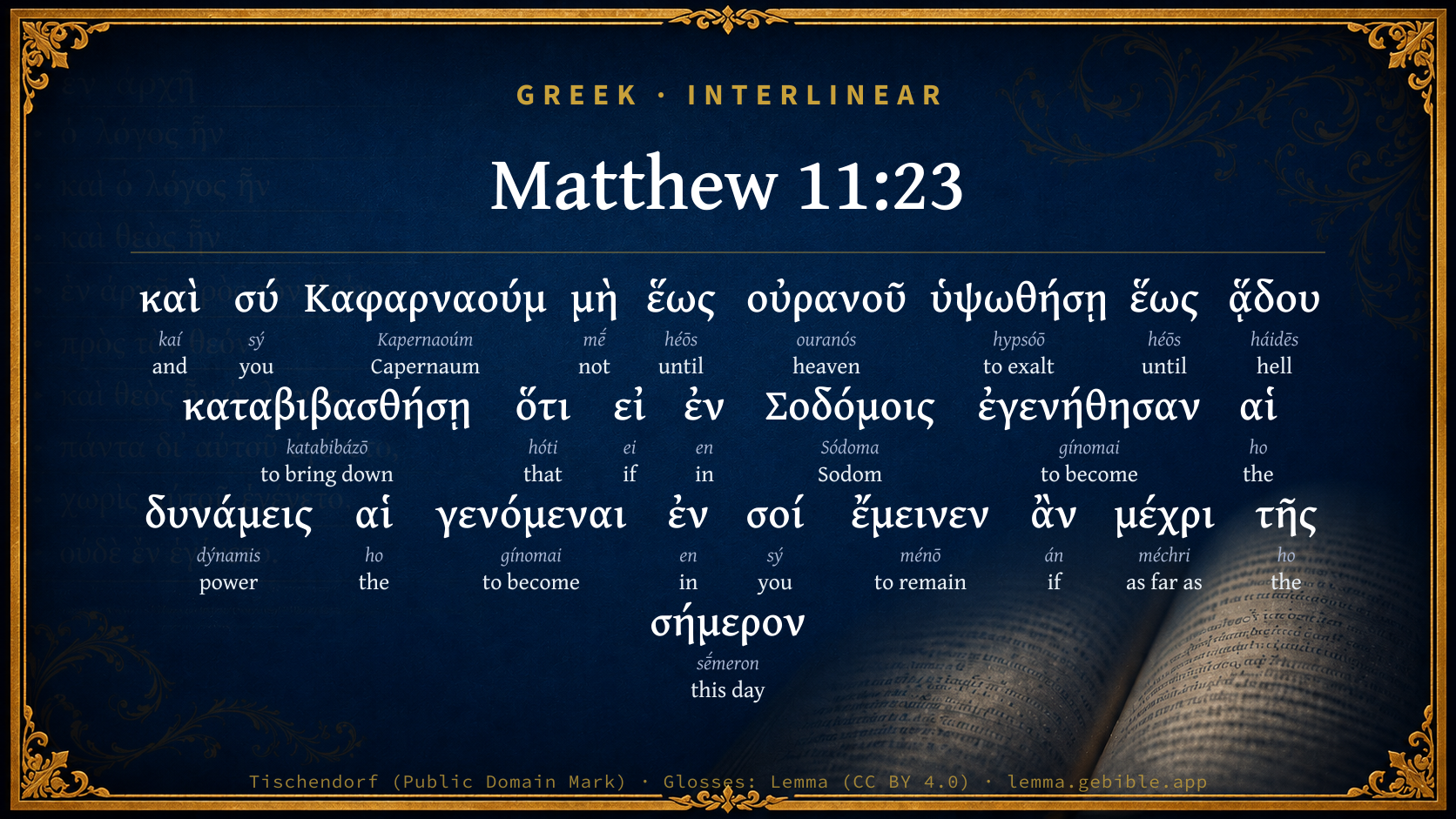
You, Capernaum, who are exalted to Heaven, you will go down to Hades. For if the mighty works had been done in Sodom which were done in you, it would have remained until this day.
Download a study sheet
One document with this verse’s original text, its word-by-word gloss line, the meaning frame, cross-references with their text, attributed commentary, and full source and license credits — printable, and it pastes into notes with its structure intact.
This verse Autodidact and up
A passage Seminary Student
Up to 50 verses in one chapter. A passage sheet keeps up to 6 commentary sources and 12 cross-references per verse, in the order this page ranks them, and says so on the sheet whenever that leaves anything out. Ask for a single verse and you get the Autodidact verse sheet above.
Everything on this page stays free to read, with no account — the sheet is a download of what is already on screen, not access to it.
Compare translations 3
The same verse in 3 English versions, stacked beneath the original-language interlinear above. Click any original word for its lexicon entry.
Each is an independent rendering of the whole verse — the interlinear is not word-aligned to these translations.
Highlighted words mark where these versions differ — a whole-verse word diff, not a word-by-word alignment.
-
World English Bible Public Domain
You, Capernaum, who are exalted to Heaven, you will go down to Hades. For if the mighty works had been done in Sodom which were done in you, it would have remained until this day.
-
King James Version Public Domain
And thou, Capernaum, which art exalted unto heaven, shalt be brought down to hell: for if the mighty works, which have been done in thee, had been done in Sodom, it would have remained until this day.
-
unfoldingWord Literal Text CC BY-SA 4.0
And you, Capernaum, you will not be exalted to heaven, will you? You will be brought down as far as Hades. For if the miracles that happened in you had happened in Sodom, it would have remained until today.
unfoldingWord Literal Text — © unfoldingWord, licensed CC BY-SA 4.0. Word-aligned USFM3 via Door43 (git.door43.org/unfoldingWord/en_ult).
Show all 19 translations
Every available English version of this verse, each an independent rendering of the whole verse.
-
World English Bible Public Domain
You, Capernaum, who are exalted to Heaven, you will go down to Hades. For if the mighty works had been done in Sodom which were done in you, it would have remained until this day.
-
Berean Standard Bible Public Domain
And you, Capernaum, will you be lifted up to heaven? No, you will be brought down to Hades! For if the miracles that were performed in you had been performed in Sodom, it would have remained to this day.
-
Majority Standard Bible Public Domain
And you, Capernaum, which is lifted up to heaven, will be brought down to Hades! For if the miracles that were performed in you had been performed in Sodom, it would have remained to this day.
-
King James Version Public Domain
And thou, Capernaum, which art exalted unto heaven, shalt be brought down to hell: for if the mighty works, which have been done in thee, had been done in Sodom, it would have remained until this day.
-
American Standard Version (1901) Public Domain
And thou, Capernaum, shalt thou be exalted unto heaven? thou shalt go down unto Hades: for if the mighty works had been done in Sodom which were done in thee, it would have remained until this day.
-
Revised Version (1885) Public Domain
And thou, Capernaum, shalt thou be exalted unto heaven? thou shalt go down unto Hades: for if the mighty works had been done in Sodom which were done in thee, it would have remained until this day.
-
Geneva Bible (1599) Public Domain
And thou, Capernaum, which art lifted vp vnto heauen, shalt be brought downe to hell: for if the great workes, which haue bin done in thee, had bene done among them of Sodom, they had remained to this day.
-
Douay-Rheims (1899) Public Domain
And thou Capharnaum, shalt thou be exalted up to heaven? thou shalt go down even unto hell. For if in Sodom had been wrought the miracles that have been wrought in thee, perhaps it had remained unto this day.
-
Young's Literal Translation Public Domain
`And thou, Capernaum, which unto the heaven wast exalted, unto hades shalt be brought down, because if in Sodom had been done the mighty works that were done in thee, it had remained unto this day;
-
Literal Standard Version CC BY-SA 4.0
And you, Capernaum, which were exalted to Heaven, will be brought down to Hades, because if the mighty works that were done in you had been done in Sodom, it had remained to this day;
-
Unlocked Literal Bible CC BY-SA 4.0
You, Capernaum, do you think you will be exalted to heaven? No, you will be brought down to Hades. For if in Sodom there had been done the mighty deeds that were done in you, it would still have remained until today.
-
unfoldingWord Literal Text CC BY-SA 4.0
And you, Capernaum, you will not be exalted to heaven, will you? You will be brought down as far as Hades. For if the miracles that happened in you had happened in Sodom, it would have remained until today.
-
Darby Bible Public Domain
And *thou*, Capernaum, who hast been raised up to heaven, shalt be brought down even to hades. For if the works of power which have taken place in thee, had taken place in Sodom, it had remained until this day.
-
World Messianic Bible Public Domain
You, Capernaum, who are exalted to heaven, you will go down to Sheol. For if the mighty works had been done in Sodom which were done in you, it would have remained until today.
-
Webster's Bible Public Domain
And thou, Capernaum, which art exalted to heaven, shalt be brought down to hell: for if the mighty works which have been done in thee, had been done in Sodom, it would have remained until this day.
-
Free Bible Version CC BY-SA 4.0
And what about you, Capernaum? Will you be exalted to heaven? No, you'll go down to Hades! If the miracles had been performed in Sodom which happened among you, Sodom would still be here today.
-
Bible in Basic English Public Domain
And you, Capernaum, were you not to be lifted up to heaven? you will go down into hell: for if the works of power which were done in you had been done in Sodom, it would have been here to this day.
-
Text-Critical English NT CC BY 4.0
And yoʋ, Capernaum, who have been exalted to heaven, will be brought down to Hades. For if the miracles that were done in yoʋ had been done in Sodom, it would have remained until this day.
-
Tyndale New Testament (1534) Public Domain
And thou Capernaum which art lift vp vnto heven shalt be brought doune to hell. For if the miracles which have bene done in the had bene shewed in zodom: they had remayned to this daye.
Literal Standard Version (2020), Covenant Press — licensed CC BY-SA 4.0. Text via the HelloAO Bible API (eBible.org). Unlocked Literal Bible (unfoldingWord) — licensed CC BY-SA 4.0. Text via the HelloAO Bible API (eBible.org). unfoldingWord Literal Text — © unfoldingWord, licensed CC BY-SA 4.0. Word-aligned USFM3 via Door43 (git.door43.org/unfoldingWord/en_ult). Free Bible Version, Dr. Jonathan Gallagher — licensed CC BY-SA 4.0. Text via the HelloAO Bible API (eBible.org).
Word by word
More ways to search: Search by grammar → Find every occurrence → Compare this word →
Practice this passage: Drill this verse → Learn its vocabulary →
- Appears 2× in the Greek New Testament
- First appears here
- Part of Speech
- Verb
- Tense
- Future
- Voice
- Passive
- Mood
- Indicative
- Person
- 2nd person
- Number
- Singular
Full Thayer's Definition
- καὶ kaí G2532 “and” Conjunction
- σύ sý G4771 “you” Personal pronoun, 2nd person, Nominative, Singular
- Καφαρναούμ Kapernaoúm G2584 “Capernaum” Noun, Proper, indeclinable
- μὴ mḗ G3361 “not” Particle, Negative
- ἕως héōs G2193 “until” Adverb
- οὐρανοῦ ouranós G3772 “heaven” Noun, Genitive, Singular, Masculine
- ὑψωθήσῃ hypsóō G5312 “to exalt” Verb, Future, Passive, Indicative, 2nd person, Singular
- ἕως héōs G2193 “until” Adverb
- ᾅδου háidēs G86 “hell” Noun, Genitive, Singular, Masculine
- καταβιβασθήσῃ katabibázō G2601 “to bring down” Verb, Future, Passive, Indicative, 2nd person, Singular
- ὅτι hóti G3754 “that” Conjunction
- εἰ ei G1487 “if” Conditional
- ἐν en G1722 “in” Preposition
- Σοδόμοις Sódoma G4670 “Sodom” Noun, Dative, Plural, Neuter
- ἐγενήθησαν gínomai G1096 “to become” Verb, Aorist, Passive deponent, Indicative, 3rd person, Plural
- αἱ ho G3588 “the” Article, Nominative, Plural, Feminine
- δυνάμεις dýnamis G1411 “power” Noun, Nominative, Plural, Feminine
- αἱ ho G3588 “the” Article, Nominative, Plural, Feminine
- γενόμεναι gínomai G1096 “to become” Verb, Aorist, Middle deponent, Participle, Nominative, Plural, Feminine
- ἐν en G1722 “in” Preposition
- σοί sý G4771 “you” Personal pronoun, 2nd person, Dative, Singular
- ἔμεινεν ménō G3306 “to remain” Verb, Aorist, Active, Indicative, 3rd person, Singular
- ἂν án G302 “if” Particle
- μέχρι méchri G3360 “as far as” Adverb
- τῆς ho G3588 “the” Article, Genitive, Singular, Feminine
- σήμερον sḗmeron G4594 “this day” Adverb
About this verse
These counts appear in no published source. They are computed here, from the morphology-tagged text and Lemma’s own curated glosses. What Lemma adds →
- 26
- words
- 20
- distinct lemmas
- Gospels
- section
Notable vocabulary
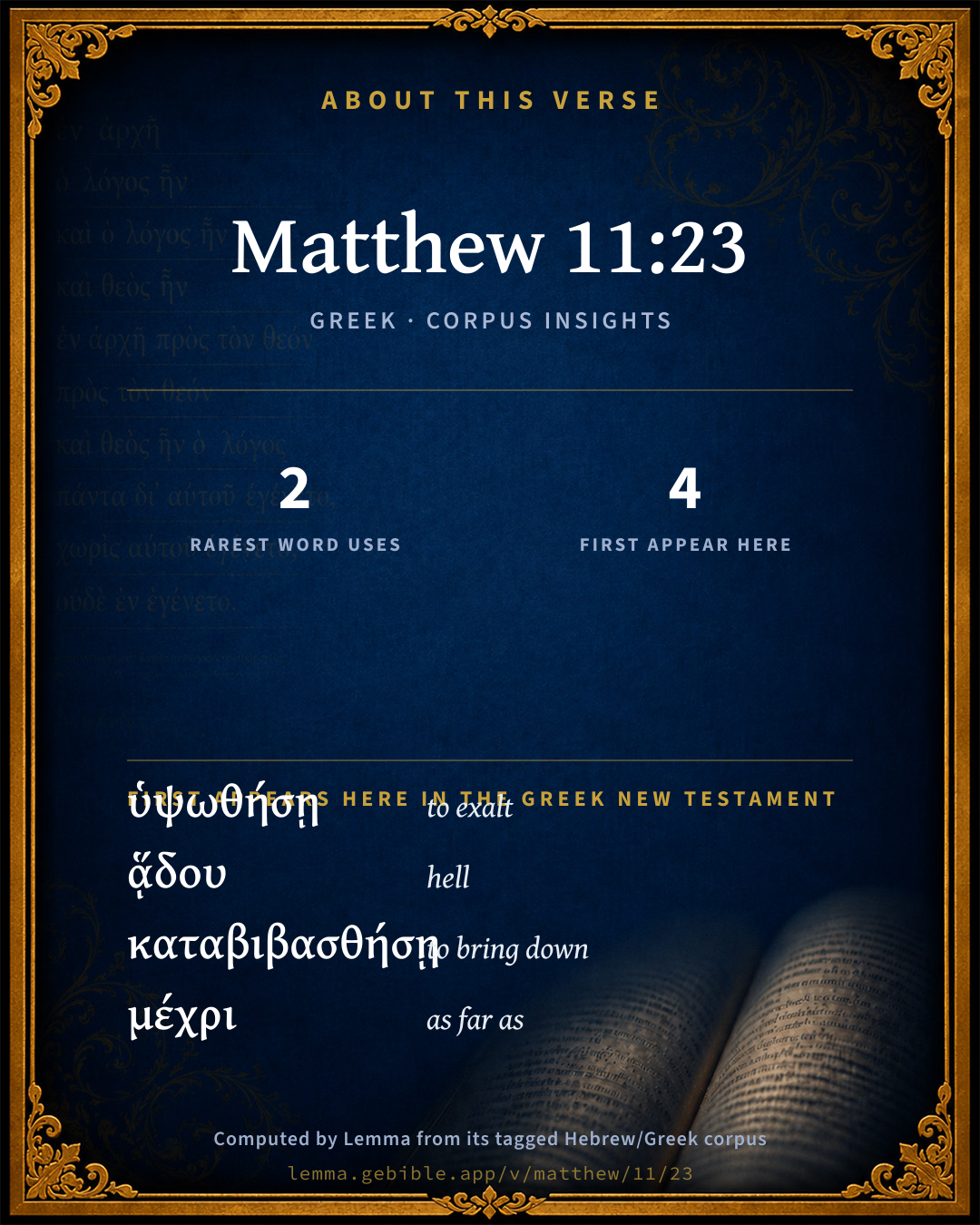
The rarest word here is καταβιβασθήσῃ to bring down G2601 — appearing just 2 times in the whole Greek New Testament.
First appearance in Scripture
These words make their first canonical appearance in the Greek New Testament here:
Shared distinctive vocabulary
καταβιβασθήσῃ to bring down G2601 occurs in 2 verses of the Greek New Testament. Also found in:
Cross-references
20Topical passages linked to Matthew 11:23 in the Treasury of Scripture Knowledge — connected by theme and wording, ordered by reader-vote popularity; previews shown in the World English Bible.
- Isaiah 14:13–15 You said in your heart, I will ascend into heaven, I will exalt my throne above the stars of God; and I will sit on the mountain of congregation, in the uttermost parts of the north;
- John 4:46–54 Jesus came therefore again to Cana of Galilee, where he made the water into wine. There was a certain nobleman whose son was sick at Capernaum.
- Genesis 13:13 Now the men of Sodom were exceedingly wicked and sinners against Yahweh.
- Matthew 4:13 Leaving Nazareth, he came and lived in Capernaum, which is by the sea, in the region of Zebulun and Naphtali,
- Revelation 11:8 Their dead bodies will be in the street of the great city, which spiritually is called Sodom and Egypt, where also their Lord was crucified.
- Genesis 19:24–25 Then Yahweh rained on Sodom and on Gomorrah sulfur and fire from Yahweh out of the sky.
- Lamentations 2:1 How has the Lord covered the daughter of Zion with a cloud in his anger! He has cast down from heaven to the earth the beauty of Israel, And hasn't remembered his footstool in the day of his anger.
- Ezekiel 16:48–50 As I live, says the Lord Yahweh, Sodom your sister has not done, she nor her daughters, as you have done, you and your daughters.
- Ezekiel 28:12–19 Son of man, take up a lamentation over the king of Tyre, and tell him, Thus says the Lord Yahweh: You seal up the sum, full of wisdom, and perfect in beauty.
- Ezekiel 31:16–17 I made the nations to shake at the sound of his fall, when I cast him down to Sheol with those who descend into the pit; and all the trees of Eden, the choice and best of Lebanon, all that drink water, were comforted in the lower parts of the earth.
- Obadiah 1:4 Though you mount on high as the eagle, and though your nest is set among the stars, I will bring you down from there, says Yahweh.
- Matthew 8:5 When he came into Capernaum, a centurion came to him, asking him,
- Matthew 16:18 I also tell you that you are Peter, and on this rock I will build my assembly, and the gates of Hades will not prevail against it.
- Luke 14:11 For everyone who exalts himself will be humbled, and whoever humbles himself will be exalted."
- Acts 2:27 Because you will not leave my soul in Hades, Neither will you allow your Holy One to see decay.
- 2 Peter 2:4–9 For if God didn't spare angels when they sinned, but cast them down to Tartarus, and committed them to pits of darkness, to be reserved to judgment;
- Jude 1:7 Even as Sodom and Gomorrah, and the cities around them, having, in the same way as these, given themselves over to sexual immorality and gone after strange flesh, are set forth as an example, suffering the punishment of eternal fire.
- Matthew 17:24 When they had come to Capernaum, those who collected the didrachma coins came to Peter, and said, "Doesn't your teacher pay the didrachma?"
- Luke 4:23 He said to them, "Doubtless you will tell me this parable, 'Physician, heal yourself! Whatever we have heard done at Capernaum, do also here in your hometown.'"
- Luke 16:23 In Hades, he lifted up his eyes, being in torment, and saw Abraham far off, and Lazarus at his bosom.
Cross-references courtesy of OpenBible.info (CC BY 4.0).
Where the printed editions differ
1 variantPlaces in this verse where the major printed Greek editions disagree on the wording in a way that affects the translation — a comparison of editions, not a manuscript-by-manuscript collation. The editions are the modern critical texts (Nestlé-Aland 28/27, SBL, Westcott-Hort, Tregelles, Tyndale House) and the traditional texts behind the KJV (the Textus Receptus and the Byzantine/Majority text). It is not a claim about which reading is original.
-
Different wording
μὴ
“surely not”
In NA28NA27TynSBLWHTreg Not in TRByzἡ (hē) '' occurs in traditional manuscripts (TR+Byz) instead of μὴ (mē) 'surely not' in older manuscripts (NA28+NA27+Tyn+SBL+WH+Treg)
Textual data: Translators Amalgamated Greek New Testament (STEPBible TAGNT) · CC BY 4.0.
Lesson kit
Teaching starters — assembled from the data on this page, not authored interpretation. Every prompt links to the verse data it draws on. Edit before teaching.
Matthew, in the Gospels, opens this verse with 26 words (20 distinct Greek lemmas). Its most distinctive word is katabibázō (“to bring down”). A historical commentator’s framing appears above. Read the whole chapter for the surrounding context.
Discussion questions
- What does “to bring down” (katabibázō) contribute to the verse as a whole?
- 4 words make their first appearance in Scripture here. What does this debut establish?
- How does Luke 10:15, which shares the word «to bring down», read alongside this verse?
- What does the repetition of “until” (2× in this one verse) do in this verse?
- The translations on this page render this verse differently — a whole-verse word diff, not a word-by-word alignment. What might account for the different wordings?
- Compare how Tyndale Open Study Notes and Bengel's Gnomon read this verse. Where do they agree or differ?
Things to notice
- 4 words make their first canonical appearance in Scripture here.
- These translations choose different wording for 17 words in this verse.
- “until” occurs 2× in this single verse.
- 20 distinct Greek lemmas span 26 words in this verse.
Commentary
Notes on Matthew 11:23 from classic Christian and Jewish commentators (each source and its license shown beneath its notes). The classic Christian expositions comment on the surrounding passage and are grouped to its opening verse, so a note may address several verses; the Jewish commentaries on the Tanakh (Rashi and others) are per-verse, so they appear only where the commentator wrote on this verse.
Lemma curates 59 commentaries, every one of them public domain or Creative Commons licensed, each selected and text-cleaned for this edition rather than reprinted as found. About our sources →
Tyndale Open Study Notes
Tyndale Open Resources
Tyndale Open Study Notes — © Tyndale Open Resources, licensed CC BY-SA 4.0. Text via the HelloAO Bible API.
Bengel's Gnomon
Johann Albrecht Bengel
Bengel's Gnomon of the New Testament — English translation (T&T Clark, Edinburgh, 1860) — public domain. Text from a community e-Sword module.
Expositor's Greek Testament
ed. W. Robertson Nicoll
The Expositor's Greek Testament, edited by W. Robertson Nicoll (1897–1910) — public domain. Text from a community e-Sword module.
Jamieson, Fausset & Brown
Robert Jamieson, A. R. Fausset & David Brown
Jamieson, Fausset & Brown — Commentary Critical and Explanatory on the Whole Bible (1871) — public domain (CC PDM 1.0). Text via the HelloAO Bible API.
Adam Clarke's Commentary
Adam Clarke's Commentary on the Bible (1810–1826) — public domain. Text from a community e-Sword/MySword module.
Ellicott's Commentary for English Readers
A Bible Commentary for English Readers, edited by Charles John Ellicott (1878–1897) — public domain. Text from a community e-Sword module.
The Cambridge Bible for Schools and Colleges
gen. ed. J. J. S. Perowne
The Cambridge Bible for Schools and Colleges (gen. ed. J. J. S. Perowne; Cambridge University Press, 1878–1918) — public domain. Text from a community e-Sword module.
John Gill's Exposition
John Gill's Exposition of the Whole Bible (1746–1763) — public domain (CC PDM 1.0). Text via the HelloAO Bible API.
Trapp's Complete Commentary
John Trapp
John Trapp, A Commentary or Exposition upon All the Books of the Old and New Testament (1647–1656) — public domain. Text from a community e-Sword module.
Albert Barnes' Notes on the Bible
Albert Barnes' Notes on the Bible (1834–1885) — public domain. Text from a community e-Sword/MySword module.
Haydock's Catholic Bible Commentary
George Leo Haydock (1774–1849), Haydock's Catholic Family Bible and Commentary, 1859 edition — public domain. Excludes Psalms (Douay-Rheims chapter numbering differs from Protestant) and Deuterocanonical books (Catholic canon only).
Matthew Poole's English Annotations
Matthew Poole's English Annotations on the Holy Bible (1683–1685) — public domain. Text from a community e-Sword/MySword module.
Whedon's Commentary on the Bible
Daniel D. Whedon
Daniel D. Whedon (gen. ed.), Commentary on the Old and New Testaments (1874–1909) — public domain. Text from a community e-Sword module.
The Pulpit Commentary
The Pulpit Commentary (1880–1919), ed. H.D.M. Spence-Jones & Joseph S. Exell — public domain. Text from a community e-Sword module.
John Wesley's Explanatory Notes
John Wesley, Explanatory Notes Upon the Whole Bible (1754–1765) — public domain. Text via the GEBible commentary corpus.
Scofield Reference Notes
C. I. Scofield
The Scofield Reference Bible (1917 edition), notes by C. I. Scofield — public domain. Text from a community e-Sword module.
Kretzmann's Popular Commentary
Paul E. Kretzmann
Paul E. Kretzmann, Popular Commentary of the Bible (1921–1924) — public domain. Text from a community e-Sword module.
Burkitt's Expository Notes on the New Testament
William Burkitt
William Burkitt's Expository Notes on the New Testament (1700–1703) — public domain. Text from a community e-Sword module.
The People's New Testament
B. W. Johnson
B. W. Johnson's The People's New Testament with Notes (1889–1891) — public domain. Electronic text from the Christian Classics Ethereal Library (CCEL) ThML edition.
unfoldingWord translationNotes
Door43 World Missions Community
unfoldingWord translationNotes — © Distant Shores Media and the Door43 World Missions Community, licensed CC BY-SA 4.0. Source: git.door43.org/Door43/en_tn.
Cambridge Greek Testament for Schools and Colleges
Cambridge Greek Testament for Schools and Colleges (Cambridge University Press, 1896; 21 vols, various authors incl. Carr, Maclear, Plummer, Farrar, Lumby, Moule, M. R. James, Simcox) — public domain. Text from a community e-Sword module.
Alford’s Greek Testament
Henry Alford
Henry Alford, The Greek Testament (1849–1861) — public domain. Text from a community e-Sword module.
International Critical Commentary
International Critical Commentary — older volumes (1896–1929), various authors — public domain. Text from a community e-Sword module.