Ephesians 6:9

Greek (Tischendorf 8th ed.) Ephesians 6:9 appears in the Greek New Testament. The text above is from the Tischendorf 8th edition. Each word links to its Strong’s number and a concise gloss. Click any word for its full Thayer’s Greek Lexicon entry.
Download image
Cite this verse

Ephesians 6:9 (World English Bible). Public Domain. Lemma interlinear Bible study tool, https://lemma.gebible.app/v/ephesians/6/9.

Show BibTeX & RIS
BibTeX
RIS
English Translation
You masters, do the same things to them, and give up threatening, knowing that he who is both their Master and yours is in heaven, and there is no partiality with him.
World English Bible · Public Domain
Download a study sheet

One document with this verse’s original text, its word-by-word gloss line, the meaning frame, cross-references with their text, attributed commentary, and full source and license credits — printable, and it pastes into notes with its structure intact.

This verse Autodidact and up

Study sheet (.html) Plain text (.txt)

A passage Seminary Student

Up to 50 verses in one chapter. A passage sheet keeps up to 6 commentary sources and 12 cross-references per verse, in the order this page ranks them, and says so on the sheet whenever that leaves anything out. Ask for a single verse and you get the Autodidact verse sheet above.

Everything on this page stays free to read, with no account — the sheet is a download of what is already on screen, not access to it.

Want to remove ads? Support Godless Engineer
Compare translations 3

The same verse in 3 English versions, stacked beneath the original-language interlinear above. Click any original word for its lexicon entry.

Each is an independent rendering of the whole verse — the interlinear is not word-aligned to these translations.

Highlighted words mark where these versions differ — a whole-verse word diff, not a word-by-word alignment.

  • World English Bible Public Domain
    You masters, do the same things to them, and give up threatening, knowing that he who is both their Master and yours is in heaven, and there is no partiality with him.
  • King James Version Public Domain
    And, ye masters, do the same things unto them, forbearing threatening: knowing that your Master also is in heaven; neither is there respect of persons with him.
  • unfoldingWord Literal Text CC BY-SA 4.0
    And masters, do the same to them. Stop using threats. You know that the Master, both theirs and yours, is in heaven, and there is no favoritism with him.

unfoldingWord Literal Text — © unfoldingWord, licensed CC BY-SA 4.0. Word-aligned USFM3 via Door43 (git.door43.org/unfoldingWord/en_ult).

Versions to compare (up to 4)

3 of 4 selected

Show all 19 translations

Every available English version of this verse, each an independent rendering of the whole verse.

  • World English Bible Public Domain
    You masters, do the same things to them, and give up threatening, knowing that he who is both their Master and yours is in heaven, and there is no partiality with him.
  • Berean Standard Bible Public Domain
    And masters, do the same for your slaves. Give up your use of threats, because you know that He who is both their Master and yours is in heaven, and there is no favoritism with Him.
  • Majority Standard Bible Public Domain
    And masters, do the same for your slaves. Give up your use of threats, because you know that your Master is in heaven, and there is no favoritism with Him.
  • King James Version Public Domain
    And, ye masters, do the same things unto them, forbearing threatening: knowing that your Master also is in heaven; neither is there respect of persons with him.
  • American Standard Version (1901) Public Domain
    And, ye masters, do the same things unto them, and forbear threatening: knowing that he who is both their Master and yours is in heaven, and there is no respect of persons with him.
  • Revised Version (1885) Public Domain
    And, ye masters, do the same things unto them, and forbear threatening: knowing that both their Master and yours is in heaven, and there is no respect of persons with him.
  • Geneva Bible (1599) Public Domain
    And ye masters, doe the same things vnto them, putting away threatning: and know that euen your master also is in heauen, neither is there respect of person with him.
  • Douay-Rheims (1899) Public Domain
    And you, masters, do the same things to them, forbearing threatenings, knowing that the Lord both of them and you is in heaven; and there is no respect of persons with him.
  • Young's Literal Translation Public Domain
    And the masters! the same things do ye unto them, letting threatening alone, having known that also your Master is in the heavens, and acceptance of persons is not with him.
  • Literal Standard Version CC BY-SA 4.0
    And the masters! Do the same things to them, letting threatening alone, having also known that your Master is in the heavens, and favor by appearance is not with Him.
  • Unlocked Literal Bible CC BY-SA 4.0
    Masters, treat your slaves in the same way. Do not threaten them. You know that he who is both their Master and yours is in heaven, and there is no favoritism with him.
  • unfoldingWord Literal Text CC BY-SA 4.0
    And masters, do the same to them. Stop using threats. You know that the Master, both theirs and yours, is in heaven, and there is no favoritism with him.
  • Darby Bible Public Domain
    And, masters, do the same things towards them, giving up threatening, knowing that both their and your Master is in heaven, and there is no acceptance of persons with him.
  • World Messianic Bible Public Domain
    You masters, do the same things to them, and give up threatening, knowing that he who is both their Master and yours is in heaven, and there is no partiality with him.
  • Webster's Bible Public Domain
    And, ye masters, do the same things to them, forbearing threatening: knowing that your Master also is in heaven; neither is there respect of persons with him.
  • Free Bible Version CC BY-SA 4.0
    Masters, you should treat your servants the same way. Don't threaten them, remember that the Lord in heaven is both their master and yours, and he treats people the same, without favoritism.
  • Bible in Basic English Public Domain
    And, you masters, do the same things to them, not making use of violent words: in the knowledge that their Master and yours is in heaven, and he has no respect for a man's position.
  • Text-Critical English NT CC BY 4.0
    Masters, do the same for your slaves and stop threatening them, because you know that your own Master is in heaven, and there is no partiality with him.
  • Tyndale New Testament (1534) Public Domain
    And ye masters do even the same thinges vnto them puttinge awaye threateninges: and remember that even youre master also is in heven nether is ther eny respecte of person with him.

Literal Standard Version (2020), Covenant Press — licensed CC BY-SA 4.0. Text via the HelloAO Bible API (eBible.org). Unlocked Literal Bible (unfoldingWord) — licensed CC BY-SA 4.0. Text via the HelloAO Bible API (eBible.org). unfoldingWord Literal Text — © unfoldingWord, licensed CC BY-SA 4.0. Word-aligned USFM3 via Door43 (git.door43.org/unfoldingWord/en_ult). Free Bible Version, Dr. Jonathan Gallagher — licensed CC BY-SA 4.0. Text via the HelloAO Bible API (eBible.org).

Word by word

More ways to search: Search by grammar → Find every occurrence → Compare this word →

Practice this passage: Drill this verse → Learn its vocabulary →

ἀπειλήν
apeilḗ
G547
“threat”
Noun, Accusative, Singular, Feminine
Part of Speech
Noun
Case
Accusative
Number
Singular
Gender
Feminine
Full Thayer's Definition

Origin: from G546

TDNT: None

1. a threatening, threat
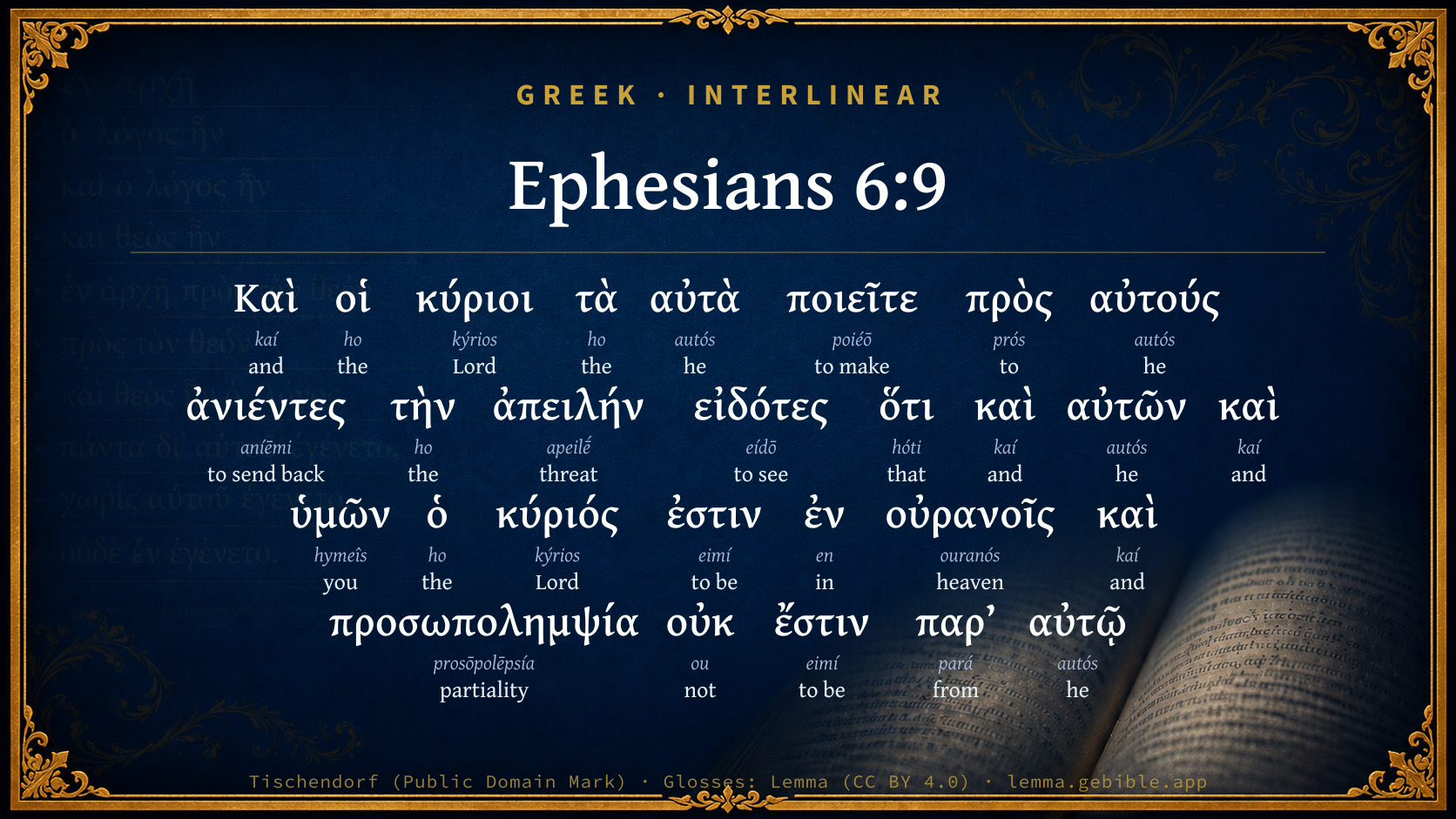
  1. Καὶ kaí G2532 “and” Conjunction
  2. οἱ ho G3588 “the” Article, Nominative, Plural, Masculine
  3. κύριοι kýrios G2962 “Lord” Noun, Nominative, Plural, Masculine
  4. τὰ ho G3588 “the” Article, Accusative, Plural, Neuter
  5. αὐτὰ autós G846 “he” Personal pronoun, Accusative, Plural, Neuter
  6. ποιεῖτε poiéō G4160 “to make” Verb, Present, Active, Imperative, 2nd person, Plural
  7. πρὸς prós G4314 “to” Preposition
  8. αὐτούς autós G846 “he” Personal pronoun, Accusative, Plural, Masculine
  9. ἀνιέντες aníēmi G447 “to send back” Verb, Present, Active, Participle, Nominative, Plural, Masculine
  10. τὴν ho G3588 “the” Article, Accusative, Singular, Feminine
  11. εἰδότες eídō G1492 “to see” Verb, Perfect, Active, Participle, Nominative, Plural, Masculine
  12. ὅτι hóti G3754 “that” Conjunction
  13. καὶ kaí G2532 “and” Conjunction
  14. αὐτῶν autós G846 “he” Personal pronoun, Genitive, Plural, Masculine
  15. καὶ kaí G2532 “and” Conjunction
  16. ὑμῶν hymeîs G5210 “you” Personal pronoun, 2nd person, Genitive, Plural
  17. ὁ ho G3588 “the” Article, Nominative, Singular, Masculine
  18. κύριός kýrios G2962 “Lord” Noun, Nominative, Singular, Masculine
  19. ἐστιν eimí G1510 “to be” Verb, Present, Active, Indicative, 3rd person, Singular
  20. ἐν en G1722 “in” Preposition
  21. οὐρανοῖς ouranós G3772 “heaven” Noun, Dative, Plural, Masculine
  22. καὶ kaí G2532 “and” Conjunction
  23. προσωπολημψία prosōpolēpsía G4382 “partiality” Noun, Nominative, Singular, Feminine
  24. οὐκ ou G3756 “not” Particle, Negative
  25. ἔστιν eimí G1510 “to be” Verb, Present, Active, Indicative, 3rd person, Singular
  26. παρ’ pará G3844 “from” Preposition
  27. αὐτῷ autós G846 “he” Personal pronoun, Dative, Singular, Masculine

About this verse

These counts appear in no published source. They are computed here, from the morphology-tagged text and Lemma’s own curated glosses. What Lemma adds →

28
words
17
distinct lemmas
Pauline Epistles
section

Notable vocabulary

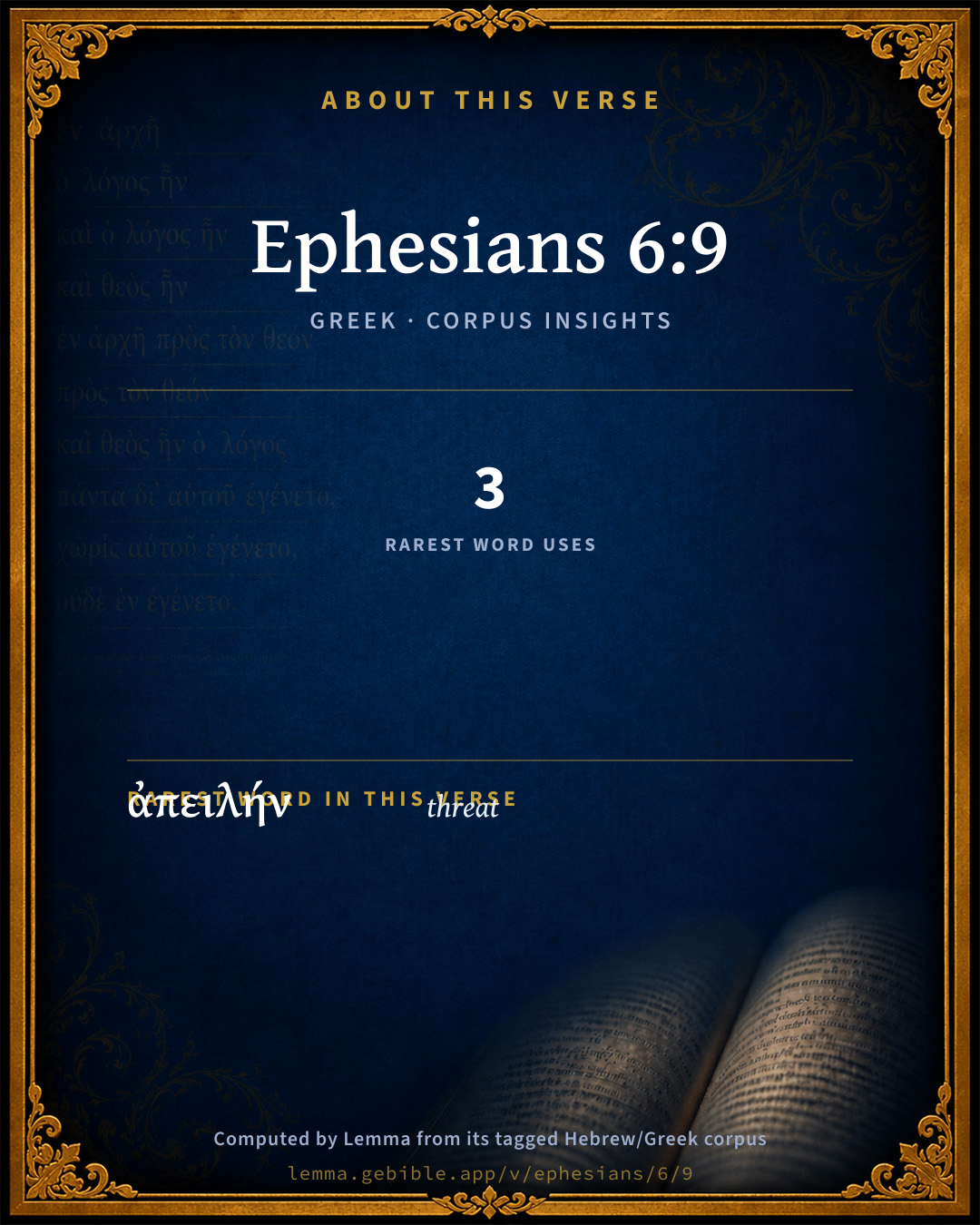
The rarest word here is ἀπειλήν threat G547 — appearing just 3 times in the whole Greek New Testament.

Shared distinctive vocabulary

ἀπειλήν threat G547 occurs in 3 verses of the Greek New Testament. Also found in:

Repetition

Words recur within this verse:

  • κύριοι Lord G2962 ×2
  • ἐστιν to be G1510 ×2
  • Καὶ and G2532 ×4
  • οἱ the G3588 ×4
  • αὐτὰ he G846 ×4

Cross-references

37

Topical passages linked to Ephesians 6:9 in the Treasury of Scripture Knowledge — connected by theme and wording, ordered by reader-vote popularity; previews shown in the World English Bible.

  • Acts 10:34 Peter opened his mouth and said, "Truly I perceive that God doesn't show favoritism;
  • Colossians 3:25–4:1 But he who does wrong will receive again for the wrong that he has done, and there is no partiality.
  • Romans 2:11 For there is no partiality with God.
  • Job 31:13–15 "If I have despised the cause of my man-servant Or of my maid-servant, When they contended with me;
  • Deuteronomy 10:17 For Yahweh your God, he is God of gods, and Lord of lords, the great God, the mighty, and the awesome, who doesn't regard persons, nor takes reward.
  • Luke 6:31 "As you would like people to do to you, do exactly so to them.
  • Matthew 7:12 Therefore whatever you desire for men to do to you, you shall also do to them; for this is the law and the prophets.
  • Leviticus 25:39–46 "'If your brother has grown poor among you, and sells himself to you; you shall not make him to serve as a slave.
  • Deuteronomy 24:14–15 You shall not oppress a hired servant who is poor and needy, whether he be of your brothers, or of your foreigners who are in your land within your gates:
  • John 13:13 You call me, 'Teacher' and 'Lord.' You say so correctly, for so I am.
  • 1 Corinthians 1:2 to the assembly of God which is at Corinth; those who are sanctified in Christ Jesus, called to be saints, with all who call on the name of our Lord Jesus Christ in every place, both theirs and ours:
  • James 2:8 However, if you fulfill the royal law, according to the Scripture, "You shall love your neighbor as yourself," you do well.
  • James 2:13 For judgment is without mercy to him who has shown no mercy. Mercy triumphs over judgment.
  • Nehemiah 5:5 Yet now our flesh is as the flesh of our brothers, our children as their children: and, behold, we bring into bondage our sons and our daughters to be servants, and some of our daughters are brought into bondage [already]: neither is it in our power to help it; for other men have our fields and our vineyards.
  • Psalms 140:12 I know that Yahweh will maintain the cause of the afflicted, And justice for the needy.
  • Ecclesiastes 5:8 If you see the oppression of the poor, and the violent taking away of justice and righteousness in a district, don't marvel at the matter: for one official is eyed by a higher one; and there are officials over them.
  • Isaiah 47:6 I was angry with my people, I profaned my inheritance, and gave them into your hand: you did show them no mercy; on the aged have you very heavily laid your yoke.
  • Isaiah 58:3–6 Why have we fasted, [say they], and you don't see? [why] have we afflicted our soul, and you take no knowledge? Behold, in the day of your fast you find [your own] pleasure, and exact all your labors.
  • Daniel 3:6 and whoever doesn't fall down and worships shall the same hour be cast into the midst of a burning fiery furnace.
  • Daniel 3:15 Now if you are ready whenever you hear the sound of the horn, flute, zither, lyre, harp, pipe, and all kinds of music to you fall down and worship the image which I have made, [well]: but if you don't worship, you shall be cast the same hour into the midst of a burning fiery furnace; and who is that god that shall deliver you out of my hands?
  • Daniel 5:19–20 and because of the greatness that he gave him, all the peoples, nations, and languages trembled and feared before him: whom he would he killed, and whom he would he kept alive; and whom he would he raised up, and whom he would he put down.
  • Amos 8:4–7 Hear this, you who desire to swallow up the needy, And cause the poor of the land to fail,
  • Malachi 3:5 I will come near to you to judgment; and I will be a swift witness against the sorcerers, and against the adulterers, and against the perjurers, and against those who oppress the hireling in his wages, the widow, and the fatherless, and who deprive the foreigner of justice, and don't fear me," says Yahweh of Hosts.
  • Matthew 22:8 "Then he said to his servants, 'The wedding is ready, but those who were invited weren't worthy.
  • Matthew 22:10 Those servants went out into the highways, and gathered together as many as they found, both bad and good. The wedding was filled with guests.
  • Matthew 24:48 But if that evil servant should say in his heart, 'My lord is delaying his coming,'
  • Matthew 24:51 and will cut him in pieces, and appoint his portion with the hypocrites; there is where the weeping and grinding of teeth will be.
  • Luke 12:45–46 But if that servant says in his heart, 'My lord delays his coming,' and begins to beat the menservants and the maidservants, and to eat and drink, and to be drunken,
  • 1 Corinthians 7:22 For he who was called in the Lord being a bondservant is the Lord's free man. Likewise he who was called being free is Christ's bondservant.
  • Ephesians 6:5–7 Servants, be obedient to those who according to the flesh are your masters, with fear and trembling, in singleness of your heart, as to Christ;
  • James 5:4 Behold, the wages of the laborers who mowed your fields, which you have kept back by fraud, cry out, and the cries of those who reaped have entered into the ears of the Lord of Hosts.
  • Leviticus 19:13 "'You shall not oppress your neighbor, nor rob him. The wages of a hired servant shall not remain with you all night until the morning.
  • Deuteronomy 15:11–16 For the poor will never cease out of the land: therefore I command you, saying, You shall surely open your hand to your brother, to your needy, and to your poor, in your land.
  • 1 Samuel 15:17 Samuel said, "Though you were little in your own sight, weren't you made the head of the tribes of Israel? Yahweh anointed you king over Israel;
  • Nehemiah 5:8–9 I said to them, We after our ability have redeemed our brothers the Jews, that were sold to the nations; and would you even sell your brothers, and should they be sold to us? Then held they their peace, and found never a word.
  • Job 24:10–12 So that they go around naked without clothing. Being hungry, they carry the sheaves.
  • Philippians 2:10–11 that at the name of Jesus every knee should bow, of those in heaven, those on earth, and those under the earth,

Cross-references courtesy of OpenBible.info (CC BY 4.0).

Commentary

Notes on Ephesians 6:9 from classic Christian and Jewish commentators (each source and its license shown beneath its notes). The classic Christian expositions comment on the surrounding passage and are grouped to its opening verse, so a note may address several verses; the Jewish commentaries on the Tanakh (Rashi and others) are per-verse, so they appear only where the commentator wrote on this verse.

Lemma curates 59 commentaries, every one of them public domain or Creative Commons licensed, each selected and text-cleaned for this edition rather than reprinted as found. About our sources →

The Biblical Illustrator

Joseph S. Exell

Eph_6:9

And ye masters, do the same things unto them, forbearing threatening.

Treatment of servants

A party of friends setting out together upon a journey, soon find it to be the best for all sides that while they are upon the road one of the company should wait upon the rest; another ride forward to seek out lodging and entertainment; a third carry the portmanteau: a fourth take charge of the horses; a fifth bear the purse, conduct and direct the route; not forgetting, however, that, as they were equal and independent when they set out, so they are all to return to a level again at their journeys end. The same regard and respect; the same forbearance, lenity, and reserve, in using their service; the same mildness in delivering commands; the same study to make their journey comfortable and pleasant, which he whose lot it was to direct the rest would in common decency think himself bound to observe towards them, ought we to show to those who, in the casting of the parts of human society, happen to be placed within our power, or to depend upon us. (Archdeacon Paley.)

Masters

I. Their station--one of relative superiority--limited and temporary.

II. Their duty--they must be just--kind--forbearing threatenings.

III. Their responsibility--to Christ their Master in heaven, who judges without partiality. (Dr. J. Lyth.)

Kindness to servants

The celebrated Earl of Chesterfield left, by his will, legacies to all his menial servants, equal to two years wages each, considering them as his unfortunate friends, equal by birth, and only inferior by fortune. John Claude, when on his dying bed, thus addressed his son, who, with an old servant, was kneeling before him--Be mindful of this domestic; as you value my blessing, take care that she wants nothing as long as she lives. (Baxendales Anecdotes.)

Forbearing threatening

Once, when a very young girl, I was impressed by the manner and words of a good woman. She sat swaying back and forth with a puzzled look on her sweet face. She was thinking how to get rid of a petty annoyance. Arising, she rang the bell. A servant entered in a noisy way. Sarah, you may sit down. The girl threw herself sullenly on a chair, averting her face. I am sorry to have to find fault in you, Sarah. O, yet neednt be, for Im quite used to hearin yer scold. I dont think I have ever scolded you. I try to watch myself against that sin. Have I ever scolded you? Well, maam, not to say ravin scoldin as some do, but yer tells me things and makes me ashamed of meself. I want to be kind to you, poor girl, for you are a stranger in a strange land. I was going to ask you to try and be more pleasant to the children. It is now a whole week since a smile has been seen on your face. Now, must I lose my good girl or keep her? Sarah looked down, and said: I think, maam, if I do me work well, I might look grave-like if it suits me. Dont you see my little girl will catch your sullen ways. No, Sarah, you must be a cheerful, pleasant girl if you are to stay; and now I want you to decide it for me. Ill stay, maam. And as the tears filled her eyes, she added: Yes are the best mistress in the wide world. Years passed, and Sarah remained a cheerful servant till a wise boy took her for a wife, and many tears fell for the loss of the faithful servant. Who shall count the value of words fitly spoken? (Christian Globe.)

The Biblical Illustrator, edited by Joseph S. Exell (c. 1880s–1900s) — public domain. Text from a community e-Sword module.

Joseph Benson's Commentary

Eph 6:9. And ye masters — On the other hand; do the same things unto them — That is, act toward them from the same principle, and after the same just and equitable manner, having an eye to the will and glory of God, and endeavouring to approve yourselves to him; forbearing threatening — Conducting yourselves toward your servants with gentleness and humanity, not in a harsh or domineering way; knowing that your Master also — Namely, Christ; is in heaven — On the throne of God, and that his authority over you is much greater and more absolute, than yours is over any of your fellow-creatures; neither is there respect of persons with him — Whatsoever difference there may be in their stations on earth: but he will administer to all the most strict and impartial justice, rewarding or punishing every one according to his real character, and especially showing that he remembers the cry of the oppressed, though men may consider them, on account of the inferiority of their circumstances, as below their regards.

Joseph Benson's Commentary on the Old and New Testaments (1811–1818) — public domain. Text from a community e-Sword module.

Tyndale Open Study Notes

Tyndale Open Resources

6:9 in the same way: That is, with integrity and concern for their welfare (see Col 4:1). • Don’t threaten them: Christian masters, too, will be held accountable by the same Master in heaven for their lives on earth. Pleasing him requires treating their slaves humanely and kindly. • he has no favorites: God judges all people by the same standard (see Deut 10:17; Acts 10:34; Rom 2:11; Col 3:25).

Tyndale Open Study Notes — © Tyndale Open Resources, licensed CC BY-SA 4.0. Text via the HelloAO Bible API.

Bengel's Gnomon

Johann Albrecht Bengel

Eph 6:9. Τὰ αὐτὰ, the same things) Do to them those things, which are the part of good-will, by way of compensation. Love regulates the duties of servants and masters, as one and the same light softens [attempers] various colours. Equality of nature and of faith is superior to difference of ranks.—ἀνιέντες τὴν ἀπειλὴν, forbearing threatening) Actual severity was generally laid aside by the masters when they became believers; now they are even to forbear threatenings, and not (in words) make a display of their power to their slaves for the purpose of terrifying them, זעם, LXX. ἀπειλή.—αὐτῶν καὶ ὑμῶν,[97] theirs and yours) We have an expression almost similar in Rom 16:13.—ἐν οὐρανοῖς, in heaven) who is Almighty. As the Lord hath treated you, so treat ye your servants; or, as you treat your servants, so He will treat you.

[97] This reading, depending on the margin of the larger Ed., is removed by the marg. of the 2 Ed. to those that are less certain; hence the Germ. Vers. has acknowledged its use, auch euer Herr.—E. B.

Αὐτῶν καὶ ὑμῶν is the reading of ABD(Δ) corrected later, Vulg., Memph. Αὐτῶν ὑμῶν is the reading of Gg. Ὑμῶν αὐτῶν, is that of f and Rec. Text, and Syr. Cypr. reads ὑμῶν καὶ αὐτῶν. Engl. V., your Master.—ED.

Bengel's Gnomon of the New Testament — English translation (T&T Clark, Edinburgh, 1860) — public domain. Text from a community e-Sword module.

Meyer's Critical & Exegetical Commentary

Heinrich August Wilhelm Meyer

Eph_6:9. Καὶ οἱ κύριοι] like καὶ οἱ πατέρες, Eph_6:4.

τὰ αὐτά] the same. The master, namely, who treats his servants μετʼ εὐνοίας, does essentially (measured by the disposition as the inner essence of the act) the same thing towards the slaves as the slave serving μετʼ εὐνοίας does towards his master.

ἀνιέντες τὴν ἀπειλ.] Negative modal definition of the τὰ αὐτὰ ποιεῖτε πρὸς αὐτούς, especially to be laid to heart in the circumstances by the masters. By ἀνιέντες may be denoted either the abating, or the entire leaving off, giving up, of the threatening. In the former sense (Wis_16:24) it has been taken by Erasmus (minus feroces minusque minabundi), Vatablus, Zeger; but certainly the latter sense alone (comp. Thucyd. iii. 10. Ephesians 2 : ἔχθραν ἀνιέντας) is appropriate to the τὰ αὐτὰ ποιεῖτε; especially as τὴν ἀπειλήν (with the article) denotes not threatening in general, but the threatening, namely, quemadmodum vulgus dominorum solet (Erasmus, Paraphr.).

εἰδότες] specifying a motive, as in Eph_6:8. Comp. Col_4:1; Barnab. 19; Constitt, ap. vii. 13. Inasmuch, namely, as they know that He, who is Lord as well of the slaves as of the masters (καὶ αὐτῶν καὶ ὑμῶν, see the critical remarks), is in heaven (the exalted Christ), and with Him is no partiality, so that He gives to the master as such no preference over the slave as such: how should they not cease to comport themselves with their threatening, as though Christ were not the Lord of both in heavenin heaven, whence at the judgment He will, without partiality, alike sustain the injured rights of the slaves, and punish the unchristian threatening of the masters, which, instead of operating by moral means, only terrifies by rude authority. Comp. Seneca, Thyest. 607:

Vos, quibus rector maris atque terrae

Jus dedit magnum necis atque vitae

Ponite inflatos tumidosque vultus.

Quicquid a vobis minor extimescit,

Major hoc vobis dominus minatur;

Omne sub regno graviore regnum est.

As to the notion of προσωποληψία, see on Gal_2:6.

Meyer — Critical and Exegetical Commentary on the New Testament — English translation by Peter Christie, edited by Frederick Crombie (T&T Clark, 1880) — public domain. Text from a community e-Sword module.

Expositor's Greek Testament

ed. W. Robertson Nicoll

Eph 6:9 . καὶ οἱ Κύριοι , τὰ αὐτὰ ποιεῖτε πρός αὐτούς : and ye masters [or lords , RV marg.], do the same things unto them . The καί has the same force as in Eph 6:4 above. The duty of the masters is a corresponding duty, essentially the same as that of the servants ( τὰ αὐτά ), and it is stated first in respect of what is to be done and then in respect of what is to be left undone. It is to put a forced sense, however, on the phrase ποιεῖτε τὰ αὐτά if it is made to refer only to the preceding δουλεύοντες (Chrys.), as if the point were that the masters had a service to render to the δοῦλοι as these had a service to render to them. Nor does it seem to look back simply to the more general idea in ποιοῦντες τὸ θέλημα τοῦ Θεοῦ . Probably the μετʼ εὐνοίας is more immediately in view, and the meaning is that the masters were to act to their servants in the same Christian way as the servants were called to act to them in the same spirit of consideration and goodwill. ἀνιέντες τὴν ἀπεολήν : giving up your threatening . The τήν , pointing to the too well-known habit of the masters, may be best rendered by “your”. ἀνίημι is used in the NT in the sense of loosening (Act 16:26 ; Act 27:40 ), and of leaving (Heb 13:5 , from LXX). In classical Greek it is used metaphorically both of slackening, releasing (Aristoph., Vesp. , 574), and giving up (Thuc., iii., 10, of ἔχθρα ). The latter sense is most in point here. As Ell. rightly observes: “St. Paul singles out the prevailing vice and most customary exhibition of bad feeling on the part of the master, and in forbidding this, naturally includes every similar form of harshness”. This negative side of the master’s duty is not noticed in the parallel passage in Col 4:1 . εἰδότες ὅτι καὶ ὑμῶν αὐτῶν [ αὐτῶν καὶ ὑμῶν ] ὁ Κύροίς ἐστιν ἐν οὐρανοῖς : knowing as ye do that also your Master [ that both their Master and yours ] is in heaven . εἰδότες , as in Eph 6:8 , expresses the reason or encouragement for such conduct on the part of masters, viz. , the fact that masters themselves have a Master or Lord, whose seat is in heaven , not merely on earth, and who is Lord equally of master and of slave. The reading of the TR, καὶ ὑμῶν αὐτῶν , has the support of most cursives and such uncials as K. Some few MSS. give καὶ αὐτῶν ὑμῶν ( [775] 3 [776] ). But the best accredited reading is καὶ αὐτῶν καὶ ὑμῶν , “both theirs and yours,” given by B 1 [777] [778] *, also by [779] [780] (except that αὐτῶν becomes ἑαυτῶν ), Syr., Boh., Vulg., Arm., etc., and accepted by LTTrWHRV. καὶ προσωποληψία οὐκ εστι παρʼ αὐτῷ : and respect of persons is not with Him . The form προσωποληψία is preferred by the best critics (LTTrWH). The noun and its cognates προσωπολημπτής (Act 10:34 ), προσωπολημπτέω (Jas 2:9 ), ἀπροσωπολήμπτως (1Pe 1:17 ), are Hellenistic forms, occurring only in biblical and ecclesiastical Greek. προσωπολημψία itself is found only four times in the NT (Rom 2:11 ; Eph 6:9 ; Col 3:25 ; Jas 2:1 ). Cf. also the phrases βλέπειν εἰς πρόσωπον (Mat 26:16 ; Mar 12:14 ), λαμβάνειν πρόσωπον (Luk 20:21 ; Gal 2:6 ), which in the NT have always a bad meaning, to judge partially, to have regard to the person in judging or treating one. In the LXX the phrase λαμβάνειν or θαυμάζειν πρόσωπον is also used in the sense of having respect to one’s person, being partial ( e.g. , Job 32:21 , where it is conjoined with giving flattering titles ), but admits at the same time of the better sense of showing favour to one (Gen 19:21 ).

[775] Codex Claromontanus (sæc. vi.), a Græco-Latin MS. at Paris, edited by Tischendorf in 1852.

[776] Codex Boernerianus (sæc. ix.), a Græco-Latin MS., at Dresden, edited by Matthæi in 1791. Written by an Irish scribe, it once formed part of the same volume as Codex Sangallensis ( δ ) of the Gospels. The Latin text, g, is based on the O.L. translation.

[777] Codex Alexandrinus (sæc. v.), at the British Museum, published in photographic facsimile by Sir E. M. Thompson (1879).

[778] Codex Claromontanus (sæc. vi.), a Græco-Latin MS. at Paris, edited by Tischendorf in 1852.

[779] Autograph of the original scribe of א .

[780] Autograph of the original scribe of א .

The Expositor's Greek Testament, edited by W. Robertson Nicoll (1897–1910) — public domain. Text from a community e-Sword module.

Hodge's Commentary on Romans, Ephesians & First Corinthians

Charles Hodge

Eph_6:9

Having enjoined on slaves their peculiar duties, the apostle turns to masters. Καὶ οἱ κύριοι, and ye masters. The force of καὶ here is Not slaves only have their duties; you masters have your peculiar obligations. The duty of masters is expressed by the comprehensive words, τὰ αὐτὰ ποιεῖτε πρὸς αὐτούς, do the same things towards them. This does not refer exclusively to μετ ̓ ευσνοίας in the preceding clause, as though the sense were, As slaves are to obey with kind feeling, so masters are to rule in the same temper. The reference is more general. Masters are to act towards their slaves with the same regard to the will of God, with the same recognition of the authority of Christ, with the same sincerity and good feeling which had been enjoined on the slaves themselves. Masters and slaves are men and brethren, the same great principles of moral and religious obligation govern both classes. In the parallel passage. Col_4:1, the expression is οἱ κύριοι, τὸ δίκαιον, καὶ τὴν ἰσότηατ τοῖς δούλοις παρέχεσθε, ye masters, give unto your servants that which is just and equal. That is, act towards them on the principles of justice and equity. Justice requires that all their rights, as men, as husbands, and as parents should be regarded. And these rights are not to be determined by the civil law, but by the law of God. As the laws, says Calvin, gave great license to masters, many assumed that everything was lawful which the civil statute allowed; and such was their severity that the Roman emperors were obliged to restrain their tyranny. But although no edicts of princes interposed in behalf of the slave, God concedes nothing to the master beyond what the law of love allows. Paul requires for slaves not only what is strictly just, but τὴν ἰσότητα. What is that? Literally, it is equality. This is not only its signification, but its meaning. Slaves are to be treated by their masters on the principles of equality. Not that they are to be equal with their masters in authority, or station, or circumstances; but they are to be treated as having, as men, as husbands, and as parents, equal rights with their masters. It is just as great a sin to deprive a slave of the just recompense for his labor, or to keep him in ignorance, or to take from him his wife or child, as it is to act thus towards a free man. This is the equality which the law of God demands, and on this principle the final judgment is to be administered. Christ will punish the master for defrauding the slave as severely as he will punish the slave for robbing his master. The same penalty will be inflicted for the violation of the conjugal or parental rights of the one as of the other. For, as the apostle adds, there is no respect of persons with him. At his bar the question will be, What was done, not who did it? Paul carries this so far as to apply the principle not only to the acts, but to the temper of masters. Theyre not only to act towards their slaves on the principles of justice and equity, but are to avoid threatening.‹29› This includes all manifestations of contempt and ill temper, or undue severity. All this is enforced by the consideration that masters have a master in heaven to whom they are responsible for their treatment of their slaves. The common text has here the reading καὶ ὑμῶν αὐτῶν ὁ κύριός your master. Lackman, Rückert, Harless, Meyer and others adopt the reading αὐτῶν καὶ ὑμῶν, of them and of you, i.e. your common master as in heaven.

It is thus that the Holy Spirit deals with slavery. Slaves are not commanded to refuse to be slaves, to break their bonds and repudiate the authority of their masters. They are required to obey with alacrity and with a sincere desire to do their duty to their masters, as part of their duty to Christ. Masters are not commanded as an immediate and imperative duty to emancipate their slaves, but to treat them according to the principles of justice and equity. It is not to be expected that men of the world will act in conformity with the Gospel in this, any more than in other respects. But believers will. And the result of such obedience if it could become general would be, that first the evils of slavery, and then slavery itself, would pass away as naturally and as healthfully as children cease to be minors.

Charles Hodge — Commentary on Romans (1835), First Corinthians (1857), and Ephesians (1856) — public domain. Text from a community e-Sword module.

Geneva Bible (1599)

Geneva Bible translators

Deut. 10:17; 2 Chron. 16:7; Job 34:19; Acts 10:34; Rom. 2:11; Gal. 2:6; Col. 3:25; 1 Pet. 1:17

It is the duty of masters to use the authority that they have over their servants modestly, and holily, seeing that they in another respect have a common master, which is in heaven, who will judge both the bond and the free.

Either of freedom or bondage.

Geneva Bible (1599) marginal notes — public domain. Text via Bolls.life.

Jamieson, Fausset & Brown

Robert Jamieson, A. R. Fausset & David Brown

the same things--Mutatis mutandis. Show the same regard to God's will, and to your servants' well-being, in your relation to them, as they ought to have in their relation to you. Love regulates the duties both of servants and masters, as one and the same light attempers various colors. Equality of nature and faith is superior to distinctions of rank [BENGEL]. Christianity makes all men brothers: compare Lev 25:42-43; Deu 15:12; Jer 34:14 as to how the Hebrews were bound to treat their brethren in service; much more ought Christians to act with love.

threatening--Greek, "the threatening" which masters commonly use. "Masters" in the Greek, is not so strong a term as "despots": it implies authority, but not absolute domination.

your Master also--The oldest manuscripts read, "the Master both of them and you": "their Master and yours." This more forcibly brings out the equality of slaves and masters in the sight of God. SENECA [Thyestes, 607], says, "Whatever an inferior dreads from you, this a superior Master threatens yourselves with: every authority here is under a higher above." As you treat your servants, so will He treat you.

neither . . . respect of persons--He will not, in judging, acquit thee because thou art a master, or condemn him because he is a servant (Act 10:34; Rom 2:11; Gal 2:6; Col 3:25; Pe1 1:17). Derived from Deu 10:17; Ch2 19:7.

Jamieson, Fausset & Brown — Commentary Critical and Explanatory on the Whole Bible (1871) — public domain (CC PDM 1.0). Text via the HelloAO Bible API.

Adam Clarke's Commentary

Verse 9. Ye masters, do the same things unto them] Act in the same affectionate, conscientious manner towards your slaves and servants, as they do towards you.

Forbearing threatening] If they should transgress at any time, lean more to the side of mercy than justice; and when ye are obliged to punish, let it be as light and as moderate as possible; and let revenge have no part in the chastisement, for that is of the devil, and not of God.

The words, forbearing threatening; ανιεντες την απειλην, signify to mitigate, relax, or not exact threatening; that is, the threatened punishment. The sense is given above.

In Shemoth Rabba, sect. 21, fol. 120, there is a good saying concerning respect of persons: "If a poor man comes to a rich man to converse with him, he will not regard him; but if a rich man comes he will hear and rehear him. The holy and blessed God acts not thus; for all are alike before him, women, slaves, the poor, and the rich."

Knowing that your Master also is in heaven] You are their masters, GOD is yours. As you deal with them, so GOD will deal with you; for do not suppose, because their condition on earth is inferior to yours, that God considers them to be less worthy of his regard than you are; this is not so, for there is no respect of persons with Him.

Adam Clarke's Commentary on the Bible (1810–1826) — public domain. Text from a community e-Sword/MySword module.

John Calvin's Commentaries

9. And ye masters. In the treatment of their slaves, the laws granted to masters a vast amount of power. Whatever had thus been sanctioned by the civil code was regarded by many as in itself lawful. To such an extent did their cruelty in some instances proceed, that the Roman emperors were forced to restrain their tyranny. But though no royal edicts had ever been issued for the protection of slaves, God allows to masters no power over them beyond what is consistent with the law of love. When philosophers attempt to give to the principles of equity their full effect in restraining the excess of severity to slaves, they inculcate that masters ought to treat them in the same manner as hired servants. But they never look beyond utility; and, in judging even of that, they inquire only what is advantageous to the head of the family, or conducive to good order. The Apostle proceeds on a very different principle. He lays down what is lawful according to the Divine appointment, and how far they, too, are debtors to their servants.

Do the same things to them. “Perform the duty which on your part you owe to them.” What he calls in another Epistle, (τὸ δίκαιον καὶ τὴν ἰσότητα) that which is just and equal, is precisely what, in this passage, he calls the same things, (τὰ αὐτὰ.) And what is this but the law of analogy? Masters and servants are not indeed on the same level; but there is a mutual law which binds them. By this law, servants are placed under the authority of their masters; and, by the same law, due regard being had to the difference of their station, masters lie under certain obligations to their servants. This analogy is greatly misunderstood; because men do not try it by the law of love, which is the only true standard. Such is the import of Paul’s phrase, the same things; for we are all ready enough to demand what is due to ourselves; but, when our own duty comes to be performed, every one attempts to plead exemption. It is chiefly, however, among persons of authority and rank that injustice of this sort prevails.

Forbearing threatenings. Every expression of disdain, arising from the pride of masters, is included in the single word, threatenings. They are charged not to assume a lordly air or a terrific attitude, as if they were constantly threatening some evil against their servants, when they have occasion to address them. Threatenings, and every kind of barbarity, originate in this, that masters look upon their servants as if they had been born for their sake alone, and treat them as if they were of no more value than cattle. Under this one description, Paul forbids every kind of disdainful and barbarous treatment.

Their Master and yours. A very necessary warning. What is there which we will not dare to attempt against our inferiors, if they have no ability to resist, and no means of obtaining redress, — if no avenger, no protector appears, none who will be moved by compassion to listen to their complaints? It happens here, in short, according to the common proverb, that Impunity is the mother of Licentiousness. But Paul here reminds them, that, while masters possess authority over their servants, they have themselves the same Master in heaven, to whom they must render an account.

And there is no respect of persons with him. A regard to persons blinds our eyes, so as to leave no room for law or justice; but Paul affirms that it is of no value in the sight of God. By person is meant anything about a man which does not belong to the real question, and which we take into account in forming a judgment. Relationship, beauty, rank, wealth, friendship, and everything of this sort, gain our favor; while the opposite qualities produce contempt and sometimes hatred. As those absurd feelings arising from the sight of a person have the greatest possible influence on human judgments, those who are invested with power are apt to flatter themselves, as if God would countenance such corruptions. “Who is he that God should regard him, or defend his interest against mine?” Paul, on the contrary, informs masters that they are mistaken if they suppose that their servants will be of little or no account before God, because they are so before men. “God is no respecter of persons,” (Acts 10:34,) and the cause of the meanest man will not be a whit less regarded by him than that of the loftiest monarch.

John Calvin's Commentaries (1540-1563) — public domain. Text from the Calvin Translation Society English edition (1840s-50s) via the Christian Classics Ethereal Library (ccel.org). Calvin's coverage is partial (roughly two-thirds of the Bible); uncommented books and verses are honest gaps, never fabricated. The 19th-century editor's footnotes and remarks are omitted so the notes are faithfully Calvin's own voice.

Ellicott's Commentary for English Readers

(9) Do the same things unto them—i.e., treat them as flesh and blood like yourselves, having, as men, the same claims on you as you on them; “do unto them as ye would that they should do unto you.” The parallel passage in the Colossian Epistle (Eph_4:1) is the best comment on this, “Give unto your servants what is just and equal.” “To forbear threatening,” or, as in the original, “the threatening,” which is so common, is one example of this sense of sympathy. For threatening implies at every moment compulsion and coercion from a position of tyrannical superiority; dealing with the slave as one who has in him no free energy and no sense of duty, and who must be driven like a brute-beast, not led or guided as a man.

Your Master also.—The stronger marginal reading is perhaps better, their Master and yours.

Respect of persons.—In this phrase the word “person” is used in its original sense (still lingering in our modern use of “person” and “personal,” for “body” and “bodily,”) of the persona, i.e., “the mask” of outward condition, circumstance, and privilege. In this general sense our Lord (Mat_22:16) is said “to regard not,” and (Luk_20:21) “to accept not” the person of man, because “He teaches the way of God in truth.” This sense is illustrated in different forms by the other uses of the word “respect of persons,” and the corresponding verb in the New Testament. Thus in Act_10:34, Rom_2:11, it is used of the distinction of privilege between Jew and Gentile, circumcision and uncircumcision; in Gal_2:6, of apostolic dignity in the eyes of men; in Jas_2:1; Jas_2:9, of distinction of social rank; here and in Col_3:25, of the difference between the slave and the freeman. In the modern sense of “person,” as signifying the real man, there is, and must be, “respect of persons” in all righteous judgment, whether of God or man.

A Bible Commentary for English Readers, edited by Charles John Ellicott (1878–1897) — public domain. Text from a community e-Sword module.

The Cambridge Bible for Schools and Colleges

gen. ed. J. J. S. Perowne

9. masters] The Gr. is lit. “Lords.” But English usage forbids that word here. See last note; and the parallel passage, Col_4:1.

do the same things] Faithfully consult their true interests, be loyal to your responsibilities in regard of them. These are “the things” you look for from them towards yourselves.

forbearing threatening] More lit., “giving up your threatening, ‘the too habitual threatening’ ” (Ellicott).

your Master also] Better, in view of the true order of the Gr., their Master and yours.

respect of persons] Cp. Act_10:34; Rom_2:11; Col_3:25; Jas_2:1; Jas_2:9.

The Cambridge Bible for Schools and Colleges (gen. ed. J. J. S. Perowne; Cambridge University Press, 1878–1918) — public domain. Text from a community e-Sword module.

John Gill's Exposition

And ye masters do the same things unto them,.... This does not refer to service and obedience, but to singleness of heart, benevolence, humanity, and a regard to Christ, and the will of God, and to the doing of good things, and to the performance of their duty, as they would have their servants do theirs; whose duty, if religious masters, is, with respect to their souls, to instruct them in, and use them to religious exercises, to pray with them, and for them, to set them good examples, to prevent them falling into, bad company, and to allow them proper time for religious duties; and with respect to their bodies, and outward concerns, to provide sufficient food and proper raiment for them, or to give them their due wages, to take care of them when sick or lame, and show compassion and humanity to them, to encourage those that are prudent, faithful, and laborious, and to correct the disobedient, and expel the incorrigible:

forbearing threatening; not that they may not in any sense threaten, but not always, nor too often, nor too much, and with great things on light occasions; nor should they be too forward to execute their threatenings, especially when their servants repent and amend; they should then forbear them and forgive; and so the Syriac version renders it, "forgive their offences": this is opposed to all hard rigour, and ill usage, either by words or blows. And this is a rule given by the Jews (c), that a master should not multiply clamour and anger, but should speak him (his servant) quietly, and in a still manner, and he will hear his objections, or arguments and reasons:

knowing that your master also is in heaven; meaning Christ, who employs, provides for, and uses well all his servants, and to whom masters must be accountable for their usage of servants; for he is the common master of masters and servants; and so the Alexandrian copy, and Vulgate Latin version, read, "their and your master": and the place of his habitation is mentioned, to distinguish him from earthly masters; and the more to move and excite masters to their duty, since he being in heaven overlooks and takes notice of all their actions, as the omniscient God; and being omnipotent, has it in his power to plead and avenge the cause of the injured:

neither is there respect of persons with him; as whether they are of this, or the other nation, Jew or Gentile; whether in this, or that state and condition, or in such and such circumstances of life; whether masters or servants, bond or free, or whether Canaanitish or Hebrew servants; between which the Jews (d) made a difference, and allowed of rigour to be used to the one, but required mercy and kindness to be showed to the other; and so were respecters of persons.

(c) Maimon. Hilchot Abadim, c. 9. sect. 8. (d) Maimon. Hilchot Abadim, c. 9. sect. 8.

John Gill's Exposition of the Whole Bible (1746–1763) — public domain (CC PDM 1.0). Text via the HelloAO Bible API.

Trapp's Complete Commentary

John Trapp

9 And, ye masters, do the same things unto them, forbearing threatening: knowing that your Master also is in heaven; neither is there respect of persons with him.

Ver. 9. Do the same things] That is, Do your parts and duties by them; and use them as men, not as beasts. Eadem dicit, non opere et officio, sed modo et proportione, saith Estius.

Forbearing threatening] Those blusters and terrible thunder cracks of fierce and furious language found in the mouths of many masters, if never so little crossed. Severitas nec sit tetra, nec tetrica: Servants should be chidden with good words, with God’s words, and not reviled. (Sidon. Epist.)

John Trapp, A Commentary or Exposition upon All the Books of the Old and New Testament (1647–1656) — public domain. Text from a community e-Sword module.

Albert Barnes' Notes on the Bible

And, ye masters - The object of this is, to secure for servants a proper treatment. It is evident, from this, that there were in the Christian church those who were “masters;” and the most obvious interpretation is, that they were the owners of slaves. Some such persons would be converted, as such are now. Paul did not say that they could not be Christians. He did not say that they should he excluded at once from the communion. He did not hold them up to reproach, or use harsh and severe language in regard to them. He taught them their duty toward those who were under them, and laid down principles which, if followed, would lead ultimately to universal freedom.

Do the same things unto them - τὰ αὐτὰ ta auta. The “same things,” here seem to refer to what he had said in the previous verses. They were, to evince toward their servants the same spirit which he had required servants to evince toward them - the same kindness, fidelity, and respect for the will of God. He had required servants to act conscientiously; to remember that the eye of God was upon them, and that in that condition in life they were to regard themselves as serving God, and as mainly answerable to him. The same things the apostle would have masters feel. They were to be faithful, conscientious, just, true to the interests of their servants, and to remember that they were responsible to God. They were not to take advantage of their power to oppress them, to punish them unreasonably, or to suppose that they were freed from responsibility in regard to the manner in which they treated them. In the corresponding passage in Colossians (Col 4:1), this is, “Masters, give unto your servants that which is just and equal;” see the note on that place.

Forbearing threatening - Margin, “moderating.” The Greek word means to “relax, loosen;” and then, to “omit, cease from.” This is evidently the meaning here The sense is, that they were to be kind, affectionate, just. It does not mean that they were to remit punishment where it was deserved; but the object is to guard against that to which they were so much exposed in their condition - a fretful, dissatisfied temper; a disposition to govern by terror rather than by love. Where this unhappy state of society exists, it would be worth the trial of those who sustain the relation of masters, to see whether it would not be “possible” to govern their servants, as the apostle here advises, by the exercise of love. Might not kindness, and confidence, and the fear of the Lord, be substituted for threats and stripes?

Knowing that your Master also is in heaven - Margin, “Some read, both your and their.” Many mss. have this reading; see Mill. The sense is not materially affected, further than, according to the margin, the effect would be to make the master and the servant feel that, in a most important sense, they were on an equality. According to the common reading, the sense is, that masters should remember that they were responsible to God, and this fact should be allowed to influence them in a proper manner. This it would do in two ways:

(1) By the fact that injustice toward their servants would then be punished as it deserved - since there was no respect of persons with God.

(2) It would lead them to act toward their servants as they would desire God to treat them. Nothing would be better adapted to do this than the feeling that they had a common Master, and that they were soon to stand at his bar.

Neither is there respect of persons with him - see this expression explained in the notes on Rom 2:11. The meaning here is, that God would not be influenced in the distribution of rewards and punishments, by a regard to the rank or condition of the master or the slave. He would show no favor to the one because he was a master; he would withhold none from the other because he was a slave. He would treat both according to their character. In this world they occupied different ranks and conditions; at his bar they would be called to answer before the same Judge. It follows from this:

(1) That a slave is not to be regarded as a “chattel,” or a “thing,” or as “property.” He is a man; a redeemed man; an immortal man. He is one for whom Christ died. But Christ did not die for “chattels” and “things.”

(2) The master and the servant in their great interests are on a level. Both are sinners; both will soon die; both will moulder back in the same manner to dust; both will stand at the tribunal of God; both will give up their account. The one will not be admitted to heaven because he is a master; nor will the other be thrust down to hell because he is a slave. If both are Christians, they will be admitted to a heaven where the distinctions of rank and color are unknown. If the master is not a Christian and the servant is, he who has regarded himself as superior to the servant in this life, will see “him” ascend to heaven while he himself will be thrust down to hell.

(3) Considerations like these will if they have their proper influence, produce two effects:

(a) They will lighten the yoke of slavery while it continues, and while it may be difficult to remove it at once. If the master and the slave were both Christians, even if the relation continued, it would be rather a relation of mutual confidence. The master would become the protector, the teacher, the guide, the friend; the servant would become the faithful helper - rendering service to one whom he loved, and to whom he felt himself bound by the obligations of gratitude and affection.

(b) But this state of feeling would soon lead to emancipation. There is something shocking to the feelings of all, and monstrous to a Christian, in the idea of holding “a Christian brother” in bondage. So long as the slave is regarded as a “chattel” or a mere piece of “property,” like a horse, so long people endeavor to content themselves with the feeling that he may be held in bondage. But the moment it is felt that he is a “Christian brother” - a redeemed fellow-traveler to eternity, a joint heir of life - that moment a Christian should feel that there is something that violates all the principles of his religion in holding him as A slave; in making a “chattel” of that for which Christ died, and in buying and selling like a horse, an ox, or an ass, a child of God, and an heir of life. Accordingly, the prevalence of Christianity soon did away the evil of slavery in the Roman empire; and if it prevailed in its purity, it would soon banish it from the face of the earth.

Albert Barnes' Notes on the Bible (1834–1885) — public domain. Text from a community e-Sword/MySword module.

Haydock's Catholic Bible Commentary

Forbearing threatenings; forbearing, and remitting the punishments which you might perhaps threaten them with, and they deserve. (Witham)

George Leo Haydock (1774–1849), Haydock's Catholic Family Bible and Commentary, 1859 edition — public domain. Excludes Psalms (Douay-Rheims chapter numbering differs from Protestant) and Deuterocanonical books (Catholic canon only).

Matthew Poole's English Annotations

And, ye masters, do the same things unto them; not the same in special, which belong only to servants, but in general, which concern you no less than them, viz. do your duty to them with good will, with an eye to God and Christ, &c.; or rather, do your duty mutually to them, according to your condition and calling, Col 4:1.

Forbearing threatening; or rather, (as in the margin), moderating, or remitting; i.e. do not carry yourselves angrily to them, (which appears in vehement and frequent threatenings), when ye may otherwise maintain your authority over them.

Knowing that your Master also is in heaven; and therefore too strong for you, though you may be too hard for your servants.

Neither is there respect of persons with him; he is just as well as powerful, and will neither spare you because you are masters, nor punish them because they are servants: see Act 10:34; Gal 2:6; Col 3:25.

Matthew Poole's English Annotations on the Holy Bible (1683–1685) — public domain. Text from a community e-Sword/MySword module.

Whedon's Commentary on the Bible

Daniel D. Whedon

9. Do the same things—That is, as Chrysostom interprets, As your bondsmen serve you, so do ye serve your bondsmen. Viewing them as Paul does, not with an eye to the rights of men, but to their duty before God, he sees master and slave as each bound to serve the other in Christ. Late interpreters, however, explain Paul’s words as meaning, analogically, Do what is due from you as masters. We think the old interpretation the true one.

Forbearing threatening—Gaining obedience by kindness and justice.

Your Master—Before whom master and slave are equal.

Respect of persons—Any sacrifice of pure justice to rank or position. See notes, Act_10:34; Rom_2:11.

Daniel D. Whedon (gen. ed.), Commentary on the Old and New Testaments (1874–1909) — public domain. Text from a community e-Sword module.

The Pulpit Commentary

And, ye masters, do the same things to them, forbearing threatening. Act correspondingly toward your slaves, as if the eye of Christ were on you, which indeed it is; if you are ever tempted to grind them down, or defraud, or scold unreasonably and make their life bitter, remember that there is a Master above you, into whose ears their cry will come. If they are to do service to you as to the Lord, you are to require service of them as if you were the Lord. Therefore forbear threatening; influence them by love more than by fear. Knowing that both their and your Master is in heaven; and there is no respect of persons with him.

Both of you stand in the same relation to the great Lord, who is in heaven and over all. (comp. Eph_1:20, Eph_1:21) Your being higher in earthly station than they will not procure for you any indulgence or consideration. You will be judged simply and solely according to your deeds. Your responsibility to the Judge and your obligations to the Savior alike bind you to just and merciful treatment. If such principles were applicable to the relations of enforced labor, they are certainly not less so to the relations of labor when free.

The duties of masters.

They needed to be instructed as well as their servants; for they had irresponsible power in their hands, and might be led to use it severely or cruelly.

I THEIR DUTIES WERE RECIPROCAL. They were to do the same things unto them not the same duties as servants were bound to do, but after the same manner, in obedience to God"s command, with the same singleness of heart, and with the same heartiness and good will. They were to give their servants what "was just and equal." They were to treat them with justice and equity, with a full recognition of their rights. The apostle, however, demands something more than just treatment; masters are to forbear the threatening which was a too familiar feature of slavery. They are not to rule them with rigor or harshness, or even with displays of temper, but with gentleness, moderation, and kindness.

II THE ARGUMENT TO ENFORCE THE DUTIES OF MASTERS, "Your Master also is in heaven; neither is there respect of persons with him?" He is the, Judge of master and servant alike, and will not respect either of them on account of their station in life, but will reward them justly according to their works. Both masters and servants, therefore, ought to have an eye to the presence of their great Master in heaven, ought to seek his glory, and pray for his assistance and acceptance. T.C.

The Pulpit Commentary (1880–1919), ed. H.D.M. Spence-Jones & Joseph S. Exell — public domain. Text from a community e-Sword module.

John Wesley's Explanatory Notes

Do the same things to them - That is, act toward them from the same principle. Forbearing threatening - Behaving with gentleness and humanity, not in a harsh or domineering way.

John Wesley, Explanatory Notes Upon the Whole Bible (1754–1765) — public domain. Text via the GEBible commentary corpus.

Burkitt's Expository Notes on the New Testament

William Burkitt

Here the master’s duty to his servant is directed to, both generally, and more particularly; in general, he directs masters to do the same things to their servants; not the same things for kind, but for manner of doing them; that is, in obedience to the same command of God, with an eye to the same glory of God, with the same singleness of heart, with the same love and goodwill.

Here note, That the greatest masters, yea, the greatest prince and potentate upon earth, lie under obligations, in point of duty, to their servants and inferiors; and it ought to be as much their care to discharge their duty sincerely, cheerfully, with good-will, and eyeing their great Master in heaven, as it concerns the poorest sinner to obey them in and after the same manner; Ye masters, do the same things unto them.

Next follow the particular directions given to masters; namely, to forbear threatenings; that is, let them not exercise their authority over them imperiously, and with rigour, but mildly, and with gentleness: rule them not tyrannically, but govern with moderation and temper.

Lord, how ordinary is it for men in place and power a little above others, to insult over and trample upon others, forgetting that there is one above them, whom they must be accountable unto themselves! Forbear threatenings, knowing that your Master also is in heaven with whom there is no respect of persons.

Here we have Almighty God described two ways:

1. From his magnificence and stately palace, in which his illustrious glory shineth: Your Master is in heaven; not as if he were only there, and not elsewhere, but eminently there, though every where else.

2. God is here described by his justice and impartiality in judging: There is no respect of persons with him; that is, when the rich master and poor servant come to stand upon a level before him, he will not respect either of them for their outward circumstance, but as a just judge, reward them both, according to their works.

Thus our apostle concludes this exhortation to the practice and performance of relative duties, between husband and wife, parent and child, master and servant.

He now closes his epistle with a special exhortation to all Christians, to look upon themselves as spiritual soldiers, listed under Christ’s exalted banner, engaged in a continual warfare with the world, and the prince of the world; and accordingly he bespeaks them in a martial phrase to the end of the chapter.

William Burkitt's Expository Notes on the New Testament (1700–1703) — public domain. Text from a community e-Sword module.

The People's New Testament

B. W. Johnson

9. And ye masters. The Roman law allowed masters to treat their slaves as brute beasts, to abuse and even to murder them. But Christianity at once put Christian masters under restraint. Do the same things unto them. Act on the same principles towards them, that the Lord requires of them towards you. There must be mutual good will and mutual service. Forbearing threatening. The habit of cruel masters. Knowing that your Master. That you have a Master who sees you, to whom your slave is just as dear as you are, and who will hold you to account if you wrong him.

B. W. Johnson's The People's New Testament with Notes (1889–1891) — public domain. Electronic text from the Christian Classics Ethereal Library (CCEL) ThML edition.

unfoldingWord translationNotes

Door43 World Missions Community

treat your slaves in the same way

"you also must treat your slaves well" or "just as slaves must do good to their masters, you also must do good to your slaves (See: Ephesians 6:5)

You know that he who is both their Master and yours is in heaven

"You know that Christ is the Master of both slaves and their masters, and that he is in heaven"

there is no favoritism with him

"he judges everyone the same way"

translationWords

lord

servant

heaven

unfoldingWord translationNotes — © Distant Shores Media and the Door43 World Missions Community, licensed CC BY-SA 4.0. Source: git.door43.org/Door43/en_tn.

Cambridge Greek Testament for Schools and Colleges

9. τὰ αὐτὰ ποιεῖτε. τὸ αὐτὸ φρονεῖν is fairly frequent in St Paul Rom 12:16; Rom 15:5; 2Co 13:11; Php 2:2; Php 4:2; cf. 1Co 12:25. There seems no other instance of ποιεῖν, but the meaning is clear, ‘Act on the same principles in recognition of the same fundamental verities.’ The combination with πρὸς is also unique and is best explained on the analogy of Mat 13:56; 1Co 2:3; Joh 1:1 = ‘In intercourse with.’

ἀνιέντες τὴν ἀπειλήν. The tongue is a real source of danger to the master. The servant cannot answer back, and the master may be betrayed into acts of cruelty to save his own consistency; cf. with Wetstein

‘Vos quibus rector maris atque terrae

Jus dedit magnum necis atque vitae,

Ponite inflatos tumidosque vultus.

Quicquid a vobis minor extimescit,

Major hoc vobis dominus minatur.

Omne sub regno graviore regnum est.’

Seneca, Thyest. 607.

προσωπολημψία. See Hort on Jas 2:1 and 1Pe 1:17.

Cambridge Greek Testament for Schools and Colleges (Cambridge University Press, 1896; 21 vols, various authors incl. Carr, Maclear, Plummer, Farrar, Lumby, Moule, M. R. James, Simcox) — public domain. Text from a community e-Sword module.

Alford’s Greek Testament

Henry Alford

9.] and ye masters, do the same things (‘jus analogum, quod vocant:’ as they are to remember one whom they serve, so (below) are ye—and, ‘mutatis mutandis,’ to act to them as they to you. This wider sense is better than that of Chrys., τὰ αὐτὰ ποῖα; μετʼ εὐνοίας δουλεύετε) with regard to them, forbearing your (usual) threatening (τήν, ‘quemadmodum vulgus dominorum solet,’ Erasm. par. in Mey.), knowing (as ye do: see ver. 8) that both of them and of yourselves the Master is in the heavens, and respect of persons (warping of justice from regard to any man’s individual pre-eminence, see reff. exists not with Him (Wetst. quotes the celebrated lines of Seneca, Thyest. 607, ‘vos quibus rector maris atque terræ | jus dedit magnum necis atque vitæ | ponite inflatos tumidosque vultus: | quicquid a vobis minor extimescit, | major hoc vobis dominus minatur: | omne sub regno graviore regnum est’).

Henry Alford, The Greek Testament (1849–1861) — public domain. Text from a community e-Sword module.

International Critical Commentary

9. καὶ οἱ κύριοι. See on καί, ver. 4.

τὰ αὐτὰ ποιεῖτε. I.e. act in a similar manner, in the same spirit. De Wette refers it to ἀγαθόν. The Greek comm. pressed τὰ αὐτά as if it meant δουλεύετε αὐτοῖς.

ἀνιέντες τὴν ἀπειλήν. “Giving up your threatening.” The article indicates the well known and familiar threatening, “quemadmodum vulgus dominorum solet,” Erasmus.

εἰδότες, κ.τ.λ. Wetstein cites a remarkable parallel from Seneca, Thyest. 607, “Vos, quibus rector maris atque terrae Jus dedit magnum necis atque vitae, Ponite inflatos tumidosque vultus. Quicquid a vobis minor extimescit, Major hoc vobis dominus minatur! Omne sub regno graviore regnum est.”

καὶ αὐτῶν καὶ ὑμῶν is supported by preponderant authority, א* (ἑαυτῶν) A B D*, Vulg. Boh. Arm., Petr. Alex. etc. Dc G have καὶ αὐτῶν ὑμῶν: K and most cursives, καὶ ὑμῶν αὐτῶν. Meyer thinks the mention of slaves (αὐτῶν) here appeared unsuitable, partly in itself and partly in comparison with Col 4:1. Whether this be a correct account of the causes of the variation, it cannot be doubted that the reading attested by the best MSS. here is the more forcible, expressing, not merely the fact that “ye also have a Master,” but that both you and they are subjects of the same Master.

προσωπολημψία, like προσωπολημπτής, and the verb προσωπολημπτέω, is found only in N.T. and ecclesiastical writers. The expression πρόσωπον λαμβάνειν has a different meaning in the N.T. from that which it had in the O.T. In the latter it only meant to show favour, in the former it is to show partiality, especially on account of external advantages.

International Critical Commentary — older volumes (1896–1929), various authors — public domain. Text from a community e-Sword module.

Vincent's Word Studies in the New Testament

Marvin R. Vincent

Forbearing [ανιεντες] . See on the kindred noun anesiv, A. V., liberty, Act 24:23.

Threatening [την απειλην] . Note the article, the threatening customary from the master to the slave.

Knowing. since ye know.

Your master also [υμων αυτων ο κυριος] . The correct reading is kai aujtwn kai uJmwn oJ kuriov both their master and yours. So Rev.

Respect of persons. See on Jas 2:1; Col 3:25.

Marvin R. Vincent, Word Studies in the New Testament (1887–1900) — public domain. Text from a community e-Sword/MySword module.

Lesson kit

Teaching starters — assembled from the data on this page, not authored interpretation. Every prompt links to the verse data it draws on. Edit before teaching.

Ephesians, in the Pauline Epistles, opens this verse with 28 words (17 distinct Greek lemmas). Its most distinctive word is apeilḗ (“threat”). A historical commentator’s framing appears above. Read the whole chapter for the surrounding context.

Discussion questions

  1. How does “threat” (apeilḗ) shape what this verse is saying?
  2. How does Acts 4:29, which shares the word «threat», read alongside this verse?
  3. What does the repetition of “Lord” (2× in this one verse) do in this verse?
  4. These translations render this verse differently. What is at stake in choosing one wording over another?
  5. Compare how The Biblical Illustrator and Joseph Benson's Commentary read this verse. Where do they agree or differ?

Things to notice

Reading settings

Reading text

Shown beneath each verse's original-language words.

Old Testament
Old Testament edition

Read the OT as the Masoretic Hebrew (MT) or the Greek Septuagint (LXX).

English shown for the Greek Septuagint (in the Hebrew ↔ Greek comparison).

Comparing translations? Open the Compare panel on any verse page to stack up to four side by side.