
1 Peter 1:4

Greek (Tischendorf 8th ed.) 1 Peter 1:4 appears in the Greek New Testament. The text above is from the Tischendorf 8th edition. Each word links to its Strong’s number and a concise gloss. Click any word for its full Thayer’s Greek Lexicon entry.
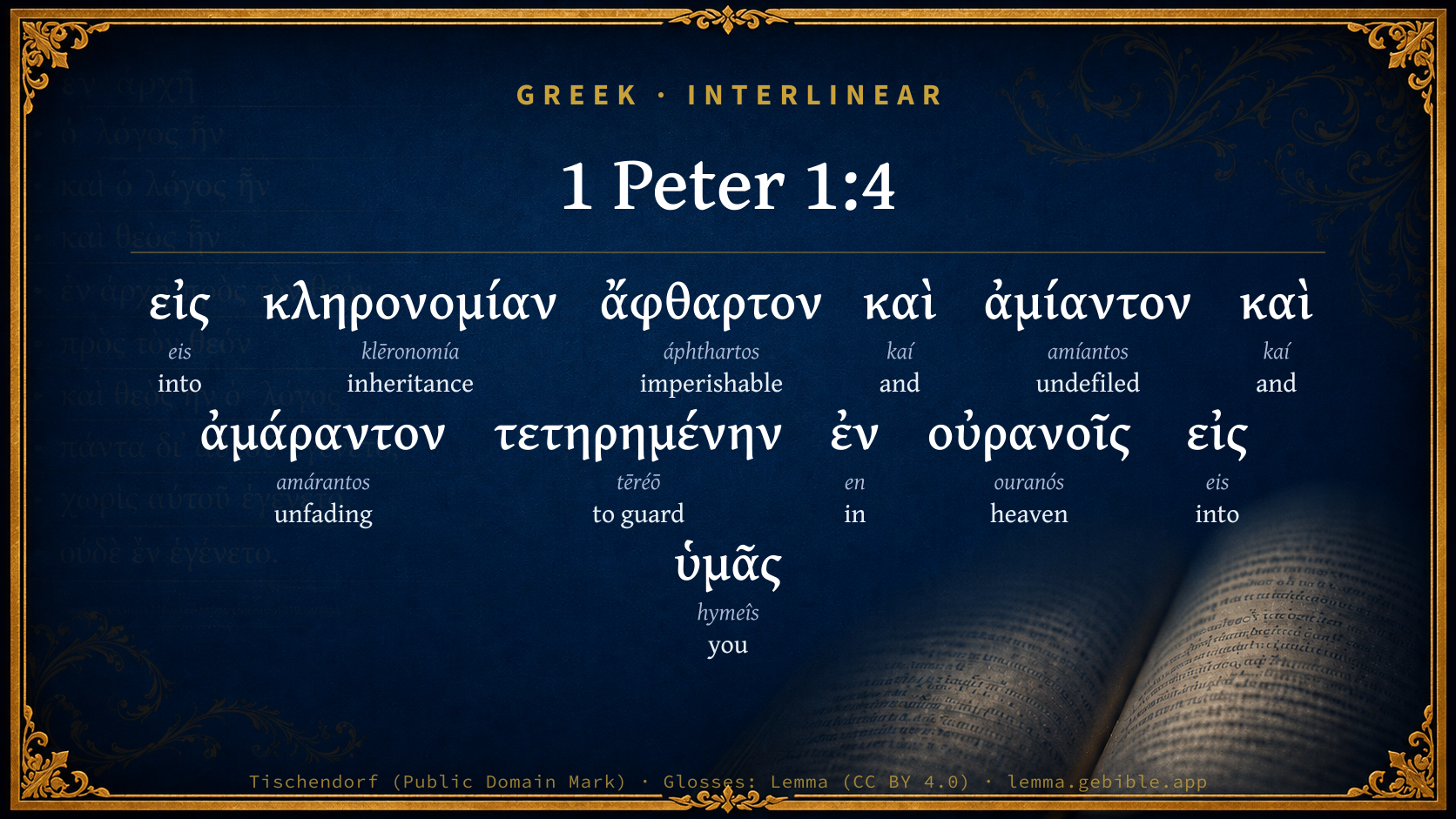
Download image
Cite this verse

1 Peter 1:4 (World English Bible). Public Domain. Lemma interlinear Bible study tool, https://lemma.gebible.app/v/1-peter/1/4.

Show BibTeX & RIS
BibTeX
RIS
English Translation
to an incorruptible and undefiled inheritance that doesn't fade away, reserved in heaven for you,
World English Bible · Public Domain
Highlights
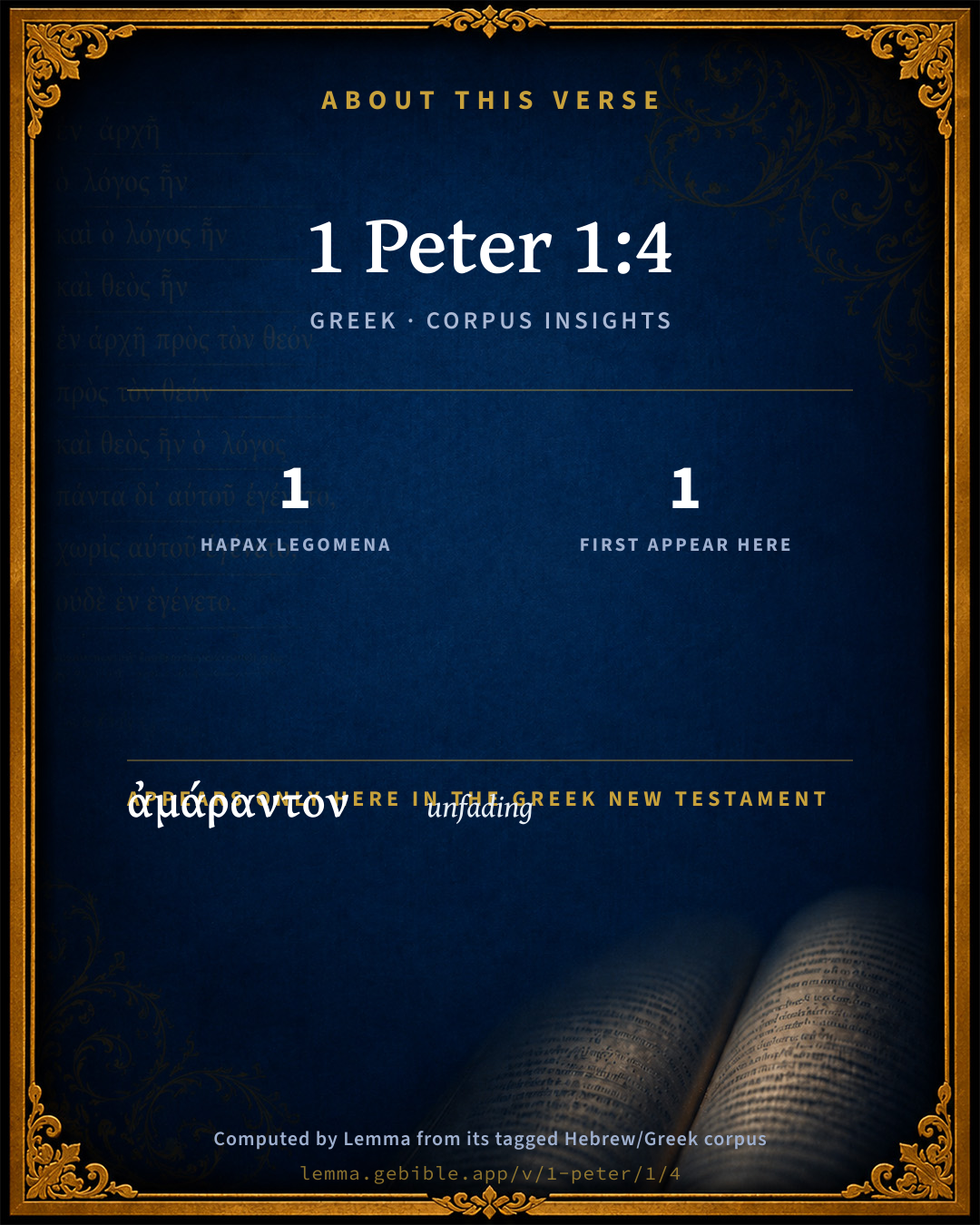
  • 1 hapax legomenon — only here in the Greek New Testament
  • 1 first appearance in the Greek New Testament
Full analysis ↓
Download a study sheet

One document with this verse’s original text, its word-by-word gloss line, the meaning frame, cross-references with their text, attributed commentary, and full source and license credits — printable, and it pastes into notes with its structure intact.

This verse Autodidact and up

Study sheet (.html) Plain text (.txt)

A passage Seminary Student

Up to 50 verses in one chapter. A passage sheet keeps up to 6 commentary sources and 12 cross-references per verse, in the order this page ranks them, and says so on the sheet whenever that leaves anything out. Ask for a single verse and you get the Autodidact verse sheet above.

Everything on this page stays free to read, with no account — the sheet is a download of what is already on screen, not access to it.

Want to remove ads? Support Godless Engineer
Compare translations 3

The same verse in 3 English versions, stacked beneath the original-language interlinear above. Click any original word for its lexicon entry.

Each is an independent rendering of the whole verse — the interlinear is not word-aligned to these translations.

Highlighted words mark where these versions differ — a whole-verse word diff, not a word-by-word alignment.

  • World English Bible Public Domain
    to an incorruptible and undefiled inheritance that doesn't fade away, reserved in heaven for you,
  • King James Version Public Domain
    To an inheritance incorruptible, and undefiled, and that fadeth not away, reserved in heaven for you,
  • unfoldingWord Literal Text CC BY-SA 4.0
    into an imperishable and undefiled and unfading inheritance, having been kept in heaven for you,

unfoldingWord Literal Text — © unfoldingWord, licensed CC BY-SA 4.0. Word-aligned USFM3 via Door43 (git.door43.org/unfoldingWord/en_ult).

Versions to compare (up to 4)

3 of 4 selected

Show all 19 translations

Every available English version of this verse, each an independent rendering of the whole verse.

  • World English Bible Public Domain
    to an incorruptible and undefiled inheritance that doesn't fade away, reserved in heaven for you,
  • Berean Standard Bible Public Domain
    and into an inheritance that is imperishable, undefiled, and unfading, reserved in heaven for you,
  • Majority Standard Bible Public Domain
    and into an inheritance that is imperishable, undefiled, and unfading, reserved in heaven for you,
  • King James Version Public Domain
    To an inheritance incorruptible, and undefiled, and that fadeth not away, reserved in heaven for you,
  • American Standard Version (1901) Public Domain
    unto an inheritance incorruptible, and undefiled, and that fadeth not away, reserved in heaven for you,
  • Revised Version (1885) Public Domain
    unto an inheritance incorruptible, and undefiled, and that fadeth not away, reserved in heaven for you,
  • Geneva Bible (1599) Public Domain
    To an inheritance immortall and vndefiled, and that withereth not, reserued in heauen for vs,
  • Douay-Rheims (1899) Public Domain
    Unto an inheritance incorruptible, and undefiled, and that can not fade, reserved in heaven for you,
  • Young's Literal Translation Public Domain
    to an inheritance incorruptible, and undefiled, and unfading, reserved in the heavens for you,
  • Literal Standard Version CC BY-SA 4.0
    to an incorruptible inheritance, and undefiled, and unfading, reserved for you in the heavens,
  • Unlocked Literal Bible CC BY-SA 4.0
    This is for an inheritance that will not perish, will not become stained, and will not fade away. It is reserved in heaven for you.
  • unfoldingWord Literal Text CC BY-SA 4.0
    into an imperishable and undefiled and unfading inheritance, having been kept in heaven for you,
  • Darby Bible Public Domain
    to an incorruptible and undefiled and unfading inheritance, reserved in [the] heavens for you,
  • World Messianic Bible Public Domain
    to an incorruptible and undefiled inheritance that doesn’t fade away, reserved in Heaven for you,
  • Webster's Bible Public Domain
    To an inheritance incorruptible, and undefiled, and that fadeth not away, reserved in heaven for you,
  • Free Bible Version CC BY-SA 4.0
    This inheritance is eternal, it never spoils or fades, and it is kept safe in heaven for you.
  • Bible in Basic English Public Domain
    And a heritage fair, holy and for ever new, waiting in heaven for you,
  • Text-Critical English NT CC BY 4.0
    to an inheritance that is imperishable, undefiled, and unfading, reserved in heaven for you,
  • Tyndale New Testament (1534) Public Domain
    to enioye an inheritaunce immortall and vndefiled and that purifieth not reserved in heven for you

Literal Standard Version (2020), Covenant Press — licensed CC BY-SA 4.0. Text via the HelloAO Bible API (eBible.org). Unlocked Literal Bible (unfoldingWord) — licensed CC BY-SA 4.0. Text via the HelloAO Bible API (eBible.org). unfoldingWord Literal Text — © unfoldingWord, licensed CC BY-SA 4.0. Word-aligned USFM3 via Door43 (git.door43.org/unfoldingWord/en_ult). Free Bible Version, Dr. Jonathan Gallagher — licensed CC BY-SA 4.0. Text via the HelloAO Bible API (eBible.org).

Word by word

More ways to search: Search by grammar → Find every occurrence → Compare this word →

Practice this passage: Drill this verse → Learn its vocabulary →

About this verse

These counts appear in no published source. They are computed here, from the morphology-tagged text and Lemma’s own curated glosses. What Lemma adds →

12
words
10
distinct lemmas
General Epistles
section

Notable vocabulary

1 hapax legomenon — a word that appears only here in the entire Greek New Testament:

  • ἀμάραντον unfading G263

First appearance in Scripture

This word makes its first canonical appearance in the Greek New Testament here:

  • ἀμάραντον unfading G263

Shared distinctive vocabulary

ἀμίαντον undefiled G283 occurs in 4 verses of the Greek New Testament. Also found in:
Repetition

Words recur within this verse:

Cross-references

22

Topical passages linked to 1 Peter 1:4 in the Treasury of Scripture Knowledge — connected by theme and wording, ordered by reader-vote popularity; previews shown in the World English Bible.

  • Revelation 21:27 There will in no way enter into it anything profane, or one who causes an abomination or a lie, but only those who are written in the Lamb's book of life.
  • Hebrews 9:15 For this reason he is the mediator of a new covenant, since a death has occurred for the redemption of the transgressions that were under the first covenant, that those who have been called may receive the promise of the eternal inheritance.
  • 1 Peter 5:4 When the chief Shepherd is revealed, you will receive the crown of glory that doesn't fade away.
  • 2 Timothy 4:8 From now on, there is stored up for me the crown of righteousness, which the Lord, the righteous judge, will give to me on that day; and not to me only, but also to all those who have loved his appearing.
  • Matthew 25:34 Then the King will tell those on his right hand, 'Come, blessed of my Father, inherit the Kingdom prepared for you from the foundation of the world;
  • Colossians 1:5 because of the hope which is laid up for you in the heavens, of which you heard before in the word of the truth of the Gospel,
  • Isaiah 40:7–8 The grass withers, the flower fades, because the breath of Yahweh blows on it; surely the people is grass.
  • Ezekiel 47:12 By the river on the bank of it, on this side and on that side, shall grow every tree for food, whose leaf shall not wither, neither shall the fruit of it fail: it shall bring forth new fruit every month, because the waters of it issue out of the sanctuary; and the fruit of it shall be for food, and the leaf of it for healing.
  • Romans 8:17 and if children, then heirs; heirs of God, and joint-heirs with Christ; if indeed we suffer with him, that we may also be glorified with him.
  • Ephesians 1:11 in whom also we were assigned an inheritance, having been foreordained according to the purpose of him who works all things after the counsel of his will;
  • Ephesians 1:18 having the eyes of your hearts enlightened, that you may know what is the hope of his calling, and what are the riches of the glory of his inheritance in the saints,
  • Psalms 31:19 Oh how great is your goodness, Which you have laid up for those who fear you, Which you have worked for those who take refuge in you, Before the sons of men!
  • Acts 20:32 Now, brothers, I entrust you to God, and to the word of his grace, which is able to build up, and to give you the inheritance among all those who are sanctified.
  • Acts 26:18 to open their eyes, that they may turn from darkness to light and from the power of Satan to God, that they may receive remission of sins and an inheritance among those who are sanctified by faith in me.'
  • Ephesians 1:14 who is a pledge of our inheritance, to the redemption of God's own possession, to the praise of his glory.
  • 1 Corinthians 9:25 Every man who strives in the games exercises self-control in all things. Now they do it to receive a corruptible crown, but we an incorruptible.
  • 1 Corinthians 15:52–54 in a moment, in the twinkling of an eye, at the last trumpet. For the trumpet will sound, and the dead will be raised incorruptible, and we will be changed.
  • Galatians 3:18 For if the inheritance is of the law, it is no more of promise; but God has granted it to Abraham by promise.
  • Colossians 1:12 giving thanks to the Father, who made us fit to be partakers of the inheritance of the saints in light;
  • Colossians 3:3–4 For you died, and your life is hidden with Christ in God.
  • James 1:11 For the sun arises with the scorching wind, and withers the grass, and the flower in it falls, and the beauty of its appearance perishes. So also will the rich man fade away in his pursuits.
  • 1 Peter 3:9 not rendering evil for evil, or reviling for reviling; but instead blessing; knowing that to this were you called, that you may inherit a blessing.

Cross-references courtesy of OpenBible.info (CC BY 4.0).

Where the printed editions differ

1 variant

Places in this verse where the major printed Greek editions disagree on the wording in a way that affects the translation — a comparison of editions, not a manuscript-by-manuscript collation. The editions are the modern critical texts (Nestlé-Aland 28/27, SBL, Westcott-Hort, Tregelles, Tyndale House) and the traditional texts behind the KJV (the Textus Receptus and the Byzantine/Majority text). It is not a claim about which reading is original.

  1. Different wording
    ὑμᾶς

    “you”

    In NA28NA27TynSBLWHTregByzKJV Not in TR

    ἡμᾶς (hēmas) 'us' occurs in a few manuscripts (TR) instead of ὑμᾶς (humas) 'you' in older manuscripts (NA28+NA27+Tyn+SBL+WH+Treg+Byz+KJV)

Textual data: Translators Amalgamated Greek New Testament (STEPBible TAGNT) · CC BY 4.0.

Commentary

Notes on 1 Peter 1:4 from classic Christian and Jewish commentators (each source and its license shown beneath its notes). The classic Christian expositions comment on the surrounding passage and are grouped to its opening verse, so a note may address several verses; the Jewish commentaries on the Tanakh (Rashi and others) are per-verse, so they appear only where the commentator wrote on this verse.

Lemma curates 59 commentaries, every one of them public domain or Creative Commons licensed, each selected and text-cleaned for this edition rather than reprinted as found. About our sources →

Tyndale Open Study Notes

Tyndale Open Resources

1:4 The language of inheritance frequently refers to what God has promised his people. Originally applied to the land of Israel (see Deut 3:28), the inheritance came to mean the people of God and God’s presence with them (see Ps 33:12; Ezek 44:28). In the New Testament, the inheritance is the spiritual benefit and eternal salvation that God promises to his people (see Eph 1:11; Heb 9:15).

Tyndale Open Study Notes — © Tyndale Open Resources, licensed CC BY-SA 4.0. Text via the HelloAO Bible API.

Bengel's Gnomon

Johann Albrecht Bengel

1Pe 1:4. Κληρονομίαν, an inheritance) They who are sons by regeneration, are heirs. He treats of this inheritance also, ch. 1Pe 3:7; 1Pe 3:9.—ἄφθαρτον, incorruptible) For it is a divine inheritance.—ἀμίαντον, undefiled[3]) For no impure person, however closely related, is a joint-heir.—ἀμάραντον, free from decay) For the heirs themselves are not subject to decay, they do not die. Peter delights to accumulate synonymous words; 1Pe 1:7-8; 1Pe 1:19; 1Pe 5:10.—τετηρημένην, kept) from the beginning. Comp. 1Pe 1:10. The same word occurs, Joh 17:12. Comp. also Joh 2:10.—ἐν οὐρανοῖς, in heaven) In the power of God.—εἰς ὑμᾶς, unto or for you) who are alive at this time.

[3] No defiled person, though of the number of those who are akin to the Lord as to external privileges (as the Jews were), is a co-heir. The “Proximi” are here opposed to the “filii, regeniti,” who are ipso facto “pure and undefiled.”—T.

Bengel's Gnomon of the New Testament — English translation (T&T Clark, Edinburgh, 1860) — public domain. Text from a community e-Sword module.

Meyer's Critical & Exegetical Commentary

Heinrich August Wilhelm Meyer

1Pe_1:4. εἰς κληρονομίαν] co-ordinate with the conception ἐλπίδα; it is nevertheless not dependent on it, but on ἀναγεννήσας, although it denotes the objective blessing to which the ἐλπίς has regard. It is added by way of apposition, in order to describe more nearly the substance of the hope with respect to its aim.

κληρονομία means, no doubt, in the O. and N. T. (Mat_21:38; Luk_12:13) sometimes inheritance; but more frequently it has the signification of possession. In the O. T. it often serves to denote the land of Canaan and its separate parts, promised and apportioned to the people of Israel (Deu_12:9; Lam_5:2; Jos_13:14, and other passages): ἡ γῆ, ἣν κύριος ὁ θεός σου δίδωσί σοι ἐν κλήρῳ, Deu_24:2, or ἣν … δίδωσί σοι κληρονομῆσαι. In the N. T., and so here also, by the term is to be understood the completed βασιλεία τοῦ Θεοῦ with all its possessions, as the antitype of the land of Canaan (cf. in particular, Heb_9:15). As this use of the word is not based on the signification inheritance, it cannot be maintained, with Wiesinger (Schott agreeing with him), that κληρονομία stands here with reference to ἀναγεννήσας, to designate that of which the Christians as children of God have expectations.[51] The following words: ἄφθαρτον καὶ ἀμίαντον καὶ ἀμάραντον] state the gloriousness of the κληρονομία.[52] ἄφθαρτος (cf. chap. 1Pe_3:4), opposite of φθαρτός (1Pe_1:18 equal to ἀπολλύμενος, 1Pe_1:7), cf. 1Pe_1:23; Rom_1:23; 1Co_9:25; 1Co_15:53-54; not subject to the φθορά. ἀμίαντος (Jam_1:27; Heb_7:26), undefiled, undefilable. ἀμάραντος ἅπ. λεγ. (ἀμαράντινος is similar, chap. 1Pe_5:4), unfading; in the last expression prominence is given to the imperishable beauty of the κληρονομία. Steinmeyers opinion is incorrect, that ἀ μίαντος has nearly the same meaning as πολύτιμος and τίμιος, 1Pe_1:19.

It is not to be assumed that Peter alludes to the character of the earthly κληρονομία (Weiss, p. 74) of the people of Israel, especially as there is nothing in the expressions ἀμάραντος and ἄφθαρτος which can without artificial straining admit of such a reference.[53]

ΤΕΤΗΡΗΜΈΝΗΝ ἘΝ ΟὐΡΑΝΟῖς ΕἸς ὙΜᾶς] The apostle having up to this time spoken generally, makes a transition, and addresses his readers directly: ἈΝΑΓΕΝΝ. ἩΜᾶς; he thereby assures them that that ΚΛΗΡΟΝΟΜΊΑ is a possession intended and reserved for them. For the conception here expressed, cf. especially Col_1:5, and Meyer in loc. The perf. τετηρημένην (Luth. inexactly: which is kept) stands here with reference to the nearness of the time when their κληρονομία will be allotted to believers; 1Pe_1:5 : ἙΤΟΊΜΗΝ ἈΠΟΚΑΛΥΦΘῆΝΑΙ.[54]

[51] No doubt Rom_8:17 might be appealed to in support of this interpretation, yet it would be unwarrantable to maintain that the idea there expressed belongs also to Peter. It must also be observed that even Paul, where he makes use of the term κληρονομία, never alludes to that idea,a circumstance which has its reason in the current usage of the word.

[52] Calvin inaccurately: tria epitheta quae sequuntur ad gratiae Dei amplificationem posita sunt.

[53] In ἀμίαντος, Weiss sees an allusion to the pollution of Judea by the people of Israel itself or its enemies (Jer_2:7; Lev_18:28; Num_35:34; Eze_36:17; Psa_79:1, where the LXX. has μιαίνειν); and in ἀμάραντος to the scorching of the country by the simoom. Weiss thinks that ἄφθαρτος may allude to the φθείρειν τὴν γῆν, Isa_24:3; still he himself does not consider this probable.

[54] Hofmann, in disputing this by saying that the perf. partic. is not explained by the nearness of the time when the believers will be in possession of the inheritance, calls in question an assertion which is nowhere here made.

Meyer — Critical and Exegetical Commentary on the New Testament — English translation by Peter Christie, edited by Frederick Crombie (T&T Clark, 1880) — public domain. Text from a community e-Sword module.

Expositor's Greek Testament

ed. W. Robertson Nicoll

1Pe 1:4 . εἰς κληρ … ἀμάραντον , as God’s sons in virtue of their regeneration they are God’s heirs (Gal 4:7 ) and have an heavenly inheritance. The accumulated adjectives recall various images employed to describe it and emphasise the fact that it is eternal (Heb 9:15 ) and spiritual. It is ἄφθαρτον , incorruptible ( cf. 1Pe 1:23 , 1Pe 3:4 ) because it belongs to the future life which the risen dead (1Co 15:52 ) share with God Himself (Rom 1:23 ; 1Ti 1:17 ). It is set where “moth doth not corrupt ( διαφθείρει , Luk 12:33 : Mat 6:19 ff. has ἀφανίζει ),” apart from this corruptible world ( cf. Isa 24:3 ). It is the incorruptible crown (1Co 9:25 ). The second epithet ἀμίαντον is applied to the great High Priest, Heb 7:26 ( cf. Heb 13:4 ; Jas 1:27 ) and implies again separation from this sinful world of which it is written ἐμιάνατε τὴν γῆν μου καὶ τὴν κληρονομίαν μου ἔθεσθε εἰς βδέλυγμα (Jer 2:7 ). Compare the description of virtue in Sap. 1Pe 4:2 , στεφανηφοροῦσα πομπεύει τὸν τῶν ἀμιάντων ἄθλων ἀγῶνα νικήσασα . ἀμάραντον is peculiar to 1 Peter in N.T., cf. ἀμαράντινον (1Pe 1:4 ): it is perhaps derived from Sap. 6:12, ἀμάραντός ἐστιν ἡ σοφία , and thus presupposes the identification of eternal life with knowledge of God (Joh 17:3 ). Compare the application of Isa 40:6 f. (cited infra 24) in Jas 1:11 . All three suit or are associated with the wreath presented to the victor in the games a metaphor which the Lord Himself used according to the Apocalypse (1Pe 2:10 , cf. 1Pe 5:4 ; Jas 1:12 ). Origen (?) in Cramer’s Catena notes that the words contradict Chiliasm. τετηρημένην εἰς ὑμᾶς , reserved (1) with a view to you, cf. Joh 12:7 , ἵνα εἰς τὴν ἡμέραν … τηρήσῃ , 2Pe 2:4 , εἰς κρίσιν τηρουμένους ; for same use of εἰς in similar context see Rom 8:18 . (2. until you came a sense which would suit the other examples of τηρεῖν εἰς . (3) … for you , εἰς = ל = dative (so Syriac), the writer or translator being influenced by εἰς above and below. The inheritance is still, as it has always been, kept back, but the Christians are sure to succeed to it. So Enoch refers to the secrets of the righteous which shall be revealed (xxxviii. 3); the lot of the righteous which the Son of Man preserves (xlviii. 7); and says Blessed are ye ye righteous and elect for glorious will be your lo … it will be said to the holy that they should seek in heaven the secrets of righteousness the heritage of faith (lviii. 5).

The Expositor's Greek Testament, edited by W. Robertson Nicoll (1897–1910) — public domain. Text from a community e-Sword module.

Jamieson, Fausset & Brown

Robert Jamieson, A. R. Fausset & David Brown

To an inheritance--the object of our "hope" (Pe1 1:3), which is therefore not a dead, but a "living" hope. The inheritance is the believer's already by title, being actually assigned to him; the entrance on its possession is future, and hoped for as a certainty. Being "begotten again" as a "son," he is an "heir," as earthly fathers beget children who shall inherit their goods. The inheritance is "salvation" (Pe1 1:5, Pe1 1:9); "the grace to be brought at the revelation of Christ" (Pe1 1:13); "a crown of glory that fadeth not away."

incorruptible--not having within the germs of death. Negations of the imperfections which meet us on every side here are the chief means of conveying to our minds a conception of the heavenly things which "have not entered into the heart of man," and which we have not faculties now capable of fully knowing. Peter, sanguine, impulsive, and highly susceptible of outward impressions, was the more likely to feel painfully the deep-seated corruption which, lurking under the outward splendor of the loveliest of earthly things, dooms them soon to rottenness and decay.

undefiled--not stained as earthly goods by sin, either in the acquiring, or in the using of them; unsusceptible of any stain. "The rich man is either a dishonest man himself, or the heir of a dishonest man" [JEROME]. Even Israel's inheritance was defiled by the people's sins. Defilement intrudes even on our holy things now, whereas God's service ought to be undefiled.

that fadeth not away--Contrast Pe1 1:24. Even the most delicate part of the heavenly inheritance, its bloom, continues unfading. "In substance incorruptible; in purity undefiled; in beauty unfading" [ALFORD].

reserved--kept up (Col 1:5, "laid up for you in heaven," Ti2 4:8); Greek perfect, expressing a fixed and abiding state, "which has been and is reserved." The inheritance is in security, beyond risk, out of the reach of Satan, though we for whom it is reserved are still in the midst of dangers. Still, if we be believers, we too, as well as the inheritance, are "kept" (the same Greek, Joh 17:12) by Jesus safely (Pe1 1:5).

in heaven--Greek, "in the heavens," where it can neither be destroyed nor plundered. It does not follow that, because it is now laid up in heaven, it shall not hereafter be on earth also.

for you--It is secure not only in itself from all misfortune, but also from all alienation, so that no other can receive it in your stead. He had said us (Pe1 1:3); he now turns his address to the elect in order to encourage and exhort them.

Jamieson, Fausset & Brown — Commentary Critical and Explanatory on the Whole Bible (1871) — public domain (CC PDM 1.0). Text via the HelloAO Bible API.

Adam Clarke's Commentary

Verse 4. To an inheritance] Called an inheritance because it belongs to the children of God. Eternal life cannot be a gift to any but these; for, even in heaven, the lot is dealt out according to law: if children, then heirs; if not children, then not heirs.

Incorruptible] αφθαρτον. It has no principles of dissolution or decay in it; and, therefore, must be totally different from this earth.

Undefiled] αμιαντον. Nothing impure can enter it; it not only has no principles or seeds of dissolution in itself, but it can never admit any; therefore its deterioration is impossible.

Fadeth not away] αμαρνατον. It cannot wither, it is always in bloom; a metaphor taken from those flowers that never lose their hue nor their fragrance. From the Greek αμαραντος we have our flowers called amaranths, because they preserve their hue and odour for a long time.

Reserved in heaven] Such a place as that described above is not to be expected on earth; it is that which was typified by the earthly Canaan, and in reference to which the patriarchs endured all trials and difficulties in this life, as seeing Him who is invisible.

Adam Clarke's Commentary on the Bible (1810–1826) — public domain. Text from a community e-Sword/MySword module.

John Calvin's Commentaries

4 To an inheritance The three words which follow are intended to amplify God’s grace; for Peter (as I have before said) had this object in view, to impress our minds thoroughly as to its excellency. Moreover, these two clauses, “to an inheritance incorruptible,” etc., and “to salvation ready to be revealed,” I deem as being in apposition, the latter being explanatory of the former; for he expresses the same thing in two ways.

Every word which follows is weighty. The inheritance is said to be reserved, or preserved, that we may know that it is beyond the reach of danger. For, were it not in God’s hand, it might be exposed to endless dangers. If it were in this world, how could we regard it as safe amidst so many changes? That he might then free us from every fear, he testifies that our salvation is placed in safety beyond the harms which Satan can do. But as the certainty of salvation can bring us but little comfort, except each one knows that it belongs to himself, Peter adds, for you For consciences will calmly recumb here, that is, when the Lord cries to them from heaven, “Behold, your salvation is in my hand and is kept for you.” But as salvation is not indiscriminately for all, he calls our attention to faith, that all who are endued with faith, might be distinguished from the rest, and that they might not doubt but that they are the true and legitimate heirs of God. For, as faith penetrates into the heavens, so also it appropriates to us the blessings which are in heaven.

John Calvin's Commentaries (1540-1563) — public domain. Text from the Calvin Translation Society English edition (1840s-50s) via the Christian Classics Ethereal Library (ccel.org). Calvin's coverage is partial (roughly two-thirds of the Bible); uncommented books and verses are honest gaps, never fabricated. The 19th-century editor's footnotes and remarks are omitted so the notes are faithfully Calvin's own voice.

Ellicott's Commentary for English Readers

(4) To an inheritance.—This is structurally parallel to and explanatory of, the clause “into a living hope” We are, as the saying is, born to an estate. This notion of an “inheritance,” or property, that we have come in for, is particularly Hebrew, occurring very frequently in the Old Testament. The Pontine dispersion had lost their “inheritance” in Palestine, but there is a better in store for them.

Incorruptible, and undefiled, and that fadeth not away.—Exuberant description of the excellencies of the new Canaan. The first epithet contrasts its imperishable nature (see Rom_1:23; 2Ti_1:10) with the fleeting tenure of the earthly Canaan. The second speaks of its freedom from pollutions such as desecrated the first “Holy Land.” Perhaps it may specially mean that the new Holy Land will never be profaned by Gentile incursions and tyrannies. The third, and most poetical of all (which is only found besides in Wis_6:12), conveys the notion of the unchanging beauty of that land—no winter ill the inheritance to which the Resurrection brings us (Son_2:11).

Reserved—The perfect tense, which hath been reserved unto you, i.e., either in the temporal sense—“kept all this while until you came,” or “with a view to you.” (Comp. Heb_11:40.) He now adds explicitly that it is no earthly, but a heavenly possession.

A Bible Commentary for English Readers, edited by Charles John Ellicott (1878–1897) — public domain. Text from a community e-Sword module.

The Cambridge Bible for Schools and Colleges

gen. ed. J. J. S. Perowne

4. to an inheritance incorruptible] The clause is co-ordinate with the preceding and depends upon the word “begotten.” The idea of the “inheritance” is again essentially Pauline (Act_20:32, Gal_3:18, Eph_1:14; Eph_1:18 and elsewhere). The epithets attached to the word distinguish it from any earthly inheritance, such as had been given to Israel (Act_7:5), and agree with the “everlasting inheritance” of Heb_9:15. Here it answers to the completed “salvation” of the next verse, of which we get glimpses and foretastes here, but which is reserved in its fulness in and for the region of the eternal. In that inheritance there is nothing that mars, nothing that defiles (Rev_21:27), nothing that fades away, as the flower of the field fadeth (Jas_1:10-11). The two latter adjectives (amiantos, amarantos) have in the Greek an impressive assonance which cannot be reproduced in English.

for you] Some MSS. give “for us,” but this was probably a correction due to the use of the first person in the preceding verse, and the present text, which rests on the authority of the best MSS., is like St Paul’s changes from the first person to the second (as in Rom_7:4-5, Eph_2:13-14), the natural expression of the feeling of the Apostle that what he hopes and believes for himself, he hopes and believes also for those to whom he writes.

The Cambridge Bible for Schools and Colleges (gen. ed. J. J. S. Perowne; Cambridge University Press, 1878–1918) — public domain. Text from a community e-Sword module.

John Gill's Exposition

To an inheritance incorruptible,.... This is a further explanation of the "lively hope", or hope laid up in heaven, which regenerate ones are begotten to: it is an "inheritance"; a large estate, and rich possession, they are born heirs apparent to; what is not to be got by industry, or obtained by the works of the law; for they that are of the law are not heirs; but what is the pure bequest and free gift of God, as a Father to his children; for an inheritance is proper and peculiar to children, nor does it belong to any but them; and it comes to them through the death of the testator, Christ, and of it the Holy Spirit is the pledge and earnest: and here it is said to be

incorruptible; it is free from corruption in itself; nor can it be corrupted by others, by moth, or rust, or other things, as gold, silver, and garments may, which are a part of earthly inheritances; nor can it be enjoyed by corrupt persons, either corrupted with sin, or clothed with frailty and mortality; wherefore, in order to inherit it, corruption must put on incorruption, in every sense; other epithets and commendations of it follow:

and undefiled; it is in its own nature pure and holy, and free from any defilement of sin; nor are there any of those impurities in it which Jews and Mahometans dream of in their vainly expected earthly paradise; nor will it be possessed by any but undefiled persons, such as are made so through the blood and righteousness of Christ:

and that fadeth not away; as do world, and the glory of it, and all inheritances and possessions in it; here is no continuing city, but there is one to come; in this inheritance are durable riches, everlasting habitations, an house eternal in the heavens, glories in it that will never wither and die, and pleasures which will never end, and which will be enjoyed without decrease or loathing:

reserved in heaven for you; the Alexandrian copy reads, "for us"; and the Ethiopic version renders it, "for us and you"; for all the saints; for all who are the elect, according to the foreknowledge of God, and who are begotten again to a lively hope; for these this inheritance is prepared, laid up, and secured in the hands or Christ their feoffee, who has it in trust for them, and with whom they are co-heirs; and it is safe for them "in heaven"; out of the reach of men and devils: this serves both to commend the inheritance, to set forth the excellency of it, lying in such a place as heaven; for the situation of an inheritance adds oftentimes to the valuableness of it; and also the safety and security of it; it is safe, being in heaven, and more so as it is in Christ's hands there. The Jews are wont to call the future state an inheritance of the land of the living: they say (u).

"this is called "an inheritance"; and add, but in this world a man has no inheritance, nor continuance;

so they interpret that phrase, "by the God of thy father", in Gen 49:25 thus (w).

"this is "the inheritance" of the superior place, which is called "heaven";

and sometimes they style it , "the superior inheritance", or "the inheritance above" (x); all which agrees with Peter's language,

(u) Tzeror Hammor, fol. 150. 3. (w) Zohar in Gen. fol. 131. 2. (x) Zohar in Exod. fol. 34. 3.

John Gill's Exposition of the Whole Bible (1746–1763) — public domain (CC PDM 1.0). Text via the HelloAO Bible API.

Trapp's Complete Commentary

John Trapp

4 To an inheritance incorruptible, and undefiled, and that fadeth not away, reserved in heaven for you,

Ver. 4. Undefiled, and that fadeth not] The two Greek words here used are also Latin; Amiantus is a precious stone (saith Dr Playfere out of Isidore), which though it be never so much soiled, yet it cannot be blemished. And Amaranthus is the name of a flower, which being a long time hung up in the house, yet still is fresh and green, as Clemens writeth (Paedagog. p. 8). To both these possibly the apostle might here allude: and it is as if he should say, The crown that you shall receive shall be studded with the stone Amiantus, which cannot be defiled; and it is garnished with the flower Amaranthus, which is fresh and green, &c.

John Trapp, A Commentary or Exposition upon All the Books of the Old and New Testament (1647–1656) — public domain. Text from a community e-Sword module.

Albert Barnes' Notes on the Bible

To an inheritance - Through the resurrection of the Lord Jesus we now cherish the hope of that future inheritance in heaven. On the word inheritance, see the Act 20:32 note; Eph 1:11, Eph 1:14, Eph 1:18 notes; Col 1:12 note. Christians are regarded as the adopted children of God, and heaven is spoken of as their inheritance - as what their Father will bestow on them as the proof of his love.

Incorruptible - It will not fade away and vanish, as that which we inherit in this world does. See the word explained in the notes at 1Co 9:25. The meaning here is, that the inheritance will be imperishable, or will endure forever. Here, to whatever we may be heirs, we must soon part with the inheritance; there it will be eternal.

And undefiled - See the Heb 7:26; Heb 13:4 notes; Jam 1:27 note. The word does not elsewhere occur in the New Testament. As applied to an inheritance, it means that it will be pure. It will not have been obtained by dishonesty, nor will it be held by fraud; it will not be such as will corrupt the soul, or tempt to extravagance, sensuality, and lust, as a rich inheritance often does here; it will be such that its eternal enjoyment will never tend in any manner to defile the heart. “How many estates,” says Benson, “have been got by fraudulent and unjust methods; by poisoning, or in some other way murdering the right heir; by cheating of helpless orphans; by ruining the fatherless and widows; by oppressing their neighbors, or grinding the faces of the poor, and taking their garments or vineyards from them! But this future inheritance of the saints is stained by none of these vices; it is neither got nor detained by any of these methods; nor shall persons polluted with vice have any share in it.” Here no one can be heir to an inheritance of gold or houses without danger of soon sinking into indolence, effeminacy, or vice; there the inheritance may be enjoyed forever, and the soul continually advance in knowledge, holiness, and the active service of God.

And that fadeth not away - Greek ἀμάραντον amaranton. This word occurs nowhere else in the New Testament, though the word ἀμαράντινος amarantinos occurs in 1Pe 5:4, applied to a crown or garland. The word is properly applied to that which does not fade or wither, in contradistinction from a flower that fades. It may then denote anything that is enduring, and is applied to the future inheritance of the saints to describe its perpetuity in all its brilliance and splendor, in contrast with the fading nature of all that is earthly. The idea here, therefore, is not precisely the same as is expressed by the word “incorruptible.” Both words indeed denote perpetuity, but that refers to perpetuity in contrast with decay; this denotes perpetuity in the sense that everything there will be kept in its original brightness and beauty. The crown of glory, though worn for millions of ages, will not be dimmed; the golden streets will lose none of their luster; the flowers that bloom on the banks of the river of life will always be as rich in color, and as fragant, as when we first beheld them.

Reserved in heaven for you - Margin, “us.” The difference in the text and the margin arises from the various readings in mss. The common reading is “for you.” The sense is not materially affected. The idea is, that it is an inheritance appointed for us, and kept by one who can make it sure to us, and who will certainly bestow it upon us. Compare the Mat 25:34 note; Joh 14:2 note; Col 1:5 note.

Albert Barnes' Notes on the Bible (1834–1885) — public domain. Text from a community e-Sword/MySword module.

Haydock's Catholic Bible Commentary

Reserved in heaven for you. Literally, in you; that is, it is also in you by reason of that lively faith and hope, which is in you, of enjoying Christ. (Witham)

George Leo Haydock (1774–1849), Haydock's Catholic Family Bible and Commentary, 1859 edition — public domain. Excludes Psalms (Douay-Rheims chapter numbering differs from Protestant) and Deuterocanonical books (Catholic canon only).

Matthew Poole's English Annotations

To an inheritance; so eternal life is called, Eph 1:18, and elsewhere, as being given not as wages to hirelings, but as an inheritance to children born of God, and adopted to him.

Incorruptible; immortal, everlasting, which being once possessed, cannot be taken away, nor pass over to others.

And undefiled; both as being pure in itself, and having nothing to offend them that enjoy it; and likewise as being incapable of any pollution or defilement, contrary to what is said of the land of Canaan, the earthly inheritance of the Israelites, Jer 2:7; Eze 36:17.

And that fadeth not away; always retains its vigour and gratefulness, never causes weariness or satiety in them that possess it. It seems to be a metaphor taken from flowers, probably the amaranthus, (the very word here used), which still keeps its freshness and verdure, without any decay or withering.

Reserved; laid up, Col 1:5; 2Ti 4:8; secured for the heirs, though not yet possessed by them.

In heaven; and therefore safe, and out of the reach of enemies. This is opposed to the uncertain condition of earthly possessions, such as Canaan was.

For you; margin, for us, viz. whom God hath begotten again: or if we read it, as in the text, for you, the apostle may change the person in order to his exhortation.

Matthew Poole's English Annotations on the Holy Bible (1683–1685) — public domain. Text from a community e-Sword/MySword module.

Whedon's Commentary on the Bible

Daniel D. Whedon

4. An inheritance—A second statement of the result of the new birth, showing the corresponding external object of the internal hope. The apostle, himself a Jew, labouring chiefly among the Jews, and writing to Churches largely composed of Jewish Christians, naturally recurs to a Hebrew imagery for the full expression of his thought. The land of Canaan, given to their fathers for an inheritance forever, (Gen_17:8,) had been lost by transgression; but these dispersed, homeless sojourners are now assured of a heavenly country and an eternal home. The inheritance belongs to the children brought by the new birth into the family of God, for, “if children, then heirs.” Rom_8:17. Heaven is a free gift; yet it is bestowed in strict accordance with law. Three negative but gloriously descriptive words represent the character of the inheritance.

Incorruptible—With no spring within of death or evil to induce decay, or corruption, or destruction.

Undefiled—Without spot or stain of sin externally.

Fadeth not—Unlike the quickly withering flower, it remains in perpetual freshness and beauty.

Reserved—Laid up and carefully watched over and guarded.

In heaven—Where the God of glory dwells. The earthly inheritance had been invaded by Assyrians, Babylonians, Egyptians, and Romans; its wealth plundered and its holy places ravaged and destroyed; but the heavenly Canaan is so protected by our glorious Lord that it is absolutely and forever secure.

For you—The change of person from us to you permits a direct impressive assurance of the certainty of the inheritance to the faithful, and an admonition as well to the elect, to take heed that they do not forfeit their election.

Daniel D. Whedon (gen. ed.), Commentary on the Old and New Testaments (1874–1909) — public domain. Text from a community e-Sword module.

The Pulpit Commentary

To an inheritance incorruptible, and undefiled, and that fadeth not away. The Christian"s hope maketh not ashamed. The inheritance is sure; it is better than the inheritance promised to Abraham; for it is

(1) incorruptible. All things earthly have in themselves the seeds of decay and death; but "when this corruptible shall have put on incorruption," the redeemed of the Lord shall receive a kingdom that cannot be moved, where "neither moth nor rust doth corrupt.

(2) It is undefiled. The inheritance of Israel was defiled, (Lev_18:27, Lev_18:28) but into the heavenly inheritance entereth not "anything that defileth". (Rev_21:27)

(3) It fadeth not away. "The grass withereth, the flower falleth away;" it is not so in the "land that is very far off." The crown reserved for its blessed inhabitants is an amaranth wreath. (comp. RAPC Wis 6:13 and 1Pe_5:4, where see note) There are no tendencies to corruption there, no possibilities of defilement, not even that fading which must pass over the fairest things of earth. Reserved in heaven for you. The many mansions in our Father"s house have been kept from the beginning, and still are kept for his elect; Satan cannot rob them of it, as he robbed man of the earthly paradise. Some of the Greek commentators find in the words, "in heaven," an argument against the millenarians. Some manuscripts read "for us," but the received reading is best supported. St. Peter passes from one person to another, as St. Paul often does, sometimes addressing his readers directly, sometimes including himself among them.

The inheritance reserved for the heirs.

The reference to the inheritance is especially appropriate, as following the designation of Christians as "strangers of the dispersion," homeless wanderers in a foreign land. The prospect which made Abraham dwell in tabernacles, and which shone before Israel during the weary years in the desert, is held forth to them here. They have been "begotten... unto an inheritance." Regeneration points to and issues in the possession of it. If children, they are heirs. The new life from Christ makes them "strangers," throwing them out of harmony with the existing order, and it makes them "heirs," giving them a present possession and future heritage in the unseen.

I THE SUBSTANCE OF THE INHERITANCE. There is, no doubt, a reference to Canaan as the promised possession of the wandering Israelites. The true meaning of the word is that of a portion obtained by lot. There is no reference to bequest or succession. No doubt the inheritance is here represented as future, but not exclusively so. The next verse obviously takes "salvation" as equivalent to the "inheritance "of this verse. The two words represent the same reality in two different aspects the one mainly under the negative idea of deliverance from evil, healing from sickness, safety from peril, though it does not altogether exclude the positive element; the other, under the positive idea of a possession which enriches spirit, heart, mind, and all tastes and faculties of a perfected humanity. The underlying reality which brings about both is God. He himself is become our Salvation. He is our Portion, the only Heritage which enriches the soul. We are "heirs of God." Possibly that deepest thought is not to be pressed here, but certainly it is not to be omitted. To keep it ever clearly before us saves us from murmuring at the darkness in which the glories of heaven are wrapped, and from degrading them by taking the emblems such as pearly gates and golden streets, harps, and crowns as more than symbols. Both the inheritance and the salvation belong alike to the present and the future. The one is represented here and now by an earnest; the other is begun to-day, though perfected in heaven. The earnest is of" the same nature as the inheritance. The partial salvation of to-day is essentially the same as the complete salvation of eternity. The faintest streak of morning twilight is the same light from the same sun which at noon floods the sky.

II THE CHARACTERISTICS OF THE INHERITANCE. Our means of forming conceptions of what it is are analogy and contrast with the things of earthly experience. If a chrysalis could think of its butterfly state, it could only picture it as like or unlike its present. So we can only paint the future with colors supplied by the present. And to paint it as the negation of all imperfection, transiency, and limitation, makes it brightest to eyes which smart with weeping, and ache with looking for a good which comes not, or after a vanished joy. It is" incorruptible." All outward possessions have the seeds of dissolution and decay in themselves, or can be decomposed and destroyed by external forces. Perhaps Peter remembered "where moth and rust do not corrupt." Our true treasure, which is truth, righteousness, a full influx of God himself into our hearts, cannot decay. It is" undefiled." Some spot of evil is on all beauty, some flaw in every precious thing, some taint of imperfection or at best some limitation which is a blemish on all that we have or love here. But this is whiter than the driven snow, and purer than the sunlight which flashes on it. It "fadeth not away." The sad stern law that it must droop and shed the glory of its petals rules each fair flower which we gather, and some of them fade all the faster because of the grasp of our hot hands. "But this is a flower which cannot wither." What of God we possess is not parted from its source, but lives his life still, though it dwells in us. Therefore it is woven into an amaranthine garland (Ver. 4), which makes the brow on which it is twined immortal as itself.

III THE RESERVATION OF THE INHERITANCE. It is or rather it has been from of old laid up in the heavens. A remarkable expression, evidently implying that future blessedness is more than "a state," and that it has objective elements which are already in existence in the heavens, even while we who are one day to possess them are toiling and moiling here. We cannot think without incongruity of our "salvation" as being thus stored with God, but we can naturally regard the objective constituents of our future blessedness as being so. The metaphor would be too violent unless the inheritance is a real something which is now in existence, and which is in so far separate from ourselves that we shall one day have it as well as be it. The main idea is that of the security of the inheritance. The Divine hand is working on that side of the veil to keep the inheritance for the heirs, and on this, as the next verse tells us, to keep the heirs for the inheritance. Guarded by his hand, it is safe. "Being in heaven, that calm abode of peace, where changes never come, nor foes climb, nor thieves break through and steal," it is safe. The heirs of earthly inheritances have not seldom found their patrimony wasted when they came to claim it, and their treasure-chests empty when opened. But kept by God, and lodged in heaven, our riches cannot perish. He himself is our Portion. So if we have him for our Treasure, and count his knowledge, his love, his likeness, our heaven on earth and our heaven in heaven, we shall not be without a sufficient allowance to live on as the earnest, nor fail to be "satisfied," when we pass into the higher life, with the wealth which will pour into our souls in the full possession of God. A.M.

The Pulpit Commentary (1880–1919), ed. H.D.M. Spence-Jones & Joseph S. Exell — public domain. Text from a community e-Sword module.

John Wesley's Explanatory Notes

To an inheritance - For if we are sons, then heirs. Incorruptible - Not like earthly treasures. Undefiled - Pure and holy, incapable of being itself defiled, or of being enjoyed by any polluted soul. And that fadeth not away - That never decays in its value, sweetness, or beauty, like all the enjoyments of this world, like the garlands of leaves or flowers, with which the ancient conquerors were wont to be crowned. Reserved in heaven for you - Who "by patient continuance in welldoing, seek for glory and honour and immortality."

John Wesley, Explanatory Notes Upon the Whole Bible (1754–1765) — public domain. Text via the GEBible commentary corpus.

The People's New Testament

B. W. Johnson

4. To an inheritance. The hope is not merely of eternal existence, but we become heirs of God, joint heirs with Christ. An inheritance incorruptible. It can never decay. Undefiled. It is sinless and eternal.

B. W. Johnson's The People's New Testament with Notes (1889–1891) — public domain. Electronic text from the Christian Classics Ethereal Library (CCEL) ThML edition.

Cambridge Greek Testament for Schools and Colleges

4. εἰς κληρονομίαν. The goal to which our hope points forward is the spiritual Canaan, “the lot of our inheritance.” Unlike the earthly Canaan it can never be ravaged by hostile marauders (ἄφθαρτον) or polluted by heathen profanation (ἀμίαντον) nor scorched and withered (ἀμάραντον).

κληρονομία in the O.T. denotes possession rather than heirship. “Originally (S. and H. Rom. p. 204) meaning (i) the simple possession of the Holy Land, it came to mean (ii) its permanent and assured possession (Psalms 25 (24):13; 36 (37):9, 11, etc.); hence (iii) specially the secure possession won by the Messiah (Isa 60:21; Isa 61:7); and so it became a symbol of all Messianic blessings.”

In the N.T. the subst. occurs 13 times and seems primarily to denote possession of an inheritance rather than heirship to a future inheritance. E.g. Act 7:5, God gave Abraham no κληρονομίαν, i.e. present possession in Canaan (but cf. Gal 3:18; Heb 11:8). Eph 1:18, Christians are partakers of the κληρονομία of the Saints in light (i.e. fellow-citizens with the Saints). But as yet we only have an instalment (ἀῤῥαβὼν) of our full inheritance, Eph 1:14; and in Col 3:24, “the reward of the inheritance” is regarded as future.

The verb κληρονομεῖν occurs 18 times, generally in the future, of inheriting (i.e. possessing) the earth, the Kingdom of God, or eternal life. In Mat 25:24 it denotes entering into possession of the Kingdom.

κληρονόμος occurs Evv. (3), St Paul (8), Heb. (3), Jas. (1), and sometimes includes the idea of heirship; but in Galatians 4. Christians are described as heirs who have come of age.

In this passage therefore St Peter probably regards Christians as being already in partial possession of the inheritance so long reserved for them. This idea is included in the statement of the Catechism, “In my Baptism … I was made … an inheritor of the Kingdom of Heaven.”

τετηρημένην … φρουρουμένους. τηρεῖν is to watch or keep safe; (φρουρεῖν to stand sentry over either to prevent escape, as in 2Co 11:32 (where the parallel passage in Act 9:24 has παρατηρεῖν), or to guard against attack, protect. Cf. Php 4:7; Gal 3:23.

Here the perfect participle, τετηρημένην, means that the inheritance destined by God to be extended to the Gentiles (εἰς ὑμᾶς) has been safely laid by in reserve in heaven all through the long years of silence when God’s mercy in including the Gentiles in the covenant was not yet made known (cf. Rom 16:25; Eph 3:5-11; 1Pe 1:11-12). The present participle, φρουρουμένους, describes the present position of Christians as heirs who still need God’s constant protection in order to attain to final salvation.

ἐν οὐρανοῖς suggests another mark of superiority of the Christian’s inheritance as compared with the earthly Canaan.

Cambridge Greek Testament for Schools and Colleges (Cambridge University Press, 1896; 21 vols, various authors incl. Carr, Maclear, Plummer, Farrar, Lumby, Moule, M. R. James, Simcox) — public domain. Text from a community e-Sword module.

Alford’s Greek Testament

Henry Alford

4.] unto (this εἰς, as the former one, depends on ἀναγεννήσας, and is coordinate to the other. It introduces the objective end to which our hope is directed. “Quamdiu peregrinamur, habemus spem vivam: finita peregrinatione, ζῶσα ἐλπίς fit κληρονομία τῆς ἐπαγγελίας.” Steinmeyer, in Wies.) an inheritance (“By κληρονομία (cf. ch. 3:7, 9) is imported the whole fulness of blessings not seen, of which the Christian as a child of God (ἀναγενν. ver. 3) has expectation, cf. Gal 4:7. This inheritance is more closely defined, as σωτηρία (vv. 5, 9), as χάρις, χάρις ζωῆς (ver. 13; ch. 3:7), as δόξα (ch. 5:1), as ἀμαράντινος τῆς δόξης στέφανος (ch. 5:4), or ἡ αἰώνιος τοῦ θεοῦ δόξα (ch. 5:10). The simplest expression for that, which the Apostle calls κληρονομία, is on the one side the χάρις ζωῆς with its δόξα, on the other the σωτηρία ψυχῶν. This κληρονομία is the full possession of that, which was promised to Abraham and all believers (Gen 12:3, see Gal 3:6 ff.), an inheritance, as much higher than that which fell to the children of Israel in the possession of Canaan, as the sonship of the regenerate, who have already received the ἐπαγγελία τοῦ πνεύματος διὰ τῆς πίστεως as a pledge of their κληρονομία, is higher than the sonship of Israel: cf. Gal 3:18, Gal 3:29: 1Co 6:9: Eph 5:5: Heb 9:15: and De Wette, h. l.” Wiesinger) incorruptible (not liable to φθορά, decay. “We are here inter peritura perituri: the things are passing which we enjoy, and we are passing who enjoy them.… When death comes, that removes a man out of all his possessions to give place to another: therefore are these inheritances decaying and dying in relation to us, because we decay and die: and when a man dies, his inheritances, and honours, and all things here, are at an end in respect of him: yea we may say the world ends to him.” Leighton), undefiled (Leighton quotes from Jerome, “Dives aut iniquus est, aut iniqui hæres.” “All possessions here are defiled and stained with many defects and failings: still somewhat wanting, some damp on them, or crack in them: fair houses, but sad cares flying about the gilded and ceiled roofs: stately and soft beds and a full table, but a sickly body and queasy stomach.… All possessions are stained with sin, either in acquiring or using them, and therefore they are called mammon of unrighteousness, Luk 16:9”) and unfading (in its beauty; which in all earthly things is passing and soon withered: see ver. 24. So that our inheritance is glorious in these three respects: it is in substance, incorruptible: in purity, undefiled: in beauty, unfading. “Amat Petrus synonyma cumulata: vv. 7, 8, 19; cap. 5:10.” Bengel), reserved (= ἀποκειμένην, laid up, Col 1:5) in the heavens (“ut sciamus eam esse extra periculum,” Calv.: also reflecting back on the epithets above, because all that is there is incorruptible and undefiled and unfading. The Greek interpreters make these words an argument against the millenarians: so Œc., εἰ ἐν οὐρανοῖς ἡ κληρονομία, μυθώδης ἡ χιλιοέτης ἀποκατάστασις. See also in Cramer’s Catena) for (with a view to, see Rom 8:18) you (turning again to his readers from the general statement of ver. 3),

Henry Alford, The Greek Testament (1849–1861) — public domain. Text from a community e-Sword module.

Vincent's Word Studies in the New Testament

Marvin R. Vincent

An inheritance [κληρονομιαν] . A Pauline word, from klhrov, a lot, and nemomai, to distribute among themselves. Hence an inheritance is originally a portion which one receives by lot in a general distribution. In the New Testament the idea of chance attaching to the lot is eliminated. It is the portion or heritage which one receives by virtue of birth or by special gift. So of the vineyard seized by the wicked husbandmen : "Let us seize on his inheritance" (Mt 21:38); of Abraham in Canaan : "God gave him none inheritance" (Act 7:5); "an eternal inheritance" (Heb 9:15).

Incorruptible, undefiled, and that fadeth not away. Note Peter's characteristic multiplication of epithets. Incorruptible [αφθαρτον] . From aj, not, and fqeirw, to destroy or corrupt. Undefiled [αμιαντον] . From aj, not, and miainw to defile, though the verb means especially to defile by staining, as with color; while molunw, also translated defile (1Co 8:7), is to besmirch, as with mire. We might render unstained, though the word is not used with any conscious reference to its etymology. That fadeth not away [αμαραντον] . Used by Peter only, and but once. From aj, not, and marainomai, to wither. The loveliness of the heavenly inheritance is described as exempt from the blight which attaches to earthly bloom. As between afqarton, incorruptible, and ajmaranton, unwithering, the former emphasizes the indestructibility of substance, and the latter of grace and beauty. The latter adjective appears in the familiar botanical name amaranth. It will be observed that all of these three epithets are compounded with the negative particle aj, not. Archbishop Trench aptly remarks that "it is a remarkable testimony to the reign of sin, and therefore of imperfection, of decay, of death throughout this whole fallen world, that as often as we desire to set forth the glory, purity, and perfection of that other, higher world toward which we strive, we are almost inevitably compelled to do this by the aid of negatives; by the denying to that higher order of things the leading features and characteristics of this." Compare Rev 21:1, 4, 22, 23, 27; Rev 22:3, 5. Reserved [τετηρημενην] . Lit., which has been reserved, a perfect participle, indicating the inheritance as one reserved through God 's care for his own from the beginning down to the present. Laid up and kept is the idea. The verb signifies keeping as the result of guarding. Thus in Joh 17:11, Christ says, "keep [τηρσον] those whom thou hast given me;" in ver. 12, "I kept them" [ετηρουν] ; i e., preserved by guarding them. "Those whom thou gavest me I guarded [εφυλαξα] ." So Rev., which preserves the distinction. Similarly, Joh 14:15, "keep [τηρησατε] my commandments;" preserve them unbroken by careful watching. So Peter was delivered to the soldiers to guard him [φυλασσειν] , but he was kept [ετηρειτο] in prison (Act 12:4, 51). Compare Col 1:5, where a different word is used : ajpokeimenhn, lit., laid away.

For you [εις] . The use of this preposition, instead of the simpler dative, is graphic : with reference to you; with you as its direct object.

Marvin R. Vincent, Word Studies in the New Testament (1887–1900) — public domain. Text from a community e-Sword/MySword module.

Lesson kit

Teaching starters — assembled from the data on this page, not authored interpretation. Every prompt links to the verse data it draws on. Edit before teaching.

1 Peter, in the General Epistles, opens this verse with 12 words (10 distinct Greek lemmas). Its most distinctive word is amárantos (“unfading”). A historical commentator’s framing appears above. Read the whole chapter for the surrounding context.

Discussion questions

  1. What does “unfading” (amárantos) contribute to the verse as a whole?
  2. This verse holds 1 word here found nowhere else in the Greek New Testament. What might the rare word draw attention to?
  3. The word “unfading” first appears here in Scripture. What is being introduced at this debut?
  4. Hebrews 7:26 shares the word «undefiled» with this verse. How do the two illuminate each other?
  5. “into” occurs 2× in this one verse. What is the effect of the repetition?
  6. These translations render this verse differently; the difference is in the English rendering, not the original. What questions does that raise?
  7. Reading how Tyndale Open Study Notes and Bengel's Gnomon read this verse, where do the two commentators agree and where do they part?

Things to notice

  • 1 word in this verse appears nowhere else in the Greek New Testament.
  • 1 word makes its first canonical appearance in Scripture here.
  • These translations choose different wording for 12 words in this verse.
  • “into” occurs 2× in this single verse.
  • 10 distinct Greek lemmas span 12 words in this verse.

Reading settings

Reading text

Shown beneath each verse's original-language words.

Old Testament
Old Testament edition

Read the OT as the Masoretic Hebrew (MT) or the Greek Septuagint (LXX).

English shown for the Greek Septuagint (in the Hebrew ↔ Greek comparison).

Comparing translations? Open the Compare panel on any verse page to stack up to four side by side.