
Matthew 16:2

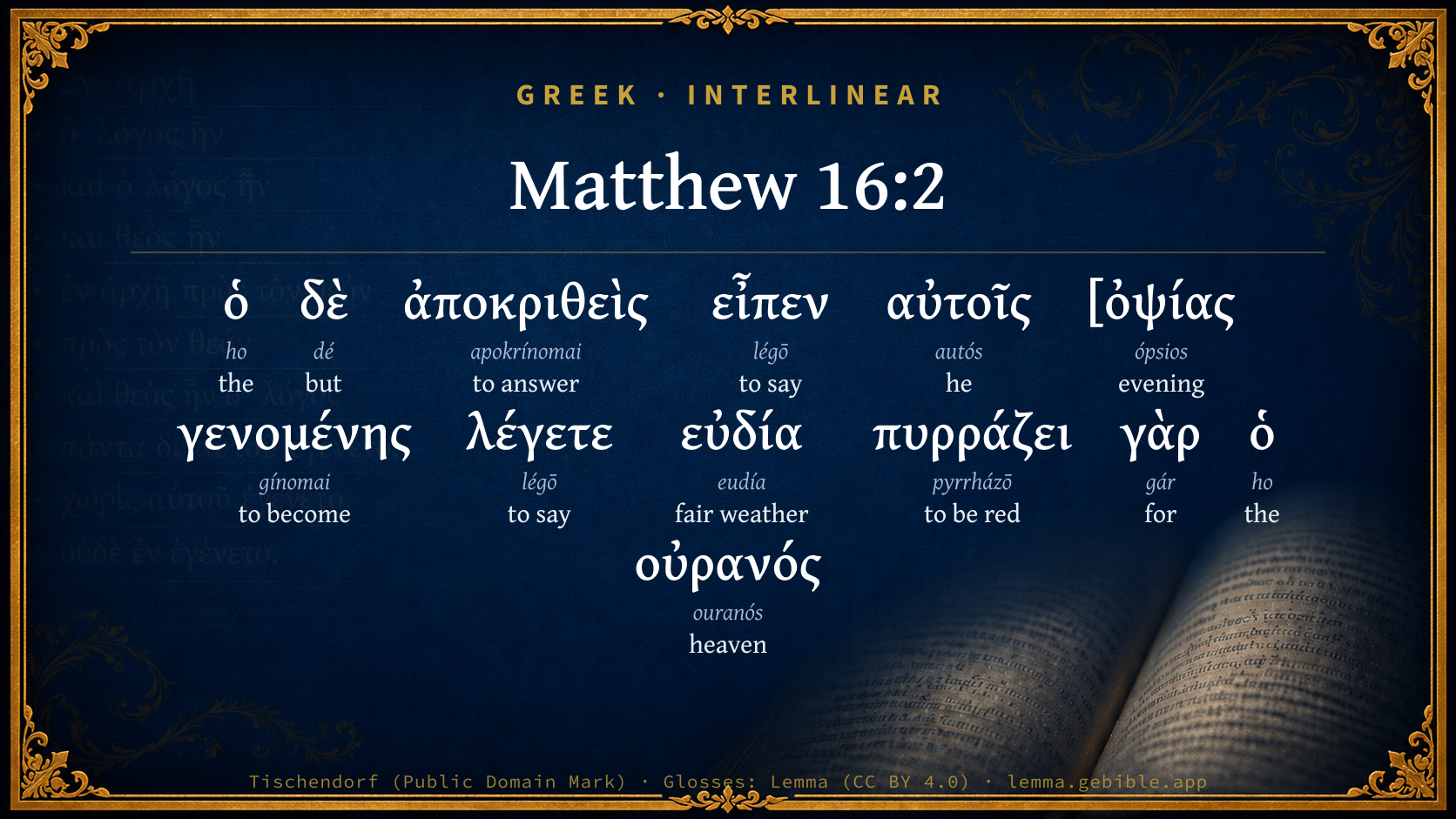
Greek (Tischendorf 8th ed.) Matthew 16:2 appears in the Greek New Testament. The text above is from the Tischendorf 8th edition. Each word links to its Strong’s number and a concise gloss. Click any word for its full Thayer’s Greek Lexicon entry.
Download image
Cite this verse

Matthew 16:2 (World English Bible). Public Domain. Lemma interlinear Bible study tool, https://lemma.gebible.app/v/matthew/16/2.

Show BibTeX & RIS
BibTeX
RIS
English Translation
But he answered them, "When it is evening, you say, 'It will be fair weather, for the sky is red.'
World English Bible · Public Domain
Highlights
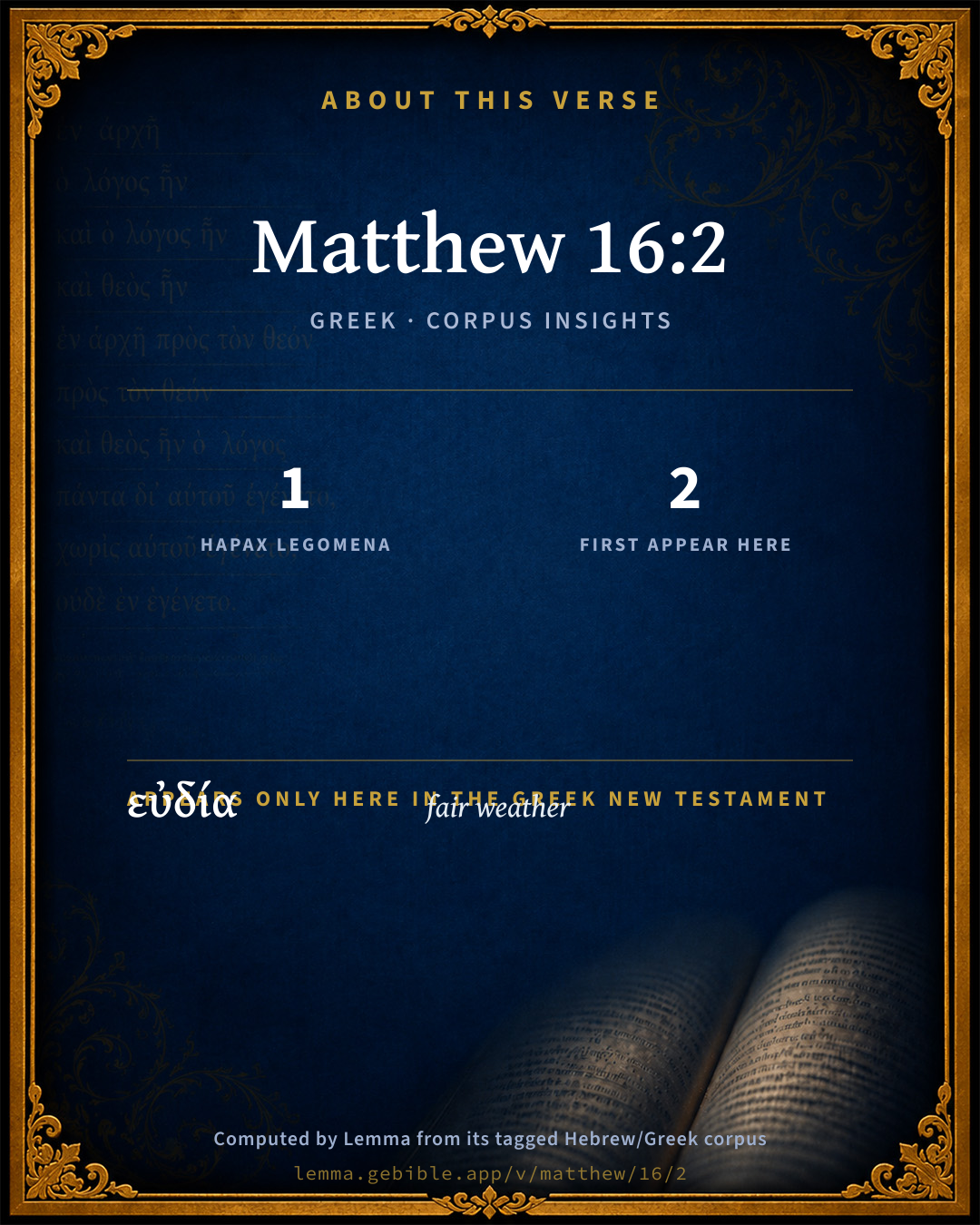
  • 1 hapax legomenon — only here in the Greek New Testament
  • 2 first appearances in the Greek New Testament
Full analysis ↓
Download a study sheet

One document with this verse’s original text, its word-by-word gloss line, the meaning frame, cross-references with their text, attributed commentary, and full source and license credits — printable, and it pastes into notes with its structure intact.

This verse Autodidact and up

Study sheet (.html) Plain text (.txt)

A passage Seminary Student

Up to 50 verses in one chapter. A passage sheet keeps up to 6 commentary sources and 12 cross-references per verse, in the order this page ranks them, and says so on the sheet whenever that leaves anything out. Ask for a single verse and you get the Autodidact verse sheet above.

Everything on this page stays free to read, with no account — the sheet is a download of what is already on screen, not access to it.

Want to remove ads? Support Godless Engineer
Compare translations 3

The same verse in 3 English versions, stacked beneath the original-language interlinear above. Click any original word for its lexicon entry.

Each is an independent rendering of the whole verse — the interlinear is not word-aligned to these translations.

Highlighted words mark where these versions differ — a whole-verse word diff, not a word-by-word alignment.

  • World English Bible Public Domain
    But he answered them, "When it is evening, you say, 'It will be fair weather, for the sky is red.'
  • King James Version Public Domain
    He answered and said unto them, When it is evening, ye say, It will be fair weather: for the sky is red.
  • unfoldingWord Literal Text CC BY-SA 4.0
    But he answering said to them, “[Evening having come, you say, ‘It will be fair weather, for the sky is red.’

unfoldingWord Literal Text — © unfoldingWord, licensed CC BY-SA 4.0. Word-aligned USFM3 via Door43 (git.door43.org/unfoldingWord/en_ult).

Versions to compare (up to 4)

3 of 4 selected

Show all 19 translations

Every available English version of this verse, each an independent rendering of the whole verse.

  • World English Bible Public Domain
    But he answered them, "When it is evening, you say, 'It will be fair weather, for the sky is red.'
  • Berean Standard Bible Public Domain
    But He replied, “When evening comes, you say, ‘The weather will be fair, for the sky is red,’
  • Majority Standard Bible Public Domain
    But He replied, “When evening comes, you say, ‘The weather will be fair, for the sky is red,’
  • King James Version Public Domain
    He answered and said unto them, When it is evening, ye say, It will be fair weather: for the sky is red.
  • American Standard Version (1901) Public Domain
    But he answered and said unto them, When it is evening, ye say, `It will be' fair weather: for the heaven is red.
  • Revised Version (1885) Public Domain
    But he answered and said unto them, When it is evening, ye say, It will be fair weather: for the heaven is red.
  • Geneva Bible (1599) Public Domain
    But he answered, and said vnto them, When it is euening, ye say, Faire wether: for ye skie is red.
  • Douay-Rheims (1899) Public Domain
    But he answered and said to them: When it is evening, you say, It will be fair weather, for the sky is red.
  • Young's Literal Translation Public Domain
    and he answering said to them, `Evening having come, ye say, Fair weather, for the heaven is red,
  • Literal Standard Version CC BY-SA 4.0
    and He answering said to them, “Evening having come, you say, Fair weather, for the sky is red,
  • Unlocked Literal Bible CC BY-SA 4.0
    But he answered and said to them, “When it is evening, you say, 'It will be fair weather, for the sky is red.'
  • unfoldingWord Literal Text CC BY-SA 4.0
    But he answering said to them, “[Evening having come, you say, ‘It will be fair weather, for the sky is red.’
  • Darby Bible Public Domain
    But he answering said to them, When evening is come, ye say, Fine weather, for the sky is red;
  • World Messianic Bible Public Domain
    But he answered them, “When it is evening, you say, ‘It will be fair weather, for the sky is red.’
  • Webster's Bible Public Domain
    He answered and said to them, When it is evening, ye say, It will be fair weather: for the sky is red.
  • Free Bible Version CC BY-SA 4.0
    Jesus replied, “In the evening you say, ‘It'll be a fine day tomorrow, because the sky is red,’
  • Bible in Basic English Public Domain
    But in answer he said to them, At nightfall you say, The weather will be good, for the sky is red.
  • Text-Critical English NT CC BY 4.0
    But he answered them, “When evening comes you say, ‘It will be fair weather, for the sky is red.’
  • Tyndale New Testament (1534) Public Domain
    He answered and sayde vnto the. At even ye saye we shall have fayre wedder and that because the skye is reed:

Literal Standard Version (2020), Covenant Press — licensed CC BY-SA 4.0. Text via the HelloAO Bible API (eBible.org). Unlocked Literal Bible (unfoldingWord) — licensed CC BY-SA 4.0. Text via the HelloAO Bible API (eBible.org). unfoldingWord Literal Text — © unfoldingWord, licensed CC BY-SA 4.0. Word-aligned USFM3 via Door43 (git.door43.org/unfoldingWord/en_ult). Free Bible Version, Dr. Jonathan Gallagher — licensed CC BY-SA 4.0. Text via the HelloAO Bible API (eBible.org).

Word by word

More ways to search: Search by grammar → Find every occurrence → Compare this word →

Practice this passage: Drill this verse → Learn its vocabulary →

εὐδία
eudía
G2105
“fair weather”
Noun, Nominative, Singular, Feminine
Part of Speech
Noun
Case
Nominative
Number
Singular
Gender
Feminine
Full Thayer's Definition

Origin: feminine from G2095 and the alternate of G2203 (as the God of the weather)

TDNT: None

1. a serene sky, fair weather
  1. ὁ ho G3588 “the” Article, Nominative, Singular, Masculine
  2. δὲ dé G1161 “but” Conjunction
  3. ἀποκριθεὶς apokrínomai G611 “to answer” Verb, Aorist, Passive deponent, Participle, Nominative, Singular, Masculine
  4. εἶπεν légō G3004 “to say” Verb, Aorist, Active, Indicative, 3rd person, Singular
  5. αὐτοῖς autós G846 “he” Personal pronoun, Dative, Plural, Masculine
  6. [ὀψίας ópsios G3798 “evening” Adjective, Genitive, Singular, Feminine
  7. γενομένης gínomai G1096 “to become” Verb, Aorist, Middle deponent, Participle, Genitive, Singular, Feminine
  8. λέγετε légō G3004 “to say” Verb, Present, Active, Indicative, 2nd person, Plural
  9. πυρράζει pyrrházō G4449 “to be red” Verb, Present, Active, Indicative, 3rd person, Singular
  10. γὰρ gár G1063 “for” Conjunction
  11. ὁ ho G3588 “the” Article, Nominative, Singular, Masculine
  12. οὐρανός ouranós G3772 “heaven” Noun, Nominative, Singular, Masculine

About this verse

These counts appear in no published source. They are computed here, from the morphology-tagged text and Lemma’s own curated glosses. What Lemma adds →

13
words
11
distinct lemmas
Gospels
section

Notable vocabulary

1 hapax legomenon — a word that appears only here in the entire Greek New Testament:

  • εὐδία fair weather G2105

First appearance in Scripture

These words make their first canonical appearance in the Greek New Testament here:

  • εὐδία fair weather G2105
  • πυρράζει to be red G4449

Shared distinctive vocabulary

πυρράζει to be red G4449 occurs in 2 verses of the Greek New Testament. Also found in:
Repetition

Words recur within this verse:

Cross-references

1

Topical passages linked to Matthew 16:2 in the Treasury of Scripture Knowledge — connected by theme and wording, ordered by reader-vote popularity; previews shown in the World English Bible.

  • Luke 12:54–56 He said to the multitudes also, "When you see a cloud rising from the west, immediately you say, 'A shower is coming,' and so it happens.

Cross-references courtesy of OpenBible.info (CC BY 4.0).

Commentary

Notes on Matthew 16:2 from classic Christian and Jewish commentators (each source and its license shown beneath its notes). The classic Christian expositions comment on the surrounding passage and are grouped to its opening verse, so a note may address several verses; the Jewish commentaries on the Tanakh (Rashi and others) are per-verse, so they appear only where the commentator wrote on this verse.

Lemma curates 59 commentaries, every one of them public domain or Creative Commons licensed, each selected and text-cleaned for this edition rather than reprinted as found. About our sources →

Joseph Benson's Commentary

Mat 16:2-3. He answered, When it is evening, &c. — As if he had said, It is evident you ask this out of a desire to cavil rather than to discern the divine will, for in other cases you take up with degrees of evidence far short of those which you here reject: as for instance, you know that a red sky in the evening is a presage of fair weather, and a red and lowering sky in the morning, of foul weather; thus ye can discern the face of the sky, and form from thence very probable conjectures concerning the weather; but can ye not discern the signs of the times — The signs which evidently show that this is the time of the Messiah? The proofs which Jesus was daily giving them by his wonderful works, his holy and beneficent conduct, and heavenly doctrine, of his divine mission, were more than sufficient to establish it; and, had the Pharisees been possessed of any candour at all, or any inclination to know the truth, they could not have been at a loss to judge in this matter, especially, as in ordinary affairs they showed abundance of acuteness. The truth is, as our Lord here signified, their not acknowledging him as the Messiah was neither owing to want of evidence, nor to want of capacity to judge of that evidence; but to their self- confidence and pride, and their carnal and worldly spirit.

Joseph Benson's Commentary on the Old and New Testaments (1811–1818) — public domain. Text from a community e-Sword module.

Tyndale Open Study Notes

Tyndale Open Resources

16:2-3 Jesus made a deliberate play on their words when they sought a “sign from heaven” (16:1). They were able to read the weather in the sky (Greek ouranos, the same word translated “heaven”), but they failed to discern the Messiah despite the many signs already given (see 11:1-6).

Tyndale Open Study Notes — © Tyndale Open Resources, licensed CC BY-SA 4.0. Text via the HelloAO Bible API.

Bengel's Gnomon

Johann Albrecht Bengel

Mat 16:2. Ὀψίας, πρωἰ, evening—morning) Two most common and most popular signs;[709] for when the sky is red in the evening, the coldness of the night astringes the thinner vapours, so that no storm occurs, even though there be wind; on the other hand, when in the morning the sky is red and dark, the thick vapours burst into a storm by the heat of the sun.

[709] Although, from the different relations of the powers of nature, they are not applicable to all climes.—App. Crit., Ed. ii., p. 124.

Bengel's Gnomon of the New Testament — English translation (T&T Clark, Edinburgh, 1860) — public domain. Text from a community e-Sword module.

Meyer's Critical & Exegetical Commentary

Heinrich August Wilhelm Meyer

Mat_16:2-3 f.[454] Lightfoot, p. 373: Curiosi erant admodum Judaei in observandis tempestatibus coeli et temperamento aëris. Babyl. Joma f. 21. 8; Hieros. Taanith f. 65. 2. For Greek and Roman testimonies relative to the weather signs in our passage, see Wetstein.

εὐδία] clear weather! An exclamation in which it is not necessary to supply ἜΣΤΑΙ, except, perhaps, in the way of helping the grammatical analysis, as also in the case of σήμερον χειμών (stormy weather to-day!). For the opposite of ΕὐΔΊΑ and ΧΕΙΜΏΝ, comp. Xen. Hell. ii. 3. 10 : ἐν εὐδίᾳ χειμῶνα ποιοῦσιν.

στυγνάζων] being lowering. See note on Mar_10:22.

ΤῸ ΠΡΌΣΩΠΟΝ] Omnis rei facies externa, Dissen, ad Pind. Pyth. vi. 14, p. 273.

τὰ δὲ σημεῖα τῶν καιρῶν] the significant phenomena connected with passing events, the phenomena which present themselves as characteristic features of the time, and point to the impending course of events, just as a red sky at evening portends fine weather, and so on. The expression is a general one, hence the plural ΤῶΝ ΚΑΙΡῶΝ; so that it was a mistake to understand the ΣΗΜΕῖΑ as referring to the miracles of Christ (Beza, Kuinoel, Fritzsche). Only when the reproach expressed in this general form is applied, as the Pharisees and Sadducees were intending to apply it, to the existing καιρός, do the miracles of Christ fall to be included among the signs, because they indicate the near approach of the Messiahs kingdom. In like manner the fulfilment of Old Testament prophecy, such as was to be traced in the events that were then taking place (Grotius), was to be regarded as among the signs in question, as also the Messianic awakening among the people, Mat_11:12 (de Wette, Baumgarten-Crusius). According to Strauss, the saying in Mat_16:2-3 is inconceivable. But the truth is, it was peculiarly in keeping with the thoughtful manner of Jesus, if, when a sign from heaven was demanded, He should refer those demanding it to their own practice of interpreting the appearances of the sky, so as to let them see how blinded they were to the signs that already existed. A similar saying is found in Luk_12:54 f., where, however, it is addressed to the multitude. There is no reason for thinking that it appears in its authentic form only in Matthew (de Wette), or only in Luke (Schleiermacher, Holtzmann), for there is nothing to prevent us from supposing that Jesus may have used similar and in itself very natural language on several occasions.

ΚΑῚ ΚΑΤΑΛΙΠ. ΑὐΤ. ἈΠῆΛΘΕ] depicting in a simple way the justa severitas (Bengel) shown toward those incorrigibles. Comp. Mat_21:17.

Comp., besides, the note on Mat_12:39.

[454] The whole passage from ὀψίας on to οὐ δύνασθε, ver. 3, is omitted in B V Χ Γ א, Curss. Codd. in Jerom. Syrcur Arm. Or. (?), while in E it is marked with an asterisk. Tisch. 8 encloses it in brackets. The omission is certainly not to be explained on the physical ground (Bengel) that these signs of the weather are not applicable to every climate, but from the fact that a similar saying does not happen to be found in the corresponding passage in Mark.

Meyer — Critical and Exegetical Commentary on the New Testament — English translation by Peter Christie, edited by Frederick Crombie (T&T Clark, 1880) — public domain. Text from a community e-Sword module.

Expositor's Greek Testament

ed. W. Robertson Nicoll

Mat 16:2-4 . Reply of Jesus .

Mat 16:2-3 , hough not in [95] and bracketed by W. H [96] , may be regarded as part of the text. Somewhat similar is Luk 12:54-56 . On some occasion Jesus must have contrasted the shrewd observation of His contemporaries in the natural sphere with their spiritual obtuseness.

[95] Codex Vaticanus (sæc. iv.), published in photographic facsimile in 1889 under the care of the Abbate Cozza-Luzi.

[96] Westcott and Hort.

Mat 16:2 . εὐδία , fine weather! ( εὖ , Διός genitive of Ζεύς ). πυρράζει γὰρ ὁ ὀ .: that the sign = a ruddy sky in the evening ( πυῤῥίζειν in Lev 13:19 ; Lev 13:24 ).

The Expositor's Greek Testament, edited by W. Robertson Nicoll (1897–1910) — public domain. Text from a community e-Sword module.

Adam Clarke's Commentary

Verse 2. When it is evening] There are certain signs of fair and foul weather, which ye are in the constant habit of observing, and which do not fail. - The signs of the times: the doctrine which I preach, and the miracles which I work among you, are as sure signs that the day-spring from on high has visited you for your salvation; but if ye refute to hear, and continue in darkness, the red and gloomy cloud of vindictive justice shall pour out such a storm of wrath upon you as shalt sweep you from the face of the earth.

Adam Clarke's Commentary on the Bible (1810–1826) — public domain. Text from a community e-Sword/MySword module.

Ellicott's Commentary for English Readers

(2) When it is evening, ye say, It will be fair weather.—It is remarkable that some of the best MSS., including the Vatican and Sinaitic, omit the whole of these suggestive words. We can hardly think of them, however, looking to their singular originality of form, as interpolated by a later transcriber, and have therefore to ask how we can explain the omission. They are not found in St. Mark, and this in itself shows that there were some reports of our Lord’s answer to the Pharisees in which they did not appear. Possibly the transcriber in this case was unable to read their meaning, and the same feeling, or the wish to bring the reports in the two Gospels into closer agreement with each other, may have influenced the writers of the two MSS. in question. Turning (1) to the words as they stand in the received text, we note, as to their form, that the insertion of the words in italics somewhat mars the colloquial abruptness of the original, “Fair weather, for the sky is red”; and (2) that the use of “sky,” instead of “heaven,” hides the point of the answer. “You watch the heaven,” He in substance answers, “and are weather-wise as to coming storm or sunshine. If your eyes were open to watch the signs of the spiritual firmament, you would find tokens enough of the coming sunshine of God’s truth, the rising of the day-spring from on high—tokens enough, also, of the darkness of the coming storm, the ‘foul weather’ of God’s judgments.” Even the fact that the redness of the sky is the same in both cases is not without its significance. The flush, the glow, the excitement that pervaded men’s minds, was at once the prognostic of a brighter day following on that which was now closing, and the presage of the storm and tempest in which that day should end.

It is a singular instance of the way in which the habit of minute criticism stunts or even kills the power of discernment which depends on imagination, that Strauss should have looked on words so full of profound and suggestive meaning as “absolutely unintelligible” (Leben Jesu, II. viii. p. 85).

In the outward framework of the parable the weather-signs of Palestine seem to have been the same as those of England. The clear red evening sky is a prophecy of a bright morning. The morning red—not “red” simply, but with the indescribable threatening aspect implied in “lowering,” the frown of the sky, as it were (comp. Mar_10:22, where the same word is rendered “grieved”)—makes men look for storms.

A Bible Commentary for English Readers, edited by Charles John Ellicott (1878–1897) — public domain. Text from a community e-Sword module.

John Gill's Exposition

He answered and said unto them,.... Knowing full well their views, and having wrought sufficient miracles to confirm his Messiahship, he thought fit to give them no other answer than this:

when it is evening, ye say, it will be fair weather, for the sky is red; when the sun is setting, it is a common thing for you to say, looking up to the heavens, and observing the face and colour of them, that it is like to be fair weather; no rain, that night, nor perhaps the next day, for the sky is red like fire, through the rays of the sun; which show the clouds to be very thin, and so will soon waste away, and consequently fine weather must follow.

John Gill's Exposition of the Whole Bible (1746–1763) — public domain (CC PDM 1.0). Text via the HelloAO Bible API.

Trapp's Complete Commentary

John Trapp

2 He answered and said unto them, When it is evening, ye say, It will be fair weather: for the sky is red.

Ver. 2. When it is evening, ye say, It will be fair, &c.] q.d. Are you so weatherwise (which yet is not your profession)? are ye so skilful in nature, and yet so ignorant of Scripture, as not to know that now is the time for the Messiah to come, and that I am he? Surely you are either notorious sots, or deep dissemblers, or both, in seeming so curiously to search after the truth, which yet you neither care to know, nor obey.

John Trapp, A Commentary or Exposition upon All the Books of the Old and New Testament (1647–1656) — public domain. Text from a community e-Sword module.

Matthew Poole's English Annotations

You can, saith our Saviour, make observations upon the works of God in nature and common providence, and from such observations you can make conclusions; if you see the sky red in the evening, you can conclude from thence that the morrow will be fair, because you think that the redness of the sky at night speaks the clouds thin and the air pure; and on the other side, the redness of it in the morning speaks the clouds thick, so as the sun cannot disperse them; or because you observe that generally it so proveth, though nothing be more mutable than the air. But you cannot

discern the signs of the times: you are only dull at making observations upon the Scriptures, and the will of God revealed in them concerning me. You might observe that all the signs of the Messias are fulfilled in me: I was born of a virgin, as was prophesied by Isaiah, Isa 7:14; in Bethlehem Judah, as was prophesied by Micah, Mic 5:2; at a time when the sceptre was departed from Judah, and the lawgiver from his feet, as was prophesied by Jacob, Gen 49:10; that John the Baptist is come in the power and spirit of Elias, to prepare my way before me, as was prophesied by Malachi, Mal 4:5; that there is one come, who openeth the eyes of the blind, and unstops the ears of the deaf, and maketh the lame to leap as an hart, and the tongue of the dumb to sing, according to the prophecy, Isa 35:5,6. All these are the signs of the time when the Messiah was to come; but these things you cannot discern, but, like a company of hypocrites, who pretend one thing and do another, you come and ask a sign, that you might believe in me, when you have so many, and yet will not believe.

Matthew Poole's English Annotations on the Holy Bible (1683–1685) — public domain. Text from a community e-Sword/MySword module.

Whedon's Commentary on the Bible

Daniel D. Whedon

2-5. Our Lord, in his answer, endeavours to reveal to these Jews their own gross state of mind. They can appreciate, to be sure, physical and glaring signs in the heavens. But there is a higher moral heavens, in which God hangs out his spiritual tokens, to which they are blind.

Daniel D. Whedon (gen. ed.), Commentary on the Old and New Testaments (1874–1909) — public domain. Text from a community e-Sword module.

The Pulpit Commentary

The paragraph consisting of this and ver. 3 is omitted by many good manuscripts, probably owing to its similarity to the passage in Mat_12:38. These verses are most probably genuine; and they certainly could not have been foisted into the text from Luk_12:54-56. The circumstances are too different, and the variations too marked, to make such interpolation probable. When it is evening. The Pharisees had demanded a sign from heaven; Jesus points to the western glow in the sky, and taunts them with being ready enough to read the signs of the weather, but slow to interpret proofs of more important circumstances. He does not, in the case of these mixed cavillers, argue from Scripture, but from the natural world, and he points out that, had they eyes to see and a mind to discern, they might mark tokens in historical events, in the moral and spiritual world, which attested his Messiahship as clearly as any specially given sign from heaven. Ye say, It will be fair weather (eudia). Probably an exclamation, Ye say, Fair weather! Rabbinical schools made a point of teaching weather lore; prognostications on this subject were greatly in vogue, and the rains of the coming year were annually foretold. On such meteorological observations, we may refer to Virgil, "Georg," 1:425, etc.; and Pliny, "Nat. Hist.," 18:35 and 78.

The Pulpit Commentary (1880–1919), ed. H.D.M. Spence-Jones & Joseph S. Exell — public domain. Text from a community e-Sword module.

John Wesley's Explanatory Notes

Luke xii, 54.

John Wesley, Explanatory Notes Upon the Whole Bible (1754–1765) — public domain. Text via the GEBible commentary corpus.

Kretzmann's Popular Commentary

Paul E. Kretzmann

Christ’s reply:

v. 2. He answered and said unto them, When it is evening, ye say, It will be fair weather; for the sky is red.

v. 3. And in the morning, It will be foul weather today; for the sky is red and lowering. O ye hypocrites, ye can discern the face of the sky; but can ye not discern the signs of the times?

Christ was deeply grieved over their duplicity, since they made their request sound reasonable before the people, as though they wanted to establish His Messiahship, whereas their real reason was blasphemy. Under no circumstances did they intend to believe on Him, Mar 8:12. The Jews were careful observers of the weather. They knew very well the common signs indicating fair and foul weather. Constant and careful watching had taught them to regard a murky and lowering morning sky as a sure sign of an approaching rainstorm, while a red sunset caused them to expect fine weather for the next day. But—skill in observing the signs of the weather; dullness and foolishness in spiritual matters! They knew not the times of their visitation, Luk 19:44. They did not recognize, and refused to accept, Jesus as the Messiah, in spite of the many signs and wonders He had done in their midst. And so the signs of His entire ministry, of His life and death, which were originally intended to invite them into the kingdom of God, would now serve to harden their hearts all the more, thus bringing about their damnation. The ability to judge, distinguish, in spiritual matters was blunted. A constant abuse of their spiritual powers and faculties had resulted in their being much like mechanical toys, or like actors that repeat their lines and make their proper gestures at the indicated places, without entering into the identity of the character whom they represent. "He says thus: Those signs of the sky ye understand; why understand ye not these signs which are done for your salvation, if ye believe, or for your perdition, if ye do not believe? For ye now have a pleasant evening, from which ye may have hope concerning a future salutary and bright day; upon this will follow a murky morning, on which ye may expect eternal damnation. For My signs, and this time of grace and the wrath to come, are not less plain, and shine as brightly as the sky itself with his evening and morning; if ye would but look into the prophets that prophesy of this time, and look at things properly which ye see. But ye permit yourselves to be moved neither through the promises of Scripture nor through things that have actually been done, and are only drowned in these temporal matters, whether happy or sad days will come. Therefore ye pay attention to nothing, and in the meantime ye still demand other signs."

Paul E. Kretzmann, Popular Commentary of the Bible (1921–1924) — public domain. Text from a community e-Sword module.

The People's New Testament

B. W. Johnson

2, 3. Ye cannot discern the signs of the times. They could read the weather, but were blind to the events (signs of the times) that showed the fulfillment of prophecy, the end of the Jewish dispensation, and the establishment of the Messiah's kingdom.

B. W. Johnson's The People's New Testament with Notes (1889–1891) — public domain. Electronic text from the Christian Classics Ethereal Library (CCEL) ThML edition.

Cambridge Greek Testament for Schools and Colleges

2 and 3. ὀψίας … οὐ δύνασθε. The genuineness of this passage is doubtful. It is omitted in several uncials (among them אB) and cursives. Origen passes over the passage in his Commentary, and Jerome notes its omission plerisque Codicibus. Still the internal evidence is strong in its favour and it is retained by the leading editors, though bracketed by Tischendorf and Westcott and Hort. See Scrivener’s , p. 49 (3).

2. εὐδία … χειμών. For this contrast cp. ἀλλὰ νῦν μοι | γαιάοχος εὐδίαν ὄπασσεν | ἐκ χειμῶνος. Pind. Isth. (VII) VI. 37–39.

Cambridge Greek Testament for Schools and Colleges (Cambridge University Press, 1896; 21 vols, various authors incl. Carr, Maclear, Plummer, Farrar, Lumby, Moule, M. R. James, Simcox) — public domain. Text from a community e-Sword module.

Alford’s Greek Testament

Henry Alford

2.] Mar 8:12 adds καὶ ἀναστενάξας τῷ πνεύματι αὐτοῦ …, omitting however the sentences following. The Jews were much given to prognosticating the rains, &c. of the coming season in each year. See Lightf. who cites examples.

Henry Alford, The Greek Testament (1849–1861) — public domain. Text from a community e-Sword module.

International Critical Commentary

2. And He answered and said to them.] Mk. has: “And having groaned in His spirit, He saith.” For the omission of ἀναστενάξας τῷ πνεύματι αὐτοῦ, see on 15:29. The editor here inserts two verses (but see critical note) which are not in Mk.

(E ?) When it is evening, you say, (It will be) fair weather: for the heaven is red.]

(E)

2. Ὀψίας γενομένης—οὐ δύνασθε] C D al. Om. א B V X S1 S2. The clause can hardly be genuine here. It seems to be a gloss modelled on Luk 12:54-56.—στυγνάζων] στυγνότης is used of the dulness of the sky in Polyb. iv. 21. 1. στυγνάζειν occurs in the LXX = שָׁמַם Eze 27:35, Eze 28:19 A, 32:10. πυρράζειν seems to occur only in Byzantine writers. πυρρίζειν occurs in the LXX, Lev 13:19, Lev 13:42, Lev 13:43, Lev 13:49, Lev 13:14:37, B2 R.

(M)

International Critical Commentary — older volumes (1896–1929), various authors — public domain. Text from a community e-Sword module.

Vincent's Word Studies in the New Testament

Marvin R. Vincent

Fair weather [ευδια] . Colloquial. Looking at the evening sky, a may says to his neighbor, "Fine weather :" and in the morning (ver. 3), "Storm today" [σημερον χειμων] .

Marvin R. Vincent, Word Studies in the New Testament (1887–1900) — public domain. Text from a community e-Sword/MySword module.

Lesson kit

Teaching starters — assembled from the data on this page, not authored interpretation. Every prompt links to the verse data it draws on. Edit before teaching.

Matthew, in the Gospels, opens this verse with 13 words (11 distinct Greek lemmas). Its most distinctive word is eudía (“fair weather”). A historical commentator’s framing appears above. Read the whole chapter for the surrounding context.

Discussion questions

  1. How does “fair weather” (eudía) shape what this verse is saying?
  2. 1 word here appears nowhere else in the Greek New Testament. Why might the author reach for such rare wording?
  3. 2 words make their first appearance in Scripture here. What does this debut establish?
  4. How does Matthew 16:3, which shares the word «to be red», read alongside this verse?
  5. What does the repetition of “to say” (2× in this one verse) do in this verse?
  6. These translations render this verse differently; the difference is in the English rendering, not the original. What questions does that raise?
  7. Compare how Joseph Benson's Commentary and Tyndale Open Study Notes read this verse. Where do they agree or differ?

Things to notice

  • 1 word in this verse appears nowhere else in the Greek New Testament.
  • 2 words make their first canonical appearance in Scripture here.
  • These translations choose different wording for 7 words in this verse.
  • “to say” occurs 2× in this single verse.
  • 11 distinct Greek lemmas span 13 words in this verse.

Reading settings

Reading text

Shown beneath each verse's original-language words.

Old Testament
Old Testament edition

Read the OT as the Masoretic Hebrew (MT) or the Greek Septuagint (LXX).

English shown for the Greek Septuagint (in the Hebrew ↔ Greek comparison).

Comparing translations? Open the Compare panel on any verse page to stack up to four side by side.