Matthew 18:23

Greek (Tischendorf 8th ed.) Matthew 18:23 appears in the Greek New Testament. The text above is from the Tischendorf 8th edition. Each word links to its Strong’s number and a concise gloss. Click any word for its full Thayer’s Greek Lexicon entry.
Download image
Cite this verse

Matthew 18:23 (World English Bible). Public Domain. Lemma interlinear Bible study tool, https://lemma.gebible.app/v/matthew/18/23.

Show BibTeX & RIS
BibTeX
RIS
English Translation
Therefore the Kingdom of Heaven is like a certain king, who wanted to reconcile accounts with his servants.
World English Bible · Public Domain
Highlights
  • 1 first appearance in the Greek New Testament
Full analysis ↓
Download a study sheet

One document with this verse’s original text, its word-by-word gloss line, the meaning frame, cross-references with their text, attributed commentary, and full source and license credits — printable, and it pastes into notes with its structure intact.

This verse Autodidact and up

Study sheet (.html) Plain text (.txt)

A passage Seminary Student

Up to 50 verses in one chapter. A passage sheet keeps up to 6 commentary sources and 12 cross-references per verse, in the order this page ranks them, and says so on the sheet whenever that leaves anything out. Ask for a single verse and you get the Autodidact verse sheet above.

Everything on this page stays free to read, with no account — the sheet is a download of what is already on screen, not access to it.

Want to remove ads? Support Godless Engineer
Compare translations 3

The same verse in 3 English versions, stacked beneath the original-language interlinear above. Click any original word for its lexicon entry.

Each is an independent rendering of the whole verse — the interlinear is not word-aligned to these translations.

Highlighted words mark where these versions differ — a whole-verse word diff, not a word-by-word alignment.

  • World English Bible Public Domain
    Therefore the Kingdom of Heaven is like a certain king, who wanted to reconcile accounts with his servants.
  • King James Version Public Domain
    Therefore is the kingdom of heaven likened unto a certain king, which would take account of his servants.
  • unfoldingWord Literal Text CC BY-SA 4.0
    For this reason, the kingdom of the heavens is compared to a man, a king, who wanted to take up a word together with his slaves.

unfoldingWord Literal Text — © unfoldingWord, licensed CC BY-SA 4.0. Word-aligned USFM3 via Door43 (git.door43.org/unfoldingWord/en_ult).

Versions to compare (up to 4)

3 of 4 selected

Show all 19 translations

Every available English version of this verse, each an independent rendering of the whole verse.

  • World English Bible Public Domain
    Therefore the Kingdom of Heaven is like a certain king, who wanted to reconcile accounts with his servants.
  • Berean Standard Bible Public Domain
    Because of this, the kingdom of heaven is like a king who wanted to settle accounts with his servants.
  • Majority Standard Bible Public Domain
    Because of this, the kingdom of heaven is like a king who wanted to settle accounts with his servants.
  • King James Version Public Domain
    Therefore is the kingdom of heaven likened unto a certain king, which would take account of his servants.
  • American Standard Version (1901) Public Domain
    Therefore is the kingdom of heaven likened unto a certain king, who would make a reckoning with his servants.
  • Revised Version (1885) Public Domain
    Therefore is the kingdom of heaven likened unto a certain king, which would make a reckoning with his servants.
  • Geneva Bible (1599) Public Domain
    Therefore is the kingdome of heauen likened vnto a certaine King, which would take an account of his seruants.
  • Douay-Rheims (1899) Public Domain
    Therefore is the kingdom of heaven likened to a king, who would take an account of his servants.
  • Young's Literal Translation Public Domain
    `Because of this was the reign of the heavens likened to a man, a king, who did will to take reckoning with his servants,
  • Literal Standard Version CC BY-SA 4.0
    Because of this was the kingdom of the heavens likened to a man, a king, who willed to take reckoning with his servants,
  • Unlocked Literal Bible CC BY-SA 4.0
    Therefore the kingdom of heaven is similar to a certain king who wanted to settle accounts with his servants.
  • unfoldingWord Literal Text CC BY-SA 4.0
    For this reason, the kingdom of the heavens is compared to a man, a king, who wanted to take up a word together with his slaves.
  • Darby Bible Public Domain
    For this cause the kingdom of the heavens has become like a king who would reckon with his bondmen.
  • World Messianic Bible Public Domain
    Therefore the Kingdom of Heaven is like a certain king who wanted to settle accounts with his servants.
  • Webster's Bible Public Domain
    Therefore is the kingdom of heaven likened to a certain king who would take account of his servants.
  • Free Bible Version CC BY-SA 4.0
    “This is why the kingdom of heaven is like a king who wanted to settle accounts with those servants who owed him money.
  • Bible in Basic English Public Domain
    For this reason the kingdom of heaven is like a king, who went over his accounts with his servants.
  • Text-Critical English NT CC BY 4.0
    “For this reason the kingdom of heaven may be compared to a king who wished to settle accounts with his servants.
  • Tyndale New Testament (1534) Public Domain
    Therfore is the kingdome of heven lykened vnto a certayne kynge which wolde take a countis of his servauntis.

Literal Standard Version (2020), Covenant Press — licensed CC BY-SA 4.0. Text via the HelloAO Bible API (eBible.org). Unlocked Literal Bible (unfoldingWord) — licensed CC BY-SA 4.0. Text via the HelloAO Bible API (eBible.org). unfoldingWord Literal Text — © unfoldingWord, licensed CC BY-SA 4.0. Word-aligned USFM3 via Door43 (git.door43.org/unfoldingWord/en_ult). Free Bible Version, Dr. Jonathan Gallagher — licensed CC BY-SA 4.0. Text via the HelloAO Bible API (eBible.org).

Word by word

More ways to search: Search by grammar → Find every occurrence → Compare this word →

Practice this passage: Drill this verse → Learn its vocabulary →

συνᾶραι
synaírō
G4868
“to bring together”
Verb, Aorist, Active, Infinitive
Part of Speech
Verb
Tense
Aorist
Voice
Active
Mood
Infinitive
Full Thayer's Definition

Origin: from G4862 and G142

TDNT: None

1. to take up together with another or others 2. to bring together with others a. to cast up or settle accounts b. to make a reckoning with
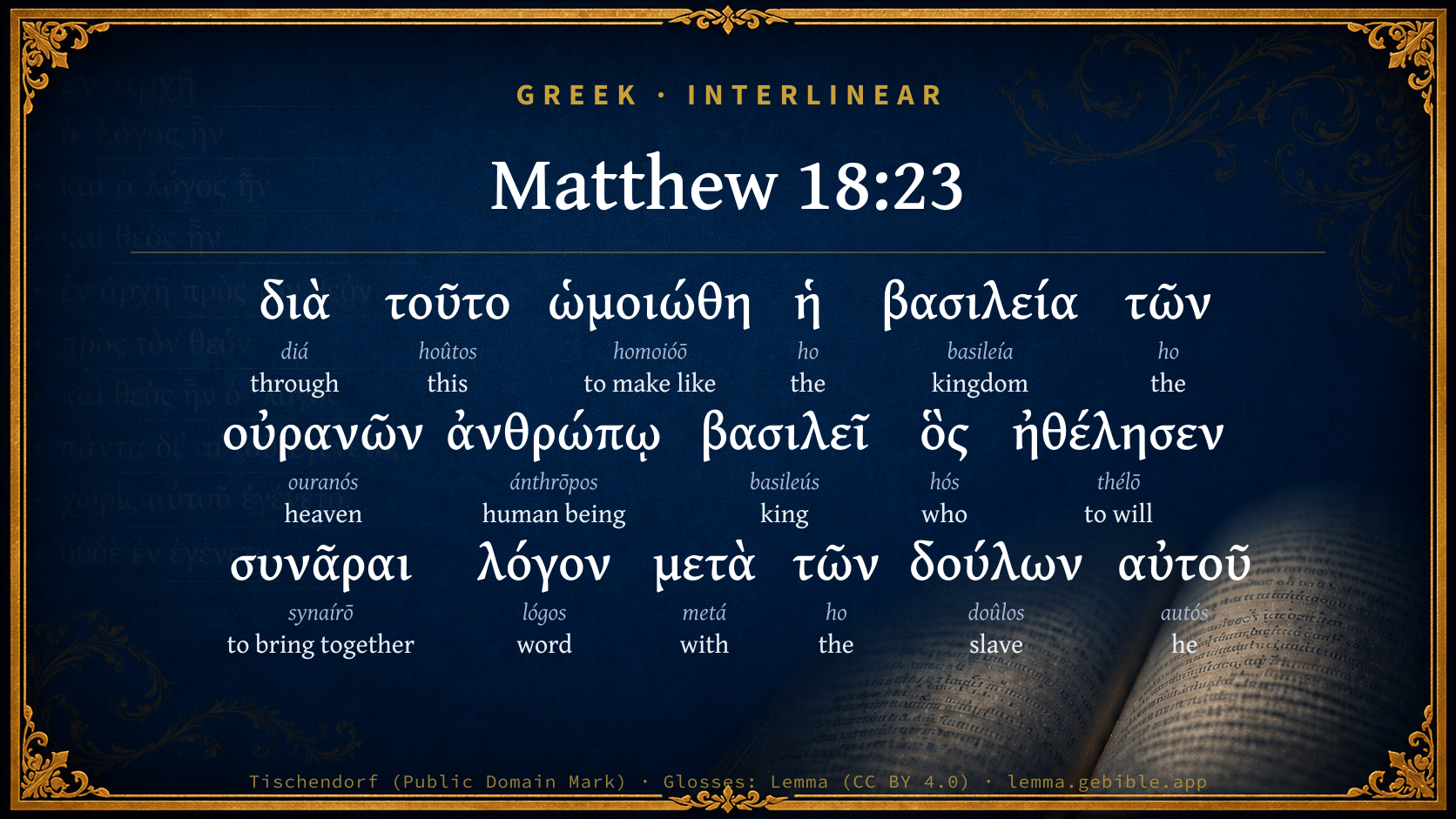
  1. διὰ diá G1223 “through” Preposition
  2. τοῦτο hoûtos G3778 “this” Demonstrative pronoun, Accusative, Singular, Neuter
  3. ὡμοιώθη homoióō G3666 “to make like” Verb, Aorist, Passive, Indicative, 3rd person, Singular
  4. ἡ ho G3588 “the” Article, Nominative, Singular, Feminine
  5. βασιλεία basileía G932 “kingdom” Noun, Nominative, Singular, Feminine
  6. τῶν ho G3588 “the” Article, Genitive, Plural, Masculine
  7. οὐρανῶν ouranós G3772 “heaven” Noun, Genitive, Plural, Masculine
  8. ἀνθρώπῳ ánthrōpos G444 “human being” Noun, Dative, Singular, Masculine
  9. βασιλεῖ basileús G935 “king” Noun, Dative, Singular, Masculine
  10. ὃς hós G3739 “who” Relative pronoun, Nominative, Singular, Masculine
  11. ἠθέλησεν thélō G2309 “to will” Verb, Aorist, Active, Indicative, 3rd person, Singular
  12. λόγον lógos G3056 “word” Noun, Accusative, Singular, Masculine
  13. μετὰ metá G3326 “with” Preposition
  14. τῶν ho G3588 “the” Article, Genitive, Plural, Masculine
  15. δούλων doûlos G1401 “slave” Noun, Genitive, Plural, Masculine
  16. αὐτοῦ autós G846 “he” Personal pronoun, Genitive, Singular, Masculine

About this verse

These counts appear in no published source. They are computed here, from the morphology-tagged text and Lemma’s own curated glosses. What Lemma adds →

17
words
15
distinct lemmas
Gospels
section

Notable vocabulary

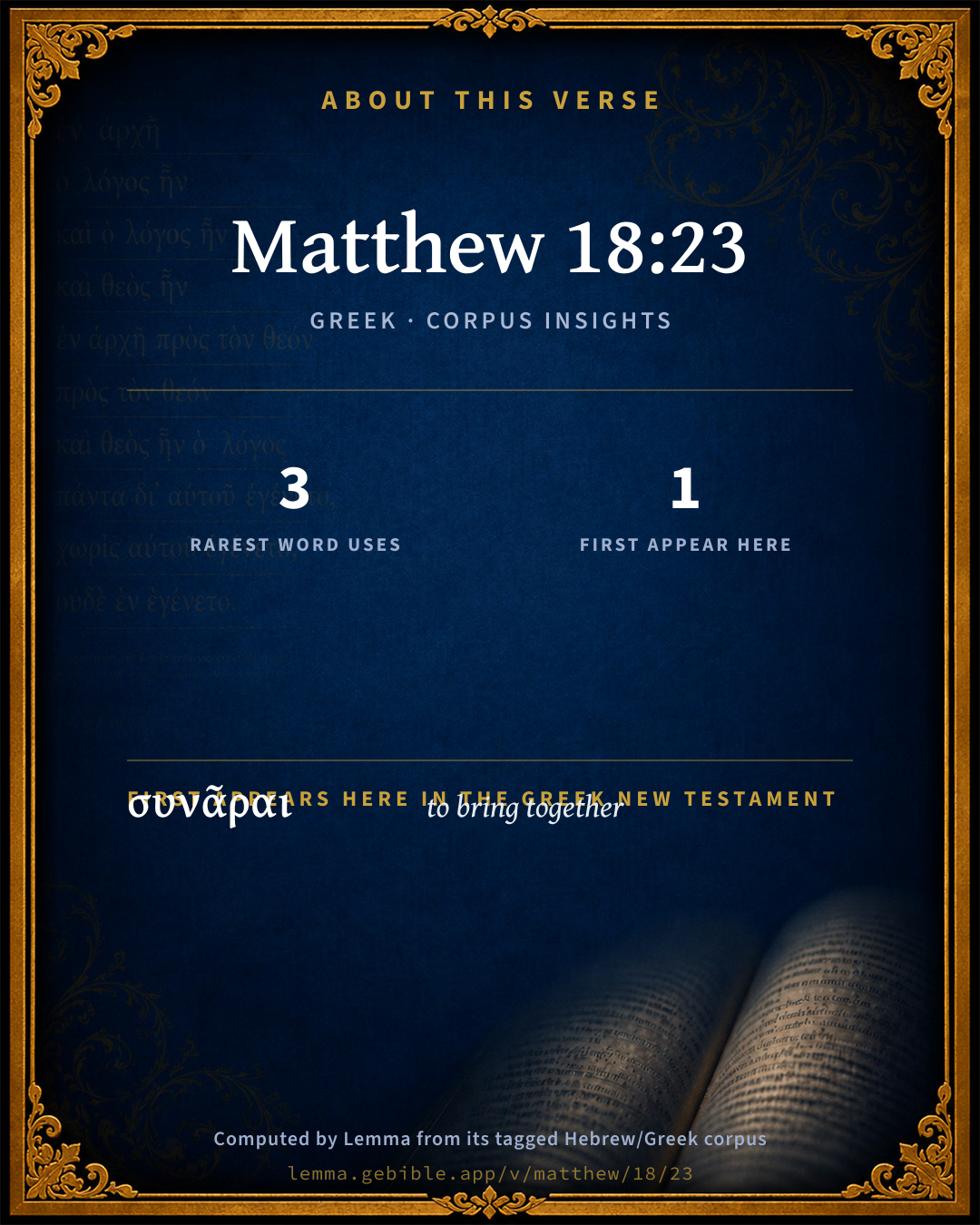
The rarest word here is συνᾶραι to bring together G4868 — appearing just 3 times in the whole Greek New Testament.

First appearance in Scripture

This word makes its first canonical appearance in the Greek New Testament here:

  • συνᾶραι to bring together G4868

Shared distinctive vocabulary

συνᾶραι to bring together G4868 occurs in 3 verses of the Greek New Testament. Also found in:

Repetition

A word recurs within this verse:

Cross-references

15

Topical passages linked to Matthew 18:23 in the Treasury of Scripture Knowledge — connected by theme and wording, ordered by reader-vote popularity; previews shown in the World English Bible.

  • Matthew 13:24 He set another parable before them, saying, "The Kingdom of Heaven is like a man who sowed good seed in his field,
  • Romans 14:12 So then each one of us will give account of himself to God.
  • Matthew 3:2 "Repent, for the Kingdom of Heaven is at hand!"
  • Matthew 13:44–45 "Again, the Kingdom of Heaven is like a treasure hidden in the field, which a man found, and hid. In his joy, he goes and sells all that he has, and buys that field.
  • Matthew 13:47 "Again, the Kingdom of Heaven is like a dragnet, that was cast into the sea, and gathered some fish of every kind,
  • Luke 16:1–2 He also said to his disciples, "There was a certain rich man who had a manager. An accusation was made to him that this man was wasting his possessions.
  • Luke 19:12–27 He said therefore, "A certain nobleman went into a far country to receive for himself a kingdom, and to return.
  • Matthew 13:31 He set another parable before them, saying, "The Kingdom of Heaven is like a grain of mustard seed, which a man took, and sowed in his field;
  • Matthew 13:33 He spoke another parable to them. "The Kingdom of Heaven is like yeast, which a woman took, and hid in three measures of meal, until it was all leavened."
  • Matthew 13:52 He said to them, "Therefore, every scribe who has been made a disciple in the Kingdom of Heaven is like a man who is a householder, who brings out of his treasure new and old things."
  • Matthew 25:14 "For it is like a man, going into another country, who called his own servants, and entrusted his goods to them.
  • 1 Corinthians 4:5 Therefore judge nothing before the time, until the Lord comes, who will both bring to light the hidden things of darkness, and reveal the counsels of the hearts. Then each man will get his praise from God.
  • 2 Corinthians 5:10–11 For we must all be revealed before the judgment seat of Christ; that each one may receive the things in the body, according to what he has done, whether good or bad.
  • Matthew 25:1 "Then the Kingdom of Heaven will be like ten virgins, who took their lamps, and went out to meet the bridegroom.
  • Matthew 25:19–30 "Now after a long time the lord of those servants came, and reconciled accounts with them.

Cross-references courtesy of OpenBible.info (CC BY 4.0).

Commentary

Notes on Matthew 18:23 from classic Christian and Jewish commentators (each source and its license shown beneath its notes). The classic Christian expositions comment on the surrounding passage and are grouped to its opening verse, so a note may address several verses; the Jewish commentaries on the Tanakh (Rashi and others) are per-verse, so they appear only where the commentator wrote on this verse.

Lemma curates 59 commentaries, every one of them public domain or Creative Commons licensed, each selected and text-cleaned for this edition rather than reprinted as found. About our sources →

The Biblical Illustrator

Joseph S. Exell

Mat_18:23-35

Therefore is the kingdom of heaven likened unto a certain king, which would take account of his servants.

The unmerciful servant

I. That we are all Gods debtors. Debt in the New Testament is a common figure for sin; but duty is a moral thing, not a commercial. It is used figuratively to denote an obligation which one has failed to meet. Let us compare our character with the requirements of Gods law.

II. That none of us has anything wherewith to pay his debt to God. Few will admit this. They say, Have patience with me and I will pay thee all. They will try to make themselves better.

III. That God is willing to forgive us all our debt.

IV. That the reception of this forgiveness by us involves in it the obligation to forgive those of our fellow-men who have trespassed against ourselves. How far this obligation extends. It does not imply that we are to take no notice of the wrong done us; this would be selfish indifference alike to our brother and his guilt. But how comes it that the obligation to cherish this forgiving spirit is connected with our reception of Gods mercy. All who accept Gods pardon are at the same time renewed into His image by the power of the Holy Spirit; and so resembling Him in character, they seek to do unto others as He has done to them. Gratitude will take this form (Eph_4:32). Lessons:

1. That our sins against God are vastly greater than our neighbours trespasses against us.

2. We are constantly needing the forbearance of God and the long-suffering of our fellow-man.

3. That implacability on our part is an evidence that we are as yet unforgiven by God. (W. M. Taylor, D. D.)

Mans unavailing effort to pay his sin debts

Commonly the very last thing which he will admit is that he can do nothing to make atonement for it. He will go about to establish his own righteousness. He will try to make himself better. He will promise future obedience, as if that could be a satisfaction for the sins of the past. It is thus with him as it is too often with business men in a time of embarrassment; for, no matter how involved his affairs may be, the very last thing that a merchant will admit is that he is hopelessly insolvent. Hugh Miller, in his autobiography, thus describes what he learned by his experience as a clerk in the branch bank of Linlithgow: I found I could predict every bankruptcy in the district; but I usually fell short from ten to eighteen months of the period in which the event actually took place. I could pretty nearly determine the time when the difficulties and entanglements which I saw, ought to have produced their proper effects, and landed in failure; but I missed taking into account the desperate efforts which men of energetic temperament make in such circumstances, and which, to the signal injury of their friends and the loss of their creditors, succeed usually in staving off the catastrophe for a season. So the sinner, in his attempts to work out his own redemption, sinks only the deeper into the mire. (W. M. Taylor, D. D.)

Forgiveness-one law for lord and servant

It is a parable to show us that our life must be a repetition of the life of God. How often shall my brother sin against me, and I forgive him?

I. The answer of the Lord, folded up in this parable, is as often as God forgives us. As soon as the lord began to reckon with his servants, he found this great defaulter; in any company God would immediately find such an one. What our Lord represents as one act, is really a continued flow of acts; every hour we are the subjects of forgiveness. Just as often you are to let forgiveness flow forth to others; the heart of the servant must be in unison with the heart of the master.

II. Gods mercy to us is to be a spring of mercy in us to others. The unmerciful servant would not resemble his master. We are receivers mainly that we may be givers. Observe the circumstances in which as Christians we are expected to exercise a forgiving spirit. Christ does not ask us to make bricks without straw. Everything that we need for the fulfilment of the command is provided. The Holy Spirit is given to mould us to the form of mercy which is in Him. It is a reasonable and ample provision. Christ endeavours to open our hearts by kindness; not by reproaches or commands, but by forgiveness. He dies that our transgressions may be put away. If the power to forgive be greater in us in this way than any other, the responsibility under which we lie to put forth that power is enormously increased.

III. We must take the entire gift, or lose all. The entire gift of the king was something more than forgiveness. It was also a forgiving heart. It is the gift of a new life. He took the liberty, joy, relief, and then stopped. He took the remission of his debt; but not the debt-remitting heart. Pardon is not salvation; there must be holiness as well. (A. Macleod, D. D.)

Gods mercy reproduced in the life of the Christian

If you cleave a stem of rock crystal into fragments, every fragment will be found a repetition more or less complete of the unbroken crystal. In a single drop of seawater you will find all the elements of the sea itself. Pluck a leaf from the oak, the beech, the plane, or any forest tree; place it between you and the light-you will find that the profile of the leaf is the profile of the perfect tree. Look at its veins; they are a little map of the branches of the tree. The tree reproduces itself in the leaf; the leaf is a picture of the whole tree. The form of the fragment, of the drop, of the leaf is the form of the whole to which it belongs. This law holds throughout the wide variety of nature. A single bone reveals the animal: a single ray of light contains the mysteries of all light; the pebble you start with your foot is an epitome of the globe we inhabit. (A. Macleod, D. D.)

The unmerciful servant-

This parable.

I. The circumstances which led to its delivery. Our Lord had been giving instructions to his disciples concerning the restoration of an erring brother. The injured party should be ready to forgive.

II. The several parts of which it is composed. The king is intended to represent the Most High; but He is not too exalted to attend to the concerns of His subjects.

1. A servant is in debt to his sovereign.

(1) Its amount exceedingly great. Our sin is great.

(2) This servant being unable to meet his heavy liabilities, the claims of justice are advanced.

(3) To arrest the execution of the sentence a humble and earnest plea is presented.

(4) Touched with a feeling of pity the king relinquishes his claims and extends to the debtors a full and free pardon.

2. One servant in debt to another: even to him who had been so heavily in debt himself, but was most generously released from all his obligations.

(1) A contrast truly appalling.

(2) A punishment richly deserved.

III. The practical lessons it enforces. (Expository Outlines)

Twenty-seceded Sunday after Trinity

Warn against misapplications of the parable.

1. It would be an error to apply it to the subject of property obligations and money-debt.

2. Neither does it relate to civil punishments (Rom_13:1-5).

3. Neither are we to see in this parable the history of any particular persons, but simply the exhibition of the nature and working of the Divine principle of grace first in absolving us, and then in the temper which it begets in the hearts of those who are the subjects of it.

4. Neither is it intended to teach us by this parable that our exercise of forgiveness is in any way the procuring cause of Gods forgiveness.

The way thus cleared, consider some of the elements of the parable itself.

1. Man is an immense debtor.

2. Sad is mans estate in view of this enormous indebtedness. There is a way, however, for these terrible consequences to be averted.

4. But there may be great debtors to whom the Lords word of entire forgiveness has been spoken, who yet in the end fail of the advantages of it.

5. Gods forgiveness is not bestowed that we may indulge our selfishness and greed.

6. There are other servants spoken of besides the two debtors. When they saw what was done they were very sorry. This is the form which true charity takes when called to witness sinfulness. (J. A. Seiss, D. D.)

The unmerciful servant

I. The practice of forgiving injuries.

II. The principle of forgiving injurious. (W. Arnot.)

Mercy uncommunicated, not truly received

If the channel of his heart had really been inserted into the fountain-head of mercy for receiving, mercy would infallibly have flowed in the way of giving, wherever the need of a brother made an opening; if the vessel had been charged, it would certainly have discharged. No compassion flowed from that heart to refresh a fellow-creature in distress, because that heart had never truly opened to accept mercy from God; the reservoir was empty, and therefore the outbranching channels remained dry. (W. Arnot.)

The magnitude of injury determined by our temper towards it

Most of the injuries with which we are called to deal are small, even in relation to human capacity; they are, very often precisely of the size that our own temper makes them. Some people possess the art of esteeming great injuries small, and some the art of esteeming small injuries great. The first is like a traveller who throws a great many stones out of the burden which he carries, and so walks with ease along the road; the other is like a traveller who gathers a great many stones on the wayside, and adds them to his burden, and is therefore soon crushed by the load. (W. Arnot.)

Man freed from an unforgiving temper by the gentle influences of the Divine love, not by self-determination

A traveller in Burmah, after fording a certain river, found his body covered all over by a swarm of small leeches, busily sucking his blood. His first impulse was to tear the tormentors from his flesh; but his servant warned him that to pull them off by mechanical violence would expose his life to danger. They must not be torn off, lest portions remain in the wounds and become a poison; they must drop off spontaneously, and so they will be harmless. The native forthwith prepared a hath for his master, by the decoction of some herbs, and directed him to lie down in it. As soon as he had bathed in the balsam the leeches dropped off. Each unforgiven injury rankling in the heart is like a leech sucking the lifeblood. Mere human determination to have done with it, will not cast the evil thing away. You must bathe your whole being in Gods pardoning mercy; and these venomous creatures will instantly let go their hold. You will stand up free. (W. Arnot.)

A wide view of heavenly good lessens the power of earthly wrongs

While a few acres of cold barren moorland constitute all your heritage, if a neighbour encroaches on it by a hairs-breadth, you assert your right and repel the aggression; possibly you may, in your zeal, accuse him of an intention to trespass, if you see him digging his own ground near your border. While your property is very small, you are afraid of losing any of it; and perhaps you cry out before you are hurt. But if you become heir to a broad estate in a fertile valley, you will no longer be disposed to watch the motions of your neighbour, and go to law with him for a spadeful of moss that he may have taken from a disputed spot. Thus, while a human soul has no other portion than an uncertain shred of this uncertain world, be is kept in terror lest an atom of his property should be lost; he will do battle with all his might against any one who is, or seems to be, encroaching on his honour, or business, or property: but when he becomes a child of God, and an heir of an incorruptible inheritance-when he is a prince on the steps of a throne, he can afford to overlook small deductions from a possession that is insignificant in itself, and liable to be taken away at any time without an hours warning. (W. Arnot.)

The forgiving spirit aided by prayer

The miller, finding that some of the lumps are large and hard, and that the mill-stones are consequently almost standing still, goes quietly out and lets more water on. Go you, and do likewise. When injuries that seem large and hard are accumulated on your head, and the process of forgiving them begins to choke and go slow under the pressure, as if it would soon stop altogether; when the demand for forgiveness grows great, and the forgiving power in the heart is unable to meet it; then, enter into your closet and shut your door, and pray to your Father specifically for more experience of His forgiving love; so shall your forgiving love grow stronger, and overcome every obstacle that stands in its way. (W. Arnot.)

Sin as debt

I. That sin is a debt, a vast debt; or that there is much, yea great, exceeding great evil in sin, considered as a debt.

II. That sinners are debtors, and have nothing to pay, and therefore are forgiven freely, as an act of Gods mercy, all their debts without any satisfaction made by them.

III. That God doth and will call sinners who are debtors to Him, to an account, be they willing or no.

IV. That a pardoned person, or one that God hath forgiven, does forgive from his heart all those that have injured him, and they that do not so are not, nor shall be ever forgiven. (Benjamin Keach.)

Evil of sin

1. Sin is a vast debt, or an exceeding great evil in respect of God, against whom it is committed.

2. Sin is a vast debt, considering what wrong it hath done to God; it is a crossing His will, a violation of His law, a contemning His authority, a despising of His sovereignty and dominion, a defacing His image, and resisting His spirit, abuse of His patience, and a slighting of all His love, mercy, and goodness.

3. Sin is a great debt, because all men, yea, all the saints of the earth, nor angels of heaven can pay this debt.

4. Sin is a vast debt, because it exposes the sinner to eternal wrath and vengeance. (Benjamin Keach.)

Ways of being debtors

1. By owing money.

2. By being a trespasser, offender, or guilty person.

3. By robbery of a mans goods or good name.

4. By violating a covenant.

5. By receiving kindnesses. He owes the debt of gratitude and thankfulness. (Benjamin Keach.)

Sinners like debtors

1. In their unwillingness to be called to account.

2. Attended with shame.

3. They have many shifts and delays.

4. Do not like to meet their creditor.

5. Continually afraid of arrest. (Benjamin Keach.)

Compassion God-like

There is nothing that makes a man so unlike to God, as a hard heart; without pity, without patience. In the tabernacle, the doors of the sanctum santorum were of olive-wood (1Ki_6:31); which is the hieroglyphic of mercy: but the gates of that fearful dungeon, which is hell, are said to be of brass and iron; He hath broken the gates of brass, and cut the bars of iron in sunder (Psa_107:16); the signs of hard hearts and instruments of destruction. Which serves to show, that the way to hell is by inhumanity; to heaven, by pity. Of all the passions in us, compassion is the best; and a man without this tenderness, is but the statue of a man; a mere stone in a human figure. The very stones will seem to weep, when foul weather is a-coming; and as if they had been once so full of sorrow for Christs sufferings, that their solid breasts could no longer contain it, they brake in pieces. There be men harder than stones, that have hearts more impenetrable, obdurate, and unrelenting, and less capable of remorse; nay, instead of pitying the wounds of the miserable, they make those miserable wounds. (T. Adams.)

Influence of forgiveness

The fate of the unmerciful servant tells us in the plainest language that the mere cancelling of our guilt does not save us. It tells us that unless the forgiveness of God humbles us, and begets within us a truly meek and loving spirit, we cannot be owned as His children. The best assurance that we are ourselves forgiven is the consciousness that the very spirit of the forgiving God is working in our own hearts towards others. (Marcus Dods.)

Forgiveness

Forgiveness is cheaper than revenge, and is sweeter and more valuable. Prudence as well as piety, counsels quiet to men under reproof or reproach. If a bee stings you, will you go to the hive and destroy it? Would not a thousand come upon you? If you receive a trifling injury, dont be anxious to avenge it. Let it drop. It is wisdom to say little respecting the injuries you have received. When enemies see they have hit you they know where to strike next time, while if you show no signs of disquiet, they think their stroke must have missed its mark. Lie quiet, and you will be likely to be let alone. (H. L. Hastings.)

The parable of the king that took account of his servant

Note-

I. The great goodness and clemency of god. Delay was asked for, and remission was given. How great the love; the gift exceeds the petition.

II. The great power of humility. The servant kneeled down and prayed in a few simple words, and he was forgiven his debt. Certain lions spare a prey that prostrates itself before them.

III. The punishment is one thing, the fault is another. There is a freeing from the dominion of Satan, and then there is a remission of the punishment. Two distinct acts. Absalom was pardoned, yet he was not admitted to Davids presence (2Sa_14:28).

IV. The inconstancy and mutability of man.

V. The need we have to forgive injuries. Like our blessed Lord and St. Stephen, we must pray for our murderers. (From the Latin.)

The just account

I. The sublimity of the judicial condition. A certain king, endowed with the highest powers, will be our judge-Jesus Christ (Rev_19:16). His three attributes are-

1. Infallible knowledge.

2. Inflexible justice.

3. Invincible power.

Hence He is to be greatly feared (Jer_10:7).

II. The impossibility of final avoidance-which would take account.

III. The necessity of obedient subjection. Servants, implying total subjection to Him (Lev_19:37). (From the Latin.)

Our great creditor

God is our great creditor on account-

I. Of original sin (Eph_2:3).

II. Of actual sin (Isa_59:2).

III. Of obedience by natural and Divine law (Rom_2:14-15).

1. Natural. God is our creator (Act_17:28). Jesus Christ is our Redeemer.

2. Divine. He is our King (Rom_13:1). We are His spiritual subjects and followers.

IV. Of gratitude for all blessings. Temporal and spiritual (1Co_12:6-11).

V. Of earnest love for any good which we may have done. To Him be all the praise and honour (Psa_115:1). (From the Latin.)

The tormentors

The torment of this place of tormentors (Mat_25:30), arises from-

I. The hopelessness of escape. The imprisonment here knows no end (Mat_3:12; Mat_25:46; Isa_66:24).

II. The weight which presses down the condemned.

III. The unceasing torment. Never any relief; not a moments ease or forgetfulness (Rev_14:11).

IV. The weariness and pain of being. A wakeful night seems multiplied into three. The same round, or rather, unvarying sameness, which makes an agony of itself.

V. The spectators of this wretchedness (Rev_14:10; Rev_6:16-17). This formed the agony of Samson (Jdg_16:27-28). It carries shame here; it will increase the agony of hereafter. (From the Latin.)

The debt of man

Let us consider the nature of our debt.

I. To god. Pay the debt of

(1) Love;

(2) Honour;

(3) Fear; for He is Lord of all.

II. To ourselves. Pay thy debt of

(1) Love; we ought to love ourselves since God loves us, and we ought to obey the commandment of love-to love ourselves; not in and for ourselves, but as in and belonging to God.

(2) Care; we ought to guard and preserve ourselves from dangers ghostly and bodily. Hence the gift of reason to defend and protect the course of life.

(3) Salvation (Php_2:12; Ecc_9:10).

III. To our neighbour. Pay thy debt of

(1) Love (Mat_19:19), dealing with him as with thyself.

(2) Instruction; if he wander, seek to lead him back into the paths of righteousness (Mat_18:15; Jam_5:20).

(3) Help and succour (1Jn_3:17-18; Isa_53:7).

Epilogue.

1. Husband and discipline every resource.

2. Strive and pray honestly to meet this triple debt. (From the Latin.)

What contrasts are here!

I. God, the King of kings, towards a servant; and again, a servant towards his fellow-servant.

II. An infinite debt, and again, a small debt.

III. Impossibility and inability; and again, possibility and ability.

IV. Compassion and kindness; and again, hardheartedness and cruel behaviour. (Heubner.)

The sinners debt

This servant, or minister, must have been some high functionary of state, who manipulated the revenues of provinces. He represents the sinner-every sinner. The debt for which every sinner is accountable, or liable, to God is enormous. It is not easy to determine exactly what was the value of the Hebrew talent. It contained 3,000 shekels of the sanctuary, and is supposed by some to have corresponded exactly to the Greek AEginetan talent, which exceeded the common Attic commercial talent. This common Attic talent is estimated by Boeckh as equivalent to 1,375 German thalers. Taking the German thaler as equivalent to 3s. sterling, a single Attic talent would amount to a little above £200; so then ten thousand talents would be something more than £2,000,000 sterling, an immense sum, more especially in those ancient times, when the relation of bullion to commodities was such that the prices of commodities in bullion were far smaller relatively than now, with our vast importations of gold from America and Australia. This immense sum, almost; baffling ordinary conception, represents the sinners spiritual debt or guilt. (J. Morison, D.D.)

The Biblical Illustrator, edited by Joseph S. Exell (c. 1880s–1900s) — public domain. Text from a community e-Sword module.

Joseph Benson's Commentary

Mat 18:23. Therefore — In this respect; the kingdom of heaven is likened unto a certain king — Here our Lord illustrates the excellent morality of the preceding verse by a lively parable; in which is shown “the necessity of forgiving the greatest injuries in every case where the offending party is sensible of his fault, and promises amendment; a necessity of the strongest kind, arising from this law of the divine government, that it is the condition on which God forgives our offences against him.” — Macknight.

Joseph Benson's Commentary on the Old and New Testaments (1811–1818) — public domain. Text from a community e-Sword module.

Bengel's Gnomon

Johann Albrecht Bengel

Mat 18:23. Διὰ τουτο, therefore) understand, “I say.”—ἠθελησε, willed, determined) of His own free will, by His supreme authority.

Bengel's Gnomon of the New Testament — English translation (T&T Clark, Edinburgh, 1860) — public domain. Text from a community e-Sword module.

Meyer's Critical & Exegetical Commentary

Heinrich August Wilhelm Meyer

Mat_18:23. Διὰ τοῦτο ] must refer to the reply to Peters question, for a new scene was introduced at Mat_18:21. Therefore to be explained thus: because I have enjoined such unlimited forgiveness (not merely a conciliatory disposition generally, in answer to de Wette and Bleek). The duty of unlimited forgiveness proves any shortcoming in regard to this matter to be but the more reprehensible, and to point this out is the object of the parable which follows.

ὡμοιώθη ἡ βας. τ. οὐρ. ] See note on Mat_13:24.

The δοῦλοι are the kings ministers who are indebted to him through having received money on loan (δάνειον, Mat_18:27), or, relatively, as treasurers, land stewards, or the like. But it is not without reason that ἀνθρώπῳ is joined to βασιλεῖ, seeing that the kingdom of heaven is likened to a human king. Comp. the ἀνὴρ βασιλεύς of Homer.

συναίρειν λόγον] to hold a reckoning, to settle accounts, occurs again in Mat_25:19, but nowhere else. Classical writers would say: διαλογίζεσθαι πρός τινα, Dem. 1236. 17.

Meyer — Critical and Exegetical Commentary on the New Testament — English translation by Peter Christie, edited by Frederick Crombie (T&T Clark, 1880) — public domain. Text from a community e-Sword module.

Expositor's Greek Testament

ed. W. Robertson Nicoll

Mat 18:23-35 . Parable of unmerciful servant .

Mat 18:23 . διὰ τοῦτο suggests that the aim of the parable is to justify the apparently unreasonable demand in Mat 18:22 : unlimited forgiveness of injuries. After all, says Jesus, suppose ye comply with the demand, what do your remissions amount to compared to what has been remitted to you by God? ἀνθρώπῳ βασιλεῖ : a man, a king; king an afterthought demanded by the nature of the case. Only a great monarch can have such debtors, and opportunity to forgive such debts. συνᾶραι λόγον (found again in Mat 25:19 ), to hold a reckoning. δούλων : all alike servants or slaves in relation to the king. So human distinctions are dwarfed into insignificance by the distance between all men and God.

The Expositor's Greek Testament, edited by W. Robertson Nicoll (1897–1910) — public domain. Text from a community e-Sword module.

Jamieson, Fausset & Brown

Robert Jamieson, A. R. Fausset & David Brown

Therefore--"with reference to this matter."

is the kingdom of heaven likened unto a certain king, which would take account of his servants--or, would scrutinize the accounts of his revenue collectors.

Jamieson, Fausset & Brown — Commentary Critical and Explanatory on the Whole Bible (1871) — public domain (CC PDM 1.0). Text via the HelloAO Bible API.

Adam Clarke's Commentary

Verse 23. Therefore is the kingdom] In respect to sin, cruelty, and oppression, God will proceed in the kingdom of heaven (the dispensation of the Gospel) as he did in former times; and every person shall give an account of himself to God. Every sin is a debt contracted with the justice of God; men are all God's own servants; and the day is at hand in which their Master will settle accounts with them, inquire into their work, and pay them their wages. Great Judge! what an awful time must this be, when with multitudes nothing shall be found but sin and insolvency!

By servant, in the text, we are to understand, a petty king, or tributary prince; for no hired servant could possibly owe such a sum as is here mentioned.

Adam Clarke's Commentary on the Bible (1810–1826) — public domain. Text from a community e-Sword/MySword module.

Ellicott's Commentary for English Readers

(23) Therefore is the kingdom of heaven likened . . .—Over and above the direct teaching of the parable it has the interest, as regards its form, of being, in some sense, an advance on those of chapter 13, i.e., as more fully bringing out human interests, and so more after the pattern of those that are characteristic of St. Luke.

A Bible Commentary for English Readers, edited by Charles John Ellicott (1878–1897) — public domain. Text from a community e-Sword module.

The Cambridge Bible for Schools and Colleges

gen. ed. J. J. S. Perowne

23. a certain king, which would take account of his servants] The picture is drawn from an Oriental Court. The provincial governors, farmers of taxes, and other high officials are summoned before a despotic sovereign to give an account of their administration.

would] “chose,” “resolved:” all is subject to his sole will.

servants] i. e. subjects, for all subjects of an Eastern monarch are “slaves.” The scholar will remember how often Demosthenes makes a point of this.

The Cambridge Bible for Schools and Colleges (gen. ed. J. J. S. Perowne; Cambridge University Press, 1878–1918) — public domain. Text from a community e-Sword module.

John Gill's Exposition

The servant therefore fell down,.... At his feet, upon his knees, or on his face, to the ground; not being able to stand before him, or look him in the face, and much less to answer the demands of his law and justice; but owned the debt, and his present inability to pay,

and worshipped him: the Vulgate Latin reads it, "prayed", or entreated him,

saying, Lord have patience with me; give me but time, spare me a little longer, send me not to prison, and I will pay thee all: a very weak and foolish promise, but what is usual for men in such circumstances to make. Thus men, under guilt, and dreadful apprehensions of wrath and ruin, frequently promise, that if their lives are but spared, what they will do for God, and in a religious way; and very foolishly and ignorantly imagine, that by their humiliation and tears, their prayers and other services by their good lives and conversations, for the future, they shall be able to make compensation to God for all the iniquities they have been guilty of: which shows them to be exceeding ignorant of the nature of sin, which is committed against an infinite being, and therefore reconciliation for it cannot be made by finite creature; as also of the nature of their duties and services, which, when performed, in ever so good a manner, can never make satisfaction for past offences, these being duties they are obliged to perform; and would have been equally obliged thereunto if they had never offended; and likewise betrays great vanity, pride, boasting, and conceit of themselves, and abilities, as that they shall be able, in a little time to pay all, when they have nothing at all to pay with: and was patience to be exercised towards them ever so long, they would still be in the same condition, and in no better capacity to make payment; but, on the contrary, would still run a larger score, and be more and more in debt. Indeed, the patience and longsuffering of God to his people is salvation; not that by giving them time, and bearing with them, they discharge their debts, and work out their salvation; but waiting upon them to be gracious to them, he brings them to repentance, to a sense of themselves and sins, and to an acknowledgment of them, and leads them, by faith, to his Son for righteousness, forgiveness, salvation, and eternal life; but as for others, his patience towards them, and forbearance of them, issue in their everlasting destruction, which, by their iniquities, they are fitted for.

John Gill's Exposition of the Whole Bible (1746–1763) — public domain (CC PDM 1.0). Text via the HelloAO Bible API.

Trapp's Complete Commentary

John Trapp

23 Therefore is the kingdom of heaven likened unto a certain king, which would take account of his servants.

Ver. 23. Which would take account of his servants] This God doth daily. 1. In the preaching of the law with its direction or correction, which he that trembleth not in hearing, saith that martyr, shall be crushed to pieces in feeling. 2. In trouble of conscience, which when open, tells us all we have done, and writes bitter things against us, though they be legible only (as things written with the juice of lemons) when held to the light fire of God’s fierce wrath. 3. In the hour of death; for every man’s death’s day is his particular doom’s day. 4. At the day of judgment, when we shall appear to give an account, 2Co 5:10. Good therefore is the counsel of Cicero, 4 in Verr., Ita vivamus ut rationem nobis reddendam arbitremur, Let us so live, as that we forget not our last reckoning. Rationem cum domino crebro putet Villicus, Let the steward often reckon with his master, saith Cato.

John Trapp, A Commentary or Exposition upon All the Books of the Old and New Testament (1647–1656) — public domain. Text from a community e-Sword module.

Albert Barnes' Notes on the Bible

Therefore is the kingdom of heaven likened ... - The phrase, “the kingdom of heaven,” here has reference to the church, or to the way in which God will deal with his people. “It shall be in my church as it was with a certain king; or God will deal with the members of his church as a certain king did with his servants.” See the notes at Mat 3:2. This parable (see Mat 13:3) is related to show the duty of forgiving others. It is not necessary to suppose that it was a true narrative, but only that it illustrated the truth which he was teaching. At the same time it may be true that such an occurrence really took place.

Would take account of his servants - To take account means to reckon, to settle up affairs. The word “servants” here means, probably, petty princes, or, more likely, collectors of the revenue or taxes. Among the ancients kings often farmed out, or sold for a certain sum, the taxes of a particular district or province. Thus, when Judea was subject to Egypt or Rome, the kings frequently sold to the high priest the taxes to be raised from Judea on condition of a much smaller sum being paid to them. This secured to them a certain sum, but it gave occasion to much oppression in the collection of the taxes. It is probable that some such persons are intended by the word servants.

Albert Barnes' Notes on the Bible (1834–1885) — public domain. Text from a community e-Sword/MySword module.

Matthew Poole's English Annotations

All these verses (except the last) are but a parable, which (as I before showed) is a similitude brought from the usual actions of men, and made use of to open or apply some spiritual doctrine. The main scope, or the proposition of truth, which our Saviour designs to open or press, is that which is first and principally to be considered and intended; and that, as I before showed, is to be known, either by the particular explication given by our Saviour, or by what went immediately before, or followeth immediately after. The scope of this parable is plainly expressed, Mat 18:35,

So likewise shall my heavenly Father do also unto you, if ye from your hearts forgive not every one his brother their trespasses. Nor is it obscurely hinted to us in what went before, where our Saviour was instructing Peter in the great duty of forgiving men their trespasses. This being agreed, as we use to say, that similitudes run not on four feet, so we are not to expect that all the actions of men, mentioned in the parable, should be answered by some correspondent actions of God: As similitudes always halt, so never more than when by them God’s actions are expressed and represented to us. The main points which this parable instructs us in are;

1. That it is our duty, especially theirs who have received forgiveness from God, to forgive their brethren.

2. That if they do not, they may justly question whether God hath forgiven them, and expect the same severity from him which they show unto their brethren.

These being the main things for instruction in which this parable is brought, and which we ought chiefly to eye as the things taught us by this parable, nothing hindereth but that it may also instruct us in some other things, though we cannot raise a proposition of truth from every branch of the parable, and some things be put in according to the passions and usual dealings of men, which possibly are in them unrighteous actions, and may follow from their ungoverned passions, which will by no means agree to the pure and holy nature of God. I will first open such terms in the parable as may be less intelligible to vulgar readers.

The kingdom of heaven; my administration of my kingdom: I am come to purchase remission of sins, and to dispense out remission of sins to those who are indebted to the justice of my Father; but in the application of my blood to men and women for the remission of their sins, both my Father and myself will do as a king, that took account of his servants, &c. Men must look for pardon from my Father, and benefit from me as their Redeemer, upon the following terms: see Mat 6:15.

Ten thousand talents; a certain for an uncertain number; a very great sum. Those who have computed it, say it amounts to a million eight hundred and seventy-five thousand pounds. He

commanded him to be sold, and his wife, and children, and all that he had; a thing which our law will not suffer, but in use amongst other nations, and amongst the Jews in particular, as may be learned from 2Ki 4:1.

And delivered him to the tormentors; that is, to the keepers of the prison; so the next words teach us, and the Greek word often signifieth no more, though it doth indeed sometimes.

An hundred pence, Mat 18:28, signifieth a small sum, hardly exceeding in our money fifty shillings. This parable excellently instructs us in these truths:

1. That as men, by the law of nature and God, and the laws of men, may be debtors to us, to our reputation, to our estate; so we are all debtors to the glory, honour, and justice of God.

2. That it is a vast debt we owe to God’s honour and justice, to which no debt owing by any to us can bear any proportion.

3. That we have nothing to pay to God, in satisfaction for our debt.

4. That God hath a right to demand a full satisfaction of us.

5. That God, for Christ’s sake, upon our application to him for mercy, will forgive us our debts.

6. That we are not so ready to forgive our brethren their little injuries, as God is to forgive us.

7. That our difficulty to forgive our brethren, after God’s liberality in forgiving us, is a great charge, or will be a great charge against us in the court of heaven.

8. That we ought to set before us God’s compassion towards us, and free love in forgiving us, potently to move us to forgive those who have done us injury, and to forgive them out of that consideration.

9. That we ought from our hearts to forgive men their trespasses; that is, so as not to hate them, bear them any grudge or malice, seek any private revenge upon them, or public satisfaction, beyond what they are able to give, but be ready to do them what common offices of kindness in their straits are in our power.

10. That the not doing of this will be an ill evidence to our souls, that God hath not indeed forgiven us, as well as a bar against such forgiveness; and an ill omen, that some punishment from God expects us in this life, to bring us to a temper more conformable to the gospel, and if not, this life, yet in the life which is to come.

Matthew Poole's English Annotations on the Holy Bible (1683–1685) — public domain. Text from a community e-Sword/MySword module.

Whedon's Commentary on the Bible

Daniel D. Whedon

23. Kingdom of heaven — God’s administration of justice, under the Messiah’s reign. King — the symbol here of God, who is king of the universe. Servants — His officers of government; perhaps here the collectors of his revenue.

Daniel D. Whedon (gen. ed.), Commentary on the Old and New Testaments (1874–1909) — public domain. Text from a community e-Sword module.

The Pulpit Commentary

Vers. 23-35. Christ illustrates his precept by the parable of the unmerciful servant, and the stern lesson which he himself enunciates at its close.

Therefore; i.e. because such is the infinite nature of the pardon to be meted out to an offending brother. The kingdom of heaven. The rule observed in the government of Christ"s kingdom with regard to forgiveness is represented by the procedure of a certain earthly king. The picture supposes some great Oriental potentate, with numerous viceroys or satraps, who have to render to him an account of revenues received. These are called servants in the sense that, though they are high officials, they are the monarch"s subordinates and dependents. Both Herodotus and Xenophon apply the term "slave" (doulov) to the great officers of state. Immense sums of money would pass through their hands. This accounts for the enormous debt of the officer in the parable. Webster and Wilkinson compare the East India Company"s collectors, who are high civil servants of the company, that is, now, of the government. If we regard the parable in a general light, as illustrating God"s dealings with sinful man, we must see in the "taking account of his servants," not the judgment of the last day, but those many occasions when God makes a man turn his eyes inward and learn how he stands in the sight of his Lord. Such occasions are sickness, misfortune, great change of circumstances, a new year, reproach of conscience, however aroused, these and such like incidents awaken a man to his true position, show him his delinquencies and misery.

Vers. 23-35. The hard debtor.

This parable follows our Lord"s answer to St. Peter"s question about the limits of forgiveness. The great reason why we should forgive freely is that we have been freely forgiven much more than any men owe to us.

I THE GREAT DEBT. This represents what the sinner owes to God. We pray that God will forgive us our debts. (Mat_6:12) Deficiencies of duty are like debts considered as arrears of payments. Positive transgressions are like debts, through our having wilfully appropriated what was not our own without paying for it. The accumulated omissions and offences make up the one consolidated debt of guilt.

1. Its immense size. Christ names a fabulous sum. There is no counting the accumulated sins of a lifetime.

2. Its full exposure. The miserable debtor had been postponing the evil day. Perhaps, as he had been left long to himself, he had begun to hope that he would never be called to account. But the day of reckoning came. That day will come for every soul. Long delay means an aggravated debt.

II THE DREADFUL PUNISHMENT. It was according to the stern legislation of antiquity, and Christ bases his parables on familiar aspects of life without thereby justifying the facts and usages that he describes. In the spiritual world great punishment is the due of great sin. A reaction against the physical horrors of the mediaeval hell has blinded our age to this fearful truth. Yet Christ frequently affirms it in calm, terrible language.

III THE GENEROUS FORGIVENESS. In his dismay the debtor grovels at the feet of his lord, and foolishly offers to repay all if only the king will be patient and give him time. That is impossible, and the king knows it. We can never repay what we owe to God. If his mercy only took the form of staying execution, at best it would only lead to a postponement of our doom. But the king forgave the debtor forgave him completely. God forgives freely and fully. He acts royally. He does not spoil his gift by making it hut half a pardon. The great debt is completely cancelled to the penitent soul.

IV THE SUBSEQUENT CRUELTY. The debtor"s conduct was doubly odious. He had just been forgiven himself, and his debt was vastly greater than his fellow servant"s. Yet he treated the poor man with brutal insistence, with cruel harshness. Nothing could be more odious than this conduct. But is it not just the conduct of every Christian who will not forgive his brother? The Christian should be melted by the sight of God"s boundless clemency, by his own reception of it, and by the knowledge that God has forgiven him far more than anything he can ever have to forgive his brother.

V THE FINAL DOOM. The king is justly angry. He recalls the pardon. He even has his wretched debtor put to torture. There are degrees of punishment in the future world, and the worse torment is reserved for those who, having accepted the mercy of God for themselves, have had no mercy on their brother-men. W.F.A.

The Pulpit Commentary (1880–1919), ed. H.D.M. Spence-Jones & Joseph S. Exell — public domain. Text from a community e-Sword module.

John Wesley's Explanatory Notes

Therefore - In this respect.

John Wesley, Explanatory Notes Upon the Whole Bible (1754–1765) — public domain. Text via the GEBible commentary corpus.

Scofield Reference Notes

C. I. Scofield

kingdom

(See Scofield "Mat 3:2")

The Scofield Reference Bible (1917 edition), notes by C. I. Scofield — public domain. Text from a community e-Sword module.

Kretzmann's Popular Commentary

Paul E. Kretzmann

Parable of the Unmerciful Servant.

v. 23. Therefore is the kingdom of heaven likened unto a certain king which would take account of his servants.

"Therefore," because unlimited forgiving in disposition and action is expected of disciples of Christ. This is an essential feature of the Church of Christ that this cheerful willingness be found. We have here an illustration both of the manner and of the extent of Christian forgiveness. A man, a king, a great monarch, one whose wealth and power seem limitless as measured by the standard of men, found it necessary, determined to hold a reckoning with his servants, with the men that were employed by him and had, in the course of time, contracted debts.

Paul E. Kretzmann, Popular Commentary of the Bible (1921–1924) — public domain. Text from a community e-Sword module.

Burkitt's Expository Notes on the New Testament

William Burkitt

Our blessed Saviour, to enforce the foregoing doctrine of mutual forgiveness, propounds a parable; the main scope of which is to shew, that unless we do actually forgive and pass by injuries done to us, we cut ourselves off from all interest in God’s pardoning mercy, and must expect no forgiveness at the hands of God.

From the whole, Note, 1. That as we all stand in need of forgiveness from God, so likewise of forgiveness from one another.

2. That we all stand bound by the laws of our holy religion, to forbear and forgive one another.

3. That Almighty God has made the forgiving one another, the certain and necessary condition of his forgiving us.

4. That such as are inexorable towards their brethren, shall find God Almighty hard to be intreated towards themselves. We may expect the same rigour and severity from God, which we shew to men.

5. That the freeness of God’s love in forgiving us, ought to be both an argument to excite us to forgive one another, and also a rule to direct us in the manner of forgiving each other.

Doth God forgive us when he has power in his hand to punish us? So must we when we have ability and opportunity for revenge. Doth God forgive universally all persons? So must we all provocations. Doth he forgive us freely and willingly, heartily and sincerely? So must we; we must be as forward in forgiving, as they in provoking.

Learn from the whole, The equity of unlimited forgiveness of our brother, because our God and Saviour forgives us more numerous and heinous sins than our brother is capable of committing against us. Let all unmerciful and unchristian creditors remember this text, who cast poor men into prison for debt, who have nothing to pay; surely he who bids us lend, looking for nothing again, will not allow us to imprison where nothing can be hoped for.

It is to be feared, such will find but little mercy hereafter, who have shewed no mercy here; for it at the great day such shall be condemned as did not visit Christians in prison, what will their condemnation be, who cast them into prison?

William Burkitt's Expository Notes on the New Testament (1700–1703) — public domain. Text from a community e-Sword module.

The People's New Testament

B. W. Johnson

23. Therefore is the kingdom of heaven likened. The Lord next enforces the great doctrine of forgiveness to our fellow-man in a parable. To a certain king, which would take account of his servants. The king is the Lord, the servants those who profess to serve him as King; the kingdom is his church on earth, but reaching beyond the earth.

B. W. Johnson's The People's New Testament with Notes (1889–1891) — public domain. Electronic text from the Christian Classics Ethereal Library (CCEL) ThML edition.

unfoldingWord translationNotes

Door43 World Missions Community

Connecting Statement:

Jesus uses a parable to teach about forgiveness and reconciliation.

the kingdom of heaven is similar

This introduces a parable. See how you translated a similar parable introduction in Matthew 13:24. (See: Parables)

to settle accounts with his servants

"his servants to pay him what they owed"

one servant was brought

This can be stated in active form. AT: "someone brought one of the king's servant" (See: Active or Passive)

ten thousand talents

"10,000 talents" or "more money than the servant could ever repay" (See: Biblical Money and Numbers)

his master commanded him to be sold ... and payment to be made

This can be stated in active form. AT: "the king commanded his servants to sell the man ... and to pay the debt with the money from the sale" (See: Active or Passive)

translationWords

kingdom of God

king

servant

command

unfoldingWord translationNotes — © Distant Shores Media and the Door43 World Missions Community, licensed CC BY-SA 4.0. Source: git.door43.org/Door43/en_tn.

Cambridge Greek Testament for Schools and Colleges

23. ἠθέλησεν συνᾶραι λόγον μετὰ τῶν δούλων αὐτοῦ. The picture is drawn from an Oriental Court. The provincial governors, farmers of taxes, and other high officials, are summoned before a despotic sovereign to give an account of their administration.

ἠθέλησεν, ‘chose,’ ‘resolved:’ all is subject to his sole will.

δούλων, i.e. subjects, for all subjects of an Eastern monarch from the highest to the lowest are ‘slaves.’ Demosthenes frequently makes a point of this, e.g. Phil. III. 32, κἂν αὐτὸς μὴ παρῇ τοὺς δούλους ἀγωνοθετήσοντας πέμπει. This shade of meaning is perhaps present in the Apostolic title δοῦλος Ἰησοῦ Χριστοῦ, Rom 1:1.

Cambridge Greek Testament for Schools and Colleges (Cambridge University Press, 1896; 21 vols, various authors incl. Carr, Maclear, Plummer, Farrar, Lumby, Moule, M. R. James, Simcox) — public domain. Text from a community e-Sword module.

Alford’s Greek Testament

Henry Alford

23. διὰ τοῦτο] ‘because this is so,’ because unlimited forgiveness is the law of the Kingdom of Heaven. The δοῦλοι here are not slaves, but ministers or stewards. By the πραθῆναι of ver. 25 they could not be slaves in the literal sense.

But in Oriental language (see Herodotus passim) all the subjects of the king, even the great ministers of state, are called δοῦλοι. The individual example is one in high trust, or his debt could never have reached the enormous sum mentioned. See Isa 1:18.

Henry Alford, The Greek Testament (1849–1861) — public domain. Text from a community e-Sword module.

International Critical Commentary

23. The editor now inserts a parable to illustrate the necessity of forgiveness.

(L)

23. Therefore the kingdom of the heavens is like to a man, a king, who wished to take reckoning with his servants.]—ὡμοιώθη] See on 11:16.—ἀνθρώπῳ βασιλεῖ] cf. 20:1, 22:2, 13:52. Here and in 22:2 ἄνθρωπος βασιλεύς probably means “an earthly king,” a grecised form of the Jewish “king of flesh and blood” which is common in the parables of the Talmud and Midrashim.—συνᾶραι λόγον] occurs in BU 775, 2nd cent. a.d.; the middle voice in Fayûm Towns, p. 261, συνῆρμαι λόγον τῷ πατρί, 1st cent. a.d.; and in Ox. Pap. i. 113, 2nd cent. a.d.

(L)

International Critical Commentary — older volumes (1896–1929), various authors — public domain. Text from a community e-Sword module.

Vincent's Word Studies in the New Testament

Marvin R. Vincent

A certain king [ανθρωπω βασιλει] . Lit., a man, a king. The kingdom of heaven is like unto a human king.

Take account of his servants [συναραι λογον μετα των δουλων αυτου] . The rendering of the A. V. is loose and inadequate, and might be taken to mean to reckon the number of his servants. The verb sunarai is compounded of sun, with, and airw, to take up, and means literally to take up together, i e., cast up, as an account. The A. V. also overlooks the force of meta, with. Therefore, Rev., better, make a reckoning with his servants.

Marvin R. Vincent, Word Studies in the New Testament (1887–1900) — public domain. Text from a community e-Sword/MySword module.

Lesson kit

Teaching starters — assembled from the data on this page, not authored interpretation. Every prompt links to the verse data it draws on. Edit before teaching.

Matthew, in the Gospels, opens this verse with 17 words (15 distinct Greek lemmas). Its most distinctive word is synaírō (“to bring together”). A historical commentator’s framing appears above. Read the whole chapter for the surrounding context.

Discussion questions

  1. How does “to bring together” (synaírō) shape what this verse is saying?
  2. The word “to bring together” first appears here in Scripture. What is being introduced at this debut?
  3. Matthew 18:24 shares the word «to bring together» with this verse. How do the two illuminate each other?
  4. “the” occurs 3× in this one verse. What is the effect of the repetition?
  5. These translations render this verse differently. What is at stake in choosing one wording over another?
  6. Reading how The Biblical Illustrator and Joseph Benson's Commentary read this verse, where do the two commentators agree and where do they part?

Things to notice

  • 1 word makes its first canonical appearance in Scripture here.
  • These translations choose different wording for 22 words in this verse.
  • “the” occurs 3× in this single verse.
  • 15 distinct Greek lemmas span 17 words in this verse.

Reading settings

Reading text

Shown beneath each verse's original-language words.

Old Testament
Old Testament edition

Read the OT as the Masoretic Hebrew (MT) or the Greek Septuagint (LXX).

English shown for the Greek Septuagint (in the Hebrew ↔ Greek comparison).

Comparing translations? Open the Compare panel on any verse page to stack up to four side by side.