

Luke 10:15
Greek (Tischendorf 8th ed.) Luke 10:15 appears in the Greek New Testament. The text above is from the Tischendorf 8th edition. Each word links to its Strong’s number and a concise gloss. Click any word for its full Thayer’s Greek Lexicon entry.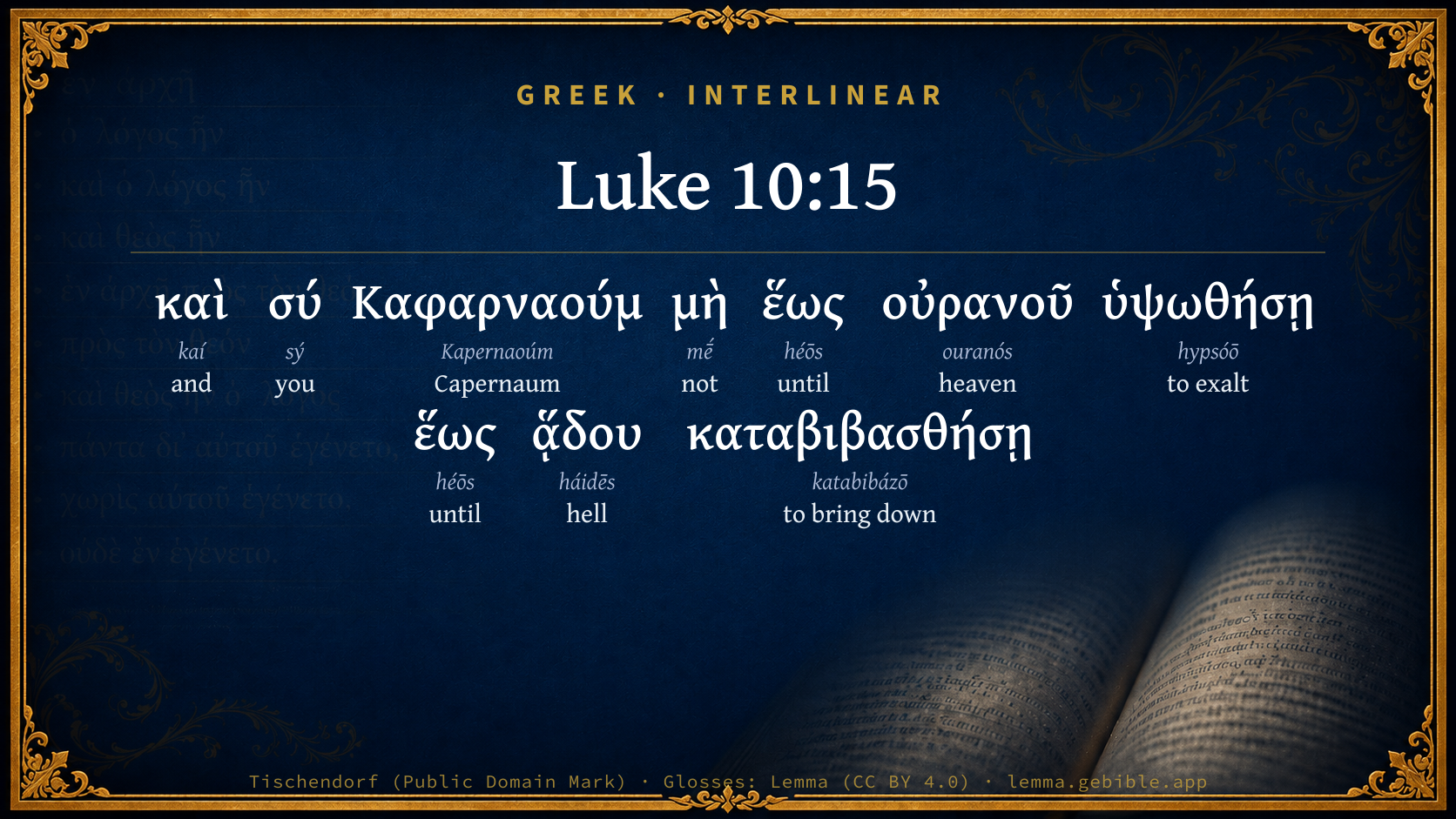
You, Capernaum, who are exalted to heaven, will be brought down to Hades.
Download a study sheet
One document with this verse’s original text, its word-by-word gloss line, the meaning frame, cross-references with their text, attributed commentary, and full source and license credits — printable, and it pastes into notes with its structure intact.
This verse Autodidact and up
A passage Seminary Student
Up to 50 verses in one chapter. A passage sheet keeps up to 6 commentary sources and 12 cross-references per verse, in the order this page ranks them, and says so on the sheet whenever that leaves anything out. Ask for a single verse and you get the Autodidact verse sheet above.
Everything on this page stays free to read, with no account — the sheet is a download of what is already on screen, not access to it.
Compare translations 3
The same verse in 3 English versions, stacked beneath the original-language interlinear above. Click any original word for its lexicon entry.
Each is an independent rendering of the whole verse — the interlinear is not word-aligned to these translations.
Highlighted words mark where these versions differ — a whole-verse word diff, not a word-by-word alignment.
-
World English Bible Public Domain
You, Capernaum, who are exalted to heaven, will be brought down to Hades.
-
King James Version Public Domain
And thou, Capernaum, which art exalted to heaven, shalt be thrust down to hell.
-
unfoldingWord Literal Text CC BY-SA 4.0
And you, Capernaum, you will not be exalted to heaven, will you? You will be brought down as far as Hades.
unfoldingWord Literal Text — © unfoldingWord, licensed CC BY-SA 4.0. Word-aligned USFM3 via Door43 (git.door43.org/unfoldingWord/en_ult).
Show all 19 translations
Every available English version of this verse, each an independent rendering of the whole verse.
-
World English Bible Public Domain
You, Capernaum, who are exalted to heaven, will be brought down to Hades.
-
Berean Standard Bible Public Domain
And you, Capernaum, will you be lifted up to heaven? No, you will be brought down to Hades!
-
Majority Standard Bible Public Domain
And you, Capernaum, who are exalted to heaven, will be brought down to Hades!
-
King James Version Public Domain
And thou, Capernaum, which art exalted to heaven, shalt be thrust down to hell.
-
American Standard Version (1901) Public Domain
And thou, Capernaum, shalt thou be exalted unto heaven? thou shalt be brought down unto Hades.
-
Revised Version (1885) Public Domain
And thou, Capernaum, shalt thou be exalted unto heaven? thou shalt be brought down unto Hades.
-
Geneva Bible (1599) Public Domain
And thou, Capernaum, which art exalted to heauen, shalt be thrust downe to hell.
-
Douay-Rheims (1899) Public Domain
And thou, Capharnaum, which art exalted unto heaven, thou shalt be thrust down to hell.
-
Young's Literal Translation Public Domain
`And thou, Capernaum, which unto the heaven wast exalted, unto hades thou shalt be brought down.
-
Literal Standard Version CC BY-SA 4.0
And you, Capernaum, which were exalted to Heaven, you will be brought down to Hades.
-
Unlocked Literal Bible CC BY-SA 4.0
You, Capernaum, do you think you will be exalted to heaven? No, you will be brought down to Hades.
-
unfoldingWord Literal Text CC BY-SA 4.0
And you, Capernaum, you will not be exalted to heaven, will you? You will be brought down as far as Hades.
-
Darby Bible Public Domain
And *thou*, Capernaum, who hast been raised up to heaven, shalt be brought down even to hades.
-
World Messianic Bible Public Domain
You, Capernaum, who are exalted to heaven, will be brought down to Sheol.
-
Webster's Bible Public Domain
And thou, Capernaum, which art exalted to heaven, shall be thrust down to hell.
-
Free Bible Version CC BY-SA 4.0
And you, Capernaum, you won't be exalted to heaven; you will go down to Hades.
-
Bible in Basic English Public Domain
And you, Capernaum, were you not lifted up to heaven? you will go down to hell.
-
Text-Critical English NT CC BY 4.0
And yoʋ, Capernaum, who have been exalted to heaven, will be brought down to Hades.
-
Tyndale New Testament (1534) Public Domain
And thou Capernau which art exalted to heaven shalt be thrust doune to hell.
Literal Standard Version (2020), Covenant Press — licensed CC BY-SA 4.0. Text via the HelloAO Bible API (eBible.org). Unlocked Literal Bible (unfoldingWord) — licensed CC BY-SA 4.0. Text via the HelloAO Bible API (eBible.org). unfoldingWord Literal Text — © unfoldingWord, licensed CC BY-SA 4.0. Word-aligned USFM3 via Door43 (git.door43.org/unfoldingWord/en_ult). Free Bible Version, Dr. Jonathan Gallagher — licensed CC BY-SA 4.0. Text via the HelloAO Bible API (eBible.org).
Word by word
More ways to search: Search by grammar → Find every occurrence → Compare this word →
Practice this passage: Drill this verse → Learn its vocabulary →
- Appears 2× in the Greek New Testament
- First appears at Matthew 11:23
- Part of Speech
- Verb
- Tense
- Future
- Voice
- Passive
- Mood
- Indicative
- Person
- 2nd person
- Number
- Singular
Full Thayer's Definition
- καὶ kaí G2532 “and” Conjunction
- σύ sý G4771 “you” Personal pronoun, 2nd person, Nominative, Singular
- Καφαρναούμ Kapernaoúm G2584 “Capernaum” Noun, Proper, indeclinable
- μὴ mḗ G3361 “not” Particle, Negative
- ἕως héōs G2193 “until” Adverb
- οὐρανοῦ ouranós G3772 “heaven” Noun, Genitive, Singular, Masculine
- ὑψωθήσῃ hypsóō G5312 “to exalt” Verb, Future, Passive, Indicative, 2nd person, Singular
- ἕως héōs G2193 “until” Adverb
- ᾅδου háidēs G86 “hell” Noun, Genitive, Singular, Masculine
- καταβιβασθήσῃ katabibázō G2601 “to bring down” Verb, Future, Passive, Indicative, 2nd person, Singular
About this verse
These counts appear in no published source. They are computed here, from the morphology-tagged text and Lemma’s own curated glosses. What Lemma adds →
- 10
- words
- 9
- distinct lemmas
- Gospels
- section
Notable vocabulary
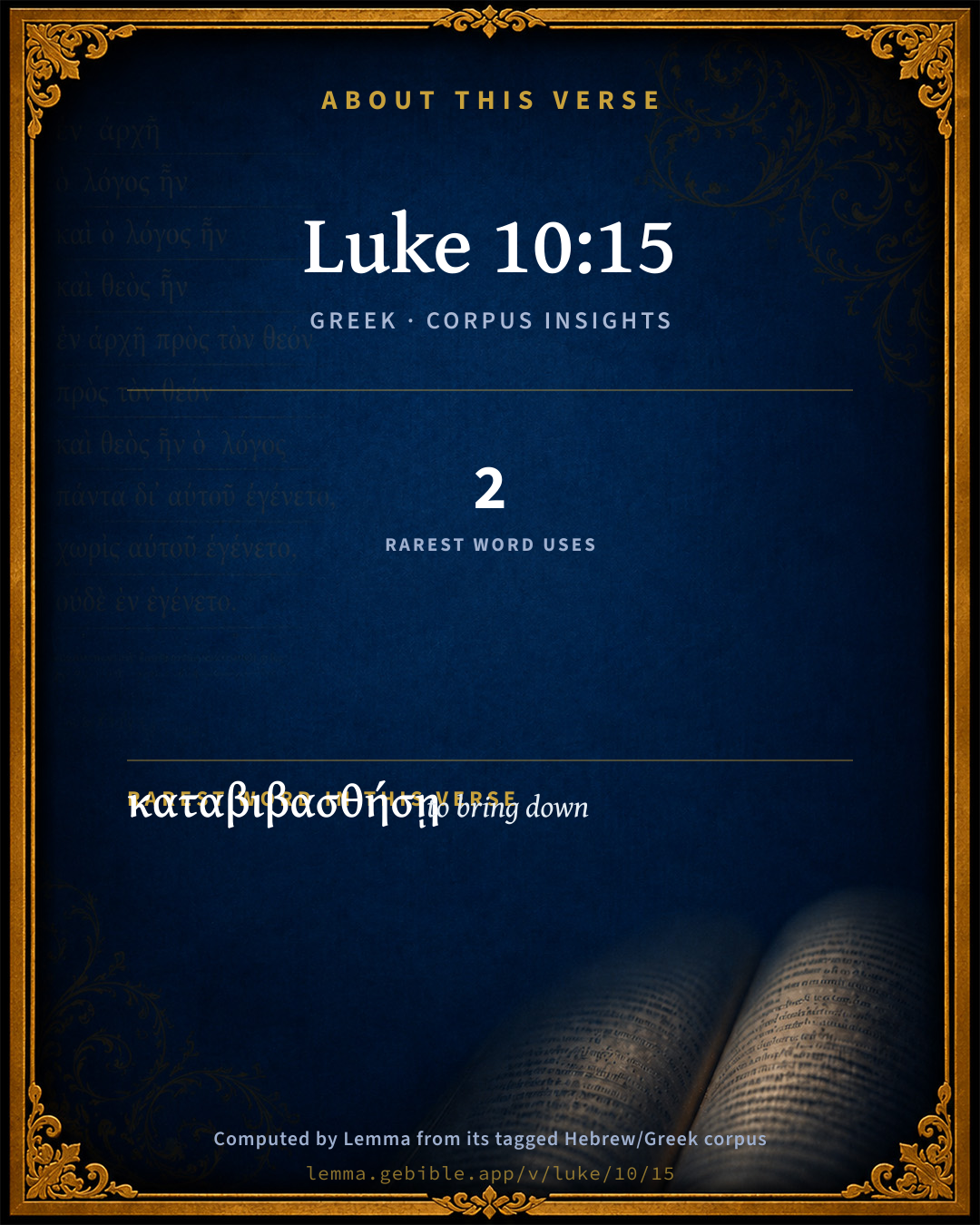
The rarest word here is καταβιβασθήσῃ to bring down G2601 — appearing just 2 times in the whole Greek New Testament.
Shared distinctive vocabulary
καταβιβασθήσῃ to bring down G2601 occurs in 2 verses of the Greek New Testament. Also found in:
Repetition
A word recurs within this verse:
- ἕως until G2193 ×2
Cross-references
20Topical passages linked to Luke 10:15 in the Treasury of Scripture Knowledge — connected by theme and wording, ordered by reader-vote popularity; previews shown in the World English Bible.
- Isaiah 14:13–15 You said in your heart, I will ascend into heaven, I will exalt my throne above the stars of God; and I will sit on the mountain of congregation, in the uttermost parts of the north;
- Matthew 4:13 Leaving Nazareth, he came and lived in Capernaum, which is by the sea, in the region of Zebulun and Naphtali,
- 2 Peter 2:4 For if God didn't spare angels when they sinned, but cast them down to Tartarus, and committed them to pits of darkness, to be reserved to judgment;
- Matthew 11:23 You, Capernaum, who are exalted to Heaven, you will go down to Hades. For if the mighty works had been done in Sodom which were done in you, it would have remained until this day.
- Luke 13:28 There will be weeping and gnashing of teeth, when you see Abraham, Isaac, Jacob, and all the prophets, in the Kingdom of God, and yourselves being thrown outside.
- Genesis 11:4 They said, "Come, let's build us a city, and a tower, whose top reaches to the sky, and let's make us a name; lest we be scattered abroad on the surface of the whole earth."
- Deuteronomy 1:28 Where are we going up? our brothers have made our heart to melt, saying, The people are greater and taller than we; the cities are great and fortified up to the sky; and moreover we have seen the sons of the Anakim there.
- Isaiah 5:14 Therefore Sheol has enlarged its desire, And opened its mouth without measure; And their glory, their multitude, their pomp, and he who rejoices among them, descend into it.
- Jeremiah 51:53 Though Babylon should mount up to the sky, and though she should fortify the height of her strength, yet from me shall destroyers come to her, says Yahweh.
- Ezekiel 26:20 then will I bring you down with those who descend into the pit, to the people of old time, and will make you to dwell in the lower parts of the earth, in the places that are desolate of old, with those who go down to the pit, that you be not inhabited; and I will set glory in the land of the living:
- Ezekiel 28:12–14 Son of man, take up a lamentation over the king of Tyre, and tell him, Thus says the Lord Yahweh: You seal up the sum, full of wisdom, and perfect in beauty.
- Ezekiel 31:18 To whom are you thus like in glory and in greatness among the trees of Eden? yet shall you be brought down with the trees of Eden to the lower parts of the earth: you shall lie in the midst of the uncircumcised, with those who are slain by the sword. This is Pharaoh and all his multitude, says the Lord Yahweh.
- Ezekiel 32:18 Son of man, wail for the multitude of Egypt, and cast them down, even her, and the daughters of the famous nations, to the lower parts of the earth, with those who go down into the pit.
- Ezekiel 32:20 They shall fall in the midst of those who are slain by the sword: she is delivered to the sword; draw her away and all her multitudes.
- Ezekiel 32:27 They shall not lie with the mighty who are fallen of the uncircumcised, who are gone down to Sheol with their weapons of war, and have laid their swords under their heads, and their iniquities are on their bones; for [they were] the terror of the mighty in the land of the living.
- Amos 9:2–3 Though they dig into Sheol, there my hand will take them; and though they climb up to heaven, there I will bring them down.
- Obadiah 1:4 Though you mount on high as the eagle, and though your nest is set among the stars, I will bring you down from there, says Yahweh.
- Matthew 10:28 Don't be afraid of those who kill the body, but are not able to kill the soul. Rather, fear him who is able to destroy both soul and body in Gehenna.
- Luke 7:1–2 After he had finished speaking in the hearing of the people, he entered into Capernaum.
- Luke 16:23 In Hades, he lifted up his eyes, being in torment, and saw Abraham far off, and Lazarus at his bosom.
Cross-references courtesy of OpenBible.info (CC BY 4.0).
Lesson kit
Teaching starters — assembled from the data on this page, not authored interpretation. Every prompt links to the verse data it draws on. Edit before teaching.
Luke, in the Gospels, opens this verse with 10 words (9 distinct Greek lemmas). Its most distinctive word is katabibázō (“to bring down”). A historical commentator’s framing appears above. Read the whole chapter for the surrounding context.
Discussion questions
- How does “to bring down” (katabibázō) shape what this verse is saying?
- Matthew 11:23 shares the word «to bring down» with this verse. How do the two illuminate each other?
- “until” occurs 2× in this one verse. What is the effect of the repetition?
- The translations on this page render this verse differently — a whole-verse word diff, not a word-by-word alignment. What might account for the different wordings?
- Reading how Tyndale Open Study Notes and Adam Clarke's Commentary read this verse, where do the two commentators agree and where do they part?
Things to notice
- These translations choose different wording for 9 words in this verse.
- “until” occurs 2× in this single verse.
- 9 distinct Greek lemmas span 10 words in this verse.
Commentary
Notes on Luke 10:15 from classic Christian and Jewish commentators (each source and its license shown beneath its notes). The classic Christian expositions comment on the surrounding passage and are grouped to its opening verse, so a note may address several verses; the Jewish commentaries on the Tanakh (Rashi and others) are per-verse, so they appear only where the commentator wrote on this verse.
Lemma curates 59 commentaries, every one of them public domain or Creative Commons licensed, each selected and text-cleaned for this edition rather than reprinted as found. About our sources →
Tyndale Open Study Notes
Tyndale Open Resources
Tyndale Open Study Notes — © Tyndale Open Resources, licensed CC BY-SA 4.0. Text via the HelloAO Bible API.
Adam Clarke's Commentary
Adam Clarke's Commentary on the Bible (1810–1826) — public domain. Text from a community e-Sword/MySword module.
The Cambridge Bible for Schools and Colleges
gen. ed. J. J. S. Perowne
The Cambridge Bible for Schools and Colleges (gen. ed. J. J. S. Perowne; Cambridge University Press, 1878–1918) — public domain. Text from a community e-Sword module.
John Gill's Exposition
John Gill's Exposition of the Whole Bible (1746–1763) — public domain (CC PDM 1.0). Text via the HelloAO Bible API.
Haydock's Catholic Bible Commentary
George Leo Haydock (1774–1849), Haydock's Catholic Family Bible and Commentary, 1859 edition — public domain. Excludes Psalms (Douay-Rheims chapter numbering differs from Protestant) and Deuterocanonical books (Catholic canon only).
Whedon's Commentary on the Bible
Daniel D. Whedon
Daniel D. Whedon (gen. ed.), Commentary on the Old and New Testaments (1874–1909) — public domain. Text from a community e-Sword module.
The Pulpit Commentary
The Pulpit Commentary (1880–1919), ed. H.D.M. Spence-Jones & Joseph S. Exell — public domain. Text from a community e-Sword module.
Cambridge Greek Testament for Schools and Colleges
Cambridge Greek Testament for Schools and Colleges (Cambridge University Press, 1896; 21 vols, various authors incl. Carr, Maclear, Plummer, Farrar, Lumby, Moule, M. R. James, Simcox) — public domain. Text from a community e-Sword module.
International Critical Commentary
International Critical Commentary — older volumes (1896–1929), various authors — public domain. Text from a community e-Sword module.
Vincent's Word Studies in the New Testament
Marvin R. Vincent
Marvin R. Vincent, Word Studies in the New Testament (1887–1900) — public domain. Text from a community e-Sword/MySword module.