2 Corinthians 12:2

Greek (Tischendorf 8th ed.) 2 Corinthians 12:2 appears in the Greek New Testament. The text above is from the Tischendorf 8th edition. Each word links to its Strong’s number and a concise gloss. Click any word for its full Thayer’s Greek Lexicon entry.
Download image
Cite this verse

2 Corinthians 12:2 (World English Bible). Public Domain. Lemma interlinear Bible study tool, https://lemma.gebible.app/v/2-corinthians/12/2.

Show BibTeX & RIS
BibTeX
RIS
English Translation
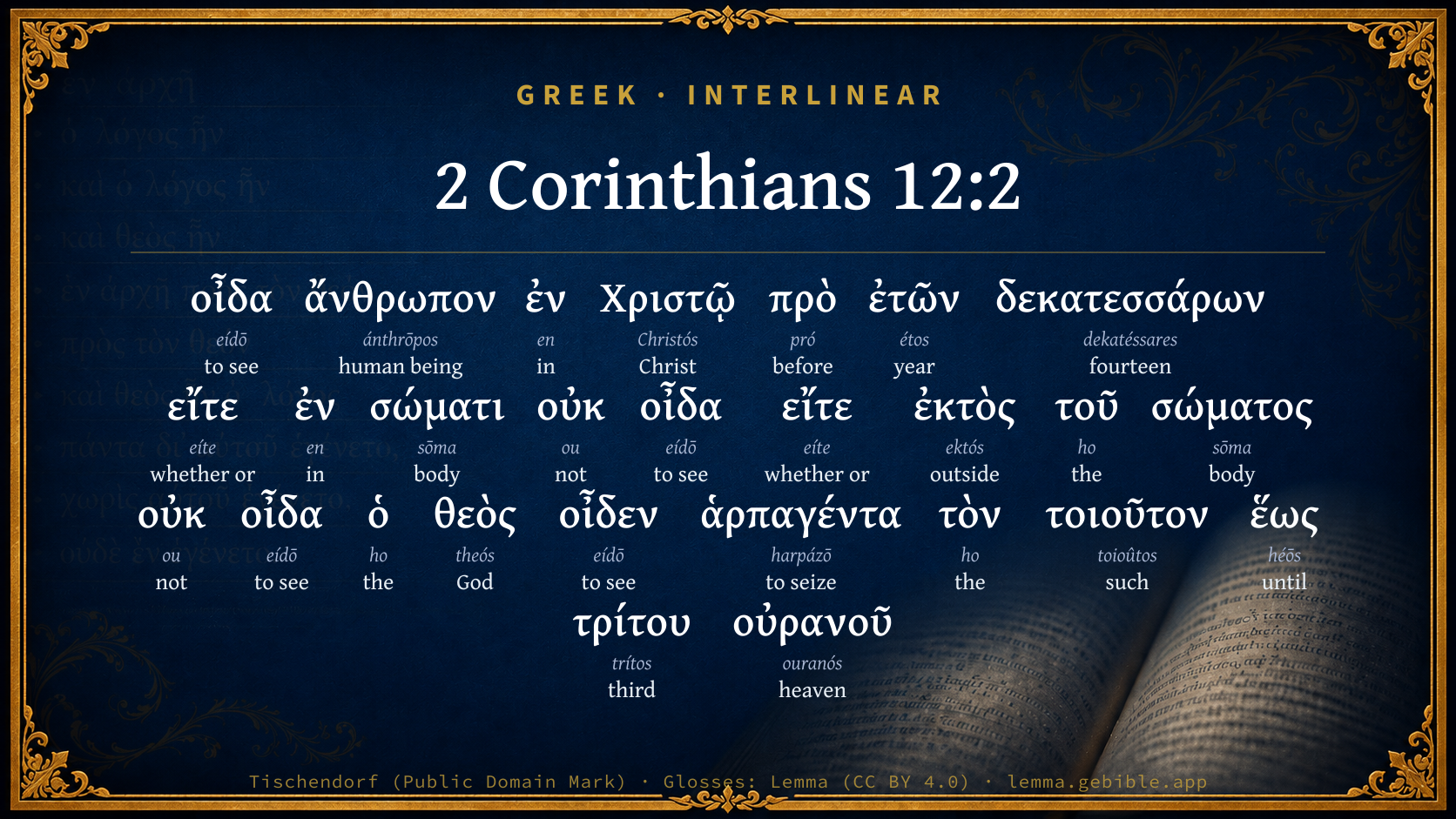
I know a man in Christ, fourteen years ago (whether in the body, I don't know, or whether out of the body, I don't know; God knows), such a one caught up into the third heaven.
World English Bible · Public Domain
Download a study sheet

One document with this verse’s original text, its word-by-word gloss line, the meaning frame, cross-references with their text, attributed commentary, and full source and license credits — printable, and it pastes into notes with its structure intact.

This verse Autodidact and up

Study sheet (.html) Plain text (.txt)

A passage Seminary Student

Up to 50 verses in one chapter. A passage sheet keeps up to 6 commentary sources and 12 cross-references per verse, in the order this page ranks them, and says so on the sheet whenever that leaves anything out. Ask for a single verse and you get the Autodidact verse sheet above.

Everything on this page stays free to read, with no account — the sheet is a download of what is already on screen, not access to it.

Want to remove ads? Support Godless Engineer
Compare translations 3

The same verse in 3 English versions, stacked beneath the original-language interlinear above. Click any original word for its lexicon entry.

Each is an independent rendering of the whole verse — the interlinear is not word-aligned to these translations.

Highlighted words mark where these versions differ — a whole-verse word diff, not a word-by-word alignment.

  • World English Bible Public Domain
    I know a man in Christ, fourteen years ago (whether in the body, I don't know, or whether out of the body, I don't know; God knows), such a one caught up into the third heaven.
  • King James Version Public Domain
    I knew a man in Christ above fourteen years ago, (whether in the body, I cannot tell; or whether out of the body, I cannot tell: God knoweth;) such an one caught up to the third heaven.
  • unfoldingWord Literal Text CC BY-SA 4.0
    I know a man in Christ—whether in the body, I do not know, or out of the body, I do not know, God knows—such a having been caught up to the third heaven 14 years ago.

unfoldingWord Literal Text — © unfoldingWord, licensed CC BY-SA 4.0. Word-aligned USFM3 via Door43 (git.door43.org/unfoldingWord/en_ult).

Versions to compare (up to 4)

3 of 4 selected

Show all 19 translations

Every available English version of this verse, each an independent rendering of the whole verse.

  • World English Bible Public Domain
    I know a man in Christ, fourteen years ago (whether in the body, I don't know, or whether out of the body, I don't know; God knows), such a one caught up into the third heaven.
  • Berean Standard Bible Public Domain
    I know a man in Christ who fourteen years ago was caught up to the third heaven. Whether it was in the body or out of it I do not know, but God knows.
  • Majority Standard Bible Public Domain
    I know a man in Christ who fourteen years ago was caught up to the third heaven. Whether it was in the body or out of it I do not know, but God knows.
  • King James Version Public Domain
    I knew a man in Christ above fourteen years ago, (whether in the body, I cannot tell; or whether out of the body, I cannot tell: God knoweth;) such an one caught up to the third heaven.
  • American Standard Version (1901) Public Domain
    I know a man in Christ, fourteen years ago (whether in the body, I know not; or whether out of the body, I know not; God knoweth), such a one caught up even to the third heaven.
  • Revised Version (1885) Public Domain
    I know a man in Christ, fourteen years ago (whether in the body, I know not; or whether out of the body, I know not; God knoweth), such a one caught up even to the third heaven.
  • Geneva Bible (1599) Public Domain
    I know a man in Christ aboue fourteene yeeres agone, (whether he were in the body, I can not tell, or out of the body, I can not tell: God knoweth) which was taken vp into the thirde heauen.
  • Douay-Rheims (1899) Public Domain
    I know a man in Christ above fourteen years ago (whether in the body, I know not, or out of the body, I know not; God knoweth), such a one caught up to the third heaven.
  • Young's Literal Translation Public Domain
    I have known a man in Christ, fourteen years ago -- whether in the body I have not known, whether out of the body I have not known, God hath known -- such an one being caught away unto the third heaven;
  • Literal Standard Version CC BY-SA 4.0
    I have known a man in Christ, fourteen years ago—whether in the body I have not known, whether out of the body I have not known, God has known—such a one being snatched up to the third heaven;
  • Unlocked Literal Bible CC BY-SA 4.0
    I know a man in Christ who fourteen years ago who—whether in the body or out of the body, I do not know, God knows—was caught up into the third heaven.
  • unfoldingWord Literal Text CC BY-SA 4.0
    I know a man in Christ—whether in the body, I do not know, or out of the body, I do not know, God knows—such a having been caught up to the third heaven 14 years ago.
  • Darby Bible Public Domain
    I know a man in Christ, fourteen years ago, (whether in [the] body I know not, or out of the body I know not, God knows;) such [a one] caught up to [the] third heaven.
  • World Messianic Bible Public Domain
    I know a man in Messiah who was caught up into the third heaven fourteen years ago—whether in the body, I don’t know, or whether out of the body, I don’t know; God knows.
  • Webster's Bible Public Domain
    I knew a man in Christ above fourteen years ago, (whether in the body, I cannot tell; or whether out of the body, I cannot tell: God knoweth;) such one caught up to the third heaven.
  • Free Bible Version CC BY-SA 4.0
    I know a man in Christ who fourteen years ago was taken up to the third heaven (whether physically in the body, or out of it, I don't know, but God knows).
  • Bible in Basic English Public Domain
    I have knowledge of a man in Christ, fourteen years back (if he was in the body, or out of the body, I am not able to say, but God only), who was taken up to the third heaven.
  • Text-Critical English NT CC BY 4.0
    I know a man in Christ who fourteen years ago was caught up to the third heaven. (Whether it was in the body or out of the body I do not know; God knows.)
  • Tyndale New Testament (1534) Public Domain
    I knowe a man in Christ above.xiiij. yeares agone (whether he weare in the body I cannot tell or whether he were oute of the body I cannot tell god knoweth) which was take vp into the thyrd heven.

Literal Standard Version (2020), Covenant Press — licensed CC BY-SA 4.0. Text via the HelloAO Bible API (eBible.org). Unlocked Literal Bible (unfoldingWord) — licensed CC BY-SA 4.0. Text via the HelloAO Bible API (eBible.org). unfoldingWord Literal Text — © unfoldingWord, licensed CC BY-SA 4.0. Word-aligned USFM3 via Door43 (git.door43.org/unfoldingWord/en_ult). Free Bible Version, Dr. Jonathan Gallagher — licensed CC BY-SA 4.0. Text via the HelloAO Bible API (eBible.org).

Word by word

More ways to search: Search by grammar → Find every occurrence → Compare this word →

Practice this passage: Drill this verse → Learn its vocabulary →

δεκατεσσάρων
dekatéssares
G1180
“fourteen”
Adjective, Genitive, Plural, Neuter
Part of Speech
Adjective
Case
Genitive
Number
Plural
Gender
Neuter
Full Thayer's Definition

Origin: from G1176 and G5064

TDNT: None

1. fourteen
  1. οἶδα eídō G1492 “to see” Verb, Perfect, Active, Indicative, 1st person, Singular
  2. ἄνθρωπον ánthrōpos G444 “human being” Noun, Accusative, Singular, Masculine
  3. ἐν en G1722 “in” Preposition
  4. Χριστῷ Christós G5547 “Christ” Noun, Dative, Singular, Masculine
  5. πρὸ pró G4253 “before” Preposition
  6. ἐτῶν étos G2094 “year” Noun, Genitive, Plural, Neuter
  7. εἴτε eíte G1535 “whether or” Conjunction
  8. ἐν en G1722 “in” Preposition
  9. σώματι sōma G4983 “body” Noun, Dative, Singular, Neuter
  10. οὐκ ou G3756 “not” Particle, Negative
  11. οἶδα eídō G1492 “to see” Verb, Perfect, Active, Indicative, 1st person, Singular
  12. εἴτε eíte G1535 “whether or” Conjunction
  13. ἐκτὸς ektós G1622 “outside” Adverb
  14. τοῦ ho G3588 “the” Article, Genitive, Singular, Neuter
  15. σώματος sōma G4983 “body” Noun, Genitive, Singular, Neuter
  16. οὐκ ou G3756 “not” Particle, Negative
  17. οἶδα eídō G1492 “to see” Verb, Perfect, Active, Indicative, 1st person, Singular
  18. ὁ ho G3588 “the” Article, Nominative, Singular, Masculine
  19. θεὸς theós G2316 “God” Noun, Nominative, Singular, Masculine
  20. οἶδεν eídō G1492 “to see” Verb, Perfect, Active, Indicative, 3rd person, Singular
  21. ἁρπαγέντα harpázō G726 “to seize” Verb, Aorist, Passive, Participle, Accusative, Singular, Masculine
  22. τὸν ho G3588 “the” Article, Accusative, Singular, Masculine
  23. τοιοῦτον toioûtos G5108 “such” Demonstrative pronoun, Accusative, Singular, Masculine
  24. ἕως héōs G2193 “until” Adverb
  25. τρίτου trítos G5154 “third” Adjective, Genitive, Singular, Masculine
  26. οὐρανοῦ ouranós G3772 “heaven” Noun, Genitive, Singular, Masculine

About this verse

These counts appear in no published source. They are computed here, from the morphology-tagged text and Lemma’s own curated glosses. What Lemma adds →

27
words
18
distinct lemmas
Pauline Epistles
section

Notable vocabulary

The rarest word here is δεκατεσσάρων fourteen G1180 — appearing just 5 times in the whole Greek New Testament.

Shared distinctive vocabulary

δεκατεσσάρων fourteen G1180 occurs in 3 verses of the Greek New Testament. Also found in:

Repetition

Words recur within this verse:

  • οἶδα to see G1492 ×4
  • εἴτε whether or G1535 ×2
  • σώματι body G4983 ×2
  • τοῦ the G3588 ×3
  • ἐν in G1722 ×2
  • οὐκ not G3756 ×2

Cross-references

34

Topical passages linked to 2 Corinthians 12:2 in the Treasury of Scripture Knowledge — connected by theme and wording, ordered by reader-vote popularity; previews shown in the World English Bible.

  • Acts 22:17 "It happened that, when I had returned to Jerusalem, and while I prayed in the temple, I fell into a trance,
  • Ezekiel 8:1–3 It happened in the sixth year, in the sixth [month], in the fifth [day] of the month, as I sat in my house, and the elders of Judah sat before me, that the hand of the Lord Yahweh fell there on me.
  • 1 Thessalonians 4:17 then we who are alive, who are left, will be caught up together with them in the clouds, to meet the Lord in the air. So we will be with the Lord forever.
  • Revelation 4:2 Immediately I was in the Spirit. Behold, there was a throne set in heaven, and one sitting on the throne
  • 2 Corinthians 11:11 Why? Because I don't love you? God knows.
  • Isaiah 57:15 For thus says the high and lofty One who inhabits eternity, whose name is Holy: I dwell in the high and holy place, with him also who is of a contrite and humble spirit, to revive the spirit of the humble, and to revive the heart of the contrite.
  • 1 Kings 18:12 It will happen, as soon as I am gone from you, that the Spirit of Yahweh will carry you I don't know where; and so when I come and tell Ahab, and he can't find you, he will kill me: but I your servant fear Yahweh from my youth.
  • Isaiah 45:24–25 Only in Yahweh, it is said of me, is righteousness and strength; even to him shall men come; and all those who were incensed against him shall be disappointed.
  • Genesis 1:14–20 God said, "Let there be lights in the expanse of sky to divide the day from the night; and let them be for signs, and for seasons, and for days and years;
  • 1 Kings 8:27 But will God in very deed dwell on the earth? behold, heaven and the heaven of heavens can't contain you; how much less this house that I have built!
  • Ezekiel 11:24 The Spirit lifted me up, and brought me in the vision by the Spirit of God into Chaldea, to them of the captivity. So the vision that I had seen went up from me.
  • Luke 24:51 It happened, while he blessed them, that he withdrew from them, and was carried up into heaven.
  • John 6:56 He who eats my flesh and drinks my blood lives in me, and I in him.
  • John 15:4–6 Remain in me, and I in you. As the branch can't bear fruit by itself, unless it remains in the vine, so neither can you, unless you remain in me.
  • Acts 8:39–40 When they came up out of the water, the Spirit of the Lord caught Philip away, and the eunuch didn't see him any more, for he went on his way rejoicing.
  • Acts 14:6 they became aware of it, and fled to the cities of Lycaonia, Lystra, Derbe, and the surrounding region.
  • Romans 8:1 There is therefore now no condemnation to those who are in Christ Jesus, who don't walk according to the flesh, but according to the Spirit.
  • Romans 16:7 Greet Andronicus and Junias, my relatives and my fellow prisoners, who are notable among the apostles, who also were in Christ before me.
  • 2 Corinthians 5:6–8 Being therefore always of good courage, and knowing that, while we are at home in the body, we are absent from the Lord;
  • 2 Corinthians 5:17 Therefore if anyone is in Christ, he is a new creation. The old things have passed away. Behold, all things have become new.
  • 2 Corinthians 12:3–5 I know such a man (whether in the body, or outside of the body, I don't know; God knows),
  • Galatians 1:22 I was still unknown by face to the assemblies of Judea which were in Christ,
  • Galatians 5:6 For in Christ Jesus neither circumcision amounts to anything, nor uncircumcision, but faith working through love.
  • Ephesians 4:10 He who descended is the one who also ascended far above all the heavens, that he might fill all things.
  • Philippians 1:22–23 But if I live on in the flesh, this will bring fruit from my work; yet I don't make known what I will choose.
  • Hebrews 9:24 For Christ hasn't entered into holy places made with hands, which are representations of the true, but into heaven itself, now to appear in the presence of God for us;
  • 2 Kings 2:16 They said to him, See now, there are with your servants fifty strong men; let them go, we pray you, and seek your master, lest the Spirit of Yahweh has taken him up, and cast him on some mountain, or into some valley. He said, You shall not send.
  • 1 Corinthians 1:30 But of him, you are in Christ Jesus, who was made to us wisdom from God, and righteousness and sanctification, and redemption:
  • 2 Corinthians 5:21 For him who knew no sin he made to be sin on our behalf; so that in him we might become the righteousness of God.
  • 2 Corinthians 13:5 Test your own selves, whether you are in the faith. Test your own selves. Or don't you know as to your own selves, that Jesus Christ is in you?--unless indeed you are disqualified.
  • Revelation 12:5 She gave birth to a son, a male child, who is to rule all the nations with a rod of iron. Her child was caught up to God, and to his throne.
  • Psalms 148:4 Praise him, you heavens of heavens, You waters that are above the heavens.
  • John 17:21–23 that they may all be one; even as you, Father, are in me, and I in you, that they also may be one in us; that the world may believe that you sent me.
  • Revelation 1:10 I was in the Spirit on the Lord's day, and I heard behind me a loud voice, like a trumpet

Cross-references courtesy of OpenBible.info (CC BY 4.0).

Commentary

Notes on 2 Corinthians 12:2 from classic Christian and Jewish commentators (each source and its license shown beneath its notes). The classic Christian expositions comment on the surrounding passage and are grouped to its opening verse, so a note may address several verses; the Jewish commentaries on the Tanakh (Rashi and others) are per-verse, so they appear only where the commentator wrote on this verse.

Lemma curates 59 commentaries, every one of them public domain or Creative Commons licensed, each selected and text-cleaned for this edition rather than reprinted as found. About our sources →

Jamieson, Fausset & Brown

Robert Jamieson, A. R. Fausset & David Brown

Translate, "I know," not "I knew."

a man--meaning himself. But he purposely thus distinguishes between the rapt and glorified person of Co2 12:2, Co2 12:4, and himself the infirmity-laden victim of the "thorn in the flesh" (Co2 12:7). Such glory belonged not to him, but the weakness did. Nay, he did not even know whether he was in or out of the body when the glory was put upon him, so far was the glory from being his [ALFORD]. His spiritual self was his highest and truest self: the flesh with its infirmity merely his temporary self (Rom 7:25). Here, however, the latter is the prominent thought.

in Christ--a Christian (Rom 16:7).

above--rather, simply "fourteen years ago." This Epistle was written A.D. 55-57. Fourteen years before will bring the vision to A.D. 41-43, the time of his second visit to Jerusalem (Act 22:17). He had long been intimate with the Corinthians, yet had never mentioned this revelation before: it was not a matter lightly to be spoken of.

I cannot tell--rather as Greek, "I know not." If in the body, he must have been caught up bodily; if out of the body, as seems to be Paul's opinion, his spirit must have been caught up out of the body. At all events he recognizes the possibility of conscious receptivity in disembodied spirits.

caught up-- (Act 8:39).

to the third heaven--even to, &c. These raptures (note the plural, "visions," "revelations," Co2 12:1) had two degrees: first he was caught up "to the third heaven," and from thence to "Paradise" (Co2 12:4) [CLEMENT OF ALEXANDRIA, Miscellanies, 5.427], which seems to denote an inner recess of the third heaven [BENGEL] (Luk 23:43; Rev 2:7). Paul was permitted not only to "hear" the things of Paradise, but to see also in some degree the things of the third heaven (compare "visions," Co2 12:1). The occurrence TWICE of "whether in the body . . . I know not, God knoweth," and of "lest I should be exalted above measure," marks two stages in the revelation. "Ignorance of the mode does not set aside the certain knowledge of the fact. The apostles were ignorant of many things" [BENGEL]. The first heaven is that of the clouds, the air; the second, that of the stars, the sky; the third is spiritual (Eph 4:10).

Jamieson, Fausset & Brown — Commentary Critical and Explanatory on the Whole Bible (1871) — public domain (CC PDM 1.0). Text via the HelloAO Bible API.

The Biblical Illustrator

Joseph S. Exell

2Co_12:2

I knew a man in Christ.

Seven blessings of being in Christ

I. Deliverance from the deadly curse which sin entails (Rom_8:1). In Noahs ark there was no deluge; in Christ Jesus there is no condemnation.

II. Everlasting life. Of this Christ is the single source. Paul addresses the Church at Rome as alive unto God in Christ Jesus our Lord. The Master said, Because I live ye shall live also. It is not I, said Paul, but Christ that liveth in me. If the nurseryman inserts the graft of a golden pippin into an apple tree, that graft might say truly, It is not I that live, but the whole tree liveth in me. So Divine a thing is this life that it is described as--

III. A new creation. This word new signifies also what is fresh, and unimpaired, and unworn, like a bright garment from its makers hand. How imperative is it that we keep this unspotted by the world! Not for ornament merely is it given, but for use.

IV. Acceptance in the beloved. If we are received into favour, it is solely for Christs sake.

V. Peace (Php_4:7).

VI. Fulness of spiritual supply (Col_2:10). Ye are filled full in Christ. Why need I hunger when in my fathers house and in my Saviours heart are such wealth beyond a whole universe to drain?

VII. Triumph Thanks be unto God who always causeth us to triumph in Christ! This is the believers battle-cry and paean of victory. Jesus gives the victory, and will bring us off more than conquerors. (T. L. Cuyler, D. D.)

I forbear, lest any man should think of me above that which he seeth me to be.--

Visible character, not private vision, the Christian mark

That we may reach the apostles meaning here it is needful to look at what he writes immediately before our text. The favour which certain false teachers had met with in the Church at Corinth had compelled Paul, out of regard for the safety of the believers there, to remind them, by direct assertion, of his own superior claim. Such self-assertion was not agreeable to his own feelings. Yet his was not the self-assertion of vainglory. First and last he gives God the praise. He rejoices not, nor glories, in his strength, but in his infirmities; for it is through his human infirmities that Divine grace and power become more clearly manifest. These very weaknesses are turned to highest account. As a ground of glorying and of claim to their regard, he might urge the visions and revelations of the Lord with which he had been favoured, but he forbears. Meantime, we must note the fact of these visions and revelations. They point to intimate spiritual communications--openings, so to speak, into the higher sphere of Gods thought and presence, so bright as to cast into the shade, for the time being, all consciousness connected with the lower sphere of bodily existence. Any philosophy, or way of conceiving of things, which throws doubt on the spiritual contact of God with man, is fatal to spiritual life and growth. For such a way of thinking involves a partial dethronement of the universal God. Never in any age of the world does He shut Himself off from contact with His children. In dealing with claims to spiritual enlightenment and influence, it behoves us to consider them cautiously. And even when we feel sure of them it becomes us to be modest in the assertion thereof. If others assert such claims on their own behalf, we are in nowise bound either to admit or deny them. No man is authorised to demand from others respect for such claims except in so far as he can support them by outward evidence. It becomes us, then, to forbear as the Apostle Paul did. Visions and revelations from the Lord we may have--rapt and ecstatic states of mind--sweet and strengthening hours of devout meditation and prayer; but of these it becomes us not to speak in the way of mere assertion as ground of boasting or superiority. From whatever point we approach the matter we find that the last test of true religion is to be found in its manifestation in character and life. By their fruits ye shall know them, said Jesus. This is the Christian mark. All divinely inspired prophets and apostles speak in the same strain. If the word revealed within is as the candle of the Lord shining there, lighting up truth, justice, and love clearly to our apprehension, it must be borne in mind that such a light has not been given for private and selfish use. If this be forgotten, the light within becomes darkness. The ambition which seeks the regard of others beyond that which its actual merits justify is the sure token of spiritual poverty and vanity. I forbear, says the great apostle, lest any man should think of me above which he seeth me to be. And so let every man forbear from boastful reference to his superior illumination and cherish that wholesome fear that he should be judged worthy beyond the measure which his actual life testifies. For to this end was such vision given--that its light should shine by its good works, and God our heavenly Father be glorified in the lives of His faithful children. (John Cordner.)

The Biblical Illustrator, edited by Joseph S. Exell (c. 1880s–1900s) — public domain. Text from a community e-Sword module.

Joseph Benson's Commentary

2Co 12:2-3. I knew a man in Christ — That is, a Christian. He must undoubtedly have meant himself, or the whole article had been quite foreign to his purpose. Indeed, that he meant himself is plain from 2Co 12:6-7. Fourteen years ago — So long, it seems, the apostle had concealed this extraordinary event; a circumstance which shows how little disposed he was to speak vauntingly of himself. Whether in the body — And by the intervention of its senses; or out of the body — And without any such intervention, the things which I saw and heard were communicated to me; I know not — It is equally possible with God to present distant things to the imagination in the body, as if the soul were absent from it, and present with them, as seems to have been the case with Ezekiel in the visions mentioned Eze 11:24, and Eze 37:1; and with John in those recorded Rev 17:3; Rev 21:10; or, as the Spirit caught away Philip, (Act 8:39,) to transport both soul and body for what time he pleases to heaven; or to transport the soul only thither for a season, and in the mean time to preserve the body fit for its re-entrance. But since the apostle himself did not know whether his soul was in his body when he had these visions, &c.; or whether one or both were actually in heaven; for us to inquire into that matter would be vain curiosity, and extreme folly. “It is of more importance to observe, that he supposed his spirit might be carried into the third heaven, and into paradise, without his body. For, from his making such a supposition, it is plain he believed his spirit could exist out of his body; and that, by the operation of God, it could be made to hear and see, without the intervention of his bodily organs.” Such a one caught up into the third heaven — The habitation of the divine glory, far above the aerial and the starry heavens. For, “in the language of the Jews, the first heaven is the region of the air, where the birds fly, which therefore are called the fowls of heaven. The second heaven is that part of space in which the stars are. This was called, by the Jews, the heaven of heavens. See 1Ki 8:27. The third heaven is the seat of God, and of the holy angels, into which Christ ascended after his resurrection, but which is not the object of men’s senses, as the other heavens are.”

Joseph Benson's Commentary on the Old and New Testaments (1811–1818) — public domain. Text from a community e-Sword module.

Whedon's Commentary on the Bible

Daniel D. Whedon

2. A man—Commentators are agreed that the man was the apostle himself. This view is confirmed by 2Co_12:7.

Fourteen years ago—As in the narrative just given, (2Co_11:32-33,) St. Paul recalls an instance of distant date, but not for the same reason. The reason here is his desire to separate the distant self, in whom he could glory, (see note, 2Co_12:5,) from his present self. Fourteen years would bring us back to A.D. 44, about the time of St. Paul’s first residence at Antioch. It was, at this present writing, about twenty years since his conversion.

In… out of the body—St. Paul’s doubt clearly shows that he held the soul to be fully capable of existing and acting separately from the body. He was no materialist. He believed in the twofold nature of man, bodily and spiritual. If he was in the body, then his body was translated for the time, like those of Enoch, Elijah, and Christ, to the abodes of the saints after their resurrection in the body. If out of the body then his soul alone was translated to that region, leaving the body still under the power of organic life. Paul does not decide whether he was in the body or out; nor, of course, can we. But we should imagine that he was in the body when he visited the resurrection state, and out of the body when he visited the abode of disembodied spirits.

Caught—The usual word for a miraculous snatching up of the person by a divine power. Act_8:39; Rev_12:5; 1Th_4:17.

To the third heaven—Greek, even to the third heaven, implying a greater height than simply into paradise, without the even. Grotius says, that the Jews “reckoned three heavens.” 1. The aerial, including the atmosphere occupied with the clouds; 2. The sidereal, or starry firmament; and, 3. The habitation of God and his angels. “But he quotes no authority, and the accuracy of his statement is questioned.—Meyer. On the other hand, the Jewish number was the sacred seven; “God makes six heavens and dwells in the seventh.” Meyer thinks that St. Paul here recognises the seven, and so admits four heavens above the level of his ascent. Bengel ingeniously says, that the Hebrew dual shamaim supposes two heavens, and it was reserved to the gospel to reveal the third.

But, as is shown in M’Clintock and Strong’s Cyclopaedia, (on the word Heaven,) a classification of biblical texts shows well the three heavens in both the Old and New Testaments: “(1.) Under the first head, coelum nubiferum, (the AERIAL HEAVEN,) the following phrases naturally fall—(a) ‘Fowl,’ or ‘fowls of the heaven, of the air,’ see Gen_2:19; Gen_7:3; Gen_7:23; Gen_9:2; Deu_4:17; Deu_28:26; 1Ki_21:24; Job_12:7; Job_28:21; Job_35:11; Psa_8:8; Psa_79:2; Psa_104:12; Jer_7:33 et passim; Eze_29:5 et passim; Dan_2:38; Hos_2:18; Hos_4:3; Hos_7:12; Zep_1:3; Mar_4:3, (τα πετεινα του ουρανου;) Luk_8:5; Luk_9:58; Luk_13:19; Act_10:12; Act_11:6—in all which passages the same original words in the Hebrew, Chaldee, and Greek Scriptures (שׁמין שׁמים, ουρανοι) are with equal propriety rendered indifferently ‘air’ and ‘heaven’—similarly we read of ‘the path of the eagle in the air,’

(Pro_30:19;) of ‘the eagles of heaven,’ (Lam_4:19;) of ‘the stork of the heaven,’ (Jer_8:7;) and of ‘birds of heaven’ in general. Ecc_10:20; Jer_4:25. In addition to these zoological terms, we have meteorological facts included under the same original words: for example, (b) ‘The dew of heaven,’ (Gen_27:28; Gen_27:39;) Deu_33:28; Dan_4:15 et passim; Hag_1:10; Zec_8:12 :) (c) ‘The clouds of heaven,’ (1Ki_18:45; Psa_147:8; Dan_7:13; Mat_24:30; Mat_26:64; Mar_14:62 :) (d) ‘The frost of heaven,’ (Job_38:29 :) (e) ‘ The winds of heaven,’ (1 Kings 18:55; Psa_78:26; Dan_8:8; Dan_11:4; Zec_2:6; Zec_6:5, [see margin;] Mat_24:31; Mar_13:27 :) (f) ‘The rain of heaven,’ (Gen_8:2; Deu_11:11; Deu_28:12; Jer_14:22; Act_14:17, [ουρανοθεν υετους;] Jas_5:18; Rev_18:6 :) (g) ‘Lightning, with thunder,’ (Job_37:3-4; Luk_17:24.) (II.) Coelum astriferum, (ASTRAL HEAVEN) The vast spaces of which astronomy takes cognizance are frequently referred to: for example, (a) in the phrase ‘host of heaven,’ in Deu_17:3; Jer_8:2; Mat_24:29, [δυναμεις των ουρανων;] a sense which is obviously not to be confounded with another signification of the same phrase, as in Luk_2:13, [see ANGELS:] (b) ‘Lights of heaven,’ (Gen_1:14-16; Eze_32:8 :) (c) ‘Stars of heaven,’ (Gen_22:17; Gen_26:4; Exo_32:13; Deu_1:10; Deu_10:22; Deu_28:62; Jdg_5:20; Neh_9:23; Isa_13:10; Nah_3:16; Heb_11:12.) (III.) Coelum angeliferum, (ANGELIC HEAVEN.) It would exceed our limits if we were to collect the descriptive phrases which revelation has given us of heaven in its sublimest sense; we content ourselves with indicating one or two of the most obvious: (a) ‘The heaven of heavens,’ (Deu_10:14; 1Ki_8:27, 2Ch_2:6; 2Ch_2:18; Neh_9:6; Psa_115:16; Psa_148:4 :) (b) ‘The third heavens,’ (2Co_12:2 :) (c) ‘The high and lofty’ [place,] (Isa_47:15 :) (d) ‘The highest,’ (Mat_21:9; Mar_11:10; Luk_2:14, compared with Psa_148:1.) This heavenly sublimity was graciously brought down to Jewish apprehension in the sacred symbol of their tabernacle and temple, which they reverenced (especially in the adytum, of ‘the Holy of Holies’) as ‘the place where God’s honour dwelt,’ (Psa_26:8,) and amid the sculptured types of his celestial retinue, in the cherubim of the mercy-seat, (2Ki_19:15; Psa_80:1; Isa_37:16.)” This classification, in our view, furnishes the correct sense of St. Paul’s terms.

Yet it is to be noted that the first two of these heavens are perceptible to our senses, and known to science; while the third is but imagined in thought, without assignable locality. This is alike true of heaven, paradise, and hell. See note on Mar_16:19.

Daniel D. Whedon (gen. ed.), Commentary on the Old and New Testaments (1874–1909) — public domain. Text from a community e-Sword module.

Tyndale Open Study Notes

Tyndale Open Resources

12:2 I was caught up (literally I know a man in Christ who was caught up): In Greek, Paul demurely uses third person to speak of himself. • The third heaven is a Jewish expression for the immediate presence of God. • fourteen years ago: That is, about AD 43.

Tyndale Open Study Notes — © Tyndale Open Resources, licensed CC BY-SA 4.0. Text via the HelloAO Bible API.

Bengel's Gnomon

Johann Albrecht Bengel

2Co 12:2. Οἶδα· εἶτε· ἁρπαγέντα, I knew: whether: caught up) These things, repeated in the next verse, not only keep the reader in pleasant suspense, sharpen his mind, and add weight to well-considered [just] glorying (boasting); but also plainly express a double movement in this action. Clemens Alex. Strom. 50. v. ἓως τρίτου οὐρανοῦ, κᾀκεῖθεν εἰς τὸν παράδεισον, f. 427. So also Irenaeus, l. 2, c. (56) 55 (where Grabius adds Justinus M., Methodius, and of more recent writers Jeremy Taylor), likewise 50:5, c. 36, where (comp. Mat 13:23; Joh 14:2) he infers different habitations from the diversity among those who produce fruit [fruits of faith], and fixes a difference of abode, διαστολὴν οἰκήσεως, for those who have their joy in heaven, in paradise, in the splendour of the city. Athanasius in Apol., καὶ ἕως τρίτου οὐρανοῦ ἡρπάσθη καὶ εἰς τὸν παράδεισον ἀνηνέχθη, “and he was caught up into the third heaven, and was borne up into paradise.” Orig. or his translator, on Romans 16, has these words, into the third heaven, and thence into paradise. Oecumenius, ἡρπάγη ἕως τρίτου οὐρανοῦ καὶ πάλιν ἐκεῖθεν εἰς τὸν παράδεισον, “he was caught up to the third heaven, and again thence into paradise.” That different revelations are mentioned in this passage is acknowledged by Hilariu[82] Diac. Primasius, Anselm, Pope Gregory in Estius, as well as Jerome on Ezekiel 28., Pelag. on this passage, Cassiodor. Haymo, Aquinas. The occurrence of the expression, lest I should be exalted, twice, corresponds to the fact, that he was twice caught up. Certainly paradise, coming last in the gradation with the emphatic article, denotes some inner recess in the third heaven, rather than the third heaven itself; an opinion which was very generally held by the ancients. See Gregor. Obs., c. 18; comp. Luk 23:43, note, and Rev 2:7. Therefore the privilege was vouchsafed to Paul only to hear the things of paradise; but he was permitted also to see the things of the third heaven; comp. the preceding verse; although even of the latter he speaks somewhat sparingly. The force of the verb οἶδα, I know, falls particularly upon the participle caught; comp. ὅτι, how that, 2Co 12:4.—πρὸ ἐτῶν δεκατεσσάρων, fourteen years ago) construed with ἁρπαγέντα, caught. He recounts something that had occurred in former times: after a long period every one seems to have become different from himself (what he was before); so that he may the more freely relate the good and evil which he has experienced. [Truly it was a long silence (he had maintained as to the revelations to him), and yet he had been engaged (conversant) among the Corinthians not for a short time, and was united to them in the closest bonds of intimacy.—V. g.]—ἐν σώματι, in the body) This is without the article; then ἐκτὸς τοῦ σώματος, out of the body, with the article; and so consistently with this, the words are found in the next verse. Paul seems to be of opinion, that he was out of the body. Howsoever this may be, Claudianus Mamertus de Statu animae, c. 12, righty concludes from this, that the better part of man is incorporeal; and this, the soul itself, was the part caught up. Whatever existed, independently of the body of Paul, was without the body, or else within it.—οὐκ οἶδα, I know not. Ignorance of the mode does not take away the certain knowledge of the thing. The apostles were ignorant of many things.—ἁρπαγέντα, caught up) Comp. Act 8:39, note.—ἕως) even to, far into the third heaven; comp. εἰς, into, 2Co 12:4. Is therefore paradise not included in the third heaven? Ans. ἕως, even to, is inclusive, as Luk 2:15, etc.—τρίτου, third) The first heaven is that of the clouds; the second is that of the stars; the third is spiritual. The dual number in שמים denotes the two visible heavens. The nomenclature of the third, which eye hath not seen, has been reserved for the New Testament; comp. Eph 4:10, note.

[82] ilarius (a Latin father: died 368 A.D.) Ed. Maurinorum, Paris. 1693.

Bengel's Gnomon of the New Testament — English translation (T&T Clark, Edinburgh, 1860) — public domain. Text from a community e-Sword module.

Meyer's Critical & Exegetical Commentary

Heinrich August Wilhelm Meyer

2Co_12:2. He now quotes instar omnium a single event of such a nature, specially memorable to him and probably unique in his experience, 2Co_12:2-4.

οἶδα ἄνθρωπον κ.τ.λ.] I know a man … who was snatched away. Paul speaks of himself as of a third person, because he wishes to adduce something in which no part of the glory at all falls on the Ego proper. And how suitable in reality was the nature of such an event to the modest mode of representation, excluding all self-glory! In that ecstasy the Ego had indeed really ceased to be the subject of its own activity, and had become quite the object of the activity of others, so that Paul in his usual condition came before himself as other than he had been in the ecstasy, and his I, considered from the standpoint of that ecstasy, appeared as a he.

ἐν Χριστῷ] a man to be found in Christ (as the element of life), 1Co_1:30, a Christian; not: quod in Christo dico, i.e. quod sine ambitione dictum velim, Beza, connecting it with οἶδα (comp. Emmerling).

πρὸ ἐτῶν δεκατεσσάρων] belongs to ἁρπαγέντα, from which it is separated by the parenthesis. We may add that this note of time is already decisive against those, who either find in this incident the conversion of the apostle (or at least something connected therewith), as Damasus, Thomas, Lyra, L. Capellus, Grotius, Oeder, Keil, Opusc. p. 318 ff.; Matthaei, Religionsgl. I. p. 610 ff., and others, including Bretschneider and Reiche, and quite recently Stölting, Beitr. z. Exeg. d. Paul. Br. 1869, p. 173or identify it with the appearance in the temple, Act_22:17 ff., as Calvin (but uncertainly), Spanheim, Lightfoot, J. Capellus, Rinck, Schrader, and others; comp. also Schott, Erört. p. 100 ff.; Wurm in the Tüb. Zeitschr. 1833, 1, p. 41 ff.; Wieseler, p. 165, and on Gal. p. 591 ff.; Osiander. The conversion was upwards of twenty years earlier than this Epistle (see on Acts, Introd. § 4). See, besides, Estius and Fritzsche, Diss. I. p. 58 ff.; Anger, rat. temp. p. 164 ff. In fact, even if the definition of the time of this event could be reconciled with that of the appearance in the temple, Act_22:17 ff., still the narrative of this passage (see especially 2Co_12:4 : ἤκουσεν ἄῤῥητα κ.τ.λ.) is at any rate so essentially different from that in Acts 22, that the identity is not to be assumed.[354] The connection which Wieseler assumes with the Damascene history does not exist in reality (comp. on 2Co_11:32 f.), but with 2Co_12:1 there begins something new. The event here mentioned, which falls in point of time to the stay at Antioch or to the end of the stay at Tarsus (Act_11:25), is to us quite unknown otherwise. The reason, however, why Paul added the definition of time is, according to Chrysostom, Pelagius, Theodoret, and others, given thus: videmus Paulum ipsum per annos quatuordecim tacuisse, nec verbum fuisse facturum, nisi importunitas malignorum coëgisset, Calvin. But how purely arbitrary! And whence is it known that he had been so long silent regarding the ecstasy? No; the specification of time flowed without special design just as naturally from the pre-eminently remarkable character which the event had for Paul, as from the mode of the representation, according to which he speaks of himself as of a third person, in whose case the notice of an already long past suggested itself spontaneously; for longo tempore alius a se ipso quisque factus videtur (Bengel).

εἴτε ἐν σώματι] sc. ἡρπάγη from what follows. Regarding εἴτε … εἴτε, whether … or, see Hartung, Partikell. II. p. 202 f., also Dissen, ad Dem. de Cor. p. 224. He puts the two cases as quite equal as respects possibility, not the first as more probable; hence with the second εἴτε no καί is added; see Dissen. In that ecstasy his lower consciousness had so utterly fallen into abeyance, that he could not afterwards tell (according to Athan. c. Ar. Serm. 4 : dared not tell) whether this had taken place by means of a temporary withdrawal of his spirit out of the body, or whether his whole person, the body included (ἐν σώματι), had been snatched away. By this alternative he expresses simply the utter incomprehensibleness for him of the manner of the occurrence. It is to him as if either the one or the other had taken place, but he knows neither the former nor the latter; hence he is not to be made responsible for the possibility or eventual mode of the one or other. Ignoratio modi non tollit certain rei scientiam, Bengel. Following Augustine, Genes. ad lit. xii. 5, Thomas and Estius explained ἐν σώματι: anima in corpore manente, so that Paul would say that he does not know whether it took place in a vision (ἐν σώματι) or by an actual snatching away of the spirit (ἐκτὸς τοῦ σ.). But if he had been uncertain, and had wished to represent himself as uncertain, whether the matter were only a seeing and perceiving by means of the spiritual senses or a real snatching away, it would not have had at all the great importance which it is held to have in the context, and he would only have exposed to his rivals a weak point, seeing that inward visions of the supernatural, although in the form of divinely presented apparitions, had not the quite extraordinary character which Paul manifestly wishes to ascribe to the event described. This also in opposition to Beyschlag, 1864, p. 207, who explains the alternative εἴτε ἐν σώματι only as the bestowal of a marvellous range and reach of the inward sensesin spite of the ἁρπαγέντα. Moreover, we must not ascribe to the apostle the Rabbinical opinion (in Schoettgen, Hor. p. 697) that he who is caught into paradise puts off his body and is clothed with an ethereal body; because otherwise he could not have put the case εἴτε ἐν σώματι.[355] So much, however, is clear, that for such a divine purpose he held as possible a temporary miraculous withdrawal of the spirit from the body without death.[356] The mode[357] in which this conceived possibility was to take place must be left undetermined, and is not to be brought under the point of view of the separability of the bare πνεῦμα (without the ΨΥΧΉ) from the body (Osiander); for spirit and soul form inseparably the Ego even in the trichotomistic expression of 1Th_5:23, as likewise Heb_4:12 (see Lünemann in loc.). Comp. also Calovius against Cameron. Hence also it is not to be said with Lactantius: abit animus, manet anima.

The anarthrous ἐν σώματι means bodily, and that his own body was meant by it, and τοῦ σώματος with the article is not anything different, was obvious of itself to the reader; ΣῶΜΑ did not need the article, Stallbaum, ad Plat. Phaed. p. 83 C.

ἁρπαγέντα] the stated word used of sudden, involuntary raptures. See Act_8:39; Rev_12:5; 1Th_4:17. The form of the 2d aorist belongs to the deteriorated Greek. See Thomas Mag. p. 424; Buttmann, I. p. 381.

τὸν τοιοῦτον] summing up again (Kühner, II. p. 330): such an one, with whom it was so. Comp. 1Co_5:5.

ἕως ΤΡΊΤΟΥ ΟὐΡ.] thus, through the first and second heaven into the third.[358] As the conception of several heavens pervades the whole of the O. and N. T. (see especially, Eph_4:10; Heb_4:14); as the Rabbins almost unanimously (Rabbi Juda assumed only two) reckon seven heavens (see the many passages in Wetstein, Schoettgen, Hor. p. 718 ff.; comp. also Eisenmenger, Entdeckt. Judenth. I. p. 460; Hahn, Theol. d. N. T. I. p. 247); and as Paul here names a definite number, without the doctrine of only three heavens occurring elsewhere; as he also in 2Co_12:4 specifies yet a higher locality situated beyond the third heaven: it is quite arbitrary to deny that he had the conception of seven heavens, as was done by Origen, contra Celsum, vi. p 289: ἑπτὰ δὲ οὐρανοὺς, ἢ ὅλως περιωρισμένον ἀριθμὸν αὐτῶν, αἱ φερόμεναι ἐν ταῖς ἐκκλησίαις οὐκ ἀπαγγέλλουσι γραφαί. The rationalistic explanations of more recent expositors, such as that of Billroth (following Schoettgen): that he only meant by this figurative (?) expression to express the nearness in which his spirit found itself to God, have as little exegetical warrant as the explanation of Calvin, Calovius, and others, that the holy number three stands κατʼ ἐξοχήν pro summo et perfectissimo, so that τρίτου denotes the highest and most perfect sphere of the higher world (Osiander);[359] or as the assertion of others (Estius, Clericus, Bengel, and others), that it is a doctrine of Scripture that there are only three heavens (the heaven of clouds, the heaven of stars, and the empyrean; according to Damascenus, Thomas, Cornelius a Lapide, and others, coelum sidereum, crystallinum, empyreum; according to Grotius: regio nubifera, reg. astrifera, reg. angelifera), or the fiction of Grotius and Emmerling, that the Jews at that time had assumed only these three heavens. It is true that, according to the Rabbins, the third heaven was still no very exalted region.[360] But we do not know at all what conception of the difference of the seven heavens Paul followed (see below), and are therefore not at all justified in conjecturing, with Rückert, in opposition to the number seven, that Paul was not following the usual hypothesis, but another, according to which the third heaven was at least one of the higher;[361] but see on 2Co_12:4, where a still further ascent from the third heaven into paradise is mentioned. Even de Wette finds the usual view most probable, that by the third heaven is meant the highest; in such things belonging to pious fancy nothing was established until the Rabbinical tradition became fixed. But the third heaven must have been to the readers a well-known and already established conception; hence we are the less entitled to depart from the historically attested number seven, and to adopt the number three (nowhere attested among the Jews) which became current in the church only on the basis of this passage (Suicer, Thes. II. p. 251), while still in the Test. XII. Patr. (belonging to the second century) p. 546 f., the number seven holds its ground, and the seven heavens are exactly described, as also the Ascensio Jesaiae (belonging to the third century) has still this conception of Jewish gnosis (see Lücke, Einl. in d. Offenb. Joh. I. p. 287 f., ed. 2). How Paul conceived to himself the several heavens as differing, we cannot determine, especially as in those Apocryphal books and among the Rabbins the statements on the point are very divergent. Erroneously, because the conception of several heavens is an historical one, Hofmann (comp. also his Schriftbeweis, II. 1, p. 535) has regarded ἕως τρίτου οὐρανοῦ as belonging to the vision, not to the conception (in connection with which he lays stress on the absence of the article), and spiritualizes the definite concrete utterance to this effect, that Paul in the vision, which made visible to him in a spiritual manner the invisible, saw himself caught away beyond the lower domains of the supermundane and up into a higher region. This is to depart from the clear literal meaning and to lose oneself in generalities. It is quite unwarranted to adduce the absence of the article with τρίτου, since with ordinal numbers the article is not at all required, Mat_20:3; Mar_15:25; Act_2:15; Act_23:23; Joh_1:40; Thuc. ii. 70. 5; Xen. Anab. iii. 6. 1; Lucian, Alex. 18; 1Sa_4:7; Susann. 15; see Kühner, ad Xen. Anab. vii. 7. 35; Nägelsbach on the Iliad, p. 292, ed. 3.

[354] According to Wieseler, the ἄῤῥητα ῥήματα were the preparatory basis for the delegation of the apostle in Act_22:18; Act_22:21. But there is no hint of this in either text. And the revelation laying the basis for his vocation among the Gentiles had been received by Paul much earlier than the appearance in the temple, Gal_1:15.

[355] Just as little is the case put to be made conceivable as a momentary transfiguration of the body (Osiander). The bodily transfiguration is simply an eschatological event (1Co_15:51 ff.; 1Th_4:17), and a transformation of such a nature, that after it the return to the previous condition is quite inconceivable.

[356] Comp. the passage already quoted in Wetstein from Philo, de Somn. I. p. 626, where Moses ἀσώματος γενόμενος is said to have fasted forty days.

[357] The remark of Delitzsch in this connection: because what is experienced compresses itself, after the fashion of eternity, into a moment (Psychol. p. 357), is to me obscure and too strange to make it conceivable by me.

[358] In Lucian, Philopatr. 12, Christ (Γαλιλαῖος) is mocked at as εἰς τρίτον οὐρανὸν ἀκροβατήσας καὶ τὰ κάλλιστα ἐκμεμαθηκώς.

[359] The old Lutherans, in the interests of the doctrine of ubiquity, maintained that the third heaven and paradise denote statum potius alterius saeculi quam locum, Hunnius.

[360] The Rabbinical division was different, e.g. (1) velum; (2) expansum; (3) nubes; (4) habitaculum; (5) habitatio; (6) sedes fixa; (7) Araboth or ταμεῖον. Others divide in other ways. See Wetstein.

[361] Rückert appeals to the fact that R. Juda assumed only two heavens. But this isolated departure from the usual Rabbinical type of doctrine cannot have any application here, where a third heaven is named. Passages would rather have to be shown, in which the number of heavens was assumed to be under seven and above two. In the absence of such passages, Rückerts conjecture is groundless.

Meyer — Critical and Exegetical Commentary on the New Testament — English translation by Peter Christie, edited by Frederick Crombie (T&T Clark, 1880) — public domain. Text from a community e-Sword module.

Expositor's Greek Testament

ed. W. Robertson Nicoll

2Co 12:2 . οἶδα ἄνθρ . ἐν Χρ . κ . τ . λ .: I know (not “I knew” as the A.V. has it) a man in Christ, i.e. , a Christian (see reff.), fourteen years ago (for the constr. πρὸ ἐτ . δεκ . cf. Joh 12:1 ) whether in the body, I know not; or whether out of the body, I know not (the words distinctly indicate St. Paul’s belief that perception is possible for a disembodied spirit); God knoweth such an one caught up to the third heaven. Cf. Eze 8:3 . “The Spirit lifted me between the earth and the heaven, and brought me in the visions of God to Jerusalem.” The date of this trance must have been about 41 or 42 A.D., years of which we have no details so far as St. Paul’s life is concerned; probably he was then at Tarsus (Act 9:30 ; Act 11:25 ; cf. the reference to St. Paul in the dialogue Philopatris , § 12; ἐς τρίτον οὐρανὸν ἀεροβατήσας ). The mention of “the third leaven” raises interesting questions as to Jewish beliefs. There is no doubt that a plurality of “heavens” is recognised all through the O.T. (see, e.g. , Deu 10:14 , 1Ki 8:27 , Neh 9:6 , Psa 68:33 ; Psa 148:4 ); but it has been matter of dispute whether the Rabbinical schools recognised seven heavens or only three . However it is now fairly well established that, in common with other ancient peoples ( e.g. , the Parsees, and probably the Babylonians), the Jews recognised seven heavens. This view not only appears in the pseudepigraphical literature, but in some of the Fathers, e.g. , Clement of Alexandria, Its most detailed exposition is found in the Book of the Secrets of Enoch , a Jewish apocalypse written in Greek in the first century of our era (now only extant in a Sclavonic version). In chap. viii. of this work we find that Paradise is explicitly located in the “third heaven,” which is the view recognised here by St. Paul (see Charles’ Sclavonic Enoch , pp. xxxi: ff.).

The Expositor's Greek Testament, edited by W. Robertson Nicoll (1897–1910) — public domain. Text from a community e-Sword module.

Cambridge Greek Testament for Schools and Colleges

2. οἷδα ἄνθρωπον ἐν Χριστῷ πρὸ ἐτῶν δεκατεσσάρων … ἁρπαγέντα κ.τ.λ. I know a man in Christ fourteen years ago, … such a one caught up &c. The A.V. is misleading. The Apostle does not say that fourteen years ago he knew a man caught up &c.; but that he knows a man who fourteen years ago was caught up &c. The ‘man in Christ’ is himself (2Co 12:7); and ἐν Χριστῷ probably means more than whose life was in Christ, who was a Christian. At this extraordinary crisis he was swallowed up in Christ, so as almost to lose his own personality. Conybeare and Howson take ἐν Χριστῷ with ἁρπαγέντα, “which would have come immediately after δεκατεσσάρων, had it not been intercepted by the parenthetic clause”; caught up in the power of Christ.

The rhythmical balance and swing of the Greek are like the strophe and antistrophe of a chorus. We may conjecture that the Apostle had often meditated on this marvellous experience, and that his meditations had at last acquired a sort of cadence. See Appendix D.

πρὸ ἐτῶν δεκατεσσάρων. ante annos quatuordecim. This mode of expression is somewhat late Greek, and possibly was influenced by the Latin idiom. Comp. πρὸ ἒξ ἡμερῶν τοῦ πάσχα (Joh 12:1): πρὸ δύο ἐτῶν τοῦ σεισμοῦ (Amo 1:1): πρὸ τριῶν μηνῶν τοῦ τρυγητοῦ (Amo 4:7). Theodoret suggests that S. Paul gives the date to let the Corinthians know that they have compelled him, after so many years of silence, to speak of this matter. But there is nothing to show that he had never mentioned it before. Still less likely is it that the date is given to connect this with the flight from Damascus. As the date of the flight is not given, to give the date of this occurrence shows no connexion between the two. The date of an extraordinary personal experience remains impressed on the memory, and it is quite natural, when one mentions the experience, to begin with the date. Moreover, the Hebrew prophets constantly do so with regard to their special inspirations (Isa 6:1; Isa 14:28; Isa 20:1-2; Jer 42:7; Eze 1:1, &c.).

εἴτε ἐν σώματι οὐκ οἶδα … οὐκ οἶδα … οἶδεν. Whether in the body I know not, or out of the body I know not; God knoweth; such a one caught up even to the third heaven. His meaning is that he was conscious of being caught up: that much he knows: his being transferred to heaven was a fact. But where his body was at the time, whether in heaven or on earth, that he does not know: his consciousness with regard to that is a blank. Traditions respecting Enoch and Elijah bad made the idea of bodily translation to heaven familiar to the Jews, and S. Paul seems to think that his experience may have been a temporary translation of this kind. What he says in 1Co 15:50 would not exclude such a supposition; he is there speaking of the permanent abiding of bodies in heaven. In the Latin Visio Pauli (see Appendix B) it is stated that he was translated bodily; dum in corpore essem in quo raptus sum usque ad tercium coelum. He is not here doubting whether the whole thing was a delusion. He is quite sure that he himself was for a time in heaven: what he is not sure of is, the relation between his body and his spirit at the time of the revelation. Philo (de somn. I. p. 626. 4) says that there was a tradition that Moses became ἀσώματος when he fasted 40 days and nights. The frequent repetition of οἷδα in 2Co 12:2-3 must be preserved in translation. The Apostle is very clear about what he knows and what he does not know. For ἁρπάζειν in this sense comp. Act 8:39; 1Th 4:17; Rev 12:5: it is not used either of Enoch (Gen 4:24), or of Elijah (2Ki 2:11). The omission of the article before τρίτον is not irregular (Act 2:15; Act 23:23, &c.); before ordinals it is not necessary. For εἴτε … εἴτε … see on 2Co 1:6.

Cambridge Greek Testament for Schools and Colleges (Cambridge University Press, 1896; 21 vols, various authors incl. Carr, Maclear, Plummer, Farrar, Lumby, Moule, M. R. James, Simcox) — public domain. Text from a community e-Sword module.

Geneva Bible (1599)

Geneva Bible translators

I speak this in Christ, that is, be it spoken without vainglory, for I seek nothing but Christ Jesus only.

Into the highest heaven: for we need not to dispute subtly upon the word (Third) but yet this place is to be marked against them which would make heaven to [be] everywhere.

Geneva Bible (1599) marginal notes — public domain. Text via Bolls.life.

Adam Clarke's Commentary

Verse 2. I knew a man in Christ] I knew a Christian, or a Christian man; for to such alone God now revealed himself, for vision and prophecy had been shut up from the Jews.

Fourteen years ago] On what occasion or in what place this transaction took place we cannot tell; there are many conjectures among learned men concerning it, but of what utility can they be when every thing is so palpably uncertain? Allowing this epistle to have been written some time in the year 57, fourteen years counted backward will lead this transaction to the year 42 or 43, which was about the time that Barnabas brought Paul from Tarsus to Antioch, Ac 11:25-26, and when he and Paul were sent by the Church of Antioch with alms to the poor Christians at Jerusalem. It is very possible that, on this journey, or while in Jerusalem, he had this vision, which was intended to be the means of establishing him in the faith, and supporting him in the many trials and difficulties through which he was to pass. This vision the apostle had kept secret for fourteen years.

Whether in the body I cannot tell] That the apostle was in an ecstasy or trance, something like that of Peter, Ac 10:9, c., there is reason to believe but we know that being carried literally into heaven was possible to the Almighty. But as he could not decide himself, it would be ridiculous in us to attempt it.

Caught up to the third heaven.] He appeared to have been carried up to this place; but whether bodily he could not tell, or whether the spirit were not separated for the time, and taken up to the third heaven, he could not tell.

The third heaven-The Jews talk of seven heavens, and Mohammed has received the same from them; but these are not only fabulous but absurd. I shall enumerate those of the Jews.

1. The YELUM, or curtain, וילון - " Which in the morning is folded up, and in the evening stretched out." Isa 40:22: He stretcheth out the heavens as a CURTAIN, and spreadeth them out as a tent to dwell in.

2. The firmament, or EXPANSE, רקיע - "In which the sun, moon, stars, and constellations are fixed." Ge 1:17: And God placed them in the FIRMAMENT of heaven.

3. The CLOUDS, or AETHER, שקים - "Where the mill-stones are which grind the manna for the righteous." Ps 78:23, c.: Though he had commended the CLOUDS from above, and opened the doors of heaven, and had rained down manna, c.

4. The HABITATION, זבול - "Where Jerusalem, and the temple, and the altar, were constructed and where Michael the great prince stands and offers sacrifices." 1Kgs 8:13: I have surely built thee a HOUSE TO DWELL IN, a settled place for thee to abide in for ever. "But where is heaven so called?" Answer: In Isa 63:15: Look down from HEAVEN, and behold from the HABITATION, מזבול, of thy holiness.

5. The DWELLING-PLACE, מעון - "Where the troops of angels sing throughout the night, but are silent in the day time, because of the glory of the Israelites." Ps 42:8: The Lord will command his loving-kindness in the day time, and in the night his song shall be with me. "But how is it proved that this means heaven? "Answer: From De 26:15. Look down from thy holy habitation, ממעון, the DWELLING-PLACE of thy holiness and from heaven, השמים, and bless thy people Israel.

6. The FIXED RESIDENCE, מבון - "Where are the treasures of snow and hail, the repository of noxious dews, of drops, and whirlwinds; the grotto of exhalations," c. "But where are the heavens thus denominated?" Answer: In 1Kgs 8:39; 1Kgs 8:49, c.: Then hear thou in HEAVEN thy DWELLING-PLACE, מכון שבת, thy FIXED RESIDENCE.

7. The ARABOTH, ערבות - Where are justice, judgment, mercy, the treasures of life peace and blessedness the souls of the righteous, the souls and spirits which are reserved for the bodies yet to be formed, and the dew by which God is to vivify the dead." Ps 89:14, Isa 59:17; Ps 36:9, Jdg 6:24; Ps 24:4; 1Sa 25:29; Isa 57:20: All of which are termed Araboth, Ps 68:4. Extol him who rideth on the heavens, בערבות ba ARABOTH, by his name Jah.

All this is sufficiently unphilosophical, and in several cases ridiculous.

In the sacred writings three heavens only are mentioned. The first is the atmosphere, what appears to be intended by רקיע rekia, the firmament or expansion, Ge 1:6. The second, the starry heaven; where are the sun, moon, planets, and stars; but these two are often expressed under the one term שמים shamayim, the two heavens, or expansions, and in Ge 1:17, they appear to be both expressed by רקיע השמים rekia hashshamayim, the firmament of heaven. And, thirdly, the place of the blessed, or the throne of the Divine glory, probably expressed by the words שמי השמים shemei hashshamayim, the heavens of heavens. But on these subjects the Scripture affords us but little light; and on this distinction the reader is not desired to rely.

Much more may be seen in Schoettgen, who has exhausted the subject; and who has shown that ascending to heaven, or being caught up to heaven, is a form of speech among the Jewish writers to express the highest degrees of inspiration. They often say of Moses that he ascended on high, ascended on the firmament, ascended to heaven; where it is evident they mean only by it that he was favoured with the nearest intimacy with God, and the highest revelations relative to his will, c. If we may understand St. Paul thus, it will remove much of the difficulty from this place and perhaps the unspeakable words, 2Co 12:4, are thus to be understood. He had the most sublime communications from God, such as would be improper to mention, though it is very likely that we have the substance of these in his epistles. Indeed, the two epistles before us seem, in many places, to be the effect of most extraordinary revelations.

Adam Clarke's Commentary on the Bible (1810–1826) — public domain. Text from a community e-Sword/MySword module.

John Calvin's Commentaries

2. I knew a man in Christ As he was desirous to restrain himself within bounds, he merely singles out one instance, and that, too, he handles in such a way as to show, that it is not from inclination that he brings it forward; for why does he speak in the person of another rather than in his own? It is as though he had said, “I should have preferred to be silent, I should have preferred to keep the whole matter suppressed within my own mind, but those persons will not allow me. I shall mention it, therefore, as it were in a stammering way, that it may be seen that I speak through constraint.” Some think that the clause in Christ is introduced for the purpose of confirming what he says. I view it rather as referring to the disposition, so as to intimate that Paul has not here an eye to himself, but looks to Christ exclusively.

When he confesses, that he does not know whether he was in the body, or out of the body, he expresses thereby the more distinctly the greatness of the revelation. For he means, that God dealt with him in such a way, that he did not himself understand the manner of it. Nor should this appear to us incredible, inasmuch as he sometimes manifests himself to us in such a way, that the manner of his doing so is, nevertheless, hid from our view. At the same time, this does not, in any degree, detract from the assurance of faith, which rests simply on this single point — that we are aware that God speaks to us. Nay more, let us learn from this, that we must seek the knowledge of those things only that are necessary to be known, and leave other things to God. (Deuteronomy 29:29.) He says, then, that he does not know, whether he was wholly taken up — soul and body — into heaven, or whether it was his soul only, that was caught up

Fourteen years ago Some enquire, also, as to the place, but it does not belong to us to satisfy their curiosity. The Lord manifested himself to Paul in the beginning by a vision, when he designed to convert him from Judaism to the faith of the gospel, but he was not then admitted as yet into those secrets, as he needed even to be instructed by Ananias in the first rudiments. (Acts 9:12.) That vision, therefore, was nothing but a preparation, with the view of rendering him teachable. It may be, that, in this instance, he refers to that vision, of which he makes mention also, according to Luke’s narrative. (Acts 22:17.) There is no occasion, however, for our giving ourselves much trouble as to these conjectures, as we see that Paul himself kept silence respecting it for fourteen years, and would not have said one word in reference to it, had not the unreasonableness of malignant persons constrained him.

Even to the third heaven. He does not here distinguish between the different heavens in the manner of the philosophers, so as to assign to each planet its own heaven. On the other hand, the number three is made use of (κατ ἐζοχὴν) by way of eminence, to denote what is highest and most complete. Nay more, the term heaven, taken by itself, denotes here the blessed and glorious kingdom of God, which is above all the spheres, and the firmament itself, and even the entire frame-work of the world. Paul, however, not contenting himself with the simple term, adds, that he had reached even the greatest height, and the innermost recesses. For our faith scales heaven and enters it, and those that are superior to others in knowledge get higher in degree and elevation, but to reach the third heavens has been granted to very few.

John Calvin's Commentaries (1540-1563) — public domain. Text from the Calvin Translation Society English edition (1840s-50s) via the Christian Classics Ethereal Library (ccel.org). Calvin's coverage is partial (roughly two-thirds of the Bible); uncommented books and verses are honest gaps, never fabricated. The 19th-century editor's footnotes and remarks are omitted so the notes are faithfully Calvin's own voice.

Ellicott's Commentary for English Readers

(2) I knew a man in Christ above fourteen years ago.—Better, I know a man. The Greek verb, though a perfect tense in form, is invariably used with the force of a present. It is all but impossible to connect the facts that follow with any definite point of time in the Apostle’s life as recorded in the Acts. The date of the Epistle may be fixed, without much risk of error, in A.D. 57. Reckoning fourteen years back, we come to A.D. 43, which coincides with the period of unrecorded activity between St. Paul’s departure from Jerusalem (Act_9:30) and his arrival at Antioch (Act_11:26). It would be giving, perhaps, too wide a margin to the words “more than fourteen years ago” to refer the visions and revelations of which he here speaks to those given him at the time of his conversion, in A.D. 37. The trance in the Temple (Act_22:17) on his first visit to Jerusalem may, perhaps, be identified with them; but it seems best, on the whole, to refer them to the commencement of his work at Antioch, when they would have been unspeakably precious, as an encouragement in his arduous work. It may be noted that Gal_2:2 specifically refers to one revelation at Antioch, and it may well have been preceded by others. The term “a man in Christ,” as a way of speaking of himself, is probably connected with the thought that “if any man be in Christ he is a new creature” (2Co_5:17; Gal_6:15). As one who lived and moved and had his being in Christ, he was raised to a higher region of experience than that in which he had lived before. It was in moments such as he describes that he became conscious of that “new creation” with a new and hitherto unknown experience.

Whether in the body, I cannot tell; or whether out of the body, I cannot tell.—No words can describe more accurately the phenomena of consciousness in the state of trance or ecstasy. It is dead to the outer world. The body remains, sometimes standing, sometimes recumbent, but, in either case, motionless. The man may well doubt, on his return to the normal condition of his life, whether his spirit has actually passed into unknown regions in a separate and disembodied condition, or whether the body itself has been also a sharer in its experiences of the unseen. We, with our wider knowledge, have no hesitation in accepting the former alternative, or, perhaps, in reducing the whole revelation to an impression on the brain and the phenomena known as cataleptic. St. Paul, however, would naturally turn to such records as those of Ezekiel’s journey, in the visions of God, from the banks of Chebar to Jerusalem (Eze_8:3; Eze_11:1), and find in them the analogue, though, as he admits, not the solution, of his own experience. The lives of many of the great movers in the history of religious thought present, it may be noted, analogous phenomena. Of Epimenides, and Pythagoras, and Socrates, of Mahomet, of Francis of Assisi, and Thomas Aquinas, and Johannes Scotus, of George Fox, and Savonarola, and Swedenborg, it was alike true that to pass from time to time into the abnormal state of ecstasy was with them almost the normal order of their lives. (See article “Trance” in Smith’s Dictionary of the Bible, by the present writer.)

Such an one caught up to the third heaven.—Rabbinic speculations on the subject of Heaven present two forms: one which, starting probably from the dual form of the Hebrew word, recognises but two heavens, both visible—the lower region of the clouds and the upper firmament; and a later, which, under the influence of ideas from the further East, spoke of seven. A remarkable legend in the Talmud (Bereshith Rabba, 19, fol. 19, col. 3) relates how the Shechinah, or glory-cloud of the Divine Presence, retired step by step from earth, where it had dwelt before the sin of Adam, at every fresh development of evil; into the first heaven at the fall, into the second at the murder of Abel, and so on, till it reached the seventh heaven on Abraham’s going down to Egypt, and descended again by successive steps from the birth of Isaac to the time of the Exodus, when it came once more to earth and dwelt in the Tabernacle with Moses. If we assume St. Paul to have accepted any such division, the third heaven would indicate little more than the region of the clouds and sky. It is more probable, however, from the tone in which he speaks, as clearly dwelling on the surpassing excellency of his visions, that he adopts the simpler classification, and thinks of himself as passing beyond the lower sky, beyond the firmament of heaven, into the third or yet higher heaven, where the presence of God was manifested. The seven heavens re-appear naturally in the legends of the Koran (Sura lxvii.) and in the speculations of mediæval theology as represented by Dante. We probably hear a far-off echo of the derision with which the announcement was received by the jesting Greeks of Corinth and by St. Paul’s personal rivals in the dialogue ascribed to Lucian, and known as the Philopatris, in which St. Paul is represented as “the Galilean, bald, with eagle nose, walking through the air to the third heaven.”

A Bible Commentary for English Readers, edited by Charles John Ellicott (1878–1897) — public domain. Text from a community e-Sword module.

The Cambridge Bible for Schools and Colleges

gen. ed. J. J. S. Perowne

2. I knew a man] That this is the Apostle is proved by 2Co_12:7. The word knew should, both here and in 2Co_12:3, be rendered know.

in Christ] i.e. after his conversion, when he had become united to Christ.

above fourteen years ago] And yet, as Chrysostom and Calvin remark, he had kept silence about it all this time. The secret raptures of the soul should be matters between it and God, not subjects of boasting save where necessity compels it. After all the main point (2Co_12:6) is what a man is, not what he has seen, even of things beyond the sphere of sense. Whether this were the ‘revelation’ spoken of in Gal_1:12; Gal_2:2, we cannot tell. St Paul had many such revelations (see note on 1Co_9:1), and he gives here no distinct intimation of the time at which the vision occurred.

whether out of the body] “The Apostle here by implication acknowledges the possibility of consciousness and receptivity in a disembodied state.” Alford.

I cannot tell] The fact of the vision was certain enough. He saw clearly what God gave him permission to see, but whether the soul was rapt from his body left without life, or whether body and soul were caught up together to the third heaven and to Paradise, was known only to God.

the third heaven] Some commentators have explained this passage by the Jewish tradition (see Dean Stanley in loc.) of seven heavens. But if St Paul had this in his mind, he here meant the clouds, a notion combated by Irenaeus, who (see next note) had unusually good opportunities of knowing the Apostle’s meaning. He says distinctly (Adv. Haer. ii. 30) that the third heaven is regarded by St Paul as a place preeminently exalted, and he rejects the idea of the seven heavens as taught by the Valentinian heretics, regarding it as absurd to suppose that four heavens remained as yet unexplored by St Paul. Some of the Jewish teachers held that there were two, others that there were seven heavens. So in Chagigah f. 12 b, “R. Jehuda said there are two heavens, as it is said in Deu_10:14, ‘the heavens and the heaven of heavens.’ Rish Lakish said there were seven, &c.” See also Debarim Rabba, § 2, fol. 253. 1. Rashi on Isa_44:8 says, “ye are my witnesses because I have opened to you the seven heavens (firmaments),” i.e. I have disclosed to you all that pertains to the knowledge of God.

The Cambridge Bible for Schools and Colleges (gen. ed. J. J. S. Perowne; Cambridge University Press, 1878–1918) — public domain. Text from a community e-Sword module.

John Gill's Exposition

And I knew such a man,.... The same man, namely himself, is here designed, and the same rapture spoken of, and the condition he was in expressed in the same words: which repetition is made for the more strong affirmation of what he delivered, and to signify the marvellousness of this vision, and how surprising and unaccountable it was.

And I knew such a man,.... The same man, namely himself, is here designed, and the same rapture spoken of, and the condition he was in expressed in the same words: which repetition is made for the more strong affirmation of what he delivered, and to signify the marvellousness of this vision, and how surprising and unaccountable it was.

2 Corinthians 12:4

co2 12:4

co2 12:4

co2 12:4How that he was caught up into paradise,.... Not the earthly paradise in which our first parents were; this was destroyed by the flood, and the place where it was not now to be known; and to what purpose the apostle should be carried thither cannot be guessed at; though some have thought that this is here meant: but not this, nor any place distinct from the "third" heaven, or place of the blessed, is meant; which is the sense of many of the ancients, who suppose the third heaven and paradise to be two distinct places, and that the apostle had two separate raptures. Clemens Alexandrinus (m), reads the words thus, "I knew a man in Christ caught up to the third heaven, , from thence to paradise"; and so Theophilact upon the place says, "from the third heaven he was immediately called up into paradise"; and so Oecumenius, "he was caught up unto the third heaven, and so again from thence into paradise"; and some modern writers have been inclined to think there were two raptures, and the rather inasmuch as the apostle is said to be caught "up to" the one, and caught "up into" the other, and makes use of the words "caught up" twice; or otherwise he would be guilty of a tautology, both in that and in repeating his ignorance of the manner of the rapture; to which is added, that he proposed to speak of "visions" and "revelations" in the plural number, Co2 12:1, and afterwards calls this vision an "abundance of revelations", Co2 12:7, but as it was at the same time that he was caught up to the third heaven, and into paradise, there being one and the same date of fourteen years ago to both; and as, in the account of the one and the other, he was equally ignorant of the manner how he was caught up, whether in the body, or out of the body; and seeing that there is no account of what he saw and heard in the third heaven, but only what he heard in paradise, which is referred to be told in the after account of this vision; and as the third heaven and paradise are one and the same place, it seems most reasonable to conclude, that not two raptures and two visions are here designed, but only one; and without any show of a vain repetition, the apostle having begun the account of this vision, might reassume what he had said, in order to give a more plain and clear account of it; and especially as there were some things he had not yet mentioned, and the whole was not easy to be understood and taken in, and the manner of it even unknown to himself; and this he might do to raise the attention the more unto it, as being something wonderful and extraordinary; besides, if his design had been to have given an account of two raptures, he would have distinguished them in a numerical way; and would have told us that he was twice caught up, as well as he afterwards says that he besought the Lord "thrice", at another time; and this would have been necessary to have prevented a mistake, of taking the one and the other for the same rapture, as is generally done; heaven is called paradise, because as the garden of Eden, which bears that name, was of God's planting, so is this made and prepared by him; as that was a delightful place, so is this; also because of Christ the tree of life, which is in the midst of it, besides an innumerable company of angels, and spirits of just men made perfect, the pure and undefiled inhabitants of it; and because of the river of divine love, of endless pleasures, the saints there are made to drink of. It was usual with the Jews to call heaven , "the garden of Eden", or paradise; and which they (n) sometimes speak of as upper and lower; the lower they suppose the souls of men are introduced into, immediately upon their dissolution; where they stay a while, and then go up to the upper paradise, the world of souls, where Abraham, Isaac, and Jacob are. The Jews ought not to object to the apostle's being had into paradise before his death, for they tell us of several that entered there whilst alive;

"nine (they say (o)). , "entered in their life time into the garden of Eden", or paradise; and these are they, Enoch the son of Jared, and Elijah, and the Messiah, and Eliezer the servant of Abraham, and Hiram king of Tyre, and Ebed Melec the Ethiopian, and Jabez the son of Rabbi Judah the prince, and Bethiah the daughter of Pharaoh, and Sarah the daughter of Asher; and there are some that say also (p) Rabbi Joshua ben Levi";

and in another place (q),

"four , entered into paradise; and these are they, Ben Azzai, and Ben Zoma, another, and R. Akiba;''

upon which is (r) added,

"they entered into paradise as it were by the hands of God, and they did not ascend up above really, but it seemed to them as if they ascended;''

how far this may serve to explain and illustrate the apostle's case, I leave, with this observation more concerning another use of the word paradise with them; which sometimes signifies a considerable share of knowledge of mysterious things, relating to the nature of God, angels, &c. of which Maimonides having spoken, says (s),

"these things the former wise men called "paradise", as they say, "four entered into paradise": and although they were the greatest men of Israel, and exceeding wise men, yet they had not all of them power to know and comprehend all these things clearly; and I say, that he is not fit to walk "in paradise", but he whose belly is filled with flesh and bread, and it is bread and flesh to know what is forbidden, and what is lawful, and the other precepts of a like nature;''

and again (t),

"a man that is filled with all these virtues (meaning with wisdom, and understanding, and government of the passions and appetites) is perfect in his body, as he that enters into paradise, and inclines himself to these things which are great and afar off:''

once more (u),

"the words of the tradition are comprehended in the written law, and the exposition of them in the oral law; and the things which are called paradise, are contained in the Talmud;''

this they (w) call , "the paradise of wisdom"; whether this sense and use of the word may be applied to the passage before us, and so be expressive of that large share of divine knowledge which was communicated in an extraordinary way to the apostle, may deserve some consideration: however, this is certain, that when he was caught up into paradise, he

heard unspeakable words, which it is not lawful for a man to utter; to instance in particular things, which be then either saw or heard, as some have done, is bold and daring; as that he saw the divine Being with the eyes of his understanding, the several angelic forms, thrones, dominions, principalities, and powers, and the glory and beauty of the souls of departed saints; and heard the harmonious music of each of these happy creatures; had a view of the book of life, and was shown the order and method of divine predestination; was let into the mystery of the calling of the Gentiles, and the change that will be on living saints, and heard the whole account of the dispensation of things, in the church of Christ to the end of the world: the things were unspeakable, never yet related, and so not to be known: they were such things which the apostle himself, when out of the rapture, might have but very inadequate ideas of, and such as he was not able to put into proper words and language to be understood by others; and which as he heard them not from a mere man, but from the Lord, so no mere man was able to utter them, none but he of whom he had heard them: and besides, whatever conceptions the apostle might have of them himself, and how capable soever he was of expressing them; yet they were not fit and proper to be told in the present state of things, being no part of the counsel of God relating to man's salvation, the whole of which he faithfully declares; and yet were necessary to be heard by him, in order to establish his faith in the Gospel, to animate him in his ministry, and fortify his mind against all the afflictions, reproaches, and persecutions, he was to meet with for the sake of Christ. The phrase seems to be the same with , "it is impossible to say it" (x); and of such like secret things in paradise, or the world of souls, the Jews say (y) that

"they are hidden, and which , "are not fit to produce in writing";''

and so these were such as were not lawful to speak out, "with human tongues", as Justin Martyr says (z); they were not in such sense "unspeakable", as not to be expressed by any; for they were expressed either by Christ himself, who was glorified in human nature, whom the apostle might now see and hear, or by some angel or angels, or they could not have been heard by the apostle as they were; but they were such as before never been spoken to any mortal man, and so could never have been spoken by any; and though they had been spoken to a mortal man, yet they could not be spoke by him to others; for though when he heard them, his human soul, for that present time, might conceive and take in much of the nature and meaning of them, yet they were such as he could not express by words, and represent to others by speech after the vision was over, and especially at this distance: not that it was sinful to have done it, if he could have done it; or that the things themselves were of such a nature, that it would have been criminal to have rehearsed them; but rather that it was impossible to do it, at least fully, since they might greatly regard the glory of the divine Being, and the worship paid him by the heavenly inhabitants: or could it be done in any tolerable manner, it might not be altogether convenient and proper in the present state of things; since the worship of the upper world lying in praise without prayer, might not be so fit to be related, lest it should be imitated by saints on earth: and seeing what the apostle heard was ineffable, and not to be spoken by himself; no credit is to be given to those spurious things called the Revelation and Ascension of Saint Paul, in which the author or authors of them pretend to tell us what these things were.

(m) Strom. l. 5. p. 586. (n) Nishma Chayim, par. 1. c. 10. fol. 25. 2. &c. (o) Derech Eretz, fol. 19. 1. Zohar in Exod, fol. 102. 3. (p) Ganz Tzemach David, par. 1. fol. 31. 1, 2. (q) T. Bab. Chagiga, fol. 14. 2. (r) Tosephot, ib. (s) Jesode Tora, c. 5, sect. 19, 20. (t) Jesode Tora, c. 7. sect. 2. (u) Ib. Talmud Tora, c. 1. sect. 12. (w) Tzeror Hammor, fol. 96. 4. (x) T. Bab. Megilla, fol, 21. 1. (y) Nishmat Chayim, fol. 28. 1. (z) Expositio fidei, p. 379.

John Gill's Exposition of the Whole Bible (1746–1763) — public domain (CC PDM 1.0). Text via the HelloAO Bible API.

Trapp's Complete Commentary

John Trapp

2 I knew a man in Christ above fourteen years ago, (whether in the body, I cannot tell; or whether out of the body, I cannot tell: God knoweth;) such an one caught up to the third heaven.

Ver. 2. I knew a man in Chirst] i.e. A Christian and approved, 2Co 13:5.

Above fourteen years ago] {See Trapp on "Act 9:9"} All this while till now, he had held his tongue. Taciturnity or silence (in some cases) is a Christian virtue. Either be silent, or say somewhat that is better than silence, was an old moral precept, η σιγαν, η κρειττονα σιγης λεγειν..

John Trapp, A Commentary or Exposition upon All the Books of the Old and New Testament (1647–1656) — public domain. Text from a community e-Sword module.

Albert Barnes' Notes on the Bible

I knew a man in Christ - I was acquainted with a Christian; the phrase “in Christ” meaning nothing more than that he was united to Christ or was a Christian; see Rom 16:7. The reason why Paul did not speak of this directly as a vision which he had himself seen was probably that he was accused of boasting, and he had admitted that it did not become him to glory. But though it did not become him to boast directly, yet he could tell them of a man concerning whom there would be no impropriety evidently in boasting. It is not uncommon, moreover, for a man to speak of himself in the third person. Thus, Caesar in his Commentaries uniformly speaks of himself. And so John in his Gospel speaks of himself, Joh 13:23-24; Joh 19:26; Joh 21:20. John did it on account of his modesty, because he would not appear to put himself forward, and because the mention of his own name as connected with the friendship of the Saviour in the remarkable manner in which he enjoyed it, might have savored of pride. For a similar reason Paul may have been unwilling to mention his own name here; and he may have abstained from referring to this occurrence elsewhere, because it might savor of pride, and might also excite the envy or ill-will of others. Those who have been most favored with spiritual enjoyments will not be the most ready to proclaim it. They will cherish the remembrance in order to excite gratitude in their own hearts and support them in trial; they will not emblazon it abroad as if they were more the favorites of heaven than others are. That this refers to Paul himself is evident for the following reasons:

(1) His argument required that he should mention something that had occurred to himself. Anything that had occurred to another would not have been pertinent.

(2) He applies it directly to himself 2Co 12:7, when he says that God took effectual measures that he should not be unduly exalted in view of the abundant revelations bestowed on him.

About fourteen years ago - On what occasion or where this occurred, or why he concealed the remarkable fact so long, and why there is no other allusion to it, is unknown; and conjecture is useless. If this Epistle was written, as is commonly supposed, about the year 58 a.d., then this occurrence must have happened about the year 44 ad. This was several years after his conversion, and of course this does not refer to the trance mentioned in Act 9:9, at the time when he was converted. Dr. Benson supposes that this vision was made to him when he was praying in the temple after his return to Jerusalem, when he was directed to go from Jerusalem to the Gentiles Act 22:17, and that it was intended to support him in the trials which he was about to endure. There can belittle danger of error in supposing that its object was to support him in those remarkable trials, and that God designed to impart to him such views of heaven and its glory, and of the certainty that he would soon be admitted there, as to support him in his sufferings, and make him willing to bear all that should be laid upon him. God often gives to his people some clear and elevated spiritual comforts before they enter into trials as well as while in them; he prepares them for them before they come. This vision Paul had kept secret for fourteen years. He had doubtless often thought of it; and the remembrance of that glorious hour was doubtless one of the reasons why he bore trials so patiently and was willing to endure so much. But before this he had had no occasion to mention it. He had other proofs in abundance that he was called to the work of an apostle; and to mention this would savor of pride and ostentation. It was only when he was compelled to refer to the evidences of his apostolic mission that he refers to it here.

Whether in the body, I cannot tell - That is, I do not pretend to explain it. I do not know how it occurred. With the fact he was acquainted; but how it was brought about he did not know. Whether the body was caught up to heaven; whether the soul was for a time separated from the body; or whether the scene passed before the mind in a vision, so that he seemed to have been caught up to heaven, he does not pretend to know. The evident idea is, that at the time he was in a state of insensibility in regard to surrounding objects, and was unconscious of what was occurring, as if he had been dead. Where Paul confesses his own ignorance of what occurred to himself it would be vain for us to inquire; and the question how this was done is immaterial. No one can doubt that God had power if he chose to transport the body to heaven; or that he had power for a time to separate the soul front the body; or that he had power to represent to the mind so clearly the view of the heavenly world that he would appear to see it; see Act 7:56. It is clear only that he lost all consciousness of anything about him at that time, and that he saw only the things in heaven. It may be added here, however, that Paul evidently supposed that his soul might be taken to heaven without the body, and that it might have separate consciousness and a separate existence. He was not, therefore, a materialist, and he did not believe that the existence and consciousness of the soul was dependent on the body.

God knoweth - With the mode in which it was done God only could be acquainted. Paul did not attempt to explain that. That was to him of comparatively little consequence, and he did not lose his time in a vain attempt to explain it. How happy would it be if all theologians were as ready to be satisfied with the knowledge of a fact, and to leave the mode of explaining it with God, as this prince of theologians was. Many a man would have busied himself with a vain speculation about the way in which it was done; Paul was contented with the fact that it had occurred.

Such an one caught up - The word which is used here (ἁρπάζω harpazō) means, to seize upon, to snatch away, as wolves do their prey (Joh 12:10); or to seize with avidity or eagerness Mat 11:12; or to carry away, to hurry off by force or involuntarily; see Joh 6:15; Act 7:39; Act 23:10. In the case before us there is implied the idea that Paul was conveyed by a foreign force; or that he was suddenly seized and snatched up to heaven. The word expresses the suddenness and the rapidity with which it was done. Probably it was instantaneous, so that he appeared at once to be in heaven. Of the mode in which it was done Paul has given no explanations; and conjecture would be useless.

To the third heaven - The Jews sometimes speak of seven heavens, and Muhammed has borrowed this idea from the Jews. But the Bible speaks of but three heavens, and among the Jews in the apostolic ages also the heavens were divided into three:

(1) The aerial, including the clouds and the atmosphere, the heavens above us, until we come to the stars.

(2) The starry heavens, the heavens in which the sun, moon, and stars appear to be situated.

(3) The heavens beyond the stars. That heaven was supposed to be the residence of God, of angels, and of holy spirits. It was this upper heaven, the dwelling-place of God, to which Paul was taken, and whose wonders he was permitted to behold - this region where God dwelt; where Christ was seated at the right hand of the Father, and where the spirits of the just were assembled. The fanciful opinions of the Jews about seven heavens may be seen detailed in Schoettgen or in Wetstein, by whom the principal passages from the Jewish writings relating to the subject have been collected. As their opinions throw no light on this passage, it is unnecessary to detail them here.

Albert Barnes' Notes on the Bible (1834–1885) — public domain. Text from a community e-Sword/MySword module.

Haydock's Catholic Bible Commentary

I know a man, &c. He speaks of himself, as it were of a third person. --- Whether in the body, I know not. If St. Paul himself knew not, how can we pretend to decide, whether his soul was for some moments separated from his body, or in what manner he saw God. (Witham) --- It appears that this took place about the period when the Holy Ghost commanded that he should be separated for the work whereunto he was called. (Acts xiii. 2.)

George Leo Haydock (1774–1849), Haydock's Catholic Family Bible and Commentary, 1859 edition — public domain. Excludes Psalms (Douay-Rheims chapter numbering differs from Protestant) and Deuterocanonical books (Catholic canon only).

Matthew Poole's English Annotations

Some doubt whether εν χριστω, in this place, be so well translated

in Christ, ( so signifying, that the person spoken of was a Christian, one that had embraced the gospel), as by Christ, (as the particle is sometimes used), so signifying, that this vision was given to him by the grace and favour of Christ. The

man he speaketh of was, doubtless, himself, otherwise it had been to him no cause or ground of glorying at all. Thus several times in Scripture, the penmen thereof speaking in commendation of themselves, they speak in the third person instead of the first. In his saying, it was

about fourteen years ago, and in that we do not read that he did ever before publish it, he avoids the imputation of any boasting and glorying; and showeth, that had he not been now constrained, for the glory of God, and the vindication of his own reputation, to have spoken of it, he would not now have mentioned it.

Whether in the body, I cannot tell; or whether out of the body. I cannot tell: what the circumstances of the apostle were in this ecstasy, he professeth not to know; and therefore it seems too bold for us curiously to inquire, or positively to determine about it. It is not very probable that his soul was separated from his body; but whether his body was, by some angel, carried up to the sight of this vision, or things absent were made present to him, the apostle himself, being deprived of the use of his senses, could not tell. But

such an one (he saith) he knew,

caught up to the third heaven; by which he means the highest heavens, where God most manifesteth his glory, where the blessed angels see his face, and where are the just souls made perfect. The Scripture, dividing the world into the earth and the heavens, calleth all heaven that is not earth or water; hence it mentioneth an aerial heaven (which is all that space between the earth and the place where the planets and fixed stars are); hence we read of the fowls of the heaven, Dan 4:12, of the windows of heaven, Gen 7:11, of a starry heaven, where the stars are, which are therefore called the stars of the heaven, Gen 22:17; and then the highest heaven; which was meant in the Lord’s prayer, when we pray: Our Father which art in heaven; and is called the heaven of heavens. This is the heaven here spoken of.

Matthew Poole's English Annotations on the Holy Bible (1683–1685) — public domain. Text from a community e-Sword/MySword module.

The Pulpit Commentary

I knew; rather, I know. A man. St. Paul speaks in this indirect way of himself (see vers. 5, 7). In Christ. (1Co_1:30) To St. Paul every true Christian was a man whose personal life was lost in the life of Christ. Above fourteen years ago. The note of time is very vague. If we are at all able to identify the vision alluded to, it must have been the vision in the temple, referred to in Act_22:17, which was, roughly speaking, "about fourteen years" before this time. The vision on the road to Damascus had occurred about twenty years earlier than the date of this Epistle. Whether in the body, etc. A powerful description of the absorption of all conscious bodily modes of apprehension. In their comments on. these verses, many commentators enter into speculations which seem to me to be so entirely arbitrary and futile that I shall not even allude to them. St. Paul"s bodily and mental state during this vision is familiar to all who know the history of Oriental and mediaeval mysticism. Caught up (Eze_11:24; Act_8:39; Rev_4:1, Rev_4:2) Into the third heaven. It is most unlikely that St. Paul is here in any way referring to the Jewish hagadoth about seven heavens. The expression is purely general, and even the rabbis did not expect to be taken au pied de la lettre. Hence all speculations about first, second, and third heavens are idle and useless. Even as late as the Clementine writings in the middle of the second century, an attempt is made, in reference to this passage, to disparage St. Paul by sneering at visions as a medium of revelation, on the ground that they may spring from self-deception; and this rapture of the "bald hook-nosed Galilean" to the third heaven is also sneered at in the "Philopatris" of the pseudo-Lucian. Yet how modest and simple is St. Paul"s awestruck reference to this event, when compared, not only with the lying details of Mohammed"s visit to heaven, but even with the visions of St. Theresa or Swedenborg!

HOMILIES BY J.R. THOMSON Ver. 2.

A man in Christ.

When we consider what man is, and who Christ is, the conjunction seems wonderful indeed. Yet, when apprehended, this union appears one fraught with richest blessings for him who is the inferior and dependent member. The thought was one familiar to the apostle; himself "a man in Christ," he spoke of others who were "in Christ before" himself, and he designated Christian societies, "Churches in Christ Jesus.

I THE NATURE OF THE UNION THUS DESCRIBED.

1. The Christian is grafted "in Christ" as a graft in a tree, joined to him as abranch to a vine. The union is thus a vital union, and is to the Christian the means and the occasion of spiritual life.

2. The Christian is accepted "in Christ," i.e. in the Beloved. For Christ"s sake the Christian is received into Divine favour. The Saviour is in this capacity a Representative, a Mediator, an Advocate.

3. The Christian is incorporated "in Christ" as the member in the body, andhas a new function to discharge in consequence of this relationship.

4. The Christian is hidden "in Christ" as the traveller in the cleft of therock, as the voyager in the ark, when "the Lord shut him in.

5. The Christian dwells "in Christ" as in a house, a home appointed for himby Divine wisdom and goodness.

II THE IMPORTANCE AND ADVANTAGES OF THIS UNION.

1. As is apparent from considering the position of those who are out of Christ. For such, where is safety, where is a law of life, where is a prospect for immortality? For to be out of Christ is to be without God, and so without hope.

2. From considering what in this life they possess who have Christ and arein him. Whilst, so far as the bodily life is concerned, they are in the world, they are in spirit in the Lord, and thus partake a higher nature and existence than belong to earth and to time.

3. From considering the imperishable character of this union. To be "inChrist" now is to be "with Christ" forever. To those who are in him there is no condemnation now, and from him there shall be no separation hereafter. The visions which Paul beheld, and the declarations he heard when he was caught up into the third heaven, were to him, and may be to us, an earnest and promise of immortal union. Therefore "Abide in him. T.

HOMILIES BY D. FRASER Ver. 2.

A man in Christ.

St. Paul spoke of himself. Once he had been out of Christ, though in a legal fashion very religious. But he gave up his legality when he found Christ. He looked to him for help, fled to him for defence, and thenceforward lived in him as a new creature. It is the best short description of every believer.

I CHOSEN IN CHRIST. (Eph_1:4) We put this first, because this must come first in the Divine order and in the very nature of things. But man does not begin with any knowledge of this as affecting himself. He grounds his faith, not on the secret purpose, but on the revealed good will of God to all in the gospel. It is after he has believed that he learns gratefully to trace his own calling and salvation, in common with that of all his fellow believers, to the gracious choice and purpose of God. Then, as the seventeenth Article of the Church of England expresses it, "The godly consideration of predestination and our election in Christ is full of sweet, pleasant, and unspeakable comfort to godly persons and such as feel in themselves the working of the Spirit of Christ.

II FREELY GRACED IN THE BELOVED. (Eph_1:6) The man in Christ is embraced in the favour with which God regards his beloved Son. He has redemption and reconciliation to God, unsearchable riches, spiritual blessings in heavenly places, and continual freedom of access to the Father in heaven.

III CREATED ANEW IN CHRIST JESUS. (Eph_2:10) God begins this work, as of old, by causing light to shine out of darkness; then he introduces a new order, peace and fertile life, and this is wrought on and in every genuine Christian. "If any man be in Christ, he is a new creation." And therefore he does what is right, not by a continual strain and effort against nature, but spontaneously and naturally, because he has a clean heart and a right spirit.

IV ESTABLISHED IN CHRIST. (2Co_1:21) He who comes to Christ under the drawing grace of the Spirit of God abides in him by the same Spirit, so as to imbibe his wisdom, experience his support, and learn what consolation there is in him, and what comfort of love. So God confirms and establishes his people in Christ, making good to them his promises, anointing them, sealing them, and giving "the earnest of the Spirit" in their hearts. This is much more than being settled in one"s religious opinions and habits. It is the staying of the mind on Christ. And usually it is reached through conflicts and sufferings that compel the soul to grapple more firmly the reality of Christ and the security of Divine promises in him, just as trees rocked by the winds strike their roots the more widely and deeply into the ground. (see 1Pe_5:10)

V APPROVED IN CHRIST. (Rom_16:10) Establishment relates to faith, knowledge, and comfort; approval refers to service. Labour for the Lord ought to be rendered in the Lord, i.e. in virtue of union with him, and by the power derived from such union. But as there are gradations of faith and love among true Christians, so also there are degrees of diligence and thoroughness in service; and some servants are more approved than others, and shall have a more full reward. Oh to serve so as to have our Master"s smile upon us now, and to be openly accepted of him at his coming as good and faithful servants!

VI PERFECT IN CHRIST JESUS: COMPLETE IN HIM. (Col_1:28 Col_2:10) There is all-perfect resource in our Lord. But all have not attained. There are babes in Christ, not perfect or mature; let them go on to fuller stature and strength. It is an object to be desired and. worked for, that every believing man may be presented perfect in Christ Jesus, i.e. ripe and mature, not crude or ill-developed in the Christian character.

VII ASLEEP IN JESUS. (1Co_15:18; 1Th_4:14, 1Th_4:18) If we are Christ"s, death is ours. It cannot do us hurt or separate us from the love of God. For a man who is in Christ, the whole state of death is brightened by the love and faithfulness of the Lord. Blessed are the dead who die in him. Sweetly sleep the laborers who, when their day"s work for Jesus is ended, fall asleep in him.

Oh, never doleful dream again Shall break the happy slumber when "He giveth his beloved sleep.

F.

The Pulpit Commentary (1880–1919), ed. H.D.M. Spence-Jones & Joseph S. Exell — public domain. Text from a community e-Sword module.

John Wesley's Explanatory Notes

I knew a man in Christ - That is, a Christian. It is plain from 2 Cor. xii, 6, 7, that he means himself, though in modesty he speaks as of a third person. Whether in the body or out of the body I know not - It is equally possible with God to present distant things to the imagination in the body, as if the soul were absent from it, and present with them; or to transport both soul and body for what time he pleases to heaven; or to transport the soul only thither for a season, and in the mean time to preserve the body fit for its re- entrance. But since the apostle himself did not know whether his soul was in the body, or whether one or both were actually in heaven, it would be vain curiosity for us to attempt determining it. The third heaven - Where God is; far above the aerial and the starry heaven. Some suppose it was here the apostle was let into the mystery of the future state of the church; and received his orders to turn from the Jews and go to the gentiles.

John Wesley, Explanatory Notes Upon the Whole Bible (1754–1765) — public domain. Text via the GEBible commentary corpus.

Scofield Reference Notes

C. I. Scofield

third heaven

First heaven, of clouds; second, of stars; third, God’s abode.

The Scofield Reference Bible (1917 edition), notes by C. I. Scofield — public domain. Text from a community e-Sword module.

Burkitt's Expository Notes on the New Testament

William Burkitt

Observe, 1. That the person here spoken of was doubtless himself, otherwise it had been no cause or ground of glorying to him at all; yet he speaks in the name of a third person.

Thence note, That they who know most of God, are most modest when they come to speak of themselves.

Observe, 2. The description of the person, a man in Christ; that is, a man acted by the Spirit of Christ, above himself; and also a description of the place he was caught up into, paradise, the seat of the blessed.

Learn thence, That there is a third heaven, or heavenly paradise, where are the concerns and hopes of holy souls: And souls are not so closely tied to the body, but they may, whenever God pleases, be wrapt up into paradise, or the third heaven. The apostle not being able to tell whether he was in the body, or out of the body, sheweth that somehow the soul was there, though he could not declare nor discover the manner how.

Observe, 3. What St. Paul heard when thus wrapt up into paradise, namely, unspeakable words, such as cannot be uttered; or, if uttered, cannot be understood.

Learn thence, That the things of the heavenly paradise are to mortal men unspeakable; there is no human language that hath words fit to reveal that part of heavenly things which God hath shut up as secret from us.

Observe, lastly, St. Paul’s great humility, both in concealing formerly this extraordinary favour, and now not without some difficulty and disguise mentioning it, though for defence of the gospel, in a manner, constrained thereunto; contenting himself with such a fame as his deportment and outward actions, in serving the interest of Christ, could procure, and no way avoid.

William Burkitt's Expository Notes on the New Testament (1700–1703) — public domain. Text from a community e-Sword module.

McGarvey & Pendleton's Commentaries

J. W. McGarvey

I know a man in Christ, fourteen years ago (whether in the body, I know not; or whether out of the body, I know not; God knoweth), such a one caught up even to the third heaven .

J. W. McGarvey (with Philip Y. Pendleton), Commentaries on the New Testament (The Fourfold Gospel, 1914; Acts; and the epistles) — public domain. Text from a community e-Sword/MySword module.

The People's New Testament

B. W. Johnson

2. I know (not knew) a man above fourteen years ago. He knows the man and could name him, since the man was himself. See verse 7. Above fourteen years ago this man was caught up, etc. This letter was written a.d. 57. The being caught up was then in a.d. 43. This is about the time that Paul was at Antioch with Barnabas, or at Tarsus (Acts 9:29, 30). It could not have been at conversion, for that was about twenty years earlier than a.d. 57, nor could it be the trance in the temple (Acts 22:17) for that was too late. Whether in the body or, etc. A person could then be caught up, see and hear, without his body, in Paul's view. Hence the human spirit is not material. The third heaven. A Jewish expression for that heaven which was beyond (1) the air, and (2) beyond the sun and stars; the secret place of the Almighty.

B. W. Johnson's The People's New Testament with Notes (1889–1891) — public domain. Electronic text from the Christian Classics Ethereal Library (CCEL) ThML edition.

Alford’s Greek Testament

Henry Alford

2-4.] An example of such a vision and revelation. The adoption of the third person is remarkable: it being evident from ver. 7 that he himself is meant. It is plain that a contrast is intended between the rapt and glorified person of vv. 2, 4,—and himself, the weak and afflicted and almost despairing subject of the σκόλοψ τῇ σαρκί of vv. 7 ff. Such glory belonged not to him, but the weakness did. Nay, so far was the glory from being his, that he knew not whether he was in or out of the body when it was put upon him: so that the ἐγὼ αὐτός, compounded of the νοῦς and σάρξ (Rom 7:25), clearly was not the subject of it, but as it were another form of his personality, analogous to that which we shall assume when unclothed of the body.

It may be remarked in passing, as has been done by Whitby, that the Apostle here by implication acknowledges the possibility of consciousness and receptivity in a disembodied state.

Let it not be forgotten, that in the context, this vision is introduced not so much for the purpose of making it a ground of boasting, which he does only passingly and under protest, but that he may by it introduce the mention of the σκόλοψ τῇ σαρκί, which bore so conspicuous a part in his ἀσθένειαι, to boast of which is his present object.

2.] I know (not, ‘knew,’ as E. V.: which [is a mistake in grammar, and] introduces serious confusion, making it seem as if the πρὸ ἐτῶν δεκατ. were the date of the knowledge, not, as it really is, of the vision) a man in Christ (ἐν χρ. belongs to ἄνθρ., not to οἶδα as Beza; ἄνθ. ἐν χρ. = ‘a Christian,’ ‘a man whose standing is in Christ:’ so οἳ καὶ πρὸ ἐμοῦ γέγοναν ἐν χριστῷ, Rom 16:7),—fourteen years ago (belongs not to οἶδα, nor to ἐν χρ. as Grot.: ‘hominem talem, qui per 14 annos Christo serviat;’—but to ἁρπαγέντα. On the idiom see reff.,—the date probably refers back to the time when he was at Tarsus waiting for God to point out his work, between Act 9:30 and 11:25. See the chronological table in the Prolegomena), whether in the body, I know not, or out of the body, I know not: God knoweth (if in the body, the idea would be that he was taken up bodily: if out of the body, to which the alternative manifestly inclines,—that his spirit was rapt from the body, and taken up disembodied. de genesi ad litteram xii. 2-5 (3-14), vol. iii. pp. 455 ff., discusses the matter at length, and concludes thus,—‘Proinde quod vidit raptus usque in tertium cœlum, quod etiam se scire confirmat, proprie vidit, non imaginaliter. Sed quia ipsa a corpore alienata utrum omnino mortuum corpus reliquerit, an secundum modum quendam viventis corporis ibi anima fuerit, sed mens ejus ad videnda vel audienda ineffabilia illius visionis arrepta sit, hoc incertum erat,—ideo forsitan dixit, “sive in corpore sive extra corpus, nescio, Deus scit.” ’, And similarly Thom. Aq. and Estius: not, as Meyer thinks, making the alternative consist between reality and a mere vision, but between the anima, the life, being rapt out of the body, leaving it dead, and the mens, the intelligence or spirit, being rapt out of the body, leaving it ‘secundum modum quendam vivens’); such an one (so τὸν τοιοῦτον resumes after a parenthesis, 1Co 5:5), rapt (snatched or taken up, reff.) as far as the third heaven.

What is the third heaven? The Jews knew no such number, but commonly (not universally: Rabbi Judah said, “Duo sunt cœli, Deu 10:14”) recognized seven heavens: and if their arrangement is to be followed, the third heaven will be very low in the celestial scale, being only the material clouds. That the threefold division into the air (nubi-ferum), the sky (astriferum), and the heaven (angeliferum), was in use among the Jews, Meyer regards as a fiction of Grotius. Certainly no Rabbinical authority is given for such a statement: but it is put forward confidently by Grotius, and since his time adopted without enquiry by many Commentators. It is uncertain whether the sevenfold division prevailed so early as the Apostle’s time: and at all events, as we must not invent Jewish divisions which never existed, so it seems rash to apply here, one about whose date we are not certain, and which does not suit the context:—for to be rapt only to the clouds, even supposing ver. 4 to relate a further assumption, would hardly be thus solemnly introduced, or the preposition ἕως used. The safest explanation therefore is, not to follow any fixed division, but judging by the evident intention of the expression, to understand a high degree of celestial exaltation. I cannot see any cogency in Meyer’s argument, that ‘the third heaven must have been an idea well known and previously defined among his readers,’ seeing that in such words as τρὶς μακάριος, &c. it is manifestly inapplicable.

3,

Henry Alford, The Greek Testament (1849–1861) — public domain. Text from a community e-Sword module.

International Critical Commentary

2-5. In solemn and subdued but rhythmical language, which reads as if it were the outcome of much meditation, and which suggests a good deal more than it states, St Paul affirms the reality of his mysterious experiences. * Reluctantly, and only for a moment, he lifts the veil which usually covers the details of the most sacred moments of his life and allows the Corinthians to see enough to convince them that the revelations of which he has claimed to be the recipient were intensely and supremely real. He could doubt his own identity with the recipient rather than doubt the reality of the revelations, and he speaks of them as if they had been experienced by some one who during those mysterious times was other than himself. But, whatever these experiences were, they could not be classed as ‘weaknesses,’ and we must admit that for the moment he has ceased to think of τὰ τῆς ἀσθενείας, for he cannot have regarded them as such, whatever his critics may have done. †

It has been suggested that these revelations are mentioned simply in order to explain the ‘weakness’ caused by the ‘stake for the flesh’ (v. 7), so that in reality there is no break in the catalogue of τὰ τῆς ἀσθενείας μον. The context is against this view. The revelations are mentioned independently of their consequences; and it would be more true to say that the σκόλοψ is an appendix to the ἀποκαλύψεις than that the ἀποκαλύψεις are a preface to the σκόλοψ. It is “because he is going to pass to another kind of glorying, which to the many seems to set him off in brighter colours” (Chrys.), that he writes what we have here.

Bousset shows that among the Jews the belief in the fact of translation to heaven was not confined to the cases of primitive saints and heroes, such as Enoch and Elijah. Historical persons of a much later date were believed to have had this experience. In the Babylonian Talmud, Chagiga, 14b (Goldschmidt, 3:834 ff.), we are told that four Rabbis had had this experience. Ben Azai beheld the glory and died. Ben Soma beheld and was stricken (went mad). Acher, who ranks as a heretic among famous teachers, cut up the young plants (ruined the garden of truth with his disastrous doctrine). Of R. Akiba alone is it said that in peace he ascended and in peace he came back. The Angels would have sent even him away, but the Holy One, who is blessed for ever, said to them, “Suffer this old man, for he is worthy, to enjoy My honour and glory.”

But we are going beyond what this evidence warrants, if we infer from it that a series of younger Rabbinical contemporaries of St Paul had had ecstatic experiences similar to his, and that he had brought this strange form of piety over from his Rabbinical past into Christianity. Granting that what is told us of these four Rabbis is historically true,-and that may be granting a great deal,—how can we tell that their experiences were similar to those of St Paul, or that he knew anything of such things before he met the Lord on the way to Damascus?

2. οἶδα ἄνθρωπον ἐν Χριστῷ πρὸ ἐτῶν δεκατεσσάρων … ἁρπαγέντα. ‘I know a man in Christ who fourteen years ago was caught up.’ Not, ‘I knew (AV) such a person fourteen years ago.’ St Paul knows him intimately at the time of writing, but not until v. 7 does he show that he is speaking of himself.

The meaning of ἐν Χριστῷ is not clear. It is not to be taken with δἶδα, as if he were speaking in Christ’s name; it belongs to ἄνθρωπό ἁρπαλέντα, and it is probably inserted in order to disclaim all credit for the glorious experience, in which he was not active but passive, being under Divine influence; it was ‘in the power of Christ’ that he was caught up. * The mention of the fourteen years is natural enough. In telling of a remarkable incident of one’s life it is natural to begin with the date, if one remembers it. The Prophets do so repeatedly with regard to thier spiritual experiences, and Amos (4:7) does so in a manner parallel to this, πρὸ τριῶν μηνῶν τοῦ τρυγητοῦ. Cf. Hos 1:1; Zec 1:1, Zec 1:7:1; Zec 6:1; Jer 1:2, 26:1, 42:7; Eze 1:1, Eze 3:16. The date in this case shows that it was after St Paul had been a Christian for about seven years that this event took place. But there is nothing to show that during these fourteen years he had never mentioned to any person the fact of these revelations until the Corinthians compelled him to break silence (Chrys., Thdrt., and some moderns). The context rather implies that the bare fact was known; i.e. it was known that he said that he had received communications direct from heaven.

There is nothing in Acts that can be identified with these experiences. The trance in 22:17 is very different; he is not caught up to the Lord, but the Lord comes to him, and he repeats what was said to him, as he does with regard to what was said to him on the road to Damascus. That he was caught up to heaven when he was lying apparently dead, after being stoned at Lystra (Act 14:19), is a surprising hypothesis. Even more surprising is the supposition that St Paul was one of the prophets who went down from Jerusalem to Antioch and foretold the great famine (Act 11:27, Act 11:28), and that it was when he was in the third heaven that the coming of the famine was revealed to him! With less improbability Zahn (Intr. to N.T iii. p. 462) connects this revelation with the momentous change of preaching to Gentiles, which was made at Antioch about a.d. 43 (Act 11:25, Act 11:26). But if that were correct, would not St Paul have declared that he had Divine authority for this step? Conjectural connexions of this kind are not of much value. For other visions cf. Act 16:9, Act 16:18:9, Act 16:23:11, Act 16:27:23; and for ἁρπαγέντα cf. Act 8:39; 1Th 4:17; 12:5. The use of ἀνελήμφθη is similar (appendix to Mk. 26. v. 19; Act 1:2, Act 1:1:11, Act 1:22, 1Ti 3:16; 2Ki 2:11). Ἡρπάγην for ἡρπάσθην is late Greek.

The psychological phenomenon of ecstasy is found in other religions and philosophies, notably in Buddhism and Neoplatonism. Porphyry (Vita Plotini, ii. 23) tells us that, while he was with him. Plotinus four times attained to that oneness (ἑνωθῆναι) with God which was his τέλος καὶ σκοπός, and that he accomplished this Ἐνεργείᾳ ἀρρήτῳ. This is very different from what the Apostle tells us about himself. In his case there is no ambitious struggle, often without success, for ecstatic union with the Deity. ‘In the power of Christ’ he is caught up into glory. There is another marked contrast when we compare the elaborate details given us about the experience of Enouch and others when translated to heaven with the brief and restrained statements made by the Apostle in these few verses. He does not tell us what he saw in the third heaven, still what he saw in the first and second, while on his way to the third.* He does not even tell us that he was conscious of passing through other celestial regions. The condensed intensity of the narrative leaves little room for the play of fancy or exaggeration.

εἴτε ἐν σώματι οὐκ οἶδα, εἴτε ἐκτὸς τοῦ σώματο͂ς οὐκ οἶδα. He is quite clear about what he knows and what he does not know. He knows that he was caught up even to the third heaven; about that there is no possibility of delusion. He was conscious of the transfer, and he vividly remembers that for a time he was in heaven. But he is not sure of the relation in which his spirit was to his body during this experience; about that his memory tells him nothing. His body may have been caught up to heaven, or it may have remained, bereft of consciousness, on earth. “That he was in the third heaven he was not ignorant, but the manner he knew not clearly” (Chrys.). This shows that he was alone at the time; if others had been with him, he would inevitably have solved this doubt by asking whether his body had disappeared.

Jewish beliefs respecting Enoch and Eliajah, Baruch and Ezra, and perhaps also Jeremiah (Mat 16:14; Mat_2 Esdr. 2:18; 2 Macc 15:13, 14) had made the notion of bodily translation to heaven a commonplace. Such a translation may be difficult to believe, but in imagination it is easily realized, whereas disembodied spirit cannot be represented in thought. This idea of bodily translation would be familiar to St Paul, and he thought it possible that it might have taken place in his own case. With εἴτε … εἴτε (see on 1:6) he places the two alternatives on an equality. In the apocryphal Revelation or Vision of Paul (Visio Pauli) it is assumed that he was caught up in the body. On the other hand, in the Assumption of Moses, the soul is carried away without the body, and Philo (De somn. i. p. 626, Mang.) says that there was a tradition that Moses was freed from the body while he listened to the Divine utterances on the mount, ὧν ἀκροατὴν Μωϋσῆν ἁσώματον γενόμενον λόλος ἔχει. But we are not told what became of his body during the forty days on Sinai.

We may suppose that in St Paul’s case the ecstasy was experienced in a form which was conditioned by his existing beliefs respecting such subjects. We do not make our dreams, and they come to us independently of our wills; but they are conditioned by the materials with which we are familiar, when we are awake (Bousset, p. 211).

Ἐν σώματι is a colloquial expression and is equivalent to an adverb. For this reason it has no art., like ἐν οἴκͅ, ‘indoors, at home’ (1Co 11:34, 1Co 11:14:35; Mar 2:1);* Where it is not thus we have ἐν τῷ ς (4:10, 5:6), just as here we have ἐκτὸς τοῦ σώματος, which is not a colloquial expression. The omission of the art. before τρίτου and other ordinals is also colloquial (Act 2:15, Act 2:23:23; Mat 26:44; Mar 14:72; ect.)

ἕως τρίτου οὐρανοῦ The ἕως does not prove that St Paul regarded the third heaven as the highest of all, but certainly ‘even to the third heaven’ would be more naturally used if the third heaven were the highest, than if there were four other heavens above it. We know from the Testaments of the Twelve Patriarchs (Lev_2. and 3.) and from the Book of the Secrets of Enoch that some Jews about the time of St Paul distinguished seven heavens, an idea in which they have been followed by the Valentinians and by the Mahometans. The Secrets of Enoch is not very clear in its account of the seven heavens, but in one place it would seem that paradise either is the third heaven or is in the third heaven (8:1-3, 42:3). In the Testaments the heavens and paradise seem to be different (Lev 18:5, Lev 18:6, Lev 18:10). It is by no means certain that St Paul was familiar with these ideas, and it is not probable that he is alluding to them here.† He is using language which was to be understood by the Corinthians, and it is not likely that he expected them to know about seven heavens; whereas ‘even to the third heaven’ might convey to any one the idea of the most sublime condition that is conceivable. Irenaeus (II. xxx. 7) has good sense on his side when, in arguing against the Valentinians, he rejects the notion that the Apostle was raised only to the third heaven in a series of seven, leaving the four highest heavens still beyond him. Bengel’s suggestion may be right, that St Paul’s three heavens are the heaven of the clouds, the heaven of the sun and stars, and the heaven in which God dwells; but that of Calvin seems to be preferable; numerus ternarius κατʼ ἐξοχήν positus est prosummo et perfectissimo. Where seven heavens are counted, the third is a very inferiod region, with somewhat earthly characteristics.

2. For the translation of σκόλοψ we are offered ‘stake,’ ‘spike,’ ‘splinter,’ and ‘thorn.’ The choice really lies between ‘stake’ and ‘thorn,’ i.e. between a very large and a comparatively small cause of bodily pain. In class. Grk. the common meaning of σκόλοψ is ‘stake,’ either for palisading or impaling, and a stake for impalement is a very vivid metaphor for intense physical suffering. Hence σκόλοψ was sometimes used of the cross (Orig. c. Cels. ii. 68) and ἀνασκολοπίζω of crucifixion (Eus. H.E. ii. 25). Tertullian twice has sudes as a translation (De Fuga in Pro_2; De Pudic. 13). Luther has Pfahl ins Fleish, Beza surculus infixus carni. In his essay at the end of Gal. 4., Lightfoot interprets the expression as “a stake driven through the flesh.” Stanley (ad loc.) and Ramsay (St Paul, p. 97) decide for ‘stake’ rather than ‘thorn’; and Beet, Emmet, Klöpper, Massie, A. T. Robertson, Waite, Way, Weymouth adopt this rendering. But Alford, Bachmann, Bousset, Conybeare and Howson, Cornely, Field, Findlay, Heinrici, Krenkel, Lietzmann, McFadyen, Menzies, Meyer, F. W. Robertson, Schaff, and Schmiedel abide by the usual rendering, ‘thorn.’ Farrar (St Paul, i. p. 221) tries to keep both; “impalement … by this wounding splinter.”

In LXX σκόλοψ occurs four times, σκόλοπες ἐν τοῖς ὀφθαλμοῖς ὑμῶν καὶ βολίδες ἐν ταῖς πλευραῖς ὑμῶν (Num 33:55). οὐκ ἔσονται οὐκέτι ἐν ὄκῳ τοῦ Ἰσραὴλ σκόλοψ πικρίας καὶ ἄκανθα ὀδύνης (Eze 28:24). ἐγὼ φράσσω τὴν ὁδὸν αὐτῆς ἐν σκόλοψιν (Hos 2:6). καὶ πάχνην ὡς ἅλα ἐπὶ γῆς χέει, καὶ παγεῖσα γίνεται σκολόπων ἄκρα (Ecclus. 43:19). ‘Thorn’ or ‘splinter’ seems to be the meaning in all four passages, but ‘stake’ might be the meaning in Hos 2:6. Yet we cannot be sure that one and the same rendering is right in all four places, for, in the first three, σκόλοψ represents three different Hebrew words. It is not impossible that Num 33:55 is the source of St Paul’s expression, and in that case we have an answer to the objection urged against ‘thorn,’ that it is not so suitable as ‘stake’ to represent intense pain.* But in all the renderings, it is the idea of acuteness that seems to be primary, and a thorn or a splinter or a spike may be sharper than a stake.

International Critical Commentary — older volumes (1896–1929), various authors — public domain. Text from a community e-Sword module.

Vincent's Word Studies in the New Testament

Marvin R. Vincent

l knew [οιδα] . Rev., correctly, I know.

Above fourteen years ago [προ ετων δεκατεσσαρων] . Above, of A. V., is due to a misunderstanding of the Greek idiom. Lit., before fourteen years, that is, fourteen years ago, as Rev.

Caught up [αρπαγεντα] . Compare Dante :

"Thou knowest, who didst lift me with thy light" " Paradiso, " 1, 75.

The verb suits the swift, resistless, impetuous seizure of spiritual ecstasy. See on Mt 11:12; and compare Act 8:39; 1Th 4:17; Rev 12:5.

Third heaven. It is quite useless to attempt to explain this expression according to any scheme of celestial gradation. The conception of seven heavens was familiar to the Jews; but according to some of the Rabbins there were two heavens - the visible clouds and the sky; in which case the third heaven would be the invisible region beyond the sky. Some think that Paul describes two stages of his rapture; the first to the third heaven, from which he was borne, as if from a halting - point, up into Paradise.

Marvin R. Vincent, Word Studies in the New Testament (1887–1900) — public domain. Text from a community e-Sword/MySword module.

Lesson kit

Teaching starters — assembled from the data on this page, not authored interpretation. Every prompt links to the verse data it draws on. Edit before teaching.

2 Corinthians, in the Pauline Epistles, opens this verse with 27 words (18 distinct Greek lemmas). Its most distinctive word is dekatéssares (“fourteen”). A historical commentator’s framing appears above. Read the whole chapter for the surrounding context.

Discussion questions

  1. The word dekatéssares carries the sense “fourteen.” How does it shape the verse?
  2. How does Matthew 1:17, which shares the word «fourteen», read alongside this verse?
  3. What does the repetition of “to see” (4× in this one verse) do in this verse?
  4. These translations render this verse differently. What is at stake in choosing one wording over another?
  5. Compare how Jamieson, Fausset & Brown and The Biblical Illustrator read this verse. Where do they agree or differ?

Things to notice

Reading settings

Reading text

Shown beneath each verse's original-language words.

Old Testament
Old Testament edition

Read the OT as the Masoretic Hebrew (MT) or the Greek Septuagint (LXX).

English shown for the Greek Septuagint (in the Hebrew ↔ Greek comparison).

Comparing translations? Open the Compare panel on any verse page to stack up to four side by side.