
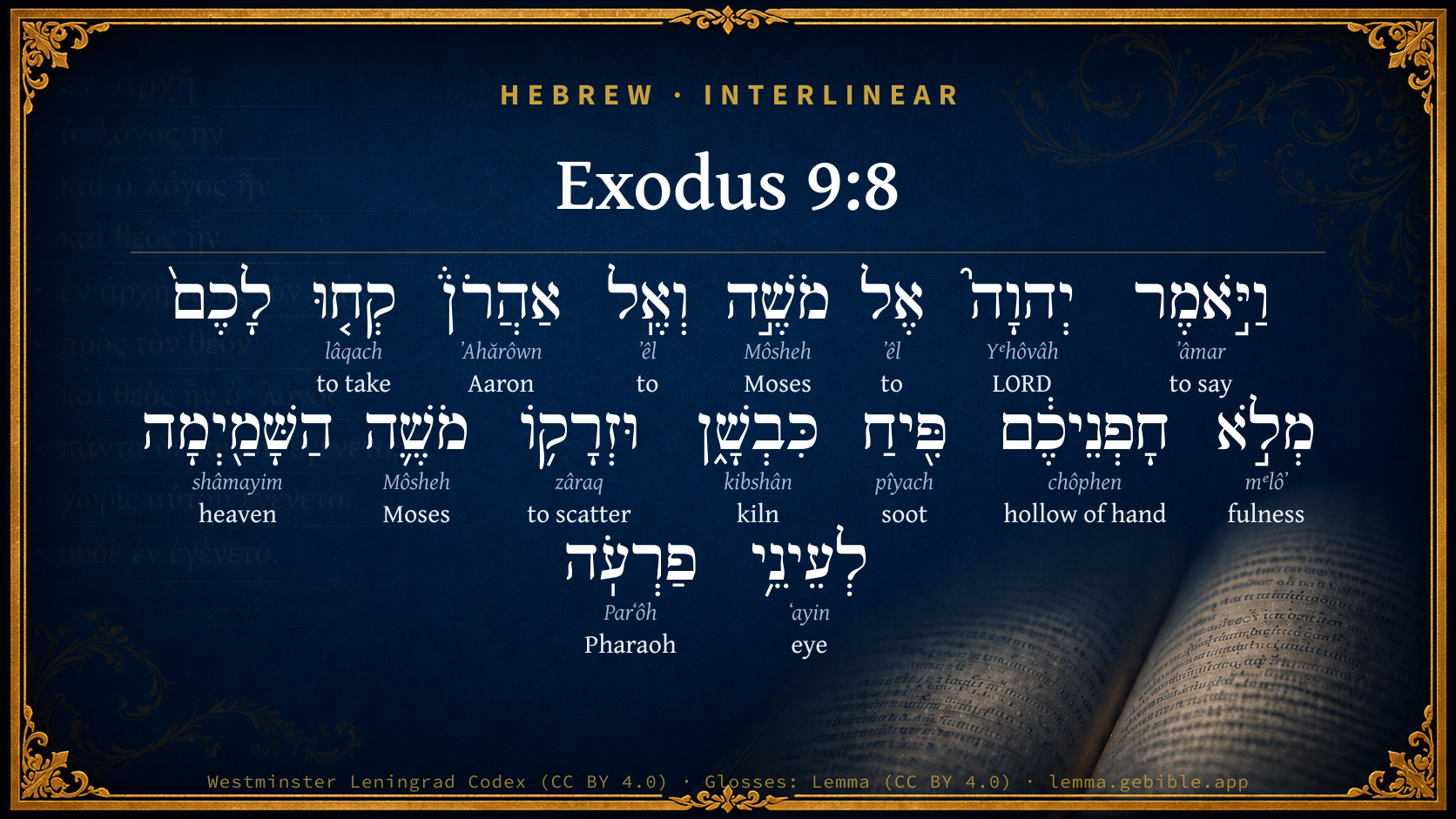
Exodus 9:8

Hebrew (Westminster Leningrad Codex) Exodus 9:8 appears in the Hebrew Old Testament. The text above is from the Westminster Leningrad Codex. Each word links to its Strong’s number, a concise gloss, and parsing drawn from the Open Scriptures Hebrew Bible morphology. Click any word for its full Brown-Driver-Briggs (BDB) entry.
Download image
Cite this verse

Exodus 9:8 (World English Bible). Public Domain. Lemma interlinear Bible study tool, https://lemma.gebible.app/v/exodus/9/8.

Show BibTeX & RIS
BibTeX
RIS
English Translation
Yahweh said to Moses and to Aaron, "Take to you handfuls of ashes of the furnace, and let Moses sprinkle it toward the sky in the sight of Pharaoh.
World English Bible · Public Domain
Highlights
  • 3 first appearances in the Hebrew Bible
Full analysis ↓
Download a study sheet

One document with this verse’s original text, its word-by-word gloss line, the meaning frame, cross-references with their text, attributed commentary, and full source and license credits — printable, and it pastes into notes with its structure intact.

This verse Autodidact and up

Study sheet (.html) Plain text (.txt)

A passage Seminary Student

Up to 50 verses in one chapter. A passage sheet keeps up to 6 commentary sources and 12 cross-references per verse, in the order this page ranks them, and says so on the sheet whenever that leaves anything out. Ask for a single verse and you get the Autodidact verse sheet above.

Everything on this page stays free to read, with no account — the sheet is a download of what is already on screen, not access to it.

Want to remove ads? Support Godless Engineer
Compare translations 3

The same verse in 3 English versions, stacked beneath the original-language interlinear above. Click any original word for its lexicon entry.

Each is an independent rendering of the whole verse — the interlinear is not word-aligned to these translations.

Highlighted words mark where these versions differ — a whole-verse word diff, not a word-by-word alignment.

  • World English Bible Public Domain
    Yahweh said to Moses and to Aaron, "Take to you handfuls of ashes of the furnace, and let Moses sprinkle it toward the sky in the sight of Pharaoh.
  • King James Version Public Domain
    And the LORD said unto Moses and unto Aaron, Take to you handfuls of ashes of the furnace, and let Moses sprinkle it toward the heaven in the sight of Pharaoh.
  • unfoldingWord Literal Text CC BY-SA 4.0
    And Yahweh said to Moses and to Aaron, “Take to you a fullness of both your hands of ash of a furnace. And Moses shall sprinkle it toward heaven before the eyes of Pharaoh.

unfoldingWord Literal Text — © unfoldingWord, licensed CC BY-SA 4.0. Word-aligned USFM3 via Door43 (git.door43.org/unfoldingWord/en_ult).

Versions to compare (up to 4)

3 of 4 selected

Show all 18 translations

Every available English version of this verse, each an independent rendering of the whole verse.

  • World English Bible Public Domain
    Yahweh said to Moses and to Aaron, "Take to you handfuls of ashes of the furnace, and let Moses sprinkle it toward the sky in the sight of Pharaoh.
  • Berean Standard Bible Public Domain
    Then the LORD said to Moses and Aaron, “Take handfuls of soot from the furnace; in the sight of Pharaoh, Moses is to toss it into the air.
  • Majority Standard Bible Public Domain
    Then the LORD said to Moses and Aaron, “Take handfuls of soot from the furnace; in the sight of Pharaoh, Moses is to toss it into the air.
  • King James Version Public Domain
    And the LORD said unto Moses and unto Aaron, Take to you handfuls of ashes of the furnace, and let Moses sprinkle it toward the heaven in the sight of Pharaoh.
  • American Standard Version (1901) Public Domain
    And Jehovah said unto Moses and unto Aaron, Take to you handfuls of ashes of the furnace, and let Moses sprinkle it toward heaven in the sight of Pharaoh.
  • Revised Version (1885) Public Domain
    And the LORD said unto Moses and unto Aaron, Take to you handfuls of ashes of the furnace, and let Moses sprinkle it toward the heaven in the sight of Pharaoh.
  • Geneva Bible (1599) Public Domain
    And the Lord said to Moses and to Aaron, Take your handfull of ashes of the fornace, and Moses shall sprinkle them towarde the heauen in the sight of Pharaoh,
  • Douay-Rheims (1899) Public Domain
    And the Lord said to Moses and Aaron: Take to you handfuls of ashes out of the chimney, and let Moses sprinkle it in the air in the presence of Pharao.
  • Young's Literal Translation Public Domain
    And Jehovah saith unto Moses and unto Aaron, `Take to you the fulness of your hands `of' soot of a furnace, and Moses hath sprinkled it towards the heavens, before the eyes of Pharaoh,
  • Literal Standard Version CC BY-SA 4.0
    And YHWH says to Moses and to Aaron, “Take for yourselves the fullness of your handfuls—soot of a furnace, and Moses has sprinkled it toward the heavens, before the eyes of Pharaoh,
  • Unlocked Literal Bible CC BY-SA 4.0
    Then Yahweh said to Moses and to Aaron, “Take some handfuls of ashes from a kiln. You, Moses, must throw the ashes up into the air while Pharaoh is watching.
  • unfoldingWord Literal Text CC BY-SA 4.0
    And Yahweh said to Moses and to Aaron, “Take to you a fullness of both your hands of ash of a furnace. And Moses shall sprinkle it toward heaven before the eyes of Pharaoh.
  • Darby Bible Public Domain
    And Jehovah said to Moses and to Aaron, Take to yourselves handfuls of ashes of the furnace, and let Moses scatter it toward the heavens before the eyes of Pharaoh.
  • World Messianic Bible Public Domain
    The LORD said to Moses and to Aaron, “Take handfuls of ashes of the furnace, and let Moses sprinkle it toward the sky in the sight of Pharaoh.
  • Webster's Bible Public Domain
    And the LORD said to Moses and to Aaron, Take to you handfuls of ashes of the furnace, and let Moses sprinkle it towards heaven in the sight of Pharaoh.
  • Free Bible Version CC BY-SA 4.0
    The Lord told Moses and Aaron, “Go and get some handfuls of soot from a furnace. Then have Moses throw it into the air in front of Pharaoh.
  • Bible in Basic English Public Domain
    And the Lord said to Moses and to Aaron, Take in your hand a little dust from the fire and let Moses send it in a shower up to heaven before the eyes of Pharaoh.
  • JPS Tanakh (1917) Public Domain
    And the LORD said unto Moses and unto Aaron: 'Take to you handfuls of soot of the furnace, and let Moses throw it heavenward in the sight of Pharaoh.

Literal Standard Version (2020), Covenant Press — licensed CC BY-SA 4.0. Text via the HelloAO Bible API (eBible.org). Unlocked Literal Bible (unfoldingWord) — licensed CC BY-SA 4.0. Text via the HelloAO Bible API (eBible.org). unfoldingWord Literal Text — © unfoldingWord, licensed CC BY-SA 4.0. Word-aligned USFM3 via Door43 (git.door43.org/unfoldingWord/en_ult). Free Bible Version, Dr. Jonathan Gallagher — licensed CC BY-SA 4.0. Text via the HelloAO Bible API (eBible.org).

Word by word

More ways to search: Search by grammar → Find every occurrence → Compare this word →

Practice this passage: Drill this verse → Learn its vocabulary →

פִּ֖יחַ
pîyach
H6368
“soot of”
Noun, Common, Masculine, Singular, Construct
Part of Speech
Noun
Type
Common
Gender
Masculine
Number
Singular
State
Construct
Full BDB Definition

Origin: from H6315

TWOT: 1741a

soot, ashes
  1. וַיֹּ֣אמֶר ʼâmar H559 “and · to say” Conjunction + Verb, Qal, Sequential Imperfect, 3rd Person, Masculine, Singular
  2. יְהוָה֮ Yᵉhôvâh H3068 “LORD” Noun, Proper
  3. אֶל ʼêl H413 “to” Preposition
  4. מֹשֶׁ֣ה Môsheh H4872 “Moses” Noun, Proper
  5. וְאֶֽל ʼêl H413 “and · to” Conjunction + Preposition
  6. אַהֲרֹן֒ ʼAhărôwn H175 “Aaron” Noun, Proper
  7. קְח֤וּ lâqach H3947 “take” Verb, Qal, Imperative, 2nd Person, Masculine, Plural
  8. מְלֹ֣א mᵉlôʼ H4393 “fulness of” Noun, Common, Masculine, Singular, Construct
  9. חָפְנֵיכֶ֔ם chôphen H2651 “handfuls · your” Noun, Common, Masculine, Dual, Construct + Suffix, Personal, 2nd Person, Masculine, Plural
  10. כִּבְשָׁ֑ן kibshân H3536 “kiln” Noun, Common, Masculine, Singular, Absolute
  11. וּזְרָק֥וֹ zâraq H2236 “and · to scatter · him” Conjunction + Verb, Qal, Perfect, 3rd Person, Masculine, Singular + Suffix, Personal, 3rd Person, Masculine, Singular
  12. מֹשֶׁ֛ה Môsheh H4872 “Moses” Noun, Proper
  13. הַשָּׁמַ֖יְמָה shâmayim H8064 “the · heaven(s) · toward” Particle, Definite Article + Noun, Common, Masculine, Plural, Absolute + Suffix, Demonstrative
  14. לְעֵינֵ֥י ʻayin H5869 “to/for · eyes of” Preposition + Noun, Common, Both, Dual, Construct
  15. פַרְעֹֽה Parʻôh H6547 “Pharaoh” Noun, Proper

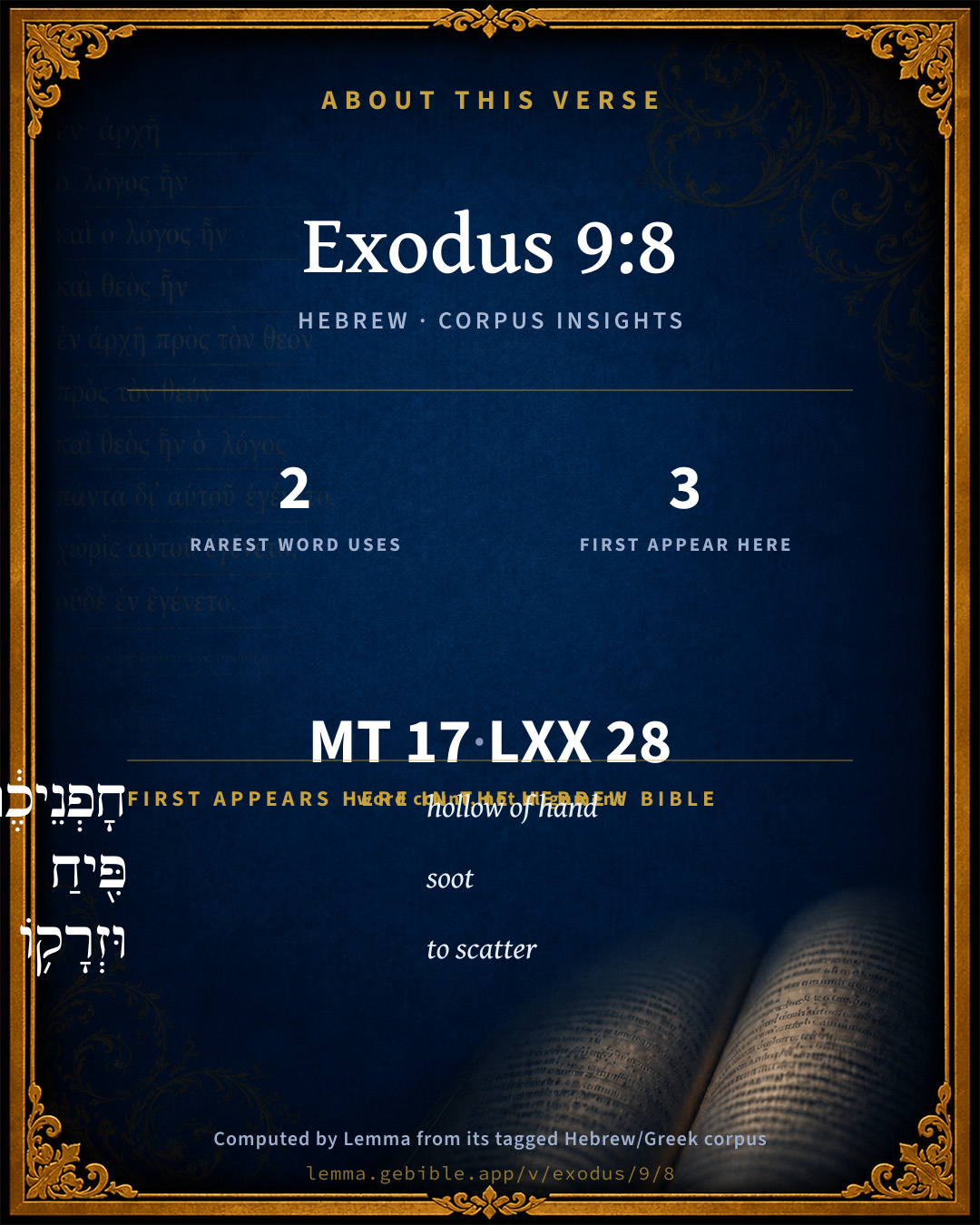
About this verse

These counts appear in no published source. They are computed here, from the morphology-tagged text and Lemma’s own curated glosses. What Lemma adds →

17
words
14
distinct lemmas
Pentateuch
section

Notable vocabulary

The rarest word here is פִּ֖יחַ soot H6368 — appearing just 2 times in the whole Hebrew Bible.

First appearance in Scripture

These words make their first canonical appearance in the Hebrew Bible here:

  • חָפְנֵיכֶ֔ם hollow of hand H2651
  • פִּ֖יחַ soot H6368
  • וּזְרָק֥וֹ to scatter H2236

Shared distinctive vocabulary

פִּ֖יחַ soot H6368 occurs in 2 verses of the Hebrew Bible. Also found in:

Grammatical profile

  • 3 verbs
  • 11 nouns
  • 3 prepositions

Verb forms

  • וַיֹּ֣אמֶר Qal · Sequential Imperfect
  • קְח֤וּ Qal · Imperative
  • וּזְרָק֥וֹ Qal · Perfect

Repetition

Words recur within this verse — often emphatic in Hebrew:

  • מֹשֶׁ֣ה Moses H4872 ×2
  • אֶל to H413 ×2

Hebrew & Septuagint length

In English translation the verse runs 29 words from the Hebrew and 30 from the Septuagint (LXX English) — closely comparable.

A rough comparison of the two English renderings, which tokenize alike — not a word-level alignment.

Word counts can differ between the Hebrew and the Greek without any difference in meaning — e.g. the Hebrew direct-object marker אֵת has no separate Greek word, and Greek often adds the article ὁ.

In the original languages it is 17 Hebrew tokens and 28 Greek tokens — but the two are counted differently (Hebrew bundles its prefixes and suffixes into one token; the Greek is in lemma form), so that isn’t a like-for-like length.

Cross-references

1

Topical passages linked to Exodus 9:8 in the Treasury of Scripture Knowledge — connected by theme and wording, ordered by reader-vote popularity; previews shown in the World English Bible.

  • Exodus 8:16 Yahweh said to Moses, "Tell Aaron, 'Stretch out your rod, and strike the dust of the earth, that it may become lice throughout all the land of Egypt.'"

Cross-references courtesy of OpenBible.info (CC BY 4.0).

Hebrew and Greek witnesses Masoretic Hebrew ↔ Greek Septuagint

The same verse in the two great witnesses to the Old Testament, shown verse-for-verse.

These are two independent witnesses, not word-aligned to each other, and the Septuagint is shown in lemma (dictionary) form.

Hebrew Exodus 9:8 Masoretic · Westminster Leningrad Codex

וַיֹּ֣אמֶר יְהוָה֮ אֶל מֹשֶׁ֣ה וְאֶֽל אַהֲרֹן֒ קְח֤וּ לָכֶם֙ מְלֹ֣א חָפְנֵיכֶ֔ם פִּ֖יחַ כִּבְשָׁ֑ן וּזְרָק֥וֹ מֹשֶׁ֛ה הַשָּׁמַ֖יְמָה לְעֵינֵ֥י פַרְעֹֽה

Yahweh said to Moses and to Aaron, "Take to you handfuls of ashes of the furnace, and let Moses sprinkle it toward the sky in the sight of Pharaoh.

World English Bible · Public Domain

Greek LXX Exodus 9:8 Septuagint · lemma form

εἶπον δέ κύριος πρός μωυσῆς καί ααρων λέγω λαμβάνω σύ πλήρης ὁ χείρ αἰθάλη καμιναία καί πάσσω μωυσῆς εἰς ὁ οὐρανός ἐναντίον φαραώ καί ἐναντίον ὁ θεράπων αὐτός

And the Lord spoke to Moses and Aaron, saying, Take you handfuls of ashes of the furnace, and let Moses scatter it toward heaven before Pharao, and before his servants.

LXX2012 (modern English Septuagint) · Public Domain

On this verse, Lange's Commentary on the Holy Scriptures discusses the Septuagint’s reading. Read the note in Commentary ↓

Hebrew: Westminster Leningrad Codex (CC BY 4.0). Greek: Septuagint (public domain); English from LXX2012 (modern English Septuagint) (Public Domain). How the Septuagint differs from the Hebrew →

Targum (Aramaic paraphrase)

2

The Targum is the ancient Jewish Aramaic paraphrase of the Hebrew Scriptures — an interpretive translation, not the Hebrew text itself. Onkelos (literal) and Pseudo-Jonathan (expansive) render the Torah, and Jonathan the Prophets. Coverage is partial: where no permissively-licensed English translation exists for a verse, only the Aramaic is shown. This is verse-level text, not a word-by-word alignment to the Hebrew.

  1. Targum Onkelos Torah (Genesis–Deuteronomy)
    וַאֲמַר יְיָ לְמשֶׁה וּלְאַהֲרֹן סִיבוּ לְכוֹן מְלֵי חָפְנֵיכוֹן פִּיחָא דְאַתּוּנָא וְיִזְרְקִנֵהּ משֶׁה לְצֵית שְׁמַיָא לְעֵינֵי פַרְעֹה:

    (no public-domain English translation for this verse)

    Targum Onkelos — Aramaic: “Onkelos Genesis” (public domain); “Onkelos Exodus” (public domain); “Onkelos Leviticus” (public domain); “Onkelos Numbers” (public domain); “Onkelos Deuteronomy” (public domain). English: “Sefaria Community Translation” (CC0 1.0 (public-domain dedication)); “J.W. Etheridge. The Targums of Onkelos and Jonathan Ben Uzziel on the Pentateuch. London: Longmans, Green, 1862” (public domain). Text via Sefaria.

  2. Targum Pseudo-Jonathan Torah (Genesis–Deuteronomy)
    וַאֲמַר יְיָ לְמשֶׁה וּלְאַהֲרן סִיבוּ לְכוֹן מָלֵי חוּפְנֵיכוֹן קְטַם דְקִיק מִן אַתּוּנָא וְיִדְרְקִינֵיהּ משֶׁה לְצֵית שְׁמַיָא לְמֶיחֱמֵי פַרְעה

    And the Lord said to Mosheh and to Aharon, Take with you hands-full of fine ashes from the furnace, and let Mosheh sprinkle them towards the height of the heavens in the sight of Pharoh.

    Targum Pseudo-Jonathan — Aramaic: “Targum Jonathan on Genesis” (public domain); “Targum Jonathan on Exodus” (public domain); “Targum Jonathan on Leviticus” (public domain); “Targum Jonathan on Numbers” (public domain); “Targum Jonathan on Deuteronomy” (public domain). English: “The Targum of Jonathan ben Uzziel, trans. J. W. Etheridge, London, 1862” (public domain). Text via Sefaria.

Commentary

Notes on Exodus 9:8 from classic Christian and Jewish commentators (each source and its license shown beneath its notes). The classic Christian expositions comment on the surrounding passage and are grouped to its opening verse, so a note may address several verses; the Jewish commentaries on the Tanakh (Rashi and others) are per-verse, so they appear only where the commentator wrote on this verse.

Lemma curates 59 commentaries, every one of them public domain or Creative Commons licensed, each selected and text-cleaned for this edition rather than reprinted as found. About our sources →

Matthew Henry's Commentary

Observe here, concerning the plague of boils and blains,

I. When they were not wrought upon by the death of their cattle, God sent a plague that seized their own bodies, and touched them to the quick. If less judgments do not do their work, God will send greater. Let us therefore humble ourselves under the mighty hand of God, and go forth to meet him in the way of his judgments, that his anger may be turned away from us.

II. The signal by which this plague was summoned was the sprinkling of warm ashes from the furnace, towards heaven (Exo 9:8, Exo 9:10), which was to signify the heating of the air with such an infection as should produce in the bodies of the Egyptians sore boils, which would be both noisome and painful. Immediately upon the scattering of the ashes, a scalding dew came down out of the air, which blistered wherever it fell. Note, Sometimes God shows men their sin in their punishment; they had oppressed Israel in the furnaces, and now the ashes of the furnace are made as much a terror to them as ever their task-masters had been to the Israelites.

III. The plague itself was very grievous - a common eruption would be so, especially to the nice and delicate, but these eruptions were inflammations, like Job's. This is afterwards called the botch of Egypt (Deu 28:27), as if it were some new disease, never heard of before, and known ever after by that name, Note, Sores in the body are to be looked upon as the punishments of sin, and to be hearkened to as calls to repentance.

IV. The magicians themselves were struck with these boils, Exo 9:11. 1. Thus they were punished, (1.) For helping to harden Pharaoh's heart, as Elymas for seeking to ;pervert the right ways of the Lord; God will severely reckon with those that strengthen the hands of the wicked in their wickedness. (2.) For pretending to imitate the former plagues, and making themselves and Pharaoh sport with them. Those that would produce lice shall, against their wills, produce boils. Note, It is ill jesting with God's judgments, and more dangerous than playing with fire. Be you not mockers, lest your bands be made strong. 2. Thus they were shamed in the presence of their admirers. How weak were their enchantments, which could not so much as secure themselves! The devil can give no protection to those that are in confederacy with him. 3. Thus they were driven from the field. Their power was restrained before (Exo 8:18), but they continued to confront Moses, and confirm Pharaoh in his unbelief, till now, at length, they were forced to retreat, and could not stand before Moses, to which the apostle refers (Ti2 3:9) when he says that their folly was made manifest unto all men.

V. Pharaoh continued obstinate, for now the Lord hardened his heart, Exo 9:12. Before, he had hardened his own heart, and resisted the grace of God; and now God justly gave him up to his own heart's lusts, to a reprobate mind, and strong delusions, permitting Satan to blind and harden him, and ordering every thing, henceforward, so as to make him more and more obstinate. Note, Wilful hardness is commonly punished with judicial hardness. If men shut their eyes against the light, it is just with God to close their eyes. Let us dread this as the sorest judgment a man can be under on this side hell.

Matthew Henry's Commentary on the Whole Bible (1708–1710) — public domain (CC PDM 1.0). Text via the HelloAO Bible API.

Jamieson, Fausset & Brown

Robert Jamieson, A. R. Fausset & David Brown

PLAGUE OF BOILS. (Exo 9:8-17)

Take to you handfuls of ashes, &c.--The next plague assailed the persons of the Egyptians, and it appeared in the form of ulcerous eruptions upon the skin and flesh (Lev 13:20; Kg2 20:7; Job 2:7). That this epidemic did not arise from natural causes was evident from its taking effect from the particular action of Moses done in the sight of Pharaoh. The attitude he assumed was similar to that of Eastern magicians, who, "when they pronounce an imprecation on an individual, a village, or a country, take the ashes of cows' dung (that is, from a common fire) and throw them in the air, saying to the objects of their displeasure, such a sickness or such a curse shall come upon you" [ROBERTS].

Jamieson, Fausset & Brown — Commentary Critical and Explanatory on the Whole Bible (1871) — public domain (CC PDM 1.0). Text via the HelloAO Bible API.

Trapp's Complete Commentary

John Trapp

Exo 9:8 And the LORD said unto Moses and unto Aaron, Take to you handfuls of ashes of the furnace, and let Moses sprinkle it toward the heaven in the sight of Pharaoh.

Ver. 8. Sprinkle it toward the heaven.] In token that this plague should, in a special manner, be inflicted from heaven. The Philistines, by their golden emerods, acknowledged that the emerods in their flesh were from God. Hippocrates called the pestilence το θειον, the divine disease, as we call the spots thereof God’s marks. The falling sickness was anciently called morbus sacer as an immediate hand of God. And what can we conceive less of the sweating sickness, with which no stranger in England was touched? And yet the English were chased therewith, not only in England, but in other countries abroad; which made them, like tyrants, both feared and avoided wherever they came. {a}

{a} Life of King Edward VI, by Sir John Heywood, p. 127.

John Trapp, A Commentary or Exposition upon All the Books of the Old and New Testament (1647–1656) — public domain. Text from a community e-Sword module.

The Biblical Illustrator

Joseph S. Exell

Exo_9:8-12

A boil breaking forth with blains.

Lessons

1. Upon former warnings despised, God falls suddenly, on the wicked with vengeance unawares.

2. Though God can plague His enemies without instruments, yet sometimes He will use them.

3. God gives command out of the ashes to bring fiery plagues on the wicked sometimes at His pleasure.

4. Hands full of ashes are to note full measure of vengeance on Gods enemies.

5. Signal actions (as here the sprinkling ashes) God sometimes useth for men to see and fear.

6. God can make ashes dust, and dust boils, to plague His enemies.

7. God foretells His servants that His command obeyed shall not be in vain.

8. Man and beast are joined together in plagues when sinners are not warned by smiting beasts alone.

9. God giveth out threatenings of judgment for manner and measure as He will.

10. The botch or blain on Egypt is a memorable plague. God appropriates it (Exo_9:9). (G. Hughes, B. D.)

Lessons

1. Experience of the devils helplessness against God will not persuade the wicked to desist from him.

2. Gods boil shall come upon these wicked instruments, do the devil what he can against it.

3. All Satans instruments are vanquished at the appearance of Gods plague (Exo_9:11).

4. The great God observes and judgeth to obduration sinners who harden themselves against His judgments.

5. Obduration from Gods giving men up to their own lusts makes them more to stop their ears and turn their hearts from His word.

6. Gods foreseeing and foresaying order (or limit) the issues of rebellion in the wicked against Himself (Exo_9:12). (G. Hughes, B. D.)

The physical suffering brought upon men by sin

I. That there is much physical suffering brought upon men by sin and disobedience. Moral considerations are at the basis of health. The body is influenced by the moods of the soul. Piety is restorative. It gives eternal life.

II. That the physical suffering consequent upon sin comes upon men independent of their social position or of their scientific attainments. The king, the magicians, and all the people of Egypt were smitten by the pestilence. None were exempt.

1. Hence we see that social position does not exempt men from the physical suffering consequent upon sin.

2. Hence we see that scientific attainment does not exempt men from the physical suffering consequent upon sin. The boils were upon the magicians.

III. That the physical suffering consequent upon sin does not always lead to moral reformation. Lessons:

1. That God permits suffering to come upon wicked men to reprove and correct their moral character.

2. That the laws of physical manhood are in harmony with true well-being of the soul.

3. That pain should lead us to review the meaning of our lives. (J. S. Exell, M. A.)

The insignificant commencement of great calamities

I. That great calamities are often insignificant in their commencement. All causes are potent to great effects. A trivial ailment may work death. A little misunderstanding may break up a Church. A little sin may ruin a soul.

II. That great calamities are often mysterious in their infliction. It is astonishing how apparently trivial causes are influential to such great results. Men are at a loss to explain how little sins are so far-reaching in their effects. It must be recognized as the wondrous ordination of God, and as the efficient law of moral life, designed to keep men right.

III. That great calamities are often irrepressible in their progress. When the judgments of God are abroad in the earth, and when little causes are working out their punitive issue in the lives of men and nations, they cannot be restrained by pride or power. (J. S. Exell, M. A.)

The helplessness of wicked men in the hour of Divine retribution

I. They are helpless because they have not the ability to avert the retributions of God. Sin ever makes men helpless.

II. They are helpless because they have not the courage to endure the retributions of God. Sin makes men cowardly. Hell cannot inspire the wicked heart with courage in the hour of trial.

III. They are helpless because they lack those moral qualities which alone can aid men in the hour of retribution. Lessons:

1. That though men have experience of Satans inability to help them in their trouble consequent upon sin, they will not desist from it.

2. That all Satans instruments are vanquished by the plague of God. (J. S. Exell, M. A.)

A type of corrupt souls

Let this incident lead us to think how great will be the anguish and confusion of wicked men and persecutors when the Lord Jesus Christ shall come again to earth, and when the light of God shall shine upon them. Then the corruption of their unconverted souls will openly appear, and they will not dare to show themselves before the holy angels, and before the redeemed, who are covered with the robe of Christs righteousness. Only imagine what would become of any of us if for every evil thought, every wicked word, every falsehood, every slander, every angry word, an ulcer or a boil were to appear on our faces? If it were to happen to us, for example, as to Miriam, the sister of Moses, who, as the punishment of her pride and angry words to her brother, became all at once a leper white as snow, that is to say, covered with a disgusting disease. How horrible we should seem if all the pollutions of our souls were to appear outwardly on our bodies! It is well for us co think occasionally of such things, to examine the sins of our hearts, to humble ourselves before God, and to feel more deeply the need of being washed in the blood of Christ, which cleanseth from all sin. It is our Lord Jesus Christ alone who can present to Himself His Church (that is, the assembly of His redeemed people) glorious and pure, not having spot or wrinkle, or any such thing, but holy and without blemish. (Prof. Gaussen.)

The Biblical Illustrator, edited by Joseph S. Exell (c. 1880s–1900s) — public domain. Text from a community e-Sword module.

Joseph Benson's Commentary

Exo 9:8-10. Take you handfuls of the ashes of the furnace — Sometimes God shows men their sin in their punishment. They had oppressed Israel in the furnaces, and now the ashes of the furnace are made as much a terror to them as ever their task masters had been to the Israelites. “The matter of this plague,” says Ainsworth, “is from the fire, which also being one of the elements they deified, is here made the instrument of evil to them, and reclaimed by Jehovah to his service, in punishment of its deluded votaries, who worshipped the creature more than the Creator.” A former miracle was from water, and the next from air, to show that God rules in all. It became a bile — A sore, angry swelling, or inflammation; breaking forth with blains — Or blisters, quickly raised; upon man and upon beast —

Thus we see that the men themselves were smitten after the cattle, which is agreeable to the method of Providence in punishing, first sending previous afflictions to warn mankind, that they may shun greater evils by timely repentance. This bile is afterward called the botch of Egypt, (Deu 28:27,) as if it were some new disease, never heard of before, and known ever after by that name.

Joseph Benson's Commentary on the Old and New Testaments (1811–1818) — public domain. Text from a community e-Sword module.

Whedon's Commentary on the Bible

Daniel D. Whedon

SIXTH PLAGUE — BOILS, Exo_9:8-12.

8. Ashes of the furnace — Not the oven, but the smelting furnace, or the lime-kiln. — Kimchi.

Sprinkle… toward… heaven in the sight of Pharaoh — The ashes of the great furnaces, or lime-kilns, where Israel had toiled so long, were solemnly spread out before Jehovah, and his judgment invoked upon the oppressor.

Daniel D. Whedon (gen. ed.), Commentary on the Old and New Testaments (1874–1909) — public domain. Text from a community e-Sword module.

The Preacher's Complete Homiletical Commentary

Joseph S. Exell (gen. ed.)

CRITICAL NOTES.—

Exo_9:8. Furnace] “For burning lime or smelting metals, and for the preparation of glass, out of which, while it is heated, a thick smoke ascends (Gen_19:28) and in which ashes and soot rest.”—Fürst.

Exo_9:9. A boil breaking forth with blains] Or, “A burning sore breaking out in pustules.”

Exo_9:10. Raised thee up] Not necessarily—“Brought thee into being”; but much rather, judging from the tenor of the entire narrative,—“Raised thee to the throne, given thee sovereign power in Egypt;” or, better still,—“Enabled thee to stand firm.” This indeed is the most literal meaning of העמרתיך, the causative form (Hiphil) of עמד, to stand. How entirely this rendering accords with the observations on the hardening or Pharaoh’s heart offered under Exo_7:3, may be seen by a reference to what is there said.—This seems the place to remind the reader of the care displayed by the Apostle Paul in his comments on cases like Pharaoh’s, in Rom_9:22 : “What if God, willing to shew his wrath, and to make his power known, endured with much long-suffering the vessels of wrath fitted for destruction:”—i.e. already fitted, previously fitted (κατηρτισμένα), as the perfect participle implies. The Greek word, indeed, is indifferently either middle or passive voice; and so is quite consistent with the idea that the vessels of wrath had fitted themselves for destruction, or had given themselves over to Satan, and had been by him, as the result of their own guilty surrender, fitted for destruction. In any case, the Apostle does not say that GOD had fitted them for destruction; which is all the more satisfactory when we notice how, in everything else, the Divine activity reigns throughout the passage; and most satisfying of all when we observe that in the following ver.

(23) it is God who is expressly said to have “afore prepared the vessels of mercy unto glory.” God, in certain cases, ENDURES (not takes delight in) the vessels of wrath; ENDURES them for a while longer, permitting them to multiply their acts of tyranny or other wickedness, instead of AT ONCE smiting them down in death, and so preventing their doing any more wrong and harm;—when they have already become vessels of wrath, and are ripe for their doom.

MAIN HOMILETICS OF THE PARAGRAPH.—Exo_9:8-12

THE PLAGUE OF BOILS; OR, THE PHYSICAL SUFFERING BROUGHT UPON MEN BY SIN

Now the plagues of Egypt begin to assume a more serious character. Hitherto they had been an annoyance. Now they are an affliction threatening life. This sixth plague is ushered in with a peculiar ceremony. Moses appears before Pharaoh with a censor in his hand, filled with ashes from the furnace. He scatters the ashes and they are carried by the wind in all directions. They become small dust and afflict the Egyptians with boils. This ceremony was well calculated to remind Pharaoh that this plague was retributive. He had compelled the Israelites to labour in the brick-kilns, and had made their lives bitter with hard bondage in the heat of the furnace. Hence the ashes now smite the oppressor. Even the beasts of the Egyptians were thus afflicted; even those that escaped the previous plague. It not unfrequently happens that when men injure others, they are injured some time or other in the same way themselves. This is the abundant teaching of history. In the first three plagues the natural resources of the land were made the medium of retribution; but in the sixth God showed Pharaoh that He could bring ruin upon him from the very workshops which had been used in the erection of his splendid edifices.

I. That there is much physical suffering brought upon men by sin and disobedience. Through the disobedience of Pharaoh and his people they were smitten with boils. Their suffering was directly traceable to their sins. Had they been obedient to the commands of God, as uttered by Moses and Aaron, they would have been spared this affliction. And the commands of God come to men in our own day. They are uttered distinctly in the Bible. They are made known faithfully from the pulpit. They are silently made known by many pious lives. But they are disobeyed. And in this we find the true explanation of much of the pain and physical suffering that comes upon men. Their ailments are the outcome of their sins. And thus bodily pain is given to punish and correct moral transgression. There are multitudes in our land in continued suffering who would be healthy if they would be good. Moral considerations are at the basis of health. If men would be physically well they should obey the laws of God as revealed in His Book, and recognize all His claims upon them. Sin will always make a man want medicine. The body is influenced by the moods of the soul. Piety is restorative. It gives eternal life.

II. That the physical suffering consequent upon sin comes upon men independent of their social position, or of their scientific attainments. The king, the magicians, and all the people of Egypt were smitten by the pestilence. None were exempt.

1. Hence we see that social position does not exempt men from the physical suffering consequent upon sin. Men who occupy high station in society, have frequently every facility for sin. They have time. They have money. They have every opportunity of concealment. But there are times when the sins of the monarch are made known in his physical manhood, and when nature speaks to him in retributive voice. Royalty is subject to the same laws of physical life as the pauper, and must equally pay the penalty of transgression. The purple and fine linen are not proof against pain. Suffering is not bribed by money.

2. Hence we see that scientific attainment does not exempt men from the physical suffering consequent upon sin. The boils were upon the magicians. These magicians were men of scientific knowledge. They were the king’s advisers. Their position in the nation was dependent upon their education and skill. Hence their trickery. But the suffering consequent upon sin, is not to be warded off by scientific prescriptions; nor is it to be deluded by cunning. Thus men who have strengthened others in sin are themselves overtaken with the retributions of heaven. All men are in the hand of God.

III. That the physical suffering consequent upon sin does not always lead men to moral reformation. This terrible pestilence did not work repentance in the heart of Pharaoh, but only rendered him more wilful in his obstinacy. And so men are often unsubdued by the most alarming consequences of their conduct. They are afflicted. Their families are ruined. Their reputation is gone. Yet they show no token of penitence. Their calamities only appear to harden them. In this mood of soul they are taken on to destruction, to eternity. Pain is not necessarily regenerative in its influence. It does not always humble the spirit. It does not always conquer the tyrant. Man has a wonderous power of moral resistance. He can reject the severe discipline of God. LESSONS:

1. That God permits suffering to come upon wicked men to reprove and correct their moral character.

2. That the laws of physical manhood are in harmony with true well-being of the soul.

3. That pain should lead us to review the meaning of our lives.

SUGGESTIVE COMMENTS ON THE VERSES

Exo_9:8-9. Upon former warnings despised God falls suddenly upon the wicked.

Though God can plague His enemies without instruments, yet sometimes He will use them.

God gives command out of ashes to bring fiery plagues on the wicked.

Handfuls of ashes are to note full measure of vengeance on God’s enemies.

Signal actions God sometimes uses for men to see and fear

God can make ashes dust, and dust boils, to plague His enemies.

Divine retributions:—

1. Transformative.

2. Diffusive.

3. Afflictive.

Exo_9:10. Exact obedience must God’s instruments give as to matters and actions in executing God’s plagues.

Exact performance does God make of His word upon the obedience of His servants in plaguing His enemies.

Man and beast in Egypt are the memorials of God’s faithfulness in His vengeance.

THE INSIGNIFICANT COMMENCEMENT OF GREAT CALAMITIES

I. That great calamities are often insignificant in their commencement. This plague was caused by the sprinkling of a few handfuls of ashes. None of those who witnessed the performance of this ceremony by Moses and Aaron would imagine that so great a calamity could have proceeded from so trivial a cause. But in reality there is no such thing in the universe as a trivial cause; all causes are potent to great effects. A trivial ailment may work death. A little misunderstanding may break up a church. A little sin may ruin a soul. Let us remember that a few handfuls of ashes are productive of great woe. A little anger breaks into a great fire, and may end in murder. A little slander spreads a long way, and may injure the best reputation in the world, and nullify the toil of the best Christian worker.

II. That great calamities are often mysterious in their infliction. Moses and Aaron simply sprinkled the ashes in the air, and they became afflictive with this sore pestilence. How was this accomplished? What was the method of its working? The result would astonish Pharaoh and his magicians. And so it is astonishing how apparently trivial causes are influential to such great results. Men are at a loss to explain how little sins are so far-reaching in their effects. This cannot be explained on any principle of science. It must be recognized as the wondrous ordination of God, and as the efficient law of moral life, designed to keep men right.

III. That great calamities are often irrepressible in their progress. These ashes were sprinkled in the sight of Pharaoh and his magicians; but the proud monarch was impotent to prevent or stay the curse. And so when the judgments of God are abroad in the earth, and when little causes are working out their punitive issue in the lives of men and nations, they cannot be restrained by pride or power. And thus we see how the smallest ashes in the hand of God may become afflictive to a vast nation.

THE HELPLESSNESS OF WICKED MEN IN THE HOUR OF DIVINE RETRIBUTION

Exo_9:11-12. Men exhibit their principles in the hour of retribution and pain; then it is that character is made manifest. In this verse we see how helpless were the magicians under the retributions of heaven.

I. They are helpless because they have not the ability to avert the retributions of God. These magicians had not the ability to avert the pain with which they were afflicted. They had not the power to contend with God. Nor could Satan throw around them a shield to quench the darts of a retributive Providence. The devil gets men into trouble, and then leaves them in it without help. The sinner is helpless before the anger of God. In the Great Judgment he will be unable to avert the sentence of the Judge. Sin ever makes men helpless.

II. They are helpless because they have not the courage to endure the retributions of God. These magicians had not bold manhood enough to bear the plague defiantly, and to shake off its pain by apparent insensibility. Sinners are generally the most sensitive to the judgments of God. Sin makes men cowardly. Hell cannot inspire the wicked heart with courage in the hour of trial.

III. They are helpless because they lack those moral qualities which alone can aid men in the hour of retribution. If man is to stand in the presence of God during the time of pain, he must be strong in faith, in prayer, and hope, and in a desire to work the Divine will. But of this strength, the sinner is destitute, and he is therefore given over to the weakness of the moment. LESSONS:

1. That though men have experience of Satan’s inability to help them in their trouble consequent upon sin, they will not desist from it.

2. That all Satan’s instruments are vanquished by the plague of God.

HEART-OBDURACY

I. It is permitted by God.

II. It renders men deaf to the voice of God.

III. It calls for the continued retribution of heaven.

ILLUSTRATIONS

BY

REV. WM. ADAMSON

Ashes! Exo_9:8. At one time, it was common in Egypt to burn strangers and captives alive, and to sprinkle their ashes far and wide in the air. As the little ones of Israel were cast into the Nile-god, a cruel holocaust; it is as likely that they were thrown into the furnaces, and their dust scattered to the winds to invoke blessings. Moses was directed to take the dust of the brick-kilns. and throw it into the air for a curse instead of a blessing. The sprinkling of ashes was also an ancient sign of purification. Its meaning was now reversed, and it became the instrument of corruption. Modern science has taught us that what would have formerly seemed only a figure of speech is literally possible; and that a few handfuls of ashes can be divided into particles so inconceivably minute as to fill the air over a whole country. Professor Tyndal’s valuable experiments—as well as those of other scientists—incontestably shew that invisibly small particles may be poisonous germs of infectious plagues. Therefore

“Regard no vice as small,

That thou mayest brook it.”

—Oriental.

Boils and Blains! Exo_9:9. Boils were an inflamed ulcer; whilst blains were an angry tumour, or malignant swelling in the skin. The one was an aggravation of the other; for in Exo_5:9 the expression “breaking forth” means literally to vegetate—i.e. to put forth flowers like a plant or tree. In Deuteronomy it is called the “botch of Egypt;” and it is used in Job 2, 7 to express the disease with which Satan was permitted to afflict Job. Whether this plague upon the Egyptians was associated with habitual uncleanness cannot be decided; but it may very well be inferred that Satan’s malignant purpose was to blacken the pure and spotless moral life of the Chaldean patriarch. Smith says that this plague was black leprosy—a fearful kind of elephantiasis. Whatever it was in character, it was evidently a terrible infliction on the religious purity of the people; and designed to teach them that the heart was wholly corrupt:—

“Idols of mind, affection, will,

The power of darkness triumphs there.”

—Montgomery.

Little Things! Exo_9:10 A small flaw in a cable—a slight error in a chart may cause the loss of a ship. The communication of a spark led to the burning of the Goliath training ship. The careless handling of a small box led to the disastrous explosion at Bremerhaven. Only a few ashes led to the wholesale plague of boils! As Bishop Hopkins says, it is not the greatness or smallness of the coin, but the royal image stamped upon it, that gives it authority and power; so truly, the stamp of God being on little means will produce results as great, as though mighty means were employed. Even in man’s hand, the tiny keen-edged axe can soon demolish what it has taken the springs and summers and showers and snows of hundreds of years to raise. As has been said, it is but the littleness of man that sees no greatness in a trifle. What a greatness there was in the Divinely-prepared worm, which laid low that bowering gourd, beneath whose green and grateful shade the prophet of Nineveh sat. Even

“The little mountains, humble though they

be, Make the mighty ages of eternity.”

Boil-symbolism! Exo_9:11. In Revelation 16 Exo_9:10, we find that the Roman Vatican, while smarting from the effects of the extreme castigations and heavy shocks received under the preceding four vials from God’s righteous indignation, are visited with a plague of boils and blains. They gnawed their tongues for pain, and blasphemed the God of heaven because of their pains and sores. It is remarkable that these sores are associated with spiritual adulteries, with the harlot of fornications. They can signify nothing else than the hideous blotch of infidelity or atheism, which has spread with infectious virulence to the ends of the Papal earth. As vicious humours taint the blood, poison the body, and break out in unsightly and ulcerous sores upon the skin; so with the principles of Roman atheism. This moral ulcer has spread far and wide—corrupt in its principles—vicious in its manifestations—destructive in its tendencies; if we are to believe the Pontiff’s own confessions as to the religious sentiments of Papal nations:—

“Withering their moral faculties, and breaking

The bones of all their pride.

—Lamb.

Impenitence! Exo_9:12. Shakespeare says: “Bow, stubborn knees! and heart with strings of steel, be soft as sinews of the newborn babe; all may be well!” But Pharaoh would not bow. Of the antitypical Egypt, it is also said that they repented not of their deeds: Revelation 16 Exo_9:10. All are as hardened as at the beginning. Like Pharaoh they are impenitent to the end. The cumulative combination of retributive justice—so far from inducing repentance—only raises the blasphemy to a higher pitch:

“Egypt forbear! no more blaspheme:

God has a thousand terrors in His name,

A thousand armies at command,

Waiting the signal of His hand.”

—Watts.

The Preacher's Complete Homiletical Commentary (gen. ed. Joseph S. Exell; Funk & Wagnalls, c. 1892) — public domain (pre-1929). A full-Bible homiletical/sermon-outline anthology covering 65 of 66 books (2 John is absent from the source module). Text from a community e-Sword module.

Lange's Commentary on the Holy Scriptures

F.—The boils and blains

Exo_9:8-12

8And Jehovah said unto Moses and unto Aaron, Take to you handfuls of ashes of the furnace, and let Moses sprinkle it toward the heaven [toward heaven] in the sight of Pharaoh. 9And it shall become small [fine] dust in [upon] all the land of Egypt, and shall be a boil [become boils] breaking forth with blains upon man, and upon beast throughout all the land of Egypt. 10And they took ashes of the furnace, and stood before Pharaoh, and Moses sprinkled it up toward heaven; and it became a boil [became boils] breaking forth with blains upon man, and upon beast. 11And the magicians could not stand before Moses because of the boils; for 12the boil was [boils were] upon the magicians, and upon all the Egyptians. And Jehovah hardened the heart of Pharaoh, and he hearkened not unto them, as Jehovah had spoken unto Moses.

EXEGETICAL AND CRITICAL

Exo_9:8. “That the sixth plague, that of the boils, was extraordinary only in its extent, is shown by comparing Deu_28:27, where the same disease occurs with the name ‘boils [A. V. botch] of Egypt,’ as a common one in Egypt” (Hengstenberg). Rosenmüller (on Deu_28:27) understands it of the elephantiasis, which is peculiar (?) to Egypt. But between diseases which chiefly work inward and boils there is a radical difference. Also “the elephantiasis does not affect cattle” [Hengstenberg]. See other interpretations in Hengstenberg, Egypt and the Books of Moses. His own explanation is; inflammatory pustules—not merely heat-pimples. שְׁחִין from שָׁחַן, to be hot. LXX. ἔλκη φλυκτίδες. Vulg. ulcera et vesicæ turgentes. Keil (following Seetzen): the so-called Nile-pox. Leyrer (in Herzog’s Real- Encyclopädie): Anthrax, a black inflammatory ulcer, “whose occurrence has been frequently observed after pestilences among beasts, especially after the inflammation of the spleen among cattle.”

Exo_9:9. The symbolic element in the transactions is here especially prominent. The shower of ashes which Moses made before Pharaoh’s eyes was only the symbolic cause of the boils which Jehovah inflicted. Kurtz and others associate this with a propitiatory rite of the Egyptians, the sprinkling of the ashes of sacrifices, especially of human sacrifices. But here no propitiatory act is performed, but a curse inflicted; and it is a far-fetched explanation to say that the Egyptian religious purification was thus to be designated as defilement. Keil lays stress on the fact that the furnace (כִּבְשָׁן), according to Kimchi, was a smelting furnace or lime-kiln, and not a cooking-stove, and since the great buildings of the cities and pyramids came from the lime-kilns, “the sixth plague was to show the proud king that Jehovah was even able to produce ruin for him out of the workshops of his splendid buildings in which he was using the strength of the Israelites, and was so cruelly oppressing them with burdensome labors that they found themselves in Egypt as it were in a furnace heated for the melting of iron (Deu_4:20).” This view he would confirm by the consideration that “in the first three plagues the natural resources of the land were transformed into sources of misery.” The thought might be further expanded thus: All the glories of Egypt were one after another turned into judgments: the divine Nile was changed into filthy blood and brought forth frogs and gnats; the fruitful soil produced the land-plagues, dog-flies, pestilences, boils and hail; Egypt, so much praised for its situation, was smitten with the curse of the locusts and of the desert wind which darkened the day; finally, the pride of the people was changed into grief by the infliction of death on the first-born; and, to conclude all, Jehovah sat in judgment on the Egyptian military power, Pharaoh’s chariots and horsemen in the Red Sea. But with all this the boils are not shown to be a judgment upon Pharaoh’s splendor. Also the alleged symbol would be not easily understood. The ashes without doubt in a pictorial and symbolic way by their color and fiery nature point to the inflammatory boils and their color. With reason, however, does Keil call attention to the fact that this plague is the first one which attacked the lives of men, and thus it constituted a premonition of death for Pharaoh in his continued resistance.

Lange's Commentary on the Holy Scriptures (Critical, Doctrinal, and Homiletical), ed. John Peter Lange, English translation edited by Philip Schaff (1864–1880) — public domain. Text from a community e-Sword module.

Tyndale Open Study Notes

Tyndale Open Resources

9:8-12 The sixth plague brought festering boils on humans and animals. At this point the magicians, far from being able to duplicate the sign, were unable to spare themselves from it. Their defeat was complete.

Tyndale Open Study Notes — © Tyndale Open Resources, licensed CC BY-SA 4.0. Text via the HelloAO Bible API.

Geneva Bible (1599)

Geneva Bible translators

Or, embers.

Geneva Bible (1599) marginal notes — public domain. Text via Bolls.life.

Adam Clarke's Commentary

The SIXTH plague - the BOILS and BLAINS

Verse 8. Handfuls of ashes of the furnace] As one part of the oppression of the Israelites consisted In their labour in the brick-kilns, some have observed a congruity between the crime and the punishment. The furnaces, in the labour of which they oppressed the Hebrews, now yielded the instruments of their punishment; for every particle of those ashes, formed by unjust and oppressive labour, seemed to be a boil or a blain on the tyrannic king and his cruel and hard-hearted people.

Adam Clarke's Commentary on the Bible (1810–1826) — public domain. Text from a community e-Sword/MySword module.

Ellicott's Commentary for English Readers

(8) Ashes of the furnace.—Furnaces in Egypt were either for the melting of metal, the preparing of lime, or the baking of bricks. It was probably from a furnace of this last kind that the ashes were now taken. Much of Goshen had been converted into a brick-field (Exo_1:14; Exo_5:7-13); and though most of the bricks made would be simply dried in the sun, a portion would be subjected to artificial heat in brick-kilns. When ashes from one of these kilns were made the germs of a disease that was a sore infliction, their own wrongdoing became to the Egyptians a whip wherewith God scourged them.

THE SIXTH PLAGUE.

(8-10) Here, again, there is little question of what the plague was. Doubts may be entertained as to its exact character, and its proper medical designation, but all agree, and cannot but agree, that it was a visitation of the bodies of men with a severe cutaneous disorder, accompanied by pustules or ulcers. It was not announced beforehand to the Egyptians, nor were they allowed the opportunity of escaping it. Like the third plague, it was altogether of the nature of a judgment; and the judgment was a severe one. Now, for the first time, was acute suffering inflicted on the persons of men; now, for the first time, was it shown how Jehovah could smite with a terrible disease; and if with a disease, why not with death? No doubt those stricken suffered unequally; but with some the affliction may have resembled the final affliction of Job, when he was smitten with “sore boils from the sole of his foot unto his crown” (Job_2:7). Its severity is marked by the statement that “the magicians could not stand before Moses because of the boils” (Exo_9:11). And it was universal, or quasi-universal (Exo_9:11). Moreover, it was not confined to men; it was also “upon the beasts”—i.e., upon such of the domesticated animals as had escaped the preceding plague. It does not, however, seem to have been fatal; and it wrought no change upon the Pharaoh, whose heart God is now, for the first time, said to have hardened (Exo_9:12), as He had declared to Moses (Exo_4:21; Exo_7:3).

A Bible Commentary for English Readers, edited by Charles John Ellicott (1878–1897) — public domain. Text from a community e-Sword module.

The Cambridge Bible for Schools and Colleges

gen. ed. J. J. S. Perowne

8. Take to you your two hands full of soot from a kiln. The kibshân (also v. 10, Gen_19:28, Exo_19:18),—different from both the ‘oven’ of ch. Exo_8:3, and the kûr, or furnace for smelting metals in (Deu_4:20, Eze_22:20, Pro_17:3),—was a kiln for baking pottery or burning lime (cf. in the Mishna, Kel. viii. 9, ‘the kibshân of lime-burners, glass-makers, and potters’). Cf. DB. ii. 73; Wilk.-B. ii. 192 (illustr.); EB. iii. 3820 f.

sprinkle] toss or throw (in a volume), as from the two filled hands (properly, the hollow of the hand, or fist, as Lev_16:12, Eze_10:2, Pro_30:4). So Eze_10:2. The word is more commonly used of a liquid: see on Exo_29:16.

8–12. The sixth plague. The boils on men and cattle. Entirely P.

The Cambridge Bible for Schools and Colleges (gen. ed. J. J. S. Perowne; Cambridge University Press, 1878–1918) — public domain. Text from a community e-Sword module.

John Gill's Exposition

And the Lord said unto Moses and unto Aaron,.... This very probably was the day following, on the third day of the month Abib, about the eighteenth of March, that orders were given to bring on the following plague:

take to you handfuls of ashes of the furnace; either in which the bricks were burnt, or rather in which food was boiled, since it can scarcely he thought there should be brickkiln furnaces so near Pharaoh's court; though perhaps some reference may be had to them, and to the labour of the children Israel at them, and as a just retaliation for their oppression of them in that way. These ashes were such as were blown off the coals, and though fresh, yet not so hot but that they could take and hold them in their hands:

and let Moses sprinkle it towards the heaven, in the sight of Pharaoh; this was to be done before Pharaoh, that he might be an eyewitness of the miracle, he himself seeing with his own eyes that nothing else were cast up into the air but a few light ashes; and this was to be done towards heaven, to show that the plague or judgment came down from heaven, from the God of heaven, whose wrath was now revealed from thence; and Moses he was to do this; he alone, as Philo (z) thinks, or rather both he and Aaron, since they were both spoken to, and both filled their hands with ashes; it is most likely that both cast them up into the air, though Moses, being the principal person, is only mentioned.

(z) De Vita Mosis, l. 1. p. 622.

John Gill's Exposition of the Whole Bible (1746–1763) — public domain (CC PDM 1.0). Text via the HelloAO Bible API.

Albert Barnes' Notes on the Bible

This marks a distinct advance and change in the character of the visitations. Hitherto, the Egyptians had not been attacked directly in their persons. It is the second plague which was not preceded by a demand and warning, probably on account of the special hardness shown by Pharaoh in reference to the murrain.

Ashes of the furnace - The act was evidently symbolic: the ashes were to be sprinkled toward heaven, challenging, so to speak, the Egyptian deities. There may possibly be a reference to an Egyptian custom of scattering to the winds ashes of victims offered to Typhon.

Albert Barnes' Notes on the Bible (1834–1885) — public domain. Text from a community e-Sword/MySword module.

Matthew Poole's English Annotations

Take to you handfuls of ashes, to mind them of their cruel usage of the Israelites in their furnace, of which see Deu 4:20; Jer 11:4. Both were to take them up, but Moses only to sprinkle them, as at other times Aaron only did the work, to show that they were but instruments, which God could use as he pleased, and God was the principal author of it.

Matthew Poole's English Annotations on the Holy Bible (1683–1685) — public domain. Text from a community e-Sword/MySword module.

The Pulpit Commentary

Vers. 8-12. THE SIXTH PLAGUE. The sixth plague was sent, like the third, without notice given. It was also, like the third, a plague which inflicted direct injury upon the person. There was a very solemn warning in it; for the same power that could afflict the body with "boils and blains," i.e. , with a severe cutaneous disease accompanied by pustulous ulcers could also (it must have been felt) smite it with death. It is uncertain what exactly the malady was. Some have supposed elephantiasis, some "black leprosy," some merely an eruptive disease such as is even now common m Egypt during the autumn. But it is, at any rate, evident that the malady was exceedingly severe magicians could not stand before Moses" because of it (ver. 11). If it was "the botch of Egypt", (Deu_28:27) as seems probable, since the name in the Hebrew is the same, it was incurable. Pharaoh and his people were warned by it that God"s power would be shown on themselves, not in the way of mere annoyance as with the earlier plagues but of serious injury and if so, why not of death? Thus, the sixth plague heralded the tenth, and, except the tenth, was the most severe of all.

Ashes of the furnace. Rather "soot from the furnace." The word commonly used in Hebrew for "ashes" is different. Many recondite reasons have been brought forward for the directions here given. But perhaps the object was simply to show that as water, and earth (Exo_8:13) and air (Exo_10:13) could be turned into plagues, so fire could be. The "soot of the furnace" might well represent fire, and was peculiarly appropriate for the preduction of a disease which was in the main an "inflammation." It is not likely that Moses imitated any superstitious practice of the priests of Egypt. Toward the heaven. The act indicated that the plague would come from heaven i.e. from God. In the sight of Pharaoh. Compare Exo_7:20 It is probable that the symbolic act which brought the plague was performed "in the sight of Pharaoh" in every case, except where the plague was unannounced, though the fact is not always recorded.

HOMILETICS.

Vers. 8-12. Sin punished by physical suffering, but such suffering not always a punishment for sin.

God has many weapons in his quiver wherewith to chastise sin. One of them is physical pain. He can cause the limbs to ache, the temples to throb, the blood to be inflamed, the breathing to labour, the head to be racked, the nerves to thrill and tingle the whole body, from the sole of the foot to the crown of the head, to be nothing but a mass of "wounds and bruises, and putrifying sores." There is no part of our frame, no process, no function, but can be made the seat of an intolerable agony. God, for the most part, spares us, in the hope that his goodness and long-suffering will lead us to repentance. He had long spared Pharaoh and the Egyptians had shown them his power in ways that annoyed and harassed, but did not seriously hurt. Now he must adopt severer measures. So his hand is laid upon their bodies, which are smitten with disease, disfigured, made loathsome to the eye, and racked with physical suffering. Here we may note three things:

I GOD PUNISHES SIN TO A LARGE EXTENT IN THIS WAY. Many sins have physical consequences attached to them by a natural law, which are in the highest degree painful, which injure the health, destroy the tissues, produce disease, madness, idiocy. Men know these consequences, but hope that they may individually escape them. As Moses and Aaron warned in vain, so now vain too often are the uplifted voices of God"s ministers. Nine-tenths, probably, of the physical suffering in England at the present day is caused by those sins of intemperance and uncleanness which are the crying evils of our age and country, and which nothing seems able to uproot or even seriously to diminish. Children are born now for the most part with the seeds of disease in them, which are the consequence of their parents" vices. They lack the physical stamina and the moral vigour which they would have possessed, had their parents led good, pious, consistent, religious lives. They have unhealthy appetites, desires, cravings, which they would not have had but for their parents" sins. Too often, to all this is added the force of bad example. Intemperance and uncleanness follow, and the inborn germs of disease are stimulated into activity; pain follows pain, agony follows agony. A wretched, life is terminated by an early death. If they leave children behind them, their case is even more hopeless. The physical taint is deepened. The moral strength to resist is weaker. Happy is it if God takes the little ones away from the evil to come.

II GOD DOES NOT EXEMPT FROM THIS PUNISHMENT, EITHER THE WEALTHY OR THE HIGHLY EDUCATED. "The boil was on the magicians." The taint of uncleanness, the mental weakness which results from habits of intemperance afflict the great, the rich, the "upper ten thousand," as surely as their humbler fellow-subjects who herd in courts and alleys. There are great families in which it is a well-known fact that intemperance has become hereditary. There are others where the heir never lives to the age of thirty. No rank not even royal rank exempts from subjection to hygienic laws. Neither does intellect nor education. It may be that the intellectual and highly educated are less likely than others to plunge into dissipation and sensual vices. But if, in spite of their higher nature, they give the reins to their lower, the same results follow as in the case of the least gifted of their fellow-men. Retribution reaches them. They "receive within themselves the reward of their iniquity." Their physical nature, no less than their moral, is tainted; and pain, suffering, often agony, are their portion.

III THOSE WHO RECEIVE THE PUNISHMENT OFTEN HARDEN THEMSELVES. The boil was on the magicians; but we do not hear that the magicians submitted themselves, or owned the supremacy of Jehovah. So now, those whose sin draws down upon them suffering rarely repent, rarely forsake their sin, rarely humble themselves beneath the chastening rod of the Almighty. No doubt drunkards are occasionally reformed and profligates reclaimed. But for one lost sheep thus recovered, how many scores perish in their evil courses, and descend the rapid incline which conducts to the gulf of destruction? We are amazed at the obstinacy of Pharaoh; but we are most of us just as obstinate. Nothing will induce us to give up our pet vices. We cling to them, even when the boil is upon us. If we give them up for a time, we recur to them. If we leave them off in act, we dwell fondly upon them in thought and imagination. O hard human hearts, that will not yield to God"s discipline of pain, when sent as chastisement! What can ye expect, but that chastisement will give place to vengeance? Physical suffering is sometimes sent, not to punish, but to refine and purify. Job"s comforters supposed that one so afflicted must have committed some great crime, or be concealing some habitual vice of a grave character. But it was not so. The sufferings of saints are blessing. They give a fellowship with Christ, which nothing else can give. They make the saint rehearse in thought, over and over again, each step of that grievous, yet blessed via dolorosa, along which he went upon his way to the Cross of Calvary. They intensify faith and love they give assurance of acceptance (Heb_12:6) they elevate, purify, sanctify. Earth has no lovelier sight than that not uncommon one of a crippled sufferer, stretched day after day and year after year upon a bed of pain, yet always cheerful, always thoughtful for others, always helpful by advice, kind word, even (if their strength allows) kind acts. Such Blessed ones live with Christ, suffer with Christ, feel themselves to be in Christ; as St. Paul says, they "fill up that which is behind of the afflictions of Christ in their flesh", (Col_1:24) and "are joyful in their tribulation". (2Co_7:4)

HOMILIES BY J. ORR Vers. 8-13. The plague of boils and blains.

This plague, like the third, was unannounced. God varies his methods. There was need for some token being given of God"s severe displeasure at Pharaoh"s gross abuse of his goodness and forbearance. This plaque is distinguished from the rest by being introduced with a significant action.

I THE ACTION INTRODUCING THE PLAGUE (vers. 8-10). Hitherto the only actions employed had been the stretching out of Aaron"s rod, and in the case of the third plague, the smiting of the dust with it. Now, Moses is instructed to take handfuls of the ashes from the furnace and sprinkle them towards heaven in the sight of Pharaoh and his servants. The performance of so solemn an act implied that a new stage was being reached in Pharaoh"s hardening, as also in God"s punitive dealings with him. From this point onwards matters are rapidly developed to a crisis. The act was symbolical, and may be variously interpreted.

1. As a challenge to the Egyptian Deities, specially Neit, "who bore the designation of, The Great Mother of the highest heaven" and was worshipped as the tutelary goddess of Lower Egypt" (Canon Cook).

2. As connected with the scattering of the ashes of human victims to avert evil from the land. This was done, or had been done, in the days of the Shepherds, in the worship of Sutech or Typhon. The victims were usually foreigners, perhaps often Hebrews. "After being burnt alive on a high altar, their ashes were scattered in the air by the priests, in the belief that they would avert evil from all parts whither they were blown" (Geikie). The sprinkling of ashes by Moses, and their descent, not in blessing, but in boils and blains, would thus have a terrible significance.

3. As symbolical of the laying of a curse upon the people. It is, at least in some parts of the East, a practice to take ashes and throw them into the air, in token of giving effect to an imprecation. Most probable of all,

4. As a symbol of retribution for the sufferings of Israel. The "furnace" is a common Scripture emblem for the bitter slavery of the Hebrews. (Gen_15:17; Deu_4:20; 1Ki_8:57 Isa_48:10; Jer_11:4) Ashes taken from the furnace and sprinkled towards heaven, whence they descended in a plague, would thus naturally symbolise the return upon Pharaoh and his servants of the cruelties with Which they had afflicted Israel. The cry of the sufferers in the furnace had entered into the ears of the Lord of Sabaoth. The evil deeds of the afflicters were now to come back upon them in retribution. It was as though the ashes of the victims sacrificed in the long tyranny were rising in vengeance against the oppressor.

II THE PECULIARITY OF THE PLAGUE IN THE SMITING OF THE PERSONS (ver. 10). The disease with which the Egyptians were smitten was painful, loathsome, and excruciatingly severe as compared with ordinary inflictions of a similar nature: Tortured in their bodies, they were "receiving in themselves that recompense of their error which was." (Rom_1:27) This experience of sore personal suffering ought surely to have arrested their folly. It showed them how absolutely helpless they were in the hands of God. The plague was universal (ver. 11). Not one could beast against another. The plague was peculiarly afflictive to a people which prided itself on its cleanliness. It smote beasts as well as men. What a terrible calamity! The whole head was sick, and the whole heart faint. From the sole of the foot even to the crown of the head there was no soundness in it; but wounds, and bruises, and putrifying sores. (Isa_1:6) Yet, instead of repenting, the people appear only to have been stung to further revolt. So it was, at least, with their king.

1. An image of the condition of the sinner.

2. A new proof of the power of God. The hand of God is to be seen in theinfliction of diseases. God threatens, in Deuteronomy, to lay the evil diseases of Egypt upon the Israelites if they should prove disobedient. (Deu_29:6)

3. An instance of the inefficacy of bodily sufferings to produce repentance. Rev_16:10, Rev_16:11, "They gnawed their tongues for pain, and blasphemed the God of heaven because of their pains and their sores, and repented not of their deeds.

III THE DEFEAT OF THE MAGICIANS (ver. 11). They could not now even stand before Moses. Pharaoh is being left more and more alone in his resistance.

IV PHARAOH STILL HARDENED (ver. 12). Before, one plague was the utmost he could hold out against. He yielded under the second and the fourth. Now he maintains his attitude of resistance under two plagues in succession. J.O.

HOMILIES BY D. YOUNG Vers. 8-12. The sixth plague the boils and blains.

Only the barest conjectures are possible as to why these ashes of the furnace were taken as materials whence to draw this sixth plague. If we look at the first two plagues we see that they come out of the water. The next plague, that of the gnats, comes out of the dust of the earth, and the flies may be taken as having the same origin. The murrain probably arose through a vitiating change in the food of the animals; and here again we are directed to look downwards to the earth, out of which comes the food both for man and beast. Next comes this sixth plague, and by the mention of ashes of the furnace it would almost seem as if God meant his people to understand that all the useful elements in nature were to do their part in plaguing Pharaoh. Water has had. its share, the earth its share, fire now gets its share; and there only remains the air above and around, and out of this, sure enough, there presently came the hail, the locusts,

Warping on the Eastern wind,

and the thick darkness. Thus, in all visible directions where man looks for blessing, God meets him with a stern intimation that he can turn the blessing into a curse. So much for the origin of this plague; now with regard to its form. NOTE,

I THAT GOD"S PUNISHMENTS NOW ADVANCE TO TAKE UP THEIR ABODE IN THE BODIES OF PHARAOH AND HIS PEOPLE.

As God can take the lower animals, which he has made for our use, and turn them at his pleasure into a blessing or a curse, so he can come nearer still, and make our bodies, which are agents of the most exquisite pleasures, into agents of pain just as exquisite. Notice that in the very mode of infliction there was a mixture of severity and mercy. Severity, because undoubtedly there would be terrible pain; mercy, because probably the pain was confined to the surface of the body; none the easier to bear, certainly; and yet easier in this, that it did not belong to an affliction of the great vital organs. Severity again, on the other hand, just because it affected the sensitive surface of the body. It is through our sensations that God has caused so much both of pleasure and information to come. Thus God, who had given so much delight to Pharaoh and his people, through making them so sensitive to the outward world, now deranges all the minute nerves and vessels, and by spreading boils and blains over the surface of the body he effectually stops all enjoyment of life. We know that it is possible for a person to be seriously ill-even fatally so, perhaps confined as a hopeless invalid for years and yet to get considerable enjoyment out of life, as in reading and in light occupations for the mind. But what pleasure can be got when, from head to foot, the body is covered with boils and blains? As long as this sort of pain lasts, little else can be thought of than how to get rid of it.

II As in the plague of the gnats, so here in the plague of the boils and blains, OUR ATTENTION IS SPECIALLY DIRECTED TO THE MAGICIANS. On the former occasion, with or without sincerity, they had said, "This is the finger of God;" now they are in themselves, so to speak, the finger of God. They can neither avert nor dissemble their subjection to the power that works through Moses. At first, doubtless, they had looked upon him with haughtiness, audacity, and scorn, as being hardly worth a moment"s attention. Very likely it was counted a great condescension to turn the rods into serpents. But now, whatever feeling be in their hearts, the hold that Jehovah has on their bodies is only too evident. Silence and outward serenity are impossible under such suffering as this. The twitchings of the face cannot be concealed, the groan cannot be suppressed, the unquailing attitude cannot be maintained. Who shall tell what individual humiliations and defeats lie behind this brief expression: "The magicians could not stand before Moses because of the boils." Because of the boils! It was not a very dignified sort of disaster; not very pleasant to recall in after times. These magicians, we may imagine, had scorned the very name of Jehovah, worse, mayhap, than Pharaoh himself.

And now in these boils and blains there is, suppressed as it were, scorn and mockery from Jehovah in return. Opposers of God may not only have to be brought down from their wide, but in such a way as will involve them in ridicule and shame. The exposure of falsehood is only a work of time, and as we see here, it can be accomplished in a comparatively short time. Pain effectually drives away all dissembling, and nature proves too much even for the man to whom art has become second nature. Y.

HOMILIES BY J. URQUHART Vers. 8-12.

I The Sixth Plague. THE MEANS USED. Ashes were taken from the brick-kiln in which the Israelites toiled, and in Pharaoh"s presence sprinkled in mute appeal toward heaven. The memorials of oppression lifted up before God will fall in anguish upon the oppressors. (Jam_5:1-5) The French Revolution and the ages of giant wrong that had gone before. American slavery and its punishment.

II THE SUDDENNESS OF THE INFLICTION. There was no warning. The dust was cast up, and immediately the plague was upon man and beast. The judgment of wickedness will come as in a moment. Sodom. The flood.

III THE SHAME OF THE MAGICIANS.

1. Upon them the plague seems to have been more severe than uponothers. Upon the abettors of other men"s tyranny and wrong, God"s judgment will fall heaviest. The deep responsibility of Christian teachers and men of influence and talent. Let them see to it that they are on the side of righteousness, and not of the world"s class selfishness and manifold wrong.

2. They were brought to shame in the presence of those who trusted inthem. The falsehood of their pretensions was exposed by their inability to defend themselves. When God visits for the world"s sin, there will be everlasting confusion and shame for its apologists and abettors. U.

The Pulpit Commentary (1880–1919), ed. H.D.M. Spence-Jones & Joseph S. Exell — public domain. Text from a community e-Sword module.

Keil & Delitzsch

C. F. Keil & F. Delitzsch

The sixth plague smote man and beast with Boils Breaking Forth in Blisters. - שׁחין (a common disease in Egypt, Deu 28:27) from the unusual word שׁחן (incaluit) signifies inflammation, then an abscess or boil (Lev 13:18.; Kg2 20:7). אבעבּעת, from בּוּע, to spring up, swell up, signifies blisters, φλυκτίδες (lxx), pustulae. The natural substratum of this plague is discovered by most commentators in the so-called Nile-blisters, which come out in innumerable little pimples upon the scarlet-coloured skin, and change in a short space of time into small, round, and thickly-crowded blisters. This is called by the Egyptians Hamm el Nil, or the heat of the inundation. According to Dr. Bilharz, it is a rash, which occurs in summer, chiefly towards the close at the time of the overflowing of the Nile, and produces a burning and pricking sensation upon the skin; or, in Seetzen's words, "it consists of small, red, and slightly rounded elevations in the skin, which give strong twitches and slight stinging sensations, resembling those of scarlet fever". The cause of this eruption, which occurs only in men and not in animals, has not been determined; some attributing it to the water, and others to the heat. Leyrer, in Herzog's Cyclopaedia, speaks of the "Anthrax which stood in a causal relation to the fifth plague; a black, burning abscess, which frequently occurs after a murrain, especially the cattle distemper, and which might be called to mind by the name ἄνθραξ, coal, and the symbolical sprinkling of the soot of the furnace." In any case, the manner in which this plague was produced was significant, though it cannot be explained with positive certainty, especially as we are unable to decide exactly what was the natural disease which lay at the foundation of the plague. At the command of God, Moses and Aaron took "handfuls of soot, and sprinkled it towards the heaven, so that it became dust over all the land of Egypt," i.e., flew like dust over the land, and became boils on man and beast. הכּבשׁן פּיח: soot or ashes of the smelting-furnace or lime-kiln. כּבשׁן is not an oven or cooking stove, but, as Kimchi supposes, a smelting-furnace or lime-kiln; not so called, however, a metallis domandis, but from כּבשׁ in its primary signification to press together, hence (a) to soften, or melt, (b) to tread down. Burder's view seems inadmissible; namely, that this symbolical act of Moses had some relation to the expiatory rites of the ancient Egyptians, in which the ashes of sacrifices, particularly human sacrifices, were scattered about. For it rests upon the supposition that Moses took the ashes from a fire appropriated to the burning of sacrifices - a supposition to which neither כּבשׁן nor פּיח is appropriate. For the former does not signify a fire-place, still less one set apart for the burning of sacrifices, and the ashes taken from the sacrifices for purifying purposes were called אפר, and not פּיח (Num 19:10). Moreover, such an interpretation as this, namely, that the ashes set apart for purifying purposes produced impurity in the hands of Moses, as a symbolical representation of the thought, that "the religious purification promised in the sacrificial worship of Egypt was really a defilement," does not answer at all to the effect produced. The ashes scattered in the air by Moses did not produce defilement, but boils or blisters; and we have no ground for supposing that they were regarded by the Egyptians as a religious defilement. And, lastly, there was not one of the plagues in which the object was to pronounce condemnation upon the Egyptian worship or sacrifices; since Pharaoh did not wish to force the Egyptian idolatry upon the Israelites, but simply to prevent them from leaving the country.

The ashes or soot of the smelting-furnace or lime-kiln bore, no doubt, the same relation to the plague arising therefrom, as the water of the Nile and the dust of the ground to the three plagues which proceeded from them. As Pharaoh and his people owed their prosperity, wealth, and abundance of earthly goods to the fertilizing waters of the Nile and the fruitful soil, so it was from the lime-kilns, so to speak, that those splendid cities and pyramids proceeded, by which the early Pharaohs endeavoured to immortalize the power and glory of their reigns. And whilst in the first three plagues the natural sources of the land were changed by Jehovah, through His servants Moses and Aaron, into sources of evil, the sixth plague proved to the proud king that Jehovah also possessed the power to bring ruin upon him from the workshops of those splendid edifices, for the erection of which he had made use of the strength of the Israelites, and oppressed them so grievously with burdensome toil as to cause Egypt to become like a furnace for smelting iron (Deu 4:20), and that He could make the soot or ashes of the lime-kiln, the residuum of that fiery heat and emblem of the furnace in which Israel groaned, into a seed which, when carried through the air at His command, would produce burning boils on man and beast throughout all the land of Egypt. These boils were the first plague which attacked and endangered the lives of men; and in this respect it was the first foreboding of the death which Pharaoh would bring upon himself by his continued resistance. The priests were so far from being able to shelter the king from this plague by their secret arts, that they were attacked by them themselves, were unable to stand before Moses, and were obliged to give up all further resistance. But Pharaoh did not take this plague to heart, and was given up to the divine sentence of hardening.

Keil & Delitzsch — Biblical Commentary on the Old Testament (1861–1891) — public domain (CC PDM 1.0). Text via the HelloAO Bible API. (Old Testament only.)

Kretzmann's Popular Commentary

Paul E. Kretzmann

The Plague of Boils and Blains

v. 8. And the Lord said unto Moses and unto Aaron, Take to you handfuls of ashes of the furnace, soot from the ovens, and let Moses sprinkle it toward the heaven in the sight of Pharaoh, who should again know the cause and note the effect.

v. 9. And it shall become small dust in all the land of Egypt, and shall be a boil breaking forth with blains upon man and upon beast throughout all the land of Egypt. The soot, reduced to fine black dust and increased a thousandfold, was to infect both man and beast throughout Egypt with inflammatory pustules or ulcers, painful boils and sores, probably on the order of smallpox.

v. 10. And they took ashes of the furnace, and stood before Pharaoh; and Moses sprinkled it up toward heaven, and it became a boil breaking forth with blains upon man and upon beast, an inflammation coming to a head in pustules, filled with a watery fluid.

v. 11. And the magicians could not stand before Moses because of the boils; for the boil was upon the magicians and upon all the Egyptians. Far from being able to imitate the miracle in this case, the Egyptian sorcerers were not even able to protect themselves against the ulcerous inflammation.

v. 12. And the Lord hardened the heart of Pharaoh, He placed the curse upon him which his obduracy deserved, and he hearkened not unto them, as the Lord had spoken unto Moses. If a sinner consistently rejects repentance and a change of heart, the Lord finally inflicts this obduracy upon him as a curse.

Paul E. Kretzmann, Popular Commentary of the Bible (1921–1924) — public domain. Text from a community e-Sword module.

unfoldingWord translationNotes

Door43 World Missions Community

kiln

a furnace

fine

very small

to break out on

"to quickly appear on"

translationWords

Aaron

unfoldingWord translationNotes — © Distant Shores Media and the Door43 World Missions Community, licensed CC BY-SA 4.0. Source: git.door43.org/Door43/en_tn.

Rashi

Rabbi Shlomo Yitzchaki (Rashi)

מלא חפניכם HANDFULS (more lit., as much as will fill your fists), old French joincheiz; Engl, double-handfuls.

פיח הכבשן SOOT OF THE FURNACE — the word פיח denotes a thing which is blown away (נפוח) from coals that have become extinguished after being burnt in a furnace; in old French oulvis.

פיח is derived from a root that signifies blowing, and it so called because the wind blows it about and scatters it abroad.

וזרקו משה AND LET MOSES THREW IT — Since anything which is thrown with force must be thrown with one hand only, there were here several miracles: one, that Moses’ closed fingers (קמץ) held as much as would fill his two fists and those of Aaron, and another, that this dust spread itself over the entire land of Egypt (Midrash Tanchuma, Vaera 14; Exodus Rabbah 11:8).

Rashi on the Tanakh — English translations: “The Judaica Press complete Tanach with Rashi, translated by A. J. Rosenberg” (CC BY 4.0); “Pentateuch with Rashi's commentary by M. Rosenbaum and A.M. Silbermann, 1929-1934” (public domain); “The Metsudah Tanach series, Lakewood, N.J” (CC BY 4.0); and “The Book of Joshua, Metsudah Publications, 1997” (CC BY 4.0). Text via Sefaria.

Lesson kit

Teaching starters — assembled from the data on this page, not authored interpretation. Every prompt links to the verse data it draws on. Edit before teaching.

Exodus, in the Pentateuch, opens this verse with 17 words (14 distinct Hebrew lemmas). Its most distinctive word is pîyach (“soot”). A historical commentator’s framing appears above. Read the whole chapter for the surrounding context.

Discussion questions

  1. What does “soot” (pîyach) contribute to the verse as a whole?
  2. 3 words make their first appearance in Scripture here. What does this debut establish?
  3. How does Exodus 9:10, which shares the word «soot», read alongside this verse?
  4. What does the repetition of “Moses” (2× in this one verse) do in this verse?
  5. The translations on this page render this verse differently — a whole-verse word diff, not a word-by-word alignment. What might account for the different wordings?
  6. «וַיֹּ֣אמֶר» is a Qal Sequential Imperfect verb. How does that grammatical form shape the action described?
  7. Compare how Matthew Henry's Commentary and Jamieson, Fausset & Brown read this verse. Where do they agree or differ?

Things to notice

Reading settings

Reading text

Shown beneath each verse's original-language words.

Old Testament
Old Testament edition

Read the OT as the Masoretic Hebrew (MT) or the Greek Septuagint (LXX).

English shown for the Greek Septuagint (in the Hebrew ↔ Greek comparison).

Comparing translations? Open the Compare panel on any verse page to stack up to four side by side.