Matthew 5:34

Greek (Tischendorf 8th ed.) Matthew 5:34 appears in the Greek New Testament. The text above is from the Tischendorf 8th edition. Each word links to its Strong’s number and a concise gloss. Click any word for its full Thayer’s Greek Lexicon entry.
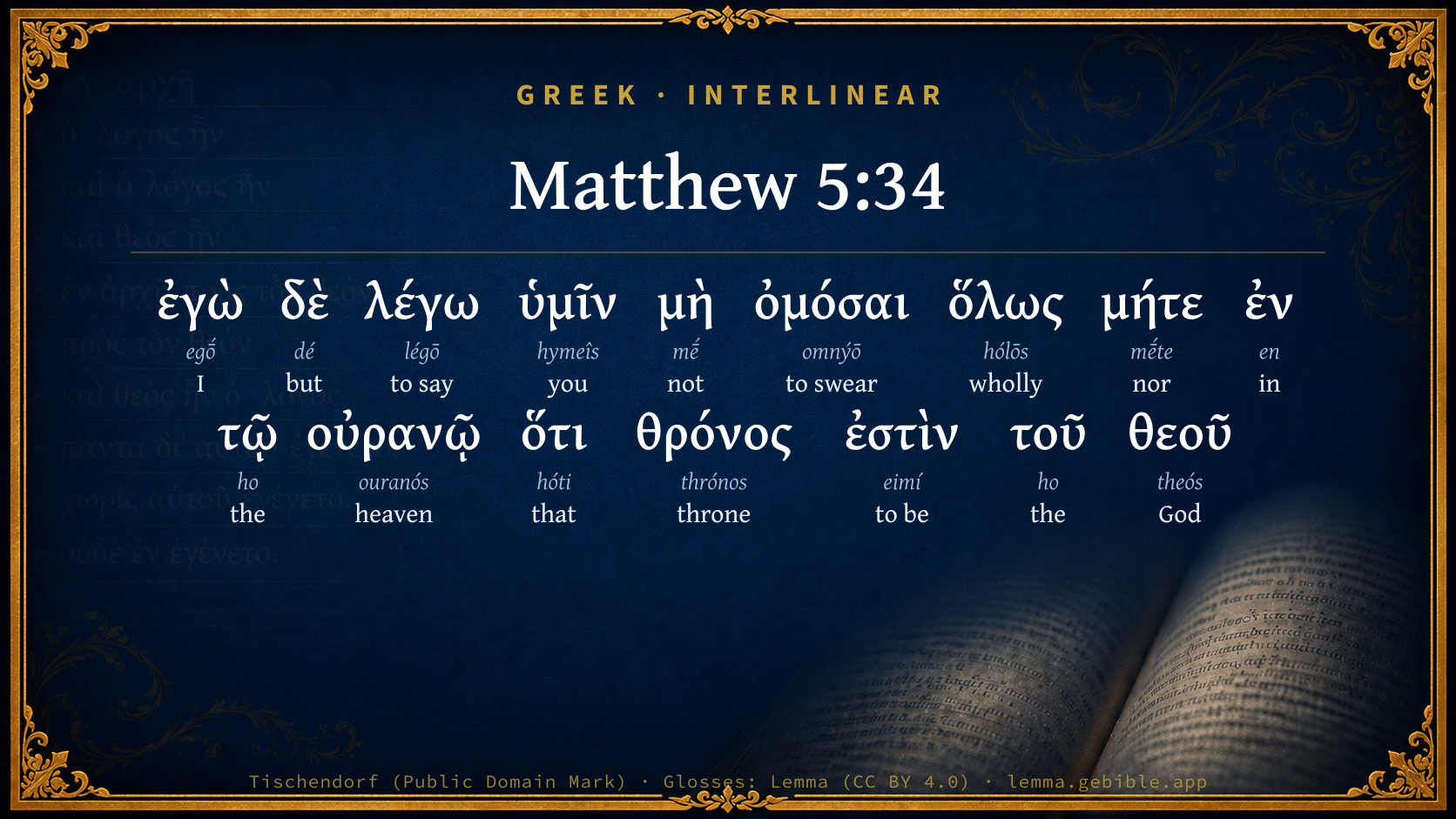
Download image
Cite this verse

Matthew 5:34 (World English Bible). Public Domain. Lemma interlinear Bible study tool, https://lemma.gebible.app/v/matthew/5/34.

Show BibTeX & RIS
BibTeX
RIS
English Translation
but I tell you, don't swear at all: neither by heaven, for it is the throne of God;
World English Bible · Public Domain
Highlights
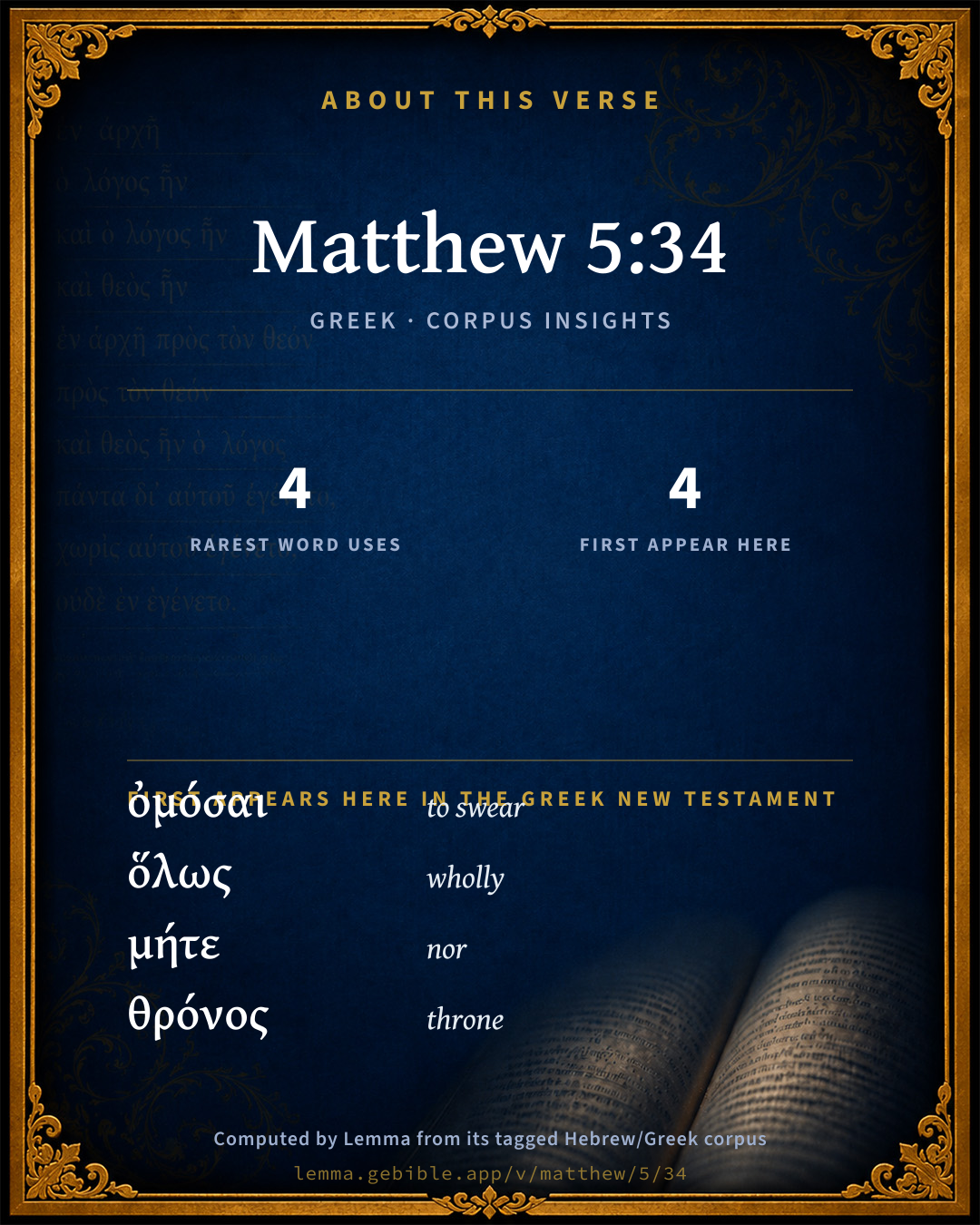
  • 4 first appearances in the Greek New Testament
Full analysis ↓
Download a study sheet

One document with this verse’s original text, its word-by-word gloss line, the meaning frame, cross-references with their text, attributed commentary, and full source and license credits — printable, and it pastes into notes with its structure intact.

This verse Autodidact and up

Study sheet (.html) Plain text (.txt)

A passage Seminary Student

Up to 50 verses in one chapter. A passage sheet keeps up to 6 commentary sources and 12 cross-references per verse, in the order this page ranks them, and says so on the sheet whenever that leaves anything out. Ask for a single verse and you get the Autodidact verse sheet above.

Everything on this page stays free to read, with no account — the sheet is a download of what is already on screen, not access to it.

Want to remove ads? Support Godless Engineer
Compare translations 3

The same verse in 3 English versions, stacked beneath the original-language interlinear above. Click any original word for its lexicon entry.

Each is an independent rendering of the whole verse — the interlinear is not word-aligned to these translations.

Highlighted words mark where these versions differ — a whole-verse word diff, not a word-by-word alignment.

  • World English Bible Public Domain
    but I tell you, don't swear at all: neither by heaven, for it is the throne of God;
  • King James Version Public Domain
    But I say unto you, Swear not at all; neither by heaven; for it is God's throne:
  • unfoldingWord Literal Text CC BY-SA 4.0
    But I tell you not to swear at all, neither by heaven, for it is the throne of God;

unfoldingWord Literal Text — © unfoldingWord, licensed CC BY-SA 4.0. Word-aligned USFM3 via Door43 (git.door43.org/unfoldingWord/en_ult).

Versions to compare (up to 4)

3 of 4 selected

Show all 19 translations

Every available English version of this verse, each an independent rendering of the whole verse.

  • World English Bible Public Domain
    but I tell you, don't swear at all: neither by heaven, for it is the throne of God;
  • Berean Standard Bible Public Domain
    But I tell you not to swear at all: either by heaven, for it is God’s throne;
  • Majority Standard Bible Public Domain
    But I tell you not to swear at all: either by heaven, for it is God’s throne;
  • King James Version Public Domain
    But I say unto you, Swear not at all; neither by heaven; for it is God's throne:
  • American Standard Version (1901) Public Domain
    but I say unto you, swear not at all; neither by the heaven, for it is the throne of God;
  • Revised Version (1885) Public Domain
    but I say unto you, Swear not at all; neither by the heaven, for it is the throne of God;
  • Geneva Bible (1599) Public Domain
    But I say vnto you, Sweare not at all, neither by heauen, for it is the throne of God:
  • Douay-Rheims (1899) Public Domain
    But I say to you not to swear at all, neither by heaven, for it is the throne of God:
  • Young's Literal Translation Public Domain
    but I -- I say to you, not to swear at all; neither by the heaven, because it is the throne of God,
  • Literal Standard Version CC BY-SA 4.0
    but I say to you not to swear at all; neither by Heaven, because it is the throne of God,
  • Unlocked Literal Bible CC BY-SA 4.0
    But I say to you, swear not at all, neither by heaven, for it is the throne of God;
  • unfoldingWord Literal Text CC BY-SA 4.0
    But I tell you not to swear at all, neither by heaven, for it is the throne of God;
  • Darby Bible Public Domain
    But *I* say unto you, Do not swear at all; neither by the heaven, because it is [the] throne of God;
  • World Messianic Bible Public Domain
    but I tell you, don’t swear at all: neither by heaven, for it is the throne of God;
  • Webster's Bible Public Domain
    But I say to you, Swear not at all: neither by heaven; for it is God's throne:
  • Free Bible Version CC BY-SA 4.0
    But I tell you, don't swear at all. Don't swear by heaven, because it's the throne of God.
  • Bible in Basic English Public Domain
    But I say to you, Take no oaths at all: not by the heaven, because it is the seat of God;
  • Text-Critical English NT CC BY 4.0
    But I say to you, do not swear at all, neither by heaven, for it is the throne of God;
  • Tyndale New Testament (1534) Public Domain
    But I saye vnto you swere not at all nether by heue for it ys Goddes seate:

Literal Standard Version (2020), Covenant Press — licensed CC BY-SA 4.0. Text via the HelloAO Bible API (eBible.org). Unlocked Literal Bible (unfoldingWord) — licensed CC BY-SA 4.0. Text via the HelloAO Bible API (eBible.org). unfoldingWord Literal Text — © unfoldingWord, licensed CC BY-SA 4.0. Word-aligned USFM3 via Door43 (git.door43.org/unfoldingWord/en_ult). Free Bible Version, Dr. Jonathan Gallagher — licensed CC BY-SA 4.0. Text via the HelloAO Bible API (eBible.org).

Word by word

More ways to search: Search by grammar → Find every occurrence → Compare this word →

Practice this passage: Drill this verse → Learn its vocabulary →

About this verse

These counts appear in no published source. They are computed here, from the morphology-tagged text and Lemma’s own curated glosses. What Lemma adds →

16
words
15
distinct lemmas
Gospels
section

Notable vocabulary

The rarest word here is ὅλως wholly G3654 — appearing just 4 times in the whole Greek New Testament.

First appearance in Scripture

These words make their first canonical appearance in the Greek New Testament here:

Shared distinctive vocabulary

ὅλως wholly G3654 occurs in 4 verses of the Greek New Testament. Also found in:

Repetition

A word recurs within this verse:

Cross-references

6

Topical passages linked to Matthew 5:34 in the Treasury of Scripture Knowledge — connected by theme and wording, ordered by reader-vote popularity; previews shown in the World English Bible.

  • James 5:12 But above all things, my brothers, don't swear, neither by heaven, nor by the earth, nor by any other oath; but let your "yes" be "yes," and your "no," "no;" so that you don't fall into hypocrisy.
  • Isaiah 66:1 Thus says Yahweh, heaven is my throne, and the earth is my footstool: what manner of house will you build to me? and what place shall be my rest?
  • Deuteronomy 23:21–23 When you shall vow a vow to Yahweh your God, you shall not be slack to pay it: for Yahweh your God will surely require it of you; and it would be sin in you.
  • Matthew 23:16–22 "Woe to you, you blind guides, who say, 'Whoever swears by the temple, it is nothing; but whoever swears by the gold of the temple, he is obligated.'
  • Ecclesiastes 9:2 All things come alike to all. There is one event to the righteous and to the wicked; to the good, to the clean, to the unclean, to him who sacrifices, and to him who doesn't sacrifice. As is the good, so is the sinner; he who takes an oath, as he who fears an oath.
  • Isaiah 57:15 For thus says the high and lofty One who inhabits eternity, whose name is Holy: I dwell in the high and holy place, with him also who is of a contrite and humble spirit, to revive the spirit of the humble, and to revive the heart of the contrite.

Cross-references courtesy of OpenBible.info (CC BY 4.0).

Commentary

Notes on Matthew 5:34 from classic Christian and Jewish commentators (each source and its license shown beneath its notes). The classic Christian expositions comment on the surrounding passage and are grouped to its opening verse, so a note may address several verses; the Jewish commentaries on the Tanakh (Rashi and others) are per-verse, so they appear only where the commentator wrote on this verse.

Lemma curates 59 commentaries, every one of them public domain or Creative Commons licensed, each selected and text-cleaned for this edition rather than reprinted as found. About our sources →

Bengel's Gnomon

Johann Albrecht Bengel

Mat 5:34. Μὴ ὀμόσαι ὅλως, not to swear at all) The ὅλως, at all, extends this prohibition to swearing truly as well as falsely: it does not, however, universally prohibit all true swearing. The right employment of oaths is not only like divorce permitted but clearly established by the law, nor is it here abolished by Christ; see Mat 5:17. But the abuse of oaths was extremely frequent with the Jews of that age, to the destruction of their legitimate use, as is clear from the forms of swearing cited in this passage; nor did they think him guilty of perjury who called only creatures to witness in his oath, however falsely he might swear. See Samuel Petit,[214] Variae Lectiones, ch. 16. The following decree of the Jews is to be found in Elle Schemoth Rabba,[215] section 44, As heaven and earth shall pass away, so shall the oath pass away which calls them to witness. There is clearly, however, a prohibition, whilst the prevalent[216] abuse of oaths is forbidden, and their true use restored. Many of the ancient Christians received this command simply and literally, and so much the more readily declined the heathen oaths which they were commanded to take. See however, Rev 10:6; Jer 23:8; Isa 45:23, the last of which passages refers to Christian times. On the contrary, there is now-a-days a great danger lest a very small proportion of the number that are made be true, and of the true a very small proportion necessary, and of those that are necessary a very small proportion free, fruitful, holy, and joyful. Many are employed for show, for calumny, for silencing just suspicions.—ἐν, by) That which is sworn by is offered in pledge: it should therefore be in the power of him who swears. He who swears wrongly (Mat 5:34; Mat 5:36) is guilty of sacrilege. Therefore, in this sense a man ought not to swear by God, because, in case of his swearing falsely, he pledges himself to renounce God. This, however, it is not in his power to do. But we must swear in that manner which is sanctioned in the Divine law itself, so that our oath should be an invocation of the Divine name. Even the customary formula, So help me God, is not to be taken in the former but in the latter sense, so that the emphasis should fall upon the word GOD. This interpretation is at any rate favourable to him who swears, and makes the matter rather easier.—τῷ οὐρανῷ, by heaven) How much greater is their sin who swear by God Himself!—θρόνος, throne) How great is the majesty of God! God is not enclosed by heaven, but His glory is especially manifested there.

[214] A celebrated scholar, born at Nîsmes in 1594, studied at Geneva, raised at an early age to the Professorship of Theology and of Greek and Hebrew in that city. Died 1645. A man of vast and profound erudition.—(I. B.)

[215] i.e. “Mystical Commentary on Exodus,” a rabbinical work in high estimation among the Jews.—(I. B.)

[216] “Grassatus,” a word used of a fiercely raging epidemic—(I. B.)

Bengel's Gnomon of the New Testament — English translation (T&T Clark, Edinburgh, 1860) — public domain. Text from a community e-Sword module.

Meyer's Critical & Exegetical Commentary

Heinrich August Wilhelm Meyer

Mat_5:34-36. Μὴ ὀμόσαι ὅλως] to swear not at all (the adverb placed emphatically at the end, compare Mat_2:10), dependent upon λέγω ὑμῖν (comp. Plat. Phaed. p. 59 E, Menex. 240 A), in which the command is implied (Jacobs, ad Anthol. X. p. 200; Kühner, ad Anab. v. 7. 34; Wunder, ad Soph. O. C. 837), interdicts all kinds of swearing in general;[415] not merely that of common life, which is at variance with reverence for God (Luther, Calvin, Calovius, Bengel, Fritzsche, Ewald, Tholuck, Harless, Hilgenfeld, Keim, and others), nor even merely oaths regarded ex Judaeorum sensu (thus Matthaei, doctrina Christi de jurejur. Hal. 1847). The simple prohibition,given, however, to the disciples, and for the life of fellowship of true believers,and in so far not less ideal than the requirements that have preceded, appears from the words themselves (comp. Jam_5:12), and also from Mat_5:37. Christianity as it should be according to the will of Christ, should know no oath at all: τὸ μὴ ὀμνύειν ὅλως ἐπιτείνει μάλιστα τὴν εὐσέβειαν, Euth. Zigabenus. To the consciousness of the Christian, God should always be so vividly present, that, to him and others in the Christian community, his yea and nay are, in point of reliability, equivalent to an oath. His yea and nay are oath enough. Comp. on ὅλως, prorsus (= παντελῶς, Hesychius), Xen. Mem. i. 2. 35: προαγορεύομεν τοῖς νέοις ὅλως μὴ διαλέγεσθαι, Oecon. Mat_20:20. Accordingly, it is only in the incomplete temporal condition of Christianity, as well as in the relation to the world in which it is placed, and to the existing relations of the department of public law, to which it conforms itself, that the oath has its necessary, indeed (comp. Heb_6:16), but conditional and temporary existence. Christ Himself has sworn (Mat_26:63 f.); Paul has frequently sworn (Rom_1:9; 2Co_1:23; 2Co_11:3 f.; Gal_2:20; Php_1:8); nay, God swears to His own people (Gen_22:16; Gen_26:3; Num_14:23; Isa_45:23; Luk_1:73; Act_7:17; Heb_6:13). Therefore Anabaptists and Quakers are wrong in rejecting an oath without any exception, as was already done by Justin, Irenaeus, Clement, Origen, Chrysostom, Jerome, and other Fathers. The various but altogether arbitrary explanations of those who here recognise no absolute prohibition may be seen in Tholuck. The direct oath, by God, is not indeed expressly mentioned along with others in what follows; its prohibition, however, is implied, just as a matter of course, and entirely, first of all in the general μὴ ὀμόσαι ὅλως, as it is the reference to God which constitutes precisely the fundamental conception and nature of the oath, and, as in the doctrine here discussed, Mat_5:33, the direct oath is contained not only in οὐκ ἐπιορκ., according to Lev_19:12, but also expressly in ἀποδώσεις τῷ κυρίῳ, etc. If Christ, therefore, had intended to forbid merely the oaths of common life, He would, instead of the altogether general statement, μὴ ὀμόσαι ὅλως, have made use of a form of expression excluding oaths to be taken in relation to the magistracy (probably by a παρεκτός, as in Mat_5:32). It is true, indeed, that in the special prohibitions which follow, He mentions only indirect oaths,consequently not those that are valid in a court of justice,but just because the prohibition of the direct oath was already contained in μὴ ὀμός. ὅλως, first of all and before all other kinds of oaths; and His object now is simply to set forth that even indirect swearing fell under the general prohibition of swearing. And He sets this forth in such a way, that in so doing the prohibition of the direct oath forms the presupposition of His demonstration, as it could not otherwise be expected after μὴ ὀμόσαι ὅλως. What a scanty πλήρωσις of the lawand one altogether out of keeping with the ideal character of the points which precededwould it have been had Jesus only intended to say: I forbid you the wanton oaths of the streets, of the markets (Keim), in all their forms!

μήτε ἐν τῷ οὐρ., κ.τ.λ.] not to swear in general, nor (specially) by heaven, nor by earth. See on μὴ … μήτε, Klotz, ad Devar. p. 709; Kühner, II. 2, p. 828 f.; Winer, p. 454 [E. T. 612]; also Baeumlein, Part. p. 222.

The kinds of swearing censured by Jesus were very common amongst the Jews; Philo, de Spec. Legg. p. 770 A; Lightfoot, l.c.; Meuschen, N. T. ex Talm. illustr. p. 58.

θρόνος θεοῦ and ὑποπόδιον … αὐτοῦ] (Isa_66:1; Mat_23:22).

τοῦ μεγ. βας.] of Jehovah (Psa_48:2; Psa_95:4; Job_13:18 ff.; therefore the holy city, Mat_4:5).

μήτε[416] ἐν τῇ κεφαλῇ] Not merely the Jews (Berachoth, f. 3. 2; Lightfoot, Hor. p. 281), but also the heathen (Eur. Hel. 835), swore by their head. Dougtius, Anal. II. p. 7 f.; Wetstein on the passage. Comp. the exposition of Virg. Aen. ix. 300.

ὀμνύειν is by the Greek writers connected with κατά τινος, or with the accus. (Jam_5:12). Here, as in Mat_23:16 ff., Jer_5:7, Dan_12:7, with ἐν (in harmony with the idea that the oath cleaves to the object appealed to, comp. on ὉΜΟΛΟΓΕῖΝ ἘΝ, Mat_10:32), and with ΕἸς (directing the thought; comp. Plut. Oth. 18), after the Hebrew נִשְּׁבַּע ב׳.

ὅτι οὐ δύνασαι, κ.τ.λ.] for thou art not in a condition to make one single hair (if it is black) white or (if it is white) black. There is, of course, no allusion to the dyeing of hair. Wolf, Köcher, Kuinoel, and others incorrectly render it: thou canst not produce a single white or black hair. On such a signification, what means the mention of the colour? The meaning of the whole passage is: Ye shall not swear by all these objects; for all such oaths are nothing less than the oath directly by God Himself, on account of the relation in which those objects stand to God. In the creature by which thou swearest, its Creator and Lord is affected.

[415] Comp. West in the Stud. u. Krit. 1852, p. 221 ff.; Nitzsch, christl. Lehre, p. 393 ff.; Werner in the Stud. u. Krit. 1858, p. 711 ff.; Wuttke, Sittenl. II. § 277; Achelis in the Stud. u. Krit. 1867, p. 436 ff. Jerome had already remarked, with striking simplicity: evangelica veritas non recipit juramentum cum omnis sermo fidelis pro jurejurando sit. The emphatic ὅλως forbids, however, the limitation only to the forms of the oath that are afterwards mentioned (Althaus in d. Luther. Zeitschr. 1868, p. 504, and already Theophylact, 1), so that the oath by the name of God would remain unaffected; in like manner, the restriction of the prohibition to promissory oaths (Ficker in the same Zeitschr. 1870, p. 633 ff., and already Grotius).

[416] If μηδέ were here the reading (Fritzsche), then the meaning would be: not even by thy head; see Hartung, Partik. I. p. 196. But this reading is neither critically admissibleas it has only א** in its favournor exegetically necessary, since the series of negations is symmetrically continued with μήτε ἐν τ. κεφ. ς., which symmetry is not interrupted by ὀμόσῃς, because the latter does not stand before ἐν τῇ κεφ. ς. Matthew might have written μηδέ (comp. also Bornemann, ad Xen. Anab. iii. 2. 27; Ellendt, Lex. Soph. II. p. 123), but he was not obliged to do so.

Meyer — Critical and Exegetical Commentary on the New Testament — English translation by Peter Christie, edited by Frederick Crombie (T&T Clark, 1880) — public domain. Text from a community e-Sword module.

Expositor's Greek Testament

ed. W. Robertson Nicoll

Mat 5:34 . ὅλως : emphatic = παντελῶς , don’t swear at all . Again an unqualified statement, to be taken not in the letter as a new law, but in the spirit as inculcating such a love of truth that so far as we are concerned there shall be no need of oaths. In civil life the most truthful man has to take an oath because of the untruth and consequent distrust prevailing in the world, and in doing so he does not sin against Christ’s teaching. Christ Himself took an oath before the High Priest (Mat 26:63 ). What follows (Mat 5:34-36 ) is directed against the casuistry which laid stress on the words τῷ κυρίῳ , and evaded obligation by taking oaths in which the divine name was not mentioned: by heaven, earth, Jerusalem, or by one’s own head. Jesus points out that all such oaths involved a reference to God. This is sufficiently obvious in the case of the first three, not so clear in case of the fourth. λευκὴν ἢ μέλαιναν : white is the colour of old age, black of youth. We cannot alter the colour of our hair so as to make our head look young or old. A fortiori we cannot bring on our head any curse by perjury, of which hair suddenly whitened might be the symbol. Providence alone can blast our life. The oath by the head is a direct appeal to God. All these oaths are binding, therefore, says Jesus; but what I most wish to impress on you is: do not swear at all. Observe the use of μήτε (not μηδέ ) to connect these different evasive oaths as forming a homogeneous group. Winer, sect. Lev 6 , endorses the view of Herrmann in Viger that οὔτε and μήτε are adjunctival , οὐδέ and μηδέ disjunctival , and says that the latter add negation to negation, while the former divide a single negation into parts. Jesus first thinks of these evasive oaths as a bad class, then specifies them one after the other. Away with them one and all, and let your word be ναὶ ναί , οὒ οὔ . That is, if you want to give assurance, let it not be by an oath, but by simple repetition of your yes and no . Grotius interprets: let your yea or nay in word be a yea or nay in deed , be as good as your word even unsupported by an oath. This brings the version of Christ’s saying in Mt. into closer correspondence with Jas 5:12 ἤτω τὸ Ναί ναὶ , καὶ τὸ Οὔ οὔ . Beza, with whom Achelis ( Bergpredigt ) agrees, renders, “Let your affirmative discourse be a simple yea, and your negative, nay”. τὸ δὲ περισσὸν , the surplus, what goes beyond these simple words. ἐκ τοῦ πονηροῦ , hardly “from the evil one,” though many ancient and modern interpreters, including Meyer, have so understood it. Meyer says the neuter “of evil” gives a very insipid meaning. I think, however, that Christ expresses Himself mildly out of respect for the necessity of oaths in a world full of falsehood. I know, He means to say, that in certain circumstances something beyond yea and nay will be required of you. But it comes of evil, the evil of untruthfulness. See that the evil be not in you. Chrysostom (Hom. xvii.) asks: How evil, if it be God’s law? and answers: Because the law was good in its season. God acted like a nurse who gives the breast to an infant and afterwards laughs at it when it wants it after weaning.

The Expositor's Greek Testament, edited by W. Robertson Nicoll (1897–1910) — public domain. Text from a community e-Sword module.

Adam Clarke's Commentary

Verse 34. - 35. Neither by heaven, c.] It was a custom among the Scythians, when they wished to bind themselves in the most solemn manner, to swear by the king's throne and if the king was at any time sick, they believed it was occasioned by some one's having taken the oath falsely. Herod. l. iv.

Who is there among the traders and people of this world who obey this law? A common swearer is constantly perjuring himself: such a person should never be trusted. When we make any promise contrary to the command of God, taking, as a pledge of our sincerity, either GOD, or something belonging to him, we engage that which is not ours, without the Master's consent. God manifests his glory in heaven, as upon his throne; he imprints the footsteps of his perfections upon the earth, his footstool; and shows that his holiness and his grace reign in his temple as the place of his residence. Let it be our constant care to seek and honour God in all his works.

Adam Clarke's Commentary on the Bible (1810–1826) — public domain. Text from a community e-Sword/MySword module.

Ellicott's Commentary for English Readers

(34) Swear not at all.—Not a few interpreters, and even whole Christian communities, as e.g. the Society of Friends, see in these words, and in Jas_5:12, a formal prohibition of all oaths, either promissory or evidential, and look on the general practice of Christians, and the formal teaching of the Church of England in her Articles (Art. xxxix.), as simply an acquiescence in evil. The first impression made by the words is indeed so strongly in their favour that the scruples of such men ought to be dealt with (as English legislation has at last dealt with them) with great tenderness. Their conclusion is, however, it is believed, mistaken: (1) Because, were it true, then in this instance our Lord would be directly repealing part of the moral law given by Moses, instead of completing and expanding it, as in the case of the Sixth and Seventh Commandments. He would be destroying, not fulfilling. (2) Because our Lord himself answered, when He had before been silent, to a solemn formal adjuration (Mat_26:63-64), and St. Paul repeatedly uses such forms of attestation (Rom_1:9; 1Co_15:31; 2Co_1:23; Gal_1:20; Php_1:8). (3) Because the context shows that the sin which our Lord condemned was the light use of oaths in common speech, and with no real thought as to their meaning. Such oaths practically involved irreverence, and were therefore inconsistent with the fear of God. The real purpose of an oath is to intensify that fear by bringing the thought of God’s presence home to men at the very time they take them, and they are therefore rightly used when they attain that end. Practically, it must be admitted that the needless multiplication of oaths, both evidential and promissory, on trivial occasions, has tended, and still tends, to weaken awe and impair men’s reverence for truth, and we may rejoice when their number is diminished. In an ideal Christian society no oaths would be needed, for every word would be spoken as by those who knew that the Eternal Judge was hearing them.

(34-35) Neither by heaven; . . . nor by the earth; . . . neither by Jerusalem.—Other formulæ of oaths meet us in Mat_23:16-22; Jas_5:12. It is not easy at first to understand the thought that underlies such modes of speech. When men swear by God, or the name of Jehovah, there is an implied appeal to the Supreme Ruler. We invoke Him (as in the English form, “So help me God”) to assist and bless us according to the measure of our truthfulness, or to punish us if we speak falsely. But to swear by a thing that has no power or life seems almost unintelligible, unless the thing invoked be regarded as endowed in idea with a mysterious holiness and a power to bless and curse. Once in use, it was natural that men under a system like that of Israel, or, we may add, of Christendom, should employ them as convenient symbols intensifying affirmation, and yet not involving the speaker in the guilt of perjury or in the profane utterance of the divine name. Our Lord deals with all such formulæ in the same way. If they have any force at all, it is because they imply a reference to the Eternal. Heaven is His throne, and earth is His footstool (the words are a citation from Isa_66:1), and Jerusalem is the city of the great King. To use them lightly is, therefore, to profane the holy name which they imply. Men do not guard themselves either against irreverence or perjury by such expedients.

A Bible Commentary for English Readers, edited by Charles John Ellicott (1878–1897) — public domain. Text from a community e-Sword module.

The Cambridge Bible for Schools and Colleges

gen. ed. J. J. S. Perowne

34. Swear not at all] The prohibition must be understood of rash and careless oaths in conversation, not of solemn asseveration in Courts of Justice.

for it is God’s throne] Such was the prevalent hypocrisy that the Jews of the day thought that they escaped the sin of perjury if in their oaths they avoided using the name of God. One of the Rabbinical sayings was “As heaven and earth shall pass away, so passeth away the oath taken by them.” Our Lord shows that a false oath taken by heaven, by earth, or by Jerusalem is none the less a profanation of God’s name.

Hypocrisy reproduces itself. Louis XI. “admitted to one or two peculiar forms of oath the force of a binding obligation which he denied to all others, strictly preserving the secret, which mode of swearing he really accounted obligatory, as one of the most valuable of state mysteries.” Introd. to Quentin Durward.

The Cambridge Bible for Schools and Colleges (gen. ed. J. J. S. Perowne; Cambridge University Press, 1878–1918) — public domain. Text from a community e-Sword module.

John Gill's Exposition

But I say unto you, swear not at all,.... Which must not be understood in the strictest sense, as though it was not lawful to take an oath upon any occasion, in an affair of moment, in a solemn serious manner, and in the name of God; which may be safely done: but of rash swearing, about trivial matters, and by the creatures; as appears by what follows,

neither by heaven; which is directly contrary to the Jewish canons (m), which say,

"they that swear "by heaven", and by earth, are free.''

Upon the words in Sol 2:7, "I adjure you", &c. it is asked (n),

"by what does she adjure them? R. Eliezer says, by the heavens, and by the earth; by the hosts, the host above, and the host below.''

So Philo the Jew says (o) that the most high and ancient cause need not to be immediately mentioned in swearing; but the "earth", the sun, the stars, "heaven", and the whole world. So R. Aben Ezra, and R. David Kimchi, explain Amo 4:2. "The Lord God hath sworn by his holiness"; that is, say they, "by heaven": which may be thought to justify them, in this form of swearing; though they did not look upon it as a binding oath, and therefore if broken they were not criminal (p).

"He that swears by heaven, and by the earth, and by the sun, and the like; though his intention is nothing less than to him that created them, this is no oath.''

The reason why it is forbidden by Christ to swear by heaven, is,

for it is God's throne; referring to Isa 66:1 where he sits, the glory of his majesty shines forth, and is itself glorious and excellent, and not to be mentioned in a vain way; and especially, for the reason Christ elsewhere gives, Mat 23:22 that "he that shall swear by heaven, sweareth by the throne of God, and by him that sitteth thereon"; so that they doubly sinned, first, by openly swearing by that which is God's creature; and then, by tacitly bringing God into their rash and vain oaths.

(m) Misn. Shebuot, c. 4. sect. 13. (n) Shirhashirim Rabba, fol. 10. 4. (o) De Special. leg. p 770. (p) Maimon. Hilch. Shebuot, c. 12. sect. 3.

John Gill's Exposition of the Whole Bible (1746–1763) — public domain (CC PDM 1.0). Text via the HelloAO Bible API.

Trapp's Complete Commentary

John Trapp

34 But I say unto you, Swear not at all; neither by heaven; for it is God’s throne:

Ver. 34. Swear not at all] Not at all by the creatures. {a} (which the Pharisees held no fault), nor yet by the name of God in common talk, lightly, rashly, and irreverently; for such vain oaths the land mourneth. Oaths, alas, are become very interjections of speech to the common people, and phrases of gallantry to the braver. He that cannot swear with a grace, wanteth his tropes and his figures befitting a gentleman. Not to speak of those civilized complements of faith and loyalty (which are counted light matters), who hears not how ordinarily and openly ruffianly oaths and abhorred blasphemies are darted up with hellish mouths, against God and our Saviour, whom they can swear all over, and seldom name, but in an oath? How can these pray, "Hallowed be that Name," that they so daily dishallow? {b} Some cannot utter a sentence without an oath, yea, a fearful one, an oath of sound, if enraged especially. Oh the tragedies, the blusters, the terrible thunder cracks or fierce and furious language, interlaced with oaths, enough to make the very stones crack under them! Yea, to such a height and habitual practice hereof are some grown, that they swear and foam out a great deal of filth, and perceive it not. Had these men such distemper of body as that their excrements came from them when they knew not of it, it would trouble them. So it would, I dare say, did they believe the Holy Scriptures, threatening so many woes to them, yea, telling them of a large roll, ten yards long and five yards broad, full of curses against the swearer, yea, resting upon his house, where he thinks himself most secure, Zec 5:2-3 "Brimstone is scattered upon the house of the wicked," saith Job, {Job 18:15} as ready to take fire if God but lighten upon it. They walk, as it were, upon a mine of gunpowder, and it may be just in God they should be blown up, when their hearts are full of hell, and their mouths even big with hellish blasphemies. Surely their damnation sleepeth not; God hath vowed he will not hold them guiltless, sworn these swearers shall never enter into his rest, Exo 20:7; Psa 95:11. And for men, those that have but any ingenuity abhor and shun their company. The very Turks have the Christians blaspheming Christ in execration, and will punish their prisoners sorely, when as through impatience or desperateness they burst out into them. Yea, the Jews, as their conversion is much hindered by the blasphemies of the Italians (who blaspheme oftener than swear), so in their speculations of the causes of the strange success of the affairs of the world, they assign the reason of the Turks prevailing so against the Christians, to be their oaths and blasphemies, which wound the ears of the very heavens. They can tell that swearing is one of those sins for the which God hath a controversy with a land, Hos 4:2; Jer 23:10. And I can tell what a great divine hath observed, that the stones in the wall of Aphek shall sooner turn executioners than a blasphemous Aramite shall escape unrevenged. So much doth a jealous God hate to be robbed of his glory, or wronged in his name, even by ignorant pagans (how much more by professed Christians!) whose tongues might seem no slander. Those that abuse earthly princes in their name and titles are imprisoned, banished, or hanged as traitors. And shall these go altogether unpunished? Hell gapes for such miscreants, &c.

Neither by heaven] As the Manichees and Pharisees did, and held it no sin. But God only is the proper object of an oath, Isa 65:16; Jer 12:6. The name of the creature, say some, may be inferred, the attestation referred to God alone. But they say better that tell us that the form of an oath is not at all to be indirect or oblique, in the name of the creature. Albeit I doubt not but he that sweareth by heaven sweareth by him that dwelleth in heaven, &c. And forasmuch as God clotheth himself with the creatures, Psa 104:1-2, is it fit for us to spit upon the king’s royal robes, especially when they are upon his back? But forasmuch as we must shun and be shy of the very show and shadow of sin, they do best and safest that abstain from all oaths of this nature, 1Th 5:22. They do very ill that swear by this light, bread, hand, fire (which they absurdly call God’s angel), by St Ann, St George, by our Lady, &c., by the parts of Christ, which they substitute in the room of God. The barbarous soldiers would not break his bones, but these miscreants with their carrion mouths rend and tear (oh cause for tears!) his heart, hands, head, feet, and all his members asunder. Let all such consider, that, as light a matter as they make of it, this swearing by the creature is a "forsaking of God," Jer 5:7, a provocation little less than unpardonable; an exposing God’s honour to the spoil of the creatures, which was the heathen’s sin, Rom 1:23; and abasing themselves below the meanest creatures, "for men verily swear by the greater," Heb 6:16. And the viler the thing is they swear by, the greater is the oath, because they ascribe thereto omniscience, power to punish, justice, &c., Amo 8:14; Zep 1:3-5; besides a heavy doom of unavoidable destruction denounced against such. They that speak in favour of this sin allege 1Co 15:31. But that is not an oath, but an obtestation; q.d. my sorrows and sufferings for Christ would testify, if they could speak, that I die daily. And that, Son 3:5, where Christ seemeth to swear "by the toes and hinds of the field." But that is not an oath either, but an adjuration: for he chargeth them not to trouble his Church; or if they do, the roes and hinds shall testify against them, because they do what those would not, had they reason as they have. In like sort Moses attesteth heaven and earth, Deu 32:1; and so doth God himself, Isa 1:2. And for those phrases, "As Pharaoh liveth," "As thy soul liveth," &c., they are rather earnest vouchings of things than oaths. {c} And yet that phrase of gallantry now so common, "As true as I live," is judged to be no better than an oath by the creature, Num 14:21; cf. Psa 95:11. And we may not swear in jest, but in judgment, Jer 4:2.

For it is God’s throne] We must not conceive that God is commensurable by a place, as if he were partly here and partly there, but he is everywhere all-present. The heavens have a large place, yet have they one part here and another there, but the Lord is totally present wheresoever present. Heaven therefore is said to be his throne, and he is said to inhabit it, Isa 66:1, not as if he were confined to it, as Aristotle and those atheists in Job conceited it; {d} but because there he is pleased to manifest the most glorious and visible signs of his presence, and there in a special manner he is enjoyed and worshipped by the crowned saints and glorious angels, &c. Here we see but as in a glass obscurely, his toe, train, hind parts, footstool. No man can see more and live; no man need see more here, that he may live for ever. But "there we shall see as we are seen, know as we are known," see him face to face, Isa 6:1; Isa 60:13; Isa 66:1; Exo 33:23; 1Co 13:12. Oh how should this fire up our dull hearts, with all earnestness and intention of endeared affection to long, lust, pant, faint after the beatifical vision! How should we daily lift up our hearts and hands to God in the heavens, that he would send from heaven and save us; send his law, and command deliverance out of Sion; yea, that himself would break the heavens and come down, and fetch us home upon the clouds of heaven, as himself ascended, that when we awake we may be full of his image, and as we have borne the image of the earthly, so we may bear the image of the heavenly! St Paul, after he had once seen God in his throne, being rapped up into the third heaven (like the bird of Paradise), he never left groaning out, Cupio dissolvi, " I desire to be dissolved and to be with Christ, which is far far the better." {e} And Pareus, a little before his death, uttered this swan song,

" Discupio solvi, tecumque, o Christe, manere:

Portio fac regni sim quotacunque tui."

Oh that I were in heaven! Oh that I might

Be ever with the Lord! Oh blissful plight!

Thus must our broken spirits even spend and exhale themselves in continual sallies, as it were, and egressions of thoughts, wishings, and longings after God, affecting not only a union, but a unity with him. {f} St Austin wished that he might have seen three things, Romam in flore, Paulum in ore, et Christum in corpore: Rome flourishing, Paul discoursing, and Christ living upon the earth. But I had rather wish, with venerable Bede, "My soul desireth to see Christ my King upon his throne, and in his majesty." {g}

{a} Deiurando per creaturas, contra Lyram, et de iuramenti usu, contra Anabapt. videbis Pareum in Jacob, v. 12.

{b} Sunt qui altius linguas suas in Christi sanguine demergunt, quam illi olim manus.

{c} Non est forma iuramenti, sed asseverationis seriae, et obtestationis domesticae; q.d. quam vere vivit Pharao, &c. Alsted.

{d} Job 22:14. Docuit Aristoteles providentiam Dei ad coelum lutae usque protendi, non ultra.

{e} πολλω μαλλον κρεισσον. A transcendant expression, like that 2Co 4:17.

{f} Mi sine nocte diem, vitam sine morte quietam,

Dei sine fine dies. Vita, quiesque Deus.

{g} Anima mea desiderat Christum regem meum videre in decore suo. Beda.

John Trapp, A Commentary or Exposition upon All the Books of the Old and New Testament (1647–1656) — public domain. Text from a community e-Sword module.

Albert Barnes' Notes on the Bible

But I say unto you, Swear not at all - That is, in the manner which he proceeds to specify. Swear not in any of the common and profane ways customary at that time.

By heaven; for it is God’s throne - To swear by that was, if it meant anything, to swear by Him that sitteth thereon, Mat 23:22.

Nor by the earth; for it is his footstool - Swearing by that, therefore, is really swearing by God. Or perhaps it means:

1.That we have no right to pledge, or swear by, what belongs to God; and,

2.That oaths by inanimate objects are unmeaningful and wicked.

If they are real oaths, they are by a living Being, who has power to take vengeance. A footstool is that on which the feet rest when sitting. The term is applied to the earth to denote how lowly and humble an object it is when compared with God.

Jerusalem - See the notes at Mat 2:1.

City of the Great King - That is, of God; called the Great King because he was the King of the Israelites, and Jerusalem was the capital of the nation, and the place where he was especially honored as king. Compare Psa 46:4; Psa 48:1-2; Psa 87:3.

Albert Barnes' Notes on the Bible (1834–1885) — public domain. Text from a community e-Sword/MySword module.

Haydock's Catholic Bible Commentary

Swear not at all. We must not imagine that here are forbidden all oaths, where there is a just and necessary cause of calling God to witness. An oath on such an occasion is an act of justice and religion. Here are forbidden unnecessary oaths in common discourse, by which the sacred name of God, which never ought to be pronounced without reverence and respect, is so frequently and scandalously profaned. (Witham) --- ’Tis not forbidden to swear in truth, justice and judgment; to the honour of God, or our own or neighbour’s just defence; but only to swear rashly, or profanely, in common discourse, and without necessity. (Challoner)

George Leo Haydock (1774–1849), Haydock's Catholic Family Bible and Commentary, 1859 edition — public domain. Excludes Psalms (Douay-Rheims chapter numbering differs from Protestant) and Deuterocanonical books (Catholic canon only).

Matthew Poole's English Annotations

Doth our Saviour here oppose himself to the law of God, which saith, Deu 6:13; 10:20, Thou shalt fear the Lord thy God, and swear by his name? Doth he condemn Abraham, who sware his servant by the Lord God of heaven and earth? Gen 24:3. Doth he destroy such a useful means for the end of strife? Heb 6:16. None of all these. We must consider that our Saviour is here opposing himself to the corruptions of that age brought in by the Pharisees, who had taught people that swearing was nothing, if they did not forswear themselves; or at least swearing by the heaven, by the earth, by Jerusalem, by their head, or in suchlike forms, was no sin, if they forbore the name of God; that they were only obliged to swear by the name of God in public courts of justice, but they were not tied up to it at other times. To these and such like corruptions our Saviour opposeth these words, I say unto you, Swear not at all; not at all voluntarily, but where it is necessary for the end of strife; not at all in your common discourse, Jam 5:12; and so it is expounded in the next verse. The law doth not only forbid false swearing, but common and ordinary swearing, needless swearing, which speaks a great want of reverence in the heart of the name of God. And let not your teachers cheat you, in telling you God, or the name of God, is not concerned, in your swearing by heaven: is not heaven the throne of God? Or by earth: is not that the footstool of God? Or by Jerusalem: is not that the city of God? Or by your head: is it not God that hath given you your life and bodily members? Is it in your power to make a hair of your head white or black? So as the great thing here forbidden, is common and ordinary swearing, where God calleth us not unto it for the determination of strife. Do not only think that false swearing, but be assured that ordinary, common, needless swearing, is forbidden by God.

Matthew Poole's English Annotations on the Holy Bible (1683–1685) — public domain. Text from a community e-Sword/MySword module.

Whedon's Commentary on the Bible

Daniel D. Whedon

34. Swear not at all — Neither in his prohibition of swearing nor of violence (38-42) is our Lord giving any law for the magistrate or the governmental regulations, but for private conduct. The officer of government has still a right to use force, and the magistrate to administer an oath. In fact, to forbid these things in private life secures that they may be done magistratively with better effect.

None of the oaths which our Lord adduces as specimens are judicial oaths. The Orientalists are great profane swearers, and the secondary oaths here forbidden by our Lord are just the ordinary profanities of their conversation. Dr. Thomson (vol. i, p. 284) says: “This people are fearfully profane. Everybody curses and swears when in a passion. No people that I have ever known can compare with these Orientals for profaneness in the use of the names and attributes of God.… They swear by the head, by their life, by heaven, and by the temple, or, what is in its place, the church. The forms of cursing and swearing, however, are almost infinite, and fall on the pained ear all day long.” Our Lord’s caution not to forswear is given because the people held that to violate these minor oaths of conversation was no perjury. Our Lord not only pronounces it to be forswearing, but forbids the swearing at all.

Daniel D. Whedon (gen. ed.), Commentary on the Old and New Testaments (1874–1909) — public domain. Text from a community e-Sword module.

The Pulpit Commentary

Swear not at all. (cf. Jam_5:12) Yet, as St. Augustine points out, St. Paul took oaths in his writings; (2Co_1:23 2Co_11:31) and our Lord himself did not refuse to answer when put upon his oath. (Mat_26:63, Mat_26:64) He, that is to say, and St. Paul after him, accepted the fact that there are times when a solemn oath must be taken. How, then, can we explain this absolute prohibition here? In that our Lord is not here thinking at all of formal and solemn oaths, but of oaths as the outcome of impatience and exaggeration. The thoughtlessness of fervent asseveration is often betrayed into an oath. Such an oath, or even any asseveration that passes in spirit beyond "yea, yea," "nay, nay," has its origin ek tou ponhrou ; cf. Chaucer, "Sweryng sodeynly without avysement is eek a gret synne" ("Parson"s Tale," Ira"). Martensen, however ("Ethics, Individual," takes the prohibition of oaths as formally unconditional and total, in accordance with the highest ideal of what man will hereafter be and require, and he sees the limitation, which he allows is to be given to these words, in the present conditions of human society. We have an ideal duty towards God, but we have also a practical duty to those among whom we live, and the present state of human affairs permits and necessitates oaths. Hence it was that even Christ submitted to them. Neither by heaven, etc. Our Lord further defines what he means by an oath. It does not mean only an expression in which God"s Name is mentioned, but any expression appealing to any object at all, whether this be supraterrestrial, terrestrial, national, or personal. Although God"s Name is often omitted in such cases, from a feeling of reverence, its omission does not prevent the asseveration being an oath. Heaven; Revised Version, the heaven; for the thought is clearly not the immaterial transcendental heaven, the abode of bliss, but the physical heaven. (cf. Mat_6:26, Revised Version) Heaven... footstool. Adapted from Isa_66:1, where it forms part of the glorious declaration that no material temple can contain God, that "the Most High dwelleth not in temples made with hands" as St. Stephen paraphrases it. (Act_7:48) The great King is seated enthroned in the heaven, with his feet touching the earth.

The Pulpit Commentary (1880–1919), ed. H.D.M. Spence-Jones & Joseph S. Exell — public domain. Text from a community e-Sword module.

The People's New Testament

B. W. Johnson

34, 35. Swear not at all. Christ does not forbid judicial oaths. Note, (1) God sometimes swears by himself (Gen. 22:16, 17); (2) Jesus made oath before the Sanhedrim (Matt. 26:63); (3) Paul made oath to the Corinthians (2 Cor. 1:23). He does forbid all profanity and idle oaths, such as were common among the Jews, and still so defile the mouths of men. Neither by heaven. The Jews held that it was impious to swear by the name of God, but that one could swear “by heaven,” “by the earth,” “by Jerusalem.” One was God's throne, the second his footstool, Jerusalem the city of the Messiah King, all too holy for profanation.

B. W. Johnson's The People's New Testament with Notes (1889–1891) — public domain. Electronic text from the Christian Classics Ethereal Library (CCEL) ThML edition.

Cambridge Greek Testament for Schools and Colleges

34. μὴ ὀμόσαι ὅλως. The prohibition must be understood of rash and careless oaths in conversation, not of solemn asseveration in Courts of Justice.

ὅτι θρόνος ἐστὶν τοῦ θεοῦ. Such was the prevalent hypocrisy that the Jews of the day thought that they escaped the sin of perjury if in their oaths they avoided using the name of God. One of the Rabbinical sayings was ‘As heaven and earth shall pass away, so passeth away the oath taken by them.’ Our Lord shows that a false oath taken by heaven, by earth, or by Jerusalem is none the less a profanation of God’s name.

Hypocrisy reproduces itself. Louis XI. ‘admitted to one or two peculiar forms of oath the force of a binding obligation which he denied to all others, strictly preserving the secret, which mode of swearing he really accounted obligatory, as one of the most valuable of state mysteries.’ Introd. to Quentin Durward.

Cambridge Greek Testament for Schools and Colleges (Cambridge University Press, 1896; 21 vols, various authors incl. Carr, Maclear, Plummer, Farrar, Lumby, Moule, M. R. James, Simcox) — public domain. Text from a community e-Sword module.

Alford’s Greek Testament

Henry Alford

34.] The exact meaning of these verses is to be ascertained by two considerations. (1) That the Jews held all those oaths not to be binding, in which the sacred name of God did not directly occur: as Philo states (De Special. Legg. ad 3, 4, 5 decal. cap. § 1, vol. ii. p. 271), προσλαβέτω τις, εἰ βούλοιτο, μὴ μὲν τὸ ἀνωτάτω καὶ πρεσβύτατον εὐθὺς αἴτιον, ἀλλὰ γῆν, ἥλιον, ἀστέρας, οὐρανόν, τὸν σύμπαντα κόσμον. And Lightfoot (Hor. Hebr. ad locum) cites from the Rabbinical books, ‘Si quis jurat per cœlum, per terram, per solem, etc.… non est juramentum.’ See note, ch. 23:16. It therefore appears that a stress is to be laid on this technical distinction in the quotation made by our Lord; and we must understand as belonging to the quotation, ‘but whatever thou shalt swear not to the Lord may be transgressed.’ (2) Then our Lord passes so far beyond this rule, that He lays down (including in it the understanding that all oaths must be kept if made, for that they are all ultimately referable to swearing by God) the rule of the Christian community, which is not to swear at all; for that every such means of strengthening a man’s simple affirmation arises out of the evil in human nature, is rendered requisite by the distrust that sin has induced, and is, therefore, out of the question among the just and true and pure of heart. See Jas 5:12, and note there, as explanatory why, in both cases, swearing by the name of God is not specified as forbidden. In the words, ‘Swear not at all,’ our Lord does not so much make a positive enactment by which all swearing is to individuals forbidden, e.g. on solemn occasions, and for the satisfaction of others, (for that would be a mere technical Pharisaism wholly at variance with the spirit of the Gospel, and inconsistent with the example of God himself, Heb 6:13-17; Heb 7:21; of the Lord when on earth, whose ἀμὴν ἀμὴν λέγω ὑμῖν was a solemn asseveration, and who at once respected the solemn adjuration of Caiaphas, ch. 26:63, 64; of His Apostles, writing under the guidance of His Spirit, see Gal 1:20: 2Co 1:23: Rom 1:9: Php 1:8, and especially 1Co 15:31; of His holy angels, Rev 10:6,) as declare to us, that the proper state of Christians is, to require no oaths; that when τὸ πονηρόν is expelled from among them, every ναί and οὐ will be as decisive as an oath, every promise as binding as a vow. We observe (α) that these verses imply the unfitness of vows of every kind as rules of Christian action; (β) that the greatest regard ought to be had to the scruples of those, not only sects, but individuals, who object to taking an oath, and every facility given in a Christian state for their ultimate entire abolition. There is a very full account in Tholuck, Bergpredigt, pp. 258-75, of the history of opinions on this question.

34,

34.] ὀμν. ἐν is a Hebraism: the classical usage is with κατά and a gen., or simply with an acc.; see reff.

Henry Alford, The Greek Testament (1849–1861) — public domain. Text from a community e-Sword module.

Lesson kit

Teaching starters — assembled from the data on this page, not authored interpretation. Every prompt links to the verse data it draws on. Edit before teaching.

Matthew, in the Gospels, opens this verse with 16 words (15 distinct Greek lemmas). Its most distinctive word is hólōs (“wholly”). A historical commentator’s framing appears above. Read the whole chapter for the surrounding context.

Discussion questions

  1. The word hólōs carries the sense “wholly.” How does it shape the verse?
  2. 4 words here appear for the first time in Scripture. What is being introduced at this debut?
  3. 1 Corinthians 5:1 shares the word «wholly» with this verse. How do the two illuminate each other?
  4. “the” occurs 2× in this one verse. What is the effect of the repetition?
  5. These translations render this verse differently. What is at stake in choosing one wording over another?
  6. Reading how Bengel's Gnomon and Meyer's Critical & Exegetical Commentary read this verse, where do the two commentators agree and where do they part?

Things to notice

  • 4 words make their first canonical appearance in Scripture here.
  • These translations choose different wording for 5 words in this verse.
  • “the” occurs 2× in this single verse.
  • 15 distinct Greek lemmas span 16 words in this verse.

Reading settings

Reading text

Shown beneath each verse's original-language words.

Old Testament
Old Testament edition

Read the OT as the Masoretic Hebrew (MT) or the Greek Septuagint (LXX).

English shown for the Greek Septuagint (in the Hebrew ↔ Greek comparison).

Comparing translations? Open the Compare panel on any verse page to stack up to four side by side.