
Matthew 5:19

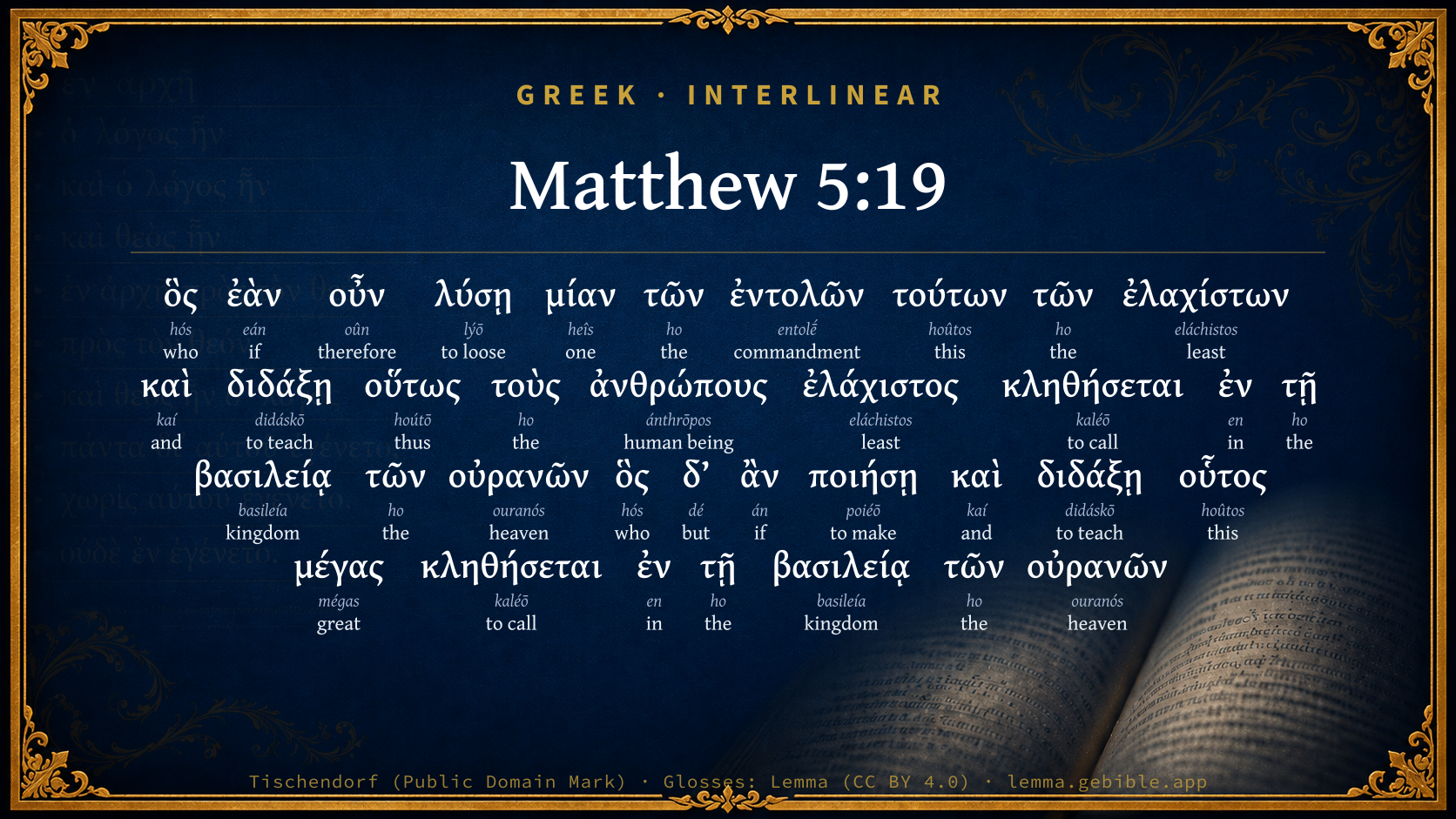
Greek (Tischendorf 8th ed.) Matthew 5:19 appears in the Greek New Testament. The text above is from the Tischendorf 8th edition. Each word links to its Strong’s number and a concise gloss. Click any word for its full Thayer’s Greek Lexicon entry.
Download image
Cite this verse

Matthew 5:19 (World English Bible). Public Domain. Lemma interlinear Bible study tool, https://lemma.gebible.app/v/matthew/5/19.

Show BibTeX & RIS
BibTeX
RIS
English Translation
Whoever, therefore, shall break one of these least commandments, and teach others to do so, shall be called least in the Kingdom of Heaven; but whoever shall do and teach them shall be called great in the Kingdom of Heaven.
World English Bible · Public Domain
Highlights
  • 2 first appearances in the Greek New Testament
Full analysis ↓
Download a study sheet

One document with this verse’s original text, its word-by-word gloss line, the meaning frame, cross-references with their text, attributed commentary, and full source and license credits — printable, and it pastes into notes with its structure intact.

This verse Autodidact and up

Study sheet (.html) Plain text (.txt)

A passage Seminary Student

Up to 50 verses in one chapter. A passage sheet keeps up to 6 commentary sources and 12 cross-references per verse, in the order this page ranks them, and says so on the sheet whenever that leaves anything out. Ask for a single verse and you get the Autodidact verse sheet above.

Everything on this page stays free to read, with no account — the sheet is a download of what is already on screen, not access to it.

Want to remove ads? Support Godless Engineer
Compare translations 3

The same verse in 3 English versions, stacked beneath the original-language interlinear above. Click any original word for its lexicon entry.

Each is an independent rendering of the whole verse — the interlinear is not word-aligned to these translations.

Highlighted words mark where these versions differ — a whole-verse word diff, not a word-by-word alignment.

  • World English Bible Public Domain
    Whoever, therefore, shall break one of these least commandments, and teach others to do so, shall be called least in the Kingdom of Heaven; but whoever shall do and teach them shall be called great in the Kingdom of Heaven.
  • King James Version Public Domain
    Whosoever therefore shall break one of these least commandments, and shall teach men so, he shall be called the least in the kingdom of heaven: but whosoever shall do and teach them, the same shall be called great in the kingdom of heaven.
  • unfoldingWord Literal Text CC BY-SA 4.0
    Therefore, whoever annuls one of the least of these commandments and teaches men to do so will be called least in the kingdom of the heavens. But whoever does and teaches, that one will be called great in the kingdom of the heavens.

unfoldingWord Literal Text — © unfoldingWord, licensed CC BY-SA 4.0. Word-aligned USFM3 via Door43 (git.door43.org/unfoldingWord/en_ult).

Versions to compare (up to 4)

3 of 4 selected

Show all 19 translations

Every available English version of this verse, each an independent rendering of the whole verse.

  • World English Bible Public Domain
    Whoever, therefore, shall break one of these least commandments, and teach others to do so, shall be called least in the Kingdom of Heaven; but whoever shall do and teach them shall be called great in the Kingdom of Heaven.
  • Berean Standard Bible Public Domain
    So then, whoever breaks one of the least of these commandments and teaches others to do likewise will be called least in the kingdom of heaven; but whoever practices and teaches them will be called great in the kingdom of heaven.
  • Majority Standard Bible Public Domain
    So then, whoever breaks one of the least of these commandments and teaches others to do likewise will be called least in the kingdom of heaven; but whoever practices and teaches them will be called great in the kingdom of heaven.
  • King James Version Public Domain
    Whosoever therefore shall break one of these least commandments, and shall teach men so, he shall be called the least in the kingdom of heaven: but whosoever shall do and teach them, the same shall be called great in the kingdom of heaven.
  • American Standard Version (1901) Public Domain
    Whosoever therefore shall break one of these least commandments, and shall teach men so, shall be called least in the kingdom of heaven: but whosoever shall do and teach them, he shall be called great in the kingdom of heaven.
  • Revised Version (1885) Public Domain
    Whosoever therefore shall break one of these least commandments, and shall teach men so, shall be called least in the kingdom of heaven: but whosoever shall do and teach them, he shall be called great in the kingdom of heaven.
  • Geneva Bible (1599) Public Domain
    Whosoeuer therefore shall breake one of these least commandements, and teach men so, he shall be called the least in the kingdome of heauen: but whosoeuer shall obserue and teach them, the same shall be called great in the kingdome of heauen.
  • Douay-Rheims (1899) Public Domain
    He therefore that shall break one of these least commandments, and shall so teach men, shall be called the least in the kingdom of heaven. But he that shall do and teach, he shall be called great in the kingdom of heaven.
  • Young's Literal Translation Public Domain
    `Whoever therefore may loose one of these commands -- the least -- and may teach men so, least he shall be called in the reign of the heavens, but whoever may do and may teach `them', he shall be called great in the reign of the heavens.
  • Literal Standard Version CC BY-SA 4.0
    Therefore whoever may loose one of these commands—the least—and may teach men so, he will be called least in the kingdom of the heavens, but whoever may do and may teach [them], he will be called great in the kingdom of the heavens.
  • Unlocked Literal Bible CC BY-SA 4.0
    Therefore whoever breaks the least one of these commandments and teaches others to do so will be called least in the kingdom of heaven. But whoever keeps them and teaches them will be called great in the kingdom of heaven.
  • unfoldingWord Literal Text CC BY-SA 4.0
    Therefore, whoever annuls one of the least of these commandments and teaches men to do so will be called least in the kingdom of the heavens. But whoever does and teaches, that one will be called great in the kingdom of the heavens.
  • Darby Bible Public Domain
    Whosoever then shall do away with one of these least commandments, and shall teach men so, shall be called least in the kingdom of the heavens; but whosoever shall practise and teach [them], *he* shall be called great in the kingdom of the heavens.
  • World Messianic Bible Public Domain
    Therefore, whoever shall break one of these least commandments and teach others to do so, shall be called least in the Kingdom of Heaven; but whoever shall do and teach them shall be called great in the Kingdom of Heaven.
  • Webster's Bible Public Domain
    Whoever therefore shall break one of these least commandments, and shall teach men so, he shall be called the least in the kingdom of heaven: but whoever shall do, and teach them, the same shall be called great in the kingdom of heaven.
  • Free Bible Version CC BY-SA 4.0
    So whoever disregards the least important commandment, and teaches people to do so, will be called the least in the kingdom of heaven; but whoever practices and teaches the commandments will be called great in the kingdom of heaven.
  • Bible in Basic English Public Domain
    Whoever then goes against the smallest of these laws, teaching men to do the same, will be named least in the kingdom of heaven; but he who keeps the laws, teaching others to keep them, will be named great in the kingdom of heaven.
  • Text-Critical English NT CC BY 4.0
    Therefore whoever does away with one of the least of these commandments and teaches others to do likewise will be called least in the kingdom of heaven, but whoever practices them and teaches them will be called great in the kingdom of heaven.
  • Tyndale New Testament (1534) Public Domain
    Whosoever breaketh one of these lest commaundmentes and teacheth men so he shalbe called the leest in the kyngdome of heven. But whosoever obserueth and teacheth the same shal be called greate in the kyngdome of heven.

Literal Standard Version (2020), Covenant Press — licensed CC BY-SA 4.0. Text via the HelloAO Bible API (eBible.org). Unlocked Literal Bible (unfoldingWord) — licensed CC BY-SA 4.0. Text via the HelloAO Bible API (eBible.org). unfoldingWord Literal Text — © unfoldingWord, licensed CC BY-SA 4.0. Word-aligned USFM3 via Door43 (git.door43.org/unfoldingWord/en_ult). Free Bible Version, Dr. Jonathan Gallagher — licensed CC BY-SA 4.0. Text via the HelloAO Bible API (eBible.org).

Word by word

More ways to search: Search by grammar → Find every occurrence → Compare this word →

Practice this passage: Drill this verse → Learn its vocabulary →

ἐλαχίστων
eláchistos
G1646
“least”
Adjective, Genitive, Plural, Feminine, Superlative
Part of Speech
Adjective
Case
Genitive
Number
Plural
Gender
Feminine
Degree
Superlative
Full Thayer's Definition

Origin: "superlative of elachus (short); used as equivalent to G3398 "

TDNT: 14:48,6

1. smallest least a. in size b. in amount: of management of affairs c. in importance: what is the least moment d. in authority: of commandments e. in the estimation of men: of persons f. in rank and excellence: of persons
  1. ὃς hós G3739 “who” Relative pronoun, Nominative, Singular, Masculine
  2. ἐὰν eán G1437 “if” Conditional
  3. οὖν oûn G3767 “therefore” Conjunction
  4. λύσῃ lýō G3089 “to loose” Verb, Aorist, Active, Subjunctive, 3rd person, Singular
  5. μίαν heîs G1520 “one” Adjective, Accusative, Singular, Feminine
  6. τῶν ho G3588 “the” Article, Genitive, Plural, Feminine
  7. ἐντολῶν entolḗ G1785 “commandment” Noun, Genitive, Plural, Feminine
  8. τούτων hoûtos G3778 “this” Demonstrative pronoun, Genitive, Plural, Feminine
  9. τῶν ho G3588 “the” Article, Genitive, Plural, Feminine
  10. καὶ kaí G2532 “and” Conjunction
  11. διδάξῃ didáskō G1321 “to teach” Verb, Aorist, Active, Subjunctive, 3rd person, Singular
  12. οὕτως hoútō G3779 “thus” Adverb
  13. τοὺς ho G3588 “the” Article, Accusative, Plural, Masculine
  14. ἀνθρώπους ánthrōpos G444 “human being” Noun, Accusative, Plural, Masculine
  15. ἐλάχιστος eláchistos G1646 “least” Adjective, Nominative, Singular, Masculine, Superlative
  16. κληθήσεται kaléō G2564 “to call” Verb, Future, Passive, Indicative, 3rd person, Singular
  17. ἐν en G1722 “in” Preposition
  18. τῇ ho G3588 “the” Article, Dative, Singular, Feminine
  19. βασιλείᾳ basileía G932 “kingdom” Noun, Dative, Singular, Feminine
  20. τῶν ho G3588 “the” Article, Genitive, Plural, Masculine
  21. οὐρανῶν ouranós G3772 “heaven” Noun, Genitive, Plural, Masculine
  22. ὃς hós G3739 “who” Relative pronoun, Nominative, Singular, Masculine
  23. δ’ dé G1161 “but” Conjunction
  24. ἂν án G302 “if” Particle
  25. ποιήσῃ poiéō G4160 “to make” Verb, Aorist, Active, Subjunctive, 3rd person, Singular
  26. καὶ kaí G2532 “and” Conjunction
  27. διδάξῃ didáskō G1321 “to teach” Verb, Aorist, Active, Subjunctive, 3rd person, Singular
  28. οὗτος hoûtos G3778 “this” Demonstrative pronoun, Nominative, Singular, Masculine
  29. μέγας mégas G3173 “great” Adjective, Nominative, Singular, Masculine
  30. κληθήσεται kaléō G2564 “to call” Verb, Future, Passive, Indicative, 3rd person, Singular
  31. ἐν en G1722 “in” Preposition
  32. τῇ ho G3588 “the” Article, Dative, Singular, Feminine
  33. βασιλείᾳ basileía G932 “kingdom” Noun, Dative, Singular, Feminine
  34. τῶν ho G3588 “the” Article, Genitive, Plural, Masculine
  35. οὐρανῶν ouranós G3772 “heaven” Noun, Genitive, Plural, Masculine

About this verse

These counts appear in no published source. They are computed here, from the morphology-tagged text and Lemma’s own curated glosses. What Lemma adds →

36
words
21
distinct lemmas
Gospels
section

Notable vocabulary

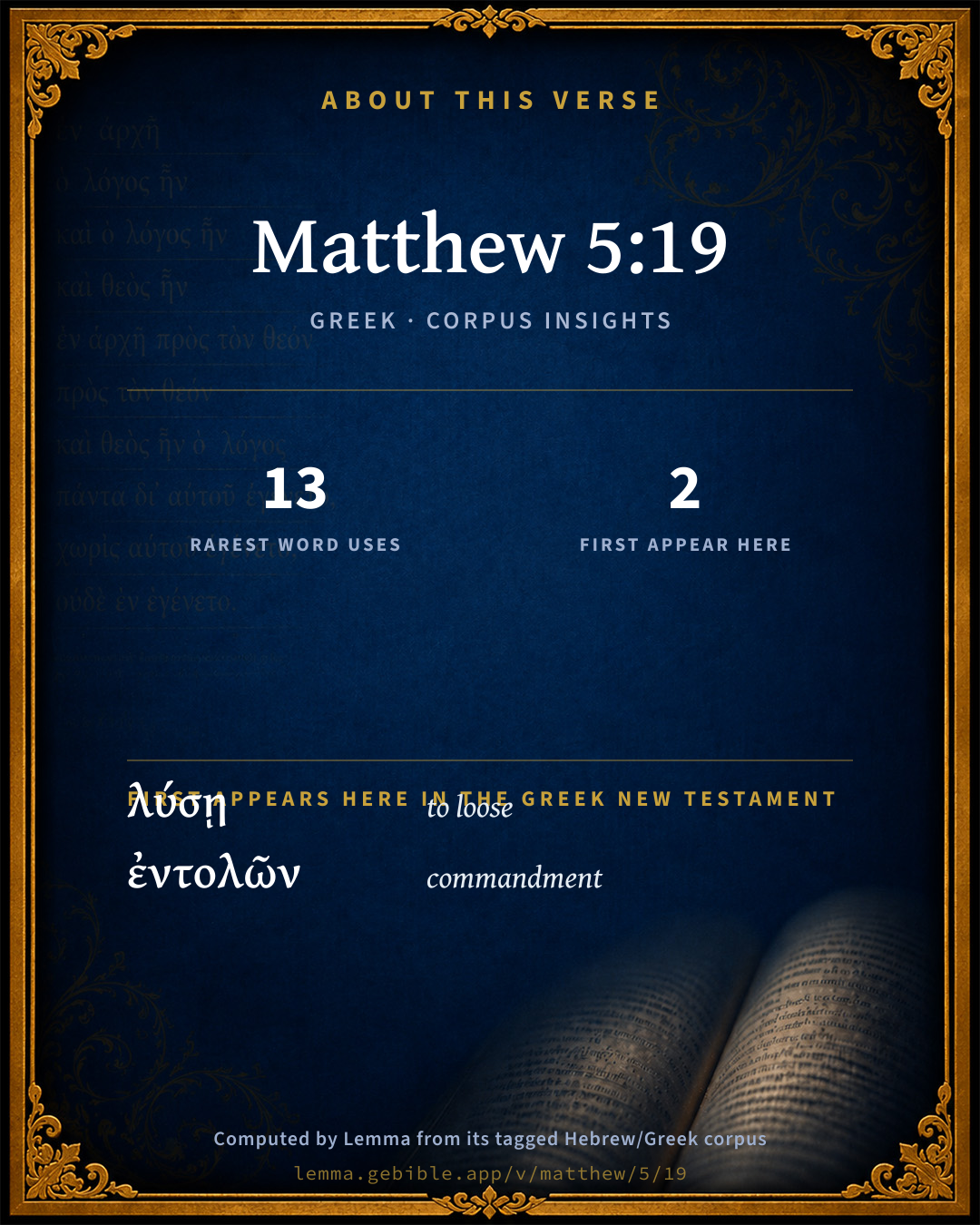
The rarest word here is ἐλαχίστων least G1646 — appearing just 13 times in the whole Greek New Testament.

First appearance in Scripture

These words make their first canonical appearance in the Greek New Testament here:

  • λύσῃ to loose G3089
  • ἐντολῶν commandment G1785

Shared distinctive vocabulary

ἐλαχίστων least G1646 occurs in 11 verses of the Greek New Testament. Also found in:
Repetition

Words recur within this verse:

  • ἐλαχίστων least G1646 ×2
  • διδάξῃ to teach G1321 ×2
  • κληθήσεται to call G2564 ×2
  • βασιλείᾳ kingdom G932 ×2
  • οὐρανῶν heaven G3772 ×2
  • τῶν the G3588 ×7
  • ὃς who G3739 ×2
  • τούτων this G3778 ×2
  • καὶ and G2532 ×2
  • ἐν in G1722 ×2

Cross-references

37

Topical passages linked to Matthew 5:19 in the Treasury of Scripture Knowledge — connected by theme and wording, ordered by reader-vote popularity; previews shown in the World English Bible.

  • Deuteronomy 12:32 Whatever thing I command you, that shall you observe to do: you shall not add thereto, nor diminish from it.
  • James 2:10–11 For whoever shall keep the whole law, and yet stumble in one point, he has become guilty of all.
  • Matthew 28:20 teaching them to observe all things that I commanded you. Behold, I am with you always, even to the end of the age." Amen.
  • Romans 13:8–10 Owe no one anything, except to love one another; for he who loves his neighbor has fulfilled the law.
  • Matthew 11:11 Most assuredly I tell you, among those who are born of women there has not arisen anyone greater than John the Baptizer; yet he who is least in the Kingdom of Heaven is greater than he.
  • 1 Timothy 6:3–4 If anyone teaches a different doctrine, and doesn't consent to sound words, the words of our Lord Jesus Christ, and to the doctrine which is according to godliness,
  • Daniel 12:3 Those who are wise shall shine as the brightness of the expanse; and those who turn many to righteousness as the stars forever and ever.
  • Psalms 119:6 Then I wouldn't be disappointed, When I consider all of your commandments.
  • Psalms 119:128 Therefore I consider all of your precepts to be right. I hate every false way.
  • Galatians 5:14–24 For the whole law is fulfilled in one word, in this: "You shall love your neighbor as yourself."
  • 1 Thessalonians 4:1–7 Finally then, brothers, we beg and exhort you in the Lord Jesus, that as you received from us how you ought to walk and to please God, that you abound more and more.
  • 1 Timothy 4:11–12 Command and teach these things.
  • Deuteronomy 27:26 Cursed be he who doesn't confirm the words of this law to do them. All the people shall say, Amen.
  • Matthew 15:3–6 He answered them, "Why do you also disobey the commandment of God because of your tradition?
  • Titus 3:8 This saying is faithful, and concerning these things I desire that you affirm confidently, so that those who have believed God may be careful to maintain good works. These things are good and profitable to men;
  • Revelation 2:20 But I have this against you, that you tolerate your woman, Jezebel, who calls herself a prophetess. She teaches and seduces my servants to commit sexual immorality, and to eat things sacrificed to idols.
  • Matthew 19:28 Jesus said to them, "Most assuredly I tell you that you who have followed me, in the regeneration when the Son of Man will sit on the throne of his glory, you also will sit on twelve thrones, judging the twelve tribes of Israel.
  • Romans 6:1 What shall we say then? Shall we continue in sin, that grace may abound?
  • Romans 6:15 What then? Shall we sin, because we are not under law, but under grace? May it never be!
  • Galatians 3:10–13 For as many as are of the works of the law are under a curse. For it is written, "Cursed is everyone who doesn't continue in all things that are written in the book of the law, to do them."
  • Philippians 4:8–9 Finally, brothers, whatever things are true, whatever things are honorable, whatever things are just, whatever things are pure, whatever things are lovely, whatever things are of good report; if there is any virtue, and if there is any praise, think about these things.
  • 1 Timothy 6:11 But you, man of God, flee these things, and follow after righteousness, godliness, faith, love, patience, and gentleness.
  • Titus 2:8–10 and soundness of speech that can't be condemned; that he who opposes you may be ashamed, having no evil thing to say about us.
  • Revelation 2:14–15 But I have a few things against you, because you have there some who hold the teaching of Balaam, who taught Balak to throw a stumbling block before the children of Israel, to eat things sacrificed to idols, and to commit sexual immorality.
  • 1 Samuel 2:30 Therefore Yahweh, the God of Israel, says, I said indeed that your house, and the house of your father, should walk before me forever: but now Yahweh says, Be it far from me; for those who honor me I will honor, and those who despise me shall be lightly esteemed.
  • Luke 11:42 But woe to you Pharisees! For you tithe mint and rue and every herb, but you bypass justice and the love of God. You ought to have done these, and not to have left the other undone.
  • Malachi 2:8–9 But you have turned aside out of the way. You have caused many to stumble in the law. You have corrupted the covenant of Levi," says Yahweh of Hosts.
  • Matthew 20:26 It shall not be so among you, but whoever desires to become great among you shall be your servant.
  • Luke 1:15 For he will be great in the sight of the Lord, and he will drink no wine nor strong drink. He will be filled with the Holy Spirit, even from his mother's womb.
  • Luke 22:24–26 There arose also a contention among them, which of them was considered to be greatest.
  • Acts 1:1 The first book I wrote, Theophilus, concerned all that Jesus began both to do and to teach,
  • Romans 3:8 Why not (as we are slanderously reported, and as some affirm that we say), "Let us do evil, that good may come?" Those who say so are justly condemned.
  • Philippians 3:17–18 Brothers, be imitators together of me, and note those who walk this way, even as you have us for an example.
  • 1 Peter 5:4 When the chief Shepherd is revealed, you will receive the crown of glory that doesn't fade away.
  • Matthew 23:16–23 "Woe to you, you blind guides, who say, 'Whoever swears by the temple, it is nothing; but whoever swears by the gold of the temple, he is obligated.'
  • Luke 9:48 and said to them, "Whoever receives this little child in my name receives me. Whoever receives me receives him who sent me. For whoever is least among you all, this one will be great."
  • 1 Thessalonians 2:10–12 You are witnesses with God, how holy, righteously, and blamelessly we behaved ourselves toward you who believe.

Cross-references courtesy of OpenBible.info (CC BY 4.0).

Commentary

Notes on Matthew 5:19 from classic Christian and Jewish commentators (each source and its license shown beneath its notes). The classic Christian expositions comment on the surrounding passage and are grouped to its opening verse, so a note may address several verses; the Jewish commentaries on the Tanakh (Rashi and others) are per-verse, so they appear only where the commentator wrote on this verse.

Lemma curates 59 commentaries, every one of them public domain or Creative Commons licensed, each selected and text-cleaned for this edition rather than reprinted as found. About our sources →

The Biblical Illustrator

Joseph S. Exell

Mat_5:19

Break one of these least commandments.

The perilous harmfulness of little sins

Man is set free from the curse of the law, but not from its authority.

I. Let us consider these minor violations of the moral law as they are considered in relation to the lawgiver himself. The least commandment has the same authority as the greatest. Little sins will soon acquire all the gigantic proportions of the greatest. It is no paradox to say, that little sins are peculiarly offending in the sight of God, because they are little; in other words, because we run the risk of offending Him for what on our own showing we care very little about, and from which we only expect an insignificant return. It would aggravate the venality of a Judge that the bribe was so paltry. The least sin is aggravated by the small degree of temptation by which it is accompanied.

II. The awful danger of these little sins in regard to ourselves. Little sins leave men hardly conscious float they have broken Gods law; great sins stir up piercing thoughts. See the peril of little sins, as they are sure to draw greater ones after them. It is fools sport to play with firebrands. The multiplication of little sins show how we need the merit of an infinite atonement. (D. Moore, M. A.)

We learn

I. That all the law of God is binding on Christians (Jam_2:10).

II. That all the commands of God should be preached in their proper place by Christian ministers.

III. That they who pretend that there are any laws of God so small that they need not obey them, are unworthy of His kingdom.

IV. That true piety has respect to all the commands of God, and keeps them (Psa_119:64). (Dr. A. Barnes.)

I. Christ does not hereby authorise us to suppose any of His commandments to be little. The meaning is-anything contained under or included in them, though seemingly small to us; as anger, scornful speaking, and reviling is the sin of murder.

II. As little in it, as he accounts of them; that is nothing; they shall be excluded.

(1) Observe the danger of vacating Gods commands.

(2) In any respect.

(3) In any one instance. (Thomas Adam.)

A little sin indicative of a carnal disposition

That an act in itself inconsiderable, may indicate the existing state of feeling, as clearly as one that is more palpable. As the motion of a leaf shows the quarter from which the wind blows as certainly as the agitated branches of an oak, so you may gather any ones dislike, though he does not strike you, or abuse you, or attempt insidiously to destroy your reputation. Only let him receive you with coldness, and his disaffection is as indisputable as if it were manifest in angry assault … Is it not evident that the man who has brought himself to the perpetration of one fraud, has broken down the only security against the perpetration of a score, lie who can be the oppressor of a few, wants only the means to become the despot of an empire. (C. Williams.)

Avoid the least sin

If we would save the big ship, let us stop the small leak. If we would save the palace from flames, let us put out the spark. (Newman Hall.)

The great evil and danger of little sins

I. What is meant by the least commandment. It must not be understood as if one commandment were less necessary to be obeyed than another; Gods commands are all alike necessary.

1. They are all enjoined by the same authority.

2. They are all necessary to be performed in order to eternal life. But when Christ speaks of the least commandment, He alludes

(1) to the corrupt doctrine of the Scribes distinguishing Gods commands into small and great.

(2) Those commandments which are great in respect of the Lawgiver, may yet be least in comparison with other commands of the same law, which are indeed thought greatest. This inequality arises from the inequality of the objects about which they are concerned, our duty to God or man. Sometimes it arises from the latitude that any command hath in it, to our thoughts, words, or actions; a thought is said to be less than an action.

II. What is meant by being least in the kingdom of heaven. Either the kingdom of grace, the Church, heaven. Little sins carry great guilt and bring heavy condemnation.

1. This appears in that the least sin is a most high affront and provocation of the great God.

2. It is a violation of a holy and strict law.

3. What a complicated evil every sin is, that the commission of the least makes you guilty of the greatest.

4. The authority of the great God seems more to be despised by the commission of small sins than by the commission of great.

5. Little sins do greatly deface the image of God in the soul. In curious pictures, a little scratch is a great deformity.

6. Little sins have in them ordinarily of temptation, and therefore more of wilfulness.

7. Little sins do maintain the trade and course of sinning.

III. The evil and danger of little sins hath been made apparent: I shall add farther proofs of their aggravated guilt.

1. Little sins usually are the destroying sins.

2. Small sins-what they want in weight, usually make up in number. A ship may have a heavy burden of sands, as well as of millstones; and may be as soon sunk with them.

3. It is very difficult to convince men of the great evil and danger of little sins.

4. The allowance of the least sin is a certain sign of a rotten heart.

5. Little sins usually make way for the vilest.

(1) The devil, by his temptations, nurses up youngling sins, till they arrive at full stature.

(2) Natural corruption is of a growing nature.

6. Little sins are the greatest provocations; murder is a reproach to all; unbelief does not provoke public scandal.

7. Damnation for little sins will be most intolerable-here for such little sins!

IV. Application:

1. If little sins have so much danger, what shall we think of great impieties?

2. Then behold a fearful shipwreck of all the hopes of formalists.

3. What absolute need we stand in of Christ.

4. What cause we have to bemoan and humble ourselves before God.

5. Pray for a tender conscience.

6. Keep alive reverent thoughts of God.

7. Get a more thorough sense of the spirituality of the law. (Bp. Hopkins.)

Little sins accumulate

The devil cannot expect always to receive such returns of great and crying impieties: but yet, when he keeps the stock of corruption going, and drives on the trade of sinning by lesser sins, believe it, corruption will be on the thriving hand, and you may grow rich in guilt, and treasure up to yourselves wrath against the day of wrath, by adding those that you call little sins unto the heap. (Bp. Hopkins.)

Great advancement made in sin by little stages

If Satan prevails with us to go with him one step out of our way, we axe in danger to stop nowhere till we come to the height of all profaneness: he will make us take a second, and a third, and so to travel on to destruction; for each of these is but one step: the last step of sin is but one step, as well as the first; and if the devil prevail with us to take one step, why should he not prevail with us to take the last step as well as the first step, seeing it is but one? Your second sin no more exceeds your first, than your first doth your duty; and so of the rest. (Bp. Hopkins.)

Little sins are often united with great, which together sweep the soul to destruction

As you see in rivers, the natural course of them tends to the sea; but the tide, joining with them, makes the current run the swifter and the more forcibly: so is it with sin. Little sins are the natural stream of a mans life; that do of themselves tend hell-ward, and are of themselves enough to carry the soul down silently and calmly to destruction: but, when greater and grosser sins join with them, they make a violent tide, that hurries the soul away with a more swift and rampant motion down to hell, than little sins would or could do of themselves. (Bp. Hopkins.)

The need of a sensitive conscience

A tender conscience is like the apple of a mans eye: the least dust that gets into it afflicts it. (Bp. Hopkins.)

The Biblical Illustrator, edited by Joseph S. Exell (c. 1880s–1900s) — public domain. Text from a community e-Sword module.

Joseph Benson's Commentary

Mat 5:19. Whosoever therefore shall break — Shall himself transgress in his practice, or pervert and weaken by his doctrine, one of these least commandments, and teach men so — Shall direct or encourage men to do the same, or shall teach them, either by word or example, that the obligation of these commands is dissolved; he shall be called — Or, shall be accounted one of the least, and unworthiest members in the kingdom of heaven — Or, Church of the Messiah, and shall soon be entirely cut off from it, as unfit for so holy a society, and shall have no part in the church triumphant. “There is in the text a figure, which the rhetoricians call μειωσις, diminution, often elegantly used to convey a strong idea. Thus, Gal 5:21, They which do such things shall not inherit the kingdom of God, that is, shall be severely punished.” — Macknight. But whosoever shall do and teach them, &c. — Whosoever shall himself carefully practise these precepts of the law, and other parts of the divine word, and shall inculcate their universal obligation, shall be greatly rewarded.

Joseph Benson's Commentary on the Old and New Testaments (1811–1818) — public domain. Text from a community e-Sword module.

Tyndale Open Study Notes

Tyndale Open Resources

5:19 The realization of the law in Christ means that obedience to all of his commands (see 28:20) is the only acceptable response for his disciples. • Commandment refers to the Old Testament commands (5:18) as now fulfilled in Christ’s teaching (see 5:21-48). • the least in the Kingdom of Heaven: Jesus may mean that such an individual will enter the Kingdom, but only barely and with low status; alternatively, some Jewish evidence suggests that he is referring to damnation (cp. 8:12, where “those for whom the Kingdom was prepared” are eternally excluded).

Tyndale Open Study Notes — © Tyndale Open Resources, licensed CC BY-SA 4.0. Text via the HelloAO Bible API.

Bengel's Gnomon

Johann Albrecht Bengel

Mat 5:19. Αύσῃ, shall break) The antithetical word to this is ποιήσῃ, shall do, which occurs further on in this verse. The Scribes, who thought themselves “great,” were in the habit of breaking them. The same verb, λύω, occurs in Joh 7:23; Joh 10:35.—τούτων, of these) those, namely, which follow in Mat 5:22; Mat 5:28, etc.—τῶν ἐλαχίστων, of the least) These precepts, “Thou shalt not kill,” etc., are not essentially the least, for in them the whole law is contained. But they are so only inasmuch as, when rightly explained, they regulate even the most subtile affections and emotions of the soul, and the slightest movements of the tongue, and thus, when compared with other precepts, appear to men to be the least.—ἐλάχιστος, least) Referring to the preceding ἐλαχίστων. An instance of Ploce.[191] As we treat the Word of God, so does God treat us; see Joh 17:6; Joh 17:11; Rev 3:10. “A little” signifies “almost nothing,” whence “the least” comes to mean “none at all” (for they considered anger, for instance, as of no consequence whatever); cf. in Mat 5:20, “ye shall not enter.” ἐλάχιστος; has a different force in this passage from that which ὁ μικρότερος (the least) “in the kingdom of heaven” has in ch. Mat 11:11.—ἐν τῂ βασιλείᾳ τὼν οὐρανῶν, in the kingdom of heaven) which cannot endure the presence of the unrighteous.—ποιήσῃ καὶ διδάξῃ, shall do and teach) The same order of words occurs in Act 1:1.—ποιήσῃ, shall do them, sc. all; for it is not lawful to break or neglect even one of them.—οὗτος, this man, he) A pronoun used emphatically. Comp. with this use of οὗτος, ch. Mat 7:21 (Latin Version[192]); Luk 9:24; Joh 7:18.—μέγας, great) All the commandments are of great account to him, especially in their full compass[193] (see Mat 5:18); therefore he shall be called great.

[191] See Appendix. The same word employed twice: in the first instance, expressing the simple idea of the word itself; and in the second, an attribute of it.—ED.

[192] See Gnomon on Mat 7:21, and notes.—(I. B.) The Vulgate, referred to, thus renders the οὗτος, etc., which abc Hil. and Cypr. read, but which BZ omit, “Qui facit voluntatem patris, etc., ipse intrabit,” etc.—ED.

[193] “Præsertim in complexu suo,”—i.e. when considered with reference to all that they involve, as explained by our Lord in this discourse, v. 21, etc.—(I. B.)

Bengel's Gnomon of the New Testament — English translation (T&T Clark, Edinburgh, 1860) — public domain. Text from a community e-Sword module.

Meyer's Critical & Exegetical Commentary

Heinrich August Wilhelm Meyer

Mat_5:19. Conclusion from Mat_5:18. On ὃς ἐάν with the conjunctive of the aorist, denoting that which was probably to happen in the future (the contingent futurum exactum), see Winer, p. 287 f. [E. T. 385]; Kühner, II. 2, p. 929; ἐάν for ἄν, see Winer, p. 291 [E. T. 390].

λύσῃ] like καταλῦσαι, Mat_5:17;[403] Fritzsche and Arnoldi (after Castalio, Beza, Wolf, and others): transgressus fuerit, on account of the ποιήσῃ in the opposition; comp. also Ritschl, p. 40. But this ΠΟΙΉΣῌ partly forms a very appropriate antithesis to the ΛΎΣῌ in our sense, which, after ΚΑΤΑΛῦΣΑΙ in Mat_5:17, would be abandoned only from arbitrariness; partly there is by no means wanting between ΛΎΕΙΝ and ΔΙΔΆΣΚΕΙΝ an appropriate, i.e. a climactic, distinction (they shall declare it to be of no authority, and teach accordingly); partly it is not credible that Jesus should have declared that the transgressor of the law was ἐλάχιστον ἐν τῇ βας. τ. οὐρανῶν, see Mat_11:11. Doing (ποιήσῃ) and teaching (διδάξῃ) refer, as a matter of course, without it being necessary to supply any object besides the general word is (translated: whosoever shall have done and taught it), to that which is required in the smallest commandment, and that in the sense of the πλήρωσις, Mat_5:17.

ΤῶΝ ἘΝΤΟΛῶΝ ΤΟΎΤΩΝ ΤῶΝ ἘΛΑΧΊΣΤΩΝ] ΤΟΎΤΩΝ points back to what is designated by ἸῶΤΑ and ΚΕΡΑΊΑ in Mat_5:18, not forwards to Mat_5:22; Mat_5:28 (Bengel); ἘΛΑΧΊΣΤΩΝ refers, therefore, not to the Pharisaic distinctions between great and small commandments (see especially, Wetstein, p. 295 f.), but to what Jesus Himself had just designated as ἰῶτα and ΚΕΡΑΊΑ, those precepts which in reality are the least important. They stand, however, in accordance with the ΠΛΉΡΩΣΙς of the law, in essential organic connection with the ideal contents of the whole, and can therefore be so little regarded as having no authority, that rather he who does this (ΛΎΣῌ), and teaches others to act in this manner (ΔΙΔΆΞῌ), will obtain only one of the lowest places (one of the lowest grades of dignity and happiness) in the kingdom of the Messiah. He is not to be excluded (as Augustine, Luther, Calvin, Calovius, Wolf, Bengel, and others have misinterpreted the meaning of ἐλάχ. κληθ.), because his antinomianism is not a principle, not directed against the law as such, but only against individual precepts of the law, which in themselves are small, and whose importance as a whole he does not recognise.[404] Comp. 1Co_3:15.

Note the correlation of τῶν ἐλαχίστων … ἐλάχιστος … μέγας.

[403] Comp. on λύειν in the sense of abrogating, overturning of laws, Joh_7:23; Herod, iii. 82; Demosth. xxxi. 12. 186. 14. Ebrard (on Olshausen) erroneously explains it: the mechanical dissolution of a law into a multitude of casuistical and ritualistic precepts. The τούτων τῶν ἐλαχίστων should have prevented this view. Amongst Greek writers also the simple verb represents the compound that has preceded it; comp. on Rom_15:4.

[404] Ver. 19 stands in so essential a connection with the discourse, that the supposition of Olshausen, that Jesus had in view special acts of an antinomian tendency on the part of some of His disciples, appears just as unnecessary as it is arbitrary. Köstlin and Hilgenfeld find here a very distinct disapproval of the Apostle Paul and of the Paulinites, who break free from the law; nay, Paul, thinks Köstlin, was actually named by Jewish Christians the smallest (Eph_3:8), as he so names himself (1Co_15:9). A purely imaginary combination.

Meyer — Critical and Exegetical Commentary on the New Testament — English translation by Peter Christie, edited by Frederick Crombie (T&T Clark, 1880) — public domain. Text from a community e-Sword module.

Expositor's Greek Testament

ed. W. Robertson Nicoll

Mat 5:19 . ὃς ἐὰν οὖν λύσῃ , etc.: οὗν pointing to a natural inference from what goes before. Christ’s view being such as indicated, He must so judge of the setter aside of any laws however small. When a religious system has lasted long, and is wearing towards its decline and fall, there are always such men. The Baptist was in some respects such a man. He seems to have totally neglected the temple worship and sacred festivals. He shared the prophetic disgust at formalism. Note now what Christ’s judgment about such really is. A scribe or Pharisee would regard a breaker of even the least commandments as a miscreant. Jesus simply calls him the least in the Kingdom of Heaven. He takes for granted that he is an earnest man, with a passion for righteousness, which is the key to his iconoclastic conduct. He recognises him therefore as possessing real moral worth, but, in virtue of his impatient radical-reformer temper, not great, only little in the scale of true moral values, in spite of his earnestness in action and sincerity in teaching. John the Baptist was possibly in His mind, or some others not known to us from the Gospels. ὃς δʼ ἂν ποιήσῃ καὶ διδάξῃ , etc. We know now who is least: who is great? The man who does and teaches to do all the commands great and small; great not named but understood οὗτος μέγας . Jesus has in view O. T. saints, the piety reflected in the Psalter, where the great ethical laws and the precepts respecting ritual are both alike respected, and men in His own time living in their spirit. In such was a sweetness and graciousness, akin to the Kingdom as He conceived it, lacking in the character of the hot-headed law-breaker. The geniality of Jesus made Him value these sweet saintly souls.

The Expositor's Greek Testament, edited by W. Robertson Nicoll (1897–1910) — public domain. Text from a community e-Sword module.

Geneva Bible (1599)

Geneva Bible translators

He beginneth with the true expounding of the Law, and setteth it against the old (but yet false) glosses of the Scribes: So far is he from abolishing the least commandment of his Father.

He shall have no place in the Church.

Geneva Bible (1599) marginal notes — public domain. Text via Bolls.life.

Jamieson, Fausset & Brown

Robert Jamieson, A. R. Fausset & David Brown

Whosoever therefore shall break--rather, "dissolve," "annul," or make "invalid."

one of these least commandments--an expression equivalent to "one of the least of these commandments."

and shall teach men so--referring to the Pharisees and their teaching, as is plain from Mat 5:20, but of course embracing all similar schools and teaching in the Christian Church.

he shall be called the least in the kingdom of heaven--As the thing spoken of is not the practical breaking, or disobeying, of the law, but annulling or enervating its obligation by a vicious system of interpretation, and teaching others to do the same; so the thing threatened is not exclusion from heaven, and still less the lowest place in it, but a degraded and contemptuous position in the present stage of the kingdom of God. In other words, they shall be reduced by the retributive providence that overtakes them, to the same condition of dishonor to which, by their system and their teaching, they have brought down those eternal principles of God's law.

but whosoever shall do and teach them--whose principles and teaching go to exalt the authority and honor of God's law, in its lowest as well as highest requirements.

the same shall be called great in the kingdom of heaven--shall, by that providence which watches over the honor of God's moral administration, be raised to the same position of authority and honor to which they exalt the law.

Jamieson, Fausset & Brown — Commentary Critical and Explanatory on the Whole Bible (1871) — public domain (CC PDM 1.0). Text via the HelloAO Bible API.

Adam Clarke's Commentary

Verse 19. Whosoever - shall break one of these least commandments] The Pharisees were remarkable for making a distinction between weightier and lighter matters in the law, and between what has been called, in a corrupt part of the Christian Church, mortal and venial sins. See Clarke on Mt 22:36.

Whosoever shall break. What an awful consideration is this! He who, by his mode of acting, speaking, or explaining the words of God, sets the holy precept aside, or explains away its force and meaning, shall be called least - shall have no place in the kingdom of Christ here, nor in the kingdom of glory above. That this is the meaning of these words is evident enough from the following verse.

Adam Clarke's Commentary on the Bible (1810–1826) — public domain. Text from a community e-Sword/MySword module.

Ellicott's Commentary for English Readers

(19) Shall break one of these least commandments.—The words seem at first to imply that even the ceremonial law was to be binding in its full extent upon Christ’s disciples. The usage of the time, however, confined the word to the moral laws of God (as in Sir_32:23-24), and throughout the New Testament it is never used in any other sense, with the possible exception of Heb_7:5; Heb_7:16 (comp. especially Rom_13:9; 1Co_7:19). And the context, which proceeds at once to deal with moral laws and does not touch on ceremonial, is in accordance with this meaning. The “least commandments,” then, are those which seemed trivial, yet were really great—the control of thoughts, desires, words, as compared with the apparently greater commands that dealt with acts. The reference to “teaching” shows that our Lord was speaking to His disciples, as the future instructors of mankind, and the obvious import of His words is that they were to raise, not lower, the standard of righteousness which had been recognised previously.

Shall be called the least in the kingdom of heaven.—The consequence of tampering with the great laws of duty, or the least laws, which are practically great, is described in terms at once severe and gentle; gentle, because the sentence, where the guilt is not wilful, or is repented of, is not one of absolute exclusion from the kingdom; severe in so far as being the “least” in that kingdom, the object of pity or sorrow to others, involved a severe humiliation to those who aimed at being the highest. To that condemnation many in every age of the Church have been liable, the Anthiomian fanatic and the Jesuit casuist standing so far on the same footing.

Whosoever shall do and teach.—Here again the teaching work of the disciples is prominent. The combination is in this case even more significant than in the other. Not right doing only, still less right teaching only, but both together, made up the ideal of the preacher’s work.

Great.—Not “greatest.” The avoidance of the latter word, interpreted by the later teaching of 18:4, would seem to have been deliberate. Men might aim at a positive standard of the greatness of the true teacher and the true worker, but the conscious aim at being “greatest” was self-frustrating. That honour belonged to him only who was all unconscious that he had any claim to it.

A Bible Commentary for English Readers, edited by Charles John Ellicott (1878–1897) — public domain. Text from a community e-Sword module.

The Cambridge Bible for Schools and Colleges

gen. ed. J. J. S. Perowne

19. Again addressed to the Apostles as teachers. The union of doing and teaching is essential. It was the grave sin of the Pharisees that they taught without doing. See ch. Mat_23:2-3. This explains the for of next verse.

The Cambridge Bible for Schools and Colleges (gen. ed. J. J. S. Perowne; Cambridge University Press, 1878–1918) — public domain. Text from a community e-Sword module.

John Gill's Exposition

Whosoever therefore shall break one of these least commandments,.... Which are to be understood not of the beatitudes in the preceding verses, for these were not delivered by Christ under the form of commandments; nor of any of the peculiar commands of Christ under the Gospel dispensation; but of the precepts of the law, of which some were comparatively lesser than others; and might be said to be broke, loosed, or dissolved, as the word here used signifies, when men acted contrary to them.

And shall teach men so; not only teach them by their example to break the commandments, but by express orders: for however gross and absurd this may seem to be, that there should be any such teachers, and they should have any hearers, yet such there were among the Jews; and our Lord here manifestly strikes at them: for notwithstanding the great and excellent things they say of the law, yet they tell us, that the doctors of the sanhedrim had power to root anything out of the law; to loose or make void any of its commands, for a time, excepting in the case of idolatry; and so might any true prophet, or wise man; which they pretend is sometimes necessary for the glory of God, and the good of men; and they are to be heard and obeyed, when they say, transgress anyone of all the commands which are in the law (h). Maimonides says (i), that the sanhedrim had power, when it was convenient, for the time present, to make void an affirmative command, and to transgress a negative one, in order to return many to their religion; or to deliver many of the Israelites from stumbling at other things, they may do whatsoever the present time makes necessary: for so, adds he, the former wise men say, a man may profane one sabbath, in order to keep many sabbaths. And elsewhere (k) he affirms,

"if a prophet, whom we know to be a prophet, should order us , "to transgress anyone of the commands", which are mentioned in the law, or many commands, whether light or heavy, for a time, we are ordered to hearken to him; and so we learn from the former wise men, by tradition, that in everything a prophet shall say to thee , "transgress the words of the law", as Elias on Mount Carmel, hear him, except in the case of idolatry.''

And another of their writers says (l),

"it is lawful sometimes to make void the law, and to do that which appears to be forbidden.''

Nay, they even (m) say, that if a Gentile should bid an Israelite transgress anyone of the commands mentioned in the law, excepting idolatry, adultery, and murder, he may transgress with impunity, provided it is done privately. You see what reason Christ had to express himself in the manner he does, and that with resentment, saying,

he shall be called, or be

the least in the kingdom of heaven; meaning either the church of God, where he shall have neither a name, nor place; he shall not be in the least esteemed, but shall be cast out as a worthless man; or the ultimate state of happiness and glory, in the other world, where he shall not enter, as is said in the next verse; but, on the other hand,

whosoever shall do and teach; whose doctrine and conversation, principles and practices agree together; who both teach obedience to the law, and perform it themselves: where again he glances at the masters in Israel, and tacitly reproves them who said, but did not; taught the people what they themselves did not practise; and so were unworthy of the honour, which he that both teaches and does shall have: for

the same shall be called great in the kingdom of heaven; he shall be highly esteemed of in the church here, and be honoured hereafter in the world to come. The Jews have a saying somewhat like this;

"he that lessens himself for the words of the law in this world, , "he shall become great" in the world to come (n),''

or days of the Messiah.

(h) T. Bab. Yebamot, fol. 79. 1. & 89. 2. & 90. 2. (i) Hilch. Memarim, c. 2. sect. 4. (k) Hilch. Yesode Hattorah, c. 9. sect. 3. (l) Bartenora in, Misn. Beracot, c. 9. sect. 5. (m) T. Hicros. Sheviith, fol. 35. 1. (n) T. Bab. Bava Metzia, fol. 85. 2.

John Gill's Exposition of the Whole Bible (1746–1763) — public domain (CC PDM 1.0). Text via the HelloAO Bible API.

Trapp's Complete Commentary

John Trapp

19 Whosoever therefore shall break one of these least commandments, and shall teach men so, he shall be called the least in the kingdom of heaven: but whosoever shall do and teach them, the same shall be called great in the kingdom of heaven.

Ver. 19. Whosoever therefore shall break one of these least commandments] So the Pharisees called and counted these weightier things of the law in comparison to their tithings, Mat 23:23, and traditions, Mat 15:3. They deemed it as great a sin to eat with unwashed hands as to commit fornication. Dicunt Iesuitae quaedam peccata adeo esse in se et per se levia, ut factores, nec sordidos, nec malos, nec impios, nec Deo exosos reddant. (Chemnitius.) But albeit some commandments are greater than some, as those of the first table (in meet comparison) than those of the second; yet that pharisaical diminution of commandments, that idle distinction of sins into gnats and camels, venial and mortal, motes and mountains, is by no means to be admitted. The least sin is contrary to charity, as the least drop of water is to fire. The least missing of the mark is an error as well as the greatest; and both alike for kind though not for degrees. חטאה αυαρτια, a missing of the mark, or swerving from the rule. Hence lesser sins are reproached by the name of the greater; malice is called murder; lustful looks, adultery; sitting at idolatrous feasts (though without all intent of worship), idolatry, 1Co 10:14. See Job 31:27-28. Disobedience in never so small a matter (as eating a forbidden apple, gathering a few sticks on the sabbath day, looking into or touching the ark) hath been severely punished. Though the matter seem small, yet thy malice and presumption is great, that wilt in so small a thing incur the Lord’s so high displeasure. What could be a less commandment than to abstain from blood? Yet is their obedience herein urged with many words, and that with this reason, as ever they will have God to do anything for them or theirs, Deu 12:22. The whole law is (say the schoolmen) but one copulative. Any condition not observed forfeits the whole lease; and any commandment not obeyed subjects a man to the curse, Deu 27:26; Gal 3:10. And so some one good action hath blessedness ascribed and assured to it, as peacemaking, Mat 5:9; so he that shall "keep the whole law and yet offend in one point, is guilty of all," Jas 2:10. When some of the Israelites had broken the fourth commandment, God challengeth them for all, Exo 16:28. Where, then, will they appear that plead for this Zoar, for that Rimmon?-a merry lie, a petty oath, an idle errand on the Lord’s day, &c. Sick bodies love to be gratified with some little bit that favoureth the disease. But meddle not with the murdering morsels of sin; there will be bitterness in the end. Jonathan had no sooner tasted of the honey with the tip of his rod only, but his head was forfeited. There is a deceitfulness in sin, a lie in these vanities, Heb 3:13; Joh 2:23; "give them an inch, they’ll take an ell." Let the serpent but get in his head, he will shortly wind in his whole body. He plays no small game, but meaneth us much hurt, how modest soever he seemeth to be. It is no less than the kingdom that he seeketh, by his maidenly insinuations, as Adonijah. As therefore we must submit to God, so we must resist the devil, without expostulation, 1Pe 5:7-9; throw water on the fire of temptation, though but to some smaller sin, and stamp on it too. "Behold how great a matter a little fire kindleth," saith St James. {Jas 3:5} A little poison in a cup, a little leak in a ship, or breach in a wall, may ruin all. A little wound at the heart and a little sin in the soul may hide God’s face from us, as a cloud, Lam 3:44. Therefore as the prophet, when a cloud as big as a man’s hand only appeared, knew that the whole heaven would be overly covered, and willed the king to betake himself to his chariot; so let us to our shelter, for a company comes, as she said, when she bore her son Gad. After Jonathan and his armourbearer came the whole host; and when Delilah had prevailed, came the lords of the Philistines. He that is fallen from the top of a ladder cannot stop at the second round. Every sin hardeneth the heart, and gradually disposeth it to greater offences; as lesser wedges make way for bigger. After Ahaz had made his wicked altar and offered on it, he brought it into the temple; first setting it on the brazen altar, afterwards bringing it into the house, and then, lastly, setting it on the north side of God’s altar, 2Ki 16:12-14. Withstand sin therefore at first, and live by Solomon’s rule, "Give not water passage, no, not a little." Silence sin as our Saviour did the devil, and suffer it not to solicit thee. If it be importunate, answer it not a word, as Hezekiah would not Rabshakeh; or give it a short and sharp answer, yea, the blue eye that St Paul did (υπωπαιζω), 1Co 9:27. Lividum reddo corpus meum. (Aug.) This shall be "no grief unto thee hereafter, nor offence of heart," as she told David; the contrary may, 1Sa 25:31. It repented St Austin of his very excuses made to his parents, being a child, and to his schoolmaster, being a boy. He retracts his ironies, because they had the appearance of a lie, because they looked ill-favouredly. (Confess. i. 19; Retract. i. 1.) Bishop Ridley repents of his playing at chess, as wasting too much time. Bradford bewaileth his dulness and unthankfulness. (Acts and Mon.) David’s heart smote him for cutting the lap of Saul’s coat only; and that for none other intent than to clear his own innocence; that in which Saul commended him for his moderation. There are some that would shrink up sin into a narrow scantling, and bring it to this, if they could, that none do evil but they that are in jails. But David approves his sincerity by his respect to all God’s comandments, and hath this commendation, that he did all the wills of God (θεληματα), Psa 18:21-22 Act 13:36. Solomon also bids "count nothing little that God commandeth, but keep God’s precepts as the sight of the eye," Pro 7:2. Those venturous spirits, that dare live in any known sin, aspire not to immortality, Php 2:12; they shall be least, that is, nothing at all, in the kingdom of heaven.

And teacheth men so] As the Pharisees did, and all the old and modern heresiarchs. In the year 1559 it was maintained by one David George (that arch-heretic) that good works were pernicious and destructory to the soul. Prodiit paradoxon, quod bona opera sint perniciosa ad salutem. (Bucholc. Ind. Chron.) The Anabaptists and Socinians have broached many doctrines of devils, not fit to be once named among Christians. The Pneumatomachi of old set forth a base book of the Trinity, under St Cyprian’s name, and sold it at a very cheap rate, that the poorest might be able to reach it and read it, as Ruffinus complaineth. In those primitive times, those capital heresies (concerning the Trinity and Christ’s incarnation) were so generally held, that it was a witty thing then to be a right believer, as Erasmus phraseth it, Ingeniosa res fuit, esse Christianum. All the world, in a manner, was turned Arian, as St Jerome hath it, Ingemuit orbis, et miratus est se factum esse. (Arianum.) Orosius telleth us that the Goths, being desirous to be instructed in the Christian religion, requested of Valens the emperor to send them some to preach the faith unto them. He being himself an Arian, sent them Arian doctors, who set up that heresy among them. By the just judgment of God, therefore, the same Valens being overthrown in the battle by the Goths, was also burnt by them in a poor cottage, whither he had fled for shelter. Iusto itaque Dei iudicio Valens a Gothis crematus est, quorum ille animis pestiferum errorum virus in fuderat. (Tertullian.) Heretics have an art of Pythanology, whereby they cunningly insinuate into men’s affections, and many times persuade before they teach, as it is said of the Valentinians. It was therefore well and wisely done of Placilla the empress, when her husband Theodosius, senior, desired to confer with Eunomius, she earnestly dissuaded him; lest being perverted by his speeches, he might fall into his heresy. (Sozom. vii. 6, 7.)

Shall be least in the kingdom of heaven] That is, nothing at all there; as Mat 20:16. Either of these two sins here mentioned exclude out of heaven; how much more both? If single sinners that break God’s commandments, and no more, shall be damned, those that teach men so shall be doubly damned: if God will be avenged on the former seven-fold, surely he will on the latter seventy-fold seven-fold. When the beast and the kings of the earth and their armies shall be gathered together (toward the end of the world) to make war against Christ, the multitude shall be slain with the sword, the poor seduced people that were carried along, many of them (as those two hundred that followed Absalom out of Jerusalem) in the simplicity of their hearts, and understood not the matter, shall have an easier judgment, 2Sa 15:11. But the beast was taken, and the false prophet, and were both cast alive (not slain with the sword, and so cast to the infernal vultures to be devoured by them as a prey; but cast alive), that they may feel those most exquisite pains, into a lake of fire burning with brimstone, Rev 19:20-21, wherewith they are encompassed, as fish cast into a pond are with water. {a}

But whosoever shall do, and teach them] First do, and thereby prove what that good, holy, and acceptable will of God is, Rom 12:2; and then teach others what himself hath felt and found good by experience. Come, and I will tell you what God hath done for my soul. "Come, children, hearken unto me, I will teach you the fear of the Lord. I will instruct thee and teach thee in the way which thou shalt go: I will guide thee with mine eye. I will teach transgressors thy ways, and sinners shall be converted unto thee," Psa 66:16; Psa 34:11; Psa 51:13. Charity is no churl, Psa 32:8; but cries, I would to God that all that hear me this day were as I am. Andrew calleth Simon; and Philip, Nathanael; the Samaritaness, her neighbours; and those good souls, one another, Hos 6:1. The love of Christ constrained the apostles, 2Co 5:11; they could not but speak the things they had heard and felt; as little as the holy Virgin could conceal the joy she had conceived upon the conception of God her Saviour. They could not but be as busy in building staircases for heaven as these Pharisees were in digging descents to hell. Blind guides they were of the blind, and both fell into the ditch, but the guides fell undermost. By corrupt teachers Satan catcheth men, as a cunning fisher by one fish catcheth another, that he may feed upon both. Here they corrupted the law by their false glosses, as our Saviour sets forth. But where they kept Moses’ chair warm, sat close and said sooth; all that they bid you observe, that observe and do, saith he, Mat 23:2-3; for a bad man may cry a good commodity, and a stinking breath sound a trumpet with great commendation. Balaam, Satan’s boggey man, may be (for the time) Christ’s spokesman, and preach profitably to others, though himself be a castaway, 1Co 9:27; as water, when it hath cleansed other things, is cast into the sink. Hear such therefore, saith our Saviour, but do not after their works, for they say and do not; they speak by the talent, but work by the ounce; their tongues are larger than their hands; their lives give the lie to their lips; {b} they shun the way themselves (with that priest and Levite) which they showed to others, when mercy should be showed to the wounded man. Out of their own mouths therefore will God condemn them; and it is a fearful thing to fall into the punishing hands of the living God. As for those burning and shining lights, that have Urim and Thummim, bells and pomegranates, trumpets of sound doctrine in one hand and lamps of good life in the other, as Gideon’s soldiers; they shall be great in the kingdom of heaven. He that holdeth them in his right hand here, Rev 1:20, shall set them at his right hand hereafter, and give them to hear, as Ezekiel did, the noise "of a great rushing, saying, Blessed be the glory of the Lord," Eze 3:12.

{a} Dirissimum exitii genus quo hiatu prae reliquis devovebuntur. Parcus.

{b} Odi homines ignava opera, philosophia, sententia. Ennius. Συναδοντων μεν τοις εργοις αποδεκτεον, διαφωνουντων δε λογους υποληπτεον. Arist.

John Trapp, A Commentary or Exposition upon All the Books of the Old and New Testament (1647–1656) — public domain. Text from a community e-Sword module.

Albert Barnes' Notes on the Bible

Whosoever therefore shall break - Shall violate or disobey.

One of these least commandments - The Pharisees, it is probable, divided the precepts of the law into lesser and greater, teaching that they who violated the former were guilty of a trivial offence only. See Mat 23:23. Christ teaches that in his kingdom they who make this distinction, or who taught that any laws of God might be violated with impunity, should be called least; while they should be held in high regard who observed all the laws of God without distinction.

Shall be called least - That is, shall be least. See Mat 5:9. The meaning of this passage seems to be this: in the kingdom of heaven, that is, in the kingdom of the Messiah, or in the church which he is about to establish (see the notes at Mat 3:2), he that breaks the least of these commandments shall be in no esteem, or shall not be regarded as a proper religious teacher. The Pharisees, by dividing the law into greater and lesser precepts, made no small part of it void by their traditions and divisions, Mat 23:23; Mat 15:3-6. Jesus says that in his kingdom all this vain division and tradition would cease. Such divisions and distinctions would be a small matter. He that attempted it should be the least of all. People would be engaged in yielding obedience to all the law of God without any such vain distinctions.

Shall be called great - He that teaches that all the law of God is binding, and that the whole of it should be obeyed, without attempting to specify what is most important, shall be a teacher worthy of his office, and shall be called great. Hence, we learn:

1.That all the law of God is binding on Christians. Compare Jam 2:10.

2.That all the commands of God should be preached, in their proper place, by Christian ministers.

3.That they who pretend that there are any laws of God so small that they need not obey them, are unworthy of his kingdom. And,

4.That true piety has respect to all the commandments of God. Compare Psa 119:6.

Albert Barnes' Notes on the Bible (1834–1885) — public domain. Text from a community e-Sword/MySword module.

Haydock's Catholic Bible Commentary

He shall be called; i.e. (by a frequent Hebrew idiom) he shall be the least in the kingdom of heaven; that is, according to St. Augustine he shall not be there at all; for none but the great in sanctity and virtue shall find admittance into heaven. (Witham) --- Do not then imitate the Scribes and Pharisees, who content themselves with instructing other in the precepts of the law, without practising them themselves, or if they observe the letter, neglect the spirit of the law, performing what it ordain, not to please God, but to satisfy their vanity. (Calmet)

George Leo Haydock (1774–1849), Haydock's Catholic Family Bible and Commentary, 1859 edition — public domain. Excludes Psalms (Douay-Rheims chapter numbering differs from Protestant) and Deuterocanonical books (Catholic canon only).

Matthew Poole's English Annotations

Whosoever shall in his practice violate but one of the commandments of God, which the Pharisees judge of the least, and which possible are so compared with others, and shall teach men that they may do as he doth, making such false interpretations of the law as may warrant such a practice, he shall be accounted of the least value and esteem in the church of God, and shall never come into the kingdom of glory: but he who shall strictly and uniformly obey all the commandments, and teach others to do the like by his doctrine and example, that man shall have a great renown and reputation in the church, which is the kingdom of heaven upon earth, and shall have a great reward in the kingdom of glory hereafter.

Matthew Poole's English Annotations on the Holy Bible (1683–1685) — public domain. Text from a community e-Sword/MySword module.

Whedon's Commentary on the Bible

Daniel D. Whedon

19. Whosoever — Our Lord farther shows his reverence for the law by guarding its least requirement with highest penalties. These least commandments — Contained in the Old Testament. Teach men so — As many of you may have feared that I or my disciples were about to do, in the new kingdom. Our Lord therefore is here laying down principles affecting the teachers whom he is to send forth. Shall teach men so — If to violate, with purpose, a known law of God is a dangerous sin, how much deeper the danger of teaching others to sin! Least — Many of the best commentators understand this as signifying that he shall be excluded. Yet such, surely, is not its exact meaning. Clearly to be least IN the kingdom of heaven is far less than shall in no case enter into the kingdom of heaven. Our Lord’s phrase here is adopted by him for the purpose of the antithesis — the violator of the least shall himself be least. Such mercy is shown to the case of erring man, in whom mistake may mingle in the interpretation of God’s laws, even when he would be a wise teacher, that our Lord uses a sentence which may imply, and yet does not absolutely express, exclusion. Such a man’s reward is terribly cut down; he is scarce if at all saved. Nothing but a state of repentance for all sin, known or unknown, can avail him. Great — The true observer and teacher of the law in its completeness shall be a star of brightest lustre in the firmament of heaven. Our Lord here clearly illustrates the truth of different degrees of future reward.

Daniel D. Whedon (gen. ed.), Commentary on the Old and New Testaments (1874–1909) — public domain. Text from a community e-Sword module.

The Pulpit Commentary

Matthew only. As Christ honoured the Law (ver. 17) so are his disciples to honour it. Whosoever therefore. Seeing that every part of the Law is of permanent value. In this verse our Lord once for all declares his opposition to antinomianism. Every one of the commands in the Law is, in its true and ideal meaning, still binding. Shall break (lush). Not merely in contrast to "do" (poihsh vide infra) in the sense of "transgress" (Fritzsche), but "abrogate". (cf. Bishop Westcott, on Joh_5:18, "Not the violation of the sanctity of the day in a special case, but the abrogation of the duty of observance;" cf. also Mat_16:19 Mat_18:18 1Jn_3:8) It expresses, indeed, a less complete abrogation than katalusai (ver. 17), because, while speaking of himself, the Lord could use the strongest word possible, and that with reference to the whole Law or the Prophets; but here his expression is limited by the inability of any individual disciple to carry out an abrogation even of one command. One of these least commandments. Not necessarily such as the Pharisees reckoned least, in their enumeration of small and great, but such as our Lord himself symbolized by "jot" or "tittle;" those precepts which in reality are the least important (Meyer). Chrysostom strangely says that our Lord here refers, not to old laws, but to those which he was about to lay down; similarly Bengel thinks of vers. 22-28, etc. While the Jews distinguished carefully between small and great precepts, they insisted on the importance of keeping even the smallest; cf. "Ab.," 4:5 (Taylor), "Hasten to a slight precept.., for the reward of precept is precept." And shall teach men so. Doing his best to abrogate it, not only in his own person by neglect or violation, but also for others by teaching them to disregard it. He shall be called the least. The Revised Version omits "he, .... the." He is not cast out of the kingdom ("Ubi nisi magni esse non possunt," Augustine), but his want of moral insight (did he consider it "breadth of thought"?) leads to his being called least in the kingdom. It is the converse of the parable in Luk_19:17, etc. There faithfulness in a very little (elacistw) wins much; here disregard of a very little causes a person to be reckoned (ver. 9, note) as very little the principle of judgment being that of Luk_16:10, "He that is faithful in a very little is faithful also in much; and he that is unrighteous in avery little is unrighteous also in much." In the kingdom of heaven; i.e. probably in its full and final establishment. The doctrine of grades of blessedness and of punishment hereafter is clearly taught in Scripture. (e.g. Luk_12:47, Luk_12:48) But whosoever shall do and teach them. Similarly the Revised Version; but rather supply "it," i.e. "that which is required in the smallest commandment" (Meyer). The personal performance and conscious spreading of one of the least commandments will be found to involve so much that it gains for the person a high position. Do and teach. For many will perform a command without taking any conscious part in spreading it. The same; Revised Version, he (outov). Why inserted here and not in the previous clause? Partly because of the awkwardness of inserting outov there so soon after outwv ; partly because our Lord wished to lay stress there on the recompense, here on the person ("he and no other") who receives recompense. On the thought, cf. "Test. XII Parr." (Levi., "If he teach these things and practise them, he shall share the throne of the king, as also Joseph our brother." It is worth adding Tyndale"s remark in his "Exposition," "Whosoever shall first fulfil them these least commandments following himself, and then teach other, and set all his study to the furtherance and maintaining of them, that doctor shall all they of the kingdom of heaven have in price, and follow him and seek him out, as doth an eagle her prey, and cleave to him as burrs."

The Pulpit Commentary (1880–1919), ed. H.D.M. Spence-Jones & Joseph S. Exell — public domain. Text from a community e-Sword module.

John Wesley's Explanatory Notes

One of the least - So accounted by men; and shall teach - Either by word or example; shall be the least - That is, shall have no part therein.

John Wesley, Explanatory Notes Upon the Whole Bible (1754–1765) — public domain. Text via the GEBible commentary corpus.

Kretzmann's Popular Commentary

Paul E. Kretzmann

In the meantime all men should know:

v. 19. Whosoever therefore shall break one of these least commandments, and shall teach men so, he shall be called the least in the kingdom of heaven; but whosoever shall do and teach them, the same shall be called great in the kingdom of heaven.

Here is a conclusion. Since the above is Christ’s view, He is bound to take His stand with reference to the transgressors of that rule. He that dissolves, abrogates, sets aside even those commandments that seem small and of little import, he that disregards as much as one of the little horns or hooks, whose presence or absence may, indeed, change the meaning of an entire passage, falls under Christ’s sentence of condemnation, he is declared to be the least in the kingdom of heaven. The sincerity of his convictions will not be accepted as an excuse, and his fault will only be made greater by his extending the false opinion he holds by means of teaching. He shall be called the least, he shall be rejected in this kingdom, he shall be excluded from its glories. On the other hand, he that teaches in entire conformity with the Old Testament, that preaches not only the Gospel, but the Law in its great purpose of preparing the hearts, that keeps silence with regard to nothing, that does not add thereto nor take therefrom, he shall have a great name in the kingdom of heaven, he shall receive the reward of faithfulness. For this teaching is essential in educating men as to the true righteousness of life, in holding up before the Christians a proper rule of conduct.

Paul E. Kretzmann, Popular Commentary of the Bible (1921–1924) — public domain. Text from a community e-Sword module.

Burkitt's Expository Notes on the New Testament

William Burkitt

To evidence yet farther, that the moral law is a perfect rule of life, our Saviour tells his disciples, that if any of them did either by their doctrine or practice, make void any one of the least of God’s commands, either by allowing themselves in the omission of any kmown duty, or in the commission of any known din, they shall never enter into the kingdom of God.

Learn, That such a professor of Christianity as allows himself in the least voluntary transgression, either of omission or commission, and encourages other by his example to do the like, is certainly in a state of damnation.

William Burkitt's Expository Notes on the New Testament (1700–1703) — public domain. Text from a community e-Sword module.

The People's New Testament

B. W. Johnson

19. Shall break one of the least of these. The Pharisees taught that some commands were more important than others, and that it was a trivial matter to break the smallest commands. The papists still divide sin into mortal and venial. Christ shows that the spirit of obedience does not seek to make such distinction. Shall be least. He may get into the kingdom, possibly, but such a spirit will give him a very low spiritual rank.

B. W. Johnson's The People's New Testament with Notes (1889–1891) — public domain. Electronic text from the Christian Classics Ethereal Library (CCEL) ThML edition.

unfoldingWord translationNotes

Door43 World Missions Community

whoever breaks

"whoever disobeys" or "whoever ignores"

the least one of these commandments

"any of these commandments, even the least important one"

whoever ... teaches others to do so will be called

This can be stated in active form. AT: "if anyone ... teaches others to do so, God will call that person" (See: Active or Passive)

least in the kingdom of heaven

The phrase "kingdom of heaven" refers to God's rule as king. This phrase is found only in Matthew. If possible use "heaven" in your translation. AT: "the least important in his heavenly kingdom" or "the least important under the rule of our God in heaven" (See: Metonymy)

keeps them and teaches them

"obeys all these commandments and teaches others to do the same"

great

most important

For I say to you

This adds emphasis to what Jesus says next.

you ... your ... you

These are plural. (See: Forms of You)

that unless your righteousness exceeds ... Pharisees, you will in no way enter

This can be stated in a positive form. AT: "that your righteousness must exceed ... Pharisees in order to enter" (See: Double Negatives)

translationWords

command

kingdom of God

righteous

scribe

Pharisee

unfoldingWord translationNotes — © Distant Shores Media and the Door43 World Missions Community, licensed CC BY-SA 4.0. Source: git.door43.org/Door43/en_tn.

Cambridge Greek Testament for Schools and Colleges

19. λύσῃ … διδάξῃ. Recall in this connection St Paul’s attitude in relation to the law. διδάσκειν points to the Presbyter or Teacher, λύσῃ, a more general term, to the people.

ποιήσῃ καὶ διδάξῃ. Again addressed to the Apostles as teachers. The union of doing and teaching is essential. It was the grave sin of the Pharisees that they taught without doing. See ch. Mat 23:2-3. This explains the for of next verse.

Cambridge Greek Testament for Schools and Colleges (Cambridge University Press, 1896; 21 vols, various authors incl. Carr, Maclear, Plummer, Farrar, Lumby, Moule, M. R. James, Simcox) — public domain. Text from a community e-Sword module.

Alford’s Greek Testament

Henry Alford

19.] There is little difficulty in this verse, if we consider it in connexion with the verse preceding, to which it is bound by the οὖν and the τούτων, and with the following, to which the γάρ unites it. Bearing this in mind, we see (1) that λύσῃ, on account of what follows in ver. 20 and after, must be taken in the higher sense, as referring to the spirit and not the letter: whosoever shall break (have broken), in the sense presently to be laid down. (2) That τῶν ἐντ. τούτ. τῶν ἐλ. refers to ἰῶτα ἓν ἢ μία κεραία above, and means one of those minute commands which seem as insignificant, in comparison with the greater, as the ἰῶτα and κεραία in comparison with great portions of writing. (3) That ἐλάχιστος κληθ. does not mean ‘shall be excluded from,’ inasmuch as the question is not of keeping or not keeping the commandments of God in a legal sense, but of appreciating, and causing others to appreciate, the import and weight of even the most insignificant parts of God’s revelation of Himself to man; and rather therefore applies to teachers than to Christians in general, though to them also through the λύσῃ and ποιήσῃ. (4) That no deduction can be drawn from these words binding the Jewish law, or any part of it, as such, upon Christians. That this is so, is plainly shewn by what follows, where our Lord proceeds to pour upon the letter of the law the fuller light of the spirit of the Gospel: thus lifting and expanding (not destroying) every jot and tittle of that precursory dispensation into its full meaning in the life and practice of the Christian; who, by the indwelling of the divine Teacher, God’s Holy Spirit, is led into all truth and purity. (5) That these words of our Lord are decisive against such persons, whether ancient or modern, as would set aside the Old Testament as without significance, or inconsistent with the New. See the preceding note, and the Book of Common Prayer, Article vii.

ἐλάχιστος is in direct allusion to ἐλαχίστων; but it can hardly be said (De Wette, Tholuck) that, because there is no article, it means ‘one of the least’ (ein geringster), for the article is often omitted after an appellative verb. μέγας rests on different grounds; being positive, and in its nature generic. See ch. 11:11; 18:1-4.

On κληθήσεται, see note on ver. 9. Observe the conditional aorists, λύσῃ, ποιήσῃ, διδάξῃ, combined with the indic. fut. κληθήσεται,—and thus necessitating the keeping the times distinct. The time indicated by κληθήσεται is one when the λῦσαι, ποιῆσαι, διδάξαι, shall be things of the past—belonging to a course of responsibility over and done with.

Henry Alford, The Greek Testament (1849–1861) — public domain. Text from a community e-Sword module.

Lesson kit

Teaching starters — assembled from the data on this page, not authored interpretation. Every prompt links to the verse data it draws on. Edit before teaching.

Matthew, in the Gospels, opens this verse with 36 words (21 distinct Greek lemmas). Its most distinctive word is eláchistos (“least”). A historical commentator’s framing appears above. Read the whole chapter for the surrounding context.

Discussion questions

  1. What does “least” (eláchistos) contribute to the verse as a whole?
  2. 2 words make their first appearance in Scripture here. What does this debut establish?
  3. How does Matthew 2:6, which shares the word «least», read alongside this verse?
  4. What does the repetition of “least” (2× in this one verse) do in this verse?
  5. The translations on this page render this verse differently — a whole-verse word diff, not a word-by-word alignment. What might account for the different wordings?
  6. Compare how The Biblical Illustrator and Joseph Benson's Commentary read this verse. Where do they agree or differ?

Things to notice

  • 2 words make their first canonical appearance in Scripture here.
  • These translations choose different wording for 14 words in this verse.
  • “least” occurs 2× in this single verse.
  • 21 distinct Greek lemmas span 36 words in this verse.

Reading settings

Reading text

Shown beneath each verse's original-language words.

Old Testament
Old Testament edition

Read the OT as the Masoretic Hebrew (MT) or the Greek Septuagint (LXX).

English shown for the Greek Septuagint (in the Hebrew ↔ Greek comparison).

Comparing translations? Open the Compare panel on any verse page to stack up to four side by side.