
1 Samuel 2:10

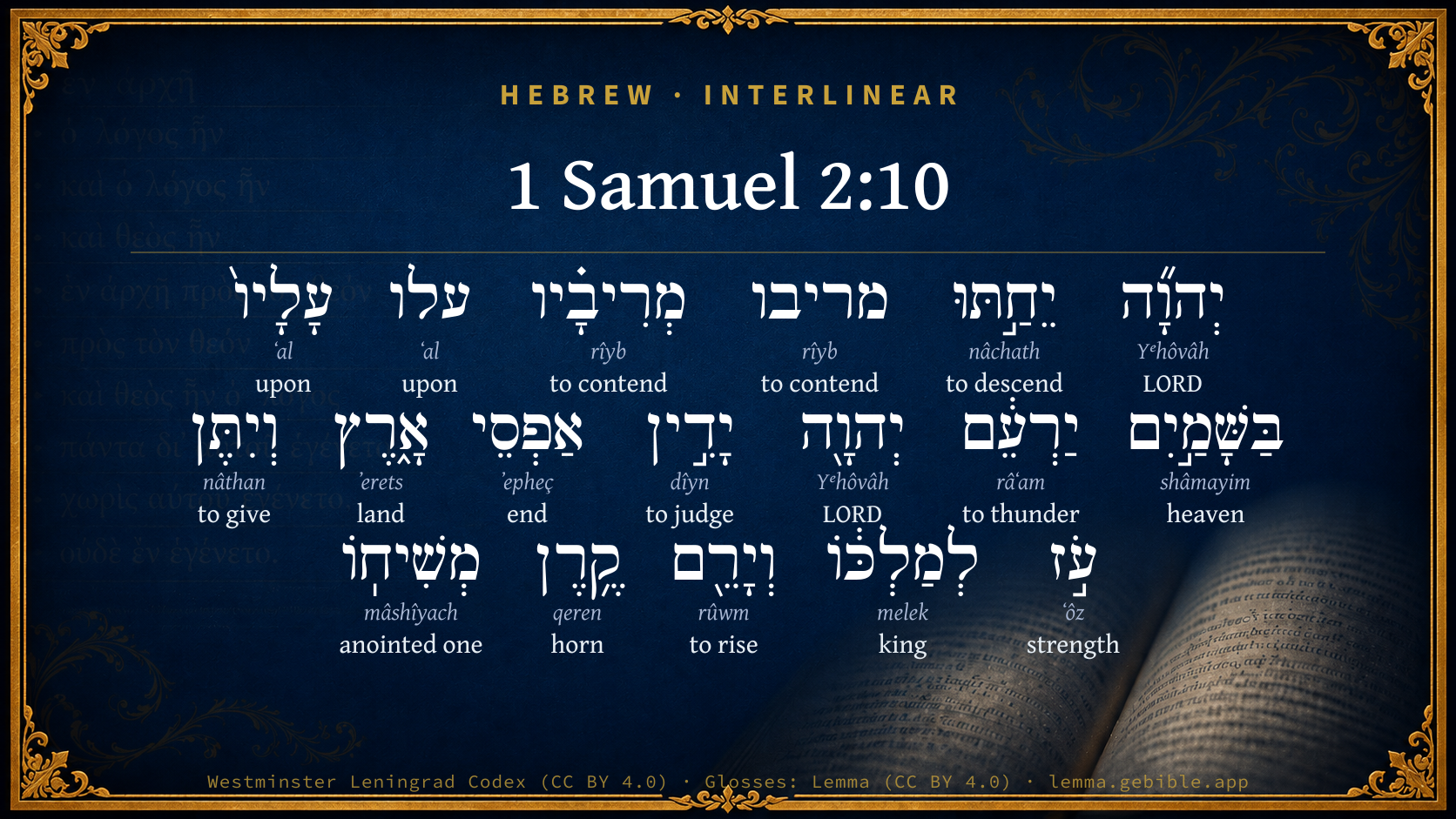
Hebrew (Westminster Leningrad Codex) 1 Samuel 2:10 appears in the Hebrew Old Testament. The text above is from the Westminster Leningrad Codex. Each word links to its Strong’s number, a concise gloss, and parsing drawn from the Open Scriptures Hebrew Bible morphology. Click any word for its full Brown-Driver-Briggs (BDB) entry.
Download image
Cite this verse

1 Samuel 2:10 (World English Bible). Public Domain. Lemma interlinear Bible study tool, https://lemma.gebible.app/v/1-samuel/2/10.

Show BibTeX & RIS
BibTeX
RIS
English Translation
Those who strive with Yahweh shall be broken to pieces; Against them will he thunder in the sky: Yahweh will judge the ends of the earth; He will give strength to his king, Exalt the horn of his anointed.
World English Bible · Public Domain
Highlights Full analysis ↓
Download a study sheet

One document with this verse’s original text, its word-by-word gloss line, the meaning frame, cross-references with their text, attributed commentary, and full source and license credits — printable, and it pastes into notes with its structure intact.

This verse Autodidact and up

Study sheet (.html) Plain text (.txt)

A passage Seminary Student

Up to 50 verses in one chapter. A passage sheet keeps up to 6 commentary sources and 12 cross-references per verse, in the order this page ranks them, and says so on the sheet whenever that leaves anything out. Ask for a single verse and you get the Autodidact verse sheet above.

Everything on this page stays free to read, with no account — the sheet is a download of what is already on screen, not access to it.

Want to remove ads? Support Godless Engineer
Compare translations 3

The same verse in 3 English versions, stacked beneath the original-language interlinear above. Click any original word for its lexicon entry.

Each is an independent rendering of the whole verse — the interlinear is not word-aligned to these translations.

Highlighted words mark where these versions differ — a whole-verse word diff, not a word-by-word alignment.

  • World English Bible Public Domain
    Those who strive with Yahweh shall be broken to pieces; Against them will he thunder in the sky: Yahweh will judge the ends of the earth; He will give strength to his king, Exalt the horn of his anointed.
  • King James Version Public Domain
    The adversaries of the LORD shall be broken to pieces; out of heaven shall he thunder upon them: the LORD shall judge the ends of the earth; and he shall give strength unto his king, and exalt the horn of his anointed.
  • unfoldingWord Literal Text CC BY-SA 4.0
    Yahweh, the ones opposing him will be shattered. He will make thunder against him in the heavens. Yahweh will judge the ends of the earth. And he will give strength to his king and lift up the horn of his anointed one.”

unfoldingWord Literal Text — © unfoldingWord, licensed CC BY-SA 4.0. Word-aligned USFM3 via Door43 (git.door43.org/unfoldingWord/en_ult).

Versions to compare (up to 4)

3 of 4 selected

Show all 18 translations

Every available English version of this verse, each an independent rendering of the whole verse.

  • World English Bible Public Domain
    Those who strive with Yahweh shall be broken to pieces; Against them will he thunder in the sky: Yahweh will judge the ends of the earth; He will give strength to his king, Exalt the horn of his anointed.
  • Berean Standard Bible Public Domain
    Those who oppose the LORD will be shattered. He will thunder from heaven against them. The LORD will judge the ends of the earth and will give power to His king. He will exalt the horn of His anointed.”
  • Majority Standard Bible Public Domain
    Those who oppose the LORD will be shattered. He will thunder from heaven against them. The LORD will judge the ends of the earth and will give power to His king. He will exalt the horn of His anointed.”
  • King James Version Public Domain
    The adversaries of the LORD shall be broken to pieces; out of heaven shall he thunder upon them: the LORD shall judge the ends of the earth; and he shall give strength unto his king, and exalt the horn of his anointed.
  • American Standard Version (1901) Public Domain
    They that strive with Jehovah shall be broken to pieces; Against them will he thunder in heaven: Jehovah will judge the ends of the earth; And he will give strength unto his king, And exalt the horn of his anointed.
  • Revised Version (1885) Public Domain
    They that strive with the LORD shall be broken to pieces; against them shall he thunder in heaven: the LORD shall judge the ends of the earth; and he shall give strength unto his king, and exalt the horn of his anointed.
  • Geneva Bible (1599) Public Domain
    The Lordes aduersaries shall be destroyed, and out of heauen shall he thunder vpon them: the Lord shall iudge the endes of the worlde, and shall giue power vnto his King, and exalt the horne of his Anoynted.
  • Douay-Rheims (1899) Public Domain
    The adversaries of the Lord shall fear him: and upon them shall he thunder in the heavens. The Lord shall judge the ends of the earth, and he shall give empire to his king, and shall exalt the horn of his Christ.
  • Young's Literal Translation Public Domain
    Jehovah -- broken down are His adversaries, Against them in the heavens He thundereth: Jehovah judgeth the ends of earth, And giveth strength to His king, And exalteth the horn of His anointed.'
  • Literal Standard Version CC BY-SA 4.0
    YHWH—His adversaries are broken down, || He thunders against them in the heavens: YHWH judges the ends of the earth, || And gives strength to His king, || And exalts the horn of His anointed.”
  • Unlocked Literal Bible CC BY-SA 4.0
    Those who oppose Yahweh will be broken to pieces; he will thunder against them from heaven. Yahweh will judge the ends of the earth; he will give strength to his king and exalt the horn of his anointed.”
  • unfoldingWord Literal Text CC BY-SA 4.0
    Yahweh, the ones opposing him will be shattered. He will make thunder against him in the heavens. Yahweh will judge the ends of the earth. And he will give strength to his king and lift up the horn of his anointed one.”
  • Darby Bible Public Domain
    They that strive with Jehovah shall be broken to pieces; in the heavens will he thunder upon them. Jehovah will judge the ends of the earth; and he will give strength unto his king, and exalt the horn of his anointed.
  • World Messianic Bible Public Domain
    Those who strive with the LORD shall be broken to pieces. He will thunder against them in the sky. “The LORD will judge the ends of the earth. He will give strength to his king, and exalt the horn of his anointed.”
  • Webster's Bible Public Domain
    The adversaries of the LORD shall be broken to pieces; out of heaven shall he thunder upon them: the LORD shall judge the ends of the earth; and he shall give strength to his king, and exalt the horn of his anointed.
  • Free Bible Version CC BY-SA 4.0
    The Lord crushes his enemies, he thunders against them from heaven. He rules the whole earth; he strengthens his king, and gives power to the one he has anointed.”
  • Bible in Basic English Public Domain
    Those who make war against the Lord will be broken; against them he will send his thunder from heaven: the Lord will be judge of the ends of the earth, he will give strength to his king, lifting up the horn of him on whom the holy oil has been put.
  • JPS Tanakh (1917) Public Domain
    They that strive with the LORD shall be broken to pieces; against them will He thunder in heaven; the LORD will judge the ends of the earth; and He will give strength unto His king, and exalt the horn of His anointed.

Literal Standard Version (2020), Covenant Press — licensed CC BY-SA 4.0. Text via the HelloAO Bible API (eBible.org). Unlocked Literal Bible (unfoldingWord) — licensed CC BY-SA 4.0. Text via the HelloAO Bible API (eBible.org). unfoldingWord Literal Text — © unfoldingWord, licensed CC BY-SA 4.0. Word-aligned USFM3 via Door43 (git.door43.org/unfoldingWord/en_ult). Free Bible Version, Dr. Jonathan Gallagher — licensed CC BY-SA 4.0. Text via the HelloAO Bible API (eBible.org).

Word by word

More ways to search: Search by grammar → Find every occurrence → Compare this word →

Practice this passage: Drill this verse → Learn its vocabulary →

יֵחַ֣תּוּ
nâchath
H5181
“to descend”
Verb, Niphal, Imperfect, 3rd Person, Masculine, Plural
Part of Speech
Verb
Stem
Niphal
Form
Imperfect
Person
3rd Person
Gender
Masculine
Number
Plural
Full BDB Definition

Origin: a primitive root

TWOT: 1351

to go down, descend - (Qal) - to go down, descend - to descend, descend into (chastisement) (figuratively) - (Niphal) to come down into, penetrate - (Piel) to cause to descend, press down, stretch (a bow) - (Hiphil) to bring down
  1. יְהוָ֞ה Yᵉhôvâh H3068 “LORD” Noun, Proper
  2. מריבו rîyb H7378 “contending · him” Verb, Hiphil, Participle Active, Masculine, Singular, Construct + Suffix, Personal, 3rd Person, Masculine, Singular
  3. מְרִיבָ֗יו rîyb H7378 “contending · him” Verb, Hiphil, Participle Active, Masculine, Plural, Construct + Suffix, Personal, 3rd Person, Masculine, Singular
  4. עלו ʻal H5921 “upon · him” Preposition + Suffix, Personal, 3rd Person, Masculine, Singular
  5. עָלָיו֙ ʻal H5921 “upon · him” Preposition + Suffix, Personal, 3rd Person, Masculine, Singular
  6. בַּשָּׁמַ֣יִם shâmayim H8064 “in/at the · heaven(s)” Preposition, Determined + Noun, Common, Masculine, Plural, Absolute
  7. יַרְעֵ֔ם râʻam H7481 “to thunder” Verb, Hiphil, Imperfect, 3rd Person, Masculine, Singular
  8. יְהוָ֖ה Yᵉhôvâh H3068 “LORD” Noun, Proper
  9. יָדִ֣ין dîyn H1777 “to judge” Verb, Qal, Imperfect, 3rd Person, Masculine, Singular
  10. אַפְסֵי ʼepheç H657 “ends of” Noun, Common, Masculine, Plural, Construct
  11. אָ֑רֶץ ʼerets H776 “land” Noun, Common, Both, Singular, Absolute
  12. וְיִתֶּן nâthan H5414 “and · to give” Conjunction + Verb, Qal, Imperfect, 3rd Person, Masculine, Singular
  13. עֹ֣ז ʻôz H5797 “strength” Noun, Common, Masculine, Singular, Absolute
  14. לְמַלְכּ֔וֹ melek H4428 “to/for · king · his” Preposition + Noun, Common, Masculine, Singular, Construct + Suffix, Personal, 3rd Person, Masculine, Singular
  15. וְיָרֵ֖ם rûwm H7311 “and · to rise” Conjunction + Verb, Hiphil, Imperfect, 3rd Person, Masculine, Singular
  16. קֶ֥רֶן qeren H7161 “horn of” Noun, Common, Both, Singular, Construct
  17. מְשִׁיחֽוֹ mâshîyach H4899 “anointed one · his” Noun, Common, Masculine, Singular, Construct + Suffix, Personal, 3rd Person, Masculine, Singular

About this verse

These counts appear in no published source. They are computed here, from the morphology-tagged text and Lemma’s own curated glosses. What Lemma adds →

18
words
15
distinct lemmas
Historical
section

Notable vocabulary

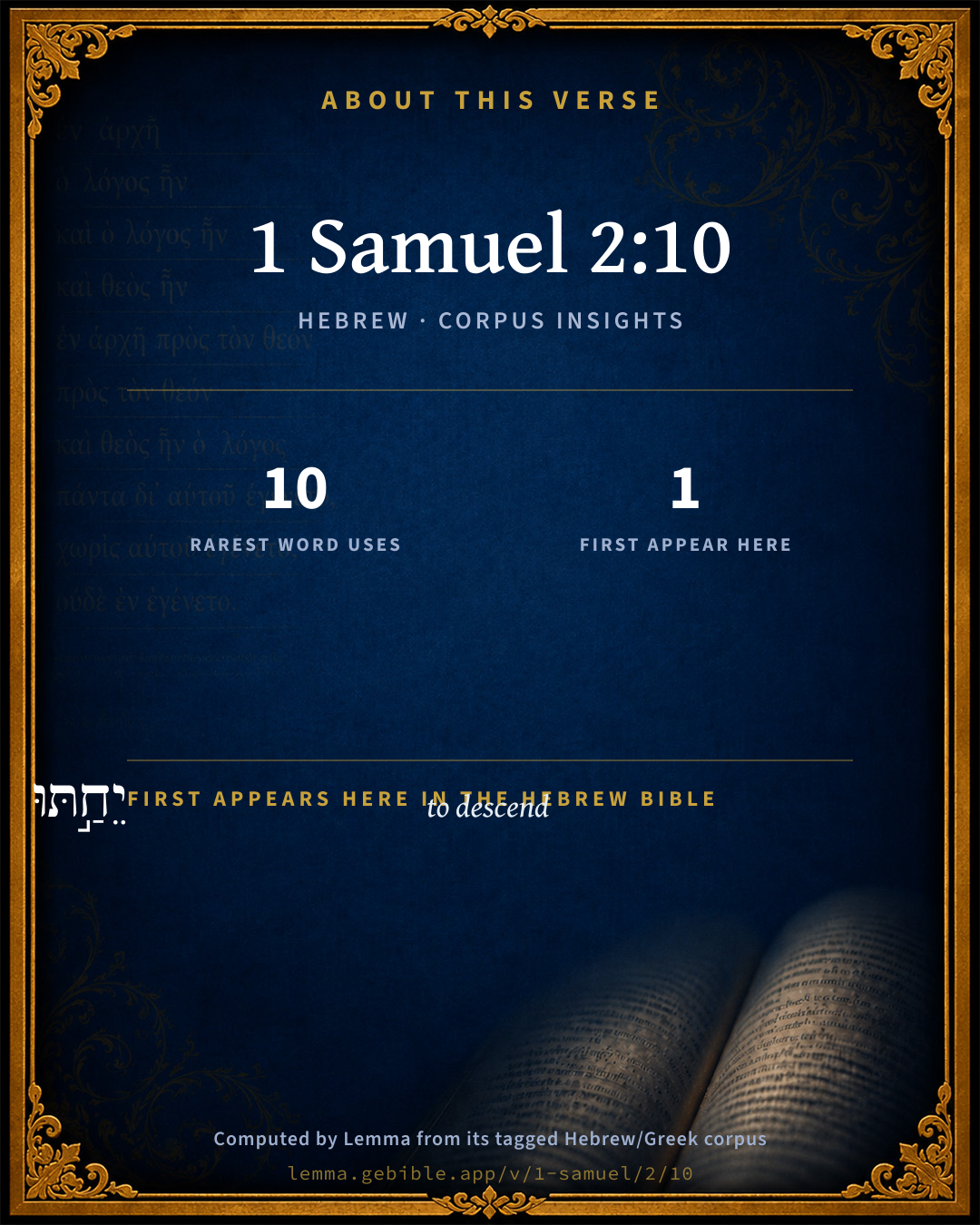
The rarest word here is יֵחַ֣תּוּ to descend H5181 — appearing just 10 times in the whole Hebrew Bible.

First appearance in Scripture

This word makes its first canonical appearance in the Hebrew Bible here:

  • יֵחַ֣תּוּ to descend H5181

Shared distinctive vocabulary

יֵחַ֣תּוּ to descend H5181 occurs in 9 verses of the Hebrew Bible. Also found in:

Grammatical profile

  • 7 verbs
  • 9 nouns
  • 2 prepositions

Verb forms

  • יֵחַ֣תּוּ Niphal · Imperfect
  • מריבו Hiphil · Participle Active
  • מְרִיבָ֗יו Hiphil · Participle Active
  • יַרְעֵ֔ם Hiphil · Imperfect
  • יָדִ֣ין Qal · Imperfect
  • וְיִתֶּן Qal · Imperfect
  • וְיָרֵ֖ם Hiphil · Imperfect

Repetition

Words recur within this verse — often emphatic in Hebrew:

  • יְהוָ֞ה LORD H3068 ×2
  • מריבו to contend H7378 ×2
  • עלו upon H5921 ×2

Hebrew & Septuagint length

In English translation the verse runs 39 words from the Hebrew and 106 from the Septuagint (LXX English) — the Septuagint runs noticeably longer here. See the side-by-side →

A rough comparison of the two English renderings, which tokenize alike — not a word-level alignment.

Word counts can differ between the Hebrew and the Greek without any difference in meaning — e.g. the Hebrew direct-object marker אֵת has no separate Greek word, and Greek often adds the article ὁ.

Cross-references

44

Topical passages linked to 1 Samuel 2:10 in the Treasury of Scripture Knowledge — connected by theme and wording, ordered by reader-vote popularity; previews shown in the World English Bible.

  • Psalms 2:9 You shall break them with a rod of iron. You shall dash them in pieces like a potter's vessel."
  • Psalms 89:24 But my faithfulness and my loving kindness will be with him. In my name, his horn will be exalted.
  • Exodus 15:6 Your right hand, Yahweh, is glorious in power, Your right hand, Yahweh, dashes the enemy in pieces.
  • Psalms 18:13–14 Yahweh also thundered in the sky, The Most High uttered his voice: Hailstones and coals of fire.
  • Psalms 96:13 Before Yahweh; for he comes, For he comes to judge the earth. He will judge the world with righteousness, The peoples with his truth.
  • 1 Samuel 7:10 As Samuel was offering up the burnt offering, the Philistines drew near to battle against Israel; but Yahweh thundered with a great thunder on that day on the Philistines, and confused them; and they were struck down before Israel.
  • Psalms 20:6 Now I know that Yahweh saves his anointed. He will answer him from his holy heaven, With the saving strength of his right hand.
  • Psalms 21:7–9 For the king trusts in Yahweh. Through the loving kindness of the Most High, he shall not be moved.
  • Psalms 92:9–10 For, behold, your enemies, Yahweh, For, behold, your enemies shall perish. All the evil-doers will be scattered.
  • Psalms 98:9 Let them sing before Yahweh, For he comes to judge the earth. He will judge the world with righteousness, And the peoples with equity.
  • Judges 5:31 So let all your enemies perish, Yahweh: But let those who love him be as the sun when he goes forth in his might. The land had rest forty years.
  • Psalms 2:2 The kings of the earth take a stand, And the rulers take counsel together, Against Yahweh, and against his anointed, saying,
  • Psalms 2:6 "Yet I have set my king on my holy hill of Zion."
  • Psalms 21:1 The king rejoices in your strength, Yahweh! How greatly he rejoices in your salvation!
  • Psalms 45:7 You have loved righteousness, and hated wickedness. Therefore God, your God, has anointed you with the oil of gladness above your fellows.
  • Psalms 50:1–6 The Mighty One, God, Yahweh, speaks, And calls the earth from sunrise to sunset.
  • Psalms 68:1–2 Let God arise! Let his enemies be scattered! Let them who hate him also flee before him.
  • Ecclesiastes 11:9 Rejoice, young man, in your youth, And let your heart cheer you in the days of your youth, And walk in the ways of your heart, And in the sight of your eyes; But know that for all these things God will bring you into judgment.
  • Matthew 25:31–32 "But when the Son of Man comes in his glory, and all the holy angels with him, then he will sit on the throne of his glory.
  • Matthew 28:18 Jesus came to them and spoke to them, saying, "All authority has been given to me in heaven and on earth.
  • 1 Samuel 12:3 Here I am: witness against me before Yahweh, and before his anointed: whose ox have I taken? or whose donkey have I taken? or whom have I defrauded? whom have I oppressed? or of whose hand have I taken a ransom to blind my eyes therewith? and I will restore it you.
  • 1 Samuel 12:18 So Samuel called to Yahweh; and Yahweh sent thunder and rain that day: and all the people greatly feared Yahweh and Samuel.
  • 1 Samuel 15:28 Samuel said to him, Yahweh has torn the kingdom of Israel from you this day, and has given it to a neighbor of yours who is better than you.
  • 1 Samuel 16:1 Yahweh said to Samuel, How long will you mourn for Saul, seeing I have rejected him from being king over Israel? fill your horn with oil, and go: I will send you to Jesse the Bethlehemite; for I have provided me a king among his sons.
  • 2 Samuel 7:8 Now therefore thus shall you tell my servant David, Thus says Yahweh of Hosts, I took you from the sheep pen, from following the sheep, that you should be prince over my people, over Israel;
  • 2 Samuel 7:13 He shall build a house for my name, and I will establish the throne of his kingdom forever.
  • Job 40:9 Or have you an arm like God? Can you thunder with a voice like him?
  • Psalms 28:8 Yahweh is their strength. He is a stronghold of salvation to his anointed.
  • Psalms 89:17 For you are the glory of their strength. In your favor, our horn will be exalted.
  • Psalms 148:14 He has lifted up the horn of his people, The praise of all his saints; Even of the children of Israel, a people near to him. Praise Yah!
  • Isaiah 32:1 Behold, a king shall reign in righteousness, and princes shall rule in justice.
  • Matthew 25:34 Then the King will tell those on his right hand, 'Come, blessed of my Father, inherit the Kingdom prepared for you from the foundation of the world;
  • Luke 1:69 And has raised up a horn of salvation for us in the house of his servant David
  • Acts 10:38 even Jesus of Nazareth, how God anointed him with the Holy Spirit and with power, who went about doing good and healing all who were oppressed by the devil, for God was with him.
  • Romans 14:10–12 But you, why do you judge your brother? Or you again, why do you despise your brother? For we will all stand before the judgment seat of Christ.
  • 2 Corinthians 5:10 For we must all be revealed before the judgment seat of Christ; that each one may receive the things in the body, according to what he has done, whether good or bad.
  • Revelation 20:11–15 I saw a great white throne, and him who sat on it, from whose face the earth and the heaven fled away. There was found no place for them.
  • Ecclesiastes 12:14 For God will bring every work into judgment, with every hidden thing, whether it is good, or whether it is evil.
  • Luke 19:27 But bring those enemies of mine who didn't want me to reign over them here, and kill them before me.'"
  • John 5:21–22 For as the Father raises the dead and gives them life, even so the Son also gives life to whom he desires.
  • 1 Samuel 12:13 Now therefore see the king whom you have chosen, and whom you have asked for: and, behold, Yahweh has set a king over you.
  • 2 Samuel 22:14 Yahweh thundered from heaven, The Most High uttered his voice.
  • Isaiah 45:24 Only in Yahweh, it is said of me, is righteousness and strength; even to him shall men come; and all those who were incensed against him shall be disappointed.
  • Acts 4:27 For truly, in this city against your holy servant, Jesus, whom you anointed, both Herod and Pontius Pilate, with the Gentiles and the people of Israel, were gathered together

Cross-references courtesy of OpenBible.info (CC BY 4.0).

Hebrew and Greek witnesses Masoretic Hebrew ↔ Greek Septuagint

The same verse in the two great witnesses to the Old Testament, shown verse-for-verse.

Here the Septuagint runs noticeably longer than the Hebrew — LXX2012 (modern English Septuagint) 106 words vs World English Bible 39. A rough length comparison of the two English translations, not a word-level alignment — read both below.

These are two independent witnesses, not word-aligned to each other, and the Septuagint is shown in lemma (dictionary) form.

Hebrew 1 Samuel 2:10 Masoretic · Westminster Leningrad Codex

יְהוָ֞ה יֵחַ֣תּוּ מריבו מְרִיבָ֗יו עלו עָלָיו֙ בַּשָּׁמַ֣יִם יַרְעֵ֔ם יְהוָ֖ה יָדִ֣ין אַפְסֵי אָ֑רֶץ וְיִתֶּן עֹ֣ז לְמַלְכּ֔וֹ וְיָרֵ֖ם קֶ֥רֶן מְשִׁיחֽוֹ

Those who strive with Yahweh shall be broken to pieces; Against them will he thunder in the sky: Yahweh will judge the ends of the earth; He will give strength to his king, Exalt the horn of his anointed.

World English Bible · Public Domain

Greek LXX 1 Samuel 2:10 Septuagint · lemma form

κύριος ἀσθενής ποιέω ἀντίδικος αὐτός κύριος ἅγιος μή καυχάομαι ὁ φρόνιμος ἐν ὁ φρόνησις αὐτός καί μή καυχάομαι ὁ δυνατός ἐν ὁ δύναμις αὐτός καί μή καυχάομαι ὁ πλούσιος ἐν ὁ πλοῦτος αὐτός ἀλλά ἤ ἐν οὗτος καυχάομαι ὁ καυχάομαι συνἵημι καί γιγνώσκω ὁ κύριος καί ποιέω κρίμα καί δικαιοσύνη ἐν μέσος ὁ γῆ κύριος ἀναβαίνω εἰς οὐρανός καί βροντάω αὐτός κρίνω ἄκρος γῆ καί δίδωμι ἰσχύς ὁ βασιλεύς ἐγώ καί ὑψόω κέρας χριστός αὐτός

The Lord will weaken his adversary; the Lord is holy. Let not the wise man boast in his wisdom, nor let the mighty man boast in his strength, and let not the rich man boast in his wealth; but let him that boasts boast in this, to understand and know the Lord, and to execute judgment and justice in the midst of the earth. The Lord has gone up to the heavens, and has thundered: he will judge the extremities of the earth, and he gives strength to our kings, and will exalt the horn of his Christ. And she left him there before the Lord,

LXX2012 (modern English Septuagint) · Public Domain

On this verse, Adam Clarke's Commentary discusses the Septuagint’s reading. Read the note in Commentary ↓

Hebrew: Westminster Leningrad Codex (CC BY 4.0). Greek: Septuagint (public domain); English from LXX2012 (modern English Septuagint) (Public Domain). How the Septuagint differs from the Hebrew →

Targum (Aramaic paraphrase)

1

The Targum is the ancient Jewish Aramaic paraphrase of the Hebrew Scriptures — an interpretive translation, not the Hebrew text itself. Onkelos (literal) and Pseudo-Jonathan (expansive) render the Torah, and Jonathan the Prophets. Coverage is partial: where no permissively-licensed English translation exists for a verse, only the Aramaic is shown. This is verse-level text, not a word-by-word alignment to the Hebrew.

  1. Targum Jonathan Prophets (Joshua–Malachi)
    יְיָ יִתַבַּר בַּעֲלֵי דְבָבָא דְקַיְמִין לְאַבְאָשָׁא לְעַמֵיהּ עֲלֵיהוֹן מִן שְׁמַיָא בְּקַל רָם יַשְׁקֵיף יְיָ יַעְבֵּיד פּוּרְעֲנוּת מִן מָגוֹג וּמִמַשִׁרְיַת עַמְמִין חֲטוּפִין דְאָתָן עִמֵיהּ מִסְיָפֵי אַרְעָא וְיִתֵּן תּוּקְפָא לְמַלְכֵּיהּ וִירַבֵּי מַלְכוּת מְשִׁיחֵיהּ:

    (no public-domain English translation for this verse)

    Targum Jonathan — Aramaic: “Mikraot Gedolot” (public domain). English: “Sefaria Community Translation” (CC0 1.0 (public-domain dedication)); “London "Chaldee Paraphrase," 1871” (public domain). Text via Sefaria.

Commentary

Notes on 1 Samuel 2:10 from classic Christian and Jewish commentators (each source and its license shown beneath its notes). The classic Christian expositions comment on the surrounding passage and are grouped to its opening verse, so a note may address several verses; the Jewish commentaries on the Tanakh (Rashi and others) are per-verse, so they appear only where the commentator wrote on this verse.

Lemma curates 59 commentaries, every one of them public domain or Creative Commons licensed, each selected and text-cleaned for this edition rather than reprinted as found. About our sources →

The Cambridge Bible for Schools and Colleges

gen. ed. J. J. S. Perowne

10. The adversaries of the Lord] Render,

Jehovah, they that strive with Him shall be broken to pieces:

against them in heaven let Him (or, He shall) thunder:

Jehovah shall judge the ends of the earth:

and may He (or, He shall) give strength unto His king,

and exalt the horn of His Anointed.

The conclusion of the hymn is partly a prayer for the destruction of Jehovah’s enemies, partly an expression of confidence that this will surely be effected. The mention of Jehovah’s judgments leads up naturally to the thought of those who are his instruments for executing them. Hannah’s prophetic prayer was but partially fulfilled in the king soon to be anointed by her son as the deliverer of Israel: it reaches forward to Him whom the Jewish kings foreshadowed, the King Messiah, in whom alone the lofty anticipations of the prophetess are to be completely realised.

shall be broken to pieces] The Sept. here inserts the greater part of Jer_9:23-24. The passage may nave been originally placed in the margin as an illustration, and afterwards incorporated in the text.

his anointed] Here first in connexion with the kingly office do we meet the word which was to become the characteristic title of the expected deliverer, the “Messiah” or “Anointed One,” “the Christ.” The Sept. renders “ὑψώσει κέρας χριστοῦ αὐτοῦ” (cp. Luk_2:26): the Vulgate “sublimabit cornu Christi sui.” See the notes on 1Sa_10:1 and 1Sa_12:3.

It has been alleged that the mention of the king stamps the song as of later date, posterior to the establishment of the monarchy. This is by no means the case. The idea of a king was not altogether novel to the Israelite mind. The promise to Abraham spoke of kings among his posterity (Gen_17:6): the Mosaic legislation prescribes the method of election and the duty of the king (Deu_17:14-20): Gideon had been invited to establish a hereditary monarchy (Jdg_8:22). Anointing too was recognised as the regular rite of admission to the office (Jdg_9:8). Amid the prevalent anarchy and growing disintegration of the nation, amid internal corruption and external attack, the desire for a king was probably taking definite shape in the popular mind. The prophet who came to Eli speaks again of “Jehovah’s anointed” (1Sa_2:35). But who so worthy to be first chosen to anticipate the future as the mother of him who was destined to guide the chosen nation through this critical epoch of its existence, and superintend the foundation of the Davidic-Messianic kingdom?

Chapters 1 and 2 to 1Sa_2:10 form the Haphtarah or lesson from the prophets, appointed to be read in the Jewish synagogues on the first day of the new year.

A translation of the Targum or Chaldee Paraphrase of Hannah’s Song is given in Note III. p. 236.

The Cambridge Bible for Schools and Colleges (gen. ed. J. J. S. Perowne; Cambridge University Press, 1878–1918) — public domain. Text from a community e-Sword module.

Trapp's Complete Commentary

John Trapp

1Sa 2:10 The adversaries of the LORD shall be broken to pieces; out of heaven shall he thunder upon them: the LORD shall judge the ends of the earth; and he shall give strength unto his king, and exalt the horn of his anointed.

Ver. 10. The adversaries of the Lord shall be broken to pieces.] "As a potter’s vessel." {Psa 2:9} Turk and Pope, both those Antichrists, shall be served on this sort, saith Peter Martyr.

Out of heaven shall he thunder upon them.] As he did soon after this prophecy upon the Philistines. {1Sa 7:10} The mightiest men quake before God, and as the worms when it thundereth, wriggle into their holes.

The Lord shall judge the ends of the earth.] The Lord Christ shall; who is here first of all in Scripture called Messiah, or the Anointed One, of whom David and Solomon were types; and in that sense may also be here understood.

John Trapp, A Commentary or Exposition upon All the Books of the Old and New Testament (1647–1656) — public domain. Text from a community e-Sword module.

Joseph Benson's Commentary

1Sa 2:10. The adversaries of the Lord shall be broken to pieces — Here we have an instance of pious affections rising up, through the influence of the Holy Spirit, to the height of prophecy. Here Hannah begins to predict the deliverance of the Israelites from the hand of the Philistines, and their other enemies: and her prediction was fulfilled when, at the command of Samuel, they were gathered together, and fought with the Philistines at Mizpeh, chap. 1Sa 7:10. At which time, as Hannah foretels, the Lord thundered out of heaven upon them; and again when David slew Goliath, and the men of Israel and Judah routed and pursued them, (1Sa 17:52,) as well as on many other occasions, till at length they were finally subdued. The Lord shall judge the ends of the earth — That Isaiah , 1 st, The Philistines, who lived in the extremity of Canaan westward; and, 2d, The enemies of God’s people in the remotest parts of the earth, who shall be converted or destroyed before the consummation of all things. He shall give strength unto his king — Here she predicts they should have a king. But she is chiefly to be understood as speaking, either, 1st, of David, who was most properly God’s king, appointed and anointed at his express command, instead of Saul, whom he rejected, on account of his disobedience; or, 2d, Of Christ, David’s son, of whom David was but a type. “Who doth not perceive,” saith St. Augustine, (De Civ. Dei, lib. 17, cap. 4,) “that the spirit which animated this woman, whose name, Hannah, signifies grace, prophesied of the Christian religion, the city of God, whose king and founder is Christ? Who does not see that she speaks of the grace of God, from which the proud are estranged that they may fall, but with which the humble are filled, that they may rise.” Thus also the preceding clause, The Lord shall judge the ends of the earth, obtains a more sublime and important sense, and more exact accomplishment. David’s victories and dominions reached far, but God will give to the son of David the uttermost parts of the earth for his possession. And he will give strength unto his king, for the accomplishment of his great undertaking. And, as the next words express, will exalt the horn — The power and honour, of his Anointed — Till he hath put all his enemies under his feet. It is remarkable, that this is the first time that the name Messiah (or God’s anointed) is found in the Scriptures, there being no such word in any of the preceding books. This is an additional reason why we should consider this prophecy of Hannah as looking forward to gospel days. “And when one considers,” as Dr. Dodd observes, “the terms in which this beautiful song is expressed; when one considers the perfect resemblance there is between this and that of the blessed Virgin, Luk 1:46; when one considers the allusion which the father of John the Baptist makes to the latter part of it, (Luk 1:69-70,) one cannot persuade one’s self but that Hannah had a respect to something higher than Peninnah her rival, or the triumphs even of David himself. The expressions are too magnificent and sublime to be confined to such objects. Kimchi (the Jewish rabbi) was so struck with them, that he ingenuously acknowledges, that the king, of whom Hannah speaks here, is the Messiah; of whom she speaks either by prophecy or tradition. ‘For,’ continues he, ‘there was a tradition among the Israelites, that a great king should arise in Israel; and she seals up her song with celebrating this king, who was to deliver them from all their enemies.’ In short, all the particulars of the 9th and 10th verses especially, perfectly characterize the reign of the Messiah; his protection of his saints; the vain efforts of their enemies; their triumph over them; the extent of his kingdom, and the perpetual increase of his power.”

Joseph Benson's Commentary on the Old and New Testaments (1811–1818) — public domain. Text from a community e-Sword module.

Tyndale Open Study Notes

Tyndale Open Resources

2:10 The king was to fulfill the descriptions of 2:4-9 by using his God-given power to care for the oppressed, the hungry, and the barren (see Ps 72:1-4, 12-14; Prov 31:8-9). • he increases the strength: See study note on 1 Sam 2:1. • anointed one (Hebrew mashiakh): This climax to Hannah’s prayer is prophetic both of Israel’s anointed kings and of God’s supreme Anointed King—the Messiah, Jesus Christ (see 12:3-5; 24:6, 10; Ps 132:17; Dan 9:25-26).

Tyndale Open Study Notes — © Tyndale Open Resources, licensed CC BY-SA 4.0. Text via the HelloAO Bible API.

Geneva Bible (1599)

Geneva Bible translators

She grounded her prayer on Jesus Christ which was to come.

Geneva Bible (1599) marginal notes — public domain. Text via Bolls.life.

Jamieson, Fausset & Brown

Robert Jamieson, A. R. Fausset & David Brown

the Lord shall judge the ends of the earth . . . exalt the horn of his anointed--This is the first place in Scripture where the word "anointed," or Messiah, occurs; and as there was no king in Israel at the time, it seems the best interpretation to refer it to Christ. There is, indeed, a remarkable resemblance between the song of Hannah and that of Mary (Luk 1:46).

Jamieson, Fausset & Brown — Commentary Critical and Explanatory on the Whole Bible (1871) — public domain (CC PDM 1.0). Text via the HelloAO Bible API.

Adam Clarke's Commentary

Verse 10. The adversaries of the Lord shall be broken] Those who contend with him, מריביו meribaiu, by sinning against his laws, opposing the progress of his word, or persecuting his people.

Shall judge the ends on the earth] His empire shall be extended over all mankind by the preaching of the everlasting Gospel, for to this the afterpart of the verse seems to apply: He shall give strength unto his king, and shall exalt the horn of his Christ, or, as the Targum says, וירבי מלכות משיחיה viribbey malcuth Meshicheyh, "he shall multiply the kingdom of the Messiah." Here the horn means spiritual as well as secular dominion.

After the clause, The adversaries of the Lord shall be broken to pieces, the Septuagint add the following words: Μη καυχασθω ὁ φρονιμος εν τῃ φρονησει αυτου, κ. τ. λ. Let not the wise man glory in his wisdom and let not the rich man glory in his riches; but let him who glorieth rather glory in this, that he understandeth and knoweth the Lord; and that he executeth judgment and righteousness in the midst of the earth. This is a very long addition, and appears to be taken from Jer 9:23, but on collating the two places the reader will find the words to be materially different. This clause is wanting in the Complutensian Polyglot, but it is in the edition of Aldus, in that of Cardinal Caroffa, and in the Codex Alexandrinus.

Adam Clarke's Commentary on the Bible (1810–1826) — public domain. Text from a community e-Sword/MySword module.

Ellicott's Commentary for English Readers

(10) His king . . . of his anointed.—A Lapide, quoted by Wordsworth, wrote here, “haec omnia spectant ad Christum,” “all these things have regard to Christ.” Jewish expositors, too, have generally interpreted these words as a prophecy of King Messiah. The words received a partial fulfilment in the splendid reigns of David and Solomon; but the pious Jew looked on the golden halo which surrounded these great reigns as but a pale reflection of the glory which would accompany King Messiah when He should appear.

This is the first passage in the Old Testament which speaks of “His Anointed,” or “His Messiah.” The LXX. render the words “Christou autou.”

This song was soon evidently well known in Israel. The imagery, and in several passages the very words, are reproduced in the Psalms. See Excursus A and B at the end of this Book.

A Bible Commentary for English Readers, edited by Charles John Ellicott (1878–1897) — public domain. Text from a community e-Sword module.

John Gill's Exposition

And Elkanah went to Ramah to his house,.... Of which see Sa1 1:19. This was after he had offered the sacrifices at the feast, worshipped the Lord, and Hannah had delivered her prayer or song of praise, and both had committed Samuel to the care of Eli, and left him with him:

and the child did minister unto the Lord before Eli the priest; he not only read in the book of the law, but learned to sing the praises of God vocally, and to play upon an instrument of music used in the service of God in those times, and to light the lamps in the tabernacle, and open and shut the doors of it, and the like; which were suitable to his age, and which might not be quite so tender as some have thought; or this may respect some small beginnings in the ministry of the sanctuary, in which he gradually increased under the inspection, guidance, and instruction of Eli, which is meant by ministering before him; the Targum is,"in the life of Eli the priest;''he began his ministration before his death.

John Gill's Exposition of the Whole Bible (1746–1763) — public domain (CC PDM 1.0). Text via the HelloAO Bible API.

Albert Barnes' Notes on the Bible

He shall give strength ... - This is a most remarkable passage, containing a clear and distinct prophecy of the Kingdom and glory of the Christ of God. (Compare Luk 1:69-70).

Albert Barnes' Notes on the Bible (1834–1885) — public domain. Text from a community e-Sword/MySword module.

Haydock's Catholic Bible Commentary

Him. Septuagint, "The Lord will render his adversary weak. The holy Lord. Let not the prudent boast of his prudence," &c. (Haydock; which seems to be added from Jeremias ix. 23., Calmet) "The Lord has mounted the heavens, and thundered. He judges the ends of the earth, and gives power to those who rule, as kings, over us," &c. (Haydock) --- Heavens. This prediction against the Philistines was exactly verified, chap. vii. 10. It denotes the protection which God grants to his servants, Psalm xvii. 8, 14. --- Christ. Chaldean, and the best interpreters, understand this of the Messias: "He will multiply the kingdom of his Messias." (Jonathan) --- Anna might also have David in view, who was one of his most express figures. (Calmet) --- But neither he, nor Solomon, ever ruled over all the earth, as Christ will, Psalm ii. 18. (Worthington) --- Zachary seems to allude to this text, Luke i. 69. (Calmet) --- The empire of Christ rose from the smallest beginnings. (Menochius)

George Leo Haydock (1774–1849), Haydock's Catholic Family Bible and Commentary, 1859 edition — public domain. Excludes Psalms (Douay-Rheims chapter numbering differs from Protestant) and Deuterocanonical books (Catholic canon only).

Matthew Poole's English Annotations

The adversaries of the Lord; and of his people; especially the Philistines, who at this time were the chief oppressors of Israel.

Shall be broken to pieces these and the following words are prophetical of what God was about to do: they who are now our lords, shall be subdued.

Out of heaven, i.e. out of the clouds or air, which is oft called heaven.

Shall he thunder upon them; as was done, 1Sa 7:10.

Shall judge, i.e. shall condemn and punish, as that verb by a synedoche is oft used. Of the earth, or, of the land, to wit, the Philistines who dwelt in the utmost borders of Canaan, even upon the sea-coast.

Unto his king; either,

1. Unto the judge or ruler whom he shall set up for the protection and deliverance of his people; the word king being elsewhere so taken. Or,

2. The King properly so called; and so she prophesieth, that Israel should have a king, and that there should be a great difference between king and king; between the people’s king, Saul, whom they would obstinately and passionately desire, by whom therefore they should have but little relief; and God’s king, David, whom God would choose as a man after his own heart, and whom he would strengthen and assist so, as by his hands to break all his enemies to pieces.

Exalt the horn, i.e. increase or advance the strength.

Of his anointed, i.e. of his king. The same thing repeated in other words, although it may have a mystical sense and respect to Christ, the singular anointed one of God, and the special King of his people, whom all their other kings did typify and represent, and from whom they received authority and power.

Matthew Poole's English Annotations on the Holy Bible (1683–1685) — public domain. Text from a community e-Sword/MySword module.

Whedon's Commentary on the Bible

Daniel D. Whedon

10. Above him — Above the enemy who contends against God.

In the heavens he shall thunder — As he did when the Philistines attacked Samuel and the Israelites. 1Sa_7:10, and references.

The ends of the earth — The earth in its utmost extremities; the whole world. His king and his anointed are the same, and are to be understood, not of one particular king alone, but of Saul and David and their successors. It is not true, as some have affirmed, that this is the first time the word משׁיח, anointed one, is found in the Scriptures, for in Lev_4:3; Lev_5:16, it is several times applied to the high priest. Neither is it to be understood of Christ alone, for it is used of Saul, (1Sa_24:10,) and David, (2Sa_19:21; 2Sa_22:51,) and other Hebrew kings, (Psa_89:38,) and even of Cyrus, the Persian conqueror. Isa_45:1. But the Hebrew Monarchy, of which David was the brightest star, was a type of the Messiah’s kingdom, and culminated at last in the Messiah himself. Hence Jehovah’s promises of salvation to David, his anointed, were also extended “to his seed for evermore.” Psa_18:50; compare 2Sa_7:12-16. Thus we see how, in the spirit of inspiration, this song of Hannah looks far into the future, and catches glimpses even of Messiah’s day.

Daniel D. Whedon (gen. ed.), Commentary on the Old and New Testaments (1874–1909) — public domain. Text from a community e-Sword module.

The Pulpit Commentary

The adversaries. In the Hebrews the nouns are again sing., though the verb is pl., showing that they are to be taken collectively. Lit. the translation is, "Jehovah they shall be broken in pieces, whoever it be that contendeth with him;" the word having reference to contentions in a court of law, and the whole verse keeping the administration of justice in view. It proceeds, "Upon him he shall thunder in heaven;" i.e. Jehovah, seated on his throne in heaven, shall, as the supreme Judge, utter the sentence; and thunder was to the Hebrew God"s voice. He shall judge the ends of the earth, i.e. the whole earth up to its remotest quarters. The last distich is remarkable. It is a distinct prophecy of David"s kingdom, and of the king as the anointed one, but looking onwards to the Messiah, David"s greater Son. So distinct a reference to a king before a king existed has made Ewald and others regard the whole hymn as an interpolation of later times. But already Hannah"s thoughts had risen to a higher level than the fortunes of the literal Israel. In claiming for Jehovah, her covenant God, the righteous government of the whole world, she prepares our minds for the corresponding thought of Jehovah being the universal Saviour. Very probably the whole national mind was set upon having a king to enable them to make head against the Philistines long before, under Samuel, the desire became so strong as to be irresistible. The thought of a king was in no respect alien from the Jewish commonwealth. (Deu_17:14) They had wished Gideon to hold this office; (Jud_1:8:22) Jotham"s parable in Judges 9. described the nation as eager to be thus governed, but the better minds as bent on declining so dangerous a preeminence. There is very much to prove that the nation had come to regard the appointment of a king as an eventual necessity, however long delayed. But not here only, but everywhere, the Jewish mind was constantly brooding upon the future. Hannah does no more than every patriarch and saint and prophet of the old dispensation. Prophecies such as that in Gen_49:10 filled the hearts of all alike. And though the present longings of the nation for a king make Hannah"s words not unnatural even in their lower sense, yet the truer exposition is that which acknowledges in Israel a people raised up for a special purpose, and the bestowal by God upon its seers for the carrying out of this purpose of the gift of prophecy. And it was this extraordinary gift which bent and shaped the mind of the nation, and filled it with future aspirations; and not a causeless state of the national mind which, excited by vague hopes, made men from time to time give utterance to anticipations which by some strange coincidence always came true.

Ver. 10. (SHILOH.)

The King Messiah.

The last word of the song of Hannah is the first mention of the Lord"s Anointed, Messiah, Christ.

1. Her language was a direct prediction of the appointment of a theocraticking, for which Samuel prepared the way, and which, under Divine direction, he was the chief agent in effecting.

2. It was an indirect prediction of One who had been long expected (Gen_3:14, 15 12:1-3 22:17, 18 49:10; Num_24:17-19; Deu_18:15-19) and in whom the idea of such a king would be completely realised.

3. It marks the dawn of a splendid series of prophecies founded on thereign of David, and ever brightening to the perfect day (2Sa 7:23:1-7 Psa_2:1-10.; Isa_9:9; Dan_9:25; Mic_5:1; Mal_4:2. Fairbairn, "Typology," 1:111; Pye Smith, "Script. Test.," 1:169). Consider

I HIS REGAL OFFICE. Its general purpose was

1. To unite a divided people. (Gen_49:10) Nothing was more needed in the days of the judges.

2. To save them from their enemies. "Thy salvation" (1Sa_2:1; Psa_18:50 Psa_95:1; Mat_1:21)

3. To rule over them, judge them in righteousness, and establish among them order peace, and happiness. "The regal office of our Saviour consisteth partly in the ruling, protecting, and rewarding of his people; partly in the coercing, condemning, and destroying of his enemies" (Pearson "on the Creed," Art. 2.). It was the fatal mistake of Israel in all ages to look for an outward, worldly, and imposing, rather than an inward, moral, and spiritual fulfilment of this purpose. The same mistake has, to some extent, pervaded Christendom. "My kingdom is not of this world." "The kingdom of God is righteousness, peace, and joy in the Holy Ghost." "Alexander, Caesar, Charlemagne, and myself have founded empires. But upon what did we rest the creations of our genius? Upon force. Jesus Christ alone founded his empire upon love; and at this moment millions would die for him" ("Table Talk and Opinions of Napoleon Buonaparte").

II HIS DIVINE APPOINTMENT. "His King." His Anointed". (Psa_2:6 Psa_18:50)

1. The choice was of God. "Chosen out of the people". (Psa_89:19) Even Saul, a man after the people"s heart rather than after God"s heart, was selected and appointed by him. The invisible King of Israel did not relinquish his authority.

2. Founded on personal eminence. David. The ancient Persians believed that their ruler was an incarnation of the eternal light, the object of their worship, and therefore rendered him Divine honour. This was a reality in Christ.

3. Confirmed and manifested by the anointing of his Spirit (1Sa_10:1 1Sa_16:13; 2Sa_2:4) the outward act being a symbol of the inward endowment (Mat_3:16; Luk_4:18) "God giveth not the Spirit by measure unto him" (Joh_3:34; Heb_1:9)

III HIS GLORIOUS EXALTATION.

1. After a state of humiliation; implied in the language here used; also indicated in ver. 8; and typified by the lowly origin of David and his course to the throne.

2. By the right hand of God. "He will give strength;" "All power is given unto me in heaven and in earth"; (Mat_28:18) exhibited in his resurrection, ascension, and possession of supreme honour, authority, and power.

3. To a kingdom universal and eternal. "The Lord shall judge the ends of the earth" (Psa_2:8 Psa_72:2-5 Psa_132:18; Luk_1:31-33, Luk_1:69) Whilst Jesus lives and reigns in heaven, he also lives and reigns on earth. He does so by the continued and ever increasing power of his example and teachings, his wondrous life, and still more wondrous death. The truths and principles which he declared and embodied are, at this moment, accepted by the loftiest intellects, the purest consciences, and the tenderest hearts amongst men. Who now reverses a single judgment which he pronounced upon men or things? Who can conceive any character more worthy of reverence and affection than his? The lapse of time has only served to invest his words and character with fresh interest and power. Other kings and conquerors are fading away amidst the shadows of the past; but he is ever rising before the view of mankind more distinctly, and living in their thoughts, their consciences, and their hearts more mightily. Yea, more, he lives and reigns on earth by his Divine presence, his providential working, and the power of his Spirit. Just as the sun, shining in mid-heaven, sheds down his rays upon the earth; so Christ, the Sun of righteousness (though no longer seen by mortal eye), pours down the beams of his influence upon us continually, and rules over all things for the complete establishment of his kingdom. D.

The Pulpit Commentary (1880–1919), ed. H.D.M. Spence-Jones & Joseph S. Exell — public domain. Text from a community e-Sword module.

John Wesley's Explanatory Notes

Exalt - Increase, or advance the strength. Of his anointed - Of his king. This may respect Christ, the singular anointed one of God, and the special king of his people. In this sense also, the Lord shall judge the ends of the earth: David's victories and dominions reached far. But God will give to the Son of David, the uttermost parts of the earth for his possession. And he will give strength unto his king, for the accomplishing his great undertaking, and exalt the horn, of the power and honour of his anointed, till he hath put all his enemies under his feet.

John Wesley, Explanatory Notes Upon the Whole Bible (1754–1765) — public domain. Text via the GEBible commentary corpus.

Scofield Reference Notes

C. I. Scofield

anointed

A prophecy of Christ as King. Cf. Psa 2:1-9.

The Scofield Reference Bible (1917 edition), notes by C. I. Scofield — public domain. Text from a community e-Sword module.

unfoldingWord translationNotes

Door43 World Missions Community

Connecting Statement:

Hannah continues to recite a song to Yahweh. (See: Parallelism)

Those who oppose Yahweh will be broken

This can be stated in active form. AT: "Yahweh will break those who oppose him" (See: Active or Passive)

broken to pieces

This idiom means "defeated." (See: Idiom)

the ends of the earth

This is an idiom that means everywhere. AT: "the whole earth" (See: Idiom)

exalt the horn of his anointed

A horn is a symbol of strength. See how you translated similar words in 1 Samuel 2:1. AT: "he will make the leader he has chosen stronger than his enemies" (See: Metaphor)

his anointed

This speaks of the person that Yahweh chose and empowered for his purposes as if Yahweh had anointed the person with oil. This can be stated in active form. AT: "the one he has anointed" or "the one he has chosen" (See: Metaphor and Active or Passive)

translationWords

heaven

judge

earth

king

horn

anoint

unfoldingWord translationNotes — © Distant Shores Media and the Door43 World Missions Community, licensed CC BY-SA 4.0. Source: git.door43.org/Door43/en_tn.

Rashi

Rabbi Shlomo Yitzchaki (Rashi)

Let Him thunder against them from heaven. The spelling is עָלוּ "they have ascended" meaning that even if they have ascended to the heavens, He thunders upon them and casts them down.

May Adonoy judge the ends of the earth. He judges and punishes them. Justisier in O. F.

Rashi on the Tanakh — English translations: “The Judaica Press complete Tanach with Rashi, translated by A. J. Rosenberg” (CC BY 4.0); “Pentateuch with Rashi's commentary by M. Rosenbaum and A.M. Silbermann, 1929-1934” (public domain); “The Metsudah Tanach series, Lakewood, N.J” (CC BY 4.0); and “The Book of Joshua, Metsudah Publications, 1997” (CC BY 4.0). Text via Sefaria.

Radak

Rabbi David Kimhi (Radak)

O Lord, may His adversaries be shattered: The adversaries of the righteous are His adversaries.

In/From heaven shall He thunder upon him: Upon him - upon each one of His adversaries. And the [letter,] bet (which normally means, in) of beshamayim is in place of min (from) - as it is stated (II Samuel 22:14), "The Lord will thunder min heaven." And likewise the bet in (Leviticus 22:14), "bet (from) the holy things, he may not eat"; (Leviticus 38:12) "And the remnant bet (from) the meat and from the bread"; and those that are similar to these. But it can [also] be explained according to its literal understanding - meaning to say, He will make the thunder in the heaven, to make them hear it and to confound them. And this is the explanation of, "upon him" - meaning to say, for his sake. And the thunder is a metaphor for the decrees that descend from heaven, as it said (II Samuel 22:2), "And He sent arrows and scattered them; lightning and bewildered them."

He shall judge the ends of the earth: In the way of (Job 28:24), "As He observes the ends of the earth"; and (Jeremiah 23:24), "If a man hides in hiding places [would I not see him]."

And He shall give power to His king and exalt the horn of His anointed: He repeated the thing, since the king [here] is the anointed one. And Channah said this by way of prophecy or by way of tradition. For she had a tradition that that there would be a king in Israel in the future. And she sealed this song with the words [about] the king, since she mentioned the downfall of the wicked - and those are the enemies of Israel - and she said that God should give power to the king of Israel, that He should save Israel from their enemies through him. And if she said this by way of prophecy, she hinted through it that through Shmuel, her son, there would be a king in Israel, and he would anoint him.

Radak on the Tanakh — English translations: “Sefaria Community Translation” (CC0 1.0 (public-domain dedication)); “Eliyahu Munk, HaChut Hameshulash” (CC BY 4.0); “Rabbi Mike Feuer, Jerusalem Anthology” (CC BY 4.0); and “R. David Kimhi on the first book of Psalms, Translated by R.G. Finch, London, 1919” (public domain). Text via Sefaria.

Lesson kit

Teaching starters — assembled from the data on this page, not authored interpretation. Every prompt links to the verse data it draws on. Edit before teaching.

1 Samuel, in the Historical, opens this verse with 18 words (15 distinct Hebrew lemmas). Its most distinctive word is nâchath (“to descend”). The Greek Septuagint runs longer here. A historical commentator’s framing appears above. Read the whole chapter for the surrounding context.

Discussion questions

  1. How does “to descend” (nâchath) shape what this verse is saying?
  2. This is the first place “to descend” appears in Scripture (first appears here). What does its debut here establish?
  3. How does 2 Samuel 22:35, which shares the word «to descend», read alongside this verse?
  4. What does the repetition of “LORD” (2× in this one verse) do in this verse?
  5. The Septuagint runs longer here than the Hebrew. What might account for the difference?
  6. These translations render this verse differently. What is at stake in choosing one wording over another?
  7. «יֵחַ֣תּוּ» is a Niphal Imperfect verb. How does that grammatical form shape the action described?
  8. Compare how The Cambridge Bible for Schools and Colleges and Trapp's Complete Commentary read this verse. Where do they agree or differ?

Things to notice

  • 1 word makes its first canonical appearance in Scripture here.
  • These translations choose different wording for 24 words in this verse.
  • “LORD” occurs 2× in this single verse.
  • 15 distinct Hebrew lemmas span 18 words in this verse.

Reading settings

Reading text

Shown beneath each verse's original-language words.

Old Testament
Old Testament edition

Read the OT as the Masoretic Hebrew (MT) or the Greek Septuagint (LXX).

English shown for the Greek Septuagint (in the Hebrew ↔ Greek comparison).

Comparing translations? Open the Compare panel on any verse page to stack up to four side by side.