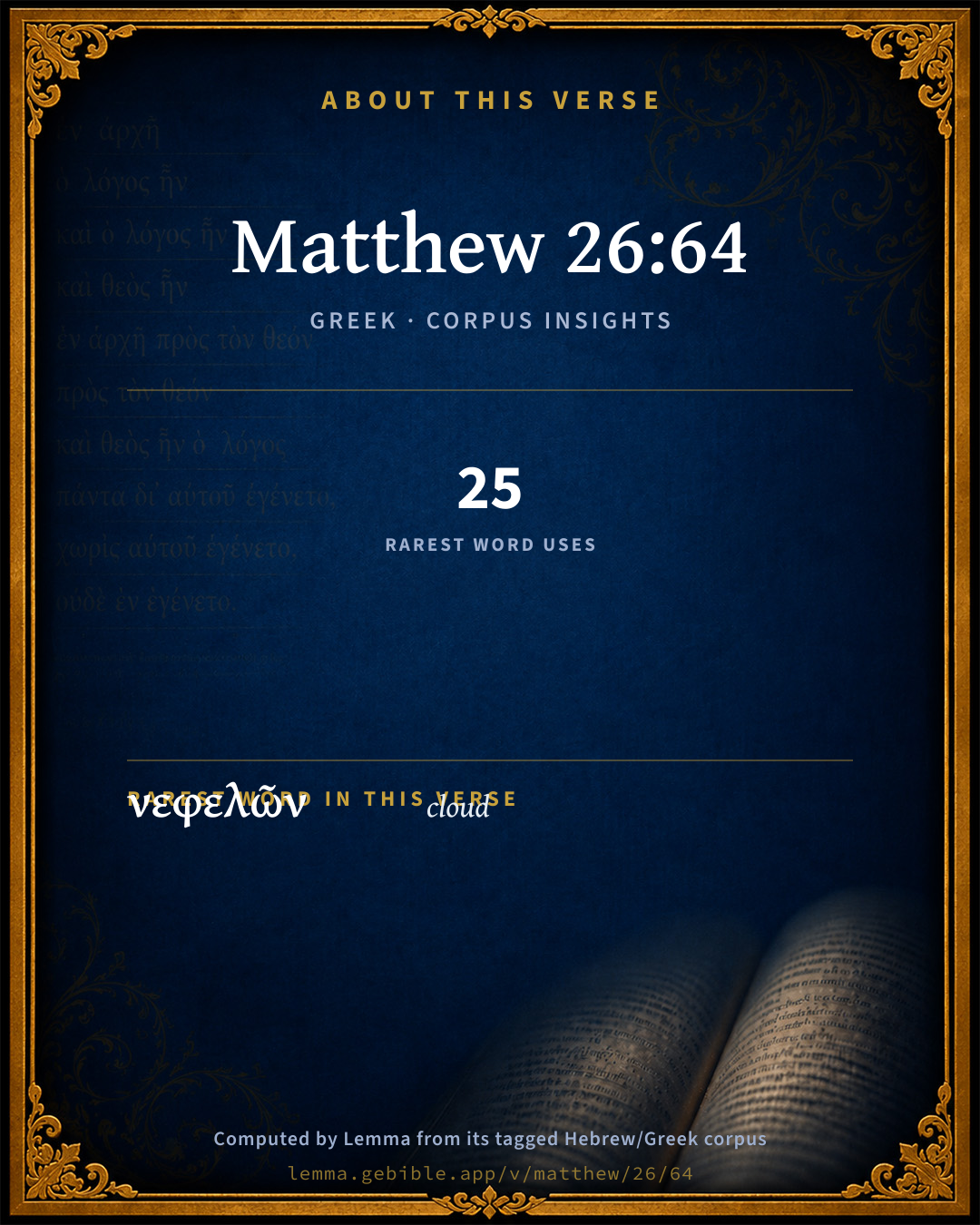
Matthew 26:64

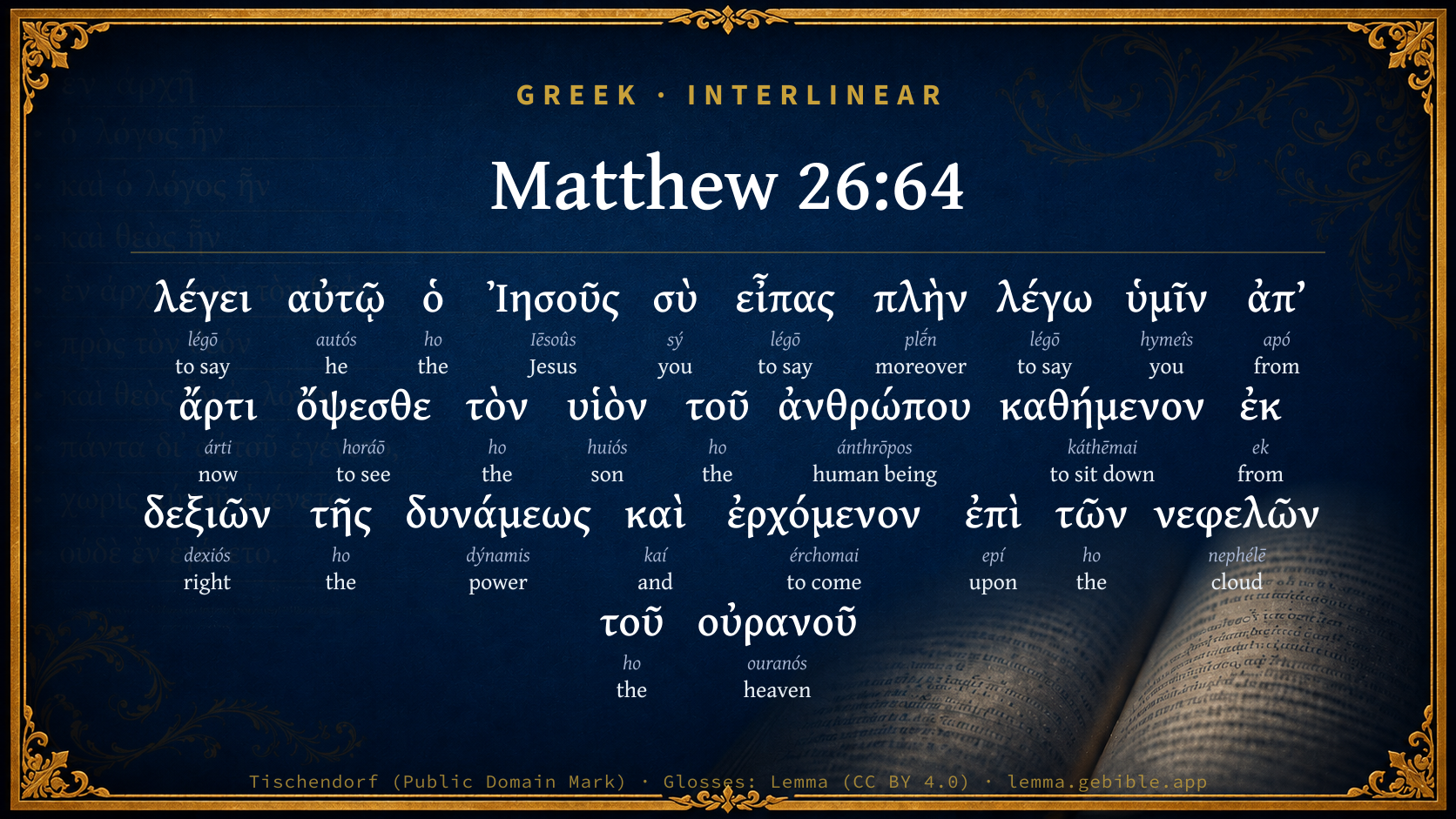
Greek (Tischendorf 8th ed.) Matthew 26:64 appears in the Greek New Testament. The text above is from the Tischendorf 8th edition. Each word links to its Strong’s number and a concise gloss. Click any word for its full Thayer’s Greek Lexicon entry.
Download image
Cite this verse

Matthew 26:64 (World English Bible). Public Domain. Lemma interlinear Bible study tool, https://lemma.gebible.app/v/matthew/26/64.

Show BibTeX & RIS
BibTeX
RIS
English Translation
Jesus said to him, "You have said it. Nevertheless, I tell you, henceforth you will see the Son of Man sitting at the right hand of Power, and coming on the clouds of the sky."
World English Bible · Public Domain
Download a study sheet

One document with this verse’s original text, its word-by-word gloss line, the meaning frame, cross-references with their text, attributed commentary, and full source and license credits — printable, and it pastes into notes with its structure intact.

This verse Autodidact and up

Study sheet (.html) Plain text (.txt)

A passage Seminary Student

Up to 50 verses in one chapter. A passage sheet keeps up to 6 commentary sources and 12 cross-references per verse, in the order this page ranks them, and says so on the sheet whenever that leaves anything out. Ask for a single verse and you get the Autodidact verse sheet above.

Everything on this page stays free to read, with no account — the sheet is a download of what is already on screen, not access to it.

Want to remove ads? Support Godless Engineer
Compare translations 3

The same verse in 3 English versions, stacked beneath the original-language interlinear above. Click any original word for its lexicon entry.

Each is an independent rendering of the whole verse — the interlinear is not word-aligned to these translations.

Highlighted words mark where these versions differ — a whole-verse word diff, not a word-by-word alignment.

  • World English Bible Public Domain
    Jesus said to him, "You have said it. Nevertheless, I tell you, henceforth you will see the Son of Man sitting at the right hand of Power, and coming on the clouds of the sky."
  • King James Version Public Domain
    Jesus saith unto him, Thou hast said: nevertheless I say unto you, Hereafter shall ye see the Son of man sitting on the right hand of power, and coming in the clouds of heaven.
  • unfoldingWord Literal Text CC BY-SA 4.0
    Jesus says to him, “You said. But I say to you, from now you will see the Son of Man sitting at the right hand of power and coming on the clouds of heaven.”

unfoldingWord Literal Text — © unfoldingWord, licensed CC BY-SA 4.0. Word-aligned USFM3 via Door43 (git.door43.org/unfoldingWord/en_ult).

Versions to compare (up to 4)

3 of 4 selected

Show all 19 translations

Every available English version of this verse, each an independent rendering of the whole verse.

  • World English Bible Public Domain
    Jesus said to him, "You have said it. Nevertheless, I tell you, henceforth you will see the Son of Man sitting at the right hand of Power, and coming on the clouds of the sky."
  • Berean Standard Bible Public Domain
    “You have said it yourself,” Jesus answered. “But I say to all of you, from now on you will see the Son of Man sitting at the right hand of Power and coming on the clouds of heaven.”
  • Majority Standard Bible Public Domain
    “You have said it yourself,” Jesus answered. “But I say to all of you, from now on you will see the Son of Man sitting at the right hand of Power and coming on the clouds of heaven.”
  • King James Version Public Domain
    Jesus saith unto him, Thou hast said: nevertheless I say unto you, Hereafter shall ye see the Son of man sitting on the right hand of power, and coming in the clouds of heaven.
  • American Standard Version (1901) Public Domain
    Jesus said unto him, Thou hast said: nevertheless I say unto you, Henceforth ye shall see the Son of man sitting at the right hand of Power, and coming on the clouds of heaven.
  • Revised Version (1885) Public Domain
    Jesus saith unto him, Thou hast said: nevertheless I say unto you, Henceforth ye shall see the Son of man sitting at the right hand of power, and coming on the clouds of heaven.
  • Geneva Bible (1599) Public Domain
    Iesus saide to him, Thou hast saide it: neuerthelesse I say vnto you, hereafter shall ye see the Sonne of man, sitting at the right hande of the power of God, and come in the cloudes of the heauen.
  • Douay-Rheims (1899) Public Domain
    Jesus saith to him: Thou hast said it. Nevertheless I say to you, hereafter you shall see the Son of man sitting on the right hand of the power of God, and coming in the clouds of heaven.
  • Young's Literal Translation Public Domain
    Jesus saith to him, `Thou hast said; nevertheless I say to you, hereafter ye shall see the Son of Man sitting on the right hand of the power, and coming upon the clouds, of the heaven.'
  • Literal Standard Version CC BY-SA 4.0
    Jesus says to him, “You have said; nevertheless I say to you, hereafter you will see the Son of Man sitting on the right hand of the Power and coming on the clouds of Heaven.”
  • Unlocked Literal Bible CC BY-SA 4.0
    Jesus replied to him, “You have said it yourself. But I tell you, from now on you will see the Son of Man sitting at the right hand of Power, and coming on the clouds of heaven.”
  • unfoldingWord Literal Text CC BY-SA 4.0
    Jesus says to him, “You said. But I say to you, from now you will see the Son of Man sitting at the right hand of power and coming on the clouds of heaven.”
  • Darby Bible Public Domain
    Jesus says to him, *Thou* hast said. Moreover, I say to you, From henceforth ye shall see the Son of man sitting at the right hand of power, and coming on the clouds of heaven.
  • World Messianic Bible Public Domain
    Yeshua said to him, “You have said so. Nevertheless, I tell you, after this you will see the Son of Man sitting at the right hand of Power, and coming on the clouds of the sky.”
  • Webster's Bible Public Domain
    Jesus saith to him, Thou hast said: nevertheless I say to you, Hereafter shall ye see the Son of man sitting on the right hand of power, and coming in the clouds of heaven.
  • Free Bible Version CC BY-SA 4.0
    “You said it,” Jesus replied. “And I also tell you that in the future you'll see the Son of man sitting at the right hand of the Almighty, and coming on the clouds of heaven.”
  • Bible in Basic English Public Domain
    Jesus says to him, You say so: but I say to you, From now you will see the Son of man seated at the right hand of power, and coming on the clouds of heaven.
  • Text-Critical English NT CC BY 4.0
    Jesus said to him, “Yoʋ have said it yoʋrself. Nevertheless I say to you, from now on you will see the Son of Man sitting at the right hand of Power and coming on the clouds of heaven.”
  • Tyndale New Testament (1534) Public Domain
    Iesus sayd to him: thou haste sayd. Neverthelesse I saye vnto you hereafter shall ye se the sonne of man syttinge on the right honde of power and come in the clowddes of the skye.

Literal Standard Version (2020), Covenant Press — licensed CC BY-SA 4.0. Text via the HelloAO Bible API (eBible.org). Unlocked Literal Bible (unfoldingWord) — licensed CC BY-SA 4.0. Text via the HelloAO Bible API (eBible.org). unfoldingWord Literal Text — © unfoldingWord, licensed CC BY-SA 4.0. Word-aligned USFM3 via Door43 (git.door43.org/unfoldingWord/en_ult). Free Bible Version, Dr. Jonathan Gallagher — licensed CC BY-SA 4.0. Text via the HelloAO Bible API (eBible.org).

Word by word

More ways to search: Search by grammar → Find every occurrence → Compare this word →

Practice this passage: Drill this verse → Learn its vocabulary →

νεφελῶν
nephélē
G3507
“cloud”
Noun, Genitive, Plural, Feminine
Part of Speech
Noun
Case
Genitive
Number
Plural
Gender
Feminine
Full Thayer's Definition

Origin: from G3509

TDNT: 19:02,6

1. a cloud a. used of the cloud which led the Israelites in the wilderness
  1. λέγει légō G3004 “to say” Verb, Present, Active, Indicative, 3rd person, Singular
  2. αὐτῷ autós G846 “he” Personal pronoun, Dative, Singular, Masculine
  3. ὁ ho G3588 “the” Article, Nominative, Singular, Masculine
  4. Ἰησοῦς Iēsoûs G2424 “Jesus” Noun, Nominative, Singular, Masculine
  5. σὺ sý G4771 “you” Personal pronoun, 2nd person, Nominative, Singular
  6. εἶπας légō G3004 “to say” Verb, Aorist, Active, Indicative, 2nd person, Singular
  7. πλὴν plḗn G4133 “moreover” Adverb
  8. λέγω légō G3004 “to say” Verb, Present, Active, Indicative, 1st person, Singular
  9. ὑμῖν hymeîs G5210 “you” Personal pronoun, 2nd person, Dative, Plural
  10. ἀπ’ apó G575 “from” Preposition
  11. ἄρτι árti G737 “now” Adverb
  12. ὄψεσθε horáō G3708 “to see” Verb, Future, Middle deponent, Indicative, 2nd person, Plural
  13. τὸν ho G3588 “the” Article, Accusative, Singular, Masculine
  14. υἱὸν huiós G5207 “son” Noun, Accusative, Singular, Masculine
  15. τοῦ ho G3588 “the” Article, Genitive, Singular, Masculine
  16. ἀνθρώπου ánthrōpos G444 “human being” Noun, Genitive, Singular, Masculine
  17. καθήμενον káthēmai G2521 “to sit down” Verb, Present, Middle or Passive deponent, Participle, Accusative, Singular, Masculine
  18. ἐκ ek G1537 “from” Preposition
  19. δεξιῶν dexiós G1188 “right” Adjective, Genitive, Plural, Masculine
  20. τῆς ho G3588 “the” Article, Genitive, Singular, Feminine
  21. δυνάμεως dýnamis G1411 “power” Noun, Genitive, Singular, Feminine
  22. καὶ kaí G2532 “and” Conjunction
  23. ἐρχόμενον érchomai G2064 “to come” Verb, Present, Middle or Passive deponent, Participle, Accusative, Singular, Masculine
  24. ἐπὶ epí G1909 “upon” Preposition
  25. τῶν ho G3588 “the” Article, Genitive, Plural, Feminine
  26. τοῦ ho G3588 “the” Article, Genitive, Singular, Masculine
  27. οὐρανοῦ ouranós G3772 “heaven” Noun, Genitive, Singular, Masculine

About this verse

These counts appear in no published source. They are computed here, from the morphology-tagged text and Lemma’s own curated glosses. What Lemma adds →

28
words
21
distinct lemmas
Gospels
section

Notable vocabulary

The rarest word here is νεφελῶν cloud G3507 — appearing just 25 times in the whole Greek New Testament.

Shared distinctive vocabulary

νεφελῶν cloud G3507 occurs in 21 verses of the Greek New Testament. Also found in:

Repetition

Words recur within this verse:

Cross-references

20

Topical passages linked to Matthew 26:64 in the Treasury of Scripture Knowledge — connected by theme and wording, ordered by reader-vote popularity; previews shown in the World English Bible.

  • Daniel 7:13 I saw in the night-visions, and, behold, there came with the clouds of the sky one like a son of man, and he came even to the ancient of days, and they brought him near before him.
  • Mark 14:62 Jesus said, "I AM. You will see the Son of Man sitting at the right hand of Power, and coming with the clouds of the sky."
  • Psalms 110:1 Yahweh says to my Lord, "Sit at my right hand, Until I make your enemies your footstool for your feet."
  • Hebrews 1:3 His Son is the radiance of his glory, the very image of his substance, and upholding all things by the word of his power, when he had by himself made purification for our sins, sat down on the right hand of the Majesty on high;
  • Revelation 1:7 Behold, he is coming with the clouds, and every eye will see him, including those who pierced him. All the tribes of the earth will mourn over him. Even so, Amen.
  • Luke 21:27 Then they will see the Son of Man coming in a cloud with power and great glory.
  • Matthew 24:30 and then the sign of the Son of Man will appear in the sky. Then all the tribes of the earth will mourn, and they will see the Son of Man coming on the clouds of the sky with power and great glory.
  • Matthew 16:27 For the Son of Man will come in the glory of his Father with his angels, and then he will render to everyone according to his deeds.
  • Hebrews 12:2 looking to Jesus, the author and perfecter of faith, who for the joy that was set before him endured the cross, despising shame, and has sat down at the right hand of the throne of God.
  • Matthew 25:31 "But when the Son of Man comes in his glory, and all the holy angels with him, then he will sit on the throne of his glory.
  • Matthew 26:25 Judas, who betrayed him, answered, "It isn't me, is it, Rabbi?" He said to him, "You said it."
  • 1 Thessalonians 4:16 For the Lord himself will descend from heaven with a shout, with the voice of the archangel, and with God's trumpet. The dead in Christ will rise first,
  • John 1:50–51 Jesus answered him, "Because I told you, 'I saw you underneath the fig tree,' do you believe? You will see greater things than these!"
  • Acts 1:11 who also said, "You men of Galilee, why do you stand looking into the sky? This Jesus, who was received up from you into the sky will come back in the same way as you saw him going into the sky."
  • Acts 7:55–56 But he, being full of the Holy Spirit, looked up steadfastly into heaven, and saw the glory of God, and Jesus standing on the right hand of God,
  • Revelation 20:11 I saw a great white throne, and him who sat on it, from whose face the earth and the heaven fled away. There was found no place for them.
  • Matthew 27:11 Now Jesus stood before the governor: and the governor asked him, saying, "Are you the King of the Jews?" Jesus said to him, "So you say."
  • Luke 22:70 They all said, "Are you then the Son of God?" He said to them, "You say it, because I AM."
  • John 18:37 Pilate therefore said to him, "Are you a king then?" Jesus answered, "You say that I am a king. For this reason I have been born, and for this reason I have come into the world, that I should testify to the truth. Everyone who is of the truth listens to my voice."
  • Romans 14:10 But you, why do you judge your brother? Or you again, why do you despise your brother? For we will all stand before the judgment seat of Christ.

Cross-references courtesy of OpenBible.info (CC BY 4.0).

Commentary

Notes on Matthew 26:64 from classic Christian and Jewish commentators (each source and its license shown beneath its notes). The classic Christian expositions comment on the surrounding passage and are grouped to its opening verse, so a note may address several verses; the Jewish commentaries on the Tanakh (Rashi and others) are per-verse, so they appear only where the commentator wrote on this verse.

Lemma curates 59 commentaries, every one of them public domain or Creative Commons licensed, each selected and text-cleaned for this edition rather than reprinted as found. About our sources →

Tyndale Open Study Notes

Tyndale Open Resources

26:64 You have said it: This purposefully enigmatic response is essentially an affirmative answer (see 26:25; 27:11); Mark has “I Am” (Mark 14:62). • you will see: By quoting Dan 7:13, Jesus affirmed that he was the Son of Man who would be vindicated and exalted by God. • seated in the place of power at God’s right hand: Literally seated at the right hand of the power; see Ps 110:1. Jews were reluctant to name God directly (see study note on Matt 5:4). • The expression coming on the clouds of heaven could refer either to the destruction of Jerusalem in AD 70 or to Jesus’ second coming at the end of history.

Tyndale Open Study Notes — © Tyndale Open Resources, licensed CC BY-SA 4.0. Text via the HelloAO Bible API.

Bengel's Gnomon

Johann Albrecht Bengel

Mat 26:64. Σὺ εἶπας, Thou hast said) “With regard to the question of Caiaphas, our Lord declares that He is the Christ, as though it were affirmed in the words of the interrogator. Nor is this form of speech uncommon in ordinary Greek discourse. In the Hyppolytus of Euripides, we find, σοῦ τάδʼ οὐκ ἐμοῦ κλύεις,[1160] Thou hearest those things from thyself, not from me. And in the third book of Xenophon’s Memorabilia, αὐτὸς, ἔφη, τοῦτο λέγεις, ὦ Σώκρατες, Thou thyself, said he, sayest this, O Socrates,”—CAMERARIUS.—πλὴν, nevertheless) although ye do not believe it.—πλὴν as well as ἈΛΛᾺ is frequently used epitatically.[1161]—ἀπʼ ἄρτι, κ.τ.λ., From this time forward, etc.[1162]) From this time forward, it shall come to pass that ye shall see and know, by visible proofs, that I am HE who shall sit on the right hand of power, and come in the clouds of heaven. A pregnant mode of expression (sermo complexus). Henceforward YE SHALL SEE me sitting and COMING.[1163] The return to judgment is combined with the sitting on the right hand: and after the Lord’s Passion they believed (see Joh 8:28), that which hereafter they shall see. They did not believe in the past; therefore Jesus (as He frequently did) appeals to the future. In the glory of Jesus this is the first thing, that He is the Son of God: that He will come to judgment is the last. The former is the foundation of the latter; the latter the most glorious proof of the former. In the most adverse circumstances, it always especially consoles the sons of God to contemplate the consummation of all things: cf. Gnomon on 2Co 11:15.—τὸν Υἱὸν τοῦ Ἀνθρώπου, the Son of Man) He speaks in the third person, modestly but openly.—καθήμενον, sitting) Jesus was then standing. On His ascension, He sat down at the right hand of God.—ἐκ δεξιῶν, κ.τ.λ., on the right hand, etc.) A manifestation of the deity of Christ.—δεξιῶν, the rigid hand) The neuter plural, τὰ δεξιὰ, is used in this sense.—Τῆς ΔΥΝΆΜΕΩς, of power) that is of God. The Hebrews often call God הגבורה [Power]. Power is manifested most widely and openly in all the works of God.

[1160] Ed. Dindorf, line 352.—(I. B.)

[1161] See explanation of technical terms in voc. Epitasis.—(I. B.)

[1162] In the original a modo, which is found in the Vulgate. In his German Version Bengel renders it, Von nun an, i.e. from this moment, henceforth. E. V. renders it, hereafter.—(I. B.)

[1163] Ye shall soon after this present time believe in my being the Son of God, and in this sense, by faith shall see me sitting; and thereby shall perceive also that I am coming as Judge.—ED.

Bengel's Gnomon of the New Testament — English translation (T&T Clark, Edinburgh, 1860) — public domain. Text from a community e-Sword module.

Meyer's Critical & Exegetical Commentary

Heinrich August Wilhelm Meyer

Mat_26:64. Σὺ εἶπας] see on Mat_26:25. Mar_14:62 : ἐγώ εἰμι. A distinguished confession on the part of the Son in presence of the Father, and before the highest tribunal of the theocratic nation.

πλήν] not profecto (Olshausen), nor quin (Kuinoel), but: however, i.e. (comp. Klotz, ad Devar. p. 725) apart from what I have just affirmed, ye shall henceforward have reason to be satisfied, from actual observation, that I am the Messiah who was seen by Daniel in his vision (Dan_7:13).

ἀπάρτι] is not to be taken with λέγω ὑμῖν (Schulz in 3d ed. of Griesbach), butsince in any other connection it would lose its forcewith ὄψεσθε; nor is it to be understood in any other sense than that of henceforth, i.e. from the time of my impending death, through which I am to enter into my δόξα. But seeing that ἀπάρτι forbids us to understand ὄψεσθε as denoting only a single momentary glance (comp. on the contrary, Joh_1:51), we are bound to suppose that Jesus used it somewhat loosely to express the idea of coming to perceive in the course of experience (as in the passage of John just referred to) the fact of His being seated at the right hand of God (in allusion to Psa_110:1), and that He did not intend ἐρχόμενον, κ.τ.λ. to refer to the second advent, but (Beza, Neander, Holtzmann, Schenkel, Gess, Weissenbach) to a coming in the figurative sense of the word, namely, in the shape of those mighty influences which, from His place in heaven, He will shed upon the earth,manifestations, all of them, of His sovereign sway. We are shut up to this view by the fact that the sitting cannot possibly be regarded as an object of actual sight, and that ἀπάρτι ὄψεσθε can only be said of something that, beginning now, is continued henceforth.

τῆς δυνάμ.] The Mighty One is conceived of as power (the abstract for the concrete). Similarly in the Talmud הַגְּבוּרָה, Buxtorf, Lex. Talm. p. 385. Such abstract terms (as for instance our: majesty) have somewhat of an imposing character. Comp. 2Pe_1:17.

Meyer — Critical and Exegetical Commentary on the New Testament — English translation by Peter Christie, edited by Frederick Crombie (T&T Clark, 1880) — public domain. Text from a community e-Sword module.

Expositor's Greek Testament

ed. W. Robertson Nicoll

Mat 26:64 . σὺ εἶπας : in current phrase = I am. Was Jesus morally bound to answer? Why not continue silent? First, the whole ministry of Jesus had made the question inevitable. Second, the high priest was the proper person to ask it. Third, it was an important opportunity for giving expression to His Messianic self-consciousness. Fourth, silence would, in the cirumstances, have amounted to denial. πλὴν not = “nevertheless,” but rather = nay more: I have something more startling to tell you. What follows describes the future of the Son of Man in apocalyptic terms, and is meant to suggest the thought: “the time is coming when you and I shall change places; I then the Judge, you the prisoners at the bar”.

The Expositor's Greek Testament, edited by W. Robertson Nicoll (1897–1910) — public domain. Text from a community e-Sword module.

Geneva Bible (1599)

Geneva Bible translators

This word distinguisheth his first coming from the latter.

Sitting with God in like and equal honor at the right hand of his power, that is, in greatest power: for the right hand signifieth among the Hebrews, that that is mighty and of great power.

Clouds of heaven, see also Matt. 24:30.

Matt. 16:27; Rom. 14:20; 2 Thess. 4:14

Geneva Bible (1599) marginal notes — public domain. Text via Bolls.life.

Adam Clarke's Commentary

Verse 64. Thou hast said] That is, I am the Christ, the promised Messiah, (See Clarke on Mt 26:25;) and you and this whole nation shall shortly have the fullest proof of it: for hereafter, in a few years, ye shall see the Son of man sitting on the right hand of power, fully invested with absolute dominion, and coming in the clouds of heaven, to execute judgment upon this wicked race. See Mt 24:30. Our Lord appears to refer to Da 7:13: One like the Son of man came with the clouds of heaven, &c. This may also refer to the final judgment.

Adam Clarke's Commentary on the Bible (1810–1826) — public domain. Text from a community e-Sword/MySword module.

Ellicott's Commentary for English Readers

(64) Thou hast said.—The silence was broken as they expected. He was indeed what the words they had uttered implied. More than this, He was also the Son of Man of Daniel’s vision (Dan_7:13), the Head of an everlasting kingdom. No words in the whole Gospel records are more decisive against the views of those who would fain see in our Lord only a great moral teacher, like Socrates or Cakya Mouni. At the very crisis of His history, when denial would have saved His life. He asserts His claim to be much more than this, to be all that the most devout Christians have ever believed Him to be. At such a moment, when men stand face to face with seeming failure and with death, dreams and delusive claims for the most part melt away. Here claims that men have presumed to think of as delusive were strengthened and intensified, and reproduced as in the calmness of assured conviction.

The right hand of power.—The Greek article here can hardly be reproduced in English, but it is well to remember that our Lord speaks of “the power,” that which belonged pre-eminently to the Eternal.

A Bible Commentary for English Readers, edited by Charles John Ellicott (1878–1897) — public domain. Text from a community e-Sword module.

The Cambridge Bible for Schools and Colleges

gen. ed. J. J. S. Perowne

64. Thou hast said] See note Mat_26:25.

Hereafter shall ye see] Cp. Dan_7:13; ch. Mat_16:27, Mat_24:30, Mat_25:31.

The Cambridge Bible for Schools and Colleges (gen. ed. J. J. S. Perowne; Cambridge University Press, 1878–1918) — public domain. Text from a community e-Sword module.

John Gill's Exposition

Then the high priest rent his clothes,.... Both his outer and inner garments. This he did, to show his zeal for the honour and glory of God, his grief and concern at the profanation of his holy name by a false oath, and his abhorrence of, and indignation at the blasphemy he supposed Christ to be guilty of, in asserting himself to be the Son of God. Some have thought, that Caiaphas in this action, transgressed the law, in Lev 21:10, where it is said, that "the high priest--shall not uncover his head, nor rend his clothes": and it is one of the Jews' negative precepts (i), that "an high priest is prohibited, "ever" to rend his garments:

and that therefore being transported with passion at the greatness of the supposed crime, could not forbear expressing his detestation of it in this manner, though it was forbidden him: but it does not appear to have been unlawful: as for the law in Leviticus, it only regards the rending of garments at funerals, or in mourning for the dead, as the context shows; and so Jonathan ben Uzziel paraphrases the text, "nor rent his clothes": "in the time of mourning"; and so the Jewish (k) interpreters, in general, expound it; and besides, this prohibition, according to them, only regards the manner of rending: their rule is this (l),

"an high priest rends below, and a common person above:

the sense of which, according to their commentators, is (m),

"that if anyone dies for whom an high priest is obliged to rend his garments, he must rend below, at the extreme part of his garment, near his feet; and as for what is written, nor rend his clothes; the meaning is, he shall not rend as other men do, above, over against the breast, near the shoulder, as the rest of the people.

Moreover, a priest might not go into the sanctuary, nor perform any part of service with his clothes rent; the canon runs thus (n),

"the judgment, or the law of them that rend their garment, and of those that uncover the head, is one and the same, as it is said, Lev 10:6, lo! if he is in service, and rends his garments, he is guilty of death by the hands of heaven, though his service is right, and not profaned.

And indeed no man, whether a priest or an Israelite, might go into the temple with his clothes rent; and a priest might not rend his sacerdotal garments, on any account; yet such were not these that Caiaphas now had on; but in case of hearing blasphemy, everyone, be he what he would, was obliged to rend his garments (o):

"Whosoever hears the cursing of the name (of God) is obliged to rend, even at the cursing of the surnames he is obliged to rend; and he that hears it from an Israelite, both he that hears, and he that hears from the mouth of him that hears, he is obliged to rend; but he that hears from the mouth of a Gentile, is not obliged to rend; and Eliakim and Shebna would not have rent, but because Rabshakeh was an apostate.

So when witnesses expressed the blasphemy of such they testified against, the judges were obliged to rise up and rend their garments; concerning which, take the following rule (p):

"a blasphemer is not guilty, unless he expresses the name (of God); says R. Joshua ben Korcha, all the day the witnesses are examined by the surnames; but when the cause is finished, they do not put to death because of the surnames, but they bring every man out, and ask the chief among them, and say to him, say expressly what thou hast heard, and he says it: then the judges stand upon their feet, "and rend their garments", and do not sow them up again; and then the second and the third say, I have heard the same as he.

From all which it appears, that Caiaphas did what was the custom of the nation to do in such a case. The observation, that some learned men have made, that the high priest's rending his garments, was, though without his intention, an emblem and presage, of the rending of the priesthood from him, and his brethren, and the entire change of it; as the abolition of the whole ceremonial law, was signified by the rending of the vail of the temple in twain; and as the removing of the kingdom from Saul, was represented by Samuel's rending his mantle; and the revolt of the ten tribes to Jeroboam, by Abijah's rending his garment into twelve pieces, and giving ten to him; would have had a much better foundation to be built on, were these clothes that Caiaphas rent, his priestly ones: but such they were not; for both the high priest, and the other priests, only wore their sacerdotal garments in the temple; nor was it lawful for them to go out in them elsewhere; for so the Jews say (q),

"it is forbidden to go out into the province; city, or country, in the garments of the priesthood; but in the sanctuary, whether in the time of service, or not in the time of service, it was lawful.

In the temple, there were chests on purpose for the garments of the priests (r); from whence they took them, and where they laid them up when they had performed their service: of these there were ninety six in number; for as there were twenty four courses, there were four chests for every course; in which the garments were put by themselves, the breeches by themselves, the girdles by themselves, the bonnets by themselves, and the coats by themselves; sealed up with an inscription on them, showing what was in them: and when the men that belonged to such a course, came to perform their service in turn, they opened these chests, and clothed themselves: and when they went out of their service, they put them up in them again, and sealed them; and as for

"the high priest, he left his golden garments, , "in his chamber", (an apartment in the temple, peculiar to him, and for this use,) in the night, and at whatsoever time he went out of the sanctuary (s).

Nor might he go abroad with them, unless , "in great necessity" (t); as Simeon the Just went out in priestly garments to meet Alexander the Great, to appease him, being warned of God so to do: hence the Apostle Paul knew not Ananias the high priest,

Act 23:5, which he must have done, had he had on his priestly garments: for when the priests were not in the temple, and out of service, they wore no distinguishing habits, but were dressed as laics, and as the common people were (u). The reason of Caiaphas's rending his clothes, is expressed in, the next clause,

saying, he hath spoken blasphemy: not only because Jesus asserted that he was the Messiah, but also the Son of God; hereby making himself equal with God, which is the sense in which the Jews always understood this phrase; and he appearing to them to be but a mere man, they charged it as blasphemy against God, to assume such a character and relation to himself:

what further need have we of witnesses? of seeking after others, as they had done: or of further examining and taking the depositions of those, who were before them: he was for putting a stop to the process, and bringing the cause at once to an issue: and therefore addresses the court in the following manner,

behold now, ye have heard his blasphemy: out of his own mouth, as Luk 22:71, expresses it; and with their own ears, and at that very time; so that they had no need of recourse to things past, or examine witnesses about what they had heard from him formerly: and therefore he proposes, that they would attend to, and take notice of his present words; and which, as he suggests, were shocking and astonishing: for the word, "behold!" may not only be a note of attention, but of astonishment,

(i) Moses Kotsensis Mitzvot Tora, pr. neg. 302. (k) Jarchi, Aben Ezra, &c. in loc. (l) Misn. Horayot, c. 3. sect. 5. (m) Bartenora & Maimon. in ib. (n) Maimon. Hilch. Biath Hamikdash, c. 1. sect. 14, 17. (o) Maimon. Hilch. Obede Cochabim, c. 2. sect. 10. Vid. T. Hieros. Sanhedrin, fol. 25. 1. (p) Misn. Sanhedrin, c. 7. sect. 5. (q) T. Bab. Yoma, fol. 69. 1. & Tamid, fol. 27. 2. (r) Misn. Tamid, c. 5. sect. 3. (s) Maimon. Hilch. Cele Hamikdash, c. 8. sect. 8, 9, 10. (t) Moses Kotsensis Mitzvot Tora, pt. affirm. 173. (u) Maimon. ib. c. 10. sect. 4. Joseph. de Bello Jud. l. 6. c. 15.

John Gill's Exposition of the Whole Bible (1746–1763) — public domain (CC PDM 1.0). Text via the HelloAO Bible API.

Trapp's Complete Commentary

John Trapp

64 Jesus saith unto him, Thou hast said: nevertheless I say unto you, Hereafter shall ye see the Son of man sitting on the right hand of power, and coming in the clouds of heaven.

Ver. 64. Thou hast said] That is, as St Mark expresseth the Hebraism in plainer terms, "I am," q.d. Thou hast said it, and I must second it, I am indeed the promised Messias, and the only begotten Son of God. This was the naked truth without equivocation; a device that the Jesuits have lately fetched from hell, for the consolation of afflicted Catholics, and for the instruction of all the godly, as Blackwel and Garnet blush not to profess in print. Let us learn here of our Saviour to make a bold and wise confession of the truth when called thereunto; although we create ourselves thereby never so much danger from the enemy, who shall so be either converted, or at least convinced, and left inexcusable.

Hereafter shall ye see, &c.] q.d. Now I am in a state of abasement, God having hidden his Son under the carpenter’s son, whom ye have now bound, and shall shortly crucify. But not long hence ye shall see me in a state of advancement sitting on the right hand of power, pouring out my Spirit upon all flesh, Act 2:33; and, after that, coming in the clouds of heaven, as in a chariot of state, to judge you that are now my judges, &c.

John Trapp, A Commentary or Exposition upon All the Books of the Old and New Testament (1647–1656) — public domain. Text from a community e-Sword module.

Albert Barnes' Notes on the Bible

Thou hast said - This is a form of assenting or affirming. Thou hast said the truth; or, as Luke Luk 22:70 has it, “Ye say that I am.” This was not, however, said “immediately.” Before Jesus acknowledged himself to be the Messiah, he said to them Luk 22:67-68, “If I tell you ye will not believe, and if I also ask you” - that is, propose the proofs of my mission, and require you to give your opinion of them “ye will not answer me, nor let me go.”

Nevertheless - This word should have been translated: “moreover or furthermore.” What follows is designed to explain and give confirmation to what he had said.

Sitting on the right hand of power - That is, of God, called here the Power - equivalent to “the Mighty, or the Almighty.” It denotes dignity and majesty; for to sit at the right hand of a prince was the chief place of honor. See the notes at Mat 20:21.

Coming in the clouds of heaven - See the notes at Matt. 24; 25. The meaning of this is, You shall see “the sign from heaven” which you have so often demanded; even the Messiah returning himself “as the sign,” with great glory, to destroy your city and to judge the world.

Albert Barnes' Notes on the Bible (1834–1885) — public domain. Text from a community e-Sword/MySword module.

Haydock's Catholic Bible Commentary

Thou hast said it. Or, as it is in St. Mark, I am. According to St. Luke, Christ in the morning, before he answered directly, said to them: If I tell you, you will not believe me, &c. (Witham)

George Leo Haydock (1774–1849), Haydock's Catholic Family Bible and Commentary, 1859 edition — public domain. Excludes Psalms (Douay-Rheims chapter numbering differs from Protestant) and Deuterocanonical books (Catholic canon only).

Matthew Poole's English Annotations

Mark saith, Mar 14:62, And Jesus said, I am: and ye shall see, &c. Luke saith, Luk 22:67-69, And he said unto them, If I tell you, ye will not believe: and if I also ask you, ye will not answer me, nor let me go. Hereafter shall the Son of man sit on the right hand of the power of God. What all the evangelists say put together, makes up our Saviour’s perfect answer. To what purpose (saith Christ) should I answer you? This is now but a captious question, not propounded by you to that end that you might be satisfied as to the truth, but only to ensnare me, for if I should tell you I am, you would not believe it. If I should argue the matter with you, you would give me no answer. I have given you proof enough, but yet, Caiaphas, thou hast said the truth, I am the Christ, the Son of the ever living, blessed God; and, to confirm you further, hereafter you shall see me, whom you think to be no more than the Son of man, sitting on the right hand of the power of God, and coming in the clouds of heaven. There is a time for a man to speak, and a time for him to hold his peace; in the matter of confession of truth. The seasons for silence, or speech, are to be judged from the honour and glory of God; when we cannot be silent without betraying the truth, we are bound to speak. Our Lord therefore, being so solemnly adjured in the name of God to tell them what was the truth, now confesseth, and denieth not, that he was the Son of God, and tells them, hereafter they should see it. Whether the term hereafter refers to the time soon following, (as απ’ αρτι, in this evangelist, and ’Aπο του νυν, in Luke, seem to signify), and be to be understood of Christ’s resurrection, his ascension into heaven, the coming of the Holy Ghost, and the carrying of the gospel to all nations, or to the day of judgment (which the New Testament often speaks of as a thing at hand, and that phrase, coming in the clouds of heaven, seems rather to signify); or (as others think) to both, referring the sitting on the right hand of power to the former, and the coming in the clouds to the latter; is hard to determine.

Matthew Poole's English Annotations on the Holy Bible (1683–1685) — public domain. Text from a community e-Sword/MySword module.

Whedon's Commentary on the Bible

Daniel D. Whedon

64. Thou hast said — The same in sense is given by Mark: “I am.” This was a solemn moment. The titular high priest of the Jews, and their eternal High Priest, are now face to face. the substance is arraigned before the judgment bar of the shadow. One is the representative of the Jewish nation; the other is its Messiah and its true king. The representative, in whom for the time being the nation is embodied, puts the great question, “Are you the Messiah?” The Messiah “witnesses a good confession.” He pronounces the solemn affirmative, “I AM.” And he is REJECTED. The great act is consummated. Well might the high priest rend his clothes. Not because his prisoner had spoken blasphemy, but because himself had denied the Lord that bought him.

Nevertheless — Should rather be moreover. Hereafter — Through all the circumstances of his humiliation, Jesus foresaw with unwavering faith the day of his own exaltation. Shall ye see — Ye who now see me your prisoner will then see me your Judge. The Son of man — He does not say me, but speaks of himself by that title which the Old Testament ascribes to the Messiah.

Sitting on the right hand of power — That is, of Omnipotence. Coming in the clouds of heaven — The words are taken from Dan_7:13. The prophet is describing Christ’s coming into the presence of his Father to be invested with all power. Its true fulfilment took place at the resurrection. (See on Mat_28:18.) But as the same Lord will come at the judgment day in that same glory, so the words that describe that same glory are well used, although in a different transaction. The glory wherewith Christ was invested at his resurrection, though mostly unseen by mortal eye, was the same glory as that with which he will be visibly invested at his second coming.

Daniel D. Whedon (gen. ed.), Commentary on the Old and New Testaments (1874–1909) — public domain. Text from a community e-Sword module.

The Pulpit Commentary

Thou hast said; su eipav (ver. 25); in St. Mark, egw eimi . This is a strong affirmative asseveration, and on Christ"s lips carries with it the full meaning of the words used by Caiaphas, "I am the Messiah, the Son of the Blessed One, God of God, of one substance with the Father." Nevertheless (plhn); i.e. in spite of your incredulity. But there is no direct opposition intended between the previous and the following statements; so plhn would be better translated, but moreover, or what is more. Hereafter; aparti . From this moment, beginning from now, from my Passion, my triumph and my reign are inaugurated. Shall ye see. Ye, the representatives of Israel, shall see the events about to be consummated, the preludes of the great assize, and the coming of Messiah"s kingdom. The Son of man. God and yet man; man now in weakness and humility, about to display and give incontestable proofs of his Godhead. Right hand of power. Of Omnipotence, of Almighty God. Coming in the clouds of heaven. (Mat_24:30) Christ thus distinctly asserts his Divinity, and claims to apply to himself the utterance in Psa_110:1, and the great prophecy of Daniel. (Dan_7:13, Dan_7:14) This was the plainest and most specific declaration of his real nature, power, and attributes, made with calm majesty, though he knew it was to seal his condemnation, and open the immediate way to his death.

The Pulpit Commentary (1880–1919), ed. H.D.M. Spence-Jones & Joseph S. Exell — public domain. Text from a community e-Sword module.

John Wesley's Explanatory Notes

Hereafter shall ye see the Son of man - He speaks in the third person, modestly, and yet plainly; Sitting on the right hand of power - That is, the right hand of God: And coming upon the clouds of heaven - As he is represented by Daniel, Dan. vii, 13, 14. Our Lord looked very unlike that person now! But nothing could be more awful, more majestic and becoming, than such an admonition in such circumstances!

John Wesley, Explanatory Notes Upon the Whole Bible (1754–1765) — public domain. Text via the GEBible commentary corpus.

The People's New Testament

B. W. Johnson

64. Thou hast said. That is, thou hast said the truth in thy question. The Lord only breaks the silence to affirm his divinity under oath. It insured his death at their hands, for he was immediately condemned for the declaration. “At the very crisis of his history, when denial would have saved his life, he asserts his claim to the Divine Sonship and to a Godlike power.

B. W. Johnson's The People's New Testament with Notes (1889–1891) — public domain. Electronic text from the Christian Classics Ethereal Library (CCEL) ThML edition.

Cambridge Greek Testament for Schools and Colleges

64. σὺ εἶπας. See note, Mat 26:25.

ἀπʼ ἄρτι ὄψεσθε κ.τ.λ. Cp. Dan 7:13; ch. Mat 16:27, Mat 24:30, Mat 25:31.

ἐπὶ τῶν νεφ. See ch. Mat 24:30.

Cambridge Greek Testament for Schools and Colleges (Cambridge University Press, 1896; 21 vols, various authors incl. Carr, Maclear, Plummer, Farrar, Lumby, Moule, M. R. James, Simcox) — public domain. Text from a community e-Sword module.

Alford’s Greek Testament

Henry Alford

64.] By σὺ εἶπας, more may perhaps be implied than by Mark’s ἐγώ εἰμι: that is a simple assertion: this may refer to the convictions and admissions of Caiaphas (see Joh 11:49). But this is somewhat doubtful. The expression is only used here and in ver. 25: and there does not appear to be any reference in it as said to Judas, to any previous admission of his.

πλήν] but—i.e. ‘there shall be a sign of the truth of what I say, over and above this confession of Mine.’

ἀπʼ ἄρτι] The glorification of Christ is by Himself said to begin with his betrayal, see Joh 13:31: from this time—from the accomplishment of this trial now proceeding. In what follows, the whole process of the triumph of the Lord Jesus even till its end is contained. The ὄψεσθε is to the council, the representatives of the chosen people, so soon to be judged by Him to whom all judgment is committed—the τῆς δυνάμεως in contrast to his present weakness—καθήμενον—even as they now sat to judge Him; and the ἐρχ. ἐπὶ τ. ν. τ. οὐρ. (see Dan 7:13) looks onward to the awful time of the end, when every eye shall see Him.

Henry Alford, The Greek Testament (1849–1861) — public domain. Text from a community e-Sword module.

International Critical Commentary

(M) 64. Jesus saith to him, Thou saidst: but I say to you, Henceforth you shall see the Son of Man sitting at the right hand of power, and coming on the clouds of heaven.] Mk. has: “And Jesus said, I am; and you shall see the Son of Man sitting at the right hand of power, and coming with the clouds of heaven.”—σὺ εἶπας] Mk. has ἐγώ εἰμι. On σὺ εἶπας, see v. 25. The phrase implies a fine understanding of the circumstances of the scene. Christ was not “the Son of God” in any sense in which the words could be understood by the high priest, and a question such as that addressed to Christ, where questioner and questioned lived in a different atmosphere of thought, could not, nor ever can be, answered with a word. Yet the phrase is an implied affirmative. “Thou hast expressed in a phrase the inference which seems to follow from My teaching, and that inference is a half truth. But more is implied. From henceforth,” etc. The same evasive affirmative lies behind Luk 22:67 and Joh 18:37: “Thou sayest that I am a king. That is a right inference from My teaching; but the kingship which I claim is a kingship of spiritual supremacy.”—ἀπʼ ἄρτι] is difficult.1 It seems to be equivalent to “soon,” “hereafter.” “I am the Messiah, but the Messiah of the future, not of the present; you will understand when you shall see the Son of Man coming on the clouds of heaven.” Lk. also has ἀπὸ τοῦ νῦν.—ἐπί] Mk. has μετά. See on 24:30, where Mk. in the parallel has ἐν νεφέλαις. μετά occurs in Theodotion’s VS of Dan 7:13. See Gould on Mar 14:60.

International Critical Commentary — older volumes (1896–1929), various authors — public domain. Text from a community e-Sword module.

Vincent's Word Studies in the New Testament

Marvin R. Vincent

Thou hast said. An affirmation. You have spoken the truth. What thou hast asked me is the fact. Compare ver. 25. Nevertheless [πλην] . However. Apart from my affirmation, you shall see for yourself.

Marvin R. Vincent, Word Studies in the New Testament (1887–1900) — public domain. Text from a community e-Sword/MySword module.

Lesson kit

Teaching starters — assembled from the data on this page, not authored interpretation. Every prompt links to the verse data it draws on. Edit before teaching.

Matthew, in the Gospels, opens this verse with 28 words (21 distinct Greek lemmas). Its most distinctive word is nephélē (“cloud”). A historical commentator’s framing appears above. Read the whole chapter for the surrounding context.

Discussion questions

  1. The word nephélē carries the sense “cloud.” How does it shape the verse?
  2. Matthew 17:5 shares the word «cloud» with this verse. How do the two illuminate each other?
  3. “to say” occurs 3× in this one verse. What is the effect of the repetition?
  4. These translations render this verse differently. What is at stake in choosing one wording over another?
  5. Reading how Tyndale Open Study Notes and Bengel's Gnomon read this verse, where do the two commentators agree and where do they part?

Things to notice

Reading settings

Reading text

Shown beneath each verse's original-language words.

Old Testament
Old Testament edition

Read the OT as the Masoretic Hebrew (MT) or the Greek Septuagint (LXX).

English shown for the Greek Septuagint (in the Hebrew ↔ Greek comparison).

Comparing translations? Open the Compare panel on any verse page to stack up to four side by side.