Acts 1:11

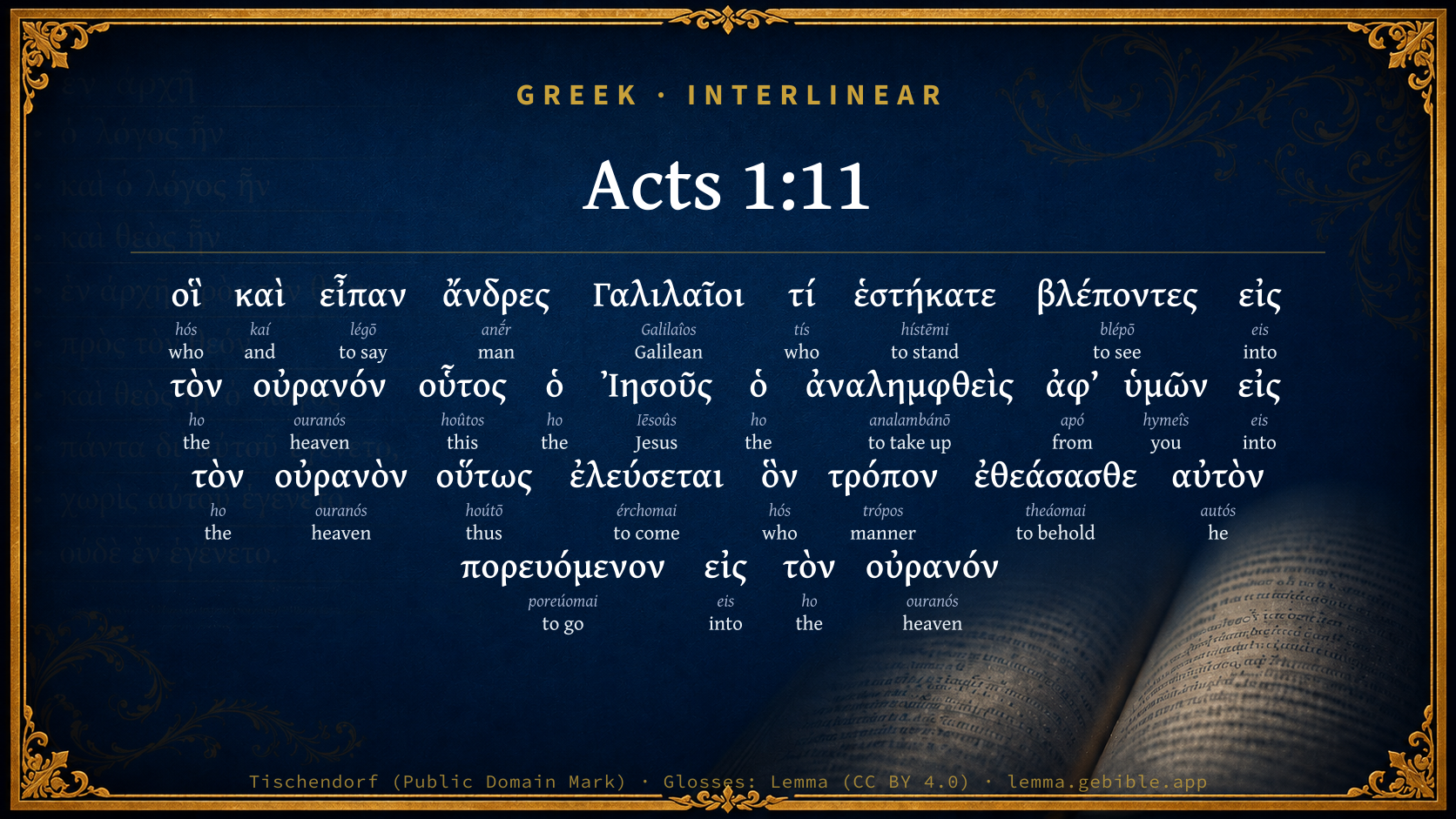
Greek (Tischendorf 8th ed.) Acts 1:11 appears in the Greek New Testament. The text above is from the Tischendorf 8th edition. Each word links to its Strong’s number and a concise gloss. Click any word for its full Thayer’s Greek Lexicon entry.
Download image
Cite this verse

Acts 1:11 (World English Bible). Public Domain. Lemma interlinear Bible study tool, https://lemma.gebible.app/v/acts/1/11.

Show BibTeX & RIS
BibTeX
RIS
English Translation
who also said, "You men of Galilee, why do you stand looking into the sky? This Jesus, who was received up from you into the sky will come back in the same way as you saw him going into the sky."
World English Bible · Public Domain
Download a study sheet

One document with this verse’s original text, its word-by-word gloss line, the meaning frame, cross-references with their text, attributed commentary, and full source and license credits — printable, and it pastes into notes with its structure intact.

This verse Autodidact and up

Study sheet (.html) Plain text (.txt)

A passage Seminary Student

Up to 50 verses in one chapter. A passage sheet keeps up to 6 commentary sources and 12 cross-references per verse, in the order this page ranks them, and says so on the sheet whenever that leaves anything out. Ask for a single verse and you get the Autodidact verse sheet above.

Everything on this page stays free to read, with no account — the sheet is a download of what is already on screen, not access to it.

Want to remove ads? Support Godless Engineer
Compare translations 3

The same verse in 3 English versions, stacked beneath the original-language interlinear above. Click any original word for its lexicon entry.

Each is an independent rendering of the whole verse — the interlinear is not word-aligned to these translations.

Highlighted words mark where these versions differ — a whole-verse word diff, not a word-by-word alignment.

  • World English Bible Public Domain
    who also said, "You men of Galilee, why do you stand looking into the sky? This Jesus, who was received up from you into the sky will come back in the same way as you saw him going into the sky."
  • King James Version Public Domain
    Which also said, Ye men of Galilee, why stand ye gazing up into heaven? this same Jesus, which is taken up from you into heaven, shall so come in like manner as ye have seen him go into heaven.
  • unfoldingWord Literal Text CC BY-SA 4.0
    And they said, “Men, Galileans, why do you stand looking into heaven? This Jesus, the one having been taken up from you into heaven, thus will come, the way you saw him going into heaven.”

unfoldingWord Literal Text — © unfoldingWord, licensed CC BY-SA 4.0. Word-aligned USFM3 via Door43 (git.door43.org/unfoldingWord/en_ult).

Versions to compare (up to 4)

3 of 4 selected

Show all 19 translations

Every available English version of this verse, each an independent rendering of the whole verse.

  • World English Bible Public Domain
    who also said, "You men of Galilee, why do you stand looking into the sky? This Jesus, who was received up from you into the sky will come back in the same way as you saw him going into the sky."
  • Berean Standard Bible Public Domain
    “Men of Galilee,” they said, “why do you stand here looking into the sky? This same Jesus, who has been taken from you into heaven, will come back in the same way you have seen Him go into heaven.”
  • Majority Standard Bible Public Domain
    “Men of Galilee,” they said, “why do you stand here looking into the sky? This same Jesus, who has been taken from you into heaven, will come back in the same way you have seen Him go into heaven.”
  • King James Version Public Domain
    Which also said, Ye men of Galilee, why stand ye gazing up into heaven? this same Jesus, which is taken up from you into heaven, shall so come in like manner as ye have seen him go into heaven.
  • American Standard Version (1901) Public Domain
    who also said, Ye men of Galilee, why stand ye looking into heaven? this Jesus, who was received up from you into heaven shall so come in like manner as ye beheld him going into heaven.
  • Revised Version (1885) Public Domain
    which also said, Ye men of Galilee, why stand ye looking into heaven? this Jesus, which was received up from you into heaven, shall so come in like manner as ye beheld him going into heaven.
  • Geneva Bible (1599) Public Domain
    Which also sayde, Yee men of Galile, why stande yee gasing into heauen? This Iesus which is taken vp from you into heauen, shall so come, as yee haue seene him goe into heauen.
  • Douay-Rheims (1899) Public Domain
    Who also said: Ye men of Galilee, why stand you looking up to heaven? This Jesus who is taken up from you into heaven, shall so come, as you have seen him going into heaven.
  • Young's Literal Translation Public Domain
    who also said, `Men, Galileans, why do ye stand gazing into the heaven? this Jesus who was received up from you into the heaven, shall so come in what manner ye saw him going on to the heaven.'
  • Literal Standard Version CC BY-SA 4.0
    who also said, “Men, Galileans, why do you stand gazing into the sky? This Jesus who was received up from you into Heaven, will so come in what manner you saw Him going on to Heaven.”
  • Unlocked Literal Bible CC BY-SA 4.0
    They said, “You men of Galilee, why do you stand here looking into heaven? This Jesus who has been taken up from you into heaven, will return in the same manner as you saw him going into heaven.”
  • unfoldingWord Literal Text CC BY-SA 4.0
    And they said, “Men, Galileans, why do you stand looking into heaven? This Jesus, the one having been taken up from you into heaven, thus will come, the way you saw him going into heaven.”
  • Darby Bible Public Domain
    who also said, Men of Galilee, why do ye stand looking into heaven? This Jesus who has been taken up from you into heaven, shall thus come in the manner in which ye have beheld him going into heaven.
  • World Messianic Bible Public Domain
    who also said, “You men of Galilee, why do you stand looking into the sky? This Yeshua, who was received up from you into the sky, will come back in the same way as you saw him going into the sky.”
  • Webster's Bible Public Domain
    Who also said, Ye men of Galilee, why stand ye gazing up to heaven? this same Jesus who is taken from you into heaven, shall so come in like manner as ye have seen him go into heaven.
  • Free Bible Version CC BY-SA 4.0
    “Men of Galilee, why are you standing here staring at the sky?” they asked. “This same Jesus who has been taken up from you to heaven shall come in the same way you saw him go into heaven.”
  • Bible in Basic English Public Domain
    And said, O men of Galilee, why are you looking up into heaven? This Jesus, who was taken from you into heaven, will come again, in the same way as you saw him go into heaven.
  • Text-Critical English NT CC BY 4.0
    They said, “Men of Galilee, why are you standing here staring into the sky? This Jesus who was taken up from you into heaven will come back in the same way you have seen him go into heaven.”
  • Tyndale New Testament (1534) Public Domain
    which also sayde: ye men of Galile why stonde ye gasinge vp into heaven? This same Iesus which is taken vp from you in to heaven shall so come even as ye haue sene him goo into heaven.

Literal Standard Version (2020), Covenant Press — licensed CC BY-SA 4.0. Text via the HelloAO Bible API (eBible.org). Unlocked Literal Bible (unfoldingWord) — licensed CC BY-SA 4.0. Text via the HelloAO Bible API (eBible.org). unfoldingWord Literal Text — © unfoldingWord, licensed CC BY-SA 4.0. Word-aligned USFM3 via Door43 (git.door43.org/unfoldingWord/en_ult). Free Bible Version, Dr. Jonathan Gallagher — licensed CC BY-SA 4.0. Text via the HelloAO Bible API (eBible.org).

Word by word

More ways to search: Search by grammar → Find every occurrence → Compare this word →

Practice this passage: Drill this verse → Learn its vocabulary →

Γαλιλαῖοι
Galilaîos
G1057
“Galilean”
Noun, Vocative, Plural, Masculine
Part of Speech
Noun
Case
Vocative
Number
Plural
Gender
Masculine
Full Thayer's Definition

Origin: from G1056

TDNT: None

1. a native of Galilee
  1. οἳ hós G3739 “who” Relative pronoun, Nominative, Plural, Masculine
  2. καὶ kaí G2532 “and” Conjunction
  3. εἶπαν légō G3004 “to say” Verb, Aorist, Active, Indicative, 3rd person, Plural
  4. ἄνδρες anḗr G435 “man” Noun, Vocative, Plural, Masculine
  5. τί tís G5101 “who” Interrogative pronoun, Accusative, Singular, Neuter
  6. ἑστήκατε hístēmi G2476 “to stand” Verb, Perfect, Active, Indicative, 2nd person, Plural
  7. βλέποντες blépō G991 “to see” Verb, Present, Active, Participle, Nominative, Plural, Masculine
  8. εἰς eis G1519 “into” Preposition
  9. τὸν ho G3588 “the” Article, Accusative, Singular, Masculine
  10. οὐρανόν ouranós G3772 “heaven” Noun, Accusative, Singular, Masculine
  11. οὗτος hoûtos G3778 “this” Demonstrative pronoun, Nominative, Singular, Masculine
  12. ὁ ho G3588 “the” Article, Nominative, Singular, Masculine
  13. Ἰησοῦς Iēsoûs G2424 “Jesus” Noun, Nominative, Singular, Masculine
  14. ὁ ho G3588 “the” Article, Nominative, Singular, Masculine
  15. ἀναλημφθεὶς analambánō G353 “to take up” Verb, Aorist, Passive, Participle, Nominative, Singular, Masculine
  16. ἀφ’ apó G575 “from” Preposition
  17. ὑμῶν hymeîs G5210 “you” Personal pronoun, 2nd person, Genitive, Plural
  18. εἰς eis G1519 “into” Preposition
  19. τὸν ho G3588 “the” Article, Accusative, Singular, Masculine
  20. οὐρανὸν ouranós G3772 “heaven” Noun, Accusative, Singular, Masculine
  21. οὕτως hoútō G3779 “thus” Adverb
  22. ἐλεύσεται érchomai G2064 “to come” Verb, Future, Middle deponent, Indicative, 3rd person, Singular
  23. ὃν hós G3739 “who” Relative pronoun, Accusative, Singular, Masculine
  24. τρόπον trópos G5158 “manner” Noun, Accusative, Singular, Masculine
  25. ἐθεάσασθε theáomai G2300 “to behold” Verb, Aorist, Middle deponent, Indicative, 2nd person, Plural
  26. αὐτὸν autós G846 “he” Personal pronoun, Accusative, Singular, Masculine
  27. πορευόμενον poreúomai G4198 “to go” Verb, Present, Middle or Passive deponent, Participle, Accusative, Singular, Masculine
  28. εἰς eis G1519 “into” Preposition
  29. τὸν ho G3588 “the” Article, Accusative, Singular, Masculine
  30. οὐρανόν ouranós G3772 “heaven” Noun, Accusative, Singular, Masculine

About this verse

These counts appear in no published source. They are computed here, from the morphology-tagged text and Lemma’s own curated glosses. What Lemma adds →

31
words
22
distinct lemmas
Acts
section

Notable vocabulary

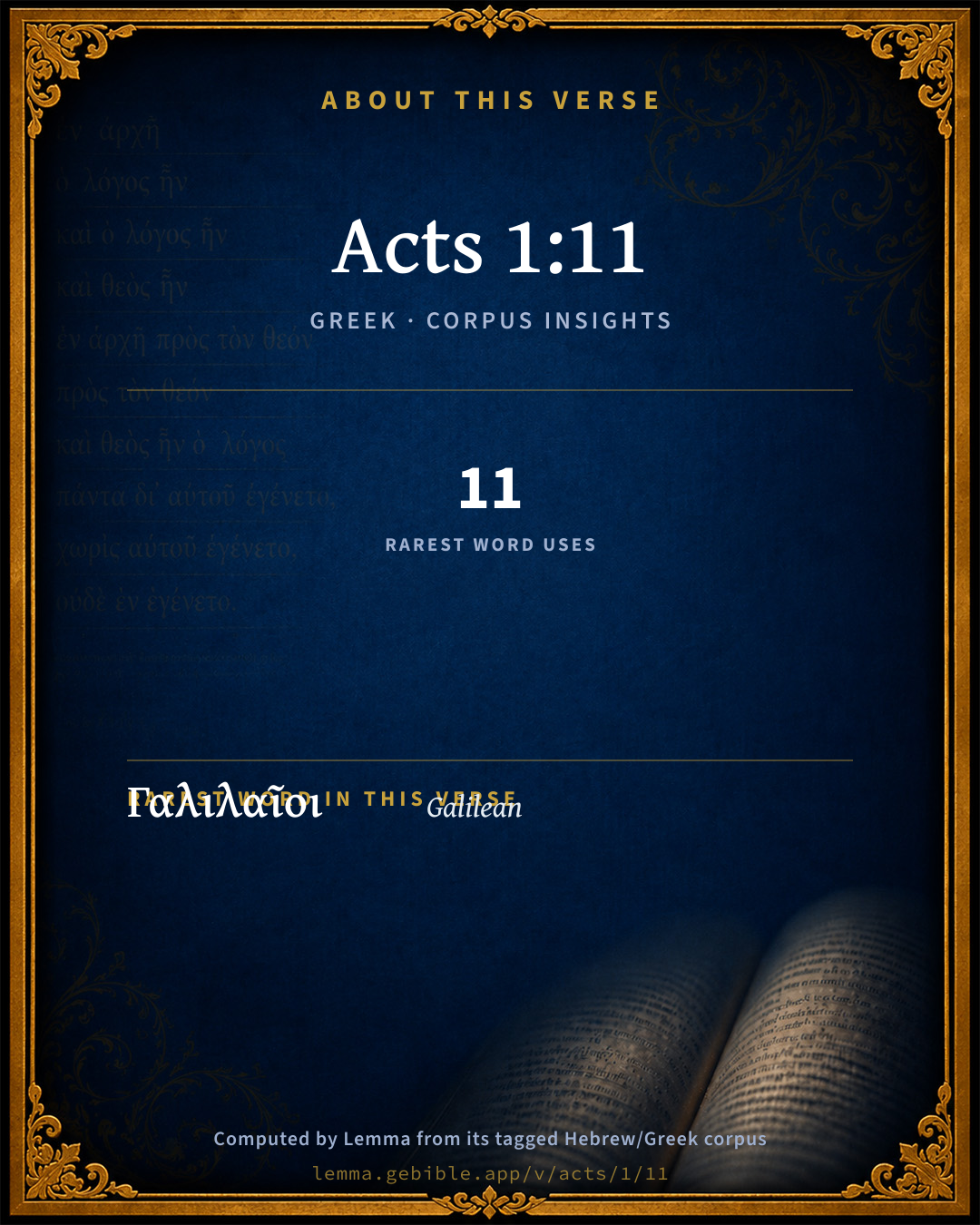
The rarest word here is Γαλιλαῖοι Galilean G1057 — appearing just 11 times in the whole Greek New Testament.

Shared distinctive vocabulary

Γαλιλαῖοι Galilean G1057 occurs in 10 verses of the Greek New Testament. Also found in:

Repetition

Words recur within this verse:

Cross-references

16

Topical passages linked to Acts 1:11 in the Treasury of Scripture Knowledge — connected by theme and wording, ordered by reader-vote popularity; previews shown in the World English Bible.

  • Revelation 1:7 Behold, he is coming with the clouds, and every eye will see him, including those who pierced him. All the tribes of the earth will mourn over him. Even so, Amen.
  • 1 Thessalonians 4:16 For the Lord himself will descend from heaven with a shout, with the voice of the archangel, and with God's trumpet. The dead in Christ will rise first,
  • Mark 13:26 Then they will see the Son of Man coming in clouds with great power and glory.
  • John 14:3 If I go and prepare a place for you, I will come again, and will receive you to myself; that where I am, you may be there also.
  • Matthew 24:30 and then the sign of the Son of Man will appear in the sky. Then all the tribes of the earth will mourn, and they will see the Son of Man coming on the clouds of the sky with power and great glory.
  • Matthew 16:27 For the Son of Man will come in the glory of his Father with his angels, and then he will render to everyone according to his deeds.
  • Matthew 25:31 "But when the Son of Man comes in his glory, and all the holy angels with him, then he will sit on the throne of his glory.
  • Daniel 7:13–14 I saw in the night-visions, and, behold, there came with the clouds of the sky one like a son of man, and he came even to the ancient of days, and they brought him near before him.
  • 1 Thessalonians 1:10 and to wait for his Son from heaven, whom he raised from the dead-- Jesus, who delivers us from the wrath to come.
  • Luke 21:27 Then they will see the Son of Man coming in a cloud with power and great glory.
  • Acts 13:31 and he was seen for many days by those who came up with him from Galilee to Jerusalem, who are his witnesses to the people.
  • 2 Thessalonians 1:7–10 and to give relief to you that are afflicted with us, when the Lord Jesus is revealed from heaven with his mighty angels in flaming fire,
  • Luke 24:5 Becoming terrified, they bowed their faces down to the earth. They said to them, "Why do you seek the living among the dead?
  • Acts 3:12 When Peter saw it, he responded to the people, "You men of Israel, why do you marvel at this man? Why do you fasten your eyes on us, as though by our own power or godliness we had made him walk?
  • Acts 2:7 They were all amazed and marveled, saying to one another, "Behold, aren't all these who speak Galileans?
  • Mark 14:70 But he again denied it. After a little while again those who stood by said to Peter, "You truly are one of them, for you are a Galilean, and your speech shows it."

Cross-references courtesy of OpenBible.info (CC BY 4.0).

Commentary

Notes on Acts 1:11 from classic Christian and Jewish commentators (each source and its license shown beneath its notes). The classic Christian expositions comment on the surrounding passage and are grouped to its opening verse, so a note may address several verses; the Jewish commentaries on the Tanakh (Rashi and others) are per-verse, so they appear only where the commentator wrote on this verse.

Lemma curates 59 commentaries, every one of them public domain or Creative Commons licensed, each selected and text-cleaned for this edition rather than reprinted as found. About our sources →

MacLaren's Expositions of Holy Scripture

Alexander MacLaren

Luke - Acts

THE ASCENSION

WAS, IS, IS TO COME

Luk 2:16. - Luk 24:51. - Act 1:11.

These three fragments, which I have ventured to isolate and bring together, are all found in one author’s writings. Luke’s biography of Jesus stretches from the cradle in Bethlehem to the Ascension from Olivet. He narrates the Ascension twice, because it has two aspects. In one it looks backward, and is necessary as the completion of what was begun in the birth. In one it looks forward, and makes necessary, as its completion, that coming which still lies in the future. These three stand up, like linked summits in a mountain. We can understand none of them unless we embrace them all. If the story of the birth is true, a life so begun cannot end in an undistinguished death like that of all men. And if the Ascension from Olivet is true, that cannot close the history of His relations to men. The creed which proclaims He was ‘born of the Virgin Mary’ must go on to say ‘. . . He ascended up into heaven’; and cannot pause till it adds ‘. . . From thence He shall come to judge the quick and the dead.’ So we have then three points to consider in this sermon.

I. Note first, the three great moments.

The thing that befell at Bethlehem, in the stable of the inn, was a commonplace and insignificant enough event looked at from the outside: the birth of a child to a young mother. It had its elements of pathos in its occurring at a distance from home, among the publicity and discomforts of an inn stable, and with some cloud of suspicion over the mother’s fair fame. But the outside of a fact is the least part of it. A little film of sea-weed floats upon the surface, but there are fathoms of it below the water. Men said, ‘A child is born.’ Angels said, and bowed their faces in adoration, ‘The Word has become flesh’. The eternal, self-communicating personality in the Godhead, passed voluntarily into the condition of humanity. Jesus was born, the Son of God came. Only when we hold fast by that great truth do we pierce to the centre of what was done in that poor stable, and possess the key to all the wonders of His life and death.

From the manger we pass to the mountain. A life begun by such a birth cannot be ended, as I have said, by a mere ordinary death. The Alpha and the Omega of that alphabet must belong to the same fount of type. A divine conformity forbids that He who was born of the Virgin Mary should have His body laid to rest in an undistinguished grave. And so what Bethlehem began, Olivet carries on.

Note the circumstances of this second of these great moments. The place is significant. Almost within sight of the city, a stone’s throw probably from the home where He had lodged, and where He had conquered death in the person of Lazarus; not far from the turn of the road where the tears had come into His eyes amidst the shouting of the rustic procession, as He had looked across the valley; just above Gethsemane, where He had agonised on that bare hillside to which He had often gone for communion with the Father in heaven. There, in some dimple of the hill, and unseen but by the little group that surrounded Him, He passed from their midst. The manner of the departure is yet more significant than the place. Here were no whirlwind, no chariots and horses of fire, no sudden rapture; but, as the narrative makes emphatic, a slow, leisurely, self-originated floating upwards. He was borne up from them, and no outward vehicle or help was needed; but by His own volition and power He rose towards the heavens. ‘And a cloud received Him out of their sight’-the Shechinah cloud, the bright symbol of the Divine Presence which had shone round the shepherds on the pastures of Bethlehem, and enwrapped Him and the three disciples on the Mount of Transfiguration. It came not to lift Him on its soft folds to the heavens, but in order that, first, He might be plainly seen till the moment that He ceased to be seen, and might not dwindle into a speck by reason of distance; and secondly, that it might teach the truth, that, as His body was received into the cloud, so He entered into the glory which He ‘had with the Father before the world was.’ Such was the second of these moments.

The third great moment corresponds to these, is required by them, and crowns them. The Ascension was not only the close of Christ’s earthly life which would preserve congruity with its beginning, but it was also the clear manifestation that, as He came of His own will, so He departed by His own volition. ‘I came forth from the Father, and am come into the world. Again, I leave the world and go unto the Father.’ Thus the earthly life is, as it were, islanded in a sea of glory, and that which stretches away beyond the last moment of visibility, is like that which stretched away beyond the first moment of corporeity; the eternal union with the eternal Father. But such an entrance on and departure from earth, and such a career on earth, can only end in that coming again of which the angels spoke to the gazing eleven.

Mark the emphasis of their words. ‘This same Jesus,’ the same in His manhood, ‘shall so come, in like manner, as ye have seen Him go.’ How much the ‘in like manner’ may mean we can scarcely dogmatically affirm. But this, at least, is clear, that it cannot mean less than corporeally visible, locally surrounded by angel-guards, and perhaps, according to a mysterious prophecy, to the same spot from which He ascended. But, at all events, there are the three moments in the manifestation of the Son of God.

II. Look, in the second place, at the threefold phases of our Lord’s activity which are thus suggested.

I need not dwell, in more than a sentence or two, on the first of these. Each of these three moments is the inauguration of a form of activity which lasts till the emergence of the next of the triad.

The birth at Bethlehem had, for its consequence and purpose, a threefold end: the revelation of God in humanity, the manifestation of perfect manhood to men, and the rendering of the great sacrifice for the sins of the world. These three-showing us God; showing ourselves as we are and as we may be; as we ought to be, and, blessed be His name, as we shall be, if we observe the conditions; and the making reconciliation for the sins of the whole world-these are the things for which the Babe lying in the manger was born and came under the limitations of humanity.

Turn to the second of the three, and what shall we say of it? That Ascension has for its great purpose the application to men of the results of the Incarnation. He was born that He might show us God and ourselves, and that He might die for us. He ascended up on high in order that the benefits of that Revelation and Atonement might be extended through, and appropriated by, the whole world.

One chief thought which is enforced by the narrative of the Ascension is the permanence, the eternity of the humanity of Jesus Christ. He ascended up where He was before, but He who ascended is not altogether the same as He who had been there before, for He has taken up with Him our nature to the centre of the universe and the throne of God, and there, ‘bone of our bone, and flesh of our flesh,’ a true man in body, soul, and spirit, He lives and reigns. The cradle at Bethlehem assumes even greater solemnity when we think of it as the beginning of a humanity that is never laid aside. So we can look confidently to all that blaze of light where He sits, and feel that, howsoever the body of His humiliation may have been changed into the body of His glory, He still remains corporeally and spiritually a true Son of man. Thus the face that looks down from amidst the blaze, though it be ‘as the sun shineth in his strength,’ is the old face; and the breast which is girded with the golden girdle is the same breast on which the seer had leaned his happy head; and the hand that holds the sceptre is the hand that was pierced with the nails; and the Christ that is ascended up on high is the Christ that loved and pitied adulteresses and publicans, and took the little child in His gracious arms-’The same yesterday, and to-day, and for ever.’

Christ’s Ascension is as the broad seal of heaven attesting the completeness of His work on earth. It inaugurates His repose which is not the sign of His weariness, but of His having finished all which He was born to do. But that repose is not idleness. Rather it is full of activity.

On the Cross He shouted with a great voice ere He died, ‘It is finished.’ But centuries, perhaps millenniums, yet will have to elapse before the choirs of angels shall be able to chant, ‘It is done: the kingdoms of the world are the kingdoms of God and of His Christ.’ All the interval is filled by the working of that ascended Lord whose session at the right hand of God is not only symbolical of perfect repose and a completed sacrifice, but also of perfect activity in and with His servants.

He has gone-to rest, to reign, to work, to intercede, and to prepare a place for us. For if our Brother be indeed at the right hand of God, then our faltering feet may travel to the Throne, and our sinful selves may be at home there. The living Christ, working to-day, is that of which the Ascension from Olivet gives us the guarantee.

The third great moment will inaugurate yet another form of activity as necessary and certain as either of the two preceding. For if His cradle was what we believe it to have been, and if His sacrifice was what Scripture tells us it is, and if through all the ages He, crowned and regnant, is working for the diffusion of the powers of His Cross and the benefits of His Incarnation, there can be no end to that course except the one which is expressed for us by the angels’ message to the gazing disciples: He shall so come in like manner as ye have seen Him go. He will come to manifest Himself as the King of the world and its Lord and Redeemer. He will come to inaugurate the great act of Judgment, which His great act of Redemption necessarily draws after it, and Himself be the Arbiter of the fates of men, the determining factor in whose fates has been their relation to Him. No doubt many who never heard His name upon earth will, in that day be, by His clear eye and perfect judgment, discerned to have visited the sick and the imprisoned, and to have done many acts for His sake. And for us who know Him, and have heard His name, the way in which we stand affected in heart and will to Christ reveals and settles our whole character, shapes our whole being, and will determine our whole destiny. He comes, not only to manifest Himself so as that ‘every eye shall see Him,’ and to divide the sheep from the goats, but also in order that He may reign for ever and gather into the fellowship of His love and the community of His joys all who love and trust Him here. These are the triple phases of our Lord’s activity suggested by the three great moments.

III. Lastly, notice the triple attitude which we should assume to Him and to them.

For the first, the cradle, with its consequence of the Cross, our response is clinging faith, grateful memory, earnest following, and close conformity. For the second, the Ascension, with its consequence of a Christ that lives and labours for us, and is with us, our attitude ought to be an intense realisation of the fact of His present working and of His present abode with us. The centre of Christian doctrine has, amongst average Christians, been far too exclusively fixed within the limits of the earthly life, and in the interests of a true and comprehensive grasp of all the blessedness that Christianity is capable of bringing to men, I would protest against that type of thought, earnest and true as it may be within its narrow limits, which is always pointing men to the past fact of a Cross, and slurs over and obscures the present fact of a living Christ who is with us, and in us. One difference between Him and all other benefactors and teachers and helpers is this, that, as ages go on, thicker and ever-thickening folds of misty oblivion wrap them, and their influence diminishes as new circumstances emerge, but this Christ’s power laughs at the centuries, and is untinged by oblivion, and is never out of date. For all others we have to say-’having served his generation,’ or a generation or two more, ‘according to the will of God, he fell on sleep.’ But Christ knows no corruption, and is for ever more the Leader, and the Companion, and the Friend, of each new age.

Brethren! the Cross is incomplete without the throne. We are told to go back to the historical Christ. Yes, Amen, I say! But do not let that make us lose our grasp of the living Christ who is with us to-day. Whilst we rejoice over the ‘Christ that died,’ let us go on with Paul to say, ‘Yea! rather, that is risen again, and is even at the right hand of God, who also maketh intercession for us.’

For that future, discredited as the thought of the second corporeal coming of the Lord Jesus in visible fashion and to a locality has been by the fancies and the vagaries of so-called Apocalyptic expositors, let us not forget that it is the hope of Christ’s Church, and that ‘they who love His appearing’ is, by the Apostle, used as the description and definition of the Christian character. We have to look forwards as well as backwards and upwards, and to rejoice in the sure and certain confidence that the Christ who has come is the Christ who will come.

For us the past should be full of Him, and memory and faith should cling to His Incarnation and His Cross. The present should be full of Him, and our hearts should commune with Him amidst the toils of earth. The future should be full of Him, and our hopes should be based upon no vague anticipations of a perfectibility of humanity, nor upon any dim dreams of what may lie beyond the grave; but upon the concrete fact that Jesus Christ has risen, and that Jesus Christ is glorified. Does my faith grasp the Christ that was-who died for me? Does my heart cling to the Christ who is-who lives and reigns, and with whom my life is hid in God? Do my hopes crystallise round, and anchor upon, the Christ that is to come, and pierce the dimness of the future and the gloom of the grave, looking onwards to that day of days when He, who is our life, shall appear, and we shall appear also with Him in glory?

Alexander MacLaren, Expositions of Holy Scripture (1904–1910) — public domain. Text from a community e-Sword module.

Scofield Reference Notes

C. I. Scofield

come

The two Advents--Summary:

(1) The O.T. foreview of the coming Messiah is in two aspects--that of rejection and suffering (as e.g. in Is 53), and that of earthly glory and power (as e.g. In Is 11 Jeremiah 23 Ezekiel 37). Often these two aspects blend in one passage (e.g. Psalms 2). The prophets themselves were perplexed by this seeming contradiction 1Pe 1:10; 1Pe 1:11. It was solved by partial fulfilment. In due time the Messiah, born of a virgin according to Isaiah, appeared among men and began His ministry by announcing the predicted kingdom as "at hand."

(See Scofield "Mat 4:17"). The rejection of King and kingdom followed.

(2) Thereupon the rejected King announced His approaching crucifixion, resurrection, departure, and return (Matthew 24, 25). Mat 12:38-40; Mat 16:1-4; Mat 16:21; Mat 16:27; Luk 12:35-46; Luk 17:20-36; Luk 18:31-34; Luk 19:12-27.

(3) He uttered predictions concerning the course of events between His departure and return Mat 13:1-50; Mat 16:18; Mat 24:4-26

(4) This promised return of Christ becomes a prominent theme in the Acts, Epistles, and Revelation.

Taken together, the N.T. teachings concerning the return of Jesus Christ may be summarized as follows:

(1) That return is an event, not a process, and is personal and corporeal Mat 23:39; Mat 24:30; Mat 25:31; Mar 14:62; Luk 17:24; Joh 14:3; Act 1:11; Php 3:20; Php 3:21; 1Th 4:14-17.

(2) His coming has a threefold relation: to the church, to Israel, to the nations.

(a) To the church the descent of the Lord into the air to raise the sleeping and change the living saints is set forth as a constant expectation and hope Mat 24:36; Mat 24:44; Mat 24:48-51; Mat 25:13; 1Co 15:51; 1Co 15:52; Php 3:20; 1Th 1:10; 1Th 4:14-17; 1Ti 6:14; Tit 2:13; Rev 22:20.

(b) To Israel, the return of the Lord is predicted to accomplish the yet unfulfilled prophecies of her national regathering, conversion, and establishment in peace and power under the Davidic Covenant Act 15:14-17 with Zec 14:1-9.

See "Kingdom (O.T.)" 2Sa 7:8-17.

(See Scofield "Zec 13:8")

Luk 1:31-33

(See Scofield "1Co 15:24")

(c) To the Gentile nations the return of Christ is predicted to bring the destruction of the present political world-system Dan 2:34; Dan 2:35. (See Scofield "Rev 19:11"), the judgment of Mat 25:31-46 followed by world-wide Gentile conversion and participation in the blessings of the kingdom; Isa 2:2-4; Isa 11:10; Isa 60:3; Zec 8:3; Zec 8:20; Zec 8:23; Zec 14:16-21.

The Scofield Reference Bible (1917 edition), notes by C. I. Scofield — public domain. Text from a community e-Sword module.

Tyndale Open Study Notes

Tyndale Open Resources

1:11 Jesus promised to return from heaven in the same way (see Matt 24:30; Mark 13:26; John 14:3). Jesus has gone to heaven to prepare the place for his followers (John 12:26; 14:1-4; 2 Cor 5:4; Phil 3:21; Heb 6:20).

Tyndale Open Study Notes — © Tyndale Open Resources, licensed CC BY-SA 4.0. Text via the HelloAO Bible API.

Bengel's Gnomon

Johann Albrecht Bengel

Act 1:11. Γαλιλαῖοι, ye men of Galilee) In apparitions which are vouchsafed to individuals, the angels employed the proper name: instead of which in this place the name of their country is employed, under which they all are included. Out of Galilee seldom, if ever, a prophet had arisen; hut all the apostles had come out of it.—τί, why?) A similar Why occurs in ch. Act 3:12.—ἐμβλέποντες) gazing earnestly, with a lingering look up into heaven, which now it serves no purpose to look at, since Jesus is no longer to he seen.—οὕτως, ὅν τρόπον, so, in like manner as) A similar phrase occurs, ch. Act 27:25, “even as it was told me:” 2Ti 3:8.—ἐλεύσεται, shall come) It is the Ascension of Christ, rather than His Advent to judgment, which is described in Scripture as His return. He is said to come, not only because He had not previously come to judge, but because His Adwent in glory shall be much more remarkable than His first Advent. The world had not believed that the Son of GOD had come: in respect to believers He is said to return: Joh 14:3, “I come again (= return) and receive you to Myself.” Then He shall be revealed in His own day. The verb cometh already was employed in the prophecy of Enoch, Jude Act 1:14. He shall come, in a visible manner, in a cloud, with a trumpet, with an attendant train, and perhaps in the same place, Act 1:12, “the mount called Olivet.” Add Zec 14:4, “His feet shall stand in that day upon the Mount of Olives, which is before Jerusalem on the east.” Comp. the annot. of Michaëlis, and the note on Mat 24:27, “As the lightning cometh out of the East, so shall the coming of the Son of man be” [It is probable that Christ’s coming will be from the East]. Not those who saw Him ascending are said to be about to see Him when He shall come. Between His Ascension and His Coming in glory no event intervenes equal in importance to each of these two events: therefore these two are joined together. Naturally therefore the apostles, before the giving of the Apocalypse, set before them the day of Christ as very near. And it accords with the majesty of Christ, that during the whole period between His Ascension and His Advent, He should without intermission be expected.

Bengel's Gnomon of the New Testament — English translation (T&T Clark, Edinburgh, 1860) — public domain. Text from a community e-Sword module.

Expositor's Greek Testament

ed. W. Robertson Nicoll

Act 1:11 . ἄνδρες Γαλ .: the ἄνδρες in similar expressions is often indicative of respect as in classical Greek, but as addressed by angels to men it may denote the earnestness of the address (Nösgen). St. Chrysostom saw in the salutation a wish to gain the confidence of the disciples: “Else, why needed they to be told of their country who knew it well enough?” Calvin also rejects the notion that the angels meant to blame the slowness and dulness of apprehension of Galilæans. At the same time the word Γαλ . seems to remind us that things which are despised (Joh 7:52 ) hath God chosen. Ex Galilæa nunquam vel certe raro fuerat propheta; at omnes Apostoli (Bengel); see also below. οὗτος ὁ Ἰησοῦς : if the mention of their northern home had reminded the disciples of their early choice by Christ and of all that He had been to them, the personal name Jesus would assure them that their master would still be a human Friend and divine Saviour; Hic Jesus: qui vobis fuit eritque semper Jesus, id est, Salvator (Corn. à Lap.). πορευόμενον : on the frequency of the verb in St. Luke as compared with other N.T. writers, often used to give effect and vividness to the scene, both Friedrich and Zeller remark; St. Peter uses the same word of our Lord’s Ascension, 1Pe 3:22 . As at the Birth of Christ, so too at His Ascension the angels’ message was received obediently and joyfully, for only thus can we explain Luk 24:52 .

The Expositor's Greek Testament, edited by W. Robertson Nicoll (1897–1910) — public domain. Text from a community e-Sword module.

Geneva Bible (1599)

Geneva Bible translators

That is, out of your sight.

Geneva Bible (1599) marginal notes — public domain. Text via Bolls.life.

Jamieson, Fausset & Brown

Robert Jamieson, A. R. Fausset & David Brown

Ye men of Galilee, why stand ye gazing up into heaven, &c.--"as if your now glorified Head were gone from you never to return: He is coming again; not another, but 'this same Jesus'; and 'as ye have seen Him go, in the like manner shall He come'--as personally, as visibly, as gloriously; and let the joyful expectation of this coming swallow up the sorrow of that departure."

Jamieson, Fausset & Brown — Commentary Critical and Explanatory on the Whole Bible (1871) — public domain (CC PDM 1.0). Text via the HelloAO Bible API.

Adam Clarke's Commentary

Verse 11. Gazing up into heaven] Not to the top of a mountain, to which an unbridled fancy, influenced by infidelity, would intimate he had ascended, and not to heaven.

This same Jesus] Clothed in human nature. shall so come in like manner-with the same body, descending from heaven by his sovereign and all-controlling power, as ye have seen him go into heaven. Thus shall he come again to judge the quick and the dead. It was a very ancient opinion among Christians, that when Christ should come again to judge the world he would make his appearance on Mount Olivet. Some think that his coming again to destroy the Jewish nation is what the angels refer to. See a connected account of the different appearances of Christ at the end of this chapter.

Adam Clarke's Commentary on the Bible (1810–1826) — public domain. Text from a community e-Sword/MySword module.

John Calvin's Commentaries

11. Ye men of Galilee, etc. I am not of their opinion who think that this name was given the apostles after an opprobrious sort, as if the angels meant to reprehend the slowness and dullness of the apostles. In my opinion, it was rather to make them more attentive, in that men, whom they did never see before, did name them as though they had perfectly known them. But they seem to reprehend without cause, for looking up into heaven. For where should they rather seek for Christ than in heaven? Doth not the Scriptures also oftentimes exhort us thereunto? I answer, that they were not reprehended because they looked up towards heaven; but because they coveted to see Christ, when as the cloud which was put between them and him did keep them from seeing him with their bodily senses: Secondly, because they hoped that he would return again straightway, that they might enjoy the sight of him again, when as lie did ascend to stay in the heavens until such time as he should come to judge the world. Wherefore, let us first learn out of this place that we must not seek Christ either in heaven, either upon earth, otherwise than by faith; and also, that we must not desire to have him present with us bodily in the world; for he that doth either of those two shall oftentimes go farther from him. So this their admiration is reprehended, not simply, but inasmuch as they were astonied by the strangeness of this matter; like as we are oftentimes carried unadvisedly into a wonderful great wondering at God’s works; but we never apply ourselves to consider for what end and purpose they were done.

Jesus, which is taken up into heaven There are two members in this one sentence. The first is, that Christ was taken up into heaven, that they may not henceforth foolishly desire to have him any longer conversant with them upon earth. The other is straightway added as a consolation concerning his second coming. Out of these two jointly, and also severally, is gathered a firm, stable, and strong argument, to refute the Papists, and all other which imagine that Christ is really present in the signs of bread and wine. For when it is said that Christ is taken up into heaven; here is plainly noted the distance of place. I grant that this word heaven is interpreted divers ways, sometimes for the air, sometimes for the whole connection of the spheres, sometimes for the glorious kingdom of God, where the majesty of God hath his [its] proper scat, howsoever it doth fill the whole world. After which sort Paul doth place Christ above all heavens, (Ephesians 1:22,) because he is above all the world, and hath the chiefest room in that place of blessed immortality, because he is more excellent than all the angels, (Ephesians 4:15.) But this is no let why he may not be absent from us bodily, and that by this word heavens, there may not be signified a separation from the world. Let them cavil as much as they will, it is evident that the heaven whereinto Christ was received is opposite to the frame of the world; therefore it doth necessarily follow, that if he be in heaven, he is without [beyond] the world.

But, first, we must mark what the purpose of the angels was, for thereby we shall more perfectly know what the words mean. The angels’ intent was to call back the apostles from desiring the carnal presence of Christ. For this purpose was it that they said that he should not come again until he came to judge the world. And to this end serveth the assigning of the time, that they might not look for him in vain before that same time. Who seeth not that in these words is manifestly showed that he was bodily absent out of the world? Who seeth not that we are forbidden to desire to have him upon the earth? But, they think they escape safe with that crafty answer, when as they say that then he shall come visibly; but he cometh now invisibly daily. But we are not here to dispute of his form; only the apostles are taught that Christ must abide in heaven until such time as he appear at the latter day. For the desiring of his corporeal presence is here condemned as absurd and perverse. The Papists deny that he is present in the sacrament carnally, while that his glorious body is present with us after a supernatural sort, and by a miracle; but we may well enough reject their inventions concerning his glorious body, as childish and frivolous toys. They feign unto themselves a miracle not confirmed with any testimony of Scripture. The body of Christ was then glorious, when as he was conversant with his disciples after his resurrection. This was done by the extraordinary and secret power of God; yet, notwithstanding, the angels do forbid to desire him afterward after that sort, and they say that he shall not come unto men in that sort (before the latter day.) Therefore, according to their commandment, let us not go about to pull him out of the heavens with our own inventions; neither let us think that we call handle him with our hands, or perceive him with our other senses, more than we can see him with our eyes. I speak always of his body. For in that they say it is infinite, as it is all absurd dream, so is it safely to be rejected. Nevertheless, I willingly confess that Christ is ascended that he may fulfill [fill] all things; but I say that he is spread abroad everywhere by the power of his Spirit, not by the substance of his flesh. I grant, furthermore, that he is present With us both in his word and in the sacraments. Neither is it to be doubted, but that all those which do with faith receive the signs of his flesh and blood, are made truly partakers of his flesh and blood. But this partaking doth nothing agree with the dotings of the Papists; for they feign that Christ is present in such sort upon the altar as Numa Pompilius did call down his Jupiter Elicitus, or as those witches did fetch down the moon from heaven with their enchantments. But Christ, by reaching us the bread in his Supper, doth will us to lift up our hearts into heaven, that we may have life by his flesh and blood. So that we do not eat his flesh grossly, that we may live thereby, but he poureth into us, by the secret power of his Spirit, his force and strength.

He shall so come I have said before, that by this consolation all sorrow which we might conceive, because of Christ’s absence, is mitigated, yea, utterly taken away, when as we hear that he shall return again. And also the end for which he shall come again is to be noted; namely, that he shall come as a Redeemer, and shall gather us with him into blessed immortality. For as lie doth not now sit idle in heaven, (as Homer signifieth, that his gods be busied only about their bellies;) so shall not he appear again without profit. Therefore, the only looking for Christ’s coming must both restrain the importunate desires of our flesh, and support our patience in all our adversities; and, lastly, it must refresh our weariness. But it worketh this only in the faithful, which believe that Christ is their Redeemer; for it bringeth unto the wicked nothing but dread, horror, and great fearfulness. And howsoever they do now scoff’ and jest when as they hear of his coming, yet shall they be compelled to behold him sitting upon his tribunal-seat, whom now they will not vouchsafe to hear speak. Furthermore, it were but frivolous to move any question about his apparel wherewith he was then clothed, whether he shall come again being clothed with the same or no. Neither am I now determined to refute that which Augustine, in his Epistle unto Consentius, doth touch, (August. ad Con. Epist. 146;) notwithstanding, it is better for me to omit that thing which I cannot unfold.

John Calvin's Commentaries (1540-1563) — public domain. Text from the Calvin Translation Society English edition (1840s-50s) via the Christian Classics Ethereal Library (ccel.org). Calvin's coverage is partial (roughly two-thirds of the Bible); uncommented books and verses are honest gaps, never fabricated. The 19th-century editor's footnotes and remarks are omitted so the notes are faithfully Calvin's own voice.

Ellicott's Commentary for English Readers

(11) Shall so come in like manner as ye have seen him go into heaven.—So our Lord, following the great prophecy of Dan_7:13, had spoken of Himself as “coming in the clouds of heaven” (see Note on Mat_26:64), in visible ‘majesty and glory. Here, again, men have asked questions which they cannot answer; not only, when shall the end be, but where shall the Judge thus appear? what place shall be the chosen scene of His second Advent? So far as we dare to localise what is left undefined, the words of the angels suggest the same scene, as well as the same manner. Those who do not shrink from taking the words of prophecy in their most literal sense, have seen in Zec_14:4, an intimation that the Valley of Jehosophat (= Jehovah judges)—the “valley of decision”—shall witness the great Assize, and that the feet of the Judge shall stand upon the Mount of Olives, from which He had ascended into heaven. This was the current mediæval view, and seems, if we are to localise at all, to be more probable than any other.

A Bible Commentary for English Readers, edited by Charles John Ellicott (1878–1897) — public domain. Text from a community e-Sword module.

The Cambridge Bible for Schools and Colleges

gen. ed. J. J. S. Perowne

11. Ye men of Galilee] The Galilæan dialect was a marked peculiarity of the apostolic band. It seems also to have been our Lord’s manner of speech. For when Peter is accused (Mat_26:73) of being one of Christ’s followers the words of the accusation are “Surely thou art one of them, for thy speech bewrayeth thee.”

shall so come] This promise of the return of Jesus, on the immediate expectation of which so many of the first Christians fixed their thoughts, explains those words in the abridged account of the Ascension in St Luke’s Gospel (Luk_24:52), “They returned to Jerusalem with great joy.”

The Cambridge Bible for Schools and Colleges (gen. ed. J. J. S. Perowne; Cambridge University Press, 1878–1918) — public domain. Text from a community e-Sword module.

John Gill's Exposition

Which also said, ye men of Galilee,.... And which was said by them, not to reproach them with their country, but partly to let them know that they knew them, who they were, and from whence they came; and partly to observe the rich and distinguishing grace of God in choosing such mean and contemptible persons to be the apostles of Christ, and eyewitnesses of his majesty:

why stand ye gazing up into heaven? reproving them for their curiosity in looking after Christ with their bodily eyes, who was no more in common to be seen this way, but with an eye of faith; and for their desire after his corporeal presence, which they were not to look for; and as if they expected he would return again immediately, whereas his return will not be till the end of the world: and besides, they were not to remain on that spot, or stand gazing there; they were to go to Jerusalem, and abide there, as Christ had ordered, till they should receive the Holy Spirit in an extraordinary way; and then they were to preach a crucified Christ, and declare that he was risen from the dead, and was gone to heaven, and was ordained to be the Judge of quick and dead,

This same Jesus; and not another; the same in person, in body and soul:

which is taken up from you into heaven; who was taken up in a cloud out of their sight, and received into heaven, where he will be till the times of the restitution of all things; and which might be matter of grief to them, because of the loss of his bodily presence; though it should have been rather joyful to them, since he was gone to the Father, and as their forerunner, to prepare a place, and make intercession for them:

shall so come in like manner as ye have seen him go into heaven; he shall come in the same flesh, in the same human nature; he shall come in the clouds of heaven, and shall be attended with his mighty angels, as he now was; he shall descend himself in person, as he now ascended in person; and as he went up with a shout, and with the sound of a trumpet, see Psa 47:5 so he shall descend with a shout, with the voice of the archangel, and the trump of God; and, it may be, he shall descend upon the very spot from whence he ascended; see Zac 14:4 and it is a notion of the Jews, that the resurrection of the Israelites will be there: they say (m), that "when the dead shall live, the Mount of Olives shall be cleaved asunder, and all the dead of Israel shall come out from under it; yea, even the righteous which die in captivity shall pass through a subterranean cavern, and come out from under the Mount of Olives.

(m) Targum in Cant. viii. 5.

John Gill's Exposition of the Whole Bible (1746–1763) — public domain (CC PDM 1.0). Text via the HelloAO Bible API.

Trapp's Complete Commentary

John Trapp

11 Which also said, Ye men of Galilee, why stand ye gazing up into heaven? this same Jesus, which is taken up from you into heaven, shall so come in like manner as ye have seen him go into heaven.

Ver. 11. Shall so come] De tempore ne quire, not a word of the time when, in answer to that overly curious question, Act 1:6. Solomon’s temple was finished in the year of the world 3000; whether Christ’s shall be consummated in 3000 more, I have not to say.

John Trapp, A Commentary or Exposition upon All the Books of the Old and New Testament (1647–1656) — public domain. Text from a community e-Sword module.

Albert Barnes' Notes on the Bible

Ye men of Galilee - Galilee was the place of their former residence, and they were commonly known by the name of Galileans.

Why stand ye ... - There is doubtless a slight degree of censure implied in this, as well as a design to call their attention away from a vain attempt to see the departed Saviour. The impropriety may have been:

In the feeling of disappointment, as if he would not restore the kingdom to Israel. Possibly they were expecting that he would again soon appear, though he had often foretold them that he would ascend to heaven.

(3)There might have been an impropriety in their earnest desire for the mere bodily presence of the Lord Jesus, when it was more important that he should be in heaven. We may see here also that it is our duty not to stand in idleness, and to gaze even toward heaven. We, as well as the apostles, have a great work to do, and we should actively engage in it without delay.

Gazing up - Looking up.

This same Jesus - This was said to comfort them. The same tried friend who had been so faithful to them would return. They ought not, therefore, to look with despondency at his departure.

Into heaven - This expression denotes into the immediate presence of God; or into the place of perpetual purity and happiness, where God especially manifests his favor. The same thing is frequently designated by his sitting on the right hand of God, as emblematic of power, honor, and favor. See the Mar 16:19; Mar 14:62 notes; Heb 1:3; Heb 8:1 notes; Act 7:55 note; Rom 8:34 note; Eph 1:20 note.

Shall so come - At the day of judgment. Joh 14:3, “if I go and prepare a place for you, I will come again,” etc.

In like manner ... - In clouds, as he ascended. See the Act 1:9 note; 1Th 4:16 note. This address was designed to comfort the disciples. Though their master and friend was taken from them, yet he was not removed forever. He would come again with similar majesty and glory to vindicate his people, and to tread his enemies under his feet. The design for which he will come will be to judge the world, Matt. 25. There will be an evident fitness and propriety in his coming for such reasons as the following:

(1) Because his appropriate work in heaven as mediator will have been accomplished; his people will have been saved; the great enemy of God and man will have been subdued; death will have been conquered; and the gospel will have shown its power in subduing all forms of wickedness; in removing the effects of sin; in establishing the Law, and in vindicating the honor of God; and all will have been done that is necessary to establish the authority of God throughout the universe. It will be proper, therefore, that this mysterious order of things shall be wound up, and the results become a matter of record in the history of the universe. This will be better than it would be to suffer an eternal millennium on the earth, while the saints should many of them slumber, and the wicked still be in their graves.

(2) It is proper that he should come to vindicate his people, and raise them up to glory. Here they have been persecuted, oppressed, put to death. Their character is assailed; they are poor; and the world despises them. It is fit that God should show himself to be their friend; that he should do justice to their injured names and motives; that he should bring out hidden and obscure virtue, and vindicate it; that he should enter every grave and bring forth his friends to life.

(3) It is proper that he should show his hatred of sin. Here it triumphs. The wicked are rich, and honored, and mighty, and say, Where is the promise of his coming? 2Pe 3:4. It is right that he should defend his cause. Hence, the Lord Jesus will come to guard the avenues to heaven, and to see that the universe suffers no wrong by the admission of an improper person to the skies.

(4) The great transactions of redemption have been public, open, often grand. The apostasy was public, in the face of angels and of the universe. Sin has been open, public high-handed. Misery has been public, and has rolled its deep and turbid waves in the face of the universe. Death has been public; all worlds have seen the race cut down and moulder. The death of Jesus was public: the angels saw it; the heavens were clothed with mourning; the earth shook, and the dead arose. Jesus was publicly whipped, cursed, crucified; and it is proper that he should publicly triumph - that all heaven rejoicing, and all hell at length humbled, should see his public victory. Hence, he will come with clouds - with angels - with fire - and will raise the dead, and exhibit to all the universe the amazing close of the scheme of redemption.

(5) We have in these verses a description of the most grand and wonderful events that this world has ever known - the ascension and return of the Lord Jesus. Here is consolation for the Christian; and here is a source of ceaseless alarm to the sinner.

Albert Barnes' Notes on the Bible (1834–1885) — public domain. Text from a community e-Sword/MySword module.

Haydock's Catholic Bible Commentary

So shall he come, as you have seen him going. This word going, says St. John Chrysostom, sufficiently intimates, that he ascended by his own power: for so will he come by his own power to judge the world. (Witham) --- Jesus Christ shall come on the last day, in the same body, in the same majesty, to judge the living and the dead. This he had likewise promised, in more than one place of the gospel, speaking of the vengeance, which he will exercise on the city of Jerusalem. St. Jerome, St. Hilary, and many other ancients, have believed that the Son of God will appear again on Mount Olivet, and that all people shall be assembled to judgment. (St. Jerome, super Joel iii. 2.; St. Hilary, super Matthew xxiv. 32.) --- And that same body, which thus ascended to heaven, and which will thus descend, is given us in the blessed Sacrament. "O miracle! exclaims St. John Chrysostom, He that sitteth with his Father above, is at the same time handled by men below. Jesus Christ ascending to heaven, both hath his flesh with him above, and hath left it with us below. Elias being taken up, left his disciple, Eliseus, his mantle and double spirit, but the Son of Man ascending, left his own flesh for us." (Lib. iii. de Sacerd. him. 2. ad pop. Ant. hom. de divit. et paup.) --- Sulpicius Severus, and St. Paulinus, assure us, that the marks of the feet of our Saviour were imprinted in the place off which he rose to heaven; and St. Augustine informs us, that many in his time went to Judea, to venerate these sacred marks. Ven. Bede testifies the same in the eighth age [i.e. in the 8th century]. In the time of Constantine the great, the empress Helen built a church on the place. (Calmet)

George Leo Haydock (1774–1849), Haydock's Catholic Family Bible and Commentary, 1859 edition — public domain. Excludes Psalms (Douay-Rheims chapter numbering differs from Protestant) and Deuterocanonical books (Catholic canon only).

Matthew Poole's English Annotations

Which also said; the two angels (in the form of men) before mentioned.

Ye men of Galilee; that is, the apostles, who were of that country.

Why stand ye gazing up into heaven? They are roused out of the ecstasy they were in at that glorious sight, to learn what was so much to their and our advantage. Shall so come:

1. Visibly.

2. In a cloud.

3. By his own power.

4. With the like majesty.

5. With the same soul and body.

Matthew Poole's English Annotations on the Holy Bible (1683–1685) — public domain. Text from a community e-Sword/MySword module.

Whedon's Commentary on the Bible

Daniel D. Whedon

11. Men of Galilee—Galilean men; a pathetic epithet now, sending back their thoughts to their origin and home.

Stand… gazing—After Jesus receded from sight they stood a long while gazing into the vacant sky, their eyes longing to recover that loved form now henceforth translated. The angels’ words rebuke their distrust and reassure their faith.

In like manner—This passage is an immovable proof-text of the actual personal second advent of our Jesus. It is the same personal, visible Jesus which ascended that shall come. The coming shall be in like manner with the going. A figurative or spiritual coming would clearly not be a coming of the same Jesus, and still more clearly not a coming in like manner. So in Mat_24:30, “They shall see the Son of man coming in the clouds of heaven.” See notes on that chapter. Very natural was it for these apostles to infer, what was not said, that they should see him during their own day instead of the day of their resurrection.

Daniel D. Whedon (gen. ed.), Commentary on the Old and New Testaments (1874–1909) — public domain. Text from a community e-Sword module.

The Pulpit Commentary

Looking for gazing up, A.V.; this for this same, A.V.; was received for is taken, A.V.; beheld him going for have seen him go, A.V. In like manner; i.e. in a cloud. The description of our Lord"s second advent constantly makes mention of clouds. "Behold, he cometh with clouds". (Rev_1:7) "One like the Son of man came with the clouds of heaven" (Dan_7:13; and so Mat_26:64; Luk_21:27, etc.) We are reminded of the grand imagery of Psa_104:3, "Who maketh the clouds his chariot, who walketh upon the wings of the wind." It may be remarked that the above is by far the fullest account we have of the ascension of our Lord. St. Luke appears to have learnt some further particulars concerning it in the interval between writing his Gospel (Luk_24:50-52) and writing the Acts. But allusions to the Ascension are frequent (Mar_16:19; Joh_6:62 Joh_20:17; Rom_8:34; Eph_4:8, Eph_4:9; Php_2:9; Col_3:1; 1Pe_3:22, etc.) With reference to Zeller"s assertion, that in St. Luke"s Gospel the Ascension is represented as taking place on the day of the Resurrection, it may freely be admitted that the narrative in the Gospel does not mark distinctly the interval of time between the different appearances and discourses of our Lord from the day of the Resurrection to that of the Ascension. It seems to group them according to their logical connection rather than according to their chronological sequence, and to be a general account of what Jesus said between the Resurrection and the Ascension. But there is nothing whatever in the text of St. Luke to indicate that what is related in the section 24:44-49 took place at the same time as the things related in the preceding verses. And when we compare with that section what is contained in Act_1:4, Act_1:5, it becomes clear that it did not. Because the words "assembling together with them," in ver. 4, clearly indicate a different occasion from the apparitions on the day of the Resurrection; and as the words in Luk_24:44-49 correspond with those in Act_1:4, Act_1:5, it must have been also on a different occasion that they were spoken. Again, the narrative of St. John, both in the twentieth and the twenty-first chapters, as well as that of Mat_28:10, Mat_28:16; Mar_16:7, precludes the possibility of the Ascension having taken place, or having been thought to have taken place, on the day of the Resurrection, or for many days after, so that to force a meaning upon the last chapter of St. Luke"s Gospel which it does not necessarily bear, and which places it at variance with St. Luke"s own account in the Acts, (Act_1:3 Act_13:31) and with the Church traditions as preserved by St. Matthew, St. Mark and St. John, is a violent and willful transaction.

The Pulpit Commentary (1880–1919), ed. H.D.M. Spence-Jones & Joseph S. Exell — public domain. Text from a community e-Sword module.

Godbey's Commentary on the New Testament

William B. Godbey

11. “And they said, Galilean men, why stand ye gazing up into Heaven? The same Jesus who was taken up from you into Heaven will so come in the manner in which you saw Him going into Heaven.” Such was the testimony of those radiant angels whose effulgent glory flashed out on the astounded multitude standing on the summit of Mount Olivet and witnessing the glorious ascension of our Lord. He went up amid the clouds, bright and glorious (as there are no rain clouds in Jerusalem in the summer time); so He will come again, riding on a brilliant white cloud, bright as the lightning. He went up accompanied by hosts of angels as well as redeemed spirits. So He will return, attended by mighty hosts of unfallen angels and all the disembodied spirits of the Bridehood, returning to the earth to receive their risen and glorified bodies. Zechariah beautifully corroborates the testimony of these angels: “His feet shall stand again upon Mount Olivet.” This is grand and conclusive, assuring us beyond the possibility of cavil that the very same transfigured and glorified body of Jesus which flew up from Mount Olivet is coming back again to put His feet on that mountain summit. The word of the Lord is unmistakable. The same Jesus who rode over Mount Olivet on the donkey is going to ride down on a cloud and put His glorified feet on the spot He evacuated to fly away to heaven. The very same Jesus who hung on the cross is going to sit on the throne.

William B. Godbey, Commentary on the New Testament (1896–1900) — public domain. Text from a community e-Sword module.

McGarvey & Pendleton's Commentaries

J. W. McGarvey

See notes on verse 10

J. W. McGarvey (with Philip Y. Pendleton), Commentaries on the New Testament (The Fourfold Gospel, 1914; Acts; and the epistles) — public domain. Text from a community e-Sword/MySword module.

The People's New Testament

B. W. Johnson

11. Ye men of Galilee. The apostles were mostly, if not all, Galileans. This same Jesus … shall so come. The cloud received him from their sight. He shall come in the clouds of heaven (Dan. 7:13; Matt. 24:30; 26:24).

B. W. Johnson's The People's New Testament with Notes (1889–1891) — public domain. Electronic text from the Christian Classics Ethereal Library (CCEL) ThML edition.

Cambridge Greek Testament for Schools and Colleges

11. Γαλιλαῖοι. We know that most of the Twelve were called in Galilee, and it is very probable that they were all from the same district, as they would be called at the earliest portion of Christ’s ministerial life, which was begun among His countrymen in the north. Below (Act 5:22) Peter speaks of the new disciple to fill the place of Judas, as one who must be fit to be a witness from the time when John was baptizing; so the Twelve must themselves have been companions of Jesus from that early period. Men of Galilee were easily known by their peculiar dialect. Thus when Peter is accused (Mat 26:73) of being a follower of Jesus, it is said to him, ‘Surely thou art one of them, for thy speech bewrayeth thee,’ a remark which shews plainly that Christ’s immediate followers and friends were known as Galilæans.

οὕτως ἐλεύσεται. These words explain the statement which occurs in the abridged account of the Ascension given by St Luke in the Gospel (Luk 24:52), ‘They returned to Jerusalem with great joy.’ They had been supernaturally assured that He would return to them.

ὃν τρόπον. The manner in which an action is performed is often expressed both in classical and Hellenistic Greek by the simple accusative; cf. Jud 1:7, τὸν ὅμοιον τούτοις τρόπον ἐκπορνεύσασαι. When a relative and antecedent are to be used in this way, the antecedent is transferred not unfrequently, as here, into the relative clause. See Mat 23:37, ὃν τρόπον ὄρνις ἐπισυνάγει τὰ νοσσία. Also LXX. Eze 42:7; 2Ma 15:39.

Cambridge Greek Testament for Schools and Colleges (Cambridge University Press, 1896; 21 vols, various authors incl. Carr, Maclear, Plummer, Farrar, Lumby, Moule, M. R. James, Simcox) — public domain. Text from a community e-Sword module.

Alford’s Greek Testament

Henry Alford

11. οἳ καὶ εἶπαν] who (not only appeared but) also said. There is a propriety in the address, ἄνδρ. Γαλιλαῖοι. It served to remind them of their origin, their call to be His disciples, and the duty of obedience to Him resting on them in consequence.

ὃν τρόπον] in the same manner as;—to be taken in all cases literally, not as implying mere certainty: see reff.

οὕτως, i.e. ἐν νεφέλῃ, Luk 21:27 [in the clouds of heaven: and in the same human form]. His corporeal identity is implied in οὗτος ὁ Ἰησοῦς.

ἐλεύσεται] ‘Non ii, qui ascendentem viderunt, dicuntur venturum visuri. Inter ascensionem et inter adventum gloriosum nullus interponitur eventus eorum utrique par: ideo hi duo conjunguntur. Merito igitur Apostoli ante datam Apocalypsin diem Christi ut valde propinquum proposuerunt. Et congruit majestati Christi, ut toto inter ascensionem et inter adventum tempore sine intermissione expectetur.’ Bengel.

Henry Alford, The Greek Testament (1849–1861) — public domain. Text from a community e-Sword module.

Lesson kit

Teaching starters — assembled from the data on this page, not authored interpretation. Every prompt links to the verse data it draws on. Edit before teaching.

Acts, in the Acts, opens this verse with 31 words (22 distinct Greek lemmas). Its most distinctive word is Galilaîos (“Galilean”). A historical commentator’s framing appears above. Read the whole chapter for the surrounding context.

Discussion questions

  1. How does “Galilean” (Galilaîos) shape what this verse is saying?
  2. Matthew 26:69 shares the word «Galilean» with this verse. How do the two illuminate each other?
  3. “into” occurs 3× in this one verse. What is the effect of the repetition?
  4. These translations render this verse differently. What is at stake in choosing one wording over another?
  5. Reading how MacLaren's Expositions of Holy Scripture and Scofield Reference Notes read this verse, where do the two commentators agree and where do they part?

Things to notice

Reading settings

Reading text

Shown beneath each verse's original-language words.

Old Testament
Old Testament edition

Read the OT as the Masoretic Hebrew (MT) or the Greek Septuagint (LXX).

English shown for the Greek Septuagint (in the Hebrew ↔ Greek comparison).

Comparing translations? Open the Compare panel on any verse page to stack up to four side by side.