
Luke 3:22

Greek (Tischendorf 8th ed.) Luke 3:22 appears in the Greek New Testament. The text above is from the Tischendorf 8th edition. Each word links to its Strong’s number and a concise gloss. Click any word for its full Thayer’s Greek Lexicon entry.
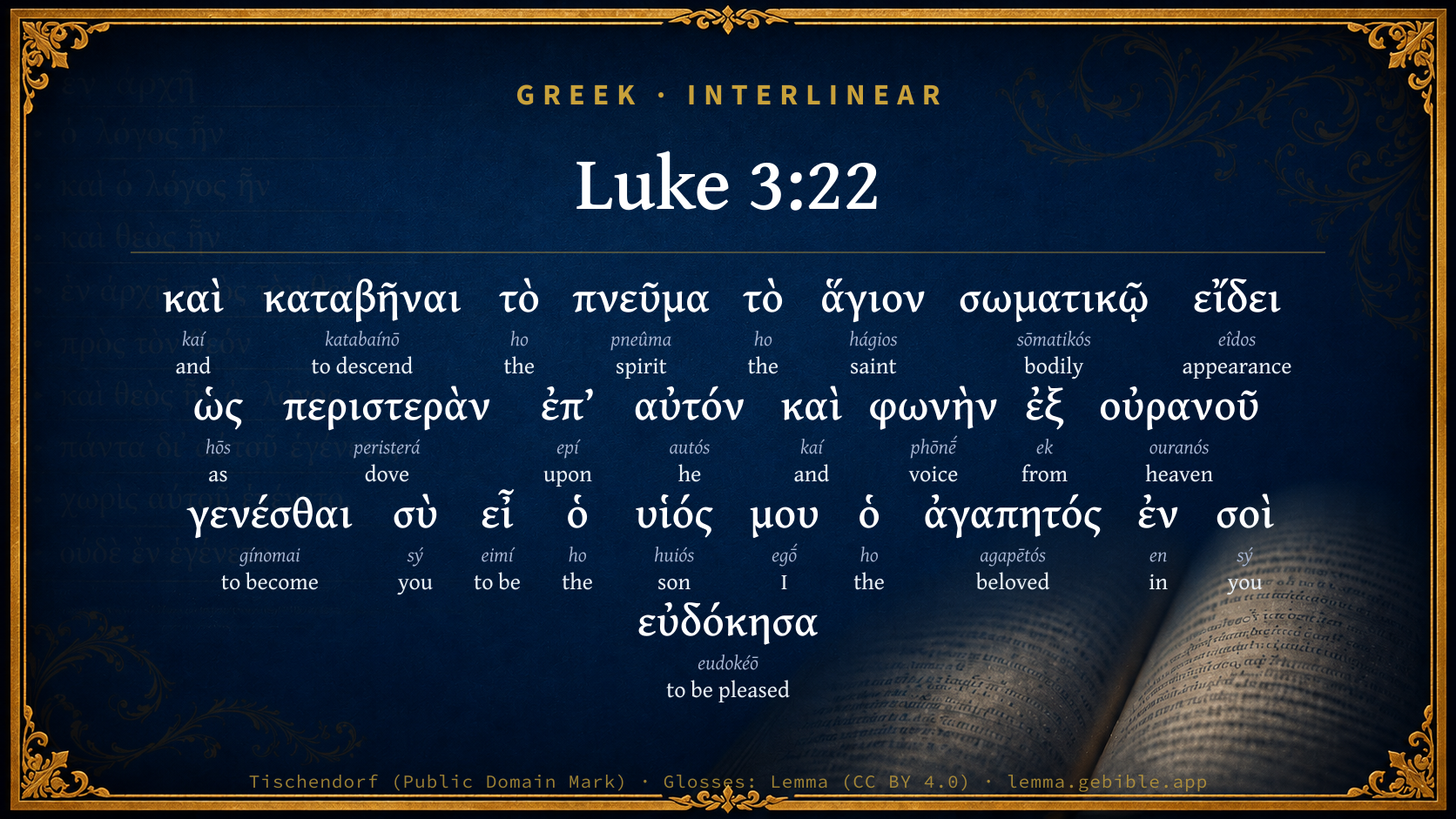
Download image
Cite this verse

Luke 3:22 (World English Bible). Public Domain. Lemma interlinear Bible study tool, https://lemma.gebible.app/v/luke/3/22.

Show BibTeX & RIS
BibTeX
RIS
English Translation
and the Holy Spirit descended in a bodily form as a dove on him; and a voice came out of the sky, saying "You are my beloved Son. In you I am well pleased."
World English Bible · Public Domain
Highlights
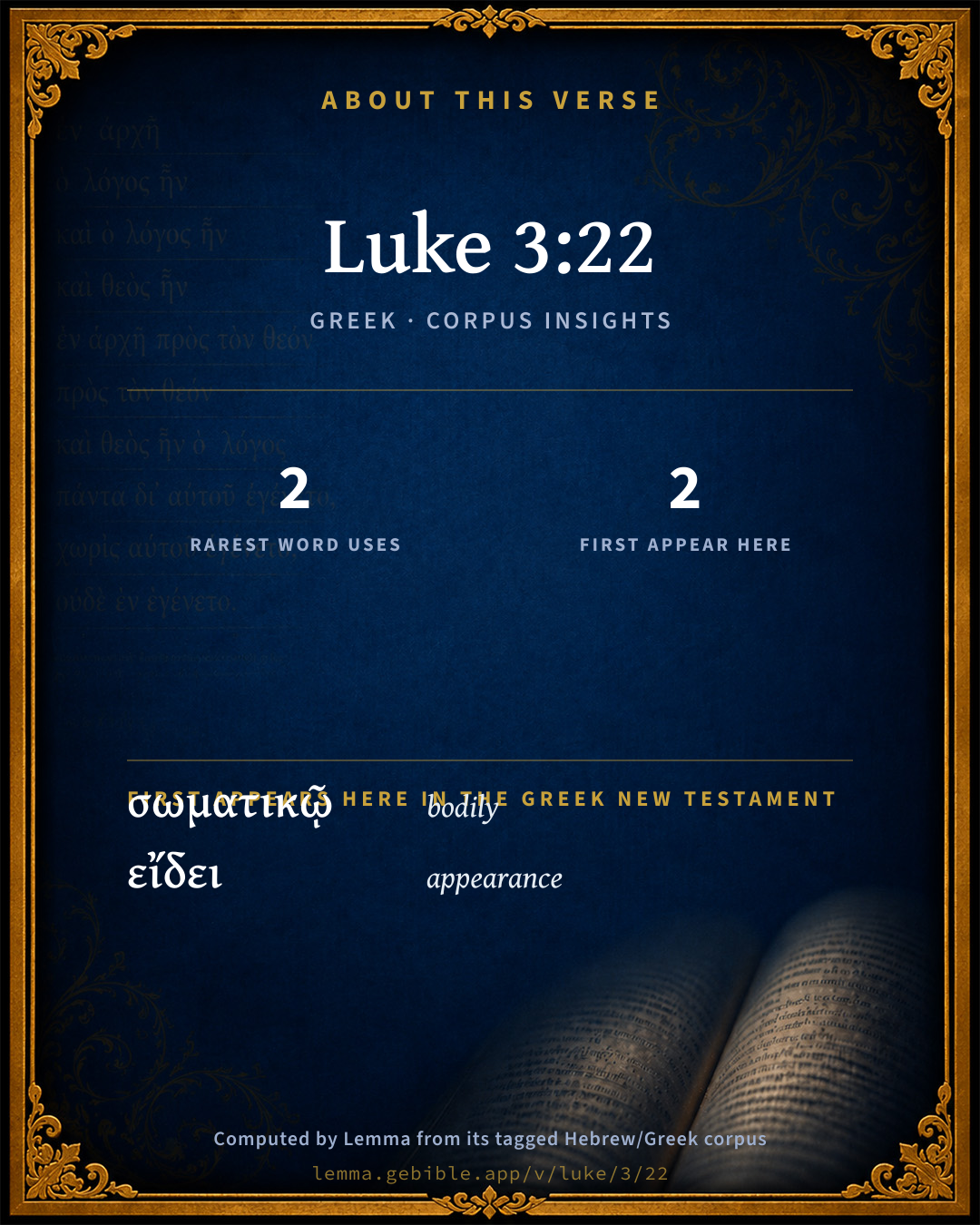
  • 2 first appearances in the Greek New Testament
Full analysis ↓
Download a study sheet

One document with this verse’s original text, its word-by-word gloss line, the meaning frame, cross-references with their text, attributed commentary, and full source and license credits — printable, and it pastes into notes with its structure intact.

This verse Autodidact and up

Study sheet (.html) Plain text (.txt)

A passage Seminary Student

Up to 50 verses in one chapter. A passage sheet keeps up to 6 commentary sources and 12 cross-references per verse, in the order this page ranks them, and says so on the sheet whenever that leaves anything out. Ask for a single verse and you get the Autodidact verse sheet above.

Everything on this page stays free to read, with no account — the sheet is a download of what is already on screen, not access to it.

Want to remove ads? Support Godless Engineer
Compare translations 3

The same verse in 3 English versions, stacked beneath the original-language interlinear above. Click any original word for its lexicon entry.

Each is an independent rendering of the whole verse — the interlinear is not word-aligned to these translations.

Highlighted words mark where these versions differ — a whole-verse word diff, not a word-by-word alignment.

  • World English Bible Public Domain
    and the Holy Spirit descended in a bodily form as a dove on him; and a voice came out of the sky, saying "You are my beloved Son. In you I am well pleased."
  • King James Version Public Domain
    And the Holy Ghost descended in a bodily shape like a dove upon him, and a voice came from heaven, which said, Thou art my beloved Son; in thee I am well pleased.
  • unfoldingWord Literal Text CC BY-SA 4.0
    and the Holy Spirit in bodily form came down on him like a dove, and a voice came from heaven, “You are my beloved Son. With you I am well pleased.”

unfoldingWord Literal Text — © unfoldingWord, licensed CC BY-SA 4.0. Word-aligned USFM3 via Door43 (git.door43.org/unfoldingWord/en_ult).

Versions to compare (up to 4)

3 of 4 selected

Show all 19 translations

Every available English version of this verse, each an independent rendering of the whole verse.

  • World English Bible Public Domain
    and the Holy Spirit descended in a bodily form as a dove on him; and a voice came out of the sky, saying "You are my beloved Son. In you I am well pleased."
  • Berean Standard Bible Public Domain
    and the Holy Spirit descended on Him in a bodily form like a dove. And a voice came from heaven: “You are My beloved Son; in You I am well pleased.”
  • Majority Standard Bible Public Domain
    and the Holy Spirit descended on Him in a bodily form like a dove. And a voice came from heaven, saying, “You are My beloved Son; in You I am well pleased.”
  • King James Version Public Domain
    And the Holy Ghost descended in a bodily shape like a dove upon him, and a voice came from heaven, which said, Thou art my beloved Son; in thee I am well pleased.
  • American Standard Version (1901) Public Domain
    and the Holy Spirit descended in a bodily form, as a dove, upon him, and a voice came out of heaven, Thou art my beloved Son; in thee I am well pleased.
  • Revised Version (1885) Public Domain
    and the Holy Ghost descended in a bodily form, as a dove, upon him, and a voice came out of heaven, Thou art my beloved Son; in thee I am well pleased.
  • Geneva Bible (1599) Public Domain
    And the holy Ghost came downe in a bodily shape like a doue, vpon him, and there was a voyce from heauen, saying, Thou art my beloued Sonne: in thee I am well pleased.
  • Douay-Rheims (1899) Public Domain
    And the Holy Ghost descended in a bodily shape, as a dove upon him; and a voice came from heaven: Thou art my beloved Son; in thee I am well pleased.
  • Young's Literal Translation Public Domain
    and the Holy Spirit came down in a bodily appearance, as if a dove, upon him, and a voice came out of heaven, saying, `Thou art My Son -- the Beloved, in thee I did delight.'
  • Literal Standard Version CC BY-SA 4.0
    and the Holy Spirit came down in a bodily appearance, as if a dove, on Him, and a voice came out of Heaven, saying, “You are My Son, the Beloved, in You I delighted.”
  • Unlocked Literal Bible CC BY-SA 4.0
    and the Holy Spirit in bodily form came down on him like a dove, and a voice came from heaven, “You are my Son, whom I love. I am pleased with you.”
  • unfoldingWord Literal Text CC BY-SA 4.0
    and the Holy Spirit in bodily form came down on him like a dove, and a voice came from heaven, “You are my beloved Son. With you I am well pleased.”
  • Darby Bible Public Domain
    and the Holy Spirit descended in a bodily form as a dove upon him; and a voice came out of heaven, *Thou* art my beloved Son, in thee I have found my delight.
  • World Messianic Bible Public Domain
    and the Holy Spirit descended in a bodily form like a dove on him; and a voice came out of the sky, saying “You are my beloved Son. In you I am well pleased.”
  • Webster's Bible Public Domain
    And the Holy Spirit descended in a bodily shape like a dove upon him, and a voice came from heaven, which said, Thou art my beloved Son; in thee I am well pleased.
  • Free Bible Version CC BY-SA 4.0
    and the Holy Spirit descended upon him, taking the form of a dove. A voice came from heaven, saying, “You are my son, the one I love. I am truly pleased with you.”
  • Bible in Basic English Public Domain
    The Holy Spirit came down in the form of a dove, and a voice came from heaven, saying, You are my dearly loved Son, with whom I am well pleased.
  • Text-Critical English NT CC BY 4.0
    and the Holy Spirit descended on him in bodily form like a dove. Then a voice came from heaven, saying, “Yoʋ are my beloved Son; in yoʋ I am well pleased.”
  • Tyndale New Testament (1534) Public Domain
    and the holy goost came doune in a bodely shape lyke a dove vpo him and a voyce came from heven sayinge: Thou arte my dere sonne in the do I delyte.

Literal Standard Version (2020), Covenant Press — licensed CC BY-SA 4.0. Text via the HelloAO Bible API (eBible.org). Unlocked Literal Bible (unfoldingWord) — licensed CC BY-SA 4.0. Text via the HelloAO Bible API (eBible.org). unfoldingWord Literal Text — © unfoldingWord, licensed CC BY-SA 4.0. Word-aligned USFM3 via Door43 (git.door43.org/unfoldingWord/en_ult). Free Bible Version, Dr. Jonathan Gallagher — licensed CC BY-SA 4.0. Text via the HelloAO Bible API (eBible.org).

Word by word

More ways to search: Search by grammar → Find every occurrence → Compare this word →

Practice this passage: Drill this verse → Learn its vocabulary →

σωματικῷ
sōmatikós
G4984
“bodily”
Adjective, Dative, Singular, Neuter
Part of Speech
Adjective
Case
Dative
Number
Singular
Gender
Neuter
Full Thayer's Definition

Origin: from G4983

TDNT: 24:04,1

1. corporeal, bodily a. having a bodily form or nature b. pertaining to the body
  1. καὶ kaí G2532 “and” Conjunction
  2. καταβῆναι katabaínō G2597 “to descend” Verb, Aorist, Active, Infinitive
  3. τὸ ho G3588 “the” Article, Nominative, Singular, Neuter
  4. πνεῦμα pneûma G4151 “spirit” Noun, Nominative, Singular, Neuter
  5. τὸ ho G3588 “the” Article, Nominative, Singular, Neuter
  6. ἅγιον hágios G40 “saint” Adjective, Nominative, Singular, Neuter
  7. εἴδει eîdos G1491 “appearance” Noun, Dative, Singular, Neuter
  8. ὡς hōs G5613 “as” Adverb
  9. περιστερὰν peristerá G4058 “dove” Noun, Accusative, Singular, Feminine
  10. ἐπ’ epí G1909 “upon” Preposition
  11. αὐτόν autós G846 “he” Personal pronoun, Accusative, Singular, Masculine
  12. καὶ kaí G2532 “and” Conjunction
  13. φωνὴν phōnḗ G5456 “voice” Noun, Accusative, Singular, Feminine
  14. ἐξ ek G1537 “from” Preposition
  15. οὐρανοῦ ouranós G3772 “heaven” Noun, Genitive, Singular, Masculine
  16. γενέσθαι gínomai G1096 “to become” Verb, Aorist, Middle deponent, Infinitive
  17. σὺ sý G4771 “you” Personal pronoun, 2nd person, Nominative, Singular
  18. εἶ eimí G1510 “to be” Verb, Present, Active, Indicative, 2nd person, Singular
  19. ὁ ho G3588 “the” Article, Nominative, Singular, Masculine
  20. υἱός huiós G5207 “son” Noun, Nominative, Singular, Masculine
  21. μου egṓ G1473 “I” Personal pronoun, 1st person, Genitive, Singular
  22. ὁ ho G3588 “the” Article, Nominative, Singular, Masculine
  23. ἀγαπητός agapētós G27 “beloved” Adjective, Nominative, Singular, Masculine
  24. ἐν en G1722 “in” Preposition
  25. σοὶ sý G4771 “you” Personal pronoun, 2nd person, Dative, Singular
  26. εὐδόκησα eudokéō G2106 “to be pleased” Verb, Aorist, Active, Indicative, 1st person, Singular

About this verse

These counts appear in no published source. They are computed here, from the morphology-tagged text and Lemma’s own curated glosses. What Lemma adds →

27
words
22
distinct lemmas
Gospels
section

Notable vocabulary

The rarest word here is σωματικῷ bodily G4984 — appearing just 2 times in the whole Greek New Testament.

First appearance in Scripture

These words make their first canonical appearance in the Greek New Testament here:

  • σωματικῷ bodily G4984
  • εἴδει appearance G1491

Shared distinctive vocabulary

σωματικῷ bodily G4984 occurs in 2 verses of the Greek New Testament. Also found in:
Repetition

Words recur within this verse:

Cross-references

13

Topical passages linked to Luke 3:22 in the Treasury of Scripture Knowledge — connected by theme and wording, ordered by reader-vote popularity; previews shown in the World English Bible.

  • Psalms 2:7 I will tell of the decree. Yahweh said to me, "You are my son. Today I have become your father.
  • 2 Peter 1:17–18 For he received from God the Father honor and glory, when the voice came to him from the Majestic Glory, "This is my beloved Son, in whom I am well pleased."
  • Isaiah 42:1 Behold, my servant, whom I uphold; my chosen, in whom my soul delights: I have put my Spirit on him; he will bring forth justice to the Gentiles.
  • John 1:32 John testified, saying, "I have seen the Spirit descending like a dove out of heaven, and it remained on him.
  • Matthew 17:5 While he was still speaking, behold, a bright cloud overshadowed them. Behold, a voice came out of the cloud, saying, "This is my beloved Son, in whom I am well pleased. Listen to him."
  • Luke 9:34–35 While he said these things, a cloud came and overshadowed them, and they were afraid as they entered into the cloud.
  • Matthew 3:17 Behold, a voice out of the heavens said, "This is my beloved Son, with whom I am well pleased."
  • Acts 10:38 even Jesus of Nazareth, how God anointed him with the Holy Spirit and with power, who went about doing good and healing all who were oppressed by the devil, for God was with him.
  • Matthew 12:18 "Behold, my servant whom I have chosen; My beloved in whom my soul is well pleased: I will put my Spirit on him. He will proclaim justice to the Gentiles.
  • 1 Peter 2:4 coming to him, a living stone, rejected indeed by men, but chosen by God, precious.
  • Colossians 1:13 who delivered us out of the power of darkness, and translated us into the Kingdom of the Son of his love;
  • Matthew 27:43 He trusts in God. Let God deliver him now, if he wants him; for he said, 'I am the Son of God.'"
  • Luke 4:21 He began to tell them, "Today, this Scripture has been fulfilled in your hearing."

Cross-references courtesy of OpenBible.info (CC BY 4.0).

Commentary

Notes on Luke 3:22 from classic Christian and Jewish commentators (each source and its license shown beneath its notes). The classic Christian expositions comment on the surrounding passage and are grouped to its opening verse, so a note may address several verses; the Jewish commentaries on the Tanakh (Rashi and others) are per-verse, so they appear only where the commentator wrote on this verse.

Lemma curates 59 commentaries, every one of them public domain or Creative Commons licensed, each selected and text-cleaned for this edition rather than reprinted as found. About our sources →

Tyndale Open Study Notes

Tyndale Open Resources

3:22 The Spirit might have looked like a dove, or perhaps it descended in a dove-like manner. • You are my dearly loved Son, and you bring me great joy: This statement resonates with Ps 2:7 and Isa 42:1. The former identifies Jesus as the Messiah from David’s line; the latter indicates his role as servant of the Lord. Jesus’ identity was again declared from heaven at his transfiguration (Luke 9:35).

Tyndale Open Study Notes — © Tyndale Open Resources, licensed CC BY-SA 4.0. Text via the HelloAO Bible API.

Bengel's Gnomon

Johann Albrecht Bengel

Luk 3:22. Σωματικῷ εἴδει, in a bodily appearance) On the other hand there also are seen at times from the kingdom of darkness bodily appearances.—σὺ, thou) This is a reply to His prayers, mentioned in Luk 3:21.

Bengel's Gnomon of the New Testament — English translation (T&T Clark, Edinburgh, 1860) — public domain. Text from a community e-Sword module.

Ellicott's Commentary for English Readers

(22) In a bodily shape.—The words are peculiar to St. Luke, and tend to confirm the traditional symbolism which finds in the dove the emblem of the Holy Spirit. They, at least, fall in naturally with this view; but the other construction, that the Holy Spirit descended, after the manner of a dove, first hovering and then resting, in a bodily form (undefined) of some sort, is, at least, not excluded.

A Bible Commentary for English Readers, edited by Charles John Ellicott (1878–1897) — public domain. Text from a community e-Sword module.

The Cambridge Bible for Schools and Colleges

gen. ed. J. J. S. Perowne

22. in a bodily shape] This addition is peculiar to St Luke, and is probably added to shew the distinctness and reality of what Theodoret calls the ‘spiritual vision’ (πνευματικὴ θεωρία).

like a dove] The expression ὡς or ὡσεὶ used by each of the Evangelists, and St John’s “and it abode upon Him” (Joh_1:32), sufficiently prove that no actual dove is intended. The Holy Spirit is symbolised by a dove from early times. The Talmudic comment on Gen_1:2 is that “the Spirit of God moved on the face of the waters like a dove”—

“And with mighty wings outspread

Dovelike sat’st brooding on the vast abyss.”

Milton (Par. Lost, i. 20).

Comp. 2Es_5:26, “of all the fowls that are created thou hast named thee one dove.” Mat_10:16. A mystical reason was assigned for this in some fathers, because the numerical value of the letters of the Greek word peristera, ‘a dove,’ amounts to 801, which is also the value of Alpha Omega. We are probably intended to understand a dovelike, hovering, lambent flame descending on the head of Jesus; and this may account for the unanimous early legend that a fire or light was kindled in Jordan (Just. Mart. c. Tryph. 88, and the Apocryphal Gospels).

a voice came from heaven, which said] Rather, out of heaven. The last words should be omitted with the best MSS. This Bath Kôl or Voice from heaven also occurred at the Transfiguration (Mat_17:5) and in the closing week of Christ’s life (Joh_12:28-30). This is one of the passages which so distinctly imply the doctrine of the Blessed Trinity.

I am well pleased] Rather, I was well pleased.

The Cambridge Bible for Schools and Colleges (gen. ed. J. J. S. Perowne; Cambridge University Press, 1878–1918) — public domain. Text from a community e-Sword module.

John Gill's Exposition

And Jesus himself began to be about thirty years of age,.... Or Jesus, when he was baptized and began his public ministry, was about thirty years of age: an age at which the priests, under the law, who were typical of Christ, entered on their work, Num 4:23 The word, "began", is left out in the Syriac and Persic versions: and is often indeed redundant, as in Luk 3:8 and frequently in Mark's Gospel. The Arabic version renders it, "Jesus began to enter into the thirtieth year", which carries the sense the same with our translation:

being, as was supposed, the son of Joseph; who had espoused Mary before she was with child of the Holy Ghost, and afterwards took her to wife, and brought up her son; so that it was not known but that he was the son of Joseph. Whether or no the Jewish notion of the Messiah, the son of Joseph (y) may not take its rise from hence, may be considered: however, Joseph might very rightly be called, as he was supposed to be, the father of Jesus, by a rule which obtains with the Jews (z) that he

"that brings up, and not he that begets, is called the father,''

or parent; of which they give various instances (a) in Joseph, in Michal, and in Pharaoh's daughter.

Which was the son of Eli; meaning, not that Joseph was the son of Eli; for he was the son of Jacob, according to Mat 1:16, but Jesus was the son of Eli; and which must be understood, and carried through the whole genealogy, as thus; Jesus the son of Matthat, Jesus the son of Levi, Jesus the son of Melchi, &c. till you come to Jesus the son of Adam, and Jesus the Son of God; though it is true indeed that Joseph was the son of Eli, having married his daughter; Mary was the daughter of Eli: and so the Jews speak of one Mary, the daughter of Eli, by whom they seem to design the mother of our Lord: for they tell (b) us of one,

"that saw, , "Mary the daughter of Eli" in the shades, hanging by the fibres of her breasts; and there are that say, the gate, or, as elsewhere (c), the bar of the gate of hell is fixed to her ear.''

By the horrible malice, in the words, you may know who is meant: however, this we gain by it, that by their own confession, Mary is the daughter of Eli; which accords with this genealogy of the evangelist, who traces it from Mary, under her husband Joseph; though she is not mentioned, because of a rule with the Jews (d), that

"the family of the mother is not called a family.''

(y) T. Bab. Succa, fol. 52. 1. Jarchi & Aben Ezra in Zech. xii 10. & xiii. 7. (z) Shemot Rabba, sect. 46. fol. 143. 1. (a) T. Bab. Sanhedrin, fol. 19. 2. Vid. T. Bab. Megilla, fol. 13. 1. (b) T. Hieros. Sanhedrin, fol. 25. 3. (c) Ib. Chagiga, fol. 77. 4. (d) Juchasin, fol. 55. 2.

John Gill's Exposition of the Whole Bible (1746–1763) — public domain (CC PDM 1.0). Text via the HelloAO Bible API.

Trapp's Complete Commentary

John Trapp

22 And the Holy Ghost descended in a bodily shape like a dove upon him, and a voice came from heaven, which said, Thou art my beloved Son; in thee I am well pleased.

Ver. 22. {See Trapp on "Mat 3:16"} {See Trapp on "Mat 3:17"}

John Trapp, A Commentary or Exposition upon All the Books of the Old and New Testament (1647–1656) — public domain. Text from a community e-Sword module.

Haydock's Catholic Bible Commentary

The reason why the Holy Ghost shewed himself in the shape of a dove, was because he could not be seen in the substance of his divinity. But why a dove? To express that simplicity acquired in the sacrament of baptism. Be ye simple as doves; to signify that peace bestowed by baptism, and prefigured by the olive branch which the dove carried back to the ark, a true figure of the Church, and which was the only security from the destructive deluge. (St. Ambrose) --- You will object: Christ, though he was God, would not be baptized till the age of 30, and do you order baptism to be received sooner? When you say, though he was God, you solve the difficulty. For, he stood not in need of being purified at all; of course, there could be no danger in deferring his baptism. But you will have much to answer for, if, being born in corruption, you pass out of this world without the garment of incorruption. (Gregory of Nazianzus, orat. 40.)

Remarks on the two Genealogies of Jesus Christ.

To make some attempt at an elucidation of the present very difficult subject of inquiry, we must carry in our minds, 1. That in the Scripture language the word begat, applies to the remote, as well as the immediate, descendant of the ancestor; so that if Marcus were the son, Titus the grandson, and Caius the great-grandson of Sempronius, it might, in the language of Scripture, be said, that Sempronius begat Caius. This accounts for the omission of several descents in St. Matthew. 2. The word begat, applies not only to the natural offspring, but to the offspring assigned to the ancestor by law. 3. If a man married the daughter of an only child of another, he became in the view of the Hebrew law the son of that person, and thus was a son assigned to him by law. The two last positions shew in what sense Aorobabel was the son both of Neri and Salathiel, and Joseph the son both of Jacob and of Heli, or Joachim. --- "St. Matthew, in descending from Abraham to Joseph, the spouse of the blessed Virgin, speaks of a son properly so called, and by way of generation, Abraham begot Isaac, &c. But St. Luke in ascending from Jesus to God himself, speaks of a son properly or improperly so called. On this account he make use of an indeterminate expression, in saying, the son of Joseph, who was of Heli. That St. Luke does not always speak of a son properly called, and by way of generation, appears from the first and last he names; for Jesus was only the putative son of Joseph, because Joseph was the spouse of Mary, the mother of Christ; and Adam was only the son of God by creation. This being observed, we must acknowledge in the genealogy in St. Luke, two sons improperly so called, that is, two sons-in-law, instead of sons. As among the Hebrews, the women entered not into the genealogy, when a house finished by a daughter, instead of naming the daughter in the genealogy, they named the son-in-law, who had for father-in-law the father of his wife. The two sons-in-law mentioned in St. Luke are Joseph, the son-in-law of Heli, and Salathiel, the son-in-law of Neri. This remarks clears up the difficulty. Joseph, the son of Jacob, in St. Matthew, was the son-in-law of Heli, in St. Luke; and Salathiel, the son of Jechonias, in St. Matthew, was the son-in-law of Neri, in St. Luke. Mary was the daughter of Heli, Eliacim, or Joacim, or Joachim. Joseph, the son of Jacob, and Mary, the daughter of Heli, had a common origin; both descending from Zorobabel, Joseph by Abiud the eldest, and Mary by Resa, the younger brother. Joseph descended from the royal branch of David, of which Solomon was the chief; and Mary from the other branch, of which Nathan was the chief. by Salathiel, the father of Zorobabel, and son of Jechonias, Joseph and Mary descended from Solomon, the son and heir of David. And by the wife of Salathiel, the mother of Zorobabel, and daughter of Neri, of which Neri Salathiel was the son-in-law, Joseph and Mary descended from Nathan, the other son of David, so that Joseph and Mary re-united in themselves all the blood of David. St. Matthew carries up the genealogy of Jesus to Abraham; this was the promise of the Messias, made to the Jews; St. Luke carries it up to Adam, the promise of the Messias, made to all men."

Whatever the difficulties attending the genealogies may be, it is evident that they arise from our imperfect knowledge of the laws, usages, and idiom of the Jews, from our ignorance of the true method of reconciling the seeming inconsistencies, or from some corruptions that in process of time may possibly have crept into the text. The silence of the enemies of the gospel, both the heathen and Jewish, during even the first century, is itself a sufficient proof, that neither inconsistency nor corruption could be then alleged against this part of the evangelical history. If the lineal descent of Jesus from David were not indisputable, he could not possess the character essential to the Messias, nor any right to the Jewish throne. We may confidently then assert, that his regular lineal descent from David could not be disproved, since it was not even disputed at a time when alone it could have been done so successfully; and by those persons who were so deeply interested in falsifying the first Christian authorities.

George Leo Haydock (1774–1849), Haydock's Catholic Family Bible and Commentary, 1859 edition — public domain. Excludes Psalms (Douay-Rheims chapter numbering differs from Protestant) and Deuterocanonical books (Catholic canon only).

Whedon's Commentary on the Bible

Daniel D. Whedon

22. The Holy Ghost descended—Were these supernatural phenomena, it is asked, a mere vision, made up of conceptions like a dream, wrought in the mind of John, or were they an external reality? Beyond all question, we reply, an external reality. The Apocalypse is a series of visions produced by inspiring power within the seer’s mind without any external object; but this movement of the Spirit upon Jesus was, externally, as real as John or Jesus himself. But how can God’s Spirit move from place to place? God’s Spirit, we reply, is not a pantheistic, move-less vapor—a universal, fixed, and stagnant essence—but a living, personal, powerful Being, omnipotent to operate according to His own will. And if angelic spirits, like Gabriel, can invest themselves with visible embodiments, or if even a human spirit can be clothed with a material body, so beyond all question can the Divine Spirit. And we must firmly repudiate that utter falsification of Luke’s words of which many, even orthodox commentators of the present day, are guilty. Every evangelist mentions the dove; and Luke declares there was bodily shape like a dove. To make this (with Olshausen, Van Oosterzee, and others) a ray of light, a shapeless something “with a quivering motion as of a dove,” is not to interpret Luke’s language, but to substitute words of one’s own.

There is nothing in the narrative to show that it was a private transaction, and equally nothing to show that it was in the presence of and seen by numbers.

A dove—As the lamb is the gentle and tender image of Jesus, so the dove is the symbol of the pure and gentle Spirit. “Harmless as doves” is the Saviour’s simile for his followers in the Spirit. To the simplicity of antiquity such symbols were permanent, impressive lessons, shaping the crude mind to high and holy conceptions. Olshausen well says, “According to biblical symbolism certain mental characters appear expressed in several animals, as the lion, the lamb, the eagle, the ox.” And so he might have inferred, that as it is the form of the animal that expresses the symbol, so the shape of the dove must have been present in that most signal of all instances of the exhibited symbol.

Voice from heaven—As true a voice, with as true an articulation, as ever came from human or superhuman organs of utterance. It was no dream or conception of John’s, but a reality to his perception. And such a voice and articulation are no more difficult to divine power than the inarticulate thunder through the medium of electric fluid, and no more incredible when properly authenticated.

From heaven—The voice came audibly from heaven; the dove came visibly from “the heaven opened.” Heaven, as we have elsewhere shown, (note on Mar_16:19,) is, both in conception and reality, up, above us. Hence, both in conception and in reality, a shape or a voice from heaven must come down to us. It comes down through space and atmosphere. If it be a reality it cuts through both. It comes through the open air, ether, and firmament. Let the retina of the eye be duly quickened, and the very opening of air and firmament becomes visible. Even then there is not conception but perception.

The ancient Greek Church celebrated the baptism of Jesus upon the sixth day of January, under the title of EPIPHANY, or Manifestation. The reason of this Chrysostom thus concisely asks and answers: “Why is not the day on which he was born called Epiphany, but the day on which he was baptized? Because he was not manifested to all when he was born, but when he was baptized. For to the day of his baptism he was generally unknown, as appears from those words of John the Baptist, ‘There standeth one among you whom ye know not.’ And what wonder that others should not know him when the Baptist himself knew him not before that day?”

But Augustine furnishes several additional reasons combined together for celebrating the Epiphany: “On this day we celebrate the mystery of God manifesting himself by his miracles in human nature; either because on this day the star in heaven gave notice of his birth; or because he turned water into wine at the marriage feast at Cana in Galilee; or because he consecrated water for the reparation of mankind by his baptism in the river Jordan; or because with the five loaves he fed five thousand men. For in either of these are contained the mysteries and joys of our salvation.” From all this it is clear that the celebration by the Church of a Scripture event, on a certain day, is no very conclusive proof that the day is the authentic anniversary of the event. For the three first centuries in the Greek Church Christmas and the Epiphany were on the same day, namely, the sixth of January. Mat_1:1-17.

Daniel D. Whedon (gen. ed.), Commentary on the Old and New Testaments (1874–1909) — public domain. Text from a community e-Sword module.

Scofield Reference Notes

C. I. Scofield

Thou art

Lit. This is my Son, the beloved, in whom I delighted. Cf. Joh 1:1; Joh 1:2; Joh 8:29; Mat 17:5.

The Scofield Reference Bible (1917 edition), notes by C. I. Scofield — public domain. Text from a community e-Sword module.

Burkitt's Expository Notes on the New Testament

William Burkitt

Observe here, the solemn investing of Christ into his office, as Mediator, is attended with a threefold miracle; namely, the opening of the heavens, the descending of the Holy Ghost, and God the Father’s voice concerning the son.

The heavens were opened; to show, that heaven, which was closed and shut against us for our sins, is now opened to us, by Christ’s undertaking for us.

Next, The Holy Ghost descends like a dove upon our Saviour. Here we have a proof and evidence of the blessed Trinity; the Father speaks from heaven, the Son comes out of the water, and the Holy Ghost descends after the manner of a dove, hovering and overshadowing him. But why did the Holy Ghost now descend upon Christ?

First, for the designation of his person, to show that he was the person set apart for the work and office of a mediator.

Secondly, for the unction and sanctification of his person for the performance of that office. Now was he anointed to be the king, priest, and prophet of his church.

Lastly, we have here the voice of God the Father, pronouncing.

1. The nearness of Christ’s relation: This is my Son.

2. The endearedness of his person: This is my beloved Son.

3. The fruit and benefit of this near relation unto us: In thee I am well pleased.

Learn hence, 1. That there is no possibility for any person to please God out of Christ; neither our persons nor our performances can find acceptance with God, but only in and through him, and for his sake.

2. That the Lord Jesus Christ is the ground and cause of all that love and good will which God the Father showeth to the sons of men.

In Christ, God is well pleased with us as a reconciled Father; out of him a consuming fire; Thou art my beloved Son, in thee I am well pleased.

William Burkitt's Expository Notes on the New Testament (1700–1703) — public domain. Text from a community e-Sword module.

Cambridge Greek Testament for Schools and Colleges

22. καταβῆναι. This was seen by John the Baptist (Joh 1:34) and by Jesus (Mar 1:10), but not (apparently) by others.

σωματικῷ εἴδει. This addition is peculiar to St Luke, and is probably added to shew the distinctness and reality of what Theodoret calls the ‘spiritual vision’ (πνευματικὴ θεωρία).

ὡς περιστεράν. The expression ὡς or ὡσεὶ used by each of the Evangelists, and St John’s “and it abode upon Him” (Joh 1:32), sufficiently prove that no actual dove is intended. The Holy Spirit is symbolised by a dove from early times. The Talmudic comment on Gen 1:2 is that “the Spirit of God moved on the face of the waters like a dove”—

“And with mighty wings outspread

Dovelike sat’st brooding on the vast abyss.”

MILTON (Par. Lost, I. 20).

Comp. 2Es 5:26, “of all the fowls that are created thou hast named thee one dove.” Mat 10:16. A mystical reason was assigned for this in some fathers, because the numerical value of the letters of the Greek word peristera, ‘a dove,’ amounts to 801, which is also the value of Alpha Omega. We are probably intended to understand a dovelike, hovering, lambent flame descending on the head of Jesus; and this may account for the unanimous early legend that a fire or light was kindled in Jordan (Just. Mart. c. Tryph. 88, and the Gospel of the Hebrews; see Epiphan. Haer. xxx. 13). Other Apocryphal Gospels (the Gospel of the Nazarenes, &c.) added other incidents obviously fictitious.

ἐξ οὐρανοῦ. ‘Out of heaven.’ St Matthew has ἐξ οὐρανῶν because he follows the common Hebraism of using ‘the heavens’ (with reference to the seven heavens of the Rabbis) except when he alludes to heaven as a mere physical region. When he speaks of heaven as God’s abode (“Our Father which art in the heavens,” “The kingdom of the heavens,” “our Father from the heavens,” &c.) he uses the plural. St Luke only uses “heavens” four times, and St John not at all. See an excellent note in Humphry Rev. Version, p. 7. This Bath Kôl or Voice from heaven also occurred at the Transfiguration (Mat 17:5) and in the closing week of Christ’s life (Joh 12:28-30). This is one of the passages which so distinctly imply the doctrine of the Blessed Trinity.

εὐδόκησα. ‘I was well pleased.’ The word εὐδοκέω is a late and ill-formed word. Like καραδοκεῖν it violates the rule (“regium praeceptum Scaligeri”) that δυς and εὖ and the privative ἀ cannot be joined to verbs except through an intermediate substantive. See the rule explained in Brief Greek Syntax §§ 107, 108. Justin Martyr adds “This day have I begotten thee,” which is also found in D and the Itala, but is a mere gloss from Psa 2:7.

Cambridge Greek Testament for Schools and Colleges (Cambridge University Press, 1896; 21 vols, various authors incl. Carr, Maclear, Plummer, Farrar, Lumby, Moule, M. R. James, Simcox) — public domain. Text from a community e-Sword module.

Alford’s Greek Testament

Henry Alford

22.] Mat 3:13-17: Mar 1:9-11. Luke’s account is much more concise than usual, and wholly independent of the others; see note on Mar 1:10: we have here however three additional particulars—1. that all the people had been baptized before the Lord’s baptism: 2. that He was praying at the time of the descent of the Spirit: 3. that the Spirit appeared in a bodily form. On (1) we may remark that this is necessarily the meaning of ἐν τῷ βαπ.—for Luke when he means ‘during,’ &c. invariably uses the present; see for the past tense with ἐν τῷ reff. and ch. 14:1; 19:15; 24:30—for the present, ch. 5:1; 8:5, &c., and for a comparison of the two, ch. 8:40 and 42.

On (3), see note at Mat 3:16, § 2,

Henry Alford, The Greek Testament (1849–1861) — public domain. Text from a community e-Sword module.

International Critical Commentary

22. σωματικῷ εἴδει ὡς περιστεράν. “In a bodily form” is peculiar to Lk. Nothing is gained by admitting something visible and rejecting the dove. Comp. the symbolical visions of Jehovah granted to Moses and other Prophets. We dare not assert that the Spirit cannot reveal Himself to human sight, or that in so doing He cannot employ the form of a dove or of tongues of fire. The tongues were appropriate when the Spirit was given “by measure” to many. The dove was appropriate when the Spirit was given in His fulness to one. It is not true that the dove was an ancient Jewish symbol for the Spirit. In Jewish symbolism the dove is Israel. The descent of the Spirit was not, as some Gnostics taught, the moment of the Incarnation: it made no change in the nature of Christ. But it may have illuminated Him so as to complete His growing consciousness of His relations to God and to man (2:52). It served two purposes: (1) to make Him known to the Baptist, who thenceforward had Divine authority for making Him known to the world (Joh 1:32, Joh 1:33); and (2) to mark the official beginning of the ministry, like the anointing of a king. As at the Transfiguration, Christ is miraculously glorified before setting out to suffer, a voice from heaven bears witness to Him, and “the goodly fellowship of the Prophets” waits on His glory.

The phrase φωνὴν γενέσθαι is freq. in Lk. (1:44, 9:35, 36; Act 2:6, Act 7:31, Act 10:13, Act 19:34). Elsewhere only Mar 1:2, Mar 1:9:7; Joh 12:30; Rev 8:5, Comp. ἔρχεται φωνή, Joh 12:28; ἐξέρχεται φωνή, Rev 16:17, Rev 19:5.

Σύ. Responsio ad preces, ver. 21 (Beng.). The Σύ shows that the voice conveyed a message to the Christ as well as to the Baptist. Mk. also has Σὺ εἶ: Mat 3:17 we have Οὗτός ἐστιν. Diversitas locutionum adhuc etiam utilis est, me uno modo dictum minus intelligatur (Aug.). In the narrative of the Transfiguration all three have Οὗτός ἐστιν.

The reference seems to be to Psa 2:7; and here D and other important witnesses have Τἰός μου εἶ σύ, ἐγὼ σήμερον γεγέννηκά σε. Augustine says that this was the reading of some MSS., “although it is stated not to be found in the more ancient MSS.” (De Cons. Evang. 2:14: comp. Enchir. ad Laurent. 49.). Justin has it in his accounts of the Baptism (Try. 88., 103.). In Mt. it is possible to take ὁ ἀγαπητός with what follows: “The beloved in whom I am well pleased”; but this is impossible here and in Mar 1:11, and therefore improbable in Mt. The repetition of the article presents the epithet as a separate fact: “Thou art My Son, My beloved one.” Comp. μοῦνος ἐὼν ἀγπητός (Hom. Oba 1:2:365). It is remarkable that St. John never uses ἀγαπητύς of Christ: neither in the Fourth Gospel nor in the Apocalypse does the word occur in any connexion.

εὐδόκησα “I am well pleased”: the timeless aorist. Comp. Joh 13:3. The verb is an exception to the rule that, except where a verb is compounded with a prep., the verbal termination is not retained, but one from a noun of the same root is substituted: e.g. ἀδυνατεῖν, εὐεργετεῖν, not ἀδύνασθαι, εὐεργάζεσθαι. Comp. καραδοκεῖν and δυσθνήσκειν, which are similar exceptions, Win. 16:5, p. 125.

The voice does not proclaim Jesus as the Messiah, as a legend would probably have represented. No such proclamation was needed either by Jesus or by the Baptist. The descent of the Spirit had told John that Jesus was the christ (Joh 1:33). This voice from heaven, as afterwards at the Transfiguration (9:35), and again shortly before the Passion (Joh 12:28), followed closely upon Christ’s prayer, and may be regarded as the answer to it. His humanity was capable of needing the strength which the heavenly assurance gave. To call this voice from heaven the Bath-Kol, of the Rabbis, or to treat it as analogous to it, is misleading. The Rabbinic Bath-Kol, or “Daughter-voice,” is regarded as an echo of the voice of God: and the Jews liked to believe that it had been granted to them after the gift of prophecy had ceased. The utterances attributed to it are in some vases so frivolous or profane, that the more intelligent Raobis denounced it as a superstition.

It has been pointed out that Lk. appears to treat the baptism of Jesus by John as a matter of course. Mt. tells us that the Baptist at first protested against it; and many writers have felt that it requires explanation. Setting aside the profane suggestions that Jesus was not sinless, and therefore needed “repentance baptism for remission of sins,” or that He was in collusion with John, we may note four leading hypotheses. 1. He wished to do honour to Joh_2. He desired to elicit from John a declaration of His Messiahship. 3. He thereby gave a solemn sign that He had done with home life, and was beginning His public ministry. 4. He thereby consecrated Himself for His work.—This last seems to be nearest to the truth. The other three would be more probable if we were expressly told that multitudes of spectators were present; whereas the reverse seems to be implied. John’s baptism was preparatory to the kingdom of the Messiah. For everyone else it was a baptism of repentance. The Messiah, who needed no repentance, could yet accept the preparation. In each case it marked the beginning of a new life. It consecrated the people for the reception of salvation. It consecrated the Christ for the bestowing of it (Neander, L. J. C. § 42 (5), Eng. tr. p. 68). But besides this it was a “fulfilment of righteousness,” a complying with the requirements of the Law. Although pure Himself, through His connexion with an unclean people He was Levitically unclean. “On the principles of O.T. righteousness His baptism was required” (Lange L. of C. i. p. 355).

In the Fathers and liturgies we find the thought that by being baptized Himself Jesus elevated an external rite into a sacrament, and consecrated the element of water for perpetual use. Baptizatus est ergo Dominus non mundari volens, sed mundare aquas (Ambr. on Luk 2:21, Luk 2:23). “By the Baptisme of thy wel beloved sonne Jesus Christe, thou dydest sanctifie the fludde Jordan, and al other waters to this misticall washing away of synne” (First Prayer-Book of Edw. 6:1549, Public Baptism); which follows the Gregorian address, “By the Baptism of Thine Only-begotten Son halt been pleased to sanctify the streams of water” (Bright, Ancient Collects, p. 161).

There is no contradiction between John’s “Comest Thou to me?” (Mat 3:14) and “I knew Him not” (Joh 1:31, Joh 1:33). As a Prophet John recognized the sinlessness of Jesus, just as Elisha recognized the avarice and untruthfulness of Gehazi, or the treachery and cruelty of Hazael (2Ki 5:26, 2Ki 8:10-12); but until the Spirit descended upon Him, he did not know that He was the Messiah (Weiss, Leben Jesu, I. ii. 9, Eng. tr. i. p. 320). John had three main functions: to predict the coming of the Messiah; to prepare the people for it; and to point out the Messiah when He came. When these were accomplished, his work was nearly complete.

International Critical Commentary — older volumes (1896–1929), various authors — public domain. Text from a community e-Sword module.

Vincent's Word Studies in the New Testament

Marvin R. Vincent

The Holy Ghost. Better, Spirit. Matthew has the Spirit of God : Mark, the Spirit.

In a bodily shape. Peculiar to Luke.

Thou art my beloved son. Lit., Thou art my son, the beloved. So Mark. But Matthew, This is my son, the beloved.

Marvin R. Vincent, Word Studies in the New Testament (1887–1900) — public domain. Text from a community e-Sword/MySword module.

Lesson kit

Teaching starters — assembled from the data on this page, not authored interpretation. Every prompt links to the verse data it draws on. Edit before teaching.

Luke, in the Gospels, opens this verse with 27 words (22 distinct Greek lemmas). Its most distinctive word is sōmatikós (“bodily”). A historical commentator’s framing appears above. Read the whole chapter for the surrounding context.

Discussion questions

  1. What does “bodily” (sōmatikós) contribute to the verse as a whole?
  2. 2 words here appear for the first time in Scripture. What is being introduced at this debut?
  3. 1 Timothy 4:8 shares the word «bodily» with this verse. How do the two illuminate each other?
  4. “the” occurs 4× in this one verse. What is the effect of the repetition?
  5. These translations render this verse differently. What is at stake in choosing one wording over another?
  6. Reading how Tyndale Open Study Notes and Bengel's Gnomon read this verse, where do the two commentators agree and where do they part?

Things to notice

  • 2 words make their first canonical appearance in Scripture here.
  • These translations choose different wording for 15 words in this verse.
  • “the” occurs 4× in this single verse.
  • 22 distinct Greek lemmas span 27 words in this verse.

Reading settings

Reading text

Shown beneath each verse's original-language words.

Old Testament
Old Testament edition

Read the OT as the Masoretic Hebrew (MT) or the Greek Septuagint (LXX).

English shown for the Greek Septuagint (in the Hebrew ↔ Greek comparison).

Comparing translations? Open the Compare panel on any verse page to stack up to four side by side.