
1 Thessalonians 1:10

Greek (Tischendorf 8th ed.) 1 Thessalonians 1:10 appears in the Greek New Testament. The text above is from the Tischendorf 8th edition. Each word links to its Strong’s number and a concise gloss. Click any word for its full Thayer’s Greek Lexicon entry.
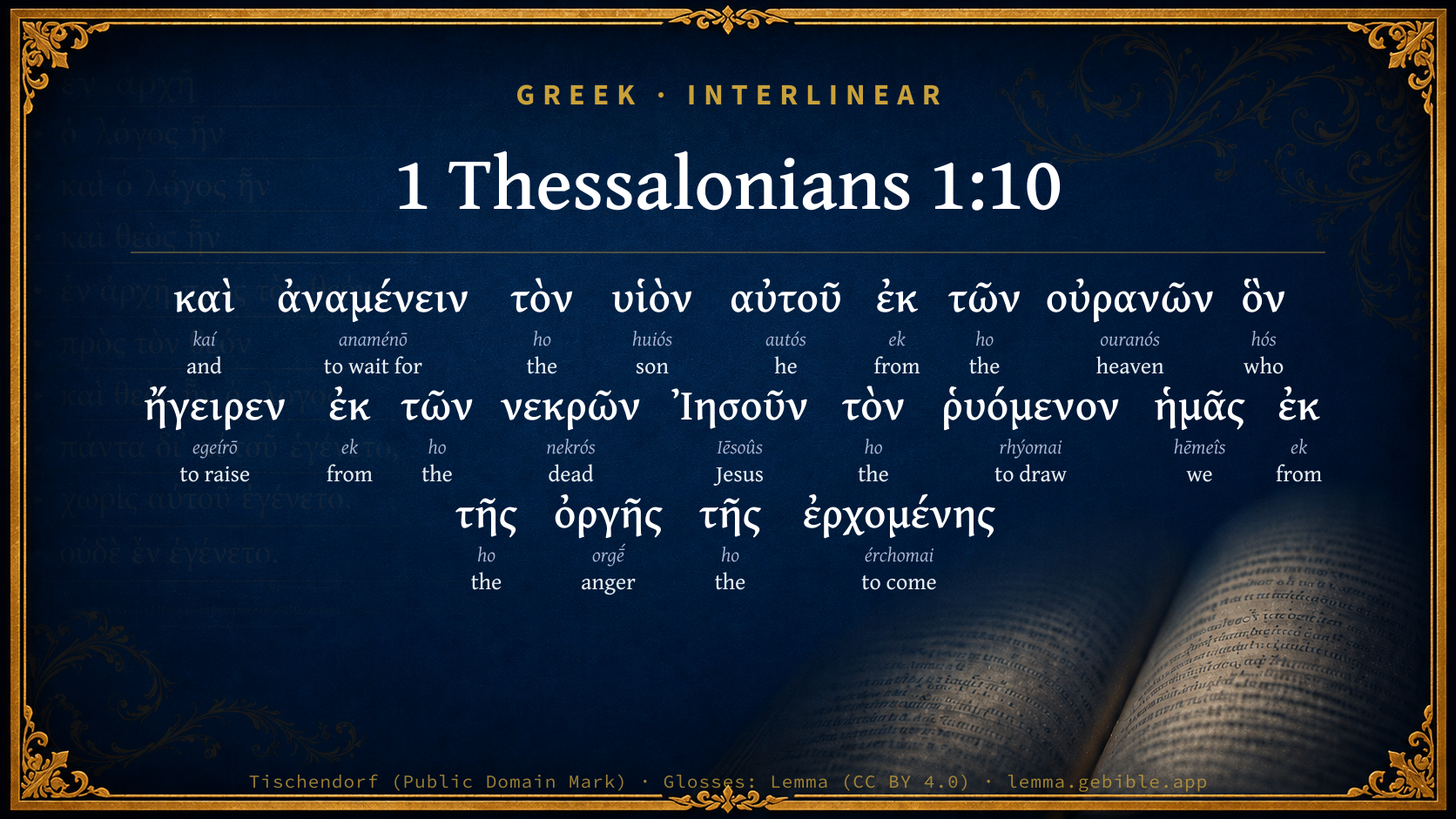
Download image
Cite this verse

1 Thessalonians 1:10 (World English Bible). Public Domain. Lemma interlinear Bible study tool, https://lemma.gebible.app/v/1-thessalonians/1/10.

Show BibTeX & RIS
BibTeX
RIS
English Translation
and to wait for his Son from heaven, whom he raised from the dead-- Jesus, who delivers us from the wrath to come.
World English Bible · Public Domain
Highlights
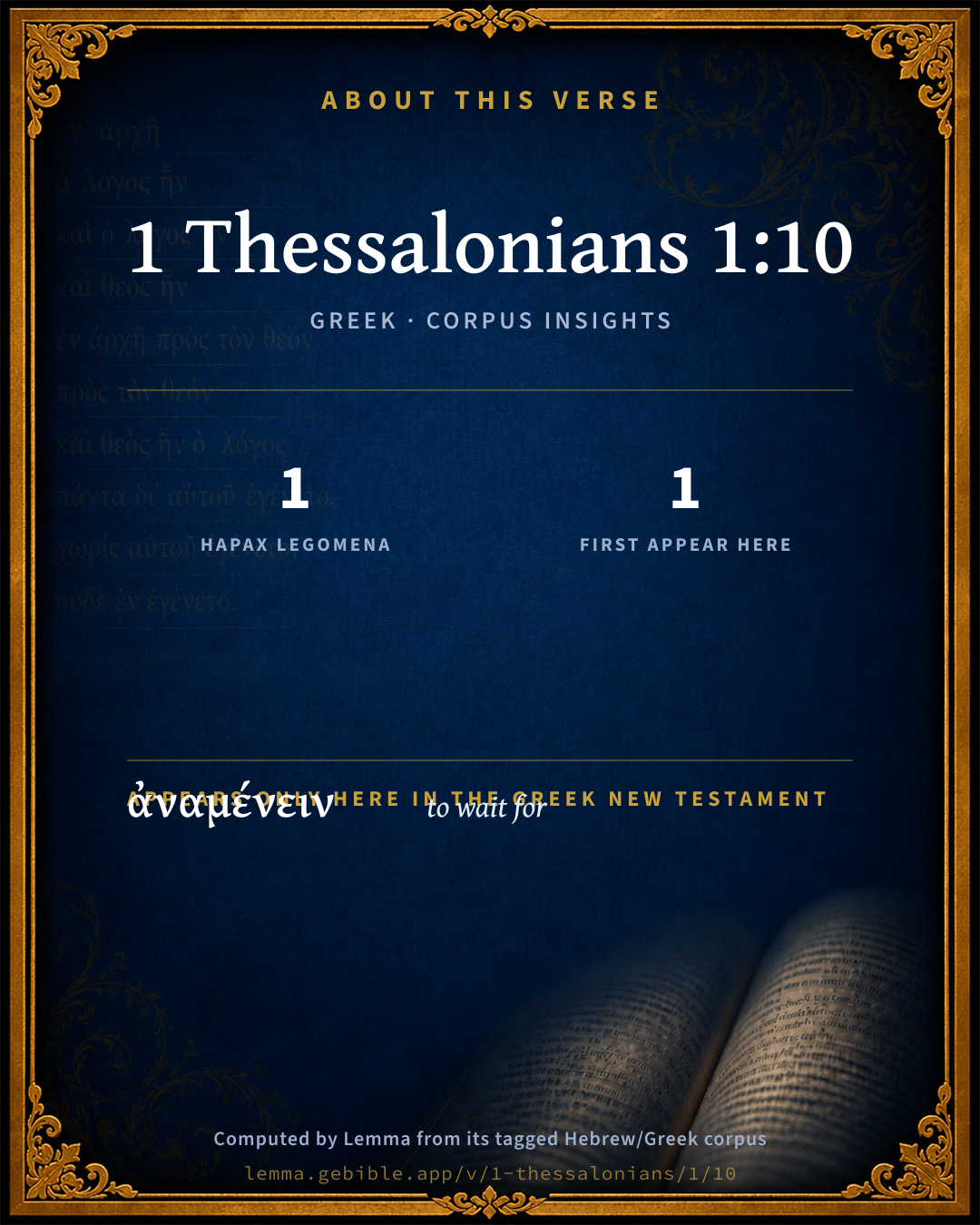
  • 1 hapax legomenon — only here in the Greek New Testament
  • 1 first appearance in the Greek New Testament
Full analysis ↓
Download a study sheet

One document with this verse’s original text, its word-by-word gloss line, the meaning frame, cross-references with their text, attributed commentary, and full source and license credits — printable, and it pastes into notes with its structure intact.

This verse Autodidact and up

Study sheet (.html) Plain text (.txt)

A passage Seminary Student

Up to 50 verses in one chapter. A passage sheet keeps up to 6 commentary sources and 12 cross-references per verse, in the order this page ranks them, and says so on the sheet whenever that leaves anything out. Ask for a single verse and you get the Autodidact verse sheet above.

Everything on this page stays free to read, with no account — the sheet is a download of what is already on screen, not access to it.

Want to remove ads? Support Godless Engineer
Compare translations 3

The same verse in 3 English versions, stacked beneath the original-language interlinear above. Click any original word for its lexicon entry.

Each is an independent rendering of the whole verse — the interlinear is not word-aligned to these translations.

Highlighted words mark where these versions differ — a whole-verse word diff, not a word-by-word alignment.

  • World English Bible Public Domain
    and to wait for his Son from heaven, whom he raised from the dead-- Jesus, who delivers us from the wrath to come.
  • King James Version Public Domain
    And to wait for his Son from heaven, whom he raised from the dead, even Jesus, which delivered us from the wrath to come.
  • unfoldingWord Literal Text CC BY-SA 4.0
    and to wait for his Son from the heavens, whom he raised from the dead—Jesus, the one rescuing us from the coming wrath.

unfoldingWord Literal Text — © unfoldingWord, licensed CC BY-SA 4.0. Word-aligned USFM3 via Door43 (git.door43.org/unfoldingWord/en_ult).

Versions to compare (up to 4)

3 of 4 selected

Show all 19 translations

Every available English version of this verse, each an independent rendering of the whole verse.

  • World English Bible Public Domain
    and to wait for his Son from heaven, whom he raised from the dead-- Jesus, who delivers us from the wrath to come.
  • Berean Standard Bible Public Domain
    and to await His Son from heaven, whom He raised from the dead—Jesus our deliverer from the coming wrath.
  • Majority Standard Bible Public Domain
    and to await His Son from heaven, whom He raised from the dead—Jesus our deliverer from the coming wrath.
  • King James Version Public Domain
    And to wait for his Son from heaven, whom he raised from the dead, even Jesus, which delivered us from the wrath to come.
  • American Standard Version (1901) Public Domain
    and to wait for his Son from heaven, whom he raised from the dead, `even' Jesus, who delivereth us from the wrath to come.
  • Revised Version (1885) Public Domain
    and to wait for his Son from heaven, whom he raised from the dead, even Jesus, which delivereth us from the wrath to come.
  • Geneva Bible (1599) Public Domain
    And to looke for his sonne from heauen, whome he raised from the dead, euen Iesus which deliuereth vs from that wrath to come.
  • Douay-Rheims (1899) Public Domain
    And to wait for his Son from heaven (whom he raised up from the dead,) Jesus, who hath delivered us from the wrath to come.
  • Young's Literal Translation Public Domain
    and to wait for His Son from the heavens, whom He did raise out of the dead -- Jesus, who is rescuing us from the anger that is coming.
  • Literal Standard Version CC BY-SA 4.0
    and to wait for His Son from the heavens, whom He raised out of the dead—Jesus, who is rescuing us from the anger that is coming.
  • Unlocked Literal Bible CC BY-SA 4.0
    They report that you are waiting for his Son from heaven, whom he raised from the dead. This is Jesus, who frees us from the wrath to come.
  • unfoldingWord Literal Text CC BY-SA 4.0
    and to wait for his Son from the heavens, whom he raised from the dead—Jesus, the one rescuing us from the coming wrath.
  • Darby Bible Public Domain
    and to await his Son from the heavens, whom he raised from among the dead, Jesus, our deliverer from the coming wrath.
  • World Messianic Bible Public Domain
    and to wait for his Son from heaven, whom he raised from the dead: Yeshua, who delivers us from the wrath to come.
  • Webster's Bible Public Domain
    And to wait for his Son from heaven, whom he raised from the dead, even Jesus, who delivered us from the wrath to come.
  • Free Bible Version CC BY-SA 4.0
    as you look forward to the coming of his Son from heaven—Jesus, the one God raised from the dead, who will save us from the judgment to come.
  • Bible in Basic English Public Domain
    Waiting for his Son from heaven, who came back from the dead, even Jesus, our Saviour from the wrath to come.
  • Text-Critical English NT CC BY 4.0
    as you wait for his Son Jesus to return from heaven, whom God raised from the dead, and who rescues us from the coming wrath.
  • Tyndale New Testament (1534) Public Domain
    and for to loke for his sonne from heven whom he raysed from deeth: I mean Iesus which delivereth vs from wrath to come.

Literal Standard Version (2020), Covenant Press — licensed CC BY-SA 4.0. Text via the HelloAO Bible API (eBible.org). Unlocked Literal Bible (unfoldingWord) — licensed CC BY-SA 4.0. Text via the HelloAO Bible API (eBible.org). unfoldingWord Literal Text — © unfoldingWord, licensed CC BY-SA 4.0. Word-aligned USFM3 via Door43 (git.door43.org/unfoldingWord/en_ult). Free Bible Version, Dr. Jonathan Gallagher — licensed CC BY-SA 4.0. Text via the HelloAO Bible API (eBible.org).

Word by word

More ways to search: Search by grammar → Find every occurrence → Compare this word →

Practice this passage: Drill this verse → Learn its vocabulary →

ἀναμένειν
anaménō
G362
“to wait for”
Verb, Present, Active, Infinitive
Part of Speech
Verb
Tense
Present
Voice
Active
Mood
Infinitive
Full Thayer's Definition

Origin: from G303 and G3306

TDNT: None

1. to wait for one (with the added notion of patience and trust)
  1. καὶ kaí G2532 “and” Conjunction
  2. τὸν ho G3588 “the” Article, Accusative, Singular, Masculine
  3. υἱὸν huiós G5207 “son” Noun, Accusative, Singular, Masculine
  4. αὐτοῦ autós G846 “he” Personal pronoun, Genitive, Singular, Masculine
  5. ἐκ ek G1537 “from” Preposition
  6. τῶν ho G3588 “the” Article, Genitive, Plural, Masculine
  7. οὐρανῶν ouranós G3772 “heaven” Noun, Genitive, Plural, Masculine
  8. ὃν hós G3739 “who” Relative pronoun, Accusative, Singular, Masculine
  9. ἤγειρεν egeírō G1453 “to raise” Verb, Aorist, Active, Indicative, 3rd person, Singular
  10. ἐκ ek G1537 “from” Preposition
  11. τῶν ho G3588 “the” Article, Genitive, Plural, Masculine
  12. νεκρῶν nekrós G3498 “dead” Adjective, Genitive, Plural, Masculine
  13. Ἰησοῦν Iēsoûs G2424 “Jesus” Noun, Accusative, Singular, Masculine
  14. τὸν ho G3588 “the” Article, Accusative, Singular, Masculine
  15. ῥυόμενον rhýomai G4506 “to draw” Verb, Present, Middle or Passive deponent, Participle, Accusative, Singular, Masculine
  16. ἡμᾶς hēmeîs G2249 “we” Personal pronoun, 1st person, Accusative, Plural
  17. ἐκ ek G1537 “from” Preposition
  18. τῆς ho G3588 “the” Article, Genitive, Singular, Feminine
  19. ὀργῆς orgḗ G3709 “anger” Noun, Genitive, Singular, Feminine
  20. τῆς ho G3588 “the” Article, Genitive, Singular, Feminine
  21. ἐρχομένης érchomai G2064 “to come” Verb, Present, Middle or Passive deponent, Participle, Genitive, Singular, Feminine

About this verse

These counts appear in no published source. They are computed here, from the morphology-tagged text and Lemma’s own curated glosses. What Lemma adds →

22
words
15
distinct lemmas
Pauline Epistles
section

Notable vocabulary

1 hapax legomenon — a word that appears only here in the entire Greek New Testament:

  • ἀναμένειν to wait for G362

First appearance in Scripture

This word makes its first canonical appearance in the Greek New Testament here:

  • ἀναμένειν to wait for G362

Shared distinctive vocabulary

ῥυόμενον to draw G4506 occurs in 15 verses of the Greek New Testament. Also found in:
Repetition

Words recur within this verse:

Cross-references

43

Topical passages linked to 1 Thessalonians 1:10 in the Treasury of Scripture Knowledge — connected by theme and wording, ordered by reader-vote popularity; previews shown in the World English Bible.

  • 1 Thessalonians 5:9 For God didn't appoint us to wrath, but to the obtaining of salvation through our Lord Jesus Christ,
  • Isaiah 25:8–9 He has swallowed up death forever; and the Lord Yahweh will wipe away tears from off all faces; and the reproach of his people will he take away from off all the earth: for Yahweh has spoken it.
  • Romans 5:9–10 Much more then, being now justified by his blood, we will be saved from God's wrath through him.
  • Matthew 3:7 But when he saw many of the Pharisees and Sadducees coming for his baptism, he said to them, "You offspring of vipers, who warned you to flee from the wrath to come?
  • Acts 2:24 whom God raised up, having freed him from the agony of death, because it was not possible that he should be held by it.
  • 1 Thessalonians 4:16–17 For the Lord himself will descend from heaven with a shout, with the voice of the archangel, and with God's trumpet. The dead in Christ will rise first,
  • 1 Peter 1:3 Blessed be the God and Father of our Lord Jesus Christ, who according to his great mercy became our father again to a living hope through the resurrection of Jesus Christ from the dead,
  • Luke 3:7 He said therefore to the multitudes who went out to be baptized by him, "You offspring of vipers, who warned you to flee from the wrath to come?
  • Romans 4:25 who was delivered up for our trespasses, and was raised for our justification.
  • Hebrews 9:28 so Christ also, having been once offered to bear the sins of many, will appear a second time, without sin, to those who are eagerly waiting for him for salvation.
  • 1 Peter 3:18 Because Christ also suffered for sins once, the righteous for the unrighteous, that he might bring you to God; being put to death in the flesh, but made alive in the spirit;
  • Romans 8:34 Who is he who condemns? It is Christ who died, yes rather, who was raised from the dead, who is at the right hand of God, who also makes intercession for us.
  • 1 Peter 1:21 who through him are believers in God, who raised him from the dead, and gave him glory; so that your faith and hope might be in God.
  • Acts 1:11 who also said, "You men of Galilee, why do you stand looking into the sky? This Jesus, who was received up from you into the sky will come back in the same way as you saw him going into the sky."
  • Revelation 1:18 and the Living one. I was dead, and behold, I am alive forevermore. Amen. I have the keys of Death and of Hades.
  • 1 Thessalonians 2:16 forbidding us to speak to the Gentiles that they may be saved; to fill up their sins always. But wrath has come on them to the uttermost.
  • 2 Peter 3:14 Therefore, beloved, seeing that you look for these things, be diligent to be found in peace, without blemish and blameless in his sight.
  • 1 Corinthians 1:7 so that you come behind in no gift; waiting for the revelation of our Lord Jesus Christ;
  • Hebrews 10:27 but a certain fearful expectation of judgment, and a fierceness of fire which will devour the adversaries.
  • Genesis 49:18 I have waited for your salvation, Yahweh.
  • Job 19:25–27 But as for me, I know that my Redeemer lives. In the end, he will stand upon the earth.
  • Matthew 1:21 She shall bring forth a son. You shall call his name Jesus, for it is he who shall save his people from their sins."
  • Acts 3:15 and killed the Prince of life, whom God raised from the dead, to which we are witnesses.
  • Acts 3:21 whom heaven must receive until the times of restoration of all things, which God spoke long ago by the mouth of his holy prophets.
  • Acts 4:10 be it known to you all, and to all the people of Israel, that in the name of Jesus Christ of Nazareth, whom you crucified, whom God raised from the dead, in him does this man stand here before you whole.
  • Acts 5:30–31 The God of our fathers raised up Jesus, whom you killed, hanging him on a tree.
  • Acts 10:40–41 God raised him up the third day, and gave him to be revealed,
  • Acts 17:31 because he has appointed a day in which he will judge the world in righteousness by the man whom he has ordained; of which he has given assurance to all men, in that he has raised him from the dead."
  • Romans 2:7 to those who by patience in well-doing seek for glory and honor and incorruptibility, eternal life;
  • Romans 8:23–25 Not only so, but ourselves also, who have the first fruits of the Spirit, even we ourselves groan within ourselves, waiting for adoption, the redemption of our body.
  • Galatians 3:13 Christ redeemed us from the curse of the law, having become a curse for us. For it is written, "Cursed is everyone who hangs on a tree,"
  • Philippians 3:20 For our citizenship is in heaven, from where we also wait for a Savior, the Lord Jesus Christ;
  • Titus 2:13 looking for the blessed hope and appearing of the glory of our great God and Savior, Jesus Christ;
  • 2 Peter 3:12 looking for and earnestly desiring the coming of the day of God, by reason of which the heavens being on fire will be dissolved, and the elements will melt with fervent heat?
  • Revelation 1:7 Behold, he is coming with the clouds, and every eye will see him, including those who pierced him. All the tribes of the earth will mourn over him. Even so, Amen.
  • Luke 2:25 Behold, there was a man in Jerusalem whose name was Simeon. This man was righteous and devout, looking for the consolation of Israel, and the Holy Spirit was on him.
  • Romans 1:4 who was declared to be the Son of God with power, according to the Spirit of holiness, by the resurrection from the dead, Jesus Christ our Lord,
  • 1 Corinthians 15:4–21 that he was buried, that he was raised on the third day according to the Scriptures,
  • Colossians 1:18 He is the head of the body, the assembly, who is the beginning, the firstborn from the dead; that in all things he might have the preeminence.
  • 1 Thessalonians 1:7 so that you became an example to all who believe in Macedonia and in Achaia.
  • 1 Thessalonians 2:7 But we were gentle among of you, as when a nurse cherishes her own children.
  • 2 Timothy 4:1 I charge you therefore before God and the Lord Jesus Christ, who will judge the living and the dead at his appearing and his Kingdom:
  • 1 Peter 2:21 For to this you were called, because Christ also suffered for us, leaving you an example, that you should follow his steps,

Cross-references courtesy of OpenBible.info (CC BY 4.0).

Commentary

Notes on 1 Thessalonians 1:10 from classic Christian and Jewish commentators (each source and its license shown beneath its notes). The classic Christian expositions comment on the surrounding passage and are grouped to its opening verse, so a note may address several verses; the Jewish commentaries on the Tanakh (Rashi and others) are per-verse, so they appear only where the commentator wrote on this verse.

Lemma curates 59 commentaries, every one of them public domain or Creative Commons licensed, each selected and text-cleaned for this edition rather than reprinted as found. About our sources →

The Cambridge Bible for Schools and Colleges

gen. ed. J. J. S. Perowne

10. and to wait for his Son from heaven … even Jesus] Lit., from the heavens: comp. 2Co_12:2, “the third heaven;” and Heb_4:14, “Jesus, … Who (in ascending) hath passed through the heavens.” Heaven is a plural word in Hebrew, and its conception was manifold, implying the existence of successive regions and stages, like the Courts and Chambers of the Tabernacle, leading up to the innermost, immediate presence-chamber of the Most High.

This expectation separated the Church of Thessalonians from the Synagogue. It involved the belief in Jesus as the Christ (Act_17:3); and if Christ, then Son of God and King of His kingdom amongst men. “The kingdom and glory of God to” which “He is calling” the Thessalonians (ch. 1Th_2:12), will be inaugurated by the return of their Deliverer from heaven; and this they are awaiting. Jesus, God’s Son, had come already, to suffer affliction and to die for men’s salvation (1Th_1:6; ch. 1Th_2:15; 1Th_5:9). He had gone to heaven, “that He might receive His kingdom and return” (Luk_19:12; comp. Act_3:21),—return as Judge to reward God’s faithful servants and to render to oppressors and persecutors their due (2Th_1:5-10). Such, we gather, had been the line of Paul and Silas’ teaching at Thessalonica: see Introd. Ch. III. Hence their readers were possessed with the idea of the parousia, or second advent of Christ. This formed a chief part of their religion. They were in truth “like men looking for their Lord, when He should return from the wedding” (Luk_12:36). Comp. note on “patience of hope,” 1Th_1:3; also ch. 1Th_4:13; 1Th_4:17, 1Th_5:1; 2Th_2:1-2; 2Th_2:16.

From 1Th_1:9-10 we may draw a definition of religion, as consisting of two things—serving and waiting, seen in its present and future, its practical and its ideal aspect; the first springing out of faith, the second out of hope, while both gain through love their Christian character and spirit.

his Son … whom he raised from the dead] “The palmary argument in proof of the Divine sonship of Jesus” (Bengel): comp. Rom_1:4, “declared to be the Son of God with power, according to the spirit of holiness, by the resurrection of the dead.” And Christ’s resurrection was equally the warrant of faith in His future kingdom and judgeship,—“whereof God hath given assurance, in that He hath raised Him from the dead” (Act_17:31). Indeed it was the seal of the whole Apostolic message (read 1Co_15:3; 1Co_15:14; 1Pe_1:3-5; 1Pe_1:21; Act_2:32-36; Act_3:13-21). Raised from the dead, Jesus was exalted as God’s Son, and man’s Saviour, and Lord of all things, to the highest heaven (Eph_1:20-22); and in this character He will return, as He said, “with His Fathers glory and with the holy angels,” to “render to every man according to his deeds” (Mat_16:27; Mar_8:38). The Resurrection was the first step in Christ’s glorification, the pledge of all the rest.

even Jesus, which delivered us from the wrath to come] delivered should be delivereth (R.V.). The Greek participle is present (“the One delivering”); and such a participle, with the definite article, approaches the force of a substantive (see note on “all that believe,” 1Th_1:7), denoting a continued work, or perpetual office. Reference to 2Co_1:10, or 2Ti_4:17-18, where the same verb is used, will show that it signifies rescue rather than redemption, indicating the greatness of the peril, and the sympathy and power of the Deliverer.

This deliverance is not yet complete: see Rom_5:9-10, “having been justified by His blood,—reconciled to God through the death of His Son, we shall be saved from God’s wrath,—saved in His life.” It is a rescue “from the wrath to come” (comp. Mat_3:7),—more strictly, the wrath that is coming; as in Eph_5:6; Col_3:6. For God’s anger against sin is never quiet; it is on the way, like a tide that rises till it reach its full height. Comp. 2Th_2:11-12; Rom_1:18; Rom_1:28. As against the Jewish nation, the Apostle sees that its term is now reached: “His wrath is come upon them to the uttermost” (ch. 1Th_2:16). For others its recompenses are preparing, who “in their hardness and impenitence of heart” are “laying up for themselves a store of wrath” (Rom_2:4-6), comp. 2Th_1:7-10 and notes.

How Jesus “delivers us” from the wrath impending over sinful men, St Paul does not tell us here; he had certainly taught the Thessalonians. In ch. 1Th_5:8-10 he opposes to God’s “wrath” “salvation through our Lord Jesus Christ, Who died for us;” and this shows that he had proclaimed at Thessalonica the same doctrine of reconciliation through the Cross which he expounds in the next group of his Epistles, and which was the core of his gospel from the beginning. On this most important point, see once more Introd. pp. 16, 17.

The Cambridge Bible for Schools and Colleges (gen. ed. J. J. S. Perowne; Cambridge University Press, 1878–1918) — public domain. Text from a community e-Sword module.

Tyndale Open Study Notes

Tyndale Open Resources

1:10 The resurrection of Jesus from the dead was the core of the apostles’ preaching (4:14; Acts 2:32; 3:15; 10:40; 13:29-30; 1 Cor 15:3-8) and the foundation for confidence in Jesus’ return (see 1 Thes 5:9; 2 Thes 1:6-10).

Tyndale Open Study Notes — © Tyndale Open Resources, licensed CC BY-SA 4.0. Text via the HelloAO Bible API.

Bengel's Gnomon

Johann Albrecht Bengel

1Th 1:10. Καὶ ἀναμένειν, and to wait for) The compound, ἀναμένειν, is applied to Him who has so gone away, as that He is about to come [again], Joh 14:3, note; Act 1:11, note. I do not altogether deny the return, but I say that the coming is elegantly used for His return, because the glorious coming has very many things altogether new connected with it. [To be waiting for [Him], is the most certain characteristic of the true Christian.—V. g.]—ὅν ἤγειρεν ἐκ νεκρῶν, whom He raised from the dead) The preeminent (palmarium) argument is here brought in, from which [viz. His resurrection] it is evident, that Jesus is the Son of God.—ῥυόμενον, Who delivers) Christ once ἐλυτρώσατο, hath redeemed us, He alway ῥυέται, delivers us.—ἀπὸ τῆς ὀργῆς τῆς ἐρχομένης, from the wrath to come) The wrath comes at the last judgment, ch. 1Th 5:9.

Bengel's Gnomon of the New Testament — English translation (T&T Clark, Edinburgh, 1860) — public domain. Text from a community e-Sword module.

Meyer's Critical & Exegetical Commentary

Heinrich August Wilhelm Meyer

1Th_1:10. It may surprise us that this characteristic mark is given not as faith in Christ (comp. Act_20:21; also Joh_17:3), but the hope of His advent. But, on the one hand, this hope of the returning Christ presupposes faith in Him, as also ῥυόμενον clearly points to faith as its necessary condition and presupposition; and, on the other hand, in the circumstances which occasioned the composition of this Epistle, the apostle must have been already led to touch in a preliminary manner upon the question, whose more express discussion was reserved to a later portion of his Epistle.

ἀναμένειν] here only in the N. T.; in 1Co_1:7, Php_3:15, etc., ἀπεκδέχεσθαι stands for it. Erroneously Flatt: to expect with joy. The idea of the nearness of the advent as an event, whose coming the church might hope to live to see, is contained in ἀναμένειν.

ἐκ τῶν οὐρανῶν] belongs to ἀναμένειν. A brachyology, in the sense of ἀναμένειν ἐκ τῶν οὐρανῶν ἐρχόμενον, see Winer, p. 547 [E. T. 775].

ὃν ἤγειρεν ἐκ τῶν νεκρῶν] is emphatically placed before Ἰησοῦν, as God by the resurrection declared Christ to be His υἱός (comp. Rom_1:4). Hofmann strangely perverts the passage, that Paul by ὃν ἤγειρεν ἐκ τῶν νεκρῶν assigns a reason for ἐκ τῶν οὐρανῶν, because the coming of the man Jesus from where He is with God to the world where His saints are, has for its supposition that He has risen from where He was with the dead. There is no emphasis on ἐκ τῶν οὐρανῶν, its only purpose is for completing the idea of ἀναμένειν.

τὸν ῥυόμενον] The present participle does not stand for τὸν ῥυσόμενον (Grotius, Pelt); it serves to show that ῥύεσθαι is not begun only at the judgment, but already here, on earth, inasmuch as the inward conviction resides in the believer that he, by means of his fellowship with Christ, the σωτήρ, is delivered from all fears of a future judgment.

τὸν ῥυόμενον] stands therefore as a substantive. See Winer, p. 331 [E. T. 443].

ὀργή] wrath, then the activity of wrath, punishment. It has also this meaning among classical writers. See Kypke, in den Obss. sacr., on Rom_2:5.

Also τῆς ἐρχομένης] is not equivalent to ἐλευσομένης (Grot., Pelt, and others), but refers to the certain coming of the wrath at the judgment, which Christ will hold at His advent (comp. Col_3:6).

Meyer — Critical and Exegetical Commentary on the New Testament — English translation by Peter Christie, edited by Frederick Crombie (T&T Clark, 1880) — public domain. Text from a community e-Sword module.

Expositor's Greek Testament

ed. W. Robertson Nicoll

1Th 1:10 . In preaching to pagans, the leaders of the primitive Christian mission put the wrath and judgment of God in the forefront ( cf. Sabatier’s Paul , 98 f.), making a sharp appeal to the moral sense, and denouncing idolatry ( cf. Sap., 14, 12 f., 22 f.). Hence the revival they set on foot. They sought to set pagans straight, and to keep them straight, by means of moral fear as well as of hope. Paul preached at Thessalonica as he did at Athens (Act 17:29-31 ; see Harnack’s Expansion of Christianity , i. 108 f.) and the substance of his mission-message on the wrath of God is preserved in Rom 1:18 to Rom 2:16 . The living God is manifested by His raising of Jesus from the dead, His awakening of faith in Christians, and His readiness to judge human sin in the hereafter. Seeberg ( der Katechismus der Urchristenheit , 82 85) finds here an echo of some primitive Christian formula of faith, but his proofs are very precarious. τὸν υἱὸν αὐτοῦ . This marked them out from Jewish proselytes, who might also be said to have turned from idols to serve the living God. The quiet combination of monotheism and a divine position of Jesus is striking ( cf. Kattenbusch, op. cit. , ii. 550 f.). ἐκ τῶν οὐρανῶν … ἐκ τ . νεκρῶν , both the hope and the historical fact lay outside the experience of the Thessalonians, but both were assured to them by their experience of the Spirit which the risen Jesus had bestowed, and which guaranteed His final work. Were it not for touches like the deeper sense of δουλεύειν , the celestial origin of Jesus, and the eschatological definition of ὀργή , one might be tempted to trace a specious resemblance between this two-fold description of Christianity at Thessalonica and the two cardinal factors in early Greek religion, viz. , the service of the Olympian deities ( θεραπεύειν ) and the rites of aversion ( ἀποπομπαί ) which were designed to deprecate the dark and hostile powers of evil. Paul preached like the Baptist judgment to come. But his gospel embraced One who baptised with the Spirit and with the fire of enthusiastic hope ( cf. 1Co 1:7 ).

The Expositor's Greek Testament, edited by W. Robertson Nicoll (1897–1910) — public domain. Text from a community e-Sword module.

Cambridge Greek Testament for Schools and Colleges

10. ACK omit των before νεκρων: Pauline usage varies.

Before της οργης, εκ is read by אABP 17 73: απο by CDGKL, &c., Western and Syrian; vg ab ira.

10. καὶ ἀναμένειν τὸν υἱὸν αὐτοῦ ἐκ τῶν οὐρανῶν. (You turned to God from idols, to serve … God) and to await His Son (coming) out of the heavens. The emphasis laid on “hope” at the outset of the εὐχαριστία prepared us for this culmination. The mind both of writers and readers was full of the thought of Christ’s glorious return (cf. 1Th 4:13 to 1Th 5:11; 2Th 1:7 ff; 2Th 2:1-14; and see Introd. pp. xxvii. ff., lxiii. f.); St Paul’s first preaching had given to Thessalonian faith this outlook. The farther we go back in the history of the Apostolic Church, the more we find it intent upon the coming of its Lord. It held freshly in mind the promise of Act 1:11, and set great store by such assurances as are recorded in Luk 12:36; Luk 19:12; Mat 26:64, &c. Cf. Act 3:21; 1Co 1:7; Php 3:20 f.; Col 3:1-4; Tit 2:13; 1Pe 1:7; Heb 9:27 f.; 1Jn 2:28; 1Jn 3:3; Rev 1:7, for the dominance in N.T. thought of this “blessed hope.”

Ἀναμένειν is a hap. leg. in the N.T.: ἀνα-implies sustained expectation; cf. ἀπεκδέχεσθαι in 1Co 1:7; Php 3:20. Τῶν οὐρανῶν, plural after שָׁמַיִם, heaven being conceived in Hebrew thought as multiple and various—rising tier above tier: cf. 2Co 12:2; Heb 4:14, &c.; also Eph 1:3, &c.; and see the article “Heaven” in Hastings’ Dictionary of the Bible.

Jewish hope was looking for a glorious descent from heaven of the Messiah, who was sometimes designated “the Son of God”; the added ὅν ἥγειρεν ἐκ τῶν νεκρῶν, Ἰησοῦν—whom He (God) raised from the dead, even Jesus—discloses the chasm parting the Church from the Synagogue: cf. the account given of St Paul’s preaching to the Jews at Thessalonica in the Introd., pp. xvii. f. The resurrection of Jesus was the critical fact in the controversy; the moment he was convinced of this fact, Saul of Tarsus became a Christian (see Gal 1:1; Gal 1:12, &c.; cf. Rom 10:9; 1Co 15:3 ff.). God’s raising of Him from the dead gave evidence that Jesus was “His Son” (cf. Rom 1:4), and Saviour and Lord of men (Rom 4:24 f., Rom 14:9; 1Co 15:20 ff., &c.; also Act 2:32 ff., &c.). The resurrection, proving Jesus to be Lord and Son of God, preludes His return in glory; for such glory is promised and due to Him in this character (see Php 2:9 ff., Act 3:21; Act 17:31; Mat 26:63 f.; Luk 24:26 f.; Rev 5:12). “Jesus” always stands with St Paul for the historical person: see 1Th 4:14, and note.

The Thessalonians await Jesus as our rescuer from the wrath that is coming—τὸν ῥυόμενον ἡμᾶς ἐκ τῆς ὀργῆς τῆς ἐρχομένης. As the glorious return of Jesus filled the horizon of this Church, so the question of final salvation or perdition engrossed their thoughts respecting themselves and their fellows: see 1Th 4:13, 1Th 5:3 ff.; 2Th 1:5 ff; 2Th 2:12 ff. Accordingly, the Apostle dwells in these two Letters on the consummation of salvation, not its present experience as he did afterwards, e.g., in Rom 5:1 ff.; Gal 4:6 f.; Eph 1:4 ff; Eph 2:5 ff; cf. Eph 5:9 and note below, 2Th 2:13-16. In the religion of the readers he emphasizes two things, serving the true God in place of idols and awaiting the return from heaven of the risen Jesus; but the doctrine of the forgiveness of sins, as that is expounded in the second group of the Epistles and hinted in 1Th 1:9 f. below, is really implied by the description of Jesus as the Deliverer from God’s wrath; for that “wrath” is directed against human sin, and sin is only removed by forgiveness (justification): see 1Th 4:6 ff.; 2Th 1:8 f.; cf. Rom 1:18; Rom 2:5 ff; Rom 4:15, &c. The assurance of Rom 5:9, σωθησόμεθα διʼ αὐτοῦ [Χριστοῦ] ἀπὸ τῆς ὀργῆς, belongs to those δικαιωθέντες νῦν ἐν τῷ αἵματι αὐτοῦ. See on this point Introd., Chap. iii. (3).

The full manifestation of God’s judicial anger is reserved for “the day of the Lord” (1Th 5:2; see note), which the Apostle associates with the return of Jesus, who will bring at once punishment for the impenitent and deliverance for the faithful (2Th 1:7-10: cf. 1Co 1:7 ff; 1Co 15:23 ff.; 2Co 5:10; Act 17:31; Joh 5:27 ff.; Heb 9:27 f.). “The wrath” is described here not as “to come” (τῆς μελλούσης, Mat 3:7), as though referred to a future separated from the present, but as “coming” (so Eph 5:6; Col 3:6: for the same participle, cf. Heb 10:37; Rev 1:4)—a future continuous with the present—since the conclusive punishment of sin is already in train: see Rom 1:18 ff.; also 1Th 2:16 below, and note. “The present ἔρχεσθαι is frequently used to denote the certainty, and possibly the nearness, of a future event, e.g. Mat 17:11; Joh 4:21; Joh 14:3” (Lightfoot).

Ὁ ῥυόμενος is a timeless present participle, equivalent to a noun (Winer-Moulton, p. 444), like ὁ καλῶν (1Th 5:24; cf. Gal 1:23; Eph 4:28); and ῥύομαι, as distinguished from ἐξαγοράζω (Gal 3:13) or λυτρόομαι (Tit 2:14), means deliverance by power, not price, indicating the greatness of the peril and the sympathy and might of the Redeemer: cf. the use of this verb in Rom 7:24; 2Co 1:10; 2Ti 4:17 f. The participle stands for הַגֹּאֵל, the redeeming kinsman, in Gen 48:16 (LXX.) and often in the Deutero-Isaiah; but such passages as Psa 7:1; Psa 86:13—where the Hebrew verb is הִצִּיל—represent the prevailing associations of the word. Under ἡμᾶς the writers include themselves with their readers, in the common experience of sin and salvation: cf. 1Th 5:8 ff., 2Th 1:7; Rom 5:1-11.

Cambridge Greek Testament for Schools and Colleges (Cambridge University Press, 1896; 21 vols, various authors incl. Carr, Maclear, Plummer, Farrar, Lumby, Moule, M. R. James, Simcox) — public domain. Text from a community e-Sword module.

International Critical Commentary

10. δουλεύειν καὶ ἀναμένει. The positive turning to God, faith toward him, has a twofold purpose, religious consecration to him, a δουλεύειν θεῷ (Rom 6:22) demanding righteousness of life (cf. 4:3 ff.); and a hope, hitherto unknown (4:13), which awaits God’s Son who comes (τὸν ἐρχόμενο) or comes down (τὸν καταβαίνοντ 4:16) out of the heavens, to finish his work as rescuer, by freeing believers from the impending judgment.

On the infin. of purpose with ἐπιστρέφει, cf. Rev 1:12 Sap. 19:2, Ecc 2:20. Like the Galatians (Gal 4:8 f.), the readers have exchanged a slavery to idols for a slavery to God. Usually Paul speaks of a slavery to Christ (δουλεύει Rom 12:11, Rom 14:18, Rom 16:18, etc.; δοῦλο Gal 1:10, Rom 1:1, etc.). δουλεύειν κυρίῳ (Psa 2:11, Psa 99:2, Sir. 2:1, etc.) like ἐπιστρέφειν ἐπι (πρὸ) κύριο is a common phrase in the Lxx On the meaning of δοῦλο in Paul, see Zahn on Rom 1:1 (in Zahn’s Kommentar).

ἀναμένει (classical, Lxx) appears only here in N. T. Paul does not use περιμένει at all (Gen 49:18, Act 1:4) or μένει transitively (Isa 8:17, Isa 8:2 Mac. 7:30, Act 20:5, Act 20:23), choosing the stronger ἐκδέχεσθα (1Co 11:33, 1Co 16:11) and ἀπεκδέχεσθα (Gal 5:5, Rom 8:19 ff. 1Co 1:7, Php 3:20). The nearness of the thing expected is suggested by the very idea of waiting (cf. Isa 59:11).

τὸν υἱὸν αὐτου … Ἰησοῦ The faith of the readers had to do not only with God but with his Son who is to come down out of the heavens, the Messiah of the apocalyptic hope. Specifically Christian is the phrase, explanatory of τὸν υἱόν, ὃν ἤγειρεν ἐκ τῶν νεκρῶ which intimates not only that the Messiah had lived and died but also that he is now, as ἐγερθείς, κύριο (cf. Rom 4:24, Rom 10:9, Eph 1:20). Likewise specifically Christian is the name Jesus; to Paul as to the Christians before him Ἰησοῦ is Χριστό and κύριο (see on 1:1). In the explanatory words τὸν ῥυόμενον ἡμᾶς κτλ (a timeless participle), the function of Jesus as Messiah is stated negatively as that of deliverance or rescue from the judgment which though future is not far distant.

This is the only mention of Jesus as Son in our letter; the designation does not occur at all in II, Phil. Phil. For ὁ υἱὸς αὐτου, cf. Gal 1:16, Gal 1:4:4, Gal 1:6, Rom 1:3, Rom 1:9, Rom 1:5:10, Rom 1:8:29; Rom 8:3 (ἑαυτου) 8:32 (ἰδίο) 1Co 1:9 (+ Ἰ. Χ. τοῦ κυρίου ἡμῶ); for υἱὸς θεου cf. Gal 2:20, 2Co 1:19, Rom 1:4, Eph 4:13; ὁ υἱό 1Co 15:28; ὁ υἱὸς τῆς ἀγάπης αὐτου (Col 1:13).—οὐρανό is rare in Paul compared with the gospels; the singular (11 times) and the plural (10 times) appear to be used interchangeably (cf. 2Co 5:1-2). Paul may have shared the conception of seven heavens (Slav. En. 8:1 ff. 20:1 ff.; cf. 2Co 12:2 ff.). ἐκ τῶν οὐρανῶ (Mar 1:11 = Mat 3:17, Psa 148:1 Sap. 9:10) occurs only here in Paul, who prefers ἐξ οὐρανου (Gal 1:8, 1Co 15:47, 2Co 5:2) or ἀπʼ οὐρανου (4:16, II 1:10).—Paul prefers ἐγείρει to ἀνιστάνα (4:14, 16, Eph 5:14) but ἀνάστασι (ἐξανάστασι) to ἔγερσι (Mat 27:53). The phrase ἐγείρειν ἐκ νεκρῶ is not found in Lxx (but cf. Sir. 48:5). The reading ἐκ νεκρῶ (AC) is more usual in Paul than ἐκ τῶν νεκρῶ (אBD; cf. Col 1:18, Eph 5:14); see Weiss, 76.—.ῥύεσθα is frequent in Psalms and Isaiah. Paul uses of things (Rom 7:24, 2Co 1:10, Col 1:13) and ἀπο of persons (II 3:2, Rom 15:31) with ῥύεσθα, a point overlooked by CDG which read ἀπο here. For the historical name (ο) Ἰησοῦ, cf. 4:14, Gal 6:17, Rom 3:26, Rom 3:8:11, 1Co 12:3, 2Co 4:5 ff. 2Co 4:11:4, Php 2:10, Eph 4:21, and Mill. 135.

ἐκ τῆς ὀργῆς τῆς ἐρχομένη “From the wrath which is coming.” This phrase seems to occur only here in the Gk. Bib. ἔρχετα, however, is used in a similar way in 5:2, Col 3:6 = Eph 5:6 (cf. ἔφθασε 2:16 and ἀποκαλύπτετα Rom 1:17 f.). The choice of ἐρΧομέν rather than μέλλους (Mat 3:7 = Luk 3:7; cf. Ign. Eph. 11:1) may have been determined by the fact that Paul purposes to express not so much the certainty (which the attributive participle present might indicate, GMT. 826) as the nearness of the judgment. Nearness involves certainty but certainty does not necessarily involve nearness. (η) ὀργη (2:16, 5:9, Rom 3:5, Rom 5:9, Rom 9:22, Rom 13:4) is (η) ὀργη (του) θεου (Rom 1:18, Col 3:6, Eph 5:6), ἡ θεία ὀργη (4 Mac. 9:32) as expressed in punishment and is equivalent to κρίσι (in Paul only II 1:5), the eschatological judgment, as ἡμέρα ὀργῆ (Rom 2:5) indicates.

The term ὀργη is Jewish; cf. especially Sir. 5:7. On the phrase ἡμέρα ὀργῆς, cf. Zep 1:15; on ἡ ἡμέρα ὀργῆς κυρίου, cf. Zep 1:18, Zep 2:3, Eze 7:19 (A). On the idea of the day of judgment in the O. T. see Briggs, Messianic Prophecy, 1886, 487 ff. In Paul σωτηρί (σώζει) and ζωη are often contrasted with ὀργη (e. g. 2:16, 5:9, Rom 2:5 ff. Rom 2:5:9).

אԠא (e a p r). Cod. Sinaiticus, saec. iv, now at St. Petersburg. Edited by Tischendorf, its discoverer, in 1862. Photographic reproduction by H. and K. Lake, Oxford, 1911. Contains I and II complete.

B B (e a p r). Cod. Vaticanus, saec. iv, now in the Vatican Library. Photographic reproduction by Cozza-Luzi, Rome, 1889, and by the Milan firm of Hoepli, 1904. Contains I and II complete.

A A (e a p r). Cod. Alexandrinus, saec. v, now in the British Museum. Edited by Woide in 1786. Facsimile by E. M. Thompson, 1879. Contains I and II complete.

K K (a p). Cod. Mosquensis, saec. ix, now at Moscow. Collated by Matthaei, 1782. Contains I and II complete.

D D (p). Cod. Claromontanus, saec. vi, Graeco-Latin, now in the National library at Paris. Edited by Tischendorf in 1852. Contains I and II complete.

G G (p). Cod. Boernerianus, saec. ix, now in the Royal Library at Dresden. “It is closely related to F, according to some the archetype of F” (Souter). Edited by Matthaei, 1791. Im Lichtdruck nachgebildet, Leipzig (Hiersemann), 1909. Contains I and II complete.

F F (p). Cod. Augiensis, saec. ix, Graeco-Latin, now in the Library of Trinity College, Cambridge. An exact transcript by Scrivener, 1859. Contains I and II complete.

P P (a p r). Cod. Porphyrianus, saec. ix, now at St. Petersburg. Edited by Tischendorf (1865). Contains I and II except I 3:5 μηκετι—ημεις οι 4:17.

EB The Encyclopædia Biblica (London, 1899-1903; ed. J. S. Black and T. K. Cheyne).

Exp The Expositor (London; ed. W. R. Nicoll).

Mill George Milligan.

Moff James Moffatt.

Dob Ernst von Dobschütz,

SK Studien und Kritiken.

Chrys Chrysostom.

Bousset, W. Bousset, Die Religion des Judentums im neutestamentlichen Zeitalter (19062).

SH Comm. on Romans in ICC. by W. Sanday an A. C. Headlam.

BDB Brown, Driver, Briggs, Heb.-Eng. Lexicon.

Witk St. Witkowski, Epistulæ Privatæ Græcæ (1906).

Exp. Times The Expository Times (Edinburgh; ed. J. Hastings).

Lxx The Old Testament in Greek (ed. H. B. Swete, 1887-94).

Bl F. Blass, Grammatik des neutestamentlichen Griechisch (1896, 19022).

Pesh Syriac Vulgate.

Arm Armenian version.

Vulg Vulgate.

L L (a p). Cod. Angelicus, saec. ix, now in the Angelican Library at Rome. Collated among others by Tischendorf (1843) and Tregelles (1845). Contains I and II complete.

Deiss. A. Deissmann, Bibelstudien (1895).

Born Bornemann.

Moult James Hope Moulton, A Grammar of N. T. Greek, I (1906).

C C (e a p r). Cod. Ephraemi Rescriptus, saec. v, now in the National Library at Paris. The N. T. fragments were edited by Tischendorf in 1843. Contains I 1:2 ευχαριστουμεν—2:8 εγενηθητε.

Find G. G. Findlay.

Wohl Wohlenberg.

Lft Lightfoot.

Lillie John Lillie, Epistles of Paul to the Thessalonians, Translated from the Greek, with Notes (1856).

Ell Ellicott.

Deiss. A. Deissmann, Light from the Ancient East (1910) = Licht vom Osten (19093).

Weiss B. Weiss in TU. XIV, 3 (1896).

WH The New Testament in the Original Greek (1881; I, Text, II, Introduction and Appendix).

Tisch Tischendorf.

Zim F. Zimmer, Der Text der Thessalonicherbriefe (1893).

Ambst Ambrosiaster.

Lün Lünemann.

Hatch, E. Hatch, Essays in Biblical Greek (1889).

r r saec. vii, a fragment now in Munich containing Php 4:11-23 and 1Th 1:1-10, discovered and edited by Ziegler, Italafragmente der Paulinishcen Briefe, 1876.

International Critical Commentary — older volumes (1896–1929), various authors — public domain. Text from a community e-Sword module.

Geneva Bible (1599)

Geneva Bible translators

This word (That) is not put here without cause: and by (wrath) is meant that revenge and punishment, wherewith the Lord will judge the world at length in his terrible wrath.

Geneva Bible (1599) marginal notes — public domain. Text via Bolls.life.

Jamieson, Fausset & Brown

Robert Jamieson, A. R. Fausset & David Brown

This verse distinguishes them from the Jews, as Th1 1:9 from the idolatrous Gentiles. To wait for the Lord's coming is a sure characteristic of a true believer, and was prominent amidst the graces of the Thessalonians (Co1 1:7-8). His coming is seldom called his return (Joh 14:3); because the two advents are regarded as different phases of the same coming; and the second coming shall have features altogether new connected with it, so that it will not be a mere repetition of the first, or a mere coming back again.

his Son . . . raised from the dead--the grand proof of His divine Sonship (Rom 1:4).

delivered--rather as Greek, "who delivereth us." Christ has once for all redeemed us; He is our Deliverer ALWAYS.

wrath to come-- (Th1 5:9; Col 3:6).

Next: 1 Thessalonians Chapter 2

Jamieson, Fausset & Brown — Commentary Critical and Explanatory on the Whole Bible (1871) — public domain (CC PDM 1.0). Text via the HelloAO Bible API.

Adam Clarke's Commentary

Verse 10. And to wait for his Son from heaven] To expect a future state of glory, and resurrection of the body, according to the Gospel doctrine, after the example of Jesus Christ, who was raised from the dead, and ascended unto heaven, ever to appear in the presence of God for us.

Delivered us from the wrath to come.] From all the punishment due to us for our sins, and from the destruction which is about to come on the unbelieving and impenitent Jews.

This was the news, the sounding out, that went abroad concerning the converted Thessalonians. Every where it was said: They have believed the Gospel; they have renounced idolatry; they worship the living and true God; they have received the gifts and graces of the Holy Spirit; they are happy in their souls, unspotted in their lives, and full of joy; expecting an eternal glory through that Christ who had died for and purged their sins, and who shall fashion their degraded bodies and make them like to his glorious body, and give them an eternal residence with himself in a state of blessedness.

These were glorious news; and, wherever they were told, prepared the way of the Gospel among the heathen. The mere preaching of the Gospel has done much to convince and convert sinners, but the lives of the sincere followers of Christ, as illustrative of the truth of these doctrines, have done much more: Truth represented in action seems to assume a body, and thus renders itself palpable. In heathen countries, which are under the dominion of Christian powers, the Gospel, though established there, does little good, because of the profane and irreligious lives of those who profess it. Why has not the whole peninsula of India been long since evangelized? The Gospel has been preached there; but the lives of the Europeans professing Christianity there have been, in general, profligate, sordid, and base. From them sounded out no good report of the Gospel; and therefore the Mohammedans continue to prefer their Koran, and the Hindoos their Vedas and Shasters, to the Bible. It should now ever be acknowledged, to the glory of God, that of late years a few apostolic men in that country are turning the tide in favour of the Gospel; and several eminent Europeans have warmly espoused the doctrine of Christ, and are labouring to circulate the word of God through the whole of British India.

Adam Clarke's Commentary on the Bible (1810–1826) — public domain. Text from a community e-Sword/MySword module.

John Calvin's Commentaries

10 Whom he raised up. He makes mention here of Christ’s resurrection, on which the hope of our resurrection is founded, for death everywhere besets us. Hence, unless we learn to look to Christ, our minds will give way at every turn. By the same consideration, he admonishes them that Christ is to be waited for from heaven, because we will find nothing in the world to bear us up, while there are innumerable trials to overwhelm us. Another circumstance must be noticed; for as Christ rose for this end — that he might make us all at length, as being his members, partakers of the same glory with himself, Paul intimates that his resurrection would be vain, unless he again appeared as their Redeemer, and extended to the whole body of the Church the fruit and effect of that power which he manifested in himself.

John Calvin's Commentaries (1540-1563) — public domain. Text from the Calvin Translation Society English edition (1840s-50s) via the Christian Classics Ethereal Library (ccel.org). Calvin's coverage is partial (roughly two-thirds of the Bible); uncommented books and verses are honest gaps, never fabricated. The 19th-century editor's footnotes and remarks are omitted so the notes are faithfully Calvin's own voice.

Ellicott's Commentary for English Readers

(10) And to wait.—The idea of the Advent is that which both here and throughout the Epistle occupies the foreground in the minds of St. Paul and his friends. These two infinitives, “to serve” and “to wait,” express not so much the intention of the Thessalonians in turning, as the condition into which they came by turning.

Whom he raised.—Not only proves His Sonship (Rom_1:4), but also gives a kind of explanation of the “awaiting Him from heaven.”

Delivered.—Better, delivereth.

To come.—Better, which is already coming. The wrath is on its way to the world, to appear with Christ from heaven (2Th_1:7-8), and He is day by day working to save us from it (Heb_7:25).

A Bible Commentary for English Readers, edited by Charles John Ellicott (1878–1897) — public domain. Text from a community e-Sword module.

John Gill's Exposition

And to wait for his Son from heaven,.... The Lord Jesus Christ, who is the natural, essential, and eternal Son of God; and whoever is truly converted, is not only turned to God the Father, and believes in him; but also believes in, receives, embraces, and professes his Son Jesus Christ; who became incarnate, and, in the human nature he assumed, obeyed, suffered, and died and rose again, and ascended into heaven, where he now is, and will be till the time of the restitution of all things; when he will descend from thence, and come and judge the world in righteousness; and from thence the saints expect him, and look and wait by faith for eternal glory and happiness by him, and with him at his appearance and kingdom; so that many articles of faith are contained in this expression, which these Thessalonians were acquainted with, believed, and acted upon: and Christ the Son of God is further described as that person

whom he raised from the dead; that is, God the Father raised from the dead, and whereby he was declared to be the Son of God; and which supposes his dying for the sins of his people, as it expresses his rising again for their justification; things which the faith of these believers was led unto, and in which light they viewed him:

even Jesus, which delivered us from wrath to come; which is revealed from heaven against sin, and comes upon the children of disobedience; which all men are deserving of, even God's elect themselves, but shall not partake of, because they are not appointed to it, but to salvation; and because they are justified by the blood and righteousness of Christ, and so are saved from it; not from all fears about it, and apprehensions of it, which they are filled with, especially under first awakenings, and sometimes afterwards when under afflictive providences; but they are delivered from the thing itself, by which is meant vindictive punishment, even from all punishment in this life, for there is no wrath mixed with any of their mercies or their chastisements; and from all punishment in the world to come, which will fall heavy on others; and that because Christ has bore their sins, and the wrath of God and curse of the law, due unto them, in their room and stead.

Next: 1 Thessalonians Chapter 2

John Gill's Exposition of the Whole Bible (1746–1763) — public domain (CC PDM 1.0). Text via the HelloAO Bible API.

Trapp's Complete Commentary

John Trapp

10 And to wait for his Son from heaven, whom he raised from the dead, even Jesus, which delivered us from the wrath to come.

Ver. 10. And to wait for his Son] This is pinned as a badge to the sleeve of every true believer, that he looketh and longeth for Christ’s coming to judgment. The old character of God’s people was, they waited for the consolation of Israel, Christ’s first coming; so is it now, the earnest expectation of his second coming.

Which delivered us from the wrath to come] This is the Etymon, the notation of his name Jesus, a Saviour. Salvation properly betokeneth the privative part of man’s happiness, but includeth the positive too. King Alphonsus, when he saw a poor man pulling his beast out of a ditch, he put to his hand to help him. Is it not more that Christ should stoop so low as to help us (who were in worse condition than the beasts that perish) out of the ditch of destruction? The devil is said to be λεων ωρυομενος, a roaring lion, but our comfort is, that the Lion of the tribe of Judah is οο ρυομενος he that delivereth us from the wrath to come. The Sun of righteousness (as Pelbartus saith, allegorizing God’s covenant signified by a rainbow) falling into a cloud of passion, is our security against a deluge of damnation.

The wrath to come] There is a present wrath that men suffer; and who knoweth the power of this wrath? Even according to a man’s fear, so is God’s wrath, Psa 90:11. Let a man fear never so much, he shall be sure to feel more, when God’s wrath falls upon him. A timerous man can fancy vast and terrible fears; fire, sword, racks, scalding lead, boiling pitch, running bell metal. Yet all this is but as a painted fire to the wrath to come, that eternity of extremity, which graceless persons shall never be able to avoid or to abide.

John Trapp, A Commentary or Exposition upon All the Books of the Old and New Testament (1647–1656) — public domain. Text from a community e-Sword module.

Albert Barnes' Notes on the Bible

And to wait for his Son from heaven - It is clear from this and from other parts of these two Epistles, that the return of the Lord Jesus to this world was a prominent subject of the preaching of Paul at Thessalonica. No small part of these Epistles is occupied with stating the true doctrine on this point (1 Th 4:v.), and in correcting the errors which prevailed in regard to it after the departure of Paul. Perhaps we are not to infer, however, that this doctrine was made more prominent there than others, or that it had been inculcated there more frequently than it had been elsewhere, but the apostle adverts to it here particularly because it was a doctrine so well fitted to impart comfort to them in their trials 1Th 4:13-18, and because, in that connection, it was so well calculated to rouse them to vigilance and zeal; 1Th 5:1-11. He makes it prominent in the second Epistle, because material errors prevailed there in reference to it which needed to be corrected.

In the passage before us, he says that the return of the Son of God from heaven was an important point which had been insisted on when he was there, and that their conduct, as borne witness to by all, had shown with what power it had seized upon them, and what a practical influence it had exerted in their lives. They lived as if they were” waiting” for his return. They fully believed in it; they expected it. They were looking out for it, not knowing when it might occur, and as if it might occur at any moment. They were, therefore, dead to the world, and were animated with an earnest desire to do good. This is one of the instances which demonstrate that the doctrine that the Lord Jesus will return to our world, is fitted, when understood in the true sense revealed in the Scriptures, to exert a powerful influence on the souls of people. It is eminently adapted to comfort the hearts of true Christians in the sorrows, bereavements, and sicknesses of life Joh 14:1-3; Act 1:11; 1Th 4:13-18; 2Pe 3:8-9; to lead us to watchfulness and to an earnest inquiry into the question whether we are prepared to meet him Mat 24:37-44; Mat 25:13; to make us dead to the world, and to lead us to act as becomes the children of light (1Th 5:5-9; to awaken and arouse impenitent and carless sinners 1Th 5:2-3; 2Pe 3:3-7, and to excite Christians to self-denying efforts to spread the gospel in distant lands, as was the case at Thessalonica. Every doctrine of the gospel is adapted to produce some happy practical effects on mankind, but there are few that are more full of elevated and holy influences than that which teaches that the Lord Jesus will return to the earth, and which leads the soul to wait for his appearing; compare notes, 1Co 1:7; Phi 3:20.

Whom he raised from the dead - See the Act 2:24-32 notes; 1Co 15:4-9 notes. Paul probably means to intimate here, that this was one of the great truths which they had received, that the Lord Jesus had been raised from the dead. We know it was a prominent doctrine wherever the gospel was preached.

Which delivered us from the wrath to come - Another of the prominent doctrines of Christianity, which was undoubtedly always inculcated by the first preachers of religion. The “wrath to come” is the divine indignation which will come upon the guilty; Mat 3:7. From that Christ delivers us by taking our place, and dying in our stead. It was the great purpose of his coming to save us from this approaching wrath. It follows from this:

(1) That there was wrath which man had to dread - since Jesus came to deliver us from something that was real, and not from what was imaginary; and,

(2) That the same wrath is to be dreaded now by all who are not united to Christ, since in this respect they are now just as all were before he died; that is, they are exposed to fearful punishment, from which He alone can deliver. It may be added, that the existence of this wrath is real, whether people believe it or not, for the fact of its existence is not affected by our belief or unbelief.

Remarks On 1 Thessalonians 1

This chapter teaches:

(1) That it is right to commend these who do well; 1Th 1:3. Paul was never afraid of injuring any one by commending him when he deserved it: nor was he ever afraid to rebuke when censure was due.

(2) Christians are chosen to salvation; 1Th 1:4. Their hope of heaven depends on the “election of God.”

(3) It is possible for a people to know that they are chosen of God, and to give such evidence of it that others shall know it also; 1Th 1:4. It is possible for a church to evince such a spirit of piety, self-denial, love, and holiness, and such a desire to spread the gospel, as to show that they are “chosen of God,” or that they are a true church. This question is not to be determined by their adherence to certain rites and forms; by their holding to the sentiments of an orthodox creed: or by their zeal in defense of the “apostolic succession,” but by their bringing forth “the fruits of good living.” In determining that the church at Thessalonica was “chosen of God,” Paul does not refer to its external organization, or to the fact that it was founded by apostolic hands, or that it had a true ministry and valid ordinances, but to the fact that it evinced the true spirit of Christian piety; and particularly that they had been zealous in sending the gospel to others. There were three things to which he referred:

1.That the gospel had power over themselves, inducing them to abandon their sins;

2.That it had such influence on their lives that others recognized in them the evidence of true religion; and,

3.That it made them benevolent, and excited them to make efforts to diffuse its blessings abroad.

(4) If a church may know that it is chosen or elected of God, it is true of an individual also that he may know it. It is not by any direct revelation from heaven; not by an infallible communication of the Holy Spirit; not by any voice or vision; but it is in the same way in which this may be evinced by a church. The conversion of an individual, or his “election of God,” may be certainly known by himself, if,

1.The gospel is received as “the word of God,” and induces him to abandon his sins;

2.If it leads him to pursue such a life that others shall see that he is actuated by Christian principles; and,

3.If he makes it his great aim in life to do good, and to diffuse abroad, as far as he can, that religion which he professes to love. He who finds in his own heart and life evidence of these things, need not doubt that he is among the “chosen of God.”

(5) The character of piety in the life of an individual Christian, and in a church, is often determined by the manner in which the gospel is embraced at first, and by the spirit with which the Christian life is entered on; see the notes on 1Th 1:5-6. If so, then this fact is of immense importance in the question about organizing a church, and about making a profession of religion. If a church is so organized as to have it understood that it shall be to a considerable extent the patron of worldly amusements - a “halfway house” between the world and religion, that purpose will determine all its subsequent character - unless it shall be counteracted by the grace of God. If it is organized so as to look with a benignant and tolerant eye on gaiety, vanity, self-indulgence, ease, and what are called the amusements and pleasures of life, it is not difficult to see what will be its character and influence. How can such a church diffuse far and near the conviction that it is “chosen of God,” as the church at Thessalonica did And so of an individual. Commonly, the whole character of the religious life will be determined by the views with which the profession of religion is made. If there is a purpose to enjoy religion and the world too; to be the patron of fashion as well as a professed follower of Christ; to seek the flattery or the plaudits of man as well as the approbation of God, that purpose will render the whole religious life useless, vacillating, inconsistent, miserable. The individual will live without the enjoyment of religion, and will die leaving little evidence to his friends that he has gone to be with God. If, on the other hand, there be singleness of purpose, and entire dedication to God at the commencement of the Christian life, the religious career will be one of usefulness, respectability, and peace. The most important period in a man’s life, then, is that when he is pondering the question whether he shall make a profession of religion.

(6) A church in a city should cause its influence to be felt afar; 1Th 1:7-9. This is true, indeed, of all other churches, but it is especially so of a church in a large town. Cities will be centers of influence in fashion, science, literature, religion, and morals. A thousand ties of interest bind them to other parts of a land, and though in fact there may be, as there often is, much more intelligence in a country neighborhood than among the same number of inhabitants taken promiscuously from a city; and though there may be, as there often is, far more good sense and capability to appreciate religious truth in a country congregation than in a congregation in a city, yet it is true that the city will be the radiating point of influence. This, of course, increases the responsibility of Christians in a city, and makes it important that, like those of Thessalonica, they should be models of self-denial and of efforts to spread the gospel.

(7) A church in a commercial town should make use of its special influence to spread the gospel abroad; 1Th 1:7-9. Such a place is connected with remote lands, and those who, for commercial purposes, visit distant ports from that place, should bear with them the spirit of the gospel. Such, too, should be the character of piety in the churches in such a city, that all who visit it for any purpose, should see the reality of religion, and be led to bear the honorable report of it again to their own land,

(8) Such, too, should be the piety of any church. The church at Thessalonica evinced the true spirit of religion; 1Th 1:7-9. Its light shone afar. It sent out those who went to spread the gospel. Its members, when they went abroad, showed that they were influenced by higher and purer principles than those which actuated them before conversion, and than were evinced by the pagan world. Those who visited them, also, saw that there was a reality in religion, and bore an honorable report of it again to their own lands. Let any church evince this spirit, and it will show that it is “chosen of God,” or a true church; and wherever there is a church formed after the primitive model, these traits will always be seen.

(9) It is our duty and privilege to “wait for the Son of God to return from heaven.” We know not when his appearing, either to remove us by death, or to judge the world, will be - and we should therefore watch and be ready. The hope of his return to our world to raise the dead, and to convey his ransomed to heaven, is the brightest and most cheering prospect that dawns on man, and we should be ready, whenever it occurs, to hail him as our returning Lord, and to rush to his arms as our glorious Redeemer. It should be always the characteristic of our piety, as it was that of John to say, “Even so, come, Lord Jesus;” Rev 22:20.

Albert Barnes' Notes on the Bible (1834–1885) — public domain. Text from a community e-Sword/MySword module.

Matthew Poole's English Annotations

And to wait for his Son from heaven: this is added to show the further power of the gospel upon them, they had not only faith to God-ward, as was said before, but to Christ-ward. They did not only turn to the true God, in opposition to the heathen, but to the Son of God as the true Christ, in opposition to the unbelieving Jews. For though he was the Son of David after the flesh, yet he was the Son of God also; and not by creation, as the angels are called the sons of God, nor by adoption, as the saints are, but by eternal generation, though the Man Christ Jesus by his personal union is the Son of God. And their faith respecting the Son of God, was their waiting for him from heaven; not that their faith consisted only in this, but it suited their present state of affliction to wait for Christ’s coming as a deliverer and rewarder, therefore here mentioned by the apostle; and their faith, hope, love, and patience may all be included in it. They believed that he was gone to heaven, and would come again, which are two great articles of the Christian faith. And though there was nothing in sense or reason, or any tradition, to persuade them of it, yet they believed it upon the apostle’s preaching it. And though the time of his coming was unknown to them, yet their faith presently put them upon waiting for it. And the certain time of his coming is kept secret, that the saints in every age may wait for it. Though he will not come till the end of the world, yet the saints ought to be influenced with the expectation of it in all generations that do precede it. It is to their advantage to wait for it, though they live not to see him come. And here the apostle concludes his account of the glorious effects of the gospel upon these Thessalonians; that which follows in the chapter is by way of doctrine concerning the Son of God.

Whom he raised from the dead; he mentions his resurrection from the dead after his sonship; for he was there declared to be the Son of God with power, Rom 1:4. And: Thou art my Son, this day have I begotten thee, applied to Christ’s resurrection, Act 13:33. Or the apostle mentions it to confirm their hope of his coming again. Had they heard of his death, and not of his rising again, they could not have expected his coming from heaven. It is used as an argument by Paul to the Athenians, that Christ will come again to judge the world by God’s raising him from the dead, Act 17:31. And these believers also might comfortably expect their own resurrection, seeing that he himself is already risen, at his coming; and so be supported under their present sufferings, though they should reach to the killing of the body.

Even Jesus: he that was before called the Son of God, is here called Jesus, or Saviour; a name that might more endear him to them, than by calling him the Son of God. And he mentions a great act of his salvation in the next words, and therefore here properly called Saviour; and when he comes, he will come to his people’s salvation, Heb 9:28.

Which delivered us from the wrath to come: if we read the word as our translation hath it, delivered, it looks to what Christ hath already done and suffered for our deliverance. If in the present tense, as the Greek now hath it, it implies a continued act: he is delivering us from the wrath to come, either by his intercession, or by supplies of his grace delivering us from the power of sin and temptations, and so preserving us in a state of salvation. Or if we read the word in the future tense, who will deliver us, as we often find the present tense both in the Hebrew and Greek to have a future signification, it refers to his last coming; and therefore the saints need not be afraid of the terror of that day, but wait for it; for though the wrath to come is greater than ever yet brake forth in the world, Rom 2:5, yet a drop of it shall not fall upon them. Though they may meet with temporal afflictions and chastisements at present, and may be assaulted by the wrath of men, yet they shall be free from the wrath to come. And this will be done by a powerful rescue of Christ, as the word imports, ρυομενον, notwithstanding all the danger and difficulty that may attend it.

Matthew Poole's English Annotations on the Holy Bible (1683–1685) — public domain. Text from a community e-Sword/MySword module.

Whedon's Commentary on the Bible

Daniel D. Whedon

10. Wait—Christian life rests not in the present, but looks forward and upward. It expects, hopes, and waits. Forward, for it has an endless future; upward, for its great future event is the coming of Christ through the parting skies. That is the most solemn of all events, for it is the day of retributive doom; and the most glorious of all events, for it is the commencement day of the Christian’s everlasting joy. Paul’s preaching of this great event thrilled the Thessalonians through and through. Christians of this age have, necessarily, through lapse of time, a less sensuous and nervous impression of the “ideal presence” of the judgment throne; but should possess a no less vivid realization of a fact which, in its own time, will be present.

Daniel D. Whedon (gen. ed.), Commentary on the Old and New Testaments (1874–1909) — public domain. Text from a community e-Sword module.

The Pulpit Commentary

And to wait. The faith of the Thessalonians took the form of hope or expectation for the coming of the Lord; an element of Christian feeling, perhaps, not so prominent in the present day. For his Son from heaven; referring to the second advent. Christ on his departure from this world went to heaven, where he resides, making intercession for us, but from thence he will come to judge the quick and the dead. In the primitive Church the advent of Christ was not regarded as at a distance, but as an event which might at any moment occur. Whom he raised from the dead; with emphasis placed before "Jesus," because his resurrection from the dead was the open declaration, the public inauguration, of his Divine sonship. (Rom_1:4) Even Jesus which delivered us. The participle is present; not past, "who delivered us," namely, by his death; nor future, "who shall deliver us," at the judgment; but present," who delivers us;" the deliverance is going on it commenced with Iris death, but will not be completed until his advent. Or the word may be used as a substantive, "Jesus, our Deliverer." From the wrath; or righteous indignation of God; here punishment as the effect of wrath. "The wrath of God is, in its deepest ground, love; love itself becomes a consuming fire to whatever is opposed to the nature of goodness" (Koch). To come; literally, which is coming, the coming wrath, denoting its absolute certainty. This coming wrath will take place at the advent of Christ, when he appears, not only for the salvation of his people, but for the destruction of his enemies. The expectation of the advent.

Believers are here described as waiting for the Son of God from heaven. Certainty of the fact of the advent; Christ shall come from heaven. Uncertainty of the time of the advent; "Of that day knoweth no man, not even the angels who are in heaven." It would appear that the early Christians believed that Christ might come at any time, even in their days; the first advent, being so recent, excited within them the expectation of the immediateness of the second. Hence the doctrine of the second advent occupied a much more prominent place in the thoughts of the primitive Christians than it does in ours. It was to them a living power; believers then lived in constant expectation of the coming of the Lord; whereas the teaching of the present day has in a measure passed from it; its uncertainty, instead of exciting us to holiness and watchfulness, is too often abused as an encouragement to sloth and security.

The Pulpit Commentary (1880–1919), ed. H.D.M. Spence-Jones & Joseph S. Exell — public domain. Text from a community e-Sword module.

John Wesley's Explanatory Notes

Whom he hath raised from the dead - In proof of his future coming to judgment. Who delivereth us - He redeemed us once; he delivers us continually; and will deliver all that believe from the wrath, the eternal vengeance, which will then come upon the ungodly.

John Wesley, Explanatory Notes Upon the Whole Bible (1754–1765) — public domain. Text via the GEBible commentary corpus.

Burkitt's Expository Notes on the New Testament

William Burkitt

Here the apostle produces a further evidence of these Thessalonians’ conversion, namely, that they did not only turn from idols to serve God the Father, but did also believe in Jesus Christ his only Son: this act of faith is expressed by waiting, they waited for his Son from heaven, that is, by faith, they expected that Christ, whom the apostle had preached to them, and was gone to heaven, would certainly come again from thence, to deliver his redeemed ones from the wrath to come, that is from the punishment and vengeance eternally due unto them for sin. And the ground of this their expectation was Christ’s resurrection from the dead; to wait for his Son from heaven, whom he raised from the dead.

Note here, 1. A description, a heart-affecting, yea, a soul- affecting description of that wrath which doth await every wicked and impenitent sinner; it is a wrath to come; after thousands, yea millions of years, that sinners have lain under it; still it is a wrath to come; and they are as far from being delivered from it, as the first hour they fell under it.

Note, 2. That Jesus Christ delivered up himself to death, that he might be a Saviour and deliverer of his people from this wrath; let it break forth when it will, not a drop of it shall ever fall upon any one of them.

Note, 3. That believers may warrantably expect deliverance by Christ from this wrath, seeing God has raised him from the dead.

Note, 4. Therefore, may and ought they to wait and wish, to look and long, for his coming from heaven, when deliverance from wrath will be perfected and completed.

Here the apostle produces a further evidence of these Thessalonians’ conversion, namely, that they did not only turn from idols to serve God the Father, but did also believe in Jesus Christ his only Son: this act of faith is expressed by waiting, they waited for his Son from heaven, that is, by faith, they expected that Christ, whom the apostle had preached to them, and was gone to heaven, would certainly come again from thence, to deliver his redeemed ones from the wrath to come, that is from the punishment and vengeance eternally due unto them for sin. And the ground of this their expectation was Christ’s resurrection from the dead; to wait for his Son from heaven, whom he raised from the dead. Note here, 1. A description, a heart-affecting, yea, a soul-affecting description of that wrath which doth await every wicked and impenitent sinner; it is a wrath to come; after thousands, yea millions of years, that sinners have lain under it; still it is a wrath to come; and they are as far from being delivered from it, as the first hour they fell under it. Note, 2. That Jesus Christ delivered up himself to death, that he might be a Saviour and deliverer of his people from this wrath; let it break forth when it will, not a drop of it shall ever fall upon any one of them. Note, 3. That believers may warrantably expect deliverance by Christ from this wrath, seeing God has raised him from the dead. Note, 4. Therefore, may and ought they to wait and wish, to look and long, for his coming from heaven, when deliverance from wrath will be perfected and completed.

William Burkitt's Expository Notes on the New Testament (1700–1703) — public domain. Text from a community e-Sword module.

McGarvey & Pendleton's Commentaries

J. W. McGarvey

and to wait for his Son from heaven, whom he raised from the dead, even Jesus, who delivereth us from the wrath to come . [Paul had gone from Thessalonica to Athens, and from Athens to Corinth. He may have done considerable missionary work in the smaller villages about Corinth. Now, as he went about through Corinth and through these villages he found that instead of being permitted to tell of the good work which he had done at Corinth, he himself had to become a listener while strangers told him how he had preached the gospel there, and how those who had been for generations worshipers of dead idols had turned unto the living God, and those whose fathers had for centuries worshiped the imaginary gods of that Mount Olympus under whose shadow they dwelt, had suddenly become worshipers of the true God as revealed in Christ: thus becoming disciples of a religion which taught that Jesus was the Son of God, that he had been raised from the dead, that he had ascended to heaven, from whence he had promised to return to his waiting disciples, whom he keeps in a constant state of justification, so that they are delivered from every manifestation of the wrath of God, either now present or to be revealed at the last judgment.]

J. W. McGarvey (with Philip Y. Pendleton), Commentaries on the New Testament (The Fourfold Gospel, 1914; Acts; and the epistles) — public domain. Text from a community e-Sword/MySword module.

The People's New Testament

B. W. Johnson

10. And to wait for his Son from heaven. The apostles saw the Lord ascend, but he left a promise that he would return, with the time wholly unrevealed. Hence, in preaching the gospel, they made his return to the world very prominent, and perhaps believed themselves in his speedy coming. Until after Jerusalem was destroyed the churches waited, as though the Lord would soon be revealed. We should still wait, “watch and pray.” We know not the hour when he may either come, or we be called to him.

B. W. Johnson's The People's New Testament with Notes (1889–1891) — public domain. Electronic text from the Christian Classics Ethereal Library (CCEL) ThML edition.

Alford’s Greek Testament

Henry Alford

10.] The especial aspect of the faith of the Thessalonians was hope: hope of the return of the Son of God from heaven: a hope, indeed, common to them with all Christians in all ages, but evidently entertained by them as pointing to an event more immediate than the church has subsequently believed it to be. Certainly these words would give them an idea of the nearness of the coming of Christ: and perhaps the misunderstanding of them may have contributed to the notion which the Apostle corrects, 2Th 2:1 ff.: see note there. By ὃν ἤγ. ἐκ τῶν νεκρῶν, that whereby (Rom 1:4) Jesus was declared to be the Son of God with power, is emphatically prefixed to His name.

τὸν ῥυόμενον] who delivereth: not = τ. ῥυσόμενον,—still less as E. V., past, ‘who delivered,’ but descriptive of His office, = ‘our Deliverer,’ as ὁ πειράζων, &c.

τῆς ἐρχ.—which is coming: cf. Eph 5:6; Col 3:6.

Henry Alford, The Greek Testament (1849–1861) — public domain. Text from a community e-Sword module.

Vincent's Word Studies in the New Testament

Marvin R. Vincent

To wait for [αναμενειν] . N. T. o. Several times in LXX, as Job 2:9; Job 7:2; Isa 59:11. Paul 's usual word is ajpekdecomai : see Rom 8:19, 28, 25; 1Co 1:7; Phi 3:20.

From heaven [εκ των ουρανων] . Lit. from the heavens. Comp. 1Co 14:47; 1Th 4:16; 2Th 1:7. Paul uses the unclassical plural much oftener than the singular. Although the Hebrew equivalent has no singular, the singular is almost universal in LXX, the plural occurring mostly in the Psalm. Oujranov is from a Sanscrit word meaning to cover or encompass. The Hebrew shamayirn signifies height, high district, the upper regions. Similarly we have in N. T. ejn uJyistoiv in the highest [πλαχεσ] , Mt 21:9; Mt 2:14; ejn uJyhloiv in the high [πλαχεσ] , Heb 1:3. Paul 's usage is evidently colored by the Rabbinical conception of a series of heavens : see 2Co 12:2; Eph 4:10. Some Jewish teachers held that there were seven heavens, 14 others three. The idea of a series of heavens appears in patristic writings, in Thomas Aquinas's doctrine of the celestial hierarchies, and in Dionysius the Areopagite, Through the scholastic theologians it passed into Dante's Paradiso with its nine heavens. 15 The words to await his Son from heaven strike the keynote of this Epistle.

Jesus which delivered [ιησουν τον ρυομενον] . More correctly, delivereth. See on Mt 1:21. Ruesqai to deliver, mostly in Paul. Lit. to draw to one's self. Almost invariably with the specification of some evil or danger or enemy. Swzein to save is often used in a similar sense, of deliverance from disease, from sin, or from divine wrath : see Mt 1:21; Mr 6:56; Mr 8:36; Act 2:40; Rom 5:9 : but swzein is a larger and more comprehensive term, including not only deliverance from sin and death, but investment with all the privileges and rewards of the new life in Christ.

The wrath to come [της οργης της ερχομενης] . Lit. the wrath which is coming. The wrath, absolutely, of the wrath of God, as Rom 5:9 Rom 7:19; 1Th 2:16. Sometimes for the punishment which wrath inflicts, as Rom 12:4; Eph 5:6; Col 3:6. See on J. 3 36. The phrase wrath to come is found in Mt 3:7; 50, 3 7. Coming does not necessarily imply the thought of speedy or imminent approach, but the general tone of the Epistle points in that direction.

Marvin R. Vincent, Word Studies in the New Testament (1887–1900) — public domain. Text from a community e-Sword/MySword module.

Lesson kit

Teaching starters — assembled from the data on this page, not authored interpretation. Every prompt links to the verse data it draws on. Edit before teaching.

1 Thessalonians, in the Pauline Epistles, opens this verse with 22 words (15 distinct Greek lemmas). Its most distinctive word is anaménō (“to wait for”). A historical commentator’s framing appears above. Read the whole chapter for the surrounding context.

Discussion questions

  1. How does “to wait for” (anaménō) shape what this verse is saying?
  2. 1 word here appears nowhere else in the Greek New Testament. Why might the author reach for such rare wording?
  3. This is the first place “to wait for” appears in Scripture (first appears here). What does its debut here establish?
  4. How does Matthew 6:13, which shares the word «to draw», read alongside this verse?
  5. What does the repetition of “the” (6× in this one verse) do in this verse?
  6. These translations render this verse differently; the difference is in the English rendering, not the original. What questions does that raise?
  7. Compare how The Cambridge Bible for Schools and Colleges and Tyndale Open Study Notes read this verse. Where do they agree or differ?

Things to notice

  • 1 word in this verse appears nowhere else in the Greek New Testament.
  • 1 word makes its first canonical appearance in Scripture here.
  • These translations choose different wording for 14 words in this verse.
  • “the” occurs 6× in this single verse.
  • 15 distinct Greek lemmas span 22 words in this verse.

Reading settings

Reading text

Shown beneath each verse's original-language words.

Old Testament
Old Testament edition

Read the OT as the Masoretic Hebrew (MT) or the Greek Septuagint (LXX).

English shown for the Greek Septuagint (in the Hebrew ↔ Greek comparison).

Comparing translations? Open the Compare panel on any verse page to stack up to four side by side.