Luke 10:18

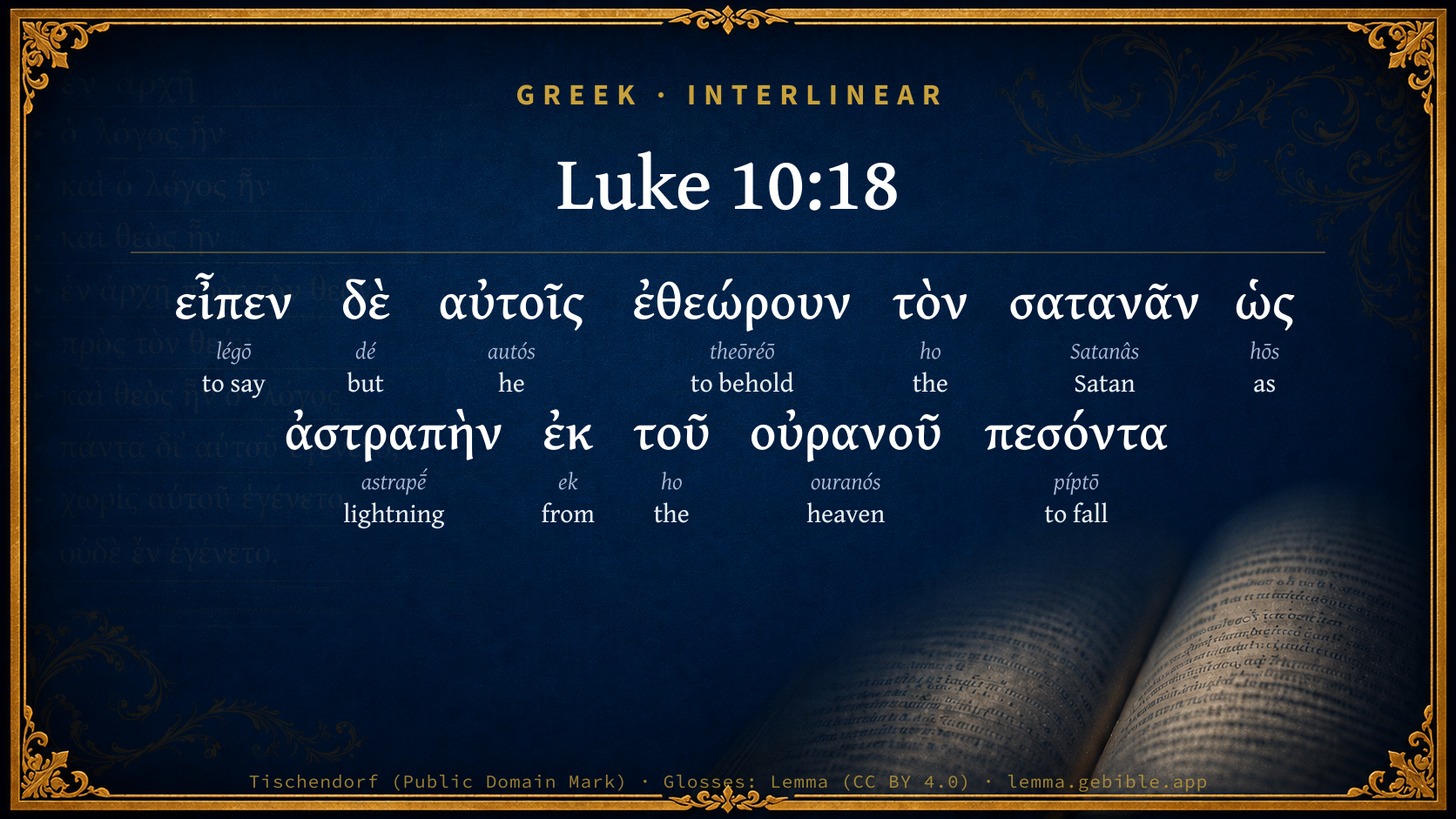
Greek (Tischendorf 8th ed.) Luke 10:18 appears in the Greek New Testament. The text above is from the Tischendorf 8th edition. Each word links to its Strong’s number and a concise gloss. Click any word for its full Thayer’s Greek Lexicon entry.
Download image
Cite this verse

Luke 10:18 (World English Bible). Public Domain. Lemma interlinear Bible study tool, https://lemma.gebible.app/v/luke/10/18.

Show BibTeX & RIS
BibTeX
RIS
English Translation
He said to them, "I saw Satan having fallen like lightning from heaven.
World English Bible · Public Domain
Download a study sheet

One document with this verse’s original text, its word-by-word gloss line, the meaning frame, cross-references with their text, attributed commentary, and full source and license credits — printable, and it pastes into notes with its structure intact.

This verse Autodidact and up

Study sheet (.html) Plain text (.txt)

A passage Seminary Student

Up to 50 verses in one chapter. A passage sheet keeps up to 6 commentary sources and 12 cross-references per verse, in the order this page ranks them, and says so on the sheet whenever that leaves anything out. Ask for a single verse and you get the Autodidact verse sheet above.

Everything on this page stays free to read, with no account — the sheet is a download of what is already on screen, not access to it.

Want to remove ads? Support Godless Engineer
Compare translations 3

The same verse in 3 English versions, stacked beneath the original-language interlinear above. Click any original word for its lexicon entry.

Each is an independent rendering of the whole verse — the interlinear is not word-aligned to these translations.

Highlighted words mark where these versions differ — a whole-verse word diff, not a word-by-word alignment.

  • World English Bible Public Domain
    He said to them, "I saw Satan having fallen like lightning from heaven.
  • King James Version Public Domain
    And he said unto them, I beheld Satan as lightning fall from heaven.
  • unfoldingWord Literal Text CC BY-SA 4.0
    And he said to them, “I was watching Satan fall from heaven like lightning.

unfoldingWord Literal Text — © unfoldingWord, licensed CC BY-SA 4.0. Word-aligned USFM3 via Door43 (git.door43.org/unfoldingWord/en_ult).

Versions to compare (up to 4)

3 of 4 selected

Show all 19 translations

Every available English version of this verse, each an independent rendering of the whole verse.

  • World English Bible Public Domain
    He said to them, "I saw Satan having fallen like lightning from heaven.
  • Berean Standard Bible Public Domain
    So He told them, “I saw Satan fall like lightning from heaven.
  • Majority Standard Bible Public Domain
    So He told them, “I saw Satan fall like lightning from heaven.
  • King James Version Public Domain
    And he said unto them, I beheld Satan as lightning fall from heaven.
  • American Standard Version (1901) Public Domain
    And he said unto them, I beheld Satan fallen as lightning from heaven.
  • Revised Version (1885) Public Domain
    And he said unto them, I beheld Satan fallen as lightning from heaven.
  • Geneva Bible (1599) Public Domain
    And he said vnto them, I sawe Satan, like lightening, fall downe from heauen.
  • Douay-Rheims (1899) Public Domain
    And he said to them: I saw Satan like lightening falling from heaven.
  • Young's Literal Translation Public Domain
    and he said to them, `I was beholding the Adversary, as lightning from the heaven having fallen;
  • Literal Standard Version CC BY-SA 4.0
    and He said to them, “I was beholding Satan having fallen as lightning from Heaven;
  • Unlocked Literal Bible CC BY-SA 4.0
    Jesus said to them, “I was watching Satan fall from heaven as lightning.
  • unfoldingWord Literal Text CC BY-SA 4.0
    And he said to them, “I was watching Satan fall from heaven like lightning.
  • Darby Bible Public Domain
    And he said to them, I beheld Satan as lightning falling out of heaven.
  • World Messianic Bible Public Domain
    He said to them, “I saw Satan having fallen like lightning from heaven.
  • Webster's Bible Public Domain
    And he said to them, I beheld Satan as lightning fall from heaven.
  • Free Bible Version CC BY-SA 4.0
    Jesus replied, “I saw Satan fall like lightning from heaven.
  • Bible in Basic English Public Domain
    And he said, I was watching for Satan, falling from heaven like a star.
  • Text-Critical English NT CC BY 4.0
    He said to them, “I watched Satan fall from heaven like lightning.
  • Tyndale New Testament (1534) Public Domain
    And he sayde vnto them: I sawe satan as it had bene lightenyng faule doune from heaven.

Literal Standard Version (2020), Covenant Press — licensed CC BY-SA 4.0. Text via the HelloAO Bible API (eBible.org). Unlocked Literal Bible (unfoldingWord) — licensed CC BY-SA 4.0. Text via the HelloAO Bible API (eBible.org). unfoldingWord Literal Text — © unfoldingWord, licensed CC BY-SA 4.0. Word-aligned USFM3 via Door43 (git.door43.org/unfoldingWord/en_ult). Free Bible Version, Dr. Jonathan Gallagher — licensed CC BY-SA 4.0. Text via the HelloAO Bible API (eBible.org).

Word by word

More ways to search: Search by grammar → Find every occurrence → Compare this word →

Practice this passage: Drill this verse → Learn its vocabulary →

About this verse

These counts appear in no published source. They are computed here, from the morphology-tagged text and Lemma’s own curated glosses. What Lemma adds →

12
words
11
distinct lemmas
Gospels
section

Notable vocabulary

The rarest word here is ἀστραπὴν lightning G796 — appearing just 9 times in the whole Greek New Testament.

Shared distinctive vocabulary

ἀστραπὴν lightning G796 occurs in 9 verses of the Greek New Testament. Also found in:

Repetition

A word recurs within this verse:

Cross-references

9

Topical passages linked to Luke 10:18 in the Treasury of Scripture Knowledge — connected by theme and wording, ordered by reader-vote popularity; previews shown in the World English Bible.

  • Revelation 12:7–9 There was war in the sky. Michael and his angels made war on the dragon. The dragon and his angels made war.
  • Isaiah 14:12 How you are fallen from heaven, day-star, son of the morning! How you are cut down to the ground, who laid the nations low!
  • John 12:31 Now is the judgment of this world. Now the prince of this world will be cast out.
  • John 16:11 about judgment, because the prince of this world has been judged.
  • Revelation 9:1 The fifth angel sounded, and I saw a star from the sky which had fallen to the earth. The key to the pit of the abyss was given to him.
  • Hebrews 2:14 Since then the children have shared in flesh and blood, he also himself in like manner partook of the same, that through death he might bring to nothing him who had the power of death, that is, the devil,
  • 1 John 3:8 He who sins is of the devil, for the devil has been sinning from the beginning. To this end the Son of God was revealed, that he might destroy the works of the devil.
  • Matthew 4:10 Then Jesus said to him, "Get behind me, Satan! For it is written, 'You shall worship the Lord your God, and him only shall you serve.'"
  • Revelation 20:2 He seized the dragon, the old serpent, which is the devil and Satan, who deceives the whole inhabited earth, and bound him for a thousand years,

Cross-references courtesy of OpenBible.info (CC BY 4.0).

Commentary

Notes on Luke 10:18 from classic Christian and Jewish commentators (each source and its license shown beneath its notes). The classic Christian expositions comment on the surrounding passage and are grouped to its opening verse, so a note may address several verses; the Jewish commentaries on the Tanakh (Rashi and others) are per-verse, so they appear only where the commentator wrote on this verse.

Lemma curates 59 commentaries, every one of them public domain or Creative Commons licensed, each selected and text-cleaned for this edition rather than reprinted as found. About our sources →

Tyndale Open Study Notes

Tyndale Open Resources

10:18 I saw Satan fall from heaven like lightning! See Rev 12:7-12.

Tyndale Open Study Notes — © Tyndale Open Resources, licensed CC BY-SA 4.0. Text via the HelloAO Bible API.

Bengel's Gnomon

Johann Albrecht Bengel

Luk 10:18. Ἐθεώρουν, I was beholding) viz. in spirit: at the time when ye went forth, or when ye acted.[94]—Ὡς ἈΣΤΡΑΠῊΝ, as lightning) with the utmost rapidity.—ἐκ τοῦ οὐρανοῦ, from heaven) in which Satan seems to have been accusing the little ones, i.e. the disciples.—πέσοντα) falling headlong (or rushing): and this, either, he had been banished by force out of heaven (certainly Satan at that time received many strokes, even through the instrumentality of those little ones; in which view the ἐθεώρουν, I was beholding, signifies, that the disciples themselves in some measure had acted against Satan, the Lord beholding them all the time, and rejoicing that He is conquering Satan through them as His instruments): or else, because he (Satan) had obtained permission to resist the disciples, by whom Satan was to be overcome; and he had hastened to come to the succour of the demons which obey him, and to support (prop up) his bad cause. Comp. Luk 10:19. At all events πεσεῖν, with which comp. Act 27:26, LXX. ΣΥΜΠΊΠΤΕΙΝ, פאט, 1Ch 14:9; 1Ch 14:13, is not always the same as ΒΛΗΘῆΝΑΙ; Rev 12:9.[95] Action in heaven includes action on earth, not vice versa.[96] The image, as lightning, is in consonance: and it is not until afterwards that Satan is said to be about to be cast out: Joh 12:31.

[94] When ye were actually preaching and performing the miracles which I enabled you to perform.—ED. and TRANSL.

[95] Where ἐβλήθη ὁ δράκων refers to the forcible ejection of the dragon, which was to be long subsequent.—ED. and TRANSL.

[96] Therefore it does not follow that because demons were cast out on earth, therefore Satan was cast out from heaven.—ED. and TRANSL.

Bengel's Gnomon of the New Testament — English translation (T&T Clark, Edinburgh, 1860) — public domain. Text from a community e-Sword module.

Expositor's Greek Testament

ed. W. Robertson Nicoll

Luk 10:18 . ἐθεώρουν : their report was no news to Jesus. While they were working He saw Satan falling. There has been much discussion as to what is meant by this fall, and why it is referred to. It has been identified with the fall of the angels at the beginning of the world, with the Incarnation, with the temptation of Jesus, in both of which Satan sustained defeat. The Fathers adopted the first of these alternatives, and found the motive of the reference in a desire to warn the disciples. The devil fell through pride; take care you fall not from the same cause (Luk 10:20 ). ὡς ἀστραπὴν , like lightning; the precise point of the comparison has been variously conceived: momentary brightness, quick, sudden movement, inevitableness of the descent down it must come to the earth, etc. πεσόντα , aorist after the imperfect ( ἐθεώρουν ), fallen , a fact accomplished. Pricaeus refers to Act 19:20 as a historical exemplification of the fall Satan’s kingdom destroyed by the rapid spread of Christianity.

The Expositor's Greek Testament, edited by W. Robertson Nicoll (1897–1910) — public domain. Text from a community e-Sword module.

Geneva Bible (1599)

Geneva Bible translators

Paul placeth the devil and his angels, in the air, Eph. 6:12, and he is said to be cast down from thence by force when his power is abolished by the voice of the Gospel.

Geneva Bible (1599) marginal notes — public domain. Text via Bolls.life.

Jamieson, Fausset & Brown

Robert Jamieson, A. R. Fausset & David Brown

I beheld--As much of the force of this glorious statement depends on the nice shade of sense indicated by the imperfect tense in the original, it should be brought out in the translation: "I was beholding Satan as lightning falling from heaven"; that is, "I followed you on your mission, and watched its triumphs; while you were wondering at the subjection to you of devils in My name, a grander spectacle was opening to My view; sudden as the darting of lightning from heaven to earth, lo! Satan was beheld falling from heaven!" How remarkable is this, that by that law of association which connects a part with the whole, those feeble triumphs of the Seventy seem to have not only brought vividly before the Redeemer the whole ultimate result of His mission, but compressed it into a moment and quickened it into the rapidity of lightning! Note.--The word rendered "devils," is always used for those spiritual agents employed in demoniacal possessions--never for the ordinary agency of Satan in rational men. When therefore the Seventy say, "the devils [demons] are subject to us," and Jesus replies, "Mine eye was beholding Satan falling," it is plain that He meant to raise their minds not only from the particular to the general, but from a very temporary form of satanic operation to the entire kingdom of evil. (See Joh 12:31; and compare Isa 14:12).

Jamieson, Fausset & Brown — Commentary Critical and Explanatory on the Whole Bible (1871) — public domain (CC PDM 1.0). Text via the HelloAO Bible API.

Adam Clarke's Commentary

Verse 18. I beheld Satan] Or, Satan himself, τον σαταναν, the very Satan, the supreme adversary, falling as lightning, with the utmost suddenness, as a flash of lightning falls from the clouds, and at the same time in the most observable manner. The fall was both very sudden and very apparent. Thus should the fall of the corrupt Jewish state be, and thus was the fall of idolatry in the Gentile world.

Adam Clarke's Commentary on the Bible (1810–1826) — public domain. Text from a community e-Sword/MySword module.

Ellicott's Commentary for English Readers

(18) I beheld Satan as lightning fall from heaven.—The tense of the first Greek verb implies continuous action: I was beholding Satan as he fell . . . While they were working their Master had been following them in spirit, gazing, as it were, on each stage of their victorious conflict. Their triumph over the demons was the beginning and the earnest of a final conquest over Satan as “the prince of the demons.” There may, possibly, be a reference to the belief then beginning to be current among the Jews as to the fall of Satan after his creation; but the primary meaning of our Lord’s words is that he was now dethroned from his usurped dominion in the “high places” (comp. Eph_6:12), which symbolised the spiritual region of the soul and mind of man. The imagery reappears in a developed form in Rev_12:9.

A Bible Commentary for English Readers, edited by Charles John Ellicott (1878–1897) — public domain. Text from a community e-Sword module.

The Cambridge Bible for Schools and Colleges

gen. ed. J. J. S. Perowne

18. I beheld Satan as lightning fall from heaven] Rather, I was observing Satan as lightning fallen from heaven, Isa_14:9-15. We find similar thoughts in Joh_16:11; Joh_12:31, “now shall the prince of this world be cast out;” 1Jn_3:8; Heb_2:14.

The Cambridge Bible for Schools and Colleges (gen. ed. J. J. S. Perowne; Cambridge University Press, 1878–1918) — public domain. Text from a community e-Sword module.

John Gill's Exposition

And he said unto them,.... In order to abate their surprise, and reduce their transport of mind:

I beheld Satan as lightning fall from heaven; meaning, that this was no news to him, nor any surprising event, that devils should be cast out of men, and be in a state of subjection; for as he existed as the eternal Son of God before his incarnation, he was present, and saw him and his angels fall from heaven, from their first estate, their habitation of bliss and glory, down to hell, upon their sin and rebellion, as violently, swiftly, and suddenly, as the lightning falls from heaven to earth; and when he sent out these his disciples, as soon as they began their work, and all along in it, he, by his divine omniscience, saw the powers of darkness falling before their ministry and miracles; and he also foresaw how Satan hereafter, in a more conspicuous manner, would fall before the preaching of his Gospel by his apostles, not only in Judea, but especially among the Gentiles, where he, the prince of this world, would be cast down from his throne, and out of his kingdom; so that what they related, as it was what he knew before, it was but little in comparison of what he himself had seen long ago, and of what he foresaw would be; and even he would give them power to do other miraculous works besides these.

John Gill's Exposition of the Whole Bible (1746–1763) — public domain (CC PDM 1.0). Text via the HelloAO Bible API.

Trapp's Complete Commentary

John Trapp

18 And he said unto them, I beheld Satan as lightning fall from heaven.

Ver. 18. Fall from heaven] That is, from men’s hearts, which he accounts his heaven; but is cast out by the mighty gospel.

John Trapp, A Commentary or Exposition upon All the Books of the Old and New Testament (1647–1656) — public domain. Text from a community e-Sword module.

Albert Barnes' Notes on the Bible

I beheld Satan ... - “Satan” here denotes evidently the prince of the devils who had been cast out by the seventy disciples, for the discourse was respecting their power over evil spirits. “Lightning” is an image of “rapidity” or “quickness.” I saw Satan fall “quickly” or rapidly - as quick as lightning. The phrase “from heaven” is to be referred to the lightning, and does not mean that he saw “Satan” fall “from heaven,” but that he fell as quick as lightning from heaven or from the clouds. The whole expression then may mean, “I saw at your command devils immediately depart, as quick as the flash of lightning. I gave you this power - I saw it put forth - and I give also now, in addition to this, the power to tread on serpents,” etc.

Albert Barnes' Notes on the Bible (1834–1885) — public domain. Text from a community e-Sword/MySword module.

Haydock's Catholic Bible Commentary

I saw Satan as lightning, &c. Many expound it in this manner: I, who am from eternity, saw Satan with all the rebellious angels, as glorious as they were, fall from heaven; fear then, and tremble, though you have received such favours from God. Others take it in this sense, that Christ, by his incarnation, hath seen the power of the devils lessened and confounded, according to what he also said, (John xii. 31.) Now shall the prince of this world be cast out. (Witham) --- What connexion have these words with what goes before? Some understand them thus: the reign of the devil is near at an end; this prince of darkness is going to be overturned; he will fall from the air, where he reigns, with the same precipitation as lightning, which cuts the clouds and presently disappears. It is almost the same things he says in other places. "The prince of this world is already judged; behold now is the judgment of this world; behold now the prince of this world shall be cast forth! When I sent you to preach the gospel to the poor, I saw Satan fall; I saw his empire overturned. The last effort which this empire of darkness shall make is the death of our Saviour, as he himself says: This is your hour, and the power of darkness. Since his resurrection he has bound the dragon in the abyss for a thousand years; he has shut up the entrance, and sealed it with his seal." (Apocalypse xii. 9. and xx. 2.) Others think that Jesus speaks here of the fall of Lucifer, at the beginning of the creation. Wishing to give his disciples a lesson in humility, on account of the vain complacency which he saw they took in the miracles they wrought, he says to them: Beware of pride, that precipitated the first angel from heaven: I have seen him in the glory with which he was surrounded, and I have seen him hurried into the abyss. Fear, lest the same should happen to you. The former explanation appears to us more simple and literal. (Calmet)

George Leo Haydock (1774–1849), Haydock's Catholic Family Bible and Commentary, 1859 edition — public domain. Excludes Psalms (Douay-Rheims chapter numbering differs from Protestant) and Deuterocanonical books (Catholic canon only).

Matthew Poole's English Annotations

Lightning comes suddenly, and with thunder. The thunder of the gospel brought down the devil as lightning: and indeed this is observable, the devil is so busy in no places where the gospel prevails, as in places where that joyful sound is not come, whether we consider his power with reference to men’s bodies or souls. This is one general advantage of gospel preaching, the devil will not endure the sound of it, so as to impose upon mankind, at that rate which he doth upon ignorant persons, that are heathens, or only differing from them in that they are baptized, and call themselves Christians. Christ saw this, as God, for the devil is not visible to human senses, as neither are any spirits; which showed the impudence of that popish impostor in Germany, who selling indulgences, (by which he pretended souls were delivered from purgatory), called to the people to look up and see them fly away. But Christ could see it as God, for he certainly knew that it would be, and that it already was, the blessed effect of the gospel.

Matthew Poole's English Annotations on the Holy Bible (1683–1685) — public domain. Text from a community e-Sword/MySword module.

Whedon's Commentary on the Bible

Daniel D. Whedon

18. I beheld Satan—Beheld here is in the Greek imperfect, I was beholding; and grammatically it describes the action as going on while another action is being performed. While you were subduing demons, I was beholding and contemplating Satan himself falling like lightning from heaven. As the yielding demons, so the falling Satan, was a visible revelation; each symbolizing the glorious future. But how could it be a literal reality which Jesus saw? We pretend not to know. If, however, we understand it aright, there was vouchsafed from the eternal Father, to the human thought of Jesus a view of the actual event of Satan’s primeval fall, seen in the past; with a true beholding like the divine seeing of a real event in the future. To the human perception of the man Jesus, that is, was presented the full view of that great event in the past eternity, known and remembered in the mind of the eternal Father, the first downfall of Lucifer from his heavenly state. That great reality he beheld, not so much in vision as in a perfect and divine perception, directed into the eternal past. This great reality was unveiled to him from God the Father (as intimated in Luk_10:21) as the symbol of Satan’s future overthrow in the great contest of Heaven and Hell on earth. It was perception rather than conception. As it was a reality, then, which the Seventy saw, so it was a reality which Jesus saw. And both realities were the type and prophecy of a divine future. We know not, however, upon what authority it is that some divines (as Stier) decide that Jesus could never receive revelation by vision. We see no proof that he who as a child grew in wisdom, who as a youth suffered temptation, who as a man was to suffer grievous eclipse of spirit on the cross, might not have had his moments of human cheer derived from divine revelation exhibited to his human vision.

Daniel D. Whedon (gen. ed.), Commentary on the Old and New Testaments (1874–1909) — public domain. Text from a community e-Sword module.

The Pulpit Commentary

And he said unto them, I beheld Satan as lightning fall from heaven. The Lord"s words here were prophetic rather than descriptive of what had taken, or was then taking place. The seventy were telling him their feelings of joy at finding that his Name in their months enabled them to cast out evil spirits from the possessed. Their Master replied in an exalted and exultant strain strange and rare sounds on the lips of the Man of sorrows telling them how he had been looking not on a few spirits of evil driven out of unhappy men, but on the king and chief of all evil falling from his sad eminence and throne of power like a flash of lightning. Jesus Christ saw, in the first success of these poor servants of his, an earnest of that wonderful and mighty victory which his followers, simply armed with the power of his Name, would shortly win over paganism. He saw, too, in the dim far future, many a contest with and victory over evil in its many forms. He looked on, we may well believe, to the final defeat which at length his servants, when they should have learned the true use and the resistless power of that glorious Name of his, should win over the restless enemy of the souls of men.

The Pulpit Commentary (1880–1919), ed. H.D.M. Spence-Jones & Joseph S. Exell — public domain. Text from a community e-Sword module.

John Wesley's Explanatory Notes

I beheld Satan - That is, when ye went forth, I saw the kingdom of Satan, which was highly exalted, swiftly and suddenly cast down.

John Wesley, Explanatory Notes Upon the Whole Bible (1754–1765) — public domain. Text via the GEBible commentary corpus.

Cambridge Greek Testament for Schools and Colleges

18. ἐθεώρουν τὸν σατανᾶν ὡς ἀστραπὴν ἐκ τοῦ οὐρανοῦ πεσόντα. ‘I was observing Satan as lightning fallen from heaven,’ Isa 14:9-15. We find similar thoughts in Joh 16:11; Joh 12:31, “Now shall the prince of this world be cast out;” 1Jn 3:8; Heb 2:14. πεσόντα, not cadentem but lapsum. The metaphor is a picturesque one, and the mixture of the imperfect (ἐθεώρουν) with the aorist (πεσόντα) seems to imply the two thoughts that Christ watched—followed with His gaze—Satan’s fall from the zenith, and saw him lying where he had fallen. The fall implies the conception of Satan as “prince of the power of the air” (τὰ πνευματικὰ τῆς πονηρίας ἐν τοῖς ἐπουρανίοις). Comp. Rev 12:9; Eph 2:2; Eph 6:12.

Cambridge Greek Testament for Schools and Colleges (Cambridge University Press, 1896; 21 vols, various authors incl. Carr, Maclear, Plummer, Farrar, Lumby, Moule, M. R. James, Simcox) — public domain. Text from a community e-Sword module.

Alford’s Greek Testament

Henry Alford

18.] This verse has been generally misunderstood, and its force lost, by imagining it to refer to some triumph just gained, which our Lord announces as the reason for their newly manifested power. The truth is, that in this brief speech He sums up proleptically, as so often in the discourses in John, the whole great conflict with and defeat of the Power of evil, from the first even till accomplished by His own victory. The ἐθεώρ. τ. σ. refers to the original fall of Satan, when he lost his place as an angel of light, not keeping his first estate; which fall however had been proceeding ever since step by step, and shall do so, till all things be put under the feet of Jesus who was made lower than the angels. And this ἐθεώρουν belongs to the period before the foundation of the world when He abode in the bosom of the Father. He is to be (see ver. 22) the Great Victor over the Adversary, and this victory began when Satan fell from heaven. (I would not altogether erase the foregoing interpretation: but surely it is grammatically more correct, with Bleek, to refer the imperfect to the time just past,—to the Lord’s prophetic sight at the time of the ministering of the Seventy. Cf. Act 18:5 for a similar imperfect. If this view be correct, the words do not refer to any “triumph just gained,” but to the Lord’s glorious anticipations of final triumph, felt during the exercise of power by His servants.)

ὡς ἀστ.] Not the suddenness only of the fall, but the brightness of the fallen Angel is thus set forth. The description is not figurative, but literal; i.e. as far as divine words can be said to be literal, being accommodated to our sensuous conceptions. See on this verse, Isa 14:9-15, to which the words have a reference; and Rev 12:7-12.

Henry Alford, The Greek Testament (1849–1861) — public domain. Text from a community e-Sword module.

International Critical Commentary

18. Ἐθεώρουν τὸν Σατάᾶν. At the very time when His ministers were casting out Satan’s ministers,—nay, even as He was sending them forth to their work, Jesus knew that Satan was being overcome, In the defeat of the demons He saw the downfall of their chief. This passage is again conclusive evidence as to Christ’s teaching respecting the existence of a personal power of evil. See on 8:12, and comp. 13:16, 22:31. In all these cases it would have been quite natural to speak of impersonal evil. See D. B.1 art. “Satan”; Edersh. L. & T. 2.Rev_13. § 2.

In N.T. the form is Σατανᾶς (not excepting 2Co 12:7), which is declined, and almost invariably has the art.; but 22:3 and Mar 3:23 are exceptions. In LXX the word is rare. We have σατάν, indecl. and without art., 1Ki 11:14, [23, 25], in the sense of “adversary,” a human enemy; and τὸν Σατανᾶν, or τὸν Σατανά, Ecclus. 21:27.

For the imperf. comp. Act 18:5, and see Win. xl. 3. d, p. 336.

ὡς ἀστραπήν. It was as visible and unmistakable: comp. 17:24; Mat 24:27. The words are amphibolous, but are better taken with ἐθεώρουν than with ἐκ τοῦ οὐρανοῦ, which is to be joined with πεσόντα: comp. 9:17, 27, 57, 13:1, etc. In B 254 ἐκ τοῦ οὐρανοῦ precedes ὡς ἀστραπήν. As in ver. 15, heaven is here put for the height of prosperity and power: Comp. Isa 14:12 and τὰ ἐπουράνια (Eph 6:12).1

πεσόντα. Last with emphasis. The “fallen” of RV. is no improvement on the “fall” of AV. “I beheld Satan fallen” means “saw him prostrate after his fall.” The aor. indicates the coincidence between the success of the Seventy and Christ’s vision of Satan’s overthrow ; and neither “fallen” nor “falling” (cadentem, Vulg.) express this so well as “fall” in English. See Burton., § 146, and T.S. Evens, Expositor, 2nd series, iii. p. 164. Some refer the fall to the original fall of the Angels (Jud 1:6), in which case ἐθεώρουν refers to the Son pre-existing with the Father. Others to the Incarnation, or the Temptation. Rather, it refers to the success of the disciples regarded as a symbol and earnest of the complete overthrow of Satan.2 Jesus had been contemplating evil as a power overthrown. In any case there is no analogy between this passage and Rev 12:12: the point is not that the devil has come down to work mischief on the earth, but that his power to work mischief is broken.

This verse is sometimes quite otherwise explained. “You are elated at your victory over the demons, and are proud of our spiritual powers. Beware of spiritual pride. There was a time when I beheld Satan himself fall even from heaven owing to this sin.”1 Others make it a rebuke to complacency and elation, but in another way. “You are overjoyed at finding that demons are subject to you. That is no very great thing. I once beheld their sovereign cast out of leaven Itself; and their subjection was involved in his overthrow.” Both these interpretations depend upon a misunderstanding of τοῦ οὐρανοῦ, which does not mean the abode of the Angels, but the summit of power (Lam 2:1). This is well expressed in the Clementine Liturgy, in the Collect at the dismissal of the energumens, ὁ ῥήξας αὐτὸν ὡς ἀστραπὴν ἐξ οὐρανοῦ εἰς γῆν, οὐ τοπικῷ ῥήγματι, ἀλλὰ ἀπὸ τιμῆς εἰς ἀτιμίαν, διʼ ἐκούσιον κακόνοιαν Hammond, Liturgies Eastern and Western, Oxford, 1878, p. 5.

International Critical Commentary — older volumes (1896–1929), various authors — public domain. Text from a community e-Sword module.

Vincent's Word Studies in the New Testament

Marvin R. Vincent

I beheld [εθεωρουν] . The verb denotes calm, intent, continuous contemplation of an object which remains before the spectator. So Joh 1:14, we beheld, implying that Jesus ' stay upon earth, though brief, was such that his followers could calmly and leisurely contemplate his glory. Compare Joh 2:23 : they beheld his miracles, "thoughtfully and attentively. Here it denotes the rapt contemplation of a vision. The imperfect, was beholding, refers either to the time when the seventy were sent forth, or to the time of the triumphs which they are here relating." While you were expelling the subordinates, I was beholding the Master fall " (Godet). The Revisers do not seem to have had any settled principle in their rendering of this word throughout the New Testament. See my article on the Revised New Testament, Presbyterian Review, October, 1881, p. 646 sq.

Satan. A transcription of the Hebrew word, derived from a verb to lie in wait or oppose. Hence an adversary. In this sense, of David, 1Sa 29:4, and of the angel who met Balaam, Num 22:22. Compare Zec 3:1, 2; Job 1, 2. Diabolov, devil, is the more common term in the New Testament. In Rev 12:9, both terms are applied to him. As lightning. Describing vividly a dazzling brilliance suddenly quenched. Fall [πεσοντα] . Lit., having fallen. The aorist marks the instantaneous fall, like lightning.

Marvin R. Vincent, Word Studies in the New Testament (1887–1900) — public domain. Text from a community e-Sword/MySword module.

Lesson kit

Teaching starters — assembled from the data on this page, not authored interpretation. Every prompt links to the verse data it draws on. Edit before teaching.

Luke, in the Gospels, opens this verse with 12 words (11 distinct Greek lemmas). Its most distinctive word is astrapḗ (“lightning”). A historical commentator’s framing appears above. Read the whole chapter for the surrounding context.

Discussion questions

  1. What does “lightning” (astrapḗ) contribute to the verse as a whole?
  2. How does Matthew 24:27, which shares the word «lightning», read alongside this verse?
  3. What does the repetition of “the” (2× in this one verse) do in this verse?
  4. The translations on this page render this verse differently — a whole-verse word diff, not a word-by-word alignment. What might account for the different wordings?
  5. Compare how Tyndale Open Study Notes and Bengel's Gnomon read this verse. Where do they agree or differ?

Things to notice

Reading settings

Reading text

Shown beneath each verse's original-language words.

Old Testament
Old Testament edition

Read the OT as the Masoretic Hebrew (MT) or the Greek Septuagint (LXX).

English shown for the Greek Septuagint (in the Hebrew ↔ Greek comparison).

Comparing translations? Open the Compare panel on any verse page to stack up to four side by side.