Genesis 14:22

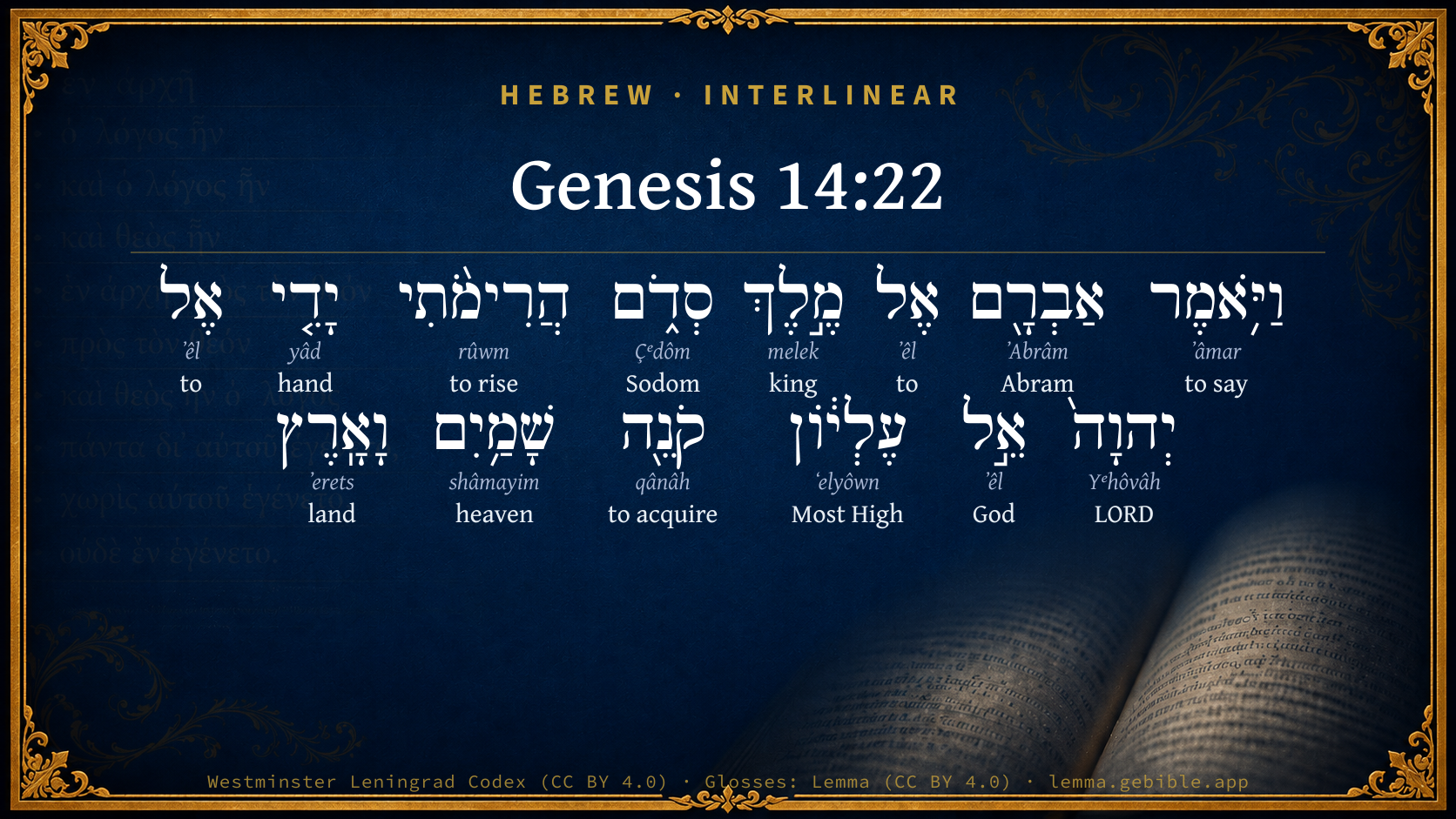
Hebrew (Westminster Leningrad Codex) Genesis 14:22 appears in the Hebrew Old Testament. The text above is from the Westminster Leningrad Codex. Each word links to its Strong’s number, a concise gloss, and parsing drawn from the Open Scriptures Hebrew Bible morphology. Click any word for its full Brown-Driver-Briggs (BDB) entry.
Download image
Cite this verse

Genesis 14:22 (World English Bible). Public Domain. Lemma interlinear Bible study tool, https://lemma.gebible.app/v/genesis/14/22.

Show BibTeX & RIS
BibTeX
RIS
English Translation
Abram said to the king of Sodom, "I have lifted up my hand to Yahweh, God Most High, possessor of heaven and earth,
World English Bible · Public Domain
Download a study sheet

One document with this verse’s original text, its word-by-word gloss line, the meaning frame, cross-references with their text, attributed commentary, and full source and license credits — printable, and it pastes into notes with its structure intact.

This verse Autodidact and up

Study sheet (.html) Plain text (.txt)

A passage Seminary Student

Up to 50 verses in one chapter. A passage sheet keeps up to 6 commentary sources and 12 cross-references per verse, in the order this page ranks them, and says so on the sheet whenever that leaves anything out. Ask for a single verse and you get the Autodidact verse sheet above.

Everything on this page stays free to read, with no account — the sheet is a download of what is already on screen, not access to it.

Want to remove ads? Support Godless Engineer
Compare translations 3

The same verse in 3 English versions, stacked beneath the original-language interlinear above. Click any original word for its lexicon entry.

Each is an independent rendering of the whole verse — the interlinear is not word-aligned to these translations.

Highlighted words mark where these versions differ — a whole-verse word diff, not a word-by-word alignment.

  • World English Bible Public Domain
    Abram said to the king of Sodom, "I have lifted up my hand to Yahweh, God Most High, possessor of heaven and earth,
  • King James Version Public Domain
    And Abram said to the king of Sodom, I have lift up mine hand unto the LORD, the most high God, the possessor of heaven and earth,
  • unfoldingWord Literal Text CC BY-SA 4.0
    But Abram said to the king of Sodom, “I raise my hand to Yahweh, God Most High, the possessor of heaven and earth,

unfoldingWord Literal Text — © unfoldingWord, licensed CC BY-SA 4.0. Word-aligned USFM3 via Door43 (git.door43.org/unfoldingWord/en_ult).

Versions to compare (up to 4)

3 of 4 selected

Show all 18 translations

Every available English version of this verse, each an independent rendering of the whole verse.

  • World English Bible Public Domain
    Abram said to the king of Sodom, "I have lifted up my hand to Yahweh, God Most High, possessor of heaven and earth,
  • Berean Standard Bible Public Domain
    But Abram replied to the king of Sodom, “I have raised my hand to the LORD God Most High, Creator of heaven and earth,
  • Majority Standard Bible Public Domain
    But Abram replied to the king of Sodom, “I have raised my hand to the LORD God Most High, Creator of heaven and earth,
  • King James Version Public Domain
    And Abram said to the king of Sodom, I have lift up mine hand unto the LORD, the most high God, the possessor of heaven and earth,
  • American Standard Version (1901) Public Domain
    And Abram said to the king of Sodom, I have lifted up my hand unto Jehovah, God Most High, possessor of heaven and earth,
  • Revised Version (1885) Public Domain
    And Abram said to the king of Sodom, I have lift up mine hand unto the LORD, God Most High, possessor of heaven and earth,
  • Geneva Bible (1599) Public Domain
    And Abram said to the King of Sodom, I haue lift vp mine hand vnto the Lord the most hie God possessor of heauen and earth,
  • Douay-Rheims (1899) Public Domain
    And he answered him: I lift up my hand to the Lord God the most high, the possessor of heaven and earth,
  • Young's Literal Translation Public Domain
    and Abram saith unto the king of Sodom, `I have lifted up my hand unto Jehovah, God Most High, possessing heaven and earth --
  • Literal Standard Version CC BY-SA 4.0
    and Abram says to the king of Sodom, “I have lifted up my hand to YHWH, God Most High, possessing the heavens and earth—
  • Unlocked Literal Bible CC BY-SA 4.0
    Abram said to the king of Sodom, “I have lifted up my hand to Yahweh, God Most High, Creator of heaven and earth,
  • unfoldingWord Literal Text CC BY-SA 4.0
    But Abram said to the king of Sodom, “I raise my hand to Yahweh, God Most High, the possessor of heaven and earth,
  • Darby Bible Public Domain
    And Abram said to the king of Sodom, I have lifted up my hand to Jehovah, the Most High ùGod, possessor of heavens and earth,
  • World Messianic Bible Public Domain
    Abram said to the king of Sodom, “I have lifted up my hand to the LORD, God Most High, possessor of heaven and earth,
  • Webster's Bible Public Domain
    And Abram said to the king of Sodom, I have lifted my hand to the LORD, the most high God, the possessor of heaven and earth,
  • Free Bible Version CC BY-SA 4.0
    But Abram replied to the king of Sodom, “I raise my hand, making a solemn promise to the Lord, the Most High God, Creator of heaven and earth,
  • Bible in Basic English Public Domain
    But Abram said to the king of Sodom, I have taken an oath to the Lord, the Most High God, maker of heaven and earth,
  • JPS Tanakh (1917) Public Domain
    And Abram said to the king of Sodom: 'I have lifted up my hand unto the LORD, God Most High, Maker of heaven and earth,

Literal Standard Version (2020), Covenant Press — licensed CC BY-SA 4.0. Text via the HelloAO Bible API (eBible.org). Unlocked Literal Bible (unfoldingWord) — licensed CC BY-SA 4.0. Text via the HelloAO Bible API (eBible.org). unfoldingWord Literal Text — © unfoldingWord, licensed CC BY-SA 4.0. Word-aligned USFM3 via Door43 (git.door43.org/unfoldingWord/en_ult). Free Bible Version, Dr. Jonathan Gallagher — licensed CC BY-SA 4.0. Text via the HelloAO Bible API (eBible.org).

Word by word

More ways to search: Search by grammar → Find every occurrence → Compare this word →

Practice this passage: Drill this verse → Learn its vocabulary →

סְדֹ֑ם
Çᵉdôm
H5467
“Sodom”
Noun, Proper
Part of Speech
Noun
Type
Proper
Full BDB Definition

Origin: from an unused root meaning to scorch

TWOT: 1465

Sodom = "burning" - a Canaanite city, usually paired with Gomorrah, located in the area of the Dead Sea and the Jordan river; both cities destroyed by God in judgment
  1. וַיֹּ֥אמֶר ʼâmar H559 “and · to say” Conjunction + Verb, Qal, Sequential Imperfect, 3rd Person, Masculine, Singular
  2. אַבְרָ֖ם ʼAbrâm H87 “Abram” Noun, Proper
  3. אֶל ʼêl H413 “to” Preposition
  4. מֶ֣לֶךְ melek H4428 “king of” Noun, Common, Masculine, Singular, Construct
  5. הֲרִימֹ֨תִי rûwm H7311 “to rise” Verb, Hiphil, Perfect, 1st Person, Common, Singular
  6. יָדִ֤י yâd H3027 “hand · my” Noun, Common, Both, Singular, Construct + Suffix, Personal, 1st Person, Common, Singular
  7. אֶל ʼêl H413 “to” Preposition
  8. יְהוָה֙ Yᵉhôvâh H3068 “LORD” Noun, Proper
  9. אֵ֣ל ʼêl H410 “God” Noun, Common, Masculine, Singular, Absolute
  10. עֶלְי֔וֹן ʻelyôwn H5945 “Most High” Adjective, Adjective, Masculine, Singular, Absolute
  11. קֹנֵ֖ה qânâh H7069 “acquiring” Verb, Qal, Participle Active, Masculine, Singular, Construct
  12. שָׁמַ֥יִם shâmayim H8064 “heaven(s)” Noun, Common, Masculine, Plural, Absolute
  13. וָאָֽרֶץ ʼerets H776 “and · land” Conjunction + Noun, Common, Both, Singular, Absolute

About this verse

These counts appear in no published source. They are computed here, from the morphology-tagged text and Lemma’s own curated glosses. What Lemma adds →

14
words
13
distinct lemmas
Pentateuch
section

Shared distinctive vocabulary

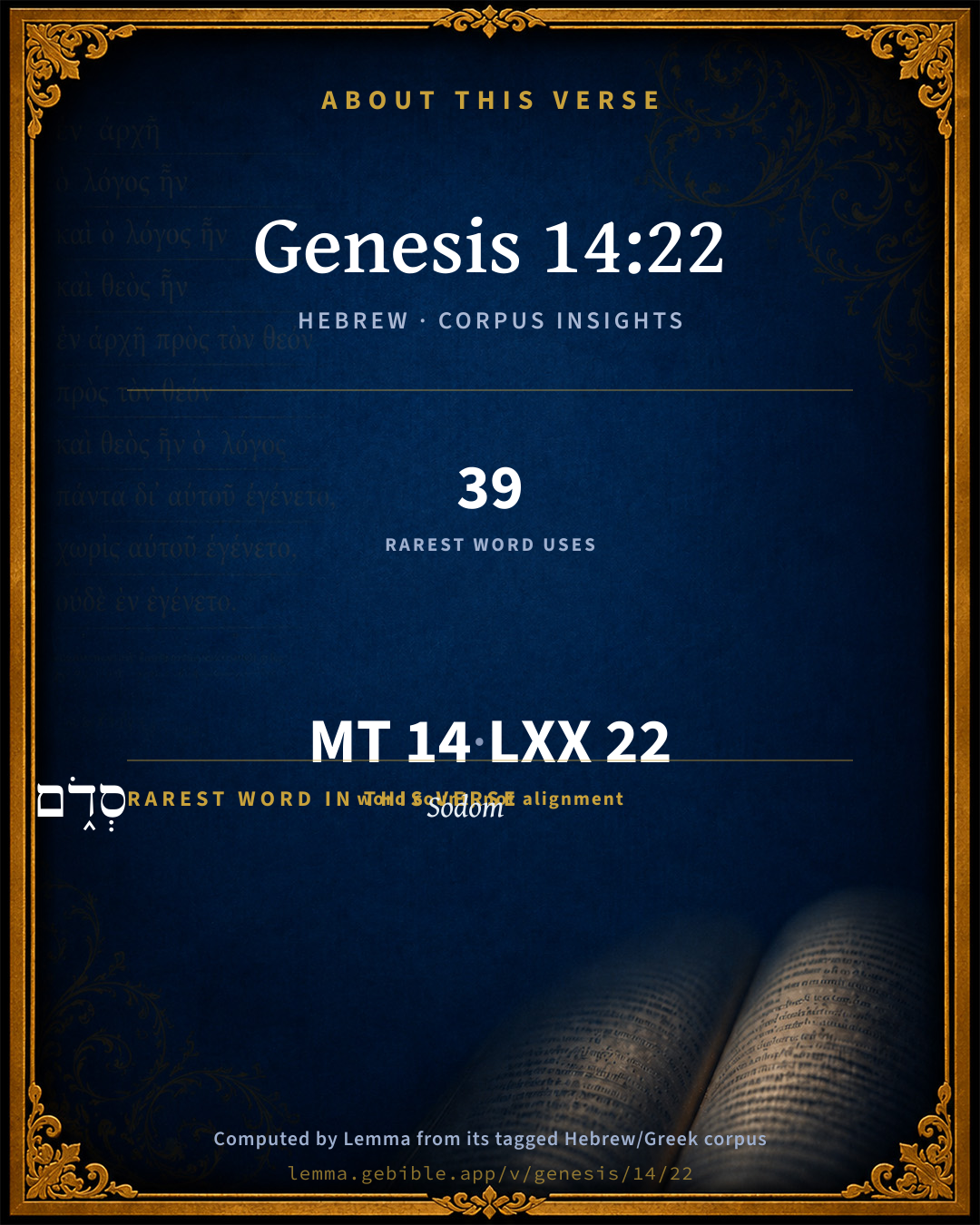
סְדֹ֑ם Sodom H5467 occurs in 38 verses of the Hebrew Bible. Also found in:

Grammatical profile

  • 3 verbs
  • 8 nouns
  • 1 adjective
  • 2 prepositions

Verb forms

  • וַיֹּ֥אמֶר Qal · Sequential Imperfect
  • הֲרִימֹ֨תִי Hiphil · Perfect
  • קֹנֵ֖ה Qal · Participle Active

Repetition

A word recurs within this verse — often emphatic in Hebrew:

  • אֶל to H413 ×2

Hebrew & Septuagint length

In English translation the verse runs 23 words from the Hebrew and 28 from the Septuagint (LXX English) — closely comparable.

A rough comparison of the two English renderings, which tokenize alike — not a word-level alignment.

Word counts can differ between the Hebrew and the Greek without any difference in meaning — e.g. the Hebrew direct-object marker אֵת has no separate Greek word, and Greek often adds the article ὁ.

In the original languages it is 14 Hebrew tokens and 22 Greek tokens — but the two are counted differently (Hebrew bundles its prefixes and suffixes into one token; the Greek is in lemma form), so that isn’t a like-for-like length.

Cross-references

14

Topical passages linked to Genesis 14:22 in the Treasury of Scripture Knowledge — connected by theme and wording, ordered by reader-vote popularity; previews shown in the World English Bible.

  • Daniel 12:7 I heard the man clothed in linen, who was above the waters of the river, when he held up his right hand and his left hand to heaven, and swore by him who lives forever that it shall be for a time, times, and a half; and when they have made an end of breaking in pieces the power of the holy people, all these things shall be finished.
  • Exodus 6:8 I will bring you into the land which I swore to give to Abraham, to Isaac, and to Jacob; and I will give it to you for a heritage: I am Yahweh.'"
  • Deuteronomy 32:40 For I lift up my hand to heaven, And say, As I live forever,
  • Judges 11:35 It happened, when he saw her, that he tore his clothes, and said, Alas, my daughter! you have brought me very low, and you are one of those who trouble me; for I have opened my mouth to Yahweh, and I can't go back.
  • Psalms 24:1 The earth is Yahweh's, with its fullness; The world, and those who dwell therein.
  • Psalms 83:18 That they may know that you alone, whose name is Yahweh, Are the Most High over all the earth.
  • Daniel 4:34 At the end of the days I, Nebuchadnezzar, lifted up my eyes to heaven, and my understanding returned to me, and I blessed the Most High, and I praised and honored him who lives forever; for his dominion is an everlasting dominion, and his kingdom from generation to generation.
  • Revelation 10:5–6 The angel who I saw standing on the sea and on the land lifted up his right hand to the sky,
  • Genesis 14:19–20 He blessed him, and said, "Blessed be Abram of God Most High, possessor of heaven and earth:
  • Genesis 17:1 When Abram was ninety-nine years old, Yahweh appeared to Abram, and said to him, "I am God Almighty. Walk before me, and be blameless.
  • Genesis 21:23–31 Now therefore swear to me here by God that you will not deal falsely with me, nor with my son, nor with my son's son. But according to the kindness that I have done to you, you shall do to me, and to the land in which you have lived as a foreigner."
  • Genesis 21:33 Abraham planted a tamarisk tree in Beersheba, and called there on the name of Yahweh, the Everlasting God.
  • Isaiah 57:15 For thus says the high and lofty One who inhabits eternity, whose name is Holy: I dwell in the high and holy place, with him also who is of a contrite and humble spirit, to revive the spirit of the humble, and to revive the heart of the contrite.
  • Haggai 2:8 The silver is mine, and the gold is mine,' says Yahweh of Hosts.

Cross-references courtesy of OpenBible.info (CC BY 4.0).

Hebrew and Greek witnesses Masoretic Hebrew ↔ Greek Septuagint

The same verse in the two great witnesses to the Old Testament, shown verse-for-verse.

These are two independent witnesses, not word-aligned to each other, and the Septuagint is shown in lemma (dictionary) form.

Hebrew Genesis 14:22 Masoretic · Westminster Leningrad Codex

וַיֹּ֥אמֶר אַבְרָ֖ם אֶל מֶ֣לֶךְ סְדֹ֑ם הֲרִימֹ֨תִי יָדִ֤י אֶל יְהוָה֙ אֵ֣ל עֶלְי֔וֹן קֹנֵ֖ה שָׁמַ֥יִם וָאָֽרֶץ

Abram said to the king of Sodom, "I have lifted up my hand to Yahweh, God Most High, possessor of heaven and earth,

World English Bible · Public Domain

Greek LXX Genesis 14:22 Septuagint · lemma form

εἶπον δέ αβραμ πρός βασιλεύς σοδομα ἐκτείνω ὁ χείρ ἐγώ πρός ὁ θεός ὁ ὕψιστος ὅς κτίζω ὁ οὐρανός καί ὁ γῆ

And Abram said to the king of Sodom, I will stretch out my hand to the Lord the most high God, who made the heaven and the earth,

LXX2012 (modern English Septuagint) · Public Domain

On this verse, The Cambridge Bible for Schools and Colleges discusses the Septuagint’s reading. Read the note in Commentary ↓

Hebrew: Westminster Leningrad Codex (CC BY 4.0). Greek: Septuagint (public domain); English from LXX2012 (modern English Septuagint) (Public Domain). How the Septuagint differs from the Hebrew →

Targum (Aramaic paraphrase)

2

The Targum is the ancient Jewish Aramaic paraphrase of the Hebrew Scriptures — an interpretive translation, not the Hebrew text itself. Onkelos (literal) and Pseudo-Jonathan (expansive) render the Torah, and Jonathan the Prophets. Coverage is partial: where no permissively-licensed English translation exists for a verse, only the Aramaic is shown. This is verse-level text, not a word-by-word alignment to the Hebrew.

  1. Targum Onkelos Torah (Genesis–Deuteronomy)
    וַאֲמַר אַבְרָם לְמַלְכָּא דִסְדוֹם אֲרֵמִית יְדַי בִּצְלוֹ קֳדָם יְיָ אֵל עִלָאָה דְקִנְיָנֵהּ שְׁמַיָא וְאַרְעָא

    And Abram said to the king of Sedom, I have uplifted my hands in prayer before the Lord God most high, whose possession is heaven and earth:

    Targum Onkelos — Aramaic: “Onkelos Genesis” (public domain); “Onkelos Exodus” (public domain); “Onkelos Leviticus” (public domain); “Onkelos Numbers” (public domain); “Onkelos Deuteronomy” (public domain). English: “Sefaria Community Translation” (CC0 1.0 (public-domain dedication)); “J.W. Etheridge. The Targums of Onkelos and Jonathan Ben Uzziel on the Pentateuch. London: Longmans, Green, 1862” (public domain). Text via Sefaria.

  2. Targum Pseudo-Jonathan Torah (Genesis–Deuteronomy)
    וַאֲמַר אַבְרָם לְמַלְכָּא דִסְדוֹם אֲרֵימִית יָדִי בִּשְׁבוּעָה קֳדָם יְיָ אֱלָהָא עִילָאָה דִבְגִין צַדִיקַיָא קָנָא בְּקִנְיָינֵיהּ שְׁמַיָא וְאַרְעָא

    And Abram said to the king of Sedom, I have uplifted my hands in an oath before the Lord God the Most High, who for the just possesseth his possession of the heavens and the earth,

    Targum Pseudo-Jonathan — Aramaic: “Targum Jonathan on Genesis” (public domain); “Targum Jonathan on Exodus” (public domain); “Targum Jonathan on Leviticus” (public domain); “Targum Jonathan on Numbers” (public domain); “Targum Jonathan on Deuteronomy” (public domain). English: “The Targum of Jonathan ben Uzziel, trans. J. W. Etheridge, London, 1862” (public domain). Text via Sefaria.

Commentary

Notes on Genesis 14:22 from classic Christian and Jewish commentators (each source and its license shown beneath its notes). The classic Christian expositions comment on the surrounding passage and are grouped to its opening verse, so a note may address several verses; the Jewish commentaries on the Tanakh (Rashi and others) are per-verse, so they appear only where the commentator wrote on this verse.

Lemma curates 59 commentaries, every one of them public domain or Creative Commons licensed, each selected and text-cleaned for this edition rather than reprinted as found. About our sources →

Trapp's Complete Commentary

John Trapp

Gen 14:22 And Abram said to the king of Sodom, I have lift up mine hand unto the LORD, the most high God, the possessor of heaven and earth,

Ver. 22. I have lifted up my hand.] A swearing gesture. {Dan 12:7 Rev 10:5-6} Neither doth he this rashly, but for very good reason first, that by this oath, as by a buckler, he might fence himself against all covetous desires of the spoil; secondly, to show that he did seriously remit of that which was his right, and went not to war for wages; thirdly, hereby to profess his faith and religion in opposition to their superstitious vanities, &c.

The possessor of heaven and earth.] The true and rightful proprietary, whose tenants-at-pleasure we all are, as Philo from this text well observeth. And here take notice how Melchizedek and Abram concur in the very terms of professing their faith, "The most high God, possessor of heaven and earth." Whereunto Abram adds "Jehovah," by which name Melchizedek haply knew not God as yet; like as Apollos was ignorant of many needful truths, till better instructed by Aquila and Priscilla. {Act 18:26}

John Trapp, A Commentary or Exposition upon All the Books of the Old and New Testament (1647–1656) — public domain. Text from a community e-Sword module.

Joseph Benson's Commentary

Gen 14:22-23. Here observe, 1st, Abram gives to God the same titles that Melchizedek had just now used. It is good to learn of others how to order our speech concerning God, and to imitate those who speak well in divine things. 2d, The ceremony used in this oath; I have lift up my hand — In religious swearing, we appeal to God’s knowledge of our truth and sincerity, and imprecate his wrath if we swear falsely; and the “lifting up of the hands” is expressive of both. Lest thou shouldest say, I have made Abram rich — Probably, Abram knew the king of Sodom to be a proud and scornful man, and one that would be apt to turn such a thing as this to his reproach afterward; and when we have to do with such men, we have need to act with particular caution. From a thread to a shoe-latchet — Not the least thing that had ever belonged to the king of Sodom.

Joseph Benson's Commentary on the Old and New Testaments (1811–1818) — public domain. Text from a community e-Sword module.

Tyndale Open Study Notes

Tyndale Open Resources

14:22 In the words of this oath, Abram may have been clarifying that his God, the Lord (Yahweh), was the God Most High that Melchizedek invoked. Perhaps Melchizedek had never heard the name Yahweh.

Tyndale Open Study Notes — © Tyndale Open Resources, licensed CC BY-SA 4.0. Text via the HelloAO Bible API.

Geneva Bible (1599)

Geneva Bible translators

Or, I have sworn.

Geneva Bible (1599) marginal notes — public domain. Text via Bolls.life.

Adam Clarke's Commentary

Verse 22. I have lift up mine hand] The primitive mode of appealing to God, and calling him to witness a particular transaction; this no doubt generally obtained among the faithful till circumcision, the sign of the covenant, was established. After this, in swearing, the hand was often placed on the circumcised part; see Ge 24:2; Ge 24:9.

Adam Clarke's Commentary on the Bible (1810–1826) — public domain. Text from a community e-Sword/MySword module.

John Calvin's Commentaries

22. And Abram said to the king of Sodom, I have lift up mine hand, etc This ancient ceremony was very appropriate to give expression to the force and nature of an oath. For by raising the hand towards heaven, we show that we appeal to God as a witness, and also as an avenger, if we fail to keep our oath. Formerly, indeed, they raised their hands in giving votes; whence the Greeks derive the word (χειροτονεῖν,) which signifies to decree: but in the rite of swearing, the reason for doing so was different. For men hereby declared, that they regarded themselves as in the presence of God, and called upon him to be both the Guardian of truth, and the Avenger of perjury. Yet it may seem strange that Abram should so easily have put himself forward to swear; for he knew that a degree of reverence was due to the name of God, which should constrain us to use it but sparingly, and only from necessity. I answer, there were two reasons for his swearing. First, since inconstant men are wont to measure others by their own standard, they seldom place confidence in bare assertions. The king of Sodom, therefore, would have thought that Abram did not seriously remit his right, unless the name of God had been interposed. And, secondly, it was of great consequence, to make it manifest to all, that he had not carried on a mercenary war. The histories of all times sufficiently declare, that even they who have had just causes of war have, nevertheless, been invited to it by the thirst of private gain. And as men are acute in devising pretexts, they are never at a loss to find plausible reasons for war, even though covetousness may be their only real stimulant. Therefore, unless Abram had resolutely refused the spoils of war, the rumor would immediately have spread, that, under the pretense of rescuing his nephew, he had been intent upon grasping the prey. Against which it was necessary for him carefully to guard, not so much for his own sakes as for the glory of God, which would otherwise have received some mark of disparagement. Besides, Abram wished to arm himself with the name of God, as with a shield, against all the allurements of avarice. For the king of Sodom would not have desisted from tempting his mind by various methods, if the occasion for using bland insinuations had not been promptly cut off.

John Calvin's Commentaries (1540-1563) — public domain. Text from the Calvin Translation Society English edition (1840s-50s) via the Christian Classics Ethereal Library (ccel.org). Calvin's coverage is partial (roughly two-thirds of the Bible); uncommented books and verses are honest gaps, never fabricated. The 19th-century editor's footnotes and remarks are omitted so the notes are faithfully Calvin's own voice.

The Cambridge Bible for Schools and Colleges

gen. ed. J. J. S. Perowne

22. I have lift up mine hand] i.e. I have sworn, taken an oath with a gesture, symbolizing the appeal to God. Cf. Deu_32:40; Dan_12:7.

the Lord, God Most High] i.e. Jehovah El Elyon. The LXX and Syriac Peshitto omit “Jehovah.” The Sam. reads ha-Elohim for “Jehovah.” Abram takes his oath in the name of the God of Melchizedek whom a later scribe probably identified with Jehovah.

The Cambridge Bible for Schools and Colleges (gen. ed. J. J. S. Perowne; Cambridge University Press, 1878–1918) — public domain. Text from a community e-Sword module.

John Gill's Exposition

And Abram said to the king of Sodom,.... In reply to his request:

I have lifted up mine hand unto the Lord; which was both a gesture of praying and of swearing, and both may be intended here; when he set out on his expedition, it is very probable he prayed to God for success, and swore that if he prospered him, that he would receive no profit or advantage from it to himself; or now in the presence of Melchizedek he lift up his hands and swore that he would take none of the goods he had recovered to his own line; and in this form of praying or swearing, he makes use of the same epithets of God Melchizedek had just used:

the most high God, the possessor of heaven and earth: having his heart struck with those just and glorious representations of God, and awed with a sense of such a glorious Being, and being forward to learn and retain everything that tended to make for the glory of God.

John Gill's Exposition of the Whole Bible (1746–1763) — public domain (CC PDM 1.0). Text via the HelloAO Bible API.

Haydock's Catholic Bible Commentary

I lift up. This is the posture of one swearing solemnly, by which we testify our belief, that God dwells in the heavens, and governs the world. (Calmet)

George Leo Haydock (1774–1849), Haydock's Catholic Family Bible and Commentary, 1859 edition — public domain. Excludes Psalms (Douay-Rheims chapter numbering differs from Protestant) and Deuterocanonical books (Catholic canon only).

Matthew Poole's English Annotations

This was the ancient manner of swearing. See Exo 6:8; Num 14:30; Deu 32:40; Eze 20:5,6.

Matthew Poole's English Annotations on the Holy Bible (1683–1685) — public domain. Text from a community e-Sword/MySword module.

Whedon's Commentary on the Bible

Daniel D. Whedon

22. I have lifted up mine hand — A solemn form of making oath before God.

Unto the Lord, the most high God — Unto Jehovah El Elion. The God of Melchizedek was El Elion, (Gen_14:19,) a name that first appears in this connexion; not Elohim, nor yet Eloah. Elion is mentioned by Sanchoniathon as the name of the Phenician deity, and was probably common among the early Semitic nations as the name of the Supreme God. But Abram knows God under another name, Jehovah, the God of gracious revelation and promise. Although as king and priest of the most high God, blessing Abram and receiving tithes from him, Melchizedek appears as one superior to “the friend of God,” yet, as Kalisch well observes, “the religious enlightenment of the king of Salem was but a ray of the sun of Abram’s faith, and scarcely sufficient as it was, in itself, entirely to dispel the darkness, it could not be intended to spread a light to distant regions.” Abram can appropriately use the name El Elion, possessor of heaven and earth, thus repeating, with thankful recognition, the name of the God of Melchizedek, but he puts before it the NAME to him more sacred, the name of the God who had appeared to him in this land of promise, and to whom he had erected altars. Gen_12:7-8; Gen_13:18.

Daniel D. Whedon (gen. ed.), Commentary on the Old and New Testaments (1874–1909) — public domain. Text from a community e-Sword module.

The Pulpit Commentary

And Abram said unto the king of Sodom, I have lift up mine hand a common form of swearing (Deu_32:40; Eze_20:5, Eze_20:6; Dan_12:7; Rev_10:5, Rev_10:6; cf. Virg., "AEn.," 12:195) unto the Lord (Jehovah; which, occurring in the present document, proves the antiquity of its use as a designation of the Deity), the most high God, El-Elion; thus identifying Jehovah with the God of Melchisedeck, and perhaps of the king of Sodom ( vide supra) the possessor of heaven and earth.

HOMILIES BY F. HASTINGS Vers. 22, 23.

Abraham"s independent spirit.

Abraham said to the king of Sodom, I have lift up my hand unto the Lord, the most high God, the possessor of heaven and earth, that I will not take from a thread even to a shoe latchet," &c. When Lot chose the plains of Sodom he knew not what trials awaited him there. The king of Sodom was attacked and defeated. He escaped, but many of his subjects were either slaughtered or made captive. Lot was carried away by the invading host. Abraham delivers him. On his return, flushed with victory, he is met by two persons Melchizedek and the king of Sodom. To the first he gives tithes, as a thank offering; from the second he will not receive anything for all the risk he had run in the conflict. If Abraham had taken all the spoil, it would only have been in accordance with the general practice of that age; but a principle, and not a custom, is his guide.

I ABRAHAM WISHED TO AVOID PLACING HIMSELF UNDER OBLIGATION TO A WORLDLY MAN.

II ABRAHAM WISHED TO AVOID THE APPEARANCE OF TOO GREAT INTIMACY WITH AN UNRIGHTEOUS MAN.

III ABRAHAM WISHED TO SHOW THAT THE SERVANT OF THE MOST HIGH GOD CAN DO GOOD WITHOUT HOPE OF REWARD.

IV ABRAHAM WISHED TO SHOW HOW UNDESIRABLE A PRACTICE IT WAS, TO GAIN BY THE MISFORTUNES OF OTHERS.

V ABRAHAM WISHED TO SHOW THAT GOD, AND A SPIRIT OF CONTENTEDNESS, WERE A GOOD MAN"S TRUE RICHES. How much better to act thus than to permit the ungodly to point the finger of scorn and say, with respect to professedly religious men, that they are just as greedy and worldly as the most irreligious. H.

The Pulpit Commentary (1880–1919), ed. H.D.M. Spence-Jones & Joseph S. Exell — public domain. Text from a community e-Sword module.

John Wesley's Explanatory Notes

I have lift up mine hand to the Lord that I will not take anything - Here Observe, (1.) The titles he gives to God, the most high God, the possessor of heaven and earth - The same that Melchizedek had just now used. It is good to learn of others how to order our speech concerning God, and to imitate those who speak well in divine things. (2.) The ceremony used in this oath; I have lift up my hand - In religious swearing we appeal to God's knowledge of our truth and sincerity, and imprecate his wrath if we swear falsely; and the lifting up of the hands is expressive of both. Lest thou shouldst say, I have made Abram rich - Probably, Abram knew the king of Sodom to be a proud and scornful man, and one that would be apt to turn such a thing as this to his reproach afterwards, and when we have to do with such men, we have need to act with particular caution.

John Wesley, Explanatory Notes Upon the Whole Bible (1754–1765) — public domain. Text via the GEBible commentary corpus.

Rashi

Rabbi Shlomo Yitzchaki (Rashi)

הרמתי ידי I HAVE LIFTED UP MY HAND — An expression signifying an oath: I lift up my hand to the Most High God (not, I have lifted up). Similarly, (Genesis 22:16) בי נשבעתי which means “By myself do I swear” and similarly, (Genesis 23:13) נתתי כסף השדה קח ממני which means “I give the price of the field, take it from me”.)

Rashi on the Tanakh — English translations: “The Judaica Press complete Tanach with Rashi, translated by A. J. Rosenberg” (CC BY 4.0); “Pentateuch with Rashi's commentary by M. Rosenbaum and A.M. Silbermann, 1929-1934” (public domain); “The Metsudah Tanach series, Lakewood, N.J” (CC BY 4.0); and “The Book of Joshua, Metsudah Publications, 1997” (CC BY 4.0). Text via Sefaria.

Ramban (Nachmanides)

Rabbi Moshe ben Nachman (Ramban / Nachmanides)

I HAVE LIFTED UP MINE HAND TO THE ETERNAL. This is an expression signifying an oath: “I lift up my hand to G-d Most High.”, the sense is that of the present tense: “I lift up my hand.” Similarly, the verse, By myself have I sworn, means “By Myself do I swear.” Thus the language of Rashi.I have found a similar text in the Sifre: 33. “We find in the case of all the righteous that they bring their inclination under oath in order not to do evil. In the case of Abraham, he says, I have lifted up mine hand to the Eternal.” It is thus similar to the verse, And he lifted up his right hand and his left hand unto heaven, and swore by Him that liveth forever. But Onkelos said, “I have lifted my hand in prayer before the Eternal.” The intent of Abraham’s words according to Onkelos is: “I have prayed to G-d, with my hands spread forth toward heaven, if I take anything that is thine.” That is to say, “G-d do so to me, and more also, 2:23. if I take, etc.”The correct interpretation appears to me to be that Abraham said, “I have lifted my hand to G-d to make those things Sacred and Devoted to Him, were I to take from that which is thine.” Declaring things to be sacred to Him is called in Hebrew “lifting of a hand,” just as in the verses: Every one that did lift up a heave offering of silver and copper; and every man that offered a wave offering of gold unto the Eternal., Verse 22. This Abraham said because having given a tenth of it to the priest, he declared that whatever he takes from the king of Sodom would be a heave offering to G-d, from which he would derive no benefit.In Bereshith Rabbah it is similarly said, “Abraham made it a heave offering, even as it is said, And ye shall heave a heave offering of it for the Eternal.”

Ramban (Nachmanides) on the Tanakh — English translation: “Commentary on the Torah by Ramban (Nachmanides). Translated and annotated by Charles B. Chavel. New York, Shilo Pub. House, 1971-1976” (CC BY 4.0). Text via Sefaria.

Lesson kit

Teaching starters — assembled from the data on this page, not authored interpretation. Every prompt links to the verse data it draws on. Edit before teaching.

Genesis, in the Pentateuch, opens this verse with 14 words (13 distinct Hebrew lemmas). Its most distinctive word is Çᵉdôm (“Sodom”). A historical commentator’s framing appears above. Read the whole chapter for the surrounding context.

Discussion questions

  1. What does “Sodom” (Çᵉdôm) contribute to the verse as a whole?
  2. How does Genesis 10:19, which shares the word «Sodom», read alongside this verse?
  3. What does the repetition of “to” (2× in this one verse) do in this verse?
  4. The translations on this page render this verse differently — a whole-verse word diff, not a word-by-word alignment. What might account for the different wordings?
  5. «וַיֹּ֥אמֶר» is a Qal Sequential Imperfect verb. How does that grammatical form shape the action described?
  6. Compare how Trapp's Complete Commentary and Joseph Benson's Commentary read this verse. Where do they agree or differ?

Things to notice

Reading settings

Reading text

Shown beneath each verse's original-language words.

Old Testament
Old Testament edition

Read the OT as the Masoretic Hebrew (MT) or the Greek Septuagint (LXX).

English shown for the Greek Septuagint (in the Hebrew ↔ Greek comparison).

Comparing translations? Open the Compare panel on any verse page to stack up to four side by side.