
Matthew 16:19

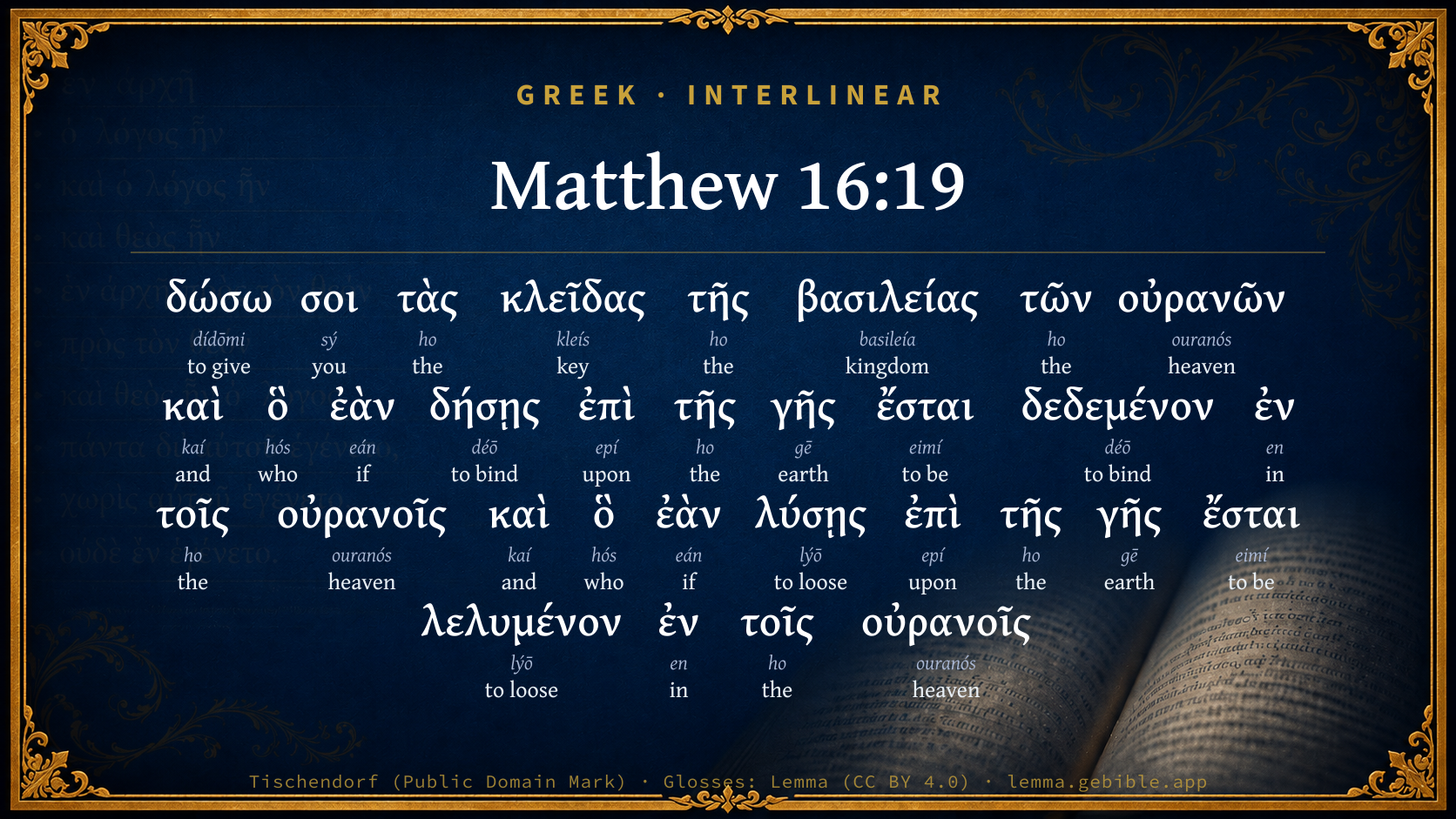
Greek (Tischendorf 8th ed.) Matthew 16:19 appears in the Greek New Testament. The text above is from the Tischendorf 8th edition. Each word links to its Strong’s number and a concise gloss. Click any word for its full Thayer’s Greek Lexicon entry.
Download image
Cite this verse

Matthew 16:19 (World English Bible). Public Domain. Lemma interlinear Bible study tool, https://lemma.gebible.app/v/matthew/16/19.

Show BibTeX & RIS
BibTeX
RIS
English Translation
I will give to you the keys of the Kingdom of Heaven, and whatever you bind on earth will be bound in heaven; and whatever you release on earth will be released in heaven."
World English Bible · Public Domain
Highlights
  • 1 first appearance in the Greek New Testament
Full analysis ↓
Download a study sheet

One document with this verse’s original text, its word-by-word gloss line, the meaning frame, cross-references with their text, attributed commentary, and full source and license credits — printable, and it pastes into notes with its structure intact.

This verse Autodidact and up

Study sheet (.html) Plain text (.txt)

A passage Seminary Student

Up to 50 verses in one chapter. A passage sheet keeps up to 6 commentary sources and 12 cross-references per verse, in the order this page ranks them, and says so on the sheet whenever that leaves anything out. Ask for a single verse and you get the Autodidact verse sheet above.

Everything on this page stays free to read, with no account — the sheet is a download of what is already on screen, not access to it.

Want to remove ads? Support Godless Engineer
Compare translations 3

The same verse in 3 English versions, stacked beneath the original-language interlinear above. Click any original word for its lexicon entry.

Each is an independent rendering of the whole verse — the interlinear is not word-aligned to these translations.

Highlighted words mark where these versions differ — a whole-verse word diff, not a word-by-word alignment.

  • World English Bible Public Domain
    I will give to you the keys of the Kingdom of Heaven, and whatever you bind on earth will be bound in heaven; and whatever you release on earth will be released in heaven."
  • King James Version Public Domain
    And I will give unto thee the keys of the kingdom of heaven: and whatsoever thou shalt bind on earth shall be bound in heaven: and whatsoever thou shalt loose on earth shall be loosed in heaven.
  • unfoldingWord Literal Text CC BY-SA 4.0
    I will give to you the keys of the kingdom of the heavens, and whatever you bind on the earth will have been bound in the heavens, and whatever you loose on the earth will have been loosed in the heavens.”

unfoldingWord Literal Text — © unfoldingWord, licensed CC BY-SA 4.0. Word-aligned USFM3 via Door43 (git.door43.org/unfoldingWord/en_ult).

Versions to compare (up to 4)

3 of 4 selected

Show all 19 translations

Every available English version of this verse, each an independent rendering of the whole verse.

  • World English Bible Public Domain
    I will give to you the keys of the Kingdom of Heaven, and whatever you bind on earth will be bound in heaven; and whatever you release on earth will be released in heaven."
  • Berean Standard Bible Public Domain
    I will give you the keys of the kingdom of heaven. Whatever you bind on earth will be bound in heaven, and whatever you loose on earth will be loosed in heaven.”
  • Majority Standard Bible Public Domain
    I will give you the keys of the kingdom of heaven. Whatever you bind on earth will be bound in heaven, and whatever you loose on earth will be loosed in heaven.”
  • King James Version Public Domain
    And I will give unto thee the keys of the kingdom of heaven: and whatsoever thou shalt bind on earth shall be bound in heaven: and whatsoever thou shalt loose on earth shall be loosed in heaven.
  • American Standard Version (1901) Public Domain
    I will give unto thee the keys of the kingdom of heaven: and whatsoever thou shalt bind on earth shall be bound in heaven; and whatsoever thou shalt loose on earth shall be loosed in heaven.
  • Revised Version (1885) Public Domain
    I will give unto thee the keys of the kingdom of heaven: and whatsoever thou shalt bind on earth shall be bound in heaven: and whatsoever thou shalt loose on earth shall be loosed in heaven.
  • Geneva Bible (1599) Public Domain
    And I will giue vnto thee the keyes of the kingdome of heauen, and whatsoeuer thou shalt binde vpon earth, shalbe bound in heauen: and whatsoeuer thou shalt loose on earth, shall be loosed in heauen.
  • Douay-Rheims (1899) Public Domain
    And I will give to thee the keys of the kingdom of heaven. And whatsoever thou shalt bind upon earth, it shall be bound also in heaven: and whatsoever thou shalt loose upon earth, it shall be loosed also in heaven.
  • Young's Literal Translation Public Domain
    and I will give to thee the keys of the reign of the heavens, and whatever thou mayest bind upon the earth shall be having been bound in the heavens, and whatever thou mayest loose upon the earth shall be having been loosed in the heavens.'
  • Literal Standard Version CC BY-SA 4.0
    and I will give to you the keys of the kingdom of the heavens, and whatever you may bind on the earth will be having been bound in the heavens, and whatever you may loose on the earth will be having been loosed in the heavens.”
  • Unlocked Literal Bible CC BY-SA 4.0
    I will give to you the keys of the kingdom of heaven. Whatever you shall bind on earth shall be bound in heaven, and whatever you shall loose on earth shall be loosed in heaven.”
  • unfoldingWord Literal Text CC BY-SA 4.0
    I will give to you the keys of the kingdom of the heavens, and whatever you bind on the earth will have been bound in the heavens, and whatever you loose on the earth will have been loosed in the heavens.”
  • Darby Bible Public Domain
    And I will give to thee the keys of the kingdom of the heavens; and whatsoever thou mayest bind upon the earth shall be bound in the heavens; and whatsoever thou mayest loose on the earth shall be loosed in the heavens.
  • World Messianic Bible Public Domain
    I will give to you the keys of the Kingdom of Heaven, and whatever you bind on earth will have been bound in heaven; and whatever you release on earth will have been released in heaven.”
  • Webster's Bible Public Domain
    And I will give to thee the keys of the kingdom of heaven: and whatever thou shalt bind on earth, shall be bound in heaven; and whatever thou shalt loose on earth, shall be loosed in heaven.
  • Free Bible Version CC BY-SA 4.0
    I will give you the keys of the kingdom of heaven, and whatever you ban on earth will have been banned in heaven, and whatever you allow on earth will have been allowed in heaven.”
  • Bible in Basic English Public Domain
    I will give to you the keys of the kingdom of heaven: and whatever is fixed by you on earth will be fixed in heaven: and whatever you make free on earth will be made free in heaven.
  • Text-Critical English NT CC BY 4.0
    I will give yoʋ the keys of the kingdom of heaven, and whatever yoʋ bind on earth will be bound in heaven, and whatever yoʋ loose on earth will be loosed in heaven.”
  • Tyndale New Testament (1534) Public Domain
    And I wyll geve vnto the the keyes of the kyngdom of heven: and whatsoever thou byndest vpon erth shall be bounde in heven: and whatsoever thou lowsest on erthe shalbe lowsed in heven.

Literal Standard Version (2020), Covenant Press — licensed CC BY-SA 4.0. Text via the HelloAO Bible API (eBible.org). Unlocked Literal Bible (unfoldingWord) — licensed CC BY-SA 4.0. Text via the HelloAO Bible API (eBible.org). unfoldingWord Literal Text — © unfoldingWord, licensed CC BY-SA 4.0. Word-aligned USFM3 via Door43 (git.door43.org/unfoldingWord/en_ult). Free Bible Version, Dr. Jonathan Gallagher — licensed CC BY-SA 4.0. Text via the HelloAO Bible API (eBible.org).

Word by word

More ways to search: Search by grammar → Find every occurrence → Compare this word →

Practice this passage: Drill this verse → Learn its vocabulary →

κλεῖδας
kleís
G2807
“key”
Noun, Accusative, Plural, Feminine
Part of Speech
Noun
Case
Accusative
Number
Plural
Gender
Feminine
Full Thayer's Definition

Origin: from G2808

TDNT: 15:24,4

1. a key a. since the keeper of the keys has the power to open and to shut b. metaph. in the NT to denote power and authority of various kinds
  1. δώσω dídōmi G1325 “to give” Verb, Future, Active, Indicative, 1st person, Singular
  2. σοι sý G4771 “you” Personal pronoun, 2nd person, Dative, Singular
  3. τὰς ho G3588 “the” Article, Accusative, Plural, Feminine
  4. τῆς ho G3588 “the” Article, Genitive, Singular, Feminine
  5. βασιλείας basileía G932 “kingdom” Noun, Genitive, Singular, Feminine
  6. τῶν ho G3588 “the” Article, Genitive, Plural, Masculine
  7. οὐρανῶν ouranós G3772 “heaven” Noun, Genitive, Plural, Masculine
  8. καὶ kaí G2532 “and” Conjunction
  9. ὃ hós G3739 “who” Relative pronoun, Accusative, Singular, Neuter
  10. ἐὰν eán G1437 “if” Conditional
  11. δήσῃς déō G1210 “to bind” Verb, Aorist, Active, Subjunctive, 2nd person, Singular
  12. ἐπὶ epí G1909 “upon” Preposition
  13. τῆς ho G3588 “the” Article, Genitive, Singular, Feminine
  14. γῆς gē G1093 “earth” Noun, Genitive, Singular, Feminine
  15. ἔσται eimí G1510 “to be” Verb, Future, Middle deponent, Indicative, 3rd person, Singular
  16. δεδεμένον déō G1210 “to bind” Verb, Perfect, Passive, Participle, Nominative, Singular, Neuter
  17. ἐν en G1722 “in” Preposition
  18. τοῖς ho G3588 “the” Article, Dative, Plural, Masculine
  19. οὐρανοῖς ouranós G3772 “heaven” Noun, Dative, Plural, Masculine
  20. καὶ kaí G2532 “and” Conjunction
  21. ὃ hós G3739 “who” Relative pronoun, Accusative, Singular, Neuter
  22. ἐὰν eán G1437 “if” Conditional
  23. λύσῃς lýō G3089 “to loose” Verb, Aorist, Active, Subjunctive, 2nd person, Singular
  24. ἐπὶ epí G1909 “upon” Preposition
  25. τῆς ho G3588 “the” Article, Genitive, Singular, Feminine
  26. γῆς gē G1093 “earth” Noun, Genitive, Singular, Feminine
  27. ἔσται eimí G1510 “to be” Verb, Future, Middle deponent, Indicative, 3rd person, Singular
  28. λελυμένον lýō G3089 “to loose” Verb, Perfect, Passive, Participle, Nominative, Singular, Neuter
  29. ἐν en G1722 “in” Preposition
  30. τοῖς ho G3588 “the” Article, Dative, Plural, Masculine
  31. οὐρανοῖς ouranós G3772 “heaven” Noun, Dative, Plural, Masculine

About this verse

These counts appear in no published source. They are computed here, from the morphology-tagged text and Lemma’s own curated glosses. What Lemma adds →

32
words
15
distinct lemmas
Gospels
section

Notable vocabulary

The rarest word here is κλεῖδας key G2807 — appearing just 6 times in the whole Greek New Testament.

First appearance in Scripture

This word makes its first canonical appearance in the Greek New Testament here:

  • κλεῖδας key G2807

Shared distinctive vocabulary

κλεῖδας key G2807 occurs in 6 verses of the Greek New Testament. Also found in:
Repetition

Words recur within this verse:

  • οὐρανῶν heaven G3772 ×3
  • δήσῃς to bind G1210 ×2
  • ἐπὶ upon G1909 ×2
  • γῆς earth G1093 ×2
  • ἔσται to be G1510 ×2
  • λύσῃς to loose G3089 ×2
  • τὰς the G3588 ×7
  • καὶ and G2532 ×2
  • ὃ who G3739 ×2
  • ἐὰν if G1437 ×2
  • ἐν in G1722 ×2

Cross-references

14

Topical passages linked to Matthew 16:19 in the Treasury of Scripture Knowledge — connected by theme and wording, ordered by reader-vote popularity; previews shown in the World English Bible.

  • Matthew 18:18 Most assuredly I tell you, whatever things you will bind on earth will be bound in heaven, and whatever things you will release on earth will be released in heaven.
  • Isaiah 22:22 The key of the house of David will I lay on his shoulder; and he shall open, and none shall shut; and he shall shut, and none shall open.
  • Revelation 1:18 and the Living one. I was dead, and behold, I am alive forevermore. Amen. I have the keys of Death and of Hades.
  • John 20:23 Whoever's sins you forgive, they are forgiven them. Whoever's sins you retain, they have been retained."
  • Revelation 3:7 "To the angel of the assembly in Philadelphia write: "He who is holy, he who is true, he who has the key of David, he who opens and no one can shut, and who shuts and no one opens, says these things:
  • 2 Corinthians 2:10 Now I also forgive whomever you forgive anything. For if indeed I have forgiven anything, I have forgiven that one for your sakes in the presence of Christ,
  • Revelation 11:6 These have the power to shut up the sky, that it may not rain during the days of their prophecy. They have power over the waters, to turn them into blood, and to strike the earth with every plague, as often as they desire.
  • 1 Corinthians 5:4–5 In the name of our Lord Jesus Christ, you being gathered together, and my spirit, with the power of our Lord Jesus Christ,
  • 1 Thessalonians 4:8 Therefore he who rejects doesn't reject man, but God, who has also given his Holy Spirit to you.
  • Revelation 9:1 The fifth angel sounded, and I saw a star from the sky which had fallen to the earth. The key to the pit of the abyss was given to him.
  • Acts 10:34–43 Peter opened his mouth and said, "Truly I perceive that God doesn't show favoritism;
  • Acts 2:14–42 But Peter, standing up with the eleven, lifted up his voice, and spoke out to them, "You men of Judea, and all you who dwell at Jerusalem, let this be known to you, and listen to my words.
  • Revelation 20:1–3 I saw an angel coming down out of heaven, having the key of the abyss and a great chain in his hand.
  • Acts 15:7 When there had been much discussion, Peter rose up and said to them, "Brothers, you know that a good while ago God made choice among you, that by my mouth the Gentiles should hear the word of the Gospel, and believe.

Cross-references courtesy of OpenBible.info (CC BY 4.0).

Commentary

Notes on Matthew 16:19 from classic Christian and Jewish commentators (each source and its license shown beneath its notes). The classic Christian expositions comment on the surrounding passage and are grouped to its opening verse, so a note may address several verses; the Jewish commentaries on the Tanakh (Rashi and others) are per-verse, so they appear only where the commentator wrote on this verse.

Lemma curates 59 commentaries, every one of them public domain or Creative Commons licensed, each selected and text-cleaned for this edition rather than reprinted as found. About our sources →

The Biblical Illustrator

Joseph S. Exell

Mat_16:19

And I will give unto thee the keys of the kingdom of heaven.

The keys

1. The kingdom of heaven does not mean heaven.

2. The kingdom of heaven does not mean the Church. It indicates power:

I. administrative.

II. Didactic. (D. Fraser, D. D.)

I will give unto thee the keys

The Saviour had spoken of an edifice in which Peter was to be a conspicuous foundation-stone. The edifice was a temple. The scene was then varied a little; and the edifice was a city. The scene was varied again; the city is a kingdom. It is the kingdom of heaven. All the representations are significant. They are all appropriate aspects, though varied, of the grand reality. Our Lord promises to Peter the keys of the kingdom of heaven. As the kingdom is a city, keys are needed for the gates. The city is a fortified place, a castle, the palatial residence of the Great King. A steward of the house is required, a major-domo, one who may take charge not only of the keys of the gates, but of the keys of the treasure-house too, and of all the storerooms of the establishment. Our Saviour intimates to Peter that he would be constituted such a steward of the house of God. He was to have great power and authority as the prime minister of the King. Acting according to the commands of his Sovereign, he would have authority to open the gates or to shut them; to open the storehouses or to close them. His power would be, relatively to the King, administrative only. And in discharge of the functions of his high office he would at once be instructed from above by the Divine Spirit, and be assisted from around by other high officials-the other apostles. He and they unitedly would constitute the Kings ministry. He would be premier. Hence it was that on the Day of Pentecost he took the lead and opened the gates of the kingdom to the Jews. Hence too, when he was in Joppa, he was instructed by his Lord to open the gates of the kingdom to the Gentiles; and he did it. Hence also, in all the lists of the apostles, Peter is invariably mentioned first. He has, however, no successor in his premiership, just as he had no successor as a Foundation-Stone. The Foundation-Stone lasts for ever. So do all the living stones. They live for ever. And so the ministry of the apostles continues for ever. The laws of the King are communicated to us for ever through the ministry of his apostolic ministers. (J. Morison, D. D.)

The keys of the kingdom

Every Jewish scribe, when fully trained and authorized to teach his brethren, received from his tutors and superiors a key, to symbolize the knowledge of the Divine will which he possessed, and was about to dedicate to the service of his brethren; many of them either carried a key at their girdle, or had it woven into their robe, as an open sign of the profession to which they had been set apart. When, therefore, Christ put the keys of the kingdom of heaven into the hands of His disciples, they would understand that they were to become scribes in His kingdom; teachers of the truth, expounders of the law they had learned from Him; witnesses and exemplars of the life they had seen Him live. These keys we have authority to use too-keys of righteousness and charity, i.e., keys of kindness and good living, as well as keys of wisdom and knowledge. By our daily conduct, and by the spirit of our whole conduct, no less than by our words, we are saying to our fellows, This, so far as we understand Him, is how Christ would have men live; you have only to live so, and you will be in His kingdom, under His rule and benediction. By our good words, and our good works, we are to constitute ourselves door-keepers in the House of the Lord, and to open the doors to all who would enter in. It is, then, no merely personal salvation, no merely future and distant heaven, no merely selfish and ignoble task, for which we look and to which we are summoned. We are looking for the heaven of being now and always in tune with the will of God, and for a salvation which embraces the whole nature of man, and extends to every race and kindred and tribe. (S. Cox, D. D.)

Binding and loosing

In the language of the Jewish schools, to bind and to loose, meant to prohibit and to permit, to determine what was wrong and must not be done, and what was right and ought to be done. Rabbi Sham-mat, for instance, bound all heathen learning, i.e., he forbade his disciples to acquire it-declared what we should call classical studies to be wrong; while Rabbi Hillel loosed these studies-declared them to be right, that is, and encouraged his disciples to take them up. In addressing this promise to His first disciples, therefore, Christ meant to say that, humble and unlearned as they were, yet, in virtue of the new spiritual life and insight which He had conferred upon them, they should become masters of sentences, and their decisions as to what was right and what wrong, should carry no less authority than they had once attached to the decisions of their rabbis and scribes. This promise also extends to us. We are authorized to make those practical applications of truth to the conditions and needs of the hour, by which the moral life and tone of men will be raised and purified. And we have made use of this power in the following, among other ways:

1. Abolishing slavery.

2. Raising the status of woman.

3. Securing the education of children.

4. Advancing the cause of temperance, thrift, industry.

5. Promoting the growth of freedom, and the fraternity of men and nations.

In these and similar ways, the general teaching of Christ has been applied to the social and moral conditions of men, bringing out new bearings of familiar principles on human conduct and duty. (S. Cox, D. D.)

Church discipline

Once from the pulpit, at an ordination of elders, the late Rev. M. MCheyne made the following declaration. When I first entered upon the work of the ministry among you, I was exceedingly ignorant of the vast importance of church discipline. I thought that my great, and almost only, work was to pray and preach. I saw your souls to be so precious, and the time so short, that I devoted all my time and care and strength to labour in word and doctrine. When cases of discipline were brought before me and the elders, I regarded them with something like abhorrence. It was a duty I shrank from; and I may truly say it nearly drove me from the work of the ministry among you altogether. But it pleased God, who teaches His servants in another way than man teaches, to bless some of the cases of discipline to the manifest and undeniable conversion of the souls of those under our care; and from that hour a new light broke in upon my mind, and I saw that if preaching be an ordinance of Christ, so is church discipline. I now feel very deeply persuaded that both are of God; that two keys are committed to us by Christ-the one the key of doctrine, by means of which we unlock the treasures of the Bible: the other the key of discipline, by which we open or shut the way to the sealing ordinances of the faith. Both are Christs gift, and neither is to be resigned without sin.

The opening and shutting power of the Christian life

Every praying man and every praying woman on the globe that lives in the intelligent knowledge of Christ, and employs the spirit and truth of Christ intelligently, just as much as councils, and synods, and conventions, and churches, has this power of the keys. God gives it to every one that desires to have the living nature of Christ in him. Ah! do you not suppose there have been thousands of men, who have gone down through life arrogating this claim, that never opened the door of heaven to one single soul? And yet there have been hundreds of poor bed-ridden Christians whose key was bright with perpetual using, and who, by faith, and example, and testimony, and clarity of teaching, did bind iniquity in the world, by the golden cords of truth, and did set loose, by the same truth, those that were bound, giving them power of spiritual insight, giving them emancipation, and bringing them into the large light and liberty of the children of God. Emancipators of the soul they were-humble, uncrowned, uncanonical, unordained, God-sanctified souls. They knew Christ, and loved Him, and poured out His spirit upon men. And every man that has that spirit has Gods keys in his hands, and has authority to bind and loose-to bind lies and all iniquity, and to set loose all those that suffer oppression by reason of spiritual despotism. They go forth effulgent messengers of Gods light and the emancipation that goes with it. (H. W. Beecher.)

The responsibility of the key-power

It is no mean prerogative; it is past all estimation, indeed, for honour and for dignity, to have the power to open heaven to any soul. If God were to give you the power to go forth, and, touching the earth, to open its fruitful bosom, so that where-ever you pressed your hand or your foot, out there should pour treasures of grain and treasures of fruit; if God were to give you that power which in ages gone by was attributed to Ceres, when it was supposed that she came to earth and taught men the arts of agriculture-what a power that would be. If God had given you power to touch the hidden treasures of metal; to know where iron lies buried; to know where all the veins of gold and silver are; to open up all the treasures beneath the surface of the earth, men would have supposed that that was a great and sovereign endowment-and it would have been great and sovereign in a lower sphere. But how much more noble is it that God has given men the power to develop, not gold and silver that perish, but riches that never fade, that moth and rust never corrupt, and that thieves do not break through to steal-eternal treasures-the immortal spirits of men. But this is the case. God has given authority to every man that lives in the higher realm of truth, to open the eternal realm to those around about him, as an inspired apostle. For you are a lineal successor of the apostle, every one of you that does the apostles work. And God sends every man that goes forth to carry the Spirit of God to his fellow-men. And it is no small prerogative, no small honour, but a most responsible trust, to have committed to you the keys of life and death; to carry in yourself those influences that shall be a savour of life to some, and a savour of death to others-that shall be a buttress and a wall of defence to some, and a stumbling-stone and rock of offence and destruction to others. How solemn it is that God gives men to be parents in this life, to rear up congregations out of their own loins, to sit in the church of the family, and makes fathers and mothers to be apostles, and gives to them keys, saying, What you bind on earth shall be bound in heaven, and what you loose on earth shall be loosed in heaven. It is even so. You cannot free yourself from the obligation. You cannot help it. You are the key-keeper for your children. You are the door-keeper for your own offspring. Take heed, then, how you carry yourselves as parents in your own household-how you administer Gods Word. It depends much upon you whether, at last, your children shall shine as the brightness of the firmament, or whether they shall rise to everlasting shame and contempt. (H. W. Beecher.)

Inspiration carries the keys

When you are inspired you have the keys. In your sublimest moods, when earth fades into a fleck hardly to be seen, and heaven crowds itself in noble fellowship upon your soul, the whole man is lifted up in an ecstasy Divine. In that hour the church holds the keys. You do not hold the keys because of hereditary descent, or ecclesiastical relationship, or mechanical contrivance, or superior patronage-you hold the keys only so long as you realize the inspiration. And no man can take those keys from you; everywhere the inspired man keeps the keys-in merchandise, in statesmanship, in philosophy, in adventure, in religious thinking, in Christian civilization, you cannot keep down the inspired man. (Dr. Parker.)

The Biblical Illustrator, edited by Joseph S. Exell (c. 1880s–1900s) — public domain. Text from a community e-Sword module.

Joseph Benson's Commentary

Mat 16:19. I will give thee the keys of the kingdom of heaven — This expression is metaphorical. As stewards of great families, especially of the royal household, bore a key or keys in token of their office, the phrase of giving a person the keys naturally grew into use, as an expression significative of raising him to great authority and power. See note on Isa 22:22. The meaning of the promise here is, that Christ would give Peter, (but not to him alone, for similar promises are made to all the apostles,) power to open the gospel dispensation, (which he did, both to Jews and Gentiles; see Act 3:14; Act 10:34; being the first who preached the gospel to them;) and to declare authoritatively the laws thereof, and the terms of salvation, as also to exercise discipline in the Christian Church, namely, to refuse admission into it to all those who did not comply with those terms, and to exclude from it all such as should violate those laws. According to this sense of the words, the power of binding and loosing, added to the power of the keys, may be considered as partly explicatory thereof. “It can be no objection,” says Dr. Macknight, “against this interpretation, that it connects the idea of binding and loosing with that of the keys, contrary to the exact propriety of the two metaphors; for all who have studied the Scriptures know, that in many passages the ideas and expressions are accommodated to the subject matter, rather than to the precedent metaphor.” In further proof that the power of binding and loosing, now conferred on Peter, and afterward on all the apostles, chap. Mat 18:18, included a power of declaring the laws of the gospel and the terms of salvation, as well as all those acts of discipline which Peter and his brethren performed as apostles, it may be observed, that “in the Jewish language, to bind and loose were words made use of by the doctors, to signify the unlawfulness or lawfulness of things, as Seldon, Buxtorf, and Lightfoot have proved. Wherefore our Lord’s meaning, at least in part, was, Whatever things thou shalt bind up from men, or declare to be forbidden to them, on earth, shall be forbidden by Heaven; and whatever things thou shalt loose to men, or permit to be done, shall be lawful and obligatory in the esteem of Heaven. Accordingly the gender made use of in both passages agrees to this interpretation.” There are some, however, who by the power of binding and loosing understand the power of actually remitting and retaining men’s sins; and in support of their opinion they quote Joh 20:22. But it may be justly doubted whether our Lord ever bestowed on his apostles, or any other of his ministers, any other power of remitting or retaining men’s sins, than, 1st, the power of declaring with authority the Christian terms of pardon, that is, whose sins are remitted and whose are retained; as is done in the form of absolution contained in the Liturgy: and, 2d, a power of inflicting and remitting ecclesiastical censures, that is, of excluding from and readmitting into a Christian congregation; together with a particular power of remitting and retaining, in certain instances, the temporal punishment of men’s sins, which it is evident from some passages of the Acts and the Epistles, the apostles occasionally exercised. “This high power of declaring the terms of salvation and precepts of the gospel, the apostles did not enjoy in its full extent till the memorable day of pentecost, when they received the Holy Ghost in the plenitude of his gifts. After this their decisions, in points of doctrine and duty, being all given by inspiration, were infallible definitions, and ratified in heaven. Here then was an immense honour conferred on the apostles, and what must yield great consolation to the pious. There is nothing doubtful in the gospel, much less false: but we may safely rest the salvation of our souls on the discoveries there made to us, since they have all come originally from God.”

Joseph Benson's Commentary on the Old and New Testaments (1811–1818) — public domain. Text from a community e-Sword module.

Tyndale Open Study Notes

Tyndale Open Resources

16:19 Keys are an image for access to privileged knowledge that gives one authority (see 13:16-17; 23:13; Isa 22:22; Rev 3:7). • forbid . . . permit: Jesus granted to Peter (and later to the rest of the Twelve, Matt 18:18) the authority to teach the will of God as revealed in Jesus Christ (13:52; 18:15-20; 23:2-12; 28:16-20). • will be: This could be translated will have been, emphasizing that God’s sovereign decision comes first.

Tyndale Open Study Notes — © Tyndale Open Resources, licensed CC BY-SA 4.0. Text via the HelloAO Bible API.

Bengel's Gnomon

Johann Albrecht Bengel

Mat 16:19. Δώσω σοὶ,[746] I will give thee) The future tense. Christ Himself, after His glorification, received the keys economically.[747] See Rev 1:18, and German exposition of the Apocalypse. Our Lord afterwards gave the keys, which He here promised, to Peter, not alone, but first in order of time (cf. Luk 5:10); since Peter was the first who, after the resurrection of Christ, exercised the apostolical office; see Act 1:15; Act 2:14. If the keys had been given exclusively to Peter, and the Bishop of Rome after him, and not to the other apostles also, even after the death of Peter, the Bishop of Rome should have acted as pastor to the other apostles.—ΤᾺς ΚΛΕῖς, the keys) Keys denote authority. Tertullian, in his work on fasting, ch. 15, says, Apostolus claves macelli tibi tradidit: the apostle[748] has given thee the keys of the meat market, where he alludes to 1Co 10:25. The keys are available for two purposes, to close and to open; the keys themselves are not said to be two.[749] One and the same key closes and opens in Rev 3:7. The Jews declare that a thousand keys were given to Enoch. See James Alting’s Hist. promot. acad. Hebr. p. 107.—τῆς βασιλείας τῶν οὐρανῶν, of the kingdom of heaven) He does not say of the Church, nor of the kingdoms of the world.—δήσης, λύσης, thou shalt bind—thou shalt loose) The keys denote the whole office of Peter. By the expressions, therefore, of binding and loosing,[750] are comprehended all those things which Peter performed in virtue of the name of Jesus Christ, and through faith in that name, by his apostolic authority, by teaching, convincing, exhorting, forbidding, permitting (see Tertullian, already quoted), consoling, remitting (see Mat 18:18; Mat 18:15; Joh 20:23); by healing, as in Act 3:7; Act 9:34; by raising from the dead, as in Act 9:41 (cf. ibid. Act 2:24); by punishing, ibid. Mat 5:5; cf. 1Co 5:5; he himself records, in Act 15:8, an instance of a matter performed on earth and sanctioned in heaven. It is advisable to compare with this passage that in Mat 18:18, and with both of them the third in Joh 20:23. In this passage, to Peter alone, after uttering his confession concerning Jesus Christ, the authority is promised, first of binding, and secondly of loosing sins, and whatsoever is included under that authority; and this is done as it were enigmatically, it not being expressed what things were to be bound and loosed, because the disciples were not yet capable of understanding so wonderful a matter; see Luk 9:54. In chapter 18, after our Lord’s transfiguration, the disciples, who had made some progress in faith, are invested in common with the authority, first of binding, and secondly of loosing, the offences of their brethren, but most especially of loosing them by prayers in the name of Christ. In John 20, after His resurrection, our Lord having breathed upon His disciples, gives them the authority, firstly of remitting, and secondly of retaining sins; for thus are the words and their order[751] changed after the opening of the gate of salvation. The greatest part of the apostolic authority regards sins (cf. Hos 13:12). The remaining particulars are contained in this discourse by synecdoche. It is not foreign to our present purpose to compare a passage of Aristophanes as to the use of the verb λύειν—Frogs; Act ii. scene 6, Epirrhema[752] [Ed. Dindorf, 691],—αἰτίαν ἐκθεῖσι, ΛΥΣΑΙ τὰς πρότερον ἁμαρτίας (χρή)—i.e.” we ought to forgive (or remit) the faults of those who explain the cause of them.”

[746] The margin of Ed. 2 makes the reading σοὶ δώσω equal in authority to δώσω σοί.—E. B.

[747] i.e. As Christ, without any derogation to His proper Divinity.—(I. B.)

[748] Sc. St Paul.—(I. B.)

[749] More keys, in fact, may be accounted to have been delivered to Peter. Hence it was that with so great efficacy he opened the entrance into the kingdom of heaven to the Jews and Gentiles. Comp. the opposite case [of the Pharisees, who shut up the kingdom of heaven against men], ch. Mat 23:4; Mat 23:13; Luk 11:52.—V. g.

[750] These words as to binding and loosing do not properly apply to the keys, but yet have a close connection with the use of the keys.—V. g.

[751] The order before had been—1. Binding (answering to retaining); 2. Loosing (answering to remitting). The order is now reversed.—ED.

[752] In old comedy, a speech, usually of Trochaic tetrameters, spoken by the Coryphæus after the Parabasis. Liddell and Scott, q. v.—(I. B.)

“The keys of the market,” i.e. the free use of authority to buy and eat whatever meat is sold in it.—ED.

‘Œconomice,’ in conformity with the Mediatorial economy, which appertains to Him.—ED.

Ba, Rec. Text, Origen 3,525a, 529d, 530a, support δώσω σοί. Dbc Vulg. Cypr. support σοὶ δώσω—ED.

Bengel's Gnomon of the New Testament — English translation (T&T Clark, Edinburgh, 1860) — public domain. Text from a community e-Sword module.

Meyer's Critical & Exegetical Commentary

Heinrich August Wilhelm Meyer

Mat_16:19. And I will give to thee the keys of the Messianic kingdom,[457] i.e. the power of deciding as to who are to be admitted into or excluded from the future kingdom of the Messiah. For the figurative expression, comp. Luk_11:52; Rev_1:18; Rev_3:7; Rev_9:1; Rev_10:1; Isa_22:22; Ascens. Isa_6:6.

δώσω] The future expresses the idea of a promise (the gift not being, as yet, actually conferred), as in the case of οἰκοδομήσω, pointing forward to the time when Christ will no longer administer the affairs of the church in a direct and personal manner. This future already shows that what was meant cannot have been the office of preaching the gospel, which preaching is supposed to lead to admission into the kingdom of heaven, wherever God has prepared mens hearts for its reception (Düsterdieck, Julius Müller). The similitude of the keys corresponds to the figurative οἰκοδομ., Mat_16:18, in so far as the ἘΚΚΛΗΣΊΑ, Mat_16:18 (which is to be transformed into the ΒΑΣΙΛΕΊΑ Τ. ΟὐΡ. at the second coming), is conceived of as a house, the doors of which are opened and locked by means of keys (generally, not exactly by two of them). In regard to Peter, however, the figure undergoes some modification, inasmuch as it passes from that of the foundation of rock, not certainly into the lower one of a gate-keeper, but (comp. Luk_12:4; 1Co_4:1; 1Co_9:17; Tit_1:7) into that of an οἰκονόμος (ΤΑΜΊΑς, Isa_22:15 ff.), from the ordinary relation of a disciple to the church to the place of authority hereafter to be assigned him in virtue of that relation. The authority in question is that of a house-steward, who is empowered to determine who are to belong and who are not to belong to the household over which his master has commissioned him to preside.[458] All this is expressed by means of an old and sacred symbol, according to which the keys of the house are promised to Peter, that he may open and no man shut, that he may shut and no man open (Isaiah as above).

For the forms κλεῖς and (as Tischendorf 8, on inadequate testimony) ΚΛΕῖΔΑς, see Kühner, I. p. 357.

ΚΑῚ Ὃ ἘᾺΝ ΔΉΣῌς Κ.Τ.Λ.] a necessary adjunct of this power: and whatsoever thou wilt have forbidden upon earth will he forbidden in heaven (by God), so that it will, in consequence, prevent admission into the Messianic kingdom; and whatsoever thou wilt have permitted upon earth (as not proving a hindrance in the way of admission to the future kingdom) will be permitted in heaven. It will depend on thy decisionwhich God will ratifywhat things, as being forbidden, are to disqualify for the kingdom of the Messiah, and what things, as being allowed, are to be regarded as giving a claim to admission. δέειν and ΛΎΕΙΝ are to be traced to the use, so current among the Jews, of אסר and התיר, in the sense of to forbid and to allow. Lightfoot, p. 378 ff.; Schoettgen, II. p. 894 f., and Wetstein on this passage; Lengerkes note on Dan_6:8; Rosenmüller, Morgenl. V. 67; Steitz, p. 438 f. Following Lightfoot, Vitringa, Schoettgen, and others, Fritzsche, Ahrens, Steitz, Weizsäcker, Keim, Gess (I. p. 68), Gottschick in the Stud. u. Krit. 1873, also adopt this interpretation of those figurative expressions. In the face of this common usage, it would be arbitrary and absurd to think of any other explanation. The same may be said not only of the reference to the supreme administrative power in general (Arnoldi and the older Catholics), or to the treasures of grace in the church, which Peter is supposed to be able to withhold or bestow as he may deem proper (Schegg), but likewise of the view which represents the words as intended to indicate the power of admitting into and excluding from the church (Thaddaeus a S. Adamo, Commentat. 1789, Rosenmüller, Lange), and in support of which an appeal is made, notwithstanding the ὅ, to the ancient practice of tying or untying doors; as well as of that other view which has been so currently adopted, after Chrysostom, Theophylact, Euth. Zigabenus, Erasmus, Luther, Beza, Calvin, Maldonatus, to the effect that what Jesus means is the remission and non-remission of sins.[459] So Grotius, Olshausen, de Wette, Bleek, Neander, Glöckler, Baumgarten-Crusius, Döllinger, Julius Müller, Düsterdieck. But to quote in connection with this the different and much later saying of Jesus, after His resurrection, Joh_20:23, is quite unwarranted; the idea of sin is a pure importation, and although λύειν ἁμαρτ. may properly enough be understood as meaning: to forgive sins (Isa_40:2; Isaiah 3 Esdr. Mat_9:13; Sir_28:8; and see Kypke on Mat_18:18), yet the use of ΔΈΕΙΝ ἉΜΑΡΤ., in the sense of retaining them, is altogether without example. Exception has been taken to the idea involved in our interpretation; but considering that high degree of faith to which Peter, as their representative, here shows them to have attained, the apostles must be supposed to possess the moral power of legislation (objected to by de Wette) as well, if they are to determine the right of admission to the Messiahs kingdom; see Steitz also, p. 458. This legislative authority, conferred upon Peter, can only wear an offensive aspect when it is conceived of as possessing an arbitrary character, and as being in no way determined by the ethical influences of the Holy Spirit, and when it is regarded as being of an absolute nature, as independent of any connection with the rest of the apostles (but see note on Mat_18:18). Comp. Wieseler, Chronol. d. Ap. p. 587 f. Ahrens, likewise, correctly interprets the words in the sense of to forbid and to allow, but supposes the words themselves to be derived from the practice of fastening with a knot vessels containing anything of a valuable nature (Hom. Od. viii. 447). Artificial and far-fetched, but resulting from the reference of the keys to the ταμεῖον.

ἔσται δεδεμ.] Observe how that is spoken of as already done, which is to take place and be realized immediately on the back of the ὃ ἐὰν δήσῃς. Comp. Buttmann, neut. Gr. p. 267 [E. T. 311]; Kühner, II. 1, p. 35. To such a degree will the two things really harmonize with one another.

[457] See Ahrens, d. Amt. Schlüssel, 1864; Steitz in the Stud. u. Krit. 1866, p. 436 ff.; likewise the reviews of the first-mentioned work in the Erlang. Zeitschr. 1865, 3, p. 137 ff.; and that of Düsterdieck in the Stud. u. Krit. 1865, p. 743; Julius Müller, dogm. Abh. p. 496 ff.

[458] There is no force in the objection that this would be to confound the keys of the house-steward with those of the porter (Ahrens). The keys of the house are entrusted to the steward for the purpose of opening and locking it; this is all that the figure implies. Whether lie opens and locks in his own person, or has it done through the medium of a porter, is of no consequence whatever, and makes no difference as far as the thing intended to be symbolized is concerned. The power of the keys belongs, in any case, to the οἰκονόμος, and not to the θυρωρός. The view of Ahrens, that the keys are to be regarded as those of the rooms, and of the place in which the family provisions are stored, the ταμεῖον, the contents of which it is supposed to be the duty of the steward to distribute (so also Döllinger, Christenth. u. Kirche, p. 31), is in opposition to the fact that the thing which is to be opened and locked must be understood to be that which is expressed by the genitive immediately after κλείς (accordingly, in this instance, the kingdom, not the ταμεῖον), comp. note on Luk_11:52, likewise Isaiah as above. Moreover, according to the explanation of Ahrens, those, on whose behalf the ταμίας uses his keys, would have to be regarded as already within the kingdom and participating in its blessings, so that there would be no further room for the idea of exclusion, which is not in keeping with the contrast which follows.

[459] In which case the result of apostolic preaching generally, i.e. its efficacy in judging men by the spiritual power of the word (Julius Müller, comp. Neander and Düsterdieck), ceases to have any significance other than that of a vague abstraction, by no means in keeping with the specific expression of the text, and leaving no room for assigning to Peter any special prerogative. This also in answer to Weiss, bibl. Theol. p. 99, 2d ed., who holds that, originally, the words were intended to indicate merely that general commission which was given to the apostles to publish among men the call to the kingdom of God.

Meyer — Critical and Exegetical Commentary on the New Testament — English translation by Peter Christie, edited by Frederick Crombie (T&T Clark, 1880) — public domain. Text from a community e-Sword module.

Vincent's Word Studies in the New Testament

Marvin R. Vincent

Keys [κλειδας] . The similitude corresponding to build. The church or kingdom is conceived as a house, of which Peter is to be the steward, bearing the keys. "Even as he had been the first to utter the confession of the church, so was he also privileged to be the first to open its hitherto closed gates to the Gentiles, when God made choice of him, that, through his mouth, the Gentiles should first hear the words of the Gospel, and at his bidding first be baptized" (Edersheim, " Life and Times of Jesus ").

Bind - loose [δησηςλυσης] . In a sense common among the Jews, of forbidding or allowing. No other terms were in more constant use in Rabbinic canon - law than those of binding and loosing. They represented the legislative and judicial powers of the Rabbinic office. These powers Christ now transferred, and that not in their pretension, but in their reality, to this apostles; the first, here, to Peter, as their representative, the second, after his resurrection, to the church (Joh 20:23, Edersheim). "This legislative authority conferred upon Peter can only wear an offensive aspect when it is conceived of as possessing an arbitrary character, and as being in no way determined by the ethical influences of the Holy Spirit, and when it is regarded as being of an absolute nature, as independent of any connection with the rest of the apostles. Since the power of binding and loosing, which is here conferred upon Peter, is ascribed (Mt 18:18) to the apostles generally, the power conferred upon the former is set in its proper light, and shown to be of necessity a power of a collegiate nature, so that Peter is not to be regarded as exclusively endowed with it, either in whole or in part, but is simply to be looked upon as first among his equals" (Meyer on Mt 16:19; Mt 18:18).

Marvin R. Vincent, Word Studies in the New Testament (1887–1900) — public domain. Text from a community e-Sword/MySword module.

Geneva Bible (1599)

Geneva Bible translators

They are bound whose sins are retained, heaven is shut against them, because they received not Christ by faith: on the other side, how happy are they, to whom heaven is open, which embrace Christ, and are delivered by him, and become fellow heirs with him.

A metaphor taken of stewards which carry the keys: and here is set forth the power of the ministers of the word, as Isa. 22:22, and that power is common to all ministers, as Matt. 18:18, and therefore the ministers of the Gospel may rightly be called the key of the kingdom of heaven.

The authority of the Church is from God.

Geneva Bible (1599) marginal notes — public domain. Text via Bolls.life.

Jamieson, Fausset & Brown

Robert Jamieson, A. R. Fausset & David Brown

And I will give unto thee the keys of the kingdom of heaven--the kingdom of God about to be set up on earth

and whatsoever thou shalt bind on earth shall be bound in heaven: and whatsoever thou shalt loose on earth shall be loosed in heaven--Whatever this mean, it was soon expressly extended to all the apostles (Mat 18:18); so that the claim of supreme authority in the Church, made for Peter by the Church of Rome, and then arrogated to themselves by the popes as the legitimate successors of St. Peter, is baseless and impudent. As first in confessing Christ, Peter got this commission before the rest; and with these "keys," on the day of Pentecost, he first "opened the door of faith" to the Jews, and then, in the person of Cornelius, he was honored to do the same to the Gentiles. Hence, in the lists of the apostles, Peter is always first named. See on Mat 18:18. One thing is clear, that not in all the New Testament is there the vestige of any authority either claimed or exercised by Peter, or conceded to him, above the rest of the apostles--a thing conclusive against the Romish claims in behalf of that apostle.

Jamieson, Fausset & Brown — Commentary Critical and Explanatory on the Whole Bible (1871) — public domain (CC PDM 1.0). Text via the HelloAO Bible API.

Adam Clarke's Commentary

Verse 19. The keys of the kingdom] By the kingdom of heaven, we may consider the true Church, that house of God, to be meant; and by the keys, the power of admitting into that house, or of preventing any improper person from coming in. In other words, the doctrine of salvation, and the full declaration of the way in which God will save sinners; and who they are that shall be finally excluded from heaven; and on what account. When the Jews made a man a doctor of the law, they put into his hand the key of the closet in the temple where the sacred books were kept, and also tablets to write upon; signifying, by this, that they gave him authority to teach, and to explain the Scriptures to the people. - Martin. This prophetic declaration of our Lord was literally fulfilled to Peter, as he was made the first instrument of opening, i.e. preaching the doctrines of the kingdom of heaven to the Jews, Ac 2:41; and to the Gentiles, Ac 10:44-47; Ac 11:1; Ac 15:7.

Whatsoever thou shalt bind on earth] This mode of expression was frequent among the Jews: they considered that every thing that was done upon earth, according to the order of God, was at the same time done in heaven: hence they were accustomed to say, that when the priest, on the day of atonement, offered the two goats upon earth, the same were offered in heaven. As one goat therefore is permitted to escape on earth, one is permitted to escape in heaven; and when the priests cast the lots on earth, the priest also casts the lots in heaven. See Sohar. Lev. fol. 26; and see Lightfoot and Schoettgen. These words will receive considerable light from Le 13:3; Le 13:23: The priest shall look upon him (the leper) and pronounce him unclean. Hebrew וטמא אתו vetime otho, he shall pollute him, i.e. shall declare him polluted, from the evidences mentioned before. And in Le 13:23: The priest shall pronounce him clean, וטהרו הכה vetiharo hacohen, the priest shall cleanse him, i.e. declare he is clean, from the evidences mentioned in the verse. In the one case the priest declared the person infected with the leprosy, and unfit for civil society; and, in the other, that the suspected person was clean, and might safely associate with his fellows in civil or religious assemblies. The disciples of our Lord, from having the keys, i.e. the true knowledge of the doctrine of the kingdom of heaven, should be able at all times to distinguish between the clean and the unclean, and pronounce infallible judgment; and this binding and loosing, or pronouncing fit or unfit for fellowship with the members of Christ, being always according to the doctrine of the Gospel of God, should be considered as proceeding immediately from heaven, and consequently as Divinely ratified.

That binding and loosing were terms in frequent use among the Jews, and that they meant bidding and forbidding, granting and refusing, declaring lawful or unlawful, c., Dr. Lightfoot, after having given numerous instances, thus concludes: -

"To these may be added, if need were, the frequent (shall I say?) or infinite use of the phrases, אסור ומותר bound and loosed, which we meet with thousands of times over. But from these allegations the reader sees, abundantly enough, both the frequency and the common use of this phrase, and the sense of it also namely, first, that it is used in doctrine, and in judgments, concerning things allowed or not allowed in the law. Secondly, that to bind is the same with, to forbid, or to declare forbidden. To think that Christ, when he used the common phrase, was not understood by his hearers in the common and vulgar sense, shall I call it a matter of laughter, or of madness?

To this, therefore, do these words amount: When the time was come wherein the Mosaic law, as to some part of it, was to be abolished, and left off, and, as to another part of it, was to be continued and to last for ever, he granted Peter here, and to the rest of the apostles, Mt 18:18, a power to abolish or confirm what they thought good, and as they thought good; being taught this, and led by the Holy Spirit: as if he should say, Whatsoever ye shall bind in the law of Moses, that is, forbid, it shall be forbidden, the Divine authority confirming it; and whatsoever ye shall loose, that is, permit, or shall teach that it is permitted and lawful, shall be lawful and permitted. Hence they bound, that is forbade, circumcision to the believers; eating of things offered to idols, of things strangled, and of blood, for a time, to the Gentiles; and that which they bound on earth was confirmed in heaven. They loosed, that is, allowed purification to Paul, and to four other brethren, for the shunning of scandal; Ac 21:24 and, in a word, by these words of Christ it was committed to them, the Holy Spirit directing, that they should make decrees concerning religion, as to the use or rejection of Mosaic rites and judgments, and that either for a time, or for ever.

"Let the words be applied by way of paraphrase to the matter that was transacted at present with Peter: 'I am about to build a Gentile Church,' saith Christ, and to thee, O Peter, do I give the keys of the kingdom of heaven, that thou mayest first open the door of faith to them; but if thou askest by what rule that Church is to be governed, when the Mosaic rule may seem so improper for it, thou shalt be so guided by the Holy Spirit, that whatsoever of the law of Moses thou shalt forbid them shall be forbidden; whatsoever thou grantest them shall be granted; and that under a sanction made in heaven.' Hence, in that instant, when he should use his keys, that is, when he was now ready to open the gate of the Gospel to the Gentiles, Acts 10, he was taught from heaven that the consorting of the Jew with the Gentile, which before had been bound, was now loosed; and the eating of any creature convenient for food was now loosed, which before had been bound; and he in like manner looses both these.

"Those words of our Saviour, Joh 20:23, Whose sins ye remit, they are remitted to them, for the most part are forced to the same sense with these before us, when they carry quite another sense. Here the business is of doctrine only, not of persons; there of persons, not of doctrine. Here of things lawful or unlawful in religion, to be determined by the apostles; there of persons obstinate or not obstinate, to be punished by them, or not to be punished.

"As to doctrine, the apostles were doubly instructed. 1. So long sitting at the feet of their Master, they had imbibed the evangelical doctrine.

"2. The Holy Spirit directing them, they were to determine concerning the legal doctrine and practice, being completely instructed and enabled in both by the Holy Spirit descending upon them. As to the persons, they were endowed with a peculiar gift, so that, the same Spirit directing them, if they would retain and punish the sins of any, a power was delivered into their hands of delivering to Satan, of punishing with diseases, plagues, yea, death itself, which Peter did to Ananias and Sapphira; Paul to Elymas, Hymeneus, and Philetus, c."

After all these evidences and proofs of the proper use of these terms, to attempt to press the word, into the service long assigned them by the Church of Rome, would, to use the words of Dr. Lightfoot, be "a matter of laughter or of madness." No Church can use them in the sense thus imposed upon them, which was done merely to serve secular ends and least of all can that very Church that thus abuses them.

Adam Clarke's Commentary on the Bible (1810–1826) — public domain. Text from a community e-Sword/MySword module.

Ellicott's Commentary for English Readers

(19) I will give unto thee the keys of the kingdom of heaven.—Two distinct trains of figurative thought are blended in the words that follow. (1.) The palace of a great king implied the presence of a chief officer, as treasurer or chamberlain, or to use the old Hebrew phrase, as “over the household.” And of this, as in the case of Eliakim, the son of Hilkiah (Isa_22:22), the key of office, the key of the gates and of the treasure, was the recognised symbol. In the highest sense that key of the house of David belonged to Christ Himself as the King. It was He who opened and none could shut, who shut and none could open (Rev_3:7). But that power was now delegated to the servant whose very name, as an Apostle, marked him out as his Lord’s representative, and the after history of Peter’s work, when through him God “opened the door of faith unto the Gentiles” (Act_14:27; Act_15:7), was the proof of his faithful discharge of the office thus assigned to him. (2.) With this there was another thought, which in the latter clause of the verse becomes the dominant one. The scribes of Israel were thought of as stewards of the treasures of divine wisdom (Mat_13:52). When they were admitted to their office they received, as its symbol, the “key of knowledge” (Luk_11:52), which was to admit them to the treasure-chambers of the house of the interpreter, the Beth-Midrash of the Rabbis. For this work the Christ had been training His disciples, and Peter’s confession had shown that the training had so far done its work. He was qualified to be a “scribe instructed unto the kingdom of heaven, and to bring forth out of its treasures things new and old” (Mat_13:52); and now the “key” was given to him as the token of his admission to that office. It made him not a priest (that office lay altogether outside the range of the symbolism), but a teacher and interpreter. The words that follow as to “binding” and “loosing” were the formal confirmation in words of that symbolic act. For they, too, belong to the scribe’s office and not the priest’s, and express an entirely different thought from that of retaining and forgiving sins. That power was, it is true, afterwards bestowed on Peter and his brother-apostles (see Note on Joh_20:23), but it is not in question here. As interpreted by the language which was familiar to the Jews (see Lightfoot, Hor. Hebr., on this verse), the words pointed primarily to legislative or interpretative functions, not to the judicial treatment of individual men. The school of Shammai, e.g., bound when it declared this or that act to be a transgression of the Sabbath law, or forbade divorce on any but the one ground of adultery; the school of Hillel loosed when it set men free from the obligations thus imposed. Here, too, the after-work of Peter was an illustration of the meaning of the words. When he resisted the attempt of the Judaisers to “put a yoke upon the neck of the disciples” (Act_15:10), he was loosing what was also loosed in heaven. When he proclaimed, as in his Epistle, the eternal laws of righteousness, and holiness, and love, he was binding those laws on the conscience of Christendom. It must be remembered, lastly, that the power thus bestowed on him was conferred afterward (Mat_18:18) on the whole company of the Apostles, or, more probably, on the whole body of the disciples in their collective unity, and there with an implied extension to partially judicial functions (see Note on Mat_18:18).

A few words will, it is believed, be sufficient to set the claims and the controversies which have had their starting point in these words on their right footing. It may be briefly noted (1) that it is at least doubtful (not to claim too much for the interpretation given above) whether the man Peter was the rock on which the Church was to be built; (2) that it is doubtful (though this is not the place to discuss the question) whether Peter was ever in any real sense Bishop of the Church of Rome, or in any way connected with its foundation; (3) that there is not a syllable pointing to the transmission of the power conferred on him to his successors in that supposed Episcopate; (4) as just stated, that the power was not given to him alone, but equally to all the disciples; (5) that the power of the keys, no less than that of “binding” and “loosing,” was not sacerdotal, but belonged to the office of a scribe or teacher. As a matter of interpretation, the Romish argument from this verse stands on a level with that which sees the supremacy of the successors of St. Peter in the “two great lights” of Gen_1:16, or the “two swords” of Luk_22:38. The claims of the Church of Rome rest, such as they are, on the greatness of her history, on her association with the imperial city, on the work done by her as the “light of the wide West” in ages of darkness, on the imposing aspect of her imagined unity; but to build them upon the promise to Peter is but the idlest of fantastic dreams, fit only to find its place in that Limbo of vanities which contains, among other abortive or morbid growths, the monstrosities of interpretation.

A Bible Commentary for English Readers, edited by Charles John Ellicott (1878–1897) — public domain. Text from a community e-Sword module.

The Cambridge Bible for Schools and Colleges

gen. ed. J. J. S. Perowne

19. the keys of the kingdom of heaven] This expression was not altogether new. To a Jew it would convey a definite meaning. He would think of the symbolic key given to a Scribe when admitted to his office, with which he was to open the treasury of the divine oracles. Peter was to be a Scribe in the kingdom of heaven. He has received authority to teach the truths of the kingdom.

whatsoever thou shalt bind on earth shall be bound in heaven] To bind (cp. ch. Mat_23:4) is to impose an obligation as binding; to loose is to declare a precept not binding. Such expressions as this were common: “The school of Shammai binds it, the school of Hillel looseth it.” The power is over things, not persons. The decisions of Peter as an authorized Scribe of the Kingdom of God will be ratified in heaven.

The Cambridge Bible for Schools and Colleges (gen. ed. J. J. S. Perowne; Cambridge University Press, 1878–1918) — public domain. Text from a community e-Sword module.

John Gill's Exposition

Then charged he his disciples,.... When Peter had so freely and fully confessed him to be the Messiah, and which was the sense of all the disciples; and when Christ had expressed his approbation of his confession, and had promised such great and excellent things upon it, he gave a strict charge unto his disciples,

that they should tell no man that he was Jesus the Christ. The word Jesus is not in some copies; and is left out in the Syriac, Arabic, and Persic versions; nor does it seem absolutely necessary; it was enough to charge them to tell no man that he was the Messiah: his reasons for it might be, lest his enemies, the Scribes and Pharisees, should be the more provoked and incensed against him, and seek his death before his time; and lest the jealousy of the Romans should be stirred up, who might fear he would set up himself against Caesar, as king of the Jews, which might lead them to take measures obstructive of his further designs; and lest some persons, hearing of this, should rise and proclaim him king of the Jews, who were big with the notion of the Messiah being a temporal prince: and moreover, because the disciples were to attest the truth of this after his resurrection; and he chose, for the present, that the people should collect this from his own ministry and miracles, which were sufficient to lead them into the knowledge of it, without any declarations of their's: and though they were possessed of true faith in him, as such, for themselves, as yet they had not the gifts and abilities to defend those doctrines respecting his person, and his offices, they had after the Spirit was poured down upon them.

John Gill's Exposition of the Whole Bible (1746–1763) — public domain (CC PDM 1.0). Text via the HelloAO Bible API.

Trapp's Complete Commentary

John Trapp

19 And I will give unto thee the keys of the kingdom of heaven: and whatsoever thou shalt bind on earth shall be bound in heaven: and whatsoever thou shalt loose on earth shall be loosed in heaven.

Ver. 19. And I will give unto thee the keys] i.e. I will make thee and all my ministers stewards in my house, 1Co 4:1, such as Obadiah was in Ahab’s house, as Eliakim in Hezekiah’s, upon whose shoulder God laid the key of the house of David, so that he opened and none shut, and shut and none opened, Isa 22:22. Now let a man so think of us ministers, how mean soever, and we shall not lack respect.

John Trapp, A Commentary or Exposition upon All the Books of the Old and New Testament (1647–1656) — public domain. Text from a community e-Sword module.

Haydock's Catholic Bible Commentary

And I will give to thee the keys, &c. This is another metaphor, expressing the supreme power and prerogative of the prince of the apostles. The keys of a city, or of its gates, are presented or given to the person that hath the chief power. We also own a power of the keys, given to the other apostles, but with a subordination to St. Peter and to his successor, as head of the Catholic Church. --- And whatsoever thou shalt bind, &c. All the apostles, and their successors, partake also of this power of binding and loosing, but with a due subordination to one head invested with the supreme power. (Witham) --- Loose on earth. The loosing the bands of temporal punishments due to sins, is called an indulgence: the power of which is here granted. (Challoner) --- Although Peter and his successors are mortal, they are nevertheless endowed with heavenly power, says St. John Chrysostom nor is the sentence of life and death passed by Peter to be attempted to be reversed, but what he declares is to be considered a divine answer from heaven, and what he decrees, a decree of God himself. He that heareth you, heareth me, &c. The power of binding is exercised, 1st. by refusing to absolve; 2d. by enjoining penance for sins forgiven; 3d. by excommunication, suspension or interdict; 4th. by making rules and laws for the government of the Church; 5th. by determining what is of faith by the judgments and definitions of the Church. (Tirinus) --- The terms binding and loosing, are equivalent to opening and shutting, because formerly the Jews opened the fastenings of their doors by untying it, and they shut or secured their doors by tying or binding it. (Bible de Vence) --- Dr. Whitby, a learned Protestant divine, thus expounds this and the preceding verse: "As a suitable return to thy confession, I say also to thee, that thou art by name Peter, i.e. a rock; and upon thee, who art this rock, I will build my making laws to govern my Church." (Tom. i, p. 143.) Dr. Hammond, another Protestant divine, explains it in the same manner. And p. 92, he says: " What is here meant by the keys, is best understand by Isaias xxii. 22, where they signified ruling the whole family or house of the king: and this being by Christ accommodated to the Church, denotes the power of governing it."

George Leo Haydock (1774–1849), Haydock's Catholic Family Bible and Commentary, 1859 edition — public domain. Excludes Psalms (Douay-Rheims chapter numbering differs from Protestant) and Deuterocanonical books (Catholic canon only).

Matthew Poole's English Annotations

And I will give unto thee; not unto thee exclusively, that is, to thee and no others; for as we no where read of any such power used by Peter, so our Saviour’s first question, Whom think you that I am? Letteth us know that his speech, though directed to Peter only, (who in the name of the rest first answered), concerned the rest of the apostles as well as Peter. Besides, as we know that the other apostles had as well as he the key of knowledge and doctrine, and by their preaching opened the kingdom of heaven to men; so the key of discipline also was committed to the rest as well as unto him: Whose soever sins ye remit, they are remitted unto them; and whose soever sins ye retain, they are retained, Joh 20:22,23. The keys of the kingdom of heaven; the whole administration of the gospel, both with reference to the publication of the doctrine of it, and the dispensing out the ordinances of it. We read of the key of knowledge, which the scribes and Pharisees took away, Luk 11:52, and the key of government: The key of the house of David will I lay upon his shoulder, Isa 22:21, I will commit thy government into his hand; which is applied to Christ, Rev 3:7. The sense is, Peter, I will betrust thee, and the rest of my apostles, with the whole administration of my gospel; you shall lay the foundation of the Christian church, and administer all the affairs of it, opening the truths of my gospel to the world, and governing those who shall receive the faith of the gospel.

And whatsoever thou shalt bind on earth shall be bound in heaven; and whatsoever thou shalt loose on earth shall be loosed in heaven. Some very learned interpreters think that our Saviour here speaketh according to the language then in use amongst the Jews; who by binding understood the determining and declaring a thing unlawful; and by loosing, declaring by doctrine, or determining by judgment, a thing unlawful, that is, such as no men’s consciences were bound to do or to avoid. So as by this text an authority was given to these first planters of the gospel, to determine (by virtue of their infallible Spirit, breathed upon them, Joh 20:21) concerning things to be done and to be avoided. Thus Act 15:28,29, they loosed the Gentiles from the observation of the ceremonial law. Some think that by this phrase our Saviour gave to his apostles, and not to them only, but to the succeeding church, to the end of the world, a power of excommunication and absolution, to admit in and to cast out of the church, and promises to ratify what they do of this nature in heaven; and that this text is expounded by Joh 20:23, Whose soever sins ye remit, they are remitted; and whose soever sins ye retain, they are retained; and that the power of the church, and of ministers in the church, as to this, is more than declarative. That the church hath a power in a due order and for just causes, to cast persons out of its communion, is plain enough from other texts; but that the church hath a power to remit sins committed against God more than declaratively, that is, declaring that upon men’s repentance and faith God hath remitted, I cannot see founded in this text. Certain it is, that Christ doth not here bind himself to confirm the erroneous actions of men, either in excommunications or absolutions; nor to authorize all such actions of this nature that they do. I do therefore rather incline to think that our Saviour by this promise declared his will, that his apostles should settle the affairs of the gospel church, determining what should be lawful and unlawful, and setting rules, according to which all succeeding ministers and officers in his church should act, which our Lord would confirm in heaven. And that the ordinary power of churches in censures is rather to be derived from other texts of Scripture than this, though I will not deny but that in the general it may be here included; but I cannot think that the sense of binding and loosing here is excommunicating and absolving, but a doctrinal or judicial determination of things lawful and unlawful granted to the apostles; the not obeying or living up to whose determinations and decisions may be indeed a just cause of casting persons out of the communion of the church, as the contrary obedience and conformity to them a good ground of receiving them in again. But whether in this text be not granted to the apostles a further power than agrees to any ministers since their age I much doubt, and am very prone to believe that there is.

Matthew Poole's English Annotations on the Holy Bible (1683–1685) — public domain. Text from a community e-Sword/MySword module.

Whedon's Commentary on the Bible

Daniel D. Whedon

19. Keys — The Church is as a fortress, or rather temple, built upon these twelve stones; and the temple has keys. The authority over the whole is conferred upon Peter, and through him on all the apostles, by bestowing upon him and them the keys. This is according to an ancient custom of surrendering the government of a city or fortress by yielding the keys. The ancient Oriental key usually bore not much resemblance to the artistic little metallic instrument which we mean by the word, and which Italian painters pictured in Peter’s hands. It was a wooden apparatus, which would heavily lade a man’s arm. Hence the language in Isa_22:22, which is a suitable parallel to these words of our Lord: “The key of the house of David will I lay upon his shoulder; so he shall open and none shall shut; and he shall shut and none shall open. Bind… loose — These words, perhaps, carry out the image of the keys. Doors and gates were in ancient times often fastened by tying instead of locking. Our Lord therefore here confers upon the twelve an inspired and miraculous authority and power to found and to govern his Church after his resurrection, by decisions which should be ratified in heaven. Yet the rabbins used the words binding and loosing, to signify affirming or denying a point of the law.

There is no proof whatever that this miraculous power of these twelve apostles ever descended to any successors. As ministers and preachers they have many successors; as apostles, none. Such was the inauguration of his apostolic college by our Saviour preparatory to his departure from the world. Having found them rocks in faith, he makes them foundation rocks of his kingdom. He is now prepared to open a new chapter of his own history. He is not to be a conquering Messiah, as even yet they may be imagining, but a suffering Messiah! He has given them a kingdom, but he is now himself to die.

Daniel D. Whedon (gen. ed.), Commentary on the Old and New Testaments (1874–1909) — public domain. Text from a community e-Sword module.

The Pulpit Commentary

I will give unto thee the keys of the kingdom of heaven. The metaphor of a house or castle, with its gates that must be opened with keys, is still maintained; or else the idea is of the exercise of a stewardship in a household. But the latter seems unnecessarily to introduce a new notion, and to mar the concinnity of the passage. In Isa_22:22 we read, "The key of the house of David will I lay upon his shoulder; and he shall open, and none shall shut; and he shall shut, and none shall open where the figure is similar. The delivery of the keys of a city, etc., to a person, symbolizes the handing over of the authority to that person. "The kingdom of heaven" means here the visible Church of Christ in its most extended form. In this Church, hereafter to be constituted, Peter personally is promised a certain authority. This is a personal reward for his good confession, and a prediction of the way in which he was to exercise it. At the same time, there is a change in the figure used. He who was the foundation of the Church is now its overseer, and may open or shut its doors, may admit or exclude whomsoever he will, always following the guidance of the inspiring Spirit. This promise was fulfilled after the Day of Pentecost. It seems to have been at this time only promised, not conferred upon Peter. The actual gift of the power to him and his brother apostles took place after the Resurrection, as we read in Joh_20:22. The "power of the keys," as it is called, is considered to have two branches a legislative pewee and an absolving power. The former Peter exercised when he took the lead after the effusion of the Spirit, and opened the door to the Jews. It was his action that admitted the Gentiles, without compliance with the distinctive rites of Judaism, to all the privileges of the gospel. (see Act_15:7) This most momentous precedent he established and made good for all time. These were legislative acts which he had the honour of introducing, and which, thus inaugurated, upheld, and defended by him, tended to advance that unity which the Lord held so dear. As an instance of his shutting the door of the kingdom in the face of an impious intruder, we may notice his rebuke to Simon Magus, (Act_8:21) "Thou hast neither part nor lot in this matter." The absolving power, supposed to be contained in the gift of the keys, seems rather to belong to the terms of the succeeding promise. We conceive that this power was first given to St. Peter in acknowledgment of his good confession, and as an emblem of unity, and was afterwards bestowed on all the apostles. That the Fathers did not regard it as limited exclusively to Peter, may he seen by quotations gathered by Wordsworth and other commentators. Thus Tertullian, "Scorpiac.," 10, "Memento claves hic Dominum Petro, et per illum Ecclesiae reliquisse;" St. Cyprian, "De Unit.," p. 107, "Apostolis omnibus post resurrectionem suam parem potestatem tribuit;" St. Augustine, "Serm.," 295, "Has claves non homo unus, sed unitas accepit Ecclcsiae." Whatsoever thou shalt bind on earth, etc. "Binding" and "loosing" has been explained in various ways. Some say the terms mean admitting or debarring from the Church, which would make them identical with the power of the keys, and would give no additional privilege; whereas it is plain that further honour is intended to be bestowed. Others affirm that the expression is to be understood of absolution from sin. They take the metaphor to be derived from a prisoner and his chain. Sinners are tied and bound with the chain of their sins; they are released on repentance by the ministry of reconciliation; (2Co_5:18, 2Co_5:19) they are bound, when the means of grace are withheld from them, owing to the absence of tokens of" sincerity and faith. This is the view taken in the Anglican Ordinal, where to the priest it is solemnly said, "Whose sins thou dost forgive, they are forgiven; and whose sips thou dost retain, they are retained." But this was no special gift to Peter; it was bestowed not long after upon all the apostolic body in the very same terms, (Mat_18:18) and was indeed inherent in the ministry. This interpretation also introduces a new element into the promise, which does not agree with the context. There is nothing to lead one to expect such an item, and to supply "sins" to the general term "whatsoever" twice repeated, is harsh and unnatural. A more reasonable explanation of the phrase is derived from the use of the terms among the Jews themselves. In their Talmudic glosses we find equivalent expressions. "To bind" is to forbid, to pronounce unlawful; "to loose" is to allow, to declare lawful. And the Lord here promises Peter a certain pre-eminence in the government and organization of the Church, and that the rules which he ordained and the sentences which he should pass in the due exercise of his apostolical authority, should be ratified and confirmed in heaven (Burgon). The phrase is found in Josephus, expressive of the possession, of unrestricted authority. Thus he speaks of the Pharisees as having power to loose and bind (luein te kai dein) whom they would. ("Bell. Jud:," 1:5:2) And it is noted that an inscription upon a statue of Isis reads, "I am the queen of the country, and whatsoever I bind no man can loose" (Diod. Sic., 1:27). This is a personal distinction conferred on St. Peter in the exercise of an office common to all the apostles, it was needful, in the early Church, that one should be chosen, primus inter pares, to be the chief office bearer and leader of the body of believers. Not that he conceived himself to be, or was recognized by others as, infallible, or as an irresponsible despot; many events before and after Pentecost forbid such an assumption; but his faith, character, and zeal pointed him out as well constituted to regulate and order the infant community, and to take the first part in maintaining that unity which was essential to the new kingdom. This personal primacy may justly be conceded, even by those who are most inimical to the arrogant claims of the papacy; for it carries not with it the consequences which have been appended. Precedence in rank does not of necessity involve supreme or even superior authority. A duke has no authority over a baron, though he has precedence. The fuller consideration of this sphere of the subject belongs rather to the historian and the polemist than to the expositor, and to such we leave it, only adding that, in his peculiar privilege, Peter stands alone, and that in his extraordinary power he had, and was intended to have, no successors.

The power of the keys.

It is necessary to understand the Eastern associations which help to explain our Lord"s figure of the "keys." The key in the East was a symbol of authority; it was made long, with a crook at one end, so that it could be worn round the neck as a badge of office. To "confer a key" was a phrase equivalent to bestowing a situation of great trust and distinction. The expressions "binding" and "loosing" are figurative expressions, which were in familiar use in the rabbinical schools. "The school of Shammai bound men when it declared this or that act to be a transgression of the sabbath law. The school of Hillel loosed when it set men free from the obligations thus imposed." It should be borne in mind that this passage is a part of Christ"s private teaching of the apostles. He was feeling that his own active work was nearly done, and very soon the work of saving men would rest on them. He would prepare them to understand their coming responsibilities; and he would assure them of their competent endowment to meet those responsibilities.

I THEY WOULD HAVE SERIOUS AND AUTHORITATIVE WORK TO DO. It is remarkable that Jesus never attempted any organization of those who professed to believe in him. But he contemplated that his apostles would have to organize the converts they made. They could not help occupying a position of authority. They would be consulted on doctrines; on the application of doctrines to practical life and conduct; they would have to deal with inconsistent disciples. What they would have to do was illustrated in the case of Ananias and Sapphira, and in the admission of Cornelius. Their Lord would prepare them for undertaking those responsibilities.

II THEY WOULD HAVE SPECIAL ENDOWMENTS FOR THEIR SPECIAL WORK. That is God"s law. He makes the gift fit the service that is called for. Among the gifts in the early Church one is named "governments." That is the gift with which they were endowed. And this distinction needs to be made clear. Their gift came, not because they were apostles, but because this particular work was entrusted to them. Gifts are not possessions or rights; they are trusts; and all the honour of them lies in being thus trusted.

III THEY WOULD HAVE SPECIAL DIVINE RECOGNITION IN THEIR WORK. What they did, in the loyal and faithful use of their gifts of government, would be owned and sealed by God. Illustrate by the Divine judgment on Ananias, following on Peter"s condemnation of him; and the Spirit following Cornelius" admission. R.T.

The Pulpit Commentary (1880–1919), ed. H.D.M. Spence-Jones & Joseph S. Exell — public domain. Text from a community e-Sword module.

John Wesley's Explanatory Notes

I will give thee the keys of the kingdom of heaven - Indeed not to him alone, (for they were equally given to all the apostles at the same time, John xx, 21, 22, 23;) but to him were first given the keys both of doctrine and discipline. He first, after our Lord's resurrection, exercised the apostleship, Acts i, 15. And he first by preaching opened the kingdom of heaven, both to the Jews, Acts ii, , and to the Gentiles, Acts x, . Under the term of binding and loosing are contained all those acts of discipline which Peter and his brethren performed as apostles: and undoubtedly what they thus performed on earth, God confirmed in heaven. Matt. xviii, 18.

John Wesley, Explanatory Notes Upon the Whole Bible (1754–1765) — public domain. Text via the GEBible commentary corpus.

Scofield Reference Notes

C. I. Scofield

keys of the kingdom

Not the keys of the church, but of the kingdom of heaven in the sense of Matthew 13, i.e. the sphere of Christian profession. A key is a badge of power or authority (cf) Isa 22:22; Rev 3:7. The apostolic history explains and limits this trust, for it was Peter who opened the door of Christian opportunity to Israel on the day of Pentecost Act 2:38-42 and to Gentiles in the house of Cornelius. Act 10:34-46. There was no assumption by Peter of any other authority Act 15:7-11. In the council James, not Peter, seems to have presided; Act 15:19; Gal 2:11-15. Peter claimed no more for himself than to be an apostle by gift 1Pe 1:1 and an elder by office 1Pe 5:1.

The power of binding and loosing was shared Mat 18:18; Joh 20:23 by the other disciples. That it did not involve the determination of the eternal destiny of souls is clear from Rev 1:18. The keys of death and the place of departed spirits are held by Christ alone.

kingdom (See Scofield "Mat 3:2")

The Scofield Reference Bible (1917 edition), notes by C. I. Scofield — public domain. Text from a community e-Sword module.

Kretzmann's Popular Commentary

Paul E. Kretzmann

A special distinction:

v. 19. And I will give unto thee the keys of the kingdom, of heaven; and whatsoever thou shalt bind on earth shall be bound in heaven; and whatsoever thou shalt loose on earth shall be loosed in heaven.

In recognition of his faith, as expressed in his confession, Christ confers on Peter and on all that believe the keys of the kingdom of heaven. The keys are an emblem of the power which admits into, or prevents any unauthorized person from entering into, a house. Christ, the Son of God, has the key of David, the power to lock and unlock the house or kingdom of God, Rev 3:7. He has earned for all sinners mercy and salvation. And this power and authority He gives to His believing disciples. Whosoever believes, has part in Christ and in all that Christ possesses. Whosoever believes is in the kingdom of heaven, has forgiveness of sins, life, and salvation, and may and shall impart also to others the treasures of the kingdom. "But this is their opinion, that the power of the keys, or the power of the bishops, according to the Gospel, is a power or commandment of God, to preach the Gospel, to remit and retain sins, and to administer Sacraments" (Augsburg Confession, Art..

Paul E. Kretzmann, Popular Commentary of the Bible (1921–1924) — public domain. Text from a community e-Sword module.

Burkitt's Expository Notes on the New Testament

William Burkitt

Observe here, 1. The person to whom this promise is made, namely to Peter, with the rest of the apostles; the confession being made by him in the name of the rest. Elsewhere we find the same authority and power given to them all, which is here committed unto Peter; Whose sins soever ye remit, they are remitted. Joh 20:23. Although there might be a priority of order among the apostles, yet no superiority of power was founded in any one of them over and above the rest.

Observe, 2. The power promised; I will give thee the keys of the kingdom of heaven; that is, the key of doctrine, and the key of discipline, or full power and authority to preach the gospel, to administer sacraments, and execute church censures. The speech is metaphorical, and alludes to stewards and officers in great houses, to whose trust the keys of the household are committed. Christ’s ministers are the stewards of his house, into whose hands the keys of his church are committed by Christ; the pope would snatch them out of all hands, and keep them in his own; he snatches at Peter’s keys, but makes shipwreck faith, arrogating Peter’s power, but abrogating his holy profession.

Learn, 1. That the authority and power which the ministers of the gospel do exercise and execute it from Christ; I will give thee the keys of the kingdom.

2. That this power of the keys Christ dispensed promiscuously to all his apostles, and never designed it as a peculiar for St. Peter. As they all made the same profession of faith by Peter, so they all received the same authority and power with Peter. And accordingly, the apostles exercised their office independently upon Peter, in converting those of the circumcision as well as he.

And St. Paul who was the apostle of the Gentiles, opened the kingdom of heaven to far more Gentiles than ever Peter did; and therefore had this key of the kingdom of heaven given to him, as much as to St. Peter.

William Burkitt's Expository Notes on the New Testament (1700–1703) — public domain. Text from a community e-Sword module.

The People's New Testament

B. W. Johnson

19. I will give unto thee the keys of the kingdom of the heaven. That is, of the church. The office of the keys is to open the doors, or close them. On Pentecost, Peter first opened the doors and declared the conditions of which men could have their sins forgiven, be bound or loosed, and thus enter into the church. Seven years later at Cæsarea he declared the same conditions to the Gentiles. While Peter took the lead the keys were given to all the apostles, and to no other mortal. See Matt. 18:18, and John 20:19–28. All that is here said to Peter is said to all the apostles.

B. W. Johnson's The People's New Testament with Notes (1889–1891) — public domain. Electronic text from the Christian Classics Ethereal Library (CCEL) ThML edition.

unfoldingWord translationNotes

Door43 World Missions Community

I will give to you

Here "you" is singular and refers to Peter. (See: Forms of You)

the keys of the kingdom of heaven

Keys are objects that are used to lock or unlock doors. Here they represent authority. (See: Metaphor)

the kingdom of heaven

This refers to God's rule as king. The phrase "kingdom of heaven" is used only in the book of Matthew. If possible, use "heaven" in your translation. (See: Metonymy)

bind on earth shall be bound in heaven ... loose on earth shall be loosed in heaven

This metaphor means that God in heaven will approve of what Peter allows or forbids on earth. (See: Metaphor)

shall be bound ... shall be loosed

These can be stated in active form. AT: "God will bind ... God will loose" (See: Active or Passive)

translationWords

kingdom of God

earth

Jesus

disciple

Christ

unfoldingWord translationNotes — © Distant Shores Media and the Door43 World Missions Community, licensed CC BY-SA 4.0. Source: git.door43.org/Door43/en_tn.

Cambridge Greek Testament for Schools and Colleges

19. τὰς κλεῖδας τῆς βασιλείας τῶν οὐρανῶν. This expression was not altogether new. To a Jew it would convey a definite meaning. A key was given to a Scribe when admitted to his office as a symbol of his authority to open the treasury of the divine oracles (ch. Mat 13:52). Peter was to be a Scribe in the kingdom of heaven. He has received authority to teach the truths of the kingdom. Again the key was symbolic of office and authority generally; cp. Isa 22:22: ‘The key of the house of David will I lay upon his shoulder, &c.’—words which are transferred to Christ Himself Rev 3:7. These words of his Lord would afterwards gain a fresh force for Peter, when he found that through him God had opened ‘the door of faith to the Gentiles.’ Act 14:27.

ὃ ἐὰν δήσῃς κ.τ.λ. ‘To bind’ (cp. ch. Mat 23:4) is to impose an obligation as binding; ‘to loose’ is to declare a precept not binding. Such expressions as this were common: ‘The school of Shammai binds it, the school of Hillel looses it.’ The power is over things, not persons. The decisions of Peter, as an authorized Scribe of the Kingdom of God will be ratified in heaven. Such decisions of the Scribes of the Kingdom of Heaven were the sentence pronounced by James, Act 15:19, and the judgments of Paul in the Corinthian Church.

Compare with this passage Joh 20:23, λάβετε πνεῦμα ἄγιον, ἄν τινων ἀφῆτε τὰς ἁμαρτίας ἀφέωνται αὐτοῖς· ἄν τινων κρατῆτε κεκράτηνται, where the reference is to the judicial authority of the apostles; here a legislative power is conferred. Observe carefully the force of the perfect ἀφέωνται and κεκράτηνται, ‘whosesoever sins ye shall remit, they have been remitted.’ Your spiritual σύνεσις will enable you to recognise and ratify the divine judgment on offending persons. So here note the future perfect ἔσται δεδεμένον. your decision will have been anticipated in heaven.

Cambridge Greek Testament for Schools and Colleges (Cambridge University Press, 1896; 21 vols, various authors incl. Carr, Maclear, Plummer, Farrar, Lumby, Moule, M. R. James, Simcox) — public domain. Text from a community e-Sword module.

Alford’s Greek Testament

Henry Alford

19.] Another personal promise to Peter, remarkably fulfilled in his being the first to admit both Jews and Gentiles into the Church; thus using the power of the keys to open the door of salvation. As an instance of his shutting it also, witness his speech to Simon Magus,—οὐκ ἔστιν σοι μερὶς οὐδὲ κλῆρος ἐν τῷ λόγῳ τούτῳ, Act 8:21. Those who deny the reference of ver. 18 to St. Peter, will find it very difficult to persuade any unbiassed Greek scholar, that the καὶ δώσω σοί, with σοι thus lying unemphatically behind the verb, is not a continuation of a previous address, but a change of address altogether.

ὃ ἂν δήσῃς κ.τ.λ.] This same promise is repeated in ch. 18:18, to all the disciples generally, and to any two or three gathered together in Christ’s name. It was first however verified, and in a remarkable and prominent way, to Peter. Of the binding, the case of Ananias and Sapphira may serve as an eminent example: of the loosing, the ὃ ἔχω, τοῦτό σοι δίδωμι, to the lame man at the Beautiful gate of the Temple. But strictly considered, the binding and loosing belong to the power of legislation in the Church committed to the Apostles, in accordance with the Jewish way of using the words אסר and התיר for prohibuit and licitum fecit. They cannot relate to the remission and retention of sins, for (as Meyer observes) though λύειν ἁμαρτίας certainly appears (reff. LXX) to mean to forgive sins, δέειν ἁμαρτ. for retaining them would be altogether without example, and, I may add, would bear no meaning in the interpretation: it is not the sin, but the sinner, that is bound, ἔνοχος αἰωνίου ἁμαρτήματος (Mar 3:29). Nor can the ancient custom of fastening doors by means of cord be alluded to; for the expressions, ὃ ἄν, ὃ ἐάν, clearly indicate something bound and something loosed, and not merely the power of the keys just conferred. The meaning in Joh 20:23, though an expansion of this in one particular direction (see note there), is not to be confounded with this.

Henry Alford, The Greek Testament (1849–1861) — public domain. Text from a community e-Sword module.

International Critical Commentary

19. I will give to thee the keys of the kingdom of the heavens, and whatsoever thou shalt bind upon earth shall be bound in the heavens, and whatsoever thou shalt loose on earth shall be loosed in the heavens.]

κλεῖς] The figure of the gates of Hades suggests the metaphor of the keys. There were keys of Hades, Rev 1:18; cf. 9:1, 20:1. The apocalyptic writer describes the risen Christ as having the keys of Hades, i.e. having power over it, power to enter it, and power to release from it, or to imprison in it. In the same way, “the kingdom of the heavens” can be likened to a citadel with barred gates. He who held the keys would have power within it, power to admit, power to exclude. In Rev 3:7 this power is held by Christ Himself: “He that hath the key of David, that openeth and none shall shut, and that shutteth and none shall open.” The words are modelled on Isa 22:22, and express supreme authority. To hold the keys is to have absolute right, which can be contested by none. Just so in B. Sanh. 113a it is said that the keys of birth, of rain, and of the resurrection of the dead are in the hand of God, and are delegated to no one.

It would, therefore, be not unexpected if we found the Messiah or Son of Man described as having the keys of the kingdom of the heavens. This would imply that He was supreme within it. But it is surprising to find this power delegated to S. Peter. We must, however, be careful not to identify the ἐκκλησία with the kingdom. There is nothing here to suggest such identification. The Church was to be built on the rock of the revealed truth that Jesus was the Messiah, the Divine Son. To S. Peter were to be given the keys of the kingdom. The kingdom is here, as elsewhere in this Gospel, the kingdom to be inaugurated when the Son of Man came upon the clouds of heaven. If S. Peter was to hold supreme authority within it, the other apostles were also to have places of rank: “Ye shall sit upon twelve thrones, judging the twelve tribes of Israel,” 18:28: The ἐκκλησία, on the other hand, was the society of Christ’s disciples, who were to announce the coming of the kingdom, who were to wait for it, and who would enter into it when it came. The Church was built upon the truth of the divine Sonship. It was to proclaim the coming kingdom. In that kingdom Peter should hold the keys which conferred authority. In the next clause this authority is described under a different metaphor. To “bind” and to “loose,” in Jewish legal terminology, are equivalent to “forbid” and to “allow,” to “declare forbidden” and to “declare allowed”; see Lightfoot, Her. Heb. in loc. The terms, therefore, describe an authority of a legal nature. If he who has the keys has authority of an administrative nature, he who binds and looses exercises authority of a legislative character. In the coming kingdom Peter was to exercise this two-sided authority.—ὃ ἐὰν δήσῃς ἐπὶ τῆς γῆς ἔσται δεδεμένον ἐν τοῖς οὐρανοῖς] The idiom “on earth,” “in heaven,” is simply an emphatic way of stating that the action referred to would be permanent in its results: “Whatsoever thou bindest shall remain bound, shall never be loosed.” Cf. B. Joma 39a: “If a man sanctifies himself a little, he will be sanctified much; if (he sanctifies himself) below, he will be sanctified above; if (he sanctifies himself) in this world, he will be sanctified in the world to come.” The contrast, therefore, between earth and heaven is merely literary. The words throw no light upon the earthly or heavenly position of the future kingdom. But nothing in this Gospel suggests any other locality for it than the renewed (cf. 19:28) earth.

International Critical Commentary — older volumes (1896–1929), various authors — public domain. Text from a community e-Sword module.

Lesson kit

Teaching starters — assembled from the data on this page, not authored interpretation. Every prompt links to the verse data it draws on. Edit before teaching.

Matthew, in the Gospels, opens this verse with 32 words (15 distinct Greek lemmas). Its most distinctive word is kleís (“key”). A historical commentator’s framing appears above. Read the whole chapter for the surrounding context.

Discussion questions

  1. The word kleís carries the sense “key.” How does it shape the verse?
  2. This is the first place “key” appears in Scripture (first appears here). What does its debut here establish?
  3. How does Luke 11:52, which shares the word «key», read alongside this verse?
  4. What does the repetition of “heaven” (3× in this one verse) do in this verse?
  5. These translations render this verse differently. What is at stake in choosing one wording over another?
  6. Compare how The Biblical Illustrator and Joseph Benson's Commentary read this verse. Where do they agree or differ?

Things to notice

  • 1 word makes its first canonical appearance in Scripture here.
  • These translations choose different wording for 12 words in this verse.
  • “heaven” occurs 3× in this single verse.
  • 15 distinct Greek lemmas span 32 words in this verse.

Reading settings

Reading text

Shown beneath each verse's original-language words.

Old Testament
Old Testament edition

Read the OT as the Masoretic Hebrew (MT) or the Greek Septuagint (LXX).

English shown for the Greek Septuagint (in the Hebrew ↔ Greek comparison).

Comparing translations? Open the Compare panel on any verse page to stack up to four side by side.