
Matthew 5:12

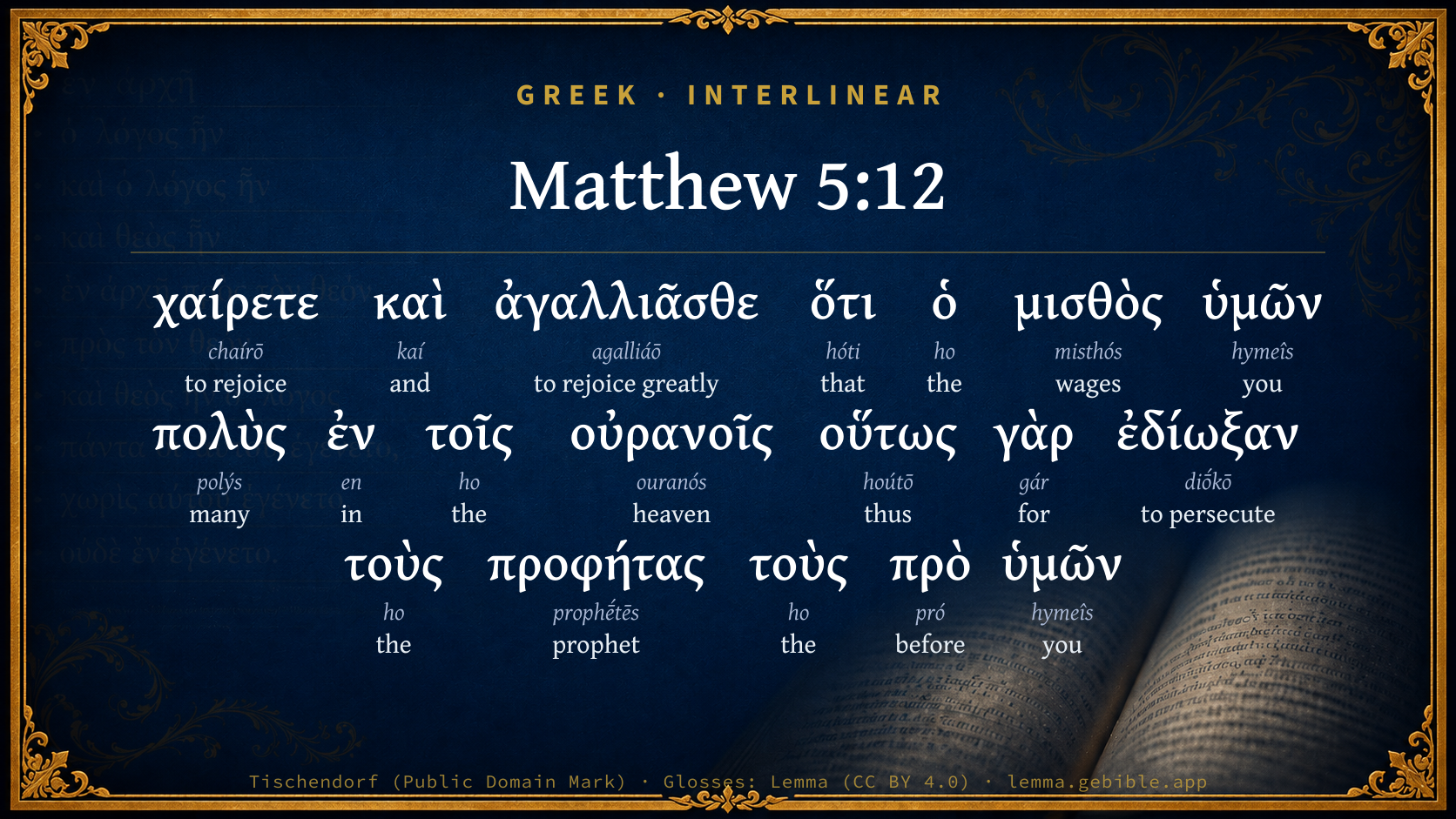
Greek (Tischendorf 8th ed.) Matthew 5:12 appears in the Greek New Testament. The text above is from the Tischendorf 8th edition. Each word links to its Strong’s number and a concise gloss. Click any word for its full Thayer’s Greek Lexicon entry.
Download image
Cite this verse

Matthew 5:12 (World English Bible). Public Domain. Lemma interlinear Bible study tool, https://lemma.gebible.app/v/matthew/5/12.

Show BibTeX & RIS
BibTeX
RIS
English Translation
Rejoice, and be exceedingly glad, for great is your reward in heaven. For that is how they persecuted the prophets who were before you.
World English Bible · Public Domain
Highlights
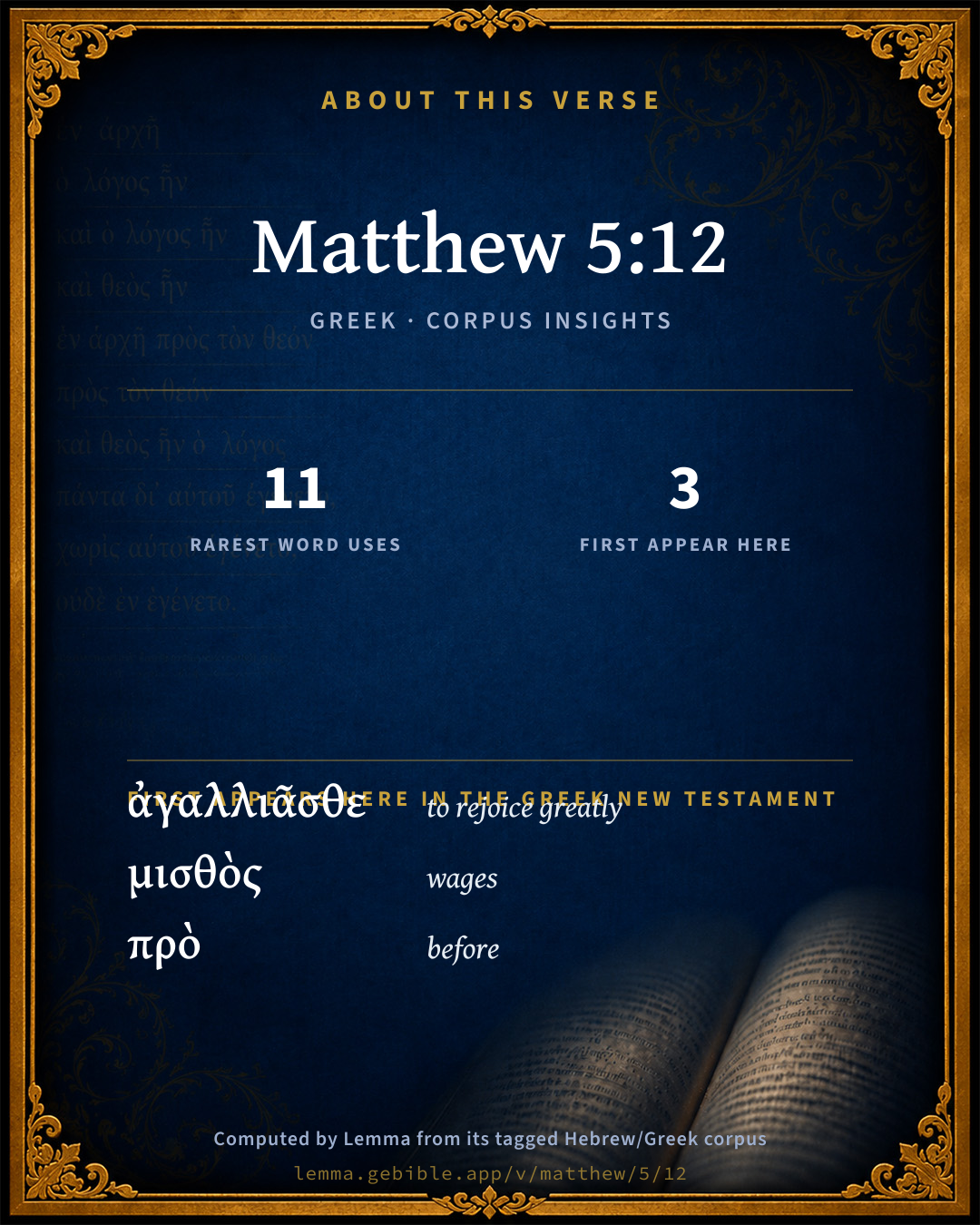
  • 3 first appearances in the Greek New Testament
Full analysis ↓
Download a study sheet

One document with this verse’s original text, its word-by-word gloss line, the meaning frame, cross-references with their text, attributed commentary, and full source and license credits — printable, and it pastes into notes with its structure intact.

This verse Autodidact and up

Study sheet (.html) Plain text (.txt)

A passage Seminary Student

Up to 50 verses in one chapter. A passage sheet keeps up to 6 commentary sources and 12 cross-references per verse, in the order this page ranks them, and says so on the sheet whenever that leaves anything out. Ask for a single verse and you get the Autodidact verse sheet above.

Everything on this page stays free to read, with no account — the sheet is a download of what is already on screen, not access to it.

Want to remove ads? Support Godless Engineer
Compare translations 3

The same verse in 3 English versions, stacked beneath the original-language interlinear above. Click any original word for its lexicon entry.

Each is an independent rendering of the whole verse — the interlinear is not word-aligned to these translations.

Highlighted words mark where these versions differ — a whole-verse word diff, not a word-by-word alignment.

  • World English Bible Public Domain
    Rejoice, and be exceedingly glad, for great is your reward in heaven. For that is how they persecuted the prophets who were before you.
  • King James Version Public Domain
    Rejoice, and be exceeding glad: for great is your reward in heaven: for so persecuted they the prophets which were before you.
  • unfoldingWord Literal Text CC BY-SA 4.0
    Rejoice and be very glad, for your reward great in the heavens, for in this way they persecuted the prophets before you.

unfoldingWord Literal Text — © unfoldingWord, licensed CC BY-SA 4.0. Word-aligned USFM3 via Door43 (git.door43.org/unfoldingWord/en_ult).

Versions to compare (up to 4)

3 of 4 selected

Show all 19 translations

Every available English version of this verse, each an independent rendering of the whole verse.

  • World English Bible Public Domain
    Rejoice, and be exceedingly glad, for great is your reward in heaven. For that is how they persecuted the prophets who were before you.
  • Berean Standard Bible Public Domain
    Rejoice and be glad, because great is your reward in heaven; for in the same way they persecuted the prophets before you.
  • Majority Standard Bible Public Domain
    Rejoice and be glad, because great is your reward in heaven, for in the same way they persecuted the prophets before you.
  • King James Version Public Domain
    Rejoice, and be exceeding glad: for great is your reward in heaven: for so persecuted they the prophets which were before you.
  • American Standard Version (1901) Public Domain
    Rejoice, and be exceeding glad: for great is your reward in heaven: for so persecuted they the prophets that were before you.
  • Revised Version (1885) Public Domain
    Rejoice, and be exceeding glad: for great is your reward in heaven: for so persecuted they the prophets which were before you.
  • Geneva Bible (1599) Public Domain
    Reioyce and be glad, for great is your reward in heauen: for so persecuted they the Prophets which were before you.
  • Douay-Rheims (1899) Public Domain
    Be glad and rejoice, for your reward is very great in heaven. For so they persecuted the prophets that were before you.
  • Young's Literal Translation Public Domain
    rejoice ye and be glad, because your reward `is' great in the heavens, for thus did they persecute the prophets who were before you.
  • Literal Standard Version CC BY-SA 4.0
    rejoice and be glad, because your reward [is] great in the heavens, for thus they persecuted the prophets who were before you.
  • Unlocked Literal Bible CC BY-SA 4.0
    Rejoice and be very glad, for great is your reward in heaven. For in this way people persecuted the prophets who lived before you.
  • unfoldingWord Literal Text CC BY-SA 4.0
    Rejoice and be very glad, for your reward great in the heavens, for in this way they persecuted the prophets before you.
  • Darby Bible Public Domain
    Rejoice and exult, for your reward is great in the heavens; for thus have they persecuted the prophets who were before you.
  • World Messianic Bible Public Domain
    Rejoice, and be exceedingly glad, for great is your reward in heaven. For that is how they persecuted the prophets who were before you.
  • Webster's Bible Public Domain
    Rejoice, and be exceeding glad: for great is your reward in heaven: for so they persecuted the prophets who were before you.
  • Free Bible Version CC BY-SA 4.0
    Be glad, be really glad, for you will receive a great reward in heaven—for they persecuted the prophets who came before you in just the same way.
  • Bible in Basic English Public Domain
    Be glad and full of joy; for great is your reward in heaven: for so were the prophets attacked who were before you.
  • Text-Critical English NT CC BY 4.0
    Rejoice and be glad, for great is your reward in heaven; for in the same way they persecuted the prophets who were before you.
  • Tyndale New Testament (1534) Public Domain
    Reioyce and be glad for greate is youre rewarde in heven. For so persecuted they the Prophetes which were before youre dayes.

Literal Standard Version (2020), Covenant Press — licensed CC BY-SA 4.0. Text via the HelloAO Bible API (eBible.org). Unlocked Literal Bible (unfoldingWord) — licensed CC BY-SA 4.0. Text via the HelloAO Bible API (eBible.org). unfoldingWord Literal Text — © unfoldingWord, licensed CC BY-SA 4.0. Word-aligned USFM3 via Door43 (git.door43.org/unfoldingWord/en_ult). Free Bible Version, Dr. Jonathan Gallagher — licensed CC BY-SA 4.0. Text via the HelloAO Bible API (eBible.org).

Word by word

More ways to search: Search by grammar → Find every occurrence → Compare this word →

Practice this passage: Drill this verse → Learn its vocabulary →

ἀγαλλιᾶσθε
agalliáō
G21
“to rejoice greatly”
Verb, Present, Middle or Passive deponent, Imperative, 2nd person, Plural
Part of Speech
Verb
Tense
Present
Voice
Middle or Passive deponent
Mood
Imperative
Person
2nd person
Number
Plural
Full Thayer's Definition

Origin: from agan (much) and G242

TDNT: 1:19, *

1. to exult, rejoice exceedingly, be exceeding glad
  1. χαίρετε chaírō G5463 “to rejoice” Verb, Present, Active, Imperative, 2nd person, Plural
  2. καὶ kaí G2532 “and” Conjunction
  3. ὅτι hóti G3754 “that” Conjunction
  4. ὁ ho G3588 “the” Article, Nominative, Singular, Masculine
  5. μισθὸς misthós G3408 “wages” Noun, Nominative, Singular, Masculine
  6. ὑμῶν hymeîs G5210 “you” Personal pronoun, 2nd person, Genitive, Plural
  7. πολὺς polýs G4183 “many” Adjective, Nominative, Singular, Masculine
  8. ἐν en G1722 “in” Preposition
  9. τοῖς ho G3588 “the” Article, Dative, Plural, Masculine
  10. οὐρανοῖς ouranós G3772 “heaven” Noun, Dative, Plural, Masculine
  11. οὕτως hoútō G3779 “thus” Adverb
  12. γὰρ gár G1063 “for” Conjunction
  13. ἐδίωξαν diṓkō G1377 “to persecute” Verb, Aorist, Active, Indicative, 3rd person, Plural
  14. τοὺς ho G3588 “the” Article, Accusative, Plural, Masculine
  15. προφήτας prophḗtēs G4396 “prophet” Noun, Accusative, Plural, Masculine
  16. τοὺς ho G3588 “the” Article, Accusative, Plural, Masculine
  17. πρὸ pró G4253 “before” Preposition
  18. ὑμῶν hymeîs G5210 “you” Personal pronoun, 2nd person, Genitive, Plural

About this verse

These counts appear in no published source. They are computed here, from the morphology-tagged text and Lemma’s own curated glosses. What Lemma adds →

19
words
15
distinct lemmas
Gospels
section

Notable vocabulary

The rarest word here is ἀγαλλιᾶσθε to rejoice greatly G21 — appearing just 11 times in the whole Greek New Testament.

First appearance in Scripture

These words make their first canonical appearance in the Greek New Testament here:

  • ἀγαλλιᾶσθε to rejoice greatly G21
  • μισθὸς wages G3408
  • πρὸ before G4253

Shared distinctive vocabulary

ἀγαλλιᾶσθε to rejoice greatly G21 occurs in 11 verses of the Greek New Testament. Also found in:
Repetition

Words recur within this verse:

Cross-references

45

Topical passages linked to Matthew 5:12 in the Treasury of Scripture Knowledge — connected by theme and wording, ordered by reader-vote popularity; previews shown in the World English Bible.

  • Luke 6:23 Rejoice in that day, and leap for joy, for behold, your reward is great in heaven, for their fathers did the same thing to the prophets.
  • James 1:2 Count it all joy, my brothers, when you fall into various temptations,
  • Colossians 3:24 knowing that from the Lord you will receive the reward of the inheritance; for you serve the Lord Christ.
  • 1 Peter 4:13 But because you are partakers of Christ's sufferings, rejoice; that at the revelation of his glory also you may rejoice with exceeding joy.
  • Colossians 1:24 Now I rejoice in my sufferings for your sake, and fill up on my part that which is lacking of the afflictions of Christ in my flesh for his body's sake, which is the assembly;
  • Ruth 2:12 Yahweh recompense your work, and a full reward be given you of Yahweh, the God of Israel, under whose wings you are come to take refuge.
  • Romans 5:3 Not only this, but we also rejoice in our sufferings, knowing that suffering works perseverance;
  • Psalms 58:11 So that men shall say, "Most assuredly there is a reward for the righteous. Most assuredly there is a God who judges the earth."
  • Proverbs 11:18 Wicked people earn deceitful wages, But one who sows righteousness reaps a sure reward.
  • Isaiah 3:10 Tell the righteous "Good!" For they shall eat the fruit of their deeds.
  • 2 Chronicles 36:16 but they mocked the messengers of God, and despised his words, and scoffed at his prophets, until the wrath of Yahweh arose against his people, until there was no remedy.
  • Matthew 16:27 For the Son of Man will come in the glory of his Father with his angels, and then he will render to everyone according to his deeds.
  • Hebrews 11:6 Without faith it is impossible to be well pleasing to him, for he who comes to God must believe that he exists, and that he is a rewarder of those who seek him.
  • 1 Thessalonians 2:15 who killed both the Lord Jesus and their own prophets, and drove us out, and didn't please God, and are contrary to all men;
  • 1 Kings 18:13 Wasn't it told my lord what I did when Jezebel killed the prophets of Yahweh, how I hid one hundred men of Yahweh's prophets by fifty in a cave, and fed them with bread and water?
  • Matthew 6:16 "Moreover when you fast, don't be like the hypocrites, with sad faces. For they disfigure their faces, that they may be seen by men to be fasting. Most assuredly I tell you, they have received their reward.
  • Luke 6:35 But love your enemies, and do good, and lend, expecting nothing back; and your reward will be great, and you will be children of the Most High; for he is kind toward the unthankful and evil.
  • 2 Corinthians 4:17 For our light affliction, which is for the moment, works for us more and more exceedingly an eternal weight of glory;
  • Philippians 2:17 Yes, and if I am poured out on the sacrifice and service of your faith, I rejoice, and rejoice with you all.
  • 1 Kings 22:26–27 The king of Israel said, Take Micaiah, and carry him back to Amon the governor of the city, and to Joash the king's son;
  • Acts 5:41 They therefore departed from the presence of the council, rejoicing that they were counted worthy to suffer dishonor for Jesus' name.
  • Genesis 15:1 After these things the word of Yahweh came to Abram in a vision, saying, "Don't be afraid, Abram. I am your shield, your exceedingly great reward."
  • Acts 7:51–52 "You stiff-necked and uncircumcised in heart and ears, you always resist the Holy Spirit! As your fathers did, so you do.
  • 1 Corinthians 3:8 Now he who plants and he who waters are the same, but each will receive his own reward according to his own labor.
  • Nehemiah 9:26 Nevertheless they were disobedient, and rebelled against you, and cast your law behind their back, and killed your prophets that testified against them to turn them again to you, and they committed awful blasphemies.
  • Matthew 21:34–38 When the season for the fruit drew near, he sent his servants to the farmers, to receive his fruit.
  • 1 Kings 18:4 for it was so, when Jezebel cut off the prophets of Yahweh, that Obadiah took one hundred prophets, and hid them by fifty in a cave, and fed them with bread and water.)
  • 1 Kings 19:10–14 He said, I have been very jealous for Yahweh, the God of hosts; for the children of Israel have forsaken your covenant, thrown down your altars, and slain your prophets with the sword: and I, even I only, am left; and they seek my life, to take it away.
  • 1 Kings 21:20 Ahab said to Elijah, Have you found me, my enemy? He answered, I have found you, because you have sold yourself to do that which is evil in the sight of Yahweh.
  • 2 Chronicles 16:10 Then Asa was angry with the seer, and put him in the prison-house; for he was in a rage with him because of this thing. Asa oppressed some of the people at the same time.
  • Psalms 19:11 Moreover by them is your servant warned. In keeping them there is great reward.
  • Jeremiah 2:30 In vain have I struck your children; they received no correction: your own sword has devoured your prophets, like a destroying lion.
  • Jeremiah 26:8 It happened, when Jeremiah had made an end of speaking all that Yahweh had commanded him to speak to all the people, that the priests and the prophets and all the people laid hold on him, saying, You shall surely die.
  • Jeremiah 26:21–23 and when Jehoiakim the king, with all his mighty-men, and all the princes, heard his words, the king sought to put him to death; but when Uriah heard it, he was afraid, and fled, and went into Egypt:
  • Matthew 6:1–2 "Be careful that you don't do your charitable giving before men, to be seen by them, or else you have no reward from your Father who is in heaven.
  • Matthew 10:41–42 He who receives a prophet in the name of a prophet will receive a prophet's reward: and he who receives a righteous man in the name of a righteous man will receive a righteous man's reward.
  • Matthew 23:31–37 Therefore you testify to yourselves that you are children of those who killed the prophets.
  • Luke 11:47–51 Woe to you! For you build the tombs of the prophets, and your fathers killed them.
  • Luke 13:34 "Jerusalem, Jerusalem, that kills the prophets, and stones those who are sent to her! How often I wanted to gather your children together, like a hen gathers her own brood under her wings, and you refused!
  • Acts 16:25 But about midnight Paul and Silas were praying and singing hymns to God, and the prisoners were listening to them.
  • 1 Kings 22:8 The king of Israel said to Jehoshaphat, there is yet one man by whom we may inquire of Yahweh, Micaiah the son of Imlah: but I hate him; for he does not prophesy good concerning me, but evil. Jehoshaphat said, "Don't let the king say so."
  • Matthew 6:4–5 so that your merciful deeds may be in secret, then your Father who sees in secret will reward you openly.
  • 2 Kings 1:9 Then [the king] sent to him a captain of fifty with his fifty. He went up to him: and, behold, he was sitting on the top of the hill. He spoke to him, man of God, the king has said, Come down.
  • 2 Chronicles 24:20–22 The Spirit of God came on Zechariah the son of Jehoiada the priest; and he stood above the people, and said to them, Thus says God, Why disobey you the commandments of Yahweh, so that you can't prosper? because you have forsaken Yahweh, he has also forsaken you.
  • Hebrews 11:26 accounting the reproach of Christ greater riches than the treasures of Egypt; for he looked to the reward.

Cross-references courtesy of OpenBible.info (CC BY 4.0).

Commentary

Notes on Matthew 5:12 from classic Christian and Jewish commentators (each source and its license shown beneath its notes). The classic Christian expositions comment on the surrounding passage and are grouped to its opening verse, so a note may address several verses; the Jewish commentaries on the Tanakh (Rashi and others) are per-verse, so they appear only where the commentator wrote on this verse.

Lemma curates 59 commentaries, every one of them public domain or Creative Commons licensed, each selected and text-cleaned for this edition rather than reprinted as found. About our sources →

The Biblical Illustrator

Joseph S. Exell

Mat_5:12

Great is your reward.

The reward of the saints

I. Consider its preciousness. It is shown-

1. By remembering who bestows it.

2. It is in heaven.

3. It meets and satisfies the yearning of the saints here.

4. It exceeds our power to measure.

5. It is connected with recognition of service.

6. It is freed from all admixture of sorrow.

7. It is carefully prepared for us.

8. It is certain.

9. It is the highest elevation.

II. Consider it as a legitimate motive to action (Heb_10:35; Heb_11:26).

III. Concluding reflections.

1. The saints great reward, not in this life.

2. They have an ever-brightening prospect.

3. Gods desire to stimulate us to a better life by revealing to us the great reward.

4. A support in trial. (J. W. Hussey, M. A.)

The Biblical Illustrator, edited by Joseph S. Exell (c. 1880s–1900s) — public domain. Text from a community e-Sword module.

Tyndale Open Study Notes

Tyndale Open Resources

5:12 The great reward Jesus mentions is not something earned by suffering for doing right; it is God’s blessing to those who have expressed his grace to others (see 10:41-42; 20:1-16). • The ancient prophets are closely connected with the New Testament apostles (see also 13:16-17; 23:29-36; Eph 2:20).

Tyndale Open Study Notes — © Tyndale Open Resources, licensed CC BY-SA 4.0. Text via the HelloAO Bible API.

Bengel's Gnomon

Johann Albrecht Bengel

Mat 5:12. Χαίρετε, rejoice) Joy is not only a feeling, but also a duty of the Christian (see Php 4:4); and in adversity, the highest grade and very nerve of patience.—ἀγαλλιᾶσθε, be exceeding glad) so that others also may perceive your joy.—ὅτι, κ.τ.λ, because, etc.) You may therefore rejoice on account of your reward.—ὁ μισθὸς, the reward) sc. of grace. The word Reward implies something further beyond the beatitudes, which spring from the very disposition of the righteous. Therefore it is said, Rejoice.—τοὺς προφήτας, the prophets) who, by bearing witness to Christ, have encountered hatred (see Act 7:52), whose reward you know to be great. Persecution has not occurred only in the case of barbarous nations whilst they were being converted to the Gospel, but always in the times of both the Old and New Testament: see 1Jn 3:12-13.

Bengel's Gnomon of the New Testament — English translation (T&T Clark, Edinburgh, 1860) — public domain. Text from a community e-Sword module.

Meyer's Critical & Exegetical Commentary

Heinrich August Wilhelm Meyer

Mat_5:12. Ὁ μισθός] comp. κατεργάζεται, 2Co_4:17, and remarks thereon. The article denotes: the reward which is destined, kept in readiness for you (Mat_25:34; Col_1:5), and that for the indignities, persecutions, and lies borne through faith in me.

ἐν τοῖς οὐρανοῖς] is great in heaven. A reference to the book of life (Fritzsche, Gratz), Php_4:3, Rev_3:5; Rev_20:15; Rev_21:27, Dan_12:1, is not yielded by the text, which only presents the idea that the reward is laid, up in heaven until the future communication of it, which begins with the establishment of the kingdom, and therefore not ἔσται, but ἐστί, is to be supplied; and this is to be taken not as irrespective of time (de Wette), but as present.

γάρ] assigns the reason from the recognised certainty (Mat_10:41) that to the prophets, who formerly were persecuted in like manner (Mat_23:29 ff.), great reward is reserved in heaven for future communication in the kingdom of the Messiah.

The prophets (comp. Mat_7:12) are a typical example for the disciples. On the conception of μισθός, which κατὰ χάριν λογίζεται (Rom_4:4), comp. Mat_20:1 ff.; Luk_17:10; see generally Weiss in d. Deutsch. Zeitschr. 1853, p. 40 ff.; Bibl. Theol. p. 104 ff.

Meyer — Critical and Exegetical Commentary on the New Testament — English translation by Peter Christie, edited by Frederick Crombie (T&T Clark, 1880) — public domain. Text from a community e-Sword module.

Expositor's Greek Testament

ed. W. Robertson Nicoll

Mat 5:12 . χαίρετε καὶ ἀγ . In spite of all, joy, exultation is possible nay, inevitable. I not only exhort you to it, but I tell you, you cannot help being in this mood, if once you throw yourselves enthusiastically into the warfare of God. Ἀγαλλιάω is a strong word of Hellenistic coinage, from ἄγαν and ἅλλομαι , to leap much, signifying irrepressible demonstrative gladness. This joy is inseparable from the heroic temper. It is the joy of the Alpine climber standing on the top of a snowclad mountain. But the Teacher gives two reasons to help inexperienced disciples to rise to that moral elevation. ὅτι ὁ μισθὸς … οὐρανοῖς . For evil treatment on earth there is a compensating reward in heaven. This hope, weak now, was strong in primitive Christianity, and greatly helped martyrs and confessors. οὔτως γὰρ γὰρ ἐ . τοὺς προφήτας . If we take the γὰρ as giving a reason for the previous statement the sense will be: you cannot doubt that the prophets who suffered likewise have received an eternal reward (so Bengel, Fritzsche, Schanz, Meyer, Weiss). But we may take it as giving a co-ordinate reason for joy = ye are in good company. There is inspiration in the “goodly fellowship of the prophets,” quite as much as in thought of their posthumous reward. It is to be noted that the prophets themselves did not get much comfort from such thoughts, and more generally that they did not rise to the joyous mood commended to His disciples by Jesus; but were desponding and querulous. On that side, therefore, there was no inspiration to be got from thinking of them. But they were thoroughly loyal to righteousness at all hazards, and reflection on their noble career was fitted to infect disciples with their spirit. τοὺς πρὸ ὑμῶν : words skilfully chosen to raise the spirit. Before you not only in time but in vocation and destiny. Your predecessors in function and suffering; take up the prophetic succession and along with it, cheerfully, its tribulations.

The Expositor's Greek Testament, edited by W. Robertson Nicoll (1897–1910) — public domain. Text from a community e-Sword module.

Jamieson, Fausset & Brown

Robert Jamieson, A. R. Fausset & David Brown

Rejoice, and be exceeding glad--"exult." In the corresponding passage of Luke (Luk 6:22-23), where every indignity trying to flesh and blood is held forth as the probable lot of such as were faithful to Him, the word is even stronger than here: "leap," as if He would have their inward transport to overpower and absorb the sense of all these affronts and sufferings; nor will anything else do it.

for great is your reward in heaven: for so persecuted they the prophets which were before you:--that is, "You do but serve yourselves heirs to their character and sufferings, and the reward will be common."

Jamieson, Fausset & Brown — Commentary Critical and Explanatory on the Whole Bible (1871) — public domain (CC PDM 1.0). Text via the HelloAO Bible API.

Adam Clarke's Commentary

Verse 12. Rejoice] In the testimony of a good conscience; for, without this, suffering has nothing but misery in it.

Be exceeding glad] αγαλλιασθε, leap for joy. There are several cases on record, where this was literally done by the martyrs, in Queen Mary's days.

Great is your reward in heaven] In the Talmudical tract Pirkey Aboth, are these words: "Rabbi Tarpon said, The day is short: the work is great: the labourers are slow: the REWARD IS GREAT: and the father of the family is urgent."

The followers of Christ are encouraged to suffer joyfully on two considerations.

1. They are thereby conformed to the prophets who went before.

2. Their reward in heaven is a great one.

God gives the grace to suffer, and then crowns that grace with glory; hence it is plain, the reward is not of debt, but of grace: Ro 6:23.

Adam Clarke's Commentary on the Bible (1810–1826) — public domain. Text from a community e-Sword/MySword module.

Ellicott's Commentary for English Readers

(12) Rejoice, and be exceeding glad.—The second word implies a glorious and exulting joy. The same combination is found, possibly as an actual echo of its use here, in 1Pe_1:8; 1Pe_4:13; Rev_19:7.

Your reward.—The teaching of Luk_17:10 shows that even here the reward is not “of debt, but of grace” (Rom_4:4). It may be added that the temper to which the “reward” is promised practically excludes the possibility of such claim as of right. The reward is for those only who suffer “for righteousness, for Christ,” not for those who are calculating on a future compensation.

In heaven.—Literally, in the heavens, as in the phrase, the “kingdom of heaven.” the plural being used possibly with reference to the Jewish belief in three (2Co_12:2) or seven heavens, more probably as implying, in its grand vagueness (like the “many mansions” of Joh_14:2), the absence of any space limits to the promised reward. As with the “kingdom of heaven,” so here, the word is not to be thrown forward into the far-off future, but points to the unseen eternal world which is even now present to us, and of which all true disciples of Christ are citizens (Php_3:20).

So persecuted they the prophets.—Zechariah the son of Jehoiada (2Ch_24:21), Jeremiah (Jer_11:21; Jer_20:2), and the sufferers in the reign of Ahab (1Ki_18:4), are the great historical instances. Isaiah may be added from tradition. But the words were, we can hardly doubt, true of the prophetic order as a whole. The witnesses for unwelcome truths have never had, anywhere or at any time, a light or easy task. In the words “the prophets which were before you” there is a tacit assumption that the disciples also to whom He spake were called to a prophetic work. There was to be, in part at least, a fulfilment of the old grand wish, “Would God that all the Lord’s people were prophets!” (Num_11:29). The Church of Christ, endowed with the Pentecostal gift, was to be as a prophet to the nations.

A Bible Commentary for English Readers, edited by Charles John Ellicott (1878–1897) — public domain. Text from a community e-Sword module.

The Cambridge Bible for Schools and Colleges

gen. ed. J. J. S. Perowne

12. so persecuted they the prophets …] Persecution is a test and token of true discipleship, that which naturally brings distress and despair to men will bring delight in the kingdom of God. The passion and death of Christ gave a fresh force to these words, see 1Pe_4:13-14.

The Cambridge Bible for Schools and Colleges (gen. ed. J. J. S. Perowne; Cambridge University Press, 1878–1918) — public domain. Text from a community e-Sword module.

John Gill's Exposition

Rejoice and be exceeding glad,.... Because of the honour put upon them, the glory they bring to Christ and his cause, by cheerfully suffering for it; and because of the glory and happiness that shall follow upon their sufferings:

for great is your reward in heaven; not of debt, but of grace; for there is no proportion or comparison between what the saints suffer for Christ, and the glory that shall be revealed in them by him; not in earth, but in heaven. Saints must not expect their reward here, but hereafter, when God himself will be their reward; he will be all in all; Christ and all his glory, glory and all the riches of it will be the reward of the inheritance, and which must needs be a "great" one. And the more to animate them to suffer with joyfulness, and to support them under all their reproaches and persecutions, it is added;

for so persecuted they the prophets which were before you; as Isaiah, Jeremiah, Zechariah, and others; which shows, that what should befall them was no new and strange thing, but what had been the lot of the most eminent servants of God in former ages.

John Gill's Exposition of the Whole Bible (1746–1763) — public domain (CC PDM 1.0). Text via the HelloAO Bible API.

Trapp's Complete Commentary

John Trapp

12 Rejoice, and be exceeding glad: for great is your reward in heaven: for so persecuted they the prophets which were before you.

Ver. 12. Rejoice and be exceeding glad] Leap and skip for joy, as frolicing young cattle use to do in the spring, when everything is in its prime and pride. (σκιρταω, Heb. רקד et Psal. cxliv. Significat proprie saltum animalium prae luxu. Lorin. Dicuntur lascivientes pecudes σκιρταν. Beza. Neh 8:10) Thus George Roper, at his coming to the stake, let a great leap. So soon as the flame was about him, he put out both his arms from his body, like a rood, and so stood steadfast, "the joy of the Lord being his strength," not plucking his arms in till the fire had consumed and burnt them off. So Doctor Taylor going toward his death, and coming within a mile or two of Hadley (where he was to suffer), he leapt and fetched a frisk or twain, as men commonly do in dancing. "Why, Master Doctor," quoth the sheriff, "how do you now?" He answered, "Well, God be praised, good Master Sheriff, never better; for now I know I am almost at home. I lack not past two stiles to go over, and I am even at my Father’s house." Likewise Rawlins White, going to the stake, whereas before he was wont to go stooping, or rathed crooked, through infirmity of age, having a sad countenance, and a very feeble complexion, and also very soft in speech and gesture, -now he went and stretched up himself bolt upright, and bare also a most pleasant and comfortable countenance, not without great courage and audacity, both in speech and behaviour. (Acts and Mon.) It were easy to instance the exceeding great joy of the apostles, Act 5:41, who went from the council rejoicing that they were so far honoured as to be dishonoured for the name of Jesus; which Casaudon calleth Elegantissimum oxymoron. So Bradford: "God forgive me," saith he, "mine unthankfulness for this exceeding great mercy, that, among so many thousands, he chooseth me to be one in whom he will suffer." And in a letter to his mother: "For Christ’s sake I suffer," saith he, "and therefore should be merry and glad; and indeed, good mother, so I am, as ever I was; yea, never so merry and glad was I as now I should be, if I could get you to be merry with me, to thank God for me, and to pray on this sort: Ah, good Father, that dost vouchsafe that my son, being a grievous sinner in thy sight, should find this favour with thee, to be one of thy Son’s captains and men of war, to fight and suffer for his Gospel’s sake; I thank thee, and pray thee in Christ’s name, that thou wouldst forgive him his sins and unthankfulness, and make him worthy to suffer, not only imprisonment, but even very death for thy truth, religion, and gospel’s sake," &c. Whether Bradford’s mother did thus or no, I know not; but William Hunter’s mother (that suffered under Bonnet) told him that she was glad that ever she was so happy as to bear such a child, as could find in his heart to lose his life for Christ’s name’s sake. Then William said to his mother, "For my little pain which I shall suffer, which is but for a little braid, Christ hath promised me a crown of joy. May not you be glad of that, mother?" With that his mother kneeled down on her knees, saying, "I pray God strengthen thee, my son, to the end; yea, I think thee as well bestowed as any child that ever I bare." "For, indeed," as Mr Philpot the martyr said, "to die for Christ is the greatest promotion that God can bring any in this vale of misery unto; yea, so great an honour, as the greatest angel in heaven is not permitted to have." This made John Clerk’s mother, of Melda in Germany (when she saw her son whipped and branded in the forehead for opposing the pope’s indulgences, and calling him Antichrist), to hearten her son, and cried out, Vivat Christus eiusque insignia: "Blessed be Christ, and welcome to these marks of his." (Scultet. Annal.) Constantinus, a citizen of Rome (with three other), being, for defence of the gospel, condemned to be burned, were put into a dungcart, who thereat rejoicing, said that they were reputed here the excrements of the world, but yet their death was a sweet odour to God. When the chain was put about Alice Driver’s neck: "Oh," said she, "here is a goodly neckerchief, blessed be God for it." Algerius, Christ’s prisoner, thus dated his letter, "from the Delectable Orchard of the Leonine prison." "And I am in prison till I be in prison," said Saunders. (Acts and Mon.) "And, indeed," said Bradford, "I thank God more for this prison than of any parlour, yea, than of any pleasure that ever I had, for in it I find God my most sweet God always." "After I came into prison" (saith Robert Glover, martyr, in a letter to his wife), "and had reposed myself there awhile, I wept for joy and gladness, my belly full, musing much of the great mercies of God; and as it were, thus saying to myself, Lord, who am I, on whom thou shouldst bestow this great mercy, to be numbered among the saints that suffer for thy gospel sake?" "And I was carried to the coal house," saith Mr Philpot, "where I and my six fellows do rouse together in the straw as cheerfully, we thank God, as others do in their beds of down." And in another letter to the Lady Vane: "I am now in the coal house, a dark and ugly prison as any is about London; but my dark body of sin hath well deserved the same, &c. And I thank the Lord, I am not alone, but have six other faithful companions, who, in our darkness, do cheerfully sing hymns and praises to God for his great goodness. We are so joyful, that I wish you part of my joy," &c. "Good brethren," said William Tims, martyr, "I am kept alone, and yet I thank God, he comforteth me past all the comfort of any man; for I was never merrier in Christ." "You shall be whipped and burned for this gear, I think," said one Mr Foster to John Fortune, martyr. To whom he replied, "If you knew how these words rejoice mine heart, you would not have spoken them." "Why," quoth Foster, "thou fool, dost thou rejoice in whipping?" "Yea," said Fortune, "for it is written in the Scriptures, and Christ saith, ‘Ye shall be whipped for my name’s sake.’ And since the time that the sword of tyranny came into your hand, I heard of none that was whipped: happy were I if I had the maiden head of this persecution." William Walsey was so desirous to glorify God with his suffering, that being wonderful sore tormented in prison with toothache, he feared nothing more than that he should depart before the day of his execution (which he called his glad day) were come. Anthony Person, with a cheerful countenance, embraced the stake whereat he was to be burned, and kissing it, said, "Now welcome, mine own sweet wife, for this day shall thou and I be married together in the love and peace of God." Lawrence Saunders took the stake to which he should be chained in his arms, and kissed it, saying, "Welcome the cross of Christ; welcome everlasting life." Walter Mill, Scot, being put to the stake, ascended gladly, saying, " Introibo altare Dei I will go to rise to God." John Noyes, martyr, took up a fagot at the fire, and kissed it, and said, "Blessed be the time that ever I was born to come to this." Denly sang in the fire at Uxbridge: so did George Carpenter, the Bavarian martyr: so did Wolfgangus Schuh, a German; when he entered into the place heaped up with fagots and wood, he sang, " Laetatus sum in his quae dicta sunt mihi, In domum Domini ibimus." "I have rejoiced in this passage which said to me, I will go to the house of the Lord." (Scultet. Annal.) Two Austin monks at Bruxelles, A. D. 1523 (the first among the Lutherans that suffered for religion), being fastened to the stake to be burnt, sang Te Deum and the Creed. Others clapped their hands in the flames in token of triumph; as Hawks and Smith, and five martyrs burnt together by Bonner. Bainham at the stake, and in the midst of the flame (which had half consumed his arms and his legs), spake these words, "O ye Papists, behold, ye look for miracles: here you may see a miracle: for in this fire I feel no more pain than if I were in a bed of down; but it is to me as a bed of roses." (Acts and Mon.) Now what was it else whereby those worthies (of whom the world was not worthy) quenched the violence of the fire, and out of weakness were made strong? Was it not by their heroic and impregnable faith causing them to endure, as seeing him that is invisible, and having respect, as Moses, to the recompence of reward! Heb 11:26-27.

For great is your reward in heaven] God is a liberal paymaster, and no small things can fall from so great a hand as his. "Oh that joy! O my God, when shall I be with thee?" said a dying peer of this realm (the Lord Harrington). So great is that joy, that we are said to enter into it, it is too full to enter into us, Mat 25:21. Elias, when he was to enter into it, feared not the fiery chariots that came to fetch him, but through desire of those heavenly happinesses, waxed bold against those terrible things, Atque hoc in carne adhuc vivens (it is St Basil’s observation); and this he did while he was as yet in the flesh. Contra horrenda audax fuit, et cum gaudio flammeos currus inscendit. (Basil.) For he had oculum in metam (which was Ludovicus Vives his motto), his eye upon the mark; he pressed forward toward the high prize, with Paul, Php 3:14; and looking through the terror of the fire, saw heaven beyond it; and this made him so valiant, so violent for the kingdom. A Dutch martyr, feeling the flame to come to his beard: "Ah," said he, "what a small pain is this to be compared to the glory to come." Hellen Stirk, a Scotch woman, to her husband at the place of execution spoke thus, "Husband, rejoice; for we have lived together many joyful days, but this day in which we must die ought to be most joyful to us both, because we must have joy for ever; therefore I will not bid you good night, for we shall suddenly meet within the kingdom of heaven." The subscription of Mistress Ann Askew to her confession was this, "Written by me, Ann Askew, that neither wisheth for death nor feareth his might, and as merry as one that is bound toward heaven." "Oh, how my heart leapeth for joy," said Mr Philpot, "that I am so near the apprehension of eternal life. God forgive me mine unthankfulness and unworthiness of so great glory. I have so much joy of the reward prepared for me, most wretched sinner, that though I be in place of darkness and mourning, yet I cannot lament; but both night and day am so joyful, as though under no cross at all; yea, in all the days of my life I was never so merry, the name of the Lord be praised therefore for ever and ever; and he pardon mine unthankfulness. The Lord wondereth," saith he in another place, "how we can be so merry in such extreme misery: but our God is omnipotent, which turneth misery into felicity. Believe me, there is no such joy in the world as the people of Christ have under the cross. I speak by experience, &c. To this joy all other being compared, are but mournings, all delight sorrows, all sweetness sour, all beauty filth, and, finally, all things counted pleasant are tediousness." Great, then, we see, is their reward in earth that suffer for Christ: they have heaven beforehand, they rejoice in tribulation, with joy unspeakable and glorious, 1Pe 1:8; they have an exuberancy of joy, such as no good can match, no evil overly match. "For though I tell you," said Mr Philpot in a letter to the congregation, "that I am in hell, in the judgment of this world, yet assuredly I feel in the same the consolation of heaven. And this loathsome and horrible prison is as pleasant to me as the walks in the garden in the King’s Bench." (Acts and Mon.) What will it be, then, when they shall have crowns on their heads and palms in their hands; when they shall come to that general assembly (πανηγυρις), Heb 12:23, and have all the court of heaven to meet and entertain them; when they shall "follow the Lamb whithersoever he goeth," Rev 14:4, and have places given them to walk among those that stand by, Zec 3:7; (that is, among the seraphim, as the Chaldee paraphrast expoundeth it), among the angels of Heaven? (Allusively, to the walks and galleries that were about the temple.) Maiora certamina, maiora sequuntur praemia, saith Tertullian. Quisquis volens detrahit famae meae, nolens addit mercedi meae, saith Augustine. The more we suffer with and for Christ, the more glory we shall have with and from Christ. Luther was wont to say, when any man spake evil of him, This will be accounted to my reckoning at the last day. Mihi maxime prosunt, saith he, qui mei pessime meminerunt. They are my best friends who speak worst of me. (Luther, Epist. ad Spalatin.)

For so persecuted they the prophets which were before you] Your betters sped no better: strange not therefore at it, start not for it. Optimum solatium sodalitium. Persecution hath ever been the saints’ portion. How early did martyrdom come into the world! The first man that died died for religion. And although Cain is gone to his place, Act 1:25, yet I would he were not still alive in his sons and successors, who hate their brethren, because they are more righteous, Et clavam eius sanguine Abelis rubentern cireumferunt, as Bucholcer speaketh. But that is not to be wished; or, at least, it is magis optabile quam opinabile, more desirable than imaginable that ever a prophet shall want a persecutor while there is a busy devil and a malicious world. The leopard is said so to hate man, that he flies upon his very picture, and teareth it: so doth the devil and his imps, God and his image. The tiger is said to be enraged with the smell of sweet odours; so are the wicked of the world with the fragrance of God’s graces. Noah rose up and condemned them by his contrary courses, and therefore underwent a world of calamities. Puritan Lot was an eyesore to the sinful Sodomites, and is cast out, as it were, by an ostracism. His father Haran, the brother of Abraham, died before his father Terah in Ur of the Chaldees, Gen 11:28. The Hebrews tell us that he was cruelly burnt by the Chaldees, because he would not worship the fire which they had made their god. Sicut Persae suum Orimasdam. How often was Moses made (as Cato among the Romans) to plead for his life! And although David’s innocence triumphed in Saul’s conscience, yet could he not be safe, but carried his life in his hand continually, as he complaineth in Psa 119:109, which was made, as is thought, in the midst of those troubles, out of his own observations and experiments. As for the prophets that came after, which of them have not your fathers slain? saith our Saviour to the Pharisees, whom he bids (by an irony) to fill up the measure of their fathers, Mat 23:32-34; and foretelling that they shall deal so by the apostles (whom he there calleth, according to the custom of that country, prophets, wise men, and scribes), he demandeth of those serpents and brood of vipers how they can escape those treasures and hoards of wrath they have been so long in heaping? They had a little before delivered up John Baptist to Herod, and did unto him whatever they would, Mat 17:11-12. Thereupon our Saviour departed out of Judea into Galilee, as John the Evangelist hath it, lest he should suffer the same things from them. For though Herod were tetrarch of Galilee, and therefore it might seem a safer way for our Saviour to keep from thence (after John was beheaded) and to continue in Judea; yet forasmuch as he was but their slaughter slave (as Bonner was to the rest of the bishops of those days), Christ knew that if he did decline their fury, there was no such cause to fear Herod. Therefore when some of the Pharisees, pretending goodwill to him, bade him leave there, for else Herod would kill him, he replied, Go tell that fox, that I know both my time and my task, which he would be doing at today and tomorrow, that is, as long as he wished, without his leave, Luk 13:31-33. τελειουμαι: τελειωθεντες. Absolute vocantur, qui pro Christo sanguinem fuderunt. (Beza.) And the third day, when his hour was once come, he should be sacrificed; but it must be in Jerusalem, and by the Pharisees, for it befell not a prophet to perish out of Jerusalem. There it was that Stephen was stoned, James slain with the sword, Peter imprisoned and destined to destruction, Paul whipped and bound, many of the saints punished often in every synagogue, and compelled by the high priest’s authority either to blaspheme or flee to strange cities, as appeareth in many places of the Acts, or rather Passions, of the apostles: for none (out of hell) ever suffered harder and heavier things than they. See what St Paul witnesseth of himself, and think the like of the rest, 2Co 6:5.

John Trapp, A Commentary or Exposition upon All the Books of the Old and New Testament (1647–1656) — public domain. Text from a community e-Sword module.

Albert Barnes' Notes on the Bible

Rejoice, and be exceeding glad - Regard it as a great privilege thus to be persecuted and to suffer - a thing not to be mourned over, but as among the chief blessings of life.

For great is your reward in heaven - That is, your reward will be great in the future world. To those who suffer most, God imparts the highest rewards. Hence, the crown of martyrdom has been thought to be the brightest that any of the redeemed shall wear; and hence many of the early Christians sought to become martyrs, and threw themselves in the way of their persecutors, that they might be put to death. They literally rejoiced, and leaped for joy, at the prospect of death for the sake of Jesus. Though God does not require us to seek persecution, yet all this shows that there is something in religion to sustain the soul which the world does not possess. Nothing but the consciousness of innocence, and the presence of God, could bear up the sufferers in the midst of these trials; and the flame, therefore, kindled to consume the martyr, has also been a bright light, showing the truth and power of the gospel of Jesus.

The prophets ... - The holy men who came to predict future events, and who were the religious teachers of the Jews. For an account of their persecution, see Heb. 11.

Albert Barnes' Notes on the Bible (1834–1885) — public domain. Text from a community e-Sword/MySword module.

Haydock's Catholic Bible Commentary

Reward, in Latin merces, in Greek misthos, signifies wages done for hire, and due for work, and presupposes merit. (Bristow) --- If you participate in the sufferings of the prophets, you will equally participate in their glory, their reward. (Haydock)

George Leo Haydock (1774–1849), Haydock's Catholic Family Bible and Commentary, 1859 edition — public domain. Excludes Psalms (Douay-Rheims chapter numbering differs from Protestant) and Deuterocanonical books (Catholic canon only).

Matthew Poole's English Annotations

Be so far from being troubled, as to count it all joy, when you fall into these trials, Jam 1:2. Let it be music in your ears to hear that the drunkards make you their song. Rejoice in your hearts, express it in your lips and behaviour,

for great is your reward, not of debt, but of grace; for our light and momentary afflictions are not worthy to be compared with an eternal and exceeding weight of glory; where there is no proportion, there can be no merit: especially, when it is given to us on the behalf of Christ to suffer, Phi 1:29. Peter upon this argument saith, The spirit of glory and of God resteth upon you, 1Pe 4:14. Our Saviour adds,

for so persecuted they the prophets before you. The magistrates, and the rulers of the Jews, persecuted Elijah, Micaiah, Jeremiah, Amos, and the rest of the prophets, whom you succeed, not in time only, but in the same office of revealing the mind of God to the people.

Matthew Poole's English Annotations on the Holy Bible (1683–1685) — public domain. Text from a community e-Sword/MySword module.

Whedon's Commentary on the Bible

Daniel D. Whedon

12. Rejoice and be exceeding glad — This verse may be most easily explained by reversing the order of its clauses. As your sufferings associate you with the prophets which were before you, so like their’s your reward in heaven is great; therefore Rejoice, etc.

2. Woes pronounced upon the opposite characters.

To three of these benedictions, St. Luke’s report of the discourse contains three counter woes. They are so presented as to suggest that Luke reports but a part, and that our Lord uttered an antithetic woe for each benediction.

Luke (Luk_6:24-25) pronounces a woe upon the rich and the full; that is, upon those who have made this world’s goods, or some other satisfaction, a substitute for the Gospel grace and blessedness. Their case we have sufficiently explained in our comment on Mat_5:3.

Luk_6:25 : Woe unto you that laugh — in opposition to the penitents of Mat_5:4. The evil of sin makes no impression upon their revelling merriment; or instead of mourning for sin, they drown the commencing grief with laughter, and perhaps riot. Christ pronounces upon them WOE; a word in which grief and authority in him are combined, and in which future sorrow and vain weeping are predicted for them.

Luk_6:26 : Woe unto you when all men shall speak well of you — This woe stands opposed to the blessed, spoken of those who are reviled for righteousness’ sake in Mat_5:11. The phrase all men (like the term the world) is used to distinguish the great ungodly mass as opposed to the righteous few. The phrase alludes to the fact that, in Jewish history, the mass of the nation — the all men — reviled the prophets, and persecuted the righteous few. Woe to that preacher who wins applause by whitewashing sin.

Daniel D. Whedon (gen. ed.), Commentary on the Old and New Testaments (1874–1909) — public domain. Text from a community e-Sword module.

The Pulpit Commentary

Rejoice, and be exceeding glad (cairete kai agalliasye). Our Lord uses no weaker expressions than those which describe the joy of the saints over the marriage of the Lamb. (Rev_19:7) The first word expresses joy as such, the second its effect in stirring the emotions; this thought St. Luke carries still further in skirthsate . (For joy felt under persecution, cf. Act_5:41) For great. The order of the Greek, oti o misyov , does not bear out the emphatic position assigned to "great" in the English Versions from Tyndale downwards (except Rheims), including Revised Version. Is your reward. The doctrine of recompense, which has so large a place in Jewish thought (for a not often-sire example, cf. "Ab.," 2:19, Taylor) comes also in Christ"s teaching. In Mat_20:1-16 reward is expressly divested of its merely legal side, and exhibited as ultimately dependent on the will of the great Householder. But here it is mentioned without reference to the difficulties involved in the conception. These difficulties centre round the thought of obligation from God to man. But it may be doubted whether these difficulties are not caused by too exclusively regarding the metaphor of contracting, instead of considering the fact indicated by the metaphor. In God"s kingdom every action has a corresponding effect, and this effect is the more certain in proportion as the action is in the sphere of morality. The idea of "quantity" hardly enters into the relation of such cause and effect. It is a question of moral correspondence. But such effect may not unfitly be called by the metaphors "hire," "reward," because, on the one hand, it is the result of conditions of moral service, and, on the other, such terms imply a Personal Will at the back of the effect, as well as a will on the part of the human "servant." (For the subject in other connexions, cf. Weiss, "Bibl. Theol.," cf. also ver. 46; Mat_6:1, Mat_6:2, Mat_6:4, Mat_6:5, Mat_6:6) In heaven. Our Lord says, "your reward is great," because the effect of your exercise of moral powers will be received in a sphere where the accidents of the surroundings will entirely correspond to moral influences. The effect of your present faithfulness, etc., will be seen in the reception Of powers of work and usefulness and enjoyment, beside which those possessed on earth will appear small. On earth the opportunities, etc., are but "few things;" hereafter they will be "many things". (Mat_25:21) For. Not as giving a reason for the assurance of reward (apparently Meyer and Weiss), but for the command, "rejoice," and be exceeding glad, and perhaps also for the predicate "blessed." Rejoice if persecuted, for such persecutions prove you to be the true successors of the prophets, your predecessors in like faithfulness. (cf. Jam_5:10) So. By reproach, e.g. Elijah, (1Ki_18:17) Amos; (Amo_7:12, Amo_7:13) by persecution, e.g. Hanani, (2Ch_16:10) Jeremiah; (Jer_37:15) by saying all manner of evil, e.g. Amos, (Amo_7:10) Jeremiah, (Jer_37:13) Daniel. (Dan_6:13) Which were before you. Added, surely, not as a mere temporal fact, but to indicate spiritual relationship (vide supra).

The Pulpit Commentary (1880–1919), ed. H.D.M. Spence-Jones & Joseph S. Exell — public domain. Text from a community e-Sword module.

John Wesley's Explanatory Notes

Your reward - Even over and above the happiness that naturally and directly results from holiness.

John Wesley, Explanatory Notes Upon the Whole Bible (1754–1765) — public domain. Text via the GEBible commentary corpus.

Kretzmann's Popular Commentary

Paul E. Kretzmann

In spite of the persecutions, then:

v. 12. Rejoice, and be exceeding glad; for great is your reward in heaven; for so persecuted they the prophets which were before you.

Joy, gladness in the highest measure is possible, an irrepressible exhibition of exultation is expected of Christ’s followers. For all the hatred that can be poured out by the enemies cannot be measured against, cannot come into consideration in comparison with, the reward of grace in heaven. They will be more than amply repaid for all the disagreeable show of hatred which they were compelled to endure here, Rom 8:17-18; 2Co 4:17. Another comfort which upholds them in their trial: they thereby become, in that respect at least, the equals of the prophets. It cannot be a source of lasting sorrow to endure for a time, knowing that the prophets of old were martyred in the same way, and yet endured the afflictions gladly for His name’s sake, 2Ch 36:16; Heb 11:33-40. Therefore, take up the work and endure the suffering of those that were before you, knowing that their reward will be yours also.

Paul E. Kretzmann, Popular Commentary of the Bible (1921–1924) — public domain. Text from a community e-Sword module.

The People's New Testament

B. W. Johnson

12. Rejoice, and be exceeding glad. On account of persecution. The reason why they may justly rejoice is given: Great is your reward in heaven. So persecuted they the prophets. Isaiah is said to have been sawed asunder; Jeremiah was thrown into a dungeon and threatened with death; Elijah was hunted by Ahab and Jezebel.

B. W. Johnson's The People's New Testament with Notes (1889–1891) — public domain. Electronic text from the Christian Classics Ethereal Library (CCEL) ThML edition.

Cambridge Greek Testament for Schools and Colleges

12. ἀγαλλιᾶσθε, of excessive and demonstrative joy. Neither the verb nor its derivatives are classical. St Luke in his parallel passage (Mat 6:23), has χάρητε ἐν ἐκείνῃ τῇ ἡμέρᾳ καὶ σκιρτήσατε.

Such contrasts as this which the kingdom of heaven presents have their counterpart in the εἰρωνεία of Greek tragedy.

τοὺς προφήτας τοὺς πρὸ ὑμῶν. Implying that the disciples too were προφῆται.

(2) Their responsibility, Mat 5:13-16

The disciples, though lowly and meek, are heirs of the world. They must claim their inheritance, and not shrink from a foremost position either from fear of persecution or from a false idea of Christian πτωχεία and ταπεινότης.

Cambridge Greek Testament for Schools and Colleges (Cambridge University Press, 1896; 21 vols, various authors incl. Carr, Maclear, Plummer, Farrar, Lumby, Moule, M. R. James, Simcox) — public domain. Text from a community e-Sword module.

Alford’s Greek Testament

Henry Alford

12. ὁ μισθὸς ὑμ.] A reward, not of debt, but of grace, as the parable in ch. 20:1 ff. clearly represents it. ‘An expression,’ as De Wette observes, ‘taken from our earthly commerce, and applied to spiritual things;’ in which however we must remember, that the principal reference is to God as the giver, and not to us as the deservers: see the parable above cited, where the μισθός is not what was earned, but what was covenanted. ‘Deus est debitor noster non ex commisso, sed ex promisso.’ Aug. (Tholuck.) These words, ἐν τοῖς οὐρανοῖς, must not be taken as having any bearing on the question as to the future habitation of the glorified saints. Their use in this and similar expressions is not local, but spiritual, indicating the blessed state when ἡ βασιλεία τῶν οὐρανῶν shall have fully come. The local question is to be decided by wholly different testimonies of Scripture;—by the general tenor of prophecy, and the analogies of the divine dealings: and all of these seem to point rather to this earth, purified and renewed, than to the heavens in any ordinary sense of the term, as the eternal habitation of the blessed.

ἐδίωξαν] For instance, Jeremiah was scourged, Jer 20:2; Zechariah son of Jehoiada was stoned, 2Ch 24:21; Isaiah, according to Jewish tradition, was sawn asunder by Manasseh.

The reasoning implied in γάρ may be thus filled up: “and great will be their reward in heaven.”

Henry Alford, The Greek Testament (1849–1861) — public domain. Text from a community e-Sword module.

Lesson kit

Teaching starters — assembled from the data on this page, not authored interpretation. Every prompt links to the verse data it draws on. Edit before teaching.

Matthew, in the Gospels, opens this verse with 19 words (15 distinct Greek lemmas). Its most distinctive word is agalliáō (“to rejoice greatly”). A historical commentator’s framing appears above. Read the whole chapter for the surrounding context.

Discussion questions

  1. How does “to rejoice greatly” (agalliáō) shape what this verse is saying?
  2. 3 words here appear for the first time in Scripture. What is being introduced at this debut?
  3. Luke 1:47 shares the word «to rejoice greatly» with this verse. How do the two illuminate each other?
  4. “the” occurs 4× in this one verse. What is the effect of the repetition?
  5. The translations on this page render this verse differently — a whole-verse word diff, not a word-by-word alignment. What might account for the different wordings?
  6. Reading how The Biblical Illustrator and Tyndale Open Study Notes read this verse, where do the two commentators agree and where do they part?

Things to notice

  • 3 words make their first canonical appearance in Scripture here.
  • These translations choose different wording for 9 words in this verse.
  • “the” occurs 4× in this single verse.
  • 15 distinct Greek lemmas span 19 words in this verse.

Reading settings

Reading text

Shown beneath each verse's original-language words.

Old Testament
Old Testament edition

Read the OT as the Masoretic Hebrew (MT) or the Greek Septuagint (LXX).

English shown for the Greek Septuagint (in the Hebrew ↔ Greek comparison).

Comparing translations? Open the Compare panel on any verse page to stack up to four side by side.