Acts 7:56

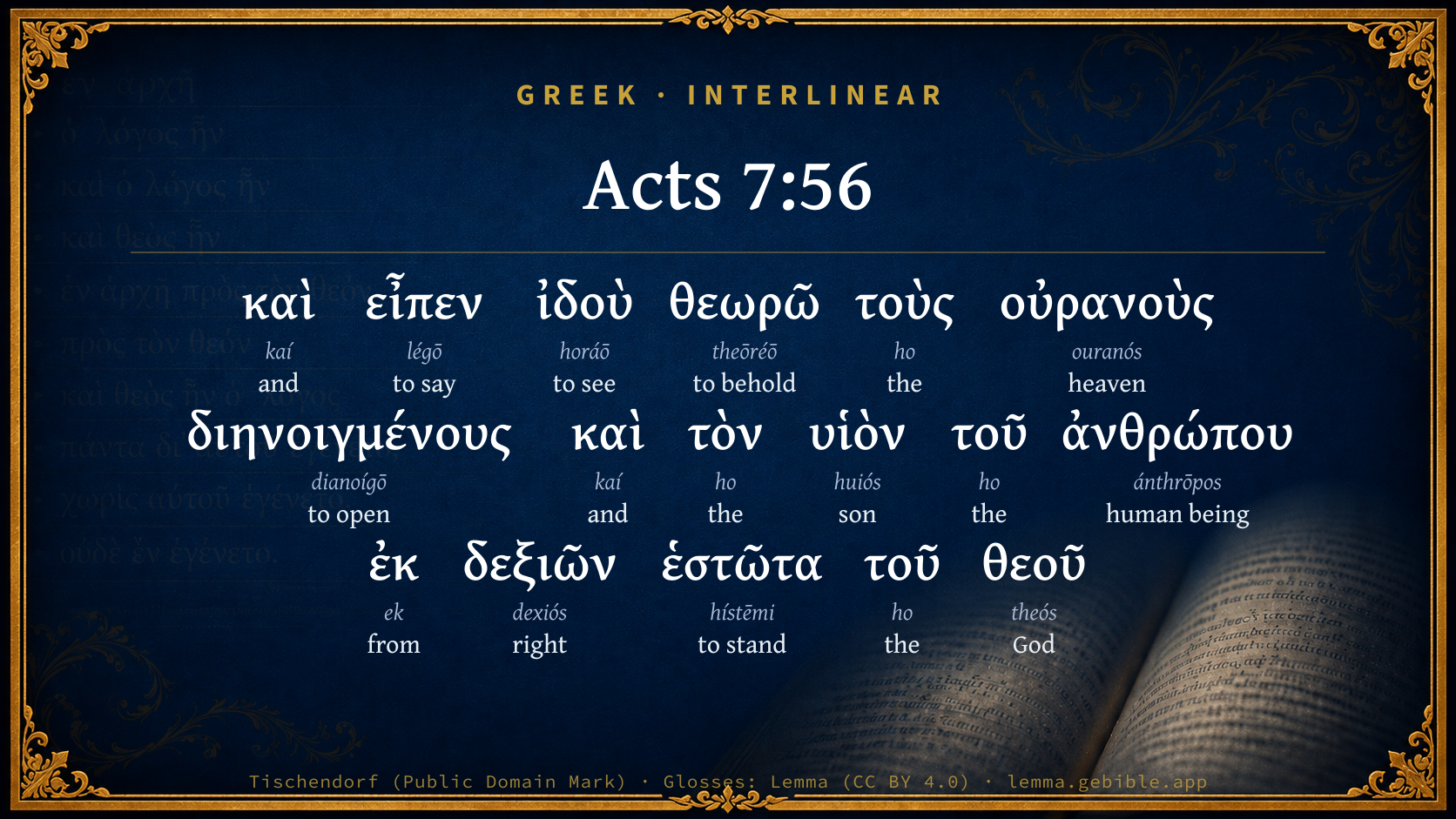
Greek (Tischendorf 8th ed.) Acts 7:56 appears in the Greek New Testament. The text above is from the Tischendorf 8th edition. Each word links to its Strong’s number and a concise gloss. Click any word for its full Thayer’s Greek Lexicon entry.
Download image
Cite this verse

Acts 7:56 (World English Bible). Public Domain. Lemma interlinear Bible study tool, https://lemma.gebible.app/v/acts/7/56.

Show BibTeX & RIS
BibTeX
RIS
English Translation
and said, "Behold, I see the heavens opened, and the Son of Man standing at the right hand of God!"
World English Bible · Public Domain
Download a study sheet

One document with this verse’s original text, its word-by-word gloss line, the meaning frame, cross-references with their text, attributed commentary, and full source and license credits — printable, and it pastes into notes with its structure intact.

This verse Autodidact and up

Study sheet (.html) Plain text (.txt)

A passage Seminary Student

Up to 50 verses in one chapter. A passage sheet keeps up to 6 commentary sources and 12 cross-references per verse, in the order this page ranks them, and says so on the sheet whenever that leaves anything out. Ask for a single verse and you get the Autodidact verse sheet above.

Everything on this page stays free to read, with no account — the sheet is a download of what is already on screen, not access to it.

Want to remove ads? Support Godless Engineer
Compare translations 3

The same verse in 3 English versions, stacked beneath the original-language interlinear above. Click any original word for its lexicon entry.

Each is an independent rendering of the whole verse — the interlinear is not word-aligned to these translations.

Highlighted words mark where these versions differ — a whole-verse word diff, not a word-by-word alignment.

  • World English Bible Public Domain
    and said, "Behold, I see the heavens opened, and the Son of Man standing at the right hand of God!"
  • King James Version Public Domain
    And said, Behold, I see the heavens opened, and the Son of man standing on the right hand of God.
  • unfoldingWord Literal Text CC BY-SA 4.0
    And he said, “Behold, I see the heavens opened, and the Son of Man standing at the right of God.”

unfoldingWord Literal Text — © unfoldingWord, licensed CC BY-SA 4.0. Word-aligned USFM3 via Door43 (git.door43.org/unfoldingWord/en_ult).

Versions to compare (up to 4)

3 of 4 selected

Show all 19 translations

Every available English version of this verse, each an independent rendering of the whole verse.

  • World English Bible Public Domain
    and said, "Behold, I see the heavens opened, and the Son of Man standing at the right hand of God!"
  • Berean Standard Bible Public Domain
    “Look,” he said, “I see heaven open and the Son of Man standing at the right hand of God.”
  • Majority Standard Bible Public Domain
    “Look,” he said, “I see heaven open and the Son of Man standing at the right hand of God.”
  • King James Version Public Domain
    And said, Behold, I see the heavens opened, and the Son of man standing on the right hand of God.
  • American Standard Version (1901) Public Domain
    and said, Behold, I see the heavens opened, and the Son of Man standing on the right hand of God.
  • Revised Version (1885) Public Domain
    and said, Behold, I see the heavens opened, and the Son of man standing on the right hand of God.
  • Geneva Bible (1599) Public Domain
    And said, Beholde, I see the heauens open, and the Sonne of man standing at the right hand of God.
  • Douay-Rheims (1899) Public Domain
    And they crying out with a loud voice, stopped their ears, and with one accord ran violently upon him.
  • Young's Literal Translation Public Domain
    and he said, `Lo, I see the heavens having been opened, and the Son of Man standing on the right hand of God.'
  • Literal Standard Version CC BY-SA 4.0
    and he said, “Behold, I see the heavens having been opened, and the Son of Man standing on the right hand of God.”
  • Unlocked Literal Bible CC BY-SA 4.0
    Stephen said, “Look, I see the heavens opened, and the Son of Man standing at the right hand of God.”
  • unfoldingWord Literal Text CC BY-SA 4.0
    And he said, “Behold, I see the heavens opened, and the Son of Man standing at the right of God.”
  • Darby Bible Public Domain
    and said, Lo, I behold the heavens opened, and the Son of man standing at the right hand of God.
  • World Messianic Bible Public Domain
    and said, “Behold, I see the heavens opened and the Son of Man standing at the right hand of God!”
  • Webster's Bible Public Domain
    And said, Behold, I see the heavens opened, and the Son of man standing on the right hand of God.
  • Free Bible Version CC BY-SA 4.0
    “Look,” he said, “I see heaven open, and the Son of Man standing at God's right hand.”
  • Bible in Basic English Public Domain
    And he said, Now I see heaven open, and the Son of man at the right hand of God.
  • Text-Critical English NT CC BY 4.0
    He said, “Behold, I see the heavens opened and the Son of Man standing at the right hand of God.”
  • Tyndale New Testament (1534) Public Domain
    and sayde: beholde I se the hevens open and the sonne of man stondynge on the ryght honde of god.

Literal Standard Version (2020), Covenant Press — licensed CC BY-SA 4.0. Text via the HelloAO Bible API (eBible.org). Unlocked Literal Bible (unfoldingWord) — licensed CC BY-SA 4.0. Text via the HelloAO Bible API (eBible.org). unfoldingWord Literal Text — © unfoldingWord, licensed CC BY-SA 4.0. Word-aligned USFM3 via Door43 (git.door43.org/unfoldingWord/en_ult). Free Bible Version, Dr. Jonathan Gallagher — licensed CC BY-SA 4.0. Text via the HelloAO Bible API (eBible.org).

Word by word

More ways to search: Search by grammar → Find every occurrence → Compare this word →

Practice this passage: Drill this verse → Learn its vocabulary →

διηνοιγμένους
dianoígō
G1272
“to open”
Verb, Perfect, Passive, Participle, Accusative, Plural, Masculine
Part of Speech
Verb
Tense
Perfect
Voice
Passive
Mood
Participle
Case
Accusative
Number
Plural
Gender
Masculine
Full Thayer's Definition

Origin: from G1223 and G455

TDNT: None

1. to open by dividing or drawing asunder, to open thoroughly (what had been closed) a. a male opening the womb (the closed matrix), i.e. the first-born b. of the eyes and the ears c. to open the mind of one, i.e. to cause to understand a thing 1. to open one's soul, i.e. to rouse in one the faculty of understanding or the desire of learning
  1. καὶ kaí G2532 “and” Conjunction
  2. εἶπεν légō G3004 “to say” Verb, Aorist, Active, Indicative, 3rd person, Singular
  3. ἰδοὺ horáō G3708 “to see” Verb, Aorist, Middle, Imperative, 2nd person, Singular
  4. θεωρῶ theōréō G2334 “to behold” Verb, Present, Active, Indicative, 1st person, Singular
  5. τοὺς ho G3588 “the” Article, Accusative, Plural, Masculine
  6. οὐρανοὺς ouranós G3772 “heaven” Noun, Accusative, Plural, Masculine
  7. καὶ kaí G2532 “and” Conjunction
  8. τὸν ho G3588 “the” Article, Accusative, Singular, Masculine
  9. υἱὸν huiós G5207 “son” Noun, Accusative, Singular, Masculine
  10. τοῦ ho G3588 “the” Article, Genitive, Singular, Masculine
  11. ἀνθρώπου ánthrōpos G444 “human being” Noun, Genitive, Singular, Masculine
  12. ἐκ ek G1537 “from” Preposition
  13. δεξιῶν dexiós G1188 “right” Adjective, Genitive, Plural, Masculine
  14. ἑστῶτα hístēmi G2476 “to stand” Verb, Perfect, Active, Participle, Accusative, Singular, Masculine
  15. τοῦ ho G3588 “the” Article, Genitive, Singular, Masculine
  16. θεοῦ theós G2316 “God” Noun, Genitive, Singular, Masculine

About this verse

These counts appear in no published source. They are computed here, from the morphology-tagged text and Lemma’s own curated glosses. What Lemma adds →

17
words
13
distinct lemmas
Acts
section

Notable vocabulary

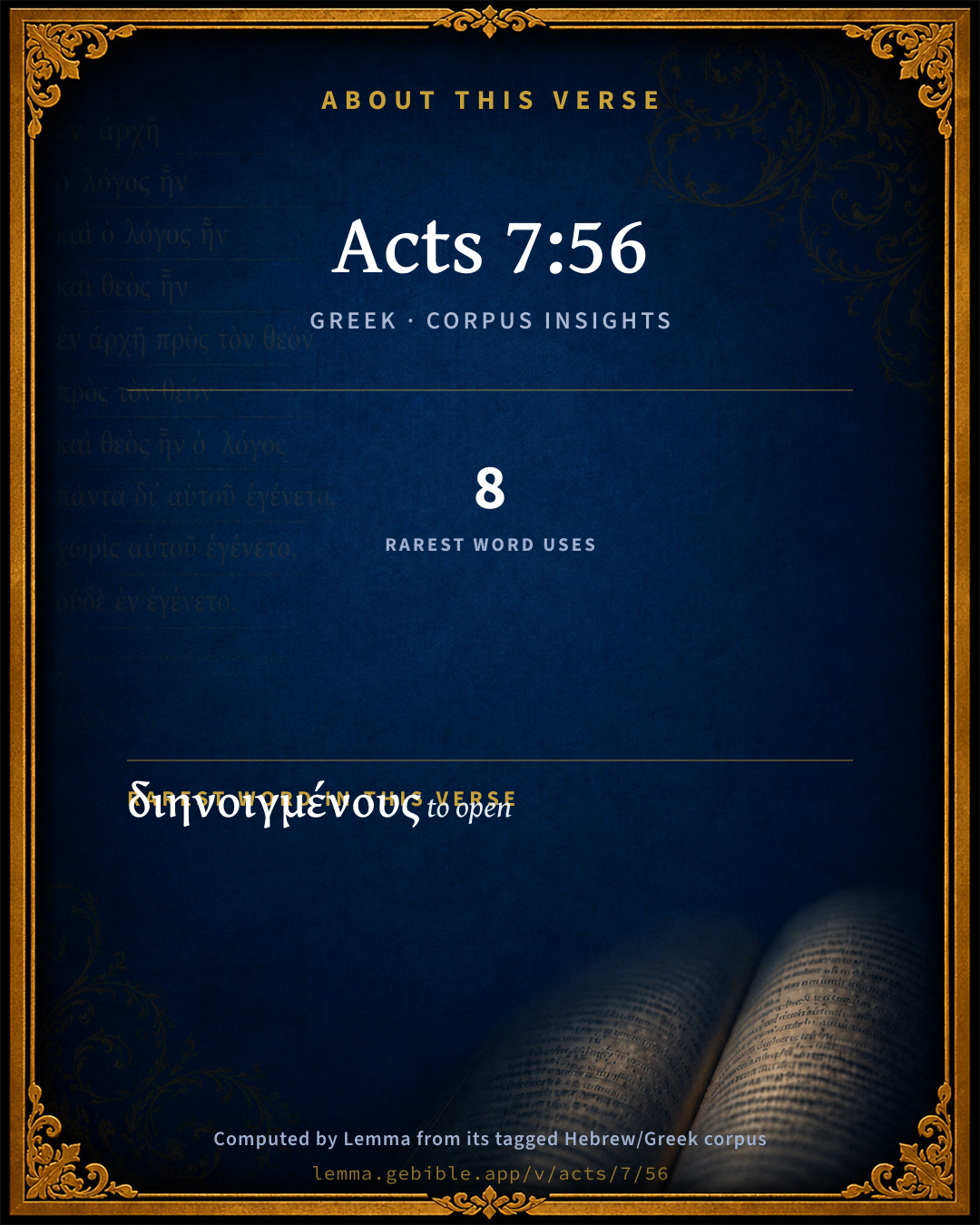
The rarest word here is διηνοιγμένους to open G1272 — appearing just 8 times in the whole Greek New Testament.

Shared distinctive vocabulary

διηνοιγμένους to open G1272 occurs in 8 verses of the Greek New Testament. Also found in:

Repetition

Words recur within this verse:

Cross-references

15

Topical passages linked to Acts 7:56 in the Treasury of Scripture Knowledge — connected by theme and wording, ordered by reader-vote popularity; previews shown in the World English Bible.

  • Matthew 26:64–65 Jesus said to him, "You have said it. Nevertheless, I tell you, henceforth you will see the Son of Man sitting at the right hand of Power, and coming on the clouds of the sky."
  • Acts 10:11 He saw heaven opened and a certain container descending to him, like a great sheet let down by four corners on the earth,
  • Revelation 11:19 God's temple that is in heaven was opened, and the ark of the Lord's covenant was seen in his temple. Lightnings, sounds, thunders, an earthquake, and great hail followed.
  • Matthew 3:16 Jesus, when he was baptized, went up directly from the water: and behold, the heavens were opened to him. He saw the Spirit of God descending as a dove, and coming on him.
  • Revelation 19:11 I saw the heaven opened, and behold, a white horse, and he who sat on it is called Faithful and True. In righteousness he judges and makes war.
  • Daniel 7:13–14 I saw in the night-visions, and, behold, there came with the clouds of the sky one like a son of man, and he came even to the ancient of days, and they brought him near before him.
  • Matthew 16:27–28 For the Son of Man will come in the glory of his Father with his angels, and then he will render to everyone according to his deeds.
  • Acts 10:16 This was done three times, and immediately the vessel was received up into heaven.
  • Revelation 4:1 After these things I looked and saw a door opened in heaven, and the first voice that I heard, like a trumpet speaking with me, was one saying, "Come up here, and I will show you the things which must happen after this."
  • Matthew 8:20 Jesus said to him, "The foxes have holes, and the birds of the sky have nests, but the Son of Man has nowhere to lay his head."
  • Matthew 25:31 "But when the Son of Man comes in his glory, and all the holy angels with him, then he will sit on the throne of his glory.
  • Mark 1:10 Immediately coming up from the water, he saw the heavens parting, and the Spirit descending on him like a dove.
  • Luke 3:21 Now it happened, when all the people were baptized, Jesus also had been baptized, and was praying. The sky was opened,
  • John 1:51 He said to him, "Most assuredly, I tell you, hereafter you will see heaven opened, and the angels of God ascending and descending on the Son of Man."
  • John 5:22–27 For the Father judges no one, but he has given all judgment to the Son,

Cross-references courtesy of OpenBible.info (CC BY 4.0).

Commentary

Notes on Acts 7:56 from classic Christian and Jewish commentators (each source and its license shown beneath its notes). The classic Christian expositions comment on the surrounding passage and are grouped to its opening verse, so a note may address several verses; the Jewish commentaries on the Tanakh (Rashi and others) are per-verse, so they appear only where the commentator wrote on this verse.

Lemma curates 59 commentaries, every one of them public domain or Creative Commons licensed, each selected and text-cleaned for this edition rather than reprinted as found. About our sources →

MacLaren's Expositions of Holy Scripture

Alexander MacLaren

Acts

STEPHEN’S VISION

Act 7:56.

I. The vision of the Son of Man, or the abiding manhood of Jesus.

Stephen’s Greek name, and his belonging to the Hellenistic part of the Church, make it probable that he had never seen Jesus during His earthly life. If so, how beautiful that he should thus see and recognise Him! How significant, in any case, is it he should instinctively have taken on his lips that name, ‘the Son of Man,’ to designate Him whom he saw, through the opened heavens, standing on the right hand of God! We remember that in the same Council-chamber and before the same court, Jesus had lashed the rulers into a paroxysm of fury by declaring, ‘Hereafter ye shall see the Son of Man sitting at the right hand of power,’ and now here is one of His followers, almost, as it were, flinging in their teeth the words which they had called ‘blasphemy,’ and witnessing that he, at all events, saw their partial fulfilment. They saw only the roof of the chamber, or, if the Council met in the open court of the Temple, the quivering blue of the Syrian sky; but to him the blue was parted, and a brighter light than that of its lustre was flashed upon his inward eye. His words roused them to an even wilder outburst than those of Jesus had set loose, and with yells of fury, and stopping their ears that they might not hear the blasphemy, they flung themselves on him, unresisting, and dragged him to his doom. Their passion is a measure of the preciousness to the Christian consciousness of that which Stephen saw, and said that he saw.

Whatever more the great designation, ‘Son of Man,’ means, it unmistakably means the embodiment of perfect manhood. Stephen’s vision swept into his soul, as on a mighty wave, the fact, overwhelming if it had not been so transcendently strengthening to the sorely bestead prisoner, that the Jesus whom he had trusted unseen, was still the same Jesus that He had been ‘in the days of His flesh,’ and, with whatever changes, still was ‘found in fashion as a man.’ He still ‘bent on earth a brother’s eye.’ Whatever He had dropped from Him as He ascended, His manhood had not fallen away, and, whatever changes had taken place in His body so as to fit it for its enthronement in the heavens, all that had knit Him to His humble friends on earth was still His. The bonds that united Him and them had not been snapped by being stretched to span the distance between the Council-chamber and the right hand of God. His sympathy still continued. All that had won their hearts was still in Him, and every tender remembrance of His love and leading was transformed into the assurance of a present possession. He was still the Son of Man.

We are all too apt to feel as if the manhood of Jesus was now but a memory, and, though our creed affirms the contrary, yet our faith has difficulty in realising the full force and blessedness of its affirmations. For the Resurrection and Ascension seem to remove Him from close contact with us, and sometimes we feel as if we stretch out groping fingers into the dark and find no warm human hand to grasp. His exaltation seems to withdraw Him from our brotherhood, and the cloud, though it is a cloud of glory, sometimes seems to hide Him from our sight. The thickening veil of increasing centuries becomes more and more difficult for faith to pierce. What Stephen saw was not for him only but for us all, and its significance becomes more and more precious as we drift further and further away in time from the days of the life of Jesus on earth. More and more do we need to make very visible to ourselves this vision, and to lay on our hearts the strong consolation of gazing steadfastly into heaven and seeing there the Son of Man. So we shall feel that He is all to us that He was to those who companied with Him here. So shall we be more ready to believe that ‘this same Jesus shall so come in like manner as He went,’ and that till He come, He is knit to us and we to Him, by the bonds of a common manhood.

II. The vision of the Son of Man at the right hand of God, or the glory of the Man Jesus.

We will not discuss curious questions which may be asked in connection with Stephen’s vision, such as whether the glorified humanity of Jesus implies His special presence in a locality; but will rather try to grasp its bearings on topics more directly related to more important matters than dim speculations on points concerning which confident affirmations are sure to be wrong. Whether the representation implies locality or not, it is clear that the deepest meaning of the expression ‘the right hand of God,’ is the energy of His unlimited power, and that, therefore, the deepest meaning of the expression ‘to be at His right hand,’ is wielding the might of the divine Omnipotence. The vision is but the visible confirmation of Jesus’ words, ‘All power is given unto Me in heaven and on earth.’

It is to be taken into account that Scripture usually represents the Christ as seated at the right hand of God, and that posture, taken in conjunction with that place, indicates the completion of His work, the majestic calm of His repose, like that creative rest, which did not follow the creative work because the Worker was weary, but because He had fulfilled His ideal. God rested because His work was finished, and was ‘very good.’ So Jesus sits, because He, too, has finished His work on earth. ‘When,’ and because ‘He had by Himself purged our sins, He sat down on the right hand of God.’

Further, that place at the right hand of God certifies that He is the Judge.

Further, it is a blessed vision for His children, as being the sure pledge of their glory.

It is a glorious revelation of the capabilities of sinless human nature.

It makes heaven habitable for us.

‘I go to prepare a place for you.’ An emigrant does not feel a stranger in new country, if his elder brother has gone before him, and waits to meet him when he lands. The presence of Jesus makes that dim, heavenly state, which is so hard to imagine, and from which we often feel that even its glories repel, or, at least, do not attract, home to those who love Him. To be where He is, and to be as He is- that is heaven.

III. The vision of the Son of Man standing at the right hand of God, or the ever-ready help of the glorified Jesus.

The divergence of the vision from the usual representation of the attitude of Jesus is not the least precious of its elements. Stephen saw Him ‘standing,’ as if He had risen to His feet to see His servant’s need and was preparing to come to his help.

What a rush of new strength for victorious endurance would flood Stephen’s soul as he beheld his Lord thus, as it were, starting to His feet in eagerness to watch and to succour! He looks down from amid the glory, and His calm repose does not involve passive indifference to His servant’s sufferings. Into it comes full knowledge of all that they bear for Him, and His rest is not the negation of activity on their behalf, but its intensest energy. Just as one of the Gospels ends with a twofold picture, which at first sight seems to draw a sad distinction between the Lord ‘received up into heaven and set down at the right hand of God,’ and His servants left below, who ‘went everywhere, preaching the word,’ but of which the two halves are fused together by the next words, ‘the Lord also working with them,’ so Stephen’s vision brought together the glorified Lord and His servant, and filled the martyr’s soul with the fact that He not only ‘worked,’ but suffered with those who suffered for His sake.

That vision is a transient revelation of an eternal fact. Jesus knows and shares in all that affects His servants. He stands in the attitude to help, and He wields the power of God. He is, as the prophet puts it, ‘the Arm of the Lord,’ and the cry, ‘Awake, O Arm of the Lord!’ is never unanswered. He helps His servants by actually directing the course of Providence for their sakes. He helps by wielding the forces of nature on their behalf. He ‘rebukes kings for their sake, saying, Touch not Mine anointed, and do My prophets no harm.’ He helps by breathing His own life and strength into them. He helps by disclosing to them the vision of Himself. He helps even when, like Stephen, they are apparently left to the murderous hate of their enemies, for what better help could any of His followers get from Him than that He should, as Stephen prayed that He would, receive their spirit, and ‘so give His beloved sleep’? Blessed they whose lives are lighted by that Vision, and whose deaths are such a falling on sleep!

Alexander MacLaren, Expositions of Holy Scripture (1904–1910) — public domain. Text from a community e-Sword module.

Bengel's Gnomon

Johann Albrecht Bengel

Act 7:56. Ἰδοὺ, Behold) A confession of faith flowing from a present experimental proof. [From this very moment the eternal life shone upon Stephen more strongly than heretofore.—V. g.]—θεωρῶ, I see) It was not the province of his enemies to see, but to believe, if they had had faith.—τοὺς οὐρανοὺς, the heavens) This expresses more than heaven, in Act 7:55.—τὸν Υἱὸν τοῦ ἀνθρώπου, the Son of man) Luke in the preceding ver. calls Him Jesus. Not Luke, but Stephen, saw Jesus. Comp. note on Mat 16:13 as to the appellation, Son of man. [An appellation which none but Christ employed, and of Himself during His life. Nor is it found in the twenty-one Epistles.] The article refers to Dan 7:13. As Adam is the representative of all his fallen offspring; so Jesus, the second Adam, is the representative-man of all the redeemed sons of men, sustaining their rights and primogeniture. 1Co 15:47; Heb 2:11, where the article is not added, the words being those of David, not Paul. It expresses His manifested state, both the past one in lowliness, and the present and future one in exaltation, as Stephen sees Him, and as He shall appear.

Bengel's Gnomon of the New Testament — English translation (T&T Clark, Edinburgh, 1860) — public domain. Text from a community e-Sword module.

Jamieson, Fausset & Brown

Robert Jamieson, A. R. Fausset & David Brown

I see . . . the Son of man standing, &c.--This is the only time that our Lord is by human lips called THE SON OF MAN after His ascension (Rev 1:13; Rev 14:14 are not instances). And why here? Stephen, full of the Holy Ghost, speaking now not of himself at all (Act 7:55), but entirely by the Spirit, is led to repeat the very words in which Jesus Himself, before this same council, had foretold His glorification (Mat 26:64), assuring them that that exaltation of the SON OF MAN which they should hereafter witness to their dismay, was already begun and actual [ALFORD].

Jamieson, Fausset & Brown — Commentary Critical and Explanatory on the Whole Bible (1871) — public domain (CC PDM 1.0). Text via the HelloAO Bible API.

John Calvin's Commentaries

56. Behold, I see the heavens. God meant not only privately to provide for his servant, but also to wring and torment his enemies; as Stephen doth courageously triumph over them, when he affirmeth plainly that he saw a miracle. And here may a question be moved, how the heavens were opened? For mine own part, I think that there was nothing changed in the nature of the heavens; but that Stephen had new quickness of sight granted him, which pierced through all lets, even unto the invisible glory of the kingdom of heaven. For admit we grant that there was some division or parting made in heaven, yet man’s eye could never reach so far. Again, Stephen alone did see the glory of God. For that spectacle was not only hid from the wicked, who stood in the same place, but they were also so blinded within themselves, that they did not see the manifest truth. Therefore, he saith that the heavens are opened to him in this respect, because nothing keepeth him from beholding the glory of God. Whereupon it followeth that the miracle was not wrought in heaven, but in his eyes. Wherefore, there is no cause why we should dispute long about any natural vision; because it is certain that Christ appeared unto him not after some natural manner, but after a new and singular sort. And I pray you of what color was the glory of God, that it could be seen naturally with the eyes of the flesh? Therefore, we must imagine nothing in this vision but that which is divine. Moreover, this is worth the noting, that the glory of God appeared not unto Stephen wholly as it was, but according to man’s capacity. For that infiniteness cannot be comprehended with the measure of any creature.

The Son of man standing. He seeth Christ reigning in that flesh wherein he was abased; so that in very deed the victory did consist in this one thing. Therefore, it is not superfluous in that Christ appeareth unto him, and for this cause doth he also call him the Son of man, as if he should say, I see that man whom ye thought ye had quite extinguished by death enjoying the government of heaven; therefore, gnash with your teeth as much as you list: there is no cause why I should fear to fight for him even unto blood, who shall not only defend his own cause, but my salvation also. Notwithstanding, here may a question be moved, why he saw him standing, who is said elsewhere to sit? Augustine, as he is sometimes more subtle than needs, saith, “that he sitteth as a judge, that he stood then as an advocate.” For mine own part, I think that though these speeches be diverse, yet they signify both one thing. For neither sitting, nor yet standing, noteth out how the body of Christ was framed; but this is referred unto his power and kingdom. For where shall we erect him a throne, that he may sit at the right hand of God the Father, seeing God doth fill all things in such sort, that we ought to imagine no place for his right hand?

Therefore, the whole text is a metaphor, when Christ is said to sit or stand at the right hand of God the Father, and the plain meaning is this, that Christ hath all power given him, that he may reign in his Father’s stead in that flesh wherein he was humbled, and that he may be next him. And although this power be spread abroad through heaven and earth, yet some men imagine amiss that Christ in every where in his human nature. For, though he be contained in a certain place, yet that hindereth no whit but that he may and doth show forth his power throughout all the world. Therefore, if we be desirous to feel him present by the working of his grace, we must seek him in heaven; as he revealed himself unto Stephen there. Also, some men do affirm ridiculously out of this place, that he drew near unto Stephen that he might see him. For we have already said, that Stephen’s eyes were so lifted up by the power of the Spirit, that no distance of place could hinder the same. I confess, indeed, that speaking properly, that is, philosophically, there is no place above the heavens. But this is sufficient for me, that it is perverse doting to place Christ any where else save only in heaven, and above the elements of the world.

John Calvin's Commentaries (1540-1563) — public domain. Text from the Calvin Translation Society English edition (1840s-50s) via the Christian Classics Ethereal Library (ccel.org). Calvin's coverage is partial (roughly two-thirds of the Bible); uncommented books and verses are honest gaps, never fabricated. The 19th-century editor's footnotes and remarks are omitted so the notes are faithfully Calvin's own voice.

Ellicott's Commentary for English Readers

(56) Behold, I see the heavens opened.—It is manifest that the vision was given to the inward spiritual eye, and not to that of sense. No priest or scribe saw the glory of the opened heavens, and, therefore, the words which declared that Stephen saw them seemed to them but an aggravation of guilt that was already deep. (See Note on Mat_3:16.)

And the Son of man.—The words call for notice as the only certain instance outside the Gospels of the use of the name which they record to have been constantly used by our Lord in speaking of Himself. (See Note on Mat_8:20.) As the speech of Stephen was delivered at least some years before any Gospel was written, and as the whole character of the speech reported, even in its apparent inconsequence and inaccuracy, is against the theory that it was put by the historian into the martyr’s lips, its occurrence here is evidence in favour of the Gospel narrative, as showing that the title, which a few years afterwards, for some reason or other, the disciples ceased to use, was at that earlier date familiar. As uttered by Stephen before the Sanhedrin, it had the special emphasis of reminding them of the words which had been spoken by the Son of Man Himself (Mat_26:64). It was from their point of view a repetition of what they had then condemned as blasphemy. In Rev_1:14 we have possibly another instance.

Standing on the right hand of God.—Our Lord’s own language (Mat_26:64), and that of the Church following it (e.g., Eph_1:20; Heb_8:1), has commonly spoken of Him as sitting at the right hand of God. It was not, we may believe, without significance that He was manifested to Stephen’s gaze as standing in the attitude of one who rises to help and welcome a follower who had shown himself faithful even unto death.

A Bible Commentary for English Readers, edited by Charles John Ellicott (1878–1897) — public domain. Text from a community e-Sword module.

The Cambridge Bible for Schools and Colleges

gen. ed. J. J. S. Perowne

56. the Son of man] This title, which in the Gospels is only used by Christ when speaking of Himself, is here first employed by another, and can fitly be so employed now, for the prophecy which Christ uttered of Himself (Mat_26:64), “Hereafter ye shall see the Son of man sitting on the right hand of power,” is now fulfilled, and its fulfilment is to be preached to the world.

The Cambridge Bible for Schools and Colleges (gen. ed. J. J. S. Perowne; Cambridge University Press, 1878–1918) — public domain. Text from a community e-Sword module.

John Gill's Exposition

And cast him out of the city,.... Of Jerusalem; for the place of stoning was without the city. The process, when regular, according to the sentence of the court, was after this manner (p);

"judgment being finished, (or the trial over,) they brought him out (the person condemned) to stone him; the place of stoning was without the sanhedrim, as it is said, Lev 24:14 "bring forth him that hath cursed without the camp", when he was ten cubits distant from the place of stoning, they order him to confess and when four cubits from it, they take off his garments--the place of stoning was twice a man's height.''

And elsewhere (q) it is said, that the place of stoning was without three camps (the camp of the Shekinah, the camp of the Levites, and the camp of the Israelites): upon which the gloss has these words;

"the court is the camp of the Shekinah, and the mountain of the house the camp of the Levites, and every city the camp of the Israelites; and in the sanhedrim in every city, the place of stoning was without the city like to Jerusalem.''

And these men, though transported with rage and fury, yet were so far mindful of rule, as to have him out of the city before they stoned him:

and they stoned him; which was done after this manner, when in form (r):

"the wise men say, a man was stoned naked, but not a woman; and there was a place four cubits from the house of stoning, where they plucked off his clothes, only they covered his nakedness before. The place of stoning was two men's heights, and there he went up with his hands bound, and one of the witnesses thrust him on his loins, that he might fall upon the earth; and if he died not at that push, the witnesses lifted up a stone, which lay there, the weight of two men, and one cast it with all his strength upon him; and if he died not, he was stoned by all Israel.''

And the witnesses laid down their clothes at a young man's feet, whose name was Saul; for the witnesses, according to the above account, were first concerned in the stoning; and this was agreeably to the rule in Deu 17:7 and which they seem to have observed amidst all their hurry and fury: and that they might perform their work with more ease and expedition, they plucked off their upper garments, and committed them to the care of Saul of Tarsus; who was now at Jerusalem, and belonged to the synagogue of the Cilicians, that disputed with Stephen, and suborned false witnesses against him. He is called a young man; not that he was properly a youth, for he must be thirty years of age, or more; since about thirty years after this he calls himself Paul the aged, Plm 1:9 when he must be at least sixty years of age, if not more; besides, Ananias calls him a "man", Act 9:13 nor would the high priests have given letters to a mere youth, investing him with so much power and authority as they did; but he is so called, because he was in the prime of his days, hale, strong, and active. The learned Alting has taken a great deal of pains to show, that this Saul, who was afterwards Paul the apostle, is the same with Samuel the little, who is frequently mentioned in the Talmud; he living at this time, and being a disciple of Rabban Gamaliel, and a bitter enemy of the heretics, or Christians; and who, at the instigation of his master, composed a prayer against them; and his name and character agreeing with him: but it is not likely that the Jews would have retained so high an opinion of him to the last, had he been the same person: for they say (s),

"that as the elders were sitting in Jabneh, Bath Kol came forth, and said, there is one among you fit to have the Holy Ghost, or the Shekinah, dwell upon him; and they set their eyes on Samuel the little; and when he died, they said, ah the holy, ah the meek disciple of Hillell!''

(p) Misn. Sanhedrin, c. 6. sect. 1, 2, 3, 4. (q) T. Bab Sanhedrin, fol. 42. 2. (r) Moses Kotsensis Mitzvot Tora, pr. Affirm. 99. Vid. Misn. Sanhedrin, c. 6. sect. 4. & Maimon. Hilchot Sanhedrin, c. 15. sect. 1. (s) Shilo, l. 4. c. 26, 27, 28.

John Gill's Exposition of the Whole Bible (1746–1763) — public domain (CC PDM 1.0). Text via the HelloAO Bible API.

Trapp's Complete Commentary

John Trapp

56 And said, Behold, I see the heavens opened, and the Son of man standing on the right hand of God.

Ver. 56. Behold, I see, &c.] Christ as man could see as far into heaven as Stephen now did, who could not therefore but stand stoutly to it. Creatures of an inferior nature will be courageous in the eye of their masters. A believer by the eye of his faith, through the perspective of the promises, may also see into heaven. But what a tale is that which the monkish writers tell of Mulfin, Bishop of Salisbury, whom (because he displaced secular priests and put in monks) they make to be a very holy man; and report of him that when he lay a dying, he cried out suddenly, "I see the heavens open, and Jesus Christ standing at the right hand of God," and so died. (Speed, 335.)

Standing on the right hand] Showing by that posture how ready he is to appear for his people. And surely if it could be said of Scipio, that Rome could not fall while Scipio stood, neither would he live to see Rome fall; how much more truly may it be said of Christ, that neither shall the Church fall while Christ standeth at the right hand of his Father, neither can Christ stand there, his Church falling.

On the right hand of God] As Christ is at the right hand of the Father, so is the Church at the right hand of Christ, Psa 45:9.

John Trapp, A Commentary or Exposition upon All the Books of the Old and New Testament (1647–1656) — public domain. Text from a community e-Sword module.

Albert Barnes' Notes on the Bible

I see the heavens opened - A figurative expression, denoting that he was permitted to see “into” heaven, or to see what was there, as if the firmament was divided, and the eye was permitted to penetrate the eternal world. Compare Eze 1:1.

Albert Barnes' Notes on the Bible (1834–1885) — public domain. Text from a community e-Sword/MySword module.

Haydock's Catholic Bible Commentary

Stopped their ears, crying out, blasphemy: and they stoned him to death. He praying for them, and saying, Lord Jesus, receive my spirit, in imitation of his Lord and Master, our Saviour Christ. And[5] reposed in the Lord. Literally, slept. In most Greek copies, are now wanting, in the Lord; but it is no doubt the sense. (Witham) --- Rushed in violently upon him. This proceeding, without any sentence, or form of law, was altogether irregular; and never used in the better times of the Jewish government. This was called, judgment of zeal, and only allowed in one instance, viz. when any one came to draw the people to idolatry. Afterwards, this kind of proceeding was extended to other crimes. See Deuteronomy xiii. 6; Numbers xxiv; 1 Machabees xi. 24; &c.

===============================

[BIBLIOGRAPHY]

[Ver. 60.] Obdormivit in Domino, Greek: ekoimethe.

====================

George Leo Haydock (1774–1849), Haydock's Catholic Family Bible and Commentary, 1859 edition — public domain. Excludes Psalms (Douay-Rheims chapter numbering differs from Protestant) and Deuterocanonical books (Catholic canon only).

Matthew Poole's English Annotations

I see the heavens opened; God not suffering any distance to hinder this refreshing sight.

The Son of man; so Christ is frequently called; and St. Stephen would by this inform them, how vain they were in striving against Christ or his truth.

Standing on the right hand of God, as an Advocate, Soldier, or Captain for Stephen; or as one showing the prize unto him, which he was now running for, and had need to be encouraged with the sight of. But it seems strange that St. Stephen should tell the Jews of this heavenly vision, being they did not see it, although in the same place with him; but this he might do.

1. Out of his ardent love to Christ, desiring to magnify him.

2. To invite his enemies to repentance, now heaven was opened, and Christ’s arms were stretched out to receive them.

3. To hinder any from being afraid to own Christ and his truths.

4. To terrify the most obdurate amongst them, by showing them their Judge, and minding them of his avenger.

5. That he might assert himself to be an eye witness of Christ’s being risen again from the dead, which they made such difficulty to believe.

Matthew Poole's English Annotations on the Holy Bible (1683–1685) — public domain. Text from a community e-Sword/MySword module.

Whedon's Commentary on the Bible

Daniel D. Whedon

56. Son of man—Beside the luminous presence of God, Stephen sees one who from recollection, or from divinely inspired intuition, he recognises as Jesus, and identifies by the term used by Daniel as “the Son of man.” The glory of God here, parallel to that of Daniel, must have identified itself with God, “the Ancient of Days,” from which the Son of man is distinguished.

Standing—Not, as usually described, sitting. He will not reposingly sit while men are thus rough-dealing with his faithful confessor. He stands up to watch the bloody scene, and terribly will he require it at their hands in the day of vengeance. So (Dan_12:1) “Michael shall stand up for the children of thy people.”

Daniel D. Whedon (gen. ed.), Commentary on the Old and New Testaments (1874–1909) — public domain. Text from a community e-Sword module.

The Pulpit Commentary

The Son of man. Our Lord"s usual designation of himself (see Mat_8:10 Mat_26:64; etc.; and also, Dan_7:13) but nowhere but here spoken of Jesus by any other.

The Pulpit Commentary (1880–1919), ed. H.D.M. Spence-Jones & Joseph S. Exell — public domain. Text from a community e-Sword module.

John Wesley's Explanatory Notes

I see the Son of man standing - As if it were just ready to receive him. Otherwise he is said to sit at the right hand of God.

John Wesley, Explanatory Notes Upon the Whole Bible (1754–1765) — public domain. Text via the GEBible commentary corpus.

McGarvey & Pendleton's Commentaries

J. W. McGarvey

See notes on verse 54

J. W. McGarvey (with Philip Y. Pendleton), Commentaries on the New Testament (The Fourfold Gospel, 1914; Acts; and the epistles) — public domain. Text from a community e-Sword/MySword module.

Cambridge Greek Testament for Schools and Colleges

56. διηνοιγμένους with אABC.

56. τὸν υἱὸν τοῦ ἀνθρώπου, the Son of Man. This title, which in the Gospels is only used by Christ when speaking of Himself, is here first employed by another, and can fitly be so employed now, for the prophecy which Christ uttered of Himself (Mat 26:64), ‘hereafter ye shall see the Son of Man sitting on the right hand of power,’ is now fulfilled, and its fulfilment is to be preached to the world.

Cambridge Greek Testament for Schools and Colleges (Cambridge University Press, 1896; 21 vols, various authors incl. Carr, Maclear, Plummer, Farrar, Lumby, Moule, M. R. James, Simcox) — public domain. Text from a community e-Sword module.

Alford’s Greek Testament

Henry Alford

56.] This is the only time that our Lord is by human lips called the Son of Man after His ascension (Rev 1:13; Rev 14:14, are not instances). And why here? I believe, for this reason. Stephen, full of the Holy Ghost, speaking now not of himself at all (ver. 55), but entirely by the utterance of the Spirit, repeats the very words, Mat 26:64, in which Jesus Himself, before this council, had foretold His glorification;—and assures them that that exaltation of the Son of Man, which they should hereafter witness to their dismay, was already begun and actual.

Henry Alford, The Greek Testament (1849–1861) — public domain. Text from a community e-Sword module.

Vincent's Word Studies in the New Testament

Marvin R. Vincent

I see [θεωρω] . See on Luk 10:18.

The Son of man. A title never applied to Christ by any of the apostles or evangelists, except here by Stephen. See on Luk 6:22.

Marvin R. Vincent, Word Studies in the New Testament (1887–1900) — public domain. Text from a community e-Sword/MySword module.

Lesson kit

Teaching starters — assembled from the data on this page, not authored interpretation. Every prompt links to the verse data it draws on. Edit before teaching.

Acts, in the Acts, opens this verse with 17 words (13 distinct Greek lemmas). Its most distinctive word is dianoígō (“to open”). A historical commentator’s framing appears above. Read the whole chapter for the surrounding context.

Discussion questions

  1. The word dianoígō carries the sense “to open.” How does it shape the verse?
  2. How does Mark 7:34, which shares the word «to open», read alongside this verse?
  3. What does the repetition of “the” (4× in this one verse) do in this verse?
  4. These translations render this verse differently. What is at stake in choosing one wording over another?
  5. Compare how MacLaren's Expositions of Holy Scripture and Bengel's Gnomon read this verse. Where do they agree or differ?

Things to notice

  • These translations choose different wording for 1 word in this verse.
  • “the” occurs 4× in this single verse.
  • 13 distinct Greek lemmas span 17 words in this verse.

Reading settings

Reading text

Shown beneath each verse's original-language words.

Old Testament
Old Testament edition

Read the OT as the Masoretic Hebrew (MT) or the Greek Septuagint (LXX).

English shown for the Greek Septuagint (in the Hebrew ↔ Greek comparison).

Comparing translations? Open the Compare panel on any verse page to stack up to four side by side.