Luke 4:25

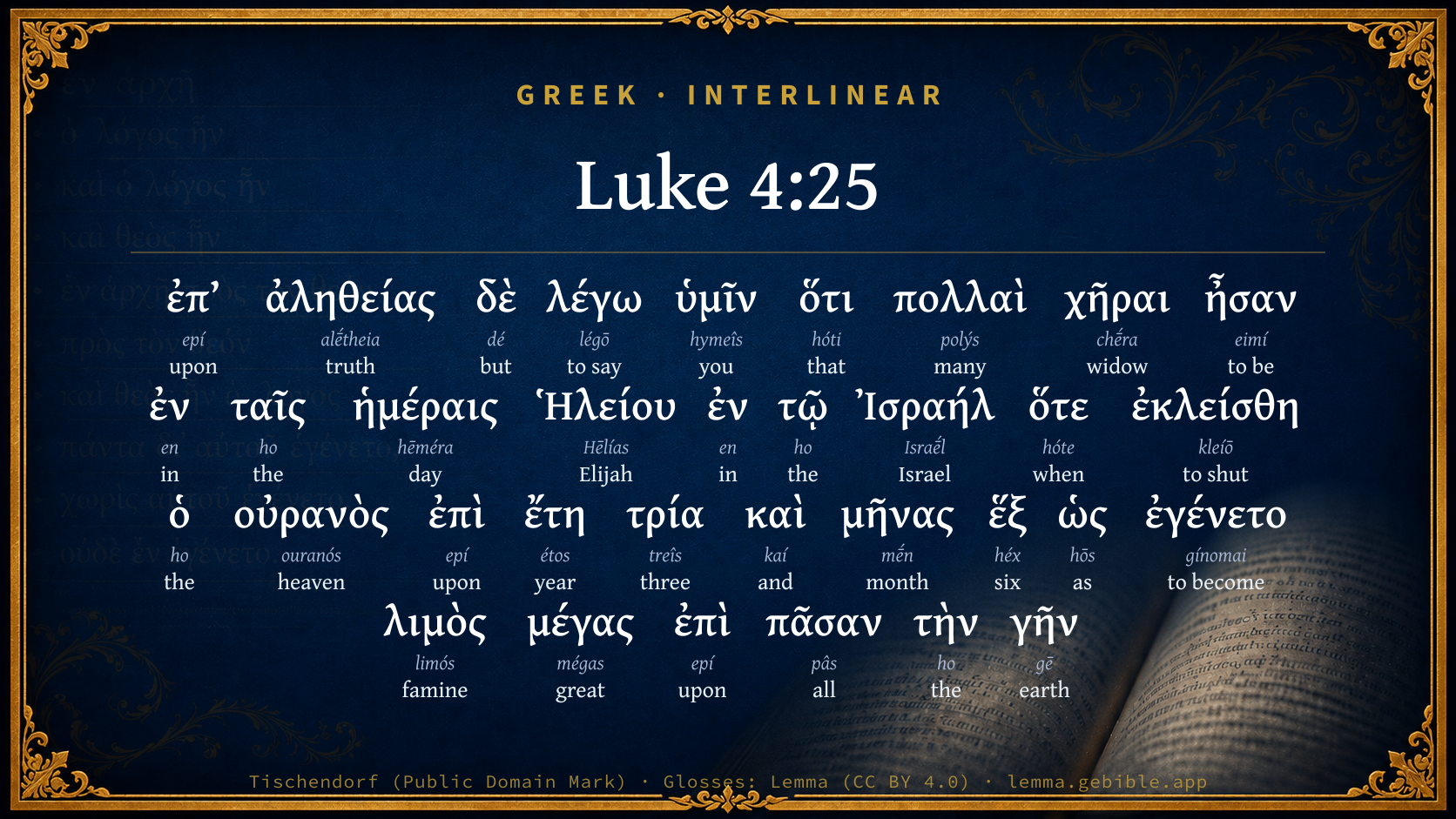
Greek (Tischendorf 8th ed.) Luke 4:25 appears in the Greek New Testament. The text above is from the Tischendorf 8th edition. Each word links to its Strong’s number and a concise gloss. Click any word for its full Thayer’s Greek Lexicon entry.
Download image
Cite this verse

Luke 4:25 (World English Bible). Public Domain. Lemma interlinear Bible study tool, https://lemma.gebible.app/v/luke/4/25.

Show BibTeX & RIS
BibTeX
RIS
English Translation
But truly I tell you, there were many widows in Israel in the days of Elijah, when the sky was shut up three years and six months, when a great famine came over all the land.
World English Bible · Public Domain
Download a study sheet

One document with this verse’s original text, its word-by-word gloss line, the meaning frame, cross-references with their text, attributed commentary, and full source and license credits — printable, and it pastes into notes with its structure intact.

This verse Autodidact and up

Study sheet (.html) Plain text (.txt)

A passage Seminary Student

Up to 50 verses in one chapter. A passage sheet keeps up to 6 commentary sources and 12 cross-references per verse, in the order this page ranks them, and says so on the sheet whenever that leaves anything out. Ask for a single verse and you get the Autodidact verse sheet above.

Everything on this page stays free to read, with no account — the sheet is a download of what is already on screen, not access to it.

Want to remove ads? Support Godless Engineer
Compare translations 3

The same verse in 3 English versions, stacked beneath the original-language interlinear above. Click any original word for its lexicon entry.

Each is an independent rendering of the whole verse — the interlinear is not word-aligned to these translations.

Highlighted words mark where these versions differ — a whole-verse word diff, not a word-by-word alignment.

  • World English Bible Public Domain
    But truly I tell you, there were many widows in Israel in the days of Elijah, when the sky was shut up three years and six months, when a great famine came over all the land.
  • King James Version Public Domain
    But I tell you of a truth, many widows were in Israel in the days of Elias, when the heaven was shut up three years and six months, when great famine was throughout all the land;
  • unfoldingWord Literal Text CC BY-SA 4.0
    But in truth I say to you that there were many widows in Israel during the days of Elijah, when the sky was shut up for three years and six months, when a great famine came upon all the land.

unfoldingWord Literal Text — © unfoldingWord, licensed CC BY-SA 4.0. Word-aligned USFM3 via Door43 (git.door43.org/unfoldingWord/en_ult).

Versions to compare (up to 4)

3 of 4 selected

Show all 19 translations

Every available English version of this verse, each an independent rendering of the whole verse.

  • World English Bible Public Domain
    But truly I tell you, there were many widows in Israel in the days of Elijah, when the sky was shut up three years and six months, when a great famine came over all the land.
  • Berean Standard Bible Public Domain
    But I tell you truthfully that there were many widows in Israel in the time of Elijah, when the sky was shut for three and a half years and great famine swept over all the land.
  • Majority Standard Bible Public Domain
    But I tell you truthfully that there were many widows in Israel in the time of Elijah, when the sky was shut for three and a half years and great famine swept over all the land.
  • King James Version Public Domain
    But I tell you of a truth, many widows were in Israel in the days of Elias, when the heaven was shut up three years and six months, when great famine was throughout all the land;
  • American Standard Version (1901) Public Domain
    But of a truth I say unto you, There were many widows in Israel in the days of Elijah, when the heaven was shut up three years and six months, when there came a great famine over all the land;
  • Revised Version (1885) Public Domain
    But of a truth I say unto you, There were many widows in Israel in the days of Elijah, when the heaven was shut up three years and six months, when there came a great famine over all the land;
  • Geneva Bible (1599) Public Domain
    But I tell you of a trueth, many widowes were in Israel in the dayes of Elias, when heauen was shut three yeres and sixe moneths, when great famine was throughout all the land:
  • Douay-Rheims (1899) Public Domain
    In truth I say to you, there were many widows in the days of Elias in Israel, when heaven was shut up three years and six months, when there was a great famine throughout all the earth.
  • Young's Literal Translation Public Domain
    and of a truth I say to you, Many widows were in the days of Elijah, in Israel, when the heaven was shut for three years and six months, when great famine came on all the land,
  • Literal Standard Version CC BY-SA 4.0
    and of a truth I say to you, many widows were in the days of Elijah, in Israel, when the sky was shut for three years and six months, when great famine came on all the land,
  • Unlocked Literal Bible CC BY-SA 4.0
    But in truth I tell you that there were many widows in Israel during the time of Elijah, when the sky was shut up for three years and six months, and a great famine came upon all the land.
  • unfoldingWord Literal Text CC BY-SA 4.0
    But in truth I say to you that there were many widows in Israel during the days of Elijah, when the sky was shut up for three years and six months, when a great famine came upon all the land.
  • Darby Bible Public Domain
    But of a truth I say to you, There were many widows in Israel in the days of Elias, when the heaven was shut up for three years and six months, so that a great famine came upon all the land,
  • World Messianic Bible Public Domain
    But truly I tell you, there were many widows in Israel in the days of Elijah, when the sky was shut up three years and six months, when a great famine came over all the land.
  • Webster's Bible Public Domain
    But I tell you in truth, many widows were in Israel in the days of Elijah, when the heaven was shut three years and six months when great famine was throughout all the land:
  • Free Bible Version CC BY-SA 4.0
    I guarantee that there were many widows in Israel during the time of Elijah when there was a drought for three and a half years, causing a great famine throughout the country.
  • Bible in Basic English Public Domain
    Truly I say to you, There were a number of widows in Israel in the days of Elijah, when the heaven was shut up for three years and six months and there was no food in the land;
  • Text-Critical English NT CC BY 4.0
    But in truth I tell you, there were many widows in Israel in the days of Elijah, when the sky was shut for three years and six months and a severe famine came over all the land,
  • Tyndale New Testament (1534) Public Domain
    But I tell you of a truth many wyddowes were in Israell in the dayes of Helias when hevyn was shet thre yeres and syxe monethes when greate fammisshemet was throughoute all the londe

Literal Standard Version (2020), Covenant Press — licensed CC BY-SA 4.0. Text via the HelloAO Bible API (eBible.org). Unlocked Literal Bible (unfoldingWord) — licensed CC BY-SA 4.0. Text via the HelloAO Bible API (eBible.org). unfoldingWord Literal Text — © unfoldingWord, licensed CC BY-SA 4.0. Word-aligned USFM3 via Door43 (git.door43.org/unfoldingWord/en_ult). Free Bible Version, Dr. Jonathan Gallagher — licensed CC BY-SA 4.0. Text via the HelloAO Bible API (eBible.org).

Word by word

More ways to search: Search by grammar → Find every occurrence → Compare this word →

Practice this passage: Drill this verse → Learn its vocabulary →

ἕξ
héx
G1803
“six”
Adjective, Numeral (indeclinable)
Part of Speech
Adjective · Numeral (indeclinable)
Full Thayer's Definition

Origin: a primary numeral

TDNT: None

1. six
  1. ἐπ’ epí G1909 “upon” Preposition
  2. ἀληθείας alḗtheia G225 “truth” Noun, Genitive, Singular, Feminine
  3. δὲ dé G1161 “but” Conjunction
  4. λέγω légō G3004 “to say” Verb, Present, Active, Indicative, 1st person, Singular
  5. ὑμῖν hymeîs G5210 “you” Personal pronoun, 2nd person, Dative, Plural
  6. ὅτι hóti G3754 “that” Conjunction
  7. πολλαὶ polýs G4183 “many” Adjective, Nominative, Plural, Feminine
  8. χῆραι chḗra G5503 “widow” Noun, Nominative, Plural, Feminine
  9. ἦσαν eimí G1510 “to be” Verb, Imperfect, Active, Indicative, 3rd person, Plural
  10. ἐν en G1722 “in” Preposition
  11. ταῖς ho G3588 “the” Article, Dative, Plural, Feminine
  12. ἡμέραις hēméra G2250 “day” Noun, Dative, Plural, Feminine
  13. Ἡλείου Hēlías G2243 “Elijah” Noun, Genitive, Singular, Masculine
  14. ἐν en G1722 “in” Preposition
  15. τῷ ho G3588 “the” Article, Dative, Singular, Masculine
  16. Ἰσραήλ Israḗl G2474 “Israel” Noun, Proper, indeclinable
  17. ὅτε hóte G3753 “when” Adverb
  18. ἐκλείσθη kleíō G2808 “to shut” Verb, Aorist, Passive, Indicative, 3rd person, Singular
  19. ὁ ho G3588 “the” Article, Nominative, Singular, Masculine
  20. οὐρανὸς ouranós G3772 “heaven” Noun, Nominative, Singular, Masculine
  21. ἐπὶ epí G1909 “upon” Preposition
  22. ἔτη étos G2094 “year” Noun, Accusative, Plural, Neuter
  23. τρία treîs G5140 “three” Adjective, Accusative, Plural, Neuter
  24. καὶ kaí G2532 “and” Conjunction
  25. μῆνας mḗn G3376 “month” Noun, Accusative, Plural, Masculine
  26. ὡς hōs G5613 “as” Adverb
  27. ἐγένετο gínomai G1096 “to become” Verb, Aorist, Middle deponent, Indicative, 3rd person, Singular
  28. λιμὸς limós G3042 “famine” Noun, Nominative, Singular, Masculine
  29. μέγας mégas G3173 “great” Adjective, Nominative, Singular, Masculine
  30. ἐπὶ epí G1909 “upon” Preposition
  31. πᾶσαν pâs G3956 “all” Adjective, Accusative, Singular, Feminine
  32. τὴν ho G3588 “the” Article, Accusative, Singular, Feminine
  33. γῆν gē G1093 “earth” Noun, Accusative, Singular, Feminine

About this verse

These counts appear in no published source. They are computed here, from the morphology-tagged text and Lemma’s own curated glosses. What Lemma adds →

34
words
28
distinct lemmas
Gospels
section

Notable vocabulary

The rarest word here is ἕξ six G1803 — appearing just 12 times in the whole Greek New Testament.

Shared distinctive vocabulary

ἕξ six G1803 occurs in 12 verses of the Greek New Testament. Also found in:

Repetition

Words recur within this verse:

Cross-references

11

Topical passages linked to Luke 4:25 in the Treasury of Scripture Knowledge — connected by theme and wording, ordered by reader-vote popularity; previews shown in the World English Bible.

  • 1 Kings 17:1 Elijah the Tishbite, who was of the foreigners of Gilead, said to Ahab, As Yahweh, the God of Israel, lives, before whom I stand, there shall not be dew nor rain these years, but according to my word.
  • James 5:17 Elijah was a man with a nature like ours, and he prayed earnestly that it might not rain, and it didn't rain on the earth for three years and six months.
  • Isaiah 55:8 For my thoughts are not your thoughts, neither are your ways my ways, says Yahweh.
  • Matthew 20:15 Isn't it lawful for me to do what I want to with what I own? Or is your eye evil, because I am good?'
  • 1 Kings 18:1–2 It happened after many days, that the word of Yahweh came to Elijah, in the third year, saying, Go, show yourself to Ahab; and I will send rain on the earth.
  • Mark 7:26–29 Now the woman was a Greek, a Syrophoenician by race. She begged him that he would cast the demon out of her daughter.
  • Luke 10:21 In that same hour Jesus rejoiced in the Holy Spirit, and said, "I thank you, O Father, Lord of heaven and earth, that you have hidden these things from the wise and understanding, and revealed them to little children. Yes, Father, for so it was well-pleasing in your sight."
  • Romans 9:15 For he said to Moses, "I will have mercy on whom I have mercy, and I will have compassion on whom I have compassion."
  • Romans 9:20 But indeed, O man, who are you to reply against God? Will the thing formed ask him who formed it, "Why did you make me like this?"
  • Ephesians 1:9 making known to us the mystery of his will, according to his good pleasure which he purposed in him
  • Ephesians 1:11 in whom also we were assigned an inheritance, having been foreordained according to the purpose of him who works all things after the counsel of his will;

Cross-references courtesy of OpenBible.info (CC BY 4.0).

Commentary

Notes on Luke 4:25 from classic Christian and Jewish commentators (each source and its license shown beneath its notes). The classic Christian expositions comment on the surrounding passage and are grouped to its opening verse, so a note may address several verses; the Jewish commentaries on the Tanakh (Rashi and others) are per-verse, so they appear only where the commentator wrote on this verse.

Lemma curates 59 commentaries, every one of them public domain or Creative Commons licensed, each selected and text-cleaned for this edition rather than reprinted as found. About our sources →

Joseph Benson's Commentary

Luk 4:25-27. Many widows were in Israel in the days of Elias, &c. — “By putting them thus in mind of Elijah’s miracle in behalf of the widow of Sarepta, a heathen inhabitant of a heathen city, in a time of famine, while many widows of Israel were suffered to starve; and of Elisha’s miracle on Naaman the Syrian leper, while many lepers in Israel remained uncleansed, he showed them both the sin and punishment of their ancestors, and left it to themselves to make the application.” When the heaven was shut up, &c. — Such a proof had they that God had sent him. Three years and six months — In 1Ki 18:1, it is said, The word of the Lord came to Elijah in the third year: namely, reckoning, not from the beginning of the drought, but from the time when he began to sojourn with the widow of Sarepta. A year of drought had preceded this, while he dwelt at the brook Cherith. So that the whole time of the drought was (as St. James likewise observes) three years and six months.

Joseph Benson's Commentary on the Old and New Testaments (1811–1818) — public domain. Text from a community e-Sword module.

Tyndale Open Study Notes

Tyndale Open Resources

4:25-26 widow of Zarephath: See 1 Kgs 17–18.

Tyndale Open Study Notes — © Tyndale Open Resources, licensed CC BY-SA 4.0. Text via the HelloAO Bible API.

Bengel's Gnomon

Johann Albrecht Bengel

Luk 4:25. Λέγω ὑμῖν, I tell you) The Lord declares this testimony by the light of His omniscience: for Elijah and Elisha might have rendered aid to more widows and lepers, even though Holy Scripture did not record it [were it not that Jesus, by His omniscience, informs us here, that they did not do so].—ἐκλείσθη, was shut up) As in Bible history, so in all other histories the notice taken of public punishments inflicted by God, famine, etc., forms a considerable part.—ἐπὶ ἔτη τρία καὶ μῆνας ἕξ, for three years and six months) 1Ki 17:1, etc., Luk 18:1.

Bengel's Gnomon of the New Testament — English translation (T&T Clark, Edinburgh, 1860) — public domain. Text from a community e-Sword module.

Meyer's Critical & Exegetical Commentary

Heinrich August Wilhelm Meyer

Luk_4:25-26. In order, however, to quote to you historical examples, in which the miraculous power of the prophets was put forth, not for countrymen, but for strangers, nay, for Gentiles, I assure you, etc. Jesus knew that here this sternness and open decisiveness on His part were not at all out of place, and that He need not hope to win His hearers; this is only confirmed by the later similar incident in Mat_13:54 ff.

ἐπὶ ἔτη τρία κ. μῆνας ἕξ] so also Jam_5:17. But according to 1Ki_17:1; 1Ki_18:1, the rain returned in the third year. Jesus, as also James (see Huther in loc.), follows, according to Luke, the Jewish tradition (Jalkut Schimoni on 1 Kings 16 in Surenhusius, καταλλ. p. 681), in which in general the number 3½ (= ½ of 7) in the measurement of time (especially a time of misfortune, according to Dan_12:7) had become time-honoured (Lightfoot, p. 756, 950; Otto, Spicileg. p. 142). It was arbitrary and unsatisfactory to reckon (before 1Ki_17:1), in addition to the three years, the naturally rainless six months preceding the rainy season (Benson on Jam_5:17; Wetstein, Wiesinger, and others; comp. also Lange, II. p. 547 f.), or to date the third year (Beza, Olshausen, Schegg) from the flight of Elias to Sarepta (1Ki_17:9).

πᾶσαν τ. γῆν] not the whole region (Beza), but the whole earth; popularly hyperbolical.

On Sarepta, situated between Tyre and Sidon, and belonging to the territory of the latter, now the village of Surafend, see Robinson, Palestine, III. p. 690 ff.

Σιδῶνος] the name of the town of Sidon, as that in whose territory Sarepta lay.

μέγας] in Luk_15:14 λιμός is feminine, as it passed over from the Doric into the κοινή (Lobeck, ad Phryn. p. 188). But in this place the reading μεγάλη, approved by Valckenaer, is so weakly attested that it cannot be thought of.

εἰ μή] not sed (Beza, Kuinoel), but nisi; see on Mat_12:4

Meyer — Critical and Exegetical Commentary on the New Testament — English translation by Peter Christie, edited by Frederick Crombie (T&T Clark, 1880) — public domain. Text from a community e-Sword module.

Expositor's Greek Testament

ed. W. Robertson Nicoll

Luk 4:25 . This verse begins, like Luk 4:24 , with a solemn asseveration. It contains the proper answer to Luk 4:23 . It has been suggested (J. Weiss) that Luk 4:22 ; Luk 4:24 have been interpolated from Mar 6:1-6 in the source Lk. here used. ἔτη τρία κ . μ . ἕξ , three years and six months. The reference is to 1Ki 17:1 ; 1Ki 18:1 , where three years are mentioned. The recurrence of the same number, three and a half years, in Jas 5:17 seems to point to a traditional estimate of the period of drought, three and a half, the half of seven, the number symbolic of misfortune (Dan 12:7 ).

The Expositor's Greek Testament, edited by W. Robertson Nicoll (1897–1910) — public domain. Text from a community e-Sword module.

Geneva Bible (1599)

Geneva Bible translators

Land of Israel, see Mark 15:38.

Geneva Bible (1599) marginal notes — public domain. Text via Bolls.life.

Jamieson, Fausset & Brown

Robert Jamieson, A. R. Fausset & David Brown

But I tell you, &c.--falling back for support on the well-known examples of Elijah and Elisha (Eliseus), whose miraculous power, passing by those who were near, expended itself on those at a distance, yea on heathens, "the two great prophets who stand at the commencement of prophetic antiquity, and whose miracles strikingly prefigured those of our Lord. As He intended like them to feed the poor and cleanse the lepers, He points to these miracles of mercy, and not to the fire from heaven and the bears that tore the mockers" [STIER].

three years and six months--So Jam 5:17, including perhaps the six months after the last fall of rain, when there would be little or none at any rate; whereas in Kg1 18:1, which says the rain returned "in the third year," that period is probably not reckoned.

Jamieson, Fausset & Brown — Commentary Critical and Explanatory on the Whole Bible (1871) — public domain (CC PDM 1.0). Text via the HelloAO Bible API.

Adam Clarke's Commentary

Verse 25. In the days of Elias] See this history, 1Kg 17:1-9, compared with 1Kg 18:1-45. This was evidently a miraculous interference, as no rain fell for three years and six months, even in the rainy seasons. There were two of these in Judea, called the first and the latter rains; the first fell in October, the latter in April: the first prepared the ground for the seed, the latter ripened the harvest. As both these rains were withheld, consequently there was a great famine throughout all the land.

Adam Clarke's Commentary on the Bible (1810–1826) — public domain. Text from a community e-Sword/MySword module.

The Cambridge Bible for Schools and Colleges

gen. ed. J. J. S. Perowne

25. many widows were in Israel] So far from trying to flatter them, He tells them that His work is not to be for their special benefit or glorification, but that He had now passed far beyond the limitations of earthly relationships.

three years and six months] Such was the Jewish tradition, as we see also in Jas_5:17 (comp. Dan_12:7; Rev_11:2-3; Rev_13:5). The book of Kings only mentions three years (1Ki_17:1; 1Ki_17:8-9; 1Ki_18:1-2), but in the “many days” it seems to imply more.

The Cambridge Bible for Schools and Colleges (gen. ed. J. J. S. Perowne; Cambridge University Press, 1878–1918) — public domain. Text from a community e-Sword module.

John Gill's Exposition

But I tell you of a truth,.... Or in truth: it answers to a phrase often used by the Jewish writers (o); and, which, they say (p), wherever, and of whatsoever it is spoken, it signifies a tradition of Moses from Mount Sinai, and so that which is most true, sure, and firm, and to be depended on; and such is what our Lord hereafter delivers; yea, the word, "truth", or "of a truth", and which is the same as "in truth", is used by the Jews (q), as , "the form of an oath": so that these words of Christ are a strong asseveration, and amount to a solemn oath with respect to what follows:

many widows were in Israel in the days of Elias; or Elijah, the prophet; that is, there were many that were not only widows, but poor widows, and in very famishing circumstances in the land of Israel, when Elijah was the prophet of the Lord to that people:

and when the heaven was shut up three years and six months; so that no rain descended all that time: the same is observed by Jam 5:17 and though the space of time, in which there was no rain, is not so clear from the history of it in the book of Kings; yet, as this is fixed by Christ, and his apostle, and there is nothing in the history that contradicts it, it is to be received without scruple:

when great famine was throughout all the land of Israel; and which so long a drought must needs bring.

(o) Misn. Sabbat, c. 1. sect. 3. Trumot, c. 2. sect. 1. (p) T. Hieros. Sabbat, fol. 3. 2. & 12. 1. Maimon. & Bartenora in Misn. Trumot, c. 3. sect. 1. (q) T. Bab. Beracot, fol. 55. 1. & Gloss. in ib.

John Gill's Exposition of the Whole Bible (1746–1763) — public domain (CC PDM 1.0). Text via the HelloAO Bible API.

Trapp's Complete Commentary

John Trapp

25 But I tell you of a truth, many widows were in Israel in the days of Elias, when the heaven was shut up three years and six months, when great famine was throughout all the land;

Ver. 25. Many widows were in Israel] q.d. God hath mercy on whom he will have mercy, &c. He is a free agent, and may do with his own as he pleaseth. If the prophets, by the Spirit’s direction, healed and helped foreigners sooner than Israelites, what so great wonder that Christ did not for his own country that which he did for others?

John Trapp, A Commentary or Exposition upon All the Books of the Old and New Testament (1647–1656) — public domain. Text from a community e-Sword module.

Albert Barnes' Notes on the Bible

Of a truth - Truly, and therefore worthy of your credit. He calls attention to two cases where “acknowledged” prophets had so little honor in their own nation that they bestowed their favors on foreigners. So, says he, such is the want of faith in my own country, that I shall work no miracles here, but shall give the evidence of my divine mission to others.

In Israel - In the land of Israel, or Judea. It was therefore the more remarkable, since there were so many in his own country whom he might have helped, that the prophet should have gone to a pagan city and aided a poor widow there.

The days of Elias - The days of Elijah. See the account of this in 1 Kings 17:8-24.

Three years and six months - From 1Ki 18:1, 1Ki 18:45, it would seem that the rain fell on the “third year” - that is, at the “end” of the third year after the rain had ceased to fall at the usual time. There were two seasons of the year when rains fell in Judea - in October and April, called the “early” and “latter” rain; consequently there was an interval between them of six months. To the three years, therefore, when rain was withheld “at the usual times,” are to be added the previous six months, when no rain fell as a matter of course, and consequently three years “and six months” elapsed without rain.

A great famine - A great want of food, from long continued and distressing drought.

Albert Barnes' Notes on the Bible (1834–1885) — public domain. Text from a community e-Sword/MySword module.

Matthew Poole's English Annotations

The two stories to which our Saviour refers are those 1Ki 17:9; 2Ki 5:14. But the question is what our Saviour intended to teach them by these stories, which made them so exceeding angry, as we shall find by and by. I answer, several things, none of which pleased them.

1. The freeness of God’s distinguishing grace. That God was not bound to give to all the same aid, and means of grace, that he gave some. This is a doctrine the world was never patient to hear. That God will have mercy on whom he will have mercy. We would fain make God a debtor to us. Those of Nazareth think they had as good, if not a better, right to Christ’s miracles than those of Capernaum. I tell you, saith Christ, God is a Sovereign in his acts of grace, and acts freely, and I can do no miracles but where he will have them done.

2. That it is through the fault of men, it they receive not the benefits of Divine grace. If the Israelites would have entertained Elijah, he might have been sent to them, as well as to Sarepta. If the lepers in Israel would have sought out and come to Elisha they might have been healed. If you would have received me, and believed in me, you might have seen what those of Capernaum did; it is because of your contempt and unbelief that I can show you no miracles. If any say, If God had put it into the hearts of the widows in Israel, or the lepers there, they would also have entertained Elijah, and have sought out and came to Elisha: why did not God put it into their hearts? To this the answer is ready: Who art thou that disputest with God? Why doth the clay reply upon the potter? Even so, O Father, for so it pleaseth thee. However, the failures of the lepers in Israel, and the widows there, and of those in Nazareth, was in a great measure in their duty, as to things within their power to do by virtue of that common grace which God denieth to none: he might justly deny his special influences, while they neglected to make use of his more common influences.

3. That in every nation he that feared God, and wrought righteousness, was ever accepted of him. God had no respect to this country, or that country; he sent Elijah to do good to a Sidonian, and Elisha to do good to a Syrian, while he neglected the ungrateful and disobedient Israelites. Thus he also not obscurely hints, that for their unbelief, and rejection of, and disobedience to him, God would send his gospel to the Gentiles, and reject them, which came to pass within a few years after. None of all these were grateful sounds in the ears of the men of Nazareth. You ask me (saith our Saviour) why I do not such things here at Nazareth as I did at Capernaum. I was not sent to you. No; but were not they some of the lost sheep of Israel? Ah! but Christ was no more sent to all Israel, than Elias was sent to all the widows in Israel. He was sent to preach to them all, but for any special, signal favours, he was sent but to some, and those some were such as did not proudly reject and contemn him, but receive him.

Matthew Poole's English Annotations on the Holy Bible (1683–1685) — public domain. Text from a community e-Sword/MySword module.

Whedon's Commentary on the Bible

Daniel D. Whedon

25. Many widows—Jesus now illustrates his proverb, in the present case, with a couple of examples in which their countrymen rejected the prophets and were themselves rejected. The widows in Israel of old rejected Elijah and the God of Elijah; they were themselves overlooked, while the widow of Sarepta was selected and elected. The lepers of Israel rejected Elijah; they were themselves consequently rejected and reprobated, and Naaman the Syrian was elected through faith to physical salvation. Like the rejected widows and lepers of Israel were these Nazarenes. The election in all the instances is conditional, not arbitrary.

In both cases, Jesus selects his elect ones (as Luke’s Gentile Gospel hints) from among Gentiles. And this may have been part of the matter of offence. But the main ground was, that Jesus abated not a hair of his pretensions to pass a summary reprobation upon the Nazarenes for their evil hearts of unbelief.

Days of Elias—Elias is the Greek form of the Old Testament name Elijah. Driven by the persecutions of Ahab, Elijah the Tishbite, by God’s command, took refuge with the widow of Zarephath or Sarepta. She was induced to supply his wants, and was rewarded of God.

Three years and six months—The time of the cessation of rain is said, to have been the third year, and it does not appear at what time it commenced. Apparently it began some time earlier, which gave time for the additional six months. References to the period of three years and six months, apparently as a round number, not to be taken as exact, are several times found in the Scriptures, as in Dan_7:25; Dan_12:7; Rev_11:2-3; Rev_12:6-14. So also in Jas_5:17. Lightfoot adduces also more instances from the rabbinical writers. It is in fact the half of the sacred number Seven. See supplementary note to Luk_6:13. Sarepta, or Zarephath in the Old Testament, Sarafend at the present time, is a large inland village half way between Tyre and Sidon.

Daniel D. Whedon (gen. ed.), Commentary on the Old and New Testaments (1874–1909) — public domain. Text from a community e-Sword module.

The Pulpit Commentary

Vers. 25-27. But I tell you of a truth, many widows were in Israel in the days of Elias, when the heaven was shut up three years and six months, when great famine was throughout all the land; but unto none of them was Elias sent, save unto Sarepta, a city of Sidon, unto a woman that was a widow. And many lepers were in Israel in the time of Eliseus the prophet; and none of them was cleansed, saving Naaman the Syrian. In support of these assertions, Jesus proceeds to quote two well known incidents in the story of Israel. They must remember God"s mercies in past times were not confined to Israel. There were many starving widows among the chosen people, not a few childless, desolate hearths; but their own great Elijah was sent to none of these, but to a despised Phoenician woman in Sarepta, hard by Sidon. Elisha, that loved man of God, who passed by the homes of the people continually, performed his famous miracle of healing on no child of Israel, though many a leper mourned his sad lot among the chosen people; but the one on whom Elisha worked his mighty miracle of mercy was the Syrian leper Naaman, the great foe of Israel.

The Pulpit Commentary (1880–1919), ed. H.D.M. Spence-Jones & Joseph S. Exell — public domain. Text from a community e-Sword module.

John Wesley's Explanatory Notes

When the heaven was shut up three years and six months - Such a proof had they that God had sent him. In 1 Kings xviii, 1, it is said, The word of the Lord came to Elijah in the third year: namely, reckoning not from the beginning of the drought, but from the time when he began to sojourn with the widow of Sarepta. A year of drought had preceded this, while he dwelt at the brook Cherith. So that the whole time of the drought was (as St. James likewise observes) three years and six months. 1 Kings xvii, 19; xviii, 44.

John Wesley, Explanatory Notes Upon the Whole Bible (1754–1765) — public domain. Text via the GEBible commentary corpus.

Burkitt's Expository Notes on the New Testament

William Burkitt

Here our Saviour by a double instance confirms what he had last told his countrymen at Nazareth, namely, that prophets are most despised by their own countrymen and acquaintance, and that strangers oft-times have more advantage by a prophet than his own people.

The first instance of this which our Saviour gives them, is in the days of Elias, though there were many widows then in his own nation, yet none of them were qualified to receive his miracles, but a stranger, a widow of Sarepta.

The second instance was in the days of Elisha; when though there were many lepers in and about the neighborhood, yet they being his countrymen, despised him, and none were qualified for a cure but Naaman the Syrian, a man of another country.

Thus the prophets of God, like some fishermen, catch least in their own pond, and do more good by their ministry among strangers, than among their own countrymen, kinsfolk, and near relations: No prophet is accepted in his own country.

William Burkitt's Expository Notes on the New Testament (1700–1703) — public domain. Text from a community e-Sword module.

The People's New Testament

B. W. Johnson

25–27. Many widows were in Israel. He points out that Elijah saved a Sidonian widow, and Elisha healed a Syrian leper, passing by Hebrews and healing Gentiles, and thus he points to the salvation of Gentiles by Christ.

Sarepta. The same as Zarephatha, a town between Tyre and Sidon. See 1 Kings 17:9, 10.

Naaman. See 2 Kings 5:14.

B. W. Johnson's The People's New Testament with Notes (1889–1891) — public domain. Electronic text from the Christian Classics Ethereal Library (CCEL) ThML edition.

unfoldingWord translationNotes

Door43 World Missions Community

General Information:

Jesus reminds the people who are listening to him in the synagogue about Elijah and Elisha, who were prophets about whom they knew. (See: Background Information)

But in truth I tell you

"I tell you truthfully." Jesus uses this phrase to emphasize the importance, truth, and accuracy of the statement that follows.

widows

Widows are women whose husbands have died.

during the time of Elijah

The people to whom Jesus was speaking would have known that Elijah was one of God's prophets. If your readers would not know that, you can make this implicit information explicit as in the UDB. AT: "when Elijah was prophesying in Israel" (See: Assumed Knowledge and Implicit Information)

when the sky was shut up

This is a metaphor. The sky is pictured as a ceiling that was closed, and so no rain would fall from it. AT: "when no rain fell down from the sky" or "when there was no rain at all" (See: Metaphor)

a great famine

"a serious lack of food." A famine is a long period of time when the crops do not produce enough food for the people.

to Zarephath ... to a widow living there

The people living in the town of Zarephath were Gentiles, not Jews. The people listening to Jesus would have understood that the people of Zarephath were Gentiles. AT: "to a Gentile widow living in Zarephath" (See: Assumed Knowledge and Implicit Information and How to Translate Names)

Naaman the Syrian

A Syrian is a person from the country of Syria. The people of Syria were Gentiles, not Jews. AT: "the Gentile Naaman from Syria" (See: How to Translate Names)

translationWords

true

Israel

Elijah

famine

Sidon

leper

Elisha

prophet

Naaman

Syria

unfoldingWord translationNotes — © Distant Shores Media and the Door43 World Missions Community, licensed CC BY-SA 4.0. Source: git.door43.org/Door43/en_tn.

Cambridge Greek Testament for Schools and Colleges

25. πολλαὶ χῆραι ἦσαν … ἐν τῷ Ἰσραήλ. So far from trying to flatter them, He tells them that His work is not to be for their special benefit or glorification, but that He had now passed far beyond the limitations of earthly relationships.

ἔτη τρία καὶ μῆνας ἔξ. Such was the Jewish tradition (Jalkut Shimeoni on 1 Kings 16) as we see also in Jas 5:17 (comp. Dan 12:7; Rev 11:2-3; Rev 13:5). The Book of Kings only mentions three years (1Ki 17:1; 1Ki 17:8-9; 1Ki 18:1-2), but in the “many days” it seems to imply more. 3½ being the half of 7 had a mystic significance. In the symbolism of numbers it indicated periods of misfortune, as in Dan 12:7. See Lightfoot Hor. Hebr. ad loc.

λιμὸς μέγας. In Luk 15:14; Act 11:28 λιμὸς is fem. as in Doric.

Cambridge Greek Testament for Schools and Colleges (Cambridge University Press, 1896; 21 vols, various authors incl. Carr, Maclear, Plummer, Farrar, Lumby, Moule, M. R. James, Simcox) — public domain. Text from a community e-Sword module.

Alford’s Greek Testament

Henry Alford

25.] Our Lord brings forward instances where the two greatest prophets in Israel were not directed to act in accordance with the proverb, ‘Physician heal thyself:’ but their miraculous powers exerted on those who were strangers to God’s inheritance.

ἔτη τρ. κ. μ. ἕξ] So also in Jas 5:17;—but in 1Ki 18:1 we find that it was in the third year that the Lord commanded Elijah to shew himself to Ahab, for He would send rain on the earth. But it does not appear from what time this third year is reckoned,—or at what time of the year, with reference to the usual former and latter rains, the drought caused by Elias’s prayer began (it apparently had begun some time before the prophet was sent to be miraculously sustained, as this very fact implies failure of the ordinary means of sustenance); and thus, without forming any further hypothesis, we have latitude enough given for the three and a half years, which seems to have been the exact time. This period is one often recurring in Jewish record and in prophecy: see Dan 7:25; Dan 12:7: Rev 11:2, Rev 11:3; Rev 12:6, Rev 12:14; Rev 13:5. Lightfoot (ii. 123) produces more instances from the Rabbinical writers. “The period of three years and a half, = 42 months or 1260 days, had an ominous sound in the ears of an Israelite, being the time of this famine, and of the duration of the desolation of the temple under Antiochus.” Wordsw.

Henry Alford, The Greek Testament (1849–1861) — public domain. Text from a community e-Sword module.

International Critical Commentary

25. “But I am like the Prophets, not only in the treatment which I receive from My own people, but also in My principles of action. For they also bestowed their miraculous benefits upon outsiders, although there were many of their own people who would have been very glad of such blessings.” Christ is here appealing to their knowledge of Scripture, not to any facts outside the O.T. Testatur hoc Dominus ex luce omniscientiæ suæ is not a legitimate inference. Arguments drawn from what was Known to Him, but not known to them, would not be likely to influence His audience, Note ὡς= “when.”

ἐπʼ ἀληθείας. “On a basis of truth”: comp. Mar 12:14. We have similar adverbial expressions in ἐπʼ ίσης (sc. μοίρας), ἐπὶ σχολῆς, ἐπὶ ἐπʼ ἀδείας.

ἐπὶ ἔτη τρία καὶ μῆνας ἕξ. Jesus, like His brother James (Jas 5:17), follows Jewish tradition as to the duration of the famine. In 1Ki 18:1 we are told that the rain came in the third year, which would make the drought about two years and a half But ever since the persecution under Antiochus Epiphanes, three and a half (=42 months =1260 days) had become the duration of times of great calamity (Dan 7:25, Dan 7:7:7; Rev 11:2, Rev 11:3, Rev 11:12:6, Rev 11:14, Rev 11:13:5). The Jews would regard “in the year” as covering three years, and would argue that the famine must have continued for some time after the rain came.

For ἐπί c.acc. of duration of time (“over,” i.e. “during”), comp. Act 13:31, Act 13:19:10; Hdt 3:59:2, 6:101:3; Thuc. 2:25, 4.Heb 11:30. is different. In accordance with common usage λιμβς is here masc; but in 15:14 and Act 11:28 it is fem. acc. to what is called Doric usage, as in the Megarean of Aristoph. Acharn. 743. But this usage occurs elsewhere in late Greek. It perhaps passed from the Doric into the Κοινὴ Διάλεκτος: for examples see Wetst, and L. and S. Lex. In LXX perhaps only 1Ki 18:2.

ἐπὶ πᾶσαν τὴν γῆν. Here, as in Jas 5:17, only the land of Israel need be understood; but it is possible that in each case we have a popular hyperbole, and that the whole world is meant. Luk 21:23 and Rom 9:28 are not quite parallel, for there the context Plainly limits the meaning. Luk 23:44 is another doubtful case, and there AV. has “earth” and RV. “Land.” Both have “land” here.

International Critical Commentary — older volumes (1896–1929), various authors — public domain. Text from a community e-Sword module.

Vincent's Word Studies in the New Testament

Marvin R. Vincent

A great famine was throughout all the land [εγενετο λιμος μεγας επι πασαν την γην] . More literally and correctly, as Rev., there came (or arose) a great famine over all the land.

Marvin R. Vincent, Word Studies in the New Testament (1887–1900) — public domain. Text from a community e-Sword/MySword module.

Lesson kit

Teaching starters — assembled from the data on this page, not authored interpretation. Every prompt links to the verse data it draws on. Edit before teaching.

Luke, in the Gospels, opens this verse with 34 words (28 distinct Greek lemmas). Its most distinctive word is héx (“six”). A historical commentator’s framing appears above. Read the whole chapter for the surrounding context.

Discussion questions

  1. What does “six” (héx) contribute to the verse as a whole?
  2. Matthew 17:1 shares the word «six» with this verse. How do the two illuminate each other?
  3. “upon” occurs 3× in this one verse. What is the effect of the repetition?
  4. These translations render this verse differently; the difference is in the English rendering, not the original. What questions does that raise?
  5. Reading how Joseph Benson's Commentary and Tyndale Open Study Notes read this verse, where do the two commentators agree and where do they part?

Things to notice

Reading settings

Reading text

Shown beneath each verse's original-language words.

Old Testament
Old Testament edition

Read the OT as the Masoretic Hebrew (MT) or the Greek Septuagint (LXX).

English shown for the Greek Septuagint (in the Hebrew ↔ Greek comparison).

Comparing translations? Open the Compare panel on any verse page to stack up to four side by side.