
Acts 10:11

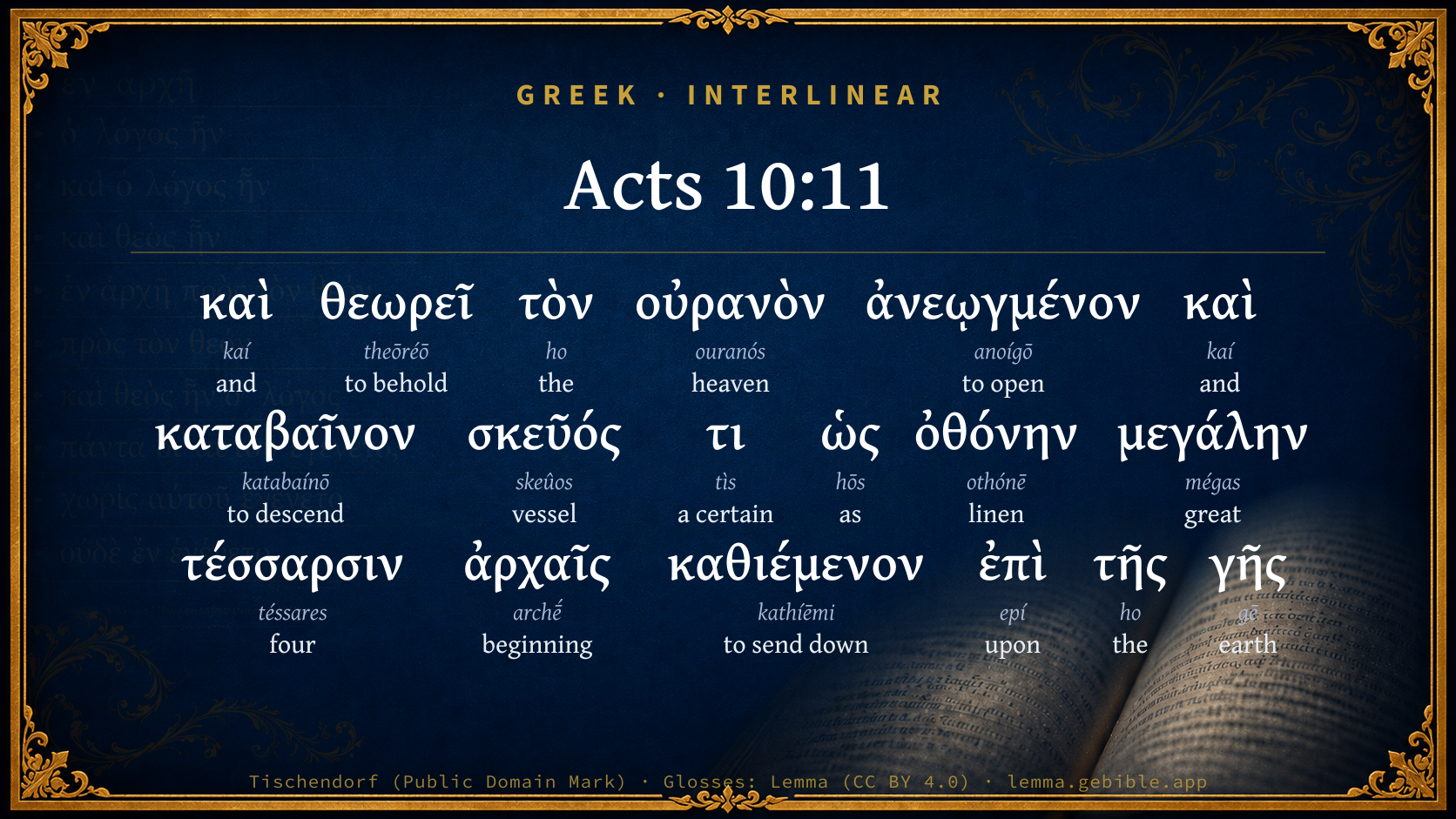
Greek (Tischendorf 8th ed.) Acts 10:11 appears in the Greek New Testament. The text above is from the Tischendorf 8th edition. Each word links to its Strong’s number and a concise gloss. Click any word for its full Thayer’s Greek Lexicon entry.
Download image
Cite this verse

Acts 10:11 (World English Bible). Public Domain. Lemma interlinear Bible study tool, https://lemma.gebible.app/v/acts/10/11.

Show BibTeX & RIS
BibTeX
RIS
English Translation
He saw heaven opened and a certain container descending to him, like a great sheet let down by four corners on the earth,
World English Bible · Public Domain
Highlights
  • 1 first appearance in the Greek New Testament
Full analysis ↓
Download a study sheet

One document with this verse’s original text, its word-by-word gloss line, the meaning frame, cross-references with their text, attributed commentary, and full source and license credits — printable, and it pastes into notes with its structure intact.

This verse Autodidact and up

Study sheet (.html) Plain text (.txt)

A passage Seminary Student

Up to 50 verses in one chapter. A passage sheet keeps up to 6 commentary sources and 12 cross-references per verse, in the order this page ranks them, and says so on the sheet whenever that leaves anything out. Ask for a single verse and you get the Autodidact verse sheet above.

Everything on this page stays free to read, with no account — the sheet is a download of what is already on screen, not access to it.

Want to remove ads? Support Godless Engineer
Compare translations 3

The same verse in 3 English versions, stacked beneath the original-language interlinear above. Click any original word for its lexicon entry.

Each is an independent rendering of the whole verse — the interlinear is not word-aligned to these translations.

Highlighted words mark where these versions differ — a whole-verse word diff, not a word-by-word alignment.

  • World English Bible Public Domain
    He saw heaven opened and a certain container descending to him, like a great sheet let down by four corners on the earth,
  • King James Version Public Domain
    And saw heaven opened, and a certain vessel descending upon him, as it had been a great sheet knit at the four corners, and let down to the earth:
  • unfoldingWord Literal Text CC BY-SA 4.0
    and he sees the sky opened and a certain container, like a large sheet, descending, being let down by four corners to the earth,

unfoldingWord Literal Text — © unfoldingWord, licensed CC BY-SA 4.0. Word-aligned USFM3 via Door43 (git.door43.org/unfoldingWord/en_ult).

Versions to compare (up to 4)

3 of 4 selected

Show all 19 translations

Every available English version of this verse, each an independent rendering of the whole verse.

  • World English Bible Public Domain
    He saw heaven opened and a certain container descending to him, like a great sheet let down by four corners on the earth,
  • Berean Standard Bible Public Domain
    He saw heaven open and something like a large sheet being let down to earth by its four corners.
  • Majority Standard Bible Public Domain
    He saw heaven open and something like a large sheet being let down to earth to him, bound at its four corners.
  • King James Version Public Domain
    And saw heaven opened, and a certain vessel descending upon him, as it had been a great sheet knit at the four corners, and let down to the earth:
  • American Standard Version (1901) Public Domain
    and he beholdeth the heaven opened, and a certain vessel descending, as it were a great sheet, let down by four corners upon the earth:
  • Revised Version (1885) Public Domain
    and he beholdeth the heaven opened, and a certain vessel descending, as it were a great sheet, let down by four corners upon the earth:
  • Geneva Bible (1599) Public Domain
    And hee sawe heauen opened, and a certaine vessell come downe vnto him, as it had bene a great sheete, knit at the foure corners, and was let downe to the earth.
  • Douay-Rheims (1899) Public Domain
    And he saw the heaven opened, and a certain vessel descending, as it were a great linen sheet let down by the four corners from heaven to the earth:
  • Young's Literal Translation Public Domain
    and he doth behold the heaven opened, and descending unto him a certain vessel, as a great sheet, bound at the four corners, and let down upon the earth,
  • Literal Standard Version CC BY-SA 4.0
    and he beholds Heaven opened, and a certain vessel descending to him, as a great sheet, bound at the four corners, and let down on the earth,
  • Unlocked Literal Bible CC BY-SA 4.0
    and he saw the sky open and a certain container descending, something like a large sheet coming down to the earth, let down by its four corners.
  • unfoldingWord Literal Text CC BY-SA 4.0
    and he sees the sky opened and a certain container, like a large sheet, descending, being let down by four corners to the earth,
  • Darby Bible Public Domain
    and he beholds the heaven opened, and a certain vessel descending, as a great sheet, [bound] by [the] four corners [and] let down to the earth;
  • World Messianic Bible Public Domain
    He saw heaven opened and a certain container descending to him, like a great sheet let down by four corners on the earth,
  • Webster's Bible Public Domain
    And saw heaven opened, and a certain vessel descending to him, as it had been a great sheet knit at the four corners, and let down to the earth:
  • Free Bible Version CC BY-SA 4.0
    he saw heaven opened. He saw something coming down that looked like a large sheet held by its four corners, being lowered onto the earth.
  • Bible in Basic English Public Domain
    And he saw the heavens opening, and a vessel coming down, like a great cloth let down on the earth,
  • Text-Critical English NT CC BY 4.0
    He saw heaven opened and an object like a large sheet coming down to him. It was tied at its four corners and was being lowered to the earth.
  • Tyndale New Testament (1534) Public Domain
    and sawe heven opened and a certayne vessell come doune vnto him as it had bene a greate shete knyt at the.iiii. corners and was let doune to the erth

Literal Standard Version (2020), Covenant Press — licensed CC BY-SA 4.0. Text via the HelloAO Bible API (eBible.org). Unlocked Literal Bible (unfoldingWord) — licensed CC BY-SA 4.0. Text via the HelloAO Bible API (eBible.org). unfoldingWord Literal Text — © unfoldingWord, licensed CC BY-SA 4.0. Word-aligned USFM3 via Door43 (git.door43.org/unfoldingWord/en_ult). Free Bible Version, Dr. Jonathan Gallagher — licensed CC BY-SA 4.0. Text via the HelloAO Bible API (eBible.org).

Word by word

More ways to search: Search by grammar → Find every occurrence → Compare this word →

Practice this passage: Drill this verse → Learn its vocabulary →

ὀθόνην
othónē
G3607
“linen”
Noun, Accusative, Singular, Feminine
Part of Speech
Noun
Case
Accusative
Number
Singular
Gender
Feminine
Full Thayer's Definition

Origin: of uncertain affinity

TDNT: None

1. linen (i.e. fine white linen for women's clothing) 2. linen clothes (sheet or sail)
  1. καὶ kaí G2532 “and” Conjunction
  2. θεωρεῖ theōréō G2334 “to behold” Verb, Present, Active, Indicative, 3rd person, Singular
  3. τὸν ho G3588 “the” Article, Accusative, Singular, Masculine
  4. οὐρανὸν ouranós G3772 “heaven” Noun, Accusative, Singular, Masculine
  5. ἀνεῳγμένον anoígō G455 “to open” Verb, Perfect, Passive, Participle, Accusative, Singular, Masculine
  6. καὶ kaí G2532 “and” Conjunction
  7. καταβαῖνον katabaínō G2597 “to descend” Verb, Present, Active, Participle, Accusative, Singular, Neuter
  8. σκεῦός skeûos G4632 “vessel” Noun, Accusative, Singular, Neuter
  9. τι tìs G5100 “a certain” Indefinite pronoun, Accusative, Singular, Neuter
  10. ὡς hōs G5613 “as” Adverb
  11. μεγάλην mégas G3173 “great” Adjective, Accusative, Singular, Feminine
  12. τέσσαρσιν téssares G5064 “four” Adjective, Dative, Plural, Feminine
  13. ἀρχαῖς archḗ G746 “beginning” Noun, Dative, Plural, Feminine
  14. καθιέμενον kathíēmi G2524 “to send down” Verb, Present, Passive, Participle, Accusative, Singular, Neuter
  15. ἐπὶ epí G1909 “upon” Preposition
  16. τῆς ho G3588 “the” Article, Genitive, Singular, Feminine
  17. γῆς gē G1093 “earth” Noun, Genitive, Singular, Feminine

About this verse

These counts appear in no published source. They are computed here, from the morphology-tagged text and Lemma’s own curated glosses. What Lemma adds →

18
words
16
distinct lemmas
Acts
section

Notable vocabulary

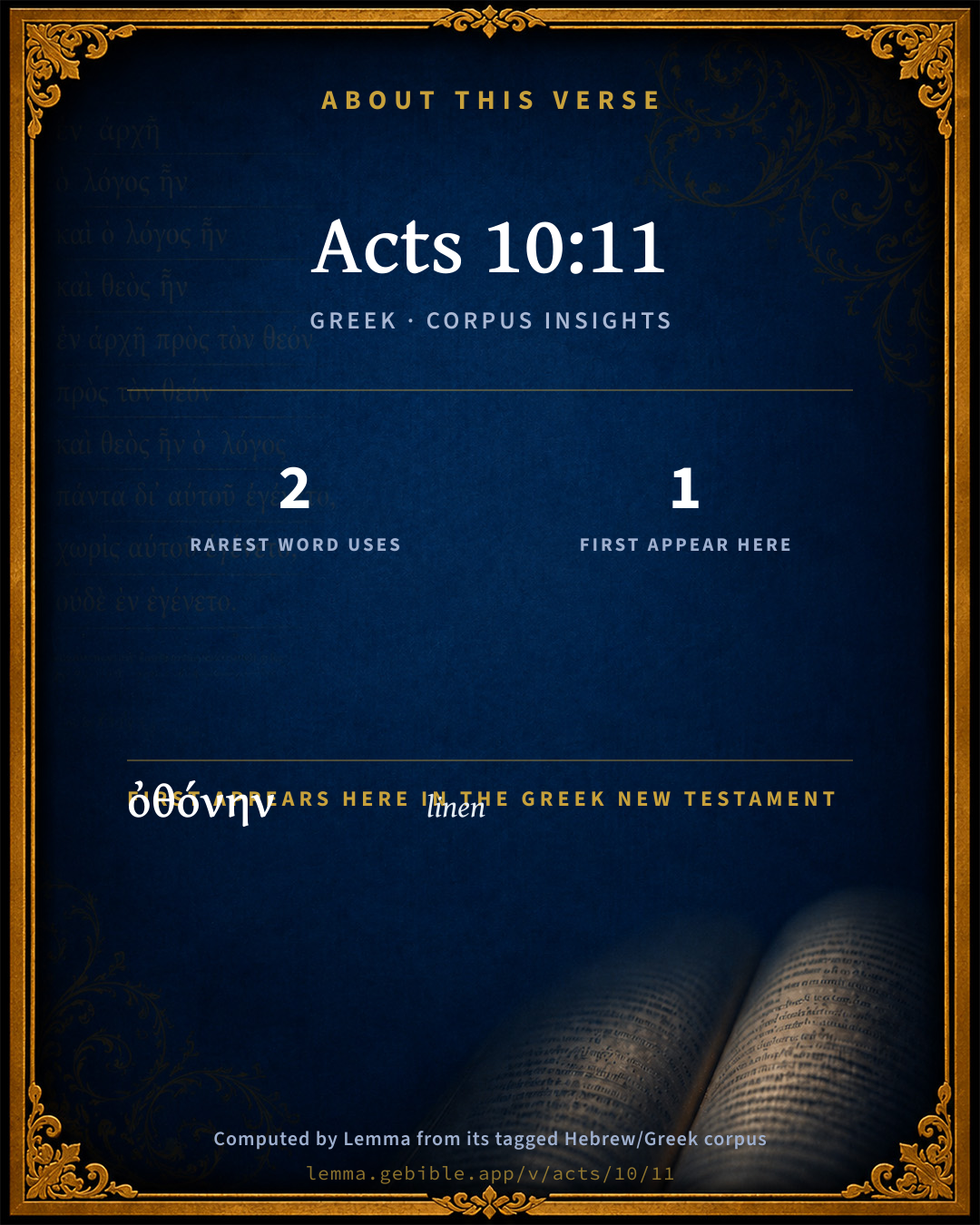
The rarest word here is ὀθόνην linen G3607 — appearing just 2 times in the whole Greek New Testament.

First appearance in Scripture

This word makes its first canonical appearance in the Greek New Testament here:

  • ὀθόνην linen G3607

Shared distinctive vocabulary

ὀθόνην linen G3607 occurs in 2 verses of the Greek New Testament. Also found in:
Repetition

Words recur within this verse:

Cross-references

26

Topical passages linked to Acts 10:11 in the Treasury of Scripture Knowledge — connected by theme and wording, ordered by reader-vote popularity; previews shown in the World English Bible.

  • Ephesians 3:6 that the Gentiles are fellow heirs, and fellow members of the body, and fellow partakers of his promise in Christ Jesus through the Gospel,
  • John 1:51 He said to him, "Most assuredly, I tell you, hereafter you will see heaven opened, and the angels of God ascending and descending on the Son of Man."
  • Romans 16:25–26
  • Genesis 49:10 The scepter will not depart from Judah, Nor the ruler's staff from between his feet, Until he comes to whom it belongs. To him will the obedience of the peoples be.
  • Isaiah 11:6–14 The wolf shall dwell with the lamb, and the leopard shall lie down with the kid; and the calf and the young lion and the fattened calf together; and a little child shall lead them.
  • Isaiah 19:23–25 In that day shall there be a highway out of Egypt to Assyria, and the Assyrian shall come into Egypt, and the Egyptian into Assyria; and the Egyptians shall worship with the Assyrians.
  • Isaiah 43:6 I will tell the north, Give up; and to the south, Don't keep back; bring my sons from far, and my daughters from the end of the earth;
  • Isaiah 56:8 The Lord Yahweh, who gathers the outcasts of Israel, says, Yet will I gather [others] to him, besides his own who are gathered.
  • Ezekiel 1:1 Now it happened in the thirtieth year, in the fourth [month], in the fifth [day] of the month, as I was among the captives by the river Chebar, that the heavens were opened, and I saw visions of God.
  • Matthew 8:11 I tell you that many will come from the east and the west, and will sit down with Abraham, Isaac, and Jacob in the Kingdom of Heaven,
  • Matthew 13:47–48 "Again, the Kingdom of Heaven is like a dragnet, that was cast into the sea, and gathered some fish of every kind,
  • Luke 3:21 Now it happened, when all the people were baptized, Jesus also had been baptized, and was praying. The sky was opened,
  • John 11:52 and not for the nation only, but that he might also gather together into one the children of God who are scattered abroad.
  • John 12:32 And I, if I am lifted up from the earth, will draw all people to myself."
  • Acts 7:56 and said, "Behold, I see the heavens opened, and the Son of Man standing at the right hand of God!"
  • Romans 1:16 For I am not ashamed of the Gospel of Christ, for it is the power of God for salvation for everyone who believes; for the Jew first, and also for the Greek.
  • Romans 3:29–31 Or is God the God of Jews only? Isn't he the God of Gentiles also? Yes, of Gentiles also,
  • Romans 9:4 who are Israelites; whose is the adoption, the glory, the covenants, the giving of the law, the service, and the promises;
  • Romans 15:9–12 and that the Gentiles might glorify God for his mercy. As it is written, "Therefore will I give praise to you among the Gentiles, And sing to your name."
  • Galatians 2:15 "We, being Jews by nature, and not Gentile sinners,
  • Galatians 3:28 There is neither Jew nor Greek, there is neither slave nor free man, there is neither male nor female; for you are all one in Christ Jesus.
  • Ephesians 1:10 to an administration of the fullness of the times, to sum up all things in Christ, the things in the heavens, and the things on the earth, in him;
  • Colossians 3:11 where there can't be Greek and Jew, circumcision and uncircumcision, barbarian, Scythian, bondservant, freeman; but Christ is all, and in all.
  • Revelation 4:1 After these things I looked and saw a door opened in heaven, and the first voice that I heard, like a trumpet speaking with me, was one saying, "Come up here, and I will show you the things which must happen after this."
  • Revelation 11:19 God's temple that is in heaven was opened, and the ark of the Lord's covenant was seen in his temple. Lightnings, sounds, thunders, an earthquake, and great hail followed.
  • Revelation 19:11 I saw the heaven opened, and behold, a white horse, and he who sat on it is called Faithful and True. In righteousness he judges and makes war.

Cross-references courtesy of OpenBible.info (CC BY 4.0).

Where the printed editions differ

2 variants

Places in this verse where the major printed Greek editions disagree on the wording in a way that affects the translation — a comparison of editions, not a manuscript-by-manuscript collation. The editions are the modern critical texts (Nestlé-Aland 28/27, SBL, Westcott-Hort, Tregelles, Tyndale House) and the traditional texts behind the KJV (the Textus Receptus and the Byzantine/Majority text). It is not a claim about which reading is original.

  1. Extra text
    ἐπ᾽ αὐτὸν

    “onto him”

    In TRByz Not in NA28NA27TynSBLWHTreg

    ἐπ᾽ αὐτὸν (ep᾽ auton) 'onto him' is only in traditional manuscripts (TR+Byz)

  2. Extra text
    δεδεμένον καὶ

    “bound and”

    In TynTRByz Not in NA28NA27SBLWHTreg

    δεδεμένον καὶ (dedemenon kai) 'bound and' is only in traditional manuscripts (Tyn+TR+Byz)

Textual data: Translators Amalgamated Greek New Testament (STEPBible TAGNT) · CC BY 4.0.

Commentary

Notes on Acts 10:11 from classic Christian and Jewish commentators (each source and its license shown beneath its notes). The classic Christian expositions comment on the surrounding passage and are grouped to its opening verse, so a note may address several verses; the Jewish commentaries on the Tanakh (Rashi and others) are per-verse, so they appear only where the commentator wrote on this verse.

Lemma curates 59 commentaries, every one of them public domain or Creative Commons licensed, each selected and text-cleaned for this edition rather than reprinted as found. About our sources →

Joseph Benson's Commentary

Act 10:11-14. And saw heaven opened — While he lay in a trance, the heaven appeared to be opened above him, to signify the opening of a mystery that had been hid. And a certain vessel — Or utensil; (for the word σκευος, here used, extends to all sorts of instruments, and every part of household furniture, of which see on Act 9:15;) descending unto him as it had been a great sheet — Οθονην μεγαλην, a great linen cloth, or wrapper, an emblem of the gospel, extending to all nations of men; knit — Δεδεμενον, tied; at the four corners — Not all in one knot, but each fastened, as it were, up to heaven; and let down to earth — To receive from all parts of the world those that were willing to be admitted into it. Wherein were all manner of four-footed beasts — The net of the gospel was to enclose persons of all countries, nations, and languages, without any distinction of Greek or Jew, or any disadvantage attaching to barbarian or Scythian, Col 3:11. And there came a voice, Rise, Peter, kill and eat — Of what thou seest, without any exception, or putting any difference between clean and unclean; the Lord thus showing him that he might now converse with Jews and Gentiles indifferently, and preach unto the latter, as well as unto the former, the word of life; and, at the same time intimating, that the Jewish Christians were, by the gospel, absolved from the ceremonial law, in which the distinction between clean and unclean meats made so considerable a part. But Peter said, Not so, Lord — I would rather continue fasting a great while longer, than satisfy my hunger on such terms; for I see only unclean animals here; and I have never —

From my childhood to this hour, defiled my conscience by eating any thing common or unclean — Hitherto I have kept my integrity in this matter, and am determined still to keep it. Peter’s words speak his resolution still to adhere to God’s law, though he has a counter command by a voice from heaven; for he knew not, at first, but the words, kill and eat, might be a command of trial, whether he would abide by the sure word, the written law; and if so, his answer, Not so, Lord, had been very proper. Temptations to eat forbidden fruit must not be parleyed with, but peremptorily rejected. Reader, if God by his grace has preserved us from gross sin unto this day, we should use that as an argument with ourselves to continue to abstain from all appearance of evil.

Joseph Benson's Commentary on the Old and New Testaments (1811–1818) — public domain. Text from a community e-Sword module.

Bengel's Gnomon

Johann Albrecht Bengel

Act 10:11. Τὸν οὐρανὸν, the heaven) The vessel was not only lifted up from the earth into heaven, but was first let down from heaven. Therefore the reception of the Gentiles into heaven presupposes the first origin of man to be heavenly (from heaven). And in heaven first are the types of the things which are afterwards made on earth for the salvation of men: comp. Heb 8:5.—σκεῦος, a vessel) a napkin.—τέσσαρσιν, at the four) corresponding to the same number of quarters of the world.—ἀρχαῖς, corners or extremities) These were not tied together in one knot, but were severally (separately) let down from heaven: ch. Act 11:5.

Bengel's Gnomon of the New Testament — English translation (T&T Clark, Edinburgh, 1860) — public domain. Text from a community e-Sword module.

Meyer's Critical & Exegetical Commentary

Heinrich August Wilhelm Meyer

Act_10:11-13. Observe the vividly introduced historical present θεωρεῖ.

τέσσαρσιν ἀρχαῖς δεδεμ.] attached with four ends, namely, to the edges of the opening which had taken place in heaven. Chap. Act_11:5 requires this explanation, not the usual one: bound together at the four corners. Nor does the text mention anything of ropes, bound to which it was let down. The visionary appearance has something marvellous even in the way of its occurrence. We are to imagine the vessel (whose four corners, moreover, are without warrant explained by Augustine, Wetstein, Bengel, Lange, and others as pointing to the four quarters of the world), looking like a colossal four-cornered linen-cloth (ὀθόνη), letting itself down, while the corners attached to heaven support the whole. On ἀρχαί, extremitates, see Jacobs, ad Anthol. XI. p. 50.

πάντα τὰ τετράποδα] The formerly usual interpretation: four-footed beasts of all sorts, i.e. of very many kinds is linguistically erroneous. The phenomenon in its supernatural visionary character exhibits as present in the σκεῦος (ἐν ᾡ ὕπηρχε) all four-footed beasts, reptiles, and birds (all kinds of them) without exception.[256] In a strangely arbitrary manner Kuinoel, after Calovius and others, holds that these were only unclean animals. See on Act_10:14.

τοῦ οὐρανοῦ] See on Mat_6:26.

ἈΝΑΣΤΆς] Perhaps Peter lay during the trance. Yet it may also be the mere call to action: arise (Act_9:11; Act_9:39, Act_8:26, and frequently; comp. on Act_8:26).

θῦσον] occide (Vulg.), slay, not: sacrifice, as 1Ma_1:47 (Thiersch), see Act_10:10.

[256] That fishes (those without fins and scales were forbidden) are not included in the vision, is explained from the fact that the σκεῦος was like a cloth. Fishes would have been unsuitable for this, especially as the animals were presented as living (θῦσον). According to Lange, it is perhaps a prophetic omission, wherein there is already floating before the mind the image of fishes as the souls to be gathered. A fanciful notion.

Meyer — Critical and Exegetical Commentary on the New Testament — English translation by Peter Christie, edited by Frederick Crombie (T&T Clark, 1880) — public domain. Text from a community e-Sword module.

Expositor's Greek Testament

ed. W. Robertson Nicoll

Act 10:11 . θεωρεῖ : “beholdeth,” historic present, giving vividness. ὡς ὀθόν . μεγ . Both words, ὀθόνη and ἀρχή (in this sense), are peculiar to St. Luke in N.T. the phrase ἀρχαὶ ὀθόνης is medical, so that the expression here rendered ends or corners of a sheet is really technical medical phraseology, see Hobart, p. 218, Plummer, Introd. to St. Luke , lxv., Zahn, Einleitung , ii., 436. ἀρχαί is also used in LXX, Exo 36:24 (Exo 39:17 ), ὀθόνη not at all in LXX, but both words are found in classical writers in senses approaching their meaning here; but here as elsewhere in St. Luke it is the combination which arrests attention, for ἀρχή and ἀρχαί are found again and again in medical language with ὀθόνη or ὀθόνιον . τέσσαρσιν ἀρχαῖς : “by four corners,” R.V. No article; there might have been many ends or corners. It is doubtful how far we can therefore press the imagery as referring to the four regions of the world, or that men would come from the north, south, etc., to share the kingdom.

The Expositor's Greek Testament, edited by W. Robertson Nicoll (1897–1910) — public domain. Text from a community e-Sword module.

Geneva Bible (1599)

Geneva Bible translators

So that it seemed to be a foursquare sheet.

Geneva Bible (1599) marginal notes — public domain. Text via Bolls.life.

Adam Clarke's Commentary

Verse 11. And saw heaven opened] His mind now entirely spiritualized, and absorbed in heavenly contemplation, was capable of discoveries of the spiritual world; a world which, with its πληρωμα, or plenitude of inhabitants, surrounds us at all times; but which we are incapable of seeing through the dense medium of flesh and blood, and their necessarily concomitant earthly passions. Much, however, of such a world and its economy may be apprehended by him who is purified from all filthiness of the flesh and spirit, and who has perfected holiness in the fear of God. But this is a subject to which the enthusiast in vain attempts to ascend. The turbulent working of his imagination, and the gross earthly crudities which he wishes to obtrude on the world as revelations from God, afford a sufficient refutation of their own blasphemous pretensions.

A great sheet, knit at the four corners] Perhaps intended to be an emblem of the universe, and its various nations, to the four corners of which the Gospel was to extend, and to offer its blessings to all the inhabitants, without distinction of nation, &c.

Adam Clarke's Commentary on the Bible (1810–1826) — public domain. Text from a community e-Sword/MySword module.

John Calvin's Commentaries

11. The opening of heaven signifieth, in my judgment, another thing in this place than in the seventh chapter. For it is said there that heaven was opened to Stephen, that he did behold the glory of Christ; in this place Peter saw our heaven which we see divided, so that a sheet came thence.

John Calvin's Commentaries (1540-1563) — public domain. Text from the Calvin Translation Society English edition (1840s-50s) via the Christian Classics Ethereal Library (ccel.org). Calvin's coverage is partial (roughly two-thirds of the Bible); uncommented books and verses are honest gaps, never fabricated. The 19th-century editor's footnotes and remarks are omitted so the notes are faithfully Calvin's own voice.

Ellicott's Commentary for English Readers

(11) A certain vessel descending . . .—The form of the vision corresponded, as has just been said, with the bodily condition of the Apostle. Its inward meaning may fairly be thought of as corresponding to his prayer. One who looked out from Joppa upon the waters of the Great Sea towards the far-off Isles of the Gentiles, might well seek to know by what process and under what conditions those who dwelt in them would be brought within the fold of which he was one of the chief appointed shepherds. The place, we may add, could not fail to recall the memory of the great prophet who had taken ship from thence, and who was conspicuous alike as a preacher of a gospel of repentance to the Gentiles, and, in our Lord’s own teaching, as a type of the Resurrection (Mat_12:40-41). The Apostle was to be taught, as the prophet had been of old, that the thoughts of God were not as his thoughts (Jon_4:10-11).

A great sheet knit at the four corners.—Better, bound by four ends—i.e., those of the ropes by which it seemed to Peter’s gaze to be let down from the opened firmament. The Greek word, literally beginnings, is used as we use “ends.”

A Bible Commentary for English Readers, edited by Charles John Ellicott (1878–1897) — public domain. Text from a community e-Sword module.

The Cambridge Bible for Schools and Colleges

gen. ed. J. J. S. Perowne

11. and saw [beholdeth] heaven opened] To shew him that the teaching of the vision was sent to him from God.

and a certain vessel descending unto him] The oldest MSS. omit the two last words.

as it had been a great sheet knit at the four corners, and let down to the earth] The oldest MSS. only give “a great sheet let down by four corners upon the earth.” The word rendered “corners” is used of the “end of a cord” in Herod. 4:60, but it seems that for such a sense there must be added either a noun or adjective for explanation. What the Apostle saw was an extended sheet, the four corners of which were held up as it were by cords let down from the four extremities of the opened sky. The significance of the outstretched sheet, as a figure of the wide world, and the four corners as the directions into which the gospel was now to be borne forth into all the world, has often been dwelt upon.

The Cambridge Bible for Schools and Colleges (gen. ed. J. J. S. Perowne; Cambridge University Press, 1878–1918) — public domain. Text from a community e-Sword module.

John Gill's Exposition

And saw heaven opened,.... Not literally, as at the baptism of Christ, and the stoning of Stephen; but in a visionary way, and which was an emblem of the opening and revealing the mystery of the calling of the Gentiles, which in other ages was not made known, as it now and afterwards was:

and a certain vessel descending unto him, as it had been a great sheet: which seems to represent the church of God, whose original is from heaven, and consists of persons born from above, who have their conversation in heaven, and were designed for it; and especially as under the Gospel dispensation, which Peter had a vision of in this emblematic way; the doctrines and ordinances of which are from heaven: and which may be compared to a linen sheet for its purity and holiness; through the blood and righteousness of Christ, and the grace of his Spirit, and with respect to its discipline and conversation; and so to a great one for its largeness; for though the number of its members, when compared with the world, are few, yet in themselves are a number which no man can number; and though it was but small at first, yet the Gospel being carried among the Gentiles it increased, and in the last times will be large:

knit at the four corners; which may denote the preaching of the Gospel, and the spread of it, and the planting of churches by it in the four parts of the world; and also the church being knit to Christ, and the members of it one to another:

and let down to the earth; for Peter to see it, and where it was to continue for a while, even to the second coming of Christ, and when the whole church of the firstborn will be let down to earth again; see Rev 21:2.

John Gill's Exposition of the Whole Bible (1746–1763) — public domain (CC PDM 1.0). Text via the HelloAO Bible API.

Trapp's Complete Commentary

John Trapp

11 And saw heaven opened, and a certain vessel descending unto him, as it had been a great sheet knit at the four corners, and let down to the earth:

Ver. 11. And saw heaven opened] sc. The visible heaven, the air; for, as for the third heaven, it openeth not without a miracle, as some think.

John Trapp, A Commentary or Exposition upon All the Books of the Old and New Testament (1647–1656) — public domain. Text from a community e-Sword module.

Albert Barnes' Notes on the Bible

And saw heaven opened - Act 7:56. See the notes on Mat 3:16. This language is derived from a common mode of speaking in the Hebrew Scriptures, as if the sky above us was a solid, vast expanse, and as if it were opened to present an opportunity for anything to descend. It is language that is highly figurative.

And a certain vessel - See the notes on Act 9:15.

As it had been - It is important to mark this expression. The sacred writer does not say that Peter literally saw such an object descending; but he uses this as an imperfect description of the vision. It was not a literal descent of a vessel, but it was such a kind of representation to him, producing the same impression, and the same effect, as if such a vessel had descended.

Knit at the four corners - Bound, united, or tied. The corners were collected, as would be natural in putting anything into a great sheet.

Albert Barnes' Notes on the Bible (1834–1885) — public domain. Text from a community e-Sword/MySword module.

Matthew Poole's English Annotations

And saw heaven; either visibly to his corporal eyes, as to St. Stephen’s; or rather mentally, more suitably to the rapture mentioned in the former verse.

Opened; which might signify, that heaven, that was shut to the children of men by the first Adam, was now by Christ, the Second Adam, opened to all believers.

Vessel; this word is taken for any utensil commonly used about the house; and, with the

sheet here spoken of, bears an analogy to a table and table cloth amongst us.

Knit at the four corners; so gathered up or knit, that the viands, Act 10:12, might not fall down. And this Peter saw to come from heaven, to show that the liberty of taking Cornelius and other Gentiles into the church, did come from thence only.

Matthew Poole's English Annotations on the Holy Bible (1683–1685) — public domain. Text from a community e-Sword/MySword module.

Whedon's Commentary on the Bible

Daniel D. Whedon

11. Heaven opened—The polished surface of the visible firmament seemed to part and let the square sheet down through.

Vessel—An article in which a thing could be contained and borne.

Sheet—Of white linen, the emblem of purity.

Knit—Rather, fastened, as if the sheet were suspended by cords, which were attached to its four corners and fastened at the upper end to the firmamental roof.

Down to the earth—So that Peter could look from the housetop down upon its upper surface.

Daniel D. Whedon (gen. ed.), Commentary on the Old and New Testaments (1874–1909) — public domain. Text from a community e-Sword module.

The Pulpit Commentary

He beholdeth the for saw, A.V.; descending for descending unto him, A.V. and T.R.; were for had been, A.V.; let down by four corners upon the earth for knit at the four corners and let down to the earth, A.V. and T.R. The vessel coming down from the open heavens implied that the command to eat what was contained in it was given by revelation. The things sent were from God, and the command to eat was from God. Peter"s hunger had prepared the way for the particular form of the vision.

The Pulpit Commentary (1880–1919), ed. H.D.M. Spence-Jones & Joseph S. Exell — public domain. Text from a community e-Sword module.

John Wesley's Explanatory Notes

Tied at the corners - Not all in one knot, but each fastened as it were up to heaven.

John Wesley, Explanatory Notes Upon the Whole Bible (1754–1765) — public domain. Text via the GEBible commentary corpus.

Godbey's Commentary on the New Testament

William B. Godbey

PETER’S VISION

11. “And he saw heaven open and a certain vessel, like a great sheet, sitting down on the ground with four rope’s ends,

William B. Godbey, Commentary on the New Testament (1896–1900) — public domain. Text from a community e-Sword module.

McGarvey & Pendleton's Commentaries

J. W. McGarvey

See notes on verse 9

J. W. McGarvey (with Philip Y. Pendleton), Commentaries on the New Testament (The Fourfold Gospel, 1914; Acts; and the epistles) — public domain. Text from a community e-Sword/MySword module.

The People's New Testament

B. W. Johnson

11–15. Saw heaven opened. The meaning of the vision is plain. Peter was hungry. He saw, let down from heaven, all kinds of animals, those ceremonially unclean and prohibited by the Mosaic law, as well as others, and was told to kill and eat. When he answered that he had never eaten anything common (as opposed to holy) and unclean, that is, forbidden by Moses, he was told that what God had cleansed was not common or unclean. This could only mean that the ceremonial distinctions of the law (Lev. chap. 11, and Deut. chap. 14) were abrogated. It was at this time that the messengers from a Gentile, one of a class, with which even Peter would not eat, yet for which Christ had died, presented themselves. The object of the vision was to show Peter that it was the will of the Lord that he should go.

B. W. Johnson's The People's New Testament with Notes (1889–1891) — public domain. Electronic text from the Christian Classics Ethereal Library (CCEL) ThML edition.

Cambridge Greek Testament for Schools and Colleges

11. Omit ἐπ’ αὐτὸν after καταβαῖνον with אABCE. The words are not represented in the Vulg.

δεδεμένον καὶ omitted with אABCE. They are not represented in the Vulg.

11. καὶ θεωρεῖ τὸν οὐρανὸν ἀνεῳγμένον, and he beholdeth heaven opened. For θεωρέω of the vision of things heavenly, cf. Act 7:56, Act 9:7. The opened heaven made it clear to Peter that the teaching of the vision was sent from God.

σκεῦός τι ὡς ὀθόνην μεγάλην, τὲσσαρσιν ἀρχαῖς καθιέμενον ἐπὶ τῆς γῆς, a certain vessel as it had been a great sheet let down by four corners upon the earth. The word ἀρχαί is used (LXX. Exo 28:23; Exo 39:15) of the extremities of the high-priest’s breastplate to which rings were to be attached for fastening it upon the ephod. What St Peter saw was an extended sheet, the four corners of which were held up as it were by cords let down from the four extremities of the opened sky. The significance of the outstretched sheet, as a figure of the wide world, and the four corners as the directions into which the Gospel was now to be borne forth into all the world has often been dwelt upon.

Cambridge Greek Testament for Schools and Colleges (Cambridge University Press, 1896; 21 vols, various authors incl. Carr, Maclear, Plummer, Farrar, Lumby, Moule, M. R. James, Simcox) — public domain. Text from a community e-Sword module.

Alford’s Greek Testament

Henry Alford

11. τέσς. ἀρχ.] not, ‘by the four corners,’ which would certainly require the article, as in reff.,—but by four rope-ends. This meaning of ἀρχή justified by Diod. Sic. i. p. 104, who, speaking of harpooning the hippopotamus, says, εἶθʼ ἑνὶ τῶν ἐμπαγέντων ἐνάπτοντες ἀρχὰς στυπίνας ἀφίασι μέχρις ἂν παραλυθῇ. The ends of the ropes were attached to the sheet, and, in the vision, they only were seen.

At all events, as Neander observes (Pfl. u. L. p. 126, note), these four ἀρχαί (whether ends of ropes attached to the corners, or those corners themselves) are not without meaning, directed as they are to the four parts of heaven, and intimating that men from the North, South, East, and West, now were accounted clean before God, and were called to a share in his kingdom: see Luk 13:29. The symbolism is, as usual, fancifully exaggerated by Wordsw. in his note. The four ἀρχαί are the four gospels, because the word ἀρχή occurs somewhere near the beginning of each, &c., &c. Who can wonder, after this, at the distrust of all Scripture symbolism by intelligent, but unspiritual minds?

I have retained the words δεδ. καί doubtfully, because it seems difficult to account for their insertion, but they may have been omitted to assimilate our text to ch. 11:5.

Henry Alford, The Greek Testament (1849–1861) — public domain. Text from a community e-Sword module.

Vincent's Word Studies in the New Testament

Marvin R. Vincent

Saw [θεωρει] . Rev., better, and more literally, beholdeth. See on Luk 10:18. The present tense is graphically introduced into the narrative. Unto him. The best texts omit.

Sheet [οθονην] . Only here and ch. 11 5. Originally fine linen; later, sail - cloth or a sail. Dr. J. Rawson Lumby suggests that the word, "applied to loose, bellying sails of ships," may indicate that the form of vessel which appeared to Peter "recalled an image most familiar to his previous life - the wind - stretched canvas of the craft on the Lake of Galilee" (" Expositor, " iii, 272).

Knit [δεδεμενον] . If this is retained, we must render bound, or attached; but the best texts omit, together with the following and. Render, as Rev., let down by four corners. Compare ch. 11 5.

Corners [αρχαις] . Lit., beginnings; the extremity or corner, marking a beginning of the sheet. "We are to imagine the vessel, looking like a colossal four - cornered linen cloth, letting itself down, while the corners attached to heaven to support the whole." The word is used in this sense by Herodotus, describing the sacrifices of the Scythians. The victim's forefeet are bound with a cord, "and the person who is about to offer, taking his station behind the victim, pulls the end [αρχην] of the rope, and thereby throws the animal down" (4, 60). The suggestion of ropes holding the corners of the sheet (Alford, and, cautiously, Farrar) is unwarranted by the usage of the word. It was the technical expression in medical language for the ends of bandages. The word for sheet in this passage was also the technical term for a bandage, as was the kindred word ojqonion, used of the linen bandages in which the Lord 's body was swathed. See Luke 2412; Joh 19:40; Joh 20:5, 6, 7. Mr. Hobart says : "We have thus in this passage a technical medical phrase - the ends of a bandage - used for the ends of a sheet, which hardly any one except a medical man would think of employing" (" Medical Language of St. Luke ").

Marvin R. Vincent, Word Studies in the New Testament (1887–1900) — public domain. Text from a community e-Sword/MySword module.

Lesson kit

Teaching starters — assembled from the data on this page, not authored interpretation. Every prompt links to the verse data it draws on. Edit before teaching.

Acts, in the Acts, opens this verse with 18 words (16 distinct Greek lemmas). Its most distinctive word is othónē (“linen”). A historical commentator’s framing appears above. Read the whole chapter for the surrounding context.

Discussion questions

  1. The word othónē carries the sense “linen.” How does it shape the verse?
  2. The word “linen” first appears here in Scripture. What is being introduced at this debut?
  3. Acts 11:5 shares the word «linen» with this verse. How do the two illuminate each other?
  4. “and” occurs 2× in this one verse. What is the effect of the repetition?
  5. These translations render this verse differently; the difference is in the English rendering, not the original. What questions does that raise?
  6. Reading how Joseph Benson's Commentary and Bengel's Gnomon read this verse, where do the two commentators agree and where do they part?

Things to notice

  • 1 word makes its first canonical appearance in Scripture here.
  • These translations choose different wording for 15 words in this verse.
  • “and” occurs 2× in this single verse.
  • 16 distinct Greek lemmas span 18 words in this verse.

Reading settings

Reading text

Shown beneath each verse's original-language words.

Old Testament
Old Testament edition

Read the OT as the Masoretic Hebrew (MT) or the Greek Septuagint (LXX).

English shown for the Greek Septuagint (in the Hebrew ↔ Greek comparison).

Comparing translations? Open the Compare panel on any verse page to stack up to four side by side.