
Luke 21:11

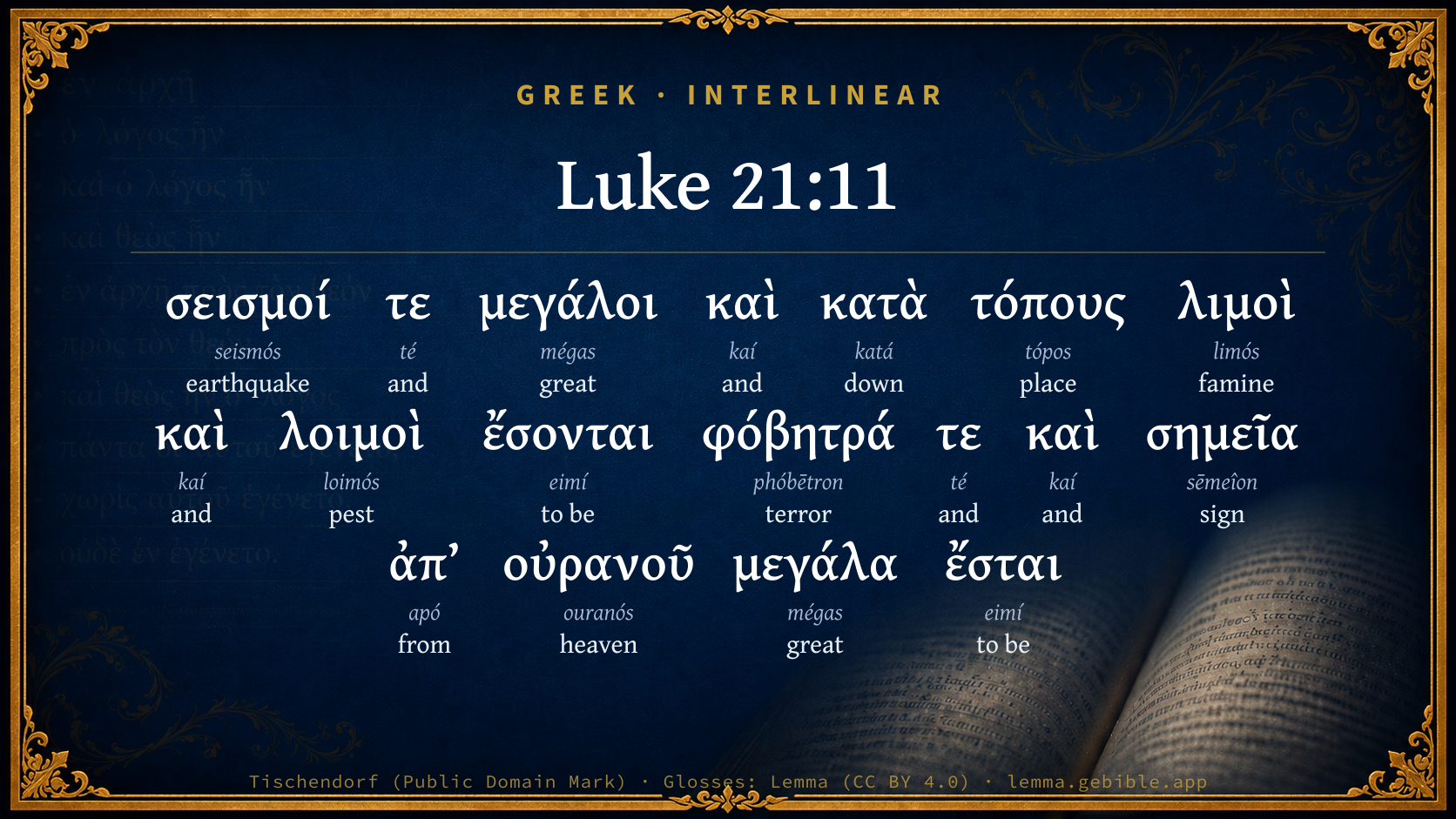
Greek (Tischendorf 8th ed.) Luke 21:11 appears in the Greek New Testament. The text above is from the Tischendorf 8th edition. Each word links to its Strong’s number and a concise gloss. Click any word for its full Thayer’s Greek Lexicon entry.
Download image
Cite this verse

Luke 21:11 (World English Bible). Public Domain. Lemma interlinear Bible study tool, https://lemma.gebible.app/v/luke/21/11.

Show BibTeX & RIS
BibTeX
RIS
English Translation
There will be great earthquakes, famines, and plagues in various places. There will be terrors and great signs from heaven.
World English Bible · Public Domain
Highlights
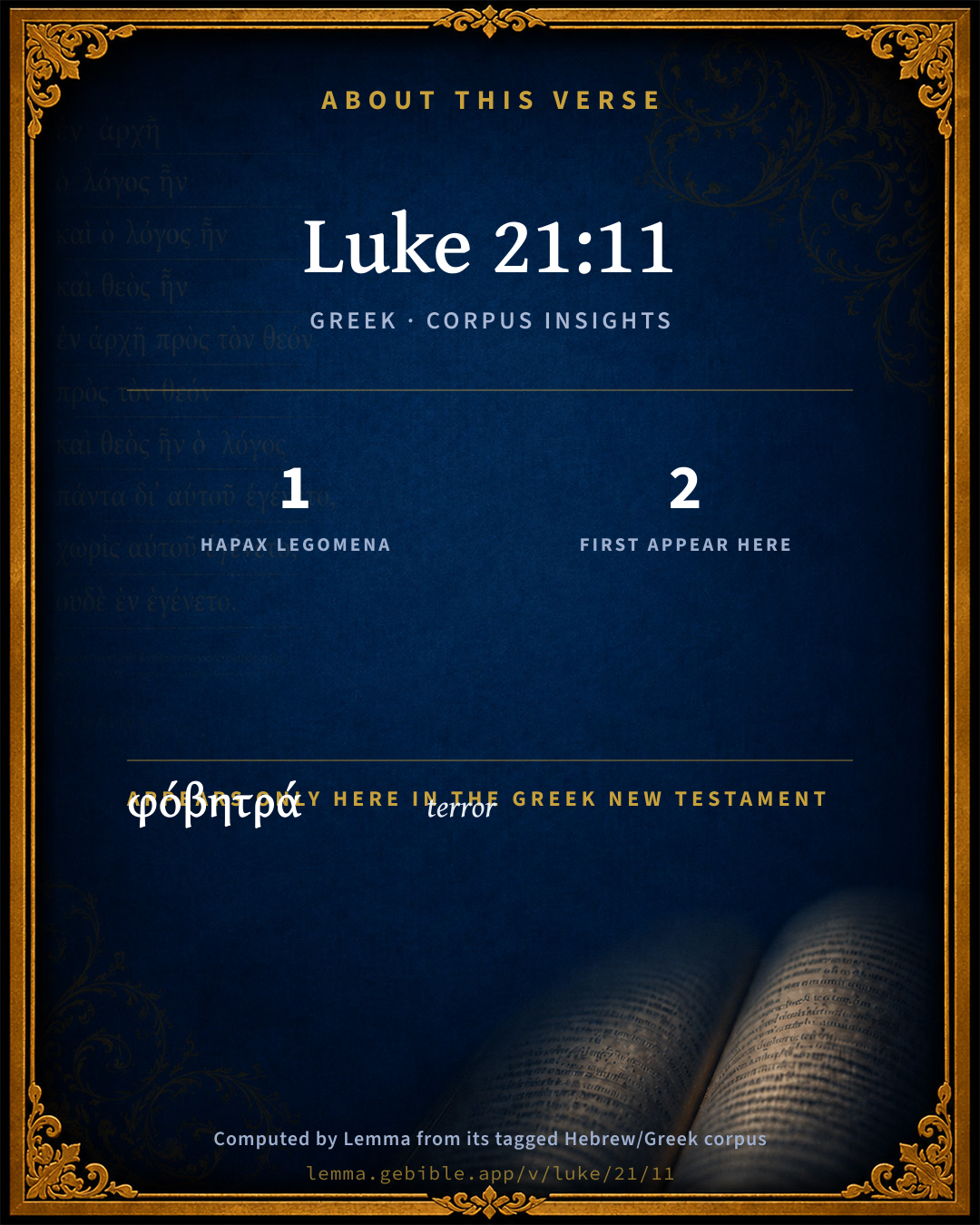
  • 1 hapax legomenon — only here in the Greek New Testament
  • 2 first appearances in the Greek New Testament
Full analysis ↓
Download a study sheet

One document with this verse’s original text, its word-by-word gloss line, the meaning frame, cross-references with their text, attributed commentary, and full source and license credits — printable, and it pastes into notes with its structure intact.

This verse Autodidact and up

Study sheet (.html) Plain text (.txt)

A passage Seminary Student

Up to 50 verses in one chapter. A passage sheet keeps up to 6 commentary sources and 12 cross-references per verse, in the order this page ranks them, and says so on the sheet whenever that leaves anything out. Ask for a single verse and you get the Autodidact verse sheet above.

Everything on this page stays free to read, with no account — the sheet is a download of what is already on screen, not access to it.

Want to remove ads? Support Godless Engineer
Compare translations 3

The same verse in 3 English versions, stacked beneath the original-language interlinear above. Click any original word for its lexicon entry.

Each is an independent rendering of the whole verse — the interlinear is not word-aligned to these translations.

Highlighted words mark where these versions differ — a whole-verse word diff, not a word-by-word alignment.

  • World English Bible Public Domain
    There will be great earthquakes, famines, and plagues in various places. There will be terrors and great signs from heaven.
  • King James Version Public Domain
    And great earthquakes shall be in divers places, and famines, and pestilences; and fearful sights and great signs shall there be from heaven.
  • unfoldingWord Literal Text CC BY-SA 4.0
    There will be both great earthquakes, and famines and plagues in various places. There will be both terrifying events and great signs from heaven.

unfoldingWord Literal Text — © unfoldingWord, licensed CC BY-SA 4.0. Word-aligned USFM3 via Door43 (git.door43.org/unfoldingWord/en_ult).

Versions to compare (up to 4)

3 of 4 selected

Show all 19 translations

Every available English version of this verse, each an independent rendering of the whole verse.

  • World English Bible Public Domain
    There will be great earthquakes, famines, and plagues in various places. There will be terrors and great signs from heaven.
  • Berean Standard Bible Public Domain
    There will be great earthquakes, famines, and pestilences in various places, along with fearful sights and great signs from heaven.
  • Majority Standard Bible Public Domain
    There will be great earthquakes in various places, famines and pestilences, along with fearful sights and great signs from heaven.
  • King James Version Public Domain
    And great earthquakes shall be in divers places, and famines, and pestilences; and fearful sights and great signs shall there be from heaven.
  • American Standard Version (1901) Public Domain
    and there shall be great earthquakes, and in divers places famines and pestilences; and there shall be terrors and great signs from heaven.
  • Revised Version (1885) Public Domain
    and there shall be great earthquakes, and in divers places famines and pestilences; and there shall be terrors and great signs from heaven.
  • Geneva Bible (1599) Public Domain
    And great earthquakes shall be in diuers places, and hunger, and pestilence, and fearefull things, and great signes shall there be from heauen.
  • Douay-Rheims (1899) Public Domain
    And there shall be great earthquakes in divers places, and pestilences, and famines, and terrors from heaven; and there shall be great signs.
  • Young's Literal Translation Public Domain
    great shakings also in every place, and famines, and pestilences, there shall be; fearful things also, and great signs from heaven there shall be;
  • Literal Standard Version CC BY-SA 4.0
    also great shakings, and there will be famines and pestilences in every place; also there will be fearful things and great signs from the sky;
  • Unlocked Literal Bible CC BY-SA 4.0
    There will be great earthquakes, and in various places famines and plagues. There will be terrifying events and great signs from heaven.
  • unfoldingWord Literal Text CC BY-SA 4.0
    There will be both great earthquakes, and famines and plagues in various places. There will be both terrifying events and great signs from heaven.
  • Darby Bible Public Domain
    there shall be both great earthquakes in different places, and famines and pestilences; and there shall be fearful sights and great signs from heaven.
  • World Messianic Bible Public Domain
    There will be great earthquakes, famines, and plagues in various places. There will be terrors and great signs from heaven.
  • Webster's Bible Public Domain
    And great earthquakes will be in divers places, and famines, and pestilences: and fearful sights, and great signs will there be from heaven.
  • Free Bible Version CC BY-SA 4.0
    “There will be severe earthquakes, famines, and epidemic diseases in many lands, and extraordinary signs in the sky that are terrifying.
  • Bible in Basic English Public Domain
    There will be great earth-shocks and outbursts of disease in a number of places, and men will be without food; and there will be wonders and great signs from heaven.
  • Text-Critical English NT CC BY 4.0
    There will be great earthquakes in various places, along with famines and plagues. There will also be terrifying sights and great signs from heaven.
  • Tyndale New Testament (1534) Public Domain
    and greate erthquakes shall be in all quarters and honger and pestilence: and fearfull thinges. And greate signes shall therbe from heven.

Literal Standard Version (2020), Covenant Press — licensed CC BY-SA 4.0. Text via the HelloAO Bible API (eBible.org). Unlocked Literal Bible (unfoldingWord) — licensed CC BY-SA 4.0. Text via the HelloAO Bible API (eBible.org). unfoldingWord Literal Text — © unfoldingWord, licensed CC BY-SA 4.0. Word-aligned USFM3 via Door43 (git.door43.org/unfoldingWord/en_ult). Free Bible Version, Dr. Jonathan Gallagher — licensed CC BY-SA 4.0. Text via the HelloAO Bible API (eBible.org).

Word by word

More ways to search: Search by grammar → Find every occurrence → Compare this word →

Practice this passage: Drill this verse → Learn its vocabulary →

φόβητρά
phóbētron
G5400
“terror”
Noun, Nominative, Plural, Neuter
Part of Speech
Noun
Case
Nominative
Number
Plural
Gender
Neuter
Full Thayer's Definition

Origin: from a derivative of G5399

TDNT: None

1. that which strikes terror, a terror, (cause of) fright
  1. σεισμοί seismós G4578 “earthquake” Noun, Nominative, Plural, Masculine
  2. τε té G5037 “and” Particle
  3. μεγάλοι mégas G3173 “great” Adjective, Nominative, Plural, Masculine
  4. καὶ kaí G2532 “and” Conjunction
  5. κατὰ katá G2596 “down” Preposition
  6. τόπους tópos G5117 “place” Noun, Accusative, Plural, Masculine
  7. λιμοὶ limós G3042 “famine” Noun, Nominative, Plural, Masculine
  8. καὶ kaí G2532 “and” Conjunction
  9. λοιμοὶ loimós G3061 “pest” Noun, Nominative, Plural, Masculine
  10. ἔσονται eimí G1510 “to be” Verb, Future, Middle deponent, Indicative, 3rd person, Plural
  11. τε té G5037 “and” Particle
  12. καὶ kaí G2532 “and” Conjunction
  13. σημεῖα sēmeîon G4592 “sign” Noun, Nominative, Plural, Neuter
  14. ἀπ’ apó G575 “from” Preposition
  15. οὐρανοῦ ouranós G3772 “heaven” Noun, Genitive, Singular, Masculine
  16. μεγάλα mégas G3173 “great” Adjective, Nominative, Plural, Neuter
  17. ἔσται eimí G1510 “to be” Verb, Future, Middle deponent, Indicative, 3rd person, Singular

About this verse

These counts appear in no published source. They are computed here, from the morphology-tagged text and Lemma’s own curated glosses. What Lemma adds →

18
words
13
distinct lemmas
Gospels
section

Notable vocabulary

1 hapax legomenon — a word that appears only here in the entire Greek New Testament:

  • φόβητρά terror G5400

First appearance in Scripture

These words make their first canonical appearance in the Greek New Testament here:

  • λοιμοὶ pest G3061
  • φόβητρά terror G5400

Shared distinctive vocabulary

λοιμοὶ pest G3061 occurs in 2 verses of the Greek New Testament. Also found in:
Repetition

Words recur within this verse:

  • μεγάλοι great G3173 ×2
  • ἔσονται to be G1510 ×2
  • καὶ and G2532 ×3
  • τε and G5037 ×2

Cross-references

2

Topical passages linked to Luke 21:11 in the Treasury of Scripture Knowledge — connected by theme and wording, ordered by reader-vote popularity; previews shown in the World English Bible.

  • Matthew 24:29–30 But immediately after the oppression of those days, the sun will be darkened, the moon will not give its light, the stars will fall from the sky, and the powers of the heavens will be shaken;
  • Luke 21:25–27 There will be signs in the sun, moon, and stars; and on the earth anxiety of nations, in perplexity for the roaring of the sea and the waves;

Cross-references courtesy of OpenBible.info (CC BY 4.0).

Commentary

Notes on Luke 21:11 from classic Christian and Jewish commentators (each source and its license shown beneath its notes). The classic Christian expositions comment on the surrounding passage and are grouped to its opening verse, so a note may address several verses; the Jewish commentaries on the Tanakh (Rashi and others) are per-verse, so they appear only where the commentator wrote on this verse.

Lemma curates 59 commentaries, every one of them public domain or Creative Commons licensed, each selected and text-cleaned for this edition rather than reprinted as found. About our sources →

Joseph Benson's Commentary

Luk 21:11. Fearful sights and great signs shall there be from heaven — Of these, Josephus has given us a particular account, Bell., Luk 7:12. “There was a comet in the form of a fiery sword, which for a year together did hang over the city. Before the first revolt and war, the people being gathered together to the feast of unleavened bread, on the 8th of April, at the 9th hour of the night, there was as much light about the altar and temple as if it had been bright day. This remained half an hour. At the same festival, the inner gate of the temple on the east side, being of massy brass, which required at least twenty men to shut it, was seen at midnight to open of its own accord. Not long after the feast-days, on the 21st of May, before the sun set, were seen in the air chariots and armies in battle array, passing along in the clouds and investing the city. And upon the feast of pentecost, at night, the priests, going into the inner temple to attend their wonted service, said, they first felt the place to move and tremble: after that they heard a voice which said, Let us depart hence. But that which was most wonderful of all, one Jesus, the son of Ananus, of the common people, four years before the war began, when the city flourished in peace and riches, coming to the celebration of the feast of tabernacles at Jerusalem, suddenly began to cry out thus: A voice from the east, a voice from the west, a voice from the four winds, a voice against Jerusalem and the temple, a voice against men and women newly married, a voice against all this people. And thus crying, day and night, he went about all the streets of the city.” Josephus adds, “that he was scourged by some of the nobility, but, without speaking a word for himself, he persevered crying as before; that he was carried before Albinus, the Roman general, who caused him to be beaten till his bones appeared. But that he neither entreated nor wept, but, as well as he could, framing a weeping voice, he cried at every stroke, Wo, wo to Jerusalem:” that he went on thus crying, chiefly upon holydays, for the space of seven years and five months, till in the time of the siege, beholding what he had foretold, he ceased. And that then, once again going about the city, on the wall, “he cried with a loud voice, Wo, wo to the city, temple, and people; and lastly he said, Wo also to myself. Which words were no sooner uttered, than a stone thrown out of an engine smote him, and so he yielded up the ghost, lamenting them all.” See note on Isa 66:6.

Joseph Benson's Commentary on the Old and New Testaments (1811–1818) — public domain. Text from a community e-Sword module.

Tyndale Open Study Notes

Tyndale Open Resources

21:11 Cataclysmic events such as these are often associated with the judgment of God (1 Sam 14:15; Ps 18:7-8; Isa 2:19, 21; 5:25; 13:13; 24:18; 29:5-6; Jer 14:12; 21:6-7; Ezek 14:21; Amos 1:1) and the end of the age (Isa 24:18; 29:5-6; Ezek 38:19; Joel 2:10; Hag 2:6, 21; Zech 14:4; cp. Rev 6:12; 8:5; 11:13, 19; 16:18). • great miraculous signs from heaven: See study note on 21:25.

Tyndale Open Study Notes — © Tyndale Open Resources, licensed CC BY-SA 4.0. Text via the HelloAO Bible API.

Bengel's Gnomon

Johann Albrecht Bengel

Luk 21:11. Φόβητρά τε καὶ σημεῖα, both fearful sights and signs) A Hendiadys.[222] These seem to have been in the lower region of the sky. Comp. with this, Luk 21:25, where greater signs are represented as about to follow. Not all prodigies are to be despised. See Josephus again.

[222] i.e. One idea expressed by two words; meaning fearful signs.—E. and T.

Bengel's Gnomon of the New Testament — English translation (T&T Clark, Edinburgh, 1860) — public domain. Text from a community e-Sword module.

Meyer's Critical & Exegetical Commentary

Heinrich August Wilhelm Meyer

Luk_21:11. Ἀπʼ οὐρανοῦ belongs not only to σημεῖα (B, Lachmann: ἀπʼ οὐρανοῦ σημ.), but also to φόβητρα, because in the connection the latter needs some qualifying clause. μεγάλα belongs to both. Moreover, comp. with reference to this detail which Luke has here, 4 Esdr. Luk_5:4. On φόβητρα (terrific appearances), comp. Plat. Ax. p. 367 A; Lucian, Philop. 9; Isa_19:17. As to κατὰ τόπους, see on Mat_24:7.

Meyer — Critical and Exegetical Commentary on the New Testament — English translation by Peter Christie, edited by Frederick Crombie (T&T Clark, 1880) — public domain. Text from a community e-Sword module.

Expositor's Greek Testament

ed. W. Robertson Nicoll

Luk 21:11 . καὶ κατὰ τόπους : the καὶ thus placed ( [172] [173] [174] ) dissociates κ . τ . from σεισμοί and connects it with λοιμοὶ καὶ λιμοὶ : not earthquakes, but pestilences and famines here, there, everywhere. λ . καὶ λ ., a baleful conjunction common in speech and in fact. φόβητρα , terrifying phenomena, here only in N.T. (in Isa 19:17 , Sept [175] ). The τε connects the φόβητρα with the signs from heaven next mentioned. They are in fact the same thing ( ἕν διὰ δυοῖν , Bengel).

[172] Codex Sinaiticus (sæc. iv.), now at St. Petersburg, published in facsimile type by its discoverer, Tischendorf, in 1862.

[173] Codex Vaticanus (sæc. iv.), published in photographic facsimile in 1889 under the care of the Abbate Cozza-Luzi.

[174] Codex Regius--eighth century, represents an ancient text, and is often in agreement with א and B.

[175] Septuagint.

The Expositor's Greek Testament, edited by W. Robertson Nicoll (1897–1910) — public domain. Text from a community e-Sword module.

Adam Clarke's Commentary

Verse 11. Fearful sights] What these were the reader will find in detail on Mt 24:7.

Adam Clarke's Commentary on the Bible (1810–1826) — public domain. Text from a community e-Sword/MySword module.

Ellicott's Commentary for English Readers

(11) Famines and pestilences.—The mention of the latter is, as far as the best MSS. are concerned, a feature peculiar to St. Luke. Others, however, give the same combination in Mat_24:7. The Greek nouns are all but identical in sound (limos = famine, and loimos = pestilence), and there is accordingly a kind of rhythmical emphasis of sound which cannot be reproduced in English.

Fearful sights.—The Greek word, literally things of terror, is peculiar to St. Luke. He omits here “the beginning of troubles.” or “travail-pangs,” which we find in St. Matthew and St. Mark.

A Bible Commentary for English Readers, edited by Charles John Ellicott (1878–1897) — public domain. Text from a community e-Sword module.

The Cambridge Bible for Schools and Colleges

gen. ed. J. J. S. Perowne

11. earthquakes] Tac. Hist. I. 2. For such physical portents at great crises see Thuc. i. 23; Tac. Ann. xii. 43, 64, Hist. i. 56; Liv. xliii. 13, &c.

famines] Act_11:28. The original gives the common paronomasia (play on words) limoi kai loimoi.

pestilences] Josephus (B. J. vi. 9, § 3) mentions both pestilence and famine as the immediate preludes of the storming of Jerusalem. They were due, like the plague at Athens, to the vast masses of people— Passover pilgrims—who were at the time crowded in the city.

fearful sights] See Wis_17:1-21. The word phobetra, ‘terrors,’ occurs here alone. Among these would be the “Abomination of Desolation,” or “desolating wing of Abomination,” which seems best to correspond with the foul and murderous orgies of the Zealots which drove all worshippers in horror from the Temple (Jos. B. J. iv. 3, § 7, V. 6, § 1, &c.). Such too would be the rumour of monstrous births (id. vi. 5, § 3); the cry ‘woe, woe’ for seven and a half years of the peasant Jesus, son of Hanan; the voice and sound of departing guardian-angels (Tac. Hist. 13), and the sudden opening of the vast brazen Temple-gate which required twenty men to move it (Jos. ib.).

signs., from heaven] Josephus mentions a sword-shaped comet. Both Tacitus and Josephus mention the portent that

“Fierce fiery warriors fought upon the clouds,

In rank, and squadron, and right form of war;”

and Tacitus tells us how the blind multitude of Jews interpreted these signs in their own favour (Hist. v. 13).

The Cambridge Bible for Schools and Colleges (gen. ed. J. J. S. Perowne; Cambridge University Press, 1878–1918) — public domain. Text from a community e-Sword module.

John Gill's Exposition

But before all these,.... Before all these things come to pass:

they shall lay their hands on you; as the high priest, the priests, and the captain of the temple did upon the apostles, Act 4:1

and persecute you; as upon the death of Stephen, Act 8:1

delivering you up to the synagogues; to be scourged there; or to the courts of judicature, the consistories of the Jews, their great sanhedrim; before these the apostles were brought, Act 4:6

and into prisons; as were all the apostles together, and Peter at another time separately, Act 4:3

being brought before kings and rulers, for my name's sake; for being called by his name, and calling upon it; for professing, and preaching his Gospel; See Gill on Mat 10:18.

John Gill's Exposition of the Whole Bible (1746–1763) — public domain (CC PDM 1.0). Text via the HelloAO Bible API.

Haydock's Catholic Bible Commentary

Terrors from heaven. Josephus, in his history of this war, in which Jerusalem was destroyed by Titus, (lib. vii. chap. 12) relates, at length, many of the prodigies which were the forerunners of the dreadful end of this unfortunate city. During a whole year a meteor, like a flaming sword, was seen impending over the city. There were likewise seen in the air, appearances of chariots and numerous armies, which pressed one upon another. On the night of Pentecost, the priests, after a confused noise, heard distinctly these words, "Let us go hence;" which are supposed to have been spoken by the angels, who had hitherto guarded and protected the holy city, but now were taking their leave of it. Josephus was in the Roman camp, before the city, during the siege, and an eye-witness of what passed on the occasion. (Haydock)

George Leo Haydock (1774–1849), Haydock's Catholic Family Bible and Commentary, 1859 edition — public domain. Excludes Psalms (Douay-Rheims chapter numbering differs from Protestant) and Deuterocanonical books (Catholic canon only).

The Pulpit Commentary

Great earthquakes. These seem to have been very frequent during the period; we hear of them in Palestine, Italy, Greece, Asia Minor, Crete, Syria. Famines and pestilences. The Jewish and pagan historians of this time Josephus, Suetonius, Taecitus, and others enumerate several memorable instances of these scourges in this eventful time. Fearful sights and great signs. Among the former may be especially enumerated the foul and terrible scenes connected with the proceedings of the Zealots (see Josephus, Bell. Jud:," 4:3. v. 6. etc.). Among the great signs "would be the rumor of monstrous births; the cry, "Woe! woe!" for seven and a half years of the peasant Jesus, son of Hanan; the voice and sound of departing guardian-angels; and the sudden opening of the vast brazen temple gate which required twenty men to move it" (Farrar).

The Pulpit Commentary (1880–1919), ed. H.D.M. Spence-Jones & Joseph S. Exell — public domain. Text from a community e-Sword module.

John Wesley's Explanatory Notes

Fearful sights and signs from heaven - Of which Josephus gives a circumstantial account.

John Wesley, Explanatory Notes Upon the Whole Bible (1754–1765) — public domain. Text via the GEBible commentary corpus.

Cambridge Greek Testament for Schools and Colleges

11. σεισμοί. Tac. Hist. I. 2. For such physical portents at great crises see Thuc. I. 23; Tac. Ann. XII. 43, 64, Hist. I. 56; Liv. XLIII. 13, &c.

λιμοί. Act 11:28. The original gives the common paronomasia λιμοὶ καὶ λοιμοί. (Comp. ἀσυνέτους, ἀσυνθέτους, Rom 1:29; Rom 1:31; Winer, p. 793.)

λοιμοί. Josephus (B. J. VI. 9, § 3) mentions both pestilence and famine as the immediate preludes of the storming of Jerusalem. They were due, like the plague at Athens, to the vast masses of people—Passover pilgrims—who were at the time crowded in the city.

φόβητρα. Terrors, Vulg[368] terrores: comp. Psa 88:15; Isa 19:17. See Wis 17:1-21; 2Es 5:6. The word occurs here alone in the N. T. Among these would be the “Abomination of Desolation,” or “desolating wing of Abomination,” which seems best to correspond with the foul and murderous orgies of the Zealots which drove all worshippers in horror from the Temple (Jos. B. J. IV. 3, § 7, Luk 21:6, § 1, &c.). Such too would be the rumour of monstrous births (id. VI. 5, § 3); the cry ‘woe, woe’ for seven and a half years of the peasant Jesus, son of Hanan; the voice and sound of departing guardian-angels (Tac. Hist. Luk 21:13), and the sudden opening of the vast brazen Temple-gate which required twenty men to move it (Jos. ib.).

[368] Vulg. Vulgate.

σημεῖα ἀπ’ οὐρανοῦ. Josephus mentions a sword-shaped comet. Both Tacitus and Josephus mention the portent that

“Fierce fiery warriors fought upon the clouds,

In rank, and squadron, and right form of war;”

and Tacitus tells us how the blind multitude of Jews interpreted these signs in their own favour (Hist. Luk 21:13).

Cambridge Greek Testament for Schools and Colleges (Cambridge University Press, 1896; 21 vols, various authors incl. Carr, Maclear, Plummer, Farrar, Lumby, Moule, M. R. James, Simcox) — public domain. Text from a community e-Sword module.

Alford’s Greek Testament

Henry Alford

11.] ἀπʼ οὐρ. belongs to both φόβηθ. and σημ.: so does μεγάλα. φόβηθρα cannot stand alone, especially with τε καί.

Henry Alford, The Greek Testament (1849–1861) — public domain. Text from a community e-Sword module.

International Critical Commentary

11. After describing the general political disturbances which shall precede the end, Jesus mentions four disturbances of nature which shall also form a prelude: earthquakes, famines, pestilences, and terrible phenomena in the heaven. Lk. alone mentions the λοιμοί (elsewhere in a metaphorical sense: Act 24:5; Pro 21:24; Psa 1:1; Psa_1 Mac. 15:21). Lk. alone also mentions the φόβηθρά τε καὶ σημεῖα. On the prodigies which preceded the capture of Jerusalem see Jos. B. J. 6:5, 3; Tac. Hist. v. 13.

According to the better text (א B L, Aegyptt. Arm. Aeth.) κατὰ τόπους belongs to λοιμοὶ καὶ λιμοί, not (as in Mk.) to σεισμοὶ μεγάλοι (A D, Latt.).Syr-Sin. has “in divers places” with both. Many authorities (א A D L, de Boh.) have λιμοὶ κ. λοιμοί. For the paronomasia comp. ζωὴν καὶ πνοήν (Act 17:25); γινώσκεις ἃ ἀναγινώσκεις (Act 8:30); ἔμαθεν ἀφʼ ὦν ἔπαθεν (Heb 5:8); ὀναίμην in Ὀνήσιμος (Phm 1:20); τινὲς τῶν κλάδων ἐξεκλάσθησαν (Rom 11:17). Some Latin, Syriac, and Aethiopic authorities here insert et hiemes (tempestates), “probably from an extraneous source written or oral” (WH. 2. App. p. 63). Comp. the addition of καὶ ταραχαί in Mar 13:8. And as regards the terrors generally comp. 4 Esdr. v. 4-10.

International Critical Commentary — older volumes (1896–1929), various authors — public domain. Text from a community e-Sword module.

Vincent's Word Studies in the New Testament

Marvin R. Vincent

Earthquakes. See on Mt 13:8.

Famines and pestilences [λιμοι και λοιμοι] . Some texts reverse the order of the words. A paronomasia or combination of like - sounding words : limoi, loimoi. Especially common in Paul 's epistles.

Fearful sights [φοβητρα] . Only here in New Testament, and rare in classical Greek. In Septuagint, Isa 19:17. Not confined to sights, but fearful things. Rev., better, terrors. Used in medical language by Hippocrates, of fearful objects imagined by the sick.

Marvin R. Vincent, Word Studies in the New Testament (1887–1900) — public domain. Text from a community e-Sword/MySword module.

Lesson kit

Teaching starters — assembled from the data on this page, not authored interpretation. Every prompt links to the verse data it draws on. Edit before teaching.

Luke, in the Gospels, opens this verse with 18 words (13 distinct Greek lemmas). Its most distinctive word is phóbētron (“terror”). A historical commentator’s framing appears above. Read the whole chapter for the surrounding context.

Discussion questions

  1. How does “terror” (phóbētron) shape what this verse is saying?
  2. This verse holds 1 word here found nowhere else in the Greek New Testament. What might the rare word draw attention to?
  3. 2 words here appear for the first time in Scripture. What is being introduced at this debut?
  4. Acts 24:5 shares the word «pest» with this verse. How do the two illuminate each other?
  5. “great” occurs 2× in this one verse. What is the effect of the repetition?
  6. These translations render this verse differently. What is at stake in choosing one wording over another?
  7. Reading how Joseph Benson's Commentary and Tyndale Open Study Notes read this verse, where do the two commentators agree and where do they part?

Things to notice

  • 1 word in this verse appears nowhere else in the Greek New Testament.
  • 2 words make their first canonical appearance in Scripture here.
  • These translations choose different wording for 12 words in this verse.
  • “great” occurs 2× in this single verse.
  • 13 distinct Greek lemmas span 18 words in this verse.

Reading settings

Reading text

Shown beneath each verse's original-language words.

Old Testament
Old Testament edition

Read the OT as the Masoretic Hebrew (MT) or the Greek Septuagint (LXX).

English shown for the Greek Septuagint (in the Hebrew ↔ Greek comparison).

Comparing translations? Open the Compare panel on any verse page to stack up to four side by side.