
Colossians 1:16

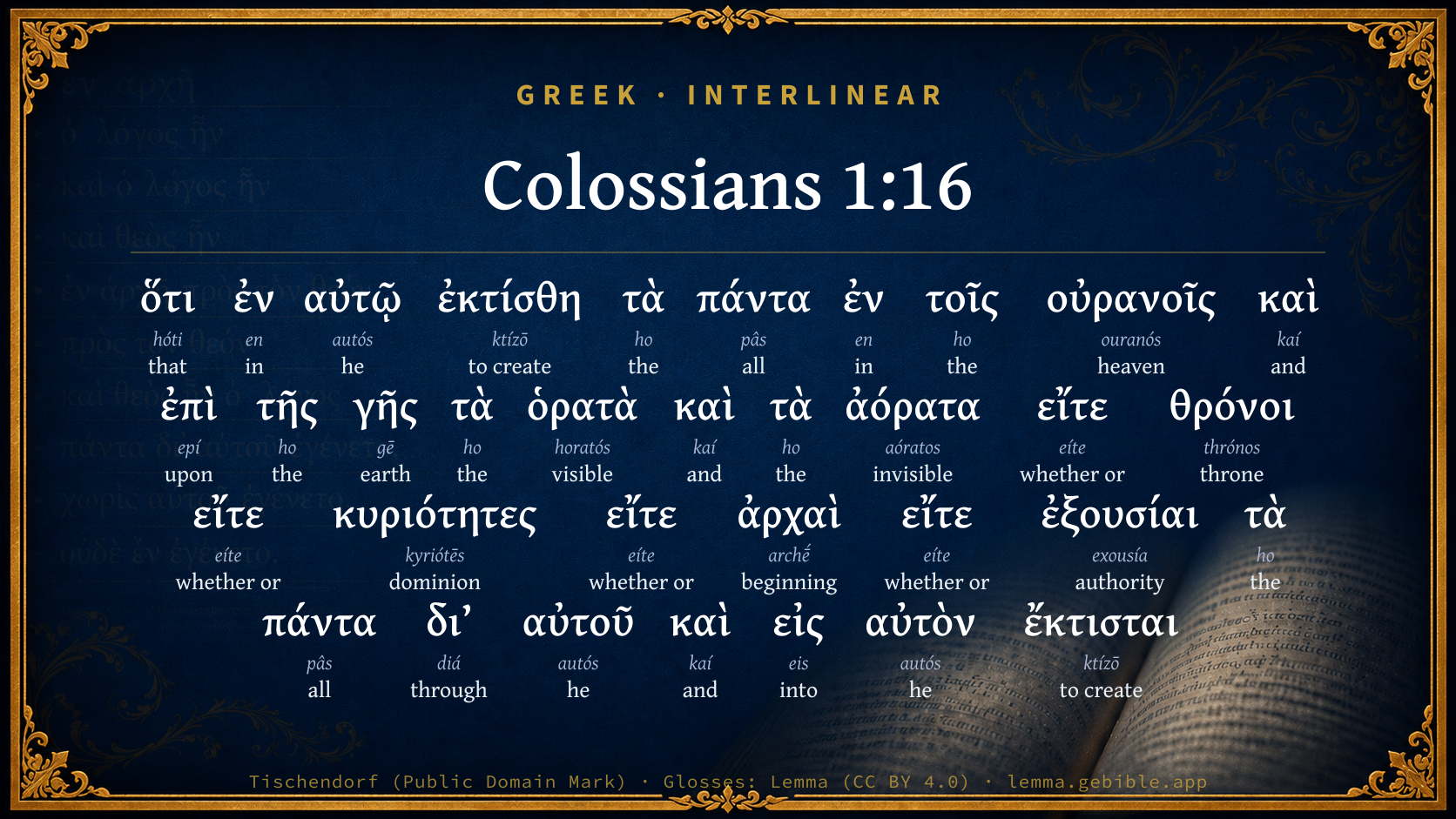
Greek (Tischendorf 8th ed.) Colossians 1:16 appears in the Greek New Testament. The text above is from the Tischendorf 8th edition. Each word links to its Strong’s number and a concise gloss. Click any word for its full Thayer’s Greek Lexicon entry.
Download image
Cite this verse

Colossians 1:16 (World English Bible). Public Domain. Lemma interlinear Bible study tool, https://lemma.gebible.app/v/colossians/1/16.

Show BibTeX & RIS
BibTeX
RIS
English Translation
For by him were all things created, in the heavens and on the earth, things visible and things invisible, whether thrones or dominions or principalities or powers; all things have been created through him, and for him.
World English Bible · Public Domain
Highlights
  • 1 hapax legomenon — only here in the Greek New Testament
  • 1 first appearance in the Greek New Testament
Full analysis ↓
Download a study sheet

One document with this verse’s original text, its word-by-word gloss line, the meaning frame, cross-references with their text, attributed commentary, and full source and license credits — printable, and it pastes into notes with its structure intact.

This verse Autodidact and up

Study sheet (.html) Plain text (.txt)

A passage Seminary Student

Up to 50 verses in one chapter. A passage sheet keeps up to 6 commentary sources and 12 cross-references per verse, in the order this page ranks them, and says so on the sheet whenever that leaves anything out. Ask for a single verse and you get the Autodidact verse sheet above.

Everything on this page stays free to read, with no account — the sheet is a download of what is already on screen, not access to it.

Want to remove ads? Support Godless Engineer
Compare translations 3

The same verse in 3 English versions, stacked beneath the original-language interlinear above. Click any original word for its lexicon entry.

Each is an independent rendering of the whole verse — the interlinear is not word-aligned to these translations.

Highlighted words mark where these versions differ — a whole-verse word diff, not a word-by-word alignment.

  • World English Bible Public Domain
    For by him were all things created, in the heavens and on the earth, things visible and things invisible, whether thrones or dominions or principalities or powers; all things have been created through him, and for him.
  • King James Version Public Domain
    For by him were all things created, that are in heaven, and that are in earth, visible and invisible, whether they be thrones, or dominions, or principalities, or powers: all things were created by him, and for him:
  • unfoldingWord Literal Text CC BY-SA 4.0
    For in him all things were created, in the heavens and on the earth, the visible and the invisible. Whether thrones or dominions or governments or authorities, all things have been created though him and for him.

unfoldingWord Literal Text — © unfoldingWord, licensed CC BY-SA 4.0. Word-aligned USFM3 via Door43 (git.door43.org/unfoldingWord/en_ult).

Versions to compare (up to 4)

3 of 4 selected

Show all 19 translations

Every available English version of this verse, each an independent rendering of the whole verse.

  • World English Bible Public Domain
    For by him were all things created, in the heavens and on the earth, things visible and things invisible, whether thrones or dominions or principalities or powers; all things have been created through him, and for him.
  • Berean Standard Bible Public Domain
    For in Him all things were created, things in heaven and on earth, visible and invisible, whether thrones or dominions or rulers or authorities. All things were created through Him and for Him.
  • Majority Standard Bible Public Domain
    For in Him all things were created, things in heaven and on earth, visible and invisible, whether thrones or dominions or rulers or authorities. All things were created through Him and for Him.
  • King James Version Public Domain
    For by him were all things created, that are in heaven, and that are in earth, visible and invisible, whether they be thrones, or dominions, or principalities, or powers: all things were created by him, and for him:
  • American Standard Version (1901) Public Domain
    for in him were all things created, in the heavens and upon the earth, things visible and things invisible, whether thrones or dominions or principalities or powers; all things have been created through him, and unto him;
  • Revised Version (1885) Public Domain
    for in him were all things created, in the heavens and upon the earth, things visible and things invisible, whether thrones or dominions or principalities or powers; all things have been created through him, and unto him;
  • Geneva Bible (1599) Public Domain
    For by him were all things created, which are in heauen, and which are in earth, thinges visible and inuisible: whether they be Thrones or Dominions, or Principalities, or Powers, all things were created by him, and for him,
  • Douay-Rheims (1899) Public Domain
    For in him were all things created in heaven and on earth, visible and invisible, whether thrones, or dominations, or principalities, or powers: all things were created by him and in him.
  • Young's Literal Translation Public Domain
    because in him were the all things created, those in the heavens, and those upon the earth, those visible, and those invisible, whether thrones, whether lordships, whether principalities, whether authorities; all things through him, and for him, have been created,
  • Literal Standard Version CC BY-SA 4.0
    because all things were created in Him, those in the heavens, and those on the earth, those visible, and those invisible, whether thrones, whether lordships, whether principalities, whether authorities; all things have been created through Him and for Him,
  • Unlocked Literal Bible CC BY-SA 4.0
    For by him all things were created, those in the heavens and those on the earth, the visible and the invisible things. Whether thrones or dominions or governments or authorities, all things were created by him and for him.
  • unfoldingWord Literal Text CC BY-SA 4.0
    For in him all things were created, in the heavens and on the earth, the visible and the invisible. Whether thrones or dominions or governments or authorities, all things have been created though him and for him.
  • Darby Bible Public Domain
    because by him were created all things, the things in the heavens and the things upon the earth, the visible and the invisible, whether thrones, or lordships, or principalities, or authorities: all things have been created by him and for him.
  • World Messianic Bible Public Domain
    For by him all things were created in the heavens and on the earth, visible things and invisible things, whether thrones or dominions or principalities or powers. All things have been created through him and for him.
  • Webster's Bible Public Domain
    For by him were all things created, that are in heaven, and that are upon earth, visible and invisible, whether thrones, or dominions, or principalities, or powers: all things were created by him, and for him:
  • Free Bible Version CC BY-SA 4.0
    for everything was created through him—in heaven and on earth, visible and invisible, empires, rulers, leaders and authorities—everything was created through him and for him.
  • Bible in Basic English Public Domain
    For by him all things were made, in heaven and on earth, things seen and things unseen, authorities, lords, rulers, and powers; all things were made by him and for him;
  • Text-Critical English NT CC BY 4.0
    For by him all things were created, in heaven and on earth, visible and invisible, whether thrones or dominions, rulers or authorities—all things were created through him and for him.
  • Tyndale New Testament (1534) Public Domain
    For by him were all thynges created thynges that are in heven and thynges that are in erth: thynges visible and thynges invisible: whether they be maieste or lordshippe ether rule or power. All thinges are creatyd by hym and in him

Literal Standard Version (2020), Covenant Press — licensed CC BY-SA 4.0. Text via the HelloAO Bible API (eBible.org). Unlocked Literal Bible (unfoldingWord) — licensed CC BY-SA 4.0. Text via the HelloAO Bible API (eBible.org). unfoldingWord Literal Text — © unfoldingWord, licensed CC BY-SA 4.0. Word-aligned USFM3 via Door43 (git.door43.org/unfoldingWord/en_ult). Free Bible Version, Dr. Jonathan Gallagher — licensed CC BY-SA 4.0. Text via the HelloAO Bible API (eBible.org).

Word by word

More ways to search: Search by grammar → Find every occurrence → Compare this word →

Practice this passage: Drill this verse → Learn its vocabulary →

ὁρατὰ
horatós
G3707
“visible”
Adjective, Nominative, Plural, Neuter
Part of Speech
Adjective
Case
Nominative
Number
Plural
Gender
Neuter
Full Thayer's Definition

Origin: from G3708

TDNT: 11:08,7

1. visible, open to view
  1. ὅτι hóti G3754 “that” Conjunction
  2. ἐν en G1722 “in” Preposition
  3. αὐτῷ autós G846 “he” Personal pronoun, Dative, Singular, Masculine
  4. ἐκτίσθη ktízō G2936 “to create” Verb, Aorist, Passive, Indicative, 3rd person, Singular
  5. τὰ ho G3588 “the” Article, Nominative, Plural, Neuter
  6. πάντα pâs G3956 “all” Adjective, Nominative, Plural, Neuter
  7. ἐν en G1722 “in” Preposition
  8. τοῖς ho G3588 “the” Article, Dative, Plural, Masculine
  9. οὐρανοῖς ouranós G3772 “heaven” Noun, Dative, Plural, Masculine
  10. καὶ kaí G2532 “and” Conjunction
  11. ἐπὶ epí G1909 “upon” Preposition
  12. τῆς ho G3588 “the” Article, Genitive, Singular, Feminine
  13. γῆς gē G1093 “earth” Noun, Genitive, Singular, Feminine
  14. τὰ ho G3588 “the” Article, Nominative, Plural, Neuter
  15. καὶ kaí G2532 “and” Conjunction
  16. τὰ ho G3588 “the” Article, Nominative, Plural, Neuter
  17. ἀόρατα aóratos G517 “invisible” Adjective, Nominative, Plural, Neuter
  18. εἴτε eíte G1535 “whether or” Conjunction
  19. θρόνοι thrónos G2362 “throne” Noun, Nominative, Plural, Masculine
  20. εἴτε eíte G1535 “whether or” Conjunction
  21. κυριότητες kyriótēs G2963 “dominion” Noun, Nominative, Plural, Feminine
  22. εἴτε eíte G1535 “whether or” Conjunction
  23. ἀρχαὶ archḗ G746 “beginning” Noun, Nominative, Plural, Feminine
  24. εἴτε eíte G1535 “whether or” Conjunction
  25. ἐξουσίαι exousía G1849 “authority” Noun, Nominative, Plural, Feminine
  26. τὰ ho G3588 “the” Article, Nominative, Plural, Neuter
  27. πάντα pâs G3956 “all” Adjective, Nominative, Plural, Neuter
  28. δι’ diá G1223 “through” Preposition
  29. αὐτοῦ autós G846 “he” Personal pronoun, Genitive, Singular, Masculine
  30. καὶ kaí G2532 “and” Conjunction
  31. εἰς eis G1519 “into” Preposition
  32. αὐτὸν autós G846 “he” Personal pronoun, Accusative, Singular, Masculine
  33. ἔκτισται ktízō G2936 “to create” Verb, Perfect, Passive, Indicative, 3rd person, Singular

About this verse

These counts appear in no published source. They are computed here, from the morphology-tagged text and Lemma’s own curated glosses. What Lemma adds →

34
words
19
distinct lemmas
Pauline Epistles
section

Notable vocabulary

1 hapax legomenon — a word that appears only here in the entire Greek New Testament:

  • ὁρατὰ visible G3707

First appearance in Scripture

This word makes its first canonical appearance in the Greek New Testament here:

  • ὁρατὰ visible G3707

Shared distinctive vocabulary

κυριότητες dominion G2963 occurs in 4 verses of the Greek New Testament. Also found in:
Repetition

Words recur within this verse:

  • εἴτε whether or G1535 ×4
  • ἐκτίσθη to create G2936 ×2
  • πάντα all G3956 ×2
  • τὰ the G3588 ×6
  • αὐτῷ he G846 ×3
  • καὶ and G2532 ×3
  • ἐν in G1722 ×2

Cross-references

26

Topical passages linked to Colossians 1:16 in the Treasury of Scripture Knowledge — connected by theme and wording, ordered by reader-vote popularity; previews shown in the World English Bible.

  • Romans 11:36 For of him, and through him, and to him, are all things. To him be the glory for ever! Amen.
  • John 1:3 All things were made through him. Without him was not anything made that has been made.
  • 1 Corinthians 8:6 yet to us there is one God, the Father, of whom are all things, and we for him; and one Lord, Jesus Christ, through whom are all things, and we live through him.
  • Hebrews 2:10 For it became him, for whom are all things, and through whom are all things, in bringing many children to glory, to make the author of their salvation perfect through sufferings.
  • 1 Chronicles 29:11 Yours, Yahweh, is the greatness, the power, the glory, the victory, and the majesty: for all that is in the heavens and in the earth is yours. Yours is the kingdom, Yahweh, and you are exalted as head above all.
  • Hebrews 1:2 has at the end of these days spoken to us by his Son, whom he appointed heir of all things, through whom also he made the worlds.
  • Ephesians 1:10 to an administration of the fullness of the times, to sum up all things in Christ, the things in the heavens, and the things on the earth, in him;
  • Proverbs 16:4 Yahweh has made everything for its own end-- Yes, even the wicked for the day of evil.
  • Isaiah 44:24 Thus says Yahweh, your Redeemer, and he who formed you from the womb: I am Yahweh, who makes all things; who stretches forth the heavens alone; who spreads abroad the earth (who is with me?);
  • Hebrews 1:10–12 And, "You, Lord, in the beginning, laid the foundation of the earth. The heavens are the works of your hands.
  • Colossians 1:15 who is the image of the invisible God, the firstborn of all creation.
  • Ephesians 1:20–21 which he worked in Christ, when he raised him from the dead, and made him to sit at his right hand in the heavenly places,
  • Colossians 2:10 and in him you are made full, who is the head of all principality and power;
  • Isaiah 43:21 the people which I formed for myself, that they might set forth my praise.
  • Psalms 102:25–27 Of old, you laid the foundation of the earth. The heavens are the work of your hands.
  • Hebrews 3:3–4 For he has been counted worthy of more glory than Moses, inasmuch as he who built the house has more honor than the house.
  • Deuteronomy 4:39 Know therefore this day, and lay it to your heart, that Yahweh he is God in heaven above and on the earth beneath; there is none else.
  • Ephesians 3:9–10 and to make all men see what is the administration of the mystery which for ages has been hidden in God, who created all things through Jesus Christ;
  • Philippians 2:10 that at the name of Jesus every knee should bow, of those in heaven, those on earth, and those under the earth,
  • 1 Peter 3:22 who is at the right hand of God, having gone into heaven, angels and authorities and powers being made subject to him.
  • Colossians 2:15 having stripped the principalities and the powers, he made a show of them openly, triumphing over them in it.
  • Ephesians 6:12 For our wrestling is not against flesh and blood, but against the principalities, against the powers, against the world's rulers of the darkness of this age, and against the spiritual hosts of wickedness in the heavenly places.
  • Colossians 1:20 and through him to reconcile all things to himself, by him, whether things on the earth, or things in the heavens, having made peace through the blood of his cross.
  • Revelation 5:13–14 I heard every created thing which is in heaven, on the earth, under the earth, on the sea, and everything in them, saying, "To him who sits on the throne, and to the Lamb be the blessing, the honor, the glory, and the dominion, forever and ever! Amen!"
  • Isaiah 40:9–12 You who tell good news to Zion, go up on a high mountain; you who tell good news to Jerusalem, lift up your voice with strength; lift it up, don't be afraid; say to the cities of Judah, Behold, your God!
  • Romans 8:38 For I am persuaded, that neither death, nor life, nor angels, nor principalities, nor things present, nor things to come, nor powers,

Cross-references courtesy of OpenBible.info (CC BY 4.0).

Commentary

Notes on Colossians 1:16 from classic Christian and Jewish commentators (each source and its license shown beneath its notes). The classic Christian expositions comment on the surrounding passage and are grouped to its opening verse, so a note may address several verses; the Jewish commentaries on the Tanakh (Rashi and others) are per-verse, so they appear only where the commentator wrote on this verse.

Lemma curates 59 commentaries, every one of them public domain or Creative Commons licensed, each selected and text-cleaned for this edition rather than reprinted as found. About our sources →

The Cambridge Bible for Schools and Colleges

gen. ed. J. J. S. Perowne

16. for] because. Now follows the proof, given in the creative action of the Son, of His priority to and lordship over created being.

by him] Lit. and far better, in Him. “The act of creation is supposed to rest in Him, and to depend on Him for its completion and realization” (Ellicott). In other words, the mighty fact that all things were created was bound up with Him, as its Secret. The creation of things was in Him, as the effect is in its cause.

A meaning so to speak more recondite has been seen here. The text has been taken to mean that the Son, the Logos, is as it were the archetypal Universe, the Sphere and Summary of all finite being as it existed (above time and temporal development) in the Eternal Mind; and accordingly that, when it came into being in time, its creation was “in” Him who thus summed it up. We venture to think that such a view is rather “read into” the words of the Christian Apostle, from non-Christian philosophies, (see Appendix C), than derived from the words.

were … created] A real event, or real events, in time. The Son is seen to have been “First with regard to creation” by the fact that He produced it; Himself existing before (or rather above) time, above all succession, all becoming.

“Created:”—the Greek verb denotes the making, constituting, of a new state of things. As a Divine operation, such “creation” is the ordering by sovereign will of the material (of whatever kind) which by that will exists. See on Eph_2:10; and cp. Joh_1:3; Heb_1:2; Heb_1:10-12; Heb_3:3-4.

The “Creator” here in view is properly the Father, working “in” the Son. But such, in the light of the context, is the Son, that, being from one point of view the Instrument, He is also from another the eternal Co-Agent of the Father’s will.

that are in heaven, and that are in earth] In all regions of finite being; in the whole created universe. Cp. Gen_1:1, and a long chain of passages down to Rev_21:1.

visible and invisible] Belonging to all orders of finite being. The division is not precisely between “material” and “spiritual;” for e.g. human beings might be classed under both these. It practically emphasizes the fact that personal powers of the Unseen Universe were as truly “created in” the Son of God as existences (of any kind) that could be seen. Here, as through the whole passage, the errors current at Colossæ are in view; errors which put “Christ” and the unseen Powers in a very different relation. See Introd., ch. 3.

thrones, or dominions, or principalities, or powers] More strictly, thrones, or lordships, or governments, or authorities. See Eph_1:21 for a close parallel. The word “thrones” is absent there, as “powers” (dunameis) is absent here. For similar language cp. Rom_8:38; below, Col_2:15; Eph_3:10; Eph_6:12; 1Pe_3:22. See further our notes on Eph_1:21 (partially quoted below, Appendix D).

Lightfoot remarks here: “No stress can be laid on the sequence of the names, as though St Paul were enunciating with authority some precise doctrine respecting the grades of the celestial hierarchy.… He does not profess to describe objective realities, but contents himself with repeating subjective opinions.… His language here shews the same spirit of impatience with this elaborate angelology as in Col_2:18.” We venture to dissent, in measure, from this statement. It is most certain that St Paul is not here directly and as a main purpose teaching a doctrine of angels. But he is glorifying the Son of God by a view of His relation to created being; and assuredly this would not be best done by alluding to phases of created being which might all the while be figments of the imagination. Passingly, but distinctly, so we hold, he does affirm the existence both of angels and of angelic orders, “the powers that be” of the invisible world, “created in” the eternal Cornerstone of order, the Son of God.—In Eph_3:10, beyond question, “the principalities and powers” are regarded as facts of the unseen world.

all things] From the details of his allusion to the hierarchies he returns to the universal statement.

were created] Lit. have been created, stand created. (Not so in the first clause of this verse.)

by him] Quite precisely, through Him; the phrase of e.g. Joh_1:3; Joh_1:10; 1Co_8:6; Heb_1:2. It teaches that the Son, in creation, while Himself a true Divine Origin (“Beginning,” Rev_3:14) of finite being, is the Divine Instrument of the Father’s supreme Origination.—The phrase alone does not quite fix this meaning, for in a very few passages (e.g. Heb_2:10) it is used of a supreme Agent’s action. But phrase and context together, as here, are decisive.

for him] “The Word is the final cause as well as the creative agent of the Universe … the goal of the Universe, as He was the starting-point.… This expression has no parallel, and could have none, in the Alexandrian phraseology and doctrine” (Lightfoot). Thus interpreted, this wonderful phrase points to that “far-off Divine event” shadowed out by 1Co_15:28; when all finite existence, even all existence which from its own side is “hostile” to God, shall be “put under the feet” of the Son, made the footstool of His throne, contributing with a harmony perfect from the side of God to the glorification of the Son, and the realization of the Father’s eternal purpose in Him. Meanwhile the words surely refer not to the mysterious future only, but to the present, to all periods and moments. From one side or another all finite being is, consciously or not, willingly or not, always subserving the glory of the Son of God, and of the Father in Him.

We gather from 1Co_15:28 that the “event” of the final subjection of all things to the Son will open up, in eternity, a mysterious “subjection” of the Son to the Father. What that means we cannot enquire here. Whatever it is, it is no dethronement of the Son (Rev_22:3); most surely no revolution in the inner and eternal Relations of Godhead; rather, a mighty Manifestation of Sonship and Fatherhood. It is instructive in this direction to remember that the present passage was written some years later than 1 Corinthians 15, and that thus the course of inspiration did anything but lower the Apostle’s language about the glory and eternity of the Son.

In the light of this phrase deep is the significance of, e.g., Rom_14:8, and of every Scripture in which Christ appears as the Lord and God of the believer’s life and being.

F. CHRIST AND CREATION. (Col_1:16.)

“The heresy of the Colossian teachers took its rise … in their cosmical speculations. It was therefore natural that the Apostle in replying should lay stress on the function of the Word in the creation and government of the world. This is the aspect of His work most prominent in the first of the two distinctly Christological passages. The Apostle there predicates of the Word [the Son] not only prior but absolute existence. All things were created by Him, are sustained in Him, are tending towards Him. Thus He is the beginning, middle, and end of creation. This He is because He is the very Image of the Invisible God, because in Him dwells the Plenitude of Deity.

“This creative and administrative work of Christ the Word [the Son] in the natural order of things is always emphasized in the writings of the Apostles when they touch on the doctrine of His Person … With ourselves this idea has retired very much into the background … And the loss is serious … How much more hearty would be the sympathy of theologians with the revelations of science and the developments of history, if they habitually connected them with the operations of the same Divine Word who is the centre of all their religious aspirations, it is needless to say.

“It will be said indeed that this conception leaves … creation … as much a mystery as before. This may be allowed. But is there any reason to think that with our present limited capacities the veil which shrouds it ever will be removed? The metaphysical speculations of twenty-five centuries have done nothing to raise it. The physical investigations of our own age from their very nature can do nothing; for, busied with the evolution of phenomena, they lie wholly outside this question, and do not even touch the fringe of the difficulty. But meanwhile revelation has interposed, and thrown out the idea which, if it leaves many questions unsolved, gives a breadth and unity to our conceptions, at once satisfying our religious needs and linking our scientific instincts with our theological beliefs.”

Lightfoot, Colossians, pp. 182, 183.

“From dearth to plenty, and from death to life,

Is Nature’s progress, when she lectures man

In heavenly truth; evincing, as she makes

The grand transition, that there lives and works

A soul in all things, and that soul is God.

The Lord of all, Himself through all diffused,

Sustains, and is the life of all that lives.

Nature is but a name for an effect

Whose Cause is God. He feeds the secret fire

By which the mighty process is maintain’d …

[All things] are under One. One Spirit, His

Who wore the platted thorns with bleeding brows,

Rules universal Nature. Not a flower

But shews some touch, in freckle, streak, or stain,

Of His unrival’d pencil. He inspires

Their balmy odours, and imparts their hues,

And bathes their eyes with nectar, and includes

In grains as countless as the seaside sands,

The forms with which He sprinkles all the earth.

Happy who walks with Him! whom what he finds

Of flavour or of scent in fruit or flower,

Or what he views of beautiful or grand, …

Prompts with remembrance of a present God.”

Cowper, The Task, Book vi.

The views outlined by Bishop Lightfoot, in the passage quoted above, are pregnant of spiritual and mental assistance. At the same time with them, as with other great aspects of Divine Truth, a reverent caution is needed in the development and limitation. The doctrine of the Creating Word, the Eternal Son, “in” Whom finite existence has its Corner-stone, may actually degenerate into a view both of Christ and Creation nearer akin to some forms of Greek speculation than to Christianity, if not continually balanced and guarded by a recollection of other great contents of Revelation. Dr J. H. Rigg, in Modern Anglican Theology (3rd Edition, 1880), has drawn attention to the affinity which some recent influential forms of Christian thought bear to Neo-Platonism rather than to the New Testament. In particular, any view of the relation of Christ to “Nature” and to man which leads to the conclusion that all human existences are so “in Christ” that the individual man is vitally united to Him antecedent to regeneration, and irrespective of the propitiation of the Cross, tends to non-Christian affinities. It is a fact never to be lost sight of that any theology which on the whole gives to the mysteries of guilt and propitiation a less prominent place than that given to them in Holy Scripture, tends to a very wide divergence from the scriptural type. Here, as in all things, the safety of thought lies on the one hand in neglecting no great element of revealed truth, on the other in coordinating the elements on the scale, and in the manner, of Divine Revelation.

G. DEVELOPMENTS OF DOCTRINE IN COLOSSIANS. (Col_1:16)

In the precise form presented in Colossians the revelation of the Creative Work of the Son is new in St Paul’s Epistles. But intimations of it are to be found in the earlier Epistles, and such as to make this final development as natural as it is impressive. In 1Co_8:6 we have the “one Lord Jesus Christ, through whom are all things, and we through Him;” which is in effect the germ of the statements of Colossians 1. And in Rom_8:19-23 we have a passage pregnant with the thought that the created Universe has a mysterious relation to “the sons of God,” such that their glorification will be also its emancipation from the laws of decay; or at least that the glorification and the emancipation are deeply related to each other. Nothing is wanted to make the kinship of that passage and Colossians 1 evident at a glance, but an explicit mention of Christ as the Head of both worlds. As it is, His mysterious but most real connexion with the making and the maintaining of the Universe is seen lying as it were just below the surface of the passage in Romans.

H. “THRONES AND DOMINIONS.” (Col_1:16)

We transcribe here a note from our edition of Ephesians in this Series; on the words of Eph_1:21 :

“Two thoughts are conveyed; first, subordinately, the existence of orders and authorities in the angelic (as well as human) world; then, primarily, the imperial and absolute Headship of the Son over them all. The additional thought is given us by Col_1:16, that He was also, in His preexistent glory, their Creator; but this is not in definite view here, where He appears altogether as the exalted Son of Man after Death. In Romans 8, Colossians 2, and Ephesians 6 … we have cognate phrases where evil powers are meant.… But the context here is distinctly favourable to a good reference. That the Redeemer should be “exalted above” powers of evil is a thought scarcely adequate in a connexion so full of the imagery of glory as this. That He should be “exalted above” the holy angels is fully in point. 1Pe_3:22 is our best parallel; and cp. Rev_5:11-12. See also Mat_13:41; “The Son of Man shall send forth His angels.”

“We gather from the Epistle to the Colossians that the Churches of Asia Proper were at this time in danger from a quasi-Jewish doctrine of Angel-worship, akin to the heresies afterwards known as Gnosticism. Such a fact gives special point to the phrases here. On the other hand it does not warrant the inference that St Paul repudiates all the ideas of such an angelology. The idea of order and authority in the angelic world he surely endorses, though quite in passing.

“Theories of angelic orders, more or less elaborate, are found in the Testaments of the Twelve Patriarchs, (cent. 1–2); Origen (cent. 3); St Ephrem Syrus (cent. 4). By far the most famous ancient treatise on the subject is the book On the Celestial Hierarchy, under the name (certainly assumed) of Dionysius the Areopagite; a book first mentioned cent. 6, from which time onwards it had a commanding influence in Christendom. (See Article Dionysius in Smith’s Dict. Christ. Biography). “Dionysius” ranked the orders (in descending scale) in three Trines; Seraphim, Cherubim, Thrones; Dominations, Virtues, Powers (Authorities); Principalities, Archangels, Angels. The titles are thus a combination of the terms Seraphim, Cherubim, Archangels, Angels, with those used by St Paul here and in Colossians 1.

“Readers of Paradise Lost, familiar with the majestic line,

‘Thrones, Dominations, Princedoms, Virtues, Pow’rs,’

are not always aware of its learned accuracy of allusion. The Dionysian system powerfully attracted the sublime mind of Dante. In the Paradiso, Canto xxxviii., is a grand and characteristic passage, in which Beatrice expounds the theory to Dante, as he stands, in the Ninth Heaven, in actual view of the Hierarchies encircling the Divine Essence:

‘All, as they circle in their orders, look

Aloft; and, downward, with such sway prevail

That all with mutual impulse tend to God.

These once a mortal view beheld. Desire

In Dionysius so intensely wrought

That he, as I have done, ranged them, and named

Their orders, marshal’d in his thought.’

Cary’s Dante.”

The Cambridge Bible for Schools and Colleges (gen. ed. J. J. S. Perowne; Cambridge University Press, 1878–1918) — public domain. Text from a community e-Sword module.

The Biblical Illustrator

Joseph S. Exell

Col_1:16

By Him were all things created.

I. Some of those cases which illustrate the harmony between natural religion and our Christian faith.

1. The doctrine of the being of a God. I do not need to open the Bible to learn that. It is enough that I open my eyes, and turn them on the book of nature, where it stands legibly written on every page.

2. So also is the doctrine that man is a sinner. It is enough to open my heart, or read in the light of conscience the blotted record of my past life.

3. Such also is the doctrine that sin deserves punishment. Hell is no discovery of the Bible. In vain do men flee from Christianity to escape what their uneasy conscience feels to be a painful doctrine.

4. Such also is the doctrine that man cannot save himself. In what country or what age of heathenism does man appear standing erect before his God, demanding justice? In none. All her temples had vicarious sacrifices and atoning altars.

5. Such also is the doctrine that the soul survives death. This hope has been a star that shone in every sky, a flower that bloomed in the poorest soil. Although it cannot be said that the doctrine of the resurrection is to be placed in the same class with those universal fixed beliefs, yet may not the feelings which prompt to such tender care of the lifeless body have suggested the idea? Different from these, the doctrine of God incarnate is one which nature nowhere teaches us. Our proofs of this must be sought for in Scripture. In illustration of this remark, notice that--

II. The word of God both here and elsewere ascribes the work of creation to Jesus (1Co_8:6; Eph_3:9; Joh_1:3). Our Lord has been connected with creation sometimes more in beautiful fancies than in plain facts. There is a flower, e.g., which the piety of other days associated with the piety and love of Calvary. In the form and arrangement of its parts it presents such a remarkable resemblance to the cross and nails, enriched by a halo of floral glory, that, as if originally made to anticipate and afterwards left to commemorate our Redeemers sufferings, it has received the name of the passion flower. And I remember how, in wooded dell, or on brown heather hill, we were wont to pull up a fern, and having cut its root across wonder on the initials Jesus Christ printed there on the wounded stem. And when the mariner, leaving our northern latitudes, pushes southward, he sees a starry cross emerging from the deep; and as his course tends further it rises higher in the heavens, till, when the pole-star has dipped beneath the wave, he gazes with awe and wonder at the sign of salvation blazing above his head. In these things a devout superstition sought to gratify its affections. It is not, however, in these fancies that we seek or see our Lords connection with nature. But as, with the genius that aspires to immortality, the painter leaves his name in the corner of the canvas, so Inspiration, dipping her pen in indelible truth, has inscribed the name of Jesus on all we see--on sun and stars, flower and tree, rock and mountain, the unstable waters and the firm land; and also on what we do not see--angels and spirits, the city and heavens of the eternal world. This is not fancy, but fact. No voice ever sounded more distinctly than that of revealed truth proclaiming the Creatorship of Jesus, and hence His Lordship of all. (T. Guthrie, D. D.)

Christ the Creator

I. Consider the statement itself.

1. Heaven itself was created by and for Christ Jesus.

(1) There is such a place, as well as such a state, and of that place Jesus is the centre.

(2) It was created for Jesus, and for the people whom He will bring there to be one for ever with Himself.

(3) It exists by Jesus and for Jesus.

(a) Prepared by Jesus. He is the designer of it.

(b) Reflects Jesus. He is the soul of it.

(c) Praises Jesus. He is the King of it.

2. The angels. All their ranks were made by Him and for Him.

(1) To worship Him, and glorify Him with their adoration.

(2) To rejoice with Him and in Him, as they do when sinners repent.

(3) To guard Christs people in life, and bring them to Him in death.

(4) To carry out His purposes of judgment, as with Pharaoh, etc.

(5) To achieve His purposes of deliverance, as Peter from prison.

3. This world was made by Him to be--

(1) A place for Him to live and die upon.

(2) A stage for His people to live and act upon.

(3) A province to be fully restored to His dominion.

(4) A new world in the ages to come, to bless other worlds, if such there be; and to display, for ever, the glories of Jesus.

4. All the lower creatures are for Jesus. And that are in earth.

(1) They are needful to man, and so to our Lords system of grace.

(2) They are illustrations of Christs wisdom, power, and goodness.

(3) They are to be treated kindly for His sake.

5. Men were created by and for Christ.

(1) That He might display a special phase of power and skill, in creating spiritual beings embodied in material forms.

(2) That He might become Himself one of them.

(3) That He might Himself be the Head of a remarkable order of beings who know both good and evil, are children of God, are bound to God by ties of gratitude, and are one with His Son.

(4) That for these He might die: to save them, and to make them His companions, friends, and worshippers for ever.

(5) That human thrones, even when occupied by wicked men, might be made to subserve His purpose by restraint or by overruling.

II. Review the reflections hence arising.

1. Jesus, then, is God. By Him were all things created.

2. Jesus is the clue of the universe; its centre and explanation. All things are to be seen in the light of the cross, and all things reflect light on the cross. For Him all things exist.

3. To live to Jesus, then, is to find out the true object of our being, and to be in accord with all creation.

4. Not living to Jesus, we can have no blessing.

5. We can only live for Him as we live by Him, for so all things do.

6. It is clear that He must triumph. All is going well. If we look at history from His throne, all things are for Him. He must reign. Let us comfort one another with these words. What an honour to be the smallest page in the retinue of such a prince! (C. H. Spurgeon.)

The Advent in Creation

A very narrow notion of the functions of Christ is afloat in the atmosphere of popular religious thought, though not formulated into dogmatic phrases. It is that our Lord is limited in work and even in nature to the mission of redemption. Such an idea implies that Christ is dependent on the existence of sin, and that His very being is but an expedient required for the deliverance of man. So stated the doctrine is monstrous. If there had been no sin, Christ would have visited the world in some way of Divine goodness. He came in the creation before the birth of sin.

I. The fact.

1. As regards the relation of Christ to creation. This is threefold.

(1) In Christ is the fundamental basis of creation. In Him, i.e., His thoughts, are the archetypes of the worlds and their contents, and the genesis of them follows the principles of His nature.

(2) Christ is the instrumental agent of creation through Him. He is the Mediator in creation as well as redemption.

(3) Christ is the end of the creation. Unto Him, i.e., all things grow into His likeness, they move upwards towards the realization of His life. Christ in His human nature was the highest development of the upward movement of creation. They are also destined to serve and glorify Him.

2. As regards the scope and range of the work of Christ. This was universal in creation. It included:

(1) All things visible and invisible, i.e., physical and spiritual existences, or things within our observation and the infinite population of the spaces beyond.

(2) All orders of being, thrones, etc., none too great for His power, none too small for His care.

(3) Every variety and every individual. Different classes are specified. Creation is not a work merely of general laws, it implies individual formation under them.

II. Inferences.

1. AS regards Christ.

(1) His pre-existence. That which was Divine in Christ was before all things. The Christ-side of God, all that is so touching and winning in the marvellous revelation of God in Jesus, is no new phase of His character. It was before the sterner revelation of Sinai. It is eternal (Heb_13:8).

(2) His glory. All that is great and beautiful in creation glorifies Him through whom it came into existence.

2. As regards the creation.

(1) This must be in harmony with Christ. Therefore--

(a) We must interpret its darker phases by what we know of the spirit and character of Christ.

(b) We must expect that ultimately its laws and forces will make for Christianity, breathing benedictions on the faithful followers of Christ, and bringing natural penalties on those who rebel against His rule.

(2) We should endeavour to trace indications of the presence of Christ in nature. (W. J. Adeney, M. A.)

The work of creation by and for Jesus Christ

I. Christ is the creator of all things. Whatever is the act of creation it must be the Divine act; and whoever is the Creator He must be Divine.

1. Creation is always averred to be a Divine act (Gen_1:1, etc.). It answers to our idea of the highest omnipotence, for the things which are made were not made of the things which do appear.

2. The creating act is always set before us as the basis on which the exclusive honours of the Deity are challenged.

(1) God puts His right to worship on this act.

(2) He suspends the veracity of His statements on it.

(3) His majesty and pre-eminence are made to depend upon it.

3. The creating act is always represented as designed to manifest the glory of Him by whom it was done. For thy pleasure they are and were created. The heavens declare the glory of God.

4. The creating act constitutes the very groundwork of natural religion. We will wait upon Thee, for Thou hast made all these things.

5. There is a validity stamped upon all the blessings of revelation, because they issue from Him who is this universal Creator. The great blessings of the gospel are placed in immediate connection with this omnific act.

(1) Reconciliation. All things are of God, who hath reconciled us.

(2) Atonement. It became Him, for whom are all things, etc.

(3) Illumination. God, who hath commanded the light to shine, etc.

(4) Protection. Let us commit our souls to Him as a faithful Creator.

6. Idolatry is reprobated on this exclusive ground, that it is offered to those who are not the makers of the universe. Worshipping and serving the creature more than the Creator.

7. Creation is always considered an unassisted act. I am the Lord that maketh all things.

8. Now, without any qualification or exception, creation is attributed to Christ; how, then, can we deny Him to be Divine?

II. All things were created for Christ, and form his right and prerogative.

1. There are two forms of the Divine foreknowledge.

(1) God is acquainted with actions however future.

(2) God realizes in His own mind what would be the issue of circumstances had they been different from what they are. They would have repented long ago.

2. We are assured, then, that this universe being created for Christ was not a supplementary design upon some previous arrangement that had been tried and had failed. This is our method, not Gods. Christ wrought this instrument, and it shall go on in His service.

3. Foreseeing sin He made the world in which it was to be vanquished, and hence we read of Gods eternal purpose, and of the Lamb which was foreordained before the foundation of the world. The world is still in revolt, but the eternal purpose shall be accomplished, and all the forces of nature and history shall contribute to it.

4. More particularly all things are created for Christ, inasmuch as--

(1) They furnish the scenes of His mediation. Lo, I come! The earth claimed His birth, life, and entombment. He made it the seat of His Church. Here is the sphere of His Spirits influence. This is the receptacle of His most complacent operations, where He is satisfied for all the travail of His soul. This is the arena of His spiritual victories.

(2) They are tributaries to His praise. All things are created to do Him direct homage. Angels do; the redeemed will; devils and sinners shall.

III. The connection between the two propositions. That Christ is the Creator and Proprietor of all things.

1. This is shown by arguing the difficulty of our redemption, because only the Creator could surmount it.

2. The sufficiency of that redemption because the Creator has wrought it. (R. W. Hamilton, LL. D.)

Christ the end of creation

I. The text furnishes a proof of our Lords divinity.

1. He is in the position of a servant who works for others; He is a Master who, by other hands or His own works for Himself. Look at the condition of man. Whatever office he fills in Providence he is a servant, and on crowned monarchs, who are but upper servants, Paul lays the duty of doing all to the glory of God. Nor do angels, although holding a much higher rank, differ from us in this respect. I am thy fellow-servant. The Lord hath made all things for Himself. This prerogative is held by Christ.

2. Some have attempted to evade the argument for our Lords Divinity based on the fact of creation. The objectors say that He created by such power as Elijah received from God to restore the widows son, etc. But the text cuts the ground under their feet. Did Elijah bring back the dead for himself and his own glory? If Christ was less than God, then in kindling the sun He no more acted for Himself than a domestic does in kindling a fire. It is the nature of a creature to hold a servants place.: Now if Jesus were man He was justly condemned, for He laid Himself open to the charge of blasphemy, since, as the Jews truly averred, He made Himself the Son of God, equal with God To the all Mine are Thine, Christ added Thine are Mine. All that is Gods is Christs, is the consistent testimony of the New Testament.

II. The glory of God was the original purpose of creation. Sill had to some extent blighted the beauty of creation. Still the Psalmist said, The heavens declare, etc., and the closer we examine the works of God, the higher our admiration rises. The whole earth is full of His glory. Some things remain unaffected by the blight of sin, as God made them for Himself; the flowers have lost none of their fragrance, and seas and seasons, obedient to their original impulse, roll on as of old to their Makers glory. But from man, alas! how is the glory departed! Look at his body when the light of his eye is quenched; or look at his soul. What glory does God get from many of us!

III. God will make even the wicked and their sins redound to His glory. A strange machine is this of Providence. Virtue is struggling with the temptations of poverty, the wicked are in great power, spreading like a green bay-tree. Sin triumphs, and devils seem to defeat the purposes of God. Defeat the purposes of God! Impossible. Did you ever stand beneath the leaden lowering cloud, and mark the lightnings leap, and think that you could grasp the bolt and change its path? Still more foolish and vain his thought who fancies that: he can arrest Gods purposes. He that sitteth in the heavens shall laugh. Do you, e.g., injure a godly man? God is using you to train up His child in the grace of patience. Messenger of Satan! dost thou buffet an apostle? God uses thee to keep him humble, arid to teach him to wear his honours meekly.: No man liveth for himself. The most bold and God-hating sinners may rest assured that when the machine of Providence has done its work, and the secret purposes of God are fully completed, it shall be seen how the Lord hath made all things for Himself.

IV. Since Christ hath made all things for Himself, His people are called to consecrate themselves and their all to His glory. To this we are called by the obligations of both a natural and spiritual creation. This may expose us to pain; but what pain Jesus endured for us! What owest thou unto thy Lord? You cannot tell that; therefore lay your all at His feet, He who lives for Christ has one end in view which lends dignity to his life. Glorify Christ and you shall enjoy Him. (T. Guthrie, D. D.)

What is said of the Father in 1Co_8:6, the same is here Said of the Son. All things must find their meeting-point, their reconciliation, at length in Him from whom they took their rise--in the Word as the mediatorial agent, and through the Word in the Father as the primary source. The Word is the final cause as well as the creative agent of the universe. This ultimate goal of the present dispensation in time is similarly stated in several passages. It is represented--

1. As the birth-throe and deliverance of all creation through Christ (Rom_8:19, etc.).

2. The absolute and final subjection of universal nature to Him (1Co_15:28).

3. The reconciliation of all things through Him (verse 20).

4. The gathering in one head of the universe in Him (Eph_1:10). The Eternal Word is the goal of the universe, as He was the starting-point. It must end in unity, as it proceeded from unity, and the centre of this unity is Christ. (Bp. Lightfoot.)

Thrones, or dominions, or principalities, or powers

The Colossian heretics seem to have held that all matter was evil, and that therefore the material creation could not have come directly from a good God, but was in a certain sense opposed to Him, or at all events separated from Him by an immense gulf. The void space was bridged by a chain of beings, half abstractions and half persons, gradually becoming more and more material. The lowest, of them had created the material universe and now governed it, and were all to he propitiated by worship. Paul opposes the solid truth to these dreams, and instead of a crowd of powers and angelic beings in whom the effulgence of Deity was gradually darkened, and the spirit became more and more thickened into matter, he lifts high and clear against that background of faith the solitary figure of the, one Christ. He fills all the space between God and man. There is no need for a crowd of shadowy beings to link heaven with earth. There is a tone of contemptuous impatience in Pauls voice as he quotes the pompous list of sensuous titles, which a busy fancy had coined. It is as if he had said, You are being told a great, deal about these angel hierarchies, and know all about their ranks and gradations. I do not know anything about them; but this I know, that if, amid the unseen things in the heavens or the earth, there be any such, my Lord made them, and is their Master. He is first and last in all things, to be listened to, loved, and worshipped by men. As when the full moon rises, so when Christ appears, all the lesser stars with which Alexandrian and Eastern speculation had peopled the abysses of the sky are lost in the mellow radiance, and instead of a crowd of flickering ineffectual lights there is one perfect orb, and heaven is overflowed. We see no creature any more save Jesus only. (A. Maclaren, D. D.)

The Biblical Illustrator, edited by Joseph S. Exell (c. 1880s–1900s) — public domain. Text from a community e-Sword module.

Joseph Benson's Commentary

Col 1:16-17. For by him were all things created, &c. — The casual particle οτι, for, or because, with which this verse begins, refers to both parts of the preceding verse. The Son is the image of the invisible God, as well as the firstborn of the whole creation, because by him were all things created. See the note on Joh 1:3, where the creation of all things by Christ, God’s eternal Word and Son, is explained at large. That are in heaven — And heaven itself; but the inhabitants are named, because more noble than the house; and earth; visible — The material fabric of this world, with all its inhabitants, called, (Heb 11:3,) τα βλεπομενα, the things which are seen, including the visible splendour of the celestial luminaries, the sun, moon, and stars, even all the hosts of these lower heavens; and invisible — The different orders of angels, both those that stood and those that afterward fell; called, in the following part of the verse, thrones, dominions, &c. Because, in after times, false teachers would arise and affirm, some, that the world was made by angels; others, that it was made by an evil principle; the apostle may have been directed by the Spirit to declare, in the most express manner, that all things were created by God’s beloved Son, that the sincere might be preserved from these pernicious errors. All things were created by him and for him — They are the productions of his unsearchable wisdom and almighty power, and were made by him, that he might possess and govern them, and be glorified in and by them. To interpret this, as the Socinians do, of the new creation in a spiritual sense, is so unnatural, that one could hardly believe, if the evidence were not so undeniably strong, that any set of learned commentators could have imbibed such an opinion. And he is before all things — In the duration, as well as in the dignity of his nature; or, as Micah expresses it, (Mic 5:2,) he is from everlasting; and by him all things consist — Or subsist in that harmonious order of being which renders this universal system one beautiful whole. For the original expression, συνεστηκε, not only implies that he sustains all things in being, or, as it is expressed Heb 1:3, upholdeth all things by the word of his power, but that all things were, and are, compacted in him into one system, and preserved therein; and that he is the cement, as well as support, of the universe. This description of the Son, as the first Maker and continual Preserver of all creatures in earth and heaven, even of the various orders of angelic beings, was most pertinent to his purpose of showing the Colossians the folly of the false teachers who were endeavouring to seduce them from their reliance on Christ for salvation, and to persuade them to confide in and worship angels, as more powerful mediators with God than his own beloved Son, by whom these angels were all created.

Joseph Benson's Commentary on the Old and New Testaments (1811–1818) — public domain. Text from a community e-Sword module.

Whedon's Commentary on the Bible

Daniel D. Whedon

b. His relation to the universe, Col_1:16-17.

16. For—Because, assigning the reason for asserting his priority, namely, the dependence of the creation upon him. The phrase by him occurs twice in the verse, the first being rather in him as the conditional cause. The idea of the creation as conceived by the Father was committed to the Son for its accomplishment and realization: in him (emphatic) did the actual work rest.

All things—Τα παντα, the universe, including every thing outside the earth in all space, and everything upon the earth. Thus much as to locality. As to kind, they were things visible, the sun, moon, and stars, the earth, plants, minerals, and animals; and things invisible, human souls, and, in particular, the angels, with their several orders of thrones, etc., for whom the Colossian philosophy was claiming a superiority over him. By him, also, was the entire universe actually created instrumentally, proving his infinite power, and for him, its end, as the sphere of his dominion and the manifestation of his glory. He is its efficient and final cause.

Daniel D. Whedon (gen. ed.), Commentary on the Old and New Testaments (1874–1909) — public domain. Text from a community e-Sword module.

Tyndale Open Study Notes

Tyndale Open Resources

1:16 Thrones, kingdoms, rulers, and authorities in the unseen world refer to various spiritual powers. This line emphasizes Christ’s supremacy over these beings who were getting so much attention from the false teachers (see 2:18). • Everything was created through him and for him: Christ is both the one through whom all things were created and the goal of all creation.

Tyndale Open Study Notes — © Tyndale Open Resources, licensed CC BY-SA 4.0. Text via the HelloAO Bible API.

Bengel's Gnomon

Johann Albrecht Bengel

Col 1:16. Ὅτι, because) The second part of the 15th verse is hereby explained.—ἐν, in) ἐν ᾧ denotes something prior to διὰ and εἰς, which presently occur. There is here noticed the beginning, the progress, the end. The same is summarily repeated in the following verse.—αὐτῷ, by Him) He Himself, often used here, signifies His great majesty, and excludes every creature.—ἐκτίσθη, were created) It is evident from the enumeration which immediately follows, that the discussion here relates to that creation which is described, Genesis 1; comp. Col 1:23.—τὰ ἐν τοῖς οὐρανοῖς, those things that are in the heavens) and the heavens themselves. But those things which are in the heavens are rather named, because the inhabitants are more noble than their dwellings.—τὰ ὁρατὰ, the visible things) There follows by gradation, and invisible, of which the species are subjoined. [Since visible things, such as the sun, moon, stars, are named first, invisible things subsequently, in succession, it may not be unworthy of consideration, whether the visible things may not have been created during the period of the six days, and the invisible things on the seventh day? Gen 2:1-2; Exo 31:17.—V. g.]—εἰτε θρόνοι εἰτε κυριότητες, whether thrones or dominions) The former greater than the latter. The abstract for the concrete.—εἴτε ἀρχαὶ εἴτε ἐξουσίαι, whether principalities or powers) The former stronger than the latter. Both of these two express an exercise of an office in respect of the creatures; but thrones and dominions seem rather to have their appellation in their exalted relation to God, in so far as they are ὀχήματα, the chariots, on which He displays His majesty, Eph 1:21.

Bengel's Gnomon of the New Testament — English translation (T&T Clark, Edinburgh, 1860) — public domain. Text from a community e-Sword module.

Meyer's Critical & Exegetical Commentary

Heinrich August Wilhelm Meyer

Col_1:16. For in Him were all things created,the logically correct confirmation of πρωτότοκος πάσ. κτίσεως. For if the creation of all things took place in Christ, it is evident that He must stand before the series of created things, and be πρωτότοκος πάσης κτίσεως.

ἐν αὐτῷ] is not equivalent to διʼ αὐτοῦ (Chrysostom, Oecumenius, Theophylact, Erasmus, Beza, Bleek, and many others), but: on Christ depended (causally) the act of creation, so that the latter was not done independently of Himin a causal connection apart from Himbut it had in Him the ground essentially conditioning it. In Him lay, in fact, the potency of life, from which God made the work of creation proceed, inasmuch as He was the personal principle of the divine self-revelation, and therewith the accomplisher of the divine idea of the world. A well-known classical usage to denote the dependence of a state of things, the causality of which is contained in any one. See Bernhardy, p. 210; Kühner, II. 1, p. 403 f.; from the N. T., Winer, p. 364 [E. T. 521]. Not as if the causa principalis of the creation lay in Christ, but the organic causality of the worlds becoming created was in Him; hence the following διʼ αὐτοῦ affirms not a different state of things, but the same thing under a varied form of conception and designation, by which it is brought out in greater definiteness. The primary ground of creation is ever God, Rom_11:36; 1Co_8:6; Heb_11:3. The speculative interpretation of scholastic theology, which found here the causa exemplaris, according to which the idea omnium rerum was in Christ, is indeed followed in the main again by Beyschlag, as earlier by Kleuker, Böhmer, Bähr, Neander, Schleiermacher, Steiger, Julius Müller, Olshausen (the latter saying: the Son of God is the intelligible world, the κόσμος νοητός, that is, things in their very idea; He bears their essence in Himself), but is destitute of confirmation from the modes of conception and expression elsewhere in the N. T., and, as ἐκτίσθη denotes the historical fact of the having been created, it would require not ἐν αὐτῷ, but ἐξ αὐτοῦ, by which the coming forth of the real from the ideal existence in Christ might be expressed. Huther finds the inward connection indicated by ἐν αὐτῷ in the idea, that the eternal essence of the universe is the divine essence itself, which in Christ became man. This idea in itself has no biblical ground; and Paul is speaking here, not of the existence and essence of the universe in Christ, but of the becoming created, which took place in Christ (ἐν αὐτῷ ζωὴ ἦν, Joh_1:4), consequently of a divine act depending on Christ; comp. Joh_1:3 : χωρὶς αὐτοῦ ἐγένετο οὐδὲ ἓν ὃ γέγονεν; Heb_1:2; and Bleek in loc. Lastly, de Wette finds in ἐν besides the instrumental agency at the same time something of a telic idea (comp. also Ewald and Weiss, Bibl. Theol. p. 424 f.); but this blending together of two heterogeneous references is not justified by the διʼ αὐτοῦ καὶ εἰς αὐτόν that follows.

ἐκτίσθη] physical act of creation; Schleiermacher ought not to have called in question the linguistic usage to this effect, with a view to favour the ethical interpretation of the founding of the church. See Wis_1:14; Wis_10:1; Wis_11:18; Deu_4:32; comp. Gen_6:7; Sir_24:9, comp. Sir_15:14; Jdt_13:18; comp. Gen_1:1; 1Co_11:9; Eph_3:9; Rom_1:25; Rev_10:6, comp. Rev_14:7. The word may have the meaning adopted by Schleiermacher: to obtain its arrangement and constitution (Herod. i. 149, 167, 168; Thuc. i. 100; Aesch. Choeph. 484; Soph. Ant. 1101; Pind. Ol. vi. 116; 3 Esdr. 4:53), and that according to the relative nature of the notion implied in the word condere (comp. Blomf. Gloss, in Aesch. Pers. 294); but not here, where it is correlative with πάσης κτίσεως, and where the quite general and in no way to be restricted τὰ πάντα follows. Throughout the N. T., in general κτίζω, κτίσις, κτίσμα, denote the original bringing forth, never merely the arrangement of that which exists; and even in such passages as Eph_2:10; Eph_2:15; Eph_4:24, the relation is conceived, only in a popular manner, as actual creation.

Observe, moreover, the distinction of the tenses: ἐκτίσθη, which denotes the act that took place; and then ἔκτισται, which denotes the creation which has taken place and now subsists. See Winer, p. 255 [E. T. 340]; Kühner, II. 1, p. 143 f., and ad Xen. Mem. iii. 1. 4, iii. 7. 7.

τὰ πάντα] the collective whole, namely, of what is created. This is then specified in a twofold way, as well in regard to place as in regard to nature.

τὰ ἐν τοῖς οὐρανοῖς κ.τ.λ.] the things to be found in the heavens and those to be found on earth. This is certainly a less exact designation of all created things than that in Rev_10:6 (τὸν οὐρανὸν καὶ τὰ ἐν αὐτῷ κ.τ.λ.; comp. Neh_9:6; Gen_2:1, et al.), but does not differ from it, as it does not exclude heaven and earth themselves, the constituent elements of which, in the popular view, are included in these two categories. Comp. 1Ch_29:11. It is incorrect, therefore, to press this expression in opposition to the explanation which refers it to the creation of the world (Wetstein: non dicit ὁ οὐρανὸς καὶ ἡ γῆ ἐκτίσθη sed τὰ πάντα, etc., quo habitatores significantur, qui reconciliantur, comp. Heinrichs and others, also Catech. Racov. 132, p. 214, ed. Oeder), and to think, with Schleiermacher, of the kingdom of heaven; but it is arbitrary also, especially after τὰ πάντα, to make the apostle mean primarily the living (Bähr, de Wette) or rational creatures. The expression embraces everything; hence there was neither need for the mention of the lower world, nor, looking at the bipartite form of enumeration, occasion for it (it is otherwise in Php_2:10; Rev_5:3). The idea that Paul could not have adduced those under the earth as a special class of created beings, because God had not created them with the view of their being under the earth (de Wette), would imply a reflection alien to the vivid flow of the passage before us.

τὰ ὁρατὰ κ. τὰ ἀόρατα] By the latter is meant the heavenly world of spirits, the angelic commonwealth, as is evident from the more precise enumeration which follows, and not the souls of men (Chrysostom, Theophylact, and others), which, on the contrary, as animating a portion of the ὁρατά, are included among the latter. Theodoret erroneously asserts that even τὰ ὁρατά applies to heavenly things (sun, moon, and stars); it applies to everything visible, as in Plat. Phaed. p. 79 A: θῶμεν οὖν, εἰ βούλει, ἔφη, δύο εἴδη τῶν ὄντων τὸ μὲν ὁρατόν, τὸ δὲ ἀειδές.

The ἀόρατα are now more precisely specified disjunctively by εἴτε, sive … sive (put more than twice; comp. Plat. Rep. p. 612 A, 493 D; Sir_41:4). As to the four denominations of angels which followwhose difference of rank Hofmann groundlessly denies,[35] understanding thereby merely spirits collectively, of whatever name they may besee on Eph_1:21; Rom_8:38. In accordance with Eph_1:21, where the grades of angels are mentioned in descending order, the arrangement here must be understood so, that the θρόνοι are the highest and the κυριότητες the lowest class, the ἀρχαί and the ἐξουσίαι being two middle orders lying between these two extremes. At Eph. l.c. Paul names also four grades of the angelic hierarchy; but neither there nor here has he intended to give a complete enumeration of them, for in the former case he omits the θρόνοι, and in the latter the δυνάμεις. The θρόνοι are not mentioned elsewhere in the N. T. (nor yet in Ignat. ad Trail. 5), but they occur in the Test. Levi, p. 548, in which they are placed in the seventh heaven (ἐν ᾧ ἀεὶ ὕμνοι τῷ θεῷ προσφέρονται), also in Dionys. Areop. Hier. coel. 6 ff., and in the Rabbins (Buxtorf, Lex. Talm. p. 1097; Schoettgen, Hor. p. 808). As regards the expression, the last three denominations are to be taken as abstracts, which represent the respective concretes, and analogously the concrete noun θρόνοι is used for those to be found on the thrones (for those enthroned); comp. Kühner, II. 1, p. 11; Ruhnken, ad Tim. p. 190. In this case the very natural supposition that the angels, whose designation by the term θρόνοι must have been in current use, were, in the imagery which gave sensuous embodiment to religious ideas, conceived as on thrones, is not to be called in question (in opposition to Fritzsche, ad Rom. II. p. 226). They were probably conceived as enthroned round the throne of God (comp. Rev_4:4; Rev_20:4). It is to be observed, moreover, generally that Paul presupposes the various classes of angels, which he names, as well known; although we are unacquainted with the details of the case, this much is nevertheless certain, that the apostle was far removed from the dreamy fancies indulged in on this point by the later Rabbins (see Eisenmenger, entdeckt. Judenth. II. p. 374). But very soon after the apostolic age (comp. Hermas, Past. vis. iii. 4), instruction as to τοποθεσίας τὰς ἀγγελικάς was regarded as teaching for the more perfect. See Ignatius, ad Trall. 5. For the Christian faith there remains and suffices the testimony as to different and distinctively designated stages and categories in the angelic world, while any attempt to ascertain more than is written in Scripture passes into the fanciful domain of theosophy.

With ἐξουσίαι is concluded the confirmatory sentence (ὅτι), so that a full stop is to be placed after ἐξουσ. With τὰ πάντα begins a new sentence, in which τὰ πάντα and αὐτός correspond to one another; hence a comma only must stand after ἔκτισται. There is no reason for placing (with Lachmann) τὰ πάντα down to ἐκκλησ. in a parenthesis.

τὰ πάντα διʼ αὐτοῦ κ.τ.λ.] a solemn recapitulation,[36] but in such a way that, instead of the act of creation previously mentioned, there is now presented the finished and ready result (ἔκτισται); the causal relation which was previously denoted by ἐν is now more precisely indicated as a relation of mediate agency (διʼ αὐτοῦ, comp. 1Co_8:6); then in εἰς αὐτόν a new element is added, and the emphasis which in Col_1:16 lay on ἐκτίσθη, is now laid on τὰ πάντα which stands at the head of the sentence. We cannot say with Hofmann, that by διʼ αὐτοῦ and εἰς αὐτόν the Son comes to stand in contradistinction to what has been created as Creator, after by ἐν αὐτῷ the creative act has been presented as one that had taken place only not without the Son. By the latter, ἐν αὐτῷ would become too general and indefinite a thought; while διʼ αὐτοῦ in fact leaves the Father as the Creator, which He is, and predicates of the Son merely the causa medians of the execution of the work, just as εἰς αὐτόν predicates the causa finalis of the same.

εἰς αὐτόν] in reference to Him, for Him, as the aim and end, in quo Pater acquiescit, Beza. Comp. Rom_11:36; 1Co_8:6; Barnab. Ep. 12: ἐν αὐτῷ τὰ πάντα καὶ εἰς αὐτόν. The more exact purport of this relation is apparent from all that follows down to Col_1:20. Everything, namely, is created, in order to be dependent on Christ and to serve His will and aim.[37] Comp. on Eph_1:23; Eph_4:10; Php_2:9 ff. The final cause of the world, referred in Rom_11:36 to God, is here affirmed of Christ, and with equal right; for He, as He was the organ of God in creation, is the commissioned ruler to whom the κυριότης τῶν πάντων is committed (Mat_28:18; Php_2:9; 1Co_15:27; Heb_2:8), in order that everything created may have the ethical telic destination of serving Him.[38] More special definitions of the meaning of εἰς αὐτόν are without due warrant, and in particular, the often-repeated one: to His glorification (Beza, Flatt, Böhmer, and others); it lays down Christ in general as the legitimus finis (Calvin).

The expositors, who explain the words as referring to the new moral creation, have summoned to their aid all kinds of arbitrary conjectures in detaila remark which applies not merely to Nösselt, Heinrichs, and others, but also to Schleiermacher, who holds (comp. Baumgarten-Crusius) that τὰ ἐν τ. οὐρ. is everything that belongs to the kingdom of heaven, and ΤᾺ ἘΠῚ Τ. Γῆς everything which belongs to civil order in earthly kingdoms; that ΤᾺ ὉΡΑΤΆ and ΤᾺ ἈΌΡΑΤΑ apply only to the latter; that the ΘΡΌΝΟΙ Κ.Τ.Λ. are magisterial offices, and the like.

[35] See, on the other hand, Hahn, Theol. d. N. T. I. p. 292 f.; Philippi, Glaubensl. II. p. 308 f.; Kahnis, Dogm. I. p. 559.

[36] Ewald well says: Just at this point the discourse breaks forth as if with fresh force, so as once more to express as clearly as possible the whole in all conceivable temporal relations.

[37] And, if the world was created not merely διʼ αὐτοῦ but also εἰς αὐτόν, conse-sequently in telic reference to Him, it is certain that with the counsel of creation there was also posited, in prospect of the entry of sin, the counsel of redemption. Comp. Thomasius, Christi Pers. u. Werk, I. p. 196 f.; Julius Müller, Dogm. Abhand. p. 121 ff.

[38] This εἰς αὐτόν is wrongly found incompatible with 1Co_8:6 (see, after Mayerhoff, Baur, and others, especially Holtzmann, p. 219), where, in fact, it is said of the ethical existence of Christians that they exist for God through Christ, inasmuch as the subject of εἰς αὐτόν (for God) and of διʼ αὐτοῦ (through Christ) is not the universe, but the ἡμεῖς. The relation of subordination between Father and Son would be only done away with at our passage, in the event of its being said of Christ that τὰ πάντα were created ἐξ αὐτοῦ. But by ἑν αὐτῷ, and by the more precise definition διʼ αὐτοῦ, it is guarded; and the subordination remains unaffected by the circumstance that the εἰς αὐτόν is laid down by God for the world as its telic aim. This εἰς αὐτόν ἔκτισται is the necessary preliminary condition, on Gods part, to the universal dominion which he has destined for Christ, and which the latter shall one day, at the goal of consummation, hand over to the Father (1Co_15:24; 1Co_15:28). Moreover, what Paul says of the κτίσις in Romans 8 is essentially connected with that εἰς αὐτόν, which does not go beyond Paul or come at all into opposition to him. The resemblance of our passage to ὁ πρῶτος καὶ ὁ ἔσχατος, Rev_1:17; Rev_22:13, rests upon the Christological basis of their common faith, not upon a dependence of our epistle on the Apocalypse, which would doubtless imply a post-Pauline date (in opposition to Holtzmann, p. 247).

Meyer — Critical and Exegetical Commentary on the New Testament — English translation by Peter Christie, edited by Frederick Crombie (T&T Clark, 1880) — public domain. Text from a community e-Sword module.

Expositor's Greek Testament

ed. W. Robertson Nicoll

Col 1:16 . Paul now gives the ground for the designation of the Son as πρωτότ . π . κτίσεως . In Him τὰ πάντα were created. From this it follows that the Son cannot be a creature, for creation is exhausted by the “all things” which were so created in Him (“omnem excludit creaturam,” Bengel). ἐν αὐτῷ : this does not mean “by Him”. The sense is disputed. The schoolmen, followed by some modern theologians, explain that the Son is the archetype of the universe, the κόσμος νοητός , the eternal pattern after which the physical universe has been created. So Philo held that the Logos was the home wherein the eternal ideas resided. But it is by no means clear that Alexandrian influence can be traced in the Epistle. Further, the notion of creation is not suitable to the origin of the ideal universe in the Son. If the Son was from eternity the archetype of the universe, then ἐκτίσθη ἐν αὐτῷ ought not to have been used, both because the aorist points to a definite time and the idea of creation is itself inapplicable. But that the ideal universe was at some time created in the Son is an highly improbable, if it is even an intelligible, idea. Again, the sense of ἐκτίσθη is controlled by that of κτίσις , which does not refer to the ideal universe. It must therefore refer to the actual creation of the universe. If Paul had intended to speak of the realisation in creation of the ideal universe which had in the Son its eternal home he would have said ἐξ αὐτοῦ . Others (Mey., Ell., Moule) take ἐν αὐτῷ to mean simply that the act of creation depended causally on the Son. This is perhaps the safest explanation, for Haupt’s interpretation that apart from His Person there would have been no creation, but with His Person creation was a necessity in other words, that creation was “given” in Christ seems with the aorist and the choice of the word ἐκτίσθη to be inconsistent with the eternal existence of the Son. τὰ πάντα , i.e. , the universe in its widest sense regarded as a collective whole. ἐν τ . οὐρανοῖς κ . ἐπὶ τ . γῆς . As Lightfoot points out, “a classification by locality,” while τὰ ὁρατὰ κ . τ . ἀόρατα is a “classification by essence”. The two do not precisely correspond, for the divisions cross each other to some extent, though some confine the things in heaven to the world of spirits, and the things on earth to the world of men, in which case they would correspond to things invisible and things visible. Against this see above on π . κτίσεως . εἴτε θρόνοι κ . τ . λ . This is not an exhaustive definition of τὰ πάντα , for Paul selects for mention those creatures to whom worship was paid by the false teachers. The names, as in similar lists, denote angels and not earthly powers. For some of them occur in Jewish angelology, and a reference to earthly dignities would be irrelevant to the polemical purpose of the passage. These angels, Paul insists, so far from being superior or equal to Christ, were as inferior to Him as the creature is to the Creator. They owed their very existence to Him, and could not therefore be allowed for one moment to usurp His place. Lightfoot thinks that Paul is expressing no opinion as to their objective existence, but is simply repeating subjective opinions; and that both here and in Col 2:18 he shows a “spirit of impatience with this elaborate angelology”. But in face of the detailed proof that he accepted the doctrine of various orders of angels (given most fully by Everling), this cannot be maintained, nor is there any polemical reference in Eph 1:21 . It may be questioned whether any inference can be drawn as to the order of the ranks of angels. The order in the parallel list, Eph 1:21 , is ἀρχή , ἐξουσία , δύναμις , κυριότης , on which Godet remarks that in Col. the question is of creation by Christ from whom all proceed, hence the enumeration descends; but in Eph. of the ascension of the risen Christ above all orders, hence the enumeration ascends. But it must be urged against this not merely that only three out of the four titles coincide, but that the order is not fully inverted. Possibly Paul employs here the order of the false teachers (so Kl [8] ). The order apparently descends, but it is questionable if this is intentional, for if the highest orders were inferior to Christ, a fortiori the lower would be. θρόνοι : taken by some to be the angels of the throne, that is angels who, like the cherubim, bear the throne of God. But it is more probable that they are those seated on thrones ( cf. Rev 4:4 ). On these orders, cf. the Slavonic Enoch , xx. 1. In the seventh heaven Enoch saw “a very great light and all the fiery hosts of great archangels, and incorporeal powers and lordships and principalities and powers ; cherubim and seraphim, thrones and the watchfulness of many eyes”. Also Enoch , lxi. 10, “and all the angels of powers and all the angels of principalities ”. Test. , xii., Patr. Levi. , 3, ἐν δὲ τῷ μετʼ αὐτόν εἰσι θρόνοι , ἐξουσίαι , ἐν ᾧ ὕμνοι ἀεὶ τῷ Θεῷ προσφέρονται . κυριότητες : apparently inferior to θρόνοι . ἀρχαὶ … ἐξουσίαι usually occur together and in this order. τὰπάντα … συνέστηκεν : thrown in as a parenthesis. διʼ αὐτοῦ . The Son is the Agent in creation ( cf. 1Co 8:6 ); this definitely states the pre-existence of the Son and assumes the supremacy of the Father, whose Agent the Son is. εἰς αὐτὸν . That the Son is the goal of creation is an advance on Paul’s previous teaching, which had been that the goal of the universe is God (Rom 11:36 ; cf. 1Co 8:6 , ἡμεῖς εἰς αὐτόν ). It is urged by Holtzmann and others as decisive against the authenticity of the Epistle as it stands. But in 1Co 15:25 sq. all things have to become subject to the Son before He hands over the kingdom to the Father. We find the same thought in Mat 28:18 and Heb 2:8 . And, as Oltramare and others point out, in 1Co 8:6 , διʼ οὗ τὰ πάντα is said of Christ, but of God in Rom 11:36 . Yet this difference is not quoted to show that Romans and Corinthians cannot be by the same hand, and it is equally illegitimate to press εἰς αὐτ . as inconsistent with Pauline authorship. ἔκτισται . The perfect, as distinct from the aorist, expresses the abiding result as distinct from the act at a definite point of time ( cf. Joh 1:3 , ἐγένετο followed by γέγονεν ).

[8] Klöpper.

The Expositor's Greek Testament, edited by W. Robertson Nicoll (1897–1910) — public domain. Text from a community e-Sword module.

Cambridge Greek Testament for Schools and Colleges

16. ὅτι. “Because”; justifying the preceding title (πρωτότοκος πάσ. κτίσ.).

ἐν αὐτῷ, stronger than the διʼ αὐτοῦ in the second part of the verse, and in Joh 1:3 a, and even than χωρὶς αὐτοῦ ἐγένετο οὐδὲ ἕν, Joh 1:3 b. It is like Col 1:17, τά πάντα ἐν αὐτῷ συνέστηκεν. We grasp, or think we grasp, the sense of the latter phrase without much difficulty, that all things find their coherence in Him alone, but we sometimes fail to appreciate its complement, that they must have had their immediate origin in Him alone, who is “the creative centre of all things, the causal element of their existence” (Ell.). Hence He is called ἡ ἀρχὴ τῆς κτίσεως τοῦ θεοῦ, Rev 3:14.

For a similar use of ἐν, but with reference to the Father, see Act 17:28. Wis 9:1 b, ὁ ποιήσας τὰ πάντα ἐν λόγῳ σου, is parallel in form alone, for it is a literal translation of the Hebrew בִּדְבָרֶךָ which in such a phrase would naturally mean “by Thy word.”

ἐκτίσθη. κτίζω is used in the N.T. only of God’s action, and so almost universally in the LXX., the exceptions being Lev 16:16 of the tabernacle being set up, 1Es 4:53 of founding a city (a classical usage), Hag 2:9 apparently of building the temple, and possibly also Jeremiah 39(32):15 as a var. lect. for κτηθήσονται. Aquila and after him Sym. and Theod. frequently substitute it for a less exact term in the LXX. when the Hebrew has ברא, e.g. Gen 1:1; Gen 1:27.

τὰ πάντα See notes on Textual Criticism. Almost certainly to be separated from the following words, partly because in the right text no article follows (yet cf. Eph 3:15), partly because τὰ πάντα occurs so often alone, both with κτίζω (e.g. the end of this verse, Eph 3:9; Rev 4:11 bis; Sir 23:20) and with other somewhat similar phrases (e.g. Col 1:20; Eph 1:10-11; Eph 1:23; Eph 4:10).

Observe (1) τὰ πάντα, as contrasted with πάντα, regards the several parts as forming a whole, cf. 1Co 15:27-28. (2) τὰ πάντα, afterwards denned as ἐν οὐρ. κ.τ.λ., not barely τὸν οὐρανὸν κ. τ. γῆν, because St Paul is laying stress on Christ’s relation not to the universe generally but to creatures, particularly sentient creatures, in it. (3) τὰ πάντα, not τὰ ἄλλα, or τὰ λοιπά, thus absolutely excluding the πρωτότοκος from being Himself a κτίσις (cf. Lightfoot).

ἐν τοις οὐρανοῖς κ. ἐπὶ τῆς γῆς. “In the heavens and on the earth,” recalling Gen 1:1 and especially Col 2:1, all things whether above or below. Perhaps οὐρανοί here (contrast 1Co 8:5, εἴτε ἐν οὐρανῷ κ.τ.λ.) to include a reference to the seven stages of the heavenly regions so frequently spoken of in the apocalyptic literature (cf. Introd. p. xxiii.), a theory which can hardly have been absent from the false teaching that St Paul was combating, and one which he himself accepted in some measure (2Co 12:2).

τά ὁρατὰ† καὶ τὰ ἀόρατα, “the visible and the invisible.” ὁρατός occurs elsewhere in the Greek Bible in this sense only in Job 37:21. ἀόρατος (see Col 1:15) is used nowhere else in the Greek Bible or the Hexapla fragments of invisible things absolutely (contrast Rom 1:20 in reference to God), but it is used in Isa 45:3, 2Ma 9:5 of things unseen before a certain time, and in Gen 1:2 of chaos.

The two words together comprise all existing things regarded from the side of human vision. Compare Plato’s τὸ ὁρατόν and τὸ ἀειδές. They practically correspond to our “material and immaterial” but avoid the probable error, philosophical and scientific, of such a division, ὁρατά probably includes both stellar and earthly powers; ἀόρατα perhaps solely super-terrestrial beings, “angels” of every kind, but hardly souls of men on earth.

θρόνοι. Here only in St Paul. The throne, from being the mere symbol of power (Luk 1:52), easily becomes the synonym for it (e.g. Rev 13:2; cf. 2Sa 14:9; 1Ki 1:37; 1Ki 1:47; 1Ki 2:33, etc.).

Here, with the three following terms, it is personified, St Paul perhaps preferring personifications of abstract terms to direct personal appellations, as more suitable to the vague and mysterious nature of these exalted beings—if as is probable from Col 2:10; Col 2:15 beings are intended.

The exact reference of θρόνοι here (a) cannot be to beings that merely support God’s throne, for this would separate θρόνοι from the class of the three following terms, which have a distinctly active sense; and (b) can hardly be definitely to those who occupy thrones surrounding the throne of God, Rev 4:4 (Abbott), for we should then expect some definite reference in the following terms as well; but (c) the reference is probably to the beings, whatever they were, called by this name in the current pseudepigraphical literature. See Slavonic Enoch XX. 1, and Asc. Isaiah, “worship neither throne nor angel which belongs to the six heavens” (7:21); “when I have raised thee to the seventh heaven … thou shalt know that there is nothing hidden from the thrones and from those that dwell in the heavens and from the angels” (7:27); “It is He alone to whose voice all the heavens and thrones give answer” (8:8). Testt. XII Patriarchs, “and in the heaven next to this are thrones, dominions, in which hymns are ever offered to God” (Levi, iii. Sinker’s trans.).

κυριότητες, dominationes Vulg., dominaciouns Wycl., Eph 1:21; 2Pe 2:10; Jud 1:8†. Not in LXX. or Hexapla fragments. As κύριος seems to have taken much of its later connotation from the fact of its being the Greek equivalent of Dominus, the Latin title of the Roman Emperor (cf. especially Dalman, Words of Jesus, p. 330), so probably κυριότης borrowed part of its meaning from dominatio. If so it probably has the connotation of despotism which is lacking in θρόνος. Translated into personal and modern terms the two are “Kings, Czars.” But in this case also the reference is doubtless to angelic beings: cf. the “Greek Legend” of Asc. Isa. vii. 21, μὴ προσκυνήσῃς μήτε ἀγγέλους μήτε ἀρχαγγέλους μήτε κυριότητας μήτε θρόνους (Charles’ Edition, p. 144).

ἀρχαὶ, ἐξουσίαι, “ether princeheedis, ether powers,” Wycl. The two words frequently come together, Col 2:10; Col 2:15; Eph 1:21 (ὑπεράνω πάσης ἀρχῆς κ. ἐξουσίας κ. δυνάμεως κ. κυριότητος κ. παντὸς ὀνόματος ὀνομαζομένου κ.τ.λ.), Col 3:10, Col 4:12.

Of the two titles ἀρχαί is doubtless the higher, expressing as it does a priority of rank and rule, ἐξουσίαι being more general, contrasting the possessors of ἐξουσία with those, whoever they may be, over whom it is exercised. For ἀρχαί without ἐξουσία see Rom 8:38-39. On ἐξουσία cf. Col 1:13 note. For the use of these two words compare the phrase “all the angels of power and all the angels of principalities” (Eth. Enoch, lxi. 10). Observe

(1) The terms are in a descending scale, generally but perhaps not in detail. For in Eph 1:21 κυριότης follows ἐξουσία.

(2) The supposition (P. Ewald) that they are in two pairs has no support either from Eph 1:21 or from the use of the terms in the pseudepigraphical books. Hence we have no right to regard the ἀρχαί and ἐξουσίαι as standing in closer relation (by opposition or assistance) to believers than the θρόνοι and κυριότητες.

(3) They include only supernatural powers, for there is no hint that the Colossians were in danger of worshipping human beings (contrast Col 2:18).

(4) Though St Paul believed in the existence of angels (1Co 6:3), and probably in grades of them (because such a belief was very common in his time), yet he here employs not strictly official, much less personal, names—contrast e.g. Eth. Enoch. Bk Jub.—but only personifications of abstract terms. This looks as though here he purposely expressed himself vaguely. He found the terms in common use, e.g. among the Colossians, and he uses them, but he neither affirms nor denies their personality.

On the other hand it is hard to see here any signs of his “impatience with this elaborate angelology” (Lightfoot).

ταʼ πάντα. Emphatic repetition, introducing new facts.

διʼ αὐτοῦ. Regarding the Son (Col 1:13) as the means by which all things have been created. So often, e.g. Joh 1:3; Joh 1:10; 1Co 8:6; Heb 1:2; cf. Rom 11:36. Compare Philo, de Mon. ii. 5 (II. p. 225), λόγος … διʼ οὗ σύμπας ὁ κόσμος ἐδημιουργεῖτο. But Lightfoot points out that Philo regarded the Logos as a passive tool or instrument, and therefore “frequently and consistently used the simple instrumental dative ᾧ to describe the relation of the Word to the Creator,” e.g. Leg. All. iii. 31 § 96, Wendland (I. p. 106), ὁ λόγος … ᾧ καθάπερ ὀργάνῳ προσχρησάμενος. But this the N.T. cannot and does not do.

καὶ εἰς αὐτόν. The Son is here regarded as the final aim to which all things tend. “The Eternal Word is the goal of the universe, as He was the starting-point. It must end in unity, as it proceeded from unity: and the centre of this unity is Christ. This expression has no parallel, and could have none, in the Alexandrian phraseology and doctrine” (Lightfoot).

In Rom 11:36 we find stated of God, without regard to the hypostatic distinctions, ὅτι ἐξ αὐτοῦ κ. διʼ αὐτοῦ κ. εἰς αὐτὸν τὰ πάντα, and in 1Co 8:6, expressly of the Father, ὁ πατήρ, ἐξ οὖ τὰ πάντα καὶ ἡμεῖς εἰς αὐτόν, where, however, the reference is verbally limited to the Father as the supreme object of the Christian life.

But observe that St Paul could surely not have used εἰς αὐτόν of God, in one place as such, of the Father in another place, and, here, of the Son, unless he had recognised the Son as wholly Divine. Pearson (Creed, p. 115), after pointing out the testimony that Col 1:16-17 bear to the greatness and the work of the Son, adds that even “if they were spoken of the Father they could be no way injurious to His majesty, Who is nowhere more plainly or fully set forth unto us as the Maker of the world.”

ἔκτισται. The perfect is chosen because he is passing from the thought of creating (Col 1:15 b, 16) to that of sustaining (Col 1:17).

Cambridge Greek Testament for Schools and Colleges (Cambridge University Press, 1896; 21 vols, various authors incl. Carr, Maclear, Plummer, Farrar, Lumby, Moule, M. R. James, Simcox) — public domain. Text from a community e-Sword module.

Geneva Bible (1599)

Geneva Bible translators

He setteth forth the Angels with glorious names, that by the comparison of most excellent spirits we may understand how far passing the excellence of Christ, in whom only we have to content ourselves, and let go all Angels.

Geneva Bible (1599) marginal notes — public domain. Text via Bolls.life.

Jamieson, Fausset & Brown

Robert Jamieson, A. R. Fausset & David Brown

For--Greek, "Because." This gives the proof that He is not included in the things created, but is the "first-begotten" before "every creature" (Col 1:15), begotten as "the Son of God's love" (Col 1:13), antecedently to all other emanations: "for" all these other emanations came from Him, and whatever was created, was created by Him.

by him--rather as Greek, "in Him": as the conditional element, pre-existent and all-including: the creation of all things BY Him is expressed afterwards, and is a different fact from the present one, though implied in it [ALFORD]. God revealed Himself in the Son, the Word of the Father, before all created existence (Col 1:15). That Divine Word carries IN Himself the archetypes of all existences, so that "IN Him all things that are in heaven and earth have been created." The "in Him" indicates that the Word is the ideal ground of all existence; the "by Him," below, that He is the instrument of actually realizing the divine idea [NEANDER]. His essential nature as the Word of the Father is not a mere appendage of His incarnation, but is the ground of it. The original relation of the Eternal Word to men "made in His image" (Gen 1:27), is the source of the new relation to them by redemption, formed in His incarnation, whereby He restores them to His lost image. "In Him" implies something prior to "by" and "for Him" presently after: the three prepositions mark in succession the beginning, the progress, and the end [BENGEL].

all things--Greek, "the universe of things." That the new creation is not meant in this verse (as Socinians interpret), is plain; for angels, who are included in the catalogue, were not new created by Christ; and he does not speak of the new creation till Col 1:18. The creation "of the things that are in the heavens" (so Greek) includes the creation of the heavens themselves: the former are rather named, since the inhabitants are more noble than their dwellings. Heaven and earth and all that is m them (Ch1 29:11; Neh 9:6; Rev 10:6).

invisible--the world of spirits.

thrones, or dominions--lordships: the thrones are the greater of the two.

principalities, or powers--rather, "rules, or authorities": the former are stronger than the latter (compare Note, see on Eph 1:21). The latter pair refer to offices in respect to God's creatures: "thrones and dominions" express exalted relation to God, they being the chariots on which He rides displaying His glory (Psa 68:17). The existence of various orders of angels is established by this passage.

all things--Greek, "the whole universe of things."

were--rather, to distinguish the Greek aorist, which precedes from the perfect tense here, "have been created." In the former case the creation was viewed as a past act at a point of time, or as done once for all; here it is viewed, not merely as one historic act of creation in the past, but as the permanent result now and eternally continuing.

by him--as the instrumental Agent (Joh 1:3).

for him--as the grand End of creation; containing in Himself the reason why creation is at all, and why it is as it is [ALFORD]. He is the final cause as well as the efficient cause. LACHMANN'S punctuation of Col 1:15-18 is best, whereby "the first-born of every creature" (Col 1:15) answers to "the first-born from the dead" (Col 1:18), the whole forming one sentence with the words ("All things were created by Him and for Him, and He is before all things, and by Him all things consist, and He is the Head of the body, the Church") intervening as a parenthesis. Thus Paul puts first, the origination by Him of the natural creation; secondly, of the new creation. The parenthesis falls into four clauses, two and two: the former two support the first assertion, "the first-born of every creature"; the latter two prepare us for "the first-born from the dead"'; the former two correspond to the latter two in their form--"All things by Him . . . and He is," and "By Him all things . . . and He is."

Jamieson, Fausset & Brown — Commentary Critical and Explanatory on the Whole Bible (1871) — public domain (CC PDM 1.0). Text via the HelloAO Bible API.

Adam Clarke's Commentary

Verse 16. 17. For by him were all things created, c.] These two verses contain parts of the same subject. I shall endeavour to distinguish the statements of the apostle, and reason from them in such a way as the premises shall appear to justify, without appealing to any other scripture in proof of the doctrine which I suppose these verses to vindicate.

Four things are here asserted:

1. That Jesus Christ is the Creator of the universe of all things visible and invisible of all things that had a beginning, whether they exist in time or in eternity.

2. That whatsoever was created was created FOR himself; that he was the sole end of his own work.

3. That he was prior to all creation, to all beings, whether in the visible or invisible world.

4. That he is the preserver and governor of all things; for by him all things consist.

Now, allowing St. Paul to have understood the terms which he used, he must have considered Jesus Christ as being truly and properly God.

I. Creation is the proper work of an infinite, unlimited, and unoriginated Being; possessed of all perfections in their highest degrees; capable of knowing, willing, and working infinitely, unlimitedly, and without control: and as creation signifies the production of being where all was absolute nonentity, so it necessarily implies that the Creator acted of and from himself; for as, previously to this creation, there was no being, consequently he could not be actuated by any motive, reason, or impulse, without himself; which would argue there was some being to produce the motive or impulse, or to give the reason. Creation, therefore, is the work of him who is unoriginated, infinite, unlimited, and eternal. But Jesus Christ is the Creator of all things, therefore Jesus Christ must be, according to the plain construction of the apostle's words, truly and properly GOD.

II. As, previously to creation, there was no being but God, consequently the great First Cause must, in the exertion of his creative energy, have respect to himself alone; for he could no more have respect to that which had no existence, than he could be moved by nonexistence, to produce existence or creation. The Creator, therefore, must make every thing FOR himself.

Should it be objected that Christ created officially or by delegation, I answer: This is impossible; for, as creation requires absolute and unlimited power, or omnipotence, there can be but one Creator; because it is impossible that there can be two or more Omnipotents, Infinites, or Eternals. It is therefore evident that creation cannot be effected officially, or by delegation, for this would imply a Being conferring the office, and delegating such power; and that the Being to whom it was delegated was a dependent Being; consequently not unoriginated and eternal; but this the nature of creation proves to be absurd.

1. The thing being impossible in itself, because no limited being could produce a work that necessarily requires omnipotence.

2. It is impossible, because, if omnipotence be delegated, he to whom it is delegated had it not before, and he who delegates it ceases to have it, and consequently ceases to be GOD; and the other to whom it was delegated becomes God, because such attributes as those with which he is supposed to be invested are essential to the nature of God. On this supposition God ceases to exist, though infinite and eternal, and another not naturally infinite and eternal becomes such; and thus an infinite and eternal Being ceases to exist, and another infinite and eternal Being is produced in time, and has a beginning, which is absurd. Therefore, as Christ is the Creator, he did not create by delegation, or in any official way.

Again, if he had created by delegation or officially, it would have been for that Being who gave him that office, and delegated to him the requisite power; but the text says that all things were made BY him and FOR him, which is a demonstration that the apostle understood Jesus Christ to be truly and essentially God.

III. As all creation necessarily exists in time, and had a commencement, and there was an infinite duration in which it did not exist, whatever was before or prior to that must be no part of creation; and the Being who existed prior to creation, and before all things - all existence of every kind, must be the unoriginated and eternal God: but St. Paul says, Jesus Christ was before all things; ergo, the apostle conceived Jesus Christ to be truly and essentially God.

IV. As every effect depends upon its cause, and cannot exist without it; so creation, which is an effect of the power and skill of the Creator, can only exist and be preserved by a continuance of that energy that first gave it being. Hence, God, as the Preserver, is as necessary to the continuance of all things, as God the Creator was to their original production. But this preserving or continuing power is here ascribed to Christ, for the apostle says, And by him do all things consist; for as all being was derived from him as its cause, so all being must subsist by him, as the effect subsists by and through its cause. This is another proof that the apostle considered Jesus Christ to be truly and properly God, as he attributes to him the preservation of all created things, which property of preservation belongs to God alone; ergo, Jesus Christ is, according to the plain obvious meaning of every expression in this text, truly, properly, independently, and essentially God.

Such are the reasonings to which the simple letter of these two verses necessarily leads me. I own it is possible that I may have misapprehended this awful subject, for humanum est errare et nescire; but I am not conscious of the slightest intentional flaw in the argument. Taking, therefore, the apostle as an uninspired man, giving his own view of the Author of the Christian religion, it appears, beyond all controversy, that himself believed Christ Jesus to be God; but considering him as writing under the inspiration of the Holy Ghost, then we have, from the plain grammatical meaning of the words which he has used, the fullest demonstration (for the Spirit of God cannot lie) that he who died for our sins and rose again for our justification, and in whose blood we have redemption, was GOD over all. And as God alone can give salvation to men, and God only can remit sin; hence with the strictest propriety we are commanded to believe on the Lord Jesus, with the assurance that we shall be saved. Glory be to God for this unspeakable gift! See my discourse on this subject.

Adam Clarke's Commentary on the Bible (1810–1826) — public domain. Text from a community e-Sword/MySword module.

John Calvin's Commentaries

16. Visible and invisible. Both of these kinds were included in the foregoing distinction of heavenly and earthly things; but as Paul meant chiefly to make that affirmation in reference to Angels, he now makes mention of things invisible. Not only, therefore, have those heavenly creatures which are visible to our eyes, but spiritual creatures also, been created by the Son of God. What immediately follows, whether thrones, etc., is as though he had said — “by whatever name they are called.”

By thrones some understand Angels. I am rather, however, of opinion, that the heavenly palace of God’s majesty is meant by the term, which we are not to imagine to be such as our mind can conceive of, but such as is suitable to God himself. We see the sun and moon, and the whole adorning of heaven, but the glory of God’s kingdom is hid from our perception, because it is spiritual, and above the heavens. In fine, let us understand by the term thrones that seat of blessed immortality which is exempted from all change.

By the other terms he undoubtedly describes the angels. He calls them powers, principalities, and dominions, not, as if they swayed any separate kingdom, or were endowed with peculiar power, but because they are the ministers of Divine power and dominion. It is customary, however, that, in so far as God manifests his power in creatures, his names are, in that proportion, transferred to them. Thus he is himself alone Lord and Father, but those are also called lords and fathers whom he dignifies with this honor. Hence it comes that angels, as well as judges, are called gods. Hence, in this passage also, angels are signalized by magnificent titles, which intimate, not what they can do of themselves, or apart from God, but what God does by them, and what functions he has assigned to them. These things it becomes us to understand in such a manner as to detract nothing from the glory of God alone; for he does not communicate his power to angels as to lessen his own; he does not work by them in such a manner as to resign his power to them; he does not desire that his glory should shine forth in them, so as to be obscured in himself. Paul, however, designedly extols the dignity of angels in terms thus magnificent, that no one may think that it stands in the way of Christ alone having the pre-eminence over them. He makes use, therefore, of these terms, as it were by way of concession, as though he had said, that all their excellence detracts nothing from Christ, however honorable the titles with which they are adorned. As for those who philosophize on these terms with excessive subtlety, that they may draw from them the different orders of angels, let them regale themselves with their dainties, but they are assuredly very remote from Paul’s design.

John Calvin's Commentaries (1540-1563) — public domain. Text from the Calvin Translation Society English edition (1840s-50s) via the Christian Classics Ethereal Library (ccel.org). Calvin's coverage is partial (roughly two-thirds of the Bible); uncommented books and verses are honest gaps, never fabricated. The 19th-century editor's footnotes and remarks are omitted so the notes are faithfully Calvin's own voice.

Ellicott's Commentary for English Readers

(16) For by him . . . all things were created by (through) him, and for (to) him.—Carrying out the idea of the preceding clause with accumulated emphasis, St. Paul speaks of all creation as having taken place “by Him,” “through Him,” and “for Him.” Now we note that in Rom_11:36, St. Paul, in a burst of adoration, declares of the Father that “from Him, and through Him, and to Him are all things;” and in Heb_2:10 the Father is spoken of as One “by whom are all things, and for whom are all things” (the word “for whom” being different from the word so rendered here, but virtually equivalent to it). Hence we observe that the Apostle here takes up a phrase belonging only to Godhead and usually applied to the Father, and distinctly applies it to Christ, but with the significant change of “from whom” into “in whom.” The usual language of holy Scripture as to the Father is “from whom,” and as to the Son “through whom,” are all things. Thus we have in Heb_1:2, “through whom He made the world;” and in Joh_1:3-10, “All things were made”—“the world was made”—“through Him.” Here, however, St. Paul twice adds “in whom,” just as he had used “in whom” of God in his sermon at Athens (Act_17:28), probably conveying the idea, foreshadowed in the Old Testament description of the divine “Wisdom,” that in His divine mind lay the germ of the creative design and work. and indirectly condemning by anticipation the fancy of incipient Gnosticism, that He was but an inferior emanation or agent of the Supreme God.

In heaven and . . . earth . . .—Here again there is a reiteration of earnest emphasis. “All things in heaven and earth” is the ancient phrase for all creation. Then, lest this phrase should be restricted to the sublunary sphere, he adds, “visible and invisible.” Lastly, in accordance with the general tone of these Epistles, and with special reference to the worship of angels introduced into Colossæ, he dwells, like the author of the Epistle to the Hebrews, on the superiority of our Lord to all angelic natures, whether they be “thrones, or dominions, or principalities, or powers.” (Comp. Eph_1:21; Php_2:9-10.)

Thrones, or dominions . . .—Compare the enumeration in Eph_1:21. The word peculiar to this passage is “thrones,” which in all the various speculations as to the hierarchy of heaven, naturally represents the first place of dignity and nearness to the Throne of God. (Comp. Rev_4:4, “Round about the throne four-and-twenty thrones.”) But it seems difficult, if not impossible, to attach distinctive meanings to those titles, and trace out their order. If St. Paul alludes at all to the Rabbinical hierarchies, he (probably with deliberate intention) takes their titles without attending to their fanciful orders and meanings. Whatever they mean, if they mean anything, all are infinitely below the glory of Christ. (See Note on Eph_1:21.)

A Bible Commentary for English Readers, edited by Charles John Ellicott (1878–1897) — public domain. Text from a community e-Sword module.

John Gill's Exposition

For by him were all things created,.... This is a reason proving Christ to be before all creatures, to be the common Parent of them, and to have the government over them, since he is the Creator of them. The creation of all things, by him, is not to be understood of the new creation, for whenever that is spoken of, the word "new" is generally used, or what is equivalent to it, or some clause or phrase added, which determines the sense, and is not the case here: besides, all things that are in heaven are said to be created here: which, to say nothing of the sun, moon, and stars, which are not capable subjects of the new creation, to restrain them to angels, cannot be true of them; for as for those who were once in heaven, but kept not their first estate, and quitted their habitation, these find no place there any more; they never were, nor will be renewed and restored by Christ; and as for the good angels, since they never sinned, they stand in no need of renovation. Moreover, all things that are on earth are also said to be created by him, and are, but not anew: for to confine these only to men, all men are not renewed in the spirit of their minds; all have not faith, nor a good hope through grace, nor love to God and Christ, the greater part of the world lies in open wickedness; and all that profess religion are not new creatures, these are a chosen generation, and a peculiar people: wherefore these words must be understood, not metaphorically, but literally; in which sense all things are created by Christ, not by him as an instrument, but as the efficient cause; for the preposition "by" does not always signify the former; but sometimes the latter; see Co1 1:9; nor to the exclusion of the Father and Spirit, who, with the Son, were jointly concerned in the creating of all things out of nothing: and these "all things" can only refer to the things that are made: eternal things can never be said to be created; this is a contradiction in terms; the Father is not created by him, nor he himself as the Son of God, nor the Spirit; but everything that is made is created by him: hence it follows, that he himself is no creature, otherwise he must create himself, which also is a contradiction, since every creature is made by him; and consequently he must be God, for he that made and built all things is God. These are divided as to the subject of them, or place where they are, into things

that are in heaven, and that are in earth. The things that are in heaven, are the things that are in the airy and starry heavens, and in the heaven of heavens. The things in the airy heavens, the fowls thereof, were on the fifth day created by him; and the things in the starry heaven, the sun, moon, and stars, were on the fourth day ordained by him; and the inhabitants of the third heaven, the angels, were made by him, Heb 1:7; and, as the Jewish writers (i) say, on the second day of the creation, though some say on the fifth. The earth comprehends the whole terraqueous globe, consisting of land and sea; and the things in it are all that are in the seas, the fishes and other things in it; and all that are in the bowels of the earth, as well as on the surface of it, all metals and minerals, all plants, herbs, and trees, every beast of the forest, the cattle on a thousand hills, the fowls on the mountains, and the wild beasts of the field, and all human creatures. Again, these all things are, as to the quality of them, distributed into

visible and invisible, both in heaven and in earth: the visible things in heaven are the fowls that fly in the airy heaven, the sun, and moon, and stars in the starry heaven, and the bodies of those saints that have been either translated, or raised, in the third heaven; the visible things in the earth are all creatures, animate and inanimate, rational and irrational, all bodies, all corporeal and material beings: the invisible things in earth are not only those that are in the innermost parts of it, but the spirits or souls of men; and those in heaven are not the invisible God, Father, Son, and Spirit, but the angels, who are incorporeal and immaterial spirits, and so invisible: and which,

whether they be thrones, or dominions, or principalities, or powers, are all made by him; by these some understand civil magistrates among men, and the various degrees and orders of them. By "thrones" they think kings, or monarchs, are meant, who sit on thrones; and by "dominions", little petty kings, or lords, dukes, and earls; and by "principalities", governors of provinces and cities; and by "powers", interior magistrates; and indeed, political governors are sometimes called dominions, dignities, principalities, and powers; and there are different orders of them, the king as supreme, and governors under him; see Jde 1:8. But since these seem rather to be said of the invisible things in heaven, and to be an explanation of them, angels may rather be thought to be intended; and are so called, not as denoting different orders and degrees among them, which some have rashly ventured to describe, but because of the use that God makes of them in the government of the world, and the executions of the various affairs of Providence relating to particular persons and kingdoms; though these several names are not so much such as the apostle chose to call them by, as what they were called by others; the three latter are indeed elsewhere used by himself, Eph 1:21; but not the former, "thrones", which yet are used by Jewish writers, and given to angels. Thus, in a book of theirs, which they esteem very ancient, and ascribe to the patriarch Abraham, it is said (k),

"there is no angel in which the name Jehovah is not found, which is everywhere, as the soul is in every member; wherefore men ought to allow Jehovah to reign in all the members, , "and in all the thrones", and in all the angels, and in every member of men.

And elsewhere, speaking of the garments of God,

"by these (say they (l)) , "the holy blessed God created the thrones", and the angels, and the living creatures, and the "seraphim", and the heavens, and the earth, and all that he created.

And the thrones in Dan 7:9; are interpreted (m), of

"the superior princes, , "the spiritual angels", who sit first in the kingdom; and they are called in the words of the Rabbins, "the throne of glory"; for so is the way of kings, that their princes sit before them, everyone on his throne, according to their dignity.

Now the apostle's sense is, that the angels, the invisible inhabitants of the upper world, are all created by Christ, let them be called by what names they will, that the Jews, or the false teachers, or any sort of heretics of those times thought fit to give them, whether they called them thrones or dominions, &c. And so the Arabic version, rather interpreting than translating the words, renders them thus, "whether you say thrones, or whether you mention dominions, or whether you understand princes, or whether you say powers"; speak of them under what title or appellation you please, they are all the creatures of the Son of God. The apostle seems to have in view, and to oppose some notions of some heretics of his time, the followers of Simon Magus, who held, that the angels were created by his Helena; or, as others, by what they call "Ennea", and that these angels created the world, and are to be worshipped; but he here affirms, that

all things were created by him, by Christ, even all the angels; and therefore he, and not they, are to be worshipped, a notion he afterwards takes notice of in the following chapter: and as all things are affirmed to be created by him, which demonstrates the dignity and deity of his person, so likewise

for him; that is, for his pleasure, that he may take delight and complacency in them, and in his own perfections displayed by them; and for his service and use, as the angels, to worship him and minister to him and for others, he sends them to: elect men are made to serve and glorify him with their bodies and spirits, which are his; and even the non-elect are made to subserve his mediatorial kingdom and interest; yea, the whole world is built and kept in being purely on his account, until he has finished the great affair of the salvation of his people, in the application of it to each of them, as he has completed the impetration of it; and then he will dissolve the heavens, and burn up the earth and all the works that are therein: all are made for his glory, and that end is, and will be answered by them in one way or another,

(i) Targum Jon. in Gen. i. 26. Bereshit Rabba, fol. 1. 1. & 3. 3. Menass. ben Israel, Conciliator in Gen. Qu. 12. (k) Sepher Jetzira, p. 17, Ed. Rittangel. (l) Tikkune Zohar in ib. p. 127, 128. & Zohar in Exod. fol. 18. 2. & in Lev. fol. 39. 1. & 47. 2. (m) Abarbinel in Dan. fol. 45. 4. & 46. 4.

John Gill's Exposition of the Whole Bible (1746–1763) — public domain (CC PDM 1.0). Text via the HelloAO Bible API.

Trapp's Complete Commentary

John Trapp

16 For by him were all things created, that are in heaven, and that are in earth, visible and invisible, whether they be thrones, or dominions, or principalities, or powers: all things were created by him, and for him:

Ver. 16. For by him were all things] This is a high praise to Christ, Rev 4:11. {See Trapp on "Joh 1:3"}

Whether they be thrones or dominions] i.e. angels with their several degrees or dignities. But what difference there is between these four words, let them tell us that are able (saith Austin), so they prove what they tell us; for my part, I confess I know it not.

John Trapp, A Commentary or Exposition upon All the Books of the Old and New Testament (1647–1656) — public domain. Text from a community e-Sword module.

Albert Barnes' Notes on the Bible

For by him were all things created - This is one of the reasons why he is called “the image of God,” and the “first-born.” He makes God known to us by his creative power, and by the same power in creation shows that he is exalted over all things as the Son of God. The phrase which is used here by the apostle is universal. He does not declare that he created all things in the spiritual kingdom of God, or that he arranged the events of the gospel dispensation, as Socinians suppose (see Crellius); but that every thing was created by him. A similar form of expression occurs in Joh 1:3; see the notes at that verse. There could not possibly be a more explicit declaration that the universe was created by Christ, than this. As if the simple declaration in the most comprehensive terms were not enough, the apostle goes into a specification of things existing in heaven and earth, and so varies the statement as if to prevent the possibility of mistake.

That are in heaven - The division of the universe into “heaven and earth” is natural and obvious, for it is the one that is apparent; see Gen 1:1. Heaven, then, according to this division, will embrace all the universe, except the earth; and will include the heavenly bodies and their inhabitants, the distant worlds, as well as heaven, more strictly so called, where God resides. The declaration, then, is, that all things that were in the worlds above us were the work of his creative power.

And that are in earth - All the animals, plants, minerals, waters, hidden fires, etc. Everything which the earth contains.

Visible and invisible - We see but a small part of the universe. The angels we cannot see. The inhabitants of distant worlds we cannot see. Nay, there are multitudes of worlds which, even with the best instruments, we cannot see. Yet all these things are said to have been created by Christ.

Whether they be thrones - Whether those invisible things be thrones. The reference is to the ranks of angels, called here thrones, dominions, etc.; see the notes at Eph 1:21. The word “thrones” does not occur in the parallel place in Ephesians; but there can be no doubt that the reference is to an order of angelic beings, as those to whom dominion and power were intrusted. The other orders enumerated here are also mentioned in Eph 1:21.

All things were created by him - The repetition, and the varied statement here, are designed to express the truth with emphasis, and so that there could not be the possibility of mistake or misapprehension; compare the notes at Joh 1:1-3. The importance of the doctrine, and the fact that it was probably denied by false teachers, or that they held philosophical opinions that tended to its practical denial, are the reasons why the apostle dwells so particularly on this point.

And for him - For his glory; for such purposes as he designed. There was a reference to himself in the work of creation, just as, when a man builds a house, it is with reference to some important purposes which he contemplates, pertaining to himself. The universe was built by the Greater to be his own property; to be the theater on which he would accomplish his purposes, and display his perfections. Particularly the earth was made by the Son of God to be the place where he would become incarnate, and exhibit the wonders of redeeming love. There could not be a more positive declaration than this, that the universe was created by Christ; and, if so, he is divine. The work of creation is the exertion of the highest power of which we can form a conception, and is often appealed to in the Scriptures by God to prove that he is divine, in contradistinction from idols. If, therefore, this passage be understood literally, it settles the question about the divinity of Christ. Accordingly, Unitarians have endeavored to show that the creation here referred to is a moral creation; that it refers to the arrangement of affairs in the Christian church, or to the kingdom of God on earth, and not to the creation of the material universe. This interpretation has been adopted even by Grotius, who supposes that it refers to the arrangement by which all things are fitted up in the new creation, and by which angels and men are reconciled. By “the things in heaven and in earth,” some Unitarian expositors have understood the Jews and the Gentiles, who are reconciled by the gospel; others, by the things in heaven, understand the angels, and, by the things on earth, men, who are brought into harmony by the gospel plan of salvation. But the objections to this interpretation are insuperable:

(1) The word “created” is not used in this sense properly, and cannot be. That it may mean to arrange, to order, is true; but it is not used in the sense of reconciling, or of bringing discordant things into harmony. To the great mass of men, who have no theory to support, it would be understood in its natural and obvious sense, as denoting the literal creation.

(2) The assertion is, that the “creative” power of Christ was exerted on “all things.” It is not in reference to angels only, or to men, or to Jews, or to Gentiles; it is in relation to “everything in heaven and in earth;” that is, to the whole universe. Why should so universal a declaration be supposed to denote merely the intelligent creation?

(3) With what propriety, or in what tolerable sense, can the expression “things in heaven and things in earth” be applied to the Jews and Gentiles? In what sense can it be said that they are “visible and invisible?” And, if the language could be thus used, how can the fact that Christ is the means of reconciling them be a reason why he should be called “the image of the invisible God?”

(4) If it be understood of a moral creation, of a renovation of things, of a change of nature, how can this be applied to the angels? Has Christ created them anew? Has he changed their nature and character? Good angels cannot need a spiritual renovation; and Christ did not come to convert fallen angels, and to bring them into harmony with the rest of the universe.

(5) The phrase here employed, of “creating all things in heaven and on earth,” is never used elsewhere to denote a moral or spiritual creation. It appropriately expresses the creation of the universe. It is language strikingly similar to that used by Moses, Gen 1:1; and it would be so understood by the great mass of mankind. If this be so, then Christ is divine, and we can see in this great work a good reason why he is called “the image of the invisible God,” and why he is at the head of the universe - the first-born of the creation. It is because, through him, God is made known to us in the work of creation; and because, being the great agent in that work, there is a propriety that he should occupy this position at the head of all things.

Albert Barnes' Notes on the Bible (1834–1885) — public domain. Text from a community e-Sword/MySword module.

Haydock's Catholic Bible Commentary

Thrones, &c. are commonly understood to refer to the celestial hierarchy of Angels, though as to their particular rank, &c. nothing certain is known. We may here observe, that the Holy Spirit proportions itself and speaks according to our ideas of a temporal kingdom, in which one authority is subject to another. In the same manner the Angels seem subordinate to one another. (St. Dionysius in Calmet) --- All things were created by him, and in him, and [3] consist in him. If all things that are were made by him, he himself was not made. And his divine power is also signified, when it is said all things consist or are preserved by him. (Witham)

===============================

[BIBLIOGRAPHY]

In ipso constant; Greek: en auto sunesteke. See St. John Chrysostom.

George Leo Haydock (1774–1849), Haydock's Catholic Family Bible and Commentary, 1859 edition — public domain. Excludes Psalms (Douay-Rheims chapter numbering differs from Protestant) and Deuterocanonical books (Catholic canon only).

Matthew Poole's English Annotations

For by him were all things created: he proves Christ to be before and Lord over every creature, more excellent than them all, with a prerogative other princes want, for none of them is a creator of his subjects, who were not made by him or for him, as all creatures without exception were made by and for Christ. The apostle here is as cautious as may be, lest by speaking of Christ as

the firstborn of every creature, he should seem to put him in the order of creatures, which he shows do depend upon him for their creation and preservation, since he brought them out of nothing into being, and therein doth sustain them.

By him; in whom they have their beings, live and move, Act 17:28. Some render the particle in, rather than by. But they disclaim the philosophical notions about Platonic ideas, only conceive all to be made in Christ, as the exemplary cause, whom God had in his eternal decree set up as the pattern of all perfections, being his image, according to which it was agreed, in the council of the Trinity, man should be made, Gen 1:26. But the most do, according to our translation, render it (as a Hebrew phrase) by, ( being of the same import with that in the end of the verse), or through, which is expressive of the principal efficient, not the instrumental cause, for all the things made were produced out of nothing into being immediately by him, Joh 1:3,10; Heb 1:8,10; he might well be Lord over them all, who was the first founder of them, Act 10:36; 1Co 8:6; and whatever the adversaries allege, it is plain in Scripture that by is used of the principal cause, Col 1:1; Rom 11:31,36; 1Co 1:1; 1Co 12:8,9; 2Co 1:1; Gal 1:1; 1Th 4:2; 2Th 3:12.

Were all things created: creation is simply, universally, and absolutely attributed to him; for whatever subtilties some would suggest,

all things created by him is equivalent to he created all things; compare Psa 96:5; 102:25, with Isa 44:24; 48:13; Jer 10:12; Act 17:24, with Rom 11:36; (like 1Co 1:9, with 1Th 2:12).

That are in heaven, and that are in earth: the apostle speaks extensively of all proceeding from not being into being, both generally and distributively, agreeably to the common expression of

all things that were made at the beginning, Act 4:24; though in Scripture, where mention is made of the creation, heaven and earth be not always expressed, Isa 40:26; Mar 10:6; 13:19; Act 17:24; Rom 1:20; 2Pe 3:4; Rev 4:11; but here, where all things in heaven and earth, visible and invisible, are expressed, it is evident that heaven and earth are together comprehended.

Visible and invisible: these two adjuncts of visible and invisible do divide all creatures whatsoever, there being nothing made that is not one or the other.

Whether they be; all enumeration is particularly made of the latter, which for their excellency (if any) might seem to be exempted (by those in danger of being beguiled to the worshipping of angels) from the state and condition of being created by Jesus Christ; particularly,

thrones, or dominions, or principalities, or powers; those he here names, as elsewhere, Rom 8:38; Eph 1:20,21; 3:10; 6:12, in the abstracts for the concretes, the invisible inhabitants of the world. I know some would have dignities in human policy to be meant, as Tit 3:1; 2Pe 2:10; Jud 1:8; but it is more rational, with the generality of ancient and modern interpreters, as Col 2:15, to expound these titles of incorporeal and angelical creatures, whether by an emphatical synonyme, angels generally, by a metonymy, being ministers of the heavenly state; or more probably, as should seem from the scope of the place, by such a subdivision of invisibles as the apostle did conceive there was, according to the properties wherein they were eminent, and the offices whereunto they were delegated of God, which he expressed disjunctively by borrowed titles from the distinctions of men in dignities and offices here below, as dukes, earls, lords, and other magistrates; the Scriptures elsewhere initmating distinctions amongst the spiritual ministers attending the commands of the heavenly Majesty upon his throne, represented shadowed by the cherubims, Gen 3:24; Exo 25:18,22; 1Sa 4:4; 2Sa 6:2; 1Ch 28:18; Psa 80:1; Isa 37:16; Eze 1:13; denominated archangels and princes, Dan 10:13,21; 1Th 4:16; Jud 1:9; which imply some distinctions and orders amongst angelical beings, but what that is we know not, (whatever is disputed in the Roman schools from the spurious Denys), and therefore having no ground from Scripture, account it no better than curiosity to inquire, and rashness to determine.

All things were created by him: after his enumeration and distribution of things created, the apostle doth, for further confirmation, repeat the universal proposition or assumption, with a preposition expressive of the same absolute efficiency of causality that is attributed to God the Father and the Holy Ghost; all created things being made by him, i.e. by Christ, whose works without are undivided from those of the other Persons in the Trinity; they were all brought out of nothing into being by him, not by angels.

And for him; which is more fully proved from his being the final (as well as efficient) cause of them; they all had their being in respect of him or for him, i.e. his glory, Rom 11:36, to manifest his Divine power and infinite goodness, Joh 5:17,23; Joh 17:5; he is their end as well as founder, Rev 5:13; the apostle affirms the same of him that is affirmed of the Father, Job 9:8; Pro 16:4; Isa 44:24; he made them all for his own sake. The Socinians, in derogation to Christ’s Divinity, would restrain, limit, and narrow what Christ saith here in this verse to the new creation, or reparation, but against manifest reason. For:

1. The words creature and creation in the foregoing verse and this, are used absolutely, as was before suggested, and so created here repeated twice, and joined with the word all, and therefore to be understood, as elsewhere, absolutely of the old or first creation, Mar 10:6; 13:19; 16:15; Rom 1:20,25; 1Co 11:9; 1Ti 4:3; Heb 4:13; 2Pe 3:4; Rev 10:6; for when it is used of the second creation, or restoration, the restrictive additament of new is joined with it, Isa 65:17,18; 2Co 5:17; Gal 6:15; Eph 2:15; 4:24, not left indefinitely as here.

2. In parallel places, the making and founding of the old creation is ascribed to Christ, both negatively and positively, Joh 1:3; Heb 1:3,10; not one thing is excepted, and therefore should not be restrained to men.

3. It is most evident from the context the apostle doth in this verse discourse of creation, in contradistinction to what he speaks of afterwards in, {Col 1:18,20} when he comes to treat of Christ as Head of his church, and we have no reason to charge the apostle with a useless repetition further.

4. The apostle’s significant enumeration and distinction of things created, doth evidence that he understood the subject, the creation, in the most extensive and unlimited consideration of it. He reckons up material as well as immaterial things, and those in heaven, which needed no restoration, as well as those on earth, which did, being polluted with sin. Those angels who had not put off the honour of the first, did not belong to the new creation; having not divested themselves of their original integrity, they needed not to be reinvested with that they never lost: and devils cannot be ranked among new creatures, neither can wicked souls, Mat 25:41; Rev 22:15; neither are there new and old orders of angels; so that the dominion Christ is here (as elsewhere) asserted as founder of, is the whole, not only the new creation, Rev 5:13.

Matthew Poole's English Annotations on the Holy Bible (1683–1685) — public domain. Text from a community e-Sword/MySword module.

The Pulpit Commentary

For in him were created all things. (ver. 17; Joh_1:3, Joh_1:4) En is "in," never "by," in St. Paul. Tanta (collective plural with singular predicate, literally, was created) corresponds nearly to our "the universe." (Joh_1:4 R.V margin; preferable) as we think is the true parallel to this sentence. St. John sees in "the Word" the animating principle of creation; St. Paul in "the Son of God"s love" its ground and raison d"etre. "He is the Source of its life, the Centre of all its developments, the Mainspring of all its motions" (Lightfoot). As the spiritual life of believers was formed "in Christ", (Col_1:2, 4 2:10-15) so, in its measure, the natural life of creation. The added in the heavens and on the earth (ver. 20; Php_2:10; Mat_6:10) reduces to the same subordination to the Lord Christ the two worlds so widely separated in common thought and in the religious philosophy of the time. The polemic bearing of this distinction comes out more clearly when to the distinction of sphere is added that of naturethe things visible and the things invisible (Col_2:18; Rom_1:20; Heb_11:3) and when amongst the latter are specified those highest orders of invisible beings whose power might be most readily supposed to come into comparison with that of the Son,whether thrones, or lordships, or principalities, or dominions (Col_2:10, Col_2:15, Col_2:18, Col_2:19; Eph_1:21 Eph_3:10 Eph_4:10 Eph_6:12; Rom_8:38; 1Co_15:24; Heb_2:5; Rev_4:4) By their low and vague conceptions of the position of Christ, and by over-exalted notions of that of the angels, the Colossian errorists had all but, if not altogether, identified their powers with his. The apostle, therefore, declares that the invisible beings of the worlds above us, however lofty their names or mighty their powers, are his creatures as much as the lowliest objects within our sight. (comp. Heb_1:2, where also false views are corrected of the importance of the angels, exaggerated at the expense of Christ) This list of angelic titles is not intended to be exhaustive, or authoritative. It is rather quoted as current at the time, and in a certain tone of "impatience with this elaborate angelology" (Lightfoot). All things through him and unto him have been created (1Co_8:6; Heb_1:2; Joh_1:3) "In him" (ver. 16 a) carries us back to the beginning of creation (with verb ejktisqh in aorist, indefinite past); "through him" leads us along its process; and "unto him" points us to its end (verb ektistai in perfect tense, of abiding result). Comp. Philo ("On Monarchy," it. "Now the image of God is the Word, through which the whole world was framed." Already St. Paul had said, "Through Christ are all things". (1Co_8:6) Hitherto the "unto (for) him" has been reserved for "the Father" (Rom_11:36; comp. Heb_2:10) Baur finds in this change of expression a radical theological contradiction and a sign of unauthenticity, as also in the contrast of Col_3:11 with 1Co_15:28. But the apostle speaks from a standpoint different from that of the earlier Epistles. In the Roman and Corinthian passages he is concerned with the relations of God to man, and his dealings with mankind through Christ; here, with the relations of Christ himself to his own kingdom. The final "delivering up of the kingdom to the Father" lies outside the scope of this passage, which begins with the delivering up of us by the Father to "the kingdom of the Son" (ver. 13). Till "the end," which is "not yet," Christ must reign, (1Co_15:25) and all things owe allegiance to him; they are created unto this end, (Eph_3:9, Eph_3:10) and therefore unto him, to serve his kingdom. (Php_2:10) The apostle asserts of creation what he has already said (Rom_14:9; Act_20:28) and is about to say again (ver. 20) of the redeemed Church. That both exist for Christ (relatively and proximately) is a truth perfectly consistent with their existing for God (absolutely and ultimately); 1Co_3:23 gives the unity of the two ideas.

The Pulpit Commentary (1880–1919), ed. H.D.M. Spence-Jones & Joseph S. Exell — public domain. Text from a community e-Sword module.

John Wesley's Explanatory Notes

For - This explains the latter part of the preceding verse. Through implies something prior to the particles by and for; so denoting the beginning, the progress, and the end. Him - This word, frequently repeated, signifies his supreme majesty, and excludes every creature. Were created all things that are in heaven - And heaven itself. But the inhabitants are named, because more noble than the house. Invisible - The several species of which are subjoined. Thrones are superior to dominions; principalities, to powers. Perhaps the two latter may express their office with regard to other creatures: the two former may refer to God, who maketh them his chariots, and, as it were, rideth upon their wings.

John Wesley, Explanatory Notes Upon the Whole Bible (1754–1765) — public domain. Text via the GEBible commentary corpus.

Burkitt's Expository Notes on the New Testament

William Burkitt

Mark the connection: The apostle affirms Christ to be the first-born of every creature, namely, because by him were all things created, and by him all things consist: Now if all things were created by him, surely he himself cannot be a creature.

And thus the sense of the apostle’s words runs easy; Christ is the image of the invisible God, the Heir and Lord of the whole creation, for by him all things were created; he that created all creatures, cannot himself be a creature; for it is impossible that any creature should create himself.

Mark futher, Christ is here represented as Creator of the universe; all things were created by him in heaven and in earth, all the angels in their several orders, degrees and dignities.

2. As he is represented the Creator, so likewise the upholder of every creature: as by him were all things created,, so by him do all things consist.

3. He is set forth as the last end of all the creatures; all things were created for him, as well as by him, for the manifestation of his own glory, as God; he that was the first cause, must be the last end: And accordingly, all the creatures throughout the whole creation do give glory unto Christ, some in an active way, as angels and saints; some in a passive way, as damned men and devils; some in an objective way, as sun, moon, and stars, giving us occasion to glorify the power and wisdom of their great Creator.

Learn, 3. That seeing the whole creation was at first made, and is still upheld by the power of Christ, it proves him to be evidently and undeniably God: He that created all things, and upholdeth all things by the word of his power, is and must be God.

Vain here is the Socinian evasion, who, by creation, understand a renovation of the mind, and a reformation of the manners of men by the gospel; for Christ is here said to create all things in heaven, that is, particularly the angels in heaven; but they having, kept their first station, wanted no renovation, so that it must be understood of the first creation of the natural world, and not of the renovation of the moral world.

God forgive these men’s perverting and bold practising upon the scriptures. Can any sensible man persuade himself, that when St. Paul says, that all things were created by Christ in heaven and earth, thrones, dominions, principalitites, and powers, that the apostle should mean no more than the moral renovation of the world below by the preaching of the gospel, in which the angels were not concerned? For though Christ was an Head of confirmation to them, yet had they no need of a renovation, or being made new, having always kept their first station.

William Burkitt's Expository Notes on the New Testament (1700–1703) — public domain. Text from a community e-Sword module.

Godbey's Commentary on the New Testament

William B. Godbey

ARGUMENT 5

GOD CREATIVE IN THE SECOND PERSON

16. “Because in Him were created all things in the heavens and upon the earth, visible and invisible, whether thrones or lordships or governments or authorities. All things were made by him and unto him.”

18. “Himself is the head of the body, the Church; who is the beginning, the first-begotten from the dead, in order that in all things he may be pre- eminent.

19. “And in him all fullness was pleased to dwell.

20. “And through himself to reconcile all things unto himself, making peace through the blood of his cross, through himself, whether things upon the earth or things in the heavens.” We have wonderful and, to the unspiritual, paradoxical revelations in this prolix quotation. The transcendent intellect and liberal culture of Paul well adapted him to the instrumentality of the Holy Ghost in the evolution of these inscrutable mysteries. The singularity of the word heaven in your translation is due to the astronomical incredulity of the translators, as the Greek is uniformly in the plural number, corroborating astronomy in its revelation of an infinite plurality of worlds, constituting the celestial universe. Already one billion and one hundred and seventy millions have been discovered, which in all probability constitute but a fraction of God’s universe, as the telescope rests upon vast fields of nebulae, which are evidently systems of worlds so infinitely distant as to be unindividualizable by the most powerful telescopes. We are here informed that the Son of God, our wonderful Christ, who lay in the Bethlehem manger, and hung on the Cross of Calvary, created all of these stupendous worlds, as many of them are of tremendous magnitude. Saturn, our neighbor, is eleven hundred times as large as this world, and Jupiter, a still nearer neighbor, fourteen hundred times as large as the earth. Hence, after all, we find that our great world is but a speck floating in the ethereal firmament of God’s boundless universe. How glorious it will be when I get my immortal pinions to wing my flight from world to world, exploring with adoring admiration the stupendous works of God, and cultivating an acquaintance with the unfallen intelligences occupying millions of immortal worlds. Yet your Savior and mine, as here we have clearly revealed, created every one of these worlds. Not only did he create the multiplied millions of worlds, flaming suns, and wandering comets, which speed their flight through the void immense, but he created the human race, every angel that shines and shouts, the melodious seraphim, the adoring cherubim, the tall sons of God whose triumphant shout answered the anthem of the morning stars which sang together at creation’s birth, the mighty archangels and the heavenly hierarchies who fill the responsible offices in the perfect organizations, principalities, and powers which characterize the heavenly universe. If the Son executed the stupendous work of all creation, where were the Father and the Holy Ghost? What did they do? You must bear in mind there are not three Gods, but one only. Hence, as we see in the next chapter, “In him dwelleth all the fullness of the Godhead.” Hence, the Father and the Spirit are in the Son in creation, redemption, and administration. You must not differentiate the Divine persons indefinitely, lest you run into tritheistic heresy of three Gods instead of One, which is the first departure into pagan polytheism. This one God manifests himself to our finite senses, and accommodates himself to the plan of salvation in three distinct persons. How are other worlds besides ours affected by the mediatorial work of Christ? The revolt of this world from the Divine government was calculated to jostle the loyalty, and wield an alienating influence on the inhabitants of other worlds, so many as are still on probation like ours. Hence, all worlds as here revealed are reached by the mediatorial administration, culminating in the complete restoration of this world to its celestial loyalty and the perfect reconciliation of all other worlds, and their final and complete fortification against all liability to apostasy, thus in the grand and triumphant finale sweeping the last probability of defection forever from the celestial universe, and eternally establishing all worlds in their Divine loyalty. It is here said that our Savior is the beginning; i.e., he existed alone in the universe before a solitary star had twinkled, or a sun had shot forth one cheering ray. Doubtless the work of creation is still in progress, omnipotence in his glorious majesty tossing other mighty worlds, and populating them with immortal intelligences. We also have it here stated that “Himself is the head of the body, the Church.” In Eph 1:23, we have the climacteric affirmation that the Church is the “fullness of him that filleth all things in all things.” O the unfathomable depths, the immeasurable altitudes, the infinitesimal latitudes and longitudes of the Divine benefactions in behalf of poor, fallen humanity! With adoring wonder we will sing the song of redemption forever! How paradoxical when we contemplate the ineffable glory of the unfallen angels, the inconceivable grandeur and sublimity, splendor and beauty, radiant from the immortal visage of cherubim, seraphim, archangel, and heavenly hierarchies, undimmed by a solitary cloud of sorrow through all the long tread of eternal ages! Lost in unutterable bewilderment while contemplating these matchless splendors, glories, and triumphs characteristic of the mighty unfallen intelligences, who wing their flight through celestial ether! Is it possible that in the wonderful dispensations of grace and glory, the blood-washed, fire-baptized Church of the First- born is destined to stand upon the topmost pinnacle of the universe, and outshout Gabriel and Michael?

Lord, shine on us from heaven, and illuminate us with a glimpse of the glories awaiting the Bridehood of Christ! While all the angels, archangels, cherubim, seraphim, and heavenly hierarchies rank as servants of God, the Bride of Christ will certainly enjoy an honorary pre-eminence and a participation of royal favor utterly staggering the loftiest flights of human imagination. If the human intellect could only apprehend these peerless glories, there would be a universal stampede into the kingdom. But, alas! they are only spiritually discerned.

William B. Godbey, Commentary on the New Testament (1896–1900) — public domain. Text from a community e-Sword module.

The People's New Testament

B. W. Johnson

16. By him were all things created. Hence he must have existed before any creation. Compare John 1:3, and Heb. 1:2. As God manifested himself by means of the Son in the gospel, so in creation he manifested himself through the Son. The visible universe is a manifestation of God through the Son. The Word is the power that gives all things existence that exist. Thrones, dominions, principalities. The angelic hierarchy; different ranks of angels, according to the teachings of some of the Jewish doctors. A heresy had already been proposed that divided these into ranks, assigned them an undue prominence, and held that Christ was only an angel. Paul does not pause to say whether these divisions are correct, but declares that Christ is above them all, created them, and that they were created for him. One of these heresies he wished to counteract was the doctrine of angel worship.

B. W. Johnson's The People's New Testament with Notes (1889–1891) — public domain. Electronic text from the Christian Classics Ethereal Library (CCEL) ThML edition.

Alford’s Greek Testament

Henry Alford

16.] because (explanatory of the πρωτ. πάσ. κτίσ.—it must be so, seeing that nothing can so completely refute the idea that Christ himself is included in creation, as this verse) in Him (as the conditional element, præ-existent and all-including: not ‘by Him,’ as E. V. after Chr. (τὸ ἐν αὐτῷ, διʼ αὐτοῦ ἐστιν)—this is expressed afterwards, and is a different fact from the present one, though implied in it.

The idea of the schoolmen, that in Christ was the ‘idea omnium rerum,’ adopted in the main by Schl., Neandor, and Olsh. (“the Son of God is the intelligible world, the κόσμος νοητός, i.e. creation in its primitive idea, Himself; He bears in Himself their reality,” Olsh.), is, as Meyer rightly observes, entirely unsupported by any views or expressions of our Apostle elsewhere: and is besides abundantly refuted by ἐκτίσθη, the historic aorist, indicating the physical act of Creation) was created (in the act of creation: cf. on ἔκτισται below) the universe (thus only can we give the force of the Greek singular with the collective neuter plural, which it is important here to preserve, as ‘all things’ may be thought of individually, not collectively)—(viz.) things in the heavens and things on the earth (Wetst. urges this as shewing that the physical creation is not meant: ‘non dicit ὁ οὐρανὸς κ. ἡ γῆ ἐκτίσθη, sed τὰ ἐν &c., quo habitatores significantur qui reconciliantur’ (cf. the Socinian view of ver. 15 above): the right answer to which is—not with De W. to say that the Apostle is speaking of living created things only, for manifestly the whole universe is here treated of, there being no reason why living things should be in such a declaration distinguished from other things,—but with Mey. to treat τὰ ἐν τ. οὐρρ. κ. τὰ ἐπ. τ. γῆς as an inexact designation of heaven and earth, and all that in them is, Rev 10:6. In 1Ch 29:11, the meaning is obviously this, σὺ πάντων τῶν ἐν τῷ οὐρ. κ. ἐπὶ τ. γῆς δεσπόζεις), things visible and things invisible (which divide between them the universe: Mey. quotes from Plato, Phæd. p. 79 a, θῶμεν οὖν, εἰ βούλει ἔφη, δύο εἴδη τῶν ὄντων, τὸ μὲν ὁρατόν, τὸ δὲ ἀειδές. The ἀόρατα are the spirit-world (not, οἷον ψυχή, Chr.: this, being incorporated, would fall under the ὁρατά, for the present purpose), which he now breaks up by εἴτε … εἴτε … εἴτε), whether (these latter be) thrones, whether lordships, whether governments, whether authorities (on εἴτε, … often repeated, see reff.: and Plato, Rep. p. 493 d, 612 a, Soph. El. 595 f. (Mey.)

These distinctive classes of the heavenly powers occur in a more general sense in Eph 1:21, where see note. For δυνάμεις there, we have θρόνοι here. It would be vain to attempt to assign to each of these their places in the celestial world. Perhaps, as De W., the Apostle chose the expressions as terms common to the doctrine of the Colossian false teachers and his own: but the occurrence of so very similar a catalogue in Eph 1:21, where no such object could be in view, hardly looks as if such a design were before him. Mey. well remarks, “For Christian faith it remains fixed, and it is sufficient, that there is testimony borne to the existence of different degrees and categories in the world of spirits above; but all attempts more precisely to fix these degrees, beyond what is written in the N. T., belong to the fanciful domain of theosophy.” All sorts of such interpretations, by Teller and others, not worth recording, may be seen refuted in De W.): the whole universe (see above on τὰ πάντα, ver. 16) has been created (not now of the mere act, but of the resulting endurance of creation—leading on to the συνέστηκεν below) by Him (instrumental: He is the agent in creation—the act was His, and the upholding is His: see Joh 1:3, note) and for Him (with a view to Him: He is the end of creation, containing the reason in Himself why creation is at all, and why it is as it is. See my Sermons on Divine Love, Serm. I. II. The fancies and caprices of those who interpret creation here ethically, are recounted and refuted by Meyer): and He Himself (emphatic, His own Person) is (as in Joh 8:58, of essential existence: ἦν might have been used, as in Joh 1:1: but as Mey. well observes, the Apostle keeps the past tenses for the explanatory clauses referring to past facts, vv. 16, 19) before all things (in time; bringing out one side of the πρωτότοκος above: not in rank, as the Socinians: of which latter Jas 5:12, 1Pe 4:8, are no justifications, for if πρὸ-πάντων be taken as there, we must render, and He, above all, exists,’ ‘He especially exists,’ προπάντων being adverbial, and not to be resolved. For the temporal sense, see reff.) all things (not ‘omnes,’ as Vulg.), and in Him (as its conditional element of existence, see above on ἐν αὐτῷ ver. 16) the universe subsists (‘keeps together,’ ‘is held together in its present state:’ οὐ μόνον αὐτὸς αὐτὰ ἐκ τοῦ μὴ ὄντος εἰς τὸ εἶναι παρήγαγεν, ἀλλά καὶ αὐτὸς αὐτὰ συγκρατεῖ νῦν, Chr. On the word, see reff.: and add Philo, quis rer. div. hæres. 12, vol. i. p. 481, ὁ ἔναιμος ὄγκος, ἐξ ἑαυτοῦ διαλυτὸς ὢν κ. νεκρός, συνέστηκε κ. ζωπυρεῖται προνοίᾳ θεοῦ).

Henry Alford, The Greek Testament (1849–1861) — public domain. Text from a community e-Sword module.

International Critical Commentary

16. ὅτι introduces the proof of the designation, πρωτότοκος πάσης κτ. It leaves, therefore, no doubt as to the meaning of that expression, and shows that the πρωτότοκος is not included in πᾶσα κτίσις, for τὰ πάντα is equivalent to πᾶσα κτίσις.

ἐν αὐτῷ is not simply = διʼ αὐτοῦ, 1Co 8:6 (Chrys., etc.). The latter designates Christ as the mediate instrument, the former goes further, and seems to express that the conditioning cause of the act of creation resided in Him. The Eternal Word stood in the same relation to the created Universe as the Incarnate Christ to the Church. The latter relation is constantly expressed by ἐν, which is also used by classical writers to express that the cause of a relation exists in some person. Comp. ver. 17, ἐν αὐτῷ συνέστηκεν, and for the preposition, Act 17:28, ἐν αὐτῷ ζῶμεν καὶ κινούμεθα καί ἐσμεν. The originating cause ἐξ οὗ τὰ πάντα is God the Father, Rom 11:36; 1Co 8:6.

The Schoolmen, following, indeed, Origen and Athanasius, interpreted the words of the causa exemplaris, viz. that the idea omnium rerum was in Christ. So that He was, as it were, the Archetypal Universe, the summary of finite being as it existed in the Eternal Mind. This view has been adopted by Neander, Schleiermacher, Olshausen, and others. Olshausen says: “The Son of God is the intelligible world, the κόσμος νοητός, that is, things in their Idea. In the creation they come forth from Him to an independent existence.”

This would correspond to Philo’s view of the Logos (which to him, however, was a philosophical abstraction), οὐδὲ ὀ ἐκ τῶν ιδεῶν κόσμος ἄλλον ἂν ἔχοι τόπον ἢ τὸν θεῖον λόγον τὸν ταῦτα διακοσμήσαντα (De Mundi Op. 4. § 4, tom. i. p. 4), and again: ὅσα ἂν ἐνθυμήματα τέκῃ, ὥσπερ ἐν οἴκῳ τῷ λόγῳ διαθείς (De Migr. Abr. 1. tom. i. p. 437). Lightfoot regards the apostle’s teaching as “an enlargement of this conception, inasmuch as the Logos is no longer a philosophical abstraction, but a Divine Person,” and he quotes, seemingly with assent, the words of Hippolytus: ἔχει ἐν ἐαντῷ τὰς ἐν τῷ πατρὶ προεννοηθείσας ἰδέας ὅθεν κελεύοντος πατρὸς γίνεσθαι κόσμον τὸ κατὰ ἕν Λόγος ἀπετελεῖτο ἀρέσκων Θεῷ (Haer. 10:33).

But, however attractive this interpretation may be, it is inconsistent with ἐκτίσθη, which expresses the historical act of creation, not a preceding εἶναι ἐν αὐτῷ. Nor has it any support elsewhere in the N.T.

ἐκτίσθη, “were created.” Schleiermacher (Studien u. Kritsken, 1832) alleges that the verb is never used in Hellenistic Greek of creation proper, and therefore understands it here of constitution and arrangement; and he interprets the statement as referring to the foundation of the Church. The word is often so used in classical writers. But in the N.T. κτίζω, κτίσις, κτίσμα are always used of original creation or production. See for the verb Mar 13:19; Rom 1:25; 1Co 11:9; 1Ti 4:3; Rev 4:11, Rev 10:6. Its use in Eph 2:10, Eph 2:15, Eph 2:4:24 is not an exception, the καινὸς ἄνθρωπος being regarded as a new creation.

The tenses of ἐκτίσθη, ἔκτισται are to be noted; the former is suitable to the historical fact of creation, the latter to the permanent relations of the creation to the Creator; comp. συνέστηκεν, ver. 17.

τὰ πάντα, all things collectively, presently specified as to place and nature. ἐν τοῖς οὐρανοῖς καὶ ἐπὶ τῆς γῆς, an expression designating all created things, the heaven and earth themselves not excluded, as Wetstein would have it, who infers that not the physical creation is meant, but “habitatores … qui reconciliantur.” The compendious expression is adopted because the apostle has chiefly in view the heavenly beings; but τὰ πάντα shows that the statement is meant to be universal.

The τά of Text. Rec. before ἐν τοῖς οὐρ. is omitted by א* B D* G P 17, al. d f g Vulg.

Inserted by אc A Dc K L and most MSS.

τά before ἐπὶ τῆς γῆς is omitted by א* B, d f g Vulg.

Inserted by א* A C D G K L P.

It will be observed that the authority for omission is much greater in the first clause than in the second, although the one cannot be inserted or omitted without the other. It is possible, therefore, that τά was accidentally omitted in the first clause after πάντα, and then omitted from the second for the sake of uniformity. On the other hand, it may have been inserted in both places from the parallels in ver. 20 and in Eph 1:10.

τὰ ὁρατὰ καὶ τὰ ἀόρατα, a Platonic division; θῶμεν οὖν, εἰ βούλει, ἔφη, δύο εἴδη τῶν ὄντων, τὸ μὲν ὁρατόν, τὸ δὲ ἀειδές. The latter term here refers to the spirit world, as the following context indicates. Chrys., Theoph., Lightfoot, etc., suppose human souls to be included, but it is more probable that man as a whole is included among the ὁρατά.

εἴτε θρόνοι, κ.τ.λ. In the parallel, Eph 1:21, we have ὑπεράνω πάσης ἀρχῆς καὶ ἐξουσίας καὶ δυνάμεως καὶ κυριότητος. It will be noted that both the names and the order are different. Moreover, the addition in Eph., καὶ παντὸς ὀνόματος ὀνομαζομένου, shows that St. Paul is only adopting current terms, not communicating any incidental revelation about objective facts (see on Eph 1:21). The gist of the passage is to make light of the speculations about the orders of angels, but to insist on the supremacy of Christ.

“His language here shows the same spirit of impatience with this elaborate angelology as in 2:18, ” Lightfoot. It is said, indeed, that St. Paul “is glorifying the Son of God by a view of His relation to created being; and assuredly this would not be best done by alluding to phases of created being which might all the while be figments of the imagination” (Moule). But it is sufficient for the purpose that the existence of angelic beings in general should be a reality. If St. Paul accepts as true the fundamental assumption of the heretical angelology, it seems to follow that revelations about heavenly existences may be found elsewhere than in the Scriptures, for this system of the angelic hierarchy could not be derived either from the O.T. or from reason.

θρόνοι are not mentioned elsewhere in the N.T., but in Test. XII. Patr. (Lev_3) they are placed in the highest (seventh) heaven. Probably the name was meant as a designation of spirits who occupied thrones surrounding the throne of God. Comp. Rev 4:4. Clement of Alex. seems to regard them as so called because supporting or forming the throne of God (Proph. Ecl. 57), as the cherubim are represented in Eze 9:3, Eze 9:10:1, Eze 9:11:22; Psa 80:2, Psa 99:1. For a summary of Jewish and Christian speculations as to the angelic hierarchy, Lightfoot’s note may be consulted.

τὰ πάντα κ.τ.λ. This is properly separated from the foregoing by a colon after ἐξουσίαι. The sentence emphatically restates in a form applied to the present what had already been said of the relation of Christ to the creation. Thus what was described in 16 as a historical act by ἐκτίσθη, is here repeated, regarded as a completed and continuing fact; so ἐν αὐτῶ συνέστηκεν expresses what for the present existence of things is the logical consequence of their origin ἐν αὐτῷ and, lastly, καὶ αὐτός ἐστιν πρὸ πάντων repeats πρωτότοκος πάσης κτίσεως. εἰς αὐτόν introduces a new idea.

εἰς αὐτόν. The conditions of existence of the created universe are so ordered that without Christ it cannot attain its perfection. This εἰς αὐτόν is nearly equivalent to διʼ ὅν in Heb 2:10. He is Alpha and Omega, the ἀρχὴ καὶ τέλος (Rev 22:13). This εἰς αὐτὸν ἔκτισται is the antecedent condition of the subjection of all things to Christ, 1Co 15:24, 1Co 15:28. There is no inconsistency, then (as Holtzmann and others maintain), between this passage and 1Co 8:6 (where the subject of εἰς αὐτόν is not τὰ πάντα, but ἡμεῖς), or Rom 11:36, where it is said of God, ἐξ αὐτοῦ καὶ διʼ αὐτοῦ καὶ εἰς αὐτὸν τὰ πάντα. Had ἐξ αὐτοῦ been used, there would have been an inconsistency; but as the passage stands, the subordination to the Father is fully indicated by the form of expression, διʼ αὐτοῦ καὶ εἰς αὐτὸν ἔκτισται, implying that it was by the Father that He was appointed the τέλος. This double use of εἰς αὐτόν to express the immediate end and the final end, is parallel to the double use of διʼ αὐτοῦ with reference to Christ in 1Co 8:6, and to God in Rom 11:36.

The thought in Eph 1:10, ἀνακεφαλαιώσασθαι τὰ πάντα ἐν Χριστῷ, is very similar to the present; but, of course, we cannot quote Eph. in a question touching the genuineness of the present Epistle.

International Critical Commentary — older volumes (1896–1929), various authors — public domain. Text from a community e-Sword module.

Vincent's Word Studies in the New Testament

Marvin R. Vincent

By him [εν αυτω] . Rev., in Him. In is not instrumental but local; not denying the instrumentality, but putting the fact of creation with reference to its sphere and center. In Him, within the sphere of His personality, resides the creative will and the creative energy, and in that sphere the creative act takes place. Thus creation was dependent on Him. In Christ is a very common phrase with Paul to express the Church 's relation to Him. Thus "one body in Christ," Rom 12:5; "fellow - workers in Jesus Christ," Rom 16:3. Compare Rom 16:7, 9, 11; 1Co 1:30; 1Co 4:15, etc.

All things [τα παντα] . The article gives a collective sense - the all, the whole universe of things. Without the article it would be all things severally.

Were created [εκτισθη] . See on Joh 1:3. The aorist tense, denoting a definite historical event.

Visible - invisible. Not corresponding to earthly and heavenly. There are visible things in heaven, such as the heavenly bodies, and invisible things on earth, such as the souls of men.

Thrones, dominions, principalities, powers [θρονοι, κυριοτητες, αρχαι, εξουσιαι] . Compare Eph 1:21; Eph 3:10; Eph 6:12; 1Co 14:24; Rom 8:38; Col 2:10, 15; Tit 3:1. In Tit 3:1, they refer to earthly dignities, and these are probably included in 1Co 14:24. It is doubtful whether any definite succession of rank is intended. At any rate it is impossible to accurately define the distinctions. It has been observed that wherever principalities [αρχαι] and powers [εξουσιαι] occur together, principalities always precedes, and that dunamiv power (see Eph 1:21) when occurring with either of the two, follows it; or, when occurring with both, follows both. The primary reference is, no doubt, to the celestial orders; but the expressions things on earth, and not only in this world in the parallel passage, Eph 1:21, indicate that it may possibly include earthly dignities. Principalities and powers are used of both good and evil powers. See Eph 3:10; Eph 6:12; Col 2:15. The passage is aimed at the angel - worship of the Colossians (see Introduction); showing that while they have been discussing the various grades of angels which fill the space between God and men, and depending on them as media of communion with God, they have degraded Christ who is above them all, and is the sole mediator. Compare Heb 1:5 - 14, where the ideas of the Son as Creator and as Lord of the angels are also combined. 187 Thrones occurs only here in enumerations of this kind. It seems to indicate the highest grade. Compare Rev 4:4, qronoi thrones, A. V. seats, and see note. Thrones here probably means the enthroned angels. Dominions or dominations, also Eph 1:21. Principalities or princedoms. In Rom 8:38, this occurs without powers which usually accompanies it.

All things [τα παντα] . Recapitulating. Collectively as before.

Were created [εκτισται] . Rev., correctly, have been created. The perfect tense instead of the aorist, as at the beginning of the verse. "The latter describes the definite, historical act of creation; the former the continuous and present relations of creation to the Creator" (Lightfoot). So Joh 1:3. "Without Him did not any thing come into being (ejgeneto, aorist) which hath come into being" (and exists, gegonen, see note).

By Him and for Him [δι αυτου και εις αυτον] . Rev., better, through Him and unto Him. See on Rom 11:36. Compare in Him at the beginning of the verse. There Christ was represented as the conditional cause of all things. All things came to pass within the sphere of His personality and as dependent upon it. Here He appears as the mediating cause; through Him, as 1Co 8:6. Unto Him. All things, as they had their beginning in Him, tend to Him as their consummation, to depend on and serve Him. Compare Rev 22:13; and Heb 2:10; "for whose sake [δι ον] and through whose agency [δι ου] are all things" Rev., "for whom and through whom." See also Eph 1:10, 23; Eph 4:10; Phi 2:9 - 11; 1Co 14:28. The false teachers maintained that the universe proceeded from God indirectly, through a succession of emanations. Christ, at best, was only one of these. As such, the universe could not find its consummation in Him.

Marvin R. Vincent, Word Studies in the New Testament (1887–1900) — public domain. Text from a community e-Sword/MySword module.

Lightfoot's Colossians and Philemon

J. B. Lightfoot

16. ὅτι κ.τ.λ.] We have in this sentence the justification of the title given to the Son in the preceding clause, πρωτότοκος πάσης κτίσεως. It must therefore be taken to explain the sense in which this title is used. Thus connected, it shows that the πρωτότοκος Himself is not included in πᾶσα κτίσις; for the expression used is not τὰ ἄλλα or τὰ λοιπά, but τὰ πάντα ἐκτίσθη–words which are absolute and comprehensive, and will admit no exception.

ἐν αὐτῷ] ‘in Him,’ as below ver. 17 ἐν αὐτῷ συνέστηκεν. For the preposition comp. Acts xvii, 28 ἐν αὐτῷ γὰρ ζῶμεν καὶ κινούμεθα καί ἐσμεν. All the laws and purposes which guide the creation and government of the Universe reside in Him, the Eternal Word, as their meeting-point. The Apostolic doctrine of the Logos teaches us to regard the Eternal Word as holding the same relation to the Universe which the Incarnate Christ holds to the Church. He is the source of its life, the centre of all its developments, the mainspring of all its motions. The use of ἐν to describe His relations to the Church abounds in St Paul (e.g. Rom. viii. 1, 2, xii. 5, xvi. 3, 7, 9, etc., 1 Cor. i. 30, iv. 15, 17, vii. 39, xv. 18, 22, etc.), and more especially in the Epistles to the Colossians and Ephesians (e.g. below ii. 7, 10). In the present passage, as in ver. 17, the same preposition is applied also to His relations to the Universe; comp. Joh. i. 4 ἐν αὐτῷ ζωὴ ἦν (more especially if we connect the preceding ὃ γέγονεν with it).

Thus it is part of the parallelism which runs through the whole passage, and to which the occurrence of πρωτότοκος in both relations gives the key. The Judæo-Alexandrian teachers represented the Logos, which in their view was nothing more than the Divine mind energizing, as the τόπος where the eternal ideas, the νοητὸς κόσμος, had their abode; Philo de Mund. Op. 4 (I. p. 4) ὅσαπερ ἐν ἐκείνῳ νόητα, ib. § 5 (p. 4) οὐδὲ ὁ ἐκ τῶν ἰδεῶν κόσμος ἄλλον ἂν ἔχοι τόπον ἣ τὸν θεῖον λόγον τὸν ταῦτα διακοσμήσαντα, ib. § 10 (p. 8) ὁ ἀσώματος κόσμος ... ἱδρυθεὶς ἐν τῷ θείῳ λόγῳ; and see especially de Migr. Abr. I. p. 437) οἶκος ἐν ᾧ διαιτᾶται ... ὅσα ἂν ἐνθυμήματα τέκη, ὥσπερ ἐν οἴκῳ τῷ λόγῳ διαθείς. The Apostolic teaching is an enlargement of this conception, inasmuch as the Logos is no longer a philosophical abstraction but a Divine Person: see Hippol. Hær. x. 33 ἄιτιον τοῖς γινομένοις Λόγος ἦν, ἐν ἑαυτῷ φέρων τὸ θέλειν τοῦ γεγεννηκότος ... ἔχει ἐν ἑαυτῷ τὰς ἐν τῷ πατρὶ προεννοηθείσας ἰδέας ὅθεν κελεύοντος πατρὸς γίνεσθαι κόσμον τὸ κατὰ ἒν Λόγος ἀπετελεῖτο ἀρέσκων Θεῷ: comp. Orig. in Ioann. i. § 22, IV. p. 21.

ἐκτίσθη] The aorist is used here; the perfect below. Ἐκτίσθη describes the definite historical act of creation; ἔκτισται the continuous and present relations of creation to the Creator: comp. Joh. i. 3 χωρὶς αὐτοῦ ἐγένετο οὐδὲ ἔν with ib. ὃ εγέονεν , 1 Cor. ix. 22 ἐγενόμην τοῖς ἀσθένεσιν ἀσθενής with ib. τοῖς πᾶσιν γέγονα πάντα, 2 Cor. xii. 17 μή τινα ὧν ἀπέσταλκα with ver. 18 καὶ συναπέστειλα τὸν ἀδελφόν, 1 Joh. iv. 9 τὸν μονογενῆ ἀπέσταλκεν ὁ Θεὸς εἰς τὸν κόσμον ἵνα ζήσωμεν δι’ αὐτοῦ with ver. 10 ὅτι αὐτὸς ἠγάπησεν ἡμᾶς καὶ ἀπέστειλεν τὸν ὑιὸν αὐτοῦ.

τὰ πάντα] ‘the universe of things,’ not πάντα ‘all things severally,’ but τὰ πάντα ‘all things collectively.’ With very few exceptions, wherever this phrase occurs elsewhere, it stands in a similar connexion; see below, vv. 17, 20, iii. 11, Rom. xi. 36, 1 Cor. viii. 6, xi. 12, xii. 6, xv. 27, 28, 2 Cor. v. 18, Eph. i. 10, 11, 23, iv. 10, Heb. i. 3, ii. 8, Rev. iv. 11. Compare Rom. viii. 32 τὰ πάντα ἡμῖν χαρίσεται, 2 Cor. iv. 15 τὰ πάντα δι’ ὑμᾶς, with 1 Cor. iii. 22 ἔιτε κόσμος ... ὑμῶν; and Phil. iii. 8 τὰ πάντα εζημιώθην with Matt. xvi. 26 ἐὰ τὸν κόσμον ὅλον κερδήσῃ. Thus it will appear that τὰ πάντα is nearly equivalent to ‘the universe.’ It stands midway between πάντα and τὸ πᾶν. The last however is not a scriptural phrase; for, while with τὰ πάντα it involves the idea of connexion, it suggests also the unscriptural idea of self-contained unity, the great world-soul of the Stoic pantheist.

ἐν τοῖς οὐρανοῖς, κ.τ.λ.] This division of the universe is not the same with the following, as if [τὰ] ἐν τοῖς οὐρανοῖς were equivalent to τὰ ἀόρατα and [τὰ] ἐπὶ τῆς γῆς to τὰ ὁρατά. It should rather be compared with Gen. i. 1 ἐποίησεν ὁ Θεὸς τὸν οὐρανὸν καὶ τὴν γῆν, ii. 1 συνετελέσθησαν ὁ οὐρανὸς καὶ ἡ γῆ καὶ πᾶς ὁ κόσμος αὐτῶν, xiv. 19 ὃς ἔκτισεν τὸν οὐρανὸν καὶ τὴν γῆν, Rev. x. 6 ὃς ἔκτισεν τὸν οὐρανὸν καὶ τὰ ἐν αὐτῳ καὶ τὴν γῆν καὶ τὰ ἐν αὐτῃ. It is a classification by locality, as the other is a classification by essences. Heaven and earth together comprehend all space; and all things whether material or immaterial are conceived for the purposes of the classification as having their abode in space. Thus the sun and the moon would belong to ὁρατά, but they would be ἐν τοῖς οὐρανοῖς; while the human soul would be classed among ἀόρατα but would be regarded as ἐπὶ τῆς γῆς; see below ver. 20.

It is difficult to say whether τὰ ... τα should be expunged or retained. The elements in the decision are; (1) The facility either of omission or of addition in the first clause, owing to the termination of πάντα: (2) The much greater authority for the omission in the first clause than in the second. These two combined suggest that τὰ was omitted accidentally in the first clause, and then expunged purposely in the second for the sake of uniformity. On the other hand there is (3) The possibility of insertion in both cases either for the sake of grammatical completeness or owing to the parallel passages, ver. 20, Ephes. i. 10. On the whole the reasons for their omission preponderate. At all events we can hardly retain the one without the other.

τὰ ὀρατὰ κ.τ.λ.] ‘Things material and immaterial,’ or, according to the language of philosophy, φαινόμενα and νούμενα: comp. Plato Phæd. 79 A θῶμεν οὖν, εἰ βούλει, ἔφη, δύο εἴδη τῶν ὄντων, τὸ μὲν ὁρατόν, τὸ δὲ ἀειδές, κ.τ.λ.

εἴτε κ.τ.λ.] ‘whether they be thrones or lordships, etc.’ The subdivision is no longer exhaustive. The Apostle singles out those created beings that from their superior rank had been or might be set in rivalry with the Son.

A comparison with the parallel passage Ephes. i. 21, ὑπεράνω πάσης ἀρχῆς καὶ ἐξουσίας καὶ δυνάμεως καὶ κυριότητος καὶ παντὸς κ.τ.λ., brings out the following points:

(1) No stress can be laid on the sequence of the names, as though St Paul were enunciating with authority some precise doctrine respecting the grades of the celestial hierarchy. The names themselves are not the same in the two passages. While ἀρχή, ἐξουσία, κυριότης, are common to both, θρόνος is peculiar to the one and δύναμις to the other. Nor again is there any correspondence in the sequence. Neither does δύναμις take the place of θρόνος, nor do the three words common to both appear in the same order, the sequence being ἀρχ. ἐξ. [δύν.] κυρ. in Eph. i. 21, and [θρόν.] κυρ. ἀρχ. ἐξ. here.

(2) An expression in Eph. i. 21 shows the Apostle’s motive in introducing these lists of names: for he there adds καὶ παντὸς ὀνόματος ὀνομαζομένον οὐ μόνον ἐν τῷ αἰῶνι τούτῳ ἀλλὰ καὶ ἐν τῷ μέλλοντι, i.e. ‘of every dignity or title (whether real or imaginary) which is reverenced,’ etc.; for this is the force of παντὸς ὀνόματος ὀνομαζομένον (see the notes on Phil. ii. 9, and Eph. l.c.). Hence it appears that in this catalogue St Paul does not profess to describe objective realities, but contents himself with repeating subjective opinions. He brushes away all these speculations without enquiring how much or how little truth there may be in them, because they are altogether beside the question. His language here shows the same spirit of impatience with this elaborate angelology, as in ii. 18.

(3) Some commentators have referred the terms used here solely to earthly potentates and dignities. There can be little doubt however that their chief and primary reference is to the orders of the celestial hierarchy, as conceived by these Gnostic Judaizers. This appears from the context; for the words τὰ ἀόρατα immediately precede this list of terms, while in the mention of πᾶν τὸ πλήρωμα and in other expressions the Apostle clearly contemplates the rivalry of spiritual powers with Christ. It is also demanded by the whole design and purport of the letter, which is written to combat the worship paid to angels. The names too, more especially θρόνοι, are especially connected with the speculations of Jewish angelology. But when this is granted, two questions still remain. First; are evil as well as good spirits included, demons as well as angels? And next; though the primary reference is to spiritual powers, is it not possible that the expression was intended to be comprehensive and to include earthly dignities as well? The clause added in the parallel passage, οὐ μόνον ἐν τῷ αἰῶνι τούτῳ κ.τ.λ., encourages us thus to extend the Apostle’s meaning; and we are led in the same direction by the comprehensive words which have preceded here, [τὰ] ἐν τοῖς οὐρανοῖς κ.τ.λ. Nor is there anything in the terms themselves which bars such an extension; for, as will be seen, the combination ἀπχαὶ καὶ ἐξουσίαι is applied not only to good angels but to bad, not only to spiritual powers but to earthly. Compare Ignat. Smyrn. 6 τὰ ἐπουράνια καὶ ἡ δόξα τῶν ἀγγέλων καὶ οἱ ἄρχοντες ὀρατοί τε καὶ ἀόρατοι.

Thus guided, we may paraphrase the Apostle’s meaning as follows: ‘You dispute much about the successive grades of angels; you distinguish each grade by its special title; you can tell how each order was generated from the preceding; you assign to each its proper degree of worship. Meanwhile you have ignored or you have degraded Christ. I tell you, it is not so. He is first and foremost, Lord of heaven and earth, far above all thrones or dominations, all princedoms or powers, far above every dignity and every potentate—whether earthly or heavenly—whether angel or demon or man—that evokes your reverence or excites your fear.’ See above, pp. 103 sq.

Jewish and Judæo-Christian speculations respecting the grades of the celestial hierarchy took various forms. In the Testaments of the Twelve Patriarchs (Levi 3), which as coming near to the Apostolic age supplies a valuable illustration (see Galatians p. 307 sq.), these orders are arranged as follows: (1) θρόνοι, ἐξουσίαι, these two in the highest or seventh heaven; (2) οἱ ἄγγελοι οἱ φέροντες τὰς ἀποκρίσεις τοῖς ἀγγέλοις τοῦ προσώπου in the sixth heaven; (3) οἱ ἄγγελοι τοῦ προσώπου in the fifth heaven; (4) οἱ ἄγιοι in the fourth heaven; (5) αἱ δυνάμεις τῶν παρεμβολῶν in the third heaven; (6) τὰ πνεύματα τῶν ἐπαγωγῶν (i.e. of visitations, retributions) in the second heaven: or perhaps the denizens of the sixth and fifth heavens, (2) and (3), should be transposed. The lowest heaven is not peopled by any spirits. In Origen de Princ. i. 5. 3, ib. i. 6. 2, I. pp. 66, 70 (comp. i. 8. 1, ib. p. 74), we have five classes, which are given in an ascending scale in this order; (1) angels (sancti angeli, τάξις ἀγγελική); (2) princedoms (principatus, δύναμις ἀρχική, ἀρχαί); (3) powers (potestates, ἐξουσίαι); (4) thrones (throni vel sedes, θρόνοι); (5) dominations (dominationes, κυρίοτητες); though elsewhere, in Ioann. i. § 34, IV. p. 34, he seems to have a somewhat different classification in view. In Ephrem Syrus Op. Syr. I. p. 270 (where the translation of Benedetti is altogether faulty and misleading) the ranks are these: (1) θεοί, θρόνοι, κυριότητες; (2) ἀρχάγγελοι, ἀρχαί, ἐξουσίαι; (3) ἄγγελοι, δυνάμεις, χερουβίμ, σεραφίμ; these three great divisions being represented by the χιλίαρχοι, the ἐκατόνταρχοι, and the πεντηκόνταρχοι respectively in Deut. i. 15, on which passage he is commenting. The general agreement between these will be seen at once. This grouping also seems to underlie the conception of Basil of Seleucia Orat. 39 (p. 207), who mentions them in this order; θρόνοι, κυριότητες, ἀρχαί, ἐξουσίαι, δυνάμεις, χερουβίμ, σεραφίμ. On the other hand the arrangement of the pseudo-Dionysius, who so largely influenced subsequent speculations, is quite different and probably later (Dion. Areop. Op. I. p. 75, ed. Cord.); (1) θρόνοι, χερουβίμ, σεραφίμ; (2) ἐξουσίαι, κυριότητες, δυνάμεις; (3) ἄγγελοι, ἀρχάγγελοι, ἀρχαι. But the earlier lists for the most part seem to suggest as their common foundation a classification in which θρόνοι, κυριότητες, belonged to the highest order, and ἀρχαί, ἐξουσίαι to the next below. Thus it would appear that the Apostle takes as an illustration the titles assigned to the two highest grades in a system of the celestial hierarchy which he found current, and which probably was adopted by these Gnostic Judaizers. See also the note on ii. 18.

θρόνοι] In all systems alike these ‘thrones’ belong to the highest grade of angelic beings, whose place is in the immediate presence of God. The meaning of the name however is doubtful: (1) It may signify the occupants of thrones which surround the throne of God; as in the imagery of Rev. iv. 4 κύκλοθεν τοῦ θρόνου θρόνοι εἴκοσι τέσσαρες (comp. xi. 16, xx. 4). The imagery is there taken from the court of an earthly king: see Jer. lii. 32. This is the interpretation given by Origen de Princ. i. 5. 3 (p. 66), i. 6. 2 (p. 70) ‘judicandi vel regendi ... habentes officium.’ Or (2) They were so called, as supporting or forming the throne of God; just as the chariot-seat of the Almighty is represented as resting on the cherubim in Ezek. i. 26, ix. 3, x. 1 sq., xi. 22, Ps. xviii. 10, 1 Chron. xxviii. 18. So apparently Clem. Alex. Proph. Ecl. 57 (p. 1003) θρόνοι ἂν εἶεν ... διὰ τὸ ἀναπαύσθαι ἐν αὐτοῖς τὸν Θεόν. From this same imagery of the prophet the later mysticism of the Kabbala derived its name ‘wheels,’ which it gave to one of its ten orders of Sephiroth. Adopting this interpretation, several fathers identify the ‘thrones’ with the cherubim: e.g. Greg. Nyss. ad Eunom. i (II. p. 349 sq.), Chrysost. de Incompr. Nat. iii. 5 (I. p. 467), Theodoret (ad loc.), August. in Psalm. xcviii. § 3 (iv. p. 1061). This explanation was adopted also by the pseudo-Dionysius de Cœl. Hier. 7 (I. p. 80), without however identifying them with the cherubim; and through his writings it came to be generally adopted. The former interpretation however is more probable; for (1) This highly symbolical nomenclature accords better with a later stage of mystic speculation, like the Kabbala; and (2) It seems natural to treat θρόνοι as belonging to the same category with κυριότητες, ἀρχαί, ἐξουσίαι, which are concrete words borrowed from different grades of human rank and power. As implying regal dignity, θρόνοι naturally stands at the head of the list.

κυριότητες] ‘dominations,’ as Ephes. i. 21. These appear to have been regarded as belonging to the first grade, and standing next in dignity to the θρόνοι. This indeed would be suggested by their name.

ἀρχαί, ἐξουσίαι as Ephes. i. 21. These two words occur very frequently together. In some places they refer to human dignities, as Luke xii. 11, Tit. iii. 1 (comp. Luke xx. 20); in others to a spiritual hierarchy. And here again there are two different uses: sometimes they designate good angels, e.g. below ii. 10, Ephes. iii. 10; sometimes evil spirits, e.g. ii. 15, Ephes. vi. 12: while in one passage at least (1 Cor. xv. 24) both may be included. In Rom. viii. 38 we have ἀρχαὶ without ἐξουσίαι (except as a v. l.), and in 1 Pet. iii. 22 ἐξουσίαι without ἀρχαί, in connexion with the angelic orders.

δι’ αὐτοῦ κ.τ.λ.] ‘As all creation passed out from Him, so does it all converge again towards Him.’ For the combination of prepositions see Rom. xi. 36 ἐξ αὐτοῦ καὶ δι’ αὐτοῦ καὶ εἰς αὐτὸν τὰ πάντα. He is not only the α but also the ω, not only the ἀρχή but also the τέλος of creation, not only the first but also the last in the history of the Universe: Rev. xxii. 13. For this double relation of Christ to the Universe, as both the initial and the final cause, see Heb. ii. 10 δι’ ὃν τὰ πάντα καὶ δι’ οὗ τὰ πάντα, where δι’ ὃν is nearly equivalent to εἰς αὐτὸν of the text.

In the Judaic philosophy of Alexandria the preposition διὰ with the genitive was commonly used to describe the function of the Logos in the creation and government of the world; e.g. de Cherub. 35 (I. p. 162) where Philo, enumerating the causes which combine in the work of Creation, describes God as ὑφ’ οὗ, matter as ἐξ οὗ, and the Word as δι’ οὗ; comp. de Mon. ii. 5 (II. p. 225) λόγος ... δι’ οὗ σύμπας ὁ κόσμος ἐδημιουργεῖτο. The Christian Apostles accepted this use of διὰ to describe the mediatorial function of the Word in creation; e.g. John i. 3 πάντα δι’ αὐτοῦ ἐγένετο κ.τ.λ., ib. ver. 10 ὁ κόσμος δι’ αὐτοῦ ἐγένετο, Heb. i. 2 δι’ οὗ καὶ ἐποίησεν τοὺς αἰῶνας. This mediatorial function however has entirely changed its character. To the Alexandrian Jew it was the work of a passive tool or instrument (de Cherub. l.c. δι’ οὗ, τὸ ἐργαλεῖον , ὄργανον ... δι’ οὗ); but to the Christian Apostle it represented a cooperating agent. Hence the Alexandrian Jew frequently and consistently used the simple instrumental dative ᾧ to describe the relation of the Word to the Creator, e.g. Quod Deus immut. 12 (I. p. 281) ᾧ καὶ τὸν κόσμον εἰργάζετο, Leg. All. i. 9 (I. p. 47) τῷ περιφανεστάτῳ καὶ τηλαυγεστάτῳ ἑαυτοῦ λόγῳ ῥήματι ὁ Θεὸς ἀμφότερα ποιεῖ, comp. ib. iii. 31 (I. p. 106) ὁ λόγος ... ᾧ καθάπερ ὀργάνῳ προσχρησάμενος. This mode of speaking is not found in the New Testament.

εἰς αὐτόν] ‘unto Him.’ As of the Father it is said elsewhere, 1 Cor. viii. 6 ἐξ ὁῦ τὰ πάντα καὶ ἡμεῖς εἰς αὐτόν, so here of the Son we read τὰ πάντα δι’ αὐτοῦ καὶ εἰς αὐτόν. All things must find their meeting-point, their reconciliation, at length in Him from whom they took their rise—in the Word as the mediatorial agent, and through the Word in the Father as the primary source. The Word is the final cause as well as the creative agent of the Universe. This ultimate goal of the present dispensation in time is similarly stated in several passages. Sometimes it is represented as the birth-throe and deliverance of all creation through Christ; as Rom. viii. 19 sq. αὐτὴ ἡ κτίσις ἐλευθερωθήσεται, πᾶσα ἡ κτίσις ... συνωδίνει. Sometimes it is the absolute and final subjection of universal nature to Him; as 1 Cor. xv. 28 ὅταν ὑποταγῇ αὐτῷ τὰ πάντα. Sometimes it is the reconciliation of all things through Him; as below, ver. 20 δι’ αὐτοῦ ἀποκαταλλάξαι τὰ πάντα. Sometimes it is the recapitulation, the gathering up in one head, of the Universe in Him; as Ephes. i. 10 ἀνακεφαλαιώσασθαι τὰ πάντα ἐν τῷ Χριστῷ. The image involved in this last passage best illustrates the particular expression in the text εἰς αὐτόν ... ἔκτισται; but all alike enunciate the same truth in different terms. The Eternal Word is the goal of the Universe, as He was the starting-point. It must end in unity, as it proceeded from unity: and the centre of this unity is Christ. This expression has no parallel, and could have none, in the Alexandrian phraseology and doctrine.

J. B. Lightfoot, St Paul's Epistles to the Colossians and Philemon: a revised text with introductions, notes and dissertations (London: Macmillan, 1875) — public domain. Electronic text from Project Gutenberg (ebook #50857). Covers Colossians and Philemon only (the verse-by-verse notes; introductions and dissertations are omitted); Lightfoot's companion Galatians and Philippians volumes are not included, as the available public-domain scans carry garbled Greek that cannot be faithfully reproduced.

Lesson kit

Teaching starters — assembled from the data on this page, not authored interpretation. Every prompt links to the verse data it draws on. Edit before teaching.

Colossians, in the Pauline Epistles, opens this verse with 34 words (19 distinct Greek lemmas). Its most distinctive word is horatós (“visible”). A historical commentator’s framing appears above. Read the whole chapter for the surrounding context.

Discussion questions

  1. What does “visible” (horatós) contribute to the verse as a whole?
  2. This verse holds 1 word here found nowhere else in the Greek New Testament. What might the rare word draw attention to?
  3. The word “visible” first appears here in Scripture. What is being introduced at this debut?
  4. Ephesians 1:21 shares the word «dominion» with this verse. How do the two illuminate each other?
  5. “whether or” occurs 4× in this one verse. What is the effect of the repetition?
  6. The translations on this page render this verse differently — a whole-verse word diff, not a word-by-word alignment. What might account for the different wordings?
  7. Reading how The Cambridge Bible for Schools and Colleges and The Biblical Illustrator read this verse, where do the two commentators agree and where do they part?

Things to notice

  • 1 word in this verse appears nowhere else in the Greek New Testament.
  • 1 word makes its first canonical appearance in Scripture here.
  • These translations choose different wording for 10 words in this verse.
  • “whether or” occurs 4× in this single verse.
  • 19 distinct Greek lemmas span 34 words in this verse.

Reading settings

Reading text

Shown beneath each verse's original-language words.

Old Testament
Old Testament edition

Read the OT as the Masoretic Hebrew (MT) or the Greek Septuagint (LXX).

English shown for the Greek Septuagint (in the Hebrew ↔ Greek comparison).

Comparing translations? Open the Compare panel on any verse page to stack up to four side by side.