
Acts 3:21

Greek (Tischendorf 8th ed.) Acts 3:21 appears in the Greek New Testament. The text above is from the Tischendorf 8th edition. Each word links to its Strong’s number and a concise gloss. Click any word for its full Thayer’s Greek Lexicon entry.
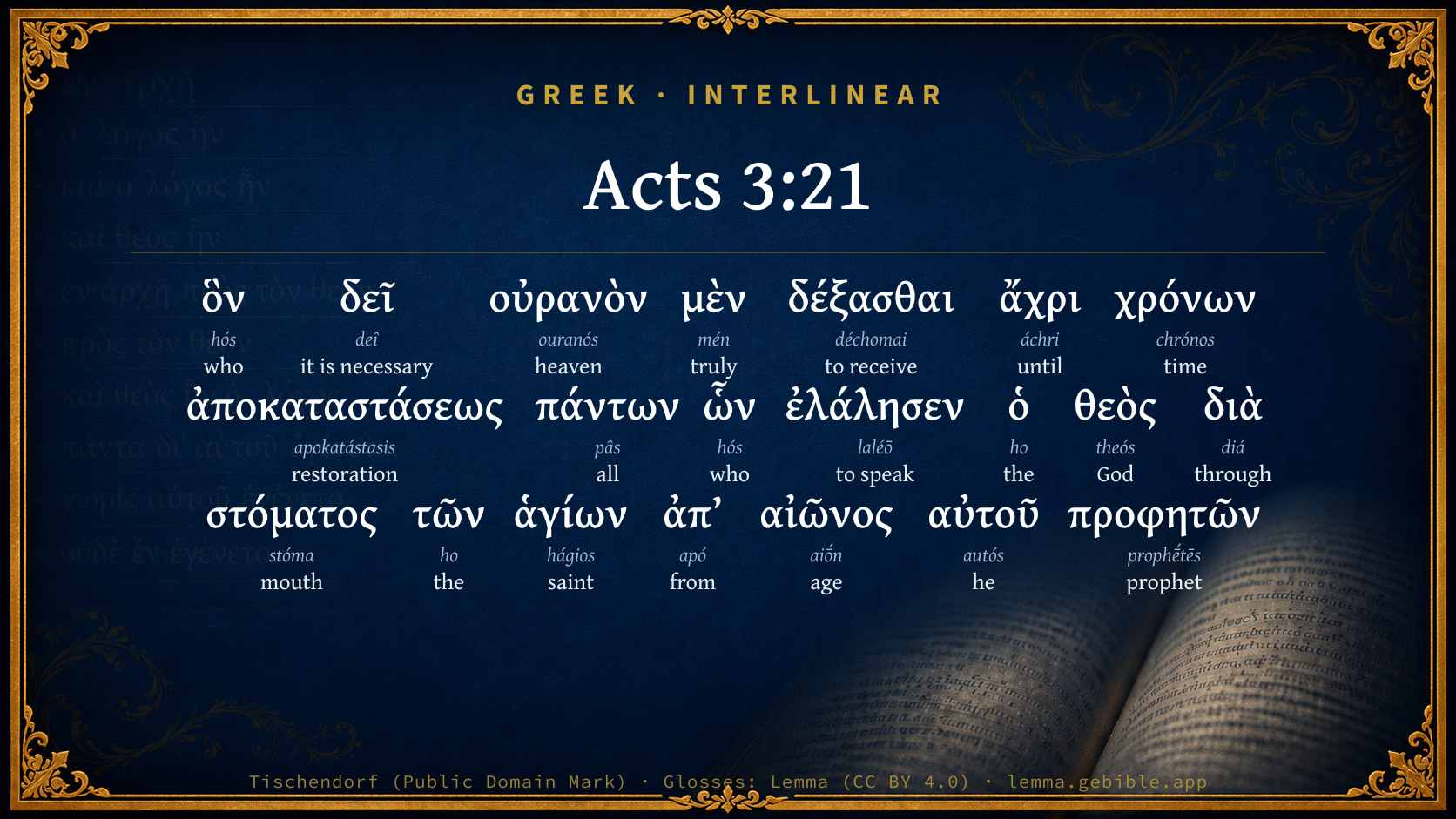
Download image
Cite this verse

Acts 3:21 (World English Bible). Public Domain. Lemma interlinear Bible study tool, https://lemma.gebible.app/v/acts/3/21.

Show BibTeX & RIS
BibTeX
RIS
English Translation
whom heaven must receive until the times of restoration of all things, which God spoke long ago by the mouth of his holy prophets.
World English Bible · Public Domain
Highlights
  • 1 hapax legomenon — only here in the Greek New Testament
  • 1 first appearance in the Greek New Testament
Full analysis ↓
Download a study sheet

One document with this verse’s original text, its word-by-word gloss line, the meaning frame, cross-references with their text, attributed commentary, and full source and license credits — printable, and it pastes into notes with its structure intact.

This verse Autodidact and up

Study sheet (.html) Plain text (.txt)

A passage Seminary Student

Up to 50 verses in one chapter. A passage sheet keeps up to 6 commentary sources and 12 cross-references per verse, in the order this page ranks them, and says so on the sheet whenever that leaves anything out. Ask for a single verse and you get the Autodidact verse sheet above.

Everything on this page stays free to read, with no account — the sheet is a download of what is already on screen, not access to it.

Want to remove ads? Support Godless Engineer
Compare translations 3

The same verse in 3 English versions, stacked beneath the original-language interlinear above. Click any original word for its lexicon entry.

Each is an independent rendering of the whole verse — the interlinear is not word-aligned to these translations.

Highlighted words mark where these versions differ — a whole-verse word diff, not a word-by-word alignment.

  • World English Bible Public Domain
    whom heaven must receive until the times of restoration of all things, which God spoke long ago by the mouth of his holy prophets.
  • King James Version Public Domain
    Whom the heaven must receive until the times of restitution of all things, which God hath spoken by the mouth of all his holy prophets since the world began.
  • unfoldingWord Literal Text CC BY-SA 4.0
    whom it is necessary for heaven to receive until the times of the restoration of all things, about which God spoke from the age through the mouth of his holy prophets.

unfoldingWord Literal Text — © unfoldingWord, licensed CC BY-SA 4.0. Word-aligned USFM3 via Door43 (git.door43.org/unfoldingWord/en_ult).

Versions to compare (up to 4)

3 of 4 selected

Show all 19 translations

Every available English version of this verse, each an independent rendering of the whole verse.

  • World English Bible Public Domain
    whom heaven must receive until the times of restoration of all things, which God spoke long ago by the mouth of his holy prophets.
  • Berean Standard Bible Public Domain
    Heaven must take Him in until the time comes for the restoration of all things, which God announced long ago through His holy prophets.
  • Majority Standard Bible Public Domain
    Heaven must take Him in until the time comes for the restoration of all things, which God announced long ago through all His holy prophets.
  • King James Version Public Domain
    Whom the heaven must receive until the times of restitution of all things, which God hath spoken by the mouth of all his holy prophets since the world began.
  • American Standard Version (1901) Public Domain
    whom the heaven must receive until the times of restoration of all things, whereof God spake by the mouth of His holy prophets that have been from of old.
  • Revised Version (1885) Public Domain
    whom the heaven must receive until the times of restoration of all things, whereof God spake by the mouth of his holy prophets which have been since the world began.
  • Geneva Bible (1599) Public Domain
    Whome the heauen must containe vntill the time that all thinges be restored, which God had spoken by the mouth of all his holy Prophets since the world began.
  • Douay-Rheims (1899) Public Domain
    Whom heaven indeed must receive, until the times of the restitution of all things, which God hath spoken by the mouth of his holy prophets, from the beginning of the world.
  • Young's Literal Translation Public Domain
    whom it behoveth heaven, indeed, to receive till times of a restitution of all things, of which God spake through the mouth of all His holy prophets from the age.
  • Literal Standard Version CC BY-SA 4.0
    whom Heaven required, indeed, to receive until times of a restitution of all things, of which God spoke through the mouth of all His holy prophets from the age.
  • Unlocked Literal Bible CC BY-SA 4.0
    He is the One heaven must receive until the time of the restoration of all things, about which God spoke long ago by the mouth of his holy prophets.
  • unfoldingWord Literal Text CC BY-SA 4.0
    whom it is necessary for heaven to receive until the times of the restoration of all things, about which God spoke from the age through the mouth of his holy prophets.
  • Darby Bible Public Domain
    whom heaven indeed must receive till [the] times of [the] restoring of all things, of which God has spoken by the mouth of his holy prophets since time began.
  • World Messianic Bible Public Domain
    whom heaven must receive until the times of restoration of all things, which God spoke long ago by the mouth of his holy prophets.
  • Webster's Bible Public Domain
    Whom the heaven must receive, until the times of restitution of all things, which God hath spoken by the mouth of all his holy prophets, since the world began.
  • Free Bible Version CC BY-SA 4.0
    For he must stay in heaven until the time when everything is restored, as God announced through his holy prophets long ago.
  • Bible in Basic English Public Domain
    Who is to be kept in heaven till the time when all things are put right, of which God has given word by the mouth of his holy prophets, who have been from the earliest times.
  • Text-Critical English NT CC BY 4.0
    Heaven must receive him until the time comes for the restoration of all things, which God declared by the mouths of all his holy prophets long ago.
  • Tyndale New Testament (1534) Public Domain
    which must receave heaven vntyll the tyme that all thinges which God hath spoken by the mouth of all his holy Prophetes sence the worlde began be restored agayne.

Literal Standard Version (2020), Covenant Press — licensed CC BY-SA 4.0. Text via the HelloAO Bible API (eBible.org). Unlocked Literal Bible (unfoldingWord) — licensed CC BY-SA 4.0. Text via the HelloAO Bible API (eBible.org). unfoldingWord Literal Text — © unfoldingWord, licensed CC BY-SA 4.0. Word-aligned USFM3 via Door43 (git.door43.org/unfoldingWord/en_ult). Free Bible Version, Dr. Jonathan Gallagher — licensed CC BY-SA 4.0. Text via the HelloAO Bible API (eBible.org).

Word by word

More ways to search: Search by grammar → Find every occurrence → Compare this word →

Practice this passage: Drill this verse → Learn its vocabulary →

ἀποκαταστάσεως
apokatástasis
G605
“restoration”
Noun, Genitive, Singular, Feminine
Part of Speech
Noun
Case
Genitive
Number
Singular
Gender
Feminine
Full Thayer's Definition

Origin: from G600

TDNT: 07:29,7

1. restoration a. of a true theocracy b. of the perfect state before the fall
  1. ὃν hós G3739 “who” Relative pronoun, Accusative, Singular, Masculine
  2. δεῖ deî G1163 “it is necessary” Verb, Present, Active, Indicative, 3rd person, Singular
  3. οὐρανὸν ouranós G3772 “heaven” Noun, Accusative, Singular, Masculine
  4. μὲν mén G3303 “truly” Particle
  5. δέξασθαι déchomai G1209 “to receive” Verb, Aorist, Middle deponent, Infinitive
  6. ἄχρι áchri G891 “until” Adverb
  7. χρόνων chrónos G5550 “time” Noun, Genitive, Plural, Masculine
  8. πάντων pâs G3956 “all” Adjective, Genitive, Plural, Neuter
  9. ὧν hós G3739 “who” Relative pronoun, Genitive, Plural, Neuter
  10. ἐλάλησεν laléō G2980 “to speak” Verb, Aorist, Active, Indicative, 3rd person, Singular
  11. ὁ ho G3588 “the” Article, Nominative, Singular, Masculine
  12. θεὸς theós G2316 “God” Noun, Nominative, Singular, Masculine
  13. διὰ diá G1223 “through” Preposition
  14. στόματος stóma G4750 “mouth” Noun, Genitive, Singular, Neuter
  15. τῶν ho G3588 “the” Article, Genitive, Plural, Masculine
  16. ἁγίων hágios G40 “saint” Adjective, Genitive, Plural, Masculine
  17. ἀπ’ apó G575 “from” Preposition
  18. αἰῶνος aiṓn G165 “age” Noun, Genitive, Singular, Masculine
  19. αὐτοῦ autós G846 “he” Personal pronoun, Genitive, Singular, Masculine
  20. προφητῶν prophḗtēs G4396 “prophet” Noun, Genitive, Plural, Masculine

About this verse

These counts appear in no published source. They are computed here, from the morphology-tagged text and Lemma’s own curated glosses. What Lemma adds →

21
words
19
distinct lemmas
Acts
section

Notable vocabulary

1 hapax legomenon — a word that appears only here in the entire Greek New Testament:

  • ἀποκαταστάσεως restoration G605

First appearance in Scripture

This word makes its first canonical appearance in the Greek New Testament here:

  • ἀποκαταστάσεως restoration G605

Shared distinctive vocabulary

ἄχρι until G891 occurs in 49 verses of the Greek New Testament. Also found in:
Repetition

Words recur within this verse:

Cross-references

13

Topical passages linked to Acts 3:21 in the Treasury of Scripture Knowledge — connected by theme and wording, ordered by reader-vote popularity; previews shown in the World English Bible.

  • Romans 8:21 that the creation itself also will be delivered from the bondage of decay into the liberty of the glory of the children of God.
  • Isaiah 1:26 I will restore your judges as at the first, And your counselors as at the beginning. Afterward you shall be called 'The city of righteousness, A faithful town.'
  • Acts 1:11 who also said, "You men of Galilee, why do you stand looking into the sky? This Jesus, who was received up from you into the sky will come back in the same way as you saw him going into the sky."
  • Malachi 4:5–6 Behold, I will send you Elijah the prophet before the great and terrible day of Yahweh comes.
  • Mark 9:11–13 They asked him, saying, "Why do the scribes say that Elijah must come first?"
  • Matthew 17:11–12 Jesus answered them, "Elijah indeed comes first, and will restore all things,
  • Luke 1:70 (As he spoke by the mouth of his holy prophets who have been from of old),
  • Revelation 22:6 He said to me, "These words are faithful and true. The Lord God of the spirits of the prophets sent his angel to show to his bondservants the things which must happen soon."
  • 2 Peter 3:2 that you should remember the words which were spoken before by the holy prophets, and the commandments of us, the apostles of the Lord and Savior:
  • Malachi 3:3–4 and he will sit as a refiner and purifier of silver, and he will purify the sons of Levi, and refine them as gold and silver; and they shall offer to Yahweh offerings in righteousness.
  • Acts 10:43 All the prophets testify about him, that through his name everyone who believes in him will receive remission of sins."
  • 2 Peter 1:21 For no prophecy ever came by the will of man: but holy men of God spoke, being moved by the Holy Spirit.
  • Revelation 18:20 Rejoice over her, O heaven, you saints, apostles, and prophets; for God has judged your judgment on her."

Cross-references courtesy of OpenBible.info (CC BY 4.0).

Where the printed editions differ

1 variant

Places in this verse where the major printed Greek editions disagree on the wording in a way that affects the translation — a comparison of editions, not a manuscript-by-manuscript collation. The editions are the modern critical texts (Nestlé-Aland 28/27, SBL, Westcott-Hort, Tregelles, Tyndale House) and the traditional texts behind the KJV (the Textus Receptus and the Byzantine/Majority text). It is not a claim about which reading is original.

  1. Extra text
    πάντων

    “of all”

    In TRByz Not in NA28NA27TynSBLWHTreg

    πάντων (pantōn) 'of all' is only in traditional manuscripts (TR+Byz)

Textual data: Translators Amalgamated Greek New Testament (STEPBible TAGNT) · CC BY 4.0.

Commentary

Notes on Acts 3:21 from classic Christian and Jewish commentators (each source and its license shown beneath its notes). The classic Christian expositions comment on the surrounding passage and are grouped to its opening verse, so a note may address several verses; the Jewish commentaries on the Tanakh (Rashi and others) are per-verse, so they appear only where the commentator wrote on this verse.

Lemma curates 59 commentaries, every one of them public domain or Creative Commons licensed, each selected and text-cleaned for this edition rather than reprinted as found. About our sources →

The Biblical Illustrator

Joseph S. Exell

Act_3:21

Whom the heavens must receive until the times of restitution of all things.

Times of restitution of all things

The times seem distinguished from the seasons as more permanent. This is the only passage in which the word translated restitution is found in the New Testament; nor is it found in the LXX. version of the Old. Etymologically, it conveys the thought of restoration to an earlier and better state, rather than that of simple consummation or completion, which the immediate context seems, in some measure, to suggest. It finds an interesting parallel in the new heavens and new earth--involving, as they do, a restoration of all things to their true order--of 2Pe_3:13. It, does not necessarily imply, as some have thought, the final salvation of all men, but it does express the idea of a state in which righteousness, and not sin, shall have dominion over a redeemed and new-created world. The corresponding verb is found in the words, Elias truly shall come first, and restore all things (Mat_17:11); and St. Peters words may well be looked on as an echo of that teaching, and so as an undesigned coincidence testifying to the truth of St. Matthews record. (Dean Plumptre.)

The golden age--the restitution of all things

1. Restitution means the setting up again of that which has been thrown down. When a fallen pillar is restored to its position; or a plant, blown down, or crushed, regains its upright attitude; when a building, overthrown, is rebuilt--there is a restitution.

2. In the universe there has been a great overturning. The course of history seems to be a succession of failures--God setting up, some other power casting down. And, apart from revelation we could not tell what the end of all things would be. In the Word of God we have the assurance of a restitution--a setting up again of all things--a restoration out of the old, but higher than the old--the same and yet different. The city shall be builded upon her own heap, and the palace shall remain after the manner thereof.

I. The restitution of nature. In the beginning God created the heavens and the earth--garnished with wisdom; blessed with love; and, surveying the whole, He pronounced it very good. But through the introduction of evil, a curse soon fell upon creation, and the earth underwent some change, in respect of its beauty and fertility. The world is regarded as full of beauty, notwithstanding its barren deserts, etc.; but had sin never entered, it would have been a scene of order and peace far surpassing our conception. The Cosmos we behold bears traces everywhere of great convulsions; and in this respect nature has been called a born ruin. There are revolutionary forces which, if let loose, would rend creation asunder. Meantime these forces check each other; only occasionally are we reminded of their power by a quaking of the earth, or a peal of thunder. But the day is coming when these forces will overleap their present bounds, and involve universal nature in a catastrophe. The two agents appointed by God to work great physical and moral revolutions are water and fire. God has already employed water to change the face of the earth, and the current of history. The other agent to be employed in the destruction of the world is fire (2Pe_3:10-14). Part, then, of the restitution of all things consists in the restitution of nature. In the beginning of revelation we see Gods first work set up, but soon thrown down, or marred. In the end we read of its being set up again in higher form: I saw a new heaven and a new earth, etc. The first creation was cursed, but in the second creation there shall-be no more curse. The first creation has thorns and thistles, but with regard to the second, Instead of the thorn shall come up the fir-tree, etc. The restitution will be not merely a return to primeval beauty, but the introduction of a far higher beauty. For then the light of the moon shall be as the light of the sun, etc. Involved in the restitution of nature is the restitution of Paradise, The Lord God planted a garden, etc. In this there was a perfect combination of the useful and the beautiful. It had trees pleasant to the sight and good for food. A river, also, went out of Eden to water the garden. And so in the midst of Paradise restored there is the tree of life, with twelve manner of fruits, etc., and a pure river of water of life, etc.

II. The restitution of man. This is intimately connected with the restitution of nature, as Paul shows in Rom_8:1. Look at man in his first estate. He was made in the image of God in nature and will. He possessed the glorious but perilous gift of liberty. And how did he demonstrate his freedom? Not as God had done in the production of good, but as Satan had done in the production of evil. He showed himself to be free by an act that destroyed his freedom. He was a broken creature, smitten with death. Being spiritually dead, temporal and eternal death was the necessary result. Besides, when man lost the image of God, he lost the sovereignty of nature, and having this dominion, he must have had powers vastly greater than those which remained with him after the fall. But man, the broken image of God, is to be restored. Man, the dethroned and prostrate monarch of nature, is to be reinstated in his sovereignty. This restitution begins in time, as a renewal of the spirit. At the resurrection the body is set up again in a far higher form, like the glorified body of the Redeemer. Then, too, the image of God being perfectly restored, man will enter on his true sovereignty again. The believer will be made a king and a priest to God.

2. All this was seen to be accomplished in Christ, as the representative man. He took up the work at the point of ruin to which man had brought it, and from that regained all that man had lost. He magnified the law which man had despised; and fulfilled all righteousness. He encountered the tempter, and defeated him. The first temptation took place in a garden, and the result was that man was driven into the wilderness. Jesus resumes the conflict in the wilderness in order to restore the garden. He Himself is the image of God, and shows that He is in possession of the lost sovereignty over nature. When He was in the wilderness it is recorded that He was with the wild beasts, who lost their ferocity and rebellion in His presence. In this we have a passing glimpse of mans returning dominion over the lower creation; of the time when the wolf shall dwell with the lamb, etc.; just as His miracles, manifesting His power over inanimate nature and the body of man, were a prophetic fulfilment of the great aspiration and effort of the human mind to regain the mastery of nature.

III. The restitution of society. We find much reformation wanted here. Next to the great question--How shall man be just with God?--is the question, On what terms shall he live with his fellow-men? It is the problem of government. Next to the salvation of the individual is the construction of society. The disturbing element in humanity does not lie primarily in forms of government, but in the individual soul; and, therefore, all attempts to regenerate man from without, by ameliorating his circumstances merely, or placing him under a new political arrangement, have failed; for the root of all rebellion is the unrenewed heart. For a machine to work perfectly--even supposing the machine itself to be perfect--there are required honest and competent men to work it; and, therefore, Christianity begins with the individual, and regenerates society from that point.

1. The first form of society is that of the family. Here we have the nursery of all other forms. If families are godless the Church cannot be prosperous. If they are immoral the city cannot be safe. If they are dis-organised the State cannot be strong. But what a dark tragedy broke up the first society of this kind! As we come down the stream of sacred history, we see that God always sets up His work again in the midst of some particular family. In the family of Noah the race makes a new start. In the families of Abraham, Isaac, and Jacob a new covenant of grace is established. In the family of David the kingdom of the Jews is confirmed. In the house at Nazareth the foundation of Christendom is laid. But existing families are ever being broken up and dispersed. The institution itself, however, is a Divine idea that cannot perish, and in the restitution of all things the family reappears. God is revealed as the Father of Christ, of whom the whole family in heaven and earth is named.

2. Next to the family is the city. Cain, who destroyed the first family, was the founder of the first city; an acknowledgment that man was no longer at home with nature; a city being a fortified place, surrounded by walls, to keep out intruders. Now, what man founded, God has adopted. After His people had wandered in the wilderness He led them to the promised land, and there built that famous capital of the old theocracy, Jerusalem. It was called the City of God, the Holy City. But it was ultimately visited by a terrible overthrow. But the city shall be built on her own heap. In the restitution of all things a new Jerusalem rises into view, a city which hath foundations, whose builder and maker is God. Christ has gone to the unseen world to prepare many mansions for His people; and in the revelation given to John there are glimpses of That great city, the holy Jerusalem.

3. Next to the city is the empire, or union of cities and states. Very early the idea of universal empire took possession of the human mind, and in the immense tower erected on the plain of Shinar we have the first embodiment of that idea. In the very attempt to make such a huge confederation they were more divided than before. Their impious attempt brought down upon them a judgment that revealed their real but originally-hidden incongruities. Thus the first Babel prophesied the fate and gave its very name to subsequent systems, political and religious, which have attempted the impossible task of founding a universal empire, or Church on a false and godless principle. In itself, however, the idea of a universal empire is not false but true. The true tendency of the world is to reach a confederation of men, or parliament of the world, notwithstanding national differences. The discoveries of science and the reciprocities of commerce are aiming, consciously or unconsciously, at this stupendous result; which, however, they cannot gain by themselves. The highest end of science and commerce is to herald the kingdom of Christ, which carries in its bosom the highest law--the law of God, and the charter of universal freedom. The idea of the Church is that of a universal brotherhood under the fatherhood of God; and the realisation of this is the splendid goal of humanity. Christ is King of kings and the Lord of lords, and everywhere it is foretold that His kingdom will be universal and eternal. (F. Ferguson, D. D.)

Restoration

I. The restitution of all things will be a clearing away of suffering. This is the special point of that mysterious passage in Rom_8:1-39. in which Paul speaks of the earnest expectation of the creature. We see the creature, rational and irrational, subjected to vanity; to a condition of anxiety and toil, unrest, disease, death; not willingly--by no act or choice of its own--generation inheriting from generation its heirloom and entail of distress; and this, St. Paul adds, by the fiat of One who laid it under this subjection--we suppose him to mean, as the penalty of sin; yet that sin is not its own, that penalty not removable by present obedience, but having to be endured, to the bitter end, even by the innocent. The thought pressed upon the apostle, as it presses upon us. And he has one and but one escape from charging God foolishly. He adds, with an emphasis which no power of voice and no skill of enunciation can satisfy, the two brief words, in hope; and goes on to explain that even before this distressed and disconsolate creature there lies a future of emancipation. Then shall it remember no more the anguish, in the joy of a delivery and the transport of a new life. We would detain the apostle and interrogate him concerning these dark sayings. We would ask, Is it of earth as the scene of a future, an everlasting inhabitation; is it of a race of nature, to be cleared of sterility and unfruitfulness; is it of irrational creatures, by man requited too often with neglect or cruelty, that the words are written, The earnest expectation of the creature waiteth for the unveiling of the sons of God? Or does restitution mean that nations, ignorant of Christ, destitute of the gospel, shall then, in some wonderful manner, walk in the light of it? But there is no voice nor any to answer us in these perhaps presumptuous questionings. Thou hast Moses and the prophets, Christ and the apostles--hear them. Soon shalt thou, faithful unto death, be reading these mysteries right in the very sunshine of the smile of God. Meanwhile, what is that to thee? Christ says, follow thou Me. Earth shall be restored to its original beauty; its face shall be wiped from tears, its scarred and seamed countenance shall be radiant again with a more than Eden loveliness: for it is one of those all things which must receive restitution when the heaven which has received Him shall send Jesus back.

II. Man, his soul and body, his very being and life, is among these all things which are awaiting a restoration. Set before the minds eye the character which you most admire, the person whom you best love--can anything but blind idolatry paint even him to you as perfect? But supposing that the very qualities which you love in their imperfection were but intensified and glorified; that the only change were in the refining away of the dross and alloy of the thing loved, would not the perfecting be a gain unmingled, the restoration a joy unspeakable and full of glory? And if it has happened to any one to behold the gradual overclouding of magnificent faculties--the growth of small imperfections, till the result was almost the unloveliness of the lovely; if it has been yours to stand finally by the grave, and bury out of your sight, a face and a form once all but Divine to you, surely you have felt then that the one solace for the loving must be the thought of the restoration, in soul and body, of the loved. But if this be true in cases of exceptional loveliness, how shall it be in the average experiences of human character and attainment? Where is the man not soiled and spoilt by imperfections? What shall we say of faults and blemishes, of follies and meannesses, of failures and irresolutions and broken vows, as we are conscious of them within? Who that has seriously tried the struggle to be holy has not found himself vexed and irritated, if not reduced to despair, by perpetual failure? But if it be so, that I, this faulty man, ever failing, halting, vanquished--seeming to make no way in the race of duty, and purity, and eternal life--shall yet certainly, if I continue to fight, be more than conqueror when I die; shall be clean, sanctified wholly, filled with peace and love, made anew in more than all the thoroughness of the first perfection, when God looked upon all the work of His hands and beheld it very good; then I will arise, if need be, from a thousand falls in one day, cast down but not destroyed, to say, Rejoice not over me, O mine enemy, for greater is He that is for me than all that can be against me.

III. That restitution of all things which thus affects earth and the man has an aspect towards God. If there be one thing clear in the Scripture narrative, it is the nearness of God to the as yet sinless Adam. The hiding from God, the expulsion from Paradise, the subsequent approach through sacrifice, the first calling upon the name of the Lord, which is mentioned as a feature of the exile--are all so many hints of a change in the facility, the nearness, and the constancy of access to God. The whole history of the race, the whole experience of the life, has been the commentary upon this parable. The sinner has been in hiding from the face of God. Calling upon Him has been an effort. Sin has made it so. Now it is one of the express revelations of the times of refreshing, that then the conscious presence, the spiritual Sheehinah, the Divine companionship, will be restored. I heard a great voice out of heaven, saying, Behold, the tabernacle of God, etc. The greatest of the restitutions will be the restoration of Gods presence. In the prospect of admission into the very presence of God, let us be willing to endure now the difficulty of the pursuit and the delay of the attainment. Every moment now spent in seeking God is an earnest of the time when we shall have found. (Dean Vaughan.)

The Biblical Illustrator, edited by Joseph S. Exell (c. 1880s–1900s) — public domain. Text from a community e-Sword module.

Whedon's Commentary on the Bible

Daniel D. Whedon

21. Heaven must receive—The Jews held but one coming of Christ, and Peter, in order to correct their view, declares that he must remain in heaven until a second advent. There was a great debate among expositors whether, according to the Greek, Jesus was to take possession of heaven or heaven was to receive him. The former is the loftier expression; but the latter, as impartial scholars generally agree, is the better Greek.

Times of restitution of all things—Great differences of opinion have existed in regard to the nature of this restitution, and consequently in regard to the meaning of this entire verse.

1. The millenarian view of a renovation of the earth at Christ’s second coming, and the resurrection of the righteous dead gloriously to reign with Christ a thousand years before the resurrection and judgment of the wicked. To all this an obvious objection is, that this could be no restoration of all things, since the vast majority of the dead are not restored to life, and ultimate justice is not done in the earth.

2. A better view, well elucidated by Limborch and, lately, by Dr. Fairbairn, relieves this difficulty. It supposes the resurrection of all the dead and the general judgment, in which all things are restored to the absolute reign of God. Thereby the very first prophecy that Satan’s head should be bruised by the seed of the woman is completely fulfilled, and all the prophetic announcements of God’s judgment in righteousness revolve their final consummation.

3. But to both these interpretations of the word restitution there are serious objections. First, by way of Greek criticism, we may say that in the phrase παντων ων, all things which, it is perfectly inadmissible that a writer or speaker should not see that the reader or hearer would naturally, from the very sound, unite them (“by attraction,” as grammarians say) as antecedent and relative. Which, therefore, cannot refer to times, but to all things. Second, such a phrase as times… which God hath spoken—(making times the antecedent of which) is neither Greek nor English. What can be meant by times… spoken? Spoken must require for its object some sort of utterance. We cannot speak times, but only words. Third, we are forced hereby to a meaning of the Greek αποκαταστασις, given by Hesychius, namely, fulfilment, or consummation, or, rather, as the noun is a verbal one, fulfilling or consummating. And then we have the clear meaning: until (or rather during) the times of the fulfilling of all things… spoken… by his prophets. Fourth, this translation alone renders the connection with the following verse immediate and natural. By either of the former constructions the thought has landed us at the close of Act_3:21 beyond the second advent; whereas, as will be shown in our next notes, the real stand-point of Act_3:22-24 is, in these days. Until—Until, αχρι, an event may be until its beginning or until its close. Thus in Act_20:6, we have in the Greek until five days, that is, during or until the end of five days. And Act_12:11 until (the end of) a season. And so we here render it until (the end of) or during the fulfilling of all things spoken by the mouth of all his holy prophets. Christ shall come at the closing up of the great Messianic ages to which all prophecy points since the world began.

The word restoration, that is, recovery from a depreciated state to a former better, very easily verges into the sense of fulfilment or verification. When a promise or prediction is made, the author of it commits his veracity or fidelity to the accomplishment of the result, and the fulfilment, as we say, makes it good, restores the committed veracity to its unquestioned state. So the fulfillment of all the prophecies is the making good, the restoration of their pledged veracity to its uncommitted state. This interpretation is imperatively required: 1. By the correspondence with Act_3:18. There Christ’s sufferings are declared to be a fulfilment required by all prophecy, and here his stay in heaven is in fulfilment of all prophecy, which furnishes a solution of the difficulty why the Messiah is gone to heaven, and tells how long he is to be absent. 2. By Christ’s prediction of the earth-wide spread of the preached Gospel, Act_1:8; by the universality of the pentecostal symbols, (Note on Act_2:4;) and by Peter’s intimation in his former speech Act_2:39. And all these points are in conclusive disproof of what Renan claims, and even Pressense too forwardly admits—the positive apostolic belief of the immediateness of the second advent. (See supplementary note to Matthew 25.) Since the world began—A very unsuitable rendering of the Greek απ αιωνος, from of old. (See note on Luk_1:70.) Same Greek phrase at Act_15:18.

Daniel D. Whedon (gen. ed.), Commentary on the Old and New Testaments (1874–1909) — public domain. Text from a community e-Sword module.

Bengel's Gnomon

Johann Albrecht Bengel

Act 3:21. Ὃν δεῖ οὐρανὸν μὲν δέξασθαι, who must indeed receive heaven [but Engl. Vers. whom the heaven must receive]) The particle μὲν, indeed, has the place of its Apodosis, which usually is expressed by δὲ, but, in this instance supplied in the ἀποστείλῃ, He may send, in Act 3:20. To be taken, i.e. confined, shut up, or contained within heaven, is a violent interpretation, as though the heaven were greater than Christ; and is inimical to the loftiness of Christ, who “ascended up far above all heavens,” Eph 4:10. It might however be said, not without a reasonable sense, the heaven receives Christ; it admits and acknowledges Him, viz. [not as containing Him, but] as a throne does its legitimate king, although Christ previously was humbled, and was not yet recognised by the world. But much more august and consonant to the language of Scripture is this sentiment, Christ takes or receives for Himself heaven; and so σὐρανὸν more appropriately also [than in the other interpretation] is without the article. It is the same as λαβεῖν βασιλείαν, to receive a kingdom, Luk 19:12, and βασιλεύειν, to reign, 1Co 15:25. Nor is the force of the verb δέχομαι opposed to this view, as if the heaven ought to be the thing containing, wherein Christ should be contained. Basilius of Seleucia, Or. 11, writes, δέχεται ἡλίας καταγώγιον ἁμαρτίας ἐλεύθερον: and not dissimilar is that in Or. 14, πῶς ὁ οὐρανὸς σαγηνεύεται. Let those instances be added, which E. Schmidius has brought forward on this passage: οὐκ ἦλθες ἐν δέοντι, δέξασθαι δόμους, thou hast not come seasonably, to take (occupy) this house; and Demosthenes, οὐδὲ διδόντων ὑμῖν τῶν καιρῶν Ἀμφίπολιν δέξασθαι δύναισθʼ ἄν, not even if the opportunity itself should give you Amphipolis, would you be able to lay hold of it. Furthermore, the verb δέξασθαι has this emphasis, that it denotes a thing offered to us. For the Father said to the Son, Take possession of heaven, Sit at My right hand, Sit on My throne which is heaven. In fine, δέξασθαι, to receive or take to Himself, has an inceptive notion, and yet it is said in the present δεῖ, it behoves, not ἔδει, it behoved; although the Ascension had taken place not yesterday or the day before. In fact, Peter speaks concerning a fact which, as compared with His glorious advent from heaven, was still as it were present, especially in relation to His hearers, who were even now approaching to the faith.—ἄχρι χρόνων ἀποκαταστάσεως, until the times of restitution shall come) i.e. until they (these times) shall be fulfilled. So ἄχρις ἡμερῶν πέντε, in five days (“ipsos quinque dies”), ch. Act 20:6: ἄχρι χαιροῦ, for a season, ch. Act 13:11. Similar phrases occur, Luk 21:24; Gal 4:2; Heb 3:13; Rev 7:3; Rev 15:8; Rev 17:17; Rev 20:3. Peter comprises the whole course of the times of the New Testament between the Ascension of the Lord and His Advent in glory, times in which that apostolic age shines forth pre-eminent, Act 3:24, as also corresponding to it the condition of the Church, which was to be constituted of Jews and Gentiles, together, [32] Justus Jonas says, “Christ is that King, who has now received heaven, reigning in the meantime through the Gospel in the Spirit, until all things be restored, i.e. until the remainder of the Jews and the Gentiles be converted.” Romans 11. Ἀποκατάστασις is the restitution of things from their confusion into their former order. You will say, Were then all things at any time in such a state as that to which they are to be restored? Answer: 1) They were, at least as far as concerns their beginnings: comp. Mat 17:11, “Elias truly shall first come and restore all things:” for which reason the apostles also above used this verb, ch. Act 1:6, “Wilt Thou at this time restore again the kingdom to Israel?” 2) There is a reference to the Divine intention and promise: as a man born blind is said to recover his sight, because the sight is a natural blessing. Weigh well the word השיב ἀποκαθίστημι, Jer 16:15; Jer 24:6; Jer 50:19; Eze 16:55. The restoration of all things shall be accomplished, when all enemies shall be the footstool of Christ: 1Co 15:25; a consummation which is being gradually accomplished now, and shall be quickly brought about at some future time.—πάντων, of all things) The universal whole is opposed to heaven, as to a part of that whole.—ὯΝ) for Ἃ, which,—ἐλάλησεν, spake) נאם, spake [made a solemn declaration, Jer 23:31].—[τῶν ἁγίων, the holy) All the prophets were holy: they all entered heaven, Luk 13:28. They who are rejected as “workers of iniquity” were not prophets, even though they uttered prophecies: Mat 7:22, “Have we not prophesied in Thy name?” with which comp. Joh 11:51: Caiaphas’ prophecy as to Jesus’ “dying for the people.” Balaam was no doubt a prophet, but not in Israel, but only in relation to (penes) Balak.—V. g.]—προφητῶν, prophets) Moses, Act 3:22, and the rest, Act 3:24. To this the ΓᾺΡ, for, is to be referred, Act 3:22.

[32] So that the times of restitution comprise the existing Church as well as the future.—E. and T.

Bengel's Gnomon of the New Testament — English translation (T&T Clark, Edinburgh, 1860) — public domain. Text from a community e-Sword module.

Meyer's Critical & Exegetical Commentary

Heinrich August Wilhelm Meyer

Act_3:21. Whom the heaven must receive (as the place of abode appointed for Him by God until the Parousia). Taken thus,[146] οὐρανόν is the subject (Beza, Piscator, Castalio, and others, the Socinians, also Kuinoel, de Wette, Baumgarten, Lechler, Hackett), and ΔΕῖ does not stand for ἜΔΕΙ, as if Peter wished historically to narrate the ascension; but the present tense places before the eyes the necessity of the elevation of Christ into heaven as an absolute relation, which as such is constantly present until the Parousia (Act_3:20, and ἄχρι χρόνων κ.τ.λ., Act_3:21). Hence also the infinitive is not of the duration of the action (ΔΈΧΕΣΘΑΙ), but of its absolute act (ΔΈΞΑΣΘΑΙ) Others find the subject in ὅν: who must occupy heaven (so Luther and many of the older Lutherans, partly in the interest of Christs ubiquity; also Bengel, Heinrichs, Olshausen, Lange, Weiss, et al.); Christus coelum debuit occupare ceu regiam suam, Calovius. But against this view the linguistic usage of δέχεσθαι, which never signifies occupare,[147] is decisive. Comp. on the other hand, Plat. Theaet. p. 177 A: τελευτήσαντας αὐτοὺς ἐκεῖνος μὲν ὁ τῶν κακῶν καθαρὸς τόπος οὐ δέξεται, Soph. Trach. 1075: ὦναξ Αἵδη δέξαι με. Occupare would be κατέχειν. Comp. Soph. Ant. 605: κατέχεις Ὀλύμπου μαρμαρόεσσαν αἴγλαν.

On the ΜΈΝ solitarium Grotius aptly remarks, that it has its reference in ἄχρι χρόνου ἀποκαταστ., quasi dicat: ubi illud tempus venerit, ex coelo in terras redibit.

ἌΧΡΙ ΧΡΌΝΩΝ ἈΠΟΚΑΤΑΣΤ. ΠΆΝΤΩΝ] until times shall have come, in which all things will be restored. Before such times set in, Christ comes not from heaven. Consequently the times of the αἰὼν ὁ μέλλων itselfthe ΚΑΙΡΟῚ ἈΝΑΨΎΞΕΩςcannot be meant; but only such times as shall precede the Parousia, and by the emergence of which it is conditioned, that the Parousia shall ensue. Accordingly the explanation of the universal renewal of the world unto a glory such as preceded the fall (παλιγγενεσία, Mat_19:28; comp. Rom_8:18 ff.; 2Pe_3:13) is excluded, seeing that that restoration of all things (πάντων) coincides with the Parousia (in opposition to de Wette, as well as many older expositors, who think on the resurrection and the judgment). The correct interpretation must start from Mal_4:6 as the historical seat of the expression, and from Mat_17:11, where Christ Himself, taking it from Malachi, has made it His own. Accordingly the ἈΠΟΚΑΤΆΣΤΑΣΙς ΠΆΝΤΩΝ can only be the restoration of all moral relations to their original normal condition. Christs reception in heaventhis is the idea of the apostlecontinues until the moral corruption of the people of God is removed, and the thorough moral renovation, the ethical restitutio in integrum, of all their relations shall have ensued. Then only is the exalted Christ sent from heaven to the people, and then only does there come for the latter the ἀνάψυξις from the presence of God, Act_3:20. What an incitement neither to neglect nor to defer repentance and conversion as the means to this ἈΠΟΚΑΤΆΣΤΑΣΙς ΠΆΝΤΩΝ! The mode in which this moral restitution must take place is, according to Act_3:22, beyond doubt,namely, by rendering obedience in all points to what the Messiah has during His earthly ministry spoken. Observe, moreover, that πάντων is not masculine (Weiss, Petr. Lehrbegr. p. 85, and bibl. Theol. p. 145), but neuter, as in Mat_17:11, Mar_9:12 (comp. Act_3:22, κατὰ πάντα, ὅσα); and that ἈΠΟΚΑΤΆΣΤΑΣΙς cannot be otherwise taken than in its constant literal meaning, restoration (Polyb. iv. 23. 1; v. 2. 11; xxvii. 10. 7; Dion. Hal. x. 8; also Plat. Ax. p. 370), wherein the state lost and to be restored is to be conceived as that of the obedience of the theocracy towards God and His messenger (Act_3:22). The state of forgiveness of sin (Act_3:19) is not identical with this, but previous to it, as ὅπως κ.τ.λ (Act_3:20) shows: the sanctification following the reconciliation.

ὯΝ ἘΛΆΛΗΣΕΝ Κ.Τ.Λ] The attracted ὯΝ refers to ΧΡΌΝΩΝ: of which he has spoken, etc. On λαλεῖν τι, in this sense, comp. Mat_26:13; Plat. Ax. p. 366 D; Soph. Phil. 110. So also λέγειν τι, to tell of something; see Stallbaum, ad Plat. Apol. p. 23 A; Phaed. p. 79 B. Others refer it to πάντων, and explain: usque ad tempus, quo omnia eventum habebunt,[148] quae, etc.; by which Peter is supposed to mean either the conquest of Messiahs enemies and the diffusion of the Christian religion (Rosenmüller, Morus, Stolz, Heinrichs), or the destruction of the Jewish state (Grotius, Hammond, Bolten), or the erection of the Messianic kingdom and the changes preceding it, the diffusion of Christianity, the resurrection of the dead, and the judgment (Kuinoel). Incorrectly, as ἀποκατάστασις, in the sense of impletio, εἰς πέρας ἐλθεῖν (Oecumenius), and the like, is without warrant in usage; and as little does it admit the substitution of the idea realization (Grotius, Schneckenburger in the Stud. u. Krit. 1855, p. 517, Lechler).

ἀπ ̓ αἰῶνος] since the world began, to be taken relatively. See on Luk_1:70.

[146] Gregory of Nazianzus, Orat. 2, de fil., already has evidently this view: δεῖ γὰρ αὐτὸν … ὑπʼ οὐρανοῦ δεχθῆναι, and Oecumenius calls heaven the ἀποδοχὴ τοῦ ἀπεσταλμένου. The Vulgate repeats the ambiguity of the original: quem oportet coelum quidem suscipere; but yet appears, by suscipere, to betray the correct view. Clearly and definitely Castalio gives it with a passive turn: quem oportet coelo capi.

[147] We should have to explain it as: who must accept the heaven (comp. Bengel). But what a singularly turgid expression would that be!

[148] Baumgarten, p. 83, endeavours to bring out essentially the same meaning, but without any change in the idea of ἀποκατάστ., in this way: he supplies the verb ἀποκατασταθήσεσθαι with ὧν ἐλάλησεν, and assumes the kingdom of Israel (Act_1:6) to be meant. To imagine the latter reference, especially after πάντων, is just as arbitrary, as the supplying of that verbal notion is exceedingly harsh. Hofm. Schriftbew. II. 2, p. 648, follows the correct reference of ὡν to χρόνων.

Meyer — Critical and Exegetical Commentary on the New Testament — English translation by Peter Christie, edited by Frederick Crombie (T&T Clark, 1880) — public domain. Text from a community e-Sword module.

Expositor's Greek Testament

ed. W. Robertson Nicoll

Act 3:21 . μὲν : no answering δέ expressed, but the antithesis is found in the ἄχρι χρόνων ἀποκ ., “quasi dicat: ubi illud tempus venerit, ex coelo in terras redibit,” Grotius (so Weiss, Blass). ὅν δεῖ οὐρανὸν δέξασθαι : the words have been rendered in three ways: (1) “whom the heaven must receive,” i.e. , as the place assigned to Him by God until the Parousia, Phi 3:20 , Col 3:4 . In this case δεῖ is not used for ἔδει , as if St. Luke were referring to the past historical fact of the Ascension only, but Christ’s exaltation to heaven is represented as a fact continually present until His coming again; or (2) the words have been taken as if ὅν were the subject, “who must possess the heaven”. But the former seems the more natural rendering, so in A.V. and R.V., as more in accordance with the use of δέχεσθαι , and κατέχειν would be rather the word in the second rendering (see Wendt’s note). Zöckler takes the words to mean “who must receive heaven,” i.e. , from the Father. Here St. Peter corrects the popular view that the Messiah should remain on earth, Joh 12:34 , and if we compare the words with the question asked in Act 1:6 , they show how his views had changed of his Master’s kingdom (see Hackett’s note). ἄχρι χρόνων ἀποκαταστάσεως : the latter noun is not found either in LXX or elsewhere in N.T., but it is used by Polybius, Diodorus, Plutarch. In Josephus, Ant. , xi., 3, 8, 9, it is used of the restoration of the Jews to their own land from the captivity, and also in Philo., Decal. , 30, of the restoration of inheritances at the Jubilee. The key to its meaning here is found not in the question of the disciples in Act 1:6 , but in our Lord’s own saying, Mat 17:11 , Mar 9:12 , “Elias truly first cometh, and shall restore all things,” καὶ ἀποκαταστήσει πάντα , and cf. LXX, Mal 4:6 , where the same verb is found ( ἀποκυταστήσει ). It was the teaching of the Scriptures that Elias should be the forerunner of the Messiah, Mal 4:5 , and Mat 17:11 ; Mat 11:14 . But his activity embraced both an external and an internal, i.e. , a moral restoration, Sir 48:10 . He is said καταστῆσαι φυλὰς Ἰακώβ , to enable those who had been illegally excluded from the congregation to attain their inheritance. But he is eager also for the moral and religious renewal of his people. All disputes would be settled by him at his coming, and chiefly and above all he conducts the people to a great repentance, which will not be accomplished before he comes, Luk 1:16-17 (Mal 4:6 , LXX). This is the inward and moral side of the ἀποκατάστασις , Mat 17:11 , Mar 9:12 . But as in Act 1:6 our Lord had corrected the ideas of the disciples as to an external restoration of the kingdom to Israel, so in the Gospels He had corrected their ideas as to the coming of Elias, and had bidden them see its realisation in the preaching of John the Baptist in turning the hearts of the fathers to the children, and the disobedient to the wisdom of the just. And so the ἀποκατάστασις πάντων had already begun, in so far as men’s hearts were restored to obedience to God, the beginning of wisdom, to the purity of family affection, to a love of righteousness and a hatred of iniquity. Even when the thoughts of the N.T. writers embrace the renewal of the visible creation, the moral and spiritual elements of restoration were present and prominent; cf. 2Pe 3:13 , Rom 8:19-21 , Rev 21:5 . So too the παλινγενεσία , in Mat 19:28 , is joined with the rule which the disciples would share with their Lord, and involved great moral issues. A renewal of all things had no doubt been foretold by the prophets, Isa 34:4 ; Isa 51:6 ; Isa 65:17 ; it was dwelt upon in later Jewish writings, and often referred to by the Rabbis ( cf., e.g., Book of Enoch , xlv., 2; lxii., 1; xci., 16, 17; Apocalypse of Baruch , xxxii., and instances in Edersheim, Jesus the Messiah , ii., p. 343); but even amongst pious Israelites there was always a danger lest their hopes for the future should be mainly associated with material prosperity and national glorification. It is perhaps significant thas Josephus uses the two terms ἀποκατάστασις and παλινγενεσία in close conjunction of the restoration of the Jews to their own land after the exile. How this restoration of all things was to be effected, and what was involved in it, St. Peter does not say, but his whole trend of thought shows that it was made dependent upon man’s repentance, upon his heart being right with God, see Weber, Jüdische Theologie p. 352 ff. (1897); Edersheim, Jesus the Messiah , ii., pp. 343, 706; Hauck’s Real-Encyclopädie , “Apokatastasis,” p. 616 ff. (1896). ὧν refers to χρόνων , so R.V. “whereof,” i.e. , of which times. Holtzmann and Wendt on the other hand refer ὧν to πάντων . But the words of our Lord in Mat 17:11 certainly point to the former reference, and the words are so taken by Weiss, Page, Hackett. In the article from Hauck quoted above, the writer speaks of the reference to χρόνων as the more correct, and points out that if ὧν is the relative to πάντων , the restoration spoken of would no longer be a restoration of all things, but only of those things of which the prophets had spoken. On the prophecies referred to see above. All the words from πάντων to προφητῶν are ascribed by Hilgenfeld to his “author to Theophilus”; the thought of the prophets existing ἀπʼ αἰῶνος (Luk 1:70 ) belongs in his opinion to the Paulinism of this reviser, just as in Luke’s Gospel he carries back the genealogy of Jesus not to Abraham but to Adam. To a similar Pauline tendency on the part of the same reviser, Hilgenfeld refers the introduction in Act 3:25-26 of the promise made to Abraham embracing all the nations of the earth (Gal 3:16 ), and also the introduction of the word πρῶτον (Rom 1:16 ; Rom 2:9 ), to show that not only upon the Jews, but also upon the Gentiles had God conferred the blessings of the Christ; cf. Act 2:39 , where the same revising hand is at work. But St. Peter’s “universalism” here is in no way inconsistent with that of a pious Jew who would believe that all nations should be blessed through Israel , so far, i.e. , as they conformed to the covenant and the law of Israel. Spitta sees no difficulty in referring both the passage before us and Act 2:39 to the Jewish Diaspora (so too Jüngst). διὰ στόματος τῶν ἁγ . προφ .: cf. Luk 1:70 , a periphrasis of which St. Luke is fond (Plummer), cf. Act 1:16 , Act 3:18 , Act 4:25 ; Act 4:30 , Act 15:7 , not found in the other Evangelists except once in St. Matthew in a quotation, Act 4:4 . ἀπʼ αἰῶνος : in the singular the phrase is only used by St. Luke in the N.T., Luk 1:70 , Act 3:21 ; Act 15:18 , but the plural ἀπʼ αἰώνων is used twice, Col 1:26 , Eph 3:9 (Friedrich), cf. in LXX, Gen 6:4 , Isa 46:9 , Jer 35 (28):8. The phrase here may be taken simply = “of old time,” cf. Tob 4:12 .

The Expositor's Greek Testament, edited by W. Robertson Nicoll (1897–1910) — public domain. Text from a community e-Sword module.

Geneva Bible (1599)

Geneva Bible translators

Or, be taken up into heaven.

Geneva Bible (1599) marginal notes — public domain. Text via Bolls.life.

Jamieson, Fausset & Brown

Robert Jamieson, A. R. Fausset & David Brown

until the times--embracing the whole period between the ascension and the second advent of Christ.

restitution of all things--comprehending, probably, the rectification of all the disorders of the fall.

Jamieson, Fausset & Brown — Commentary Critical and Explanatory on the Whole Bible (1871) — public domain (CC PDM 1.0). Text via the HelloAO Bible API.

Adam Clarke's Commentary

Verse 21. Whom the heaven must receive] He has already appeared upon earth, and accomplished the end of his appearing; he has ascended unto heaven, to administer the concerns of his kingdom, and there he shall continue till he comes again to judge the quick and the dead.

The times of restitution of all things] The word αποκαταστασις, from απο which signifies from, and καθιστανειν, to establish or settle any thing, viz. in a good state; and, when απο is added to it, then this preposition implies that this good state, in which it is settled, was preceded by a bad one, from which the change is made to a good one. So in Ac 1:6, when the disciples said to Christ, Wilt thou at this time restore again (αποκαθιστανεις) the kingdom to Israel? they meant, as the Greek word implies, Wilt thou take the kingdom from the Romans, and give it back to the Jews? Now, as the word is here connected with, which God hath spoken by the mouth of all his holy prophets, it must mean the accomplishment of all the prophecies and promises contained in the Old Testament relative to the kingdom of Christ upon earth; the whole reign of grace, from the ascension of our Lord till his coming again, for of all these things have the holy prophets spoken; and, as the grace of the Gospel was intended to destroy the reign of sin, its energetic influence is represented as restoring all things, destroying the bad state, and establishing the good-taking the kingdom out of the hands of sin and Satan, and putting it into those of righteousness and truth. This is done in every believing soul; all things are restored to their primitive order; and the peace of God, which passes all understanding, keeps the heart and mind in the knowledge and love of God. The man loves God with all his heart, soul, mind, and strength, and his neighbour as himself; and thus all the things of which the holy prophets have spoken since the world began, relative to the salvation of any soul, are accomplished in this case; and when such a work becomes universal, as the Scriptures seem to intimate that it will, then all things will be restored in the fullest sense of the term. As therefore the subject here referred to is that of which all the prophets from the beginning have spoken, (and the grand subject of all their declarations was Christ and his work among men,) therefore the words are to be applied to this, and no other meaning. Jesus Christ comes to raise up man from a state of ruin, and restore to him the image of God, as he possessed it at the beginning.

All his holy prophets] παντων, all, is omitted by ABCD, some others, one Syriac, the Coptic, AEthiopic, Armenian, and Vulgate. Griesbach leaves it out of the text, and inserts the article των, which the Greek MSS. have, in the place of παντων. The text reads thus: Which he hath spoken by his holy prophets, c.

Since the world began.] απ αιωνος as αιων signifies complete and ever-during existence or eternity, it is sometimes applied, by way of accommodation, to denote the whole course of any one period, such as the Mosaic dispensation. See Clarke on Ge 21:33. It may therefore here refer to that state of things from the giving of the law; and as Moses is mentioned in the next verse, and none before him, it is probable that the phrase should be so understood here. But, if we apply it to the commencement of time, the sense is still good: Enoch, the seventh from Adam, prophesied of these things; and indeed the birth, life, miracles, preaching sufferings, death, resurrection, ascension, and reign of Jesus Christ, have been the only theme of all prophets and inspired men from the foundation of the world.

Adam Clarke's Commentary on the Bible (1810–1826) — public domain. Text from a community e-Sword/MySword module.

John Calvin's Commentaries

21. Whom the heaven must contain. Because men’s senses are always bent and inclined towards the gross and earthly beholding of God and Christ, the Jews might think with themselves that Christ was preached, indeed, to be raised up from the dead, yet could they not tell where he was; for no man did show them where he was. Therefore Peter preventeth them, when he saith that he is in heaven. Whereupon it followeth that they must lift up their minds on high, to the end they may seek Christ with the eyes of faith, although he be far from them, although he dwell without the world in the heavenly glory. But this is a doubtful speech; because we may as well understand it that Christ is contained or comprehended in the heavens, as that he doth comprehend the heavens. Let us not therefore urge the word, being of a doubtful signification; but let us content ourselves with that which is certain, that we must seek for Christ nowhere else save only in heaven, whilst that we hope for the last restoring of all things; because he shall be far from us, until our minds ascend high above the world.

Until the time of restoring As touching the force and cause, Christ hath already restored all things by his death; but the effect doth not yet fully appear; because that restoring is yet in the course, and se, consequently, our redemption, forasmuch as we do yet groan under the burden of servitude. For as the kingdom of Christ is only begun, and the perfection thereof is deferred until the last day, so those things which are annexed thereunto do now appear only in part. Therefore, if at this day we see many things confused in the world, let this hope set us upon foot and refresh us, that Christ shall once come that he may restore tall things. In the mean season, if we see the relics of sin hang on us, if we be environed on every side with divers miseries, if the world be full of wasting and scattering abroad, let us bewail these miseries, yet so that we uphold with the hope of restoring. And this is the reason why Christ doth not appear by and by, because the warfare of the Church is not yet full, whose time, seeing it is appointed by God, it is not for us to prevent the same.

Which he spoke. I do not expound this of the times alone, but I refer it unto the whole period; so that the sense is this: That whatsoever he had spoken before of the kingdom of Christ is witnessed by all the prophets. Certes, the gospel doth win no small credit hereby, that so soon as God began to show himself to the world, he did always set Christ before them; after that he began to speak unto the fathers, he did always lay this foundation of doctrine. By the same argument Paul commendeth the gospel, both in the beginning of his Epistle to the Romans, (Romans 1:1,) and also in the end, (Romans 16:25,) to wit, that it is no new thing, but promised even from the beginning. This is true antiquity, which is able to purchase credit to doctrine: when as God himself is the author, the holy prophets the witnesses, and the continual course of times confirmeth the testimony. This confirmation was especially necessary for the Jews, who being brought up in the doctrine of the law, ought to admit nothing but that which agreeth therewith. Therefore Peter doth command them only to mind those things which the prophets have testified of Christ.

John Calvin's Commentaries (1540-1563) — public domain. Text from the Calvin Translation Society English edition (1840s-50s) via the Christian Classics Ethereal Library (ccel.org). Calvin's coverage is partial (roughly two-thirds of the Bible); uncommented books and verses are honest gaps, never fabricated. The 19th-century editor's footnotes and remarks are omitted so the notes are faithfully Calvin's own voice.

Ellicott's Commentary for English Readers

(21) Whom the heaven must receive.—The words have a pregnant force: “must receive and keep.”

Until the times of restitution of all things.—The “times” seem distinguished from the “seasons” as more permanent. This is the only passage in which the word translated “restitution” is found in the New Testament; nor is it found in the LXX. version of the Old. Etymologically, it conveys the thought of restoration to an earlier and better state, rather than that of simple consummation or completion, which the immediate context seems, in some measure, to suggest. It finds an interesting parallel in the “new heavens and new earth”—involving, as they do, a restoration of all things to their true order—of 2Pe_3:13. It does not necessarily involve, as some have thought, the final salvation of all men, but it does express the idea of a state in which “righteousness,” and not “sin,” shall have dominion over a redeemed and new created world; and that idea suggests a wider hope as to the possibilities of growth in wisdom and holiness, or even of repentance and conversion, in the unseen world than that with which Christendom has too often been content. The corresponding verb is found in the words, “Elias truly shall come first, and restore all things” (see Note on Mat_17:11); and St. Peter’s words may well be looked on as an echo of that teaching, and so as an undesigned coincidence testifying to the truth of St. Matthew’s record.

Which God hath spoken by the mouth of all his holy prophets.—The relative, if we take the meaning given above, must be referred to the “times,” not to “things.” The words, compared with 2Pe_1:21, are, as it were, the utterance of a profound dogmatic truth. The prophets spake as “they were moved by the Holy Ghost”; but He who spake by them was nothing less than God.

Since the world began.—Literally, from the age—i.e., from its earliest point. The words take in the promises to Adam (Gen_3:15) and Abraham (Gen_22:18). See Note on Luk_1:70, of which St. Peter’s words are as an echo.

A Bible Commentary for English Readers, edited by Charles John Ellicott (1878–1897) — public domain. Text from a community e-Sword module.

The Cambridge Bible for Schools and Colleges

gen. ed. J. J. S. Perowne

21. whom the heaven must receive] and retain, as we are witnesses that He has been taken up into heaven.

until the times of restitution] Better, restoration of all things, i.e. at Christ’s second coming. But this phrase, “the restoration of all things,” is used in two senses in N. T. First it is said (Mat_17:11; Mar_9:12) that Elias must “first come and restore all things.” There it signifies the beginning of Christ’s Kingdom. As Christ’s death was for all men’s redemption, the restoration of all things may be said to have begun then. In the present verse the words have reference to the time when the course of that restoration shall be completed.

which God hath spoken] Better, of which [i.e. times] God hath spoken.

all his holy prophets] All is omitted in the best MSS.

since the world began] See Act_3:18.

The Cambridge Bible for Schools and Colleges (gen. ed. J. J. S. Perowne; Cambridge University Press, 1878–1918) — public domain. Text from a community e-Sword module.

John Gill's Exposition

Whom the heaven must receive,.... Hold and retain in his human nature; and which does not at all hinder or confront his mission, and coming to his people, in the mean while, in a spiritual way and manner, to their joy and comfort: or, "who must receive heaven"; the kingdom, and glory, and reign there:

until the times of the restitution of all things: not of all created beings to their original estate, which there is no reason to believe ever will be; or of the churches of Christ to purity of doctrine, discipline, and conversation, which is to be hoped for, and will be in the spiritual reign of Christ; but of the accomplishment of all promises and prophecies concerning the bringing in the fulness of the Gentiles, and the conversion of the Jews, and so the gathering in all the elect of God; and concerning all the glorious things spoken of the church of Christ in the latter day; which sense is confirmed by what follows:

which God hath spoken by the mouth of all his holy prophets, since the world began: ever since the world was, God has had more or less holy men, set apart and sanctified by him, and on whom he bestowed the spirit of prophecy; and by the mouth of everyone of these he has spoken one thing or another concerning his church and people, and the filling up of the number of them, or the gathering of them all in; and till this is done, Christ will remain in heaven and reign there: and this sense is further confirmed by the Syriac and Arabic versions, the former rendering the words, "until the filling or fulfilling of the times of all things"; and the latter, "until the times which will confirm the perfection of all the words which God hath spoken", &c. and from the sense of the word used, which some lexicographers explain by "perfection" or "fulfilling".

John Gill's Exposition of the Whole Bible (1746–1763) — public domain (CC PDM 1.0). Text via the HelloAO Bible API.

Trapp's Complete Commentary

John Trapp

21 Whom the heaven must receive until the times of restitution of all things, which God hath spoken by the mouth of all his holy prophets since the world began.

Ver. 21. Whom the heavens must receive until, &c.] Note this against the Ubiquitaries, whose error was first broached by Gerson, about the time of the Council of Constance. Afterwards, defended at Paris by Jacobus Faber Stapulensis, A. D. 1524, who was therefore banished the next year out of France. (Scultet. Annul.) But Luther brought it into Germany, Brentins stickled for it, and Smidelinus obtruded it upon many, even against their wills; and was therefore called the apostle of the Ubiquity. The author of the Practice of Piety thus distinguisheth: Secundum esse naturale Christus non est ubique, secundum esse personale Christus est ubique, even the body of Christ. It was objected as a heresy against Thomas Man, martyr, that he had affirmed, That the Father of heaven was the altar, and the second person the sacrament: and that upon the Ascension Day, the sacrament ascended upon the altar, and there abideth still. But what an audacious heretic is he that writes of the "mortality of the soul," to interpret this place thus, "The heavens must contain him," that is, he "must be in the sun;" for he holds that there is no heaven till the resurrection.

Until the times of restitution] This Plato hammered at in his great revolution; when, after many thousands of years, all things shall be again statu quo prius, as they were at first.

John Trapp, A Commentary or Exposition upon All the Books of the Old and New Testament (1647–1656) — public domain. Text from a community e-Sword module.

Albert Barnes' Notes on the Bible

Whom the heavens must receive - The common belief of the Jews was, that the Messiah would reign on the earth forever, Joh 12:34. On this account they would object that Jesus could not be the Messiah, and hence, it became so important for the apostles to establish the fact that he had ascended to heaven. The evidence which they adduced was the fact that they saw him ascend, Act 1:9. The meaning of the expression “whom the heavens must receive,” is that it was “fit” or “proper” δεῖ dei that he should ascend. One reason of that fitness or propriety he himself stated in Joh 16:7; compare Joh 17:2. It was also fit or expedient that he should do it, to direct the affairs of the universe for the welfare of the church Eph 1:20-22, and that he should exercise there his office as a priest in interceding for his people, 1Jo 2:1-2; Heb 7:25; Heb 9:24; Rom 8:34, etc. It is remarkable that Peter did not adduce any passage of Scripture on this subject; but it was one of the points on which there was no clear revelation. Obscure intimations of it might be found in Psa 110:1-7; Psa 16:1-11; etc., but the fact that he would ascend to heaven was not made prominent in the Old Testament. ‘The words “whom the heaven must receive” also convey the idea of “exaltation” and “power”; and Peter doubtless intended to say that he was clothed with power, and exalted to honor in the presence of God. See Psa 115:3. Compare 1Pe 3:22, “Who is gone into heaven, and is on the right banal of God; angels, and authorities, and powers being made subject unto him.” See the notes on Act 2:33.

Until - This word implies that he would then return to the earth, but it does not imply that he would not again ascend to heaven.

The times of the restitution of all things - The noun rendered restitution ἀποκαταστάσεως apokatastaseōs, does not elsewhere occur in the New Testament. The verb from which it is derived occurs eight times. It means properly “to restore a thing to its former situation,” as restoring a “strained” or “dislocated” limb to its former soundness. Hence, it is used to restore, or to heal, in the New Testament: Mat 12:13, “And it (the hand) was restored whole as the other”; Mar 3:5; Luk 6:10. And hence, it is applied to the preparation or fitness for the coming of the Messiah which was to attend the preaching of John in the character of Elias, Mat 17:11; Mar 9:12. Thus, in Josephus (Antiq., Mar 2:3, Mar 2:8), the word is used to denote the return of the Jews from the captivity of Babylon, and their restoration to their former state and privileges. The word has also the idea of “consummation, completion, or filling up.” Thus, it is used in Philo, Hesychius, Phavorinus, and by the Greek Classics. (See Lightfoot and Kuinoel.) Thus, it is used here by the Syriac: “Until the complement or filling up of the times”; that is, of all the events foretold by the prophets, etc. Thus, the Arabic: “Until the times which shall establish the perfection or completion of all the predictions of the prophets,” etc. In this sense the passage means that the heavens must receive the Lord Jesus until all thrums spoken by the prophets in relation to his work, his reign, the spread of the gospel, the triumph of religion, etc., shall have been fulfilled. It also conveys the idea of the predicted recovery of the world from sin, and the restoration of peace and order; the con. summation of the work of the Messiah, now begun, but not yet complete; slow it may be in its advances, but triumphant and certain in its progress and its close.

All things - All things which have been foretold by the prophets. The expression is limited by the connection to this; and of course it does not mean that all people will be saved, or that all the evils of sin can be repaired or remedied. This can never be, for the mischief is done and cannot be undone; but everything which the prophets have foretold shall receive their completion and fulfillment.

Which God hath spoken - Which have been revealed, and are recorded in the Old Testament.

Of all his holy prophets - This does not mean that each one of the prophets had spoken of these things, but that all which had been spoken would be fulfilled.

Since the world began - This is an expression denoting the same as from the beginning, meaning to affirm with emphasis that all the prophecies would be fulfilled. The apostles were desirous to show that they, as well as the Jews, held entirely to the prophets, and taught no doctrine which they had not taught before them.

Albert Barnes' Notes on the Bible (1834–1885) — public domain. Text from a community e-Sword/MySword module.

Haydock's Catholic Bible Commentary

Whom heaven indeed must receive, as also in the Protestant translation not contain: nor can any argument be drawn from hence, that Christ’s body cannot be truly at the same time in the holy Sacrament, especially after a different manner. The true sense of these words is, that heaven is the place of Christ’s abode, till the day of judgment, and that it was in vain for them to think that he would come to take possession of any temporal kingdom. (Witham) --- The restitution of all things. Jesus remains in heaven, till his second coming to judge the living and the dead. That is the great day, when every thing shall be finally settled, and restored to its proper order. He shall avenge the injuries done to God; restore peace to the afflicted just men of the earth, and justice to their persecutors. He shall exalt his Church, and himself receive the homage of adoration, from every tribe of men. (Calmet) --- See 2 Peter iii. 13. which text, together with what we read in this place, joins inseparably the last coming of Jesus Christ, with the universal re-establishment promised in both these passages, and completely excludes the Millennium, which some erroneously expect to take place between the accomplishment of the first and second of these events. See Bossuet’s reflexions on the 20th chapter of the Apocalypse, where the errors of many Protestant writers, especially of Dodwell, are refuted. To shew that the error of the Millennium cannot be assigned as a general cause which impelled the primitive Christians to martyrdom, it will suffice to produce this decisive passage of St. Justin, who after Papias, was the first supporter of that system: speaking to Tryphon concerning this temporal kingdom, which Christ was to enjoy here below, in the re-established Jerusalem with the saints risen from the dead, for a thousand years, he says: "I have already confessed that many others, with myself, were of this opinion; ... but there are many others, and persons of sound faith, and exemplary conduct, who reject this opinion." (In dialog. cum Tryph. n. 84.) --- Clement of Alexandria, St. Cyprian, and Origen, lay down principles diametrically opposite to this system. It has also been expressly combated by Caius, and St. Denis of Alexandria, one of the greatest luminaries of the third century, as we learn from Eusebius, and St. Jerome.

George Leo Haydock (1774–1849), Haydock's Catholic Family Bible and Commentary, 1859 edition — public domain. Excludes Psalms (Douay-Rheims chapter numbering differs from Protestant) and Deuterocanonical books (Catholic canon only).

Matthew Poole's English Annotations

Whom the heaven must receive; that is, contain after it hath received him, as a real place doth a true body; for such Christ’s body was, which was received into heaven: and heaven is the palace and throne of this King of kings and Lord of lords, where he shall reign until he hath put all his enemies under his feet, 1Co 15:25.

Until the times of restitution of all things; or restoration of all things, when all things shall be restored to that condition from which sin put them: for the fall hath maimed and disordered the whole universe; and probably there is not that excellency in any of the creatures which there was at first, before man (for whom they were made) by his sin brought death to himself, and as it were a dead colour over all them; this makes the whole creation groan and travail in pain until now, Rom 8:22. But the end of the world will be a time of restitution of all things unto man especially, who shall be then restored unto God, and to a blessed immortality: for unless this be granted, all their preaching and prophesying was in vain, 1Co 15:14.

Matthew Poole's English Annotations on the Holy Bible (1683–1685) — public domain. Text from a community e-Sword/MySword module.

The Pulpit Commentary

Restoration for restitution, A.V.; whereof for which, A.V.; spake for hath spoken, A.V.; his for all his, A.V. and T.R. Whom the heaven must receive. This is clearly right, not as some render it, who must occupy heaven. The aorist dexasqai seems to point to the moment when, at the Ascension, he was carried up into heaven. (Luk_24:51) The restoration of all things (ajpokatastasewv pantwn). This must be the same operation as our Lord speaks of insei Mat_17:11: "Elias truly shall first come, and restore all things (ajpokatasth panta);" and from the words of Malachi (Mal_4:5, Mal_4:6) it would seem to be a moral or spiritual restoration preparatory to the coming of the Lord. If so, the time of restoration is not exactly synchronous with the times of refreshing, but preparatory to them; preparatory, too, to that restoration of the kingdom to Israel of which the apostles spake to the Lord. (Act_1:6) Probably, however, St. Peter includes in his view the immediately following times of" the presence of the Lord," just as in St. Mark (Mar_1:1) the preparatory mission of John the Baptist is included in the phrase, "The beginning of the gospel of Jesus Christ." Whereof God spake. The antecedent to "whereof" is "the times" (ver. 24).

The Pulpit Commentary (1880–1919), ed. H.D.M. Spence-Jones & Joseph S. Exell — public domain. Text from a community e-Sword module.

John Wesley's Explanatory Notes

Till the times of the restitution of all things - The apostle here comprises at once the whole course of the times of the New Testament, between our Lord's ascension and his coming in glory. The most eminent of these are the apostolic age, and that of the spotless Church, which will consist of all the Jews and Gentiles united, after all persecutions and apostacies are at an end.

John Wesley, Explanatory Notes Upon the Whole Bible (1754–1765) — public domain. Text via the GEBible commentary corpus.

Scofield Reference Notes

C. I. Scofield

restitution

(Greek - ναός = restoration, occurring here and Act 1:6 only. The meaning is limited by the words: "Which God hath spoken by the mouth of all his holy prophets." The prophets speak of the restoration of Israel to the land (see "Israel,"; Gen 12:2; Gen 12:3; Rom 11:26 also "Palestinian Covenant," Deu 30:1-9. (See Scofield "Deu 30:3") and of the restoration the theocracy under David’s Son. (See "Davidic Covenant," 2Sa 7:8-17).

(See Scofield "2Sa 7:16"), "Kingdom," Gen 1:26-28. See Scofield "Zec 12:8". No prediction of the conversion and restoration of the wicked dead is found in the prophets, or elsewhere. CF Rev 20:11-15.

The Scofield Reference Bible (1917 edition), notes by C. I. Scofield — public domain. Text from a community e-Sword module.

Godbey's Commentary on the New Testament

William B. Godbey

21. “Whom it behooveth heaven indeed to receive until the times of the restitution of all things which God spoke through the mouth of his holy prophets from the beginning.” This Scripture reveals the fact most unequivocally that Peter was enthused with the glowing anticipation of seeing his Lord return to the earth, before he exchanged his silver trumpet for a golden harp. This expectation would have been verified if the Pentecostal generation had preached the gospel of the kingdom to every nation, calling out the Bride of Christ and preparing her to meet her coming Lord. In this they failed, thus postponing our Lord’s return. You see here that Jesus is to remain in heaven “until the time of restitution of all things spoken by the prophets from the beginning.” You know the prophets have most unequivocally predicted the restoration of the world back to the Edenic state. The Son of Man “came to destroy the works of the devil.” This world once existed without a devil in it. The prophet John tells us positively that the devil is to be taken out, so we will again have this world without a devil in it as in Eden times. The prophets certify over and over, “The desert shall rejoice and the wilderness bloom”; “Springs of water shall break out in the wilderness and streams in the desert.” Hence the millions of acres of valuable lands in Asia, Africa and America, now desert-wastes for the want of irrigation, will have ample supplies of water and flourish as the very gardens of the Lord, abounding in perennial fruits and flowers. I believe it inspired Peter and all of his apostolical comrades and saints that our Lord is coming back and will “restore all things” as spoken by the prophets. This wonderful sentence (including Act 3:19-21) reveals succinctly, lucidly and comprehensively the gracious economy of full salvation, and in the same breath the return of the Lord to the earth. “What God hath joined together, let no man separate.” Woe unto the audacious hand that dares to divorce what God has married! Then let us go to the ends of the earth preaching this wonderful salvation, and at the same time the most potent of all inspirations to a holy experience and life, i. e., our Lord’s return to the earth on the throne of His glory, visiting awful retributionary judgment on the wicked, and crowning His faithful, expectant Bride to sit with Him on His throne. While holiness to the Lord is the grand trunk line of the heaven-bound railway running up to the New Jerusalem, yet we must not depreciate the great tributaries, and especially that potent and inspiring incentive to entire sanctification, i. e., the constant outlook for our coming King.

William B. Godbey, Commentary on the New Testament (1896–1900) — public domain. Text from a community e-Sword module.

McGarvey & Pendleton's Commentaries

J. W. McGarvey

See notes on verse 19

J. W. McGarvey (with Philip Y. Pendleton), Commentaries on the New Testament (The Fourfold Gospel, 1914; Acts; and the epistles) — public domain. Text from a community e-Sword/MySword module.

The People's New Testament

B. W. Johnson

21. Whom the heaven must receive. Until all the work predicted by the prophets had been accomplished. The times of restitution. The restoration (Revision). The moral restoration of the world. Christ will come in person, not before, but after the millennium is ushered in (Rev. 20:11–15).

B. W. Johnson's The People's New Testament with Notes (1889–1891) — public domain. Electronic text from the Christian Classics Ethereal Library (CCEL) ThML edition.

unfoldingWord translationNotes

Door43 World Missions Community

Connecting Statement:

Peter continues his speech that he began in Acts 3:12 to the Jews who stood in the temple area.

General Information:

In verses 22-23 Peter quotes something Moses told before the Messiah came.

He is the One heaven must receive

"He is the One heaven must welcome." Peter speaks of heaven as if it were a person who welcomes Jesus into his home. (See: Personification)

heaven must receive until

This means that it is necessary for Jesus to remain in heaven because that is what God has planned.

until the time of the restoration of all things

Possible meanings are 1) "until the time when God will restore all things" or 2) "until the time when God will fulfill everything that he foretold."

about which God spoke long ago by the mouth of his holy prophets

When the prophets spoke long ago, it was as if God himself was speaking because he told them what to say. AT: "about which things God spoke long ago by telling his holy prophets to speak about them"

the mouth of his holy prophets

Here the word "mouth" refers to the words that the prophets spoke and wrote down. AT: "the words of his holy prophets" (See: Metonymy)

will raise up a prophet like me from among your brothers

"will cause a one of your brothers to become a true prophet, and everyone will know about him"

your brothers

"your nation"

that prophet will be completely destroyed

This can be stated in active form. AT: "that prophet, God will completely destroy" (See: Active or Passive)

translationWords

heaven

restore

God

holy

prophet

Moses

lord

raise

brother

unfoldingWord translationNotes — © Distant Shores Media and the Door43 World Missions Community, licensed CC BY-SA 4.0. Source: git.door43.org/Door43/en_tn.

Cambridge Greek Testament for Schools and Colleges

21. τῶν ἁγίων for πάντων ἁγίων with אABCD. Vulg. ‘per os sanctorum, &c.’

ἀπ’ αἰῶνος before αὐτοῦ with אABC. The Vulg. has ‘suorum a sæculo prophetarum,’ which does not leave ἀπ’ αἰῶνος to the end of the verse.

21. δέξασθαι. And Peter and the rest could bear witness that He was gone into heaven, His work on earth being finished.

ἀποκαταστάσεως πάντων, restoration of all things, i.e. at Christ’s second coming. But this phrase, ‘the restoration of all things,’ is used in two senses in N.T. For it is said (Mat 17:11; Mar 9:12) that Elias must ‘first come and restore all things.’ There the beginning of Christ’s Kingdom is meant. As Christ’s death was for all men’s redemption, the restoration of all things may be said to have begun then. In the present verse the words have reference to the time when the course of that restoration shall be completed.

ὦν ἐλάλησεν. For the attraction of the relative, see note on Act 1:1. Render, of which [times] God hath spoken.

Cambridge Greek Testament for Schools and Colleges (Cambridge University Press, 1896; 21 vols, various authors incl. Carr, Maclear, Plummer, Farrar, Lumby, Moule, M. R. James, Simcox) — public domain. Text from a community e-Sword module.

Alford’s Greek Testament

Henry Alford

21. ὃν δεῖ οὐρ. μ. δέξασθαι] These words admit of a double rendering: (1) ‘Whom the heaven must receive.’ (2) ‘Who must possess (capessere) the heaven.’ Of these the former is in my view decidedly preferable, both as best suiting the sense, and as being the natural rendering, whereas the other is forced. Only two or three instances of δέχομαι used in this sense are produced, and in these it gets the meaning by signifying ‘to take to one’s self,’ as property or inheritance: which would surely never be said of οὐρανόν, thus barely expressed. Besides, the emphatic position of οὐρανόν, with μέν attached to it, is almost decisive against this rendering. I apprehend that this particle in a sentence of the present form is always found appended to the subject, never to the object; and that, if οὐρ. had been the object, the form of the sentence would necessarily have been ὃν μὲν δεῖ κ.τ.λ.

The reason given by Bengel for rejecting the right rendering, ‘Cœlo capi, i.e. cohiberi, concludi, violenta est interpretatio, quasi cœlum Christo majus sit; et inimica celsitudini Christi super omnes cœlos,’ is best answered by himself ‘Non tamen nullo sensu dici potuit, cœlum suscipit Christum: admittit scil. ut thronus Regem legitimum;’ only I would rather understand it locally, and recognize a parallel expression with that in ch. i., also local, νεφέλη ὑπέλαβεν αὐτόν. And so far from seeing in it any derogation from the Majesty of Christ, it seems to me admirably to set it forth: it behoves the heaven (which is his, obeying his will) to receive Him till the time appointed. The omission of the article cannot be adduced either way here: for οὐρανός ‘the heaven,’ is frequently anarthrous, as ἥλιος and other similar nouns: see (besides very numerous instances of οὐρ. after a preposition, which are hardly to the point) 2Pe 3:12, and τὰν πρὸς ἕσπερον κέλευθον οὐρανοῦ, Eur. Orest. 1003. Ζεύς ἐστιν αἰθήρ, Ζεὺς δὲ γῆ, Ζεὺς δʼ οὐρανός, Æsch. Frag. i. 96. The tragedians never prefix the article to οὐρανός, γῆ (meaning ‘the earth’), αἰθήρ, or ἥλιος, except when qualified by an adjective, as ὦ τὸν αἰπὺν οὐρ. διφρηλατῶν, Soph. Aj. 832, and even then very seldom. Middleton has but very slightly noticed this, ch. iii. 1, § 5, note.

ἄχρι] Not during, as the advocates of the present spiritual sense of the passage wish to render it, but until; see below.

χρόνων ἀποκαταστ. πάντων κ.τ.λ.] The key both to the construction and meaning here, is our Lord’s saying, Mat 17:11, Ἡλίας μὲν ἔρχεται καὶ ἀποκαταστήσει πάντα. From this we see that ἀποκατ. πάντων stands alone, as the ἀποκατ. of all things: and that ὧν does not belong to πάντων. Next, what is ἀποκατάστασις? We must be guided by the Usage of the kindred verb ἀποκαθίστημι (or -άνω). Certainly, to restore is its usual import, and most strikingly so, accompanied however with the notion of a glorious and complete restoration, in ch. 1:6. To render our word fulfilment, and apply it to πάντων ὧν ἐλάλ. κ.τ.λ., is against all precedent.

And, in the sense of restoration, I cannot see how it can be applied to the work of the Spirit, as proceeding, during this the interim-state, in the hearts of men. This would be contrary to all Scripture analogy. I understand it then of the glorious restoration of all things, the παλιγγενεσία [Mat 19:28], which as Peter here says, is the theme of all the prophets from the beginning.

No objection can be raised to this from the meaning of χρόνοι: see ch. 7:17, and Peter’s own language, 1Pe 1:20, ἐπʼ ἐσχάτου τῶν χρόνων. If the distinction be true between χρόνοι and καιροί, as denoting a longer and a shorter period respectively, which I much doubt,—it does not affect this passage: for, either way, the χρόνοι ἀποκατ. will imply the time or period of the ἀποκατ., not the moment only when it begins or is completed, as καιρός (not καιροί) ἀποκατ. might. De Wette is hardly right in saying that the unexpressed δέ to answer to μέν is contained in the sense of ἀποκατάστασις: it is rather contained in the previous clause, καὶ ἀποστείλη, κ.τ.λ. In order to fill up the ellipsis, this clause would have to be repeated after προφητῶν—τότε δὲ αὐτὸν ἀποστελεῖ.

ὧν, i.e. οὕς, agreeing with χρόνους, or perhaps περὶ ὧν, i.e. χρόνων. It does not refer to πάντων,—see above.

On the testimony of the prophets, see ver. 18, note.

Henry Alford, The Greek Testament (1849–1861) — public domain. Text from a community e-Sword module.

Vincent's Word Studies in the New Testament

Marvin R. Vincent

Of restitution [αποκαταστασεως] . Only here in New Testament. The kindred verb, to restore, occurs Mt 17:11; Act 1:6, etc. As a technical medical term, it denotes complete restoration of health; the restoring to its place of a dislocated joint, etc.

Since the world began [απ αιωνος] . The American Revisers insist on from of old.

Marvin R. Vincent, Word Studies in the New Testament (1887–1900) — public domain. Text from a community e-Sword/MySword module.

Lesson kit

Teaching starters — assembled from the data on this page, not authored interpretation. Every prompt links to the verse data it draws on. Edit before teaching.

Acts, in the Acts, opens this verse with 21 words (19 distinct Greek lemmas). Its most distinctive word is apokatástasis (“restoration”). A historical commentator’s framing appears above. Read the whole chapter for the surrounding context.

Discussion questions

  1. How does “restoration” (apokatástasis) shape what this verse is saying?
  2. 1 word here appears nowhere else in the Greek New Testament. Why might the author reach for such rare wording?
  3. This is the first place “restoration” appears in Scripture (first appears here). What does its debut here establish?
  4. How does Matthew 24:38, which shares the word «until», read alongside this verse?
  5. What does the repetition of “who” (2× in this one verse) do in this verse?
  6. The translations on this page render this verse differently — a whole-verse word diff, not a word-by-word alignment. What might account for the different wordings?
  7. Compare how The Biblical Illustrator and Whedon's Commentary on the Bible read this verse. Where do they agree or differ?

Things to notice

  • 1 word in this verse appears nowhere else in the Greek New Testament.
  • 1 word makes its first canonical appearance in Scripture here.
  • These translations choose different wording for 14 words in this verse.
  • “who” occurs 2× in this single verse.
  • 19 distinct Greek lemmas span 21 words in this verse.

Reading settings

Reading text

Shown beneath each verse's original-language words.

Old Testament
Old Testament edition

Read the OT as the Masoretic Hebrew (MT) or the Greek Septuagint (LXX).

English shown for the Greek Septuagint (in the Hebrew ↔ Greek comparison).

Comparing translations? Open the Compare panel on any verse page to stack up to four side by side.