
Matthew 14:19

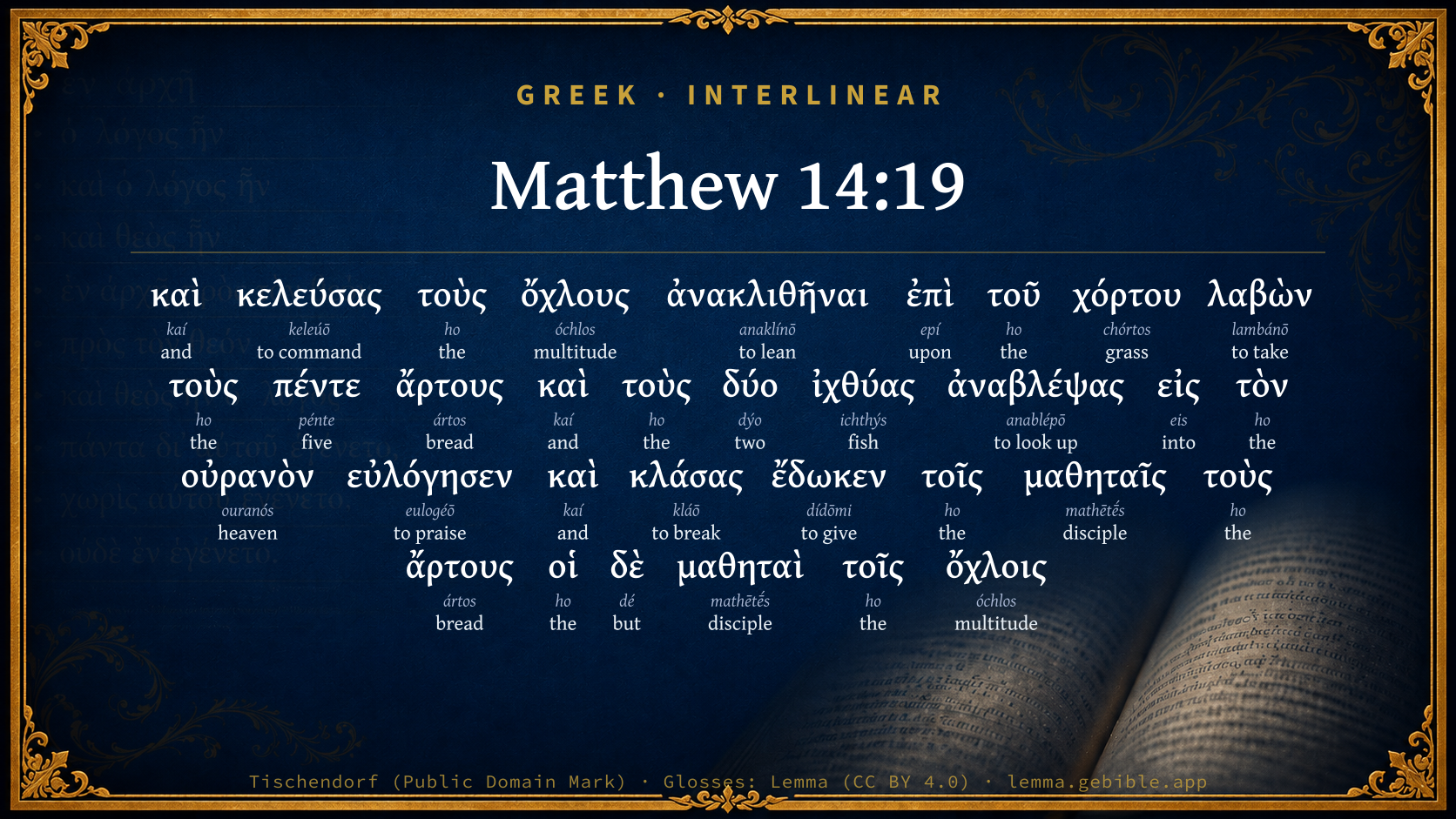
Greek (Tischendorf 8th ed.) Matthew 14:19 appears in the Greek New Testament. The text above is from the Tischendorf 8th edition. Each word links to its Strong’s number and a concise gloss. Click any word for its full Thayer’s Greek Lexicon entry.
Download image
Cite this verse

Matthew 14:19 (World English Bible). Public Domain. Lemma interlinear Bible study tool, https://lemma.gebible.app/v/matthew/14/19.

Show BibTeX & RIS
BibTeX
RIS
English Translation
He commanded the multitudes to sit down on the grass; and he took the five loaves and the two fish, and looking up to heaven, he blessed, broke and gave the loaves to the disciples, and the disciples gave to the multitudes.
World English Bible · Public Domain
Highlights
  • 2 first appearances in the Greek New Testament
Full analysis ↓
Download a study sheet

One document with this verse’s original text, its word-by-word gloss line, the meaning frame, cross-references with their text, attributed commentary, and full source and license credits — printable, and it pastes into notes with its structure intact.

This verse Autodidact and up

Study sheet (.html) Plain text (.txt)

A passage Seminary Student

Up to 50 verses in one chapter. A passage sheet keeps up to 6 commentary sources and 12 cross-references per verse, in the order this page ranks them, and says so on the sheet whenever that leaves anything out. Ask for a single verse and you get the Autodidact verse sheet above.

Everything on this page stays free to read, with no account — the sheet is a download of what is already on screen, not access to it.

Want to remove ads? Support Godless Engineer
Compare translations 3

The same verse in 3 English versions, stacked beneath the original-language interlinear above. Click any original word for its lexicon entry.

Each is an independent rendering of the whole verse — the interlinear is not word-aligned to these translations.

Highlighted words mark where these versions differ — a whole-verse word diff, not a word-by-word alignment.

  • World English Bible Public Domain
    He commanded the multitudes to sit down on the grass; and he took the five loaves and the two fish, and looking up to heaven, he blessed, broke and gave the loaves to the disciples, and the disciples gave to the multitudes.
  • King James Version Public Domain
    And he commanded the multitude to sit down on the grass, and took the five loaves, and the two fishes, and looking up to heaven, he blessed, and brake, and gave the loaves to his disciples, and the disciples to the multitude.
  • unfoldingWord Literal Text CC BY-SA 4.0
    And having commanded the crowds to recline on the grass, having taken the five loaves and the two fish, having looked up to heaven, he blessed, and having broken, he gave the loaves to the disciples, and the disciples to the crowds.

unfoldingWord Literal Text — © unfoldingWord, licensed CC BY-SA 4.0. Word-aligned USFM3 via Door43 (git.door43.org/unfoldingWord/en_ult).

Versions to compare (up to 4)

3 of 4 selected

Show all 19 translations

Every available English version of this verse, each an independent rendering of the whole verse.

  • World English Bible Public Domain
    He commanded the multitudes to sit down on the grass; and he took the five loaves and the two fish, and looking up to heaven, he blessed, broke and gave the loaves to the disciples, and the disciples gave to the multitudes.
  • Berean Standard Bible Public Domain
    And He directed the crowds to sit down on the grass. Taking the five loaves and the two fish and looking up to heaven, He spoke a blessing. Then He broke the loaves and gave them to the disciples, and the disciples gave them to the people.
  • Majority Standard Bible Public Domain
    And He directed the crowds to sit down on the grass. Taking the five loaves and the two fish and looking up to heaven, He spoke a blessing. Then He broke the loaves and gave them to the disciples, and the disciples gave them to the people.
  • King James Version Public Domain
    And he commanded the multitude to sit down on the grass, and took the five loaves, and the two fishes, and looking up to heaven, he blessed, and brake, and gave the loaves to his disciples, and the disciples to the multitude.
  • American Standard Version (1901) Public Domain
    And he commanded the multitudes to sit down on the grass; and he took the five loaves, and the two fishes, and looking up to heaven, he blessed, and brake and gave the loaves to the disciples, and the disciples to the multitudes.
  • Revised Version (1885) Public Domain
    And he commanded the multitudes to sit down on the grass; and he took the five loaves, and the two fishes, and looking up to heaven, he blessed, and brake and gave the loaves to the disciples, and the disciples to the multitudes.
  • Geneva Bible (1599) Public Domain
    And hee commanded the multitude to sit downe on the grasse, and tooke the fiue loaues and the two fishes, and looked vp to heauen and blessed, and brake, and gaue the loaues to his disciples, and the disciples to the multitude.
  • Douay-Rheims (1899) Public Domain
    And when he had commanded the multitudes to sit down upon the grass, he took the five loaves and the two fishes, and looking up to heaven, he blessed, and brake, and gave the loaves to his disciples, and the disciples to the multitudes.
  • Young's Literal Translation Public Domain
    And having commanded the multitudes to recline upon the grass, and having taken the five loaves and the two fishes, having looked up to the heaven, he did bless, and having broken, he gave the loaves to the disciples, and the disciples to the multitudes,
  • Literal Standard Version CC BY-SA 4.0
    And having commanded the multitudes to recline on the grass, and having taken the five loaves and the two fishes, having looked up to the sky, He blessed, and having broken, He gave the loaves to the disciples, and the disciples [gave] to the multitudes,
  • Unlocked Literal Bible CC BY-SA 4.0
    Then Jesus ordered the crowd to sit down on the grass. He took the five loaves and the two fish. Looking up to heaven, he blessed and broke the loaves and gave them to the disciples, and the disciples gave them to the crowd.
  • unfoldingWord Literal Text CC BY-SA 4.0
    And having commanded the crowds to recline on the grass, having taken the five loaves and the two fish, having looked up to heaven, he blessed, and having broken, he gave the loaves to the disciples, and the disciples to the crowds.
  • Darby Bible Public Domain
    And having commanded the crowds to recline upon the grass, having taken the five loaves and the two fishes, he looked up to heaven, and blessed: and having broken the loaves, he gave [them] to the disciples, and the disciples [gave them] to the crowds.
  • World Messianic Bible Public Domain
    He commanded the multitudes to sit down on the grass; and he took the five loaves and the two fish, and looking up to heaven, he blessed, broke and gave the loaves to the disciples; and the disciples gave to the multitudes.
  • Webster's Bible Public Domain
    And he commanded the multitude to sit down on the grass, and took the five loaves, and the two fishes, and looking up to heaven, he blessed, and broke, and gave the loaves to his disciples, and the disciples to the multitude.
  • Free Bible Version CC BY-SA 4.0
    He told the crowds to sit down on the grass. Then he took the five loaves and the two fish, looked up to heaven and blessed them. After that he broke the loaves into pieces and gave the bread to the disciples, and the disciples gave it to the crowds.
  • Bible in Basic English Public Domain
    And he gave orders for the people to be seated on the grass; and he took the five cakes of bread and the two fishes and, looking up to heaven, he said words of blessing, and made division of the food, and gave it to the disciples, and the disciples gave it to the people.
  • Text-Critical English NT CC BY 4.0
    Then he commanded the crowds to sit down on the grass, and taking the five loaves and the two fish, he looked up to heaven and said the blessing. Then he broke the loaves and gave them to the disciples, and the disciples gave them to the crowds.
  • Tyndale New Testament (1534) Public Domain
    And he commaunded the people to syt downe on the grasse: and toke the.v. loves and the.ii. fysshes and loked vp to heven and blessed and brake and gave the loves to his disciples and the disciples gave them to the people.

Literal Standard Version (2020), Covenant Press — licensed CC BY-SA 4.0. Text via the HelloAO Bible API (eBible.org). Unlocked Literal Bible (unfoldingWord) — licensed CC BY-SA 4.0. Text via the HelloAO Bible API (eBible.org). unfoldingWord Literal Text — © unfoldingWord, licensed CC BY-SA 4.0. Word-aligned USFM3 via Door43 (git.door43.org/unfoldingWord/en_ult). Free Bible Version, Dr. Jonathan Gallagher — licensed CC BY-SA 4.0. Text via the HelloAO Bible API (eBible.org).

Word by word

More ways to search: Search by grammar → Find every occurrence → Compare this word →

Practice this passage: Drill this verse → Learn its vocabulary →

ἀνακλιθῆναι
anaklínō
G347
“to lean”
Verb, Aorist, Passive, Infinitive
Part of Speech
Verb
Tense
Aorist
Voice
Passive
Mood
Infinitive
Full Thayer's Definition

Origin: from G303 and G2827

TDNT: None

1. to lean against, lean upon a. to lay down b. to make or bid to recline
  1. καὶ kaí G2532 “and” Conjunction
  2. κελεύσας keleúō G2753 “to command” Verb, Aorist, Active, Participle, Nominative, Singular, Masculine
  3. τοὺς ho G3588 “the” Article, Accusative, Plural, Masculine
  4. ὄχλους óchlos G3793 “multitude” Noun, Accusative, Plural, Masculine
  5. ἐπὶ epí G1909 “upon” Preposition
  6. τοῦ ho G3588 “the” Article, Genitive, Singular, Masculine
  7. χόρτου chórtos G5528 “grass” Noun, Genitive, Singular, Masculine
  8. λαβὼν lambánō G2983 “to take” Verb, Aorist, Active, Participle, Nominative, Singular, Masculine
  9. τοὺς ho G3588 “the” Article, Accusative, Plural, Masculine
  10. πέντε pénte G4002 “five” Adjective, Numeral (indeclinable)
  11. ἄρτους ártos G740 “bread” Noun, Accusative, Plural, Masculine
  12. καὶ kaí G2532 “and” Conjunction
  13. τοὺς ho G3588 “the” Article, Accusative, Plural, Masculine
  14. δύο dýo G1417 “two” Adjective, Numeral (indeclinable)
  15. ἰχθύας ichthýs G2486 “fish” Noun, Accusative, Plural, Masculine
  16. ἀναβλέψας anablépō G308 “to look up” Verb, Aorist, Active, Participle, Nominative, Singular, Masculine
  17. εἰς eis G1519 “into” Preposition
  18. τὸν ho G3588 “the” Article, Accusative, Singular, Masculine
  19. οὐρανὸν ouranós G3772 “heaven” Noun, Accusative, Singular, Masculine
  20. εὐλόγησεν eulogéō G2127 “to praise” Verb, Aorist, Active, Indicative, 3rd person, Singular
  21. καὶ kaí G2532 “and” Conjunction
  22. κλάσας kláō G2806 “to break” Verb, Aorist, Active, Participle, Nominative, Singular, Masculine
  23. ἔδωκεν dídōmi G1325 “to give” Verb, Aorist, Active, Indicative, 3rd person, Singular
  24. τοῖς ho G3588 “the” Article, Dative, Plural, Masculine
  25. μαθηταῖς mathētḗs G3101 “disciple” Noun, Dative, Plural, Masculine
  26. τοὺς ho G3588 “the” Article, Accusative, Plural, Masculine
  27. ἄρτους ártos G740 “bread” Noun, Accusative, Plural, Masculine
  28. οἱ ho G3588 “the” Article, Nominative, Plural, Masculine
  29. δὲ dé G1161 “but” Conjunction
  30. μαθηταὶ mathētḗs G3101 “disciple” Noun, Nominative, Plural, Masculine
  31. τοῖς ho G3588 “the” Article, Dative, Plural, Masculine
  32. ὄχλοις óchlos G3793 “multitude” Noun, Dative, Plural, Masculine

About this verse

These counts appear in no published source. They are computed here, from the morphology-tagged text and Lemma’s own curated glosses. What Lemma adds →

33
words
20
distinct lemmas
Gospels
section

Notable vocabulary

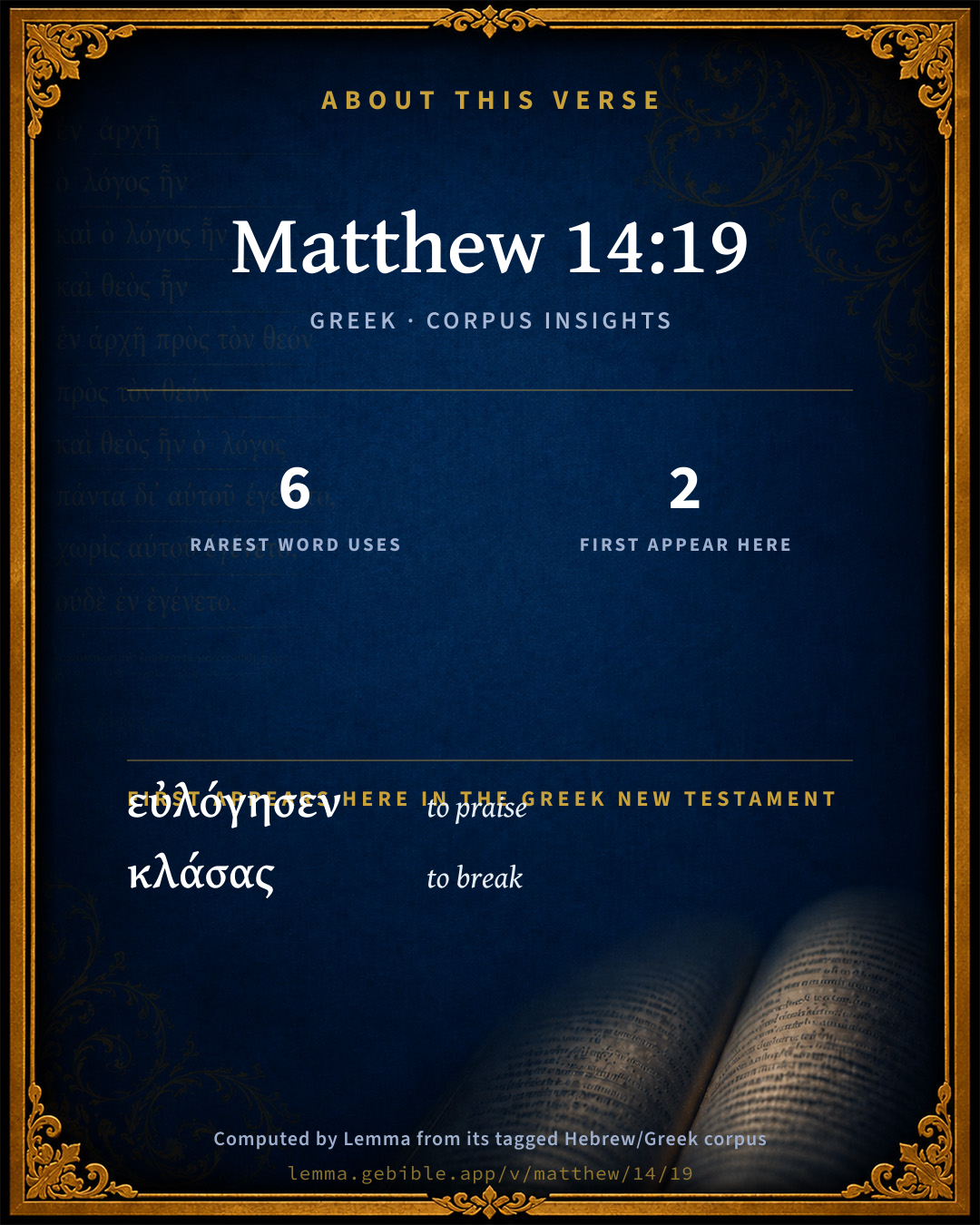
The rarest word here is ἀνακλιθῆναι to lean G347 — appearing just 6 times in the whole Greek New Testament.

First appearance in Scripture

These words make their first canonical appearance in the Greek New Testament here:

  • εὐλόγησεν to praise G2127
  • κλάσας to break G2806

Shared distinctive vocabulary

ἀνακλιθῆναι to lean G347 occurs in 6 verses of the Greek New Testament. Also found in:
Repetition

Words recur within this verse:

  • ὄχλους multitude G3793 ×2
  • ἄρτους bread G740 ×2
  • μαθηταῖς disciple G3101 ×2
  • τοὺς the G3588 ×9
  • καὶ and G2532 ×3

Cross-references

22

Topical passages linked to Matthew 14:19 in the Treasury of Scripture Knowledge — connected by theme and wording, ordered by reader-vote popularity; previews shown in the World English Bible.

  • 1 Samuel 9:13 as soon as you are come into the city, you shall immediately find him, before he goes up to the high place to eat; for the people will not eat until he come, because he does bless the sacrifice; [and] afterwards they eat who are invited. Now therefore get you up; for at this time you shall find him.
  • Mark 8:6–7 He commanded the multitude to sit down on the ground, and he took the seven loaves. Having given thanks, he broke them, and gave them to his disciples to serve, and they served the multitude.
  • Luke 24:30 It happened, that when he had sat down at the table with them, he took the bread and gave thanks. Breaking it, he gave to them.
  • 1 Timothy 4:4–5 For every creature of God is good, and nothing is to be rejected, if it is received with thanksgiving.
  • Mark 6:41 He took the five loaves and the two fish, and looking up to heaven, he blessed and broke the loaves, and he gave to his disciples to set before them, and he divided the two fish among them all.
  • Acts 27:35 When he had said this, and had taken bread, he gave thanks to God in the presence of all, and he broke it, and began to eat.
  • Matthew 15:35–36 He commanded the multitude to sit down on the ground;
  • Matthew 26:26–27 As they were eating, Jesus took bread, gave thanks for it, and broke it. He gave to the disciples, and said, "Take, eat; this is my body."
  • Romans 14:6 He who observes the day, observes it to the Lord; and he who does not observe the day, to the Lord he does not observe it. He who eats, eats to the Lord, for he gives God thanks. He who doesn't eat, to the Lord he doesn't eat, and gives God thanks.
  • 1 Corinthians 11:24 When he had given thanks, he broke it, and said, "Take, eat. This is my body, which is broken for you. Do this in memory of me."
  • Mark 7:34 Looking up to heaven, he sighed, and said to him, "Ephphatha!" that is, "Be opened!"
  • Mark 14:22–23 As they were eating, Jesus took bread, and when he had blessed, he broke it, and gave to them, and said, "Take, eat. This is my body."
  • Luke 9:14 For they were about five thousand men. He said to his disciples, "Make them sit down in groups of about fifty each."
  • 1 Corinthians 10:16 The cup of blessing which we bless, isn't it a communion of the blood of Christ? The bread which we break, isn't it a communion of the body of Christ?
  • Colossians 3:17 Whatever you do, in word or in deed, do all in the name of the Lord Jesus, giving thanks to God the Father, through him.
  • Mark 6:39 He commanded them that everyone should sit down in groups on the green grass.
  • 1 Corinthians 10:31 Whether therefore you eat, or drink, or whatever you do, do all to the glory of God.
  • Luke 9:16 He took the five loaves and the two fish, and looking up to the sky, he blessed them, and broke them, and gave them to the disciples to set before the multitude.
  • Luke 22:19 He took bread, and when he had given thanks, he broke it, and gave to them, saying, "This is my body which is given for you. Do this in memory of me."
  • John 6:10–11 Jesus said, "Have the people sit down." Now there was much grass in that place. So the men sat down, in number about five thousand.
  • John 6:23 However boats from Tiberias came near to the place where they ate the bread after the Lord had given thanks.
  • John 11:41 So they took away the stone from the place where the dead man was lying. Jesus lifted up his eyes, and said, "Father, I thank you that you listened to me.

Cross-references courtesy of OpenBible.info (CC BY 4.0).

Commentary

Notes on Matthew 14:19 from classic Christian and Jewish commentators (each source and its license shown beneath its notes). The classic Christian expositions comment on the surrounding passage and are grouped to its opening verse, so a note may address several verses; the Jewish commentaries on the Tanakh (Rashi and others) are per-verse, so they appear only where the commentator wrote on this verse.

Lemma curates 59 commentaries, every one of them public domain or Creative Commons licensed, each selected and text-cleaned for this edition rather than reprinted as found. About our sources →

Joseph Benson's Commentary

Mat 14:19-21. He commanded the multitude to sit down on the grass — Mark says, by companies, as we render the phrase συμποσια, συμποσια, which is literally, companies, companies, that is, in separate companies. These, as appears by comparing Mar 6:39 with Luk 9:14, consisted some of fifty persons, some of a hundred, according as the ground would admit. Our Lord probably ordered them to be ranged in this manner that they might sit compactly, that their numbers might appear, that the meat might be divided among them with ease, and that none might be neglected in the distribution. And no sooner did Christ signify his will to the disciples, and they intimated it to the multitude, than they all instantly did as they were ordered: so great an opinion had they of Christ’s wisdom and power! Though they thus sat on the ground, under no canopy but the sky, and had only barley bread, and, as it seems, cold or dried fishes to eat, and probably nothing but water to drink; yet, as Mr. Henry truly and beautifully observes, there was more real grandeur displayed by the Master of this feast than by Ahasuerus, in that royal feast which was intended to show the riches of his glorious kingdom, and the honour of his excellent majesty. And took the five loaves, &c. — Thus acting like the master of a family among the Jews, who was wont to take the bread into his hands and to give thanks to God, before any at the table was permitted to eat any thing: And looking up to heaven — With great reverence and affection; he blessed — That is, says Dr. Whitby, with whom agree many other commentators, he blessed, or gave thanks to God, the liberal giver of all good, for his infinite beneficence in furnishing food to all flesh, and for the power he had conferred on him of relieving mankind by his miracles, particularly that which he was about to work, and which perhaps he prayed for, to raise the attention of the multitude, as we find him doing before the resurrection of Lazarus, Joh 11:41. They apprehend that his looking up to heaven when he blessed, shows that his blessing was directed to God, and that it imported a thanksgiving for his great goodness. Accordingly John expresses it by ευχαριστησας, having given thanks, he distributed, &c. It must be observed, however, that most commentators refer the expression, he blessed, to the loaves and fishes, because Luke says expressly, ευλογησεν αυτους, he blessed them; that is, he commanded upon them that singular blessing by which they were multiplied in the distribution. Thus God is said to bless the springing of the corn, Psa 65:10. And gave the loaves to his disciples, and the disciples to the multitude — “It is not to be supposed,” says Macknight, “that twelve persons could put first a piece of bread, and then a piece of fish, into the hands of five thousand men, besides the women and children, who were all fed with such expedition, that, notwithstanding the thing was not so much as proposed to the disciples till about three, all was over by five o’clock in the afternoon, as may be gathered from Joh 6:16, where see the note. It is natural, therefore, to conclude, that, in distributing the meat, the disciples used the most expeditious method, putting, by their Master’s direction, the bread first, and after that the fish, into the hands of those only who sat at the ends of the ranks, with orders to give it to their companions. On this supposition, the meat must have extended its dimensions, not in our Lord’s hands only, but in the hands of the multitude likewise, continuing to swell till there was a greater quantity than they, who held it, could make use of; so that breaking off what was sufficient for themselves, they gave the remainder to the persons next them, who, in like manner, saw the bread and fish swell in their own hands till they also had enough and to spare. The meat being thus created among the hands of the multitude, and before their eyes, as long as there was a single person to be fed, they did all eat, and were filled, to their unspeakable astonishment. In this manner did he who is the Bread of Life feed about ten thousand people, (for doubtless the women and children were as numerous as the men,) with five loaves and two small fishes, giving a magnificent proof, not only of his goodness, but of his creating power. For after all had eaten to satiety, the disciples, at Jesus’s command, (see note on Joh 6:12,)

took up twelve baskets full of the broken pieces of meat, each disciple a basket, in which there must have been much more than the quantity at first set before the Lord to divide. The stupendous miracle, therefore, without all doubt, was conspicuous, not to the disciples only, who, carrying each his basket in his hand, had an abiding, sensible demonstration of its truth, but to every individual guest at this divine feast, who had all felt themselves delighted, filled, refreshed, and strengthened by the meal. This being one of the most astonishing, and at the same time the most extensively convincing of all the miracles Jesus performed during the course of his ministry, every one of the evangelists has recorded it; and, which is remarkable, it is the only one found in each of their histories.

Joseph Benson's Commentary on the Old and New Testaments (1811–1818) — public domain. Text from a community e-Sword module.

Bengel's Gnomon

Johann Albrecht Bengel

Mat 14:19. Ἀνακλιθῆναι, to be seated) The faith of the people is thus exercised.—τοὺς ἄρτους, the loaves) sc. whatever was there.—ἀναβλέψας, looking up) Jesus referred everything to the Father (see Joh 11:41; Joh 17:1) with the most entire confidence: far different from the practice of sinners; see Luk 18:13.—οἱ δὲ μαθηταὶ, but His disciples) A prelude to their future administration.[671] See Act 4:35.

[671] Sc. of the charities distributed to the needy brethren.—ED.)

Bengel's Gnomon of the New Testament — English translation (T&T Clark, Edinburgh, 1860) — public domain. Text from a community e-Sword module.

Meyer's Critical & Exegetical Commentary

Heinrich August Wilhelm Meyer

Mat_14:19. Ἐπὶ τ. χόρτ.] upon the grass, Mat_13:2.

Participle following upon participle without conjunctions, and in logical subordination. See Stallbaum, ad Plat. Apol. p. 27 A; Kühner, ad Xen. Mem. i. 1. 18; Dissen, ad Dem. de cor. p. 249.

κλάσας] The loaves were in the form of cakes, a thumbs breadth in thickness, and about the size of a plate. Winer, Realwörterbuch, under the word Backen. Robinson, Pal. III. pp. 40, 293.

In saying grace Jesus did what was done by the father of a family. In John it is expressed by εὐχαρισατήσας, because the meaning of the grace was the giving of thanks (comp. notes on Mat_26:26 f.; 1Co_10:16; 1Co_14:16); Luke again says: εὐλόγησεν αὐτούς, where we have the idea of a consecrating prayer, as in the case of the Lords supper.

Meyer — Critical and Exegetical Commentary on the New Testament — English translation by Peter Christie, edited by Frederick Crombie (T&T Clark, 1880) — public domain. Text from a community e-Sword module.

Expositor's Greek Testament

ed. W. Robertson Nicoll

Mat 14:19 . κελεύσας , λαβὼν , ἀναβλέψας , participles without copula all leading up to εὐλόγησεν , the central chief action: rapid, condensed narrative, briefly, simply, recounting an amazing event. εὐλόγησεν with accusative ( ἄρτους ) understood. He blessed the loaves and fishes. καὶ κλάσας ἔδωκεν , then dividing them gave them to the disciples, who in turn gave to the multitude. τῷ λόγῳ καὶ τῇ εὐλογίᾳ αὔξων καὶ πληθύνων αὐτούς , Origen.

The Expositor's Greek Testament, edited by W. Robertson Nicoll (1897–1910) — public domain. Text from a community e-Sword module.

Adam Clarke's Commentary

Verse 19. And took the five loaves, c.] This was the act of the father of a family among the Jews-his business it was to take the bread into his hands, and render thanks to God, before any of the family was permitted to taste of it.

Looking up to heaven] To teach us to acknowledge GOD as the Supreme Good, and fountain of all excellence.

He blessed] The word God should, I think, be rather inserted here than the word them, because it does not appear that it was the loaves which Christ blessed, but that God who had provided them and this indeed was the Jewish custom, not to bless the food, but the God who gave it. However, there are others who believe the loaves are meant, and that he blessed them in order to multiply them. The Jewish form of blessing, or what we term grace, before and after meat, was as follows:-

BEFORE MEAT.

ברוך אתה אלהינו מלך העולם המוצא לחם מן הארץ

Barnuc attah Elohinoo melec haolam hamoise lechem min haarets:

Blessed art thou, our God, King of the universe, who bringest

bread out of the earth!

AFTER MEAT.

ברוך אלהינו מלך העולם בורא פרי הגפן

Barnuc Elohinoo melec haolam bore peri hagephen:

Blessed art thou, our God, King of the universe, the Creator

of the fruit of the vine!

And brake] We read often in the Scriptures of breaking bread, never of cutting it: because the Jews made their bread broad and thin like cakes, and to divide such, being very brittle, there was no need of a knife.

Adam Clarke's Commentary on the Bible (1810–1826) — public domain. Text from a community e-Sword/MySword module.

Ellicott's Commentary for English Readers

(19) He commanded the multitude to sit down on the grass.—This, too, was done with a calm and orderly precision. They were to sit down in companies of fifty or a hundred each, and thus the number of those who were fed became a matter of easy calculation. St. Mark, with a vivid picturesqueness, describes them as presenting the appearance of so many beds of flowers in a well-ordered garden. The bright colours of Eastern dress probably made the resemblance more striking than it would be with a like multitude so arranged among ourselves.

Looking up to heaven, he blessed, and brake.—The act was natural and simple enough, the “saying grace” (St. John uses the word, “giving thanks”) of the head of a Jewish household as he gathered his family around him. The formulæ in such cases were commonly short and simple, like our own, such e.g. as, “May God, the ever-blessed One, bless what He has given us.” Looking, however, to the teaching which followed the miracle, as in John 6, and to our Lord’s subsequent use at the Last Supper of the same words and acts, with others which gave them a new and higher meaning, we can hardly be wrong in thinking that as He now distributed the earthly bread to the hungering crowd, through the agency of His Apostles, there was present to His mind the thought that hereafter He would, through the same instrumentality, impart to souls that hungered after righteousness the gift of communion with Himself, that thus they might feed on the true Bread that cometh down from heaven.

It lies in the nature of the case, as a miracle of the highest order, that the process of multiplication is inconceivable in its details. Did each loaf, in succession, supply a thousand with food, and then come to an end, its place taken by another? Was the structure of the fishes, bone and skin and head, reproduced in each portion that was given to the guests at that great feast? We know not, and the Evangelists did not care to ask or to record. It was enough for them that the multitude “did all eat, and were filled.”

A Bible Commentary for English Readers, edited by Charles John Ellicott (1878–1897) — public domain. Text from a community e-Sword module.

The Cambridge Bible for Schools and Colleges

gen. ed. J. J. S. Perowne

19. to sit down on the grass] Rather, grassy places. St Mark and St Luke mention that they sat in companies “by hundreds and by fifties” (Mark), “by fifties” (Luke). St John notes the time of year; “the passover, a feast of the Jews, was nigh.”

The Cambridge Bible for Schools and Colleges (gen. ed. J. J. S. Perowne; Cambridge University Press, 1878–1918) — public domain. Text from a community e-Sword module.

John Gill's Exposition

And they did all eat,.... Christ and his twelve disciples, and the five thousand men, with the women and children, of the five loaves and two fishes; everyone had their portion,

and were filled; they were satisfied, they had a full meal, they had enough, and to spare; see Ch2 31:10 which the Targumist paraphrases thus.

"And Azariah said unto him, who was appointed chief over the house of Zadok, and said, from the time that they began to separate the offering, to bring it into the sanctuary of the Lord, , "we have eat and are filled", and have "left much"; for "the word of the Lord" hath blessed his people, and what is left, lo! it is this plenty of good.''

The Jews used not to reckon it a meal, unless a man was filled, and account it an ill sign, if nothing was left: but here was fulness, and more left than was first had; which was gathered up, either for the use of the poor, or reserved for after service; teaching us liberality to the needy, and frugality, not to waste that which is left.

And they took up of the fragments that remained, twelve baskets full; according to the number of the disciples, every man had his basket full. It may be inquired, where they could have so many baskets in the wilderness? It is not likely, that everyone of the apostles had a basket with him; it is indeed not improbable, but that they might be furnished with them from some in the company, who might bring provisions with them, either for their own use, or to sell; see Joh 6:9 but perhaps the reason why they were so easily supplied with such a number of baskets in a desert place, might be a custom which the Jews (h) had of carrying baskets with hay and straw, in commemoration of what they did in Egypt; when they were obliged to carry bricks in baskets, and to go about and pick up straw in baskets to make bricks; hence the (i) Epigrammatist calls a "Jew", "cistifer", a "basket bearer", or "carrier"; and Juvenal (k) laughs at these people, as if all their household goods lay in a basket, and a little hay, or straw: it is said of R. Siraeon, that when he went to the school, , "he carried a basket" on his shoulders (l); the gloss suggests, it was to sit upon; but a basket is not very proper for a seat; very likely it was for the above reason: such a custom will account for it, how such a number of baskets could be come at in the wilderness.

(h) Nicholas de Lyra, in Psal. lxxxi. 6. (i) Nubere: nupsisti Gellia Cistifero. Martial. Epigram. 1. 5. ep. 17. (k) Judaeis: quorum Cophinus foenumque supellex. Juvenal. Satyr. 3. cum dedit ille locum, Cophino, foenoque relicto. ib. Satyr. 6. (l) T. Bab. Nedarim, fol. 49. 2.

John Gill's Exposition of the Whole Bible (1746–1763) — public domain (CC PDM 1.0). Text via the HelloAO Bible API.

Trapp's Complete Commentary

John Trapp

19 And he commanded the multitude to sit down on the grass, and took the five loaves, and the two fishes, and looking up to heaven, he blessed, and brake, and gave the loaves to his disciples, and the disciples to the multitude.

Ver. 19. And looking up to heaven, he blessed] Heathens consecrated their cares before they tasted them, as appears by many passages in Homer and Virgil. Some say that the elephant, ere he eats his food, turns up with his trunk the first sprig towards heaven. The Scripture, we are sure, says, that "men eat to God when they give thanks," Rom 14:6. To whom then do they eat that give none?

And the disciples, to the multitude] They grudged not of their little to give others some, and it grew in their hands, as the widow’s oil did in the cruse. Not getting, but giving, is the way to thrive. Nothing was ever lost by liberality.

John Trapp, A Commentary or Exposition upon All the Books of the Old and New Testament (1647–1656) — public domain. Text from a community e-Sword module.

Haydock's Catholic Bible Commentary

Commanded the multitude to sit down.[3] Lit. to lie down, as it was then the custom of the Jews, and of other nations, at meat. See Mark vi, and John vi. &c. --- He blessed. St. Luke (ix. 16.) says, he blessed them. St. John (vi. 11,) says when he had given thanks: some think this blessing and giving thanks, for the same; but blessing them, must be referred to the loaves, and giving thanks, must be to God. The loaves miraculously increased partly in the hands of Christ, when he broke them, partly in the hands of the disciples, when they distributed them about. (Witham) --- He blessed and brake. From this let Christians learn to give thanks at their meals, begging of God that his gifts may be sanctified for their use. From this miracle it appears, that it is no impossibility for bodies, even in their natural state, to be in many places at the same time; since, supposing these loaves to have been sufficient for 50 persons, as there were a hundred such companies, the loaves must have been in a hundred different places at one and the same time. It cannot be said, as some pretend, that other loaves were invisibly put into the apostles’ hands, since it is said that they filled 12 baskets of fragments of the five barley loaves; and again, he divided the two fishes among them all. If God could cause bodies, in their natural state, to be in many places at one and the same time, how much more easy would it be to do the same with spiritual bodies, with the properties of which we are entirely unacquainted; so that from this it appears, that the objection that Christ’s body cannot be in many different places in the holy Eucharist, is nugatory. But, who are we, to ask such a question of the Almighty, who know not what is possible, and what is not possible for him to do! (Bp. Hay, Sincere Christian.)

===============================

[BIBLIOGRAPHY]

Benedixit. St. Luke, (ix. 16.) benedixit illis, Greek: eulogese autous, which is not the same as Greek: eucharistein.

====================

George Leo Haydock (1774–1849), Haydock's Catholic Family Bible and Commentary, 1859 edition — public domain. Excludes Psalms (Douay-Rheims chapter numbering differs from Protestant) and Deuterocanonical books (Catholic canon only).

Whedon's Commentary on the Bible

Daniel D. Whedon

19. On the grass — It is called a desert as being uninhabited, not as being barren. It seems to have been a grassy plain. Sit down — In parties, or as we may say, in separate tables, as Mark informs us. Thus the whole was more orderly.

Daniel D. Whedon (gen. ed.), Commentary on the Old and New Testaments (1874–1909) — public domain. Text from a community e-Sword module.

The Pulpit Commentary

And he commanded the multitude; the multitudes (Revised Version). Here also the plural (ver. 15), because they are thought of as grouped over the ground. To sit down; i.e. to recline as at a meal ( anakliyhnai). On the grass (epi tou crtou). The addition of "green" (clwrov) in Mark suits the time of the Passover (ver. 13, note), but hardly of any later feast, for the grass would have been dried up. And took the five loaves, and the two fishes. He used all the means there were. And looking up to heaven. So also Mar_7:34 Joh_17:1. He blessed. He may well have used the blessing that is still used over bread ("Blessed art thou, Jehovah our God, King of the world, that causest bread to come forth from the earth"); for this can be apparently traced to the second or third century A.D., and is probably much older still (cf. Edersheim, "Life," 1:684; Zunz, "Gottesdienstliche Vortrage," p. 371, edit. 1832). (For the habit of saying grace before meals, cf. Mat_15:36 Mat_26:26 Rom_14:6 1Co_10:30 1Ti_4:5; see also 1Sa_9:13) And brake, and gave the loaves to his disciples, and the disciples to the multitude. That the people received the bread at the hands of the disciples is not mentioned by St. John. Perhaps because his chapter dwells so much on the need of direct contact with Christ. But Christ"s work through his agents, both before and after his time on earth, is an important point with the synoptists.

The Pulpit Commentary (1880–1919), ed. H.D.M. Spence-Jones & Joseph S. Exell — public domain. Text from a community e-Sword module.

The People's New Testament

B. W. Johnson

19. He commanded the multitude to sit down. We learn from Mark that they sat down in companies. On the grass. John says, “there was much grass there.” It was in the spring season, in Nisan, “the month of flowers,” and the slopes were rich with the spring grass. Looking up to heaven. In prayer we should use such outward gestures as may most fitly serve to express the inward disposition and holy affections of our heart and soul. He blessed. He either gave thanks or asked the Father's blessing on the food.

B. W. Johnson's The People's New Testament with Notes (1889–1891) — public domain. Electronic text from the Christian Classics Ethereal Library (CCEL) ThML edition.

unfoldingWord translationNotes

Door43 World Missions Community

Connecting Statement:

This concludes the account of Jesus feeding five thousand people.

sit down

"lie down." Use the verb for the position people in your culture usually are in when they eat.

He took

"He held in his hands." He did not steal them. (See: Idiom)

broke the loaves

"tore the loaves"

loaves

"loaves of bread" or "whole breads"

Looking up

Possible meanings are 1) "While looking up" or 2) "After looking up."

and were filled

This can be translated in active form. AT: "until they were full" or "until they were no longer hungry" (See: Active or Passive)

they took up

"the disciples gathered up" or "some people gathered up"

twelve baskets full

"12 baskets full" (See: Numbers)

Those who ate

"Those who ate the bread and the fish"

five thousand men

"5,000 men" (See: Numbers)

translationWords

Jesus

heaven

bless

disciple

basket

unfoldingWord translationNotes — © Distant Shores Media and the Door43 World Missions Community, licensed CC BY-SA 4.0. Source: git.door43.org/Door43/en_tn.

Cambridge Greek Testament for Schools and Colleges

19. τοῦ χόρτου. The plural τοὺς χόρτους (‘grassy places’) has the support of the late MSS.: the gen. sing. is the reading of אBC*.

19. ἀνακλιθῆναι ἐπὶ τοῦ χόρτου. St John has ἦν δὲ χόρτος πολὺς ἐν τῷ τόπῳ. St Mark and St Luke mention that they sat in companies, ἀνὰ ἑκατὸν καὶ ἀνὰ πεντήκοντα (Mark), ἀνὰ πεντήκοντα (Luke); to this St Mark adds the picturesque touch, καὶ ἀνέπεσαν πρασιαὶ πρασιαί. (ch. Mar 6:40). St John notes the time of year: ἦν δὲ ἐγγὺς τὸ πάσχα ἡ ἑορτὴ τῶν Ἰουδαίων.

ἔδωκεν. In Mark and Luke ἐδίδου: ‘continued to give,’ ‘kept giving.’

Cambridge Greek Testament for Schools and Colleges (Cambridge University Press, 1896; 21 vols, various authors incl. Carr, Maclear, Plummer, Farrar, Lumby, Moule, M. R. James, Simcox) — public domain. Text from a community e-Sword module.

Alford’s Greek Testament

Henry Alford

19. ηὐλόγησεν] Luke supplies αὐτούς, the loaves and fishes: John has for it εὐχαριστήσας. Both are one. The thanks to heaven is the blessing on the meat. ὁ Σωτὴρ πρῶτον ἀνέβλεψεν εἰς τὸν οὐρανὸν ταῖς ἀκτῖσι τῶν ὀφθαλμῶν αὐτοῦ οἱονεὶ καταβιβάζων δύναμιν ἐκεῖθεν τὴν ἀνακραθησομένην τοῖς ἄρτοις καὶ τοῖς ἰχθύσι μέλλουσι τρέφειν τοὺς πεντακισχιλίους, καὶ μετὰ τοῦτο ηὐλόγησε τ. π. ἄρτους κ. τ. δ. ἰχθ., τῷ λόγῳ κ. τῇ εὐλογίᾳ αὔξων κ. πληθύνων αὐτούς. in loc. This miracle was one of symbolic meaning for the twelve, who had just returned from their mission, as pointing to the δωρεὰν ἐλάβετε, δωρεὰν δότε of ch. 10:8 in a higher sense than they then could have understood it:—but see the symbolic import of the miracle treated in the notes to Joh_6.

Meyer well remarks that the process of the miracle is thus to be conceived:—the Lord blessed, and gave the loaves and fishes to the disciples, as they were; and then, during their distribution of them, the miraculous increase took place, so that they broke and distributed enough for all.

Henry Alford, The Greek Testament (1849–1861) — public domain. Text from a community e-Sword module.

International Critical Commentary

19. And He commanded the multitudes to sit down upon the grass.] Mt. summarises Mk 39.

And took the five loaves, and the two fishes, and looked up into heaven, and blessed, and brake, and gave to the disciples the loaves, and the disciples to the multitudes.] The editor slightly alters Mk.—ἔδωκεν] For Mk.’s ἐδίδου, see Introduction, p. xx.—ἐπὶ τοῦ χόρτου] see Introduction, p. xxviii.

(M)

International Critical Commentary — older volumes (1896–1929), various authors — public domain. Text from a community e-Sword module.

Vincent's Word Studies in the New Testament

Marvin R. Vincent

Brake. As the Jewish loaves were thin cakes, a thumb's breadth in thickness, and more easily broken than cut.

Marvin R. Vincent, Word Studies in the New Testament (1887–1900) — public domain. Text from a community e-Sword/MySword module.

Lesson kit

Teaching starters — assembled from the data on this page, not authored interpretation. Every prompt links to the verse data it draws on. Edit before teaching.

Matthew, in the Gospels, opens this verse with 33 words (20 distinct Greek lemmas). Its most distinctive word is anaklínō (“to lean”). A historical commentator’s framing appears above. Read the whole chapter for the surrounding context.

Discussion questions

  1. How does “to lean” (anaklínō) shape what this verse is saying?
  2. 2 words make their first appearance in Scripture here. What does this debut establish?
  3. How does Matthew 8:11, which shares the word «to lean», read alongside this verse?
  4. What does the repetition of “multitude” (2× in this one verse) do in this verse?
  5. The translations on this page render this verse differently — a whole-verse word diff, not a word-by-word alignment. What might account for the different wordings?
  6. Compare how Joseph Benson's Commentary and Bengel's Gnomon read this verse. Where do they agree or differ?

Things to notice

  • 2 words make their first canonical appearance in Scripture here.
  • These translations choose different wording for 16 words in this verse.
  • “multitude” occurs 2× in this single verse.
  • 20 distinct Greek lemmas span 33 words in this verse.

Reading settings

Reading text

Shown beneath each verse's original-language words.

Old Testament
Old Testament edition

Read the OT as the Masoretic Hebrew (MT) or the Greek Septuagint (LXX).

English shown for the Greek Septuagint (in the Hebrew ↔ Greek comparison).

Comparing translations? Open the Compare panel on any verse page to stack up to four side by side.