

Matthew 19:21
Greek (Tischendorf 8th ed.) Matthew 19:21 appears in the Greek New Testament. The text above is from the Tischendorf 8th edition. Each word links to its Strong’s number and a concise gloss. Click any word for its full Thayer’s Greek Lexicon entry.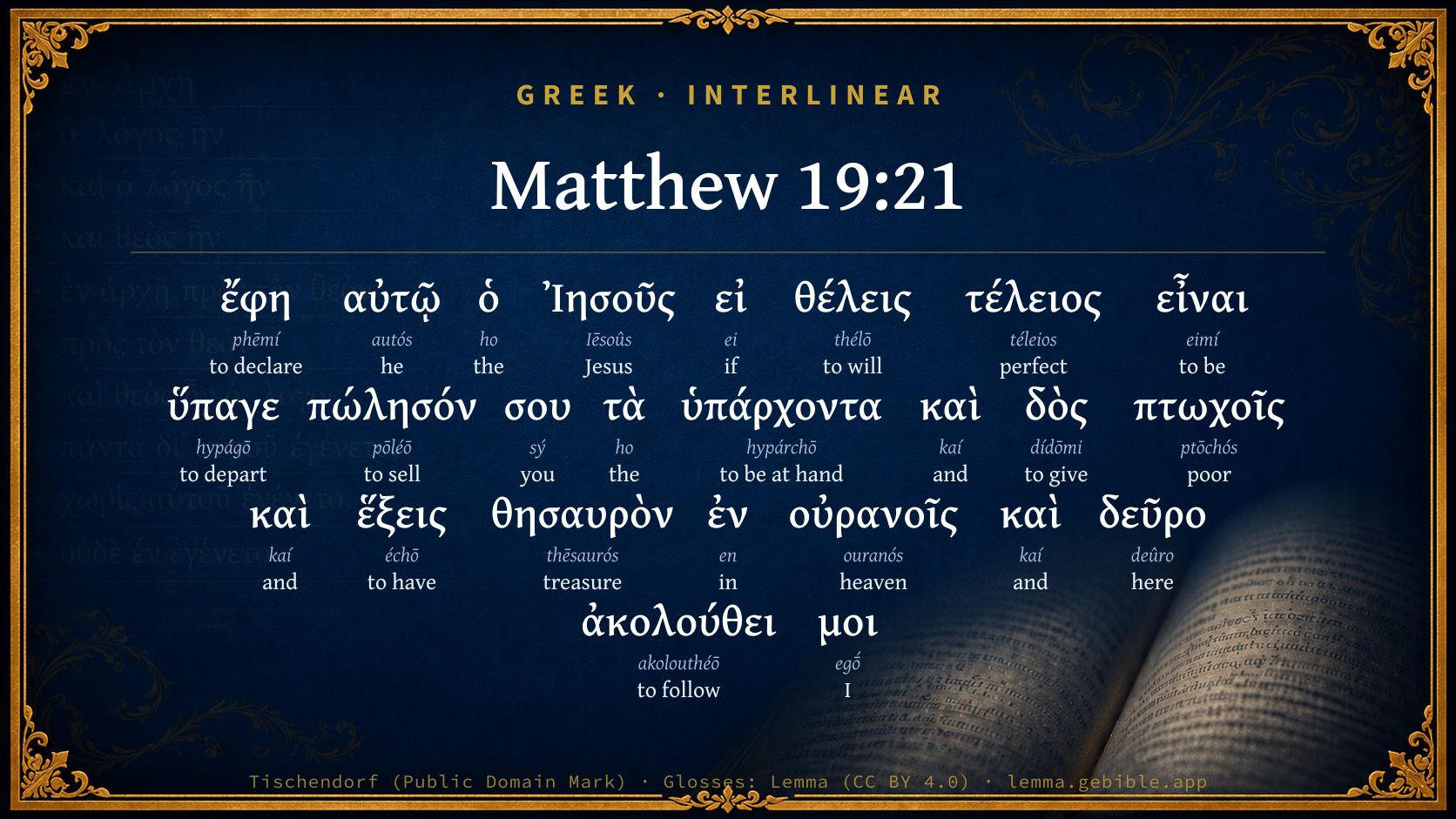
Jesus said to him, "If you want to be perfect, go, sell what you have, and give to the poor, and you will have treasure in heaven; and come, follow me."
Download a study sheet
One document with this verse’s original text, its word-by-word gloss line, the meaning frame, cross-references with their text, attributed commentary, and full source and license credits — printable, and it pastes into notes with its structure intact.
This verse Autodidact and up
A passage Seminary Student
Up to 50 verses in one chapter. A passage sheet keeps up to 6 commentary sources and 12 cross-references per verse, in the order this page ranks them, and says so on the sheet whenever that leaves anything out. Ask for a single verse and you get the Autodidact verse sheet above.
Everything on this page stays free to read, with no account — the sheet is a download of what is already on screen, not access to it.
Compare translations 3
The same verse in 3 English versions, stacked beneath the original-language interlinear above. Click any original word for its lexicon entry.
Each is an independent rendering of the whole verse — the interlinear is not word-aligned to these translations.
Highlighted words mark where these versions differ — a whole-verse word diff, not a word-by-word alignment.
-
World English Bible Public Domain
Jesus said to him, "If you want to be perfect, go, sell what you have, and give to the poor, and you will have treasure in heaven; and come, follow me."
-
King James Version Public Domain
Jesus said unto him, If thou wilt be perfect, go and sell that thou hast, and give to the poor, and thou shalt have treasure in heaven: and come and follow me.
-
unfoldingWord Literal Text CC BY-SA 4.0
Jesus said to him, “If you want to be perfect, go, sell your possessions, and give to the poor, and you will have treasure in the heavens; and come, follow me.”
unfoldingWord Literal Text — © unfoldingWord, licensed CC BY-SA 4.0. Word-aligned USFM3 via Door43 (git.door43.org/unfoldingWord/en_ult).
Show all 19 translations
Every available English version of this verse, each an independent rendering of the whole verse.
-
World English Bible Public Domain
Jesus said to him, "If you want to be perfect, go, sell what you have, and give to the poor, and you will have treasure in heaven; and come, follow me."
-
Berean Standard Bible Public Domain
Jesus told him, “If you want to be perfect, go, sell your possessions and give to the poor, and you will have treasure in heaven. Then come, follow Me.”
-
Majority Standard Bible Public Domain
Jesus told him, “If you want to be perfect, go, sell your possessions and give to the poor, and you will have treasure in heaven. Then come, follow Me.”
-
King James Version Public Domain
Jesus said unto him, If thou wilt be perfect, go and sell that thou hast, and give to the poor, and thou shalt have treasure in heaven: and come and follow me.
-
American Standard Version (1901) Public Domain
Jesus said unto him, If thou wouldest be perfect, go, sell that which thou hast, and give to the poor, and thou shalt have treasure in heaven: and come, follow me.
-
Revised Version (1885) Public Domain
Jesus said unto him, If thou wouldest be perfect, go, sell that thou hast, and give to the poor, and thou shalt have treasure in heaven: and come, follow me.
-
Geneva Bible (1599) Public Domain
Iesus sayd vnto him, If thou wilt be perfite, go, sell that thou hast, and giue it to the poore, and thou shalt haue treasure in heauen, and come, and follow me.
-
Douay-Rheims (1899) Public Domain
Jesus saith to him: If thou wilt be perfect, go sell what thou hast, and give to the poor, and thou shalt have treasure in heaven: and come follow me.
-
Young's Literal Translation Public Domain
Jesus said to him, `If thou dost will to be perfect, go away, sell what thou hast, and give to the poor, and thou shalt have treasure in heaven, and come, follow me.'
-
Literal Standard Version CC BY-SA 4.0
Jesus said to him, “If you will to be perfect, go away, sell what you have, and give to the poor, and you will have treasure in Heaven, and come, follow Me.”
-
Unlocked Literal Bible CC BY-SA 4.0
Jesus said to him, “If you wish to be perfect, go, sell what you have, and give to the poor, and you will have treasure in heaven; and come, follow me.”
-
unfoldingWord Literal Text CC BY-SA 4.0
Jesus said to him, “If you want to be perfect, go, sell your possessions, and give to the poor, and you will have treasure in the heavens; and come, follow me.”
-
Darby Bible Public Domain
Jesus said to him, If thou wouldest be perfect, go, sell what thou hast and give to [the] poor, and thou shalt have treasure in heaven; and come, follow me.
-
World Messianic Bible Public Domain
Yeshua said to him, “If you want to be perfect, go, sell what you have, and give to the poor, and you will have treasure in heaven; and come, follow me.”
-
Webster's Bible Public Domain
Jesus said to him, If thou wilt be perfect, go and sell what thou hast, and give to the poor, and thou shalt have treasure in heaven: and come and follow me.
-
Free Bible Version CC BY-SA 4.0
Jesus told him, “If you want to be perfect, then go and sell your possessions, give the money to the poor, and you'll have treasure in heaven. Then come and follow me.”
-
Bible in Basic English Public Domain
Jesus said to him, If you have a desire to be complete, go, get money for your property, and give it to the poor, and you will have wealth in heaven: and come after me.
-
Text-Critical English NT CC BY 4.0
Jesus said to him, “If yoʋ wish to be perfect, go sell what yoʋ have and give to the poor, and yoʋ will have treasure in heaven; then come follow me.”
-
Tyndale New Testament (1534) Public Domain
And Iesus sayde vnto him yf thou wylt be perfecte goo and sell that thou hast and geve it to the povre and thou shalt have treasure in heven and come and folowe me.
Literal Standard Version (2020), Covenant Press — licensed CC BY-SA 4.0. Text via the HelloAO Bible API (eBible.org). Unlocked Literal Bible (unfoldingWord) — licensed CC BY-SA 4.0. Text via the HelloAO Bible API (eBible.org). unfoldingWord Literal Text — © unfoldingWord, licensed CC BY-SA 4.0. Word-aligned USFM3 via Door43 (git.door43.org/unfoldingWord/en_ult). Free Bible Version, Dr. Jonathan Gallagher — licensed CC BY-SA 4.0. Text via the HelloAO Bible API (eBible.org).
Word by word
More ways to search: Search by grammar → Find every occurrence → Compare this word →
Practice this passage: Drill this verse → Learn its vocabulary →
- Appears 9× in the Greek New Testament
- First appears here
- Part of Speech
- Verb
- Tense
- Present
- Voice
- Active
- Mood
- Imperative
- Person
- 2nd person
- Number
- Singular
Full Thayer's Definition
- ἔφη phēmí G5346 “to declare” Verb, Imperfect, Active, Indicative, 3rd person, Singular
- αὐτῷ autós G846 “he” Personal pronoun, Dative, Singular, Masculine
- ὁ ho G3588 “the” Article, Nominative, Singular, Masculine
- Ἰησοῦς Iēsoûs G2424 “Jesus” Noun, Nominative, Singular, Masculine
- εἰ ei G1487 “if” Conditional
- θέλεις thélō G2309 “to will” Verb, Present, Active, Indicative, 2nd person, Singular
- τέλειος téleios G5046 “perfect” Adjective, Nominative, Singular, Masculine
- εἶναι eimí G1510 “to be” Verb, Present, Active, Infinitive
- ὕπαγε hypágō G5217 “to depart” Verb, Present, Active, Imperative, 2nd person, Singular
- πώλησόν pōléō G4453 “to sell” Verb, Aorist, Active, Imperative, 2nd person, Singular
- σου sý G4771 “you” Personal pronoun, 2nd person, Genitive, Singular
- τὰ ho G3588 “the” Article, Accusative, Plural, Neuter
- ὑπάρχοντα hypárchō G5225 “to be at hand” Verb, Present, Active, Participle, Accusative, Plural, Neuter
- καὶ kaí G2532 “and” Conjunction
- δὸς dídōmi G1325 “to give” Verb, Aorist, Active, Imperative, 2nd person, Singular
- πτωχοῖς ptōchós G4434 “poor” Adjective, Dative, Plural, Masculine
- καὶ kaí G2532 “and” Conjunction
- ἕξεις échō G2192 “to have” Verb, Future, Active, Indicative, 2nd person, Singular
- θησαυρὸν thēsaurós G2344 “treasure” Noun, Accusative, Singular, Masculine
- ἐν en G1722 “in” Preposition
- οὐρανοῖς ouranós G3772 “heaven” Noun, Dative, Plural, Masculine
- καὶ kaí G2532 “and” Conjunction
- δεῦρο deûro G1204 “here” Verb, Present, Active, Imperative, 2nd person, Singular
- ἀκολούθει akolouthéō G190 “to follow” Verb, Present, Active, Imperative, 2nd person, Singular
- μοι egṓ G1473 “I” Personal pronoun, 1st person, Dative, Singular
About this verse
These counts appear in no published source. They are computed here, from the morphology-tagged text and Lemma’s own curated glosses. What Lemma adds →
- 25
- words
- 22
- distinct lemmas
- Gospels
- section
Notable vocabulary
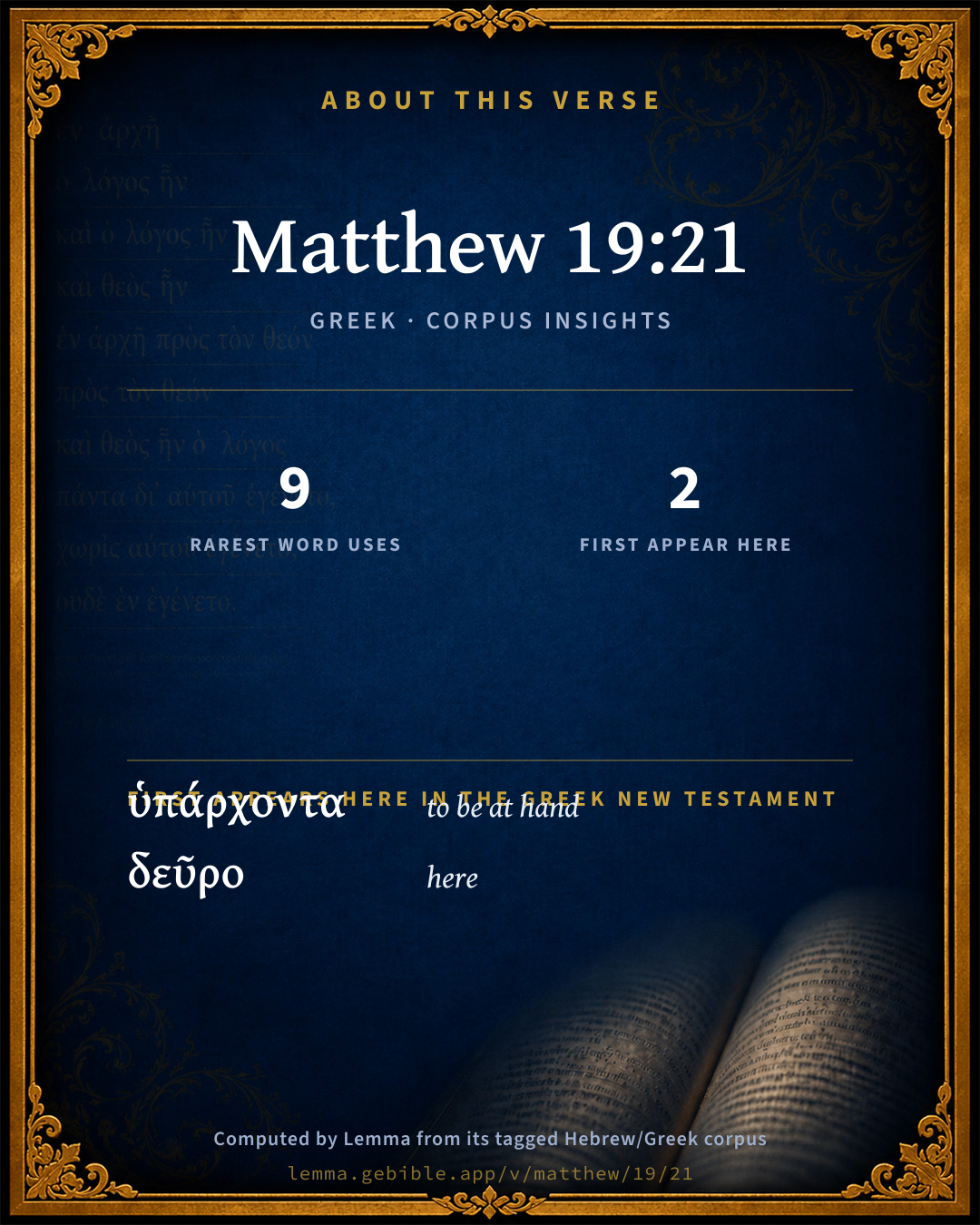
The rarest word here is δεῦρο here G1204 — appearing just 9 times in the whole Greek New Testament.
First appearance in Scripture
These words make their first canonical appearance in the Greek New Testament here:
Shared distinctive vocabulary
δεῦρο here G1204 occurs in 9 verses of the Greek New Testament. Also found in:
Cross-references
26Topical passages linked to Matthew 19:21 in the Treasury of Scripture Knowledge — connected by theme and wording, ordered by reader-vote popularity; previews shown in the World English Bible.
- Mark 10:21 Jesus looking at him loved him, and said to him, "One thing you lack. Go, sell whatever you have, and give to the poor, and you will have treasure in heaven; and come, follow me, taking up the cross."
- Luke 18:22 When Jesus heard these things, he said to him, "You still lack one thing. Sell all that you have, and distribute it to the poor. You will have treasure in heaven. Come, follow me."
- Luke 12:33 Sell that which you have, and give gifts to the needy. Make for yourselves purses which don't grow old, a treasure in the heavens that doesn't fail, where no thief approaches, neither moth destroys.
- Luke 14:33 So therefore whoever of you who doesn't renounce all that he has, he can't be my disciple.
- Acts 2:45 They sold their possessions and goods, and distributed them to all, according as anyone had need.
- Matthew 5:48 Therefore you shall be perfect, just as your Father in heaven is perfect.
- Luke 9:23 He said to all, "If anyone desires to come after me, let him deny himself, take up his cross, and follow me.
- John 10:27 My sheep hear my voice, and I know them, and they follow me.
- John 12:26 If anyone serves me, let him follow me. Where I am, there will my servant also be. If anyone serves me, the Father will honor him.
- 1 Timothy 6:17–19 Charge those who are rich in this present world that they not be haughty, nor have their hope set on the uncertainty of riches, but on the living God, who richly provides us with everything to enjoy;
- Matthew 19:28 Jesus said to them, "Most assuredly I tell you that you who have followed me, in the regeneration when the Son of Man will sit on the throne of his glory, you also will sit on twelve thrones, judging the twelve tribes of Israel.
- Matthew 6:19–20 "Don't lay up treasures for yourselves on the earth, where moth and rust consume, and where thieves break through and steal;
- Matthew 16:24 Then Jesus said to his disciples, "If anyone desires to come after me, let him deny himself, and take up his cross, and follow me.
- Luke 16:9 I tell you, make for yourselves friends by means of unrighteous mammon, so that when you fail, they may receive you into the eternal tents.
- Mark 8:34 He called the multitude to himself with his disciples, and said to them, "Whoever wants to come after me, let him deny himself, and take up his cross, and follow me.
- Luke 6:40 A disciple is not above his teacher, but everyone when he is fully trained will be like his teacher.
- Matthew 9:9 As Jesus passed by from there, he saw a man called Matthew sitting at the tax collection office. He said to him, "Follow me." He got up and followed him.
- Luke 5:27 After these things he went out, and saw a tax collector named Levi sitting at the tax office, and said to him, "Follow me!"
- Matthew 8:22 But Jesus said to him, "Follow me, and leave the dead to bury their own dead."
- Mark 2:14 As he passed by, he saw Levi, the son of Alphaeus, sitting at the tax office, and he said to him, "Follow me." And he arose and followed him.
- Acts 4:32–35 The multitude of those who believed were of one heart and soul. Not one of them claimed that anything of the things which he possessed was his own, but they had all things in common.
- Philippians 3:12–15 Not that I have already obtained, or am already made perfect; but I press on, if it is so that I may take hold of that for which also I was taken hold of by Christ Jesus.
- Hebrews 10:34 For you both had compassion on me in my chains, and joyfully accepted the plundering of your possessions, knowing that you have for yourselves a better possession and an enduring one in the heavens.
- Psalms 37:37 Mark the perfect man, and see the upright, For there is a future for the man of peace.
- Matthew 4:19 He said to them, "Come after me, and I will make you fishers for men."
- Matthew 5:19–20 Whoever, therefore, shall break one of these least commandments, and teach others to do so, shall be called least in the Kingdom of Heaven; but whoever shall do and teach them shall be called great in the Kingdom of Heaven.
Cross-references courtesy of OpenBible.info (CC BY 4.0).
Lesson kit
Teaching starters — assembled from the data on this page, not authored interpretation. Every prompt links to the verse data it draws on. Edit before teaching.
Matthew, in the Gospels, opens this verse with 25 words (22 distinct Greek lemmas). Its most distinctive word is deûro (“here”). A historical commentator’s framing appears above. Read the whole chapter for the surrounding context.
Discussion questions
- The word deûro carries the sense “here.” How does it shape the verse?
- 2 words make their first appearance in Scripture here. What does this debut establish?
- How does Mark 10:21, which shares the word «here», read alongside this verse?
- What does the repetition of “and” (3× in this one verse) do in this verse?
- These translations render this verse differently; the difference is in the English rendering, not the original. What questions does that raise?
- Compare how Tyndale Open Study Notes and Bengel's Gnomon read this verse. Where do they agree or differ?
Things to notice
- 2 words make their first canonical appearance in Scripture here.
- These translations choose different wording for 8 words in this verse.
- “and” occurs 3× in this single verse.
- 22 distinct Greek lemmas span 25 words in this verse.
Commentary
Notes on Matthew 19:21 from classic Christian and Jewish commentators (each source and its license shown beneath its notes). The classic Christian expositions comment on the surrounding passage and are grouped to its opening verse, so a note may address several verses; the Jewish commentaries on the Tanakh (Rashi and others) are per-verse, so they appear only where the commentator wrote on this verse.
Lemma curates 59 commentaries, every one of them public domain or Creative Commons licensed, each selected and text-cleaned for this edition rather than reprinted as found. About our sources →
Tyndale Open Study Notes
Tyndale Open Resources
Tyndale Open Study Notes — © Tyndale Open Resources, licensed CC BY-SA 4.0. Text via the HelloAO Bible API.
Bengel's Gnomon
Johann Albrecht Bengel
Bengel's Gnomon of the New Testament — English translation (T&T Clark, Edinburgh, 1860) — public domain. Text from a community e-Sword module.
Meyer's Critical & Exegetical Commentary
Heinrich August Wilhelm Meyer
Meyer — Critical and Exegetical Commentary on the New Testament — English translation by Peter Christie, edited by Frederick Crombie (T&T Clark, 1880) — public domain. Text from a community e-Sword module.
Expositor's Greek Testament
ed. W. Robertson Nicoll
The Expositor's Greek Testament, edited by W. Robertson Nicoll (1897–1910) — public domain. Text from a community e-Sword module.
Geneva Bible (1599)
Geneva Bible translators
Geneva Bible (1599) marginal notes — public domain. Text via Bolls.life.
Adam Clarke's Commentary
Adam Clarke's Commentary on the Bible (1810–1826) — public domain. Text from a community e-Sword/MySword module.
Ellicott's Commentary for English Readers
A Bible Commentary for English Readers, edited by Charles John Ellicott (1878–1897) — public domain. Text from a community e-Sword module.
The Cambridge Bible for Schools and Colleges
gen. ed. J. J. S. Perowne
The Cambridge Bible for Schools and Colleges (gen. ed. J. J. S. Perowne; Cambridge University Press, 1878–1918) — public domain. Text from a community e-Sword module.
John Gill's Exposition
John Gill's Exposition of the Whole Bible (1746–1763) — public domain (CC PDM 1.0). Text via the HelloAO Bible API.
Trapp's Complete Commentary
John Trapp
John Trapp, A Commentary or Exposition upon All the Books of the Old and New Testament (1647–1656) — public domain. Text from a community e-Sword module.
Haydock's Catholic Bible Commentary
George Leo Haydock (1774–1849), Haydock's Catholic Family Bible and Commentary, 1859 edition — public domain. Excludes Psalms (Douay-Rheims chapter numbering differs from Protestant) and Deuterocanonical books (Catholic canon only).
Matthew Poole's English Annotations
Matthew Poole's English Annotations on the Holy Bible (1683–1685) — public domain. Text from a community e-Sword/MySword module.
Whedon's Commentary on the Bible
Daniel D. Whedon
Daniel D. Whedon (gen. ed.), Commentary on the Old and New Testaments (1874–1909) — public domain. Text from a community e-Sword module.
The Pulpit Commentary
The Pulpit Commentary (1880–1919), ed. H.D.M. Spence-Jones & Joseph S. Exell — public domain. Text from a community e-Sword module.
John Wesley's Explanatory Notes
John Wesley, Explanatory Notes Upon the Whole Bible (1754–1765) — public domain. Text via the GEBible commentary corpus.
Scofield Reference Notes
C. I. Scofield
The Scofield Reference Bible (1917 edition), notes by C. I. Scofield — public domain. Text from a community e-Sword module.
Burkitt's Expository Notes on the New Testament
William Burkitt
William Burkitt's Expository Notes on the New Testament (1700–1703) — public domain. Text from a community e-Sword module.
The People's New Testament
B. W. Johnson
B. W. Johnson's The People's New Testament with Notes (1889–1891) — public domain. Electronic text from the Christian Classics Ethereal Library (CCEL) ThML edition.
Cambridge Greek Testament for Schools and Colleges
Cambridge Greek Testament for Schools and Colleges (Cambridge University Press, 1896; 21 vols, various authors incl. Carr, Maclear, Plummer, Farrar, Lumby, Moule, M. R. James, Simcox) — public domain. Text from a community e-Sword module.
International Critical Commentary
International Critical Commentary — older volumes (1896–1929), various authors — public domain. Text from a community e-Sword module.