Matthew 3:2

Greek (Tischendorf 8th ed.) Matthew 3:2 appears in the Greek New Testament. The text above is from the Tischendorf 8th edition. Each word links to its Strong’s number and a concise gloss. Click any word for its full Thayer’s Greek Lexicon entry.
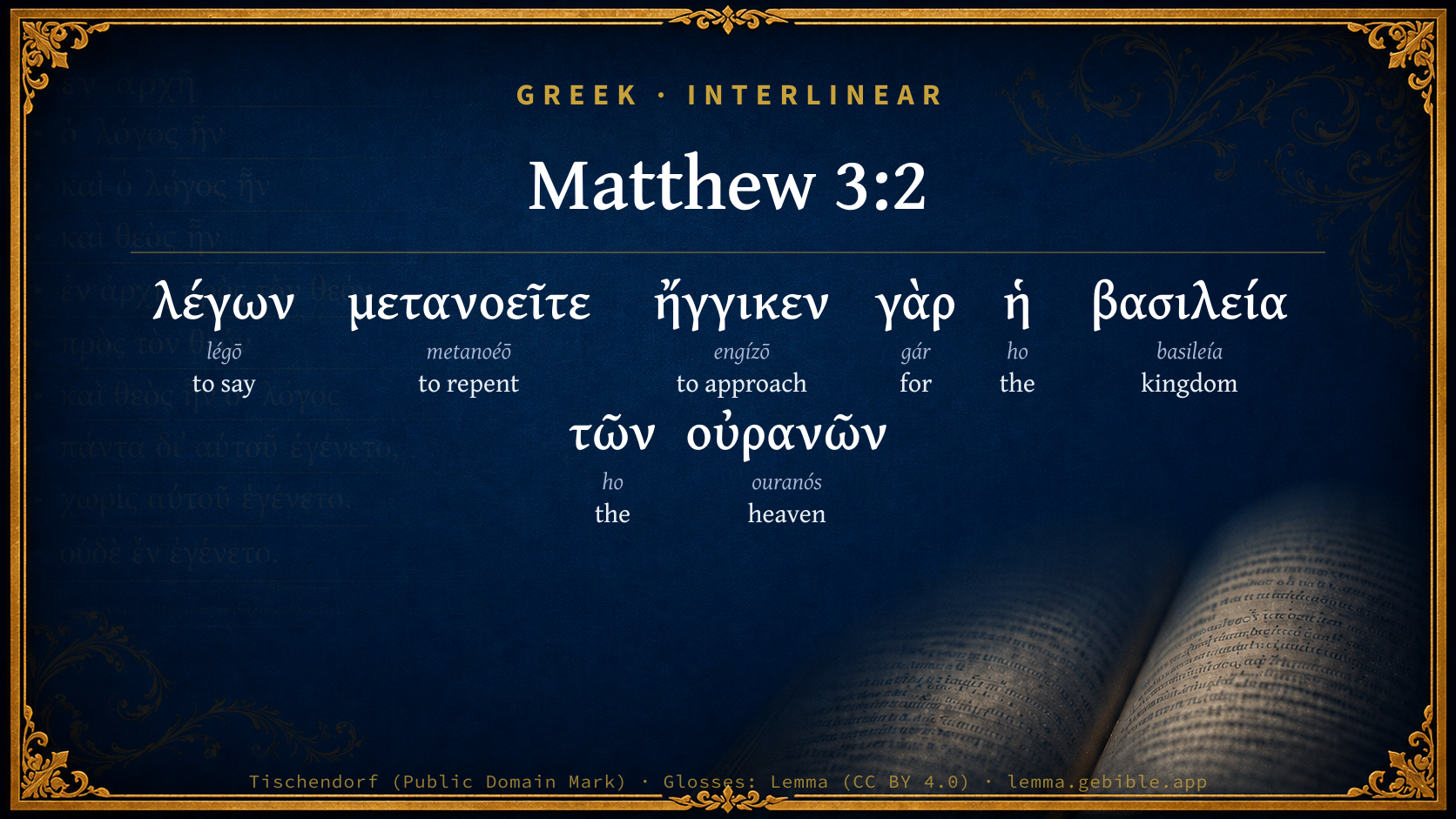
Download image
Cite this verse

Matthew 3:2 (World English Bible). Public Domain. Lemma interlinear Bible study tool, https://lemma.gebible.app/v/matthew/3/2.

Show BibTeX & RIS
BibTeX
RIS
English Translation
"Repent, for the Kingdom of Heaven is at hand!"
World English Bible · Public Domain
Highlights
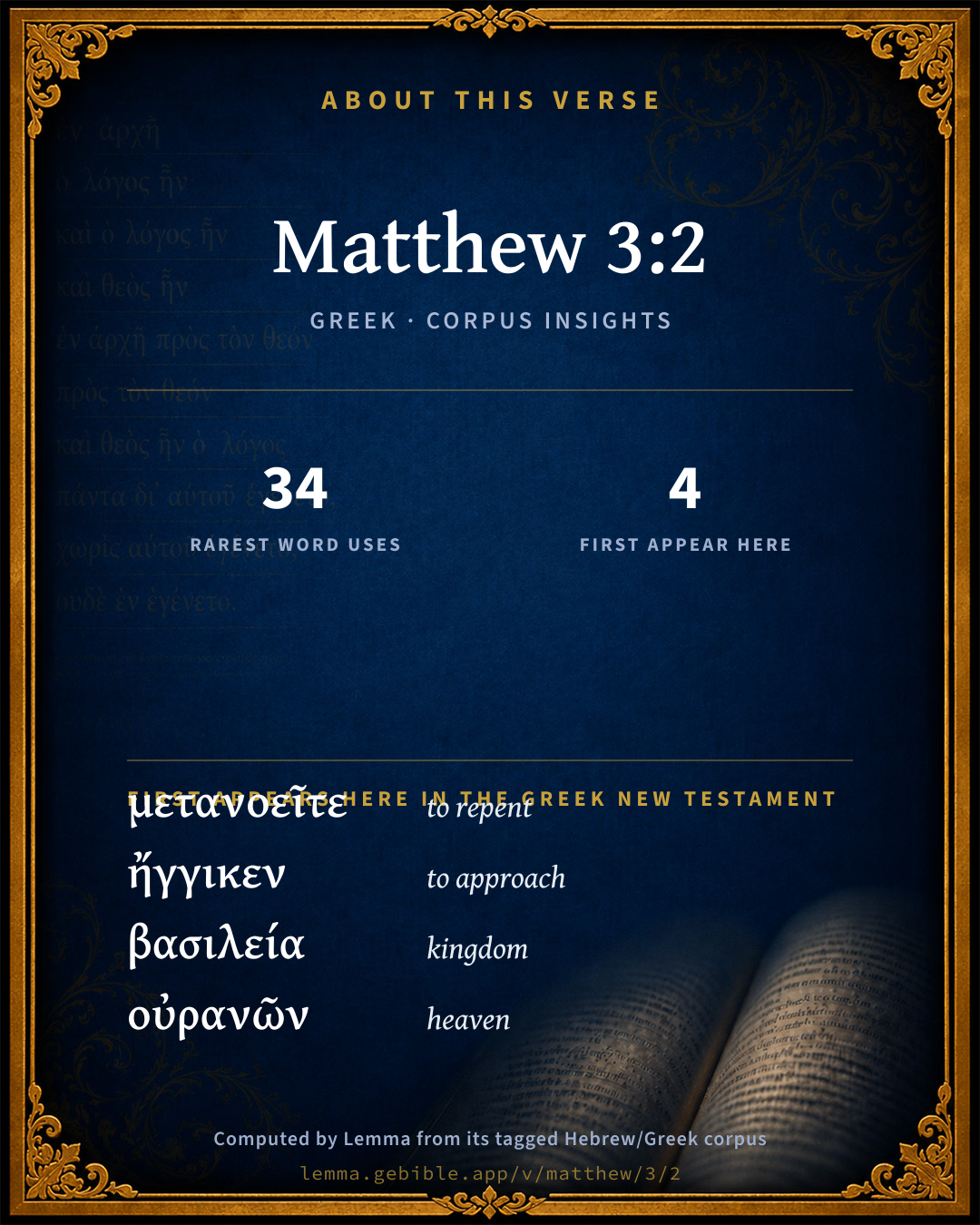
  • 4 first appearances in the Greek New Testament
Full analysis ↓
Download a study sheet

One document with this verse’s original text, its word-by-word gloss line, the meaning frame, cross-references with their text, attributed commentary, and full source and license credits — printable, and it pastes into notes with its structure intact.

This verse Autodidact and up

Study sheet (.html) Plain text (.txt)

A passage Seminary Student

Up to 50 verses in one chapter. A passage sheet keeps up to 6 commentary sources and 12 cross-references per verse, in the order this page ranks them, and says so on the sheet whenever that leaves anything out. Ask for a single verse and you get the Autodidact verse sheet above.

Everything on this page stays free to read, with no account — the sheet is a download of what is already on screen, not access to it.

Want to remove ads? Support Godless Engineer
Compare translations 3

The same verse in 3 English versions, stacked beneath the original-language interlinear above. Click any original word for its lexicon entry.

Each is an independent rendering of the whole verse — the interlinear is not word-aligned to these translations.

Highlighted words mark where these versions differ — a whole-verse word diff, not a word-by-word alignment.

  • World English Bible Public Domain
    "Repent, for the Kingdom of Heaven is at hand!"
  • King James Version Public Domain
    And saying, Repent ye: for the kingdom of heaven is at hand.
  • unfoldingWord Literal Text CC BY-SA 4.0
    saying, “Repent, for the kingdom of the heavens is near.”

unfoldingWord Literal Text — © unfoldingWord, licensed CC BY-SA 4.0. Word-aligned USFM3 via Door43 (git.door43.org/unfoldingWord/en_ult).

Versions to compare (up to 4)

3 of 4 selected

Show all 19 translations

Every available English version of this verse, each an independent rendering of the whole verse.

  • World English Bible Public Domain
    "Repent, for the Kingdom of Heaven is at hand!"
  • Berean Standard Bible Public Domain
    and saying, “Repent, for the kingdom of heaven is near.”
  • Majority Standard Bible Public Domain
    and saying, “Repent, for the kingdom of heaven is near.”
  • King James Version Public Domain
    And saying, Repent ye: for the kingdom of heaven is at hand.
  • American Standard Version (1901) Public Domain
    Repent ye; for the kingdom of heaven is at hand.
  • Revised Version (1885) Public Domain
    saying, Repent ye; for the kingdom of heaven is at hand.
  • Geneva Bible (1599) Public Domain
    And said, Repent: for the kingdome of heauen is at hand.
  • Douay-Rheims (1899) Public Domain
    And saying: Do penance: for the kingdom of heaven is at hand.
  • Young's Literal Translation Public Domain
    and saying, `Reform, for come nigh hath the reign of the heavens,'
  • Literal Standard Version CC BY-SA 4.0
    and saying, “Convert, for the kingdom of the heavens has come near,”
  • Unlocked Literal Bible CC BY-SA 4.0
    “Repent, for the kingdom of heaven is near.”
  • unfoldingWord Literal Text CC BY-SA 4.0
    saying, “Repent, for the kingdom of the heavens is near.”
  • Darby Bible Public Domain
    and saying, Repent, for the kingdom of the heavens has drawn nigh.
  • World Messianic Bible Public Domain
    “Repent, for the Kingdom of Heaven is at hand!”
  • Webster's Bible Public Domain
    And saying, Repent ye: for the kingdom of heaven is at hand.
  • Free Bible Version CC BY-SA 4.0
    “Repent, for the kingdom of heaven has arrived!”
  • Bible in Basic English Public Domain
    Saying, Let your hearts be turned from sin; for the kingdom of heaven is near.
  • Text-Critical English NT CC BY 4.0
    “Repent, for the kingdom of heaven has drawn near.”
  • Tyndale New Testament (1534) Public Domain
    saynge; Repet the kyngdome of heue is at honde.

Literal Standard Version (2020), Covenant Press — licensed CC BY-SA 4.0. Text via the HelloAO Bible API (eBible.org). Unlocked Literal Bible (unfoldingWord) — licensed CC BY-SA 4.0. Text via the HelloAO Bible API (eBible.org). unfoldingWord Literal Text — © unfoldingWord, licensed CC BY-SA 4.0. Word-aligned USFM3 via Door43 (git.door43.org/unfoldingWord/en_ult). Free Bible Version, Dr. Jonathan Gallagher — licensed CC BY-SA 4.0. Text via the HelloAO Bible API (eBible.org).

Word by word

More ways to search: Search by grammar → Find every occurrence → Compare this word →

Practice this passage: Drill this verse → Learn its vocabulary →

About this verse

These counts appear in no published source. They are computed here, from the morphology-tagged text and Lemma’s own curated glosses. What Lemma adds →

8
words
7
distinct lemmas
Gospels
section

First appearance in Scripture

These words make their first canonical appearance in the Greek New Testament here:

  • μετανοεῖτε to repent G3340
  • ἤγγικεν to approach G1448
  • βασιλεία kingdom G932
  • οὐρανῶν heaven G3772

Shared distinctive vocabulary

μετανοεῖτε to repent G3340 occurs in 32 verses of the Greek New Testament. Also found in:

Repetition

A word recurs within this verse:

Cross-references

58

Topical passages linked to Matthew 3:2 in the Treasury of Scripture Knowledge — connected by theme and wording, ordered by reader-vote popularity; previews shown in the World English Bible.

  • Matthew 4:17 From that time, Jesus began to preach, and to say, "Repent! For the Kingdom of Heaven is at hand."
  • Mark 1:15 and saying, "The time is fulfilled, and the Kingdom of God is at hand! Repent, and believe in the Gospel."
  • Daniel 2:44 In the days of those kings shall the God of heaven set up a kingdom which shall never be destroyed, nor shall the sovereignty of it be left to another people; but it shall break in pieces and consume all these kingdoms, and it shall stand forever.
  • Matthew 6:10 Let your Kingdom come. Let your will be done, as in heaven, so on earth.
  • Matthew 10:7 As you go, preach, saying, 'The Kingdom of Heaven is at hand!'
  • Luke 24:47 and that repentance and remission of sins should be preached in his name to all the nations, beginning at Jerusalem.
  • 2 Corinthians 7:10 For godly sorrow works repentance to salvation, which brings no regret. But the sorrow of the world works death.
  • Acts 3:19 "Repent therefore, and turn again, that your sins may be blotted out, so that there may come times of refreshing from the presence of the Lord,
  • Luke 15:10 Even so, I tell you, there is joy in the presence of the angels of God over one sinner repenting."
  • Matthew 13:44–45 "Again, the Kingdom of Heaven is like a treasure hidden in the field, which a man found, and hid. In his joy, he goes and sells all that he has, and buys that field.
  • Luke 13:3 I tell you, no, but, unless you repent, you will all perish in the same way.
  • Luke 10:9–11 Heal the sick who are therein, and tell them, 'The Kingdom of God has come near to you.'
  • Luke 11:20 But if I by the finger of God cast out demons, then the Kingdom of God has come to you.
  • John 3:3–5 Jesus answered him, "Most assuredly, I tell you, unless one is born anew, he can't see the Kingdom of God."
  • Acts 2:38 Peter said to them, "Repent, and be baptized, everyone of you, in the name of Jesus Christ for the forgiveness of sins, and you will receive the gift of the Holy Spirit.
  • Acts 17:30 The times of ignorance therefore God overlooked. But now he commands that all people everywhere should repent,
  • Acts 20:21 testifying both to Jews and to Greeks repentance toward God, and faith toward our Lord Jesus.
  • 2 Peter 3:9 The Lord is not slow concerning his promise, as some count slowness; but is patient with us, not wishing that any should perish, but that all should come to repentance.
  • Matthew 5:10 Blessed are those who have been persecuted for righteousness' sake, For theirs is the Kingdom of Heaven.
  • Matthew 12:41 The men of Nineveh will stand up in the judgment with this generation, and will condemn it, for they repented at the preaching of Jonah; and behold, someone greater than Jonah is here.
  • Matthew 13:33 He spoke another parable to them. "The Kingdom of Heaven is like yeast, which a woman took, and hid in three measures of meal, until it was all leavened."
  • Matthew 13:47 "Again, the Kingdom of Heaven is like a dragnet, that was cast into the sea, and gathered some fish of every kind,
  • Matthew 13:52 He said to them, "Therefore, every scribe who has been made a disciple in the Kingdom of Heaven is like a man who is a householder, who brings out of his treasure new and old things."
  • Matthew 21:29–32 He answered, 'I will not,' but afterward he changed his mind, and went.
  • Luke 6:20 He lifted up his eyes to his disciples, and said, "Blessed are you who are poor, For yours is the Kingdom of God.
  • Acts 11:18 When they heard these things, they held their peace, and glorified God, saying, "Then God has also granted to the Gentiles repentance to life!"
  • Job 42:6 Therefore I abhor myself, And repent in dust and ashes."
  • Ezekiel 33:11 Tell them, As I live, says the Lord Yahweh, I have no pleasure in the death of the wicked; but that the wicked turn from his way and live: turn you, turn you from your evil ways; for why will you die, house of Israel?
  • Matthew 5:3 "Blessed are the poor in spirit, For theirs is the Kingdom of Heaven.
  • Matthew 18:1–4 In that hour the disciples came to Jesus, saying, "Who then is greatest in the Kingdom of Heaven?"
  • Mark 1:4 John came baptizing in the wilderness and preaching the baptism of repentance for forgiveness of sins.
  • Mark 6:12 They went out and preached that people should repent.
  • Luke 9:2 He sent them forth to preach the Kingdom of God, and to heal the sick.
  • Luke 13:5 I tell you, no, but, unless you repent, you will all perish in the same way."
  • Luke 15:7 I tell you that even so there will be more joy in heaven over one sinner who repents, than over ninety-nine righteous people who need no repentance.
  • Colossians 1:13 who delivered us out of the power of darkness, and translated us into the Kingdom of the Son of his love;
  • 2 Timothy 2:25 in gentleness correcting those who oppose him: perhaps God may give them repentance leading to a full knowledge of the truth,
  • Ezekiel 18:30–32 Therefore I will judge you, house of Israel, everyone according to his ways, says the Lord Yahweh. Return you, and turn yourselves from all your transgressions; so iniquity shall not be your ruin.
  • Matthew 6:33 But seek first God's Kingdom, and his righteousness; and all these things will be given to you as well.
  • Matthew 13:31 He set another parable before them, saying, "The Kingdom of Heaven is like a grain of mustard seed, which a man took, and sowed in his field;
  • Hebrews 6:1 Therefore leaving the doctrine of the first principles of Christ, let us press on to perfection--not laying again a foundation of repentance from dead works, of faith toward God,
  • Matthew 11:11–12 Most assuredly I tell you, among those who are born of women there has not arisen anyone greater than John the Baptizer; yet he who is least in the Kingdom of Heaven is greater than he.
  • Matthew 13:11 He answered them, "To you it is given to know the mysteries of the Kingdom of Heaven, but it is not given to them.
  • Matthew 22:2 "The Kingdom of Heaven is like a certain king, who made a marriage feast for his son,
  • Acts 26:20 but declared first to them of Damascus, at Jerusalem, and throughout all the country of Judea, and also to the Gentiles, that they should repent and turn to God, doing works worthy of repentance.
  • Revelation 2:5 Remember therefore from where you have fallen, and repent and do the first works; or else I am coming to you swiftly, and will move your lampstand out of its place, unless you repent.
  • Revelation 2:21 I gave her time to repent, but she refuses to repent of her sexual immorality.
  • 1 Kings 8:47 yet if they shall repent themselves in the land where they are carried captive, and turn again, and make supplication to you in the land of those who carried them captive, saying, We have sinned, and have done perversely, we have dealt wickedly;
  • Matthew 5:19–20 Whoever, therefore, shall break one of these least commandments, and teach others to do so, shall be called least in the Kingdom of Heaven; but whoever shall do and teach them shall be called great in the Kingdom of Heaven.
  • Matthew 11:20 Then he began to denounce the cities in which most of his mighty works had been done, because they didn't repent.
  • Matthew 18:23 Therefore the Kingdom of Heaven is like a certain king, who wanted to reconcile accounts with his servants.
  • Matthew 20:1 "For the Kingdom of Heaven is like a man who was the master of a household, who went out early in the morning to hire laborers for his vineyard.
  • Matthew 23:13 "Woe to you, scribes and Pharisees, hypocrites! For you devour widows' houses, and as a pretense you make long prayers. Therefore you will receive greater condemnation.
  • Matthew 25:1 "Then the Kingdom of Heaven will be like ten virgins, who took their lamps, and went out to meet the bridegroom.
  • Matthew 13:24 He set another parable before them, saying, "The Kingdom of Heaven is like a man who sowed good seed in his field,
  • Matthew 25:14 "For it is like a man, going into another country, who called his own servants, and entrusted his goods to them.
  • Luke 16:30 "He said, 'No, father Abraham, but if one goes to them from the dead, they will repent.'
  • Luke 21:31 Even so you also, when you see these things happening, know that the Kingdom of God is near.

Cross-references courtesy of OpenBible.info (CC BY 4.0).

Commentary

Notes on Matthew 3:2 from classic Christian and Jewish commentators (each source and its license shown beneath its notes). The classic Christian expositions comment on the surrounding passage and are grouped to its opening verse, so a note may address several verses; the Jewish commentaries on the Tanakh (Rashi and others) are per-verse, so they appear only where the commentator wrote on this verse.

Lemma curates 59 commentaries, every one of them public domain or Creative Commons licensed, each selected and text-cleaned for this edition rather than reprinted as found. About our sources →

The Biblical Illustrator

Joseph S. Exell

Mat_3:2

Repent ye.

The forerunner

of Jesus was distinguished as a prophet.

I. The preacher. Powerful and faithful.

II. The duty enforced. Repentance.

III. The plea by which it is enforced. The kingdom of heaven is nigh. (T. Heath.)

Preparing for Christ

I. A general view of the character, office, and ministry of the Baptist. It was preparatory to setting up the gospel kingdom.

II. The appropriate connection between repentance and any part in the kingdom of heaven, between spiritual conviction of sin and the realized advent of Him who is to deliver us from its guilt and power. The results of such preaching:-

1. Humiliating convictions of sin.

2. It makes ready for the reception of saving faith. (D. Moore, M. A.)

I. The character of the persons to whom Johns exhortation was addressed (Luk_3:1-38.) Many of them were soldiers and publicans, or Roman tax-gatherers, generally notoriously wicked. But many of them were brought to a temporary repentance (Luk_3:10-14). The bulk of them were professedly members of the Jewish Church (Luk_3:15), and among them many of their two great sects-Sadducees and Pharisees.

II. What this exhortation implies. Repentance-after-thought and consideration; hence arises conviction, humiliation, etc. A change of mind and heart (Mat_3:7-10; Luk_3:7-14; 2Co_7:10-11). This doctrine is equally necessary to be inculcated upon us.

III. The motives by which the exhortation is enforced. The gospel dispensation is come (Luk_1:78-79). And thus is a foundation laid for repentance. Jesus is exalted to give repentance (Act_5:31). (Joseph Benson.)

Repentance

1. Repentance is generally made the child of fear; both John and Christ pressed people to repent because something good and happy was coming. This is true to our nature; men would rather turn their conduct by an expectation of good than by denunciation of evil. Fear is repellent, hope is an attraction; coldness hardens, warmth softens. Let man see a future near he likes and he will leave the past.

2. What God means when He says Repent. It is not remorse, sorrow, conviction, but a change of mind. You want a great change before Christ comes. (J. Vaughan, M. A.)

His sermon was an exhortation to repentance and a holy life.

I. Repentance is the first intromission into the sanctities of Christian religion. The Lord treads upon no paths that are not

(1) hallowed and made smooth by the sorrows and cares of contrition;

(2) cleared of the impediments of sin by dereliction, and the succeeding fruits of emendation.

II. His baptism did signify by a cognation to their usual rites and ceremonies of ablution and washing Gentile proselytes, that the Jews had so far receded from their duty and that holiness which God required of them by the law, that they were in the state of strangers.

(1) To be treated themselves as Gentile proselytes

(2) by baptism

(3) and a new state of life

(4) before they could be accepted by the Messias

(5) or admitted to His kingdom. (Jeremy Taylor.)

Repentance should be

I. Sincere. Though God is merciful He is not fallible, nor will He take the odour of sacrifices, or the incense of words in lieu of a solid, laborious virtue.

1. It is absolutely necessary to abandon the vice.

2. The thought of heaven should bring moral fortitude. The repentant soul should be great in purpose, rapid in action, unshaken in constancy.

II. Timely. It must take place at such a period as will enable us to make a real sacrifice of unlawful enjoyment to a sense of Christian duty.

1. Satiety is often mistaken for repentance. Many give up the offence when they have lost all appetite for its commission.

2. Change of body is mistaken for change of mind. He who quits a vice that has become unnatural to his period of life deems himself a progressive penitent, and believes he is receding from pleasure because pleasure is receding from him.

III. Continuous. If only a year of life remains let that be a whole year of repentance.

IV. Just. In making

(1) restitution or

(2) compensation for the injuries committed.

V. The soul of a penitent man should be as firm against future relapse as it is sorrowful for past iniquity. (Sydney Smith.)

I. True sight of sin is requisite to true repentance.

1. A man that does repent must see and know his sins.

2. Must be grieved and humbled for them.

3. He must loathe himself.

4. He must be ashamed of his sin. So long as a man walks in the dark, he does not blush, he is not ashamed, though his clothes be ragged and torn, because he is in the dark; but if he come to the light, then he blushes.

5. He must acknowledge his sins.

6. He must labour to undo his sins.

II. Repentance is a fruit of faith.

1. Tears of repentance flow from the eye of faith.

2. So also repentance flows from love. Love is the cause of grief.

III. It is one thing for a man to be pricked in heart, and another for a man to repent.

1. A man, a malefactor, when he sees what shall become of him, wishes that he had never done it.

2. A man may be broken down with the weight of sin, yet his soul may not be thawed or melted. When you take a staff and break the ice with your hands, though you break it in one place, it freezes in another; but when there is a thaw, it melts and breaks everywhere.

3. A man may have more sorrow, grief, repentance in the ore, yet have none that is well refined.

4. It is one thing for grief, sorrow, and repentance to be more in view, sense and noise; and another thing to be more in spirit, and in profit. (Wm. Bridge.)

John the Baptist a storm-centre

Sometimes, nay, often, a church or a nation lies like a ship becalmed on the tropic sea. The air around it is heavy with pestilence and with death. The heat and the stagnation bring forth a brood of contemptible vices. Then some rushing storm-centre comes sweeping across the waters, and gathers into its bosom all the thunders of the lurid sky, lashes into fury the lazy elements, torments the putrescent waves into spray and foam, whirls the ship along with the noise of waterspouts, kindles electric fire upon its masts, making the ships crew pale their features with fear-drunken, or slumbering, or careless as they are. And even such a storm-centre of moral force was St. John the Baptist. For a brief time be cleared the air of a religion heavy with imposture, but it was too late. A few pure souls prepared by him had listened in the hush which followed to the voice of Christ; but the heavy pall of formalism and insincerity fell again upon the nation, fold by fold, and when the hurricane burst upon it once more, it was not the purifying storm of spiritual regeneration, it was the tornado of final destination. (F. W. Farrar.)

Reverie of repentance

There are thousands of persons who are given to what may be called the reverie of repentance. There are thousands of persons who feel sad that they are such wicked creatures. Really they feel that it is too bad. They at times fall into a minor key. Perhaps, if they are educated to music, they sit down to the piano, and play touching airs, and sing of the wickedness of the heart till tears flow down their cheeks. They pity themselves that they are so pitiable. How much repentance is there in all this? Is there any definiteness in it? Does the man say, I am as proud as Lucifer? Not a word does he utter on that subject. Does the man say, I am meanly selfish? Oh, no; he only says, I am sin-sick. Does the man say, I am unscrupulous, I am untrustworthy, I give way to debauch in this direction, and to animal appetites in that ? Does the man follow the example of that surgeon who, when called to dress a wound, probes it in all directions, and cleanses it thoroughly before he binds it up? Does he sit down and explore his heart with a searching, minute examination? No; he does not want to go particularly into it. He merely wants to have a feeling of regret in view of his general sinfulness. (H. W. Beecher.)

The Biblical Illustrator, edited by Joseph S. Exell (c. 1880s–1900s) — public domain. Text from a community e-Sword module.

Joseph Benson's Commentary

Mat 3:2. Repent ye, &c. — Be sorry for your sins, and amend your lives; for the original word, μετανοειτε, here used, implies this. It properly signifies, says Beza, to be wise after the action, and so to grieve for a fault committed as to amend it, which, in Latin, is properly expressed by resipiscere. In this respect it differs from another Greek word, which the evangelists sometimes use, viz., μεταμελομαι, which simply signifies to be distressed, and anxious after any thing done, but does not necessarily imply any change of mind, or reformation of life. Therefore Matthew uses the latter word of Judas, the traitor, Mat 27:3, but not the former. Thus Christ and his apostles began their preaching, confirming John’s doctrine. John taught other things also, but this he began with, and this was the main scope of his preaching. He did not give them any new precepts of life, but charged them with breaking the law they had already, and called upon them to be sensible of it, sorry for it, and to reform their conduct: to lay aside the false opinions they had imbibed, whether from the Pharisees or Sadducees; to acknowledge, condemn, and lament the faults they had committed, and to turn from all error and all sin, to true faith in, and piety toward, God. He that so deplores some sins as to commit others, or to repeat the commission of those he deplores, either counterfeits, or is ignorant of repentance. Repentance is, as Jerome speaks, secunda post naufragium tabula — a lucky plank after a shipwreck. The first degree of happiness is, not to sin; the second, to know our sins, and repent of them. For repentance not only implies sorrow for sin, or sincerely wishing it undone, but a change of mind, and reformation of life. The kingdom of heaven is at hand — As if he had said, God is about to appear in an extraordinary manner, to erect that kingdom spoken of by Daniel, (Dan 2:44; and Dan 7:13-14,) as the kingdom of the God of heaven, which he would set up, and give to the Son of man, making it finally victorious over all other kingdoms. This phrase, the kingdom of heaven, is used thirty times by St. Matthew. The other evangelists, and St. Paul, term it generally, the kingdom of God, and sometimes, the kingdom of Christ. These different phrases mean the same thing, and were in familiar use among the Jews, as plainly appears from divers passages of the gospels. They seem to have borrowed them from the above-mentioned passages in the book of Daniel, which they wholly misunderstood and misinterpreted, inferring from them that God would erect a temporal kingdom the seat of which would be at Jerusalem, which would become, instead of Rome, the capital of the world. The expected sovereign of this kingdom, they learned, from Daniel, to call the Son of man, by which title they understood the promised Messiah, or the Anointed One of God. Both John the Baptist, then, and Christ took up this phrase, and used it as they found it, and gradually taught the Jews to affix right ideas to it, though it was a lesson which that worldly people were remarkably unwilling to learn. This very demand of repentance showed that it was a spiritual kingdom which was spoken of; and that no wicked man, how politic or brave, how learned and renowned soever, could possibly be a genuine subject of it. As the term kingdom implies the dominion of a king over his subjects, so the kingdom of God, or heaven, is God’s reigning in and over his rational creatures, whether angels or men; and, as to the latter, whether on earth or in heaven, that is, whether of the church militant or the church triumphant. The expression properly signifies the gospel dispensation, in and by which subjects were to be gathered to God by his Son, and a society formed, which was to subsist first in more imperfect circumstances on earth, and afterward in complete perfection and felicity in the world of glory. In some places of Scripture the phrase more particularly signifies the former, and denotes the state of Christ’s kingdom on earth, as Matthew 13., especially Mat 13:41; Mat 13:47; Mat 20:1; and sometimes it signifies only that most blessed state of things which shall take place after the resurrection, when God will be all in all. See 1Co 6:9; and 1Co 15:50. But it generally includes both; and what is closely connected therewith, God’s subduing, or executing judgment upon his and his people’s enemies. For God’s regal power is exercised in delivering, assisting, defending, and rewarding all his faithful subjects, and in warning, punishing, and destroying his obdurate enemies. This latter particular, namely, the punishing and destroying his enemies, seems, at least, to be partly meant in this passage, as appears by the context. For, to enforce his doctrine of repentance, he warns them of approaching wrath that would speedily come upon the impenitent, Mat 3:7; Mat 3:10, the executing of which wrath, first upon the unbelieving Jews, and then upon the persecuting Gentiles, is elsewhere represented as the coming of the Son of man in his kingdom.

Joseph Benson's Commentary on the Old and New Testaments (1811–1818) — public domain. Text from a community e-Sword module.

Scofield Reference Notes

C. I. Scofield

(1) The phrase, kingdom of heaven (lit. of the heavens), is peculiar to Matthew and signifies the Messianic earth rule of Jesus Christ, the Son of David. It is called the kingdom of the heavens because it is the rule of the heavens over the earth Mat 6:10 The phrase is derived from Daniel, where it is defined; Dan 2:34-36; Dan 2:44; Dan 7:23-27 as the kingdom which the God of heaven will set up after the destruction by "the stone cut out without hands," of the Gentile world-system. It is the kingdom covenanted to David’s seed 2Sa 7:7-10 described in the prophets; (See Scofield "Zec 12:8") and confirmed to Jesus the Christ, the Son of Mary, through the angel Gabriel Luk 1:32; Luk 1:33.

(2) The kingdom of heaven has three aspects in Matthew:

(a) "at hand" from the beginning of the ministry of John the Baptist Mat 3:2 to the virtual rejection of the King, and the announcement of the new brotherhood Mat 12:46-50

(b) in seven "mysteries of the kingdom of heaven," to be fulfilled during the present age Mat 13:1-52 to which are to be added the parables of the kingdom of heaven which were spoken after those of Matthew 13, and which have to do with the sphere of Christian profession during this age;

(c) the prophetic aspect--the kingdom to be set up after the return of the King in glory. Mat 24:29 to Mat 25:46; Luk 19:12-19; Act 15:14-17 See "Kingdom (N.T.)"; Luk 1:33; 1Co 15:28 Cf. "Kingdom of God," (See Scofield "Mat 6:33").

saying (See Scofield "Act 17:30").

The Scofield Reference Bible (1917 edition), notes by C. I. Scofield — public domain. Text from a community e-Sword module.

Godbey's Commentary on the New Testament

William B. Godbey

CHAPTER 5

THE BAPTISM WHICH JESUS GIVES CONTRASTED WITH THAT OF JOHN

Mat 3:2; Mar 1:7-8; Luk 3:16. “I indeed baptize you with water unto repentance; but the One coming after me is more powerful than I, whose sandals I am unworthy to carry; He will baptize you with the Holy Ghost and fire.” John and all other authentic preachers of the gospel administer the symbolic baptism with water, not only in this way sealing the covenant of repentance, but beautifully typifying the real baptism which Jesus gives with the Holy Ghost. Whereas, Matthew and Mark give us here the statement en hudati, the dative of instrumentality, showing up the fact that John used the water in an instrumental way, Luke simply says men hudati baptizo humas — i.e., “I indeed baptize you with water” — omitting the preposition en, as you see, confirming the fact that hudati is the dative of instrumentality, clearly and unequivocally involving the conclusion that John handled the water instead of the people. This preposition en in this passage — used by Matthew and Mark and omitted by Luke — has several meanings, among which “in” and “with” are most prominent. God forbid that any one should think I want to encourage controversy in a matter so small and unessential as the quantity of water and the manner of its application! You read the Word of the Lord, and be sure you satisfy your conscience. (1Pe 3:21.) We also have, in certain localities, a controversy involving the fire phase of our Savior’s baptism. Here, with the inspired Greek under my eye, I see that Matthew and Luke give us, “He will baptize you with the Holy Ghost and fire,” while Mark omits the fire altogether, simply stating, “He will baptize you with the Holy Ghost,” clearly involving the conclusion that the fire normally inheres in the Holy Spirit — i.e., is inseparable from Him: “God is a consuming fire.” (Heb 12:18.) You know the Holy Ghost is none other than very and eternal God; therefore, when you receive the Holy Ghost, you receive the baptism of fire:

“For He is like a refiner’s fire, and like fuller’s soap.” (Mal 3:2.)

Thus, fire and soap being the great purifiers, are here associated, denotative of that wonderful purification which the Holy Spirit always executes when you receive Him into your hearts. The teaching of a fiery baptism, separate and distinct from that of the Holy Spirit, antagonizes Eph 4:3, where Paul certifies that there is one, and only one, baptism in the gracious economy, the fire not being a separate and distinct baptism, but a concomitant of the Spirit; while the ordinance with water is not intrinsically a baptism, but symbolically typifies the real baptism of the Holy Spirit administered by our Savior. In connection with these facts, it is pertinent to consider 2Ti 1:6 :

“On account of which cause, I remind thee to revive and refire the gracious gift of God which is in thee for the laying on of my hands.”

The English word here, “stir up,” is anazopurein, which is a compound from ana, re; zao, life; pur, fire. Hence you see that the plain meaning of this triple Greek compound is “revive” and “refire.” We receive spiritual life in regeneration, but frequently need reviving, and will till this mortal puts on immortality.

We receive the fire of the Holy Ghost in sanctification, which should be revived and renewed, ever and anon, throughout our pilgrimage. You take food to revive your physical life, as otherwise it would evanesce, and you would die. You frequently put on fuel, stir up, and renew the fire, as otherwise it would go out, and you would freeze out in the North-pole atmosphere of this wintry world. Let us not get wise above what is written; but take the plain Word of the Lord in every Case, and you will keep out of these tangles, in which Satan is so fond of perplexing the people of God. There is no danger of getting too much life and too much fire if you get it from God. Man has fox-fire, the devil has hell-fire, and God has heavenly-fire. The Holy Ghost is God. If you seek a baptismal fire separate from the Spirit, you open the door for men and devils to deceive you with their “strange fire,” for which Nadab and Abihu, the sons of Aaron, fell dead when they offered it to the Lord. So beware, lest you offer strange fire to the Lord, and fall dead spiritually, as we seriously fear some are doing. If you seek any blessing separate from God, you run headlong into fanaticism. Feel perfectly free to get revived and fired all you possibly can, but get it all from God, remembering, amid all that God says, there is but one baptism. (Eph 5:4.)

William B. Godbey, Commentary on the New Testament (1896–1900) — public domain. Text from a community e-Sword module.

Tyndale Open Study Notes

Tyndale Open Resources

3:2 The prophetic call to return to God in repentance (cp. Isa 1:16-20) involves total reorientation from pride and sin to humble obedience to God (see Jer 3:11-22). John’s message included specific practical application (Luke 3:11-14).

Tyndale Open Study Notes — © Tyndale Open Resources, licensed CC BY-SA 4.0. Text via the HelloAO Bible API.

Bengel's Gnomon

Johann Albrecht Bengel

Mat 3:2. Μετανοεῖτε, repent ye) A lovely word (see verses 8, 11), implying change your disposition, put on a disposition royal, heavenly, worthy the kingdom of heaven.[114] Thus Jesus Christ Himself, thus His apostles commenced their preaching: thus the Lord commanded John to write at the commencement of the Apocalypse.—ἡ βασιλεία, the kingdom) See Gnomon on ch. Mat 4:17.—τῶν οὐρανῶν, of the Heavens) expressed in the plural number agreeably with the Hebrew שמים.[115] This phrase ἡ βασιλεία τῶν οὐρανῶν, the kingdom of the Heavens,[116] is peculiar to Matthew, who employed it that he might cure the Jews, for whom he was writing, of the notion of an earthly kingdom.

[114] In the original, “regnum cœlorum,” “the kingdom of the heavens.”—See f. n. 3, infra.—(I. B.)

[115] See Gen 1:1., etc.—(I. B.)

[116] E. V., “The Kingdom of Heaven.” I have generally rendered it thus, as being a phrase more familiar to the English reader.—(I. B.)

Bengel's Gnomon of the New Testament — English translation (T&T Clark, Edinburgh, 1860) — public domain. Text from a community e-Sword module.

Meyer's Critical & Exegetical Commentary

Heinrich August Wilhelm Meyer

Mat_3:2. Μετανοεῖτε] denotes the transformation of the moral disposition, which is requisite in order to obtain a share in the kingdom of the Messiah. Sanhedrin f. 97, 2 : Si Israelitae poenitentiam agunt, tunc per Goëlem. liberantur. In the mouth of John the conception could only be that of the Old Testament (נִחַם, שׁוּב), expressing the transformation according to the moral requirements of the law, but not yet the Christian idea, according to which μετάνοια has as its essential inseparable correlative, faith in Jesus as the Messiah (Mar_1:15), after which the Holy Spirit, received by means of baptism, establishes and completes the new birth from above into true ζωή. Joh_3:3; Joh_3:5; Tit_3:5 f.; Act_2:38.

ἤγγικε] it is near; for John expected that Jesus would set up His kingdom. Comp. Mat_4:17, Mat_10:7.

ἡ βασιλεία τῶν οὐρανῶν] See Fleck, de regno div. 1829; Weissenbach, Jesu in regno coelor. dignitas, 1868; Keim, Gesch. J. II. p. 40 ff.; Kamphausen, d. Gebet des Herren, p. 56 ff.; Wittichen, d. Idee des Reiches Gottes, 1872. The kingdom of heaven (the plural is to be explained from the popular idea of seven heavens; see on 2Co_12:2) corresponds to the Rabbinical מלכות השמים (Schoettgen, Diss. de regno coelor. I. in his Horae, I. p. 1147 ff., and Wetstein in loc.),an expression which is used by the Rabbins mostly indeed in the ethico-theocratic sense, but also in the eventually historical meaning of the theocracy, brought to its consummation by the Messiah (Targum, Mich. Mat_4:7 b in Wetstein). In the N. T. this expression occurs only in Matthew, and that as the usual one, which, as that which was most frequently employed by Jesus Himself, is to be regarded as derived from the collection of sayings (in answer to Weiss). Equivalent in meaning to it are: βασιλεία τοῦ θεοῦ (also in Matthew, yet much rarer and not everywhere critically certain), βασιλ. τ. Χριστοῦ, ἡ βασιλεία. Comp. Isa_20:6; Dan_2:44, Dan_7:14 ff., Dan_7:26 f. The kingdom of the Messiah is designated by ἡ βας. τ. οὐρ., because this kingdom, the consummated theocracy in its glory, is no earthly kingdom, Joh_18:36, but belongs to heaven, appears to us as descending from heaven, where, up till that time, its blessings, its salvation, and its δόξα are preserved by God for bestowal at some future period. Although among the Jewish people the theocratic idea, of which the prophets were the bearers, had preserved its root,and from this people alone, in accordance with its divine preparation and guidance, could the realization of this idea, and with it the salvation of the world, proceed, as, indeed, the profounder minds apprehended and cherished the mighty thought of Messiah in the sense of the true rule of God, and of its destination for the world,yet the common idea of the people was predominantly political and particularistic, frequently stamped with the fanatical thought of a world-rule and with millenarian ideas (the Messiah raises up the descendants of Abraham, then comes the kingdom which lasts a thousand years, then the resurrection and the condemnatory judgment of the heathen, the descent of the heavenly Jerusalem, and the everlasting life of the descendants of Abraham on the earth, which has been transformed along with the whole universe). In the teaching of Christ, however, and in the apostolic writings, the kingdom of the Messiah is the actual consummation of the prophetic idea of the rule of God; and as it is unaccompanied by millenarian ideas (which exist only in the non-apostolic Apocalypse), so also is it without any national limitation, so that participation therein rests only on faith in Jesus Christ, and on the moral renewal which is conditioned by the same, and God all in all is the last and highest aim, without the thought of the world-rule, and the expectation of the renewal of the world, of the resurrection, of the judgment, and also of the external glory losing their positive validity and necessity,thoughts which rather form the subject of living Christian hope amidst all the struggles and oppressions of the world. Moreover, those expressions, βασιλεία τῶν οὐρανῶν, κ.τ.λ., never signify anything else than the kingdom of the Messiah (Koppe, Exc. I. ad Thess.), even in those passages where they appear to denote the (invisible) church, the moral kingdom of the Christian religion, and such like; or to express some modern abstraction of the concrete conception,[376] which is one given in the history,an appearance which is eliminated by observing that the manner of expression is frequently proleptic, and which has its historical basis in the idea of the nearness of the kingdom, and in the moral development which necessarily precedes its manifestation (comp. Mat_11:12; Mat_12:28; Mat_16:19). Comp. on Rom_14:17; 1Co_4:20; Col_1:13; Col_4:11; Mat_6:10. That John the Baptist also had, under divine revelation, apprehended the idea of the Messiahs kingdom in the ethical light, free from any limitation to the Jewish people (Joh_1:29), without, however, entirely giving up the political element, is already shown by Mat_3:7 ff. It cannot, however, be proved, and is, considering the divine illumination of the Baptist, improbable, and also without any foundation in Mat_11:3, that too much has been put into his mouth by ascribing to him the definite announcement of the kingdom. If Josephus, in his account of John, makes no mention of any expression pointing to the Messiah,[377] yet this may be sufficiently explained from his want of susceptibility for the higher nature of Christianity, and from his peculiar political relation to the Romans.

[376] e.g. an organized commonwealth under the principle of the divine will (Tholuck); arrangement of things in which this will has come to its consummation, and now alone is operative (Hofmann). Schleiermacher: The idea of the kingdom of God must have originated in Christ from His self-consciousness and His perception of sin, if He conceived of His life as disseminated among the masses.

[377] Antt. xviii. 5. 2 : Κτείνες τοῦτον Ἡρώδης, ἀγαθὸν ἄνδρα καὶ τοὺς Ἰουδαίους κελεύοντα ἀρετὴν ἐπασκοῦντας καὶ τῇ πρὸς ἀλλήλους δικαιοσύνῃ καὶ πρὸς τὸν θεὸν εὐσεβείᾳ χρωμένους βαπτισμῷ συνιέναι· οὕτω γὰρ καὶ τὴν βάπτισιν ἀποδεκτὴν αὐτῷ φανεῖσθαι, μὴ ἐπί τινων ἁμαρτάδων παραιτήσει χρωμένων, ἀλλʼ ἐφʼ ἁγνείᾳ τοῦ σώματος, ἅτε δὴ καὶ τῆς ψυχῆς δικαιοσύνῃ προεκκεκαθαρμένης.

Meyer — Critical and Exegetical Commentary on the New Testament — English translation by Peter Christie, edited by Frederick Crombie (T&T Clark, 1880) — public domain. Text from a community e-Sword module.

Expositor's Greek Testament

ed. W. Robertson Nicoll

Mat 3:2 . λέγων introduces the burden of his preaching. μετανοεῖτε , Repent . That was John’s great word. Jesus used it also when He began to preach, but His distinctive watchword was Believe . The two watchwords point to different conceptions of the kingdom. John’s kingdom was an object of awful dread, Jesus’ of glad welcome. The message of the one was legal, of the other evangelic. Change of mind John deemed very necessary as a preparation for Messiah’s advent. ἡ βασιλεία τῶν οὐρανῶν , the Kingdom of Heaven . This title is peculiar to Matthew. In the other Gospels it is called the Kingdom of God . Not used either by John or by Jesus, says Weiss, but to be ascribed to the evangelist. There does not seem to be any urgent reason for this judgment. In Dan 2:44 the kingdom is spoken of as to be set up by “the God of heaven,” and in the Judaistic period previous to the Christian era, when a transcendent conception of God began to prevail, the use of heaven as a synonym for God came in. Custom might cause it to be employed, even by those who did not sympathise with the conception of God as transcendent, outside and far off from the world ( vide note in H. C., p. 55).

The Expositor's Greek Testament, edited by W. Robertson Nicoll (1897–1910) — public domain. Text from a community e-Sword module.

Geneva Bible (1599)

Geneva Bible translators

The word in the Greek tongue signifieth a changing of our minds and heart from evil to better.

The kingdom of Messiah, whose government shall be heavenly, and nothing but heavenly.

Geneva Bible (1599) marginal notes — public domain. Text via Bolls.life.

Jamieson, Fausset & Brown

Robert Jamieson, A. R. Fausset & David Brown

And saying, Repent ye--Though the word strictly denotes a change of mind, it has respect here (and wherever it is used in connection with salvation) primarily to that sense of sin which leads the sinner to flee from the wrath to come, to look for relief only from above, and eagerly to fall in with the provided remedy.

for the kingdom of heaven is at hand--This sublime phrase, used in none of the other Gospels, occurs in this peculiarly Jewish Gospel nearly thirty times; and being suggested by Daniel's grand vision of the Son of man coming in the clouds of heaven to the Ancient of days, to receive His investiture in a world-wide kingdom (Dan 7:13-14), it was fitted at once both to meet the national expectations and to turn them into the right channel. A kingdom for which repentance was the proper preparation behooved to be essentially spiritual. Deliverance from sin, the great blessing of Christ's kingdom (Mat 1:21), can be valued by those only to whom sin is a burden (Mat 9:12). John's great work, accordingly, was to awaken this feeling and hold out the hope of a speedy and precious remedy.

Jamieson, Fausset & Brown — Commentary Critical and Explanatory on the Whole Bible (1871) — public domain (CC PDM 1.0). Text via the HelloAO Bible API.

Adam Clarke's Commentary

Verse 2. Repent] μετανοειτε. This was the matter of the preaching. The verb μετανοεω is either compounded of μετα, after, and νοειν to understand, which signifies that, after hearing such preaching, the sinner is led to understand, that the way he has walked in was the way of misery, death, and hell. Or the word may be derived from μετα after, and ανοια, madness, which intimates that the whole life of a sinner is no other than a continued course of madness and folly: and if to live in a constant opposition to all the dictates of true wisdom; to wage war with his own best interests in time and eternity; to provoke and insult the living God; and, by habitual sin, to prepare himself only for a state of misery, be evidences of insanity, every sinner exhibits them plentifully. It was from this notion of the word, that the Latins termed repentance resipiscentia, a growing wise again, from re and sapere; or, according to Tertullian, Resipiscentia, quasi receptio mentis ad se, restoring the mind to itself: Contra Marcion, lib. ii. Repentance, then, implies that a measure of Divine wisdom is communicated to the sinner, and that he thereby becomes wise to salvation. That his mind, purposes, opinions, and inclinations, are changed; and that, in consequence, there is a total change in his conduct. It need scarcely be remarked, that, in this state, a man feels deep anguish of soul, because he has sinned against God, unfitted himself for heaven, and exposed his soul to hell. Hence, a true penitent has that sorrow, whereby he forsakes sin, not only because it has been ruinous to his own soul, but because it has been offensive to God.

The kingdom of heaven is at hand] Referring to the prophecy of Daniel, Da 7:13-14, where the reign of Christ among men is expressly foretold. This phrase, and the kingdom of God, mean the same thing, viz. the dispensation of infinite mercy, and manifestation of eternal truth, by Christ Jesus, producing the true knowledge of God, accompanied with that worship which is pure and holy, worthy of that God who is its institutor and its object. But why is this called a kingdom? Because it has its laws, all the moral precepts of the Gospel: its subjects, all who believe in Christ Jesus: and its king, the Sovereign of heaven and earth. N. B. Jesus Christ never saved a soul which he did not govern; nor is this Christ precious or estimable to any man who does not feel a spirit of subjection to the Divine will.

But why is it called the kingdom of HEAVEN? Because God designed that his kingdom of grace here should resemble the kingdom of glory above. And hence our Lord teaches us to pray, Thy will be done on earth, as it is in heaven. The kingdom of heaven is not meat and drink, says St. Paul, Ro 14:17; does not consist in the gratification of sensual passions, or worldly ambition; but is righteousness, peace, and joy, in the Holy Ghost. Now what can there be more than this in glory? Righteousness, without mixture of sin; peace, without strife or contention; joy, in the Holy Ghost, spiritual joy, without mixture of misery! And all this, it is possible, by the grace of the Lord Jesus Christ, to enjoy here below. How then does heaven itself differ from this state? Answer. It makes the righteousness eternal, the peace eternal, and the joy eternal. This is the heaven of heavens! The phrase, kingdom of heaven, מלכות שמים malcuth shamayim, is frequently used by the rabbinical writers, and always means, the purity of the Divine worship, and the blessedness which a righteous man feels when employed in it.

It is farther added, This kingdom is at hand. The dispensation of the glorious Gospel was now about to be fully opened, and the Jews were to have the first offers of salvation. This kingdom is also at hand to us; and wherever Christ crucified is preached, there is salvation to be found. JESUS is proclaimed to thee, O man! as infinitely able and willing to save. Believe in his name - cast thy soul upon his atonement, and enter into rest!

Adam Clarke's Commentary on the Bible (1810–1826) — public domain. Text from a community e-Sword/MySword module.

Ellicott's Commentary for English Readers

(2) Repent.—Etymologically, the word “repent,” which has as its root-meaning the sense of pain, is hardly adequate as a rendering for the Greek word, which implies change of mind and purpose. In the Greek version of the Old Testament, the word is used of divine rather than human repentance, i.e., of a change of purpose implying pity and regret (1Sa_15:29; Jer_4:28; Jer_18:8). In Wis_5:3; Sir_17:24; Sir_48:15, it includes the sorrow out of which the change comes.

The kingdom of heaven.—The phrase is used by St. Matthew about thirty times, and by him only among the New Testament writers. In the Greek the form is plural, “the kingdom of the heavens,” probably as an equivalent for the Hebrew word, which was dual in its form. The name, as descriptive of the kingdom of the Messiah, had its origin in the vision of Dan_7:13, where the kingdom of “one like the Son of Man” is contrasted with those of earthly rulers. To Gentile readers—to whom the term would convey the thought of the visible firmament, not of the invisible dwelling-place of God—the term might have been misleading, and therefore in the Gospels intended for them “the kingdom of God” (which occurs sometimes in St. Matthew also, 6:13; 12:28) is used instead of it. It is probable that both terms were used interchangeably by the Baptist and our Lord, and the systematic change is suggestive as showing that the writers of the Gospels did not feel themselves bound to a purely literal report or rendering of their words.

Is at hand.—Better, has come nigh.

A Bible Commentary for English Readers, edited by Charles John Ellicott (1878–1897) — public domain. Text from a community e-Sword module.

The Cambridge Bible for Schools and Colleges

gen. ed. J. J. S. Perowne

2. Repent ye] The original implies more than “feel sorrow or regret for sin,” it is rather “change the life, the heart, the motive for action.” It was a call to self-examination and reality of life.

the kingdom of heaven] St Matthew alone uses this expression, but he also employs the equivalent phrase, the Kingdom of God, in common with the other N. T. writers. In itself the expression was not new. It connected itself in Jewish thought with the theocracy—the direct rule of God—of which the Earthly Kingdom was a shadow. It implied the reign of the Messiah (cp. Dan_7:14). It became the watchword of the zealots “no King but God.” Jesus took up the word and gave it a new deep and varied spiritual significance, which is rather illustrated than defined.

The principal meanings of the Kingdom of Heaven in N. T. are (1) The presence of Christ on earth. (2) His Second Advent. (3) His influence in the heart. (4) Christianity, (a) as a Church, (b) as a faith. (5) The life eternal.

The Cambridge Bible for Schools and Colleges (gen. ed. J. J. S. Perowne; Cambridge University Press, 1878–1918) — public domain. Text from a community e-Sword module.

John Gill's Exposition

And saying, repent ye,.... The doctrine which John preached was the doctrine of repentance; which may be understood either of amendment of life and manners; for the state of the Jews was then very corrupt, all sorts of men were grown very wicked; and though there was a generation among them, who were righteous in their own eyes, and needed no repentance; yet John calls upon them all, without any distinction, to repent; and hereby tacitly strikes at the doctrine of justification by works, which they had embraced, to which the doctrine of repentance is directly opposite: or rather, this is meant, as the word here used signifies, of a change of mind, and principles. The Jews had imbibed many bad notions. The Pharisees held the traditions of the elders, and the doctrine of justification by the works of the law; and the Sadducees denied the resurrection of the dead; and it was a prevailing opinion among them all, and seems to be what is particularly struck at by John, that the Messiah would be a temporal king, and set up an earthly kingdom in this world. Wherefore he exhorts them to change their minds, to relinquish this notion; assuring them, that though he would be a king, and would have a kingdom, which was near at hand, yet it would be a heavenly, and not an earthly one. Hence the manner in which John enforces his doctrine, or the reason and argument he uses to prevail upon them to regard it, is by saying,

for the kingdom of heaven is at hand: by which is meant not the kingdom of glory to be expected in another world; or the kingdom of grace, that is internal grace, which only believers are partakers of in this; but the kingdom of the Messiah, which was "at hand", just ready to appear, when he would be made manifest in Israel and enter upon his work and office: it is the Gospel dispensation which was about to take place, and is so called; because of the wise and orderly management of it under Christ, the king and head of his church by the ministration of the word, and administration of ordinances; whereby, as means, spiritual and internal grace would be communicated to many, in whose hearts it would reign and make them meet for the kingdom of glory; and because the whole economy of the Gospel, the doctrines and ordinances of it are from heaven. This phrase, "the kingdom of heaven" is often to be met with in Jewish writings; and sometimes it stands opposed to the "kingdom of the earth" (r); by it is often meant the worship, service, fear, and love of God, and faith in him: thus in one of their books (s) having mentioned those words, "serve the Lord with fear": it is asked, what means this phrase, "with fear?" It is answered, the same as it is written, "the fear of the Lord is the beginning of wisdom"; and this is "the kingdom of heaven". And elsewhere they (t) ask, "what is the kingdom of heaven?" To which is answered, "the Lord our God is one Lord". Yea, the Lord God himself is so called (u), and sometimes the sanctuary; and sometimes they intend by it the times of the Messiah, as the Baptist here does; for so they paraphrase (w) those words,

"the time of the singing of birds, or of pruning, is come; the time for Israel to be redeemed is come; the time for the uncircumcision to be cut off is come; the time that the kingdom of the Cuthites (Samaritans or Heathens) shall be consumed is come; and the time that "the kingdom of heaven shall be revealed" is come, as it is written, "and the Lord shall be king over all, the earth."''

Very pertinently does John make use of this argument to engage to repentance; since there cannot be a greater motive to it, whether it regard sorrow for sin, and confession of it, or a change of principles and practice, than the grace of God through Christ, which is exhibited in the Gospel dispensation: and very appropriately does he urge repentance previous to the kingdom of heaven; because without that there can be no true and cordial embracing or entering into the Gospel dispensation, or kingdom of heaven; that is, no real and hearty receiving the doctrines, and submitting to the ordinances of it. Nor ought the Jews above all people to object to John's method of preaching; since they make repentance absolutely necessary to the revelation of the Messiah and his kingdom, and redemption by him; for they say (x) in so many words, that

"if Israel do not repent, they will never be redeemed; but as soon as they repent, they will be redeemed; yea, if they repent but one day, immediately the son of David will come.''

(r) Bereshit Rabba, fol. 7. 4. (s) Zohar in Exod. fol 39. 2. (t) Debarim Rabba, fol. 237. 2. (u) Zohar in Gen. fol. 112. 3. (w) Shirhashirim Rabba, fol. 11. 4. (x) T. Hieros. Taanith, fol. 63. 4. & 64. 1. & Bab. Sanhed. fol. 97. 2.

John Gill's Exposition of the Whole Bible (1746–1763) — public domain (CC PDM 1.0). Text via the HelloAO Bible API.

Trapp's Complete Commentary

John Trapp

2 And saying, Repent ye: for the kingdom of heaven is at hand.

Ver. 2. And saying, Repent ye] Change your minds now at the preaching of the gospel, as they changed their garments at the promulgation of the law. {a} "Rend your hearts, and not your garments," plough up the fallows of your hearts; grieve for your sins, even to repentance, as those Corinthians did, and as Simon Peter counselled Simon Magus, that snake that had cast his coat but kept his poison, for although he carried the matter so cleanly and cunningly, that Philip took him for a true convert and baptized him, yet Peter soon saw that he was "in the gall" or venom "of bitterness" (for the word used, Deu 29:18, whereunto the apostle alludes, signifieth both), and therefore prescribes him an antidote, the very same that John doth here to this generation of vipers, "Repent, if perhaps the thoughts of thy heart may be forgiven thee," Act 8:22-23. His wicked thought is called επινοια: the godly change of mind that the apostle persuadeth him unto is called μετανοια, he that by some mischance hath drunk poison (ראש χολη), must cast it up again as soon as he can, ere it got to the vitals. Repentance is the soul’s vomit, which is the hardest kind of physic, but the wholesomest. Happy is he that by the dung gate of {Neh 3:14} his mouth (in a sorrowful confession) can disburden himself of the sin that both clogs and hazards his soul to death eternal. We ran from God by sin to death, and have no other way to return but by death to sin, Heb 12:1.

For the kingdom of heaven is at hand] q.d. Ye have a price put into your hands, a fair opportunity of making yourselves for ever. Will ye (like the vine and olive in Jotham’s parable, Jdg 9:9) not leave your sweetness and fatness, your dilecta delicta, beloved sins, although it be to reign, yea, and that in God’s kingdom? Knowest thou not, that the goodness of God should lead thee to repentance? Rom 2:4; Psa 130:4. Is there not mercy with God therefore that he may be feared? Should not men rend their hearts, because God is gracious, and turn to the Lord, because he will "multiply pardon?" Joe 2:12; Isa 55:7. To argue from mercy to liberty is the devil’s logic, and makes God repent him of his favours to such, as David did of his kindness to Nabal. Rather we should argue from mercy to duty, as Joseph did to his master in a temptation; from deliverance to obedience, with David, Psa 116:8-9. And therefore return to our father’s house, with the prodigal, because there is bread enough; therefore repent, because his kingdom is at hand, and would be laid hold on. As John the Baptist was Christ’s forerunner into the world, so must repentance be his forerunner into our hearts.

{a} Ad mentem redite. Erasmus. As the prodigal came to himself, who, till converted, had been beside himself. See a like phrase, 2Ch 6:37.

John Trapp, A Commentary or Exposition upon All the Books of the Old and New Testament (1647–1656) — public domain. Text from a community e-Sword module.

Albert Barnes' Notes on the Bible

Repent ye - Repentance implies sorrow for past offences 2Co 7:10; a deep sense of the evil of sin as committed against God Psa 51:4; and a full purpose to turn from transgression and to lead a holy life. A true penitent has sorrow for sin, not only because it is ruinous to his soul, but chiefly because it is an offence against God, and is that abominable thing which he hates, Jer 44:4. It is produced by seeing the great danger and misery to which it exposes us; by seeing the justice and holiness of God Job 42:6; and by seeing that our sins have been committed against Christ, and were the cause of his death, Zec 12:10; Luk 22:61-62. There are two words in the New Testament translated “repentance,” one of which denotes a change of mind, or a reformation of life; and the other, sorrow or regret that sin has been committed. The word used here is the former, calling the Jews to a change of life, or a reformation of conduct. In the time of John, the nation had become extremely wicked and corrupt, perhaps more so than at any preceding period. Hence, both he and Christ began their ministry by calling the nation to repentance.

The kingdom of heaven is at hand - The phrases kingdom of heaven, kingdom of Christ, kingdom of God, are of frequent occurrence in the Bible. They all refer to the same thing. The expectation of such a kingdom was taken from the Old Testament, and especially from Daniel, Dan 7:13-14. The prophets had told of a successor to David that should sit on his throne 1Ki 2:4; 1Ki 8:25; Jer 33:17. The Jews expected a great national deliverer. They supposed that when the Messiah should appear, all the dead would be raised; that the judgment would take place; and that the enemies of the Jews would be destroyed, and that they themselves would be advanced to great national dignity and honor.

The language in which they were accustomed to describe this event was retained by our Saviour and his apostles. Yet they early attempted to correct the common notions respecting his reign. This was one design, doubtless, of John in preaching repentance. Instead of summoning them to military exercises, and collecting an army, which would have been in accordance with the expectations of the nation, he called them to a change of life; to the doctrine of repentance - a state of things far more accordant with the approach of a kingdom of purity.

The phrases “kingdom of God” and “kingdom of heaven” have been supposed to have a considerable variety of meaning. Some have supposed that they refer to the state of things in heaven; others, to the personal reign of Christ on earth; others, that they mean the church, or the reign of Christ in the hearts of his people. There can be no doubt that there is reference in the words to the condition of things in heaven after this life. But the church of God is a preparatory state to that beyond the grave - a state in which Christ pre-eminently rules and reigns and there is no doubt that the phrases sometimes refer to the state of things in the church; and that they may refer, therefore, to the state of things which the Messiah was to set up his spiritual reign begun in the church on earth and completed in heaven.

The expression “the kingdom of heaven is at hand” would be best translated, “the reign of God draws near.” We do not say commonly of a kingdom that it is movable, or that it approaches. A reign may be said to be at hand; and it may be said with propriety that the time when Christ would reign was at hand. In this sense it is meant that the time when Christ should reign, or set up his kingdom, or begin his dominion on earth, under the Christian economy, was about to commence. The phrase, then, should not be confined to any period of that reign, but includes his whole dominion over his people on earth and in heaven.

In the passage here it clearly means that the coming of the Messiah was near, or that the time of the reign of God which the Jews had expected was coming.

The word “heaven,” or “heavens,” as it is in the original, means sometimes the place so called; and sometimes it is, by a figure of speech, put for the Great Being whose residence is there, as in Dan 4:26; “the Heavens do rule.” See also Mar 11:30; Luk 15:18. As that kingdom was one of purity, it was proper that the people should prepare themselves for it by turning from their sins, and by bringing their hearts into a state suitable to his reign.

Albert Barnes' Notes on the Bible (1834–1885) — public domain. Text from a community e-Sword/MySword module.

Haydock's Catholic Bible Commentary

"Desert," in Greek eremos, hence hermit. St. John the Baptist is praised by St. John Chrysostom, as a perfect model, and the prince of an Eremitical life. (Hom. i. in Mar. and hom. i. in J. Bap.) Several sectarists do not approve of what St. John Chrysostom advances in favour of an ascetic life, and doing penance for past sins. (Bristow) --- Do penance.[1] Beza would have it translated repent. We retain the ancient expression, consecrated in a manner by the use of the Church; especially since a true conversion comprehends not only a change of mind, and a new life, but also a sorrow for past offences, accompanied with self-denials, and some severities of a penitential life. --- The kingdom of heaven, which many times signifies the present condition of Christ’s Church. (Witham) --- In this and other places of holy writ, instead of "do penance," Protestants give "repent ye;" but general use has rendered Greek: metanoia, by pœnitentia, or penance; and in this text, not any kind of penance, or grief for sins committed, but that which is joined with a desire of appeasing Him who has been offended by sin; and this also by some external signs and works. For as many as heard this Greek: metanoeite, obeyed the voice, received from him the baptism of penance, confessed their sins, and it was said to them: Bring forth fruit worthy of repentance, ver. 8. Therefore, all this was contained in the penance preached by the baptist. And here we must not omit, that while sectarists preach faith alone, both the baptist and Jesus Christ begin their ministry which practising and preaching penance. (Tirinus) --- Pœnitentiam agite, Greek: metanoeite. Which word, according to the use of the Scriptures and the holy fathers, does not only signify repentance and amendment of life, but also punishing past sins by fasting, and such like penitential exercises. (Challoner)

===============================

[BIBLIOGRAPHY]

Pœnitentiam agite. Greek: metanoeite. There is no need of translating in Latin, recipiscite, though more according to the etymology of the word. The judicious Mr. Bois, prebend. of Ely, in his book entitled, Veteris Interpretis cum Beza, &c. Collatio. Londini. an. 1655, commended by Walton in his Polyglot, declares he would not have this common translation of pœnitentiam agite changed: and brings these words of Melancthon, Let us not be ashamed of our mother tongue; the Church is our Mother, an so speaks the Church.

George Leo Haydock (1774–1849), Haydock's Catholic Family Bible and Commentary, 1859 edition — public domain. Excludes Psalms (Douay-Rheims chapter numbering differs from Protestant) and Deuterocanonical books (Catholic canon only).

Matthew Poole's English Annotations

The evangelist only gives us the sum and scope of the Baptist’s doctrine, the other evangelists give us a more full account of his pressing also faith in Christ, Joh 1:29; 3:29,36 so Act 19:4. Repentance, faith, and new obedience ought to be the substance and scope of all our sermons. Repentance signifieth the change of the heart and reformation of the life, a turning from sin unto God.

For the kingdom of heaven is at hand; that blessed state of the church (foretold by the prophets) under the Messias, wherein God will exhibit his Son as the King in Zion, and exert his power and kingdom, both extensively, subduing all nations to the obedience of his gospel, and intensively, in all the administrations of his government; for the kingdom of heaven is not to be understood here of the kingdom of glory, but of the kingdom of grace, in all the administrations of it. This passage containeth the argument upon which the Baptist in his sermons pressed, repentance and faith, and obedience to the will of God revealed.

Matthew Poole's English Annotations on the Holy Bible (1683–1685) — public domain. Text from a community e-Sword/MySword module.

Whedon's Commentary on the Bible

Daniel D. Whedon

2. Repent — The Jewish nation had in the time of John verged to the extreme point of depravity. Such is the testimony given in the strongest language, and painted in the most vivid colors by their own historian, Josephus. John came therefore to bring about a reformation, in order to set them in fitting state to receive the Messiah. That is, it was his mission to bring them to the moral standard of the Mosaic law, in order to fit them for the Gospel. Like his type Elijah, he was but partially successful; and a captivity, worse than punished Israel for rejecting Elijah, has fallen on Israel for rejecting John.

Kingdom of heaven — As Jesus is the Messiah, that is, the Anointed, that is, the King, so his Gospel is a law, and his dispensation is a kingdom. As a false king, namely, Satan, the adversary, has long maintained on earth the unrightful dominion of hell, so it is Messiah’s mission to come to the earth and raise the kingdom of heaven. This kingdom on earth is the shadow and lower apartment of the kingdom above. Sometimes both the kingdoms, above and below, are contemplated as one. Is at hand — The establishment of this kingdom was predicted by Dan_2:44 : “The God of heaven shall set up a kingdom which shall never be destroyed: and the kingdom shall not be left to other people, but it shall break in pieces and consume all these kingdoms, and it shall stand forever.” The kingdom of heaven, expected by the Jews of John’s day, varied according to the views of different individuals and different sects. Generally they expected that the Messiah, a man endowed with attributes more or less divine, would be the founder and monarch of that kingdom. It should be a holy kingdom, rule over all nations, and last forever. Israel would be, instead of Rome, the ruling nation of the earth. At this particular time the dominion of Rome over Judea was oppressive. Palestine was governed by a Roman procurator, who held his capital at Cesarea, leaving Jerusalem in a secondary rank. The national feeling was embittered, and seditions under rebellious leaders were constantly occurring. Hence it was a favorite thought that the Messiah should break the Roman yoke, and rule supremely at Jerusalem.

Daniel D. Whedon (gen. ed.), Commentary on the Old and New Testaments (1874–1909) — public domain. Text from a community e-Sword module.

The Pulpit Commentary

And (omitted by the Revised Version) saying. The parallel passages give the substance of John"s preaching the baptism of repentance. St. Matthew takes, as it seems, a sentence that actually fell from his lips, and presents it as the kernel of his message ("preaching... saying"). This is the more interesting as nowhere else are we told any words uttered by him in this the first stage of his ministry before crowds flocked to hear him. Repent ye... at hand; said word for word by our Lord. (Mat_4:17, note) Repent ye (metanoeite). The word expresses the central thought of true repentance, in speaking, as it does, of a change of mind. Contrast metamelesyai . (Mat_27:3 2Co_7:8-10) As such it goes deeper than the Old Testament summons "Turn ye" (wbw or the rabbinic hbw for it points out in what part of man the alteration must be. (On your meaning more than the mere thinking power, and including also the willing faculty, cf. especially Delitzsch, "Psych.," p. 211, etc., Eng. trans., 1875.) It is noticeable that the LXX never, as it seems, translate bw by metanoin , but often (of man only in Jer_8:6 Jer_31:19; and possibly Joe_2:14; cf. 1Sa_15:29) which refers to repentance as a matter of feeling. As Messiah was coming, it was only natural that John should urge repentance. Similarly, we find late Jewish writers expounding Gen_1:2, the Spirit of God was moving on the face of the waters." This is the Spirit of King Messiah, like that which is said in Isa_11:2, "And the Spirit of the Lord shall rest upon him." By what kind of merit does it draw near and come? It says, "upon the face of the waters." By the merit of repentance, which is compared to water, as it is written (Lam_2:19), "Pour out thy heart like water ("Bresh. R.," But, unfortunately, they assign far too legal a meaning to the word, and their phrase, "do repentance" (hbw h becomes almost identical with the "do penance" (poeni tentiam agite, Vulgate) of the Roman Catholics (cf. Talm. Dab., "Sanh.," 97 b). For the kingdom of heaven (see Introduction, p. 22.).

The Pulpit Commentary (1880–1919), ed. H.D.M. Spence-Jones & Joseph S. Exell — public domain. Text from a community e-Sword module.

John Wesley's Explanatory Notes

The kingdom of heaven, and the kingdom of God, are but two phrases for the same thing. They mean, not barely a future happy state, in heaven, but a state to be enjoyed on earth: the proper disposition for the glory of heaven, rather than the possession of it. Is at hand - As if he had said, God is about to erect that kingdom, spoken of by Daniel, Dan. ii, 44; vii, 13, 14; the kingdom of the God of heaven. It properly signifies here, the Gospel dispensation, in which subjects were to be gathered to God by his Son, and a society to be formed, which was to subsist first on earth, and afterward with God in glory. In some places of Scripture, the phrase more particularly denotes the state of it on earth: in, others, it signifies only the state of glory: but it generally includes both. The Jews understood it of a temporal kingdom, the seat of which they supposed would be Jerusalem; and the expected sovereign of this kingdom they learned from Daniel to call the Son of man. Both John the Baptist and Christ took up that phrase, the kingdom of heaven, as they found it, and gradually taught the Jews (though greatly unwilling to learn) to understand it right. The very demand of repentance, as previous to it, showed it was a spiritual kingdom, and that no wicked man, how politic, brave, or learned soever, could possibly be a subject of it.

John Wesley, Explanatory Notes Upon the Whole Bible (1754–1765) — public domain. Text via the GEBible commentary corpus.

Kretzmann's Popular Commentary

Paul E. Kretzmann

The emphasis of John was on one fact:

v. 2. And saying, Repent ye; for the kingdom of heaven is at hand.

That was the chief content, the matter, the burden, of his heralding, the admonition to repentance, the watch-word which characterized his preaching. He deemed a complete change of mind and heart necessary as preparation for the advent of the Messiah. For His kingdom, the kingdom of God, the kingdom of heaven, has come near; it is about to be revealed in all its glory. It is a kingdom of the heavens in opposition to an earthly kingdom of which the Jews dreamed, since Jesus, the Lord of heaven, is its Ruler, and since this kingdom, whose beauty is here often hidden by the misery of this present life, will be fully revealed in the light of the future glory above. There all those that with sorrowful and contrite hearts accepted the Savior in His lowliness and humility will be partakers of His kingdom with its eternal splendor and majesty. Sincere repentance, followed by simple faith, opens the way to all this grandeur. "But this is repentance, if I believe God’s Word, which revivals to me and accuses me of being a sinner and condemned before God, and am terrified with all my heart because I have ever been disobedient to my God, have not rightly looked upon and considered His commandments, much less kept the greatest or the least, and yet do not despair, but let myself be directed to Jesus, to seek mercy and help with Him, and also firmly believe I shall find it. For He is the Lamb of God, destined from eternity for this purpose that He shall bear the sins of the whole world and pay for them by His death."

Paul E. Kretzmann, Popular Commentary of the Bible (1921–1924) — public domain. Text from a community e-Sword module.

The People's New Testament

B. W. Johnson

2. Repent ye. The great rite of John was baptism, but the great duty commanded was repentance. Repentance is more than a sorrow for sin; it is a determination to abandon it and live a new life. It means a change of the will, or heart, new purposes, a determination to leave off sinning. Sorrow is not repentance, but “godly sorrow worketh repentance” (2 Cor. 7:10). The kingdom of heaven. The long expected kingdom ruled by the Messiah King, predicted by the prophets, and especially by Daniel (Dan. 2:44). The announcement of this anxiously-waited-for kingdom thrilled all Judea. Is at hand. It is to be noted: 1. That the kingdom to which he referred was in the future, but near. It did not begin with Abraham, or David, or even with John the Baptist. 2. It is the kingdom of heaven, not an earthly kingdom, and hence, must have a King sent from heaven. That King was not yet revealed to the public, but we have seen that one was born at Bethlehem who was to be the King. John was not the founder, but the herald of the coming King.

B. W. Johnson's The People's New Testament with Notes (1889–1891) — public domain. Electronic text from the Christian Classics Ethereal Library (CCEL) ThML edition.

Cambridge Greek Testament for Schools and Colleges

2. μετανοεῖτε. More than ‘feel sorrow or regret for sin,’ it is rather ‘change the life, the heart, the motive for action.’ It was a call to self-examination and reality of life.

ἡ βασιλεία τῶν οὐρανῶν. St Matthew alone uses this expression, but he also employs the equivalent phrase, ἡ βασιλεία τοῦ θεοῦ, in common with the other N.T. writers. In itself the expression was not new. It connected itself in Jewish thought with the theocracy—the direct rule of God—of which the earthly Kingdom was a shadow. It implied the reign of the Messiah (cp. Dan 7:14). It became the watchword of the zealots ‘no king but God.’ Jesus took up the word and gave it a new deep and varied spiritual significance, which is rather illustrated than defined.

The principal meanings of the Kingdom of Heaven in N.T. are (1) The presence of Christ on earth. (2) His Second Advent. (3) His influence in the heart. (4) Christianity, (a) as a Church, (b) as a faith. (5) The life eternal.

Cambridge Greek Testament for Schools and Colleges (Cambridge University Press, 1896; 21 vols, various authors incl. Carr, Maclear, Plummer, Farrar, Lumby, Moule, M. R. James, Simcox) — public domain. Text from a community e-Sword module.

Alford’s Greek Testament

Henry Alford

2. μετανοεῖτε] Used by the Baptist in the O.T. sense of turning to God as His people, from the spiritual idolatry and typical adultery in which the faithless among the Jews were involved. This, of course, included personal amendment in individuals. See Luk 3:10-14. Josephus describes John, Antt. xviii. 5. 2, as τοὺς Ἰουδαίους κελεύοντα ἀρετὴν ἐπασκοῦντας καὶ τῇ πρὸς ἀλλήλους δικαιοσύνῃ καὶ πρὸς τὸν θεὸν εὐσεβείᾳ χρωμένους βαπτισμῷ συνιέναι.

ἡ βασιλεία τῶν οὐρανῶν] An expression peculiar in the N.T. to St. Matthew. The more usual one is ἡ βασ. τοῦ θεοῦ: but ἡ β. τῶν οὐρ. is common in the Rabbinical writers, who do not however, except in one or two places, mean by it the reign of the Messiah, but the Jewish religion—the theocracy. Still, from the use of it by St. Matthew here, and in ch. 4:17; 10:7, we may conclude that it was used by the Jews, and understood, to mean the advent of the Christ, probably from the prophecy in Dan 2:44; Dan 7:13, Dan 7:14, Dan 7:27.

It has been observed by recent critics, that wherever the term βασ. τ. οὐρ. (or its equivalent) is used in the N.T., it signifies, not the Church, nor the Christian religion, but strictly the kingdom of the Messiah which is to be revealed hereafter. I should doubt this being exclusively true. The state of Christian men now is undoubtedly a part of the bringing in of the kingdom of Christ, and, as such, is included in this term. See Mar 12:34, and note on ch. 5:3.

Henry Alford, The Greek Testament (1849–1861) — public domain. Text from a community e-Sword module.

International Critical Commentary

2. Saying, Repent: for the kingdom of the heavens is at hand.] Mk has: “preaching a baptism of repentance unto remission of sins.” The editor omits the last clause in view of the fact that Christ came to be baptized.—μετανοεῖτε] On repentance as necessary for the coming of the Messianic period, see Volz, Jüd. Eschat. 112 f.; and for μετάνοια in Alexandrine Jewish Philosophy, see Philo, De Pænit. ii. 405; De Præm. et Pæn. ii. 410. For sayings about repentance in the Talmud, see Joma 86b. It brings healing to the world, reaches to the throne of glory, cancels a prohibition in the Torah, brings salvation, and lengthens the life of men.

βασιλεία τῶν οὐρανῶν] See Introduction, p. lxvii. The conception here involved is obviously one of warning and judgement: “Repent: for the kingdom is near”; that is to say, the coming of the kingdom will involve judgement upon the unrepentant.

(M)

International Critical Commentary — older volumes (1896–1929), various authors — public domain. Text from a community e-Sword module.

Vincent's Word Studies in the New Testament

Marvin R. Vincent

Repent [μετανοειτε] . A word compounded of the preposition meta, after, with; and the verb noew, to perceive, and to think, as the result of perceiving or observing. In this compound the preposition combines the two meanings of time and change, which may be denoted by after and different; so that the whole compound means to think differently after. Metanoia (repentance) is therefore, primarily, an after - thought, different from the former thought; then, a change of mind which issues in regret and in change of conduct. These latter ideas, however, have been imported into the word by scriptural usage, and do not lie in it etymologically nor by primary usage. Repentance, then, has been rightly defined as "Such a virtuous alteration of the mind and purpose as begets a like virtuous change in the life and practice." Sorrow is not, as is popularly conceived, the primary nor the prominent notion of the word. Paul distinguishes between sorrow [λυπη] and repentance [μετανοια] , and puts the one as the outcome of the other. "Godly sorrow worketh repentance" (2Co 7:10).

The kingdom of heaven. Lit., the kingdom of the heavens [η βασιλεια των ουρανων] . An expression peculiar to Matthew. The more usual one is the kingdom of God. It is a kingdom of heaven because its origin, its end, its king, the character and destiny of its subjects, its laws, institutions, and privileges - all are heavenly. In the teaching of Christ and in the apostolic writings the kingdom of the Messiah is the actual consummation of the prophetic idea of the rule of God, without any national limitation, so that participation therein rests only on faith in Jesus Christ, and on the moral renewal which is conditioned by the same. It is the combination of all rights of Christian citizenship in this world, and eternal blessedness in the next. All its senses are only different sides of the same great idea - the subjection of all things to God in Christ.

Voice. John's personality is thrown into shadow behind Christ. "What would be the duty of a merely human teacher of the highest moral aim, entrusted with a great spiritual mission and lesson for the benefit of mankind ? The example of St. John Baptist is an answer to this inquiry. Such a teacher would represent himself as a mere 'voice, ' crying aloud in the moral wilderness around him, and anxious, beyond aught else, to shroud his own significant person beneath the majesty of his message" (Liddon, " Our Lord 's Divinity ").

Marvin R. Vincent, Word Studies in the New Testament (1887–1900) — public domain. Text from a community e-Sword/MySword module.

Lesson kit

Teaching starters — assembled from the data on this page, not authored interpretation. Every prompt links to the verse data it draws on. Edit before teaching.

Matthew, in the Gospels, opens this verse with 8 words (7 distinct Greek lemmas). Its most distinctive word is metanoéō (“to repent”). A historical commentator’s framing appears above. Read the whole chapter for the surrounding context.

Discussion questions

  1. What does “to repent” (metanoéō) contribute to the verse as a whole?
  2. 4 words make their first appearance in Scripture here. What does this debut establish?
  3. How does Matthew 4:17, which shares the word «to repent», read alongside this verse?
  4. What does the repetition of “the” (2× in this one verse) do in this verse?
  5. The translations on this page render this verse differently — a whole-verse word diff, not a word-by-word alignment. What might account for the different wordings?
  6. Compare how The Biblical Illustrator and Joseph Benson's Commentary read this verse. Where do they agree or differ?

Things to notice

  • 4 words make their first canonical appearance in Scripture here.
  • These translations choose different wording for 5 words in this verse.
  • “the” occurs 2× in this single verse.
  • 7 distinct Greek lemmas span 8 words in this verse.

Reading settings

Reading text

Shown beneath each verse's original-language words.

Old Testament
Old Testament edition

Read the OT as the Masoretic Hebrew (MT) or the Greek Septuagint (LXX).

English shown for the Greek Septuagint (in the Hebrew ↔ Greek comparison).

Comparing translations? Open the Compare panel on any verse page to stack up to four side by side.