Matthew 23:22

Greek (Tischendorf 8th ed.) Matthew 23:22 appears in the Greek New Testament. The text above is from the Tischendorf 8th edition. Each word links to its Strong’s number and a concise gloss. Click any word for its full Thayer’s Greek Lexicon entry.
Download image
Cite this verse

Matthew 23:22 (World English Bible). Public Domain. Lemma interlinear Bible study tool, https://lemma.gebible.app/v/matthew/23/22.

Show BibTeX & RIS
BibTeX
RIS
English Translation
He who swears by heaven, swears by the throne of God, and by him who sits on it.
World English Bible · Public Domain
Download a study sheet

One document with this verse’s original text, its word-by-word gloss line, the meaning frame, cross-references with their text, attributed commentary, and full source and license credits — printable, and it pastes into notes with its structure intact.

This verse Autodidact and up

Study sheet (.html) Plain text (.txt)

A passage Seminary Student

Up to 50 verses in one chapter. A passage sheet keeps up to 6 commentary sources and 12 cross-references per verse, in the order this page ranks them, and says so on the sheet whenever that leaves anything out. Ask for a single verse and you get the Autodidact verse sheet above.

Everything on this page stays free to read, with no account — the sheet is a download of what is already on screen, not access to it.

Want to remove ads? Support Godless Engineer
Compare translations 3

The same verse in 3 English versions, stacked beneath the original-language interlinear above. Click any original word for its lexicon entry.

Each is an independent rendering of the whole verse — the interlinear is not word-aligned to these translations.

Highlighted words mark where these versions differ — a whole-verse word diff, not a word-by-word alignment.

  • World English Bible Public Domain
    He who swears by heaven, swears by the throne of God, and by him who sits on it.
  • King James Version Public Domain
    And he that shall swear by heaven, sweareth by the throne of God, and by him that sitteth thereon.
  • unfoldingWord Literal Text CC BY-SA 4.0
    And the one having sworn by heaven swears by the throne of God and by the one sitting on it.

unfoldingWord Literal Text — © unfoldingWord, licensed CC BY-SA 4.0. Word-aligned USFM3 via Door43 (git.door43.org/unfoldingWord/en_ult).

Versions to compare (up to 4)

3 of 4 selected

Show all 19 translations

Every available English version of this verse, each an independent rendering of the whole verse.

  • World English Bible Public Domain
    He who swears by heaven, swears by the throne of God, and by him who sits on it.
  • Berean Standard Bible Public Domain
    And he who swears by heaven swears by God’s throne and by the One who sits on it.
  • Majority Standard Bible Public Domain
    And he who swears by heaven swears by God’s throne and by the One who sits on it.
  • King James Version Public Domain
    And he that shall swear by heaven, sweareth by the throne of God, and by him that sitteth thereon.
  • American Standard Version (1901) Public Domain
    And he that sweareth by the heaven, sweareth by the throne of God, and by him that sitteth thereon.
  • Revised Version (1885) Public Domain
    And he that sweareth by the heaven, sweareth by the throne of God, and by him that sitteth thereon.
  • Geneva Bible (1599) Public Domain
    And he that sweareth by heauen, sweareth by the throne of God, and by him that sitteth thereon.
  • Douay-Rheims (1899) Public Domain
    And he that sweareth by heaven, sweareth by the throne of God, and by him that sitteth thereon.
  • Young's Literal Translation Public Domain
    and he who did swear by the heaven, doth swear by the throne of God, and by Him who is sitting upon it.
  • Literal Standard Version CC BY-SA 4.0
    and he who swore by Heaven, swears by the throne of God, and by Him who is sitting on it.
  • Unlocked Literal Bible CC BY-SA 4.0
    And the one who swears by heaven swears by the throne of God and by him who sits on it.
  • unfoldingWord Literal Text CC BY-SA 4.0
    And the one having sworn by heaven swears by the throne of God and by the one sitting on it.
  • Darby Bible Public Domain
    And he that swears by heaven swears by the throne of God and by him that sits upon it.
  • World Messianic Bible Public Domain
    He who swears by heaven, swears by the throne of God and by him who sits on it.
  • Webster's Bible Public Domain
    And he that shall swear by heaven, sweareth by the throne of God, and by him that sitteth upon it.
  • Free Bible Version CC BY-SA 4.0
    If you swear by heaven you swear by the throne of God and the one who sits there.
  • Bible in Basic English Public Domain
    And he who takes an oath by heaven, takes it by the seat of God, and by him who is seated on it.
  • Text-Critical English NT CC BY 4.0
    And whoever swears by heaven swears by the throne of God and by him who sits upon it.
  • Tyndale New Testament (1534) Public Domain
    And he that sweareth by heven swereth by the seate of God and by hym that sytteth theron.

Literal Standard Version (2020), Covenant Press — licensed CC BY-SA 4.0. Text via the HelloAO Bible API (eBible.org). Unlocked Literal Bible (unfoldingWord) — licensed CC BY-SA 4.0. Text via the HelloAO Bible API (eBible.org). unfoldingWord Literal Text — © unfoldingWord, licensed CC BY-SA 4.0. Word-aligned USFM3 via Door43 (git.door43.org/unfoldingWord/en_ult). Free Bible Version, Dr. Jonathan Gallagher — licensed CC BY-SA 4.0. Text via the HelloAO Bible API (eBible.org).

Word by word

More ways to search: Search by grammar → Find every occurrence → Compare this word →

Practice this passage: Drill this verse → Learn its vocabulary →

ἐπάνω
epánō
G1883
“above”
Adverb
Part of Speech
Adverb
Full Thayer's Definition

Origin: from G1909 and G507

TDNT: None

1. above a. of place b. of number: more than
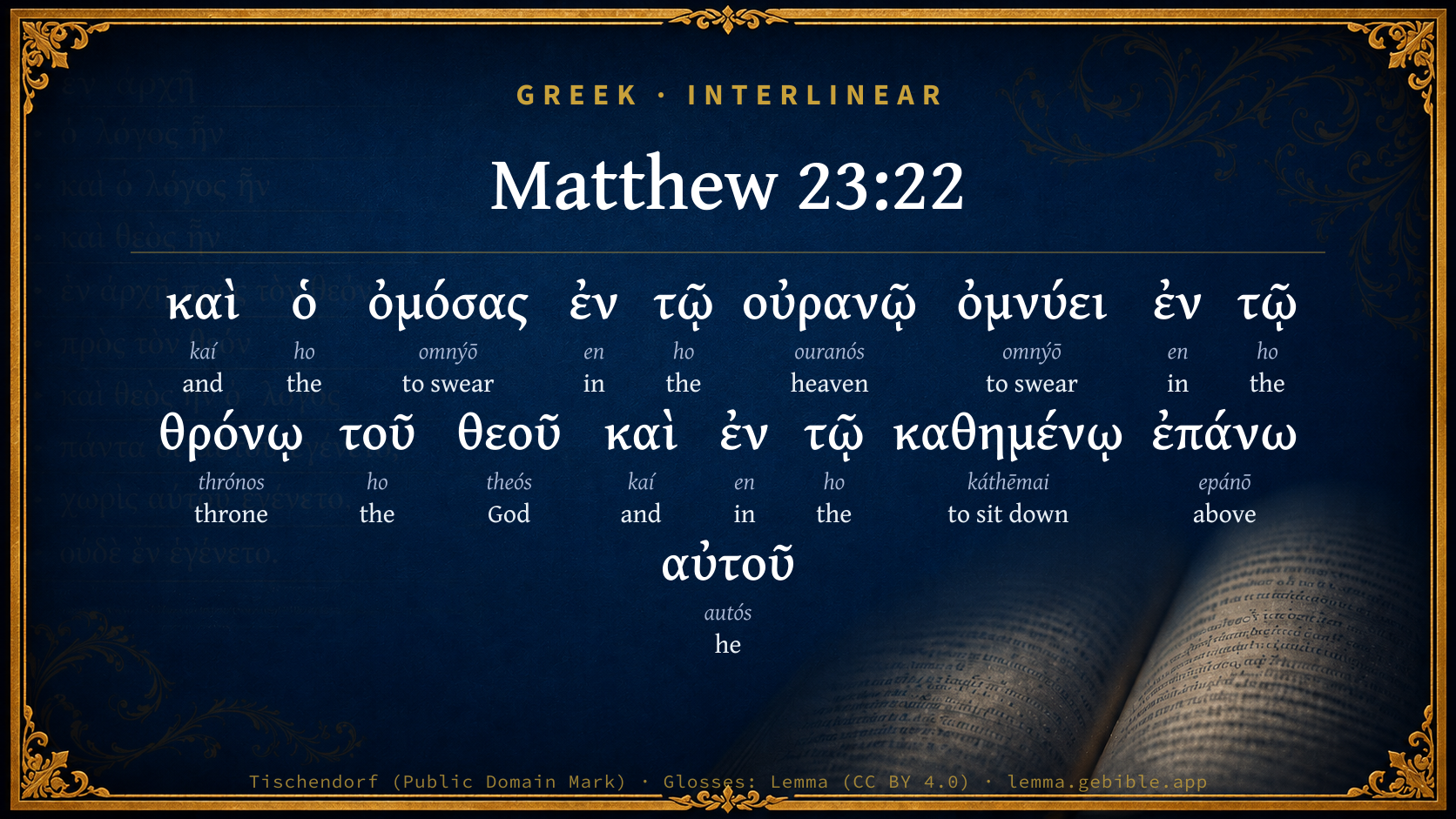
  1. καὶ kaí G2532 “and” Conjunction
  2. ὁ ho G3588 “the” Article, Nominative, Singular, Masculine
  3. ὀμόσας omnýō G3660 “to swear” Verb, Aorist, Active, Participle, Nominative, Singular, Masculine
  4. ἐν en G1722 “in” Preposition
  5. τῷ ho G3588 “the” Article, Dative, Singular, Masculine
  6. οὐρανῷ ouranós G3772 “heaven” Noun, Dative, Singular, Masculine
  7. ὀμνύει omnýō G3660 “to swear” Verb, Present, Active, Indicative, 3rd person, Singular
  8. ἐν en G1722 “in” Preposition
  9. τῷ ho G3588 “the” Article, Dative, Singular, Masculine
  10. θρόνῳ thrónos G2362 “throne” Noun, Dative, Singular, Masculine
  11. τοῦ ho G3588 “the” Article, Genitive, Singular, Masculine
  12. θεοῦ theós G2316 “God” Noun, Genitive, Singular, Masculine
  13. καὶ kaí G2532 “and” Conjunction
  14. ἐν en G1722 “in” Preposition
  15. τῷ ho G3588 “the” Article, Dative, Singular, Masculine
  16. καθημένῳ káthēmai G2521 “to sit down” Verb, Present, Middle or Passive deponent, Participle, Dative, Singular, Masculine
  17. αὐτοῦ autós G846 “he” Personal pronoun, Genitive, Singular, Masculine

About this verse

These counts appear in no published source. They are computed here, from the morphology-tagged text and Lemma’s own curated glosses. What Lemma adds →

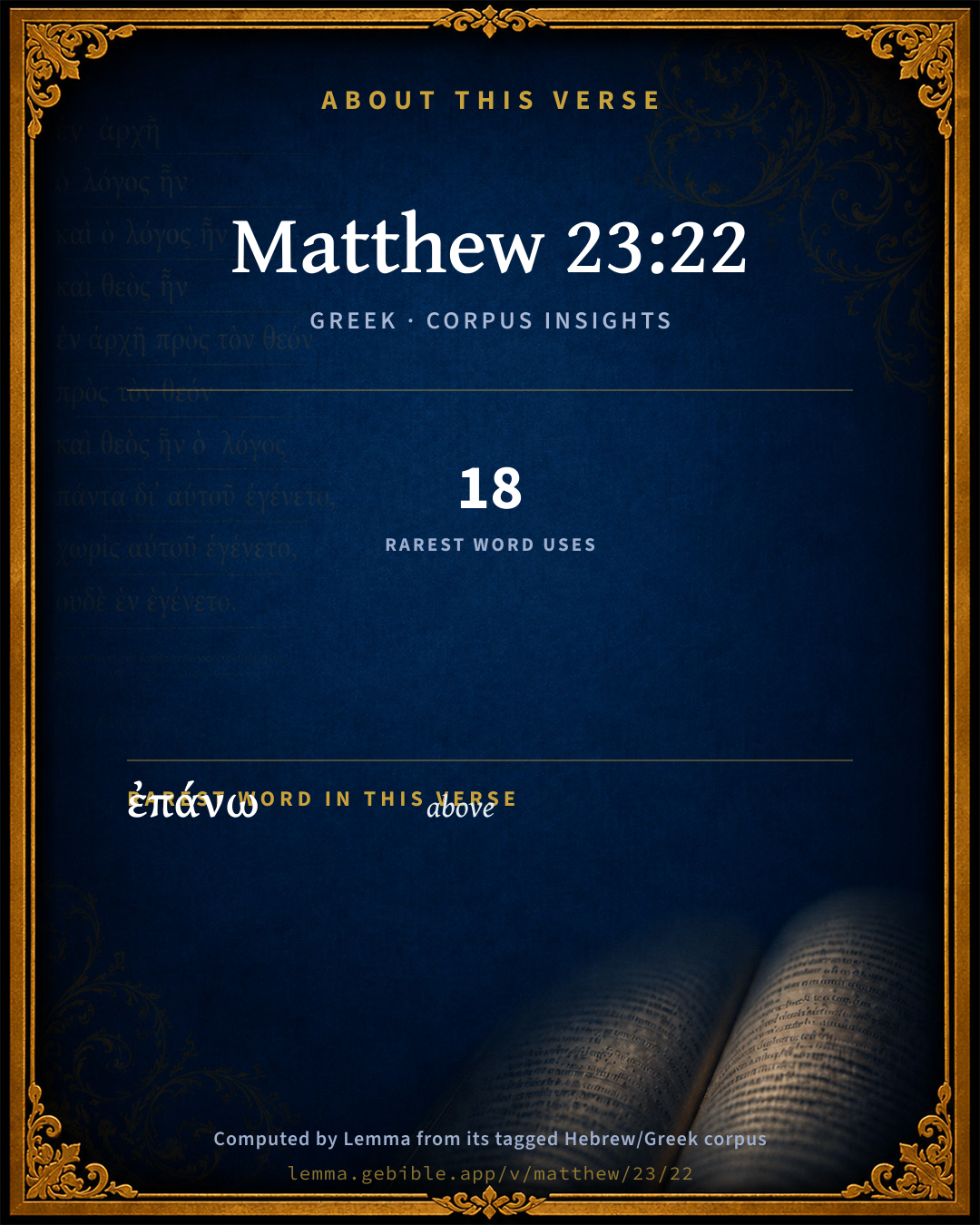
18
words
10
distinct lemmas
Gospels
section

Notable vocabulary

The rarest word here is ἐπάνω above G1883 — appearing just 18 times in the whole Greek New Testament.

Shared distinctive vocabulary

ἐπάνω above G1883 occurs in 18 verses of the Greek New Testament. Also found in:

Repetition

Words recur within this verse:

Cross-references

5

Topical passages linked to Matthew 23:22 in the Treasury of Scripture Knowledge — connected by theme and wording, ordered by reader-vote popularity; previews shown in the World English Bible.

  • Matthew 5:34 but I tell you, don't swear at all: neither by heaven, for it is the throne of God;
  • Psalms 11:4 Yahweh is in his holy temple. Yahweh is on his throne in heaven. His eyes observe. His eyes examine the children of men.
  • Isaiah 66:1 Thus says Yahweh, heaven is my throne, and the earth is my footstool: what manner of house will you build to me? and what place shall be my rest?
  • Acts 7:49 'heaven is my throne, And the earth a footstool for my feet. What kind of house will you build me?' says the Lord; 'Or what is the place of my rest?
  • Revelation 4:2–3 Immediately I was in the Spirit. Behold, there was a throne set in heaven, and one sitting on the throne

Cross-references courtesy of OpenBible.info (CC BY 4.0).

Commentary

Notes on Matthew 23:22 from classic Christian and Jewish commentators (each source and its license shown beneath its notes). The classic Christian expositions comment on the surrounding passage and are grouped to its opening verse, so a note may address several verses; the Jewish commentaries on the Tanakh (Rashi and others) are per-verse, so they appear only where the commentator wrote on this verse.

Lemma curates 59 commentaries, every one of them public domain or Creative Commons licensed, each selected and text-cleaned for this edition rather than reprinted as found. About our sources →

Geneva Bible (1599)

Geneva Bible translators

If heaven be God’s throne, then he is no doubt above all this world.

Geneva Bible (1599) marginal notes — public domain. Text via Bolls.life.

John Gill's Exposition

Woe unto you scribes and Pharisees, hypocrites,.... Christ returns to the former epithets he had very rightly given to these men, and very pertinently repeats them here; and which are confirmed by the instances of their conduct and practice here alleged, which abundantly show their hypocrisy and deceit; since they were very strict in observing some outward things, which gave them credit with the people, and especially the priests and Levites, some little trifling ceremonies and traditions of their elders, whilst they neglected internal religion, and those things which were of the greatest moment and importance:

for ye take tithe of mint, and anise, and cummin; which ought not commanded by the law, they were obliged to by the traditions of the elders. Mint is an herb well known, and has its name in the Greek from its sweet smell; on account of which the Jews used to spread it on the floors of their synagogues (y). This was one of the herbs that was subject to the law of the seventh year (z), and is mentioned with those which were to be tithed (a). The Ethiopic version, instead of mint reads "hyssop"; and which also was an herb that was obliged to be tithed (b). "Anise" is a seed also well known, and which the Jews call and of which they often observe, that it is subject to tithing, both seed, herb, flowers, or stalks (c): instead of this Munster's Hebrew Gospel has "rue"; and which, in the Misna (d), is mentioned along with mint, as it is by Luk 11:42 and said to be one of the things the Pharisees gave tithe of; though in their oral law it is reckoned among the things that are free from tithe (e): and therefore this must be a sort of work of supererogation to give tithe of that, which they were not obliged to. "Cummin" is a sort of anise; its seed is much like fennel seed, and which pigeons are very fond of: mention is made of it in Isa 28:25 and is reckoned with figs, dates, carobes, or Egyptian figs, and rice, which were obliged to be tithed (f), and was what was also bound to the offering of the first fruits to the priest (g). Christ mentions these particular herbs and seeds, as a specimen of what they paid tithes of. In Luke, it is added, "and all manner of herbs": for, according to the traditions of the elders, they were in general subject to tithes: and it is a common saying or maxim of the Jews, that the tithing of corn is from the law, but "the tithing of herbs is from the Rabbins" (h): it is a constitution of their's, and not of Moses:

and have omitted the weightier matters of the law. The distinction of the commandments of the law into lighter and heavier, or weightier, to which Christ here refers, is frequent with the Jews. When one comes to be made a proselyte, they acquaint him with some of , "the light commands", and some of , "the heavy", or "weighty commands" (i). So again, they paraphrase the words in Isa 33:18 "where is the scribe?" he that numbers all the letters in the law. "Where is the receiver?" who weighs the "light" things, , and "heavy", or "weighty things in the law" (k). Again (l),

"in the words of the law there are some things "light", and some things "heavy", or "weighty":''

but those weighty things they omitted, and regarded those that were light; yea, that had no foundation in the law at all: and no wonder, since, in the place last cited, they say (m), that

"the words of the Scribes are all of them "weighty" and that the sayings of the elders are more "weighty" than the words of the prophets.''

The things our Lord refers to, and instances in, are as follow;

judgment, mercy, and faith. "Judgment" may mean the administration of justice in courts of judicature; the putting in execution good judgments, righteous laws and statutes; protecting and relieving the injured and oppressed, and doing that which is right and equitable between man and man: but, on the contrary, these men devoured widows' houses, and oppressed the poor and fatherless. "Mercy" includes all acts of compassion to the distressed, relieving the necessitous, distributing to their wants, and showing all kindness and beneficence to the poor and needy; which the scribes and Pharisees very little practised, being a set of cruel, hard hearted, and covetous persons. "Faith" may not only design faithfulness in a man's keeping his word and promise, and fidelity to a trust reposed in him; but also faith in God, as the God of providence, and as the God of grace and mercy; believing in his word and promises, and worshipping him, which the law requires; and the rather this seems to be intended, because Luke, instead of "faith", puts "the love of God", which faith includes, and works by, and is the end of the commandment, arising from faith unfeigned: so that Christ instances in the weightier matters of both tables of the law, which these men neglected, and the latter, as well as the former; not believing the revelation of the Gospel, nor the Messiah, who was promised, and prophesied of by God, in the writings of the Old Testament:

these ought ye to have done: more especially, and in the first place, as being of the greatest use and importance:

and not to leave the other undone; meaning either the lighter matters, and lesser commands of the law; or even their tithes of herbs: if they thought themselves obliged to them, Christ would not dispute the matter with them; if they thought fit to observe them, they might, so long as they did not interfere with, and take them off from things of greater moment. But alas! these men preferred the rituals of the ceremonial law, and the traditions of the elders, above the duties of the moral law; and reckoned that the latter were nothing, if the former were wanting; for they (n) Say, that

"the words of the Scribes, are more lovely than the words of the law.''

And also (o), that

"he that profanes the holy things, and despises the solemn feasts, and makes void the covenant of Abraham our father (circumcision), and behaves impudently towards the law (ceremonial), although the law and good works are in his hands, he has no part in the world to come.''

The Persic version renders the words thus; "these ought ye to do, and not them"; as if it was our Lord's sense, that they ought to observe the weightier matters of the moral law, and not regard their tithing of herbs, and other traditions of, their fathers.

(y) Jarchi in Misn. Oketzim, c. 1. sect. 2. (z) Misn. Sheviith, c. 7. sect. 1, 2. (a) T. Hieros. Dermai, fol. 22. 3. (b) Misn. Maaserot, c. 3. sect. 9. (c) lb. c. 4. sect. 5. T. Hieros. Maaserot, fol. 51. 2. T. Bab. Avoda Zara, fol. 7. 2. Jarchi & Maimon. in Misn. Oketzim, c. 3. sect. 4. (d) Oketzim, c. 1. sect. 2. (e) Misn. Sheviith, c. 9. sect. 1. (f) Misn. Demai, c. 2. sect. 1. (g) Misn. Trumot, c. 10. sect. 4. (h) T. Bab. Yoma, fol. 83. 2. & T. Hieros. Challah, fol. 60. 2. & Maaserot, fol. 48. 3. (i) T. Bab. Yebamot, fol. 47. 1. Maimon. Hilch. Issure Bia, c. 14. sect. 2, 6, 9. Moses Kotsensis Mitzvot Tora, pr. neg. 116. (k) T. Bab. Chagiga, fol. 15. 2. & Sanhedrin, fol. 106. 2. (l) T. Hieros Beracot, fol. 3. 2. (m) Ib. (n) T. Hieros. Beracot, fol. 3. 2. (o) T. Hieres. Pesachim, fol. 33. 2.

John Gill's Exposition of the Whole Bible (1746–1763) — public domain (CC PDM 1.0). Text via the HelloAO Bible API.

Trapp's Complete Commentary

John Trapp

22 And he that shall swear by heaven, sweareth by the throne of God, and by him that sitteth thereon.

Ver. 22. By the throne of God] Heaven is his throne and earth his footstool; yet may we not conceive that God is commensurable by the place, as if he were partly here and partly elsewhere; but he is everywhere all present. {See Trapp on "Mat 5:34"}

John Trapp, A Commentary or Exposition upon All the Books of the Old and New Testament (1647–1656) — public domain. Text from a community e-Sword module.

Albert Barnes' Notes on the Bible

The throne of God - Heaven is his throne, Mat 5:34. It is so called as being the place where he sits in glory. Jesus says, here, that all who swear at all do, in fact, swear by God, or the oath is good for nothing. To swear by an altar, a gift, or a temple is of no force unless it be meant to appeal to God himself. The essential thing in an oath is calling God to witness our sincerity. If a real oath is taken, therefore, God is appealed to. If not it is foolish and wicked to swear by anything else.

Albert Barnes' Notes on the Bible (1834–1885) — public domain. Text from a community e-Sword/MySword module.

The Pulpit Commentary

By heaven. The Talmndists affirm that an oath "by heaven" or "by earth" was not binding, on the ground, probably, that these were mere creatures. Christ again dissipates such sophistries. To swear by the creature is virtually to swear by the Creator. A brute, inanimate thing cannot be witness to an oath; he alone can be appealed to who owns all. Thus we "kiss the book," calling God to witness our words. Christ had already given a lesson to his followers on this subject in the sermon on the mount. (Mat_5:34-37) He inculcates true reverence, that fear and awe of God"s dignity and God"s presence which constrains a man to avoid all profaneness and carelessness in regard to things that are concerned with God.

The Pulpit Commentary (1880–1919), ed. H.D.M. Spence-Jones & Joseph S. Exell — public domain. Text from a community e-Sword module.

International Critical Commentary

22. And he who sweareth by heaven, sweareth by the throne of God, and by Him that sitieth upon it.]

(L)

International Critical Commentary — older volumes (1896–1929), various authors — public domain. Text from a community e-Sword module.

Lesson kit

Teaching starters — assembled from the data on this page, not authored interpretation. Every prompt links to the verse data it draws on. Edit before teaching.

Matthew, in the Gospels, opens this verse with 18 words (10 distinct Greek lemmas). Its most distinctive word is epánō (“above”). A historical commentator’s framing appears above. Read the whole chapter for the surrounding context.

Discussion questions

  1. The word epánō carries the sense “above.” How does it shape the verse?
  2. How does Matthew 2:9, which shares the word «above», read alongside this verse?
  3. What does the repetition of “to swear” (2× in this one verse) do in this verse?
  4. These translations render this verse differently. What is at stake in choosing one wording over another?
  5. Compare how Geneva Bible (1599) and John Gill's Exposition read this verse. Where do they agree or differ?

Things to notice

  • These translations choose different wording for 13 words in this verse.
  • “to swear” occurs 2× in this single verse.
  • 10 distinct Greek lemmas span 18 words in this verse.

Reading settings

Reading text

Shown beneath each verse's original-language words.

Old Testament
Old Testament edition

Read the OT as the Masoretic Hebrew (MT) or the Greek Septuagint (LXX).

English shown for the Greek Septuagint (in the Hebrew ↔ Greek comparison).

Comparing translations? Open the Compare panel on any verse page to stack up to four side by side.