
Acts 7:42

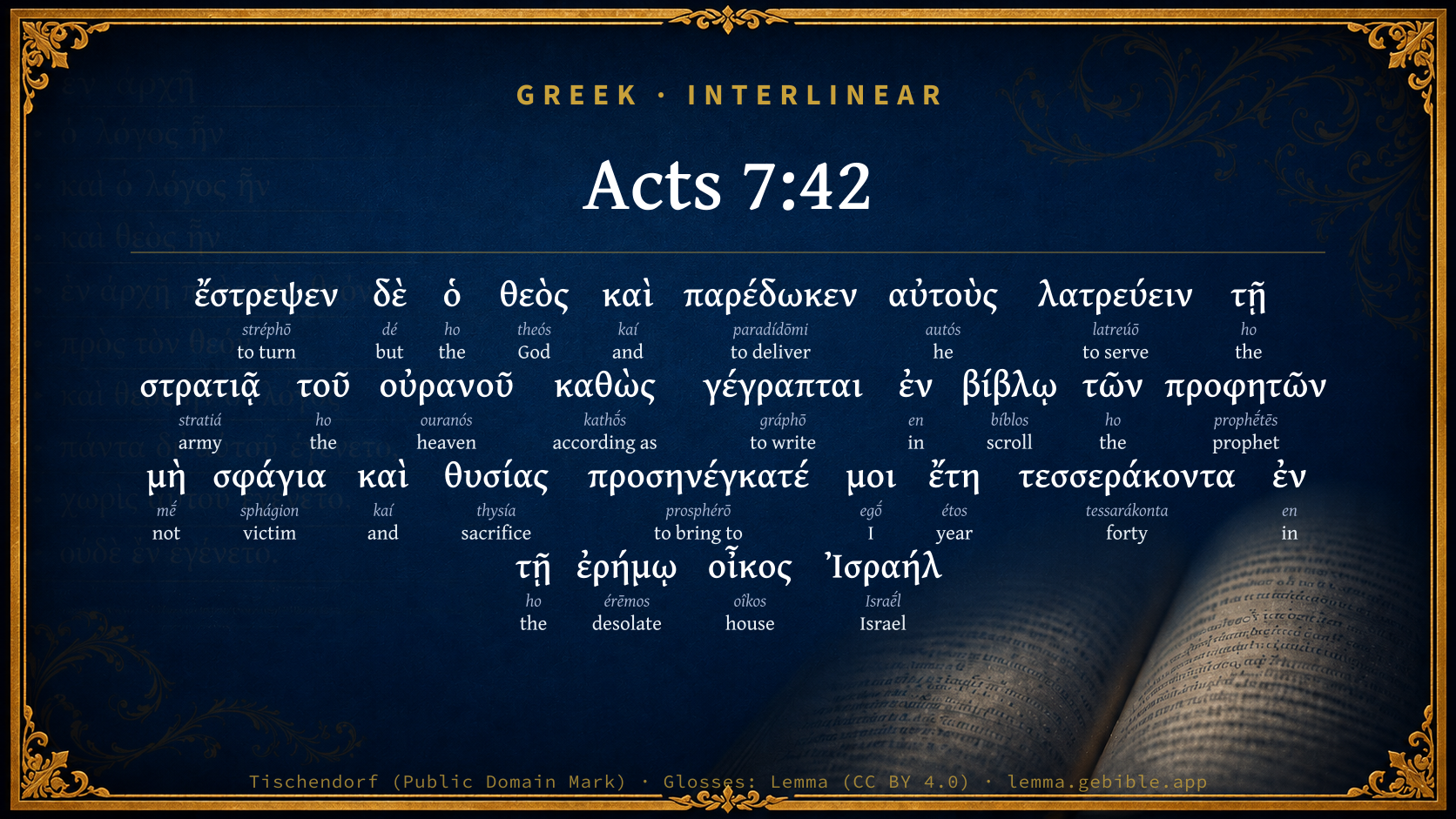
Greek (Tischendorf 8th ed.) Acts 7:42 appears in the Greek New Testament. The text above is from the Tischendorf 8th edition. Each word links to its Strong’s number and a concise gloss. Click any word for its full Thayer’s Greek Lexicon entry.
Download image
Cite this verse

Acts 7:42 (World English Bible). Public Domain. Lemma interlinear Bible study tool, https://lemma.gebible.app/v/acts/7/42.

Show BibTeX & RIS
BibTeX
RIS
English Translation
But God turned, and gave them up to serve the host of the sky, as it is written in the book of the prophets, 'Did you offer to me slain animals and sacrifices Forty years in the wilderness, O house of Israel?
World English Bible · Public Domain
Highlights
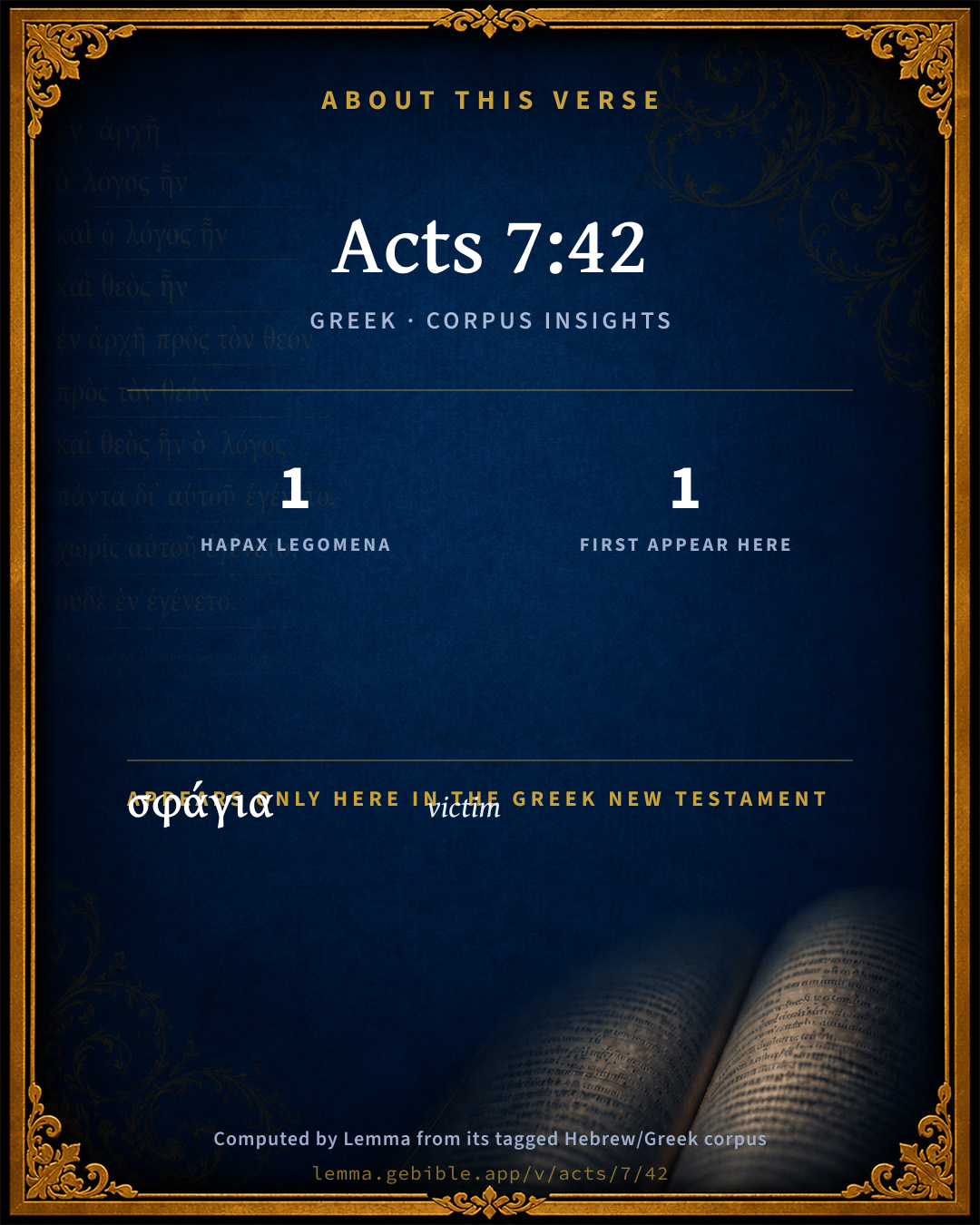
  • 1 hapax legomenon — only here in the Greek New Testament
  • 1 first appearance in the Greek New Testament
Full analysis ↓
Download a study sheet

One document with this verse’s original text, its word-by-word gloss line, the meaning frame, cross-references with their text, attributed commentary, and full source and license credits — printable, and it pastes into notes with its structure intact.

This verse Autodidact and up

Study sheet (.html) Plain text (.txt)

A passage Seminary Student

Up to 50 verses in one chapter. A passage sheet keeps up to 6 commentary sources and 12 cross-references per verse, in the order this page ranks them, and says so on the sheet whenever that leaves anything out. Ask for a single verse and you get the Autodidact verse sheet above.

Everything on this page stays free to read, with no account — the sheet is a download of what is already on screen, not access to it.

Want to remove ads? Support Godless Engineer
Compare translations 3

The same verse in 3 English versions, stacked beneath the original-language interlinear above. Click any original word for its lexicon entry.

Each is an independent rendering of the whole verse — the interlinear is not word-aligned to these translations.

Highlighted words mark where these versions differ — a whole-verse word diff, not a word-by-word alignment.

  • World English Bible Public Domain
    But God turned, and gave them up to serve the host of the sky, as it is written in the book of the prophets, 'Did you offer to me slain animals and sacrifices Forty years in the wilderness, O house of Israel?
  • King James Version Public Domain
    Then God turned, and gave them up to worship the host of heaven; as it is written in the book of the prophets, O ye house of Israel, have ye offered to me slain beasts and sacrifices by the space of forty years in the wilderness?
  • unfoldingWord Literal Text CC BY-SA 4.0
    But God turned away and abandoned them to serve the host of heaven, as it is written in the book of the prophets, ‘You did not offer slain beasts and offerings to me for 40 years in the wilderness, did you, O house of Israel?

unfoldingWord Literal Text — © unfoldingWord, licensed CC BY-SA 4.0. Word-aligned USFM3 via Door43 (git.door43.org/unfoldingWord/en_ult).

Versions to compare (up to 4)

3 of 4 selected

Show all 19 translations

Every available English version of this verse, each an independent rendering of the whole verse.

  • World English Bible Public Domain
    But God turned, and gave them up to serve the host of the sky, as it is written in the book of the prophets, 'Did you offer to me slain animals and sacrifices Forty years in the wilderness, O house of Israel?
  • Berean Standard Bible Public Domain
    But God turned away from them and gave them over to the worship of the host of heaven, as it is written in the book of the prophets: ‘Did you bring Me sacrifices and offerings forty years in the wilderness, O house of Israel?
  • Majority Standard Bible Public Domain
    But God turned away from them and gave them over to the worship of the host of heaven, as it is written in the book of the prophets: ‘Did you bring Me sacrifices and offerings forty years in the wilderness, O house of Israel?
  • King James Version Public Domain
    Then God turned, and gave them up to worship the host of heaven; as it is written in the book of the prophets, O ye house of Israel, have ye offered to me slain beasts and sacrifices by the space of forty years in the wilderness?
  • American Standard Version (1901) Public Domain
    But God turned, and gave them up to serve the host of heaven; as it is written in the book of the prophets, Did ye offer unto me slain beasts and sacrifices Forty years in the wilderness, O house of Israel?
  • Revised Version (1885) Public Domain
    But God turned, and gave them up to serve the host of heaven; as it is written in the book of the prophets, Did ye offer unto me slain beasts and sacrifices Forty years in the wilderness, O house of Israel?
  • Geneva Bible (1599) Public Domain
    Then God turned himselfe away, and gaue them vp to serue the host of heauen, as it is written in the booke of the Prophets, O house of Israel, haue ye offred to me slaine beasts and sacrifices by the space of fourtie yeres in the wildernes?
  • Douay-Rheims (1899) Public Domain
    And God turned, and gave them up to serve the host of heaven, as it is written in the books of the prophets: Did you offer victims and sacrifices to me for forty years, in the desert, O house of Israel?
  • Young's Literal Translation Public Domain
    and God did turn, and did give them up to do service to the host of the heaven, according as it hath been written in the scroll of the prophets: Slain beasts and sacrifices did ye offer to Me forty years in the wilderness, O house of Israel?
  • Literal Standard Version CC BY-SA 4.0
    and God turned, and gave them up to do service to the host of Heaven, according as it has been written in the scroll of the Prophets: Did you offer slain beasts and sacrifices to Me forty years in the wilderness, O house of Israel?
  • Unlocked Literal Bible CC BY-SA 4.0
    But God turned and gave them up to worship the stars in the sky, as it is written in the book of the prophets, 'Did you offer to me slain beasts and sacrifices for forty years in the wilderness, house of Israel?
  • unfoldingWord Literal Text CC BY-SA 4.0
    But God turned away and abandoned them to serve the host of heaven, as it is written in the book of the prophets, ‘You did not offer slain beasts and offerings to me for 40 years in the wilderness, did you, O house of Israel?
  • Darby Bible Public Domain
    But God turned and delivered them up to serve the host of heaven; as it is written in [the] book of the prophets, Have ye offered me victims and sacrifices forty years in the wilderness, O house of Israel?
  • World Messianic Bible Public Domain
    But God turned away and gave them up to serve the army of the sky, as it is written in the book of the prophets, ‘Did you offer to me slain animals and sacrifices forty years in the wilderness, O house of Israel?
  • Webster's Bible Public Domain
    Then God turned, and gave them up to worship the host of heaven; as it is written in the book of the prophets, O ye house of Israel, have ye offered to me slain beasts and sacrifices during forty years in the wilderness?
  • Free Bible Version CC BY-SA 4.0
    So God gave up on them. He left them to their worship of the stars in the sky. This is what the prophets wrote, ‘Were you giving offerings or making sacrifices to me during the forty years in the desert, you Israelites?
  • Bible in Basic English Public Domain
    But God was turned from them and let them give worship to the stars of heaven, as it says in the book of the prophets, Did you make offerings to me of sheep and oxen for forty years in the waste land, O house of Israel?
  • Text-Critical English NT CC BY 4.0
    But God turned away from them and gave them up to serve the host of heaven, just as it is written in the book of the prophets: ‘Was it to me that you offered slain beasts and sacrifices for forty years in the wilderness, O house of Israel?
  • Tyndale New Testament (1534) Public Domain
    Then God turned him selfe and gave them vp that they shuld worship the starres of the skye as it is written in the boke of the prophetes. O ye of the housse of Israel gave ye to me sacrefices and meate offerynges by the space of xl. yeares in the wildernes?

Literal Standard Version (2020), Covenant Press — licensed CC BY-SA 4.0. Text via the HelloAO Bible API (eBible.org). Unlocked Literal Bible (unfoldingWord) — licensed CC BY-SA 4.0. Text via the HelloAO Bible API (eBible.org). unfoldingWord Literal Text — © unfoldingWord, licensed CC BY-SA 4.0. Word-aligned USFM3 via Door43 (git.door43.org/unfoldingWord/en_ult). Free Bible Version, Dr. Jonathan Gallagher — licensed CC BY-SA 4.0. Text via the HelloAO Bible API (eBible.org).

Word by word

More ways to search: Search by grammar → Find every occurrence → Compare this word →

Practice this passage: Drill this verse → Learn its vocabulary →

σφάγια
sphágion
G4968
“victim”
Noun, Accusative, Plural, Neuter
Part of Speech
Noun
Case
Accusative
Number
Plural
Gender
Neuter
Full Thayer's Definition

Origin: from a derivative of G4967

TDNT: None

1. that which is destined for slaughter, a victim
  1. ἔστρεψεν stréphō G4762 “to turn” Verb, Aorist, Active, Indicative, 3rd person, Singular
  2. δὲ dé G1161 “but” Conjunction
  3. ὁ ho G3588 “the” Article, Nominative, Singular, Masculine
  4. θεὸς theós G2316 “God” Noun, Nominative, Singular, Masculine
  5. καὶ kaí G2532 “and” Conjunction
  6. παρέδωκεν paradídōmi G3860 “to deliver” Verb, Aorist, Active, Indicative, 3rd person, Singular
  7. αὐτοὺς autós G846 “he” Personal pronoun, Accusative, Plural, Masculine
  8. λατρεύειν latreúō G3000 “to serve” Verb, Present, Active, Infinitive
  9. τῇ ho G3588 “the” Article, Dative, Singular, Feminine
  10. στρατιᾷ stratiá G4756 “army” Noun, Dative, Singular, Feminine
  11. τοῦ ho G3588 “the” Article, Genitive, Singular, Masculine
  12. οὐρανοῦ ouranós G3772 “heaven” Noun, Genitive, Singular, Masculine
  13. καθὼς kathṓs G2531 “according as” Adverb
  14. γέγραπται gráphō G1125 “to write” Verb, Perfect, Passive, Indicative, 3rd person, Singular
  15. ἐν en G1722 “in” Preposition
  16. βίβλῳ bíblos G976 “scroll” Noun, Dative, Singular, Feminine
  17. τῶν ho G3588 “the” Article, Genitive, Plural, Masculine
  18. προφητῶν prophḗtēs G4396 “prophet” Noun, Genitive, Plural, Masculine
  19. μὴ mḗ G3361 “not” Particle, Negative
  20. καὶ kaí G2532 “and” Conjunction
  21. θυσίας thysía G2378 “sacrifice” Noun, Accusative, Plural, Feminine
  22. προσηνέγκατέ prosphérō G4374 “to bring to” Verb, Aorist, Active, Indicative, 2nd person, Plural
  23. μοι egṓ G1473 “I” Personal pronoun, 1st person, Dative, Singular
  24. ἔτη étos G2094 “year” Noun, Accusative, Plural, Neuter
  25. τεσσεράκοντα tessarákonta G5062 “forty” Adjective, Numeral (indeclinable)
  26. ἐν en G1722 “in” Preposition
  27. τῇ ho G3588 “the” Article, Dative, Singular, Feminine
  28. ἐρήμῳ érēmos G2048 “desolate” Adjective, Dative, Singular, Feminine
  29. οἶκος oîkos G3624 “house” Noun, Nominative, Singular, Masculine
  30. Ἰσραήλ Israḗl G2474 “Israel” Noun, Proper, indeclinable

About this verse

These counts appear in no published source. They are computed here, from the morphology-tagged text and Lemma’s own curated glosses. What Lemma adds →

31
words
25
distinct lemmas
Acts
section

Notable vocabulary

1 hapax legomenon — a word that appears only here in the entire Greek New Testament:

  • σφάγια victim G4968

First appearance in Scripture

This word makes its first canonical appearance in the Greek New Testament here:

  • σφάγια victim G4968

Shared distinctive vocabulary

στρατιᾷ army G4756 occurs in 3 verses of the Greek New Testament. Also found in:
Repetition

Words recur within this verse:

Cross-references

23

Topical passages linked to Acts 7:42 in the Treasury of Scripture Knowledge — connected by theme and wording, ordered by reader-vote popularity; previews shown in the World English Bible.

  • Amos 5:25–26 "Did you bring to me sacrifices and offerings in the wilderness forty years, house of Israel?
  • Ezekiel 20:39 As for you, house of Israel, thus says the Lord Yahweh: Go you, serve everyone his idols, and hereafter also, if you will not listen to me; but my holy name shall you no more profane with your gifts, and with your idols.
  • Jeremiah 19:13 and the houses of Jerusalem, and the houses of the kings of Judah, which are defiled, shall be as the place of Topheth, even all the houses on whose roofs they have burned incense to all the host of the sky, and have poured out drink-offerings to other gods.
  • Psalms 81:11–12 But my people didn't listen to my voice. Israel desired none of me.
  • Deuteronomy 4:19 and lest you lift up your eyes to the sky, and when you see the sun and the moon and the stars, even all the host of the sky, you are drawn away and worship them, and serve them, which Yahweh your God has allotted to all the peoples under the whole sky.
  • Job 31:26–28 If I have seen the sun when it shined, Or the moon moving in splendor,
  • Isaiah 63:10 But they rebelled, and grieved his holy Spirit: therefore he was turned to be their enemy, [and] himself fought against them.
  • Romans 1:24–28 Therefore God also gave them up in the lusts of their hearts to uncleanness, that their bodies should be dishonored among themselves,
  • Hebrews 3:15–17 while it is said, "Today if you will hear his voice, Don't harden your hearts, as in the rebellion."
  • Joshua 24:20 If you forsake Yahweh, and serve foreign gods, then he will turn and do you evil, and consume you, after that he has done you good.
  • Isaiah 66:4 I also will choose their delusions, and will bring their fears on them; because when I called, none did answer; when I spoke, they did not hear: but they did that which was evil in my eyes, and chose that in which I didn't delight.
  • Ezekiel 8:16 He brought me into the inner court of Yahweh's house; and see, at the door of the temple of Yahweh, between the porch and the altar, were about twenty-five men, with their backs toward the temple of Yahweh, and their faces toward the east; and they were worshipping the sun toward the east.
  • Hosea 4:17 Ephraim is joined to idols. Leave him alone!
  • Acts 7:36 This man led them out, having worked wonders and signs in Egypt, in the Red Sea, and in the wilderness for forty years.
  • 2 Thessalonians 2:10–12 and with all deception of wickedness for those who are being lost, because they didn't receive the love of the truth, that they might be saved.
  • Deuteronomy 17:3 and has gone and served other gods, and worshiped them, or the sun, or the moon, or any of the host of the sky, which I have not commanded;
  • 2 Kings 17:16 They forsook all the commandments of Yahweh their God, and made them molten images, even two calves, and made an Asherah, and worshiped all the host of the sky, and served Baal.
  • 2 Kings 21:3 For he built again the high places which Hezekiah his father had destroyed; and he reared up altars for Baal, and made an Asherah, as did Ahab king of Israel, and worshiped all the host of the sky, and served them.
  • Psalms 95:10 Forty long years I was grieved with that generation, And said, "It is a people that errs in their heart. They have not known my ways."
  • Ezekiel 14:7–10 For everyone of the house of Israel, or of the strangers who sojourn in Israel, who separates himself from me, and takes his idols into his heart, and puts the stumbling block of his iniquity before his face, and comes to the prophet to inquire for himself of me; I Yahweh will answer him by myself:
  • Ezekiel 20:25 Moreover also I gave them statutes that were not good, and ordinances in which they should not live;
  • Isaiah 43:23 You have not brought me of your sheep for burnt offerings; neither have you honored me with your sacrifices. I have not burdened you with offerings, nor wearied you with frankincense.
  • Hebrews 3:9 Where your fathers tested me by proving me, And saw my works for forty years.

Cross-references courtesy of OpenBible.info (CC BY 4.0).

Commentary

Notes on Acts 7:42 from classic Christian and Jewish commentators (each source and its license shown beneath its notes). The classic Christian expositions comment on the surrounding passage and are grouped to its opening verse, so a note may address several verses; the Jewish commentaries on the Tanakh (Rashi and others) are per-verse, so they appear only where the commentator wrote on this verse.

Lemma curates 59 commentaries, every one of them public domain or Creative Commons licensed, each selected and text-cleaned for this edition rather than reprinted as found. About our sources →

Matthew Henry's Commentary

Two things we have in these verses: -

I. Stephen upbraids them with the idolatry of their fathers, which God gave them up to, as a punishment for their early forsaking him in worshipping the golden calf; and this was the saddest punishment of all for that sin, as it was of the idolatry of the Gentile world that God gave them up to a reprobate mind. When Israel was joined to idols, joined to the golden calf, and not long after to Baal-peor, God said, Let them alone; let them go on (Act 7:42): Then God turned, and gave them up to worship the host of heaven. He particularly cautioned them not to do it, at their peril, and gave them reasons why they should not; but, when they were bent upon it, he gave them up to their own hearts; lust, withdrew his restraining grace, and then they walked in their own counsels, and were so scandalously mad upon their idols as never any people were. Compare Deu 4:19 with Jer 8:2. For this he quotes a passage out of Amo 5:25. For it would be less invidious to tell them their own [character and doom] from an Old Testament prophet, who upbraids them,

1. For not sacrificing to their own God in the wilderness (Act 7:42): Have you offered to me slain beasts, and sacrifices, by the space of forty years in the wilderness? No; during all that time sacrifices to God were intermitted; they did not so much as keep the passover after the second year. It was God's condescension to them that he did not insist upon it during their unsettled state; but then let them consider how ill they requited him in offering sacrifices to idols, when God dispensed with their offering them to him. This is also a check to their zeal for the customs that Moses delivered to them, and their fear of having them changed by this Jesus, that immediately after they were delivered these customs were for forty years together disused as needless things.

2. For sacrificing to other gods after they came to Canaan (Act 7:43): You took up the tabernacle of Moloch. Moloch was the idol of the children of Ammon, to which they barbarously offered their own children in sacrifice, which they could not do without great terror and grief to themselves and their families; yet this unnatural idolatry they arrived at, when God gave them up to worship the host of heaven. See Ch2 28:3. It was surely the strongest delusion that ever people were given up to, and the greatest instance of the power of Satan in the children of disobedience, and therefore it is here spoken of emphatically: Yea, you took up the tabernacle of Moloch, you submitted even to that, and to the worship of the star of your god Remphan. Some think Remphan signifies the moon, as Moloch does the sun; others take it for Saturn, for that planet is called Remphan in the Syriac and Persian languages. The Septuagint puts it for Chiun, as being a name more commonly known. They had images representing the star, like the silver shrines for Diana, here called the figures which they made to worship. Dr. Lightfoot thinks they had figures representing the whole starry firmament, with all the constellations, and the planets, and these are called Remphan - "the high representation," like the celestial globe: a poor thing to make an idol of, and yet better than a golden calf! Now for this it is threatened, I will carry you away beyond Babylon. In Amos it is beyond Damascus, meaning to Babylon, the land of the north. But Stephen changes it, with an eye to the captivity of the ten tribes, who were carried away beyond Babylon, by the river of Gozan, and in the cities of the Medes, Kg2 17:6. Let it not therefore seem strange to them to hear of the destruction of this place, for they had heard of it many a time from the prophets of the Old Testament, who were not therefore accused as blasphemers by any but the wicked rulers. It was observed, in the debate on Jeremiah's case, that Micah was not called to an account though he prophesied, saying, Zion shall be ploughed as a field, Jer 26:18, Jer 26:19.

II. He gives an answer particularly to the charge exhibited against him relating to the temple, that he spoke blasphemous words against that holy place, Act 7:44-50. He was accused for saying that Jesus would destroy this holy place: "And what if I did say so?" (saith Stephen) "the glory of the holy God is not bound up in the glory of this holy place, but that may be preserved untouched, though this be laid in the dust;" for, 1. "It was not till our fathers came into the wilderness, in their way to Canaan, that they had any fixed place of worship; and yet the patriarchs, many ages before, worshipped God acceptably at the altars they had adjoining to their own tents in the open air - sub dio; and he that was worshipped without a holy place in the first, and best, and purest ages of the Old Testament church, may and will be so when this holy place is destroyed, without any diminution to his glory." 2. The holy place was at first but a tabernacle, mean and movable, showing itself to be short-lived, and not designed to continue always. Why might not this holy place, though built of stones, be decently brought to its end, and give place to its betters, as well as that though framed of curtains? As it was no dishonour, but an honour to God, that the tabernacle gave way to the temple, so it is now that the material temple gives way to the spiritual one, and so it will be when, at last, the spiritual temple shall give way to the eternal one. 3. That tabernacle was a tabernacle of witness, or of testimony, a figure of good things to come, of the true tabernacle which the Lord pitched, and not men, Heb 8:2. This was the glory both of the tabernacle and temple, that they were erected for a testimony of that temple of God which in the latter days should be opened in heaven (Rev 11:19), and of Christ's tabernacling on earth (as the word is, Joh 1:14), and of the temple of his body. 4. That tabernacle was framed just as God appointed, and according to the fashion which Moses saw in the mount, which plainly intimates that it had reference to good things to come. Its rise being heavenly, its meaning and tendency were so; and therefore it was no diminution at all to its glory to say that this temple made with hands should be destroyed, in order to the building of another made without hands, which was Christ's crime (Mar 14:58), and Stephen's. 5. That tabernacle was pitched first in the wilderness; it was not a native of this land of yours (to which you think it must for ever be confined), but was brought in in the next age, by our fathers, who came after those who first erected it, into the possession of the Gentiles, into the land of Canaan, which had long been in the possession of the devoted nations whom God drove out before the face of our fathers. And why may not God set up his spiritual temple, as he had done the material tabernacle, in those countries that were now the possession of the Gentiles? That tabernacle was brought in by those who came with Jesus, that is, Joshua. And I think, for distinction sake, and to prevent mistakes, it ought to be so read, both here and Heb 4:8. Yet in naming Joshua here, which in Greek is Jesus, there may be a tacit intimation that as the Old Testament Joshua brought in that typical tabernacle, so the New Testament Joshua should bring in the true tabernacle into the possession of the Gentiles. 6. That tabernacle continued for many ages, even to the days of David, above four hundred years, before there was any thought of building a temple, Act 7:45. David, having found favour before God, did indeed desire this further favour, to have leave to build God a house, to be a constant settled tabernacle, or dwelling-place, for the Shechinah, or the tokens of the presence of the God of Jacob, Act 7:46. Those who have found favour with God should show themselves forward to advance the interests of his kingdom among men. 7. God had his heart so little upon a temple, or such a holy place as they were so jealous for, that, when David desired to build one, he was forbidden to do it; God was in no haste for one, as he told David (Sa2 7:7), and therefore it was not he, but his son Solomon, some years after, that built him a house. David had all that sweet communion with God in public worship which we read of in his Psalms before there was any temple built. 8. God often declared that temples made with hands were not his delight, nor could add any thing to the perfection of his rest and joy. Solomon, when he dedicated the temple, acknowledged that God dwelleth not in temples made with hands; he has not need of them, is not benefited by them, cannot be confined to them. The whole world is his temple, in which he is every where present, and fills it with his glory; and what occasion has he for a temple then to manifest himself in? Indeed the pretended deities of the heathen needed temples made with hands, for they were gods made with hands (Act 7:41), and had no other place to manifest themselves in than in their own temples; but the one only true and living God needs no temple, for the heaven is his throne, in which he rests, and the earth is his footstool, over which he rules (Act 7:49, Act 7:50), and therefore, What house will you build me, comparable to this which I have already? Or, what is the place of my rest? What need have I of a house, either to repose myself in or to show myself? Hath not my hand made all these things? And these show his eternal power and Godhead (Rom 1:20); they so show themselves to all mankind that those who worship other gods are without excuse. And as the world is thus God's temple, wherein he is manifested, so it is God's temple in which he will be worshipped. As the earth is full of his glory, and is therefore his temple (Isa 6:3), so the earth is, or shall be, full of his praise (Hab 3:3), and all the ends of the earth shall fear him (Psa 67:7), and upon this account it is his temple. It was therefore no reflection at all upon this holy place, however they might take it, to say that Jesus should destroy this temple, and set up another, into which all nations should be admitted, Act 15:16, Act 15:17. And it would not seem strange to those who considered that scripture which Stephen here quotes (Isa 66:1-3), which, as it expressed God's comparative contempt of the external part of his service, so it plainly foretold the rejection of the unbelieving Jews, and the welcome of the Gentiles that were of a contrite spirit into the church.

Matthew Henry's Commentary on the Whole Bible (1708–1710) — public domain (CC PDM 1.0). Text via the HelloAO Bible API.

Joseph Benson's Commentary

Act 7:42-43. Then God turned — Upon this, God, being most righteously provoked, turned away from them in anger, and, as in many other instances, punished one sin by letting them fall into another; and at length gave them up, in succeeding ages, to the most abandoned, public, and general idolatry, even to worship all the host of heaven — The stars and other heavenly bodies, and that with as little reserve, and as little shame, as the most stupid of the heathen nations. As it is written in the book of the prophets — Namely, of the twelve minor prophets, which the Jews always connected together in one book. What is here quoted is taken from the Prophet Amo 5:25; where see the note. The passage consists of two parts; of which the former confirms Act 7:41, concerning the sin of the people; the latter, the beginning of Act 7:42, respecting their punishment: O house of Israel, have ye offered to me — To me alone; slain beasts, &c., forty years in the wilderness? — You know that even then you began to revolt, and provoke me to jealousy with your abominations. They had offered many sacrifices, but did not offer them to God alone, but sacrificed to idols also; and God did not accept even those that they offered to him, because they did not offer them with an upright heart. And in succeeding ages you were continually renewing and aggravating your rebellions and treasons against me. Yea, ye took up the tabernacle of Moloch — Instead of confining yourselves to my tabernacle; and the star of your god Remphan — Or Chium, as it is called in Amos. Moloch probably meant the sun, and Remphan, or Chium, the moon; or some other star. Aben Ezra thinks Saturn; figures which ye made — Images, or emblematical representations, of these supposed deities; to worship them — Both the images, and the supposed deities which they were intended to represent. See note on Amo 5:26. I will carry you away beyond Babylon — Into countries more distant. So Dr. Prideaux reconciles Stephen’s quotation with the original passages in Amos, where we read, beyond Damascus. This was fulfilled by the king of Assyria, 2Ki 17:6.

Joseph Benson's Commentary on the Old and New Testaments (1811–1818) — public domain. Text from a community e-Sword module.

Tyndale Open Study Notes

Tyndale Open Resources

7:42-43 This passage quotes Amos 5:25-27 (Greek version) to illustrate how the people of Israel rebelled against Moses (Acts 7:39-41). Molech was a Canaanite god to whom human sacrifices were offered (Lev 18:21; 20:2-5; 1 Kgs 11:7; 2 Kgs 23:10; Jer 32:35). Rephan, a star god identified with the planet Saturn, was worshiped by the Israelites during their wilderness wanderings.

Tyndale Open Study Notes — © Tyndale Open Resources, licensed CC BY-SA 4.0. Text via the HelloAO Bible API.

Bengel's Gnomon

Johann Albrecht Bengel

Act 7:42. Ἔστρεψε, turned) because our fathers ἐστράφησαν, turned back (from Him towards Egypt): Act 7:39.—παρέδωκεν, gave them up) often, from the time of their making the calf down to the times of Amos, and subsequently, as the perversity of the people continually increased.—τῇ στρατίᾳ τοῦ οὐρανοῦ, the host of heaven) for example, Mars and Saturn. See the foll. ver. The oldest form of idolatry, which looked more plausible than the others.[49] It is called a host or army, on account of its multitude, order, and power.—τῶν προφητῶν, of the prophets) the twelve.—μὴ—μοι ἔτη—ἐρήμῳ, ΟἾΚΟς ἸΣΡΑΉΛ;—ῬΕΜΦᾺΝ—ἘΠΟΙΉΣΑΤΕ ΠΡΟΣΚΥΝΕῖΝ ΑὐΤΟῖς—ἘΠΈΚΕΙΝΑ ΒΑΒΥΛῶΝΟς) Amo 5:25-26, LXX., ΜῊ—ΜΟΙ ΟἾΚΟς ἸΣΡΑῊΛ ἜΤΗ—ἘΡΉΜῼ; ῬΑΙΦᾺΝ (instead of ῬΕΜΦᾺΝ)—ἘΠΟΙΉΣΑΤΕ ἙΑΥΤΟῖς—ἘΠΈΚΕΙΝΑ ΔΑΜΑΣΚΟῦ (instead of ΒΑΒΥΛῶΝΟς). The prophecy of Amos has two parts: the former of which confirms Act 7:41, as to the guilt of the people; the latter confirms the beginning of Act 7:42, as to the judgment of GOD, there being subjoined the mention of their being carried away to Babylon.—ΣΦΆΓΙΑ, slain victims) They had offered these to the Lord; but they had not done so either to Him alone, or at all times, or with a perfect and willing heart.

[49] Called Sabeanism, from Saba, Sabaoth, the heavenly hosts. See Job 31:26-27.—E. and T.

Bengel's Gnomon of the New Testament — English translation (T&T Clark, Edinburgh, 1860) — public domain. Text from a community e-Sword module.

Meyer's Critical & Exegetical Commentary

Heinrich August Wilhelm Meyer

Act_7:42. Ἔστρεψε δὲ ὁ Θεός] but God turned,a figurative representation of the idea: He became unfavourable to them. The active in a neuter sense (1Ma_2:63; Act_5:22; Act_15:16; Kühner, II. pp. 9, 10); nothing is to be supplied. Incorrectly Vitringa, Morus, and others hold that ἔστρεψε connected with παρέδ. denotes, after the Hebrew שׁוּב, rursus tradidit. This usage has not passed over to the N. T., and, moreover, it is not vouched for historically that the Israelites at an earlier period practised star-worship. Heinrichs connects ἔστρ. with αὐτούς: convertit animos eorum ab una idololatria ad aliam. But the expression of divine disfavour is to be retained on account of the correlation with Act_7:39.

καὶ παρέδ. αὐτοὺς λατρ.] and gave them up to serve (an explanatory infinitive). The falling away into star-worship (στρατ. τ. οὐρανοῦ = צְבָא הַשָּׁמַיִם, in which, from the worshippers point of view, the sun, moon, and stars are conceived as living beings) is apprehended as wrought by an angry God by way of punishment for that bull-worship, according to the idea of sin being punished by sin. The assertion, often repeated since the time of Chrysostom and Theophylact, that only the divine permission or the withdrawal of grace is here denoted, is at variance with the positive expression and the true biblical conception of divine retribution. See on Rom_1:24. Self-surrender (Eph_4:19) is the correlative moral factor on the part of man.

μὴ σφάγια κ.τ.λ.] Amo_5:25-27, freely after the LXX. Ye have not surely presented unto me sacrifices and offerings (offerings of any kind) for forty years in the wilderness? The question supposes a negative answer; therefore without an interrogation the meaning is: Ye cannot maintain that ye have offered … to me. The apparent contradiction with the accounts of offerings, which were actually presented to Jehovah in the desert (Exo_24:4 ff.; Numbers 7; Num_9:1 ff.) disappears, when the prophetic utterance, understood by Stephen as a reproach,[207] is considered as a sternly and sharply significant divine verdict, according to which the ritual offerings in the desert, which were rare and only occurred on special occasions (comp. already Lyra), could not be taken at all into consideration against the idolatrous aberrations which testified the moral worthlessness of those offerings. Usually (as by Morus, Rosenmüller, Heinrichs, Olshausen, similarly Kuinoel) μοι is considered as equivalent to mihi soli. But this is incorrect on account of the enclitic pronoun and its position, and on account of the arbitrarily intruded μόνον. Fritzsche (ad Marc. p. 65 f.) puts the note of interrogation only after προσκυνεῖν αὐτοῖς, Act_7:43 : Sacrane et victimas per XL annos in deserto mihi obtulistis, et in pompa tulistis aedem Molochi etc.? In this way Gods displeasure at the unstedfastness of His people would be vividly denoted by the contrast. But this expedient is impossible on account of the μή presupposing a negation. Moreover, it is as foreign to the design of Stephen, who wishes to give a probative passage for the λατρεύειν τῇ στρατιᾷ τοῦ οὐρανοῦ, to concede the worship of Jehovah, as it is, on the other hand, in the highest degree accordant with that design to recognise in Act_7:42 the negative element of his proof (the denial of the rendering of offering to Jehovah), and in Act_7:43 the positive proof (the direct reproach of star-worship).

[207] According to another view, the period of forty years without offerings appears in the prophet as the golden age of Israel, and as a proof how little God cares for such offerings. See Ewald, Proph. in loc.

Meyer — Critical and Exegetical Commentary on the New Testament — English translation by Peter Christie, edited by Frederick Crombie (T&T Clark, 1880) — public domain. Text from a community e-Sword module.

Expositor's Greek Testament

ed. W. Robertson Nicoll

Act 7:42 . ἔστρεψε : properly intransitive. Weiss takes it transitively: God turned them from one idol worship to another; but here probably means that God turned away from them, in the sense that He cared no longer for them as before; so Grimm, sub v. ; or that He actually changed so as to be opposed to them; cf. Jos 24:20 , Heb., so Wetstein “Deus se ab iis avertit,” and cf. LXX, Isa 63:10 . παρέδωκεν , cf. Rom 1:24 , and εἴασε in Act 14:16 ; Eph 4:19 , “gave themselves up”. ἑαυτοὺς παρέδωκαν , from the side of man. λατρεύειν τῇ στρατιᾷ τοῦ οὐρ ., cf. Deu 17:3 , 2Ki 17:16 ; 2Ki 21:3 , 2Ch 33:3 ; 2Ch 33:5 , Jer 8:2 ; Jer 19:13 , a still grosser idolatry: “antiquissima idolatria, ceteris speciosior” Bengel. The created host was worshipped in place of Jehovah Sabaoth, “the Lord of Hosts”. The word, though used always in the N.T. of religious service, is sometimes applied to the worship of idols, as well as of the One God; cf. Rom 1:25 (LXX, Exo 20:5 ; Exo 23:24 , Eze 20:32 ), so λατρεία is used of the worship of idols in 1Ma 1:43 ; see Trench, Synonyms , i., p. 142 ff. ἐν βίβλῳ τῶν προφ .: here part of the Hebrew Scriptures which the Jews summed up under the title of “the Prophets,” as a separate part, the other two parts being the Law and the Hagiographa (the Psalms, Luk 24:44 ); or Twelve Minor Prophets which probably formed one book. Μὴ σφάγια κ . τ . λ .: a quotation from Amo 5:25-27 , with little variation the quotation in Act 7:42 is really answered by the following verse. The question does not mean literally that no sacrifices were ever offered in the wilderness, which would be directly contrary to such passages as Exo 24:4 , Num 7:9 . The sacrifices no doubt were offered, but how could they have been real and effectual and acceptable to God while in their hearts the people’s affections were far from Him, and were given to idol deities? μή , expecting a negative answer = num (see Zöckler’s note, in loco ). οἶκος : nominative for vocative, as often, as if in apposition to the ὑμεῖς contained in προσηνέγκατε (Blass). Some emphasise μοι = mihi soli , or suppose with Nösgen that the question is ironical.

The Expositor's Greek Testament, edited by W. Robertson Nicoll (1897–1910) — public domain. Text from a community e-Sword module.

Geneva Bible (1599)

Geneva Bible translators

By the host of heaven, here he meaneth not the Angels, but the moon and sun and other stars.

Being destitute and void of his Spirit, he gave them up to Satan, and wicked lusts to worship stars.

Geneva Bible (1599) marginal notes — public domain. Text via Bolls.life.

Jamieson, Fausset & Brown

Robert Jamieson, A. R. Fausset & David Brown

gave them up--judicially.

as . . . written in the book of the prophets--the twelve minor prophets, reckoned as one: the passage is from Amo 5:25.

have ye offered to me . . . sacrifices?--The answer is, Yes, but as if ye did it not; for "neither did ye offer to Me only, nor always, nor with a perfect and willing heart" [BENGEL].

Jamieson, Fausset & Brown — Commentary Critical and Explanatory on the Whole Bible (1871) — public domain (CC PDM 1.0). Text via the HelloAO Bible API.

Adam Clarke's Commentary

Verse 42. Then God turned, and gave them up, c.] He left them to themselves, and then they deified and worshipped the sun, moon, planets, and principal stars.

In the book of the prophets] As this quotation is found in Amos, Am 5:25, by the book of the prophets is meant the twelve minor prophets, which, in the ancient Jewish division of the sacred writings, formed only one book.

Have ye offered to me slain beasts] It is certain that the Israelites did offer various sacrifices to God, while in the wilderness and it is as certain that they scarcely ever did it with an upright heart. They were idolatrous, either in heart or act, in almost all their religious services; these were therefore so very imperfect that they were counted for nothing in the sight of God; for this seems to be strongly implied in the question here asked, Have ye offered to ME (exclusively and with an upright heart) slain beasts and sacrifices by the space of forty years? On the contrary, these forty years were little else than a tissue of rebellion and idolatry.

Adam Clarke's Commentary on the Bible (1810–1826) — public domain. Text from a community e-Sword/MySword module.

John Calvin's Commentaries

Stephen will here declare that the Jews did never make an end of sinning, but that they wandered farther in their froward errors; so that that first fall of theirs was unto them as it were an entrance into a labyrinth. And this doth he assign unto the just vengeance of God, that after that time their madness grew so, that they gat for one idol infinity. This example teacheth us to be careful to follow the rule which God hath set down; because, so soon as we are turned even but a little aside from the same, we must needs be carried to and fro with divers dotings, we must needs be entangled in many superstitions, and be utterly drowned in the huge sink of errors; which punishment God in justice layeth upon men which refuse to obey his word. Therefore Stephen saith that God was turned away; which word imported as much as if he should say, that he turned his back. For he had fastened his eyes after a sort upon the people, when he showed his singular care which he took in governing them; being offended with their falling away, now he turneth his face another way.

We may also hereby gather that we can no otherwise follow the right way, save only when the Lord watcheth over us to govern us; but so soon as his face is turned away, we run by and by into errors. The Israelites were forsaken of God even then when they made the calf; but Stephen meant to express the greatness of the punishment, as if he should have said, that they were altogether cast off into a reprobate sense then; as Paul also teacheth, that those which gave not glory to God when he had showed himself unto them, were, by the just judgment of God, given up unto blindness and blockishness, and unto shameful lusts, (Romans 1:28.) Hereby it came to pass, that after that religion began to be corrupt, innumerable abominations succeeded a few superstitions, and gross monsters of idolatry came in place of light corruptions. For because men neglected the light which was set before them, they became altogether blockish by the just judgment of God, so that they had no more judgment than brute beasts. Idolatry surely is very fertile, that of one reigned god there should by and by come an hundred, that a thousand superstitions should flow from one. But this so great madness of men springeth hence, because God revengeth himself by delivering them to Satan; because, after he hath once in hand to govern us, there is no change in his part, but he is plucked away from us by our rash lightness.

Have ye offered unto me slain beasts and sacrifices? This place is taken out of the fifth chapter of Amos, (Amos 5:25.) The speech which Stephen useth showeth that all the prophecies were gathered into one body; and Amos addeth, (after that he had inveighed against the idolatry and sundry sins of the people,) that this is no new evil, that the Jews are rebellious against God, because their fathers had fallen away from true godliness even in the wilderness. Furthermore, he denieth that they offered slain beasts to him, not because there were there no sacrifices at all, but because God refused their corrupt worship; like as he reproveth and chideth the people in Isaiah, because they honored him with no sacrifice,

“Thou,” (saith he,) “O Jacob, hast not called upon me, neither hast thou honored me with thy sacrifices, neither have I made thee serve in offering or incense. Thou hast not bought for me calamus, neither hast thou filled me with fatness. But thou hast been burdenous [burdensome] unto me in thy sins, and hast caused me to serve in thine iniquities,” (Isaiah 43:22.)

Assuredly the Jews did all these things daily, but God accepteth not the obedience of the wicked, neither doth he approve the same. Again, he abhorreth all that which is polluted with such mingle-mangles as are added. Thus doth Amos speak of the fathers which were revolts. That which is added forthwith may be referred either unto them or unto their posterity.

John Calvin's Commentaries (1540-1563) — public domain. Text from the Calvin Translation Society English edition (1840s-50s) via the Christian Classics Ethereal Library (ccel.org). Calvin's coverage is partial (roughly two-thirds of the Bible); uncommented books and verses are honest gaps, never fabricated. The 19th-century editor's footnotes and remarks are omitted so the notes are faithfully Calvin's own voice.

Ellicott's Commentary for English Readers

(42) The host of heaven.—The word includes the host or army of the firmament, sun, moon, and stars, as in 2Ch_33:3; 2Ch_33:5; Jer_8:2. The sin of Israel was that it worshipped the created host, instead of Jehovah Sabaoth, the “Lord of hosts.”

In the book of the prophets.—The term is used in conformity with the Rabbinic usage which treated the Twelve Minor Prophets as making up a single book.

Have ye offered to me . . .?—Better, did ye offer . . . ? The words are, with one exception, from the LXX. of Amo_5:25-26. The narrative of the Pentateuch is inconsistent with the statement that no sacrifices were offered to Jehovah during the forty years’ wandering; but the question emphasises the thought which Amos desired to press upon the men of his generation, that Jehovah rejected the divided worship offered to them by a people who were all along hankering after, and frequently openly returning to, the worship of Egypt or Chaldæa. Moloch, and not the true God of Abraham, had been their chosen deity.

A Bible Commentary for English Readers, edited by Charles John Ellicott (1878–1897) — public domain. Text from a community e-Sword module.

The Cambridge Bible for Schools and Colleges

gen. ed. J. J. S. Perowne

42. Then God turned] Read, But. Cp. Jos_24:20, “If ye forsake the Lord and serve strange gods, then he will turn and do you hurt.”

and gave them up to worship [serve] the host of heaven] God had previously warned them against this kind of idolatry (Deu_4:19), but we learn from the records of their historians (2Ki_17:16) and their prophets (Jer_19:13; Zep_1:5) that the warning was given in vain.

as it is written in the book of the prophets] The Hebrews divided their Scriptures into three sections, the Law, the Prophets, and the Hagiographa (called the Psalms, Luk_24:44), and each of these parts is looked upon as a special and separate book. The Law comprised the five books of Moses. The earlier prophets were the books of Joshua, Judges, Samuel, and Kings: the later prophets were Isaiah, Jeremiah, Ezekiel and the twelve which we now call Minor Prophets. The Hagiographa consisted of the following books in the order here given: Psalms (and the expression of Luk_24:44 will be understood because the Psalms stand first in this section), Proverbs, Job, the Song of Songs, Ruth, Lamentations, Ecclesiastes, Esther (these five last mentioned were called the five rolls, being written on separate rolls for use at special festival and fast services), Daniel, Ezra (Nehemiah), and Chronicles.

O ye house of Israel, have ye offered, &c.] It is more emphatic to keep the order of the Greek. Read, Did ye offer unto me slain beasts and sacrifices forty years in the wilderness, O house of Israel? The whole passage to the end of Act_7:43 is a quotation from Amos (Act_5:25-27). The question in this verse is to be answered in the negative, for in their hearts, though they were sacrificing to Jehovah, they had turned back into Egypt, and such service God counts as no service at all.

The Cambridge Bible for Schools and Colleges (gen. ed. J. J. S. Perowne; Cambridge University Press, 1878–1918) — public domain. Text from a community e-Sword module.

John Gill's Exposition

Then God turned,.... Away from them, withdrew his presence, and his favours from them:

and gave them up to worship the host of heaven; not angels, but the sun, moon, and stars; for since they liked not to retain the knowledge and worship of the true God, who made the heavens, and the earth, God in righteous judgment, in a judicial way, gave them up to a reprobate mind, to commit all the idolatry of the Gentiles, as a punishment of their former sin in making and worshipping the calf:

as it is written in the book of the prophets; of the twelve lesser prophets, which were all in one book; and which, as the Jews say (e), were put together, that a book of them might not be lost through the smallness of it; among which Amos stands, a passage in whose prophecy is here referred to; namely, in Amo 5:25 "O ye house of Israel, have ye offered to me slain beasts and sacrifices by the space of forty years in the wilderness"; no; they offered to devils, and not to God, Deu 32:17 and though there were some few sacrifices offered up; yet since they were not frequently offered, nor freely, and with all the heart, and with faith, and without hypocrisy, they were looked upon by God as if they were not offered at all.

(e) Kimchi praefat. ad Hoseam.

John Gill's Exposition of the Whole Bible (1746–1763) — public domain (CC PDM 1.0). Text via the HelloAO Bible API.

Trapp's Complete Commentary

John Trapp

42 Then God turned, and gave them up to worship the host of heaven; as it is written in the book of the prophets, O ye house of Israel, have ye offered to me slain beasts and sacrifices by the space of forty years in the wilderness?

Ver. 42. Of the prophets] The twelve small prophets were in one volume.

John Trapp, A Commentary or Exposition upon All the Books of the Old and New Testament (1647–1656) — public domain. Text from a community e-Sword module.

Albert Barnes' Notes on the Bible

Then God turned - That is, turned away from them; abandoned them to their own desires.

The host of heaven - The stars, or heavenly bodies. The word “host” means “armies.” It is applied to the heavenly bodies because they are very numerous, and appear to be “marshalled” or arrayed in military order. It is from this that God is called Yahweh “of hosts,” as being the ruler of these well-arranged heavenly bodies. See the notes on Isa 1:9. The proof that they did this Stephen proceeds to allege by a question from the prophets.

In the book of the prophets - Amo 5:25-26. The twelve minor prophets were commonly written in one volume, and were called the Book of the Prophets; that is, the book containing these several prophecies, Daniel, Hosea, Micah, etc. They were small “tracts” separately, and were bound up together to preserve them from being lost. This passage is not quoted literally; it is evidently made from memory; and though in its main spirit it coincides with the passage in Amos, yet in some important respects it varies from it.

O ye house of Israel - Ye people of Israel.

Have ye offered ... - That is, ye have not offered. The interrogative form is often an emphatic way of saying that the thing had “not” been done. But it is certain that the Jews did offer sacrifices to God in the wilderness, though it is also certain that they did not do it with a pure and upright heart. They kept up the form of worship generally, but they frequently forsook God, and offered worship to idols. through the continuous space of forty years they did “not” honor God, but often departed from him, and worshipped idols.

Albert Barnes' Notes on the Bible (1834–1885) — public domain. Text from a community e-Sword/MySword module.

Haydock's Catholic Bible Commentary

And God turned. Turned as it were from them, punishing them, by permitting them to serve the host of heaven, the sun, moon, and stars. (Witham)

George Leo Haydock (1774–1849), Haydock's Catholic Family Bible and Commentary, 1859 edition — public domain. Excludes Psalms (Douay-Rheims chapter numbering differs from Protestant) and Deuterocanonical books (Catholic canon only).

Matthew Poole's English Annotations

Then God turned, from being as a Father to them, to be a Judge over them, to punish them; whereas formerly he had blessed them.

And gave them up; this was indeed to deliver them to Satan; God withholding his grace which they had abused, Rom 1:21,25, and giving them up, (to fall from one sin unto another), though not positively, yet permissively.

The host of heaven; the angels are so called, Luk 2:13; but it is rather here to be understood of the sun, moon, and stars, which are called so, Deu 17:3; Isa 40:26.

In the book of the prophets: the words here referred to are in Amo 5:25. It is said to be

in the book, in the singular number, because the twelve small prophets are by the Jews mentioned but as one book.

Have ye offered to me slain beasts, &c.: this positive question does vemently deny that they had offered any sacrifices unto God whilst they were in the wilderness; but at the same time they had offered sacrifices unto idols; for when they had corrupted God’s worship, their sacrifices were as no sacrifices unto him, Isa 1:11; Isa 43:23.

Matthew Poole's English Annotations on the Holy Bible (1683–1685) — public domain. Text from a community e-Sword/MySword module.

Whedon's Commentary on the Bible

Daniel D. Whedon

42. God turned—Averted himself and gave them up.

The host of heaven—Literally, the army of heaven; the body of stars are so styled, being, as it were, a countless host marshalled in the sky. As the Israelites had run after bullock-worship, God abandoned them to run into star-worship also.

In the book of the prophets—The book of the minor prophets, which are spoken of as a separate volume. The quotation is from Amo_5:25-26. The question asked, Have ye offered me slain beasts forty years? does not imply necessarily, or perhaps truly, a negative reply. It is not equivalent to an affirmation that during the forty years Israel had not offered sacrifice to God. The import of the question and the retort in the following verse is this: Have you offered thus long sacrifices to me, the true God? Yes, to be sure, but you have worshipped the false gods also.

Daniel D. Whedon (gen. ed.), Commentary on the Old and New Testaments (1874–1909) — public domain. Text from a community e-Sword module.

The Pulpit Commentary

But for then, A.V.; to serve for to worship, A.V.; did ye offer unto me slain beasts and sacrifices forty years in the wilderness, O house of Israel? for O ye house of Israel, have ye offered, etc., by the space of forty years in the wilderness? A.V. The passage which follows is nearly verbatim et literatim the LXX of Amo_5:25, Amo_5:27, except the well-known substitution of "Babylon" for "Damascus" in Amos. This, according to Lightfoot, with whom most commentators agree, was in accordance with a very common practice of readers in the schools and pulpits of the Jews, to adapt and accommodate a text to their own immediate purpose, keeping, however, to historical truth. Here Stephen points to the Babylonish Captivity as the punishment of the sins of their fathers, thus warning them of more terrible judgments to follow their rejection of Christ.

The Pulpit Commentary (1880–1919), ed. H.D.M. Spence-Jones & Joseph S. Exell — public domain. Text from a community e-Sword module.

John Wesley's Explanatory Notes

God turned - From them in anger; and gave them up - Frequently from the time of the golden calf, to the time of Amos, and afterward. The host of heaven - The stars are called an army or host, because of their number, order, and powerful influence. In the book of the prophets - Of the twelve prophets, which the Jews always wrote together in one book. Have ye offered - The passage of Amos referred to, chap. v, 25, &c., Amos v, 25 consists of two parts; of which the former confirms ver. 41, of the sin of the people; the latter the beginning of ver. 42, concerning their punishment. Have ye offered to me - They had offered many sacrifices; but God did not accept them as offered to him, because they sacrificed to idols also; and did not sacrifice to him with an upright heart. Amos v, 25.

John Wesley, Explanatory Notes Upon the Whole Bible (1754–1765) — public domain. Text via the GEBible commentary corpus.

Kretzmann's Popular Commentary

Paul E. Kretzmann

God’s rejection of His people:

v. 42. Then God turned, and gave them up to worship the host of heaven; as it is written in the book of the prophets, 0 ye house of Israel, have ye offered to Me slain beasts and sacrifices by the space of forty years in the wilderness?

v. 43. Yea, ye took up the tabernacle of Moloch and the star of your god Remphan, figures which ye made to worship them; and I will carry you away beyond Babylon.

Stephen here supplements the account of the Pentateuch, of the books of Moses, with a passage from the Prophet Amos, chap. 5:25-26. After this flagrant exhibition of disobedience, God turned from His people. It was a form of His judgment that He permitted them to go on in the way of idolatry; it was a curse upon their hardness of heart that He gave them up, abandoned them; to the worship of the host of heaven, to star-worship as it was practiced in Egypt, Chaldea, and Phoenicia. Of this Amos had written: Did you really offer slain beasts and sacrifices to Me for the forty years in the wilderness? As though He would say: How could they possibly have been real and effectual and acceptable, as long as the people’s affections were far from the Lord, bound up in the worship of idols? And therefore the Lord answers His question Himself. While the Israelites were pretending to be interested in the true worship only, the very Tabernacle of God, as a matter of fact, became to them a tabernacle of Moloch, of the Babylonian deity that was worshiped by many heathen nations, and with Revolting customs, Jer 32:35; Lev 18:21. And thus also the Israelites had carried along with them a figure of their star-god Remphan, which seems to have been the Assyrian name for the planet Saturn. Such figures they served, giving to them the worship which was due to God only. And therefore the punishment of God’s rejection came upon them, who had them carried away, taken into exile, not only beyond Damascus, as the prophet had written, but even beyond Babylon, as Stephen here adds from the evidence of history. It was God’s condemnation upon an idolatrous nation, a lesson for all ages of the world.

Paul E. Kretzmann, Popular Commentary of the Bible (1921–1924) — public domain. Text from a community e-Sword module.

Godbey's Commentary on the New Testament

William B. Godbey

42. “And God turned away and gave them up to worshipping the host of heaven,” i. e., the sun, moon, and stars. I do not wonder that they worshipped the unparalleled splendor of an Egyptian sky, where clouds are never seen, rain never falls, and the sun in his glory accumulates a splendor and grandeur inconceivable in these occidental lands of cloudy skies. Four thousand years ago Heliopolis, a compound word which means City of the Sun, stood on the banks of the Nile, literally constituted of palaces so gorgeous and monuments so splendid as to reflect the sunbeams in all directions from every conceivable point of the compass, so as to exhibit a splendor and glory as if a thousand meridian suns had evacuated Apollo’s chariot and come down to show the world their unearthly glory. The most of those gorgeous monuments and splendid statuary have been carried away. I saw a number of them in Rome. However, one majestic red granite monolith [I. e., all one piece], too ponderous for manipulation and unsusceptible of disintegration, still stands in its majesty, a vivid reminder of their wonderful Heliopolis, and “monarch of all he surveys.” In Coptic language the sun is Osiris, and the moon is His, under which names they were extravagantly worshipped by the Egyptians in the days of Israel.

William B. Godbey, Commentary on the New Testament (1896–1900) — public domain. Text from a community e-Sword module.

McGarvey & Pendleton's Commentaries

J. W. McGarvey

See notes on verse 41

J. W. McGarvey (with Philip Y. Pendleton), Commentaries on the New Testament (The Fourfold Gospel, 1914; Acts; and the epistles) — public domain. Text from a community e-Sword/MySword module.

Cambridge Greek Testament for Schools and Colleges

42. ἔστρεψεν δὲ ὁ θεός, but God turned, i.e. changed His treatment of the people. Cf. Isa 63:10, ‘but they rebelled and vexed His Holy Spirit, therefore He was turned (ἐστράφη) to be their enemy.’ The word is not often found in this sense.

λατρέυειν τῇ στρατιᾷ τοῦ οὐρανοῦ, to serve the host of heaven. God had previously warned them against this kind of idolatry (Deu 4:19), but we learn from the records of their historians (2Ki 17:16) and their prophets (Jer 19:13; Zep 1:5) that the warning was given in vain.

ἡ στρατιὰ τοῦ οὐρανοῦ is a Hebrew notion, and the expression is often found in the LXX. Jer 7:18; Jer 8:2; 2Ch 33:3; Zep 1:5.

ἐν βίβλῳ τῶν προφητῶν. The Hebrews divided their Scriptures into three sections, the Law, the Prophets, and the Hagiographa (called the Psalms, Luk 24:44), and each of these parts is looked upon as a special and separate book. The Law comprised the five books of Moses. The earlier prophets were the books of Joshua, Judges, Samuel, and Kings: the later prophets were Isaiah, Jeremiah, Ezekiel and the twelve which we now call Minor Prophets. The Hagiographa consisted of the following books in the order here given: Psalms (and the expression of Luk 24:44 will be understood because the Psalms stand first in this section), Proverbs, Job, the Song of Songs, Ruth, Lamentations, Ecclesiastes, Esther (these five last mentioned were called the five rolls, being written on separate rolls for use at special festival services), Daniel, Ezra, Nehemiah, and Chronicles.

μὴ σφάγια κ.τ.λ. Render, did ye offer unto me slain beasts and sacrifices forty years in the wilderness, O house of Israel? The whole passage to the end of Act 7:43 is a quotation from Amos (Act 5:25-27). The question in this verse is to be answered in the negative, for in their hearts, though they were sacrificing to Jehovah, they had turned back into Egypt, and such service God counts as no service at all.

Cambridge Greek Testament for Schools and Colleges (Cambridge University Press, 1896; 21 vols, various authors incl. Carr, Maclear, Plummer, Farrar, Lumby, Moule, M. R. James, Simcox) — public domain. Text from a community e-Sword module.

Alford’s Greek Testament

Henry Alford

42. ἔστρεψεν] neuter, changed,—turned, as ἀναστρέψω, ch. 15:16. No word, as ἑαυτόν, or τὴν γνώμην, or τὸ πρόσωπον αὐτοῦ, need be supplied: nor must ἔστρ. κ. παρ. be rendered ‘again delivered them’ (Vitring., De Dieu, al.), a Hebraism which has no place in the N. T. (Mey.): nor must we understand αὐτούς (as C in var. readd.),—God turned them; for, though philologically there is no objection to this, the sense requires that ἔστρεψεν should form an introduction to παρέδωκεν—God, who had hitherto watched over them for good, now provoked by their rebellion, turned, and delivered them up to their own ways.

παρέδωκεν—not ‘suffered them to fall into:’ all these explainings away of the strong expressions of Scripture belong to the rationalistic school of interpreters (which is not modern merely: even Chrysostom has here εἴασε): it was a judicial delivering up, not a mere letting alone, see reff.

τῇ στρ. τ. οὐρ.] This fact is not mentioned in the Pentateuch, but may refer to the worship of Baal. In aftertimes we have frequent traces of star-worship: see 2Ki 17:16; 2Ki 21:3, 2Ki 21:5; 2Ki 23:4, 2Ki 23:5; Jer 19:13; Zep 1:5. See also Deu 4:19; Deu 17:3; Job 31:26.

βίβλ. τ. προφ.] The book of the prophets, regarded as a whole. The citation (ref.) is from the LXX.

μὴ σφάγ. κ. θ.] A question usually preceding a negative answer, see Mat 7:9; Rom 11:1; 1Co 9:8 al.: but not always: see Mat 12:23 (26:22); Joh 4:29; Joh 8:22. Winer, edn. 6, § 57. 3, b. There is no stress on μοί (‘Is it to Me that ye offered, &c. (i.e. to me only?’) as Rosenm., Heinr., Olsh., Kuin., Stier: the position of μοί in the sentence will not allow of this). I should take the question here according to the usual construction, and understand it as a reproach, implying that God does not receive as offered to Him, sacrifices in which He has been made to share with idols:—it is not true that ye offered to Me (but no stress on Me) sacrifices, &c.; ‘I regard it as never having happened.’

Henry Alford, The Greek Testament (1849–1861) — public domain. Text from a community e-Sword module.

Vincent's Word Studies in the New Testament

Marvin R. Vincent

To worship [λατρευειν] . Rev., more correctly, serve. See on Luk 1:74.

The host of heaven. Star - worship, or Sabaeanism, the remnant of the ancient heathenism of Western Asia, which consisted in the worship of the stars, and spread into Syria, though the Chaldaean religion was far from being the simple worship of the host of heaven; the heavenly bodies being regarded as real persons, and not mere metaphorical representations of astronomical phenomena. It is to the Sabaean worship that Job alludes when, in asserting the purity of his life (xxxi. 26, 27), he says : "If I beheld the sun when it shined, or the moon walking in brightness, and my heart hath been secretly enticed, or my mouth hath kissed my hands : this also were an iniquity to be punished by the judge : for I should have denied the God that is above." Though not a part of the religion of the Egyptians, Rawlinson thinks it may have been connected with their earlier belief, since prayer is represented in hieroglyphics by a man holding up his hands, accompanied by a star (Herodotus, vol 2 p. 291).

Marvin R. Vincent, Word Studies in the New Testament (1887–1900) — public domain. Text from a community e-Sword/MySword module.

Lesson kit

Teaching starters — assembled from the data on this page, not authored interpretation. Every prompt links to the verse data it draws on. Edit before teaching.

Acts, in the Acts, opens this verse with 31 words (25 distinct Greek lemmas). Its most distinctive word is sphágion (“victim”). A historical commentator’s framing appears above. Read the whole chapter for the surrounding context.

Discussion questions

  1. What does “victim” (sphágion) contribute to the verse as a whole?
  2. This verse holds 1 word here found nowhere else in the Greek New Testament. What might the rare word draw attention to?
  3. The word “victim” first appears here in Scripture. What is being introduced at this debut?
  4. Luke 2:13 shares the word «army» with this verse. How do the two illuminate each other?
  5. “the” occurs 5× in this one verse. What is the effect of the repetition?
  6. These translations render this verse differently; the difference is in the English rendering, not the original. What questions does that raise?
  7. Reading how Matthew Henry's Commentary and Joseph Benson's Commentary read this verse, where do the two commentators agree and where do they part?

Things to notice

  • 1 word in this verse appears nowhere else in the Greek New Testament.
  • 1 word makes its first canonical appearance in Scripture here.
  • These translations choose different wording for 20 words in this verse.
  • “the” occurs 5× in this single verse.
  • 25 distinct Greek lemmas span 31 words in this verse.

Reading settings

Reading text

Shown beneath each verse's original-language words.

Old Testament
Old Testament edition

Read the OT as the Masoretic Hebrew (MT) or the Greek Septuagint (LXX).

English shown for the Greek Septuagint (in the Hebrew ↔ Greek comparison).

Comparing translations? Open the Compare panel on any verse page to stack up to four side by side.