
Matthew 19:12

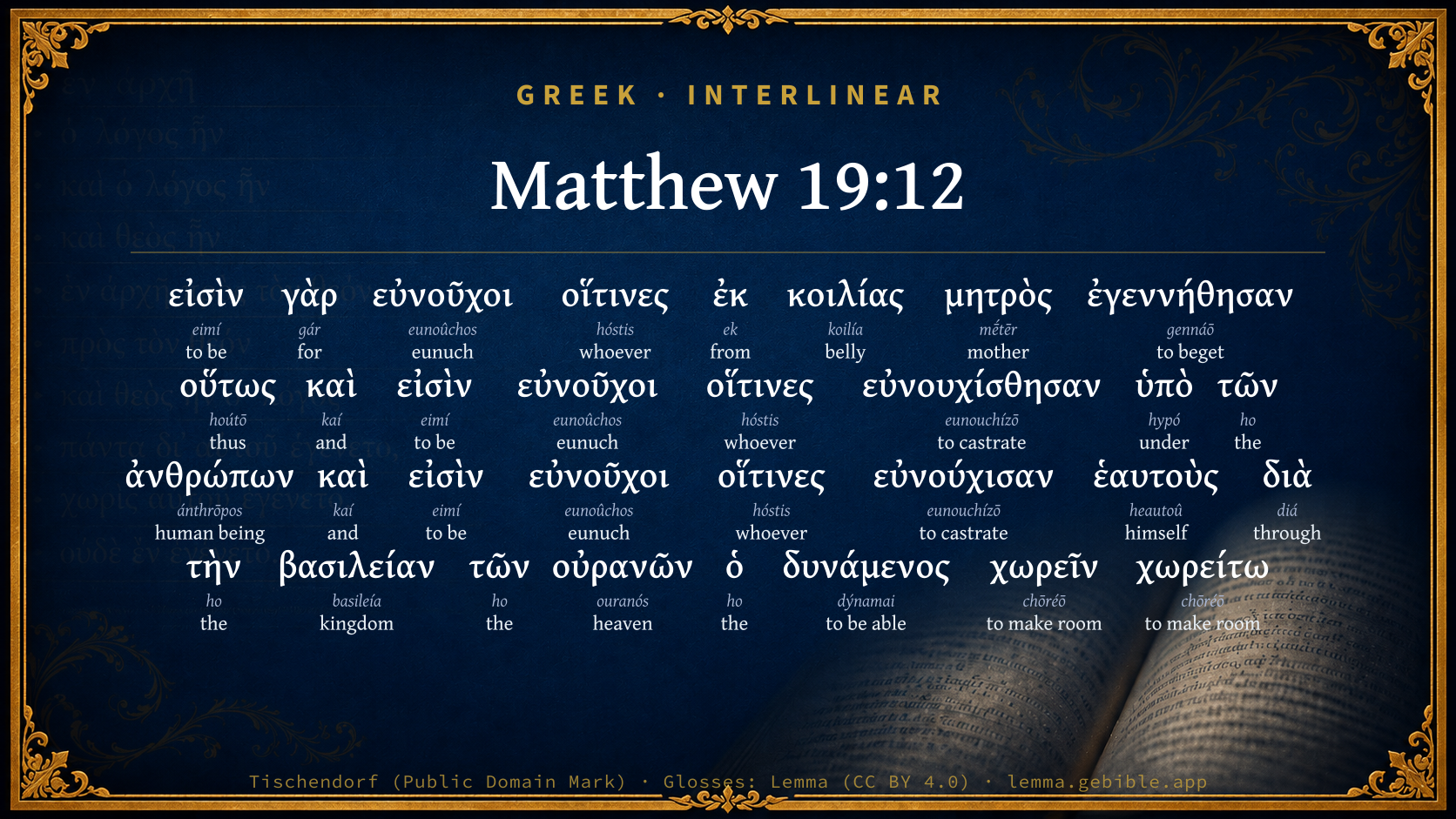
Greek (Tischendorf 8th ed.) Matthew 19:12 appears in the Greek New Testament. The text above is from the Tischendorf 8th edition. Each word links to its Strong’s number and a concise gloss. Click any word for its full Thayer’s Greek Lexicon entry.
Download image
Cite this verse

Matthew 19:12 (World English Bible). Public Domain. Lemma interlinear Bible study tool, https://lemma.gebible.app/v/matthew/19/12.

Show BibTeX & RIS
BibTeX
RIS
English Translation
For there are eunuchs who were born that way from their mother's womb, and there are eunuchs who were made eunuchs by men; and there are eunuchs who made themselves eunuchs for the Kingdom of Heaven's sake. He who is able to receive it, let him receive it."
World English Bible · Public Domain
Highlights
  • 2 first appearances in the Greek New Testament
Full analysis ↓
Download a study sheet

One document with this verse’s original text, its word-by-word gloss line, the meaning frame, cross-references with their text, attributed commentary, and full source and license credits — printable, and it pastes into notes with its structure intact.

This verse Autodidact and up

Study sheet (.html) Plain text (.txt)

A passage Seminary Student

Up to 50 verses in one chapter. A passage sheet keeps up to 6 commentary sources and 12 cross-references per verse, in the order this page ranks them, and says so on the sheet whenever that leaves anything out. Ask for a single verse and you get the Autodidact verse sheet above.

Everything on this page stays free to read, with no account — the sheet is a download of what is already on screen, not access to it.

Want to remove ads? Support Godless Engineer
Compare translations 3

The same verse in 3 English versions, stacked beneath the original-language interlinear above. Click any original word for its lexicon entry.

Each is an independent rendering of the whole verse — the interlinear is not word-aligned to these translations.

Highlighted words mark where these versions differ — a whole-verse word diff, not a word-by-word alignment.

  • World English Bible Public Domain
    For there are eunuchs who were born that way from their mother's womb, and there are eunuchs who were made eunuchs by men; and there are eunuchs who made themselves eunuchs for the Kingdom of Heaven's sake. He who is able to receive it, let him receive it."
  • King James Version Public Domain
    For there are some eunuchs, which were so born from their mother's womb: and there are some eunuchs, which were made eunuchs of men: and there be eunuchs, which have made themselves eunuchs for the kingdom of heaven's sake. He that is able to receive it, let him receive it.
  • unfoldingWord Literal Text CC BY-SA 4.0
    For there are eunuchs who were born thus from their mother’s womb, and there are eunuchs who were made eunuchs by men, and there are eunuchs who made themselves eunuchs because of the kingdom of the heavens. The one being able to receive, let him receive.”

unfoldingWord Literal Text — © unfoldingWord, licensed CC BY-SA 4.0. Word-aligned USFM3 via Door43 (git.door43.org/unfoldingWord/en_ult).

Versions to compare (up to 4)

3 of 4 selected

Show all 19 translations

Every available English version of this verse, each an independent rendering of the whole verse.

  • World English Bible Public Domain
    For there are eunuchs who were born that way from their mother's womb, and there are eunuchs who were made eunuchs by men; and there are eunuchs who made themselves eunuchs for the Kingdom of Heaven's sake. He who is able to receive it, let him receive it."
  • Berean Standard Bible Public Domain
    For there are eunuchs who were born that way; others were made that way by men; and still others live like eunuchs for the sake of the kingdom of heaven. The one who can accept this should accept it.”
  • Majority Standard Bible Public Domain
    For there are eunuchs who were born that way; others were made that way by men; and still others live like eunuchs for the sake of the kingdom of heaven. The one who can accept this should accept it.”
  • King James Version Public Domain
    For there are some eunuchs, which were so born from their mother's womb: and there are some eunuchs, which were made eunuchs of men: and there be eunuchs, which have made themselves eunuchs for the kingdom of heaven's sake. He that is able to receive it, let him receive it.
  • American Standard Version (1901) Public Domain
    For there are eunuchs, that were so born from their mother's womb: and there are eunuchs, that were made eunuchs by men: and there are eunuchs, that made themselves eunuchs for the kingdom of heaven's sake. He that is able to receive it, let him receive it.
  • Revised Version (1885) Public Domain
    For there are eunuchs, which were so born from their mother’s womb: and there are eunuchs, which were made eunuchs by men: and there are eunuchs, which made themselves eunuchs for the kingdom of heaven’s sake. He that is able to receive it, let him receive it.
  • Geneva Bible (1599) Public Domain
    For there are some eunuches, which were so borne of their mothers belly: and there be some eunuches, which be gelded by men: and there be some eunuches, which haue gelded them selues for the kingdome of heauen. He that is able to receiue this, let him receiue it.
  • Douay-Rheims (1899) Public Domain
    For there are eunuchs, who were born so from their mother's womb: and there are eunuchs, who were made so by men: and there are eunuchs, who have made themselves eunuchs for the kingdom of heaven. He that can take, let him take it.
  • Young's Literal Translation Public Domain
    for there are eunuchs who from the mother's womb were so born; and there are eunuchs who were made eunuchs by men; and there are eunuchs who kept themselves eunuchs because of the reign of the heavens: he who is able to receive `it' -- let him receive.'
  • Literal Standard Version CC BY-SA 4.0
    for there are eunuchs who from the mother’s womb were so born; and there are eunuchs who were made eunuchs by men; and there are eunuchs who kept themselves eunuchs because of the kingdom of the heavens: he who is able to receive [it]—let him receive.”
  • Unlocked Literal Bible CC BY-SA 4.0
    For there are eunuchs who were that way from their mother's womb, and there are eunuchs who were made eunuchs by men, and there are eunuchs who made themselves eunuchs for the sake of the kingdom of heaven. He who is able to receive this teaching, let him receive it.”
  • unfoldingWord Literal Text CC BY-SA 4.0
    For there are eunuchs who were born thus from their mother’s womb, and there are eunuchs who were made eunuchs by men, and there are eunuchs who made themselves eunuchs because of the kingdom of the heavens. The one being able to receive, let him receive.”
  • Darby Bible Public Domain
    for there are eunuchs which have been born thus from [their] mother's womb; and there are eunuchs who have been made eunuchs of men; and there are eunuchs who have made eunuchs of themselves for the sake of the kingdom of the heavens. He that is able to receive [it], let him receive [it].
  • World Messianic Bible Public Domain
    For there are eunuchs who were born that way from their mother’s womb, and there are eunuchs who were made eunuchs by men; and there are eunuchs who made themselves eunuchs for the Kingdom of Heaven’s sake. He who is able to receive it, let him receive it.”
  • Webster's Bible Public Domain
    For there are some eunuchs, who were so born from their mothers womb: and there are some eunuchs, who were made eunuchs by men: and there are eunuchs, who have made themselves eunuchs for the kingdom of heaven's sake. He that is able to receive it, let him receive it.
  • Free Bible Version CC BY-SA 4.0
    “Some are born as eunuchs, some are made eunuchs by men, and some choose to be eunuchs for the sake of the kingdom of heaven. Those who can accept this should accept it.”
  • Bible in Basic English Public Domain
    For there are men who, from birth, were without sex: and there are some who were made so by men: and there are others who have made themselves so for the kingdom of heaven. He who is able to take it, let him take it.
  • Text-Critical English NT CC BY 4.0
    For there are eunuchs who were born that way from their mother's womb, and there are eunuchs who have been made eunuchs by men, and there are eunuchs who have made themselves eunuchs for the sake of the kingdom of heaven. Whoever is able to accept this should accept it.”
  • Tyndale New Testament (1534) Public Domain
    Ther are chaste which were so borne out of their mothers belly. And ther are chaste which be made of men. And ther be chaste which have made them selves chaste for the kyngdome of heves sake. He that can take it let him take it.

Literal Standard Version (2020), Covenant Press — licensed CC BY-SA 4.0. Text via the HelloAO Bible API (eBible.org). Unlocked Literal Bible (unfoldingWord) — licensed CC BY-SA 4.0. Text via the HelloAO Bible API (eBible.org). unfoldingWord Literal Text — © unfoldingWord, licensed CC BY-SA 4.0. Word-aligned USFM3 via Door43 (git.door43.org/unfoldingWord/en_ult). Free Bible Version, Dr. Jonathan Gallagher — licensed CC BY-SA 4.0. Text via the HelloAO Bible API (eBible.org).

Word by word

More ways to search: Search by grammar → Find every occurrence → Compare this word →

Practice this passage: Drill this verse → Learn its vocabulary →

εὐνουχίσθησαν
eunouchízō
G2134
“to castrate”
Verb, Aorist, Passive, Indicative, 3rd person, Plural
Part of Speech
Verb
Tense
Aorist
Voice
Passive
Mood
Indicative
Person
3rd person
Number
Plural
Full Thayer's Definition

Origin: from G2135

TDNT: 14:45,3

1. to castrate, to neuter a man 2. metaph. to make one's self a eunuch i.e. by abstaining (like a eunuch from marriage)
  1. εἰσὶν eimí G1510 “to be” Verb, Present, Active, Indicative, 3rd person, Plural
  2. γὰρ gár G1063 “for” Conjunction
  3. εὐνοῦχοι eunoûchos G2135 “eunuch” Noun, Nominative, Plural, Masculine
  4. οἵτινες hóstis G3748 “whoever” Relative pronoun, Nominative, Plural, Masculine
  5. ἐκ ek G1537 “from” Preposition
  6. κοιλίας koilía G2836 “belly” Noun, Genitive, Singular, Feminine
  7. μητρὸς mḗtēr G3384 “mother” Noun, Genitive, Singular, Feminine
  8. ἐγεννήθησαν gennáō G1080 “to beget” Verb, Aorist, Passive, Indicative, 3rd person, Plural
  9. οὕτως hoútō G3779 “thus” Adverb
  10. καὶ kaí G2532 “and” Conjunction
  11. εἰσὶν eimí G1510 “to be” Verb, Present, Active, Indicative, 3rd person, Plural
  12. εὐνοῦχοι eunoûchos G2135 “eunuch” Noun, Nominative, Plural, Masculine
  13. οἵτινες hóstis G3748 “whoever” Relative pronoun, Nominative, Plural, Masculine
  14. ὑπὸ hypó G5259 “under” Preposition
  15. τῶν ho G3588 “the” Article, Genitive, Plural, Masculine
  16. ἀνθρώπων ánthrōpos G444 “human being” Noun, Genitive, Plural, Masculine
  17. καὶ kaí G2532 “and” Conjunction
  18. εἰσὶν eimí G1510 “to be” Verb, Present, Active, Indicative, 3rd person, Plural
  19. εὐνοῦχοι eunoûchos G2135 “eunuch” Noun, Nominative, Plural, Masculine
  20. οἵτινες hóstis G3748 “whoever” Relative pronoun, Nominative, Plural, Masculine
  21. εὐνούχισαν eunouchízō G2134 “to castrate” Verb, Aorist, Active, Indicative, 3rd person, Plural
  22. ἑαυτοὺς heautoû G1438 “himself” Reflexive pronoun, 3rd person, Accusative, Plural, Masculine
  23. διὰ diá G1223 “through” Preposition
  24. τὴν ho G3588 “the” Article, Accusative, Singular, Feminine
  25. βασιλείαν basileía G932 “kingdom” Noun, Accusative, Singular, Feminine
  26. τῶν ho G3588 “the” Article, Genitive, Plural, Masculine
  27. οὐρανῶν ouranós G3772 “heaven” Noun, Genitive, Plural, Masculine
  28. ὁ ho G3588 “the” Article, Nominative, Singular, Masculine
  29. δυνάμενος dýnamai G1410 “to be able” Verb, Present, Middle or Passive deponent, Participle, Nominative, Singular, Masculine
  30. χωρεῖν chōréō G5562 “to make room” Verb, Present, Active, Infinitive
  31. χωρείτω chōréō G5562 “to make room” Verb, Present, Active, Imperative, 3rd person, Singular

About this verse

These counts appear in no published source. They are computed here, from the morphology-tagged text and Lemma’s own curated glosses. What Lemma adds →

32
words
20
distinct lemmas
Gospels
section

Notable vocabulary

The rarest word here is εὐνουχίσθησαν to castrate G2134 — appearing just 2 times in the whole Greek New Testament.

First appearance in Scripture

These words make their first canonical appearance in the Greek New Testament here:
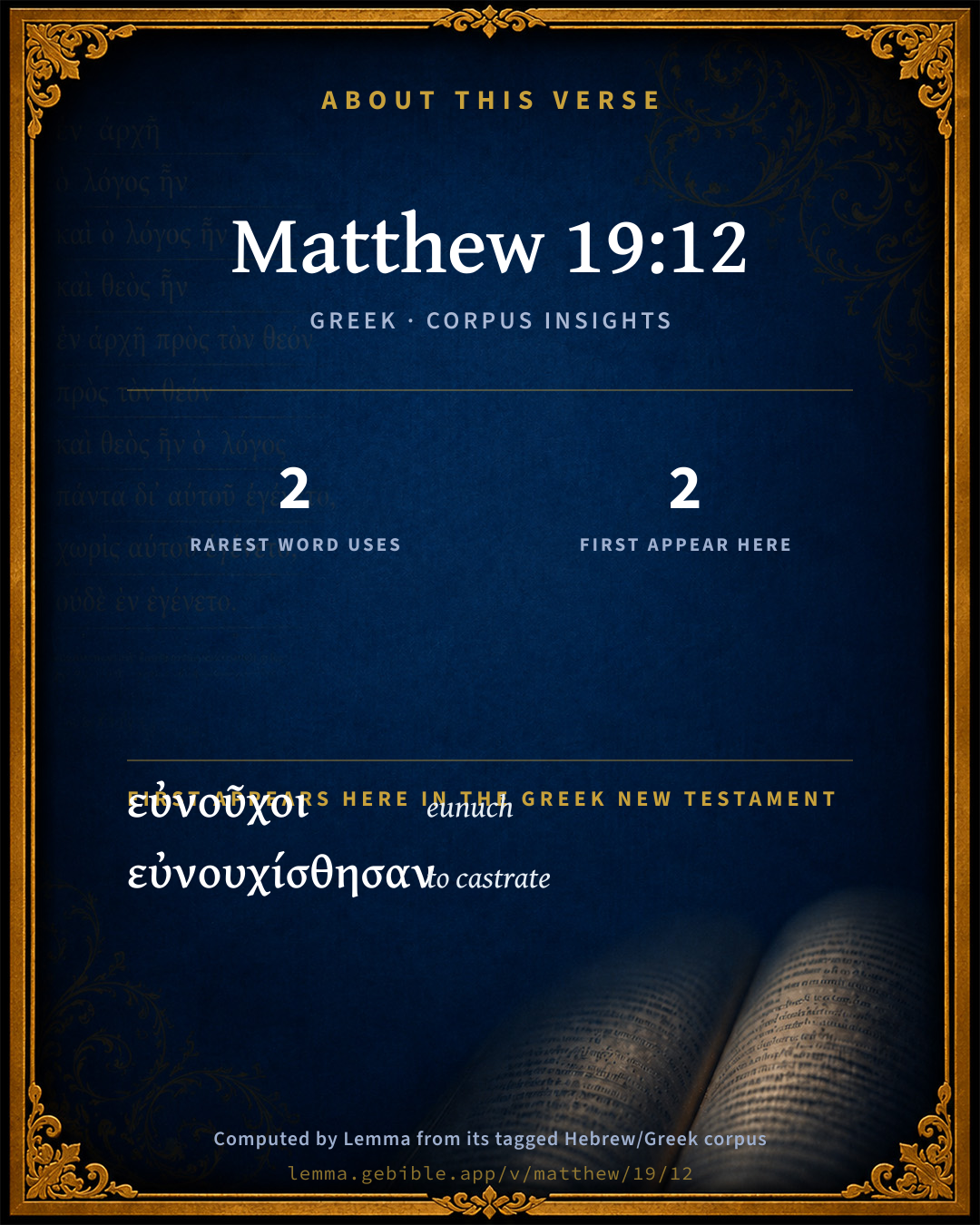
  • εὐνοῦχοι eunuch G2135
  • εὐνουχίσθησαν to castrate G2134

Repetition

Words recur within this verse:

  • εἰσὶν to be G1510 ×3
  • εὐνοῦχοι eunuch G2135 ×3
  • οἵτινες whoever G3748 ×3
  • εὐνουχίσθησαν to castrate G2134 ×2
  • χωρεῖν to make room G5562 ×2
  • τῶν the G3588 ×4
  • καὶ and G2532 ×2

Cross-references

5

Topical passages linked to Matthew 19:12 in the Treasury of Scripture Knowledge — connected by theme and wording, ordered by reader-vote popularity; previews shown in the World English Bible.

  • 1 Corinthians 7:32–38 But I desire to have you to be free from cares. He who is unmarried is concerned for the things of the Lord, how he may please the Lord;
  • 1 Corinthians 9:5 Have we no right to take along a wife who is a believer, even as the rest of the apostles, and the brothers of the Lord, and Cephas?
  • Isaiah 56:3–4 Neither let the foreigner, who has joined himself to Yahweh, speak, saying, Yahweh will surely separate me from his people; neither let the eunuch say, Behold, I am a dry tree.
  • Isaiah 39:7 Of your sons who shall issue from you, whom you shall father, shall they take away; and they shall be eunuchs in the palace of the king of Babylon.
  • 1 Corinthians 9:15 But I have used none of these things, and I don't write these things that it may be done so in my case; for I would rather die, than that anyone should make my boasting void.

Cross-references courtesy of OpenBible.info (CC BY 4.0).

Commentary

Notes on Matthew 19:12 from classic Christian and Jewish commentators (each source and its license shown beneath its notes). The classic Christian expositions comment on the surrounding passage and are grouped to its opening verse, so a note may address several verses; the Jewish commentaries on the Tanakh (Rashi and others) are per-verse, so they appear only where the commentator wrote on this verse.

Lemma curates 59 commentaries, every one of them public domain or Creative Commons licensed, each selected and text-cleaned for this edition rather than reprinted as found. About our sources →

Joseph Benson's Commentary

Mat 19:12. For there are some eunuchs, &c. — Our Lord here shows that the fore-mentioned gift of continence is given to three sorts of persons: 1st, To some by natural constitution, without their choice. 2d, To some by the violence of men, against their choice: and, 3d, To others by grace, with their choice; who steadily withstand their natural inclinations, that they may wait upon God without distraction, and may glorify him in a single life, judging it to be a state more free from worldly cares, and more friendly to devotion, than that of marriage. He that is able to receive it, let him receive it — He that has this gift, in any of these ways, whether by natural constitution and disposition; or by the injury of human force used upon him, rendering him incapable of the matrimonial union; or by an ardent desire of promoting the interests of religion, animating him to subdue his natural appetite, and enabling him to live in voluntary chastity, unencumbered with secular concerns; such a person will not sin though, he leads a single life. The words, however, let him receive it, must not be referred to the clauses immediately preceding them, as if our Lord had meant to say, He that is able to become a eunuch by any of the ways I have mentioned, let him become one; for the second way, namely, through violence offered to men’s bodies, is absolutely unlawful: but they must be referred to Mat 19:11, as is plain from the words themselves; and the meaning of them is, He that can receive the saying there mentioned, and live chastely without marriage, may receive it; and, as many commentators understand the words, ought to receive it. “They who have the gift of continency,” says Henry, “and are not under any necessity of marrying, do best if they continue single, 1Co 7:1; for they that are unmarried have opportunity, if they have but a heart, to care more for the things of the Lord, how they may please the Lord, 1Co 7:32; 1Co 7:34, being less encumbered with the cares of this life, and having greater vacancy of thoughts, and time to mind better things.” The word eunuchs, from the Greek ευνουχοι, eunouchoi, means having the care of the bed, or bed-chamber, (from ευνην εχειν,) this being the principal employment of eunuchs in the eastern countries, that is, of such as our Lord says were made eunuchs by men, merely for the purpose of attending in the apartments of queens and princesses.

Joseph Benson's Commentary on the Old and New Testaments (1811–1818) — public domain. Text from a community e-Sword module.

Tyndale Open Study Notes

Tyndale Open Resources

19:12 Eunuchs are males castrated either by a birth defect or by a surgical operation. Jesus also uses the term metaphorically for those who choose not to marry (see Luke 14:26; 18:29; 1 Cor 7:7-8). • for the sake of the Kingdom: Jesus was not denigrating marriage; he was simply indicating that the unmarried often have greater potential for ministry (see 1 Cor 7:25-35).

Tyndale Open Study Notes — © Tyndale Open Resources, licensed CC BY-SA 4.0. Text via the HelloAO Bible API.

Bengel's Gnomon

Johann Albrecht Bengel

Mat 19:12. Εἰσὶ, κ.τ.λ., there are, etc.) There are three kinds of eunuchs: the first and second of which are treated indirectly, the third directly, in this passage. For the two former are either produced thus by nature, or made thus by the hand of man: to the latter it is given from above, although they may have been endowed with a body capable of marriage. And these (the latter) can receive the saying concerning blessed eunuchism: whereas, of those (the former), it can only be said that they cannot receive the law concerning marriage; although they too may accidentally (per accidens) obtain blessed eunuchism.—ὑπὸ τῶν ἀνθρώπων, by men) by whose art they are castrated, that they may act as chamberlains, singers, etc., or that they may, on some other ground, be prevented from contracting marriage, of which they had been previously capable. For these, also, are included in a perfect enumeration.—εὐνούχισαν ἑαυτοὺς, have made themselves eunuchs) which they alone can do, to whom it is given. It is not in man’s power thus to make another an eunuch; see 1Co 7:7.—ἑαυτοὺς, themselves) sc. by a voluntary abstinence from marriage; sometimes having even relinquished a wife for the name of Christ (see Mat 19:29), and adding exercises calculated to preserve chastity, and subdue the fires of nature.—διὰ, κ.τ.λ., for the kingdom of heaven’s sake) Not because they can only be saved by remaining unmarried, but that they may be able to devote themselves more entirely to the contemplation and propagation of Divine Truth; see 1Co 7:32; 1Co 9:12.—χωρείτω, let him receive) A precept not addressed to all, but only to those who are able to receive it. Not even all the Apostles seem to have been able to receive it; see 1Co 9:5.

Bengel's Gnomon of the New Testament — English translation (T&T Clark, Edinburgh, 1860) — public domain. Text from a community e-Sword module.

Expositor's Greek Testament

ed. W. Robertson Nicoll

Mat 19:12 is an explanatory commentary on δέδοται . εὐνοῦχος : keeper of the bedchamber in an Oriental barem (from εὐνή , ed, and ἔχω ), a jealous office, which could be entrusted only to such as were incapable of abusing their trust; hence one who has been emasculated. Jesus distinguishes three sorts, two physical and one ethical: (1) those born with a defect ( ἐγεννήθησαν οὕτως ); (2) those made such by art ( εὐνουχίσθησαν ὑπὸ τῶν ἀνθρώπων ); (3) those who make themselves eunuchs ( εὐνούχισαν ἑαυτοὺς ). διὰ τὴν β . τ . ο ., for the Kingdom of Heaven’s sake. This explains the motive and the nature of ethical eunuchism. Here, as in Mat 15:17 , Jesus touches on a delicate subject to teach His disciples a very important lesson, viz. , that the claims of the Kingdom of God are paramount; that when necessary even the powerful impulses leading to marriage must be resisted out of regard to them. ὁ δυνάμενος χωρεῖν χωρείτω : by this final word Jesus recognises the severity of the demand as going beyond the capacity of all but a select number. We may take it also as an appeal to the spiritual intelligence of His followers = see that ye do not misconceive my meaning. Is not monasticism, based on vows of life-long celibacy, a vast baleful misconception, turning a military requirement to subordinate personal to imperial interests, as occasion demands, into an elaborate ascetic system?

The Expositor's Greek Testament, edited by W. Robertson Nicoll (1897–1910) — public domain. Text from a community e-Sword module.

Geneva Bible (1599)

Geneva Bible translators

Which abstain from marriage, and live continently through the gift of God.

The word Eunuch is a general word, and hath divers kinds under it, as gelded men and barren men.

Geneva Bible (1599) marginal notes — public domain. Text via Bolls.life.

Jamieson, Fausset & Brown

Robert Jamieson, A. R. Fausset & David Brown

For there are some eunuchs which were so born from their mother's womb--persons constitutionally either incapable of or indisposed to marriage.

and there are some eunuchs which were made eunuchs of men--persons rendered incapable by others.

and there be eunuchs which have made themselves eunuchs for the kingdom of heaven's sake--persons who, to do God's work better, deliberately choose this state. Such was Paul (Co1 7:7).

He that is able to receive it, let him receive it--"He who feels this to be his proper vocation, let him embrace it"; which, of course, is as much as to say--"he only." Thus, all are left free in this matter.

Next: Matthew Chapter 20

Jamieson, Fausset & Brown — Commentary Critical and Explanatory on the Whole Bible (1871) — public domain (CC PDM 1.0). Text via the HelloAO Bible API.

Adam Clarke's Commentary

Verse 12. Eunuchs] ευνουχος, from ευνην εχειν, to have the care of the bed or bedchamber; this being the principal employment of eunuchs in the eastern countries, particularly in the apartments of queens and princesses. These are they whom our Lord says are made eunuchs by men, merely for the above purpose.

So born from their mother's womb] Such as are naturally incapable of marriage, and consequently should not contract any.

For the kingdom of heaven's sake.] I believe our Lord here alludes to the case of the ESSENES, one of the most holy and pure sects among the Jews. These abstained from all commerce with women, hoping thereby to acquire a greater degree of purity, and be better fitted for the kingdom of God: children they had none of their own, but constantly adopted those of poor people, and brought them up in their own way. PHILO, JOSEPHUS, and PLINY have largely described this very singular sect; and Dean PRIDEAUX, with his usual fidelity and perspicuity, has given the substance of what each has said. CONNEX. vol. iii. p. 483, c. edit. 1725. The account is very interesting, and well worthy the attention of every Christian. Among the rabbins we find these different kinds of eunuchs, not only mentioned, but circumstantially described, סריס חמה saris chama, eunuchs of the sun, i.e. eunuchs by the hand of God; men born impotent. סריס אדם saris Adam, eunuchs of men, those who were castrated. And they add a third sort; those who make themselves eunuchs, abstain from marriage, c., that they may give themselves UP to the study of the Divine law. See many examples in Schoettgen.

He that is able to receive] χωρειν χωρειτω. These words are variously translated: he who can take let him take it; comprehend, let him comprehend it: admit, let him admit it. The meaning seems to be, Let the man who feels himself capable of embracing this way of life, embrace it; but none can do it but he to whom it is given, who has it as a gift from his mother's womb.

The great ORIGEN, understanding the latter clause of this verse (which I have applied to the Essenes) literally - O human weakness! - went, and literally fulfilled it on himself!

Adam Clarke's Commentary on the Bible (1810–1826) — public domain. Text from a community e-Sword/MySword module.

Ellicott's Commentary for English Readers

(12) There are some eunuchs.—The words are singularly startling in their form, and bear upon them an unmistakable stamp of being a true report of teaching which, in its depth and originality, went beyond the grasp of those who heard and reported it. What they teach is, that only those who are in some sense “eunuchs,” who are, i.e., without the impulses that lead men to marriage, either naturally, or by the mutilation which then, as now, was common in the East, or who have conquered those impulses by the power of self-consecration to a higher life, can safely abstain from marriage. The celibacy of self-indulgence, or even of selfish prudence, tends but too fatally to impurity of heart or life. The man who thus makes himself as the eunuch, must do it “for the kingdom of heaven’s sake,” not, as too many have understood the words to mean, in order to win heaven for himself (that aim is not excluded, but it must not be the only or chief motive), but for the sake of all that the kingdom of heaven implies, in order to enlarge its range, and more effectually to bring the souls of men to receive it. Those who heard the words could hardly fail, as they thought over them, to look on their Master’s life as having been the great perfect example of what He thus taught as to the higher form of holiness. The motives which St. Paul states as determining his own choice of the celibate life (1Co_7:7), or the counsel which he gave to others (1Co_7:32-34), are identical with this teaching in their principle. They have influenced men in all ages of the Church, leading them to sacrifice the life of home, with all its blessings, for their work as pastors or evangelists. The Church of Rome and the founders of monastic orders were not wrong in their ideal of the highest form of life. Their mistake lay in enforcing that ideal as a rule on those who had not the power to realise it. The boldness (as it seems to us) of our Lord’s language seems intended to teach men that the work must be done as effectively as if, like Origen, they had obeyed the implied commandment in its letter. If the impulses still remain; if life is made miserable by the struggle with them; if they taint the soul by not being allowed to flow in their legitimate channel, the man is, ipso facto, disqualified for the loftier ideal. He has not made himself a eunuch for the kingdom of heaven’s sake, and he is therefore among those who “cannot receive the saying” that it “is not good to marry.” On such grounds the conduct of those who have married after pledging themselves, as priests of the Church of Rome, to vows of celibacy is amply justified. The vows were such as ought never to have been imposed, and men ought never to have taken, and therefore, like the tetrarch’s oath (Mat_14:7-9), when they were distinctly found to clash with the higher law of Nature, and to narrow what God had left free, their obligatory power ceased. The case of the monk who enters deliberately into an order of which celibacy is a condition, may seem at first to stand on a different footing; but here, also, though celibacy may legitimately be made a condition of continuing to belong to an order, the vow of a lifelong celibacy must be held to have been such as men had no right either to impose or take, and therefore as binding only so long as a man chooses to continue a member of the society which requires it.

A Bible Commentary for English Readers, edited by Charles John Ellicott (1878–1897) — public domain. Text from a community e-Sword module.

The Cambridge Bible for Schools and Colleges

gen. ed. J. J. S. Perowne

12. eunuchs = “unmarried.”

12. for the kingdom of heaven’s sake] In old days some men abstained from marriage in order to devote themselves to the study of the law, in later times men have done so for the furtherance of Christianity.

The Cambridge Bible for Schools and Colleges (gen. ed. J. J. S. Perowne; Cambridge University Press, 1878–1918) — public domain. Text from a community e-Sword module.

John Gill's Exposition

For there are some eunuchs,.... Our Lord here distinguishes the various sorts of persons, that can and do live in a single state with content: some by nature, and others by violence offered to them, are rendered incapable of entering into a marriage state; and others, through the gift of God, and under the influence of his grace, abstain from marriage cheerfully and contentedly, in order to be more useful in the interest of religion; but the number of either of these is but few, in comparison of such who choose a conjugal state, and with whom it is right to enter into it, notwithstanding all the difficulties that may attend it. Some men are eunuchs, and of these there are different sorts; there are some,

which were so born from their mother's womb; meaning, not such who, through a natural temper and inclination of mind, could easily abstain from marriage, and chose to live single; but such who had such defects in nature that they were impotent, unfit for, and unable to perform the duties of a marriage state; who, as some are born without hands or feet, these were born without proper and perfect organs of generation; and such an one was, by the Jews, frequently called, , "an eunuch of the sun (n)": that is, as their doctors (o) explain it, one that from his mother's womb never saw the sun but as an eunuch; that is, one that is born so; and that such an one is here intended, ought not to be doubted. The signs of such an eunuch, are given by the Jewish (p) writers, which may be consulted by those, that have ability and leisure. This sort is sometimes (q) called "an eunuch by the hands of heaven", or God, in distinction from those who are so by the hands, or means of men, and are next mentioned:

and there are some eunuchs, which were made eunuchs of men: as among the Romans formerly, and which Domitian the emperor forbid by a law (r); and more especially in the eastern countries, and to this day among the Turks, that they may the more safely be entrusted with the custody of their women; and this sort the Jews call , "an eunuch of men", or , "by the hands of men". The distinction between an "eunuch of the sun", and an "eunuch of men", is so frequent with the Jews (s), and so well known to them, that a question need not be made of our Lord's referring to it:

and there be eunuchs which have made themselves eunuchs; not in a literal sense, in which the words are not to be taken, as they were by Origen; who though otherwise too much pursued the allegorical way of interpreting Scripture, here took it literally, and castrated himself (t); as did also a sort of heretics, called Valesians (u), from one Valens an Arabian; and which practice is recommended by Philo the Jew (w), and by Heathen philosophers (x), for the sake of chastity. But here it means such, who having the gift of continency without mutilating their bodies, or indulging any unnatural lusts, can live chastely without the use of women, and choose celibacy:

for the kingdom of heaven's sake; not in order, by their chaste and single life, to merit and obtain the kingdom of glory; but that they might be more at leisure, being free from the incumbrances of a marriage state, to attend the worship and service of God, the ordinances of the Gospel church state, to minister in, and preach the Gospel of Christ, and be a means of spreading it in the world, and of enlarging his kingdom and interest.

He that is able to receive it, let him receive it: whoever is able to receive cordially, and embrace heartily, the above saying concerning the expediency and goodness of a single life, and having the gift of continency, can live according to it; let him take it, and hold it fast, and act up to it; he may have less of worldly trouble, and be more useful for God in the Gospel of Christ, and to the interest of religion; but this should be a voluntary thing: no man should be forced into it; and he that goes into it, ought to consider well whether he is able to contain, or not.

(n) T. Bab. Yebamot, fol. 75. 1. 79. 2. & 80. 1. Maimon. Hilch. Ishot, c. 2. sect. 14. (o) Maimon & Bartenora in Misn. Yebamot, c. 8. sect. 4. (p) Bartenora, ibid. & Maimon. Hilch. Ishot, ut supra. (q) T. Bab. Yebamot, fol. 80. 2. (r) Philostrat. vit. Apollon. l. 6. c. 17. (s) Misn. Yebamot, c. 8. sect. 4. Zabim, c. 2. sect. 1. T. Hieros. Yebamot, fol. 9. 4. Maimon. Hilch. Ishot, c. 2. sect. 26. & 4. 18. Mechosre Caphara, c. 3. sect. 6. Mishcabumoshab, c. l. sect. 5. (t) Euseb. Ecel. Hist. l. 6. c. 8. (u) Augustin de Haeres. c. 37. & Danaeus in ib. (w) Lib. quod deterius, p. 186. (x) Sexti Pythag. Sent. p. 8.

John Gill's Exposition of the Whole Bible (1746–1763) — public domain (CC PDM 1.0). Text via the HelloAO Bible API.

Trapp's Complete Commentary

John Trapp

12 For there are some eunuchs, which were so born from their mother’s womb: and there are some eunuchs, which were made eunuchs of men: and there be eunuchs, which have made themselves eunuchs for the kingdom of heaven’s sake. He that is able to receive it, let him receive it.

Ver. 12. Which were so born] Of a frigid constitution of body, and unapt for generation. This is not continence, but impotence, effeminacy, a defect in nature.

Which were made eunuchs of men] Evirati, bereft of manhood, as in the court of Persia of old, and of Turkey at this day, where Christians’ children are not gelded only, but deprived of all their genitals, supplying the uses of nature with a silver quill; which inhuman custom was brought in among them by Selymus II out of jealousy lest his eunuchs were not so chaste as they should have been in keeping their ladies’ beds. For though made eunuchs by men, yet are they not without their fleshly concupiscences, yea, they are magni amatores mulierum, as she in Terence saith.

Which have made themselves eunuchs] Not gelded themselves, as Origen and some others in the primitive times, by mistake of this text. (So Tertullian tells of Democritus, that he pulled out his own eyes, because he could not look upon women and not lust after them; wherein he did but publish his extreme folly to the whole city, saith he.) Nor yet tied themselves by vow to perpetual continence, out of a superstitious opinion of meriting heaven thereby, as the Essenes of old (Joseph. B. J. ii. 6), and the Popish clergy now; but live single, that they may serve God with more freedom, fighting against fleshly lusts (that fight against the soul) with those spiritual weapons, meditation, prayer, abstinence, &c., which are mighty through God to the pulling down of Satan’s strongholds set up in the heart. Hence the Hebrew, Syriac, Chaldee, and Arabic render this text, Qui castrarunt animam suam, which have gelded their souls. And the truth is, there they must begin, that will do anything in this kind to purpose. Incesta est, et sine stupro, quae stuprum cupit, saith Seneca. And St Paul’s virgin must "be holy both in body and in spirit," 1Co 7:34.

John Trapp, A Commentary or Exposition upon All the Books of the Old and New Testament (1647–1656) — public domain. Text from a community e-Sword module.

Albert Barnes' Notes on the Bible

For there are some eunuchs ... - Jesus proceeds to state that there were some who were able to receive that saying and to remain in an unmarried state. Some were so born; some were made such by the cruelty of men; and there were some who voluntarily abstained from marriage for the kingdom of heaven’s sake - that is, that they might devote themselves entirely to the proper business of religion. Perhaps he refers here to the Essenes, a sect of the Jews (see the notes at Mat 3:7), who held that marriage was unsuitable to their condition; who had no children of their own, but perpetuated their sect by adopting the poor children of others. Eunuchs were employed chiefly in attending on the females or in the harem. They rose often to distinction, and held important offices in the state. Hence, the word is sometimes used with reference to such an officer of state, Act 8:27.

Albert Barnes' Notes on the Bible (1834–1885) — public domain. Text from a community e-Sword/MySword module.

Haydock's Catholic Bible Commentary

And there are eunuchs, who have made themselves eunuchs, &c. It is not to be taken in the literal sense, but of such who have taken a firm and commendable resolution of leading a single life. --- He that can receive it, let him receive it. Some think that to receive, in this and the foregoing verse, is to understand; and so will have the sense to be, he that can understand what I have said of different eunuchs, let him understand it; as when Christ said elsewhere, he that hath ears to hear, let him hear. But others expound it as an admonition to men and women, not to engage themselves in a vow of living a single life, unless, after serious deliberation, they have good grounds to think they can duly comply with this vow, otherwise let them not make it. Thus St. Jerome on this place, and St. John Chrysostom where they both expressly take notice, that this grace is granted to every one that asketh and beggeth for it by prayer. (Witham) --- To the crown and glory of which state, let those aspire who feel themselves called by heaven.

George Leo Haydock (1774–1849), Haydock's Catholic Family Bible and Commentary, 1859 edition — public domain. Excludes Psalms (Douay-Rheims chapter numbering differs from Protestant) and Deuterocanonical books (Catholic canon only).

Whedon's Commentary on the Bible

Daniel D. Whedon

12. For — Our Lord proceeds now to specify three classes to whom it is given not to marry. To the first it is given by a peculiarity of nature; to the second by the cruelty of man; to the third by a divine duty and qualification. Eunuchs — The word eunuch signifies a couch-guard; and it designates a class of men who, in the Oriental countries, are subjected to a cruel degradation, and kept by their masters to guard the females of their harems. It is used here by our Lord to designate all persons who live entirely pure from the other sex. So born — Born of a constitution by which marriage is not desired. Made eunuchs of men — By barbarous violence. Made themselves eunuchs — By perfect chastity of mind and body. There are some (like Bishop Asbury) who, giving themselves up wholly to the ministry, or to religious study or devotion, exempt themselves for all or a part of their lives from the entanglements of life, that they may serve God more intensely.

Worst of all is the method of the Church of Rome, which enforces upon a whole class the duty of celibacy, regardless of natural power or constitution; and which binds others, by forced and perpetual vows, to the restraint for which no gift has qualified them. The results are cruelly and shamefully demoralizing.

Daniel D. Whedon (gen. ed.), Commentary on the Old and New Testaments (1874–1909) — public domain. Text from a community e-Sword module.

The Pulpit Commentary

Our Lord proceeds to note three classes of men to whom it is given to abstain from marriage. There are some eunuchs, which were so born. The first class consists of those who are physically unable to contract matrimony, or, having the power, lack the inclination. They are compulsorily continent, and are not voluntary abstainers. Neither is the second class: those which were made eunuchs of men. Such were common enough in the harems and courts of Orientals. The cruel and infamous treatment which such persons underwent was practised against their will, and consequently their continence had no sort of merit. The third is the only class which of choice and for high reasons lived a celibate life: which have made themselves eunuchs for the kingdom of heaven"s sake. This is not to be understood of excision; for this would be a contravention of the order of nature and the good work of creation. Origen, who took the passage literally, and with his own hands mutilated himself, was justly condemned by the verdict of the Church. The verb is to be understood in a metaphorical sense of the mortification of the natural desires and impulses at the cost of much pain and trouble, the spirit conquering the flesh by the special grace of God. The motive of such self-denial is high and pure. It is practised "for the kingdom of heaven"s sake," that is, to be free from distraction and the cares and dangers involved in a married life. St. Paul carries forward the Lord"s teaching when he writes, (1Co_7:32, 1Co_7:33) "He that is unmarried is careful for the things of the Lord, how he may please the Lord; but he that is married is careful for the things of the world, how he may please his wife". (comp. Isa_56:3, Isa_56:4) The celibate life, deliberately embraced for religion"s sake, is here approved by Christ, not to the disparagement of matrimony, but as a counsel which some are enabled to follow to their soul"s great benefit. It may be added that the counsel applies also to married persons who sacrifice conjugal endearments for spiritual reasons wives as though they had none". (1Co_7:29) Let him receive it. This is not an injunction, but a permission; it is no universal rule, prescribed to all or to the many; it is a special grace allowed to the few, and by few attained. "Each man," says St. Paul, "hath his own gift from God, one after this manner, and another after that". (1Co_7:7, 1Co_7:26) Some think the Essenes are here referred to; but it is not likely that our Lord would endorse the practices of a sect which in some of its tenets was by no means commendable. Rather he is laying down a limitation that, while self-sacrifice and self-dedication to God are acceptable and fraught with peculiar blessings, none should attempt to win heaven in this way, unless they are specially prepared for such a life by the grace of God mastering the human will and controlling every earthly desire. The pre-eminent value set on celibacy by the early Church was learned from this and similar passages; but Christ institutes no comparison between the single and married states; and it would have been wiser to imitate his reserve in estimating the spiritual merits of the two conditions.

The Pulpit Commentary (1880–1919), ed. H.D.M. Spence-Jones & Joseph S. Exell — public domain. Text from a community e-Sword module.

John Wesley's Explanatory Notes

There are eunuchs who have made themselves eunuchs for the kingdom of heaven's sake - Happy they! who have abstained from marriage (though without condemning or despising it) that they might walk more closely with God! He that is able to receive it, let him receive it - This gracious command (for such it is unquestionably, since to say, such a man may live single, is saying nothing. Who ever doubted this?) is not designed for all men: but only for those few who are able to receive it. O let these receive it joyfully!

John Wesley, Explanatory Notes Upon the Whole Bible (1754–1765) — public domain. Text via the GEBible commentary corpus.

Scofield Reference Notes

C. I. Scofield

kingdom

(See Scofield "Mat 3:2")

The Scofield Reference Bible (1917 edition), notes by C. I. Scofield — public domain. Text from a community e-Sword module.

The People's New Testament

B. W. Johnson

12. There are eunuchs. The classes are named who need not marry: (1) Those born physically incompetent; (2) those made eunuchs by mutilation, once a very common practice in the East, and (3) those who abstain from marriage to devote themselves, free from worldly cares, to Christ's work. Paul was an example.

B. W. Johnson's The People's New Testament with Notes (1889–1891) — public domain. Electronic text from the Christian Classics Ethereal Library (CCEL) ThML edition.

Cambridge Greek Testament for Schools and Colleges

12. εἰσὶν γάρ. The γὰρ explains οἷς δέδοται.

διὰ τὴν βασιλείαν τῶν οὐρανῶν. In old days some men abstained from marriage in order to devote themselves to the study of the law, in later times men have done so for the furtherance of Christianity.

ὁ δυνάμενος χωρεῖν χωρείτω. Let him accept the rule who can accept it—he to whom it has been given—he who belongs to either of the three classes named.

The disciples found difficulty in the pure and binding conditions of marriage laid down by Christ, and saw no escape save in abstaining from marriage like the Essenes of that day (Joseph. B. J., γάμου μὲν ὑπεροψία παρʼ αὐτοῖς, and Antiq. XVIII. 1. 5, οὔτε γαμετὰς εἰσάγονται). Christ shews that there is difficulty there too. The limitations of Christ were forgotten in early days of Church history. False teachers arose, ‘forbidding to marry’ (1Ti 4:3, κωλυόντων γαμεῖν).

As in so many of our Lord’s important ‘rules,’ the principle of Hebrew parallelism is discernible here. The closing words—ὁ δυν. χωρ. χωρείτω—recall the opening words and respond to them—οὐ πάντες … οἷς δέδοται, the enclosed triplet rises to a climax—the highest motive is placed last.

Cambridge Greek Testament for Schools and Colleges (Cambridge University Press, 1896; 21 vols, various authors incl. Carr, Maclear, Plummer, Farrar, Lumby, Moule, M. R. James, Simcox) — public domain. Text from a community e-Sword module.

Alford’s Greek Testament

Henry Alford

12.] τὸν λόγον τοῦτον, this saying of yours, viz. οὐ συμφέρει γαμῆσαι. The γάρ in ver. 12 shews that the sense is carried on: see ch. 1:18.

Our Lord mentions the three exceptions, the οἷς δέδοται οὐ γαμῆσαι. 1. Those who from natural incapacity, or if not that, inaptitude, have no tendencies towards marriage: 2. Those who by actual physical deprivation, or compulsion from men, are prevented from marrying: 3. Those who in order to do the work of God more effectually (as e.g. Paul), abstain from marriage, see 1Co 7:26. The εὐνοῦχοι and εὐνουχίζω in the two first cases are to be taken both literally and figuratively in the latter, figuratively only. It is to be observed that our Lord does not here utter a word from which any superiority can be attributed to the state of celibacy: the imperative in the last clause being not a command but a permission, as in Rev 22:17. His estimate for us of the expediency of celibacy, as a general question, is to be gathered from the parable of the talents, where He visits with severe blame the burying of the talent for its safer custody. The remark is Neander’s, and the more valuable, as he himself lived and died unmarried. See his Leben Jesu, edn. 4, p. 584.

12.] χωρεῖν, as in E. V. and in ver. 11, to receive it.

Henry Alford, The Greek Testament (1849–1861) — public domain. Text from a community e-Sword module.

International Critical Commentary

(L) 12. For there are eunuchs who were born so from their mother’s womb, and there are eunuchs who were made eunuchs by men, and there are eunuchs who made themselves eunuchs for the kingdom of the heavens. He who can receive it, let him receive it.] The verse explains what is meant by οἶς δέδοται. Some there are to whom the spiritual capacity to recognise the truth of “this saying” and to practise it has been given. For just as there are physical eunuchs, i.e. men for whom natural infirmity or the cruelty of men has made marriage impossible, so that for them the saying “better not to marry” is a necessary truism; so there are some who have made themselves spiritual eunuchs, i.e. have renounced marriage for the sake of the kingdom, i.e. because the calls of religious duty have made marriage inexpedient. To such as these spiritual insight has been given which enables them to realise that it is better not to marry. For renunciation of earthly blessings for the sake of the kingdom, cf. vv. 28, 29. The Lord may have had in mind such instances of the renunciation of marriage as the Essenes, or John the Baptist, or some among His disciples.

International Critical Commentary — older volumes (1896–1929), various authors — public domain. Text from a community e-Sword module.

Lesson kit

Teaching starters — assembled from the data on this page, not authored interpretation. Every prompt links to the verse data it draws on. Edit before teaching.

Matthew, in the Gospels, opens this verse with 32 words (20 distinct Greek lemmas). Its most distinctive word is eunouchízō (“to castrate”). A historical commentator’s framing appears above. Read the whole chapter for the surrounding context.

Discussion questions

  1. What does “to castrate” (eunouchízō) contribute to the verse as a whole?
  2. 2 words make their first appearance in Scripture here. What does this debut establish?
  3. How does 1 Corinthians 7:32–38, which shares this passage’s theme, read alongside this verse?
  4. What does the repetition of “to be” (3× in this one verse) do in this verse?
  5. These translations render this verse differently. What is at stake in choosing one wording over another?
  6. Compare how Joseph Benson's Commentary and Tyndale Open Study Notes read this verse. Where do they agree or differ?

Things to notice

  • 2 words make their first canonical appearance in Scripture here.
  • These translations choose different wording for 14 words in this verse.
  • “to be” occurs 3× in this single verse.
  • 20 distinct Greek lemmas span 32 words in this verse.

Reading settings

Reading text

Shown beneath each verse's original-language words.

Old Testament
Old Testament edition

Read the OT as the Masoretic Hebrew (MT) or the Greek Septuagint (LXX).

English shown for the Greek Septuagint (in the Hebrew ↔ Greek comparison).

Comparing translations? Open the Compare panel on any verse page to stack up to four side by side.