
Matthew 3:16

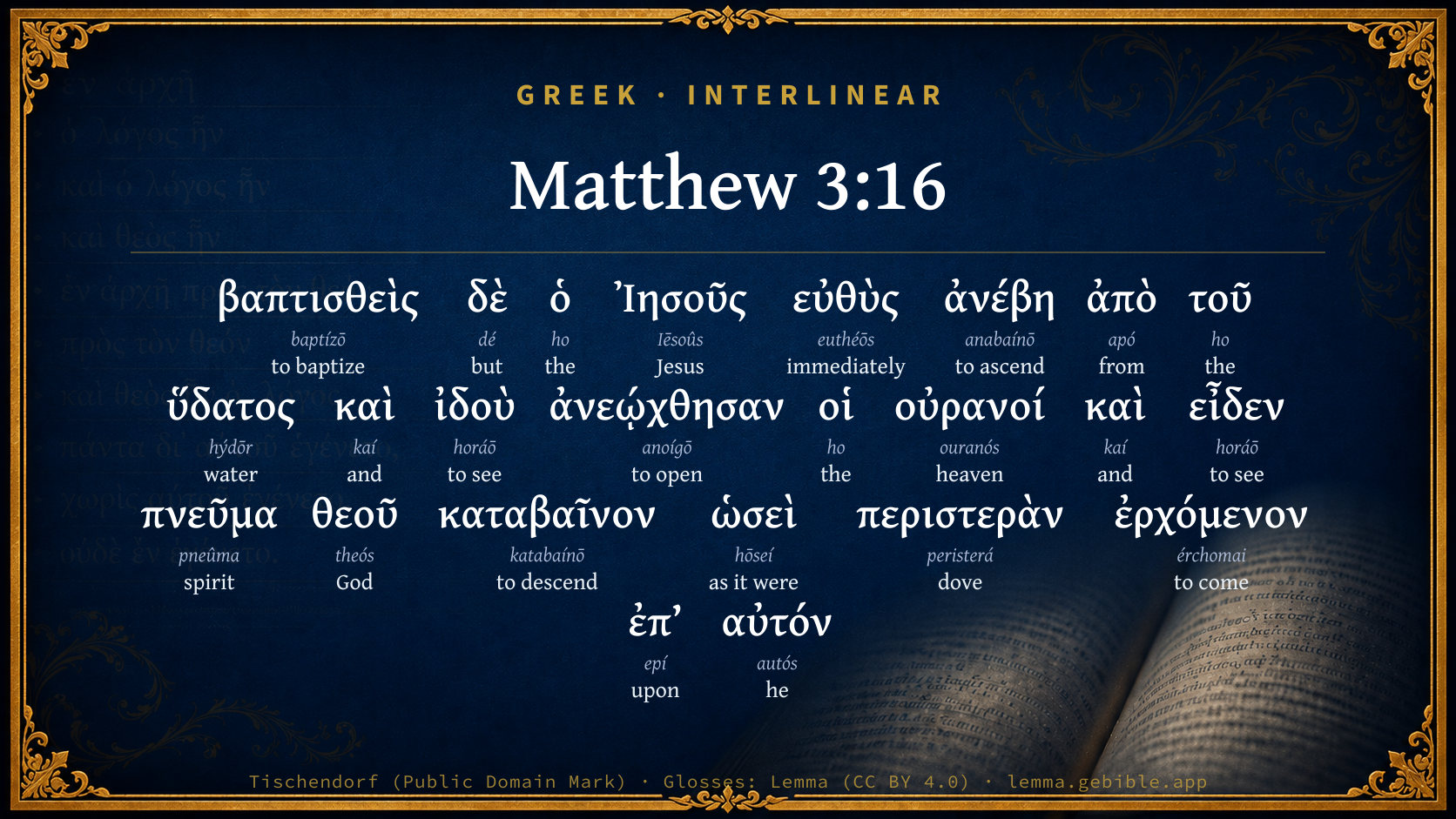
Greek (Tischendorf 8th ed.) Matthew 3:16 appears in the Greek New Testament. The text above is from the Tischendorf 8th edition. Each word links to its Strong’s number and a concise gloss. Click any word for its full Thayer’s Greek Lexicon entry.
Download image
Cite this verse

Matthew 3:16 (World English Bible). Public Domain. Lemma interlinear Bible study tool, https://lemma.gebible.app/v/matthew/3/16.

Show BibTeX & RIS
BibTeX
RIS
English Translation
Jesus, when he was baptized, went up directly from the water: and behold, the heavens were opened to him. He saw the Spirit of God descending as a dove, and coming on him.
World English Bible · Public Domain
Highlights
  • 5 first appearances in the Greek New Testament
Full analysis ↓
Download a study sheet

One document with this verse’s original text, its word-by-word gloss line, the meaning frame, cross-references with their text, attributed commentary, and full source and license credits — printable, and it pastes into notes with its structure intact.

This verse Autodidact and up

Study sheet (.html) Plain text (.txt)

A passage Seminary Student

Up to 50 verses in one chapter. A passage sheet keeps up to 6 commentary sources and 12 cross-references per verse, in the order this page ranks them, and says so on the sheet whenever that leaves anything out. Ask for a single verse and you get the Autodidact verse sheet above.

Everything on this page stays free to read, with no account — the sheet is a download of what is already on screen, not access to it.

Want to remove ads? Support Godless Engineer
Compare translations 3

The same verse in 3 English versions, stacked beneath the original-language interlinear above. Click any original word for its lexicon entry.

Each is an independent rendering of the whole verse — the interlinear is not word-aligned to these translations.

Highlighted words mark where these versions differ — a whole-verse word diff, not a word-by-word alignment.

  • World English Bible Public Domain
    Jesus, when he was baptized, went up directly from the water: and behold, the heavens were opened to him. He saw the Spirit of God descending as a dove, and coming on him.
  • King James Version Public Domain
    And Jesus, when he was baptized, went up straightway out of the water: and, lo, the heavens were opened unto him, and he saw the Spirit of God descending like a dove, and lighting upon him:
  • unfoldingWord Literal Text CC BY-SA 4.0
    Now, having been baptized, Jesus immediately came up from the water, and behold, the heavens were opened to him, and he saw the Spirit of God coming down like a dove, resting upon him,

unfoldingWord Literal Text — © unfoldingWord, licensed CC BY-SA 4.0. Word-aligned USFM3 via Door43 (git.door43.org/unfoldingWord/en_ult).

Versions to compare (up to 4)

3 of 4 selected

Show all 19 translations

Every available English version of this verse, each an independent rendering of the whole verse.

  • World English Bible Public Domain
    Jesus, when he was baptized, went up directly from the water: and behold, the heavens were opened to him. He saw the Spirit of God descending as a dove, and coming on him.
  • Berean Standard Bible Public Domain
    As soon as Jesus was baptized, He went up out of the water. Suddenly the heavens were opened, and He saw the Spirit of God descending like a dove and resting on Him.
  • Majority Standard Bible Public Domain
    As soon as Jesus was baptized, He went up out of the water. Suddenly the heavens were opened to Him, and He saw the Spirit of God descending like a dove and resting on Him.
  • King James Version Public Domain
    And Jesus, when he was baptized, went up straightway out of the water: and, lo, the heavens were opened unto him, and he saw the Spirit of God descending like a dove, and lighting upon him:
  • American Standard Version (1901) Public Domain
    And Jesus when he was baptized, went up straightway from the water: and lo, the heavens were opened unto him, and he saw the Spirit of God descending as a dove, and coming upon him;
  • Revised Version (1885) Public Domain
    And Jesus, when he was baptized, went up straightway from the water: and lo, the heavens were opened unto him, and he saw the Spirit of God descending as a dove, and coming upon him;
  • Geneva Bible (1599) Public Domain
    And Iesus when hee was baptized, came straight out of the water. And lo, the heaues were opened vnto him, and Iohn saw the Spirit of God descending like a doue, and lighting vpon him.
  • Douay-Rheims (1899) Public Domain
    And Jesus being baptized, forthwith came out of the water: and lo, the heavens were opened to him: and he saw the Spirit of God descending as a dove, and coming upon him.
  • Young's Literal Translation Public Domain
    And having been baptized, Jesus went up immediately from the water, and lo, opened to him were the heavens, and he saw the Spirit of God descending as a dove, and coming upon him,
  • Literal Standard Version CC BY-SA 4.0
    And having been immersed, Jesus immediately went up from the water, and behold, the heavens were opened to Him, and He saw the Spirit of God descending as a dove, and coming on Him,
  • Unlocked Literal Bible CC BY-SA 4.0
    After he was baptized, Jesus came up immediately from the water, and behold, the heavens were opened to him. He saw the Spirit of God coming down like a dove and resting upon him.
  • unfoldingWord Literal Text CC BY-SA 4.0
    Now, having been baptized, Jesus immediately came up from the water, and behold, the heavens were opened to him, and he saw the Spirit of God coming down like a dove, resting upon him,
  • Darby Bible Public Domain
    And Jesus, having been baptised, went up straightway from the water, and lo, the heavens were opened to him, and he saw the Spirit of God descending as a dove, and coming upon him:
  • World Messianic Bible Public Domain
    Yeshua, when he was immersed, went up directly from the water: and behold, the heavens were opened to him. He saw the Spirit of God descending as a dove, and coming on him.
  • Webster's Bible Public Domain
    And Jesus, when he was baptized, went up immediately out of the water: and lo, the heavens were opened to him, and he saw the Spirit of God descending like a dove, and lighting upon him:
  • Free Bible Version CC BY-SA 4.0
    Immediately after he was baptized, Jesus came out of the water. The heavens were opened, and he saw God's Spirit like a dove descending, landing on him.
  • Bible in Basic English Public Domain
    And Jesus, having been given baptism, straight away went up from the water; and, the heavens opening, he saw the Spirit of God coming down on him as a dove;
  • Text-Critical English NT CC BY 4.0
    After being baptized, Jesus immediately went up from the water. And behold, the heavens were opened to him, and he saw the Spirit of God descending like a dove and alighting on him.
  • Tyndale New Testament (1534) Public Domain
    And Iesus assone as he was baptised came strayght out of the water. And lo heue was open over hym: and Ihon sawe the spirite of God descende lyke a doue and lyght vpon hym.

Literal Standard Version (2020), Covenant Press — licensed CC BY-SA 4.0. Text via the HelloAO Bible API (eBible.org). Unlocked Literal Bible (unfoldingWord) — licensed CC BY-SA 4.0. Text via the HelloAO Bible API (eBible.org). unfoldingWord Literal Text — © unfoldingWord, licensed CC BY-SA 4.0. Word-aligned USFM3 via Door43 (git.door43.org/unfoldingWord/en_ult). Free Bible Version, Dr. Jonathan Gallagher — licensed CC BY-SA 4.0. Text via the HelloAO Bible API (eBible.org).

Word by word

More ways to search: Search by grammar → Find every occurrence → Compare this word →

Practice this passage: Drill this verse → Learn its vocabulary →

περιστερὰν
peristerá
G4058
“dove”
Noun, Accusative, Singular, Feminine
Part of Speech
Noun
Case
Accusative
Number
Singular
Gender
Feminine
Full Thayer's Definition

Origin: of uncertain derivation

TDNT: 07:03,8

1. a dove
  1. βαπτισθεὶς baptízō G907 “to baptize” Verb, Aorist, Passive, Participle, Nominative, Singular, Masculine
  2. δὲ dé G1161 “but” Conjunction
  3. ὁ ho G3588 “the” Article, Nominative, Singular, Masculine
  4. Ἰησοῦς Iēsoûs G2424 “Jesus” Noun, Nominative, Singular, Masculine
  5. εὐθὺς euthéōs G2112 “immediately” Adverb
  6. ἀνέβη anabaínō G305 “to ascend” Verb, Aorist, Active, Indicative, 3rd person, Singular
  7. ἀπὸ apó G575 “from” Preposition
  8. τοῦ ho G3588 “the” Article, Genitive, Singular, Neuter
  9. ὕδατος hýdōr G5204 “water” Noun, Genitive, Singular, Neuter
  10. καὶ kaí G2532 “and” Conjunction
  11. ἰδοὺ horáō G3708 “to see” Verb, Aorist, Middle, Imperative, 2nd person, Singular
  12. ἀνεῴχθησαν anoígō G455 “to open” Verb, Aorist, Passive, Indicative, 3rd person, Plural
  13. οἱ ho G3588 “the” Article, Nominative, Plural, Masculine
  14. οὐρανοί ouranós G3772 “heaven” Noun, Nominative, Plural, Masculine
  15. καὶ kaí G2532 “and” Conjunction
  16. εἶδεν horáō G3708 “to see” Verb, Aorist, Active, Indicative, 3rd person, Singular
  17. πνεῦμα pneûma G4151 “spirit” Noun, Accusative, Singular, Neuter
  18. θεοῦ theós G2316 “God” Noun, Genitive, Singular, Masculine
  19. καταβαῖνον katabaínō G2597 “to descend” Verb, Present, Active, Participle, Accusative, Singular, Neuter
  20. ὡσεὶ hōseí G5616 “as it were” Adverb
  21. ἐρχόμενον érchomai G2064 “to come” Verb, Present, Middle or Passive deponent, Participle, Accusative, Singular, Neuter
  22. ἐπ’ epí G1909 “upon” Preposition
  23. αὐτόν autós G846 “he” Personal pronoun, Accusative, Singular, Masculine

About this verse

These counts appear in no published source. They are computed here, from the morphology-tagged text and Lemma’s own curated glosses. What Lemma adds →

24
words
20
distinct lemmas
Gospels
section

Notable vocabulary

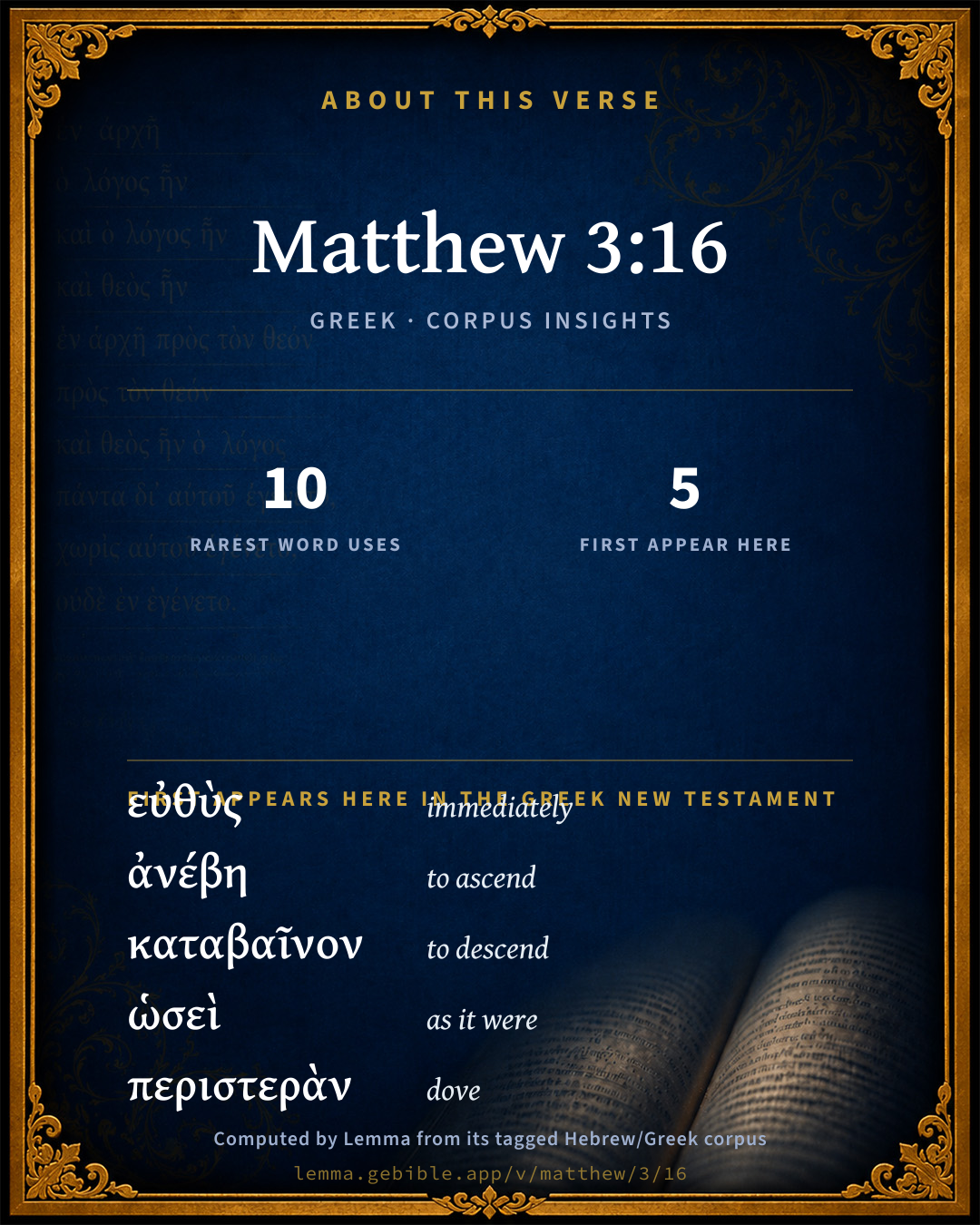
The rarest word here is περιστερὰν dove G4058 — appearing just 10 times in the whole Greek New Testament.

First appearance in Scripture

These words make their first canonical appearance in the Greek New Testament here:

  • εὐθὺς immediately G2112
  • ἀνέβη to ascend G305
  • καταβαῖνον to descend G2597
  • ὡσεὶ as it were G5616
  • περιστερὰν dove G4058

Shared distinctive vocabulary

περιστερὰν dove G4058 occurs in 10 verses of the Greek New Testament. Also found in:
Repetition

Words recur within this verse:

Cross-references

11

Topical passages linked to Matthew 3:16 in the Treasury of Scripture Knowledge — connected by theme and wording, ordered by reader-vote popularity; previews shown in the World English Bible.

  • Isaiah 11:2 The Spirit of Yahweh shall rest on him, the spirit of wisdom and understanding, the spirit of counsel and might, the spirit of knowledge and of the fear of Yahweh.
  • Mark 1:10 Immediately coming up from the water, he saw the heavens parting, and the Spirit descending on him like a dove.
  • Luke 3:21–22 Now it happened, when all the people were baptized, Jesus also had been baptized, and was praying. The sky was opened,
  • Isaiah 42:1 Behold, my servant, whom I uphold; my chosen, in whom my soul delights: I have put my Spirit on him; he will bring forth justice to the Gentiles.
  • John 1:31–34 I didn't know him, but for this reason I came baptizing in water: that he would be revealed to Israel."
  • Isaiah 61:1 The Spirit of the Lord Yahweh is on me; because Yahweh has anointed me to preach good news to the humble; he has sent me to bind up the broken-hearted, to proclaim liberty to the captives, and the opening [of the prison] to those who are bound;
  • Acts 7:56 and said, "Behold, I see the heavens opened, and the Son of Man standing at the right hand of God!"
  • Ezekiel 1:1 Now it happened in the thirtieth year, in the fourth [month], in the fifth [day] of the month, as I was among the captives by the river Chebar, that the heavens were opened, and I saw visions of God.
  • Colossians 1:18–19 He is the head of the body, the assembly, who is the beginning, the firstborn from the dead; that in all things he might have the preeminence.
  • John 3:34 For he whom God has sent speaks the words of God; for God gives the Spirit without measure.
  • Isaiah 59:21 As for me, this is my covenant with them, says Yahweh: my Spirit who is on you, and my words which I have put in your mouth, shall not depart out of your mouth, nor out of the mouth of your seed, nor out of the mouth of your seed's seed, says Yahweh, from henceforth and forever.

Cross-references courtesy of OpenBible.info (CC BY 4.0).

Commentary

Notes on Matthew 3:16 from classic Christian and Jewish commentators (each source and its license shown beneath its notes). The classic Christian expositions comment on the surrounding passage and are grouped to its opening verse, so a note may address several verses; the Jewish commentaries on the Tanakh (Rashi and others) are per-verse, so they appear only where the commentator wrote on this verse.

Lemma curates 59 commentaries, every one of them public domain or Creative Commons licensed, each selected and text-cleaned for this edition rather than reprinted as found. About our sources →

The Biblical Illustrator

Joseph S. Exell

Mat_3:16

Heavens were opened unto Him.

This great sight

1. Great in the Object.

2. Great in the Person.

3. Great in the Mysteries.

Trinity Sunday

I. The three persons in the holy trinity.

1. Jesus of Nazareth.

2. The Holy Ghost miraculously exhibited.

3. The Holy Father.

II. A vivid representation of gospel salvation.

1. Here was salvation embodied in Jesus Christ.

2. The Holy Ghost falls on Him.

3. The Holy Fathers solemn attestation of the sufficiency of Christ and His salvation.

III. The privilege of believers here confirmed in the person of Jesus Christ.

1. We view Him as our Federal Head and Representative.

2. In this capacity He received the Holy Ghost.

3. In this character the Father delighted in Him, and also in His people.

(1) What a practical view of the doctrine of the Holy Trinity.

(2) Have we a personal interest in this great work?

(3) Let the power of these truths be seen in our lives. (F. Close, M. A.)

Divine testimony to the Tri-unity of the Godhead

I. Demonstrate from Scripture the Tri-unity of the Godhead.

II. Prove Christs perfect union in the Godhead, as the true ground of Christian faith.

III. How great a blessing this glorious doctrine is for all Gods people. There may be mines of precious wealth, of minerals, gold, silver, jewels, in a domain only partially known; so with this doctrine. God the Father planned the way of redemption. God the Son willingly came to accomplish our salvation. And God the Spirit guides us into all truth. The whole Trinity joins in mans salvation.

1. How great the condescension of Jehovah thus to reveal the nature and perfections of mercy.

2. How much all revelation testifies of God the Fathers delight in His beloved Son.

3. How God is well pleased in the souls salvation by Christ. (J. G. Angley, M. A.)

Christs baptism

I. Christs submission to the ordinance of baptism.

1. Jesus humbly waits upon the Baptist. The fortitude with which to meet publicity.

2. He is privately discovered to John.

3. The Saviour meekly persists in His obedient resolution. How lovely this conflict of humility!

4. Jesus at last receives the sign from His forerunner.

II. The honours Christ received at His baptism.

1. The opening of the heavens.

2. The descent of the Spirit followed.

3. The proclamation of the Father closed the scene of wonders. (J. Bennett, D. D.)

I. Here is a declaration of the dignity and endearedness of the Saviour, My beloved Son.

1. The dignity of His Person.

2. The endearedness of the Son.

II. The fathers complacency in the son. Complacency takes place.

1. In Creation: All things were made by Him.

2. In redemption: He hath made us accepted in the beloved.

3. The Father is well pleased with Christ in His incarnation and mediation.

4. He is well pleased with Him in all His people. (H. Budd, M. A.)

Here we have

(1) the rising of the morning star, John the Baptist;

(2) The more glorious rising and shining of the Sun of Righteousness Himself;

(3) A messenger from heaven. The Spirit of Christ is a dove-like Spirit. The dove was the fowl offered in sacrifice; so Christ offered Himself without spot unto God.

(4) A voice from heaven. As the Holy Ghost manifests Himself in the likeness of a dove, so God the Father in a voice. This voice speaks Gods favour to Christ.

1. Expresses the relation He stands in to Him.

2. Expresses the affection the Father hath to Him. Observe Gods favour to us Is Him. He is My beloved Son, IN whom I am well pleased. Consider what God is out of Christ, and what God is IN Christ.

I. What God is out of Christ to the sinner.

(1) An angry God;

(2) a threatening God;

(3) a dishonoured God;

(4) a distant God.

II. What God is in Christ.

(1) A reconciled God;

(2) a promising God;

(3) a glorified God;

(4) a near God. (Ralph Erskine.)

The arithmetic of heaven

A gentleman, passing a church with Daniel Webster, asked him, How can you reconcile the doctrine of the Trinity with reason? The statesman replied by asking, Do you understand the arithmetic of heaven? The application is evident. (Anon.)

The heavens are never shut while either of the sacraments is duly administered and received; neither do the heavens ever thus open without the descent of the Holy Ghost. (Bishop Hall.)

1. The Person that did hear witness.

2. The manner how He testified to the honour of His Son.

3. The authority of that voice from heaven.

4. The Person to whom the witness is borne.

5. What is witnessed of Him in respect of Himself.

6. What is witnessed of Him in respect of our consolation, we the beloved in Him. (Hacket.)

As the Father sent His voice from heaven to earth, let our lips be full of prayers, that we may send our voice from earth to heaven. (Hacket.)

The Biblical Illustrator, edited by Joseph S. Exell (c. 1880s–1900s) — public domain. Text from a community e-Sword module.

Joseph Benson's Commentary

Mat 3:16. And Jesus, when he was baptized, &c. — Hereby he was, 1st, installed into his ministerial office, as the priests were by washing, Exo 29:4; Lev 8:6; Leviticus 2 d, engaged solemnly in the same military work with us against sin and Satan; 3d, admitted a member of the gospel Church, as he was before of the Jewish, by circumcision; 4th, he was baptized as a public person, the Head of his Church, in whom, and by virtue of whose baptism, all his members are baptized spiritually, Rom 6:4; Col 2:12. Went up straightway out of the water — Or, as the original, ανεβη απο του υδατος, rather signifies, ascended from the water, namely, went up from the banks of Jordan. The heavens were opened unto him — For his sake, appearing as if they had been rent asunder directly over his head. It is probable they might resemble that opening of the heavens which we often see in a time of great lightning, when the sky seems to divide, to make the fuller and clearer way for the lightning: although, doubtless, this was much more striking and glorious. And he saw — Christ himself saw, and also John the Baptist, as appears by Joh 1:33-34; and by this he was further confirmed that this was the very Christ: — the Spirit of God descending like a dove — Not only in a hovering, dove-like motion, but, it seems, with a bright flame, in the shape of a dove, for St. Luke says, Luk 3:22, σωματικω ειδει, ωσει περιστεραν, in a bodily shape, as a dove. See also Joh 1:32. The Holy Spirit descended upon him in this form to signify what Christ Isaiah , 1 st, in his own nature to them that come to him, meek and loving; 2d, in the execution of his office, reconciling us to the Father, and bringing us good tidings of peace and reconciliation, as the dove brought Noah tidings of the deluge being assuaged; 3d, in the operations of his Spirit upon his people, whereby they are made meek, lowly, and harmless as doves. And lighting upon him — As a visible token of a new degree of the Holy Ghost’s operation in Christ, now at his entrance upon his public employment, even of that Spirit by which, according to the intimations God had given in his word, he was anointed in a peculiar manner, and abundantly fitted for his public work. Psa 45:7; Isa 61:1. And thus was Christ installed into his ministerial function, both by baptism and the unction of the Holy Ghost, as the priests of old were by washing and anointing.

Joseph Benson's Commentary on the Old and New Testaments (1811–1818) — public domain. Text from a community e-Sword module.

Kretzmann's Popular Commentary

Paul E. Kretzmann

The occasion must needs be marked by preternatural accompaniments:

v. 16. And Jesus, when He was baptized, went up straightway out of the water; and, lo, the heavens were opened unto Him, and He saw the Spirit of God descending like a dove and lighting upon Him:

v. 17. and, lo, a voice from heaven, saying, This is My beloved Son, in whom I am well pleased.

Here was a revelation of the divine essence. As soon as Jesus had been baptized, He at once walked up the bank away from the river. His baptism had been necessary, but the miracle which was now to take place was even more important as manifesting the relationship obtaining between Him and the other persons of the Godhead. In a wonderful manner, causing a surprised exclamation in the evangelist’s narrative, the heavens were opened, a most glorious apparition, since it was an actual happening and not a vision, as in the case of Jacob, Stephen, and others, Gen 28:12; Act 7:55-56; Act 10:11. And he, John, saw the Spirit of God descending in a bodily shape like a dove upon Jesus, Joh 1:32-34; Luk 3:22. It is an idle speculation to inquire why the dove was chosen, and to find the comparison in the perfect gentleness, purity, and fullness of life of this bird. Let us rather emphasize the fact that God wanted to convey the idea of an unlimited imparting of the Holy Spirit to His Son, according to His human nature, Psa 45:8; Heb 1:9; Act 10:38. And the marvels were not yet ended. Once more Matthew calls out: Behold! God the Father is now also manifested by a voice from heaven, identifying both Him and the Son. See Isa 42:1; Psa 2:7. This man that was thus plainly distinguished and set apart from all the rest of the people there present is the true Son of God, beloved of Him in a unique sense. It is an eternal act of loving contemplation with which the. Father regards the Son. It is with the consciousness of the Father’s good pleasure, His full and unequivocal consent and blessing, that Christ enters upon His ministry. The Triune God, at the baptism of Jesus, set the seal of His approval upon the work of redemption.

Summary.In the course of John the Baptist’s ministry, during which he had occasion to administer a sharp rebuke to the Pharisees and Sadducees, Jesus also received Baptism at his hands, whereupon there occurred a marvelous revelation of the Triune God.

The Baptism Of John

When John the Baptist came into the wilderness of Judea with his message and baptism of repentance, he was not foisting upon the people a new and strange ceremony of which they had never heard. On the contrary, divers washings, many different kinds of Levitical baptisms, had been known to the Jews since the time of Moses. The rite originated in the ceremonial lustration of the unclean, Gen 35:2; Exo 19:10; Num 19:7; and was soon extended to embrace every form of Levitical purifying that was done with water, Heb 9:10.

One of the earliest forms of religious ablutions was the baptism of the priests at their consecration, Exo 29:1-9; Exo 40:12. There is an allusion to this washing of the priests in Heb 10:22. Any defilement of the body contracted by the priests after their installation, in the daily performance of their duties, especially by contact of their hands and feet with unclean things, had to be removed by washing these members when they entered the sanctuary, Exo 30:17-21; Exo 40:30-32. Two passages of the psalms refer to this custom, Psa 26:6; Psa 73:13. If an Israelite had touched the carcass of an animal or carried any part thereof, he was considered unclean and had to wash his clothes and his body. Lev 11:24-28; Lev 5:2; Lev 22:4-6. There was a baptism of those who had recovered from leprosy, Lev 13:6-34. On the great day of atonement the high priest performed very careful ablutions, both at the beginning and at the conclusion of his ministrations, Lev 16:4-24. The man who had led the scapegoat into the wilderness and likewise he who had carried forth without the camp the bullock and the goat for a sin-offering, were required to bathe their flesh in water. Lev 16:26-28. When Levites were consecrated, they were sprinkled with water. Num 8:5-7. The priest and the two laymen that had prepared the ashes of the red heifer had to bathe their flesh in water. Num 19:7-10. There were also other ceremonial washings or baptisms, with which the Jews were familiar, Lev 15:1-29; Num 1:11-22; Deu 21:1-9; Deu 23:10-11.

But the most interesting of the Jewish religious washings was the baptism of proselytes, who, after being instructed in certain parts of the Law, and having made fresh profession of their faith, were then immersed in water, after which they were considered full-fledged Israelites in all things. It is this ceremony to which the baptism of John, in its outward form was related.

Another interesting question is that concerning the difference, if any, between the baptism of John and that instituted by Christ. It must be noted, on the one hand, that there are many points of agreement. John baptized by divine command, Luk 3:2-3; Joh 1:33; Mat 21:25; Luk 7:30. His was a baptism in and with water. Mat 3:11; Mar 1:8; Luk 3:16; Joh 1:26; Joh 3:23. It was, finally, a baptism unto repentance, for the forgiveness of sins, Mar 1:4; Luk 3:3. In all these features it agreed with the Baptism of Christ.

Nevertheless, there was a difference between the baptism of John and that of Christ. When Paul came to Ephesus and found certain disciples that had merely been baptized unto John’s baptism, he baptized them in the name of the Lord Jesus, Act 19:1-16. The chief points of difference between the two baptisms are indicated in this passage. John’s baptism is consistently called a "baptism, of repentance. " It was administered to adults only, to such as confessed their sins, as had reached the age of discretion, Mat 3:6; Mar 1:5, whereas the Baptism of Christ is for all people, including the children, Act 2:39-41; Col 2:11. The Baptism of Jesus works and transmits the forgiveness of sins as a gift which has been earned; the baptism of John points forward to the winning of this precious boon through the redemption to be made through Jesus Christ. In short, the baptism of John was typical, preparatory, as was his preaching; the glorious fulfillment has come in and with Christ.

Paul E. Kretzmann, Popular Commentary of the Bible (1921–1924) — public domain. Text from a community e-Sword module.

Tyndale Open Study Notes

Tyndale Open Resources

3:16 The Spirit of God descending like a dove was anointing Jesus, through whom salvation would come. This event was like a king’s being anointed with oil at his coronation. The Holy Spirit empowered Jesus to accomplish God’s salvation and defeat Satan (see 12:18, 28). This same Spirit empowers Jesus’ followers (10:20; Acts 1:8).

Tyndale Open Study Notes — © Tyndale Open Resources, licensed CC BY-SA 4.0. Text via the HelloAO Bible API.

Bengel's Gnomon

Johann Albrecht Bengel

Mat 3:16. Ἀνέβη εὐθύς, went up immediately) There was nothing to detain Him longer. Thus also He rose immediately from the dead.—ἰδοὺ, κ.τ.λ., lo, etc.) A novel and great occurrence.—Αὐτῷ, to Him) This implies far more than if the Evangelist had said “above Him.”—οἱ οὐρανοὶ, the heavens) in the plural number.

Mat 3:16-17. Καὶ, κ.τ.λ., and, etc.) A most glorious manifestation of the Holy Trinity, and a proof of what occurs when we are baptized, since Christ was not baptized for Himself. And He received the Holy Spirit to baptize us with. See Joh 1:33.—ὡσεὶ περιστερὰν, like a dove) See Gen 8:10-11.

Bengel's Gnomon of the New Testament — English translation (T&T Clark, Edinburgh, 1860) — public domain. Text from a community e-Sword module.

Meyer's Critical & Exegetical Commentary

Heinrich August Wilhelm Meyer

Mat_3:16. Εὐθύς] which cannot belong to ἀνεῴχθ. (Maldonatus, Grotius, B. Crusius), nor can it be referred to βαπτισθείς by supposing a hyperbaton (Fritzsche); see Kühner, II. 2, p. 642. Matthew would have written, καὶ εὐθὺς βαπτισθείς. It belongs to ἀνέβη, beside which it stands: after He was baptized, He went up straightway, etc. This straightway was understood at once as a matter of course, but does not belong, however, merely to the descriptive, but to the circumstantial style of the narrative, setting forth the rapid succession (of events).

ἀνεῴχθησαν αὐτῷ οἱ οὐρανοί] designates neither a clearing up of the heavens (Paulus), nor a thunderstorm quickly discharging itself (Kuinoel, Ammon), since the poetic descriptions, as in Sil. It. i. 535 ff., are quite foreign (see Drackenborch, ad Sil. It. iii. 136; Heyne, ad Virg. Aen. iii. 198) to our simple historical narrative; as, moreover, neither in the Gospel according to the Hebrews, nor in Epiphanius, Haer. xxx. 13, nor in Justin, c. Tryph. 88,[384] is a thunderstorm meant. Only an actual parting of the heavens, out of which opening the Spirit came down, can be intended. Eze_1:1; Joh_1:51; Rev_4:1; Act_7:56; Isa_64:1.

αὐτῷ does not refer to the Baptist (Beza, Heumann, Bleek, Kern, Krabbe, de Wette, Baur), since Mat_3:16 begins a new portion of the history, in which John is no longer the subject. It refers to Jesus, and is the dative of purpose. To Him the heavens open; for it was on Him that the Spirit was to descend. Comp. Vulgate.

εἶδε] Who? not John, but Jesus, without ἐπʼ αὐτόν standing for ἘΦʼ ΑὙΤΌΝ (Kuinoel); Kühner, II. 1, p. 489 f.; Bleek on the passage. The Gospel according to the Hebrews clearly referred ΕἾΔΕ to Jesus, with which Mar_1:10 also decidedly agrees.[385]

ὡσεὶ περιστεράν] The element of comparison is interpreted by modern writers not as referring to the shape of the visibly descending Spirit, but to the manner of descent, where partly the swiftness (Fritzsche), partly the soft, gentle movement (Bleek) and activity (Neander), and the like, have been imagined as referred to. But as all the four evangelists have precisely the same comparison (Mar_1:10; Luk_3:22; Joh_1:32), which, as a mere representation of the manner of the descent, would be just as unessential as it would be an indefinite and ambiguous comparison; as, farther, Luke expressly says the Spirit descended, σωματικῷ εἴδει ὡσεὶ περιστερά, where, by the latter words, the σωματ. εἴδει is defined more precisely (comp. the Gospel according to the Hebrews in Epiphanius, Haer. xxx. 13 : εἴδε, namely, Jesus, τὸ πνεῦμα τοῦ θεοῦ τὸ ἅγιον ἐν εἴδει περιστερᾶς κατελθούσης; also Justin, c. Tr. 88),so that interpretation appears as a groundless attempt to lessen the miraculous element, and only the old explanation (Origen and the Fathers in Suicer, Thes. s.v. περιστερά, Euth. Zigabenus, Erasmus, Luther), that the form of a dove actually appeared, can be received as the correct one. So also Paulus (who, however, thought of a real dove which accidentally appeared at the time!), de Wette, Kuhn (L. J. I. p. 319), Theile (zur Biogr. Jesu, p. 48), Keim, Hilgenfeld, who compares 4 Esdr. Mat_5:26. The symbolic element of this divine σημεῖον (see remarks after Mat_3:17) rests just in its appearance in the form of a dove, which descends.

[384] In the Gospel according to the Hebrews: περιέλαμψεν τὸν τόπον φῶς μέγα. Justin. κατελθόντος τοῦ Ἰησοῦ ἐπὶ τὸ ὕδωρ καὶ πῦρ ἀνήφθη ἐν τῷ Ἰορδάνῃ.

[385] Schmidt in the Jahrb. f. D. Th. 1869, p. 655, erroneously says: If Jesus were the subject, ἐφʼ αὑτόν must necessarily have been put. See Buttmann, neut. Gr. p. 97 f. [E. T. 111 f.].

Meyer — Critical and Exegetical Commentary on the New Testament — English translation by Peter Christie, edited by Frederick Crombie (T&T Clark, 1880) — public domain. Text from a community e-Sword module.

Expositor's Greek Testament

ed. W. Robertson Nicoll

Mat 3:16-17 . The preternatural accompaniments . These have been variously viewed as meant for the people, for the Baptist, and for Jesus. In my judgment they concern Jesus principally and in the first place, and are so viewed by the evangelist. And as we are now making the acquaintance of Jesus for the first time, and desiring to know the spirit, manner, and vocation of Him whose mysterious birth has occupied our attention, we may confine our comments to this aspect. Applying the principle that to all objective supernatural experiences there are subjective psychological experiences corresponding, we can learn from the dove-like vision and the voice from heaven the thoughts which had been passing through the mind of Jesus at this critical period. These thoughts it most concerns us to know; yet it is just these thoughts that both believers and naturalistic unbelievers are in danger of overlooking; the one through regarding the objective occurrences as alone important, the other because, denying the objective element in the experience, they rush to the conclusion that there was no experience at all. Whereas the truth is that, whatever is to be said as to the objective element, the subjective at all events is real: the thoughts reflected and symbolised in the vision and the voice.

Mat 3:16 . εὐθὺς may be connected with βαπτισθεὶς , with ἀνέβη , or with ἠνεῴχθησαν in the following clause by a hyperbaton (Grotius). It is commonly and correctly taken along with ἀνέβη . But why say straightway ascended? Euthy. gives an answer which may be quoted for its quaintness: “They say that John had the people under water up to the neck till they had confessed their sins, and that Jesus having none to confess tarried not in the river”. Fritzsche laughs at the good monk, but Schanz substantially adopts his view. There might be worse explanations. καὶ ἰδοὺ ἠνεῴχθησαν , etc. When Jesus ascended out of the water the heavens opened and He (Jesus) saw the spirit of God descending as a dove coming upon Him. According to many interpreters, including many of the Fathers, the occurrence was of the nature of a vision, the appearance of a dove coming out of the heavens. ὁ εὐαγγελιστὴς οὐκ εἶπεν ὅτι ἐν φύσει περιστερᾶς , ἀλλʼ ἐν εἴδει περιστερᾶς Chrys. Dove-like: what was the point of comparison? Swift movement, according to some; soft gentle movement as it sinks down on its place of rest, according to others. The Fathers insisted on the qualities of the dove. Euthy. sums up these thus: φιλάνθρωπον γάρ ἐστι καὶ ἀνεξίκακον · ἀποστερούμενον γὰρ τῶν νεοσσῶν ὑπομένει , καὶ οὐδὲν ἧττον τοὺς ἀποστεροῦντας προσίεται . Καὶ καθαρώτατόν ἐστι , καὶ τῇ εὐωδίᾳ χαίρει . Whether the dove possesses all these qualities philanthropy, patient endurance of wrong, letting approach it those who have robbed it of its young, purity, delight in sweet smells I know not; but I appreciate the insight into the spirit of Christ which specifying such particulars in the emblematic significance of the dove implies. What is the O. T. basis of the symbol? Probably Gen 8:9-10 . Grotius hints at this without altogether adopting the view. Thus we obtain a contrast between John’s conception of the spirit and that of Jesus as reflected in the vision. For John the emblem of the spirit was the stormy wind of judgment; for Jesus the dove with the olive leaf after the judgment by water was past.

Mat 3:17 . οὗτός ἐστιν : “this is,” as if addressed to the Baptist; in Mar 1:9 , σὺ εἶ , as if addressed to Jesus. ἐν ᾧ εὐδοκ .: a Hebraism,: הָפֵץ בְּ . εὐδόκησα , aorist, either to express habitual satisfaction, after the manner of the Gnomic Aorist ( vide Hermann’s Viger , p. 169), or to denote the inner event = my good pleasure decided itself once for all for Him. So Schanz; cf. Winer, § 40, 5, on the use of the aorist. εὐδοκεῖν , according to Sturz, De Dialecto Macedonica et Alexandrina , is not Attic but Hellenistic. The voice recalls and in some measure echoes Isa 42:1 , “Behold My servant, I uphold Him; My chosen one, My soul delights in Him. I have put My spirit upon Him.” The title “Son” recalls Psa 2:7 . Taking the vision, the voice, and the baptism together as interpreting the consciousness of Jesus before and at this time, the following inferences are suggested. (1) The mind of Jesus had been exercised in thought upon the Messianic vocation in relation to His own future. (2) The chief Messianic charism appeared to Him to be sympathy, love. (3) His religious attitude towards God was that of a Son towards a Father. (4) It was through the sense of sonship and the intense love to men that was in His heart that He discovered His Messianic vocation. (5) Prophetic texts gave direction to and supplied means of expression for His religious meditations. His mind, like that of John, was full of prophetic utterances, but a different class of oracles had attractions for Him. The spirit of John revelled in images of awe and terror. The gentler spirit of Jesus delighted in words depicting the ideal servant of God as clothed with meekness, patience, wisdom, and love.

The Expositor's Greek Testament, edited by W. Robertson Nicoll (1897–1910) — public domain. Text from a community e-Sword module.

Geneva Bible (1599)

Geneva Bible translators

To John.

Geneva Bible (1599) marginal notes — public domain. Text via Bolls.life.

Jamieson, Fausset & Brown

Robert Jamieson, A. R. Fausset & David Brown

And Jesus when he was baptized, went up straightway out of the water--rather, "from the water." Mark has "out of the water" (Mar 1:10). "and"--adds Luke (Luk 3:21), "while He was praying"; a grand piece of information. Can there be a doubt about the burden of that prayer; a prayer sent up, probably, while yet in the water--His blessed head suffused with the baptismal element; a prayer continued likely as He stepped out of the stream, and again stood upon the dry ground; the work before Him, the needed and expected Spirit to rest upon Him for it, and the glory He would then put upon the Father that sent Him--would not these fill His breast, and find silent vent in such form as this?--"Lo, I come; I delight to do Thy will, O God. Father, glorify Thy name. Show Me a token for good. Let the Spirit of the Lord God come upon Me, and I will preach the Gospel to the poor, and heal the broken-hearted, and send forth judgment unto victory." While He was yet speaking--

lo, the heavens were opened--Mark says, sublimely, "He saw the heavens cleaving" (Mar 1:10).

and he saw the Spirit of God descending--that is, He only, with the exception of His honored servant, as he tells us himself (Joh 1:32-34); the by-standers apparently seeing nothing.

like a dove, and lighting upon him--Luke says, "in a bodily shape" (Luk 3:22); that is, the blessed Spirit, assuming the corporeal form of a dove, descended thus upon His sacred head. But why in this form? The Scripture use of this emblem will be our best guide here. "My dove, my undefiled is one," says the Song of Solomon (Sol 6:9). This is chaste purity. Again, "Be ye harmless as doves," says Christ Himself (Mat 10:16). This is the same thing, in the form of inoffensiveness towards men. "A conscience void of offense toward God and toward men" (Act 24:16) expresses both. Further, when we read in the Song of Solomon (Sol 2:14), "O my dove, that art in the clefts of the rocks, in the secret places of the stairs (see Isa 60:8), let me see thy countenance, let me hear thy voice; for sweet is thy voice, and thy countenance is comely"--it is shrinking modesty, meekness, gentleness, that is thus charmingly depicted. In a word--not to allude to the historical emblem of the dove that flew back to the ark, bearing in its mouth the olive leaf of peace (Gen 8:11) --when we read (Psa 68:13), "Ye shall be as the wings of a dove covered with silver, and her feathers with yellow gold," it is beauteousness that is thus held forth. And was not such that "holy, harmless, undefiled One," the "separate from sinners?" "Thou art fairer than the children of men; grace is poured into Thy lips; therefore God hath blessed Thee for ever!" But the fourth Gospel gives us one more piece of information here, on the authority of one who saw and testified of it: "John bare record, saying, I saw the Spirit descending from heaven like a dove, and IT ABODE UPON HIM." And lest we should think that this was an accidental thing, he adds that this last particular was expressly given him as part of the sign by which he was to recognize and identify Him as the Son of God: "And I knew Him not: but He that sent me to baptize with water, the same said unto me, Upon whom thou shalt see the Spirit descending AND REMAINING ON HIM, the same is He which baptizeth with the Holy Ghost. And I saw and bare record that this is the Son of God" (Joh 1:32-34). And when with this we compare the predicted descent of the Spirit upon Messiah (Isa 11:2), "And the Spirit of the Lord shall rest upon Him," we cannot doubt that it was this permanent and perfect resting of the Holy Ghost upon the Son of God--now and henceforward in His official capacity--that was here visibly manifested.

Jamieson, Fausset & Brown — Commentary Critical and Explanatory on the Whole Bible (1871) — public domain (CC PDM 1.0). Text via the HelloAO Bible API.

Adam Clarke's Commentary

Verse 16. The heavens were opened unto him] That is, to John the Baptist - and he, John, saw the Spirit of God - lighting upon him, i.e. Jesus. There has been some controversy about the manner and form in which the Spirit of God rendered itself visible on this occasion. St. Luke, Lu 3:22, says it was in a bodily shape like to a dove: and this likeness to a dove some refer to a hovering motion, like to that of a dove, and not to the form of the dove itself: but the terms of the text are too precise to admit of this far-fetched interpretation.

This passage affords no mean proof of the doctrine of the Trinity. That three distinct persons are here, represented, there can be no dispute.

1. The person of Jesus Christ, baptized by John in Jordan.

2. The person of the Holy Ghost in a bodily shape, (σωματικω ειδει, Lu 3:22) like a dove.

3. The person of the Father; a voice came out of heaven, saying, This is my beloved Son, c.

The voice is here represented as proceeding from a different place to that in which the persons of the Son and Holy Spirit were manifested and merely, I think, more forcibly to mark this Divine personality.

Adam Clarke's Commentary on the Bible (1810–1826) — public domain. Text from a community e-Sword/MySword module.

Ellicott's Commentary for English Readers

(16) The heavens were opened.—The narrative implies (1) that our Lord and the Baptist were either alone, or that they alone saw what is recorded. “The heavens were opened to him” as they were to Stephen (Act_7:56). The Baptist bears record that he too beheld the Spirit descending (Joh_1:33-34), but there is not the slightest ground for supposing that there was any manifestation to others. So in the vision near Damascus, St. Paul only heard the words and saw the form of Him who spake them (Act_9:7; Act_22:9). That which they did see served, as did the tongues of fire on the day of Pentecost, as an attestation to the consciousness of each, of the reality of the gift imparted, and of its essential character. That descent of the Spirit, “as it were a dove,” as St. Luke adds (Luk_3:22), “in bodily form,” taught the Baptist, as it teaches us, that the gift of supernatural power and wisdom brought with it also the perfection of the tenderness, the purity, the gentleness of which the dove was the acknowledged symbol. To be “harmless as doves” was the command the Lord gave to His disciples (Mat_10:16), and when they read this record, they were taught as we are, “of what manner of spirit” they were meant to be.

A Bible Commentary for English Readers, edited by Charles John Ellicott (1878–1897) — public domain. Text from a community e-Sword module.

The Cambridge Bible for Schools and Colleges

gen. ed. J. J. S. Perowne

16. the heavens] A literal translation of the Hebrew word, which is a plural form.

he [Jesus] saw] We should infer from the text that the vision was to Jesus alone, but the Baptist also was a witness as we learn from Joh_1:32. “And John bare record, I saw the Spirit descending from heaven like a dove, and it abode upon him.” This was to John the sign by which the Messiah should be recognised.

The Cambridge Bible for Schools and Colleges (gen. ed. J. J. S. Perowne; Cambridge University Press, 1878–1918) — public domain. Text from a community e-Sword module.

John Gill's Exposition

And Jesus, when he was baptized,.... Christ, when he was baptized by John in the river Jordan, the place where he was baptizing,

went up straightway out of the water. One would be at a loss at first sight for a reason why the Evangelist should relate this circumstance; for after the ordinance was administered, why should he stay in the water? what should he do there? Everyone would naturally and reasonably conclude, without the mention of such a circumstance, that as soon as his baptism was over, he would immediately come up out of the water. However, we learn this from it, that since it is said, that he came up out of the water, he must first have gone down into it; must have been in it, and was baptized in it; a circumstance strongly in favour of baptism by immersion: for that Christ should go down into the river, more or less deep, to the ankles, or up to the knees, in order that John should sprinkle water on his face, or pour it on his head, as is ridiculously represented in the prints, can hardly obtain any credit with persons of thought and sense. But the chief view of the Evangelist in relating this circumstance, is with respect to what follows; and to show, that as soon as Christ was baptized, and before he had well got out of the water,

lo the heavens were opened: and some indeed read the word "straightway", in connection with this phrase, and not with the words "went up": but there is no need of supposing such a trajection, for the whole may be rendered thus;

and Jesus, when he was baptized, was scarcely come up out of the water, but lo, immediately, directly, as soon as he was out, or rather before,

the heavens were opened to him; the airy heaven was materially and really opened, parted, rent, or cloven asunder, as in Mar 1:10 which made way for the visible descent of the Holy Ghost in a bodily shape. A difficulty arises here, whether the words, "to him", are to be referred to Christ, or to John; no doubt but the opening of the heavens was seen by them both: but to me it seems that John is particularly designed, since this vision was upon his account, and for his sake, and to him the following words belong; "and he", that is,

John, saw the Spirit of God descending like a dove, and lighting upon him: for this is what was promised to John, as a sign, which should confirm his faith in Jesus, as the true Messiah, and which he himself says he saw, and upon which he based the record and testimony he bore to Christ, as the Son of God; see Joh 1:32 not but that the descent of the Holy Ghost in this manner might be seen by Christ, as well as John, according to Mar 1:10. The Spirit of God, here said to descend and light on Christ, is the same, which in the first creation moved upon the face of the waters; and now comes down on Christ, just as he was coming up out of the waters of Jordan, where he had been baptized; and which the Jews (r) so often call , "the Spirit of the king Messiah, and the spirit of the Messiah". The descent of him was in a "bodily shape", as Luke says in Luk 3:22 either in the shape of a dove, which is a very fit emblem of the Spirit of God who descended, and the fruits thereof, such as simplicity, meekness, love, &c. and also of the dove-like innocence, humility, and affection of Christ, on whom he lighted; or it was in some other visible form, not expressed, which pretty much resembled the hovering and lighting of a dove upon anything: for it does not necessarily follow from any of the accounts the Evangelists give of this matter, that the holy Spirit assumed, or appeared in, the form of a dove; only that his visible descent and lighting on Christ was , as a dove descends, hovers and lights; which does not necessarily design the form of the creature, but the manner of its motion. However, who can read this account without thinking of Noah's dove, which brought in its mouth the olive leaf, a token of peace and reconciliation, when the waters were abated from off the earth? Give me leave to transcribe a passage I have met with in the book of Zohar (s);

"a door shall be opened, and out of it shall come forth the dove which Noah sent out in the days of the flood, as it is written, "and he sent forth the dove", that famous dove; but the ancients speak not of it, for they knew not what it was, only from whence it came, and did its message; as it is written, "it returned not again unto him any more": no man knows whither it went, but it returned to its place, and was hid within this door; and it shall take a crown in its mouth, and put it upon the head of the king Messiah.''

And a little after, the dove is said to abide upon his head, and he to receive glory from it. Whether this is the remains of some ancient tradition, these men studiously conceal, concerning the opening of the heavens, and the descent of the Spirit of God, as a dove, upon the Messiah; or whether it is hammered out of the evangelic history, let the reader judge.

(r) Bereshit Rabba, fol. 2. 4. & 6. 3. Vajikra Rabba, fol. 156. 4. Zohar in Gen. fol. 107. 3. & 128. 3. Baal Hatturim in Gen. i. 2. Caphtor Uperah, fol. 113. 2. (s) In Num. fol. 68. 3, 4.

John Gill's Exposition of the Whole Bible (1746–1763) — public domain (CC PDM 1.0). Text via the HelloAO Bible API.

Trapp's Complete Commentary

John Trapp

16 And Jesus, when he was baptized, went up straightway out of the water: and, lo, the heavens were opened unto him, and he saw the Spirit of God descending like a dove, and lighting upon him:

Ver. 16. And Jesus when he was baptized] Many of the ancients held that the day of Epiphany was the day of our Saviour’s baptism. But that, I think, is but a conjecture. The Habassines, a kind of mongrel Christians in Africa, baptize themselves every year on that day in lakes or ponds; thereby to keep a memorial of our Saviour’s baptism in Jordan. This is (as Tyndal was wont to say of a like matter) to pass by the provision, and lick the sign post.

Went up straightway out of the water] And stood upon the shore, apart from the company, that all might see and hear what was now to be done. St Luke addeth, {Luk 3:21} that he fell there upon his knees and prayed; thereby teaching us, with what deep devotion we are to receive the sacraments, which are given us of God to signify, as by sign; to assure, as by seal; and to convey, as by instrument, Jesus Christ and all his benefits. The Father, Son, and Holy Ghost are there one in covenanting and working thy salvation. Stir up thyself therefore to hope and faith at the sacrament: speak to thy faith, as Deborah did to herself, Jdg 5:12; "Awake, awake, Deborah, utter a song:" give glory to God, lay claim to the covenant: lean on Christ’s bosom at that supper, and bethink thyself, with Esther at the feast, what suit thou hast to commence, what Haman to hang up, what lust to subdue, what grace (chiefly) to get growth in, &c. But for most communicants, urge them to prayer before, in, and after sacrament, and they must say (if they say truly), as David did of Saul’s armour, I cannot go with these, for I have not been accustomed to them, 1Sa 17:39.

And, lo, the heavens were opened unto him] As he was praying; for prayer is the key of heaven, wherewith we may take out of God’s treasury plentiful mercy for ourselves and others. He cannot possibly be poor that can pray, Rom 10:12. One said of the Pope, that he could never want money so long as he could hold a pen in his hand: of the faithful Christian it may safely be affirmed, he cannot want any good thing while he can call to God for it. If he can find a praying heart, God will find a pitying heart and a supplying hand. Now he is worthily miserable that will not make himself happy by asking. The ark and the mercy seat were never separated. God never said to Israel, "Seek ye me in vain," Isa 45:19. The hand of faith never knocked at heaven’s gates, but they were opened, and the Spirit descended, though not so visibly as here at the baptism of our Saviour, nor a voice heard so audibly from heaven as then, yet as truly and effectually to the support of the poor suppliant: who while he prayeth in the Holy Ghost, Jdg 1:20, receiveth new supplies of the Spirit, {επιχορηγια, Php 1:19; Eph 4:16} and is sweetly, but secretly, sealed up thereby to the day of redemption.

And he saw the Spirit of God descending] From the Father (who spake from the most excellent glory, 2Pe 1:17) upon the Son, who stood upon the shore, so that here was concilium augustissimum, a most majestical meeting of the three persons in Trinity, about the work of man’s redemption, as once about his creation: Gen 1:26; "Let us make man." The Hebrews interpret it, "I and my judgment hall;" by which phrase the Trinity of old was implied. For a judgment hall in Israel consisted of three at least; which, in their close manner of speech, they applied to God, but their posterity understood it not. And as in the matter of man’s creation and redemption, so likewise of his sanctification, remarkable is that of the apostle, 1Co 12:4-7, where the diversities of gifts are said to be of the Spirit; the diversities of ministries (whereby these gifts are administered) of the Lord, that is, of Christ; and the diversities of operations (effected by the gifts and ministries) to be of God the Father.

Like a dove, and lighting upon him] This was shadowed of old, by Noah’s dove lighting upon the ark; and serveth to denote Christ’s innocence, purity, love to his little ones, κυουσι γαρ αλληλας, saith Aristotle; {a} and another thus:-

" Felle columba caret, rostro non caedit, et ungues

Possidet innocuos puraque grana legit."

That was more than ridiculous, nay, it was blasphemous, that those pilgrims that went to Jerusalem to fight in the Holy War (as they called it) did carry a goose before them, pretending it to be the Holy Ghost. These were drunk with the wine of the whore of Babylon’s abominations; and not filled with the Spirit, as St Stephen was, and Barnabas, and others of old; as of late, among many, that famous Beza, de quo collegae saepe dicebant, eum sine felle vivere. And himself reports of himself and his colleagues, in an epistle to Calvin, that, disputing with a Spanish Jesuit about the Eucharist, "the Jesuit" (saith he) "called us vulpes, et simias, et serpentes (foxes, apes, serpents). My answer was this, Non magis nos credere, quam transubstantiationem." To not greatly believe us than transubstantiation. So that angel John Bradford (as one calleth him), when he reasoned with Alphonsus a Castro; the friar was in a wonderful rage, and spake so high that the whole house rang again, chafing with om and cho, saith Mr Fox. But Bradford answered him with meekness of wisdom, and, like the waters of Shiloah at the foot of Sion, ran softly, Isa 8:6. He had been baptized with that Holy Ghost that descended upon our Saviour, who received not the Spirit by measure, but had a fulness, not of abundance only, but also of redundance, Joh 1:14.

{a} περιστερα, παρα, του περισσως εραν. Herdfield.

John Trapp, A Commentary or Exposition upon All the Books of the Old and New Testament (1647–1656) — public domain. Text from a community e-Sword module.

Albert Barnes' Notes on the Bible

Out of the water - This shows that he had descended to the river. It literally means, “he went up directly from the water.” The original does not imply that they had descended into the river, and it cannot be proved, therefore, from this passage, that his baptism was by immersion; nor can it be proved that even, if his baptism was by immersion, that therefore the same mode is binding on people now. In order to demonstrate from this passage that immersion is essential, it is necessary to demonstrate:

(a) that he went into the river;

(b) that, being there, he was wholly immersed;

(c) that the fact that he was immersed, if he was, proves that all others must be, in order that there could be a valid baptism.

Neither of these three things has ever been demonstrated from this passage, nor can they be.

The heavens were opened unto him - This was done while he was praying, Luk 3:21. The ordinances of religion will be commonly ineffectual without prayer. If in those ordinances we look to God, we may expect that he will bless us; the heavens will be opened, light will shine upon our path, and we shall meet with the approbation of God. The expression, “the heavens were opened,” is one that commonly denotes the appearance of the clouds when it lightens. The heavens appear to open or give way. Something of this kind probably appeared to John at this time. The same appearance took place at Stephen’s death, Act 7:56. The expression means that he was permitted to see far into the heavens beyond what the natural vision would allow.

To him - Some have referred this to Jesus, others to John. It probably refers to John. See Joh 1:33. It was a testimony given to John that this was the Messiah.

He saw - John saw.

The Spirit of God - See Mat 3:11. This was the third person of the Trinity, descending upon him in the form of a dove, Luk 3:22. The dove, among the Jews, was the symbol of purity of heart, harmlessness, and gentleness, Mat 10:16; compare Psa 55:6-7. The form chosen here was doubtless an emblem of the innocence, meekness, and tenderness of the Saviour. The gift of the Holy Spirit, in this manner, was the public approbation of Jesus Joh 1:33, and a sign of his being set apart to the office of the Messiah. We are not to suppose that there was any change done in the moral character of Jesus, but only that he was publicly set apart to his work, and solemnly approved by God in the office to which he was appointed.

Albert Barnes' Notes on the Bible (1834–1885) — public domain. Text from a community e-Sword/MySword module.

Haydock's Catholic Bible Commentary

He . . . went up, &c. Christ was in the river when he was baptized. As soon as he went out, and was praying, says St. Luke, (iii. 21,) the heavens were opened to him, or in favour of him; and he saw the Spirit of God descending: i.e. Christ himself saw the shape of the dove, which was also seen by the Baptist, as we find, John i. 33. And it was perhaps seen by all that were present. --- As a dove, or like a dove in a bodily shape. The dove was an emblem of Christ’s meekness and innocence. (Witham) --- Calmet supposes that it was St. John that saw the Spirit of God descend thus upon Jesus Christ. The Greek text is favourable to this interpretation. But the Vulgate supposes it was Jesus Christ himself. St. John declares that he saw the Spirit; (John i. 32,) but this apparent disagreement is easily cleared, by supposing that both saw the shape of the dove, and also the surrounding crowd, and that they all heard the voice of the Father, as it was heard by the disciples in the transfiguration on Mount Thabor, (chap. xvii,) and by the crowd in the temple. John xii. (Tirinus)

George Leo Haydock (1774–1849), Haydock's Catholic Family Bible and Commentary, 1859 edition — public domain. Excludes Psalms (Douay-Rheims chapter numbering differs from Protestant) and Deuterocanonical books (Catholic canon only).

Matthew Poole's English Annotations

This story is also related Mar 1:10,11; Lu 3:21. Luke saith that Jesus praying, the heaven was opened. Mark saith, cloven asunder. It is most probable that the opening of the heavens mentioned (though possibly far more glorious) bare a proportion to that opening of the heavens which we often see in a time of great lightning, when the air seemeth to divide to make the fuller and clearer way for the light.

Unto him; that is, unto John.

And he saw the Spirit of God descending like a dove, and lighting upon him. The Spirit of God is an invisible substance, and cannot be seen by human eyes, but the shape assumed by any person of the Trinity may be seen. Whether it was a real dove, or only the appearance of a dove, is little material for us to know. It was certainly one or the other; nor could any representation at this time be more fit, either to let the world know the dove like nature of Christ, Isa 42:2, or what should be the temper of all those who receive the same Spirit, though by measure, and are by it taught to be innocent as doves. Not that Christ had not received the Spirit before, but that his receiving of it might be notified to others. This dove, or appearance of a dove, lighted upon Christ, thereby showing for whose sake this apparition was. Christ was not confirmed only to be the Son of God by this appearance of the Holy Spirit in the form of a dove, and lighting upon him, but also by a voice from the excellent glory, saith Peter, 2Pe 1:17; God forming a voice in the air which spake, saying,

This is my beloved Son, in whom I am well pleased. The word signifieth, a dearly beloved Son. The same voice was repeated at Christ’s transfiguration, Mat 17:5. Peter from it concludes the certainty of the faith of the gospel, in the aforementioned text.

In whom I am well pleased: the word signifieth a special and singular complacency and satisfaction: I am pleased in his person, according to that, Pro 8:30; I am well pleased in his undertaking, in all that he shall do and suffer in the accomplishment of the redemption of man. We are made accepted in the Beloved, Eph 1:6. This text (as is generally observed) is a clear proof of the trinity of persons or subsistences in the one Divine Being: here was the Father speaking from heaven, the Son baptized and come out of the water, the Holy Ghost descending in the form or shape of a dove.

Matthew Poole's English Annotations on the Holy Bible (1683–1685) — public domain. Text from a community e-Sword/MySword module.

Whedon's Commentary on the Bible

Daniel D. Whedon

16. Baptized — How he was baptized is not said. His coming out of the water aids us not in guessing how, for the preposition properly signifies from. Nor if Jesus waded into and out of the water, would it in the least aid the matter. Thousands in ancient and modern times have been baptized by affusion, as they are represented in ancient pictures, standing or kneeling in the bed of a stream. But at any rate, the mode of his baptism was such as to make it the symbol and picture of the spiritual baptism which forthwith descended upon him in dovelike form.

And he saw — That is, Jesus saw the dovelike Spirit. And John says that he saw it Joh_1:32. There is no proof for the opinion of some that it was unseen by many others. Like a dove — That is, in a dovelike shape, as Luke beyond all equivocation declares — in a bodily shape like a dove. That is, the Spirit invested itself with a dove form, in order to make itself visible to their senses. It assumed the form of a dove, as that bird was to the minds of those spectators the emblem of innocence. We cannot understand the purpose of commentators who endeavour to mar the beauty of this gracious manifestation by talking of its not being a dovelike form, but forsooth a quivering motion, (of what?) like a dove!

And here have we not a striking illustration of the Incarnation? As the Holy Spirit the third hypostasis in the Trinity, assumes the bodily form of a dove by way of self-manifestation to the eyes of men, so what difficulty in supposing that the second person of the Trinity should become God manifest in the flesh in a human form? So, many a time in the Old Testament, the angel of Jehovah, or rather the angel-Jehovah, being no other than Jehovah manifest, is described as appearing to the patriarchs. In Eden Jehovah-God walked in the garden, and pronounced sentence upon Adam. Jacob wrestled with God “face to face” at Peniel. The angel-Jehovah appeared to Moses, and said, “I am the God of thy Father.” And revealing his name, to be uttered to Pharaoh, he says: “Thus shalt thou say, I AM hath sent me unto you.” The most learned doctors in the Church, in all ages, have agreed, and that on most reliable ground, that this personage so at various times appearing, was no other than the Son of Man, seen at last in vision by Daniel, (chap. 7,) invested with “an everlasting dominion, which shall not pass away.” Few persons, at any rate, feel any difficulty in supposing, or at least comprehending and conceiving, that these angelic forms were visible embodiments of the person of Jehovah. What greater difficulty is there in conceiving that the person of Jesus should have been as truly the visible representative manifestation, or embodiment, of the same Divine Being?

Daniel D. Whedon (gen. ed.), Commentary on the Old and New Testaments (1874–1909) — public domain. Text from a community e-Sword module.

The Pulpit Commentary

And Jesus, when he was baptized. Combining the statements of the synoptists, we may conclude that Jesus went up from the water at once, praying as he went, and that, while he was going up and praying, the heavens opened. Out of; from "(Revised Version); apo ; for, as it seems, he had not gone fully out of the water. The heavens were opened unto him. So also the Revised Version, but the Revised Version margin, with Westcott and Herr, rightly omits "unto him." The words were inserted because it was thought that Jesus alone saw the manifestation, as indeed we should have supposed if we had had only the account of St. Mark, who reads, "he saw" before "the heavens being rent asunder". (but of Joh_1:32-34) To our Lord and to the Baptist the appearance was as though the sky really opened. (cf. Eze_1:1 Act_7:56) The Spirit of God; recalling Gen_1:2. "Messiah now enters on his public office, and for that receives, as true Man, the appropriate gifts. The Spirit by whom men are sub jectively united to God descends upon the Word made Flesh, by whom objectively God is revealed to men". (Bishop Westcott, on Joh_1:32) Like; as (Revised Version). The comparison is hardly to the gentleness of the descent of a dove, but to a visible appearance in bodily form, as a dove (see parallel passage in Luke). Not, of course, that the Holy Spirit was thus at all incarnate, but that either the appearance of a dove was seen by John"s eyes only (cf. especially Theodore of Mopsuestia, in Meyer), or, as is not unlikely (even though the suggestion belongs ultimately to Paulus), a dove really flew down and lighted on the Lord (Luke), and that this, to outsiders merely a curious incident, (cf. Joh_12:29) was to our Lord and the Baptist a sign of spiritual blessing. A dove (peristera); any member of the pigeon tribe; chosen because a symbol of deliverance, (Gen_8:8) of purity, (Lev_5:7) of harmlessness, (Mat_10:16) and of endearment. (Son_6:9) There is no evidence (cf. Edersheim, "Life," 1:287) that the dove was at this period interpreted by Jews as a symbol of the Holy Spirit. The Targum on Son_2:12 paraphrasing "the voice of the turtle-dove" by "the voice of the Holy Spirit," dates in its present form from the eighth to the tenth century. The dove mentioned (though probably by interpolation) in the account of Polycarp"s death, appears to be a symbol of the soul (cf. Bishop Lightfoot). Wichelhaus (as quoted by Kubel) says suggestively, "lamb and dove no kingdom in the world has these emblems on its escutcheon." And; omit, with manuscripts. Lighting; coming (Revised Version), because it is needless to translate a common Greek (ercomenon) by a rare English word. Observe that it refers to the Holy Spirit, not to the dove as such. Upon him. (so Luke and Joh_1:32, Joh_1:33; Mark more vaguely, "unto him

Vers. 16, 17. The heavenly attestation of the Sonship of Jesus.

The singular and thrilling event recorded in these verses is recorded also by St. Markand (Mar_1:9-11) by St. Luke (Luk_3:21, Luk_3:22) in an equally full manner, while it is distinctly alluded to by St. John. (Joh_1:32, Joh_1:33) It is remarkable that, though nothing is said either way, we are left to conclude that the vision was confined to the two only Jesus himself and John the Baptist. From that time John, who had personally long known Jesus, knew him for certain as the Messiah; and not only heralded the Christ, but could point to him as the Christ. (Joh_1:29, Joh_1:30) Notice

I THE CRISIS AT WHICH THIS GLORIOUS ATTESTATION OCCURRED. The first profound act of public, spontaneous self-humiliation is alighted upon by the visit of a supernatural glorification. Immediately the act of baptism was over, the heavens opened, the Dove sped down, the voice of the Majesty himself of all the universe uttered itself forth, and glory was poured on Jesus.

II THE CONSTITUENT PARTS OF IT.

1. The "heavens opened." We are certainly entitled by Scripture warrant, to say the least, in order to help our weaker understanding and thought, to consider heaven as a place, that place being the abode of God. These helps to human imaginings of the Unknown will not discredit our faith in the Divine omnipresence and in the fact that he is perfect Spirit; but they are needful to our present limitations of apprehension of the dim, vast, uncomprehended.

2. The Spirit descended, and in the form of a dove. No doubt it was now that an enormous accession of the Spirit was made to the human nature of Jesus Christ, And the "bodily form" of the dove was to betoken alike the soft flight and that tenderest gentleness of the Spirit, and the peace and love of him who was now more fully replenished with the Spirit.

3. A voice from heaven speaks. It is here said "a" voice. But the words spoken prove that it was none less than the voice of Heaven, the voice of the majesty of the Father, of the GloryGod himself!

a. Great is the impression of voice.

b. Great may be the absolute charm of voice.

c. Great beside all else is the fixed, distinct certainty of voice, as e.g. compared with vision or with imagination.

God speaks in all creation with ten thousand voices, it is true. But when he speaks with that voice which utters words, the ear hears as in its own right. The words uttered by the voice of God assert

(a) the Sonship of Jesus;

(b) that he is the object of the Father"s unqualified complacence; and

(c) because flint might be the complacence of feeling chiefly, by the analogy of human relationship, the voice asserts the Father"s perfect approbation as well.

III THE GREAT OBJECT OF THIS ATTESTATION. It appears to have been vouchsafed for the absolute warranting of the faith of John the Baptist. The simplicity, and what should seem in some light the narrowness, of this object invest it to a very large extent with its greatness.

1. What a testimony of condescending graciousness to that one man! He is to live for Christ, to work for Christ, to die for Christ. And to furnish him with exactly the enough satisfaction of evidence, faith, growing into knowledge, all the grandest apparatus of Heaven is brought into use!

2. What a testimony of real consideration to the world! Is a great trust committed to earthly vessels? Is it a trust of critical and tremendous responsibility? Are men, not angels, the ministers of truth, of life, of salvation to their fellow-men, in the name of Christ? Then alike it is mercy for those who are to be blessed, as for those who are to bless, that into these latter, though they should stand but one by one, and follow one another in narrowest line of succession, the whole force of absolute conviction should be thrown by Heaven"s and God"s own most approved methods. On this occasion we cannot doubt Jesus himself was refreshed with the vision of open heaven, with the alighting on him of the holy Dove, with the voice of the Father, and the words that voice spoke. But, in that John was the witness, and presumably the only witness hereof, the significance can be but one; and it is plain and most striking. B.

Vers. 16, 17. The baptism of Jesus by the Holy Ghost.

After receiving John"s baptism, Jesus "went up straightway from the water." He did not remain to make confession of sin, and for the obvious reason that he had none. He went up "from the water," or ascended the outer hank of the Jordan; for John appears to have ministered his baptism within the double bank of that river. Then "lo, the heavens were opened unto him," etc. An interval is here clearly marked between the baptism of John and that of the Holy Ghost, to show that the baptisms are distinct. The latter was the true baptism of Jesus.

I THE SCENE MANIFESTED THE BLESSED TRINITY.

1. Here is Jesus, declared to be the Son of God.

a. This is a Messianic title cited. (see Psa_2:7; also 2Sa_7:14 Heb_1:5; and Luk_1:35)

b. It does not appear to be used to set forth the pre-existence of Jesus. It is even remarkable that John, when speaking of that preexistence, uses the title "Word;" but when he comes to treat of the Incarnation, then he uses this title. (Joh_1:1-14)

c. Nevertheless, as a title of the Incarnation, it expresses the Divinity of Christ. It sets forth Messiah as of the same nature with the Father. (see Mat_26:63-65 Joh_1:18 Joh_5:18 Joh_10:36 Joh_19:7 Rom_1:3, 4 Heb 1)

2. He is so declared by the voice of the Father.

(1) This voice was probably like thunder. (cf. Joh_12:29; also Job_40:9 Job_37:4, 5 Psa_18:13 Psa_29:3, Psa_29:4)

(2) Yet was it distinct from thunder, for it came in articulate phrase. It was therefore supernatural. It resembled the voice in which the Lord spake to Moses or answered the high priests who consulted him by the Urim and Thummim.

(3) The vision of the Father is reserved for the heavenly state. The angels do there continually enjoy it. (see Mat_18:10 Luk_1:19; cf. Est_1:14) Hitherto man has not seen the Father. (see Deu_4:12Jo Deu_1:18) The sonship of man will be revealed in the resurrection; then will also be revealed the Fatherhood of God. We hear of these things now by the hearing of the ear; the eye shall see them then. (Rom_8:19)

3. The Spirit of the Father rests upon the Son.

(1) It came from the cloven heavens from the "excellent glory." It was "the Spirit of glory and of God.

(2) It came as a dove. The stream of glory hovered as a dove hovers before it alights, and then rested upon him. Possibly also in the very form of a dove. In either case it was supernatural.

(3) "It abode upon him". (Joh_1:32-34) The gift of the Spirit as a Spirit of wisdom and power is to be distinguished from the indwelling of the same Spirit as a Spirit of holiness. The apostles are repeatedly said to be "filled with the Holy Ghost;" but of Jesus it is said once for all that he was "fall of the Holy Ghost". (Luk_4:1)

(4) Out of his fulness we receive the measures of grace. (Joh_1:16 Joh_3:34, Joh_3:35)

II THE BAPTISM INTRODUCED JESUS INTO HIS PROPHETIC OFFICE.

1. As to the fact

(1) This is certified by Luke, who, after describing the baptism of Jesus, adds this note: "And Jesus himself, when he began to teach, was about thirty years of age". (Luk_3:23)

(2) It is also evident from the event. For immediately after his baptism Jesus was driven into the wilderness. There he engaged in conflict with Satan; and after forty days he entered a synagogue and opened his commission in these words: "The Spirit of the Lord is upon me, because he hath anointed me to preach. To-day is this Scripture fulfilled in your ears". (Luk_4:18-21)

(3) He had his commission in the voice. God spake in oh! time by the prophets. The Baptist was the last and greatest of these. "This is my Son." He now calls attention to the mission and teaching of Jesus. (cf. Mat_17:5)

2. As to the form.

(1) The Spirit of God came upon him. This is the indispensable qualification. When he descends upon the preacher, the light of heaven comes into his soul. Without the Spirit of God there can be no effective spiritual teaching.

(2) It came upon him as a dove. The Holy Spirit came upon the apostles in tongues or flames, of fire. There was something to he purged in them. Christ had nothing that needed cleansing. The dove is the emblem of innocence, purity, and meekness. (see Isa_42:1, Isa_42:2) These qualities should be sought and cultivated by all preachers. (cf. Mat_10:16)

3. As to the effect.

(1) It was illuminating. The glory streaming from the opened heavens was the symbol and sign of spiritual illumination.

(2) It was miracle-working. To the qualification of his baptism his doctrine and miracles are ascribed. (see Isa_11:2 Isa_42:1 Mat_12:28 Joh_3:34 Act_10:37, Act_10:38)

(3) All God"s people have the Spirit of sanctification. Special gifts are specially given.

III THIS BAPTISM WAS THE FIRST ACT IN THE CONSECRATION OF JESUS TO HIS PRIESTHOOD.

1. In the complete consecration the baptisms are three.

(1) There was the baptism of water. "Moses brought Aaron and his sons" to the door of the tabernacle of the congregation and "washed them with water.

(2) This was followed by the baptism of oil. "Moses poured of the anointing oil upon Aaron"s head, and anointed him to sanctify him.

(3) The baptisms were completed in that of blood. "Moses took the blood" of the ram of consecration, "and put it upon Aaron"s right ear, and upon the thumb of his right hand, and upon the great toe of his right foot.

(4) These baptisms had their counterpart severally in the consecration of Christ, viz. at the Jordan; on the Mount of Transfiguration; and in Gethsemane and Calvary.

2. We are here concerned with the first of these.

(1) As Moses the Levite washed Aaron with water; so John, also a Levite, washed Jesus with water, to mark him as the Antitype of Aaron.

(2) But the baptism which really inaugurated Jesus was that of the Holy Ghost, which followed the baptism of John. "It is the Spirit that beareth witness" in this case, not the "water". (cf. 1Jn_5:6, 1Jn_5:8, 1Jn_5:9)

(3) The attesting voice comes now with fresh meaning. "My beloved Son, in whom I am well pleased." Jesus came to do the will and fulfil the pleasure of God, which the Law failed to do or fulfil. (cf. Heb_10:5-10)

(4) No eulogy could be greater. We, in Christ, may hear this voice of eulogy in the last day. We are "accepted in the Beloved". (Eph_1:6)

(5) Bethabara had its name, the "House of passage," from the passage of the children of Israel over the Jordan at that place. Then the river was cloven. Now the heavens are cloven. There the people went up into Canaan, the type of heaven. The gospel is the kingdom of heaven, and brings heaven near.

(6) Jesus at Bethabara represented his Church. There the glory of heaven came down upon him, though he did not then cross the Jordan. We must be baptized from heaven and with heaven before we can ascend into heaven. J.A.M.

The Pulpit Commentary (1880–1919), ed. H.D.M. Spence-Jones & Joseph S. Exell — public domain. Text from a community e-Sword module.

John Wesley's Explanatory Notes

And Jesus being baptized - Let our Lord's submitting to baptism teach us a holy exactness in the observance of those institutions which owe their obligation merely to a Divine command. Surely thus it becometh all his followers to fulfil all righteousness. Jesus had no sin to wash away. And yet he was baptized. And God owned his ordinance, so as to make it the season of pouring forth the Holy Spirit upon him. And where can we expect this sacred effusion, but in an humble attendance on Divine appointments? Lo, the heavens were opened, and he saw the Spirit of God - St. Luke adds, in a bodily form - Probably in a glorious appearance of fire, perhaps in the shape of a dove, descending with a hovering motion, till it rested upon him. This was a visible token of those secret operations of the blessed Spirit, by which he was anointed in a peculiar manner; and abundantly fitted for his public work.

John Wesley, Explanatory Notes Upon the Whole Bible (1754–1765) — public domain. Text via the GEBible commentary corpus.

Scofield Reference Notes

C. I. Scofield

Jesus

For the first time the Trinity, foreshadowed in many ways in the O.T., is fully manifested. The Spirit descends upon the Son, and at the same moment the Father’s voice is heard from heaven.

The Scofield Reference Bible (1917 edition), notes by C. I. Scofield — public domain. Text from a community e-Sword module.

Burkitt's Expository Notes on the New Testament

William Burkitt

Here we have the solemn inauguration of Christ into his prophetic office, accompanied with a threefold miracle.

1. The opening of the heavens.

2. The descent of the Holy Ghost upon him, like as a dove descends.

3. God the Father’s voice concerning his son.

The heavens were opened to shew that heaven, which was closed and shut against us for our sins, is now opened to us, by Christ’s undertaking for us. As the first Adam shuts us out of heaven, the second Adam lets us into it; he opened heaven, to us by his meritorious passion, and he keeps it open by his prevailing intercession.

Next, the Holy Ghost descends like a dove upon our Savior: here we have an evidence of the blessed Trinity; the Father speaks from Heaven, the Son comes out of the water,

Hence we gather, That the Holy Ghost is not a quality, or an operation, but a person, and a person really distinct from the Father and the Son.

But why did the Holy Spirit now descend upon Christ, seeing he was mow truly and really God?

Answer The divinity of Christ was quiescent in him, till he entered upon his prophetic office at thirty years old, and after.

And the Holy Ghost now descends, first, for the designation of his person, to shew that Christ was the person set apart for the work and office of a mediator.

Secondly, For the qualification of his person for the performance of his office. This was Christ’s unction, Isa 61:1 when he was anointed above his fellows, to be the king, priest and, prophet of his church.

Last of all, We have the audible voice of God the Father pronouncing,

1. The nearness of Christ’s relation to himself, This is my Son, not by adoption, but by eternal generation.

2. The endearedness of his person, This is my beloved Son.

3. The fruit and benefit of this near and dear relation unto us; In him I am well pleased.

Note, 1. That there is no possibility for any person to please God out of Christ; both our persons and our performances find acceptance only for his sake.

2. That in and through Christ, God is well pleased with all believers: This is my beloved Son, in whom I am well pleased, &c.

Lord! what revivng news is this to thy church, to hear that her head and husband, her surety, mediator, and intercessor, is that only Son of God in whom his soul is delighted and ever well pleased! That Son who always pleased thee, and by and through whom thou art well pleased with, and reconciled to, thy offending creatures!

William Burkitt's Expository Notes on the New Testament (1700–1703) — public domain. Text from a community e-Sword module.

The People's New Testament

B. W. Johnson

16. And Jesus, when he was baptized. The baptism took place in the river Jordan, and was doubtless by immersion. Dr. Whitby, of the Church of England, on this passage, says: “The observation of the Greek Church is this, that he who ascended out of the water must first descend into it. Baptism is therefore to be performed, not by sprinkling, but by washing the body.” Dr. Schaff, the great Pedo-baptist scholar, says: “While the validity of baptism does not depend on the quantity or quality of water, or the mode of its application, yet immersion and emersion is the primitive and expressive mode to symbolize the idea of entire spiritual purification and renovation.” Dr. Schaff also says: “The Greek word baptize is derived from a root that means 'to dip,' 'to immerse.'” These views are endorsed by all the great Pedo-baptist scholars. Went up straightway out of the water. The Revision says “from the water,” which is correct, as the preposition is apo; yet Mark uses ek in giving the same account, which the Revision correctly renders “out of.” He went up, praying, as we learn from Luke 3:21. Lo, the heavens were opened unto him. The skies were parted, rolled back, so as to reveal, as it were, the throne of God. Spirit … descending like a dove. In form, and not, as some suppose, in motion merely, which would convey no definite idea. It descended to anoint him to be Christ.

B. W. Johnson's The People's New Testament with Notes (1889–1891) — public domain. Electronic text from the Christian Classics Ethereal Library (CCEL) ThML edition.

unfoldingWord translationNotes

Door43 World Missions Community

Connecting Statement:

This is the end of the part of the story about John the Baptist. It describes what happened after he baptized Jesus.

After he was baptized

This can be stated in active form. AT: "After John baptized Jesus" (See: Active or Passive)

behold

The word "behold" here alerts us to pay attention to the surprising information that follows.

the heavens were opened to him

This can be stated in active form. AT: "Jesus saw the sky open" or "God opened the heavens to Jesus" (See: Active or Passive)

coming down like a dove

Possible meanings are 1) this is simply a statement that the Spirit was in the form of a dove or 2) this is a simile that compares the Spirit coming down upon Jesus gently, the way a dove would. (See: Simile)

a voice came out of the heavens saying

"Jesus heard a voice from heaven." Here "voice" refers to God speaking. AT: "God spoke from heaven" (See: Metonymy)

Son

This is an important title for Jesus that describes his relationship to God. (See: Translating Son and Father)

translationWords

baptize

Jesus

heaven

Holy Spirit

dove

voice

beloved

Son of God

unfoldingWord translationNotes — © Distant Shores Media and the Door43 World Missions Community, licensed CC BY-SA 4.0. Source: git.door43.org/Door43/en_tn.

Cambridge Greek Testament for Schools and Colleges

16. οἱ οὐρανοί. A literal translation of the Hebrew word, which is a plural form.

καὶ εἶδεν. We should infer from the text that the vision was to Jesus alone, but the Baptist also was a witness as we learn from Joh 1:32, “And John bare record, I saw the Spirit descending from heaven like a dove, and it abode upon him.” This was to John the sign by which the Messiah should be recognised.

Cambridge Greek Testament for Schools and Colleges (Cambridge University Press, 1896; 21 vols, various authors incl. Carr, Maclear, Plummer, Farrar, Lumby, Moule, M. R. James, Simcox) — public domain. Text from a community e-Sword module.

Alford’s Greek Testament

Henry Alford

16. βαπτισθείς] On this account I would make the following remarks. (1) The appearance and voice seem to have been manifested to our Lord and the Baptist only. They may have been alone at the time: or, if not, we have an instance in Act 9:7, of such an appearance being confined to one person, while the others present were unconscious of it. We can hardly however, with some of the Fathers, say, that it was πνευματικὴ θεωρία,—or ὀπτασία, οὐ φύσις τὸ φαινόμενον, ,—or ‘Aperiuntur cœli non reseratione elementorum, sed spiritualibus oculis, quibus et Ezechiel in principio voluminis sui apertos eos esse commemorat.’ Jerome in loc. (2) The Holy Spirit descended not only in the manner of a dove, but σωματικῷ εἴδει ( Luke): which I cannot understand in any but the literal sense, as the bodily shape of a dove, seen by the Baptist. There can be no objection to this, the straightforward interpretation of the narrative, which does not equally apply to the Holy Spirit being visible at all, which John himself asserts Him to have been (Joh 1:32-34), even more expressly than is asserted here. Why the Creator Spirit may not have assumed an organized body bearing symbolical meaning, as well as any other material form, does not seem clear. This was the ancient, and is the only honest interpretation. All the modern explanations of the ὡσεὶ περιστ. as importing the manner of coming down, belong, as Meyer has rightly remarked, to the vain rationalistic attempt to reduce down that which is miraculous. The express assertion of Luke, and the fact that all four Evangelists have used the same expression, which they would not have done if it were a mere tertium comparationis, are surely a sufficient refutation of this rationalizing (and, I may add, blundering) interpretation.

εὐθύς belongs to ἀνέβη, not to βαπτ., nor to ἀνεῴχθ. It is the first member of the conjunctive clause of which καὶ ἰδού is the second—as we say, the moment that Jesus was gone up out of the water, behold. (3) Two circumstances may be noticed respecting the manner of the descent of the Spirit: (α) it was, as a dove:—the Spirit as manifested in our Lord was gentle and benign. Lord Bacon (Meditationes Sacræ, cited in Trench on the Miracles, p. 37) remarks:—“Moses edidit miracula, et profligavit Ægyptios pestibus multis: Elias edidit, et occlusit cœlum ne plueret super terram: Elisæus edidit, et evocavit ursas de deserto quæ laniarent impuberes: Petrus Ananiam sacrilegum hypocritam morte, Paulus Elymam magum cæcitate percussit: sed nihil hujusmodi fecit Jesus. Descendit super eum Spiritus in forma columbæ, de quo dixit, Nescitis cujus Spiritus sitis. Spiritus Jesu, spiritus columbinus: fuerunt illi servi Dei tanquam boves Dei triturantes granum, et conculcantes paleam: sed Jesus agnus Dei sine ira et judiciis.” On the history of this symbol for the Holy Spirit, see Lücke’s Comm. on John, vol. i. 425. (β) This was not a sudden and temporary descent of the Spirit, but a permanent though special anointing of the Saviour for his holy office. It ‘abode upon Him,’ Joh 1:32. And from this moment His ministry and mediatorial work (in the active official sense) begins. εὐθέως, the Spirit carries Him away to the wilderness: the day of His return thence (possibly; but see notes on Joh 1:29) John points Him out as the Lamb of God: then follows the calling of Andrew, Peter, Philip, and Nathanael, and the third day after is the first miracle at the marriage in Cana. But we must not imagine any change in the nature or person of our Lord to have taken place at his baptism. The anointing and crowning are but signs of the official assumption of the power which the king has by a right independent of, and higher than these. (4) The whole narrative is in remarkable parallelism with that of the Transfiguration. There we have our Lord supernaturally glorified in the presence of two great prophetic personages, Moses and Elias, who speak of His decease,—on the journey to which He forthwith sets out (ch. 17:22, compared with 19:1); and accompanied by the same testimony of the voice from heaven, uttering the same words, with an addition accordant with the truth then symbolized. (5) In connexion with apocryphal additions, the following are not without interest: κατελθόντος τοῦ Ἰησοῦ ἐπὶ τὸ ὕδωρ, καὶ πῦρ ἀνήφθη ἐν τῷ Ἰορδάνῃ· καὶ ἀναδύντος αὐτοῦ ἀπὸ τοῦ ὕδατος κ.τ.λ. Justin Martyr, Dial. § 88, p. 185. The author of the tract ‘de Rebaptismate,’ among the works of Cyprian, blames the spurious book called ‘Petri Prædicatio,’ for relating, among other things, of Christ, “cum baptizaretur, ignem super aquam esse visum, quod in evangelio nullo est scriptum.” (ch. 9) The Ebionite gospel, according to Epiphanius, Hær. xxx. 13, vol. i. p. 138, added, after ἐν ᾧ εὐδόκησα,—ἐγὼ σήμερον γεγέννηκά σε. καὶ εὐθὺς περιέλαμψε τὸυ τόπον φῶς μέγα. ὃν ἰδὼν ὁ Ἰωάννης λέγει αὐτῷ Σὺ τίς εἶ κύριε; καὶ πάλιν φωνὴ ἐξ οὐρανοῦ πρὸς αὐτόν· οὗτός ἐστιν ὁ υἱός μου ὁ ἀγαπητός, εἰς ὃν ηὐδόκησα. καὶ τότε ὁ Ἰωάν. προσπεσὼν αὐτῷ ἔλεγε Δέομαί σου κύριε, σύ με βάπτισον. ὁ δὲ ἐκώλυεν αὐτῷ λέγων Ἄφες, ὅτι οὕτως ἐστὶ πρέπον πληρωθῆναι πάντα. Jerome gives the following opening of the narrative from the gospel according to the Hebrews: “Ecce mater domini et fratres ejus dicebant ei Joannes baptista baptizat in remissionem peccatorum: eamus et baptizemur ab eo. Dixit autem eis Quid peccavi ut vadam et baptizer ab eo? nisi forte hoc ipsum quod dixi ignorantia est.”

Henry Alford, The Greek Testament (1849–1861) — public domain. Text from a community e-Sword module.

International Critical Commentary

16. And Jesus, having been baptized, went up straightway from the water: and, behold, the heavens were opened to Him, and He saw the Spirit of God coming down as a dove, and coming upon Him.] Mk. has: “And straightway going up out of the water, He saw the heavens being rent, and the Spirit as a dove coming down into Him”.

Mt. by substituting ἀπό for ἐκ and avoiding εἰς in the previous verse, suggests that the “baptism” did not necessarily involve complete immersion.

After the insertion of vv. 14, 15 he adds βαπτισθεὶς δὲ ὁ Ἰησοῦς as a connecting link = Mk.’s καί. He then retains Mk.’s εὐσύς, which he elsewhere generally omits. καὶ εὐθύς is characteristic of Mk., and seems to be used by him without any emphasis on the idea of immediacy, but rather as a mere connecting link. Mt. prefers τότε; Lk. καὶ ἐγένετο—καί ἰδού] See on 1:20.—ἀνεῴχθησαν] a commonplace word for Mk.’s graphic σχιζομένους, which is not used elsewhere in this sense. Cf. Isa 64:1 “O that thou wouldest rend the heavens,” where the LXX. has ἐὰν ἀνοίξῃς τὸν οὐρανόν. Eze 1:1 καὶ ἠνοίχθησαν οἱ οὐρανοί, καὶ εἶδον.—καὶ εἶδεν τὸ πνεῦμα θεοῦ καταβαῖνον ὡσεὶ περιστερὰν ἐρχόμενον ἐπʼ αὐτόν] Mk. has: “the Spirit as a dove coming down into Him.” The ὡσεὶ περιστερὰν must mean like a dove in appearance. Lk. so interpreted it and explained it. Philo describes Wisdom as a dove, Quis Rer. Div. Her. i. 491. Mk.’s “coming down as a dove into Him” is rather harsh. Mt. expands to smooth the construction: “coming down as a dove and coming upon Him.” The editor may have felt that “coming down into” seemed to suggest too forcibly that up to this time Jesus had been without the Spirit. The τὸ—θεοῦ—ἐπʼ may be due also to Isa 42:1 τὸ πνευμὰ μου ἐπʼ αὐτὸν.

(M)

International Critical Commentary — older volumes (1896–1929), various authors — public domain. Text from a community e-Sword module.

Vincent's Word Studies in the New Testament

Marvin R. Vincent

As a dove [ωσει περιστεραν] . In the form of a dove, and not, as some interpret, referring merely to the manner of the descent - swiftly and gently as a dove (compare Luk 3:22 " In a bodily form, as a dove "). The dove was an ancient symbol of purity and innocence, adopted by our Lord in Mt 10:16. It was the only bird allowed to be offered in sacrifice by the Levitical law. In Christian art it is the symbol of the Holy Spirit, and that in his Old Testament manifestations as well as in those of the New Testament. From a very early date the dove brooding over the waters was the type of the opening words of Genesis. An odd fresco on the choir - walls of the Cathedral of Monreale, near Palermo, represents a waste of waters, and Christ above, leaning forward from the circle of heaven with extended arms. From beneath him issues the divine ray along which the dove is descending upon the waters. So Milton :

"Thou from the first Wast present, and with mighty wings outspread Dove - like sat'st brooding on the vast abyss And mad 'st it pregnant."

In art, the double - headed dove is the peculiar attribute of the prophet Elisha. A window in Lincoln College, Oxford, represents him with the double - headed dove perched upon his shoulder. The symbol is explained by Elisha 's prayer that a double portion of Elijah 's spirit might rest upon him.

It has been asserted that, among the Jews, the Holy Spirit was presented under the symbol of a dove, and a passage is cited from the Talmud : "The Spirit of God moved on the face of the waters like a dove." Dr. Edersheim (" Life and Times of Jesus the Messiah ") vigorously contradicts this, and says that the passage treats of the supposed distance between the upper and lower waters, which was only three finger - breadths. This is proved by Gen 1:2, where the Spirit of God is said to brood over the face of the waters, "just as a dove broodeth over her young without touching them." " Thus the comparison is not between the Spirit and the dove, but between the closeness with which a dove broods over her young without touching them, and the supposed proximity of the Spirit to the lower waters without touching them. "He goes on to say that the dove was not the symbol of the Holy Spirit, but of Israel." If, therefore, rabbinic illustration of the descent of the Holy Spirit with the visible appearance of a dove must be sought for, it would lie in the acknowledgment of Jesus as the ideal typical Israelite, the representative of his people. "

Marvin R. Vincent, Word Studies in the New Testament (1887–1900) — public domain. Text from a community e-Sword/MySword module.

Lesson kit

Teaching starters — assembled from the data on this page, not authored interpretation. Every prompt links to the verse data it draws on. Edit before teaching.

Matthew, in the Gospels, opens this verse with 24 words (20 distinct Greek lemmas). Its most distinctive word is peristerá (“dove”). A historical commentator’s framing appears above. Read the whole chapter for the surrounding context.

Discussion questions

  1. What does “dove” (peristerá) contribute to the verse as a whole?
  2. 5 words here appear for the first time in Scripture. What is being introduced at this debut?
  3. Matthew 10:16 shares the word «dove» with this verse. How do the two illuminate each other?
  4. “to see” occurs 2× in this one verse. What is the effect of the repetition?
  5. These translations render this verse differently; the difference is in the English rendering, not the original. What questions does that raise?
  6. Reading how The Biblical Illustrator and Joseph Benson's Commentary read this verse, where do the two commentators agree and where do they part?

Things to notice

  • 5 words make their first canonical appearance in Scripture here.
  • These translations choose different wording for 19 words in this verse.
  • “to see” occurs 2× in this single verse.
  • 20 distinct Greek lemmas span 24 words in this verse.

Reading settings

Reading text

Shown beneath each verse's original-language words.

Old Testament
Old Testament edition

Read the OT as the Masoretic Hebrew (MT) or the Greek Septuagint (LXX).

English shown for the Greek Septuagint (in the Hebrew ↔ Greek comparison).

Comparing translations? Open the Compare panel on any verse page to stack up to four side by side.