
Matthew 13:32

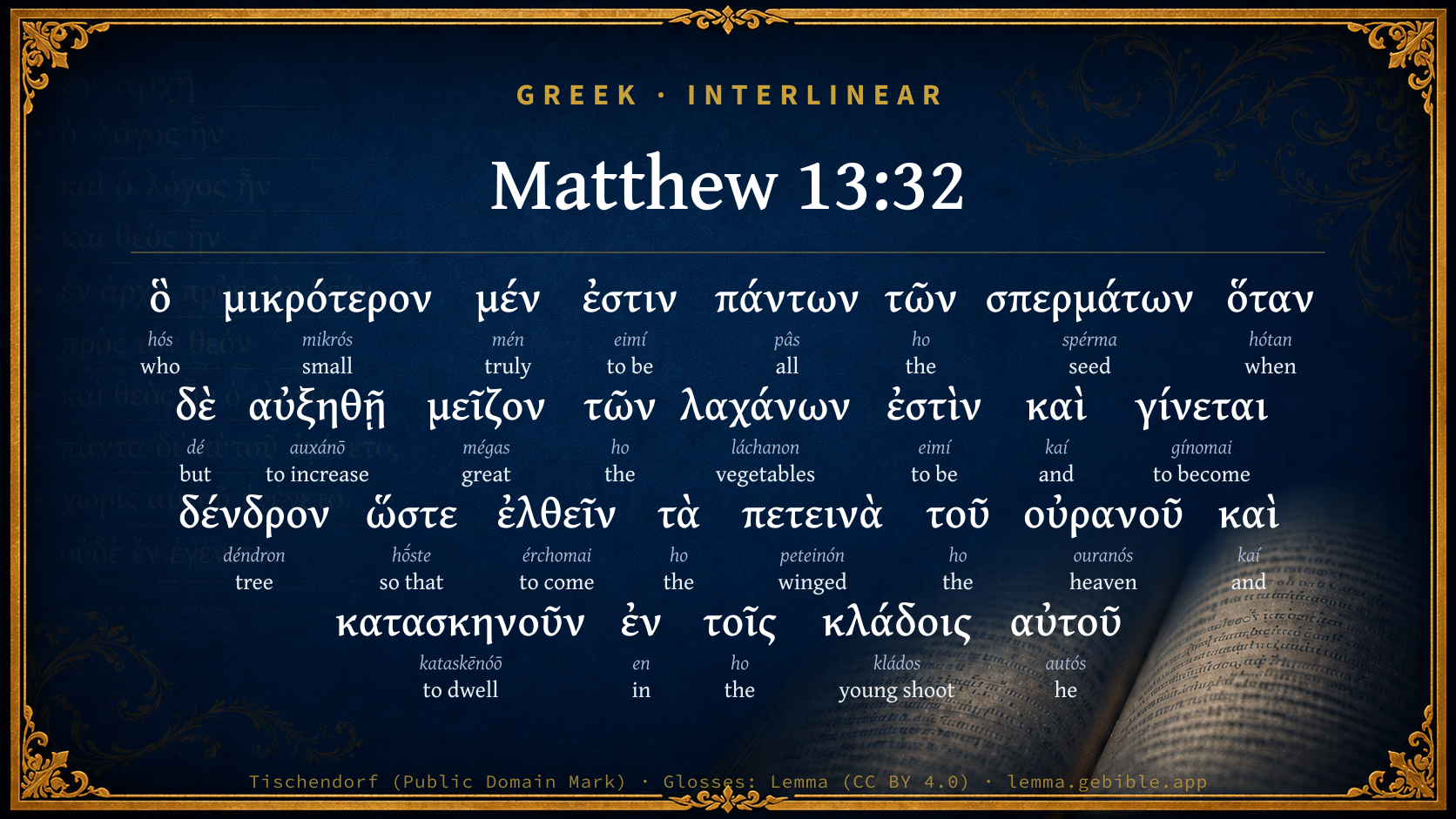
Greek (Tischendorf 8th ed.) Matthew 13:32 appears in the Greek New Testament. The text above is from the Tischendorf 8th edition. Each word links to its Strong’s number and a concise gloss. Click any word for its full Thayer’s Greek Lexicon entry.
Download image
Cite this verse

Matthew 13:32 (World English Bible). Public Domain. Lemma interlinear Bible study tool, https://lemma.gebible.app/v/matthew/13/32.

Show BibTeX & RIS
BibTeX
RIS
English Translation
which indeed is smaller than all seeds. But when it is grown, it is greater than the herbs, and becomes a tree, so that the birds of the air come and lodge in its branches."
World English Bible · Public Domain
Highlights
  • 3 first appearances in the Greek New Testament
Full analysis ↓
Download a study sheet

One document with this verse’s original text, its word-by-word gloss line, the meaning frame, cross-references with their text, attributed commentary, and full source and license credits — printable, and it pastes into notes with its structure intact.

This verse Autodidact and up

Study sheet (.html) Plain text (.txt)

A passage Seminary Student

Up to 50 verses in one chapter. A passage sheet keeps up to 6 commentary sources and 12 cross-references per verse, in the order this page ranks them, and says so on the sheet whenever that leaves anything out. Ask for a single verse and you get the Autodidact verse sheet above.

Everything on this page stays free to read, with no account — the sheet is a download of what is already on screen, not access to it.

Want to remove ads? Support Godless Engineer
Compare translations 3

The same verse in 3 English versions, stacked beneath the original-language interlinear above. Click any original word for its lexicon entry.

Each is an independent rendering of the whole verse — the interlinear is not word-aligned to these translations.

Highlighted words mark where these versions differ — a whole-verse word diff, not a word-by-word alignment.

  • World English Bible Public Domain
    which indeed is smaller than all seeds. But when it is grown, it is greater than the herbs, and becomes a tree, so that the birds of the air come and lodge in its branches."
  • King James Version Public Domain
    Which indeed is the least of all seeds: but when it is grown, it is the greatest among herbs, and becometh a tree, so that the birds of the air come and lodge in the branches thereof.
  • unfoldingWord Literal Text CC BY-SA 4.0
    which is indeed the smallest of all the seeds, but when it grows, it is greater than the vegetable plants and becomes a tree, so that the birds of the sky come and nest in its branches.”

unfoldingWord Literal Text — © unfoldingWord, licensed CC BY-SA 4.0. Word-aligned USFM3 via Door43 (git.door43.org/unfoldingWord/en_ult).

Versions to compare (up to 4)

3 of 4 selected

Show all 19 translations

Every available English version of this verse, each an independent rendering of the whole verse.

  • World English Bible Public Domain
    which indeed is smaller than all seeds. But when it is grown, it is greater than the herbs, and becomes a tree, so that the birds of the air come and lodge in its branches."
  • Berean Standard Bible Public Domain
    Although it is the smallest of all seeds, yet it grows into the largest of garden plants and becomes a tree, so that the birds of the air come and nest in its branches.”
  • Majority Standard Bible Public Domain
    Although it is the smallest of all seeds, yet it grows into the largest of garden plants and becomes a tree, so that the birds of the air come and nest in its branches.”
  • King James Version Public Domain
    Which indeed is the least of all seeds: but when it is grown, it is the greatest among herbs, and becometh a tree, so that the birds of the air come and lodge in the branches thereof.
  • American Standard Version (1901) Public Domain
    which indeed is less than all seeds; but when it is grown, it is greater than the herbs, and becometh a tree, so that the birds of the heaven come and lodge in the branches thereof.
  • Revised Version (1885) Public Domain
    which indeed is less than all seeds; but when it is grown, it is greater than the herbs, and becometh a tree, so that the birds of the heaven come and lodge in the branches thereof.
  • Geneva Bible (1599) Public Domain
    Which in deede is the least of all seedes: but when it is growen, it is the greatest among herbes, and it is a tree, so that the birdes of heauen come and builde in the branches thereof.
  • Douay-Rheims (1899) Public Domain
    Which is the least indeed of all seeds; but when it is grown up, it is greater than all herbs, and becometh a tree, so that the birds of the air come, and dwell in the branches thereof.
  • Young's Literal Translation Public Domain
    which less, indeed, is than all the seeds, but when it may be grown, is greatest of the herbs, and becometh a tree, so that the birds of the heaven do come and rest in its branches.'
  • Literal Standard Version CC BY-SA 4.0
    which less, indeed, is than all the seeds, but when it may be grown, is greatest of the herbs, and becomes a tree, so that the birds of the sky come and rest in its branches.”
  • Unlocked Literal Bible CC BY-SA 4.0
    This seed is indeed the smallest of all seeds. But when it has grown, it is greater than the garden plants. It becomes a tree, so that the birds of the air come and nest in its branches.”
  • unfoldingWord Literal Text CC BY-SA 4.0
    which is indeed the smallest of all the seeds, but when it grows, it is greater than the vegetable plants and becomes a tree, so that the birds of the sky come and nest in its branches.”
  • Darby Bible Public Domain
    which is less indeed than all seeds, but when it is grown is greater than herbs, and becomes a tree, so that the birds of heaven come and roost in its branches.
  • World Messianic Bible Public Domain
    which indeed is smaller than all seeds. But when it is grown, it is greater than the herbs and becomes a tree, so that the birds of the air come and lodge in its branches.”
  • Webster's Bible Public Domain
    Which indeed is the least of all seeds: but when it is grown, it is the greatest among herbs, and becometh a tree, so that the birds of the air come and lodge on its branches.
  • Free Bible Version CC BY-SA 4.0
    Even though it's the tiniest of seeds it grows much bigger than other plants. In fact it grows into a tree big enough for birds to roost in its branches.”
  • Bible in Basic English Public Domain
    Which is smaller than all seeds; but when it has come up it is greater than the plants, and becomes a tree, so that the birds of heaven come and make their resting-places in its branches.
  • Text-Critical English NT CC BY 4.0
    Although it is the smallest of all seeds, it grows larger than the other garden plants and becomes a tree, and the birds of the sky come and nest in its branches.”
  • Tyndale New Testament (1534) Public Domain
    which is the leest of all seedes. But when it is groune it is the greatest amonge yerbes and it is a tree: so that the bryddes of the ayer come and bylde in the brauches of it.

Literal Standard Version (2020), Covenant Press — licensed CC BY-SA 4.0. Text via the HelloAO Bible API (eBible.org). Unlocked Literal Bible (unfoldingWord) — licensed CC BY-SA 4.0. Text via the HelloAO Bible API (eBible.org). unfoldingWord Literal Text — © unfoldingWord, licensed CC BY-SA 4.0. Word-aligned USFM3 via Door43 (git.door43.org/unfoldingWord/en_ult). Free Bible Version, Dr. Jonathan Gallagher — licensed CC BY-SA 4.0. Text via the HelloAO Bible API (eBible.org).

Word by word

More ways to search: Search by grammar → Find every occurrence → Compare this word →

Practice this passage: Drill this verse → Learn its vocabulary →

λαχάνων
láchanon
G3001
“vegetables”
Noun, Genitive, Plural, Neuter
Part of Speech
Noun
Case
Genitive
Number
Plural
Gender
Neuter
Full Thayer's Definition

Origin: from lachaino (to dig)

TDNT: 05:05,5

1. any pot herb, vegetables
  1. ὃ hós G3739 “who” Relative pronoun, Nominative, Singular, Neuter
  2. μικρότερον mikrós G3398 “small” Adjective, Nominative, Singular, Neuter, Comparative
  3. μέν mén G3303 “truly” Particle
  4. ἐστιν eimí G1510 “to be” Verb, Present, Active, Indicative, 3rd person, Singular
  5. πάντων pâs G3956 “all” Adjective, Genitive, Plural, Neuter
  6. τῶν ho G3588 “the” Article, Genitive, Plural, Neuter
  7. σπερμάτων spérma G4690 “seed” Noun, Genitive, Plural, Neuter
  8. ὅταν hótan G3752 “when” Conjunction
  9. δὲ dé G1161 “but” Conjunction
  10. αὐξηθῇ auxánō G837 “to increase” Verb, Aorist, Passive, Subjunctive, 3rd person, Singular
  11. μεῖζον mégas G3173 “great” Adjective, Nominative, Singular, Neuter, Comparative
  12. τῶν ho G3588 “the” Article, Genitive, Plural, Neuter
  13. ἐστὶν eimí G1510 “to be” Verb, Present, Active, Indicative, 3rd person, Singular
  14. καὶ kaí G2532 “and” Conjunction
  15. γίνεται gínomai G1096 “to become” Verb, Present, Middle or Passive deponent, Indicative, 3rd person, Singular
  16. δένδρον déndron G1186 “tree” Noun, Nominative, Singular, Neuter
  17. ὥστε hṓste G5620 “so that” Conjunction
  18. ἐλθεῖν érchomai G2064 “to come” Verb, Aorist, Active, Infinitive
  19. τὰ ho G3588 “the” Article, Accusative, Plural, Neuter
  20. πετεινὰ peteinón G4071 “winged” Noun, Accusative, Plural, Neuter
  21. τοῦ ho G3588 “the” Article, Genitive, Singular, Masculine
  22. οὐρανοῦ ouranós G3772 “heaven” Noun, Genitive, Singular, Masculine
  23. καὶ kaí G2532 “and” Conjunction
  24. κατασκηνοῦν kataskēnóō G2681 “to dwell” Verb, Present, Active, Infinitive
  25. ἐν en G1722 “in” Preposition
  26. τοῖς ho G3588 “the” Article, Dative, Plural, Masculine
  27. κλάδοις kládos G2798 “young shoot” Noun, Dative, Plural, Masculine
  28. αὐτοῦ autós G846 “he” Personal pronoun, Genitive, Singular, Neuter

About this verse

These counts appear in no published source. They are computed here, from the morphology-tagged text and Lemma’s own curated glosses. What Lemma adds →

29
words
23
distinct lemmas
Gospels
section

Notable vocabulary

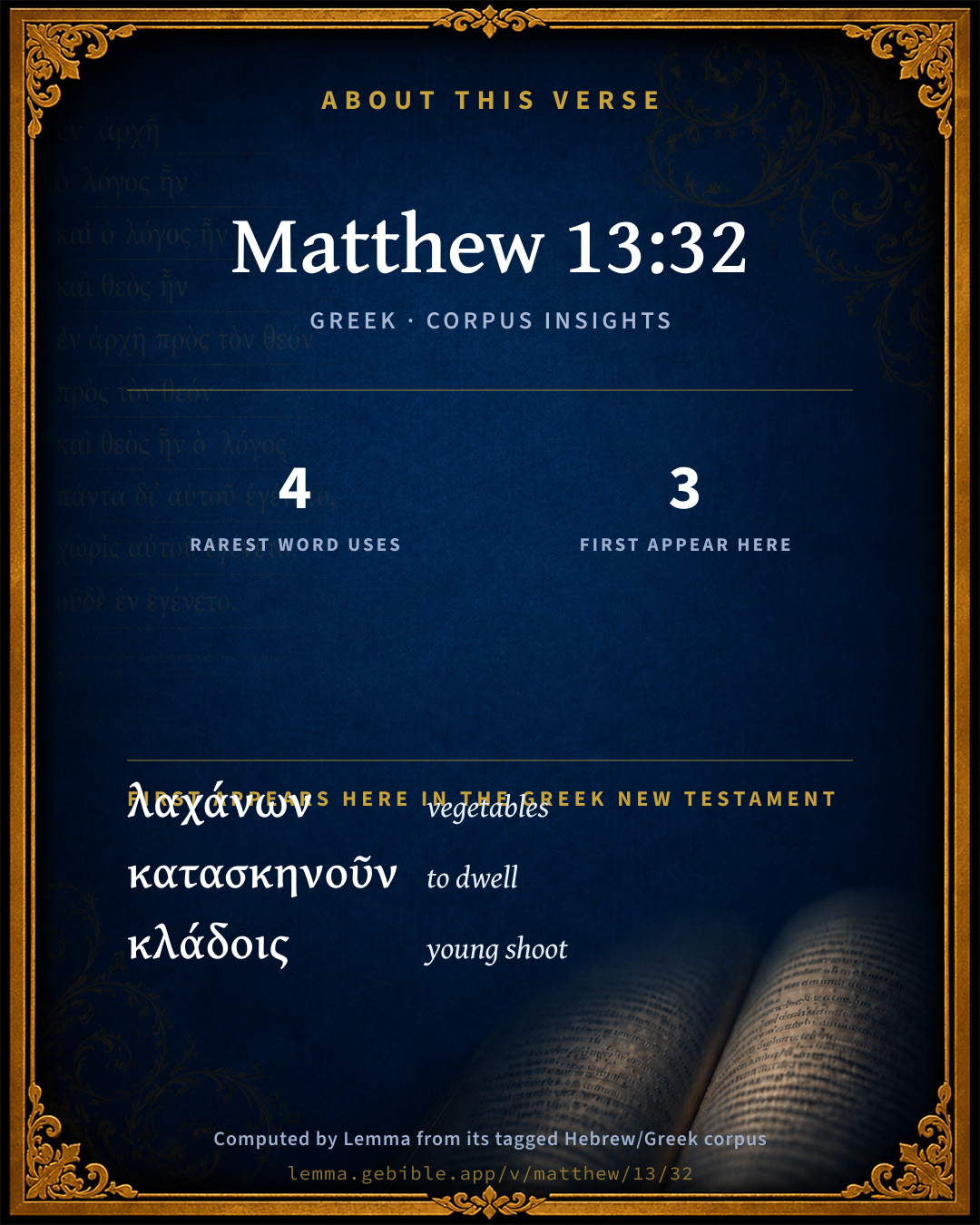
The rarest word here is λαχάνων vegetables G3001 — appearing just 4 times in the whole Greek New Testament.

First appearance in Scripture

These words make their first canonical appearance in the Greek New Testament here:

  • λαχάνων vegetables G3001
  • κατασκηνοῦν to dwell G2681
  • κλάδοις young shoot G2798

Shared distinctive vocabulary

λαχάνων vegetables G3001 occurs in 4 verses of the Greek New Testament. Also found in:
Repetition

Words recur within this verse:

Cross-references

17

Topical passages linked to Matthew 13:32 in the Treasury of Scripture Knowledge — connected by theme and wording, ordered by reader-vote popularity; previews shown in the World English Bible.

  • Ezekiel 31:6 All the birds of the sky made their nests in its boughs; and under its branches did all the animals of the field bring forth their young; and under its shadow lived all great nations.
  • Daniel 4:12 The leaves of it were beautiful, and the fruit of it much, and in it was food for all: the animals of the field had shadow under it, and the birds of the sky lived in the branches of it, and all flesh was fed from it.
  • Ezekiel 17:23–24 in the mountain of the height of Israel will I plant it; and it shall bring forth boughs, and bear fruit, and be a goodly cedar: and under it shall dwell all birds of every wing; in the shade of the branches of it shall they dwell.
  • Acts 21:20 They, when they heard it, glorified God. They said to him, "You see, brother, how many thousands there are among the Jews of those who have believed, and they are all zealous for the law.
  • Daniel 2:44–45 In the days of those kings shall the God of heaven set up a kingdom which shall never be destroyed, nor shall the sovereignty of it be left to another people; but it shall break in pieces and consume all these kingdoms, and it shall stand forever.
  • Zechariah 8:20–23 Thus says Yahweh of Hosts: "Many peoples, and the inhabitants of many cities will yet come;
  • Romans 15:18–19 For I will not dare to speak of any things except those which Christ worked through me, for the obedience of the Gentiles, by word and deed,
  • Psalms 104:12 The birds of the sky nest by them. They sing among the branches.
  • Daniel 2:34–35 You saw until a stone was cut out without hands, which struck the image on its feet that were of iron and clay, and broke them in pieces.
  • Zechariah 4:10 Indeed, who despises the day of small things? For these seven shall rejoice, and shall see the plumb line in the hand of Zerubbabel. These are the eyes of Yahweh, which run back and forth through the whole earth."
  • Psalms 72:16–19 There shall be abundance of grain throughout the land. Its fruit sways like Lebanon. Let it flourish, thriving like the grass of the field.
  • Isaiah 2:2–4 It shall happen in the latter days, that the mountain of Yahweh's house shall be established on the top of the mountains, And shall be raised above the hills; And all nations shall flow to it.
  • Ezekiel 47:1–5 He brought me back to the door of the house; and, behold, waters issued out from under the threshold of the house eastward; (for the forefront of the house was toward the east;) and the waters came down from under, from the right side of the house, on the south of the altar.
  • Micah 4:1–3 But in the latter days, It will happen that the mountain of Yahweh's temple will be established on the top of the mountains, And it will be exalted above the hills; And peoples will stream to it.
  • Zechariah 14:7–10 It will be a unique day which is known to Yahweh; not day, and not night; but it will come to pass, that at evening time there will be light.
  • Acts 1:15 In these days, Peter stood up in the midst of the disciples (and the number of names was about one hundred twenty), and said,
  • Revelation 11:15 The seventh angel sounded, and great voices in heaven followed, saying, "The kingdom of the world has become the Kingdom of our Lord, and of his Christ. He will reign forever and ever!"

Cross-references courtesy of OpenBible.info (CC BY 4.0).

Commentary

Notes on Matthew 13:32 from classic Christian and Jewish commentators (each source and its license shown beneath its notes). The classic Christian expositions comment on the surrounding passage and are grouped to its opening verse, so a note may address several verses; the Jewish commentaries on the Tanakh (Rashi and others) are per-verse, so they appear only where the commentator wrote on this verse.

Lemma curates 59 commentaries, every one of them public domain or Creative Commons licensed, each selected and text-cleaned for this edition rather than reprinted as found. About our sources →

Bengel's Gnomon

Johann Albrecht Bengel

Mat 13:32. Ὃ, which) sc. seed: for κόκκος (grain) is masculine.—μικρότερον, the least) i.e. not absolutely, but in the proportion which the seed bears to the plant. It was a well-known kind of seed, used proverbially; see ch. Mat 17:20.—σπερμάτων, of seeds) The world contains various seeds of wisdom, power, and virtue; the Christian faith has surpassed them all, having been propagated through the whole world. The kingdom of heaven is like a grain; and so is the whole of Christianity, faith, etc. These things may be variously expressed. The faith here intended is that of all those believers, who embrace it before others: the others are those who believe afterwards—nations, kings, etc.—μεῖζον—λαχάνων—δένδρον, greater herbs—tree) two classes of vegetables. Tremellius,[628] on this passage in the Syriac Version, adduces examples of such immense trees.—It became a tree, one may say, in the time of Constantine.[629]—τὰ πετεινὰ, the birds) see Eze 17:23.—κλάδοις, branches) sc. widely spreading.

[628] EMMANUEL TREMELLIUS was born in the sixteenth century at Ferrara, of Jewish parents. He rendered himself master of the Hebrew language, and secretly embraced Protestantism. He became Professor of Hebrew at Heidelberg, from whence he went to Metz, and thence to Sedan. He made himself known by his Latin Version of the Syriac New Testament. He died in 1580.—(I. B.)

[629] The kingdom of Christ is being extended now throughout the whole world.—V. g.

Bengel's Gnomon of the New Testament — English translation (T&T Clark, Edinburgh, 1860) — public domain. Text from a community e-Sword module.

Meyer's Critical & Exegetical Commentary

Heinrich August Wilhelm Meyer

Mat_13:32. Ὅ] refers to κόκκος σινάπ., and owes its gender to the fact of its being attracted by the neuter following; Winer, p. 156 [E. T. 217 ff.].

μικρότερον] not instead of the superlative; see, however, on note Mat_11:11. But, inasmuch as this is a proverbial expression of a hyperbolical character, little need be made of the fact that seeds of a still more diminutive kind are to be met with; comp. Mat_17:20, and Lightfoot. Satis est, in genere verum esse, quod dicit Dominus, Erasmus.

τῶν λαχάνων] than any other vegetable.

ὅταν δὲ αὐξ. κ.τ.λ.] but when it shall have grown, portrays the extraordinary result that follows the sowing of the tiny little seed. The astonishing nature of such a result is still more forcibly brought out in Luk_13:19 by means of δένδρον μέγα.

κατασκ.] dwell. The interpretation of the word as meaning to build nests (Erasmus) is not general enough; comp. note on Mat_8:20.

Meyer — Critical and Exegetical Commentary on the New Testament — English translation by Peter Christie, edited by Frederick Crombie (T&T Clark, 1880) — public domain. Text from a community e-Sword module.

Expositor's Greek Testament

ed. W. Robertson Nicoll

Mat 13:32 . ὃ , neuter, by attraction of σπερμάτων , instead of ὃν in agreement with κόκκῳ , masculine. μικρότερον , not less perhaps than all the seeds in the world. An American correspondent sent me a sample of the seeds of the cotton tree , which he thinks Christ would have made the basis of His parable had He spoken it in America. μεῖζον τῶν λαχάνων , greater than (all) the herbs . The comparison implies that it too is an herb. There would be no point in the statement that a plant of the nature of a tree grew to be greater than all garden herbs. This excludes the mustard tree, called Salvadora Persica , to which some have thought the parable refers. δένδρον , not in nature but in size; an excusable exaggeration in a popular discourse. Koetsveld remarks on the greatly increased growth attained by a plant springing from a single seed with plenty of room all round it ( De Gelijk. , p. 50). ὥστε here indicates at once tendency and result, large enough to make that possible, and it actually happened. The birds haunted the plant like a tree or shrub. Mark refers only to the possibility (Mar 4:32 ). κατασκηνοῦν ( cf. κατασκηνώσεις , Mat 8:20 ), not nidulari , to make nests (Erasmus), but to “lodge,” as in A. V [82] The mustard plant is after all of humble size, and gives a very modest idea of the growth of the kingdom. But it serves admirably to express the thought of a growth beyond expectation . Who would expect so tiny a seed to produce such a large herb, a monster in the garden?

[82] Authorised Version.

The Expositor's Greek Testament, edited by W. Robertson Nicoll (1897–1910) — public domain. Text from a community e-Sword module.

Jamieson, Fausset & Brown

Robert Jamieson, A. R. Fausset & David Brown

Which indeed is the least of all seeds--not absolutely, but popularly and proverbially, as in Luk 17:6, "If ye had faith as a grain of mustard seed," that is, "never so little faith."

but when it is grown, it is the greatest among herbs--not absolutely, but in relation to the small size of the seed, and in warm latitudes proverbially great.

and becometh a tree, so that the birds of the air come and lodge in the branches thereof--This is added, no doubt, to express the amplitude of the tree. But as this seed has a hot, fiery vigor, gives out its best virtues when bruised, and is grateful to the taste of birds, which are accordingly attracted to its branches both for shelter and food, is it straining the parable, asks TRENCH, to suppose that, besides the wonderful growth of His kingdom, our Lord selected this seed to illustrate further the shelter, repose and blessedness it is destined to afford to the nations of the world?

The Leaven (Mat 13:33).

Jamieson, Fausset & Brown — Commentary Critical and Explanatory on the Whole Bible (1871) — public domain (CC PDM 1.0). Text via the HelloAO Bible API.

Adam Clarke's Commentary

Verse 32. Which indeed is the least of all seeds] That is, of all those seeds which produce plants, whose stems and branches, according to the saying of the botanists, are apt δενδριζειν, arborescere, to grow into a ligneous or woody substance.

Becometh a tree] That is, it is not only the largest of plants which are produced from such small seeds, but partakes, in its substance, the close woody texture, especially in warm climates, where we are informed it grows to an almost incredible size. The Jerusalem Talmud, tract Peah. fol. 20, says, "There was a stalk of mustard in Sichin, from which sprang out three boughs; one of which, being broken off, served to cover the tent of a potter, and produced three cabes of mustard seed. Rabbi Simeon ben Chalapha said, A stalk of mustard seed was in my field, into which I was want to climb, as men are wont to climb into a fig tree." See Lightfoot and Schoettgen. This may appear to be extravagant; and it is probable that, in the case of the three cabes of seed, there is considerable exaggeration; but, if it had not been usual for this plant to grow to a very large size, such relations as these would not have appeared even in the Talmud; and the parable of our Lord sufficiently attests the fact. Some soils being more luxuriant than others, and the climate much warmer, raise the same plant to a size and perfection far beyond what a poorer soil, or a colder climate, can possibly do. Herodotus says, he has seen wheat and barley in the country about Babylon which carried a blade full four fingers-breadth: and that the millet and sesamum grew to an incredible size. I have myself seen a field of common cabbages, in one of the Norman isles, each of which was from seven to nine feet in height; and one in the garden of a friend, which grew beside an apple-tree, though the latitude of the place is only about 48 deg. 13 min. north, was fifteen feet high, the stem of which is yet remaining, (September, 1798.) These facts, and several others which might be added, confirm fully the possibility of what our Lord says of the mustard-tree, however incredible such things may appear to those who are acquainted only with the productions of northern regions and cold climates.

Adam Clarke's Commentary on the Bible (1810–1826) — public domain. Text from a community e-Sword/MySword module.

Ellicott's Commentary for English Readers

(32) The least of all seeds.—The description is, of course, popular, and need not be pressed with micro scopical exactness.

The greatest among herbs.—More literally, greater than the herbs—i.e., belonging to a higher order of vegetation.

A Bible Commentary for English Readers, edited by Charles John Ellicott (1878–1897) — public domain. Text from a community e-Sword module.

The Cambridge Bible for Schools and Colleges

gen. ed. J. J. S. Perowne

32. the least of all seeds] Not absolutely the least, but least in proportion to the plant that springs from the seed. Moreover the mustard seed was used proverbially of anything excessively minute.

lodge in the branches] i. e. settle for the purpose of rest or shelter or to eat the seeds of which goldfinches and linnets are very fond (Tristram, Nat. Hist. of Bible, p. 473). Lodge, literally dwell in tents. If we think of the leafy huts constructed for the feast of tabernacles the propriety of the word will be seen. The mustard plant does not grow to a very great height, so that St Luke’s expression “waxed a great tree” must not be pressed. Dr Thomson (Land and Book) mentions as an exceptional instance that he found it on the plain of Akkar as tall as a horse and its rider.

The Cambridge Bible for Schools and Colleges (gen. ed. J. J. S. Perowne; Cambridge University Press, 1878–1918) — public domain. Text from a community e-Sword module.

John Gill's Exposition

All these things spake Jesus unto the multitude,.... In the hearing of his disciples, whilst in the ship, the multitude being on the shore,

in parables; in the four foregoing ones,

and without a parable spake he not unto them: not that he never had preached but in a parabolical way unto them, or that he never did afterwards use any other way of speaking; for it is certain, that both before and after, he delivered himself plainly, and without figures: but the meaning is, that in that sermon, and at that time, he thought fit to make use of no other method, as appears from the many other parables he afterwards delivered; and though he explained the meaning of some of them to his disciples, at their request, yet he dismissed the multitude without any explication of them.

John Gill's Exposition of the Whole Bible (1746–1763) — public domain (CC PDM 1.0). Text via the HelloAO Bible API.

Trapp's Complete Commentary

John Trapp

32 Which indeed is the least of all seeds: but when it is grown, it is the greatest among herbs, and becometh a tree, so that the birds of the air come and lodge in the branches thereof.

Ver. 32. Which indeed is the least of all seeds] That is, one of the least (μικροτερον), for there is as little or less than it, as poppy seed, &c. Cypress seeds are said to be so small, that they can hardly be seen asunder; and yet of them grows so great and tall a tree, Nusquam magis tota natura quam in minimis, saith Pliny. {a} Tremellius testifieth, that things almost incredible are related of the wonderful growth of the Jewish mustard seed. Maldonate also telleth us, "that in Spain he had seen little woods of mustard seed trees; and that the bakers therehence fetch fuel to heat their ovens, and do other offices." The word of God (a thing worth observation, saith a modern divine) is in the gospel compared to mustard seed; which (as one gathereth out of Pythagoras) of all seeds is most in ascent, taketh deepest root, and being mixed with vinegar is sovereign against serpents. Right so the word of God worketh effectually in us, begets an ascent in our affections, lays in us a sure foundation, and though it touch us sharply as vinegar, yet is a most powerful preservative against that old serpent.

{a} Cupressi semina adeo sunt minuta, ut quaedam oculis cerni non possint, et tamen in iis tanta est arbor, tamque procera. Plin. xi. 2.

John Trapp, A Commentary or Exposition upon All the Books of the Old and New Testament (1647–1656) — public domain. Text from a community e-Sword module.

Haydock's Catholic Bible Commentary

The least of all seeds. That is, it is one of the least seeds; but in hot countries it is observed to grow to a considerable height, and to become a bush or a little tree. (Witham) --- The gospel of Christ, compared in this verse to the grain of mustard seed, has indeed little show of grandeur and human greatness. St. Paul calls it a scandal to the Jew, and a stumbling block to the Gentile. But Jesus Christ here assures us, that when it has been spread and promulgated by his ambassadors, viz. the apostles, it shall surpass every other mode of instruction both in fame and extent. (St. Ambrose, St. Jerome, St. Augustine)

George Leo Haydock (1774–1849), Haydock's Catholic Family Bible and Commentary, 1859 edition — public domain. Excludes Psalms (Douay-Rheims chapter numbering differs from Protestant) and Deuterocanonical books (Catholic canon only).

Whedon's Commentary on the Bible

Daniel D. Whedon

32. Least of all seeds — The point of the parable is to exhibit the contrast between the smallness of the Gospel beginnings and the greatness of the result. The mustard was the least of seeds that produced the genuine tree. Greatest among herbs — Though a tree in size, it was a herb by proper classification. Birds of the air — This is added to complete the image of a goodly tree; but it is also a sweet illustration of the character of the Church, as a refuge and a protection for the souls that resort to her shadow. See Eze_17:23 : “Under it shall dwell all fowl of every wing.”

This parabolic image of the growth of the kingdom of Christ is beautifully parallel to many passages in the Old Testament, where the rise and expansion of kingdoms are compared to the growth of a stately tree. (Dan_4:10-12; Eze_31:3-9.) It is also strongly accordant with the image in Dan_2:34-35, of the kingdom of God, which at first was a small stone, but finally became a great mountain, and filled the whole earth. And this last image describes the growth of the kingdom, as being completely universal, more explicitly even than our Lord’s simile here of the mustard spreading its branches.

Daniel D. Whedon (gen. ed.), Commentary on the Old and New Testaments (1874–1909) — public domain. Text from a community e-Sword module.

The Pulpit Commentary

Which indeed is the least of (is less than, Revised Version) all seeds; i.e. all those ordinarily sown in Palestine then. Instances of the proverbial use in the Talmuds of the size of a grain of mustard to express something very small, may be seen in Levy, s.v. ldrj. But when it is grown, it is the greatest among herbs; it is greater than the herbs (Revised Version); i.e. than those which are usually called lacana . And becometh a tree, so that the birds of the air. There is not necessarily any connotation of evil about these (cf. vers. 4, 19); the thought is simply that those who are naturally outsiders are glad to come under cover of this tree. Compare, for both thought and language, Daniel"s description of the empire of Babylon, (Dan_4:12, Dan_4:21) and Ezekiel"s prophecy of the kingdom of Judah. (Eze_17:23) Come and lodge in the branches thereof. Lodge (kataskhnoin); Mat_8:20, note. In Palestine the goldfinches and linnets settle on the mustard in flocks (Tristram, "Nat. Hist. of Bible," p. 473, edit. 1889).

The Pulpit Commentary (1880–1919), ed. H.D.M. Spence-Jones & Joseph S. Exell — public domain. Text from a community e-Sword module.

John Wesley's Explanatory Notes

The least - That is, one of the least: a way of speaking extremely common among the Jews. It becometh a tree - In those countries it grows exceeding large and high. So will the Christian doctrine spread in the world, and the life of Christ in the soul.

John Wesley, Explanatory Notes Upon the Whole Bible (1754–1765) — public domain. Text via the GEBible commentary corpus.

The People's New Testament

B. W. Johnson

32. Which, indeed, is the least of all seeds. The least of all the field or garden seeds sown in Palestine. But when it is grown, it is the greatest among herbs. All herbs cultivated in the fields or garden of Palestine. Dr. Hooker measured a mustard-plant in the Jordan Valley ten feet high. Thus, the kingdom, from an insignificant beginning, grows to a mighty magnitude.

B. W. Johnson's The People's New Testament with Notes (1889–1891) — public domain. Electronic text from the Christian Classics Ethereal Library (CCEL) ThML edition.

Cambridge Greek Testament for Schools and Colleges

32. μικρότερον πάντων τῶν σπερμάτων. Not absolutely the least, but least in proportion to the plant that springs from the seed. Moreover the mustard seed was used proverbially of anything excessively minute.

κατασκηνοῖν ἐν τοῖς κλάδοις αὐτοῦ, i.e. settle for the purpose of rest or shelter or to eat the seeds, of which goldfinches and linnets are very fond. (Tristram, Nat. Hist. of Bible, p. 473.) κατασκηνοῖν. Literally, dwell in tents. If we think of the leafy huts constructed for the feast of tabernacles the propriety of the word will be seen. The mustard plant does not grow to a very great height, so that St Luke’s expression ἐγένετο εἰς δένδρον [μέγα] must not be pressed. Dr Thomson (Land and Book) mentions as an exceptional instance that he found it on the plain of Akkar as tall as a horse and its rider.

κατασκηνοῖν. For the infinitive termination see Winer, p. 92. Cp. the contraction χρυσόει = χρυσοῖ, though in infin. generally χρυσόειν = χρυσοῦν, also the Pindaric forms ἔχοισιν for ἔχουσιν, &c. δίδοι for δίδου. (Donaldson’s Pindar, de Stilo Pindari, p. liv) and the Thessalian genitive form is -οι for -ου (Papillon, Compar. Phil. 112 note).

Cambridge Greek Testament for Schools and Colleges (Cambridge University Press, 1896; 21 vols, various authors incl. Carr, Maclear, Plummer, Farrar, Lumby, Moule, M. R. James, Simcox) — public domain. Text from a community e-Sword module.

Alford’s Greek Testament

Henry Alford

32.] Third parable. The grain of mustard seed. Mar 4:30-34.Luk 13:18Luk 13:18, Luk 13:19. On the connexion of this parable with the two last, Chrysostom observes (Hom. in Matt. xlvi. 2, p. 483), ἐπειδὴ γὰρ εἶπεν ὅτι ἀπὸ τοῦ σπόρου τρία μέρη ἀπόλλυται, καὶ σώζεται ἕν, καὶ ἐν αὐτῷ πάλιν τῷ σωζομένῳ τοσαύτη γίνεται βλάβη, ἵνα μὴ λέγωσι ‘καὶ τίνες καὶ πόσοι ἔσονται οἱ πιστοί;’ καὶ τοῦτον ἐξαιρεῖ τὸν φόβον, διὰ τῆς παραβολῆς τοῦ σινάπεως ἐνάγων εἰς πίστιν αὐτοὺς καὶ δεικνὺς ὅτι πάντως ἐκταθήσεται τὸ πρᾶγμα.

The comparison of kingdoms to trees was familiar to the Jews: see Dan 4:10-12, Dan 4:20-22: Eze 31:3-9; Eze 17:22-24: Psa 80:8-11.

32. μικρότερον κ.τ.λ.] less than all, not for the superlative. The words are not to be pressed to their literal sense, as the mustard seed was a well-known Jewish type for any thing exceedingly small.

The mustard tree attains to a large size in Judæa. Lightfoot quotes (Hor. Hebr. in l.) Hieros. Peah. fol. 20. 2, ‘Caulis erat sinapis in Sichin, e quo enati sunt rami tres; e quibus unus decerptus co-operuit tentoriolum figuli, produxitque tres cabos sinapis. Rabbi Simeon ben Chalaphta dixit, Caulis sinapis erat mihi in agro meo, in quam ego scandere solitus sum, ita ut scandere solent in ficum.’

This parable, like most others respecting the kingdom of God, has a double reference—general and individual. (1) In the general sense, the insignificant beginnings of the kingdom are set forth: the little babe cast in the manger at Bethlehem; the Man of sorrows with no place to lay His Head; the crucified One; or again the hundred and twenty names who were the seed of the Church after the Lord had ascended; then we have the Kingdom of God waxing onward and spreading its branches here and there, and different nations coming into it. “He must increase,” said the great Forerunner. We must beware however of imagining that the outward Church-form is this Kingdom. It has rather reversed the parable, and is the worldly power waxed to a great tree and the Churches taking refuge under the shadow of it. It may be, where not corrupted by error and superstition, subservient to the growth of the heavenly plant: but is not itself that plant. It is at best no more than (to change the figure) the scaffolding to aid the building, not the building itself. (2) The individual application of the parable points to the small beginnings of divine grace; a word, a thought, a passing sentence, may prove to be the little seed which eventually fills and shadows the whole heart and being, and calls ‘all thoughts, all passions, all delights’ to come and shelter under it. Jerome has a comment on this parable (in loc.) too important to be passed over: ‘Prædicatio Evangelii minima est omnibus disciplinis. Ad primam quippe doctrinam, fidem non habet veritatis, hominem Deum, Deum mortuum, et scandalum crucis prædicans. Confer hujuscemodi doctrinam dogmatibus Philosophorum et libris eorum, et splendori eloquentiæ, et compositioni sermonum, et videbis quanto minor sit cæteris seminibus sementis Evangelii. Sed illa cum creverit, nihil mordax, nihil vividum, nihil vitale demonstrat, sed totum flaccidum, marcidumque et mollitum ebullit in olera et in herbas quæ cito arescunt et corruunt. Hæc autem prædicatio quæ parva videbatur in principio, cum vel in anima credentis, vel in toto mundo sata fuerit, non exsurgit in olera, sed crescit in arborem.’

Henry Alford, The Greek Testament (1849–1861) — public domain. Text from a community e-Sword module.

International Critical Commentary

(LM) 32. Which indeed is less than all seeds. But when it has grown it is greater than the herbs, and becomes a tree, so that the birds of the heaven come and lodge in its branches.] Mk. has: “Which when it is sown upon the earth, though it is less than all seeds which are upon the earth, and when it is sown, grows up and becomes greater than all herbs, and makes great branches, so that the birds of the heaven are able to lodge under its shadow.”

ὃ μικρότερον μέν ἐστιν] Mt. simplifies Mk.’s harsh construction, ὃς—μικρότερον ὄν. He also avoids the repetition of ὅταν σπαρῇ and ἐπὶ τῆς γῆς.—κατασκηνοῖν] cf. Psa 104:12.—ἐν τοῖς κλάδοις αὐτοῦ] Mk. has ὑπὸ τὴν σκιὰν αὐτοῦ. Both expressions are used of birds in connection with trees. For ὑπὸ τὴν σκιὰν αὐτοῦ, cf. Eze 17:23; and for ἐν τοῖς κλάδοις αὐτοῦ, Dan 4:18 Th. The latter phrase expresses more suitably here the size of the tree.

Mt. and Lk. have several agreements in this parable as against Mk.; cf. ὁμοία ἐστίν. Mt. Lk. ὃν λαβὼν ἄνθρωπος ἔσπειρεν ἐν τῷ ἀγρῷ αὐτοῦ, Mt. = ὃν λαβὼν ἄνθρωπος ἔβαλεν εἰς κῆπον ἐαυτοῦ, Lk. αὐξηθῇ, Mt.=ηὔξησεν, Lk.; δένδρον, Mt. Lk.—ἐν τοῖς κλάδοις αὐτοῦ] So far as Mt. goes, these variations from Mk. might be easily explained as editorial revisions of Mk.’s text. But his omission of Mar 4:26-29, combined with these variations and with the fact that the interpretation of the Tares does not immediately follow that parable, but comes later, after other parables in vv. 36-43, suggests that he borrowed the whole section 24-52 (excepting v. 34) from the Logia. In that case, when he came to Mar 4:26 he turned to his other source for all that follows down to v. 52. His variations from Mar 4:30-32 are then due chiefly to the fact that this parable stood in the Logia in a form which differed from that of Mk. Lk. at 8:18 omits Mar 4:26-34, but has the parable of the Mustard Seed combined with that of the Leaven later in his Gospel at 13:18-21. He probably, therefore, borrowed them from a non-Marcan source, which may have been the first Gospel, or a source which contained these two parables in the same order and largely in the same language as the Logia.

The parable seems to describe the future propagation of the word or doctrine of the kingdom. Starting from small beginnings in the teaching of Christ, it will spread rapidly and win many adherents.

International Critical Commentary — older volumes (1896–1929), various authors — public domain. Text from a community e-Sword module.

Lesson kit

Teaching starters — assembled from the data on this page, not authored interpretation. Every prompt links to the verse data it draws on. Edit before teaching.

Matthew, in the Gospels, opens this verse with 29 words (23 distinct Greek lemmas). Its most distinctive word is láchanon (“vegetables”). A historical commentator’s framing appears above. Read the whole chapter for the surrounding context.

Discussion questions

  1. How does “vegetables” (láchanon) shape what this verse is saying?
  2. 3 words make their first appearance in Scripture here. What does this debut establish?
  3. How does Mark 4:32, which shares the word «vegetables», read alongside this verse?
  4. What does the repetition of “to be” (2× in this one verse) do in this verse?
  5. These translations render this verse differently; the difference is in the English rendering, not the original. What questions does that raise?
  6. Compare how Bengel's Gnomon and Meyer's Critical & Exegetical Commentary read this verse. Where do they agree or differ?

Things to notice

  • 3 words make their first canonical appearance in Scripture here.
  • These translations choose different wording for 18 words in this verse.
  • “to be” occurs 2× in this single verse.
  • 23 distinct Greek lemmas span 29 words in this verse.

Reading settings

Reading text

Shown beneath each verse's original-language words.

Old Testament
Old Testament edition

Read the OT as the Masoretic Hebrew (MT) or the Greek Septuagint (LXX).

English shown for the Greek Septuagint (in the Hebrew ↔ Greek comparison).

Comparing translations? Open the Compare panel on any verse page to stack up to four side by side.