John 3:13

Greek (Tischendorf 8th ed.) John 3:13 appears in the Greek New Testament. The text above is from the Tischendorf 8th edition. Each word links to its Strong’s number and a concise gloss. Click any word for its full Thayer’s Greek Lexicon entry.
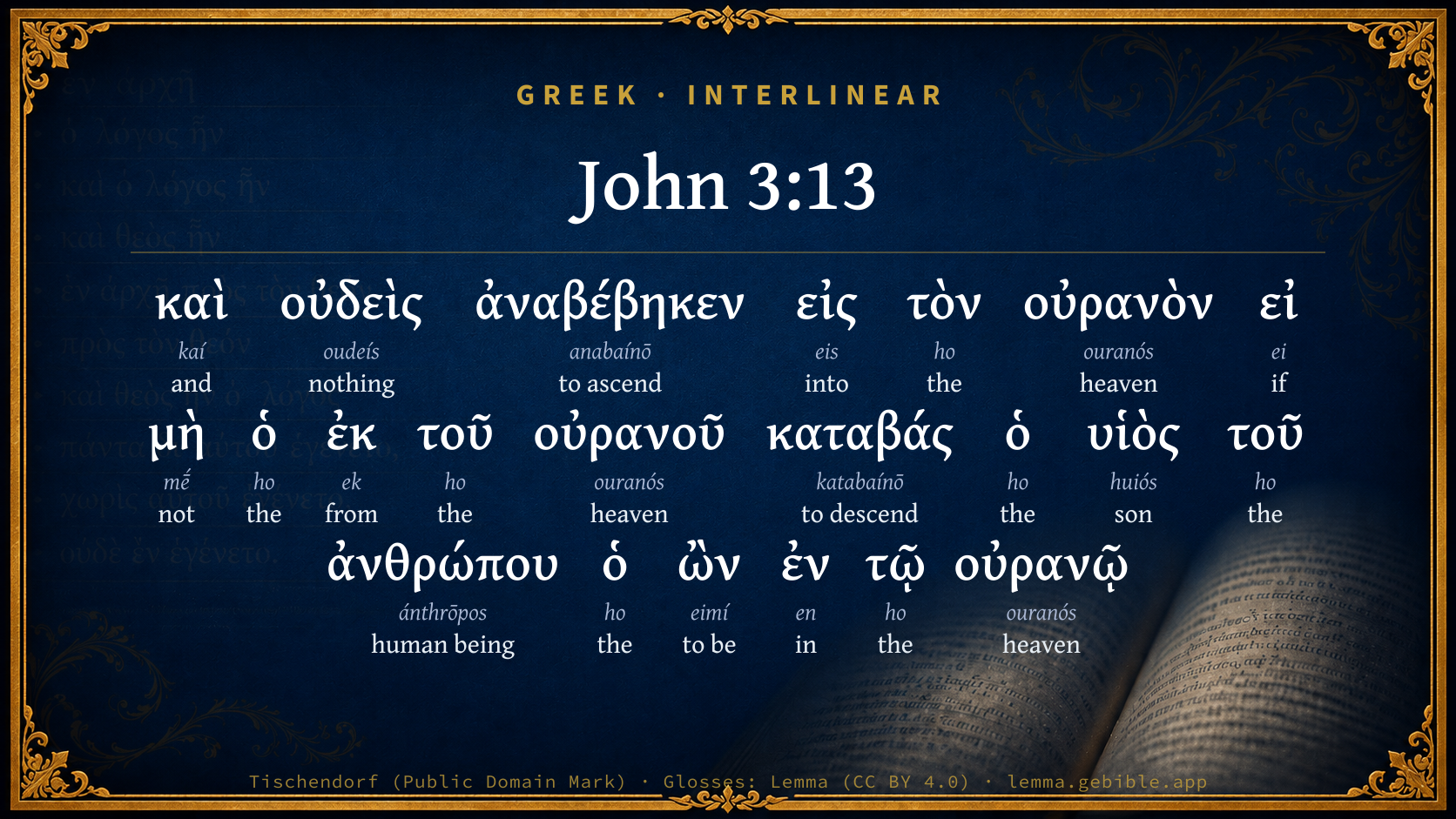
Download image
Cite this verse

John 3:13 (World English Bible). Public Domain. Lemma interlinear Bible study tool, https://lemma.gebible.app/v/john/3/13.

Show BibTeX & RIS
BibTeX
RIS
English Translation
No one has ascended into heaven, but he who descended out of heaven, the Son of Man, who is in heaven.
World English Bible · Public Domain
Download a study sheet

One document with this verse’s original text, its word-by-word gloss line, the meaning frame, cross-references with their text, attributed commentary, and full source and license credits — printable, and it pastes into notes with its structure intact.

This verse Autodidact and up

Study sheet (.html) Plain text (.txt)

A passage Seminary Student

Up to 50 verses in one chapter. A passage sheet keeps up to 6 commentary sources and 12 cross-references per verse, in the order this page ranks them, and says so on the sheet whenever that leaves anything out. Ask for a single verse and you get the Autodidact verse sheet above.

Everything on this page stays free to read, with no account — the sheet is a download of what is already on screen, not access to it.

Want to remove ads? Support Godless Engineer
Compare translations 3

The same verse in 3 English versions, stacked beneath the original-language interlinear above. Click any original word for its lexicon entry.

Each is an independent rendering of the whole verse — the interlinear is not word-aligned to these translations.

Highlighted words mark where these versions differ — a whole-verse word diff, not a word-by-word alignment.

  • World English Bible Public Domain
    No one has ascended into heaven, but he who descended out of heaven, the Son of Man, who is in heaven.
  • King James Version Public Domain
    And no man hath ascended up to heaven, but he that came down from heaven, even the Son of man which is in heaven.
  • unfoldingWord Literal Text CC BY-SA 4.0
    And no one has ascended into heaven except the one having descended from heaven—the Son of Man.

unfoldingWord Literal Text — © unfoldingWord, licensed CC BY-SA 4.0. Word-aligned USFM3 via Door43 (git.door43.org/unfoldingWord/en_ult).

Versions to compare (up to 4)

3 of 4 selected

Show all 19 translations

Every available English version of this verse, each an independent rendering of the whole verse.

  • World English Bible Public Domain
    No one has ascended into heaven, but he who descended out of heaven, the Son of Man, who is in heaven.
  • Berean Standard Bible Public Domain
    No one has ascended into heaven except the One who descended from heaven—the Son of Man.
  • Majority Standard Bible Public Domain
    No one has ascended into heaven except the One who descended from heaven—the Son of Man, who is in heaven.
  • King James Version Public Domain
    And no man hath ascended up to heaven, but he that came down from heaven, even the Son of man which is in heaven.
  • American Standard Version (1901) Public Domain
    And no one hath ascended into heaven, but he that descended out of heaven, `even' the Son of man, who is in heaven.
  • Revised Version (1885) Public Domain
    And no man hath ascended into heaven, but he that descended out of heaven, even the Son of man, which is in heaven.
  • Geneva Bible (1599) Public Domain
    For no man ascendeth vp to heauen, but he that hath descended from heauen, that Sonne of man which is in heauen.
  • Douay-Rheims (1899) Public Domain
    And no man hath ascended into heaven, but he that descended from heaven, the Son of man who is in heaven.
  • Young's Literal Translation Public Domain
    and no one hath gone up to the heaven, except he who out of the heaven came down -- the Son of Man who is in the heaven.
  • Literal Standard Version CC BY-SA 4.0
    And no one has gone up to Heaven, except He who came down out of Heaven—the Son of Man who is in Heaven.
  • Unlocked Literal Bible CC BY-SA 4.0
    No one has ascended into heaven except he who descended from heaven—the Son of Man.
  • unfoldingWord Literal Text CC BY-SA 4.0
    And no one has ascended into heaven except the one having descended from heaven—the Son of Man.
  • Darby Bible Public Domain
    And no one has gone up into heaven, save he who came down out of heaven, the Son of man who is in heaven.
  • World Messianic Bible Public Domain
    No one has ascended into heaven but he who descended out of heaven, the Son of Man, who is in heaven.
  • Webster's Bible Public Domain
    And no man hath ascended to heaven, but he that came down from heaven, even the Son of man who is in heaven.
  • Free Bible Version CC BY-SA 4.0
    No one has gone up to heaven, but the Son of man came down from heaven.
  • Bible in Basic English Public Domain
    And no one has ever gone up to heaven but he who came down from heaven, the Son of man.
  • Text-Critical English NT CC BY 4.0
    No one has ascended into heaven, except he who descended from heaven, the Son of Man, who is in heaven.
  • Tyndale New Testament (1534) Public Domain
    And no man ascendeth vp to heaven but he that came doune from heaven that is to saye the sonne of man which is in heaven.

Literal Standard Version (2020), Covenant Press — licensed CC BY-SA 4.0. Text via the HelloAO Bible API (eBible.org). Unlocked Literal Bible (unfoldingWord) — licensed CC BY-SA 4.0. Text via the HelloAO Bible API (eBible.org). unfoldingWord Literal Text — © unfoldingWord, licensed CC BY-SA 4.0. Word-aligned USFM3 via Door43 (git.door43.org/unfoldingWord/en_ult). Free Bible Version, Dr. Jonathan Gallagher — licensed CC BY-SA 4.0. Text via the HelloAO Bible API (eBible.org).

Word by word

More ways to search: Search by grammar → Find every occurrence → Compare this word →

Practice this passage: Drill this verse → Learn its vocabulary →

καταβάς
katabaínō
G2597
“to descend”
Verb, Aorist, Active, Participle, Nominative, Singular, Masculine
Part of Speech
Verb
Tense
Aorist
Voice
Active
Mood
Participle
Case
Nominative
Number
Singular
Gender
Masculine
Full Thayer's Definition

Origin: from G2596 and the base of G939

TDNT: 09:42,9

1. to go down, come down, descend a. the place from which one has come down from b. to come down 1. as from the temple at Jerusalem, from the city of Jerusalem 2. of celestial beings coming down to earth c. to be cast down 2. of things a. to come (i.e. be sent) down b. to come (i.e. fall) down 1. from the upper regions of the air 3. metaph. to (go i.e.) be cast down to the lowest state of wretchedness and shame
  1. καὶ kaí G2532 “and” Conjunction
  2. οὐδεὶς oudeís G3762 “nothing” Adjective, Nominative, Singular, Masculine, Negative
  3. ἀναβέβηκεν anabaínō G305 “to ascend” Verb, Perfect, Active, Indicative, 3rd person, Singular
  4. εἰς eis G1519 “into” Preposition
  5. τὸν ho G3588 “the” Article, Accusative, Singular, Masculine
  6. οὐρανὸν ouranós G3772 “heaven” Noun, Accusative, Singular, Masculine
  7. εἰ ei G1487 “if” Conditional
  8. μὴ mḗ G3361 “not” Particle, Negative
  9. ὁ ho G3588 “the” Article, Nominative, Singular, Masculine
  10. ἐκ ek G1537 “from” Preposition
  11. τοῦ ho G3588 “the” Article, Genitive, Singular, Masculine
  12. οὐρανοῦ ouranós G3772 “heaven” Noun, Genitive, Singular, Masculine
  13. ὁ ho G3588 “the” Article, Nominative, Singular, Masculine
  14. υἱὸς huiós G5207 “son” Noun, Nominative, Singular, Masculine
  15. τοῦ ho G3588 “the” Article, Genitive, Singular, Masculine
  16. ἀνθρώπου ánthrōpos G444 “human being” Noun, Genitive, Singular, Masculine
  17. ὁ ho G3588 “the” Article, Nominative, Singular, Masculine
  18. ὢν eimí G1510 “to be” Verb, Present, Active, Participle, Nominative, Singular, Masculine
  19. ἐν en G1722 “in” Preposition
  20. τῷ ho G3588 “the” Article, Dative, Singular, Masculine
  21. οὐρανῷ ouranós G3772 “heaven” Noun, Dative, Singular, Masculine

About this verse

These counts appear in no published source. They are computed here, from the morphology-tagged text and Lemma’s own curated glosses. What Lemma adds →

22
words
14
distinct lemmas
Gospels
section

Repetition

Words recur within this verse:

  • οὐρανὸν heaven G3772 ×3
  • τὸν the G3588 ×7

Cross-references

22

Topical passages linked to John 3:13 in the Treasury of Scripture Knowledge — connected by theme and wording, ordered by reader-vote popularity; previews shown in the World English Bible.

  • Proverbs 30:4 Who has ascended up into heaven, and descended? Who has gathered the wind in his fists? Who has bound the waters in his garment? Who has established all the ends of the earth? What is his name, and what is his son's name, if you know?
  • John 6:38 For I have come down from heaven, not to do my own will, but the will of him who sent me.
  • Acts 2:34 For David didn't ascend into the heavens, but he says himself, 'The Lord said to my Lord, "Sit by my right hand,
  • John 1:18 No one has seen God at any time. The one and only Son, who is in the bosom of the Father, he has declared him.
  • John 13:3 Jesus, knowing that the Father had given all things into his hands, and that he came forth from God, and was going to God,
  • 1 Corinthians 15:47 The first man is of the earth, made of dust. The second man is the Lord from heaven.
  • Ephesians 4:9–10 Now this, "He ascended," what is it but that he also first descended into the lower parts of the earth?
  • John 6:62 Then what if you would see the Son of Man ascending to where he was before?
  • Romans 10:6 But the righteousness which is of faith says this, "Don't say in your heart, 'Who will ascend into heaven?' (that is, to bring Christ down);
  • John 3:31 He who comes from above is above all. He who is from the Earth belongs to the Earth, and speaks of the Earth. He who comes from heaven is above all.
  • John 6:46 Not that anyone has seen the Father, except he who is from God. He has seen the Father.
  • Mark 16:19–20 So then the Lord Jesus, after he had spoken to them, was received up into heaven, and sat down at the right hand of God.
  • John 6:42 They said, "Isn't this Jesus, the son of Joseph, whose father and mother we know? How then does he say, 'I have come down out of heaven?'"
  • John 17:5 Now, Father, glorify me with your own self with the glory which I had with you before the world existed.
  • Deuteronomy 30:12 It is not in heaven, that you should say, Who shall go up for us to heaven, and bring it to us, and make us to hear it, that we may do it?
  • John 6:33 For the bread of God is that which comes down out of heaven, and gives life to the world."
  • John 6:51 I am the living bread which came down out of heaven. If anyone eats of this bread, he will live forever. Yes, the bread which I will give for the life of the world is my flesh."
  • John 8:42 Therefore Jesus said to them, "If God were your Father, you would love me, for I came out and have come from God. For I haven't come of myself, but he sent me.
  • John 16:28–30 I came out from the Father, and have come into the world. Again, I leave the world, and go to the Father."
  • Matthew 28:20 teaching them to observe all things that I commanded you. Behold, I am with you always, even to the end of the age." Amen.
  • Acts 20:28 Take heed, therefore, to yourselves, and to all the flock, in which the Holy Spirit has made you overseers, to shepherd the assembly of the Lord and God which he purchased with his own blood.
  • Ephesians 1:23 which is his body, the fullness of him who fills all in all.

Cross-references courtesy of OpenBible.info (CC BY 4.0).

Where the printed editions differ

1 variant

Places in this verse where the major printed Greek editions disagree on the wording in a way that affects the translation — a comparison of editions, not a manuscript-by-manuscript collation. The editions are the modern critical texts (Nestlé-Aland 28/27, SBL, Westcott-Hort, Tregelles, Tyndale House) and the traditional texts behind the KJV (the Textus Receptus and the Byzantine/Majority text). It is not a claim about which reading is original.

  1. Extra text
    ὁ ὢν ἐν τῷ οὐρανῷ.

    “who is being in <the> heaven.”

    In TregTRByz Not in NA28NA27TynSBLWH

    ὁ ὢν ἐν τῷ οὐρανῷ. (ho ōn en tō ouranō) 'who is being in heaven.' is only in traditional manuscripts (Treg+TR+Byz)

Textual data: Translators Amalgamated Greek New Testament (STEPBible TAGNT) · CC BY 4.0.

Commentary

Notes on John 3:13 from classic Christian and Jewish commentators (each source and its license shown beneath its notes). The classic Christian expositions comment on the surrounding passage and are grouped to its opening verse, so a note may address several verses; the Jewish commentaries on the Tanakh (Rashi and others) are per-verse, so they appear only where the commentator wrote on this verse.

Lemma curates 59 commentaries, every one of them public domain or Creative Commons licensed, each selected and text-cleaned for this edition rather than reprinted as found. About our sources →

The Biblical Illustrator

Joseph S. Exell

Joh_3:13

No man hath ascended up to heaven, but He that came down from heaven

Christ comforting Nicodemus

Christ having reproved Nicodemus for his ignorance, now shows the remedy thereof in Himself.

1. Christs sharp word is not His last. Having inflicted a wound He offers Himself, the only remedy, to cure it.

2. It is alike impossible for men, by their own parts and natural endowments, to comprehend spiritual mysteries and enter into Gods counsels, here called an ascending up to heaven.

3. In so far as sinners come to a true and saving knowledge of heavenly mysteries, they are in a sort transported up to heaven. If Capernaum were exalted to heaven by the offer of these things, what are they who embrace them?

4. It is proper in Christ only, in some sense, to ascend to heaven, both for the measure and degree of knowledge which, as God, is infinite, and, as man, is large as human nature is capable of, and for the kind of knowledge which, as God, is of Himself, and can only be mans by communication from Him who came down from heaven.

5. The Son of God in the boson of the Father manifested Himself in our nature, that He might in our nature understand and communicate the heavenly mysteries; therefore it is marked as the ground of His ascending or comprehending these things that He came down, hereby showing that His abasing of Himself did exalt Him as Mediator to that dignity, to be the storehouse of wisdom to His people.

6. Christ, by His Incarnation, did not cease to be God, for He is still in heaven.

7. The Son of God has assumed the human nature into so strict a personal union that what is proper to either nature is ascribed unto the Person under whatsoever name. And hereby Christ shows His love to our nature that under that name, Son of Man, He ascribes what is proper to His Godhead to Himself. (G. Hutcheson.)

The text in relation to error

Three distinct heresies are overthrown by these words.

I. That of the NESTORIANS, who affirm a duality of persons as well as of natures in Christ; for unless our Blessed Lord were one Person, it could not in truth be affirmed that the Son of Man, even whilst on earth, was in heaven.

II. That of the CERINTHIANS and all others who deny the pre-existence and Divinity of Christ; for unless He had been God, it could not have been said that He came down from heaven even whilst still in heaven.

III. That of the MANICHAEANS, who deny the proper humanity of our Blessed Lord; for unless He had been really man, of the substance of His mother, it could not be said that He was the Son of Man. (Toletus.)

The Son of Man

The name is used

I. Not only because of His Incarnation, but also because of the manner of that Incarnation. When He came into this world and manifested Himself, so that we were able to see Him who by nature is invisible, He might have taken new flesh and a body created especially for Him, other than that of man. He, however, took mans flesh, and calls Himself here the Son of Man, and so assures us that He was really born of woman; otherwise He would not be really the Son of Man. These words also declare, not only that He took our flesh, for this alone would not have made Him the Son of Man, but that He took it by being born.

II. These words remind us for our comfort that He is truly our Brother, and that we are all brethren of Christ by virtue of His birth as the Son of Man.

III. He uses these words to certify us of the fulfilment of those promises which declared that He should take our flesh and be the seed of man, the Son of David and of Abraham.

IV. Again, He uses these words in confirmation of our being made the sons of God; for if Christ for our sake became the Son of Man, we through His humiliation and Incarnation were therefore made the sons of God.

V. By using the name, Son of Man, the mark of His humiliation, He would teach us humility. (Toletus.)

The Biblical Illustrator, edited by Joseph S. Exell (c. 1880s–1900s) — public domain. Text from a community e-Sword module.

Tyndale Open Study Notes

Tyndale Open Resources

3:13 There is great distance between this world and heaven (see 1:51; 3:31; 6:38, 42). Jesus bridged that distance, validating his divine status by defeating death and returning to heaven (16:5-11).

Tyndale Open Study Notes — © Tyndale Open Resources, licensed CC BY-SA 4.0. Text via the HelloAO Bible API.

Bengel's Gnomon

Johann Albrecht Bengel

Joh 3:13. Καί) And; you will see this is properly set down, if you change the interrogation at Joh 3:12, with some little time’s reflection, into an absolute [categorical] form of expression. In the preceding and present verse we are marked [characterized] as of ourselves aliens to heaven. Without reposing faith in My words and in Myself, saith Jesus, ye cannot understand or attain to heavenly things. The antecedent is put for the consequent. Similarly καί, and, is used ch. Joh 12:35, “Lest darkness come upon you; for he that walketh,” etc. [καὶ ὁ περιπατῶν. The conjunction for the relative, in which darkness he who walketh].—οὐδείς) no man sprung on the earth. Angels evidently are not excluded: ch. Joh 1:51. Believers do not ascend, but are drawn by the Ascending [Saviour] after Himself, whom they have put on in their baptism. [Hence appears the indispensable need of faith.—V. g.]—εἰς τὸν οὐρανόν, to heaven) He most especially speaks of the heaven of the Divine majesty.—εἰ μή, unless) Here, having changed the past time of the verb ἀναβέβηκεν, hath ascended, into the future, understand ἀναβήσεται, shall ascend: comp. ch. Joh 6:62, “What and if ye shall see the Son of man ascend up where He was before?” Nowhere before His passion has the Lord spoken more clearly concerning His ascension, than in this passage, and in its parallel, ch. Joh 6:62; where similarly He adduces His ascension, as something much more difficult to be believed than those things were, which were then seeming so incredible to His hearers. On the whole, the two discourses, ch. 3 and 6, have a great similarity to one another; and the one treats of the rise, the other of the nourishment of the new life, [each alike] breathing altogether of heavenly things. The objection made to the Saviour is as to the how, τὸ πῶς. He [on the other hand] insists on the whence, and the whither [quorsum, whitherwards the new birth tends].—ὁ ἐκ τοῦ οὐρανοῦ καταβάς, He who descends from heaven) The Son of man, having assumed human nature, whereas He had previously been in heaven as the Son of God, began to be on earth. Therefore That One, saith Jesus of Himself, can of Himself ascend, and will ascend to heaven. Pro 30:4, “Who hath ascended up to heaven, or descended?—What is His name, and what is His Son’s name?”—ὁ ὤν) who was in heaven, and, before the creation of the heavens, [was] with God: ch. Joh 1:1, notes. Thus, we may see, He both descended and will ascend. Comp. evidently ἦν, was, ch. Joh 6:62, “Where He was before:” so ὤν, who was [in the bosom of the Father: not which is, Engl. Vers.], ch. Joh 1:18. Frequently ὤν is used of the imperfect time: ch. Joh 9:25, “Whereas I was blind,” τυφλὸς ὤν, Joh 19:38, “Being a disciple” [i.e. who was a disciple]; Luk 24:44, “I spake whilst I was yet with you,” ἔτι ὤν; 2Co 8:9, “Though He was rich,—He became,” etc., πλούσιος ὤν. So ὤν in this passage is interpreted by Raphelius in his Appendix annot. from Herodotus, p. 682. Nor is he alone in this interpretation.

Bengel's Gnomon of the New Testament — English translation (T&T Clark, Edinburgh, 1860) — public domain. Text from a community e-Sword module.

Meyer's Critical & Exegetical Commentary

Heinrich August Wilhelm Meyer

Joh_3:13. And no other than I can reveal to you heavenly things. This is what Jesus means, if we rightly take His words, not an assertion of His divinity as the first of the heavenly things (Hengstenberg), which would make the negative form of expression quite inexplicable. Comp. Joh_1:18, Joh_6:46.

The καὶ is simply continuative in its force, not antithetic (Knapp, Olshausen), nor furnishing a basis, or explanatory of the motive (Beza, Tholuck; Lücke, Lange).

οὐδεὶς ἀναβέβηκεν, κ.τ.λ.] which, on account of the perfect tense, obviously cannot refer to the actual ascension of Christ[158] (against Augustine, Beda, Theophylact, Rupertus, Calovius, Bengel, etc.); nor does it give any support to the unscriptural raptus in coelum of the Socinians (see Oeder ad Catech. Racov. p. 348 ff.); nor is it to be explained by the unio hypostatica of Christs human nature with the divine, by virtue of which the former may be said to have entered into heaven (Calovius, Maldonatus, Steinfass, and others). It is usually understood in a figurative sense, as meaning a spiritual elevation of the soul to God in order to knowledge of divine things, a coming to the perception of divine mysteries, which thus were brought down, as it were, by Christ from heaven (see of late especially Beyschlag); to support which, reference is made to Deu_30:12, Pro_30:4, Bar_3:29, Rom_10:6-7. But this is incorrect, because Christ brought along with Him out of His pre-existent state His immediate knowledge of divine things (Joh_3:11; Joh_1:18; Joh_8:26, al.), and possesses it in uninterrupted fellowship with the Father; consequently the figurative method of representation, that during His earthly life He brought down this knowledge through having been raised up into heaven, would be inappropriate and strange. Ὁ ἐκ τοῦ οὐρ. καταβ. also must be taken literally, of an actual descent; and there is therefore nothing in the context to warrant our taking ἀναβ. εἰς τ. οὐρ. symbolically. Hengstenberg rightly renders the words literally, but at the end of the verse he would complete the sense by adding, who will ascend up into heaven. This in itself is arbitrary, and not at all what we should look for in John; it is not in keeping with the connection, and would certainly not have been understood as a matter of course by a person like Nicodemus, though it were the point of the declaration: consequently it could not fitly be suppressed, and least of all as a saying concerning the future. Godet does not get beyond the explanation of essential communion with God on the part of Jesus from the time of His birth. The only rendering true to the words is simply this: Instead of saying, No one has been in heaven except, etc., Jesus says, as this could only have happened to any other by his ascending thither, No one has ascended into heaven except, etc.; and thus the εἰ μή refers to an actual existence in heaven, which is implied in the ἀναβέβηκεν. And thus Jansenius rightly renders: Nullus hominum in coelo fuit, quod ascendendo fieri solet, ut ibi coelestia contemplaretur, nisi, etc.; and of late Fritzsche the elder in his Novis opusc. p. 230; and now also Tholuck, and likewise Holtzmann in Hilgenfields Zeitschr. 1865, p. 222.

ὁ ἐκ τοῦ οὐρ. καταβάς] which took place by means of the incarnation. These words, like ὁ ὢν ἐν τ. οὐρ., are argumentative, for they necessarily imply the fact of existence in heaven; but ὁ ὢν, which must be taken as an attributive definition of ὁ υἱὸς τ. ἀνθρ., and not as belonging to καταβάς, and therefore taking the article, cannot be equivalent to ὃς ἦν (Luthardt; Hofmman, I. 134; Weiss, etc.), as if ποτε, τὸ πρότερον or the like were there, but is equivalent to ὅς ἐστι, whose existence is in heaven, who has there His proper abode, His home.[159]

ὁ υἱὸς τοῦ ἀνθρ.] Messianic designation which Christ applies to Himself, in harmony with the fulfilment of the prophetic representation in Dan_7:13, which began with the καταβάς (comp. on Joh_1:51). Nicodemus could understand this only by means of a fuller development of faith and knowledge.

[158] So also Weizsäcker, who assumes that we have here an experience belonging to the apostolic age, carried back and placed in the mouth of Christ. An anachronism which would amount to literary carelessness.

[159] Nonnus: ἀστερόεντι μελάθρῳ πάτριον οὖδας ἔχων.Joh_9:25 is similar: τυφλὸς ὤν: blind from ones birth. Schleie macher refers the coming down from heaven to the conception of His mission, and the being in heaven to the continuity of His God-consciousness. See e.g. his Leben Jesu, p. 287 ff.

Note.

According to Beyschlag, p. 99 ff., this verse is utterly opposed to the derivation of Christs higher knowledge from the recollection of a pre-existent life in heaven. But we must bear in mind, (1) that the notion of an ascent to God to attain a knowledge of His mysteries (which Beyschlag considers the only right explanation) never occurs in the N. T. with reference to Jesusa circumstance which would surprise us, especially in John, if it had been declared by Jesus Himself. But it was not declared by Him, because He has it not, but knows His knowledge to be the gift of His Father which accompanied Him in His mission (Joh_10:36). (2) He could not have claimed such an ascent to heaven for Himself alone, for a like ascent, though not in equal degree, must belong to other men of God. He must, therefore, at least have expressed Himself comparatively: οὐδεὶς οὓτως ἀναβέβηκεν ἐ. τ. οὐρ. ὡς ὁ, κ.τ.λ. Even the church now sings:

Rise, rise, my soul, and stretch Thy wings

Towards heaven, Thy native place.

But something distinct and more than this was the case with Christ, viz. as to the past, that He had His existence in heaven, and had come down therefrom; and as to His earthly presence, that He is in heaven.

Meyer — Critical and Exegetical Commentary on the New Testament — English translation by Peter Christie, edited by Frederick Crombie (T&T Clark, 1880) — public domain. Text from a community e-Sword module.

Expositor's Greek Testament

ed. W. Robertson Nicoll

Joh 3:13 . καὶ οὐδεὶς ἀναβέβηκεν … καταβάς . The connection is: You have not believed earthly things, much less will you believe those which are heavenly; for not only are they in their own nature more difficult to understand, but there is none to testify of them save only that One who came down out of heaven. The sentence may be paraphrased thus: No one has gone up to heaven and by dwelling there gained a knowledge of the heavenly things: One only has dwelt there and is able to communicate that knowledge He, viz. , who has come down from heaven. “Presence in heaven” is considered to be the ground and qualification for communicating trustworthy information regarding “heavenly things”. Direct knowledge and personal experience of heavenly things alone justify authoritative declarations about them; as in earthly things one may expect to be believed if he can say, “we speak that we do know and testify that we have seen”. But this “presence in heaven” Jesus declares to be the qualification exclusively of one person. This person He describes as “He that came down out of heaven,” adding as a further description “the Son of Man” [who is in heaven]. This description identifies this person as Jesus Himself. He claims therefore to have a unique qualification for the declaration of truth about heavenly things, and this qualification consists in this, that He and He alone has had direct perception of heavenly things. He has been in heaven. By “heaven” it is not a locality that is indicated, but that condition which is described in the prologue as πρὸς τὸν θεόν . And when He speaks of coming down out of heaven He can only mean manifesting Himself to those who are on that lower level from which they had not been able to ascend to the knowledge of heavenly things. In short, we have here the basis in Christ’s own words of the statement in the prologue that the Word was in the beginning with God, and became flesh to be a light to men. Why is ὁ υἱὸς τοῦ ἀνθρώπου introduced? It identifies the person spoken of, and it suggests that He who alone had the knowledge of heavenly things now wore human nature, was accessible, and was there for the purpose of communicating this knowledge. The words added in the T.R., ὁ ὢν ἐν τῷ οὐρανῷ , affirm that although He had come out of heaven He was still in it, and they show that a condition of being, not a locality, was meant by “heaven”.

The Expositor's Greek Testament, edited by W. Robertson Nicoll (1897–1910) — public domain. Text from a community e-Sword module.

Godet's Commentaries

Frédéric Louis Godet

Ver. 13. “And no one hath ascended up to heaven except he who descended from heaven, the Son of man who is in heaven.”

The question, “how will you believe?” (Joh 3:12) implied, in the thought of Him who proposed it, the necessity of faith. Joh 3:13 justifies this necessity. The intermediate idea is the following: “Indeed, without faith in my testimony, there is no access for you to those heavenly things which thou desirest to know.” Καί : and yet. Olshausen, de Wette, Lucke, Luthardt and Meyer find in Joh 3:13 the proof, not of the necessity of faith in the revelation contained in the teaching of Jesus, but of that in revelation in general. But this thesis is too purely theoretical to find a place in such a conversation. Hengstenberg thinks that Jesus here wishes to reveal His divinityas the first among the heavenly things which Nicodemus has need to know. Meyer rightly answers that the negative form of the proposition is inconsistent with this intention. Besides, Jesus would have employed, in that case, the expression Son of God, rather than Son of man.

The general meaning of this saying is as follows: “You do not believe my word...And yet no one has ascended to heaven so as to behold the heavenly things and make them known to you, except He who has descended from it to live with you as a man, and who, even while living here below, abides there also; so that He alone knows them de visu, and so that, consequently, to believe in His teaching is for you the only means of knowing them.” But how can Jesus say of Himself that He ascended to heaven? Did He speak of His ascension by way of anticipation (Augustine, Calvin, Bengel, Hengstenberg)? But His future ascension would not justify the necessity of faith in His earthly teaching. Lucke, Olshausen, Beyschlag, after the example of Erasmus, Beza, etc., think that heaven is here only the symbol of perfect communion with God—a communion to which Jesus had morally risen, and by virtue of which He alone possessed the adequate knowledge of God and of the things above. This sense would be admissible if the word ascended had not as its antithesis the term descended, which refers to a positive fact, that of the incarnation; the corresponding term ascend must, therefore, refer to a fact no less positive, or rather—since the verb is in the perfect and not the aorist—to a state resulting from a fact quite as positive. Meyer and Weiss, following Jansen, think that the idea of ascending may be regarded as applying only to men in general and that an abstraction from it can be made with reference to Jesus. Ascending is here only as if the indispensable condition for all other men of dwelling in heaven: “No one...except he who (without having ascended thither) has descended from it, he who is there essentially (Meyer), or who was there previously (Weiss).” This is an attempt to escape the difficulty of theεἱ μή, except; the fact of being in heaven is reserved for Jesus, while suppressing, so far as He is concerned, that of ascending; comp. the use of εἰ μή in Mat 12:4; Luk 4:26-27; Gal 1:19. However, the case is not altogether the same in those passages. We might try to take the εἰ μή in the sense of but, like the Hebrew ki im; but in that case John must have written κατέβη instead of ὁ καταβάς : “No one has ascended, but the Son of man descended.”

The Socinians, perfectly understanding the difficulty, have had recourse to the hypothesis of a carrying away of Jesus to heaven, which was granted to Him at some time or other of His life before His public ministry. As for ourselves, we have no occasion to have recourse to such an hypothesis; we know a positive fact which is sufficient to explain thehas ascended when we apply it to Jesus Himself; it is that which occurred at His baptism. Heaven was then opened to Him; He penetrated it deeply by His gaze; He read the heart of God, and knew at that moment everything which He was to reveal to men of the divine plan, the heavenly things. In proportion as the consciousness of His eternal relation as Son to the Father was given to Him, there necessarily resulted from it the knowledge of the love of God towards mankind. Comp. Mat 11:27.— Heaven is a state, before being a place. As Gess says: “To be in the Father is to be in heaven.” Subsidiarily, no doubt, the word heaven takes also a local sense; for this spiritual state of things is realized most perfectly in whatever sphere of the universe is resplendent with all the glory of the manifestation of God. The moral sense of the word heaven prevails in the first and third clauses; the local sense must be added to it in the second. “No one has ascended...” signifies thus: “No one has entered into communion with God and possesses thereby an intuitive knowledge of divine things, in order to reveal them to others, except He to whom heaven was opened and who dwells there at this very moment.”

And by virtue of what was Jesus, and Jesus alone, admitted to such a privilege. Because heaven is His original home. He alone has ascended thither, because He only descended thence. The term descended implies in His case the consciousness of having personally lived in heaven (Gess). This word denotes, therefore, more than a divine mission; it implies the abasement of the incarnation, and consequently involves the notion of pre-existence. It is an evident advance upon Nicodemus’ profession of faith (Joh 3:2). The filial intimacy to which Jesus is exalted rests on His essential Sonship, previous to His earthly life. If the word descended implies pre-existence, the term, Son of man, brings out the human side in this heavenly revealer. The love of mankind impelled Him to become one of us, in order that He might speak to us as a man, and might instruct us in heavenly things in a manner intelligible to us. The recollection of Pro 30:4 seems not to be foreign to the expression which Jesus makes use of: “Do I know the knowledge of the holy ones? Who ascendeth to heaven and descendeth from it?”

The last words: who is in heaven are preserved in the text byTischendorf (8th ed.) and by Meyer, notwithstanding the Alexandrian authorities; Westcott rightly says: “They have against them the ancient MSS., and for them the ancient versions.” But according to this critic, the testimony of the versions is in this case remarkably weakened by the contrary testimony of the Sinaitic MS. which so often accords with them. The rejection may have been the result of an accidental omission or of the difficulty of reconciling this addition with the idea of the preceding clause;—that of having descended. On the other hand, we can understand how these words may have been interpolated, in order to resolve the apparent contradiction between the idea ofbeing in heaven in order to have ascended thither, and that of having descended. At all events, the idea which these words express, that of the actual presence of Christ in heaven, is already very positively contained in the perfect ἀναβέβηκεν, has ascended. This tense indeed does not signify: has accomplished at a given moment the act of ascending (this would be the sense of the aorist), but He is there, He lives there, as having ascended thither. Thus the preceding antithesis is resolved. Jesus lives in heaven, as a being who has re-ascended thither after having descended in order to become Son of man (Joh 16:28). The Lord led two lives parallel to each other, an earthly life and a heavenly life. He lived in His Father, and, while living thus with the Father, He gave Himself unceasingly to men in His human life. The teaching in parables, in which the heavenly things take on His lips an earthly dress, is the true language answering to that existence which is formed of two simultaneous lives, the one penetrating the other.

Some interpreters (Luthardt, Weiss), understand the participle (ὁ ὤν), in the sense of the imperfect who was (before the incarnation); this word, according to them, expresses the idea of pre-existence as a condition of theκαταβαίνειν, of the act of descending. But this participle (ὁ ὤν), if it is authentic, is rather in relation with the principal verb: has ascended, than with the participle (ὁ καταβάς). “He lives in heaven, having re-ascended thither, inasmuch as He has descended thence.” To express, without ambiguity, the idea of the imperfect, the periphrasis (ὃς ὴν) would have been necessary; Lucke sees in ὁ ὤν a perpetual present. This idea may be applied to Joh 1:18, where the question is of the Son of God, but not to our passage, where the subject is the Son of man.

Meyer, Weiss and Keil maintain that Jesus explains here the knowledge which He has of divine things by His pre-existence. Such an idea can be found in these words only on condition of denying any application of the idea ofascending to Jesus, a thing which is impossible. The higher knowledge of Jesus is, much rather, presented here as the result of an initiation (has ascended), which took place for Him during the course of His human existence, and through which He received at a certain time the immediate and constant, though truly human, intuition of divine things. And, in fact, this is the impression which every word of Jesus produces: that of a man who perceives the divine directly, but who perceives it with a human consciousness like our own. It is impossible for me to understand how Weiss can, on the one hand, make this higher knowledge proceed from a recollection of His anterior existence, and maintain, on the other, that such knowledge “does not go beyond the limits of a truly human consciousness.” The Son of man, living in heaven, so as to have re-ascended thither after having descended, is the sole revealer of divine things: this is the first of the ἐπουράνια, the heavenly secrets, which Jesus communicates to Nicodemus. The second is the salvation of men through the lifting up of this same Son of man, not on a throne, but on a cross, the supreme wonder of divine love to the world: Joh 3:14-16. This is the essential contents of the revelation which Jesus announced to him in Joh 3:13.

Frédéric Louis Godet — Commentaries on Luke, John, Romans, and 1 Corinthians — English translation (T&T Clark, Edinburgh, 1870s–1890s) — public domain. Text from a community e-Sword module.

Geneva Bible (1599)

Geneva Bible translators

That is, hath any spiritual light and understanding, or ever had, but only that Son of God, which came down to us.

That which is proper to the divinity of Christ, is here spoken of whole Christ, to give us to understand that he is but one person, wherein two natures are united, and this kind of speech men call, the communicating of proprieties.

Only Christ can teach us heavenly things for no man ascendeth, etc.

Whereas he is said to have come down from heaven, that must be understood of his Godhead, and of the manner of his conception: for Christ’s birth upon the earth was heavenly, and not earthly, for he was conceived by the holy Ghost.

Geneva Bible (1599) marginal notes — public domain. Text via Bolls.life.

Jamieson, Fausset & Brown

Robert Jamieson, A. R. Fausset & David Brown

no man hath ascended, &c.--There is something paradoxical in this language--"No one has gone up but He that came down, even He who is at once both up and down." Doubtless it was intended to startle and constrain His auditor to think that there must be mysterious elements in His Person. The old Socinians, to subvert the doctrine of the pre-existence of Christ, seized upon this passage as teaching that the man Jesus was secretly caught up to heaven to receive His instructions, and then "came down from heaven" to deliver them. But the sense manifestly is this: "The perfect knowledge of God is not obtained by any man's going up from earth to heaven to receive it--no man hath so ascended--but He whose proper habitation, in His essential and eternal nature, is heaven, hath, by taking human flesh, descended as the Son of man to disclose the Father, whom He knows by immediate gaze alike in the flesh as before He assumed it, being essentially and unchangeably 'in the bosom of the Father'" (Joh 1:18).

Jamieson, Fausset & Brown — Commentary Critical and Explanatory on the Whole Bible (1871) — public domain (CC PDM 1.0). Text via the HelloAO Bible API.

Adam Clarke's Commentary

Verse 13. No man hath ascended] This seems a figurative expression for, No man hath known the mysteries of the kingdom of God; as in De 30:12; Ps 73:17; Pr 30:4; Ro 11:34. And the expression is founded upon this generally received maxim: That to be perfectly acquainted with the concerns of a place, it is necessary for a person to be on the spot. But our Lord probably spoke to correct a false notion among the Jews, viz. that Moses had ascended to heaven, in order to get the law. It is not Moses who is to be heard now, but Jesus: Moses did not ascend to heaven; but the Son of man is come down from heaven to reveal the Divine will.

That came down] The incarnation of Christ is represented under the notion of his coming down from heaven, to dwell upon earth.

Which is in heaven.] Lest a wrong meaning should be taken from the foregoing expression, and it should be imagined that, in order to manifest himself upon earth he must necessarily leave heaven; our blessed Lord qualifies it by adding, the Son of man who is in heaven; pointing out, by this, the ubiquity or omnipresence of his nature: a character essentially belonging to God; for no being can possibly exist in more places than one at a time, but HE who fills the heavens and the earth.

Adam Clarke's Commentary on the Bible (1810–1826) — public domain. Text from a community e-Sword/MySword module.

John Calvin's Commentaries

13. No one hath ascended to heaven. He again exhorts Nicodemus not to trust to himself and his own sagacity, because no mortal man can, by his own unaided powers, enter into heaven, but only he who goes thither under the guidance of the Son of God. For to ascend to heaven means here, “to have a pure knowledge of the mysteries of God, and the light of spiritual understanding.” For Christ gives here the same instruction which is given by Paul, when he declares that

the sensual man does not comprehend the things which are of God, (1 Corinthians 2:14;)

and, therefore, he excludes from divine things all the acuteness of the human understanding, for it is far below God.

But we must attend to the words, that Christ alone, who is heavenly, ascends to heaven, but that the entrance is closed against all others. For, in the former clause, he humbles us, when he excludes the whole world from heaven. Paul enjoins

those who are desirous to be wise with God to be fools with themselves, (1 Corinthians 3:18.)

There is nothing which we do with greater reluctance. For this purpose we ought to remember, that all our senses fail and give way when we come to God; but, after having shut us out from heaven, Christ quickly proposes a remedy, when he adds, that what was denied to all others is granted to the Son of God. And this too is the reason why he calls himself the Son of man, that we may not doubt that we have an entrance into heaven in common with him who clothed himself with our flesh, that he might make us partakers of all blessings. Since, therefore, he is the Father’s only Counselor, (Isaiah 9:6,) he admits us into those secrets which otherwise would have remained in concealment.

Who is in heaven. It may be thought absurd to say that he is in heaven, while he still dwells on the earth. If it be replied, that this is true in regard to his Divine nature, the mode of expression means something else, namely, that while he was man, he was in heaven. It might be said that no mention is here made of any place, but that Christ is only distinguished from others, in regard to his condition, because he is the heir of the kingdom of God, from which the whole human race is banished; but, as it very frequently happens, on account of the unity of the Person of Christ, that what properly belongs to one nature is applied to another, we ought not to seek any other solution. Christ, therefore, who is in heaven, hath clothed himself with our flesh, that, by stretching out his brotherly hand to us, he may raise us to heaven along with him.

John Calvin's Commentaries (1540-1563) — public domain. Text from the Calvin Translation Society English edition (1840s-50s) via the Christian Classics Ethereal Library (ccel.org). Calvin's coverage is partial (roughly two-thirds of the Bible); uncommented books and verses are honest gaps, never fabricated. The 19th-century editor's footnotes and remarks are omitted so the notes are faithfully Calvin's own voice.

Ellicott's Commentary for English Readers

(13) And no man hath ascended up.—There can be no other means of receiving heavenly truth. No man hath learnt it, and is able to teach it, except the Son of Man, who ever was, and is, in heaven. The thought has met us before (Joh_1:18). To Nicodemus it must have come as an answer to the words of Agur, which had passed into a proverb to express the vanity of human effort to know God. “Who hath ascended up into heaven or descended?. . . . What is his name, and what is his son’s name, if thou canst tell?” (Pro_30:4). No man had so passed to heaven and returned again to earth; but there was One then speaking with him who had been in heaven with God, and could tell him its eternal truths. He had that knowledge which a man could obtain only by ascending to heaven, and He came down from heaven with it. From the human point of view He was as one who had already ascended and descended. (Comp. Note on Joh_1:51.) This is the evident meaning of the sentence, and the form is quite consistent with it. To explain the perfect tense of the future ascension, or to introduce the idea of the “hypostatic union,” by virtue of which the human nature may be said to have ascended into heaven with the divine, is, to give an explanation, not of the text, but of a misunderstanding of it. (But comp. Joh_6:62.)

Which is in heaven.—These words are omitted in some MSS., including the Sinaitic and the Vatican. The judgment of most modern editors (not including Westcott and Hort) retains them. It is an instance where it is hard to account for the insertion by a copyist, but where the omission is not unlikely, owing to their seeming difficulty. And yet the difficulty is one which vanishes before the true idea of heaven. If heaven is thought of as a place infinitely distant beyond clouds and sky, or as a time in the far future when this world’s life shall end, then it is indeed hard to understand what is here meant by “the Son of Man which is in heaven;” and a copyist may well have found in omission the easiest solution of the difficulty. But if heaven is something wholly different from this coldness of distance in space or time; if it is a state, a life, in which we are, which is in us—now in part, hereafter in its fulness—then may we understand and with glad hearts hold to the vital truth that the Son of Man, who came down from heaven, was ever in heaven; and that every son of man who is born of water and of the Spirit is “made a member of Christ, a child of God, and an inheritor (in the present, κληρονόμος) of the kingdom of heaven.”

A Bible Commentary for English Readers, edited by Charles John Ellicott (1878–1897) — public domain. Text from a community e-Sword module.

The Cambridge Bible for Schools and Colleges

gen. ed. J. J. S. Perowne

13. no man hath ascended up to heaven] No man has been in heaven, so as to see and know these heavenly things, excepting Christ.

came down from heaven] Literally, out of heaven; at the Incarnation. On ‘the Son of Man’ see on Joh_1:51.

which is in heaven] These words are omitted in the best MSS. If they are retained, the meaning is ‘Whose proper home is heaven.’ Or the Greek participle may be the imperfect tense (comp. Joh_6:62, Joh_9:25, Joh_17:5), which was in heaven before the Incarnation. It is doubtful whether in this verse we have any direct allusion to the Ascension, though this is sometimes assumed.

The Cambridge Bible for Schools and Colleges (gen. ed. J. J. S. Perowne; Cambridge University Press, 1878–1918) — public domain. Text from a community e-Sword module.

John Gill's Exposition

And as Moses lifted up the serpent in the wilderness,.... The history referred to is in Num 21:8. There is, in many things, an agreement between this serpent, and Jesus Christ: as in the matter of it, it was a brazen serpent; it was made not of gold, nor of silver, but of brass, the meaner metal, and was a very unlikely means, of itself, to heal the Israelites; and might be despised by many: this may denote the meanness of Christ in his human nature, in his birth and parentage, and place of education and converse; and especially in his crucifixion and death; and which, to an eye of carnal sense and reason, seemed a very improbable means of saving sinners; and therefore were to some a stumbling block, and to others foolishness: though on the other hand, as brass is a shining metal, and might be chose for the serpent in the wilderness to be made of, that by the lustre of it the eyes of the Israelites might be attracted and directed to it, who were at the greatest distance in the camp; so it may be expressive of the glory of Christ, as the only begotten of the Father, and who is the brightness of his Father's glory; and which is the great attractive, motive, and inducement to engage souls to look unto him, and believe in him, Isa 45:22; and whereas brass is both a strong and durable metal, it may signify the strength of Christ, who is the mighty God, and mighty to save; and his duration, as a Saviour, being the same today, yesterday, and for ever: likewise, the comparison between the serpent Moses lifted up, and Christ, may be observed in the form of it. The brazen serpent had the form of a serpent, but not the poison and venomous nature of one; so Christ was sent, in the likeness of sinful flesh, and was found in fashion as a man, as a sinful man, but was without sin, and was perfectly holy; and yet being in this form, was made both sin and a curse, that he might redeem his people both from sin, and from the curse of the law, by dying a death which denominated him accursed, of which the serpent was, an emblem: besides, this serpent was a fiery one; at least it looked like one of the fiery serpents, being of brass, which shone as though it burned in a furnace; and may be an emblem both of Christ's Father's wrath, which was poured out like fire upon him, and of his love to his people, which was like burning fire, the coals whereof gave a most vehement flame. Moreover, this serpent Moses made, and was ordered to make, was but "one", though the fiery serpents, with which the Israelites were bitten, were many; so there is but one Mediator between God and man; but one Saviour, in whom alone is salvation, and in no other, even Jesus Christ. To which may be added the "situation" in which this serpent was put: it was set by Moses on a pole; it was lifted up on high, that every one in the camp of Israel might see it; and may point out the ascension of Christ into heaven, and his exaltation at God's right hand there, as some think; or his being set up in the ministry of the word, and held forth and exalted there as the only Saviour of lost sinners; or rather his crucifixion, which is sometimes expressed by a lifting up, Joh 8:28. Once more, there is an agreement in the effect that followed upon the lifting up of the serpent; and which was the design of it, viz. the healing of such Israelites as were bitten by the fiery serpents, who looked to this: for as the Israelites were bitten by fiery serpents, with the poison of which they were infected, and were in danger of death, and to many of them their bitings were mortal; so men are poisoned with the venom of the old serpent the devil, by which they are subjected to a corporeal death, and are brought under a spiritual, or moral death, and are liable to an eternal one: and as these bitings were such as Moses could not cure; so the wounds of sin, through the old serpent, are such as cannot be healed by the law, moral or ceremonial, or by obedience to either; and as they were the Israelites who were convinced of their sin, and acknowledged it, and had a cure by looking to the brazen serpent; so such whom the Spirit of God convinces of sin, and to whom he gives the seeing eye of faith, these, through seeing, the Son, and looking to Jesus, as crucified and slain, receive healing by his stripes and wounds: and as those, who were ever so much bit and poisoned by the fiery serpents, or were at ever so great a distance from the pole, or had the weakest eye, yet if they could but discern the serpent on the pole, though it only appeared as a shining piece of brass, had a cure; so the greatest of sinners, and who are afar off from God, and all that is good, and who have faith but as a grain of mustard seed, or but glimmering view of Christ, of his glory, fulness, and suitableness, shall be saved by him. To add no more, this was done "in the wilderness": which may signify this world, Christ's coming into it, his crucifixion in it, and his going without the camp, bearing our reproach, or suffering without the gates of Jerusalem. It is certain, that the Jews had a notion that the brazen serpent was symbolical and figurative: Philo the Jew makes it to be a symbol of fortitude and temperance (t); and the author of the apocryphal book of Wisdom (u), calls it "a sign of salvation". They thought there was something mysterious in it: hence they say (w),

"in four places it is said, "make thee", &c. In three places it is explained, viz. Gen 6:14, and one is not explained, Num 21:8, "make thee a fiery serpent", , is not explained.''

And elsewhere (x) they ask,

"and could the serpent kill, or make alive? But at the time that Israel looked up, and served with their hearts their Father which is in heaven, they were healed; but if not, they were brought low.''

So that the look was not merely to the brazen serpent, but to God in heaven; yea, to the word of God, his essential Logos, as say the Targumists on Num 21:9. The Jerusalem Targum paraphrases the words thus:

"and Moses made a serpent of brass, and put it upon a high place, and whoever was bitten by the serpents, and lift up his face, in prayer, to his Father which is in heaven, and looked upon the serpent of brass, lived.''

And Jonathan ben Uzziel paraphrases them thus:

"and Moses made a serpent of brass, and put it upon a high place; and it was, when a serpent had bitten any man, and he looked to the serpent of brass, "and directed his heart", , "to the name of the word of the Lord", he lived.''

And this healing they understand not only of bodily healing, but of the healing of the soul: for they observe (y), that

"as soon as they said, "we have sinned", immediately their iniquity was expiated; and they had the good news brought them "of the healing of the soul", as it is written, "make thee a seraph"; and he does not say a serpent; and this is it: "and it shall come to pass, that every one that is bitten, when he looketh upon it, shall live", , "through the healing of the soul":''

yea, they compare the Messiah to a serpent; for so the Targum on Isa 14:29 paraphrases that passage:

"the Messiah shall come forth from Jesse's children's children; and his works shall be among you as a "flying serpent".''

And who else can be designed by the "other serpent of life" (z), and the "holy serpent" (a) they speak of, in opposition to the evil serpent that seduced Eve? And it is well known, that "a serpent", and "Messiah", are numerically, or by gematry, the same; a way of interpretation, and explanation, often in use with the Jews. Now, as this serpent was lifted up on a pole on high, that every one that was bitten with the fiery serpent might look to it, and be healed;

even so must the son of man be lifted up; upon the cross, and die: the crucifixion and death of Christ were necessary, and must be, because of the decrees and purposes of God, by which he was foreordained thereunto, and by which determinate counsel he was delivered, taken, crucified, and slain; and because of his own engagements as a surety, laying himself under obligations in the council and covenant of peace, to suffer, and die, in the room of his people; and because of the prophecies in the Old Testament, and his own predictions, that so it should be; as also, that the antitype might answer the type; and particularly, that he might be a suitable object of faith for wounded sinners, sensible of sin, to look unto.

(t) De Agricult. p. 202. & Allegor. l. 3. p. 1101, 1102, 1103, 1104. (u) C. 16. v. 6. (w) T. Hieros. Roshhashanah, fol. 59. 1. (x) Misn. Roshhashanah, c. 3. sect. 3. (y) Tzeror Hammor, fol. 123. 2. (z) Zohar in Gen fol. 36. 2. (a) Tikkune Zohar in Jetzira, p. 134.

John Gill's Exposition of the Whole Bible (1746–1763) — public domain (CC PDM 1.0). Text via the HelloAO Bible API.

Trapp's Complete Commentary

John Trapp

13 And no man hath ascended up to heaven, but he that came down from heaven, even the Son of man which is in heaven.

Ver. 13. And no man hath ascended, &c.] Objection. Therefore all but Christ are shut out of heaven. Solution. The Church and Jesus make but one Christ, caput et corpus unus Christus, 1Co 12:12. He counts not himself full without his members, who are called the "fulness of him that filleth all," Eph 1:23.

John Trapp, A Commentary or Exposition upon All the Books of the Old and New Testament (1647–1656) — public domain. Text from a community e-Sword module.

Albert Barnes' Notes on the Bible

And no man hath ascended into heavens - No man, therefore, is qualified to speak of heavenly things, Joh 3:12. To speak of those things requires intimate acquaintance with them - demands that we have seen them; and as no one has ascended into heaven and returned, so no one is qualified to speak of them but He who came down from heaven. This does not mean that no one had Gone to heaven or had been saved, for Enoch and Elijah had been borne there (Gen 5:24; compare Heb 11:5; 2Ki 2:11); and Abraham, Isaac, and Jacob, and others were there: but it means that no one had ascended and “returned,” so as to be qualified to speak of the things there.

But he that came down ... - The Lord Jesus. He is represented as coming down, because, being equal with God, he took upon himself our nature, Joh 1:14; Phi 2:6-7. He is represented as “sent” by the Father, Joh 3:17, Joh 3:34; Gal 4:4; 1Jo 4:9-10.

The Son of man - Called thus from his being “a man;” from his interest in man; and as expressive of his regard for man. It is a favorite title which the Lord Jesus gives to himself.

Which is in Heaven - This is a very remarkable expression. Jesus, the Son of man, was then bodily on earth conversing with Nicodemus; yet he declares that he is “at the same time” in heaven. This can be understood only as referring to the fact that he had two natures that his “divine nature” was in heaven, and his “human nature” on earth. Our Saviour is frequently spoken of in this manner. Compare Joh 6:62; Joh 17:5; 2Co 8:9. Since Jesus was “in” heaven - as his proper abode was there - he was fitted to speak of heavenly things, and to declare the will of God to man And we may learn:

1.That the truth about the deep things of God is not to be learned from “men.” No one has ascended to heaven and returned to tell us what is there; and no infidel, no mere man, no prophet, is qualified of himself to speak of them.

2.That all the light which we are to expect on those subjects is to be sought in the Scriptures. It is only Jesus and his inspired apostles and evangelists that can speak of those things.

It is not wonderful that some things in the Scriptures are mysterious. They are about things which we have not seen, and we must receive them on the “testimony” of one who has seen them. The Lord Jesus is divine. He was in heaven while on earth. He had, therefore, a nature far above the human, and is equal with the Father, Joh 1:1.

Albert Barnes' Notes on the Bible (1834–1885) — public domain. Text from a community e-Sword/MySword module.

Haydock's Catholic Bible Commentary

No man hath ascended --- but he that descended from heaven, the Son of man, who is in heaven. These words, divers times repeated by our Saviour, in their literal and obvious sense, shew that Christ was in heaven, and had a being before he was born of the Virgin Mary, against the Cerinthians, &c. That he descended from heaven: that when he was made man, and conversed with men on earth, hew was at the same time in heaven. Some Socinians give us here their groundless fancy, that Jesus after his baptism took a journey to heaven, and returned again before his death. Nor yet would this make him in heaven, when he spoke this to his disciples. (Witham)

George Leo Haydock (1774–1849), Haydock's Catholic Family Bible and Commentary, 1859 edition — public domain. Excludes Psalms (Douay-Rheims chapter numbering differs from Protestant) and Deuterocanonical books (Catholic canon only).

Matthew Poole's English Annotations

No man hath so ascended up to heaven, as to know the secret will and counsels of God, for of such an ascending it must be meant; otherwise, Elijah ascended up to heaven before our Saviour ascended. Thus the phrase is supposed to be used, Pro 30:4. None but Christ (who as to his Divine nature came down from heaven) hath ever so ascended thither;

even the Son of man, who was in heaven; we translate it is, but the participle ων is of the preter imperfect tense, as well as the present tense: or, who is in heaven, by virtue of the personal union of the two natures in the Redeemer; as we read. Act 20:28, the church, which he hath purchased with his own blood. By reason of the personal union of the two natures in Christ, though the properties of each nature remain distinct, yet the properties of each nature are sometimes attributed to the whole person. The Lutherans have another notion, ascribing an omnipresence even to the human nature of Christ, because of its personal union with the Divine nature; and so affirm that Christ’s human nature, while it was on earth, was also substantially in heaven; as, on the other side, they are as stiff in maintaining that, although Christ’s human nature be now in heaven, yet it is also on earth, really and essentially present wherever the sacrament of the Lord’s supper is administered; but this is to ascribe a body unto Christ which is indeed no body, according to any notion we have of a body.

Matthew Poole's English Annotations on the Holy Bible (1683–1685) — public domain. Text from a community e-Sword/MySword module.

Whedon's Commentary on the Bible

Daniel D. Whedon

13. Ascended… came down.—After the words ascended up to heaven, there is implied the clause, and so no man is able to testify. The words do not mean that the Son of man had then ascended. They deny that any man had. And so the Son of man, which came down from heaven, is the sole authoritative testifier. He alone is the sure witness.

Which is in heaven— The Son of man needed not to ascend; for though on earth he is ever in heaven. See note on John 2:51. The person of the Son of man is again a Jacob’s ladder; though its feet are on earth its head is in heaven. The angels of God, that is, the revelations of God’s truth, can thus descend. And they descend with the absolute certainty of truth, because it is a living ladder, and its head has eyes that see things in heaven just as they are. The incarnate Son of man is the conductor from heaven to earth of all those divine facts and truths which the eternal Logos hath seen and known, and evermore will see and know, in his infallible unity with God. Now Nicodemus has first admitted, on the faith of miracles, that Jesus is sent from God; he is bound then to credit his declaration of his insight of heaven, and accept the highest mysteries, even of regeneration, etc.

Daniel D. Whedon (gen. ed.), Commentary on the Old and New Testaments (1874–1909) — public domain. Text from a community e-Sword module.

The Pulpit Commentary

Vers. 13-15. (2) The truth concerning the Son of man and his sacrifice.

And. The simple copula is here fuller significance. Olshausen regards it as "adversative," equivalent to "yet." Meyer, as a simple continuation of the previous statement. The kai has more than a mere conjunctive force. Lance puts it thus: "And yet you must be told heavenly things by him who, being the Heavenly One, is himself the first subject of this revelation." No one hath ascended into heaven. The past tense must be honestly considered. The word cannot refer to the future ascension of Jesus the Lord of glory to where he was before to the glory which he had with the Father before the world was; (Joh_17:5) nor can it refer, as the Socinian interpreters supposed, to a rapture into heaven of the Divine Man between his baptism and temptation (Socini "Opera," 2:511, 610, quoted by J.P. Smith, "Scripture Testimony to the Messiah," 2, pp. 103-117), of which we have not the faintest trace either in Scripture or tradition; nor is it sufficient, with Hengstenberg and others, to regard it as a mere Hebraism for high and exalted intercourse with God and heavenly things. True, there have been many who have sought to climb the steep ascent; (Gen_11:4 Isa_14:13) true also that rabbis spoke of Moses having "ascended into the heavens," by which (says Whitby) they meant "admission to the Divine counsels." The authority on which he depends is the late "Targum on Cantic. 1:5, 11, 12," by which, however, all that is clear is that the Targnmist was referring to the ascent of Moses to the top of Sinai, i.e. above the multitude in the deserts, to the place whither Jehovah came to speak with him. But Exo_20:22, the canonical Scripture, makes it clear that it was "from the heavens" that Jehovah spoke with his servant. There are, however, other passages quoted by Schottgen from Jerusalem Targum on Deu_30:12, and from the "Mishna," in which Moses is said to have "ascended into heaven, and heard the voice of God;" but further inquiry leads us to judge that the Hebrew commentators were thinking of the going up to Sinai for his lofty revelations, and their followers have supposed that this process was a synonym of the revelations themselves. Many have thought to rise above the world to the beatific vision, but Jesus says none have done it in the only sense in which they would have been thereby fitted to discourse on the heavenly things. Two things are needed for this in the main to be in heaven, and come thence charged with its Divine communications. Enoch, Elijah, may have been translated that they should not see death, but they are not so lifted into the abode of God that they might come thence charged with heavenly truth, and able to explain the "how" of Divine grace. No one hath ascended into heaven except he who has by living there as in his eternal home come down from heaven. Meyer, Luthardt, Westcott, etc., all call attention to other and analogous usage of ei mh , which fastens upon a part of the previous negative, not the whole assertion, and therefore here upon the idea of living in heaven and coming thence. (Luk_4:26, 27 Gal_1:7) Man, if he should presume to come with a full revelation of Divine and heavenly things, must come down from a height to which he had previously ascended; but no man has thus and for this purpose ascended, except he who has descended from heaven, having been there before his manifestation in the flesh, having been "in God." "with God," "in the bosom of the Father," and having come thence, not losing his essential ego, his Divine personality, even though calling himself the Son of man. For any other to have come down from heaven, it was necessary that he should first have ascended thither; but the Son of man has descended without having ascended. He calls himself "Son of man," and he claims to have come down from heaven without ceasing to be what he was before. Godet urges that, by the "ascended into heaven," he meant such lofty communion with God and immediate knowledge of Divine things as to differentiate him from all others, but that the phrase, "come down from heaven," implies previous existence in his native place, and that the Lord"s filial intimacy with God rests on his essential sonship. Still, he conceives that Jesus asserts his own ascension in the spiritual sense to the heart of God, and his descent with consequent resultant knowledge, and expounds both statements by the explanation that as Son of man he is living the twofold life in heaven and on earth at the same time. By using the term, "Son of man," Christ emphasized the exalted dignity that is involved in the extent of his self-humiliation, and complete sympathy with us. He was the second Adam, the Lord from heaven. Who is (not was) in heaven. If this be only an early gloss, it throws light on the two previous clauses. It declares that, though he came down, and though his introduction to this world was an incarnation, yet that he is in the deepest sense still in heaven. Such language is a vindication of his claim to reveal heavenly things. Augustine says, "Ecce hic erat et in coelo erat, hic erat in carne, in coelo erat divinitate, natus de matre, non recedens a Patre." Again, "Si Paulus ambulabat in carne in terra et conversabatur in coelo, Deus coeli et terrae poterat esse et in coelo et in terra." Archdeacon Watkins says admirably, "If heaven is a state, a life, in which we are, which is in us, now in part, hereafter in its fulness, then we may understand, and with glad hearts hold to, the vital truth that the Son of man who came down from heaven was ever in heaven."

The Pulpit Commentary (1880–1919), ed. H.D.M. Spence-Jones & Joseph S. Exell — public domain. Text from a community e-Sword module.

John Wesley's Explanatory Notes

For no one - For here you must rely on my single testimony, whereas there you have a cloud of witnesses: Hath gone up to heaven, but he that came down from heaven. Who is in heaven - Therefore he is omnipresent; else he could not be in heaven and on earth at once. This is a plain instance of what is usually termed the communication of properties between the Divine and human nature; whereby what is proper to the Divine nature is spoken concerning the human, and what is proper to the human is, as here, spoken of the Divine.

John Wesley, Explanatory Notes Upon the Whole Bible (1754–1765) — public domain. Text via the GEBible commentary corpus.

Scofield Reference Notes

C. I. Scofield

Son of man

(See Scofield "Mat 8:20")

The Scofield Reference Bible (1917 edition), notes by C. I. Scofield — public domain. Text from a community e-Sword module.

Burkitt's Expository Notes on the New Testament

William Burkitt

Here our Saviour declares to Nicodemus, That none ever ascended up into heaven, to fetch down from thence the knowledge of divine mysteries, and to reveal the way of life and salvation to mankind by a Mediator, but only Christ himself; who, though he took upon him the human nature, and was then man upon earth yet was he at the same time in his divine nature actually in heaven as God. This text evidently proves two distinct natures in Christ; namely, a divine nature as he was God, and an human nature as man. In his human nature, he was then upon earth, when he spake these words; in his divine nature, he was at that instant in heaven.

Here observe, That the Son of God hath taken the human nature, into so close and intimate a union with his God-head, and what is proper to either nature is ascribed unto the person of our Saviour. The same person who was on earth as the Son of man, who was then in heaven as God, and yet but one person still.

Lord! what love hast thou shown to our human nature, that under that name thou ascribest to thyself what is proper to thy Godhead!

The Son of man which is in heaven. The Socinians produce this text, to prove that Christ after his baptism was taken up into heaven, there to be made acquainted with the will of God, to fit him for the execution of his prophetical office here on earth, and that for this reason he was said to be in the beginning with God, as Moses before him was taken up into the mount, and taught by God.

But, 1. We have not the least word of any such thing in Scripture, though we have a particular account of our Saviour’s birth, circumcision, baptism, doctrine, miracles, death resurrection, ascension, yea, of small things compared with this; as his flight into Egypt, his sitting on a pinnacle of the temple; yet not a word of his assumption into heaven.

2. There was no need of it, because Almighty God could reveal himself to Christ, as well as to other prophets, out of heaven as well as in it: besides, Christ was fitted for his prophetic office by the unction of the spirit he received here on earth; and therefore this ascent was altogether needless.

William Burkitt's Expository Notes on the New Testament (1700–1703) — public domain. Text from a community e-Sword module.

The People's New Testament

B. W. Johnson

13. And no man hath ascended up to heaven, but he that came down … the Son of man which is in heaven. This implies: (1) That he existed before he appeared on earth. (2) That heaven was his true abode. (3) That, on earth, his spirit was in communication with heaven.

B. W. Johnson's The People's New Testament with Notes (1889–1891) — public domain. Electronic text from the Christian Classics Ethereal Library (CCEL) ThML edition.

Cambridge Greek Testament for Schools and Colleges

13. οὐδεὶς ἀναβ. No one has been in heaven, so as to see and know these ἐπουράνια, excepting the Son of Man (see on Joh 1:51). There is probably no direct reference to the Ascension. Ἐκ τ. οὐρ. Out of heaven, at the Incarnation, when from being ἐπουράνιος He became the Son of Man.

ὁ ὢν ἐν τ. οὐρ. These words are wanting in the best MSS. and other authorities. It is much easier to account for their insertion than for their omission. It is, therefore, safest to regard them as a very early expansion of the Greek in ancient Versions. see on Joh 1:13. They mean, ‘Whose proper home is heaven,’ or, taking ὤν as imperf. (Joh 6:62, Joh 9:25, Joh 17:5), ‘Which was in heaven’ before the Incarnation, Winer, p. 429.

Cambridge Greek Testament for Schools and Colleges (Cambridge University Press, 1896; 21 vols, various authors incl. Carr, Maclear, Plummer, Farrar, Lumby, Moule, M. R. James, Simcox) — public domain. Text from a community e-Sword module.

Alford’s Greek Testament

Henry Alford

13.] The whole verse seems to have intimate connexion with and reference to Pro 30:4; and as spoken to a learned doctor of the law, would recall that verse,—especially as the further question is there asked, ‘Who hath gathered the wind in His fists?’ (מִי אָסַף־רוּחַ בּחָפְנָיו), and ‘What is His name, and what His Son’s name?’ See also Deu 30:12, and the citation, Rom 10:6-8.

All attempts to explain away the plain sense of this verse are futile and ridiculous. The Son of Man, the Lord Jesus, the Word made Flesh, was in, came down from, heaven,—and was in heaven (heaven about Him, heaven dwelling on earth, ch. 1:51), while here, and ascended up into heaven when He left this earth;—and by all these proofs, speaking in the prophetic language of accomplished Redemption, does the Lord establish, that He alone can speak of τὰ ἐπουράνια to men, or convey the blessing of the new birth to them. Be it remembered, that He is here speaking proleptically, of results of His course and sufferings on earth,—of the way of regeneration and salvation which God has appointed by Him. He regards therefore throughout the passage, the great facts of redemption as accomplished, and makes announcements which could not be literally acted upon till they had been so accomplished. See vv. 14 ff., whose sense will be altogether lost, unless this ἀναβέβηκεν be understood of His exaltation to be a Prince and a Saviour.

ὁ ὢν ἐν τῷ οὐρ.] See ch. 1:18 and note. Doubtless the meaning involves ‘whose place is in heaven;’ but it also asserts the being in heaven of the time then present: see ch. 1:51. Stier (iv. 68, edn. 2) speaks well of the majestic ὁ ὢν ἐν τῷ οὐρανῷ, by which the Lord characterizes His whole life in the flesh between the καταβαίνειν and the ἀναβαίνειν. As uniting in Himself God, whose dwelling is heaven, with man whose dwelling is on earth, He ever was in heaven. And nearly connected with this fact is the transition to His being the fountain of eternal life, in vv. 14 ff.: cf. 1Co 15:47-50, where the same connexion is strikingly set forth.

To explain such expressions as ἀναβαίνειν εἰς τ. οὐρ., &c., as mere Hebrew metaphors (Lücke, De Wette, &c.) is no more than saying that Hebrew metaphors were founded on deep insight into divine truth:—these words in fact express the truths on which Hebrew metaphors were constructed. Socinus is quite right, when he says that those who take ἀναβ. εἰς τ. οὐ. metaphorically, must in all consistency take ὁ καταβὰς ἐκ τ. οὐρ. metaphorically also; “qualis descensus, talis etiam ascensus.”

Henry Alford, The Greek Testament (1849–1861) — public domain. Text from a community e-Sword module.

International Critical Commentary

13. οὐδεὶς ἀναβέβηκεν εἰς τὸν οὐρανόν κτλ. The argument is that none can speak with authority of τὰ ἐπουράνια, except one who has been ἐν οὐρανῷ, and has come down from thence. And of no one can this be said but the “Son of Man” (see Introd., p. cxxx), for no man has ever ascended thither. To the question of Pro 30:4 τίς ἀνέβη εἰς τὸν οὐρανον καὶ κατέβη; the suggested answer is “God alone” (cf. Deu 30:12 and the reference thereto in Rom 10:6). So too in Bar. 3:29, “Who hath ascended to heaven and taken her (sc. Wisdom), and brought her down from the clouds?” the answer is “No one.” There is a Talmudic saying which taught this explicitly: “R. Abbahu said: If a man says to thee, I ascend to heaven, he will not prove it,”1 i.e. the thing is impossible. This was the accepted Jewish doctrine.

On the other hand, the Jewish apocalypses have legends of saints being transported to heaven that they might be informed of spiritual truth, e.g. Enoch (Enoch lxx. 1, etc.), Abraham (in the Testament of Abraham), Isaiah (Ascension of Isaiah, 7), etc.2 But of such legends the Fourth Gospel has no trace. “No one has ascended into heaven, save He who descended from heaven, viz. the Son of Man.”

There is no reference to the Ascension of Christ in this passage (cf. 6:62, 20:17), which merely states that no man has gone up into heaven to learn heavenly secrets. It is only the Son of Man who came down from heaven, which is His home, who can speak of it and of τὰ ἐπουράνια with the authority of knowledge.3

The phrase καταβαίνειν ἐκ τοῦ οὐρανοῦ is used again of Christ’s coming in the flesh at 6:33, 38, 41, 42, 50, 51, 58, but in that sense nowhere else in the N.T. In 1Th 4:16 κατ. ἐξ οὐρανοῦ is used of the Advent of Christ in glory, and in 1:32 above of the Descent of the Spirit at the Baptism of Jesus. καταβαίνειν is also used Eph 4:9 of the Descent into Hades. The phrase here, however, undoubtedly refers to the Descent of Christ to earth in His Incarnation, and the use of the title “the Son of Man” in this context has no Synoptic parallel (see Introd., p. cxxx).

It may be added that the pre-existence of the Son of Man in heaven is a tenet of the Book of Enoch: “That Son of Man was named in the presence of the Lord of Spirits and His name before the Head of days. And before the sun and the signs were created, before the stars of the heaven were made, His name was named before the Lord of Spirits” (xlviii. 2, 3). See on 6:62.

ὁ υἱὸς τοῦ ἀνθρώπου. So אBLTbW 33, but the clause ὁ ὢν ἐν τῷ οὐρανῷ is added by ANΓΔΘ, with the Lat. and some Syr. vss. (not Diatessaron). If the clause were part of the original text, it is not easy to account for its omission. It does not contain any doctrine different from that of the Prologue as to the pre-existence of the Son; cf. ὁ ὢν εἰς τὸν κόλπον τοῦ πατρός (1:18). Nor does it add anything to the argument, which is complete in itself, if the verse ends with ὁ υἱὸς τοῦ ἀνθρώπου. Indeed, it makes the argument more difficult to follow. The point is that the Incarnate Son of Man is the only person on earth who can speak with authority of heavenly things, and that because He has come down from heaven itself. If we retain ὁ ὢν ἐν τῷ οὐρανῷ we must interpret the phrase of the timeless existence of the Son in the heavenly places, while yet He is manifested on earth. But this thought suggests later developments of Christology. The clause is probably an interpretative gloss, added at an early period, possibly in the second century.1

It may be doubted whether vv. 13-15 really belong to the discourse of Jesus to Nicodemus, or whether they should not ather be taken as part of the commentary which Jn. subjoins (see on v. 16 below). If the latter alternative be accepted, the report of the discourse ends quite naturally with the question of v. 12. But the title “the Son of Man” is never used in the Gospels in narrative, or in evangelistic comment, being found only in the report of words of Jesus Himself.2 This consideration is conclusive for taking the comment of Jn. as beginning with v. 16, and not with v. 13.

International Critical Commentary — older volumes (1896–1929), various authors — public domain. Text from a community e-Sword module.

Vincent's Word Studies in the New Testament

Marvin R. Vincent

And [και] . Note the simple connective particle, with nothing to indicate the logical sequence of the thought.

Hath ascended. Equivalent to hath been in. Jesus says that no one has been in heaven except the Son of man who came down out of heaven; because no man could be in heaven without having ascended thither.

Which is in heaven. Many authorities omit.

Marvin R. Vincent, Word Studies in the New Testament (1887–1900) — public domain. Text from a community e-Sword/MySword module.

Lesson kit

Teaching starters — assembled from the data on this page, not authored interpretation. Every prompt links to the verse data it draws on. Edit before teaching.

John, in the Gospels, opens this verse with 22 words (14 distinct Greek lemmas). Its most distinctive word is katabaínō (“to descend”). A historical commentator’s framing appears above. Read the whole chapter for the surrounding context.

Discussion questions

  1. What does “to descend” (katabaínō) contribute to the verse as a whole?
  2. Proverbs 30:4 shares this passage’s theme. How do the two illuminate each other?
  3. “heaven” occurs 3× in this one verse. What is the effect of the repetition?
  4. These translations render this verse differently. What is at stake in choosing one wording over another?
  5. Reading how The Biblical Illustrator and Tyndale Open Study Notes read this verse, where do the two commentators agree and where do they part?

Things to notice

Reading settings

Reading text

Shown beneath each verse's original-language words.

Old Testament
Old Testament edition

Read the OT as the Masoretic Hebrew (MT) or the Greek Septuagint (LXX).

English shown for the Greek Septuagint (in the Hebrew ↔ Greek comparison).

Comparing translations? Open the Compare panel on any verse page to stack up to four side by side.