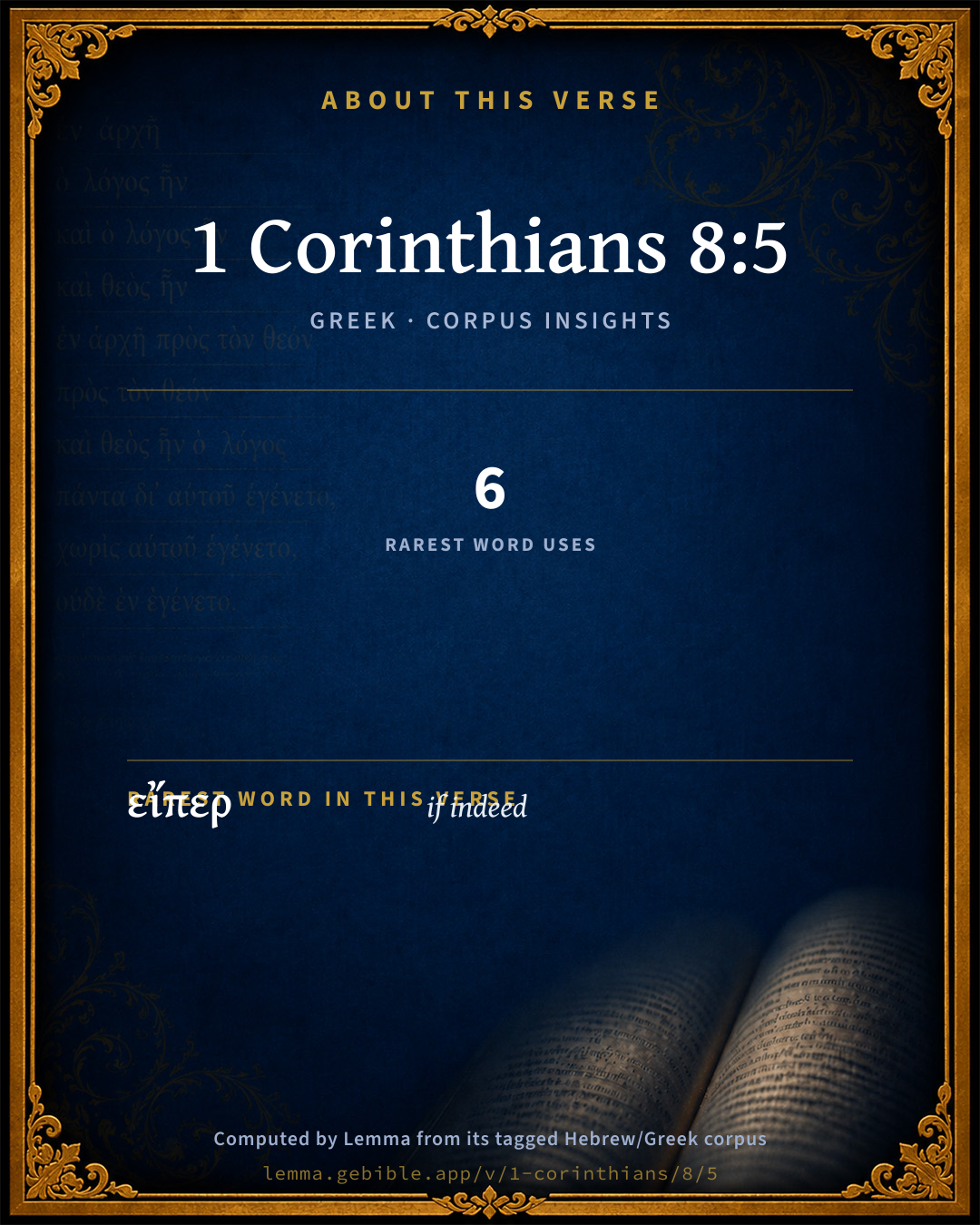
1 Corinthians 8:5

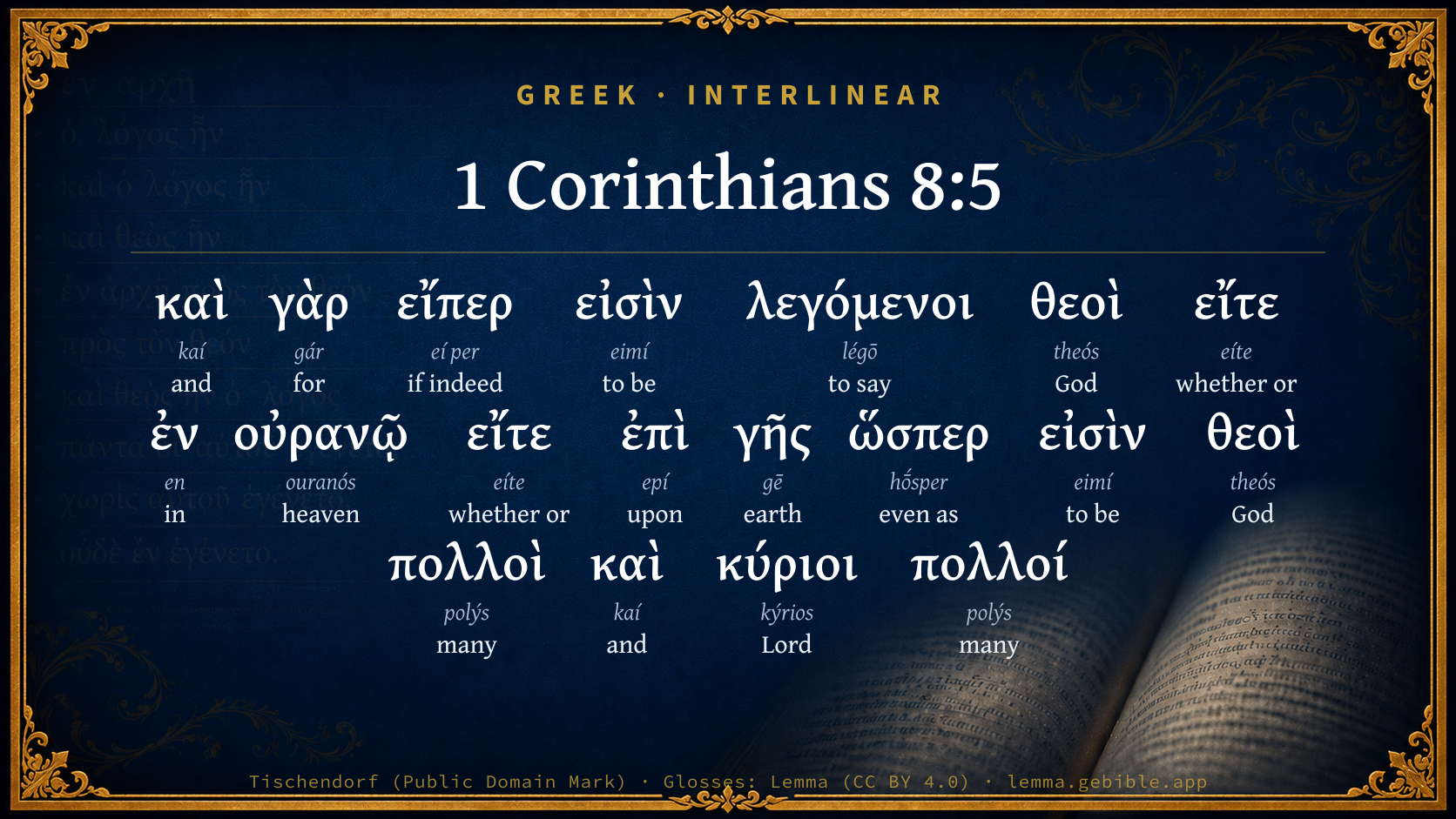
Greek (Tischendorf 8th ed.) 1 Corinthians 8:5 appears in the Greek New Testament. The text above is from the Tischendorf 8th edition. Each word links to its Strong’s number and a concise gloss. Click any word for its full Thayer’s Greek Lexicon entry.
Download image
Cite this verse

1 Corinthians 8:5 (World English Bible). Public Domain. Lemma interlinear Bible study tool, https://lemma.gebible.app/v/1-corinthians/8/5.

Show BibTeX & RIS
BibTeX
RIS
English Translation
For though there are things that are called "gods," whether in the heavens or on earth; as there are many "gods" and many "lords;"
World English Bible · Public Domain
Download a study sheet

One document with this verse’s original text, its word-by-word gloss line, the meaning frame, cross-references with their text, attributed commentary, and full source and license credits — printable, and it pastes into notes with its structure intact.

This verse Autodidact and up

Study sheet (.html) Plain text (.txt)

A passage Seminary Student

Up to 50 verses in one chapter. A passage sheet keeps up to 6 commentary sources and 12 cross-references per verse, in the order this page ranks them, and says so on the sheet whenever that leaves anything out. Ask for a single verse and you get the Autodidact verse sheet above.

Everything on this page stays free to read, with no account — the sheet is a download of what is already on screen, not access to it.

Want to remove ads? Support Godless Engineer
Compare translations 3

The same verse in 3 English versions, stacked beneath the original-language interlinear above. Click any original word for its lexicon entry.

Each is an independent rendering of the whole verse — the interlinear is not word-aligned to these translations.

Highlighted words mark where these versions differ — a whole-verse word diff, not a word-by-word alignment.

  • World English Bible Public Domain
    For though there are things that are called "gods," whether in the heavens or on earth; as there are many "gods" and many "lords;"
  • King James Version Public Domain
    For though there be that are called gods, whether in heaven or in earth, (as there be gods many, and lords many,)
  • unfoldingWord Literal Text CC BY-SA 4.0
    For even if there are so-called gods, whether in heaven or on earth, just as there are many “gods” and many “lords,”

unfoldingWord Literal Text — © unfoldingWord, licensed CC BY-SA 4.0. Word-aligned USFM3 via Door43 (git.door43.org/unfoldingWord/en_ult).

Versions to compare (up to 4)

3 of 4 selected

Show all 19 translations

Every available English version of this verse, each an independent rendering of the whole verse.

  • World English Bible Public Domain
    For though there are things that are called "gods," whether in the heavens or on earth; as there are many "gods" and many "lords;"
  • Berean Standard Bible Public Domain
    For even if there are so-called gods, whether in heaven or on earth (as there are many so-called gods and lords),
  • Majority Standard Bible Public Domain
    For even if there are so-called gods, whether in heaven or on earth (as there are many so-called gods and lords),
  • King James Version Public Domain
    For though there be that are called gods, whether in heaven or in earth, (as there be gods many, and lords many,)
  • American Standard Version (1901) Public Domain
    For though there be that are called gods, whether in heaven or on earth; as there are gods many, and lords many;
  • Revised Version (1885) Public Domain
    For though there be that are called gods, whether in heaven or on earth; as there are gods many, and lords many;
  • Geneva Bible (1599) Public Domain
    For though there bee that are called gods, whether in heauen, or in earth (as there be many gods, and many lords)
  • Douay-Rheims (1899) Public Domain
    For although there be that are called gods, either in heaven or on earth (for there be gods many, and lords many);
  • Young's Literal Translation Public Domain
    for even if there are those called gods, whether in heaven, whether upon earth -- as there are gods many and lords many --
  • Literal Standard Version CC BY-SA 4.0
    for even if there are those called gods, whether in Heaven, whether on earth—as there are many gods and many lords—
  • Unlocked Literal Bible CC BY-SA 4.0
    For maybe so-called gods do exist, either in heaven or on earth, just as there are many “gods” and many “lords.”
  • unfoldingWord Literal Text CC BY-SA 4.0
    For even if there are so-called gods, whether in heaven or on earth, just as there are many “gods” and many “lords,”
  • Darby Bible Public Domain
    For and if indeed there are [those] called gods, whether in heaven or on earth, (as there are gods many, and lords many,)
  • World Messianic Bible Public Domain
    For though there are things that are called “gods”, whether in the heavens or on earth—as there are many “gods” and many “lords”—
  • Webster's Bible Public Domain
    For though there are that are called gods, whether in heaven or upon earth, (as there are gods many, and lords many)
  • Free Bible Version CC BY-SA 4.0
    Even though there are some things called “gods,” whether in heaven or on earth—in fact there are many “gods” and “lords.”
  • Bible in Basic English Public Domain
    For though there are those who have the name of gods, in heaven or on earth, as there are a number of gods and a number of lords,
  • Text-Critical English NT CC BY 4.0
    For even if there are so-called gods, whether in heaven or on earth (as indeed there are many “gods” and many “lords”),
  • Tyndale New Testament (1534) Public Domain
    And though ther be that are called goddes whether in heven other in erth (as ther be goddes many and lordes many)

Literal Standard Version (2020), Covenant Press — licensed CC BY-SA 4.0. Text via the HelloAO Bible API (eBible.org). Unlocked Literal Bible (unfoldingWord) — licensed CC BY-SA 4.0. Text via the HelloAO Bible API (eBible.org). unfoldingWord Literal Text — © unfoldingWord, licensed CC BY-SA 4.0. Word-aligned USFM3 via Door43 (git.door43.org/unfoldingWord/en_ult). Free Bible Version, Dr. Jonathan Gallagher — licensed CC BY-SA 4.0. Text via the HelloAO Bible API (eBible.org).

Word by word

More ways to search: Search by grammar → Find every occurrence → Compare this word →

Practice this passage: Drill this verse → Learn its vocabulary →

εἴπερ
eí per
G1512
“if indeed”
Conditional
Part of Speech
Conditional
Full Thayer's Definition

Origin: from G1487 and G4007

TDNT: None

1. if indeed, since, if after all
  1. καὶ kaí G2532 “and” Conjunction
  2. γὰρ gár G1063 “for” Conjunction
  3. εἰσὶν eimí G1510 “to be” Verb, Present, Active, Indicative, 3rd person, Plural
  4. λεγόμενοι légō G3004 “to say” Verb, Present, Passive, Participle, Nominative, Plural, Masculine
  5. θεοὶ theós G2316 “God” Noun, Nominative, Plural, Masculine
  6. εἴτε eíte G1535 “whether or” Conjunction
  7. ἐν en G1722 “in” Preposition
  8. οὐρανῷ ouranós G3772 “heaven” Noun, Dative, Singular, Masculine
  9. εἴτε eíte G1535 “whether or” Conjunction
  10. ἐπὶ epí G1909 “upon” Preposition
  11. γῆς gē G1093 “earth” Noun, Genitive, Singular, Feminine
  12. ὥσπερ hṓsper G5618 “even as” Adverb
  13. εἰσὶν eimí G1510 “to be” Verb, Present, Active, Indicative, 3rd person, Plural
  14. θεοὶ theós G2316 “God” Noun, Nominative, Plural, Masculine
  15. πολλοὶ polýs G4183 “many” Adjective, Nominative, Plural, Masculine
  16. καὶ kaí G2532 “and” Conjunction
  17. κύριοι kýrios G2962 “Lord” Noun, Nominative, Plural, Masculine
  18. πολλοί polýs G4183 “many” Adjective, Nominative, Plural, Masculine

About this verse

These counts appear in no published source. They are computed here, from the morphology-tagged text and Lemma’s own curated glosses. What Lemma adds →

19
words
14
distinct lemmas
Pauline Epistles
section

Notable vocabulary

The rarest word here is εἴπερ if indeed G1512 — appearing just 6 times in the whole Greek New Testament.

Shared distinctive vocabulary

εἴπερ if indeed G1512 occurs in 6 verses of the Greek New Testament. Also found in:

Repetition

Words recur within this verse:

  • εἰσὶν to be G1510 ×2
  • θεοὶ God G2316 ×2
  • εἴτε whether or G1535 ×2
  • πολλοὶ many G4183 ×2
  • καὶ and G2532 ×2

Cross-references

8

Topical passages linked to 1 Corinthians 8:5 in the Treasury of Scripture Knowledge — connected by theme and wording, ordered by reader-vote popularity; previews shown in the World English Bible.

  • Jeremiah 2:28 But where are your gods that you have made you? let them arise, if they can save you in the time of your trouble: for according to the number of your cities are your gods, Judah.
  • Galatians 4:8 However at that time, not knowing God, you were in bondage to those who by nature are not gods.
  • 2 Thessalonians 2:4 he who opposes and exalts himself against all that is called God or that is worshiped; so that he sits as God in the temple of God, setting himself up as God.
  • Deuteronomy 10:17 For Yahweh your God, he is God of gods, and Lord of lords, the great God, the mighty, and the awesome, who doesn't regard persons, nor takes reward.
  • Jeremiah 2:11 Has a nation changed [its] gods, which yet are no gods? but my people have changed their glory for that which does not profit.
  • Jeremiah 11:13 For according to the number of your cities are your gods, Judah; and according to the number of the streets of Jerusalem have you set up altars to the shameful thing, even altars to burn incense to Baal.
  • Daniel 5:4 They drank wine, and praised the gods of gold, and of silver, of brass, of iron, of wood, and of stone.
  • John 10:34–35 Jesus answered them, "Isn't it written in your law, 'I said, you are gods?'

Cross-references courtesy of OpenBible.info (CC BY 4.0).

Commentary

Notes on 1 Corinthians 8:5 from classic Christian and Jewish commentators (each source and its license shown beneath its notes). The classic Christian expositions comment on the surrounding passage and are grouped to its opening verse, so a note may address several verses; the Jewish commentaries on the Tanakh (Rashi and others) are per-verse, so they appear only where the commentator wrote on this verse.

Lemma curates 59 commentaries, every one of them public domain or Creative Commons licensed, each selected and text-cleaned for this edition rather than reprinted as found. About our sources →

Bengel's Gnomon

Johann Albrecht Bengel

1Co 8:5. Λεγόμενοι, that are called) God is said to be the supremely powerful One. Hence by homonymy [things or persons distinct in nature receiving by analogy the same name], angels who are powerful on account of their spiritual nature, and men who are powerful from being placed in authority, are called gods.—ἐν οὐρανῷ, in heaven)—ἐπὶ γῆς, on earth) The provinces of the gods among the Gentiles were divided into heaven, and earth, along with the sea; but each of these belongs to God.—θεοὶ πολλοὶ καὶ κύριοι πολλοὶ, gods many and lords many) Psa 136:2-3.

Bengel's Gnomon of the New Testament — English translation (T&T Clark, Edinburgh, 1860) — public domain. Text from a community e-Sword module.

Meyer's Critical & Exegetical Commentary

Heinrich August Wilhelm Meyer

1Co_8:5. For (γάρ) even (καί) if really (εἴπερ, see Hartung, Partikell. I. p. 343; Baeumlein, Partik. p. 202) there exist so-called gods, whether in heaven or on earth. Heathenism conceived heaven and earth to be filled with beings whom they called gods (Jupiter, Apollo, and so forth; gods of the woods and the rivers, etc.). Paul does not admit the existence of such gods,[1325] but merely supposes it, and that with καὶ εἴπερ. i.e. even in the case that, if there be in reality, if after all, whereby of course in incerto relinquitur, utrum jure an injuria sumatur (Hermann, a[1326] Viger. p. 834), this, however, not being implied in εἴπερ by itself, but by the connection in which it stands here. Comp Rom_8:9; Rom_8:17, etc.; and see Baeumlein, l.c. The supposed casethe reality of which is still left to stand on its own footingis then established, so far as its possibility is concerned, by ὥσπερ κ.τ.λ[1328]: as there are, indeed, gods many and lords many. What is conceded here is the premiss from which that possibility may be drawn as a consequence. If there exist, that is to say, a multitude of superhuman beings, who come under the category of θεοί (in the wider sense) and ΚΎΡΙΟΙ, then we must admit that it is possible that those whom the heathen call gods

Jupiter, Apollo, and so onhave an actual existence.[1329] The θεοὶ πολλοί and ΚΎΡΙΟΙ ΠΟΛΛΟΊ are, as the connection necessarily leads us to understand, not human rulers, deified kings, and the like, but the superhuman powers (angels), of whom it is said in Deu_10:17 : ὁ γὰρ Κύριος ὁ Θεὸς ὑμῶν, οὗτος Θεὸς τῶν θεῶν καὶ Κύριος τῶν κυρίων. Comp Psa_136:2-3. Most commentators take ΕἸΣΊ as said e gentilium persuasione (so Pott, Flatt, Heydenreich, de Wette, Ewald, Neander, Maier), which would give as the sense of the whole: if there be in reality so-called gods among the heathen, as, indeed, they speak of many gods and lords (de Wette). But this explanation runs counter to the fact that εἰσί is put first with emphasis; and the e gentilium persuasione is neither expressed nor hinted at in the text, but is a pure insertion of the commentators, and that with the less warrant, seeing that it is the emphatic ἡμῖν in the apodosis that first introduces a contrast with others. This applies, too, against the arbitrary distinction made by Billroth, who maintains that only the first ΕἸΣΊ denotes real existence (the ΛΕΓΌΜ. ΘΕΟΊ being demons, x. 20), while with the second we should supply: in the view of the heathen. Rückert takes both the first and second εἰσί in the right sense, but makes ΕἼΠΕΡ mean,contrary to the rules of the language,although it must be conceded that (which is not its meaning even in such passages as those given by Kühner, II. § 824, note 2), and supposes that the apostle conceived the angels and demons to be the realities answering to the λεγόμ. θεοί.[1331]

As regards καὶ εἰ, etiam, tum, si, which marks the contents of the conditional clause as uncertain, comp on Mar_14:29; and see Hermann, a[1333] Viger. p. 832; Stallbaum, a[1334] Plat. Apol. p. 32 A. It is here the etiamsi de re in cogitatione posita, Ellendt, Lex. Soph. I. p. 884. Examples of καὶ γὰρ εἰ, for even if, may be seen in Hartung, Partikell. I. p. 141.

[1325] We know from 1Co_10:20 that he did not allow that the gods as such existed at all, but held those beings regarded as gods to be demons. Comp. Weiss, bibl. Theol. p. 279.

[1326] d refers to the note of the commentator or editor named on the particular passage.

[1328] .τ.λ. καὶ τὰ λοιπά.

[1329] The meaning of the verse, therefore, freely rendered, would be: For even if we suppose that the gods of the heathen mythology have a real existence, which is no such absurd supposition, seeing that there is not merely One God and One Lord (in the wider sense of these words), but gods many and lords many: still for us Christians, etc., ver. 6. Hofmann agrees substantially with our exposition of the passage. See also his Schriftbew. I. p. 348.

[1331] There is no ground whatever for bringing in the demons here from 1Co_10:20 (this in opposition to Olshausen and others). The second part of the verse, which makes no further mention of λεγομένοις θεοῖς, should have sufficed of itself to prevent this; still more the correlation in which the many gods and lords stand to the εἷς Θεός and εἷς Κύριος in ver. 6.

[1333] d refers to the note of the commentator or editor named on the particular passage.

[1334] d refers to the note of the commentator or editor named on the particular passage.

1Co_8:5-6. Confirmatory elucidation of the preceding statement ὅτι οὐδὲν εἴδωλον … εἰ μὴ εἶς.

Meyer — Critical and Exegetical Commentary on the New Testament — English translation by Peter Christie, edited by Frederick Crombie (T&T Clark, 1880) — public domain. Text from a community e-Sword module.

Expositor's Greek Testament

ed. W. Robertson Nicoll

1Co 8:5 may be an interjected comment of the Church Letter upon its creed; ( c ) the expression “gods many and lords many” applied to heathen divinities, which is foreign to Pauline as to Jewish phraseology, but natural on the lips of old polytheists ; ( d ) the aptness with which ἀλλʼ οὐκ ἐν πᾶσιν ἡ γνῶσις (1Co 8:7 ) fits in with this explanation, being understood as Paul’s reply to his readers’ declaration of their enlightened faith. See, on this question, W. Lock in Expositor , ., vi., 65. The articles of belief cited from the Cor [1234] in 1Co 8:4 b and 6 had probably been formulated first by P., like the Πάντα μοι ἔξεστιν of 1Co 6:12 , and so would be fitly quoted to him. οὐδὲν εἴδωλον ἐν κόσμῳ ( cf. 1Co 10:19 ), being parl [1235] to οὐδεὶς Θεός κ . τ . λ ., should be rendered not “An idol is nothing,” etc., but “There is no idol in the world” (so R.V. virtually, Mr [1236] , Hf [1237] , Bt [1238] , Ed [1239] , Sm [1240] ). Existence is denied to the idol not absolutely (see 5, 1Co 10:19 f.), but relatively; it has no real place ἐν κόσμῳ , no power over the elements of nature; “the earth is the Lord’s,” etc. (1Co 10:26 ); there is no Zeus in the sky, nor Poseidon ruling the sea, but “one God and Father” everywhere, a faith emancipating enlightened Christians from every heathenish superstition. οὐδὲν εἴδωλον κ . τ . λ . forms the polemic counterpart to οὐδεὶς Θεὸς εἰ μὴ εἷς (see parls.), the cornerstone of Jehovism, which Christ has made the world’s creed. εἴδωλον ( sc. a thing possessing εἶδος , form only), semblance, phantasm , renders in the LXX several Hebrew words for false gods esp. ’elîlîm , nothings , and hebhel, emptiness ; the term was applied first to the images, then to the (supposed) godships they represent, branding them as shams and shows: see 1Th 1:9 , Act 14:15 , Psa 96:5 . The κόσμος reveals the being and power of the One God (Rom 1:20 ); idolaters have no living God, but are ἄθεοι ἐν τῷ κόσμῳ (Eph 2:12 ).

[1234] Corinth, Corinthian or Corinthians.

[1235] parallel.

[1236] Meyer’s Critical and Exegetical Commentary (Eng. Trans.).

[1237] J. C. K. von Hofmann’s Die heilige Schrift N.T. untersucht , ii. 2 (2te Auflage, 1874).

[1238] J. A. Beet’s St. Paul’s Epp. to the Corinthians (1882).

[1239] T. C. Edwards’ Commentary on the First Ep. to the Corinthians . 2

[1240] P. Schmiedel, in Handcommentar zum N.T. (1893).

[1241] Corinth, Corinthian or Corinthians.

[1242] C. J. Ellicott’s St. Paul’s First Epistle to the Corinthians .

[1243] ad locum , on this passage.

[1244] parallel.

[1245] participle

[1246] Greek, or Grotius’ Annotationes in N.T.

[1247] Greek, or Grotius’ Annotationes in N.T.

[1248] Greek, or Grotius’ Annotationes in N.T.

The Expositor's Greek Testament, edited by W. Robertson Nicoll (1897–1910) — public domain. Text from a community e-Sword module.

Hodge's Commentary on Romans, Ephesians & First Corinthians

Charles Hodge

1Co_8:5

For though there be that are called gods, whether in heaven or in earth, as there be gods many, and lords many,

This verse admits of two interpretations. It is commonly understood to mean, that although there are many imaginary gods in heaven and earth, i.e. beings whom the heathen regard as divinities, yet in fact there is but one God. When he says, there are many gods and many lords, he is to be understood to mean that such is the fact in the mythology of the heathen. A large number of commentators, however, understand the passage thus: There is but one true God; for although it be admitted that there are many beings called gods, as in fact there are gods many and lords many, yet to us there is but one. The apostle concedes that, in the wide sense of the term, there are many gods and lords; and, therefore, if it should be admitted (what he does not admit) that the whole hierarchy of divinities, as conceived of by the heathen, actually existed, it is nevertheless true that there is but one God, the creator and end of all things. In favor of this interpretation is the usage of the O. T. Deu_10:17 The Lord your God is God of gods and Lord of lords. Jos_22:22. Dan_2:47. Psa_136:2, Psa_136:3.

1. These passages show that the words god and lord are applied in a wide sense to other beings than to the true God.

2. The position and force of the words are in favor of this view. They mean, Sunt qui dii dicuntur; there are powers and beings who are called gods, as there are gods many, and lords many. To make this mean, there are in the estimation of the heathen many gods, is to insert something which is not in the text.

3. In 1Co_10:19, 1Co_10:20, the apostle asserts that the objects of heathen worship are real and powerful beings.

4. The apparent contradiction between saying, there is no idol in the world, and saying, there are many gods, is easily removed. The meaning is, There is no such being in the universe as Jupiter or Mars; for although there is a multitude of supernatural beings, called gods and lords, not only by the heathen, but also in Scripture, yet there are no such beings as those which the heathen imagine.

The whole heathen mythology is a fable, the work of the imagination. There are no such gods in existence, though there are demons in abundance, of various ranks and powers, called gods. There are two things which the apostle means to deny.

1. The existence of such beings as the heathen conceived their gods to be.

2. That the supernatural beings who do really exist, and who are called gods, are really divine. They are mere creatures.

Charles Hodge — Commentary on Romans (1835), First Corinthians (1857), and Ephesians (1856) — public domain. Text from a community e-Sword module.

Jamieson, Fausset & Brown

Robert Jamieson, A. R. Fausset & David Brown

"For even supposing there are (exist) gods so called (Th2 2:4), whether in heaven (as the sun, moon, and stars) or in earth (as deified kings, beasts, &c.), as there be (a recognized fact, Deu 10:17; Psa 135:5; Psa 136:2) gods many and lords many." Angels and men in authority are termed gods in Scripture, as exercising a divinely delegated power under God (compare Exo 22:9, with Exo 22:28; Psa 82:1, Psa 82:6; Joh 10:34-35).

Jamieson, Fausset & Brown — Commentary Critical and Explanatory on the Whole Bible (1871) — public domain (CC PDM 1.0). Text via the HelloAO Bible API.

Adam Clarke's Commentary

Verse 5. There be that are called gods] There are many images that are supposed to be representations of divinities: but these divinities are nothing, the figments of mere fancy; and these images have no corresponding realities.

Whether in heaven or in earth] As the sun, moon, planets, stars, the ocean, rivers, trees, &c. And thus there are, nominally, gods many, and lords many.

Adam Clarke's Commentary on the Bible (1810–1826) — public domain. Text from a community e-Sword/MySword module.

John Calvin's Commentaries

5. For though there be that are called “They have,” says he, “the name, but the reality is wanting.” He uses the word called here, to mean — renowned in the estimation of men He has also made use of a general division, when he says in heaven or on earth The gods that are made mention of as being in heaven, are the heavenly hosts, as the Scripture terms the sun, moon, and the other stars. How very far they are, however, from being entitled to divine honors, Moses shows from this, that they were created for our use. The sun is our servant; the moon is our handmaid. How absurd, therefore, it is to render to them divine honors! By the gods that are on earth, are properly meant, in my opinion, men and women for whom religious worship has been appointed. For, as Pliny observes, those who had deserved well of mankind had their memory consecrated by religion, so as to be worshipped as deities — Jupiter, Mars, Saturn, Mercury, and Apollo, who were mortal men, but were, after death, exalted to the rank of deities; and, more recently, Hercules, Romulus, and at length the Caesars — as if it were in the power of mankind to make deities at their pleasure, while they cannot give to themselves either life or immortality. There are also other gods that are terrestrial, taken either from cattle or from brute creatures, as, for example, among the Egyptians, the ox, the serpent, the cat, the onion, the garlic; and, among the Romans, the boundary-stone, and the stone Vesta. They are gods, then, only in name; but Paul says that he does not stop to notice deifications of this sort.

John Calvin's Commentaries (1540-1563) — public domain. Text from the Calvin Translation Society English edition (1840s-50s) via the Christian Classics Ethereal Library (ccel.org). Calvin's coverage is partial (roughly two-thirds of the Bible); uncommented books and verses are honest gaps, never fabricated. The 19th-century editor's footnotes and remarks are omitted so the notes are faithfully Calvin's own voice.

Ellicott's Commentary for English Readers

(5) For though there be. . . .—This is an hypothetic argument. “Be” is the emphatic word of the supposition. Even assuming that there do exist those beings which are called “gods” (we have a right to make such a supposition, for Deu_10:17, Psa_105:2-3, speaks of “gods and lords” of another kind), the difference between the heathen, “gods many” and the “lords and gods” of whom the Old Testament speaks, is that the former are deities, and the latter only a casual way of speaking of angels and other spiritual subjects and servants of the one God. This is brought out in the following verse.

A Bible Commentary for English Readers, edited by Charles John Ellicott (1878–1897) — public domain. Text from a community e-Sword module.

The Cambridge Bible for Schools and Colleges

gen. ed. J. J. S. Perowne

5. as there be gods many, and lords many] The Apostle does not say there are many gods or lords, but only that the gods of the heathen are called so. Calvin reminds us that the sun and moon, which have been deified by some, are but our servants, and that other so-called gods of the heathen are but deified powers of nature, or deified men.

The Cambridge Bible for Schools and Colleges (gen. ed. J. J. S. Perowne; Cambridge University Press, 1878–1918) — public domain. Text from a community e-Sword module.

John Gill's Exposition

For though there be that are called gods,.... That are so by name, though not by nature; who are called so in Scripture, as angels and magistrates, or by men, who give them such names, and account them so:

whether in heaven; as the sun, moon, and stars:

or in earth; as men who formerly lived on earth; or various creatures on earth, who have been accounted deities; or stocks and stones graven by man's device:

as there be gods many: almost without number, as were among the Egyptians, Grecians, Romans, and others; yea, even among the Jews, who falling into idolatry, their gods were according to the number of their cities, Jer 2:28

and lords many; referring to the Baalim, or the several idols that went by the name of Baal, or lord, as Baal Peor, Num 25:3 Baal Zephon, Exo 14:2 Baal Zebub, Kg2 1:2 Baal Berith, Jdg 8:33.

John Gill's Exposition of the Whole Bible (1746–1763) — public domain (CC PDM 1.0). Text via the HelloAO Bible API.

Trapp's Complete Commentary

John Trapp

5 For though there be that are called gods, whether in heaven or in earth, (as there be gods many, and lords many,)

Ver. 5. That are called gods] Hesiod reckons up 30,000 of them that were in his time, Τρις γαρ μυριοι εισιν επι χθονι πουλυβοτειρη αθανατοι. What an army may we think there were of them in later ages!

As there be gods many] The serpent’s grammar first taught Deum pluraliter declinare, " Ye shall be as gods," Gen 3:5, saith Damianus.

And lords many] Demi gods, heroes, whose images were worshipped. Ninus was the first that made an image for his father Belus, and all that came to see it were pardoned for all their offences; whence in time that image came to be worshipped. But they did a very ill office that first brought in images, saith Varro (as Calvin citeth his words), "for they increased error and took away fear." And Plutarch saith, It is sacrilege to worship by images.

John Trapp, A Commentary or Exposition upon All the Books of the Old and New Testament (1647–1656) — public domain. Text from a community e-Sword module.

Albert Barnes' Notes on the Bible

That are called gods - Gods so called. The pagans everywhere worshipped multitudes, and gave to them the name of gods.

Whether in heaven - Residing in heaven, as a part of the gods were supposed to do. Perhaps, there may be allusion here to the sun, moon, and stars; but I rather suppose that reference is made to the celestial deities, or to those who were supposed to reside in heaven, though they were supposed occasionally to visit the earth, as Jupiter, Juno, Mercury, etc.

Or in earth - Upon the earth; or that reigned particularly ever the earth, or sea, as Ceres, Neptune, etc. The ancient pagans worshipped some gods that were supposed to dwell in heaven; others that were supposed to reside on earth; and others that presided over the inferior regions, as Pluto, etc.

As there be gods many - ὥσπερ hōsper, etc. As there are, in fact, many which are so called or regarded. It is a fact that the pagans worship many whom they esteem to be gods, or whom they regard as such. This cannot be an admission of Paul that they were truly gods, and ought to he worshipped; but it is a declaration that they esteemed them to be such, or that a large number of imaginary beings were thus adored. The emphasis should be placed on the word “many;” and the design of the parenthesis is, to show that the number of these that were worshipped was not a few, but was immense; and that they were in fact worshipped as gods, and allowed to have the influence over their minds and lives which they would have if they were real; that is, that the effect of this popular belief was to produce just as much fear, alarm, superstition, and corruption, as though these imaginary gods had a real existence. So that though the more intelligent of the pagan put no confidence in them, yet the effect on the great mass was the same as if they had had a real existence, and exerted over them a real control.

And lords many - (κύριοι πολλοὶ kurioi polloi). Those who had a “rule” over them; to whom they submitted themselves; and whose laws they obeyed. This name “lord” was often given to their idol gods. Thus, among the nations of Canaan their idols was called בּצל Ba‛al, (“Baal, or lord”), the tutelary god of the Phoenicians and Syrians; Jdg 8:33; Jdg 9:4, Jdg 9:46. It is used here with reference to the IdoLS, and means that the laws which they were supposed to give in regard to their worship had control over the minds of their worshippers.

Albert Barnes' Notes on the Bible (1834–1885) — public domain. Text from a community e-Sword/MySword module.

Haydock's Catholic Bible Commentary

Many gods, &c. Reputed for such among the heathens. (Challoner)

George Leo Haydock (1774–1849), Haydock's Catholic Family Bible and Commentary, 1859 edition — public domain. Excludes Psalms (Douay-Rheims chapter numbering differs from Protestant) and Deuterocanonical books (Catholic canon only).

Matthew Poole's English Annotations

There are many whom heathens call gods, and whom God himself calleth gods: the angels that are in heaven are called God’s host, Gen 32:2; the heavenly host, Luk 2:13; the sons of God, Job 1:6; 2:1. Magistrates are also called gods, Psa 82:6, because God hath committed a great part of his power unto them. Thus there are many gods and many lords.

Matthew Poole's English Annotations on the Holy Bible (1683–1685) — public domain. Text from a community e-Sword/MySword module.

Whedon's Commentary on the Bible

Daniel D. Whedon

5. Called gods—The world is full of pantheons and mythologies of gods, so called by their worshippers.

In heaven or in earth—Chrysostom says, that in heaven means the sun and stars, worshipped by Persians and others; on earth, the gods and demigods in human form, as in the Greek mythology. Yet the phrase refers, perhaps, to the name of God as above, and to Christ as manifest on earth.

There be—In men’s estimation and worship.

Daniel D. Whedon (gen. ed.), Commentary on the Old and New Testaments (1874–1909) — public domain. Text from a community e-Sword module.

The Pulpit Commentary

For though there be that are called gods. The verse is a limitation of the phrase which perhaps he had quoted from their letter. There are, indeed, demons, and there are created things, like the host of heaven and the powers of nature, which are called gods and pass for gods. Gods many, and lords many. Perhaps a passing allusion to the use of elohim, gods, for men in great positions, and to the habitual deification of Roman emperors even in their lifetime. The title "Augustus," which they all had borne, was to Jewish ears "the name of blasphemy", (Rev_13:1) implying that they were to be objects of reverence. Indeed, the worship of the Caesars was, in that strange epoch of mingled atheism and superstition, almost the only sincere cult that was left.

Vers. 5, 6.

The unity of God.

The Apostle Paul had been trained in the monotheism which had from the first been the belief of the Hebrew race, and from which they had not for centuries previous to his time ever swerved. But as a preacher of Christianity, a religion which aspired to world wide empire, he was constantly brought, especially as the apostle of the Gentiles, into contact with the worshippers of idols, both philosophic and popular. And he was often called to be the counsellor of those who, although called out of heathenism, still lived in a heathen atmosphere and were entangled in consequence in not a few practical difficulties. In discussing for the benefit of these Corinthian questions of conduct arising out of their necessary association with those who practised heathen customs, Paul took his stand boldly and uncompromisingly upon the great religious doctrine of the unity of God.

I THE UNITY OF GOD IS CONTRASTED WITH POLYTHEISTIC BELIEF AND WORSHIP.

1. The deities of the heathen are called gods. They are called, but they are not; it is a delusion. "An idol is nothing in the world." The grand denunciation of the Hebrew psalm occurs to the mind: "Eves have they, but they see not," etc.

2. These deities are deemed "gods" and "lords." They were and still are, in heathen lands, deemed superhuman, supernatural, and are invested by the imagination with some claims to the homage, reverence, and service of intelligent men.

3. They are in number many, every river and grove having its deity. It is well known that the heathen had. even their household gods, e.g. the Romans their lares et penates.

4. They have their several localities and ranks and. realms of dominion. They are "in heaven," as the superior Olympian deities; or "on earth," as those inferior numina which haunt this lower world, nymphs and fauns and, dryads, etc. Such was the system which Christianity found, with which Christianity came into conflict.

II THE UNITY OF GOD FURNISHES A CENTRE AND AN AIM FOR THE NEW RELIGIOUS LIFE OF MEN.

1. In himself he is "the one God, the Father." In itself this was a glorious revelation; and in Jesus Christ provision was made for its wide promulgation and acceptance.

2. He is the Creator and Upholder of all; "Of whom are all things.

3. And especially he is the great Object of our faith, love, and devotion. We are "for, ... unto him." It is at this point that the great revelation of the new theology becomes the great motive of the new religion. Polytheism distracted the minds of the worshippers, and made it impossible that faith in God should become the inspiration of a new and better life; for it was a question What measure of reverence and of service shall be offered to this deity, and what to that? But Christianity revealed one God, in whom are all perfections, and who is not only the Creator but the moral Governor and Saviour of mankind. They who live to serve this God have an elevating, purifying, powerful aim in the conduct of their life.

III THE UNITY OF GOD FURNISHES THE NOBLEST MOTIVE TO THE NEW RELIGIOUS LIFE.

1. The one God is made known by the one Lord Jesus Christ. It is a misunderstanding of the Scripture doctrine to conceive of this view of the Redeemer as conflicting with the monotheism which is the glory of the Bible revelation. The one Lord reveals the one God, as the Word. reveals the Utterer, as the Son reveals the Father.

2. Christ is the universal Mediator, "by whom are all things." This is the doctrine of John as well as of Paul. And we may well understand the moral as well as the physical creation to be included. For all the Blessings which the Father destines for humanity he has resolved to confer by Jesus Christ.

3. We as Christians are what we are "through him." As in the former clause we recognized the great aim, so here we recognize the great means and motive of the new, the distinctively Christian life. The Divine nature and mediation of Immanuel, so far from obscuring our belief in the unity of God, is the best and strongest and most effectual support of that doctrine. Even as Jesus himself said, "He that hath seen me hath seen the Father;" and "No man cometh unto the Father but by me. T.

Vers. 5, 6.

Not gods, but God.

Two primary and foundation truths of religion were committed to the keeping of the Jews as a nation. They were revealed to, and fully apprehended by, Abraham, and were the reason for his separation from his polytheistic surroundings in the country of the Chaldees, and for the subsequent remarkable isolation of his descendants in the small, compact, yet central country of Palestine. Those two truths were the unity and the spirituality of God. "God is one;" "God is a Spirit." It is the first of these truths which St. Paul here reaffirms, in view of the pagan conception of many deities and divinities; and there can be no doubt concerning the clear cut testimony which Christianity makes to the truth of the Divine unity. There is only one God, whose favour and reconciliation we have to seek, and whose claim to obedience and service we must meet. It is true that Mohammedanism also affirms the unity of God, but it adds the questionable statement, "and Mahomet is his prophet." Christianity does indeed declare that there are "three persons in one God;" and that "Jesus Christ is the Son of God;" but both these truths are to be held, and can be held, consistently with our faith in the Divine unity. We have to avoid the perils of tritheism, and of conceptions of the divinity of Christ which fall short of his essential Deity; for "the Word was God;" "God manifest in the flesh." In the verses before us we have

I THE COMMON NOTION OF GODS AND LORDS. "As there be gods many, and lords many." Paganism peopled earth and sea and sky with different orders of divinities, and imagined gods presiding over mountains, streams, and flowers; over flood and. pestilence and fire; over virtue and over vice; over families and nations. Illustrate by the impressions made upon St. Paul when he first entered Athens. The place seemed to him crowded with idols, "given over to idolatry." There was a regular hierarchy; and probably a dim notion of one supreme god. to whom the rest were subordinate, but as these lesser gods and lords stood in direct and close relations with men, it was inevitable that they should get all the worship. Illustrate from what is observed in heathen lands now; especially where heathenism is associated with learning and civilization, as in India. Show what complicated social questions arise in that country out of the conflicting claims of the multitudinous gods and lords; and the painful uncertainty which men in idolatrous countries must feel as to whether they have propitiated the right god, or left an offended one still to execute his vengeance. In contrast with elaborate heathenism, the worship and service of the one God is simple and satisfying. Fear God, and there is no one else to fear.

II THE CHRISTIAN NOTION OF "GOD" AND "LORD." The two words may be taken to include the Divine Being as an Object of worship, and as our practical Ruler. Our God is at once the highest Being we can conceive, who rightly claims our reverence; and the very centre of all authority, to whose will we must wholly bow. But the two terms may be used to indicate the oneness, yet distinction, of the Father and the Son. The term "lord" suggests the immediacy of Christ"s relations to us. So the word "God" may stand for the essential being; and the word "Lord" for the mediatorial being.

1. The essential being God. Four points are here noticed by St. Paul.

(1) God is one.

(2) He is the Father that relation being the most suitable for representing him, because it includes the personal interest of his love for each one of his creatures, which such words as "King," "Ruler," "Judge," "Moral Governor," do not.

(3) All things are of him. He is the one and only Creator of things and of men. And

(4) we are witnesses for him, who are bound to hold firmly, and show forth fully, this first truth of the one Father God.

2. His mediatorial being. Under this term we apprehend the one God as the Lord Jesus Christ, and we are to see that he is practically

(1) our present Lord and Ruler;

(2) our only Mediator in his manifestation of himself in our flesh and upon our earth; and

(3) our Christian standing and Christian hope are only in him and by him. Fully embracing this truth of the Divine unity, we shall be wholly delivered from the fear of offending the "gods many or lords many," whether they be fellow men or imagined divinities. R.T.

The Pulpit Commentary (1880–1919), ed. H.D.M. Spence-Jones & Joseph S. Exell — public domain. Text from a community e-Sword module.

John Wesley's Explanatory Notes

For though there be that are called gods - By the heathens both celestial, (as they style them,) terrestrial, and infernal deities.

John Wesley, Explanatory Notes Upon the Whole Bible (1754–1765) — public domain. Text via the GEBible commentary corpus.

Burkitt's Expository Notes on the New Testament

William Burkitt

Here the apostle tells them, that although the heathen idolaters acknowledged a plurality of gods, some in heaven, as the sun, moon, and stars; some on earth, as men and beasts, they having their celestial and terrestrial gods and lords; but these were only called gods, that is, gods in name, not in nature, not in reality.

Yet, says he, we Christians do own and acknowledge but one living and true God, one in nature, not one in person, to whom all our prayers must be directed; and one Mediator, by whom all our prayers are to be offered: To us there is but one God, the Father.

This text the Arians, Socinians, and Unitarians, exceedingly boast of, as if it expressly confined the Deity to the Father, as distinct from Christ and the Holy Ghost.

Thus they argue:--"He who says there is one emperor, to wit, Cesar, says in effect there is no other emperor but Cesar: so when St. Paul saith, there is one God the Father, he doth (say they) in effect declare that there is no other God besides the Father."

To this the orthodox answer, 1. "That God the Father is often put in scripture for the whole deity, comprehending the three persons; he being Fons Deitatis, and Fundamentum Trinitatis, as the schoolmen speak. So that the application of the word God here unto the Father, doth not exclude the Son from being God, but only from being the Fountain of the Deity, as the Father is.

Christ says, I am Alpha and Omega, the first and the last. Rev 1:17

Will any conclude thence, that God the Father is not Alpha and Omega? Is not he the first and the last, as well as Christ?

Again, We call our Lord Jesus the only Saviour: do we therefore exclude God the Father from being a Saviour: Is he not styled the Saviour of all men? 1Ti 4:10

Again, God the Father is called the Creator of all things: yet it is asserted that all things were created by Christ, the Word, Joh 1:2.

In short, we assert as well as they, the unity of the Godhead, and that Christ is not another God, but only another person from the Father.

We answer, 2. Their own argument may be thus retorted upon themselves: As the apostle says here, there is but one God the Father, so he adds in the next words, there is but one Lord Jesus Christ.

Now if the saying that there is but one God, doth exclude Christ from being God, , then the saying that there is but one Lord, doth exclude God the Father from being Lord; and if it be blasphemy to exclude God the Father from being Lord; it is no less to exclude Christ the Son from being God."

Know then, that as Christians have in all ages of the church acknowledged one God only, even God the Father, so have they also owned that Jesus Christ was truly God, of the substance of the Father, God of God, very God of very God. The Lord keep us stedfast in this faith! seeing he that honoureth the Son honoureth the Father that hath sent him; but he that denieth the Son denieth the Father also.

William Burkitt's Expository Notes on the New Testament (1700–1703) — public domain. Text from a community e-Sword module.

Godbey's Commentary on the New Testament

William B. Godbey

5. “For if indeed there are those denominated gods, whether in Heaven or upon earth,” i. e., all these idols are denominated gods, many fabled to live in Heaven and myriads dwelling on the earth. “As there are gods many and lords many.” These fabulous unreal divinities are the many gods, and the men on the earth in the different nations, honored with the epithet “lord,” are the “lords many” here mentioned.

William B. Godbey, Commentary on the New Testament (1896–1900) — public domain. Text from a community e-Sword module.

McGarvey & Pendleton's Commentaries

J. W. McGarvey

For though there be that are called gods, whether in heaven [as celestial bodies, or as myths] or on earth [as idols]; as there are gods many [the Greek cities had pantheons and temples filled with them], and lords many [the Roman emperors, and even lesser dignitaries, demanded that divine honors be paid them];

J. W. McGarvey (with Philip Y. Pendleton), Commentaries on the New Testament (The Fourfold Gospel, 1914; Acts; and the epistles) — public domain. Text from a community e-Sword/MySword module.

The People's New Testament

B. W. Johnson

5. Though there be that are called gods. The heathen world worshiped many false gods.

B. W. Johnson's The People's New Testament with Notes (1889–1891) — public domain. Electronic text from the Christian Classics Ethereal Library (CCEL) ThML edition.

Cambridge Greek Testament for Schools and Colleges

5. καὶ γὰρ εἴπερ εἰσίν. ‘For even if we admit that there are,’ a supposition the truth of which the Apostle immediately concedes. εἴπερ with the present is equivalent to since.

ὥσπερ εἰσὶν θεοὶ πολλοὶ καὶ κύριοι πολλοί. The Apostle here certainly gives his adhesion to the existence of these beings, though he does not (see next verse) regard them as divine. They exist, and are called θεοί by the heathen. But the term is a misnomer. δαιμόνια is the proper title for those spiritual beings whom the heathen worship. But an idol is nothing whatever. See ch. 1Co 10:19-20. What St Paul would deny is that the εἴδωλον or representation had any sort of affinity with the beings who really rejoiced in men’s ignorance on this point, and profited by it. On this mysterious question cf. Joh 12:31; Joh 14:30; 2Co 4:4; Eph 6:12, and the Revelation passim.

Cambridge Greek Testament for Schools and Colleges (Cambridge University Press, 1896; 21 vols, various authors incl. Carr, Maclear, Plummer, Farrar, Lumby, Moule, M. R. James, Simcox) — public domain. Text from a community e-Sword module.

Alford’s Greek Testament

Henry Alford

5.] For even supposing that (εἴπερ makes an hypothesis, so that “in incerto relinquitur, jure an injuria sumatur,” Herm. ad Viger., p. 834. See also Hartung, Partikellehre, i. 343, who gives many examples.

καὶ γὰρ εἰ, as Eur. Med. 450, καὶ γὰρ εἰ σύ με στυγεῖς, οὐκ ἂν δυναίμην σοὶ κακῶς φρονεῖν ποτε; see Hartung, Partikellehre, i. 140 f.) beings named gods (not those who are named gods, οἱ λεγ. θ., i. esset, all who are so named) exist (the chief emphasis is on εἰσίν, on which the hypothesis turns), whether in heaven, whether upon earth, as (we know that) there are (viz. as being spoken of, Deu 10:17, ὁ γὰρ κύριος ὁ θεὸς ὑμῶν, οὗτος θεὸς τῶν θεῶν καὶ κύριος τῶν κυρίων, see also Psa 135:2, Psa 135:3) gods many, and lords many (the ὥσπερ brings in an acknowledged fact, on which the possibility of the hypothesis rests—‘Even if some of the many gods and many lords whom we know to exist, be actually identical with the heathen idols …’ The Apostle does not concede this, but only puts it). This exegesis, which is Meyer’s, is denied by De Wette, who takes εἴπερ as concessive, ‘even though,’ and understands εἰσίν both times as only ‘are,’—in the meaning of the heathen,—imagining it impossible that Paul should have seriously said in an objective sense, ‘there are gods many.’ But in the sense in which he uses θεοί (see above) there is no unlikelihood that he should assert this.

Chrys. gives the following explanation: καὶ γὰρ εἴπερ εἰσὶ λεγόμενοι θεοί, ὥσπερ οὖν καὶ εἰσίν, οὐχ ἁπλῶς εἰσίν, ἀλλά, λεγόμενοι, οὐκ ἐν πράγματι, ἀλλʼ ἐν ῥήματι τοῦτο ἔχοντες· εἴτε ἐν οὐρανῷ, εἴτε ἐπὶ γῆς· ἐν οὐρανῷ τὸν ἥλιον λέγων κ. τὴν σελήνην κ. τὸν λοιπὸν τῶν ἄστρων χορόν· καὶ γὰρ καὶ ταῦτα προσεκύνησαν Ἕλληνες· ἐπὶ γῆς δὲ δαίμονας, καὶ τοὺς ἐξ ἀνθρώπων θεοποιηθέντας ἅπαντας. Hom. xx. p. 172. And similarly Theodoret, Theophyl., Œcum., Calv., Beza, Calov., Estius, Schrader, al. See the various minor differences of interpretation, in Pool’s Synopsis and De Wette: and a beautiful note in Stanley.

There is a sentence in Herodotus (9:27) singularly resembling this in its structure: ἡμῖν δέ, εἰ μηδὲν ἄλλο ἐστὶ ἀποδεδεγμένον, ὥσπερ ἐστὶ πολλά τε καὶ εὖ ἔχοντα, … ἀλλὰ καὶ ἀπὸ τοῦ ἐν Μαραθῶνι ἔργου ἄξιοί ἐσμεν, κ.τ.λ. Cf. also Hom. Il. α. 81 f.; φ. 576 f.

Henry Alford, The Greek Testament (1849–1861) — public domain. Text from a community e-Sword module.

International Critical Commentary

5. καὶ γὰρ εἴπερ κ.τ.λ. ‘For even granted that there are so-called gods, whether in heaven or upon earth, just as there are gods many and lords many.’ Here εἲπερ εἰσέν and ὥσπερ εἰσίν are correlative, and εἰσίν must be taken in the same sense in both clauses. If both refer to what really exists, the meaning will be, ‘If you like to say that, because there are supernatural beings in abundance, as we all believe, therefore the so-called gods of the heathen really exist, nevertheless for us Christians there is only one God.’* If both refer to heathen superstition, the meaning will be, ‘Granted that there are so called gods, as there are—plenty of them; still for us,’ etc. He seems to mean that to the worshippers the idol is an object of adoration; so that, while actually they worship a nonentity, ethically they are worshippers of δαιμόνια (10:20). Jehovah is God of gods and Lord of lords (Deu 10:17; Psa 136:2, Psa 136:3), and therefore the second εἰσίν probably refers to actual existence. Moreover, St Paul, while denying that the heathen gods existed (see Lightfoot on Gal 4:8), yet held that heathen sacrifices were offered to beings that do exist (10:19-21); there were supernatural powers behind the idols, although not the gods which the idols represented. It is perhaps too much to say that εἴπερ, which in N.T. is peculiar to St Paul (2Th 1:6; Rom 3:30, Rom 3:8:9, Rom 3:17), is used of what the writer holds to be true or probable, yet it certainly does not imply that the hypothesis is improbable: ‘granted that’ is the meaning. See Sanday and Headlam, p. 96; Thackeray, p. 144. ‘Whether in heaven or on earth’ gives the two main divisions of the κόσμος in v. 4. Dicuntur dii in caelo, ut sol, luna et varia sidera; in terra, imago Jovis, Mercurii atque Herculis (Atto). More probably the latter are the heavenly, while the earthly are the nymphs, fauns, etc. See Stanley’s notes on this verse.

International Critical Commentary — older volumes (1896–1929), various authors — public domain. Text from a community e-Sword module.

Vincent's Word Studies in the New Testament

Marvin R. Vincent

Gods - lords. Superhuman beings to whom these titles are given, as Eph 6:12; 2Co 4:4; Joh 12:31; Joh 14:30.

Marvin R. Vincent, Word Studies in the New Testament (1887–1900) — public domain. Text from a community e-Sword/MySword module.

Godet's Commentaries

Frédéric Louis Godet

Vv. 5, 6. “For though there be that are called gods, whether in heaven or in earth, as there be gods many, and lords many, 6. but to us there is but one God, the Father, of whom are all things, and we in Him, and one Lord, Jesus Christ, by whom are all things, and we by Him.” — Καὶ γάρ, and indeed. Paul affirms, in harmony with the Corinthians, that whatever may be the multiplicity of gods worshipped by the heathen, the Christian recognises only one God, Him whose character he here defines, and but one Lord, the Mediator between God and men. “The imagination of the Greeks,” says Beet, “filled with divinities the visible and invisible heavens, and on earth, mountains, forests, and rivers.” These are the λεγόμενοι θεοί, the beings designated by the name of gods and worshipped as such, but who, as the epithet indicates, have only the name of deity. The two propositions which begin, the one with εἴπερ, even though, the other with ὥσπερ, as indeed, have been very variously understood, according as the two verbs εἰσί, are, which stand at the head of both, have been taken to denote a logical or a real existence. In the view of Rückert, Olshausen, Meyer, Kling, Hofmann, real existence is to be understood in both cases in this sense: “Even if (εἴπερ) the gods of mythology really exist (a supposition which is not absurd), agreeably to the fact that (ὥσπερ) there really exist gods and lords in abundance (the angels in their different orders enumerated by Paul, Eph 1:21; Col 1:16; comp. Deu 10:17 and Psa 136:2-3), even if such gods really exist, yet there is for us, Christians, only one God and one Lord.” But it is not easy to explain clearly the relation between these two real existences, the former of which on this understanding is put as hypothetical, and then the second as certain, and which nevertheless both relate to one and the same subject. Others, like Chrysostom, Calvin, Beza, Neander, de Wette, regard these two existences as imaginary. “Even though (εἴπερ) the heathen worship a multitude of fictitious gods, as one may see, indeed (ὥσπερ), that according to them, every place is full of gods and lords....” But de Wette himself cannot help seeing the useless tautology of these two propositions of really identical meaning. Commentators of a third view, like Grotius, Billroth, understand the former of the two εἰσί, are, in the sense of a real existence, the latter in that of an imaginary existence: “Even though there really exists a host of beings, such as the sky, the sun, the moon, the earth, the ocean, which are made gods, as it may be seen in fact that among the heathen these are deities.” But with what view would the apostle thus insist on the reality of the creatures which heathenism had deified? If, as is exact, one of the two verbs should denote a real, the other a fictitious existence, is it not much more natural to interpret in the latter sense that one of the two εἰσί (are), which is accompanied by the participle λεγόμενοι, called? For this apposition undoubtedly does not force us (comp. 2Th 2:4) to attribute an imaginary character to these gods, but it permits and leads to it. In this case the following would be the meaning of the verse: “Even though there are in abundance beings called gods, and worshipped as such, with whom the imagination of the heathen peoples both heaven and earth (Jupiter, Apollo, Mars, Ceres, Bacchus, Nymphs), as in fact (ὥσπερ) there really exist—we must not be deceived on the point—gods many and lords many....” By these last words the apostle means, that if the particular mythological deities are only fictions, there is yet behind these fictions a reality of which we must take account. In 1Co 10:20 he expressly declares, that “what the Gentiles sacrifice they sacrifice to demons;” not, certainly, that he regards the god Jupiter as one demon and the god Apollo as another; but in heathenism in general he recognises the work of malignant spirits, who have turned man away from God, and filled the void thus formed in the soul with this vain and impure phantasmagoria. It is in the same sense that he describes demons, Eph 6:12, as “rulers of the present darkness;” that he calls Satan, 2Co 4:4, the god of this world who blinds the unbelieving; and that Jesus Himself calls him the Prince of this world (Joh 12:31; Joh 14:30). The term, gods many, refers to the heads of this kingdom of darkness; the term, lords many, to the inferior spirits, the subordinate agents; comp. in our Epistle 1Co 15:24.

If criticism, such as is practised in our day, had the least interest in setting our Epistle in opposition to that of the Romans, how easy would it be for it to maintain by means of this passage, either that they proceed from two different authors, or that the apostle’s ideas had become changed in the interval between the one and the other! In point of fact, the explanation which the apostle gives of the origin of heathenism in the Epistle to the Romans (chap. 1) is purely psychological, and leaves wholly out of account all influence exercised by superior beings. But the two explanations hold true together and complete one another. The apostle emphasizes in each Epistle that which is of importance to the subject he is treating; in Romans, where he wishes to bring out the corruption of mankind, he shows the moral origin of idolatry: how this great collective sin proceeded from the heart of man; in our Epistle, where he has in view certain practical rules to be drawn for the conduct of the Corinthians, he emphasizes the diabolical influence which concurred to produce heathenism. Is there not a lesson of prudence and wise reserve to be drawn from this fact for so many other analogous cases? It will be seen afterwards with what view the apostle here presents simultaneously these two aspects of the truth: on the one side, the nothingness of heathen divinities; and, on the other, the diabolical reality which is hidden under this empty phantasmagoria. The first point of view will justify the liberty allowed in regard to the eating of offered meats; the second, the absolute prohibition against taking part in the idol feasts.

Vv. 6. With these fictitious, and yet, in a certain sense, real gods and lords, Paul forcibly contrasts by the adverb ἀλλά, but, and the pronoun ἡμῖν, for us, put first, the only God and the only Lord recognised by the Christian conscience. The title the Father, added to the word God, is taken in the absolute sense in which it embraces His Fatherhood both in relation to Christ and to us. The apostle here adds two notions: the proceeding of all things from God alone (ἐξ οὗ, of whom), and the moral consecration of believers to Him alone (εἰς αὐτόν, for Him). In such a context he cannot be intending to describe thereby His greatness and perfection; but he means that nothing of all that forms part of the universe created by such a Being (offered meats in particular) can defile the believer (1Co 10:25-26). How could that which is made by God prevent him from being and remaining for God what he ought to be? (see Hofmann).

As God, the Father, is contrasted with the principal heathen deities, Christ, the Lord, is so with the secondary deities who served as mediators between the great gods and the world. What Paul means is, that as the world is from God, and the Church for God; so the world is by Christ, and the Church also by Him.

The former of the two propositions relative to Christ: by whom are all things, can only apply, as is recognised by all the critics of our time, de Wette, Heinrici, Reuss, Meyer, and even Pfleiderer and Holtzmann, to the work of creation. Baur thinks that the διά may be referred in the first proposition, as well as in the second, to the work of redemption. But the ἡμεῖς, we, of the second proposition evidently contrasts Christians, as objects of redemption, with τὰ πάντα, all things, as objects of another work, which, as is shown by the previous proposition, can only be creation. Holsten, alone, cannot bring himself to this avowal. In the words, all things by Him, he finds only the idea of the government of all things by the glorified Christ. But the by Him corresponds to the of Him (ἐξ αὐτοῦ) of the previous proposition, and can consequently apply only to the same work, that of creation, of which God is the author and Christ the agent. It is the same thought as in Col 1:15-17, where the ἐν corresponds to our διά, and as in Joh 1:3, where the δἰ αὐτοῦ expresses the creation of all things by the Logos. The idea which Holsten finds in this proposition would, besides, be out of all relation to Paul’s object, which is to show that a meat divinely created cannot separate man from God. The Vaticanus, instead of δἰ οὗ, reads δἰ ὅν, on account of whom; evidently the mistake of a copyist.

In the second proposition the word ἡμεῖς, we, contrasted with all things, shows that the subject in question is the spiritual creation accomplished by Christ, the work of salvation. These words have their commentary in Col 1:18-22, as the preceding in Col 1:15-17. They form the counterpart of the second preceding proposition relating to God. In the physical order we are of God and by Christ; in the spiritual order we are by Christ and for God.

We have already pointed out more than once how, notwithstanding the diversity of forms, the views of Paul coincide with those of John. We have just seen this in connection with the regimen δἰ οὗ, which so vividly reminds us of the δἰ αὐτοῦ of Joh 1:3. This connection is equally striking if we compare from the Christological viewpoint this saying of Paul with Joh 17:3. In the two passages, the personal distinction between God and Christ is strongly emphasized, though the community of nature between both appears from this very distinction, and from all the rest of the books where these sayings are contained. Reuss maintains that there are in the Gospel of John two opposite theories going side by side; but we must in that case say the same of the writings of the Apostle Paul, whose rigorous logic no one disputes. In point of fact there is no contradiction in either; for both emphasize with the full consciousness of what they affirm the subordination of the Son in the unity of the Divine life; see on 1Co 3:23.

Here we have one of the passages which establish the complete unity of the apostle’s Christology in his first letters, and in those of his imprisonment (Col., Eph., Phil.). “Let there be an end then,” says Gess rightly (Apost. Zeugn., ii. p. 295), “to the assertion that the Christology of the later Epistles is contrary to that of Paul; according to which Christ, it is held, is nothing more than the ideal or celestial man, and that though one is forced to allow that our passage makes Him the mediator of the creation of the universe!”

Thus far, St. Paul would say, we are all at one, but here now is the point where difference begins, and this difference impresses the Christian who loves, with regard and sacrifices toward those whose judgment differs from his.

Frédéric Louis Godet — Commentaries on Luke, John, Romans, and 1 Corinthians — English translation (T&T Clark, Edinburgh, 1870s–1890s) — public domain. Text from a community e-Sword module.

Lesson kit

Teaching starters — assembled from the data on this page, not authored interpretation. Every prompt links to the verse data it draws on. Edit before teaching.

1 Corinthians, in the Pauline Epistles, opens this verse with 19 words (14 distinct Greek lemmas). Its most distinctive word is eí per (“if indeed”). A historical commentator’s framing appears above. Read the whole chapter for the surrounding context.

Discussion questions

  1. What does “if indeed” (eí per) contribute to the verse as a whole?
  2. Romans 3:30 shares the word «if indeed» with this verse. How do the two illuminate each other?
  3. “to be” occurs 2× in this one verse. What is the effect of the repetition?
  4. These translations render this verse differently. What is at stake in choosing one wording over another?
  5. Reading how Bengel's Gnomon and Meyer's Critical & Exegetical Commentary read this verse, where do the two commentators agree and where do they part?

Things to notice

  • These translations choose different wording for 8 words in this verse.
  • “to be” occurs 2× in this single verse.
  • 14 distinct Greek lemmas span 19 words in this verse.

Reading settings

Reading text

Shown beneath each verse's original-language words.

Old Testament
Old Testament edition

Read the OT as the Masoretic Hebrew (MT) or the Greek Septuagint (LXX).

English shown for the Greek Septuagint (in the Hebrew ↔ Greek comparison).

Comparing translations? Open the Compare panel on any verse page to stack up to four side by side.