Matthew 22:2

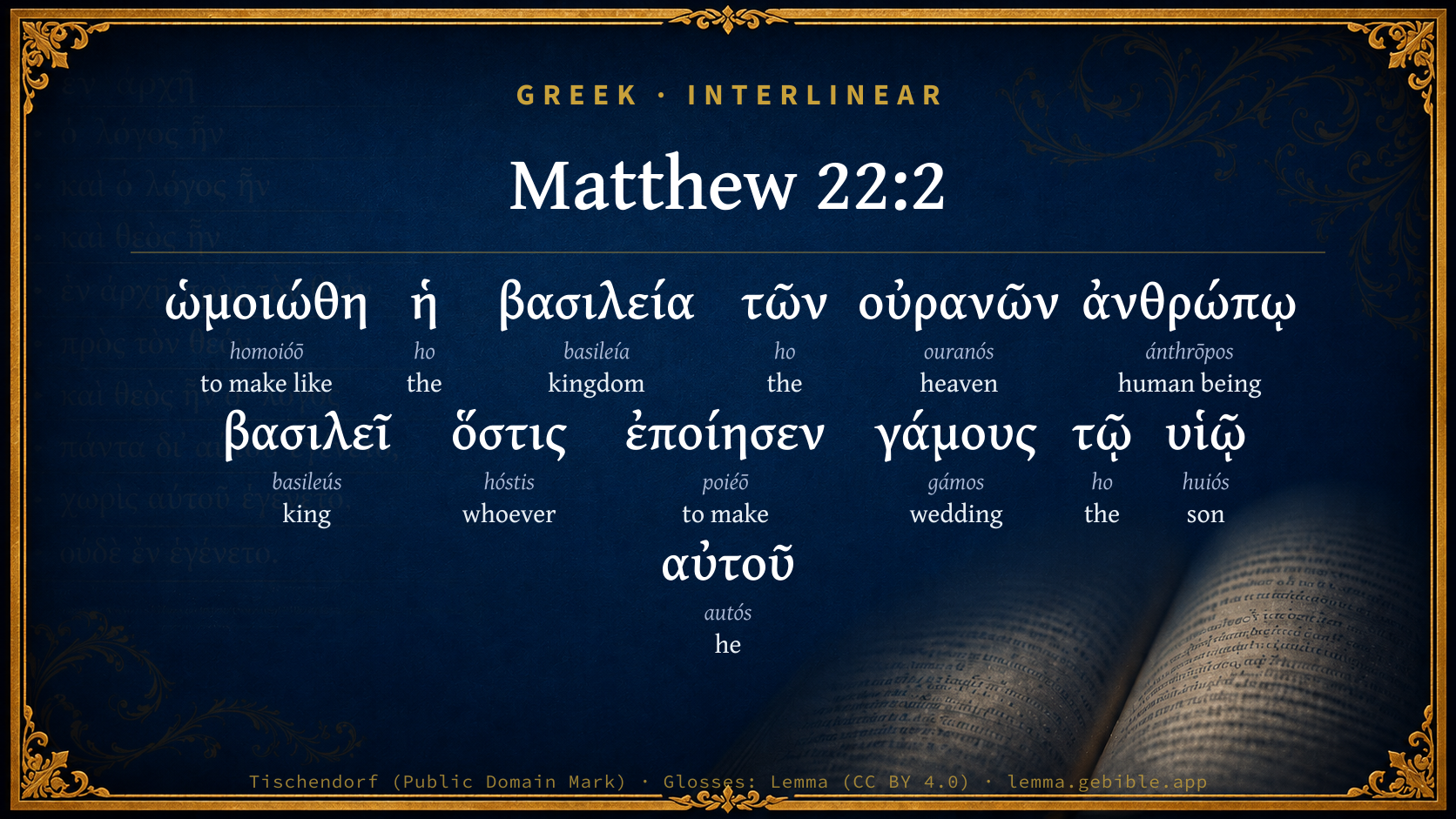
Greek (Tischendorf 8th ed.) Matthew 22:2 appears in the Greek New Testament. The text above is from the Tischendorf 8th edition. Each word links to its Strong’s number and a concise gloss. Click any word for its full Thayer’s Greek Lexicon entry.
Download image
Cite this verse

Matthew 22:2 (World English Bible). Public Domain. Lemma interlinear Bible study tool, https://lemma.gebible.app/v/matthew/22/2.

Show BibTeX & RIS
BibTeX
RIS
English Translation
"The Kingdom of Heaven is like a certain king, who made a marriage feast for his son,
World English Bible · Public Domain
Highlights
  • 1 first appearance in the Greek New Testament
Full analysis ↓
Download a study sheet

One document with this verse’s original text, its word-by-word gloss line, the meaning frame, cross-references with their text, attributed commentary, and full source and license credits — printable, and it pastes into notes with its structure intact.

This verse Autodidact and up

Study sheet (.html) Plain text (.txt)

A passage Seminary Student

Up to 50 verses in one chapter. A passage sheet keeps up to 6 commentary sources and 12 cross-references per verse, in the order this page ranks them, and says so on the sheet whenever that leaves anything out. Ask for a single verse and you get the Autodidact verse sheet above.

Everything on this page stays free to read, with no account — the sheet is a download of what is already on screen, not access to it.

Want to remove ads? Support Godless Engineer
Compare translations 3

The same verse in 3 English versions, stacked beneath the original-language interlinear above. Click any original word for its lexicon entry.

Each is an independent rendering of the whole verse — the interlinear is not word-aligned to these translations.

Highlighted words mark where these versions differ — a whole-verse word diff, not a word-by-word alignment.

  • World English Bible Public Domain
    "The Kingdom of Heaven is like a certain king, who made a marriage feast for his son,
  • King James Version Public Domain
    The kingdom of heaven is like unto a certain king, which made a marriage for his son,
  • unfoldingWord Literal Text CC BY-SA 4.0
    “The kingdom of the heavens is compared to a man, a king, who made a wedding feast for his son.

unfoldingWord Literal Text — © unfoldingWord, licensed CC BY-SA 4.0. Word-aligned USFM3 via Door43 (git.door43.org/unfoldingWord/en_ult).

Versions to compare (up to 4)

3 of 4 selected

Show all 19 translations

Every available English version of this verse, each an independent rendering of the whole verse.

  • World English Bible Public Domain
    "The Kingdom of Heaven is like a certain king, who made a marriage feast for his son,
  • Berean Standard Bible Public Domain
    “The kingdom of heaven is like a king who prepared a wedding banquet for his son.
  • Majority Standard Bible Public Domain
    “The kingdom of heaven is like a king who prepared a wedding banquet for his son.
  • King James Version Public Domain
    The kingdom of heaven is like unto a certain king, which made a marriage for his son,
  • American Standard Version (1901) Public Domain
    The kingdom of heaven is likened unto a certain king, who made a marriage feast for his son,
  • Revised Version (1885) Public Domain
    The kingdom of heaven is likened unto a certain king, which made a marriage feast for his son,
  • Geneva Bible (1599) Public Domain
    The kingdome of heauen is like vnto a certaine King which maried his sonne,
  • Douay-Rheims (1899) Public Domain
    The kingdom of heaven is likened to a king, who made a marriage for his son.
  • Young's Literal Translation Public Domain
    `The reign of the heavens was likened to a man, a king, who made marriage-feasts for his son,
  • Literal Standard Version CC BY-SA 4.0
    “The kingdom of the heavens was likened to a man, a king, who made wedding feasts for his son,
  • Unlocked Literal Bible CC BY-SA 4.0
    “The kingdom of heaven is like a certain king who prepared a marriage feast for his son.
  • unfoldingWord Literal Text CC BY-SA 4.0
    “The kingdom of the heavens is compared to a man, a king, who made a wedding feast for his son.
  • Darby Bible Public Domain
    The kingdom of the heavens has become like a king who made a wedding feast for his son,
  • World Messianic Bible Public Domain
    “The Kingdom of Heaven is like a certain king, who made a wedding feast for his son,
  • Webster's Bible Public Domain
    The kingdom of heaven is like to a certain king, who made a marriage for his son,
  • Free Bible Version CC BY-SA 4.0
    “The kingdom of heaven is like a king who organized a wedding celebration for his son,” Jesus explained.
  • Bible in Basic English Public Domain
    The kingdom of heaven is like a certain king, who made a feast when his son was married,
  • Text-Critical English NT CC BY 4.0
    “The kingdom of heaven can be compared to a king who prepared a wedding feast for his son.
  • Tyndale New Testament (1534) Public Domain
    The kingdome of heven is lyke vnto a certayne kynge which maryed his sonne

Literal Standard Version (2020), Covenant Press — licensed CC BY-SA 4.0. Text via the HelloAO Bible API (eBible.org). Unlocked Literal Bible (unfoldingWord) — licensed CC BY-SA 4.0. Text via the HelloAO Bible API (eBible.org). unfoldingWord Literal Text — © unfoldingWord, licensed CC BY-SA 4.0. Word-aligned USFM3 via Door43 (git.door43.org/unfoldingWord/en_ult). Free Bible Version, Dr. Jonathan Gallagher — licensed CC BY-SA 4.0. Text via the HelloAO Bible API (eBible.org).

Word by word

More ways to search: Search by grammar → Find every occurrence → Compare this word →

Practice this passage: Drill this verse → Learn its vocabulary →

ὡμοιώθη
homoióō
G3666
“to make like”
Verb, Aorist, Passive, Indicative, 3rd person, Singular
Part of Speech
Verb
Tense
Aorist
Voice
Passive
Mood
Indicative
Person
3rd person
Number
Singular
Full Thayer's Definition

Origin: from G3664

TDNT: 08:08,7

1. to be made like 2. to liken, compare a. illustrate by comparisons
  1. ἡ ho G3588 “the” Article, Nominative, Singular, Feminine
  2. βασιλεία basileía G932 “kingdom” Noun, Nominative, Singular, Feminine
  3. τῶν ho G3588 “the” Article, Genitive, Plural, Masculine
  4. οὐρανῶν ouranós G3772 “heaven” Noun, Genitive, Plural, Masculine
  5. ἀνθρώπῳ ánthrōpos G444 “human being” Noun, Dative, Singular, Masculine
  6. βασιλεῖ basileús G935 “king” Noun, Dative, Singular, Masculine
  7. ὅστις hóstis G3748 “whoever” Relative pronoun, Nominative, Singular, Masculine
  8. ἐποίησεν poiéō G4160 “to make” Verb, Aorist, Active, Indicative, 3rd person, Singular
  9. γάμους gámos G1062 “wedding” Noun, Accusative, Plural, Masculine
  10. τῷ ho G3588 “the” Article, Dative, Singular, Masculine
  11. υἱῷ huiós G5207 “son” Noun, Dative, Singular, Masculine
  12. αὐτοῦ autós G846 “he” Personal pronoun, Genitive, Singular, Masculine

About this verse

These counts appear in no published source. They are computed here, from the morphology-tagged text and Lemma’s own curated glosses. What Lemma adds →

13
words
11
distinct lemmas
Gospels
section

Notable vocabulary

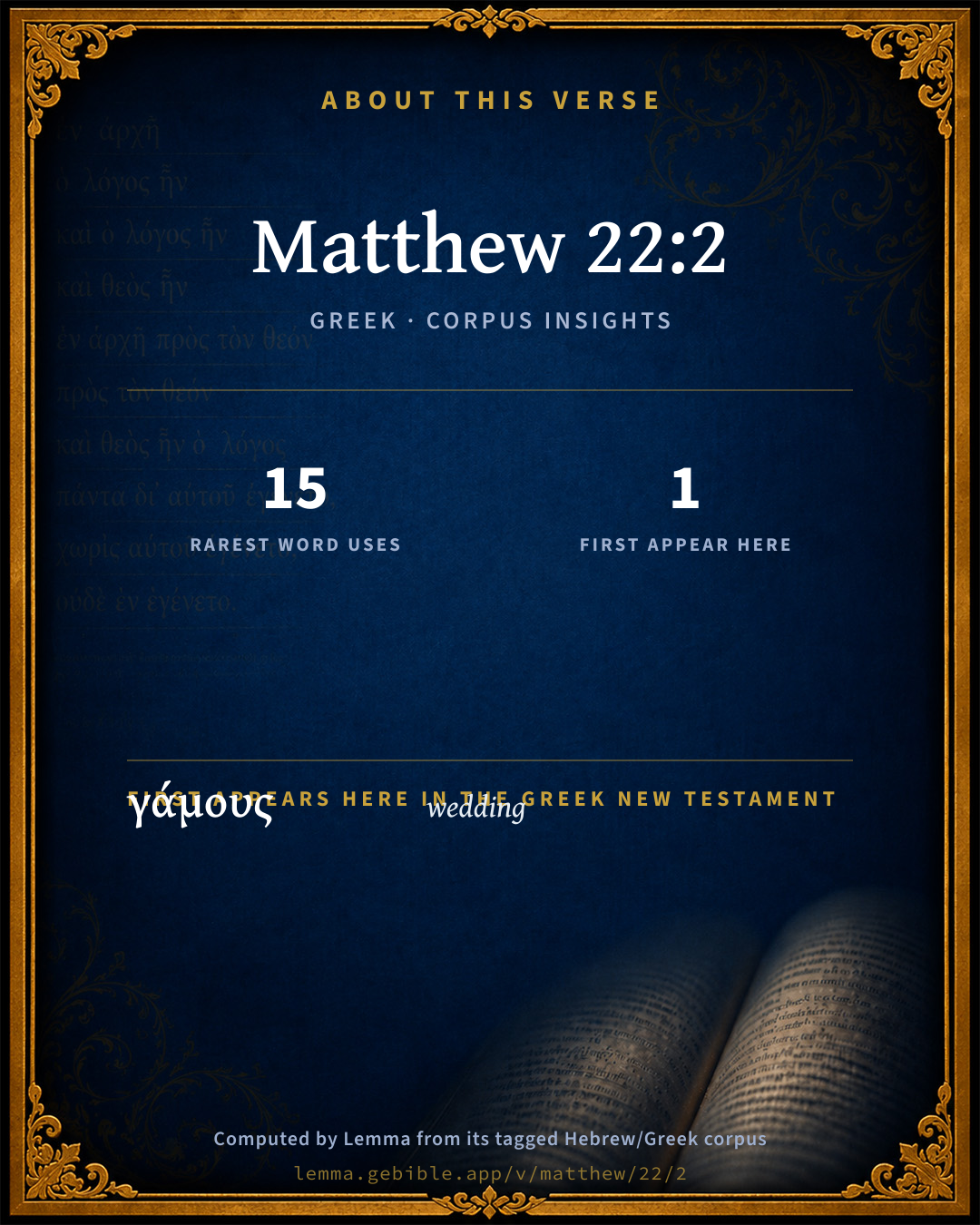
The rarest word here is ὡμοιώθη to make like G3666 — appearing just 15 times in the whole Greek New Testament.

First appearance in Scripture

This word makes its first canonical appearance in the Greek New Testament here:

  • γάμους wedding G1062

Shared distinctive vocabulary

ὡμοιώθη to make like G3666 occurs in 15 verses of the Greek New Testament. Also found in:

Repetition

A word recurs within this verse:

Cross-references

11

Topical passages linked to Matthew 22:2 in the Treasury of Scripture Knowledge — connected by theme and wording, ordered by reader-vote popularity; previews shown in the World English Bible.

  • Matthew 13:24 He set another parable before them, saying, "The Kingdom of Heaven is like a man who sowed good seed in his field,
  • Revelation 19:7–9 Let us rejoice and be exceedingly glad, and let us give the glory to him. For the marriage of the Lamb has come, and his wife has made herself ready."
  • Ephesians 5:24–32 But as the assembly is subject to Christ, so let the wives also be to their own husbands in everything.
  • Psalms 45:10–16 Listen, daughter, consider, and turn your ear. Forget your own people, and also your father's house.
  • 2 Corinthians 11:2 For I am jealous over you with a godly jealousy. For I married you to one husband, that I might present you as a pure virgin to Christ.
  • Matthew 13:31–33 He set another parable before them, saying, "The Kingdom of Heaven is like a grain of mustard seed, which a man took, and sowed in his field;
  • Matthew 13:44–47 "Again, the Kingdom of Heaven is like a treasure hidden in the field, which a man found, and hid. In his joy, he goes and sells all that he has, and buys that field.
  • Matthew 22:2–14 "The Kingdom of Heaven is like a certain king, who made a marriage feast for his son,
  • Matthew 25:1–14 "Then the Kingdom of Heaven will be like ten virgins, who took their lamps, and went out to meet the bridegroom.
  • Luke 14:16–24 But he said to him, "A certain man made a great supper, and he invited many people.
  • John 3:29–30 He who has the bride is the bridegroom; but the friend of the bridegroom, who stands and hears him, rejoices greatly because of the bridegroom's voice. This, my joy, therefore is made full.

Cross-references courtesy of OpenBible.info (CC BY 4.0).

Commentary

Notes on Matthew 22:2 from classic Christian and Jewish commentators (each source and its license shown beneath its notes). The classic Christian expositions comment on the surrounding passage and are grouped to its opening verse, so a note may address several verses; the Jewish commentaries on the Tanakh (Rashi and others) are per-verse, so they appear only where the commentator wrote on this verse.

Lemma curates 59 commentaries, every one of them public domain or Creative Commons licensed, each selected and text-cleaned for this edition rather than reprinted as found. About our sources →

Joseph Benson's Commentary

Mat 22:2-3. The kingdom of heaven is like unto a certain king — That is, the dispensation of the gospel may be well illustrated by that which happened in the case of a king; who made a marriage for his son — Our Lord is frequently represented in Scripture under the character of a bridegroom. The marriage-feast here spoken of is intended to signify the blessings of the gospel, which are set forth under the emblem of a feast in divers passages of Scripture, especially Isa 25:6; and Isa 55:1-2; Luk 14:16; where see the notes. And sent forth his servants — John the Baptist and the twelve, and the seventy sent forth during our Lord’s lifetime; to call them that were bidden — Τους κεκλημενους, that had been before invited — Namely, the Jews, who had been invited from the times of Moses, by the law and the prophets, to this long-expected marriage of the Desire of all nations; and to whom the first offers of grace and salvation through Christ were made, to the wedding, or nuptial banquet, as γαμους here properly signifies. And they would not come — They were so rude and foolish as to refuse complying with the invitation. By this their refusal, and by the reasons assigned for it, stated here and Luk 14:18-19, is shown the rejection of the gospel by the Jews, and the carnal causes, not only of their, but of all men’s refusing to come unto the gospel-feast.

Joseph Benson's Commentary on the Old and New Testaments (1811–1818) — public domain. Text from a community e-Sword module.

Tyndale Open Study Notes

Tyndale Open Resources

22:2 The king represents God, whose son is Jesus (Gal 4:4; Heb 1:1-2). • The feast represents the Kingdom of the Messiah.

Tyndale Open Study Notes — © Tyndale Open Resources, licensed CC BY-SA 4.0. Text via the HelloAO Bible API.

Meyer's Critical & Exegetical Commentary

Heinrich August Wilhelm Meyer

Mat_22:2 f. On γάμους ποιεῖν, to prepare a marriage feast, comp. Wetstein and Xen. de rep. Lac. i. 6; Tob_8:19. Michaelis, Fischer, Kuinoel, Paulus are mistaken in supposing that what is meant is a feast on the occasion of his sons accession to the throne.

The Messiah is the bridegroom (Mat_25:1; Rev_21:2; Rev_21:9), whose marriage represents the setting up of His kingdom. Comp. Mat_9:15, Joh_3:29, and note on Eph_5:27.

καλέσαι] i.e. to tell those who had been previously invited that it was now time to come to the marriage. Comp. Mat_22:4; Luk_14:17. For instances of such repeated invitations, see Wetstein.

ἀνθρ. βασιλ.] as in Mat_18:23; ὁμοιώθη, as in Mat_13:24.

Meyer — Critical and Exegetical Commentary on the New Testament — English translation by Peter Christie, edited by Frederick Crombie (T&T Clark, 1880) — public domain. Text from a community e-Sword module.

Expositor's Greek Testament

ed. W. Robertson Nicoll

Mat 22:2 . γάμους , a wedding feast; plural, because the festivities asted for days, seven in Jdg 14:17 . The suggestion that the feast is connected with the handing over of the kingdom to the son (“quem pater successorem declarare volebat,” Kuinoel) is not to be despised. The marriage and recognition of the son as heir to the throne might be combined, which would give to the occasion a political significance, and make appearance at the marriage a test of loyalty. Eastern monarchs had often many sons by different wives, and heirship to the throne did not go by primogeniture, but by the pleasure of the sovereign, determined in many cases by affection for a favourite wife, as in the case of Solomon (Koetsveld, de Gelijk. )

The Expositor's Greek Testament, edited by W. Robertson Nicoll (1897–1910) — public domain. Text from a community e-Sword module.

Ellicott's Commentary for English Readers

(2) Which made a marriage for his son.—The germ of the thought which forms the groundwork of the parable is found, in a passing allusion, in Luk_12:36—“When he shall return from the wedding.” Here, for the first time, it appears in a fully developed form. The parable of Luk_14:15-24 is not specially connected with the idea of a wedding feast. The thought itself rested, in part at least, on the language of the older prophets, who spoke of God as the Bridegroom, and Israel as His bride (Isa_62:5), who thought of the idolatries of Israel as the adultery of the faithless wife (Jer_3:1-4) who had abandoned the love of her espousals (Jer_2:2). Here the prominent idea is that of the guests who are invited to the feast. The interpretation of the parable lies, so far, almost on the surface. The king is none other than God, and the wedding is that between Christ and His Church, the redeemed and purified Israel (Rev_19:7-9). We have to remember the truth, which the form of the parable excludes, that the guests themselves, so far as they obey the call, and are clothed in the wedding garment, are, in their collective unity, the Church which is the bride. (Comp. Eph_5:23-27.)

A Bible Commentary for English Readers, edited by Charles John Ellicott (1878–1897) — public domain. Text from a community e-Sword module.

The Cambridge Bible for Schools and Colleges

gen. ed. J. J. S. Perowne

2. which made a marriage for his son] Rather, a marriage feast for his son.

The Cambridge Bible for Schools and Colleges (gen. ed. J. J. S. Perowne; Cambridge University Press, 1878–1918) — public domain. Text from a community e-Sword module.

John Gill's Exposition

The kingdom of heaven is like unto a certain king,.... The Gospel dispensation which had now taken place, the methods of divine grace in it, and the behaviour of men under it, may be fitly illustrated by the following simile, or parable; the design of which is to express the great love of God the Father, who is represented by this

certain king, in espousing any of the children of men to his own son: as, that he a king, who is the King of kings, and Lord of Lords, should concern himself in this manner; and especially, that he should espouse such mean and unworthy creatures to his own, his only, and beloved son, his equal, and his heir: also, the view of it is to set forth the plenteous provisions of grace made under the Gospel dispensation in the word and ordinances; the great neglect and contempt of these by the Jews, who were externally called unto them; the wrath of God upon them for their abuse of them, and ill usage of his servants; the calling of the vilest among them, or of the Gentiles, and how far persons may go in a profession of religion without the wedding garment, and at last be lost:

which made a marriage for his son: which may be understood either of contracting and bringing him into a marriage relation, or of making a marriage feast on that account: in the former sense, the persons concerned are the Father, the bridegroom, and the bride: the parties contracted are the Son of God and sinful creatures. The bridegroom is no other than the only begotten of God the Father, his only Son and heir, the Maker and Governor of the universe, who has all the, perfections of the Deity, and fulness of the Godhead in him; and, as mediator, has all accomplishments and, excellencies; he has all the riches of grace and glory; all the treasures of wisdom and knowledge; all loveliness, beauty, and amiableness in his person, and everything to recommend him as the chiefest among ten thousand: on the other hand, the bride is the church, which consists of a set of persons chosen by God, in Christ, before the foundation of the world; who were considered as sinless creatures, and viewed as such when first betrothed to Christ in the everlasting covenant: but for the further demonstration of his love to them, were suffered to fall in Adam, with the rest of mankind, and to be scattered abroad; when they lost the image of God, came short of his glory, passed under a sentence of condemnation, became liable to the curse of the law, and eternal death; were defiled and polluted in their nature, and in their estate became bankrupts and beggars; and yet this hindered not the consummation of the marriage between Christ and them. The person that contracted this relation between them, is the Father of Christ, who chose them for him to be his spouse and bride; brought and presented them to him, as he did Eve to Adam before the fall; and gave them to him, and made them one body and flesh with him, in the everlasting covenant; and draws them, and brings them to him by his powerful grace, in the effectual calling; there was a secret betrothing of all these persons to him in eternity, at his own request, and the full consent of his Father, who had the disposal of them; there is an open espousal of them, as particular persons, at conversion; and there will be a more public and general consummate marriage of them, at the last day, when they are all called by grace, and brought home: moreover, this may be understood of the marriage feast which the Father makes on this extraordinary account. So the Syriac version renders the word by "a feast"; and in this sense is it used by the Septuagint in Gen 29:22 by which is meant, not the latter day glory, or marriage feast of the Lamb, to which only saints will be invited, and partake of; nor the ultimate glory, when all the elect shall go with Christ into the marriage chamber, and spend an eternity in endless and unspeakable felicity with him; nor the spiritual blessings of grace enjoyed by believers now; but the external ministry of the word and ordinances, which are a feast of fat things, a rich entertainment, the particulars of which are after given; which many are invited to, who never partake thereof, and others do, and yet destitute of the grace of God; for both good and bad were guests at this feast. The allusion is to the custom of the Jews, and of other nations, in making feasts and grand entertainments at such times. The Jews used to make feasts both at espousals, and at marriage: hence we (g) read of , "a feast of espousals", and of "a marriage feast": the reference here is to the latter; and which used to be made at the charge of the father: for so runs one of their canons (h):

"a father marries his son, , "and makes a feast for him", and the expense is the father's &c.''

(g) T. Bab. Yebamot, fol. 43. 1, 2. (h) Maimon. Hilch. Nechalot, c. 9. sect. 13. Vid. Misn. Sheviith, c. 7. sect. 4. & Juchasin, fol. 88. 1.

John Gill's Exposition of the Whole Bible (1746–1763) — public domain (CC PDM 1.0). Text via the HelloAO Bible API.

Trapp's Complete Commentary

John Trapp

2 The kingdom of heaven is like unto a certain king, which made a marriage for his son,

Ver. 2. Like unto a certain king] God is a great King, and he stands upon his seniority, Mal 1:8, will be served of the best, and curseth that cheat that does otherwise, Mat 22:14. He scorneth to drink the devil’s snuffs, to take his leavings.

John Trapp, A Commentary or Exposition upon All the Books of the Old and New Testament (1647–1656) — public domain. Text from a community e-Sword module.

Albert Barnes' Notes on the Bible

The kingdom of heaven - See the notes at Mat 3:2. The idea here is, “God deals with man in his kingdom, or in regard to the dispensation of the gospel, as a certain king did,” etc. This parable refers, undoubtedly, to the rejection of the Jews and to the calling of the Gentiles. The gospel, with all its privileges, was offered to the Jewish people; but through their wickedness and pride they rejected it, and all its blessings were offered to the Gentiles and accepted. This is the general truth. Many circumstances are thrown in to fill out the narrative which cannot be particularly explained.

A marriage for his son - Rather a “marriage-feast,” or a feast on the occasion of the marriage of his son. The king here doubtless represents God providing for the salvation of the world.

Albert Barnes' Notes on the Bible (1834–1885) — public domain. Text from a community e-Sword/MySword module.

Haydock's Catholic Bible Commentary

Is like to a man being a king, &c. This parable seems different from that of Luke xiv. 16. See St. Augustine, lib. ii. de Cons. Evang. chap. lxx. The main design in this parable, is to shew the Jews that they were all invited to believe in Christ; though so few of them believed. The king is God; his son is Jesus Christ; the spouse is the Church; the marriage is Christ’s incarnation; the feast, the grace of God in this life, and his glory in the next. His servants were the prophets; and lastly his precursor, St. John the Baptist. --- My fatlings, which I have prepared, and made fat for the feast: but this is but an ornament of the parable. (Witham) --- The same takes place in the kingdom of heaven, as when a king makes a marriage feast for his son. Jesus Christ seems to have had two things in view in this parable: 1st. that many are called to the kingdom of heaven, i.e. his Church, and that few come, as he concludes, ver. 14, many are called, &c. 2d. that not all that come when called will be saved, i.e. will be reputed worthy of the celestial feast; because some have not on the wedding-garment, as he shews, ver. 11. (Menochius) --- Thus the conduct of God in the formation of his Church, and in the vocation of men to glory which himself has prepared for them in the kingdom of heaven, is like to that of a king, wishing to celebrate the marriage of his son. (Bible de Vence) --- Marriage is here mentioned, says St. John Chrysostom to shew there is nothing sorrowful in the kingdom of God, but all full of the greatest spiritual joy. St. John the Baptist likewise calls our Saviour the spouse; and St. Paul says, I have espoused thee to one man, 2 Corinthians xi. (St. John Chrysostom, hom. lxx.) See also Ephesians v. 25. and Apocalypse xxi. 2. and 9. The nuptials in this place do not signify the union of marriage, or incarnation of Jesus Christ, by which the Church is made his spouse; but the marriage feast, to which men are said to be invited. This is no other than the doctrines, the sacraments and graces, with which God feeds and nourishes our souls, united to him by faith in this life, and by eternal joy and glory in the next. (Jansenius) --- This union is begun here on earth by faith, is cemented by charity in all such as are united to Christ in the profession of the one true faith he came down to establish, and will be consummated and made perpetual hereafter by the eternal enjoyment of Christ in his heavenly kingdom.

George Leo Haydock (1774–1849), Haydock's Catholic Family Bible and Commentary, 1859 edition — public domain. Excludes Psalms (Douay-Rheims chapter numbering differs from Protestant) and Deuterocanonical books (Catholic canon only).

Whedon's Commentary on the Bible

Daniel D. Whedon

2. Like unto a certain king — This parable is an expansion of the one in Luk_14:16. This is delivered later in our Lord’s history, after the guilt of his enemies had become more glaring, and their punishment more sure. Our Lord therefore changes the rich man to a king; paints the guilt of the rejecters in more aggravated colours; assigns them a more terrible destruction, prosecutes the history of their being supplanted by the Gentiles; and traces it even until their condemnation at the judgment day. The king is God the Father Almighty; the Son, our Lord Jesus Christ; the marriage is his espousing the Church on earth; the marriage supper is the participation of the Gospel by men.

Daniel D. Whedon (gen. ed.), Commentary on the Old and New Testaments (1874–1909) — public domain. Text from a community e-Sword module.

The Pulpit Commentary

The kingdom of heaven is like. (comp. Mat_20:1) This parable supplements that of the wicked husbandmen. As that referred to Jewish times, so this refers to gospel times. The householder in the one becomes the king in the other; one demands work and duty, the other bestows gifts and blessings; one is angered at ingratitude for favours received, the other punishes for contempt of offered bounty. A certain king; anyrwpw basilei : a man a king, even God the Father, the expression denoting "the Almighty"s wonderful condescension, as assimilating himself to our infirmities in his dispensations towards us" (I Williams). Made a marriage; gamouv : marriage festivities; the plural perhaps denoting the days consumed in the celebration. (see Gen_29:27 Jud_1:14:12 RAPC Tob 8:19, 20) Morison compares our English word "nuptials." In the Old Testament, Jehovah is the Husband of his Church; in the New, Christ is represented as married to the spiritual Israel, which takes the place of the older dispensation. For his son. Jesus Christ, whose intimate union with his Church is often represented under the figure of a marriage. (see Mat_9:15 Joh_3:29 2Co_11:2 Eph_5:23, 32 Rev_19:7)

The Pulpit Commentary (1880–1919), ed. H.D.M. Spence-Jones & Joseph S. Exell — public domain. Text from a community e-Sword module.

John Wesley's Explanatory Notes

A king, who made a marriage feast for his son - So did God, when he brought his first - begotten into the world.

John Wesley, Explanatory Notes Upon the Whole Bible (1754–1765) — public domain. Text via the GEBible commentary corpus.

Scofield Reference Notes

C. I. Scofield

kingdom

(See Scofield "Mat 3:2")

The Scofield Reference Bible (1917 edition), notes by C. I. Scofield — public domain. Text from a community e-Sword module.

The People's New Testament

B. W. Johnson

2. The kingdom of heaven is like unto a certain king. Its relation to the Jews and Gentiles is likened unto a king who made a marriage for his son. Rendered “marriage feast” in the Revision. The scenery of this parable is drawn from the Oriental marriage feast, which assumed a much more important place in the ceremony of marriage than it does in our times. See the wedding feast at Cana, in John, chap. 2. The betrothal usually took place many months before, but the marriage rite was consummated by bringing the bride to the home of the bridegroom, and the occasion was celebrated by a feast, to which many were invited. In the parable the King is God, the Son our Lord, the bride is his church, those first invited are the Jews, those invited later are all mankind, the marriage feast is when the Lamb's Bride is taken home to the Father's house, the day named in Rev. 19:7–9, the day of judgment and reward.

B. W. Johnson's The People's New Testament with Notes (1889–1891) — public domain. Electronic text from the Christian Classics Ethereal Library (CCEL) ThML edition.

Cambridge Greek Testament for Schools and Colleges

2. γάμους, ‘a marriage feast.’ εἰλαπίνη ἠὲ γάμος; ἐπεὶ οὐκ ἔρανος τάδε γʼ ἐστίν, Od. I. 226.

Cambridge Greek Testament for Schools and Colleges (Cambridge University Press, 1896; 21 vols, various authors incl. Carr, Maclear, Plummer, Farrar, Lumby, Moule, M. R. James, Simcox) — public domain. Text from a community e-Sword module.

Alford’s Greek Testament

Henry Alford

2.] The householder of the former parable is the King here, who ποιεῖ γάμους for his Son. γάμοι are not always necessarily ‘a marriage,’ but any great celebration, as accession to the throne, or coming of age, &c. See Est 1:5, LXX. Meyer (in loc.) denies this, but does not refer to the passage of Esther just cited, which to my mind is decisive. Est 9:22 is not satisfactorily explained on his interpretation, viz. that the LXX translate freely and exegetically,—but is another instance in point. Here however the notion of a marriage is certainly included; and the interpretation is, the great marriage supper (Rev 19:9) of the Son of God: i.e. His full and complete union to His Bride the Church in glory: which would be to the guests the ultimate result of accepting the invitation. See Eph 5:25-27. The difficulty, of the totality of the guests in this case constituting the Bride, may be lessened by regarding the ceremony as an enthronization, in which the people are regarded as being espoused to their prince. On the whole imagery, cf. Psa_45.

Henry Alford, The Greek Testament (1849–1861) — public domain. Text from a community e-Sword module.

International Critical Commentary

2. The kingdom of the heavens is likened to a human king, who made a marriage for his son.] For ὡμοιώθη, see on 13:24. For ἀνθρώπῳ βασιλεῖ, 18:23.

(L)

International Critical Commentary — older volumes (1896–1929), various authors — public domain. Text from a community e-Sword module.

Vincent's Word Studies in the New Testament

Marvin R. Vincent

Made a marriage [εποιησεν] . But the phrase refers to the marriage - feast, rather than to the marriage - ceremony. In Est 9:22, the word is used of feasting without any reference to a marriage. Rev., a marriage - feast.

Marvin R. Vincent, Word Studies in the New Testament (1887–1900) — public domain. Text from a community e-Sword/MySword module.

Lesson kit

Teaching starters — assembled from the data on this page, not authored interpretation. Every prompt links to the verse data it draws on. Edit before teaching.

Matthew, in the Gospels, opens this verse with 13 words (11 distinct Greek lemmas). Its most distinctive word is homoióō (“to make like”). A historical commentator’s framing appears above. Read the whole chapter for the surrounding context.

Discussion questions

  1. How does “to make like” (homoióō) shape what this verse is saying?
  2. The word “wedding” first appears here in Scripture. What is being introduced at this debut?
  3. Matthew 6:8 shares the word «to make like» with this verse. How do the two illuminate each other?
  4. “the” occurs 3× in this one verse. What is the effect of the repetition?
  5. These translations render this verse differently. What is at stake in choosing one wording over another?
  6. Reading how Joseph Benson's Commentary and Tyndale Open Study Notes read this verse, where do the two commentators agree and where do they part?

Things to notice

  • 1 word makes its first canonical appearance in Scripture here.
  • These translations choose different wording for 11 words in this verse.
  • “the” occurs 3× in this single verse.
  • 11 distinct Greek lemmas span 13 words in this verse.

Reading settings

Reading text

Shown beneath each verse's original-language words.

Old Testament
Old Testament edition

Read the OT as the Masoretic Hebrew (MT) or the Greek Septuagint (LXX).

English shown for the Greek Septuagint (in the Hebrew ↔ Greek comparison).

Comparing translations? Open the Compare panel on any verse page to stack up to four side by side.