
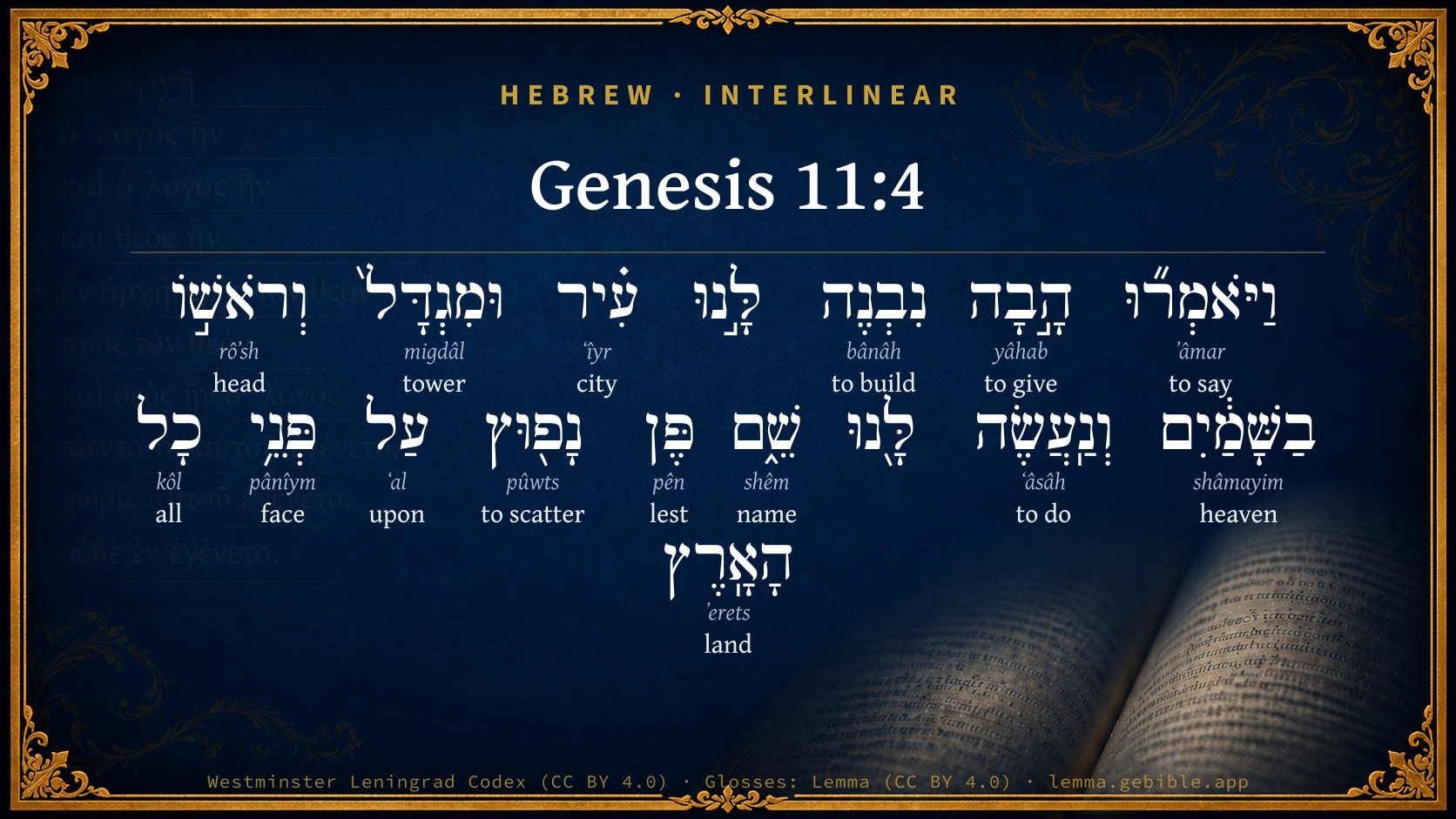
Genesis 11:4

Hebrew (Westminster Leningrad Codex) Genesis 11:4 appears in the Hebrew Old Testament. The text above is from the Westminster Leningrad Codex. Each word links to its Strong’s number, a concise gloss, and parsing drawn from the Open Scriptures Hebrew Bible morphology. Click any word for its full Brown-Driver-Briggs (BDB) entry.
Download image
Cite this verse

Genesis 11:4 (World English Bible). Public Domain. Lemma interlinear Bible study tool, https://lemma.gebible.app/v/genesis/11/4.

Show BibTeX & RIS
BibTeX
RIS
English Translation
They said, "Come, let's build us a city, and a tower, whose top reaches to the sky, and let's make us a name; lest we be scattered abroad on the surface of the whole earth."
World English Bible · Public Domain
Highlights
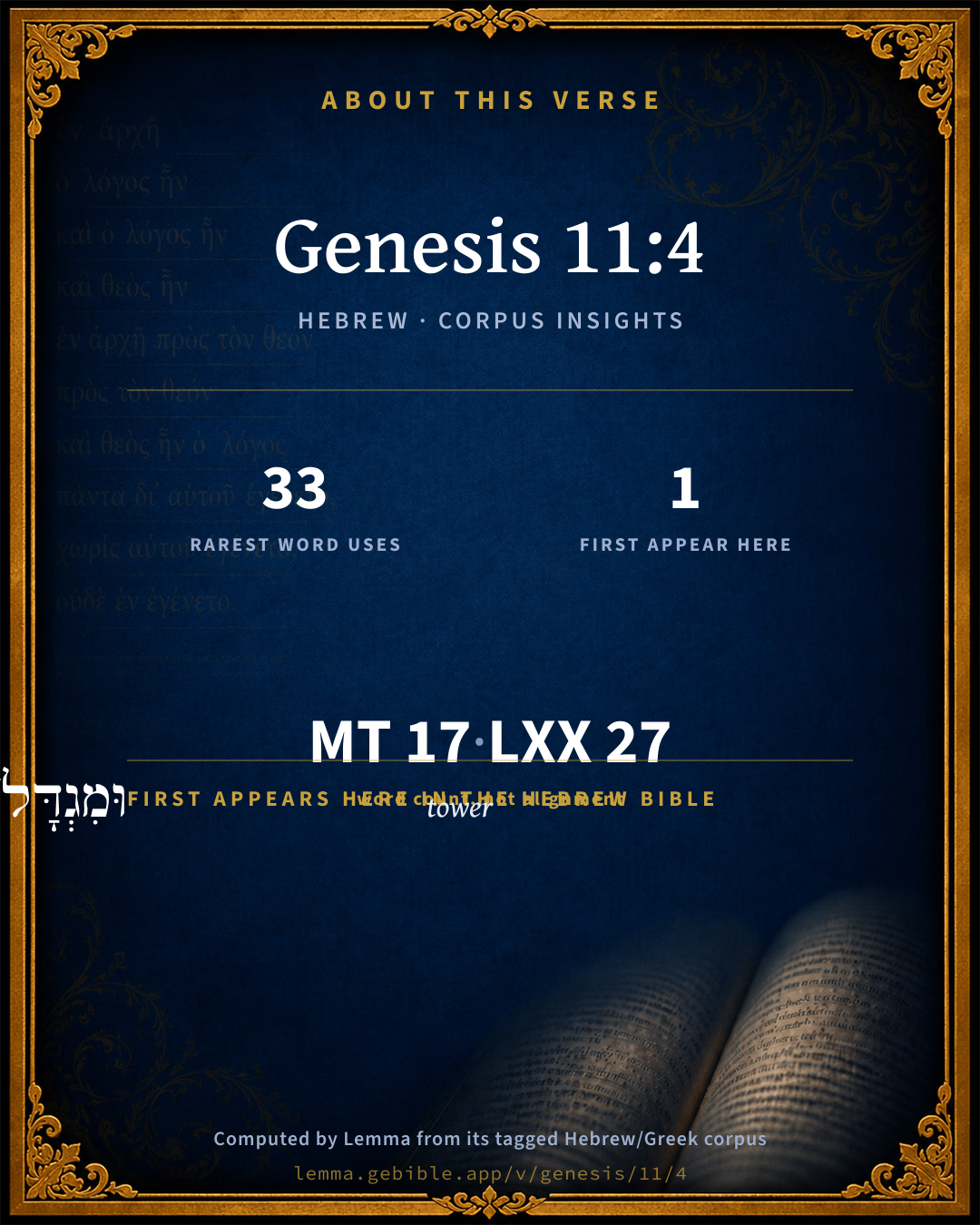
  • 1 first appearance in the Hebrew Bible
Full analysis ↓
Download a study sheet

One document with this verse’s original text, its word-by-word gloss line, the meaning frame, cross-references with their text, attributed commentary, and full source and license credits — printable, and it pastes into notes with its structure intact.

This verse Autodidact and up

Study sheet (.html) Plain text (.txt)

A passage Seminary Student

Up to 50 verses in one chapter. A passage sheet keeps up to 6 commentary sources and 12 cross-references per verse, in the order this page ranks them, and says so on the sheet whenever that leaves anything out. Ask for a single verse and you get the Autodidact verse sheet above.

Everything on this page stays free to read, with no account — the sheet is a download of what is already on screen, not access to it.

Want to remove ads? Support Godless Engineer
Compare translations 3

The same verse in 3 English versions, stacked beneath the original-language interlinear above. Click any original word for its lexicon entry.

Each is an independent rendering of the whole verse — the interlinear is not word-aligned to these translations.

Highlighted words mark where these versions differ — a whole-verse word diff, not a word-by-word alignment.

  • World English Bible Public Domain
    They said, "Come, let's build us a city, and a tower, whose top reaches to the sky, and let's make us a name; lest we be scattered abroad on the surface of the whole earth."
  • King James Version Public Domain
    And they said, Go to, let us build us a city and a tower, whose top may reach unto heaven; and let us make us a name, lest we be scattered abroad upon the face of the whole earth.
  • unfoldingWord Literal Text CC BY-SA 4.0
    Then they said, “Come, let us build a city for ourselves and a tower with its top in the heavens, and let us make a name for ourselves, so that we are not scattered over the face of the whole earth.”

unfoldingWord Literal Text — © unfoldingWord, licensed CC BY-SA 4.0. Word-aligned USFM3 via Door43 (git.door43.org/unfoldingWord/en_ult).

Versions to compare (up to 4)

3 of 4 selected

Show all 18 translations

Every available English version of this verse, each an independent rendering of the whole verse.

  • World English Bible Public Domain
    They said, "Come, let's build us a city, and a tower, whose top reaches to the sky, and let's make us a name; lest we be scattered abroad on the surface of the whole earth."
  • Berean Standard Bible Public Domain
    “Come,” they said, “let us build for ourselves a city with a tower that reaches to the heavens, that we may make a name for ourselves and not be scattered over the face of all the earth.”
  • Majority Standard Bible Public Domain
    “Come,” they said, “let us build for ourselves a city with a tower that reaches to the heavens, that we may make a name for ourselves and not be scattered over the face of all the earth.”
  • King James Version Public Domain
    And they said, Go to, let us build us a city and a tower, whose top may reach unto heaven; and let us make us a name, lest we be scattered abroad upon the face of the whole earth.
  • American Standard Version (1901) Public Domain
    And they said, Come, let us build us a city, and a tower, whose top `may reach' unto heaven, and let us make us a name; lest we be scattered abroad upon the face of the whole earth.
  • Revised Version (1885) Public Domain
    And they said, Go to, let us build us a city, and a tower, whose top may reach unto heaven, and let us make us a name; lest we be scattered abroad upon the face of the whole earth.
  • Geneva Bible (1599) Public Domain
    Also they said, Goe to, let vs builde vs a citie and a towre, whose top may reache vnto the heauen, that we may get vs a name, lest we be scattered vpon the whole earth.
  • Douay-Rheims (1899) Public Domain
    And they said: Come, let us make a city and a tower, the top whereof may reach to heaven: and let us make our name famous before we be scattered abroad into all lands.
  • Young's Literal Translation Public Domain
    And they say, `Give help, let us build for ourselves a city and tower, and its head in the heavens, and make for ourselves a name, lest we be scattered over the face of all the earth.'
  • Literal Standard Version CC BY-SA 4.0
    And they say, “Give help, let us build for ourselves a city and tower with its head in the heavens, and make for ourselves a name, lest we be scattered over the face of all the earth.”
  • Unlocked Literal Bible CC BY-SA 4.0
    They said, “Come, let us build ourselves a city and a tower whose top will reach to the sky, and let us make a name for ourselves. If we do not, we will be scattered across the surface of the whole earth.”
  • unfoldingWord Literal Text CC BY-SA 4.0
    Then they said, “Come, let us build a city for ourselves and a tower with its top in the heavens, and let us make a name for ourselves, so that we are not scattered over the face of the whole earth.”
  • Darby Bible Public Domain
    And they said, Come on, let us build ourselves a city and a tower, the top of which [may reach] to the heavens; and let us make ourselves a name, lest we be scattered over the face of the whole earth.
  • World Messianic Bible Public Domain
    They said, “Come, let’s build ourselves a city, and a tower whose top reaches to the sky, and let’s make a name for ourselves, lest we be scattered abroad on the surface of the whole earth.”
  • Webster's Bible Public Domain
    And they said, come, let us build us a city, and a tower, whose top may reach to heaven; and let us make us a name, lest we should be scattered abroad upon the face of the whole earth.
  • Free Bible Version CC BY-SA 4.0
    Then they said, “Now let's build a city for ourselves with a tower whose top reaches the heavens. That way we'll gain a great reputation and we won't end up being scattered all over the world.”
  • Bible in Basic English Public Domain
    And they said, Come, let us make a town, and a tower whose top will go up as high as heaven; and let us make a great name for ourselves, so that we may not be wanderers over the face of the earth.
  • JPS Tanakh (1917) Public Domain
    And they said: 'Come, let us build us a city, and a tower, with its top in heaven, and let us make us a name; lest we be scattered abroad upon the face of the whole earth.'

Literal Standard Version (2020), Covenant Press — licensed CC BY-SA 4.0. Text via the HelloAO Bible API (eBible.org). Unlocked Literal Bible (unfoldingWord) — licensed CC BY-SA 4.0. Text via the HelloAO Bible API (eBible.org). unfoldingWord Literal Text — © unfoldingWord, licensed CC BY-SA 4.0. Word-aligned USFM3 via Door43 (git.door43.org/unfoldingWord/en_ult). Free Bible Version, Dr. Jonathan Gallagher — licensed CC BY-SA 4.0. Text via the HelloAO Bible API (eBible.org).

Word by word

More ways to search: Search by grammar → Find every occurrence → Compare this word →

Practice this passage: Drill this verse → Learn its vocabulary →

הָ֣בָה
yâhab
H3051
“give”
Verb, Qal, Imperative, 2nd Person, Masculine, Singular + Suffix, h
Part of Speech
Verb
Stem
Qal
Form
Imperative
Person
2nd Person
Gender
Masculine
Number
Singular
Full BDB Definition

Origin: a primitive root

TWOT: 849

to give, provide, ascribe, come - (Qal) - to give - to set, place - to provide (with reflexive) - to ascribe (glory) - to grant, permit, come now
  1. וַיֹּאמְר֞וּ ʼâmar H559 “and · to say” Conjunction + Verb, Qal, Sequential Imperfect, 3rd Person, Masculine, Plural
  2. נִבְנֶה bânâh H1129 “to build” Verb, Qal, Cohortative, 1st Person, Common, Plural
  3. עִ֗יר ʻîyr H5892 “city” Noun, Common, Feminine, Singular, Absolute
  4. וּמִגְדָּל֙ migdâl H4026 “and · tower” Conjunction + Noun, Common, Both, Singular, Absolute
  5. וְרֹאשׁ֣וֹ rôʼsh H7218 “and · head · his” Conjunction + Noun, Common, Masculine, Singular, Construct + Suffix, Personal, 3rd Person, Masculine, Singular
  6. בַשָּׁמַ֔יִם shâmayim H8064 “in/at the · heaven(s)” Preposition, Determined + Noun, Common, Masculine, Dual, Absolute
  7. וְנַֽעֲשֶׂה ʻâsâh H6213 “and · to do” Conjunction + Verb, Qal, Cohortative, 1st Person, Common, Plural
  8. שֵׁ֑ם shêm H8034 “name” Noun, Common, Masculine, Singular, Absolute
  9. פֶּן pên H6435 “lest” Conjunction
  10. נָפ֖וּץ pûwts H6327 “to scatter” Verb, Qal, Imperfect, 1st Person, Common, Plural
  11. עַל ʻal H5921 “upon” Preposition
  12. פְּנֵ֥י pânîym H6440 “face(s) of” Noun, Common, Both, Plural, Construct
  13. כָל kôl H3605 “all of” Noun, Common, Masculine, Singular, Construct
  14. הָאָֽרֶץ ʼerets H776 “the · land” Particle, Definite Article + Noun, Common, Both, Singular, Absolute

About this verse

These counts appear in no published source. They are computed here, from the morphology-tagged text and Lemma’s own curated glosses. What Lemma adds →

17
words
15
distinct lemmas
Pentateuch
section

First appearance in Scripture

This word makes its first canonical appearance in the Hebrew Bible here:

  • וּמִגְדָּל֙ tower H4026

Shared distinctive vocabulary

הָ֣בָה to give H3051 occurs in 29 verses of the Hebrew Bible. Also found in:

Grammatical profile

  • 5 verbs
  • 8 nouns
  • 3 prepositions
  • 1 conjunction

Verb forms

  • וַיֹּאמְר֞וּ Qal · Sequential Imperfect
  • הָ֣בָה Qal · Imperative
  • נִבְנֶה Qal · Cohortative
  • וְנַֽעֲשֶׂה Qal · Cohortative
  • נָפ֖וּץ Qal · Imperfect

Hebrew & Septuagint length

In English translation the verse runs 35 words from the Hebrew and 39 from the Septuagint (LXX English) — closely comparable.

A rough comparison of the two English renderings, which tokenize alike — not a word-level alignment.

Word counts can differ between the Hebrew and the Greek without any difference in meaning — e.g. the Hebrew direct-object marker אֵת has no separate Greek word, and Greek often adds the article ὁ.

In the original languages it is 17 Hebrew tokens and 27 Greek tokens — but the two are counted differently (Hebrew bundles its prefixes and suffixes into one token; the Greek is in lemma form), so that isn’t a like-for-like length.

Cross-references

14

Topical passages linked to Genesis 11:4 in the Treasury of Scripture Knowledge — connected by theme and wording, ordered by reader-vote popularity; previews shown in the World English Bible.

  • Deuteronomy 1:28 Where are we going up? our brothers have made our heart to melt, saying, The people are greater and taller than we; the cities are great and fortified up to the sky; and moreover we have seen the sons of the Anakim there.
  • John 5:44 How can you believe, who receive glory from one another, and you don't seek the glory that comes from the only God?
  • Luke 1:51 He has shown strength with his arm. He has scattered the proud in the imagination of their heart.
  • Deuteronomy 9:1 Hear, Israel: you are to pass over the Jordan this day, to go in to dispossess nations greater and mightier than yourself, cities great and fortified up to the sky,
  • Daniel 4:30 The king spoke and said, Is not this great Babylon, which I have built for the royal dwelling-place, by the might of my power and for the glory of my majesty?
  • Psalms 49:11–13 Their inward thought is that their houses will endure forever, And their dwelling places to all generations. They name their lands after themselves.
  • Proverbs 10:7 The memory of the righteous is blessed, But the name of the wicked will rot.
  • 2 Samuel 8:13 David got him a name when he returned from smiting the Syrians in the Valley of Salt, even eighteen thousand men.
  • Genesis 6:4 The Nephilim were in the earth in those days, and also after that, when God's sons came to men's daughters. They bore children to them: the same were the mighty men who were of old, men of renown.
  • Daniel 4:11 The tree grew, and was strong, and the height of it reached to the sky, and the sight of it to the end of all the earth.
  • Genesis 11:8–9 So Yahweh scattered them abroad from there on the surface of all the earth. They stopped building the city.
  • Psalms 92:9 For, behold, your enemies, Yahweh, For, behold, your enemies shall perish. All the evil-doers will be scattered.
  • Daniel 4:22 it is you, O king, that are grown and become strong; for your greatness is grown, and reaches to the sky, and your dominion to the end of the earth.
  • Deuteronomy 4:27 Yahweh will scatter you among the peoples, and you shall be left few in number among the nations, where Yahweh shall lead you away.

Cross-references courtesy of OpenBible.info (CC BY 4.0).

Hebrew and Greek witnesses Masoretic Hebrew ↔ Greek Septuagint

The same verse in the two great witnesses to the Old Testament, shown verse-for-verse.

These are two independent witnesses, not word-aligned to each other, and the Septuagint is shown in lemma (dictionary) form.

Hebrew Genesis 11:4 Masoretic · Westminster Leningrad Codex

וַיֹּאמְר֞וּ הָ֣בָה נִבְנֶה לָּ֣נוּ עִ֗יר וּמִגְדָּל֙ וְרֹאשׁ֣וֹ בַשָּׁמַ֔יִם וְנַֽעֲשֶׂה לָּ֖נוּ שֵׁ֑ם פֶּן נָפ֖וּץ עַל פְּנֵ֥י כָל הָאָֽרֶץ

They said, "Come, let's build us a city, and a tower, whose top reaches to the sky, and let's make us a name; lest we be scattered abroad on the surface of the whole earth."

World English Bible · Public Domain

Greek LXX Genesis 11:4 Septuagint · lemma form

καί εἶπον δεῦτε οἰκοδομέω ἑαυτοῦ πόλις καί πύργος ὅς ὁ κεφαλή εἰμί ἕως ὁ οὐρανός καί ποιέω ἑαυτοῦ ὄνομα πρό ὁ διασπείρω ἐπί πρόσωπον πᾶς ὁ γῆ

And they said, Come, let us build to ourselves a city and tower, whose top shall be to heaven, and let us make to ourselves a name, before we are scattered abroad upon the face of all the earth.

LXX2012 (modern English Septuagint) · Public Domain

On this verse, Adam Clarke's Commentary discusses the Septuagint’s reading. Read the note in Commentary ↓

Hebrew: Westminster Leningrad Codex (CC BY 4.0). Greek: Septuagint (public domain); English from LXX2012 (modern English Septuagint) (Public Domain). How the Septuagint differs from the Hebrew →

Targum (Aramaic paraphrase)

2

The Targum is the ancient Jewish Aramaic paraphrase of the Hebrew Scriptures — an interpretive translation, not the Hebrew text itself. Onkelos (literal) and Pseudo-Jonathan (expansive) render the Torah, and Jonathan the Prophets. Coverage is partial: where no permissively-licensed English translation exists for a verse, only the Aramaic is shown. This is verse-level text, not a word-by-word alignment to the Hebrew.

  1. Targum Onkelos Torah (Genesis–Deuteronomy)
    וַאֲמָרוּ הָבוּ נִבְנֵי לָנָא קַרְתָּא וּמַגְדְּלָא וְרֵישֵׁהּ מָטֵי עַד צֵית שְׁמַיָּא וְנַעְבֵּיד לָנָא שׁוּם דִּילְמָא נִתְבַּדַּר עַל אַפֵּי כָל אַרְעָא

    And they said, Come, let us build a city, and a tower, the bead of it coming to the pinnacle of the heavens. And we will make to us a name, lest we be dispersed upon the face of all the earth.

    Targum Onkelos — Aramaic: “Onkelos Genesis” (public domain); “Onkelos Exodus” (public domain); “Onkelos Leviticus” (public domain); “Onkelos Numbers” (public domain); “Onkelos Deuteronomy” (public domain). English: “Sefaria Community Translation” (CC0 1.0 (public-domain dedication)); “J.W. Etheridge. The Targums of Onkelos and Jonathan Ben Uzziel on the Pentateuch. London: Longmans, Green, 1862” (public domain). Text via Sefaria.

  2. Targum Pseudo-Jonathan Torah (Genesis–Deuteronomy)
    וַאֲמָרוּ הָבוּ נִבְנֵי לָנָא קַרְתָּא וּמִגְדְלָא וְרֵישֵׁיהּ מָטֵי עַד צֵית שְׁמַיָא וְנַעֲבֵד לָנָא סִגְדוּ בְּרֵישֵׁיהּ וְנִשְׁוֵי חַרְבָּא בִּידֵהּ וּתְהֵי עַבְדָא לְקִיבְלֵהּ סִדְרֵי קְרָבָא קָדָם עַד לָא נִתְבַּדַר מֵעִלַוֵי אַנְפֵּי אַרְעָא

    And they said, Come, we will build us a city and a tower, and the head of it shall come to the summit of the heavens; and we will make us (an image for) worship on the top of it, and put a sword in his hand to act against the array of war, before that we be scattered on the face of the earth.

    Targum Pseudo-Jonathan — Aramaic: “Targum Jonathan on Genesis” (public domain); “Targum Jonathan on Exodus” (public domain); “Targum Jonathan on Leviticus” (public domain); “Targum Jonathan on Numbers” (public domain); “Targum Jonathan on Deuteronomy” (public domain). English: “The Targum of Jonathan ben Uzziel, trans. J. W. Etheridge, London, 1862” (public domain). Text via Sefaria.

Commentary

Notes on Genesis 11:4 from classic Christian and Jewish commentators (each source and its license shown beneath its notes). The classic Christian expositions comment on the surrounding passage and are grouped to its opening verse, so a note may address several verses; the Jewish commentaries on the Tanakh (Rashi and others) are per-verse, so they appear only where the commentator wrote on this verse.

Lemma curates 59 commentaries, every one of them public domain or Creative Commons licensed, each selected and text-cleaned for this edition rather than reprinted as found. About our sources →

Trapp's Complete Commentary

John Trapp

Gen 11:4 And they said, Go to, let us build us a city and a tower, whose top [may reach] unto heaven; and let us make us a name, lest we be scattered abroad upon the face of the whole earth.

Ver. 4. Let us build us a city and a tower.] This tower raised a head of majesty, 5164 paces from the ground, having its basis and circumference equal to the height. The passage to go up, went winding about the outside, and was of an exceeding great breadth, there being not only room for horses, carts, &c., to meet and turn, but lodgings also for man and beast (as Verstegan reports), grass and grain fields for their nourishment. {a}

Let us make us a name.] This is a disease that cleaves to us all, to "receive honour one of another, and not to seek the honour that cometh from God only". {Joh 5:44} A rare man he is surely, that has not some Babel of his own, whereon he bestows pains and cost, only to be talked of. Hoc ego primus vidi , was Zabarelle’s επινικιον. {b} Epicurus would have us believe, that he was the first that ever found out the truth of things. Palaemon gave out, that all learning was born and would die with him. {c} Aratus the astrologer, that he had numbered the stars, and written of them all. Archimedes, the mathematician, that if he had but where to set his foot, he could move the earth out of its place. Herostratus burnt Diana’s temple for a name. {d} And Plato {e} writes of Protagoras, that he bragged, that whereas he had lived sixty years, forty of them he had spent in corrupting of youth. Cicero {f} tells us, that Gracchus did all for popular applause; and observes, that those philosophers that have written of the contempt of glory, have yet set their names to their own writings, which shows an itch after that glory they persuaded others to despise. These two things, saith Cicero somewhere of himself, I have to boast of, Optimarum artium scientiam et maximarum rerum gloriam , my learned works, and noble acts. Julius Caesar had his picture set upon the globe of the world, with a sword in his right hand, a book in his left, with this motto, Ex utroque Caesar . Vibius Rufus used the chair wherein Caesar was wont to sit, and was slain; he married also Cicero’s widow, and boasted of them both, as if either for that seat he had been Caesar, or for that wife an orator, {g} When Maximus died in the last day of his consulship, Caninius Rebilus petitioned Caesar for that part of the day, that he might be said to have been consul. {h} So many of the Popish clergy have with great care and cost procured a cardinal’s hat, when they have lain a dying, that they might be entitled cardinals in their epitaph, as Erasmus writes. But for men’s ennobling themselves by building, those seven wonders of the world were made merely for a name. Pharos, a watch-tower in Egypt, being one of the seven, was built by Ptolomy Philadelph, all of white marble. The chief architect was Sostratus of Gnidos, who engraved on the work this inscription, "Sostratus of Gnidos, son of Dexiphanes, to the gods protectors, for the safeguard of sailors." This inscription he covered with plaster, and thereon engraved the name and title of the king the founder: that (that soon wasted and washed away) his own that was written in marble, might be eternised to posterity. This tower, saith Wickam, is a known story. And Phidias, the famous carver, so cunningly set his own countenance into Minerva’s shield at Athens, that it could not be defaced, but the shield itself must be disfigured. The Hague, in Holland, has two thousand households in it. The inhabitants will not wall it, as desiring to have it counted rather the principal village of Europe, than a lesser city. And Sextus Marius, being once offended with his neighbour, invited him to be his guest for two days together. The first of those two days he pulled down his neighbour’s farmhouse; the next, he set it up again, far bigger and better than before. And all this for a name, that his neighbours might see and say, what good or harm he could do to them at his pleasure. {i}

{a} Heyl., Geog.

{b} Dr Prid., Contra Eudoemon. Joh.

{c} Secum literas esse natas, et morituras . - Sueton.

{d} Aug. de Civit. Dei., lib. xvi.

{e} Plato in Menone Tusc. iii.

{f} Pro Archia Poeta.

{g} Epist. Famil., lib. vii. - Gabriel Simeon in Symbolis. - Dion Cass. in Tyberio.

{h} O vigilantem Consulem qui tuto consulatus sui tempore, somnum non vidit .

{i} Heylin’s Geog., p. 750, - B. Godwin’s Catalogue. - Heylin’s Geog., p. 240. - Dio in Tiberio.

John Trapp, A Commentary or Exposition upon All the Books of the Old and New Testament (1647–1656) — public domain. Text from a community e-Sword module.

The Biblical Illustrator

Joseph S. Exell

Gen_11:4

Go to, let us build us a city and a tower

The tower of Babel

I.

Three motives may have led to the building of the tower of Babel.

1. A feeling that in union and communion lay the secret of mans renown and strength; that to disperse the family was to debilitate it.

2. A remembrance of the deluge, and a guilty dread of some similar judgment, leading them to draw close to each other for support.

3. Man was awaking to self-consciousness and a knowledge of his own resources. He was gaining a glimpse into the possible progress of civilization. The tower was to be a focus where the rays of his power would be concentrated.

II. To all philanthropists this narrative preaches this simple and sublime truth--that genuine unity is not to be effectually compassed in any other manner than by striking at the original root of discord. Every scheme for the promotion of brotherhood which deals only with the external symptoms of disunion, and aims at correcting only what appears on the surface of society, is ultimately sure of frustration.

III. In His own good time and manner God realized the presumptuous design of the Babel builders, and united in one central institution the scattered families of man. In the mediation of His Son He has reared up a Tower whose top reaches to heaven. It was in order to gather the nations into this world-embracing community that the apostles of Christ went forth charged with a message of peace and love. When the Spirit descended at Pentecost the physical impediment obstructing union--that difference of language which the sin of Babel had introduced--was removed. The apostles spake with other tongues, as the Spirit gave them utterance. (Dean Goulburn.)

The tower of Babel

The events connected with the building of the tower of Babel forcibly illustrate the power and the weakness of man. There is great power of scheming, great power of working, ending in an ignominious failure. So it is in all the ways of life; there is a way of spending force for naught, and there is a way of turning every effort to good account; there is a scheming that is nothing but inflation, and there is a purposing which gives shape and strength to ones daily life. The courses of Providence, as revealed in the history of the world, enable us now to judge programmes by anticipation; before we begin to build we can now tell how we shall finish, or whether we shall finish at all. Poor self-deceiving heart! How many bricks has it made, and burnt thoroughly, and yet how few towers it has ever finished! The people constitute themselves into a community of builders, and they propose to themselves a city and a tower. In this plan there are three things which men generally account laudable--

1. There is self-reliance. The loudest cry of today is, Help yourselves! It is thought that the man who trusts his own arm trusts a good servant. So far, therefore, there is nothing amiss in these builders.

2. There is a desire for self-preservation--lest we be scattered abroad upon the face of the whole earth. Self-preservation is held to be the first law of nature. If a man will not take care of himself, who will take care of him? Still, therefore, the builders have not trespassed.

3. There is ambition--a city, and a tower, and a name! No man can make much headway in life who is not ambitious. The finalist grows weaker every day; the progressionist strengthens with every encounter. The whole work was within mans own sphere. They wanted more than a city and a tower; they wanted a name, let us make us a name. That has been the ruin of many a man: anything for a name--any price for renown! This is not the ambition which is commended; this stands to a true ambition as presumption to faith. One thing is clear, viz., that God is observant of human plans. He knows our purpose, He overhears our secret communings. He allows men to build for awhile, and in the time of their rejoicing over the work of their hands He throws the city and tower to the dust. The error of these people was not in having a plan, but in having a plan without God.

(1) Carefully examine the quality and meaning of every new plan of life. Many a man has been ruined by ideas which he deemed necessary to the success of his fortune;

(a) Appearances;

(b) Miscalculations;

(c) Oversights; have contributed their share to his disasters.

(2) Beware of the sophism that heaven helps them that help themselves. The doctrine is true only in so far as men may by helping themselves in accordance with the will of heaven.

(3) Regulate ambition by the Divine will.

(4) If we make great plans let us make them in Gods name and carry them out in Gods strength. See the folly of planning without God.

(a) God has all forces at command.

(b) God has set a limit to every mans life.

(c) God has pronounced Himself against those who dishonour His name. All these considerations have also a reflex bearing on those who plan in a right spirit.

(5) Let us learn what is meant by all the unfinished towers that we see around us. This man began to build, etc. Job said, My purposes are broken off. Look at disappointed men, etc.; ruined men, etc.

(6) Cooperation with God will alone secure the entire realization of our plans. Application:

(a) We all have plans.

(b) Examine them.

(c) Remember the only foundation, on which alone men can build with safety. (The Pulpit Analyst.)

The builders of Babel

It is a melancholy fact that the evil of our nature tends continually to increase, and assume a sad variety of forms. As men abide under the power of evil they wax worse and worse. We have an instance of this downward tendency in the builders of Babel. Since the flood the course of sin may be thus traced;

1. In the form of sensual indulgence. The type was drunkenness, of which Noah has given a sad example.

2. Disregard of parental authority. Ham.

3. In the form of ambition. Builders of Babel.

I. LOVE OF GLORY. They would indulge the passion for fame at all costs.

1. The boldest schemes of ambition are generally the work of a few.

2. Such ambition involves the slavery of the many.

II. FALSE IDEAS OF THE UNITY OF THE RACE.

1. They thought that it was external City. Tower.

2. They held that the individual must be sacrificed to the outward grandeur of the State. This is the genius of all Babel-building, to make the city supreme, and to sink the individual. All must be sacrificed to one idea: the nation--State--Constitution. It is not within the province of worldly ambition to recognize the sublime importance of the individual soul. Hence the conflict between the policies of statecraft and the interests of true religion. This exaltation of the State above the individual has--

(1) A political form;

(2) an ecclesiastical form.

III. PRESUMING TO PLACE THEMSELVES ABOVE PROVIDENCE.

1. God interferes in all matters which threaten His government.

2. God often interferes effectually by unexpected means. These foolish builders imagined that they were safe in the unity of their speech, yet it was here that they were vanquished.

IV. A PREMATURE ATTEMPT TO REALIZE THAT BETTER TIME COMING FOR HUMANITY. (T. H. Leale.)

Babel bricks

These emigrants to Shinar were evidently dissatisfied with a patriarchal life, and desirous of founding a great monarchy.

I. AMBITION, or the perversion of the divinely-implanted principle, Excelsior.

I

1. Cautions us to beware of our own hearts; and--

2. Counsels us to be careful of the Divine will.

II. ASSUMPTION, or the presupposition of mans independence of God. It--

1. Cautions us to remember our entire dependence; and--

2. Counsels us to regard the Divine preeminence as essential to our happiness.

III. ASSOCIATION, or the persuasion that human unity means human perpetuity. It--

1. Cautions us against forgetting that God must come into any scheme after unity; and--

2. Counsels us about fulfilling the Divine ideal of unity in Him.

Lessons:

1. Moral towers of Babel (great or small) should be erected in Gods name, and carried through in Gods strength.

2. Moral towers of Babel (great or small), if not so attempted and accomplished, tend to dishonour Gods name, and to disown Gods strength.

3. Moral towers of Babel (great or small), thus dishonouring Him, are sure, sooner or later, to be overthrown by God, who has all forces at His command; and--

4. Moral towers of Babel (great or small) conceived in Gods name, constructed by Gods strength, and contributing to Gods glory, are certain of the Divine permission and permanence. (W. Adamson.)

Human labour

I. HUMAN LABOUR ALWAYS DEVELOPS THE NATURE OF MAN.

1. The constructive element.

2. The ambitious element.

3. The social element.

4. The cooperative element.

II. HUMAN LABOUR GENERALLY ILLUSTRATES THE PATIENCE OF HEAVEN.

1. Their enterprise from the beginning was rebellion against heaven.

2. They were allowed to go on almost to its final accomplishment.

III. HUMAN LABOUR MUST ULTIMATELY MEET WITH THE JUST TREATMENT OF GOD.

1. He discloses its purpose.

2. He arrests its progress.

3. He frustrates its design. (Homilist.)

I. THAT SELF-RENOWN IS AN OBJECT TOO LOW FOR MAN TO AIM AT.

The tower of Babel

1. Because he has duties to perform towards others.

2. Because mans highest and best powers cannot be properly developed by having this as the only object in view.

(1) The sense of right cannot be quickened.

(2) Self is a sphere too limited for a mans sympathy to be fully manifested.

(3) Self is an object too cold and limited to strengthen and intensify mans love.

3. Because there is no true happiness in the pursuit, nor actual attainment of the object.

II. THAT UNION PRODUCES STRENGTH.

1. It concentrates the powers of many towards one object.

2. It is recognized in heaven.

(1) For evil (Psa_2:1-5).

(2) For good (Mar_13:20).

3. The more Divine the union, the greater will be its reality and strength.

III. THAT HUMAN EFFORTS ARE FRUITLESS WHEN NOT IN HARMONY WITH THE DIVINE INTENTIONS.

1. A higher intelligence is opposed to them.

2. A greater power.

3. A purer love. They deserved to be destroyed, but were only scattered.

4. This failure was--

(1) Humiliating.

(2) From an unexpected source.

(3) Complete. Conclusion:

1. In every undertaking, let us endeavour to know if it be according to Gods will.

2. Let us have Gods glory as the sole object of life. (Homilist.)

Universal monarchy

But why, it may be asked, should it be the will of God to prevent a universal monarchy, and to divide the inhabitants of the world into a number of independent nations? This question opens a wide field for investigation. Suffice it to say at present, such a state of things contains much mercy, both to the world and to the Church. With respect to the world, if the whole earth had continued under one government, that government would, of course, considering what human nature is, have been exceedingly despotic and oppressive. The division of the world into independent nations has also been a great check on persecution, and so has operated in a way of mercy towards the Church. If the whole world had been under one government, and that government inimical to the gospel, there had been no place of refuge left upon the earth for the faithful. From the whole we may infer two things--

1. The harmony of Divine revelation with all that we know of fact. If all that man can be proved to have done towards the formation of any language be confined to changing, combining, improving, and reducing it to a grammatical form, there is the greatest probability, independent of the authority of revelation, that languages themselves were originally the work of God, as was that of the first man and woman.

2. The desirableness of the universal spread of Christs kingdom. We may see in the reasons which render a universal government among men incompatible with the liberty and safety of the world abundant cause to pray for this, and for the union of all His subjects under Him. Here there is no danger of tyranny or oppression, nor any need of those low motives of rivalship to induce him to seek the well-being of his subjects. A union with Christ and one another embraces the best interests of mankind. (A. Fuller.)

Lessons

1. Sinful apostates are active in drawing each other to sin.

2. Wickedness is studious for means to effect its ends.

3. No difficulties usually hinder sin from its undertakings.

4. It is but brick and slime wherewith wickedness builds (Gen_11:3).

5. Wicked ones are much encouraging one another to evil.

6. Cities and towers, ornament and strength, are sinners trophies.

7. Sins structure would be as high and stately as heaven.

8. Sinners are ambitious of a name on earth.

9. Dispersion is the evil which sinners fear.

10. Sinners resolve to provide their own security against Gods judgments by the works of their own hands (Gen_11:4). (G. Hughes, B. D.)

Right building

There are times in life when lucky ideas strike men; when there is a kind of intellectual springtide in their nature; when men rise and say, I have got it! Go to, this is it! And in the bright hours when such ideas strike one the temptation is to be a little contemptuous in reference to dull men who are never visited by conceptions so bright and original as we deem them. A man has been in great perplexity, month after month, and suddenly he says, Go to, the solution is now before me; I see my way right out of this dark place; and he heightens his tone as the joy swells in his heart. That is right. We could not do without intellectual birthdays; we could not always be carrying about a dead, leaden brain, that never sees light or shouts victory. We like these moments of inspiration to break in upon the dull monotony of such a lifetime as ours. So it is perfectly right that men should express their new conceptions--their new programme--and lay out a bold policy in a clear and confident tone. But are all our ideas so very bright? When we see our way to brick making, is it always in the right direction? When we set our mind upon founding a city and building a tower the top of which shall rest against the stars, is it right? You see that question of right comes in again and again, and in proportion as a man wishes to live a true Divine life he will always say, before going to his brick making and his city founding and his tower building, Now, is this right? Many of us could have built great towers, only we knew we should be building downwards if we set our hands to such work as has often tempted us. Do not let us look coldly upon apparently unsuccessful men, and say, Look at us; we have built a great city and tower, and you, where are you?--stretching in the dust and grovelling in nothing. They could have built quite as large a tower as ours; they could have been quite as far up in the clouds as we are, only we had perhaps less conscience than they had. When we saw a way to burning bricks, we burned them; and a way to establishing towers, we founded them; and they, poor creatures, unsuccessful men, began to pray about it, and to wonder if it was right, and to ask casuistical questions, and to rack themselves upon conscience; and so they have done no building! And yet they may have built. Who can tell? All buildings are not made of brick; all men do not require to lay out brick fields, and burn clay, in order to build. It may be found one day, when the final inspection takes place, that the man who has built nothing visible has really built a palace for the residence of God. It may be found, too, that some successful people have nothing but bricks--nothing but bricks, bricks, bricks! Then it will be seen who the true builders were. What I pause here to say is this: We may have bright ideas, we may have (to us) new conceptions; there are, to our thinking, original ways of doing things; now and again cunning plans of overcoming difficulties strike us. Do I condemn this intellectual activity? No; I simply say, Let your intellect and your conscience go together; do not be one-sided men; do not be living altogether out of the head, be living out of your moral nature as well; and if it be right, then build the tower with all industry and determination. Let it be strong and lofty, and God shall come down upon your work and glorify it, and claim it as His own. (J. Parker, D. D.)

Ambition

Bold men--men of vigorous mind, striking out something that is very definite, and about which there could be no mistake. We, too, are doing just what they did; we are following the god Ambition--the restless god Ambition, who never sleeps, never pauses, never gives his devotees vacation, but is always stirring them up to more and more furious desires. Do I condemn ambition? Nothing of the kind. I praise ambition; I say to every young man who may today accept me as his teacher, Be ambitious; build loftily; let your aspirations be confined only by the limits which God Himself has set to human power and human capability; but--but--that old question comes in again, Is it right? Is it right? Our ambitions may be our temptations; our ambitions may be stumbling blocks over which we fall into outer darkness; our ambitions may be the cups out of which we drink some deadly intoxicant, poisoning the mind and destroying the hearts life. Therefore I pause again to ask, Is it right? Then, too, we pronounce some men ambitious who are really not ambitious. All men do not understand the word ambition. Ambition has been vulgarized, taken out altogether from its refined and beautiful associations, and debased into something that is intensely of the earth, earthy. I call men to intellectual ambition; to spiritual ambition; to the ambition which says, I count not myself to have attained; this one thing I do, I press. Alas! there are ten thousand men in our city streets today who are pressing; but the question is, Towards what do they press? The apostle says, I press towards the mark for the prize of my high calling of God in Christ Jesus. That is better than saying, Let us build a tower whose top shall reach even unto heaven; and yet it is true tower building--it is palace building. (J. Parker, D. D.)

Bad advice soon taken

It must needs be that one man gave his counsel first, saying to the rest, Come, let us build, etc. But when once it was broached not one man allowed it, but even all full quickly yielded to it. Whereby we see, first, the vileness of man, not only to devise that which is naught, but to set it full greedily abroad when it is devised, and to labour to persuade others to embrace and follow the same. Again, to consent to that which is wickedly devised of others, and to make a particular conceit a general judgment, action, and work at last. Great cause, therefore, that mens lewd devices should be restrained from being published, since both the devisers wish and mans great corruption is so prone to yield a wicked consent and following of the same. Caiaphass counsel, when it once sounded of Christs death, was quickly hearkened unto, and from that day forward consultation had together how they might accomplish the same. Whosoever broached it first that the people should ask Barabbas and refuse Jesus, it was soon received, liked, and followed of such ignorant spirits and giddy heads. That a sort should combine together and kill the apostle had a beginner, and how quickly pleased the plot such other bloody minds and spiteful hearts! How soon embraced Lots younger daughter the counsel of the elder to do so vile a thing! That unbrotherly conspiracy against Joseph was soon yielded unto when once it was uttered. Do you remember the murmuring against Moses and Aaron, in the Book of Numbers? How began it? Had it not a captain, then a second, then a third, then a number? Once broached that Moses and Aaron took too much upon them; that others were equal with them, and therefore should be in like authority; that the people were wronged, and so forth--soon was it liked, soon was it caught, soon was it prosecuted of proud minds, that would be aloft, and knew not to obey. Conclude we, then, upon all those that sin, some be wicked to broach a wickedness, and thousands weak to follow the same when once they hear it; yea, though it be to build a tower against God. It never was, nor ever shall be, either godly policy or Christian duty to suffer mens brains to broach what they list, and others to follow unquiet devices, hateful to God and hurtful to His Church in a high degree. (Bishop Babington.)

The tower of Babel

In Babylonia there are at present the remains of three stupendous ruins, each of which have been claimed by different travellers as occupying the site of the tower of Babel. One of these especially has much to support its claim. The temple of Belus was in all probability erected on the site of the tower of Babel, so the arguments which settle the position of one of these erections serve to fix the other. Rawlinson says of these particular ruins:--It is an oblong mass, composed chiefly of unbaked bricks, rising from the plain to the height of one hundred and ten feet, and having at the top a broad flat space with heaps of rubbish. The faces of the mound are about two hundred yards in length, and thus agree with Herodotus estimate. Tunnels driven through the structure show that it was formerly covered with a wall of baked brick masonry: many such bricks are found loose, and bear the name of Nebuchadnezzar. The difficulty of identifying the site of the scriptural Babylon arises chiefly from the fact that the materials of which it was built have at various times been removed for the construction of the great cities which have successively replaced it. Nebuchadnezzar either repaired Babylon, as many suppose, or built it anew upon a neighbouring site with the remains of the more ancient Babel. The kind of building which was erected, and known as the tower of Babel, may be best understood by the description of the great temple of Nebo at Borsippa, known to moderns as the Birs-Nimrud. It was a sort of oblique pyramid, built in seven receding stages. Upon a platform of crude brick, raised a few feet above the level of the alluvial plain, was built of burnt brick the first or basement stage--an exact square, two hundred and seventy-two feet each way, and twenty-six feet in perpendicular height. Upon this stage was erected a second, two hundred and thirty feet each way, and likewise twenty-six feet high; which, however, was not placed exactly in the middle of the first, but considerably nearer to the southwestern end, which constituted the back of the building. The other stages are arranged similarly--the third being one hundred and eighty-eight feet, and again twenty-six feet high; the fourth one hundred and forty-six feet square and fifteen feet high; the fifth one hundred and four feet square, and the same height as the fourth; the sixth sixty-two feet square, and again the same height; and the seventh twenty feet square, and once more the same height. On the seventh stage there was probably placed the ark or tabernacle, which seems to have been again fifteen feet high, and must have nearly, if not entirely, covered the top of the seventh story. The entire original height, allowing three feet for the platform, would thus have been one hundred and fifty-six feet, or without the platform, one hundred and fifty-three feet. The whole formed a sort of oblique pyramid, the gentler slope facing the N.E., and the steeper inclining to the S.W. On the N.E. side was the grand entrance, and here stood the vestibule, a separate building, the debris from which having joined those from the temple itself, fill up the intermediate space, and very remarkably prolong the round in this direction. (Things Not Generally Known.)

The materials used to build it

The materials generally used for the construction of Babylonian buildings are here most faithfully described (Gen_11:3). As in Egypt, the edifices of Mesopotamia consisted of sun-dried, but often also burnt bricks, baked of the purest clay, and sometimes mixed with chopped straw, which materially enhances their compactness and hardness; these bricks were generally covered with inscriptions, promising to prove of the greatest historical value. But instead of mortar, the Babylonians used as a cement that celebrated asphalt or bitumen, which is nowhere found in such excellence and abundance as in the neighbourhood of Babylon. One of the most gifted of the modern explorers declared the ruins of Birs-Nimroud a specimen of the perfection of Babylonian masonry, and remarked, that the cement by which the bricks were united is of so tenacious a quality, that it is almost impossible to detach one from the mass entire (Layard, Nineveh and Babylon, p. 499). Nothing but the violence of a fearful conflagration, the ravages of which are manifest in the ruins of Birs-Nimroud, would have been able to annihilate a building which appeared to be beyond the destructive power of time. (M. M.Kalisch, Ph. D.)

Babel

This, we may depend upon it, was no republic of builders; no cooperative association of bricklayers and bricklayers labourers, bent on immortalizing themselves by the work of their own hands. This early effort at centralization, with a huge metropolis as its focus, sprang, we may be quite sure, from the brain of some one ambitious potentate, and was baptized, from the very first, in the blood and sweat and misery of toiling millions. That Go to, let us make brick, let us build us a city, let us make us a name, is not the language of voluntary association; but is the stately style, which emperors affect. By this time we know only too well what it means--the cynical indifference to human suffering, the wastefulness of human life, the utter selfishness, the cruelty, the hardness of heart, masked under gilded forms. The characteristic of all world empires--that which makes them world empires--is that they lean upon might, and not upon right. Just in so far as they do this, they are world empires. And, doing this, they are a defiance to the eternal righteousness of God. And, being this, they are doomed to decay. In such world empires there is no true cohesion. The force which unites is purely external. The moment its pressure relaxes, the thing breaks up. In other words, man, seeking to make himself as God, can offer no rest, no centre of unity, no position of stable equilibrium, to his fellow men. He may be armed with irresistible might. He may be statesman and general, as well as king or emperor. By his very success he sows the seeds of decay. Collapse and disintegration overtake his work, even in the very hour of its seeming triumph. I remember visiting the tomb of the First Napoleon in Paris on one of the last days of the June of 1870. You know it, or you have heard about it. It struck me irresistibly, with all its accompaniments, as the symbol of just such a world empire, as I have been speaking about tonight. Within three months from that day, that empire--like its predecessor--had collapsed in blood and disaster. Not he, who, being man, would make himself as God; but He, who being God, makes Himself man; is the true centre of rest and union for a suffering and divided humanity. (David J. Vaughan, M. A.)

Let us make us a name

Human greatness

1. A name is an important thing for a man.

2. All men make some kind of name for themselves.

3. Striving to make a name as the chief end of life is a grand mistake. This is what the men in the land of Shinar were now doing. Men have a natural desire for distinction; but what is the legitimate object? Is it to appear great, or to be great? Reputation is one thing, character another. The words of Christ, in Mat_23:12, will enable us to discover the right and wrong direction of this ambition.

I. A GREATNESS THAT COMES TO HUMILIATION. He that exalteth himself shall be abased.

1. In the moral reflections of his own soul. Conscience can never be satisfied by achievements the most brilliant, or possessions the most splendid, where selfishness has been the spring of their attainment.

2. In the estimation of all Christly men. These men see no greatness where there is not goodness.

3. In the retributions of Providence. There is a moral government over us all, there is a Nemesis that tracks the steps of men.

II. A GREATNESS THAT COMES FROM HUMILIATION. He that humbleth himself shall be exalted.

1. In their own spirits. They master their passions, rise superior to mere personal considerations, rule their own souls, and are greater than they who take a city.

2. In the moral judgment of society. Just as a man makes himself of no reputation and works from disinterested love--unostentatiously and with no selfish motives--does he get enthroned in public sentiment.

3. In the friendship of God. (Homilist.)

Vainglory foolish

That we may get a name: see the madness of the world ever to neglect heaven, and seek a name in earth, where nothing is firm, nothing continueth, but fadeth away and perisheth as a thought. This madness the prophet David mentioneth in his 49th Psalm, and laugheth at it, saying, They think their houses and their habitations shall continue, etc.

Making a name

This is a disease that cleaves to us all, to receive honour one of another, and not to seek the honour which comes from God Joh_5:44). A rare man is he surely that hath not some Babel of his own, whereon he bestows pains and cost, only to be talked of. Hoc ego primus vidi, was Zabarelles ἐπινίκιον. Epicurus would have us believe that he was the first that ever found out the truth of things. Palaemon gave out that all learning was born and would die with him. Aratus, the astrologer, that he had numbered the stars and written of them all. Archimedes, the mathematician, that if he had but where to set his foot, he could move the earth out of its place. Herostratus burnt Dianas temple for a name. And Plato writes of Protagoras, that he vaunted that, whereas he had lived sixty years, forty of them he had spent in corrupting of youth. Tully tells us that Gracchus did all for popular applause, and observes that those philosophers that have written of the contempt of glory, have yet set their names to their own writings, which shows an itch after that glory they persuaded others to despise. These two things, saith Tully somewhere of himself, I have to boast of, Optimarum atrium scientiam rerum gloriam, my learned works, and noble acts. Julius Caesar had his picture set upon the globe of the world, with a sword in his right hand, a book in his left, with this motto, En utroque Caesar. Vibius Rufus used the chair wherein Caesar was wont to sit, and was slain; he also married Tullys widow, and boasted of them both, as if either for that seat he had been Caesar, or for that wife an orator. When Maximus died in the last day of his consulship, Caninius Rebulus petitioned Caesar for that part of the day that he might be said to have been consul. So many of the popish clergy have with great care and cost procured a cardinals hat, when they have lain a-dying, that they might be entitled cardinals in their epitaph, as Erasmus writeth . . . And Sextus Marius, being once offended with his neighbour, invited him to be his guest for two days together. The first of those two days he pulled down his neighbours farmhouse, the next he set it up again far bigger and better than before. And all this for a name, that his neighbours might see, and say, what hurt or good he could do them at his pleasure. (J. Trapp.)

End of worldly ambition

Look to the end of worldly ambition, and what is it? Take the four greatest rulers, perhaps, that ever sat upon a throne. Alexander, when he had so completely subdued the nations that he wept because he had no more to conquer, at last set fire to a city and died in a sense of debauch. Hannibal, who filled three bushels with the gold rings taken from the slaughtered knights, died at last by poison administered by his own hand, unwept, and unknown, in a foreign land. Caesar having conquered 800 cities, and dyed his garments with the blood of one million of his foes, was stabbed by his best friends, in the very place which had been the scene of his greatest triumph. Napoleon, after being the scourge of Europe, and the desolator of his country, died in banishment, conquered and captive. So truly the expectation of the wicked shall be cut off. (G. S. Bowes.)

The Biblical Illustrator, edited by Joseph S. Exell (c. 1880s–1900s) — public domain. Text from a community e-Sword module.

Tyndale Open Study Notes

Tyndale Open Resources

11:4 Far from the original garden (2:15), the first cities of Genesis represent arrogance (4:17), tyranny (10:8-12), and wickedness (18:20-21). The city on the Babylonian plain was a magnet for human pride and idolatry. • a tower that reaches into the sky: This was probably a temple-tower (a ziggurat). Common in ancient Babylonian urban culture, ziggurats were regarded as sacred mountains by which deities descended to earth (Jacob’s dream in 28:12 possibly reflects this idea). • This will make us famous (literally let us make a name for ourselves): The tower builders sought fame through idolatrous ambition. God promised to give Abram a famous name because of his humble obedience (12:2).

Tyndale Open Study Notes — © Tyndale Open Resources, licensed CC BY-SA 4.0. Text via the HelloAO Bible API.

Geneva Bible (1599)

Geneva Bible translators

They were moved with pride and ambition, thinking to prefer their own glory to God’s honor.

Geneva Bible (1599) marginal notes — public domain. Text via Bolls.life.

Jamieson, Fausset & Brown

Robert Jamieson, A. R. Fausset & David Brown

a tower whose top may reach unto heaven--a common figurative expression for great height (Deu 1:28; 9:1-6).

lest we be scattered--To build a city and a town was no crime; but to do this to defeat the counsels of heaven by attempting to prevent emigration was foolish, wicked, and justly offensive to God.

Jamieson, Fausset & Brown — Commentary Critical and Explanatory on the Whole Bible (1871) — public domain (CC PDM 1.0). Text via the HelloAO Bible API.

Adam Clarke's Commentary

Verse 4. Let us build us a city and a tower] On this subject there have been various conjectures. Mr. Hutchinson supposed that the design of the builders was to erect a temple to the host of heaven-the sun, moon, planets, c. and, to support this interpretation, he says וראשו בשמים verosho bashshamayim should be translated, not, whose top may reach unto heaven, for there is nothing for may reach in the Hebrew, but its head or summit to the heavens, i.e. to the heavenly bodies: and, to make this interpretation the more probable, he says that previously to this time the descendants of Noah were all agreed in one form of religious worship, (for so he understands ושפה אחת vesaphah achath, and of one lip,) i.e. according to him, they had one litany; and as God confounded their litany, they began to disagree in their religious opinions, and branched out into sects and parties, each associating with those of his own sentiment; and thus their tower or temple was left unfinished.

It is probable that their being of one language and of one speech implies, not only a sameness of language, but also a unity of sentiment and design, as seems pretty clearly intimated in Ge 11:6. Being therefore strictly united in all things, coming to the fertile plains of Shinar they proposed to settle themselves there, instead of spreading themselves over all the countries of the earth, according to the design of God; and in reference to this purpose they encouraged one another to build a city and a tower, probably a temple, to prevent their separation, "lest," say they, "we be scattered abroad upon the face of the whole earth:" but God, miraculously interposing, confounded or frustrated their rebellious design, which was inconsistent with his will; see De 32:8; Ac 17:26; and, partly by confounding their language, and disturbing their counsels, they could no longer keep in a united state; so that agreeing in nothing but the necessity of separating, they went off in different directions, and thus became scattered abroad upon the face of the earth. The Targums, both of Jonathan ben Uzziel and of Jerusalem, assert that the tower was for idolatrous worship; and that they intended to place an image on the top of the tower with a sword in its hand, probably to act as a talisman against their enemies. Whatever their design might have been, it is certain that this temple or tower was afterwards devoted to idolatrous purposes. Nebuchadnezzar repaired and beautified this tower, and it was dedicated to Bel, or the sun.

An account of this tower, and of the confusion of tongues, is given by several ancient authors. Herodotus saw the tower and described it. A sybil, whose oracle is yet extant, spoke both of it and of the confusion of tongues; so did Eupolemus and Abydenus. See Bochart Geogr. Sacr., lib. i., c. 13, edit. 1692. On this point Bochart observes that these things are taken from the Chaldeans, who preserve many remains of ancient facts; and though they often add circumstances, yet they are, in general, in some sort dependent on the text.

1. They say Babel was built by the giants, because Nimrod, one of the builders, is called in the Hebrew text גבור gibbor, a mighty man; or, as the Septuagint, γιγας, a giant.

2. These giants, they say, sprang from the earth, because, in Ge 10:11, it is said, He went, מן הארץ ההוא min haarets hahiv, out of that earth; but this is rather spoken of Asshur, who was another of the Babel builders.

3. These giants are said to have waged war with the gods, because it is said of Nimrod, Ge 10:9, He was a mighty hunter before the Lord; or, as others have rendered it, a warrior and a rebel against the Lord. See Jarchi in loco.

4. These giants are said to have raised a tower up to heaven, as if they had intended to have ascended thither. This appears to have been founded on "whose top may reach to heaven," which has been already explained.

5. It is said that the gods sent strong winds against them, which dispersed both them and their work. This appears to have been taken from the Chaldean history, in which it is said their dispersion was made to the four winds of heaven, בארבע רוחי שמיא bearba ruchey shemaiya, i.e. to the four quarters of the world.

6. And because the verb פוץ phuts, or נפץ naphats, used by Moses, signifies, not only to scatter, but also to break to pieces; whence thunder, Isa 30:30, is called נפץ nephets, a breaking to pieces; hence they supposed the whole work was broken to pieces and overturned. It was probably from this disguised representation of the Hebrew text that the Greek and Roman poets took their fable of the giants waging war with the gods, and piling mountain upon mountain in order to scale heaven. See Bochart as above.

Adam Clarke's Commentary on the Bible (1810–1826) — public domain. Text from a community e-Sword/MySword module.

John Calvin's Commentaries

4. Whose top may reach unto heaven. This is an hyperbolical form of speech, in which they boastingly extol the loftiness of the structure they are attempting to raise. And to the same point belongs what they immediately subjoin, Let us make us a name; for they intimate, that the work would be such as should not only be looked upon by the beholders as a kind of miracle, but should be celebrated everywhere to the utmost limits of the world. This is the perpetual infatuation of the world; to neglect heaven, and to seek immortality on earth, where every thing is fading and transient. Therefore, their cares and pursuits tend to no other end than that of acquiring for themselves a name on earth. David, in the forty ninth psalm, deservedly holds up to ridicule this blind cupidity; and the more, because experience (which is the teacher of the foolish) does not restore posterity to a sound mind, though instructed by the example of their ancestors; but the infatuation creeps on through all succeeding ages. The saying of Juvenal is known, — ‘Death alone acknowledges how insignificant are the bodies of men.’ Yet even death does not correct our pride, nor constrain us seriously to confess our miserable condition: for often more pride is displayed in funerals than in nuptial pomp. By such an example, however, we are admonished how fitting it is that we should live and die humbly. And it is not the least important part of true prudence, to have death before our eyes in the midst of life, for the purpose of accustoming ourselves to moderation. For he who vehemently desires to be great in the world, is first contumelious towards men, and at length, his profane presumption breaks forth against God himself; so that after the example of the giants, he fights against heaven.

Lest we be scattered abroad. Some interpreters translate the passage thus, ‘Before we are scattered:’ but the peculiarity of the language will not bear this explanation: for the men are devising means to meet a danger which they believe to be imminent; as if they would say, ‘It cannot be, that when our number increases, this region should always hold all men; and therefore an edifice must be erected by which their name shall be preserved in perpetuity, although they should themselves be dispersed in different regions.’ It is however asked, whence they derived the notion of their future dispersion? Some conjecture that they were warned of it by Noah; who, perceiving that the world had relapsed into its former crimes and corruptions, foresaw, at the same time, by the prophetic spirit, some terrible dispersion; and they think that the Babylonians, seeing they could not directly resist God, endeavored, by indirect methods, to avert the threatened judgment. Others suppose, that these men, by a secret inspiration of the Spirit, uttered prophecies concerning their own punishment, which they did not themselves understand. But these expositions are constrained; nor is there any reason which requires us to apply what they here say, to the curse which was inflicted upon them. They knew that the earth was formed to be inhabited and would everywhere supply its abundance for the sustenance of men; and the rapid multiplication of mankind proved to them that it was not possible for them long to remain shut up within their present narrow limits; wherefore, to whatever other places it would be necessary for them to migrate, they design this tower to remain as a witness of their origin.

John Calvin's Commentaries (1540-1563) — public domain. Text from the Calvin Translation Society English edition (1840s-50s) via the Christian Classics Ethereal Library (ccel.org). Calvin's coverage is partial (roughly two-thirds of the Bible); uncommented books and verses are honest gaps, never fabricated. The 19th-century editor's footnotes and remarks are omitted so the notes are faithfully Calvin's own voice.

Ellicott's Commentary for English Readers

(4) A tower, whose top may reach unto heaven.—The Hebrew is far less hyperbolical: namely, whose head (or top) is in the heavens, or skies, like the walls of the Canaanite cities (Deu_1:28). The object of the builders was twofold: first, they wished to have some central beacon which might guide them in their return from their wanderings; and secondly, they had a distinctly ambitious object, for by remaining as one nation they would be able to reduce to obedience all the tribes now perpetually wandering away from them, and so would “make them a name.” We may, indeed, dismiss the silly stories of Josephus about their defiance of God and Nimrod’s impiety, and the purpose of escaping a second deluge, for all which there is not the least vestige of authority in the sacred record; but we undoubtedly find a political purpose of preventing that dispersion of mankind which God had commanded (Gen_1:28), and of using the consequent aggregation of population for the attaining to empire. There was probably some one able and ambitious mind at the bottom of this purpose, and doubtless it had very many advantages: for it is what is now called centralisation, by which the individual sacrifices his rights to the nation, the provinces to the capital, and small nations are bound together in one empire, that the force of the whole body may be brought to bear more rapidly and effectually in carrying out the will of the nation or of the ruler, as the case may be. Nimrod’s efforts at a later date were successful (Gen_10:10-12); and when we remember the blood-stained course of some of his cities, we may well doubt whether, with all its present advantages, this centralisation really promotes human happiness.

A Bible Commentary for English Readers, edited by Charles John Ellicott (1878–1897) — public domain. Text from a community e-Sword module.

The Cambridge Bible for Schools and Colleges

gen. ed. J. J. S. Perowne

4. a city, and a tower] The story seems to suggest that in the abandonment of tent for city life these primitive people were disobeying the Divine command.

whose top may reach unto heaven] Lit. “its top in heaven.”

Probably the words are intended quite literally to suggest the endeavour to “reach unto” Heaven, which was regarded as a solid vault. As the highest stage in an Assyrian or Babylonian pyramid, Ziggurat, was surmounted by a shrine of the deity, there is perhaps more meaning and less fancifulness in these words than has often been suspected.

It is natural to compare the later Greek legend of the giants who sought to scale Olympus and to dethrone Zeus. But there is no indication of warlike defiance.

The famous tower at Borsippa, on the left bank of the Euphrates, whose ruins now go by the name of Birs Nimrud, was a temple dedicated to Bel-Nebo, and rose in seven tiers or stages, representing the seven planets. This building, having fallen into ruins, was restored by Nebuchadnezzar. A similar building, E-sagil, dedicated to Bel Merodach, the patron god of the city, must have been one of the most enormous structures of ancient Babylon. The fame of temple towers or pyramids, Ziggurats, of this description was doubtless widely current throughout Western Asia, and may have given rise to strange legends concerning their erection in primitive times.

let us make us a name] i.e. make ourselves renowned. Cf. Isa_63:12, “to make himself an everlasting name”; 2Sa_7:23, “to make him a name.” For the Heb. shêm = “name” in the sense of “renown,” cf. Gen_6:4, “the men of renown”; Isa_55:13, “it shall be to the Lord for a name.” Some scholars prefer to render shêm by “monument,” or “memorial,” as possibly in 2Sa_8:13. Old Jewish commentators thought it might refer to Shem, or even to the sacred Name of the Almighty!

lest we be scattered abroad] The tower was to be visible to the whole world, and make its builders famous for ever. The tower and the city would be a conspicuous place for purposes of concentration and defence. It was apparently (see Gen_11:6) the Lord’s will that the people should scatter over the world. The people resolved upon a project which would frustrate the Divine purpose, gratify their own ambition, and protect them as far as possible against punishment. Distance and isolation meant danger.

The Cambridge Bible for Schools and Colleges (gen. ed. J. J. S. Perowne; Cambridge University Press, 1878–1918) — public domain. Text from a community e-Sword module.

John Gill's Exposition

And they said, go to, let us build us a city and a tower,.... Some Jewish writers (r) say, these are the words of Nimrod to his people; but it is a question whether he was now born, or if he was, must be too young to be at the head of such a body of people; but they are spoken to one another, or by the principal men among them to the common people, advising and encouraging to such an undertaking. It is generally thought what led them to it was to secure them from another flood, they might be in fear of; but this seems not likely, since they had the covenant and oath of God, that the earth should never be destroyed by water any more; and besides, had this been the thing in view, they would not have chosen a plain to build on, a plain that lay between two of the greatest rivers, Tigris, and Euphrates, but rather one of the highest mountains and hills they could have found: nor could a building of brick be a sufficient defence against such a force of water, as the waters of the flood were; and besides, but few at most could be preserved at the top of the tower, to which, in such a case, they would have betook themselves. The reason of this building is given in a following clause, as will be observed. Some think by "a city and tower" is meant, by the figure "hendyadis", one and the same thing, a city with towers; and, according to Ctesias (s), there were two hundred and fifty towers in Babylon: but no doubt the city and tower were two distinct things; or there was one particular tower proposed to be built besides the city, though it might stand in it, or near it, as an acropolis or citadel to it; as it is not unusual in cities to have such, to betake unto in case of danger:

whose top may reach unto heaven: not that they imagined such a thing could be literally and strictly done, but that it should be raised exceeding high, like the cities in Canaan, said to be walled up to heaven, Deu 1:28 hyperbolically speaking; and such was the tower of Babel, by all accounts, even of Heathens: the Sibyl in Josephus (t) calls it a most high tower; and so Abydenus (u) reports;"there are (says he) that say, that the first men that rose out of the earth, proud of their strength and largeness (of their bodies), and thinking themselves greater than the gods, erected a tower of a vast height, near to heaven, where Babylon now is.''And the temple of Belus, which some take to be the same with this tower, at least was that perfected, and put to such an use, was, according to Ctesias (w), of an immense height, where the Chaldeans made their observations of the stars: however, the tower that was in the middle of it, and which seems plainly to be the same with this, was exceeding high: the account Herodotus (x) gives of it is,"in the midst of the temple a solid tower is built, of a furlong in length, and of as much in breadth; and upon this tower another tower is placed, and another upon that, and so on to eight towers.'' the word used by Herodotus, translated "length", signifies also "height", and so it is taken here by some; and if so, it looks as if every tower was a furlong high, which makes the whole a mile, which is too extravagant to suppose, though it may denote the height of them all, a furlong, which makes it a very high building. This agrees with Strabo's account of it, who calls it a pyramid, and says it was a furlong high (y): according to Rauwolff (z), the tower of Babel is still in being; this, says he, we saw still (in 1574), and it is half a league in diameter; but it is so mightily ruined, and low, and so full of vermin, that hath bored holes through it, that one may not come near it for half a mile, but only in two months in the winter, when they come not out of their holes. Another traveller (a), that was in those parts at the beginning of the last century, says,"now at this day, that which remaineth is called the remnant of the tower of Babel; there standing as much as is a quarter of a mile in compass, and as high as the stone work of Paul's steeple in London--the bricks are three quarters of a yard in length, and a quarter in thickness, and between every course of bricks there lieth a course of mats, made of canes and palm tree leaves, so fresh as if they had been laid within one year.''Not to take notice of the extravagant account of the eastern writers, who say the tower was 5533 fathoms high (b); and others, beyond all belief, make it 10,000 fathoms, or twelve miles high (c); and they say the builders were forty years in building it: their design in it follows:

and let us make us a name; which some render "a sign" (d), and suppose it to be a signal set upon the top of the tower, which served as a beacon, by the sight of which they might be preserved from straying in the open plains with their flocks, or return again when they had strayed. Others take it to be an idol proposed to be set upon the top of the tower; and the Targums of Jonathan and Jerusalem intimate as if the tower was built for religious worship, paraphrasing the words,"let us build in the midst of it a temple of worship on the top of it, and let us put a sword into his (the idol's) hand.''And it is the conjecture of Dr. Tennison, in his book of idolatry, that this tower was consecrated by the builders of it to the sun, as the cause of drying up the waters of the deluge: but the sense is, that they proposed by erecting such an edifice to spread their fame, and perpetuate their name to the latest posterity, that hereby it might be known, that at such a time, and in such a place, were such a body of people, even all the inhabitants of the world; and all of them the sons of one man, as Ben Gersom observes; so that as long as this tower stood, they would be had in remembrance, it being called after their names; just as the Egyptian kings afterwards built their pyramids, perhaps for a like reason; and in which the end of neither have been answered, it not being known who were by name concerned therein, see Psa 49:11 though a late learned writer (e) thinks, that by making a name is meant choosing a chief or captain, which was proposed by them; and that the person they pitched upon was Nimrod, in which sense the word he supposes is used, Sa2 23:17 but what has been observed at the beginning of this note may be objected to it; though Berosus (f) says, that Nimrod came with his people into the plain of Sannaar, where be marked out a city, and founded the largest tower, in the year of deliverance from the waters of the flood one hundred and thirty one, and reigned fifty six years; and carried the tower to the height and size of mountains, "for a sign" and "monument", that the people of Babylon were the first in the world, and ought to be called the kingdom of kingdoms; which last clause agrees with the sense given:

lest we be scattered abroad upon the face of the whole earth: which they seemed to have some notion of, and feared would be their case, liking better to be together than to separate, and therefore were careful to avoid a dispersion; it being some way or other signified to them, that it was the will of God they should divide into colonies, and settle in different parts, that so the whole earth might be inhabited; or Noah, or some others, had proposed a division of the earth among them, each to take his part, which they did not care to hearken to; and therefore, to prevent such a separation, proposed the above scheme, and pursued it.

(r) In Pirke Eliezer, c. 24. (s) Apud Diodor. Sicul. Bibliothec, l. 2. p. 96. (t) Antiqu. l. 1. c. 4. sect. 3. (u) Apud Euseb. Evangel. Praepar. l. 9. c. 14. p. 416. (w) Apud Diodor. ut supra, (Sicul. Bibliothec, l. 2.) p. 98. (x) Clio sive, l. 1. c. 181. (y) Geograph. l. 16. p. 508. (z) Travels, ut supra. (pars. 2. ch. 7. p. 138.) (a) Cartwright's Preacher's Travels, p. 99, 100. (b) Elmacinus, p. 14. Patricides, p. 13. apud Hottinger. Smegma, p. 264. (c) Vid. Universal History, vol. 1. p. 331. (d) Perizonius, apud Universal History, ib. p. 325. (e) Dr. Clayton's Chronology of the Hebrew Bible, p. 56. (f) Antiqu. l. 4. p. 28, 29.

John Gill's Exposition of the Whole Bible (1746–1763) — public domain (CC PDM 1.0). Text via the HelloAO Bible API.

Haydock's Catholic Bible Commentary

Famous before; Hebrew lest, &c.; as if they intended to prevent that event. (Haydock) --- Their motive appears to have been pride, which raised the indignation of God. Nemrod, the chief instigator, might have designed the tower for a retreat, whence he might sally out and maintain his tyranny. (Menochius)

George Leo Haydock (1774–1849), Haydock's Catholic Family Bible and Commentary, 1859 edition — public domain. Excludes Psalms (Douay-Rheims chapter numbering differs from Protestant) and Deuterocanonical books (Catholic canon only).

Matthew Poole's English Annotations

Whose top may reach unto heaven, i.e. a very high tower; a usual hyperbole, both in Scripture, as Deu 1:28; 9:1, and in other authors. This tower and its vast height is noted by Herodotus, Diodorus, and others.

Let us make us a name, i.e. a great name, as the phrase is elsewhere used. Compare also 2Sa 7:9, with 1Ch 17:8. See also Isa 63:12,14; Dan 9:15. They take no care for God's name, and the defence and propagation of the true religion, as duty bound them, but merely out of pride and vain-glory labour to erect an everlasting monument of their wit, and wealth, and magnificence to all posterity.

Their design was not to secure themselves against a flood, which they well knew brick buildings were no fence against; nor would they then have built this tower in a plain, but upon some high mountain; but rather to prevent a total and irrecoverable dispersion. They sought therefore to bind themselves together in one glorious empire, and to make this glorious city the capital seat of it, and the place of refuge and resort upon any considerable occasion.

Matthew Poole's English Annotations on the Holy Bible (1683–1685) — public domain. Text from a community e-Sword/MySword module.

Whedon's Commentary on the Bible

Daniel D. Whedon

4. A city, and a tower — Nimrod, the beginning of whose kingdom was Babel, (Gen_10:10,) is recognized by almost universal tradition as the leader in this movement. His name, which signifies “Let us rebel,” concisely expresses the sentiment of this verse. It was not to escape another deluge, as Josephus imagines, that a lofty tower was to be built, for, had this been the object, a mountain would certainly have been selected for its site rather than a plain; but to establish a conspicuous rallying point, and to erect a strong citadel, whereby the despotic unity at which they aimed could be enforced. They proposed to build a city and a very lofty tower, with its summit in the sky. So the Israelites spoke of the Canaanitish cities as walled up to heaven. Deu_1:28; Deu_9:1.

This hyperbolical expression, passing to the heathen nations, perhaps gave rise to the fable concerning the giants who piled up mountains to scale the heavens and dethrone Jupiter. (Homer, Odys., 11:311, etc.)

Let us make us a name — Hebrew, a Shem, perhaps in allusion to Shem who sought renown from God, and refused to engage in their impious schemes. God had promised enduring fame to him, (Gen_9:26;) they would seek it for themselves. Despotic unity, military power and fame, with the attendant consequences of war, luxury, and slavery, these were the ends of their heaven-defying pride.

Daniel D. Whedon (gen. ed.), Commentary on the Old and New Testaments (1874–1909) — public domain. Text from a community e-Sword module.

The Pulpit Commentary

And they said. Being impelled by their success in making bricks for their dwellings (Lange), though the resolution to be mentioned may have been the cause of their brick-making (Bush). Go to, let us build us a city. (Cf. Gen_4:17, which represents Cain as the first city builder. And a tower. Not as a distinct erection, but as forming a part, as it were the Acre-polls, of the city (Bochart) Whose top may reach unto heaven. Literally, and his head in the heavens, a hyperbolical expression for a tower of great height, as in Deu_1:28 Deu_9:1 (cf. Homer, "Odys," 5:239, ejlath t h+n oujranomhkhv). This tower is commonly identified with the temple of Belus, which Herodotus describes (1. 181) as being quadrangular (two stadia each way), and having gates of brass, with a solid tower in the middle, consisting of eight sections, each a stadium in height, placed one above another, ascended by a spiral staircase, and having in the top section a spacious temple with a golden table and a well-furnished bed. Partially destroyed by Xerxes (B.C. 490), it was attempted unsuccessfully to be rebuilt by Alexander the Great; but the remaining portion of the edifice was known to be in existence five centuries later, and was sufficiently imposing to be recognized as the temple of Belus (Pliny, 6:30). The site of this ancient tower is supposed by George Smith to be covered by the ruin "Babil," a square mound about 200 yards each way, in the north of the city; and that of the tower of Babel to be occupied by the ruin Birs-Nimrod (situated six miles south-west of Hillah, which is about forty miles west of Bagdad), a tower consisting of seven stages, said by inscriptions on cylinders extracted from the ruin to have been "the Temple of the Seven Planets, which had been partially built by a former king of Babylon, and, having fallen into decay, was restored and completed by Nebuchadnezzar" ("Assyrian Discoveries," 12. p. 59; "Chaldaean Genesis," p. 163; cf. Layard"s "Nineveh and Babylon," chap. 22. p. 496). It is, however, prima facie, unlikely that either Babil or Birs-Nimrod is the exact site of Babel. The original building was never finished, and may not have attained any great dimensions. Perhaps the most that can be said is that these existing mounds enable us to picture what sort of erection the tower of Babel was to be. And let us make a name, neither an idol temple, being = God, which it never is without the article, (cf. Lev_24:11) (Jewish writers) nor a monument, as in 2Sa_8:13 (Clericus); nor a metropolis, reading instead of as in 2Sa_20:19 (Clericus); nor a tower that might serve as a sign to guide the wandering nomads and guard them against getting lost when spread abroad with their flocks, as in 2Sa_8:13; Isa_55:13 (Perizonius, Dathe, Ilgen); but a name, a reputation, as in Isa_63:12, Isa_63:14; Jer_32:20; Dan_9:15 (Luther, Calvin, Rosenm Keil, Lange, Murphy, Wordsworth, Kalisch). This was the first impelling motive to the erection of the city and tower. The offspring of ambition, it was designed to spread abroad their fame usque ad ultimos terrarum fines (Calvin). According to Philo, each man wrote his name upon a brick before he built it in. The second was to establish a rallying point that might serve to maintain their unity. Lest we be scattered abroad. Lest antequam, pro, before that, as if anticipating that the continuous increase of population would necessitate their dispersion (LXX, Vulgute), or as if determined to distinguish themselves before surrendering to the Divine command to spread themselves abroad (Luther); but the more exact rendering of pe is mh, ne, lest, introducing an apodosis expressive of something to be avoided by a preceding action (of. Gesenius, "Hebrews Gram.," and Furst, "Lex.," sub voce. What the builders dreaded was not the recurrence of a flood (Josephus, Lyra), but the execution of the Divine purpose intimated in Gen_9:1, and perhaps recalled to their remembrance by Noah (Usher) or by Sham (Wordsworth), or by Eber (Candlish); and what the builders aimed at was resistance to the Divine will. Upon the face of the whole earth. Over the entire surface of the globe, and not simply over the land of Shiner (Inglis), or over the immediate region in which they dwelt (Clericus,. Dathe, et alii, ut supra).

Ver. 4.

The tower-builders of Babel.

I THE IMPIETY OF THEIR DESIGN.

1. Ambition. They were desirous of achieving fame, or "a name" for themselves. Whether in this there was a covert sneer at the exaltation promised to the Shemites, or simply a display of that lust of glory which natively resides within the fallen heart, it was essentially a guilty purpose by which they were impelled. In only one direction is ambition perfectly legitimate, viz., in the direction of moral and spiritual goodness, as distinguished from temporal and material greatness (cf. 1Co_12:31) Only then may the passion for glory be exuberantly gratified, when its object is the living God instead of puny and unworthy self (cf. Jer_9:23, Jer_9:24; 1Co_1:29, 1Co_1:31)

2. Rebellion. Setting its head among the clouds, "exalting its throne above the stars," it was designed to be an act of insolent defiance to the will of Heaven. The city and the tower of Babel had their origin in deliberate, determined, enthusiastic, exulting hostility to the Divine purpose that they should spread themselves abroad over the face of the whole earth. And herein lies the essence Of all impiety: whatever thought, counsel, word, or work derives its inspiration, be it only in an infinitesimal degree, from antagonism to the mind of God is sin. Holiness is but another name for obedience.

II THE MAGNITUDE OF THEIR ENTERPRISE. The undertaking of the tower-builders was

1. Sublimely conceived. The city was to ward off invasion from without, and to counteract disruption from within. Gathering men of a common tongue into a common residence, engaging them in common pursuits, and providing them with common interests was the sure way to make them strong. If this was the creative idea out of which cities sprung, the Cainites, if not pious, must at least have been possessed of genius. Then the tower was to touch the skies. Unscientific perhaps, but scarcely irrational; "an undertaking not of savages, but of men possessed with the idea of somehow getting above nature." And though certainly to aspire after such supremacy over nature in the spirit of a godless science which recognizes no power or authority superior to itself was the very sin of these Babelites, yet nothing more convincingly attests the essential greatness of man than the ever-widening control which science is enabling him to assert over the forces of matter.

1. Hopefully begun. The builders were united in their language and purpose. The place was convenient for the proposed erection. The most complete preparations were made for the structure. The work was

2. commenced with determination and amid universal enthusiasm. It had all the conditions of success, humanly speaking one mind, one heart, one hand.

3. Suddenly abandoned. "They left off to build the city." So the most prosperous undertakings often terminate in miserable failure. The mighty enterprise was mysteriously frustrated. So have all such wicked combinations in times past been overthrown. Witness the great world empires of Babylon, Persia, Greece, Rome. So in the end will the great mystery of iniquity, of which that early Babel was the first type.

III THE INSPECTION OF THEIR WORK.

1. No work of man can hope to escape the eye of God. Even now he is minutely acquainted with the thoughts, and words, and works, and ways of every individual on the earth (Pro_15:3; Heb_4:13) while there is a day coming when "there is nothing covered that shall not be revealed". (Mat_10:26)

2. Every work of man shall be judged at the bar of God. (1Co_3:13) The Divine verdict upon human undertakings will often strangely conflict with the judgments of men.

IV THE CONCLUSION OF THEIR TONGUES.

1. As a fact in the experience of the builders, it was

(1) Unchallengeable. They could not understand one another, so that they could not doubt that a change of some kind had passed upon their speech; and observation convinces us that as men have now a variety of tongues, something must have broken up the original unity of speech.

(2) mysterious. It is not likely that these primitive builders understood how their language had been transmuted. Modem philology has no certain word to utter upon the subject yet.

(3) Supernatural. It was effected by the immediate agency of God. If even natural causes had begun to operate, they were quickened by the Divine action. Believers in a God who made the tongue of man should have no difficulty in believing in a God who changed the tongue of man.

2. As a judgment on the persons of the builders, it was

(1) Unexpected in its coming, as are all God"s judgments, like the Flood and like the coming of the Son of man.

(2) Deserved by its subjects. Caught, as it were, in the very act of insubordination, guilty of nothing short of treason against the King of heaven, they were visited with summary and condign chastisement. So are all God"s punishments richly merited by those on whom they fall.

(3) Appropriate in its character. It was fitting that they who had abused their oneness of speech, which was designed for their good, to keep them in the Church, should be punished with variety of tongues.

(4) Effectual in its design. Sent to scatter them abroad, it succeeded in its aim. Man"s designs often fail; God"s never.

V THE DISPERSION OF THEIR RANKS.

1. Judicial in its character. In its incidence on the builders it wore a punitive aspect. Providences that are full of blessings for the good are always laden with curses to the wicked.

2. Beneficial in its purpose. The scattering of the earth"s population over the surface of the globe was originally intended for what it has eventually turned out to be, a blessing for the race.

3. Unlimited in its extent. Though the original dispersion could not have carried the tribes to any remote distances from Shinar, the process then begun was intended not to rest until the earth was fully occupied by the children of men.

VI THE MEMORIAL OF THEIR FOLLY. This was

1. Exceedingly expressive. The unfinished tower was designated Babel, or Confusion. It is well that things should be called by their right names. The name of Babel was an epitome of the foolish aim and end of the builders. The world is full of such monuments of folly.

2. Self-affixed. So God often compels "men of corrupt minds" and "reprobate concerning the faith" not only to manifest, but also to publish, their own folly.

3. Long-enduring. It continued to be known as Babel in the days of Moses and long after an emblem of that shame which shall eventually be the portion of all the wicked.

Learn

1. The sinfulness of ambition.

2. The folly of attempting to resist God.

3. The power of God in carrying out his purposes.

4. The mercy of God in dividing the nations.

5. The ability of God to re-gather the divided nations of the earth.

The tower of Babel.

I A MONUMENT OF MAN"S

1. Sinful ambition.

2. Laborious ingenuity.

3. Demonstrated feebleness.

4. Stupendous folly.

II A MEMORIAL OF GOD"S

1. Overruling providence.

2. Resistless power.

3. Retributive justice.

4. Beneficent purpose. W.

HOMILIES BY J.F. MONTGOMERY Ver. 4.

God"s city or man"s city.

"And they said, Go to, lot us build us a city and a tower, whose top may reach unto heaven; and let us make us a name, lest we be scattered abroad upon the face of the whole earth." In the world after the Flood we trace the, outlines of the gospel dispensation. To Noah was revealed "good will toward men; the acceptance of sacrifice; faith as the condition and channel of blessing; and work, to spread the knowledge of, and trust in his name, i.e. what he is pleased to reveal concerning himself. But "the carnal mind" was there resisting the Spirit. Noah and his seed were to replenish the earth (Gen_9:1; cf. Mar_16:15) They were promised safety from beasts, of whom, if separated, they might be afraid (Gen_9:2; cf. Mat_10:29, Mat_10:31; Luk_10:19) Here was a trial of faith and obedience (cf. Exo_34:24) But men had not faith, would not trust, would not go forth at his word. Their calling was to seek God"s city, (Heb_11:10-16) to live as citizens of it. (Php_3:20) They chose a city for themselves; earthly security, comforts, luxuries. Called to glorify God"s name, their thought was to make a name for themselves. Self was the moving power. The name of God is the trust of his people. (Psa_20:7; Pro_18:10) a center of unity to all his children in every place. They trusted in themselves; would be like God to themselves. The tower, the work of their own hands, was to be their center of unity; and the name of it came to be Babel, i.e. confusion (cf. Mat_15:13) Love draws mankind together. Self-seeking tends to separation. God bade them spread that they might be united in faith and in work. They chose their own way of union, and it led to dispersion with no bond of unity.

I WE ARE CALLED TO BUILD THE CITY OF GOD. (Heb_4:4) To prepare the way for Rev_21:3. The gifts of Christ are made effectual by the work of men. That city, built of living stones (1 Peter if. 5), cemented not with slime, but by unity of faith. (Eph_4:3) And a tower, a center of unity, the "good confession (Rom_14:11; Php_2:11) And to obtain a name, to be confessed by the Lord before the angels, to be acknowledged as his "brethren," and stamped with the "new name." And promise given, as if pointing to Babel: "Your labor is not in vain in the Lord.

II MANY HAVE NO MIND TO BUILD. They love ease and have no earnestness, triflers with time, or direct their earnestness to earthly prizes a name among men.

III EVEN BELIEVERS ARE OFTEN THUS HINDERED. There may be spiritual selfishness along with really spiritual aims. The multitude of cares may distract the soul. Temptations may wear the garb of zeal, or of charity, or of prudence. Watch and pray. God"s faithfulness will not fail. M. (1Co_10:13)

The Pulpit Commentary (1880–1919), ed. H.D.M. Spence-Jones & Joseph S. Exell — public domain. Text from a community e-Sword module.

Rashi

Rabbi Shlomo Yitzchaki (Rashi)

פן נפוץ LEST WE BE SCATTERED ABROAD — That He shall not be able by bringing some plague upon us, to scatter us from here.

Rashi on the Tanakh — English translations: “The Judaica Press complete Tanach with Rashi, translated by A. J. Rosenberg” (CC BY 4.0); “Pentateuch with Rashi's commentary by M. Rosenbaum and A.M. Silbermann, 1929-1934” (public domain); “The Metsudah Tanach series, Lakewood, N.J” (CC BY 4.0); and “The Book of Joshua, Metsudah Publications, 1997” (CC BY 4.0). Text via Sefaria.

Sforno

Rabbi Ovadia Sforno

Thus we will make for ourselves a name. This “name” was the idol that was to be placed in the tower. They hoped that on account of the grandeur of the tower and the city this idol would come to be recognized universally as the supreme deity. In this way the king of the city would achieve dominion over the entire world.

Sforno on the Tanakh — English translation: “Yalkut, Sifsei Chachomim Chumash, Metsudah Publications, 2009” (CC BY 4.0). Text via Sefaria.

Radak

Rabbi David Kimhi (Radak)

ויאמרו הבה נבנה לנו עיר, the purpose of the city was residential, the purpose of the Tower was to serve as an observation tower enabling the people in the city to keep track of where their flocks and herds were grazing. It would also serve as a beacon for shepherds who were far away to find their way home by focusing on the Tower.

וראשו בשמים, an exaggeration describing that the Tower would be very tall. We find a similar exaggeration when Moses described the walls of Canaanite cities in Deuteronomy 1,28 as “reaching into heaven.”

ונעשה לנו שם, they meant that as a result of having a permanent residence instead of being nomads, they would acquire a far greater reputation of being people to be reckoned with. If they were to travel, and when asked would refer to this city as their home town, this would impress people over the globe. Not only that, the fact that the traveler himself compared his home town with whatever other town or settlement he would encounter, would remind him of his home town comparing favourably with the place he had just visited, and he would be sure to return home. It would act as both a physical and psychological magnet to draw the traveler back home.

Radak on the Tanakh — English translations: “Sefaria Community Translation” (CC0 1.0 (public-domain dedication)); “Eliyahu Munk, HaChut Hameshulash” (CC BY 4.0); “Rabbi Mike Feuer, Jerusalem Anthology” (CC BY 4.0); and “R. David Kimhi on the first book of Psalms, Translated by R.G. Finch, London, 1919” (public domain). Text via Sefaria.

Lesson kit

Teaching starters — assembled from the data on this page, not authored interpretation. Every prompt links to the verse data it draws on. Edit before teaching.

Genesis, in the Pentateuch, opens this verse with 17 words (15 distinct Hebrew lemmas). Its most distinctive word is yâhab (“to give”). A historical commentator’s framing appears above. Read the whole chapter for the surrounding context.

Discussion questions

  1. How does “to give” (yâhab) shape what this verse is saying?
  2. The word “tower” first appears here in Scripture. What is being introduced at this debut?
  3. Genesis 11:3 shares the word «to give» with this verse. How do the two illuminate each other?
  4. The translations on this page render this verse differently — a whole-verse word diff, not a word-by-word alignment. What might account for the different wordings?
  5. The verb «וַיֹּאמְר֞וּ» is Qal Sequential Imperfect. How does its form color the action?
  6. Reading how Trapp's Complete Commentary and The Biblical Illustrator read this verse, where do the two commentators agree and where do they part?

Things to notice

Reading settings

Reading text

Shown beneath each verse's original-language words.

Old Testament
Old Testament edition

Read the OT as the Masoretic Hebrew (MT) or the Greek Septuagint (LXX).

English shown for the Greek Septuagint (in the Hebrew ↔ Greek comparison).

Comparing translations? Open the Compare panel on any verse page to stack up to four side by side.