Hebrews 1:10

Greek (Tischendorf 8th ed.) Hebrews 1:10 appears in the Greek New Testament. The text above is from the Tischendorf 8th edition. Each word links to its Strong’s number and a concise gloss. Click any word for its full Thayer’s Greek Lexicon entry.
Download image
Cite this verse

Hebrews 1:10 (World English Bible). Public Domain. Lemma interlinear Bible study tool, https://lemma.gebible.app/v/hebrews/1/10.

Show BibTeX & RIS
BibTeX
RIS
English Translation
And, "You, Lord, in the beginning, laid the foundation of the earth. The heavens are the works of your hands.
World English Bible · Public Domain
Download a study sheet

One document with this verse’s original text, its word-by-word gloss line, the meaning frame, cross-references with their text, attributed commentary, and full source and license credits — printable, and it pastes into notes with its structure intact.

This verse Autodidact and up

Study sheet (.html) Plain text (.txt)

A passage Seminary Student

Up to 50 verses in one chapter. A passage sheet keeps up to 6 commentary sources and 12 cross-references per verse, in the order this page ranks them, and says so on the sheet whenever that leaves anything out. Ask for a single verse and you get the Autodidact verse sheet above.

Everything on this page stays free to read, with no account — the sheet is a download of what is already on screen, not access to it.

Want to remove ads? Support Godless Engineer
Compare translations 3

The same verse in 3 English versions, stacked beneath the original-language interlinear above. Click any original word for its lexicon entry.

Each is an independent rendering of the whole verse — the interlinear is not word-aligned to these translations.

Highlighted words mark where these versions differ — a whole-verse word diff, not a word-by-word alignment.

  • World English Bible Public Domain
    And, "You, Lord, in the beginning, laid the foundation of the earth. The heavens are the works of your hands.
  • King James Version Public Domain
    And, Thou, Lord, in the beginning hast laid the foundation of the earth; and the heavens are the works of thine hands:
  • unfoldingWord Literal Text CC BY-SA 4.0
    And “according to the beginnings, Lord, you founded the earth, and the heavens are the works of your hands.

unfoldingWord Literal Text — © unfoldingWord, licensed CC BY-SA 4.0. Word-aligned USFM3 via Door43 (git.door43.org/unfoldingWord/en_ult).

Versions to compare (up to 4)

3 of 4 selected

Show all 19 translations

Every available English version of this verse, each an independent rendering of the whole verse.

  • World English Bible Public Domain
    And, "You, Lord, in the beginning, laid the foundation of the earth. The heavens are the works of your hands.
  • Berean Standard Bible Public Domain
    And: “In the beginning, O Lord, You laid the foundations of the earth, and the heavens are the work of Your hands.
  • Majority Standard Bible Public Domain
    And: “In the beginning, O Lord, You laid the foundations of the earth, and the heavens are the work of Your hands.
  • King James Version Public Domain
    And, Thou, Lord, in the beginning hast laid the foundation of the earth; and the heavens are the works of thine hands:
  • American Standard Version (1901) Public Domain
    And, Thou, Lord, in the beginning didst lay the foundation of the earth, And the heavens are the works of thy hands:
  • Revised Version (1885) Public Domain
    And, Thou, Lord, in the beginning hast laid the foundation of the earth, And the heavens are the works of thy hands:
  • Geneva Bible (1599) Public Domain
    And, Thou, Lord, in the beginning hast established the earth, and the heauens are the workes of thine handes.
  • Douay-Rheims (1899) Public Domain
    And: Thou in the beginning, O Lord, didst found the earth: and the works of thy hands are the heavens.
  • Young's Literal Translation Public Domain
    and, `Thou, at the beginning, Lord, the earth didst found, and a work of thy hands are the heavens;
  • Literal Standard Version CC BY-SA 4.0
    and, “You, LORD, founded the earth at the beginning, || And the heavens are a work of Your hands.
  • Unlocked Literal Bible CC BY-SA 4.0
    “In the beginning, Lord, you laid the earth's foundation. The heavens are the work of your hands.
  • unfoldingWord Literal Text CC BY-SA 4.0
    And “according to the beginnings, Lord, you founded the earth, and the heavens are the works of your hands.
  • Darby Bible Public Domain
    And, *Thou* in the beginning, Lord, hast founded the earth, and works of thy hands are the heavens.
  • World Messianic Bible Public Domain
    And, “You, Lord, in the beginning, laid the foundation of the earth. The heavens are the works of your hands.
  • Webster's Bible Public Domain
    And, Thou, Lord, in the beginning hast laid the foundation of the earth: and the heavens are the works of thy hands.
  • Free Bible Version CC BY-SA 4.0
    “You, Lord, laid the foundations of the earth in the beginning. The heavens are the product of your hands.
  • Bible in Basic English Public Domain
    You, Lord, at the first did put the earth on its base, and the heavens are the works of your hands:
  • Text-Critical English NT CC BY 4.0
    And, “In the beginning yoʋ, O Lord, laid the foundation of the earth, and the heavens are the works of yoʋr hands.
  • Tyndale New Testament (1534) Public Domain
    And thou Lorde in the begynninge hast layde the foundacion of the erth. And the heves are the workes of thy hondes.

Literal Standard Version (2020), Covenant Press — licensed CC BY-SA 4.0. Text via the HelloAO Bible API (eBible.org). Unlocked Literal Bible (unfoldingWord) — licensed CC BY-SA 4.0. Text via the HelloAO Bible API (eBible.org). unfoldingWord Literal Text — © unfoldingWord, licensed CC BY-SA 4.0. Word-aligned USFM3 via Door43 (git.door43.org/unfoldingWord/en_ult). Free Bible Version, Dr. Jonathan Gallagher — licensed CC BY-SA 4.0. Text via the HelloAO Bible API (eBible.org).

Word by word

More ways to search: Search by grammar → Find every occurrence → Compare this word →

Practice this passage: Drill this verse → Learn its vocabulary →

ἐθεμελίωσας
themelióō
G2311
“to establish”
Verb, Aorist, Active, Indicative, 2nd person, Singular
Part of Speech
Verb
Tense
Aorist
Voice
Active
Mood
Indicative
Person
2nd person
Number
Singular
Full Thayer's Definition

Origin: from G2310

TDNT: 04:03,3

1. to lay the foundation, to found 2. to make stable, establish
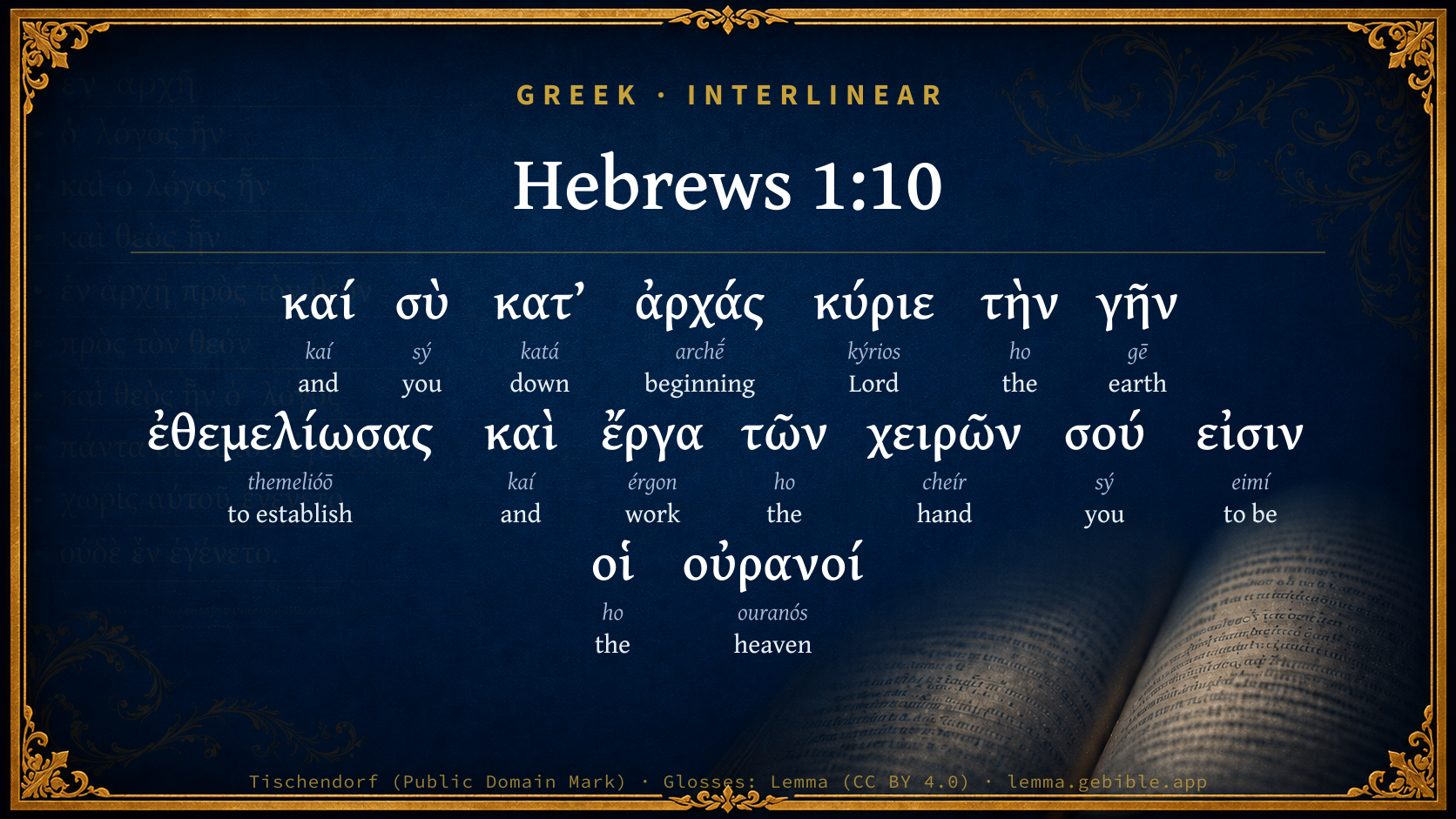
  1. καί kaí G2532 “and” Conjunction
  2. σὺ sý G4771 “you” Personal pronoun, 2nd person, Nominative, Singular
  3. κατ’ katá G2596 “down” Preposition
  4. ἀρχάς archḗ G746 “beginning” Noun, Accusative, Plural, Feminine
  5. κύριε kýrios G2962 “Lord” Noun, Vocative, Singular, Masculine
  6. τὴν ho G3588 “the” Article, Accusative, Singular, Feminine
  7. γῆν gē G1093 “earth” Noun, Accusative, Singular, Feminine
  8. καὶ kaí G2532 “and” Conjunction
  9. ἔργα érgon G2041 “work” Noun, Nominative, Plural, Neuter
  10. τῶν ho G3588 “the” Article, Genitive, Plural, Feminine
  11. χειρῶν cheír G5495 “hand” Noun, Genitive, Plural, Feminine
  12. σού sý G4771 “you” Personal pronoun, 2nd person, Genitive, Singular
  13. εἰσιν eimí G1510 “to be” Verb, Present, Active, Indicative, 3rd person, Plural
  14. οἱ ho G3588 “the” Article, Nominative, Plural, Masculine
  15. οὐρανοί ouranós G3772 “heaven” Noun, Nominative, Plural, Masculine

About this verse

These counts appear in no published source. They are computed here, from the morphology-tagged text and Lemma’s own curated glosses. What Lemma adds →

16
words
12
distinct lemmas
General Epistles
section

Notable vocabulary

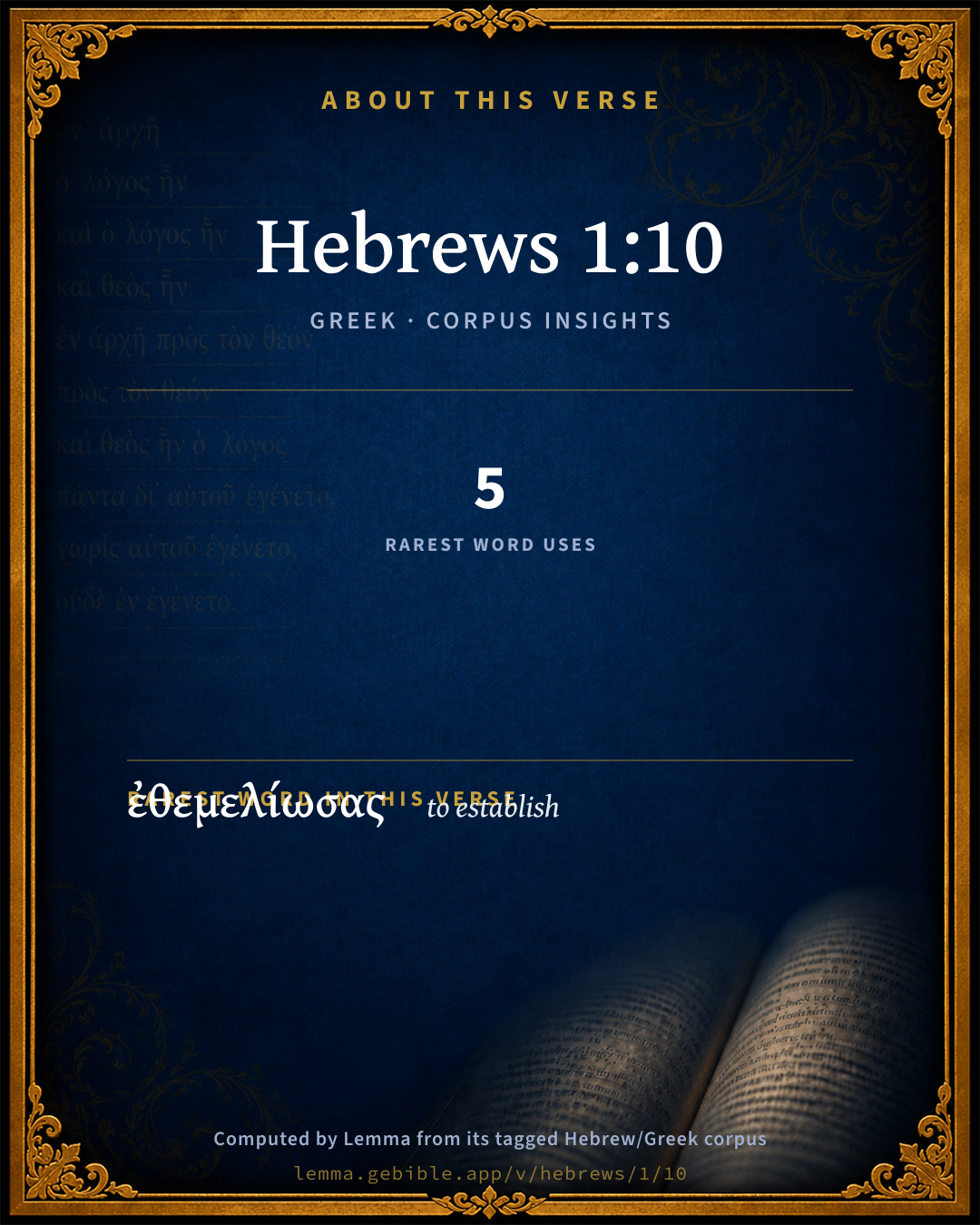
The rarest word here is ἐθεμελίωσας to establish G2311 — appearing just 5 times in the whole Greek New Testament.

Shared distinctive vocabulary

ἐθεμελίωσας to establish G2311 occurs in 5 verses of the Greek New Testament. Also found in:

Repetition

Words recur within this verse:

Cross-references

14

Topical passages linked to Hebrews 1:10 in the Treasury of Scripture Knowledge — connected by theme and wording, ordered by reader-vote popularity; previews shown in the World English Bible.

  • Psalms 102:25–27 Of old, you laid the foundation of the earth. The heavens are the work of your hands.
  • Genesis 1:1 In the beginning God created the heavens and the earth.
  • John 1:1–3 In the beginning was the Word, and the Word was with God, and the Word was God.
  • Jeremiah 32:17 Ah Lord Yahweh! behold, you have made the heavens and the earth by your great power and by your outstretched arm; there is nothing too hard for you,
  • Isaiah 48:13 Yes, my hand has laid the foundation of the earth, and my right hand has spread out the heavens: when I call to them, they stand up together.
  • Psalms 8:3–4 When I consider your heavens, the work of your fingers, The moon and the stars, which you have ordained;
  • Isaiah 42:5 Thus says God Yahweh, he who created the heavens, and stretched them forth; he who spread abroad the earth and that which comes out of it; he who gives breath to the people on it, and spirit to those who walk therein:
  • Zechariah 12:1 An oracle. The word of Yahweh concerning Israel. Yahweh, who stretches out the heavens, and lays the foundation of the earth, and forms the spirit of man within him says:
  • Proverbs 8:29 When he gave to the sea its boundary, That the waters should not violate his commandment, When he marked out the foundations of the earth;
  • Isaiah 51:13 and have forgotten Yahweh your Maker, who stretched forth the heavens, and laid the foundations of the earth; and fear continually all the day because of the fury of the oppressor, when he makes ready to destroy? and where is the fury of the oppressor?
  • Isaiah 64:8 But now, Yahweh, you are our Father; we are the clay, and you our potter; and we all are the work of your hand.
  • Revelation 3:14 "To the angel of the assembly in Laodicea write: "The Amen, the Faithful and True Witness, the Head of God's creation, says these things:
  • Deuteronomy 4:19 and lest you lift up your eyes to the sky, and when you see the sun and the moon and the stars, even all the host of the sky, you are drawn away and worship them, and serve them, which Yahweh your God has allotted to all the peoples under the whole sky.
  • Psalms 19:1 The heavens declare the glory of God. The expanse shows his handiwork.

Cross-references courtesy of OpenBible.info (CC BY 4.0).

Commentary

Notes on Hebrews 1:10 from classic Christian and Jewish commentators (each source and its license shown beneath its notes). The classic Christian expositions comment on the surrounding passage and are grouped to its opening verse, so a note may address several verses; the Jewish commentaries on the Tanakh (Rashi and others) are per-verse, so they appear only where the commentator wrote on this verse.

Lemma curates 59 commentaries, every one of them public domain or Creative Commons licensed, each selected and text-cleaned for this edition rather than reprinted as found. About our sources →

Ellicott's Commentary for English Readers

(10) And.—Heb_1:10-12 are by this word linked with Heb_1:8, as presenting the second part of the contrast between angels and the Son. As there we read of a divine sovereignty, so here of the work of creation, the power to change all created things, the divine attribute of changeless existence. This quotation from Psa_102:25-27 agrees almost exactly with the text of the LXX. as we have it in the Alexandrian MS., except that the words “as a garment” (not found in the Psalm) must here (Heb_1:12) be added, according to our best authorities. The only point of any difficulty in these verses is that the writer discovers a testimony to the supremacy of the Son in words which, as they stand in the Psalm, would appear to be directly addressed to God as Creator. If, however, the Psalm be examined, it will be found (see Heb_1:13-14) to contain the expression of hopes which in reality were inseparably united with the fulfilment of the Messianic promise. “The Lord shall appear to build up Zion:” this is the Psalmist’s theme, and it is to the same Lord that he addresses the words which are quoted here. As in Jesus the Christian Jew saw Him who fulfilled all these promises of God to His people, the application of the words of adoration to the same Lord would at once be recognised as true.

A Bible Commentary for English Readers, edited by Charles John Ellicott (1878–1897) — public domain. Text from a community e-Sword module.

Albert Barnes' Notes on the Bible

And - That is, “To add another instance;” or, “to the Son he saith in another place, or in the following language.” This is connected with Heb 1:8. “Unto the Son he saith Heb 1:8, Thy throne,” etc. - and Heb 1:10 he “also” saith, “Thou Lord,” etc. That this is the meaning is apparent, because:

(1) The “object” of the whole quotation is to show the exalted character of the Son of God, and,

(2) An address here to Yahweh would be wholly irrelevant. Why, in an argument designed to prove that the Son of God was superior to the angels, should the writer break out in an address to Yahweh in view of the fact that he had laid the foundations of the world, and that he himself would continue to live when the heavens should be rolled up and pass away? Such is not the manner of Paul or of any other good writer, and it is clear that the writer here designed to adduce this as applicable to the Messiah. Whatever difficulties there may be about the principles on which it is done, and the reason why This passage was selected for the purpose, there can be no doubt about the design of the writer. He meant to be understood as applying it to the Messiah beyond all question, or the quotation is wholly irrelevant, and it is inconceivable why it should have been made. “Thou Lord.” This is taken from Psa 102:25-27. The quotation is made from the Septuagint with only a slight variation, and is an accurate translation of the Hebrew. In the Psalm, there can be no doubt that Yahweh is intended. This is apparent on the face of the Psalm, and particularly because the “name” Yahweh is introduced in Heb 1:10, and because He is addressed as the Creator of all things, and as immutable. No one, on reading the Psalm, ever would doubt that it referred to God, and if the apostle meant to apply it to the Lord Jesus it proves most conclusively that he is divine. In regard to the difficult inquiry why he applied this to the Messiah, or on what principle such an application can be vindicated, we may perhaps throw some light by the following remarks. It must be admitted that probably few persons, if any, on reading the “Psalm,” would suppose that it referred to the Messiah; but:

(1) The fact that the apostle thus employs it, proves that it was understood in his time to have such a reference, or at least that those to whom he wrote would admit that it had such a reference. On no other principle would he have used it in an argument. This is at least of some consequence in showing what the prevailing interpretation was.

(2) It cannot be demonstrated that it had no such reference, for such was the habit of the sacred writers in making the future Messiah the theme of their poetry, that no one can prove that the writer of this Psalm did not design that the Messiah should be the sub ject of his praise here.

(3) There is nothing in the Psalm which may not be applied to the Messiah; but there is much in it that is especially applicable to him. Suppose, for example, that the Psalmist Psa 102:1-11, in his complaints, represents the people of God before the Redeemer appeared - as lowly, sad, dejected, and afflicted - speaking of himself as one of them, and as a fair representative of that people, the remainder of the Psalm will well agree with the promised redemption. Thus, having described the sadness and sorrow of the people of God, he speaks of the act that God would arise and have mercy upon Zion Psa 102:13-14, that the pagan would fear the name of the Lord, and all the kings of the earth would see his glory Psa 102:15, and that when the Lord should build up Zion, he would appear in his glory; Psa 102:16. To whom else could this be so well applied as to the Messiah? To what time so well as to his time? Thus, too in Psa 102:20, it is said that the Lord would look down from heaven “to hear the groaning of the prisoner, and to loose them that are appointed to death” - language remarkably resembling that used by Isaiah, Isa 61:1, which the Saviour applies to himself, in Luk 4:17-21. The passage then quoted by the apostle Psa 102:25-27 is designed to denote the “immutability” of the Messiah, and the fact that in him all the interests of the church were safe. He would not change. He had formed all things, and he would remain the same. His kingdom would be permanent amidst all the changes occurring on earth, and his people had no cause of apprehension or alarm; Psa 102:28.

(4) Paul applies this language to the Messiah in accordance with the doctrine which he had stated Heb 1:2, that it was by him that God “made the worlds.” Having stated that, he seems to have felt that it was not improper to apply to him the passages occurring in the Old Testament that speak of the work of creation. The argument is this, “He was in fact the creator of all things.” But to the Creator there is applied language in the Scriptures which shows that he was far exalted above the angels. He would remain the same, while the heavens and the earth should fade away. His years are enduring and eternal. “Such” a being must be superior to the angels; such a being must be divine. The words “Thou Lord” - σὺ Κύριε su Kurie - are not in the Hebrew of the Psalm, though they are in the Septuagint. In the Hebrew, in the Psalm (Psa 102:24,), it is an address to God - “I said, O my God” - אלי 'Eeliy - but there can be no doubt that the Psalmist meant to address Yahweh, and that the word “God” is used in its proper sense, denoting divinity; see Heb 1:1, Heb 1:12, of the Psalm. “In the beginning;” see Gen 1:1.

When the world was made; compare notes on Joh 1:1, where the same phrase is applied to the Messiah - “In the beginning was the word, where the same phrase is applied to the Messiah - “In the beginning was the word.” “Hast laid the foundation of the earth.” Hast made the earth. This language is such as is common in the Scriptures, where the earth is represented as laid on a foundation, or as supported. It is figurative language, derived from the act of rearing an edifice. The meaning here is, that the Son of God was the original creator or founder of the universe. He did not merely arrange it out of pre-existing materials, but he was properly its creator or founder. “And the heavens are the works of thine hands.” This must demonstrate the Lord Jesus to be divine. He that made the vast heavens must be God. No creature could perform a work like that; nor can we conceive that power to create the vast array of distant worlds could possibly be delegated. If that power could be delegated, there is not an attribute of Deity which may not be, and thus all our notions of what constitutes divinity would be utterly confounded. The word “heavens” here, must mean all parts of the universe except the earth; see Gen 1:1. The word “hands” is used, because it is by the hands that we usually perform any work.

Albert Barnes' Notes on the Bible (1834–1885) — public domain. Text from a community e-Sword/MySword module.

Joseph Benson's Commentary

Heb 1:10-12. And thou, Lord, in the beginning, &c. — These words, with those contained in the two following verses, are quoted from Psa 102:25-27, where they are evidently spoken of the God of Israel, the living and true God. “Some have thought they are here addressed to the Father, and not to the Son. But, as the former passages are directed to the Son, it is reasonable to suppose this is so likewise: especially as it would not have been to the apostle’s purpose to quote it here, if it had been addressed to the Father. By affirming that these words were spoken to the Son, the apostle confuted the opinion of those Jews who held that the angels assisted in making this mundane system; an error which was afterward maintained by some heretics in the Christian Church. They — Permanent as they seem, and though firmly founded; shall at length perish — Of the perishing of the earth and aerial heavens, Peter speaks, 2Pe 3:10-13, where he also foretels that there shall be new heavens and a new earth, formed for the habitation of the righteous, after the old creation is destroyed. But thou remainest — Διαμενεις, continuest in undecaying glory; as a vesture — Περιβολαιον, a mantle, upper garment, or cloak; shalt thou fold them up — With infinite ease; and they shall be changed — Into new heavens and a new earth; or thou shalt remove them out of their place, and introduce a new scene of things with as much ease as a prince lays aside one robe and puts on another. But thou art eternally the same, and thy years shall not fail — Through everlasting ages, nor can thy perfections admit any possible diminution.

Joseph Benson's Commentary on the Old and New Testaments (1811–1818) — public domain. Text from a community e-Sword module.

Tyndale Open Study Notes

Tyndale Open Resources

1:10-12 These verses, quoting Ps 102:25-27, celebrate the Son as both the creator and the one who brings the created order to an end. All created things will wear out like old clothing, and the Son will discard them (cp. Heb 2:5; 2 Pet 3:13; Rev 21:1). By contrast, the Son of God will live forever.

Tyndale Open Study Notes — © Tyndale Open Resources, licensed CC BY-SA 4.0. Text via the HelloAO Bible API.

Bengel's Gnomon

Johann Albrecht Bengel

Heb 1:10. Καὶ, and) This particle connects the testimonies.—σὺ κατʼ ἀρχὰς—οὐκ ἐκλείψουσι) Psa 102:26-28; LXX. κατʼ ἀρχὰς σὺ, Κύριε, τἡν γῆν, etc., the remainder in the same words. The time of the creation is intimated, to which the end of the world is opposed; and by this very fact, Dissertation 3. of Artemonius is done away with.—σὺ, Thou) The same to whom the discourse is directed in the preceding ver.—Κύριε, O Lord) The LXX. have repeated that from ver. 23 of the same psalm. Christ is preached (proclaimed) even in those passages, where many might contend that the writer was principally speaking of the Father.—γῆν, the earth: οὐρανοὶ, the heavens) A gradation. There is no reason why the angels may not be included in the word heavens, as the creation of man is included under the word earth, which passes away.

Bengel's Gnomon of the New Testament — English translation (T&T Clark, Edinburgh, 1860) — public domain. Text from a community e-Sword module.

Meyer's Critical & Exegetical Commentary

Heinrich August Wilhelm Meyer

Heb_1:10-12. A second citationco-ordinate with the Scripture testimony adduced, Heb_1:8-9derived from Psa_102:26-28 (2527) according to the LXX. The psalm is a lamentation, belonging probably to the first century after the Captivity. The words of address refer in the original to God. The author, however, mainly indeed misled[40] by the κύριε in the LXX., which was the ordinary appellation of Christ in apostolic time, takes the utterance as an address to Christ, the Son of God. This interpretation must the more have appeared to him unquestionable, inasmuch as the scope of the utterance fully harmonized with his own conception of the Son of God as the premundane Logos. Comp. Heb_1:2-3. When, for the rest, Hofmann (Schriftbew. I. p. 169 f., 2 Aufl.) supposes that the author found no address whatever to Christ designed in the κύριε of the psalm, but only meant to say in the words of Scripture what was true of Jesus according to his own belief and that presupposed in the readers, this is a freak of fancy without anything to justify it, and even opposed to the context (comp. πρὸς δὲ τὸν υἱόν, Heb_1:8). For the author can have been concerned only about this very object of proving the higher attestation given to his assertion by the Scriptures.

Καί] not a constituent part of the citation, but a brief formula of connecting, when a further passage of Scripture is linked to that which precedes, comp. Act_1:20.

σὺ κατʼ ἀρχάς, κύριε, τὴν γῆν ἐθεμελίωσας] LXX. Cod. Alex.: κατʼ ἀρχὰς, σύ, κύριε, τὴν γῆν ἐθεμελίωσας; Cod. Vatic.: κατʼ ἀρχὰς, τὴν γῆν σύ, κύριε, ἐθεμελίωσας. It is probable the author changed the position of the words in order to make σύ the more emphatic.

κατʼ ἀρχάς] in the beginning. With the LXX. elsewhere only Psa_119:152, instead of the more usual ἐν ἀρχῇ or ἀπʼ ἀρχῆς, but frequently met with in Philo and the classics (see Raphel, Wetstein, and Munthe ad loc.). In the Hebrew stands the more general לְפָּנִים, formerly, or of old.

[40] According to Delitzsch, indeed, it would be a poor look-out if that were true. But when, following in Hofmanns steps, he objects against it that we may already see from Heb_8:8 ff., Heb_12:6 ff., that the author is far from everywhere understanding Christ to be intended by the O. T. κύριος, these passages naturally prove nothing, since the usual practice is never the constant and invariable practice. When Delitzsch further adds: such perversity originating in ignorance is not to be laid to the charge of an author who shows so deep an insight into the innermost core of the O. T., that is a prejudiced verdict, arising from subjectivity and dogmatic partiality, to the establishing of which it would have been necessary first of all to bring forward the proof that the author of the Epistle to the Hebrews in reality possessed an accurate knowledge not only of the Greet text of the LXX., but also of the original text of the O. T.,a proof which even Delitzsch has not been able to afford.

Meyer — Critical and Exegetical Commentary on the New Testament — English translation by Peter Christie, edited by Frederick Crombie (T&T Clark, 1880) — public domain. Text from a community e-Sword module.

Expositor's Greek Testament

ed. W. Robertson Nicoll

Heb 1:10 . In Heb 1:10-12 the writer introduces another quotation from Psa 102 (in LXX Psalm 101:25 7). The quotation is verbatim from the LXX except that σὺ is lifted from the fifth to the first place in the sentence, for emphasis, and that a second ὡς ἱμάτιον is inserted after αὐτούς in Heb 1:12 . With the introductory καὶ Weiss understands πρὸς τὸν υἱὸν λέγει , as in Heb 1:8 . He is also of opinion that the writer considers that the words were spoken by Jehovah and that κύριε , therefore, must be the Messiah. This is possible, but it is not necessary for the justification of the Messianic reference. This follows from the character of the psalm, which predicts the manifestation of Jehovah as the Saviour of His people, even though this may only be in the far future (see Psa 103:13 : “Thou shalt arise and have mercy upon Zion.… So the heathen shall fear the name of the Lord, etc.”) Prof. B. W. Bacon of Yale has investigated this matter afresh and finds that, so far from the application of these verses to the Messiah being an audacious innovation, or even achieved, as Calvin says, “pia deflectione,” “the psalm itself was a favourite resort of those who sought in even pre-Christian times for proof-texts of Messianic eschatology”; also that “we have specific evidence of the application of Psa 102:23-24 to the Messiah by those who employed the Hebrew or some equivalent text” and finally that by the rendering of ענה in Psa 102:24 (English Psa 102:23 ) by respondit or ἀπεκρίθη “we have the explanation of how, in Christian circles at least, the accepted Messianic passage could be made to prove the doctrine that the Messiah is none other than the pre-existent wisdom of Pro 8:22-31 , “through whom,” according to our author, Heb 1:2 , “God made the worlds.” Indeed, we shall not be going too far if with Bruce we say: “It is possible that the writer (of Heb.) regarded this text (Psa 102:25-27 ) as Messianic because in his mind creation was the work of the pre-existent Christ. But it is equally possible that he ascribed creative agency to Christ out of regard to this and other similar texts believed to be Messianic on other grounds.” See Preuschen’s Zeitschrift für N.T. Wissenschaft , 1902, p. 280.

In Heb 1:13-14 , we have the final contrast between the place of the Son and that of the angels in human redemptive history. This contrast is connected by the form of its statement with Heb 1:5 (“to which of the angels, etc.”). There it was the greater name that was in question, here it is the higher station and function. πρὸς τίνα δὲ κ . τ . λ . “But to which of the angels has He at any time said …?” implying that to the Son He has said it, as is proved by the citation from Psa 110 . On this psalm (see note on Heb 1:9 ). δὲ connects this ver. with Heb 1:8 , and stands in the third place as frequently in classics when a preposition begins the sentence (Herod., viii., 68, 2; Thuc., i., 6; Soph., Philoct. , 764. See examples in Klotz’ Devarius , p. 379). κάθου ἐκ δεξιῶν μου , see Heb 1:3 ; ἐκ δεξ . is not classical, but frequent in Hellenistic Greek, see references, ἕως ἂν θῶ .… “Until I set thine enemies as a footstool for thy feet.” ὑποπόδιον is a later Greek word used in LXX and N.T. The figure arose from the custom of conquerors referred to in Jos 10:24 . Here it points to the complete supremacy of Christ. This attained sovereignty is the gauge of the World’s consummation. The horizon of human history is the perfected rule of Jesus Christ. It is the end for which all things are now making. Whereas the angels are but the agents whose instrumentality is used by. God for the furtherance of this end. οὐχὶ πάντες εἰσὶ λειτουργικὰ πνεὐματα .… “Are they not all ministering spirits sent forth to serve for the sake of those who are to obtain salvation?” They have no function of rule, but are directed by a higher will to promote the interests of those who are to form Christ’s kingdom. This is true of all of them [ πάντες ] whatever hierarchies there be among them. λειτουργικὰ , cf. Heb 5:5 . λειτουργός with its cognates has come to play a large part in ecclesiastical language. It is originally “a public servant”; from λεῖτος , an unused adjective connected with λαός , meaning “what belongs to the people” and ἔργον . It occurs frequently in LXX, sometimes denoting the official who attends on a king (Jos 1:1 ), sometimes angels (Psa 103:21 ), commonly the priests and Levites (Neh 10:39 ), οἱ ἱερεῖς οἱ λειτουργοί , and Isa 61:6 . In N.T. it is used of those who render service to God or to Christ or to men ( cf. Lepine’s Ministers of Jesus Christ , p. 126). εἰς διακονίαν ἀποστελλόμενα , present part., denoting continuous action. “Sent forth”; therefore as servants by a higher power ( cf. Act 1:25 , διακονίας ταύτης κ . ἀποστολῆς ). Διακονία originally means the ministry of a body servant or table servant ( cf. Luk 4:39 ; Mar 1:13 , οἱ ἄγγελοι διηκόνουν αὐτῷ ) and is used throughout N.T. for ministry in spiritual things. μέλλοντας might almost be rendered “destined” as in Mat 3:7 ; Mat 11:14 ; Mat 16:27 ; Mat 17:12 , etc. κληρονομεῖν , see on Heb 1:4 . σωτηρίαν in the classics means either preservation or deliverance. In N.T. the word naturally came to be used as the semi-technical term for the deliverance from sin and entrance into permanent wellbeing effected by Christ. See Luk 1:71 ; Luk 1:77 ; Joh 4:22 ; Act 4:12 ; Act 16:17 ; Rom 1:16 , etc. In Heb 2:3 the salvation referred to is termed τηλικαύτη . Cf. Hooker’s outburst, Eccles. Pol. , i., iv., 1, and Sir Oliver Lodge ( Hibbert Journal , Jan., 1903, p. 223): “If we are open to influence from each other by non-corporeal methods, may we not be open to influence from beings in another region or of another order? And if so, may we not be aided, inspired, guided by a cloud of witnesses not witnesses only, but helpers, agents like ourselves of the immanent God?” On guardian angels, see Charles’ Book of Jubilees , Moulton in J. T. S. , August 1902, and Rogers’ edition of Aristoph., Eccles. , 999, and the Orphic Fragment quoted by Clement ( Strom. , v.) Σῷ δὲ θρόνῳ πυρόεντι παρεστᾶσιν πολυμόχθοι Ἄγγελοι οἷσι μέμηλε βροτοῖς ὡς πάντα τελεῖται . Cf. Shakespeare’s “Angels and ministers of grace defend us”.

The Expositor's Greek Testament, edited by W. Robertson Nicoll (1897–1910) — public domain. Text from a community e-Sword module.

Geneva Bible (1599)

Geneva Bible translators

Madest the earth firm and sure.

Geneva Bible (1599) marginal notes — public domain. Text via Bolls.life.

Jamieson, Fausset & Brown

Robert Jamieson, A. R. Fausset & David Brown

And--In another passage (Psa 102:25-27) He says.

in the beginning--English Version, Psa 102:25, "of old": Hebrew, "before," "aforetime." The Septuagint, "in the beginning" (as in Gen 1:1) answers by contrast to the end implied in "They shall perish," &c. The Greek order here (not in the Septuagint) is, "Thou in the beginning, O Lord," which throws the "Lord" into emphasis. "Christ is preached even in passages where many might contend that the Father was principally intended" [BENGEL].

laid the foundation of--"firmly founded" is included in the idea of the Greek.

heavens--plural: not merely one, but manifold, and including various orders of heavenly intelligences (Eph 4:10).

works of thine hands--the heavens, as a woven veil or curtain spread out.

Jamieson, Fausset & Brown — Commentary Critical and Explanatory on the Whole Bible (1871) — public domain (CC PDM 1.0). Text via the HelloAO Bible API.

Adam Clarke's Commentary

Verse 10. And, Thou, Lord] This is an address to the Son as the Creator, see Heb 1:2; for this is implied in laying the foundation of the earth. The heavens, which are the work of his hands, point out his infinite wisdom and skill.

Adam Clarke's Commentary on the Bible (1810–1826) — public domain. Text from a community e-Sword/MySword module.

John Calvin's Commentaries

10. And, Thou, Lord, in the beginning, etc. This testimony at first sight may seem to be unfitly applied to Christ, especially in a doubtful matter, such as is here handled; for the subject in dispute is not concerning the glory of God, but what may be fitly applied to Christ. Now, there is not in this passage any mention made of Christ, but the majesty of God alone is set forth. I indeed allow that Christ is not named in any part of the Psalm; but it is yet plain that he is so pointed out, that no one can doubt but that his kingdom is there avowedly recommended to us. Hence all the things which are found there, are to be applied to his person; for in none have they been fulfilled but in Christ, such as the following, — “Thou shalt arise and have mercy on Sion, that the heathens may fear the name, and all the kings of the earth thy glory.” Again, — “When the nations shall be gathered together, and the kingdoms, to serve the Lord.” Doubtless, in vain shall we seek to find this God through whom the whole world have united in one faith and worship of God, except in Christ.

All the other parts of the Psalm exactly suit the person of Christ, such as the following, that he is the eternal God, the creator of heaven and earth, that perpetuity belongs to him without any change, by which his majesty is raised to the highest elevation, and he himself is removed from the rank of all created beings.

What David says about the heavens perishing, some explain by adding, “Were such a thing to happen,” as though nothing was affirmed. But what need is there of such a strained explanation, since we know that all creatures are subjected to vanity? For to what purpose is that renovation promised, which even the heavens wait for with the strong desire as of those in travail, except that they are now verging towards destruction?

But the perpetuity of Christ which is here mentioned, brings no common comfort to the godly; as the Psalm at last teaches us, they shall be partakers of it, inasmuch as Christ communicates himself and what he possesses to his own body.

John Calvin's Commentaries (1540-1563) — public domain. Text from the Calvin Translation Society English edition (1840s-50s) via the Christian Classics Ethereal Library (ccel.org). Calvin's coverage is partial (roughly two-thirds of the Bible); uncommented books and verses are honest gaps, never fabricated. The 19th-century editor's footnotes and remarks are omitted so the notes are faithfully Calvin's own voice.

The Cambridge Bible for Schools and Colleges

gen. ed. J. J. S. Perowne

10. Thou, Lord, in the beginning] The quotation is from Psa_102:25-27. The word “Lord” is not in the original, but it is in the LXX.; and the Hebrew Christians who already believed that it was by Christ that “God made the world” (see note on Heb_1:2) would not dispute the Messianic application of these words to Him. They are a prayer of the afflicted written at some late period of the exile. Calvin (on Eph_4:8) goes so far as to say of such passages that the Apostle “by a pious diversion of their meaning (piâ deflectione) accommodates them to the Person of Christ.” The remark illustrates the courageous honesty and stern good sense of the great Reformer; but no Jewish-Christian exegete would have thought that he was practising a mere pious misapplication of the sacred words, or have admitted the objection of Cardinal Cajetan that “in a matter of such importance it was unbecoming to use such an argument.” The writer’s object is not proof—which was for his readers unnecessary; he wished to illustrate acknowledged truths by admitted principles.

in the beginning] Heb. לְפָנִים, “face-wards,” i.e. of old.

The Cambridge Bible for Schools and Colleges (gen. ed. J. J. S. Perowne; Cambridge University Press, 1878–1918) — public domain. Text from a community e-Sword module.

John Gill's Exposition

And thou Lord, in the beginning hast laid the foundation of the earth,.... The person here addressed, as the Lord or Jehovah, and as the Maker of the heavens and the earth, is the same with the Son spoken to, and of, before; for the words are a continuation of the speech to him, though they are taken from another psalm, from Psa 102:25. The phrase, "thou, Lord" is taken from Psa 102:12 and is the same with, "O my God", Psa 102:24 and whereas it is there said, "of old", and here, in the beginning, the sense is the same; and agreeably to the Septuagint, and the apostle, Jarchi interprets it by "at", or "from the beginning"; and so the Targum paraphrases it, , "from the beginning", that the creatures were created, &c. that in the beginning of the creation, which is the apostle's meaning; and shows the eternity of Christ, the Lord, the Creator of the earth, who must exist before the foundation of the world; and confutes the notion of the eternity of the world: and the rounding of it shows that the earth is the lower part of the creation; and denotes the stability of it; and points out the wisdom of the Creator in laying such a foundation; and proves the deity of Christ, by whom that, and all things in it, were made:

the heavens are the works of thine hands: there are more heavens than one; there are the airy heaven, and the starry heaven, and the heaven of heavens, the third heaven; and they were created the beginning, as the earth was, Gen 1:1 and are the immediate work of Christ; they were made by himself, not by the means of angels, who were not in being till these were made; nor by any intermediate help, which he could not have, and which he did not need: the phrase is expressive of the power of Christ in making the upper parts of the creation, and of his wisdom in garnishing them, in which there is a wonderful display of his glory; and the whole serves to set forth the dignity and excellency of his person.

John Gill's Exposition of the Whole Bible (1746–1763) — public domain (CC PDM 1.0). Text via the HelloAO Bible API.

Trapp's Complete Commentary

John Trapp

10 And, Thou, Lord, in the beginning hast laid the foundation of the earth; and the heavens are the works of thine hands:

Ver. 10. The works of thy hands] Psa 8:3, they are called the works of God’s fingers, artificially elaborated; that heaven of heavens especially, whose artificer and workman is God, Heb 11:10, τεχνιτης. The apostle there intimates that it is curiously and cunningly contrived.

John Trapp, A Commentary or Exposition upon All the Books of the Old and New Testament (1647–1656) — public domain. Text from a community e-Sword module.

Haydock's Catholic Bible Commentary

And again: thou in the beginning, O Lord, hast founded the earth, &c. The text, as well as the authority of interpreters, shew these words to be still spoken of the Son of God, of Christ, who was both true God and man. And thought part of Psalm ci. from which these words are taken, contain a prayer to God for the restoring of the city of Jerusalem, yet in this psalm is chiefly signified the glory of Christ, and of his Church, which will be spread over all nations. See St. John Chrysostom, Estius, Cornelius a Lapide, &c. --- As a vesture shalt thou change them, &c. The apostle, in the second verse of this chapter, had said that the world was made by the Son of God: now he tells us that all created things shall wax old like a garment, shall decay and perish, (at least from their present state and condition) shall be changed; but thou, who art both God and man, art always the same, without decay or change. (Witham) --- The apostle here applies the work of the creation to the Son of God, and thus furnishes a clear and striking proof of his divinity, against the Unitarians. To elude this proof, some of them pretend that these verses have been fraudulently added; but they are found in all the Greek copies, and in all ancient versions of this epistle. Others try to give forced interpretations to these verses, but the words are convincingly clear to all who do not purposely shut their eyes.

George Leo Haydock (1774–1849), Haydock's Catholic Family Bible and Commentary, 1859 edition — public domain. Excludes Psalms (Douay-Rheims chapter numbering differs from Protestant) and Deuterocanonical books (Catholic canon only).

Matthew Poole's English Annotations

And, Thou, Lord: this connective particle joins this to the former proof, that Christ had a more excellent name than angels, even that of God. That he was God, he proved out of Psa 45:6,7. He seconds it in this and the two following verses, which he quotes out of Psa 102:25-27. The strength of which lieth thus: He who was Jehovah, and the great Creator of the world, is God; such is Christ, the great gospel Prophet. This is evident in the prayer recorded in the Psalm made to him, compared with the Spirit’s testimony, Heb 1:8; the very works appropriated to Jehovah there, are the acknowledged works of God the Son, as redemption, Psa 102:20,21, vocation of the Gentiles, Psa 102:15,18,22.

In the beginning; in the beginning of time, when that came to be the measure and limit of things, as Gen 1:1. Before there were any such creatures as angels, he was Jehovah, Joh 1:1; and then manifested himself to be Jehovah. The enemies of Christ’s Deity say that the name Jehovah is not in the verse of the Psalm quoted by the Spirit; yet thou, the relative used in all those verses, refers to God, the antecedent, prayed to in Psa 102:24, and to Jehovah, the name given him in Psa 102:1,12,15,16,18,19,21,22, of that Psalm; all importing one and the same person. And it is well known that Κυριος, Lord, doth eminently decipher the Redeemer in the New Testament; he is not an instrument of Jehovah to create by, but the fountain of all being, Jehovah himself.

Hast laid the foundation of the earth; and the heavens are the works of thine hands: by founding the earth, and the heavens being the work of his hands, is meant the whole work of creation throughout the space of six days: he was the true, full, sole, and self-causality of the earth’s being, and all creatures in it, and of the heavens, and all beings which are in them; he was the great Architect and Founder of them all; they were his peculiar workmanship, possession, and dominion, 1Co 8:6; compare Joh 1:3; Col 1:16. If the heavens were the works of his hands, and all in them, then he was the Creator of angels, and therefore must be, for person, name, and office, more excellent than they.

Matthew Poole's English Annotations on the Holy Bible (1683–1685) — public domain. Text from a community e-Sword/MySword module.

Whedon's Commentary on the Bible

Daniel D. Whedon

10-12. If the reader compare these views of this passage with Joh_1:1-14; Col_1:15, and onwards; Php_2:6; 1Co_8:6; 1Co_10:4; 1Co_15:47; 2Co_4:4; 2Co_8:9, he will reasonably infer that the author of Hebrews agrees with John and Paul in his views of the exalted nature of the Son, or Logos, in his pre-existent being. Having thus traced the heirship and creatorship of the Son, he now penetrates even more deeply into his essential relations to the divine Essence.

10. And—Quoted from Psa_102:26-28, where see notes. Though this psalm is within the Messianic number, there is nothing in its contents which limits it to him. We are at liberty, indeed, whether applied to the Trinity or to the Son, to see that our author intends it to be an expansion of his own words in Heb_1:2, by whom also he made the worlds. It is to the Logos, the executive Maker of the worlds, that in accordance with the mind of the Church he applies them.

In the beginning—Literal Greek, κατ’ αρχας, at beginnings. At the various commencements, whether of different things in the same world, or of serial worlds in succession. Less solemn and aboriginal than St. John’s εν αρχη, “In the beginning was the Word.” For even if a scientist maintains that matter is chronologically eternal, still in the order of nature and truth God, the Word, is back of it. It is dependent and phenomenal: He is independent, unconditioned, and absolute. If creation, or creations, be eternal in series, it is because He eternally and freely creates.

Laid the foundation—It is not illegitimate for modern science to read into these words the definite facts comprehensively embraced in them. By the divine Word, the author of order in chaos, the work of order, whatever it was, was performed. If that chaos was a nebula, there was nothing in the mere nebula itself by which it could frame itself into an intellective system. If it condensed and hardened, without some regulative mind it would harden into an unintelligent solidity. It required an indwelling Mind, a divine Logos, to translate the unintelligent mass into intelligent forms. As easily could a pile of type lying in pi form themselves into a poem without a forming mind, as a pile of matter frame itself into a cosmos without the formative Logos. No atheistic philosophy, whether of Hume or Herbert Spencer, has been able to bridge this chasm.

Foundation—Geology reveals such “foundation” in the primitive rocks, and in the strata of successive ages.

Heavens—The atmospheric expanse; and we may add, as speaking optically from our earth-centre, the firmament and the starry heavens.

Works of thine hands—Spoken anthropomorphically, that is, under momentary conception, as if God were an infinite man; which abstracting away from him all imperfection, and adding all perfection, we rightfully do. Weak-minded pseudo-philosophers raise a great protest against such anthropomorphism, showing a sudden sensitiveness at our degrading God—a God in whom they themselves do not believe. And yet Mr. Spencer, who leads in this outcry against anthropomorphizing “the Absolute,” thinks he elevates him by denying to him the attribute of intelligence. A better philosopher, Sir Isaac Newton, says, (at the close of his “Optics,”) that the entire universe, including all material things from the planets down to animal bodies, the organs of sense and motion, and the instinct of brutes and insects, “can be the effect of nothing else than the wisdom and skill of a powerful everliving Agent, who, being in all places, is more able by his will to move the bodies within his boundless, uniform sensorium, (of space,) and thereby to form and reform the parts of the universe, than we are by our will to move the parts of our own bodies.” In his “Principia” he says: “It is confessed that God supreme exists necessarily. By the same necessity he is always and everywhere. Whence he is all similar to himself—all eye, all ear, all brain; all perceptive, intellective, and active force; but in a manner not at all human or corporeal, but in a mode to us unknown.”—Liber iii, De Mundi Systemate.

That acute Christian philosopher, Tayler Lewis, rebuking the squeamish avoidance of anthropomorphisms by later Jewish writers, as Philo and the Rabbis, shows that the divine mind is truly competent to see things as man sees them, and to realize the human feeling. If God knows how things appear to our human thought he must be able to see them not only as he absolutely sees them, but as we finitely see them; that is, he thinks our thoughts. “May not God come actually into the human sphere and the human finity? May he not, if it pleases him, tabernacle in the human mind, knowing things as we know them, feeling them as we feel them? For, unless he thus knows them as we know them, feels them as we feel them, there would be a knowledge unknown to him as it really is—that is, as it exists in our mind.” And yet, Moses, who uses the strongest anthropomorphisms, (and we may add, Newton, as in the above quotation,) “knew that God was infinite as well as Spinoza” knew it.

Daniel D. Whedon (gen. ed.), Commentary on the Old and New Testaments (1874–1909) — public domain. Text from a community e-Sword module.

The Pulpit Commentary

Vers. 10-12. And, Thou, Lord, in the beginning, etc. The bearing of this quotation (from Psa_102:25-27) on the argument in hand is not at first sight obvious; since, in the psalm, the address is plainly to God, without any mention of, or apparent reference to, the Son. The psalm is entitled, "A prayer of the afflicted, when he is overwhelmed, and poureth out his complaint before the LORD." It seems likely, from its contents, to have been written by some suffering saint during the Babylonian captivity: for its purport is a prayer, rising into confident expectation for deliverance from a state of deep affliction, Israel being in captivity and Jerusalem in ruins. The prayed-for and expected deliverance, portrayed in vers. 16-24, corresponds so closely, both in thought and expression, with that pictured in the latter chapters of Isaiah, (beginning at Isa 40) that we cannot hesitate in assigning the same meaning to both. There is, for instance, the looking down of the Loan from. heaven to behold the affliction of his people; (cf. Isa_63:15) the setting free of captives; (cf. Isa_42:7 Isa_61:1) the rebuilding and restoration of Zion, and in connection with this the conversion of the Gentiles to serve the Lore) with Israel. (cf. Isaiah 40-66; and especially Isa_59:19 Isa_60:2) These are specimens of the general correspondence between the two pictures, which must be evident to all who have studied both. But the ultimate reference of Isaiah"s prophecy is certainly Messianic: wherefore that of the psalm may be concluded to be the same. And thus we have made one step in explanation of the applicability of this quotation to the argument of the Epistle in confirming its ultimate reference to the Messiah"s advent; to the final realization of the ideal of the Son, typified by theocratic kings. But we have still to account for the apparent application to the Son of what, in the original psalm, shows no sign of being addressed to him. One view is that there is no intention in the Epistle of quoting it as addressed to him, the phrase, pron (as has been seen) not of necessity implying such intention. According to this view, the point of the quotation is that the Messianic salvation is made to rest solely on the eternity and immutability of God of him who, as he created all at first, so, though heaven and earth should pass away, remains unchanged. And the character of the salvation, thus regarded, is conceived to carry with it the transcendent super-angelic dignity of its accomplisher, the SON. So, in effect, Ebrard, who dwells on this as one example of the general character of apostolical exegesis, as opposed to rabbinical, in that, instead of drawing inferences, often arbitrary, from isolated words or phrases, the apostolic interpreters draw all their arguments from the spirit of the passages considered in their connection and this with a depth of intuition peculiar to themselves. Other commentators consider it more consistent with both the context and the argument to see, in the Epistle at least, an intended address to the Son. If this be so, our conclusion must be that this application of the psalmist"s words is the inspired writer"s own; since it is certainly not apparent in the psalm. It by no means follows that the writer of the Epistle foisted, consciously or unconsciously, a false meaning into the psalm. Even apart from the consideration of his being an inspired contributor to the New Testament canon, he was too learned in Scripture, and too able a reasoner, to adduce an evidently untenable argument. He may be understood as himself applying the passage in a way which he does not mean to imply was intended by the psalmist. His drift may be, "You have seen how in Ps 45. the Son is addressed as God, and as having an eternal throne. Yea, so Divine is he that the address to the everlasting God himself in another psalm prophetic of his advent may be truly recognized as an address to him." Whichever view we take of this difficult passage, this at any rate is evident that the inspired writer of the Epistle, apart from the question of the relevancy of quotation in the way of argument, associated Christ in his own mind with the unchangeable Creator of all things.

Vers. 10-12. The Son and the universe.

"And, Thou, Lord, in the beginning hast laid the foundation," etc. The main subject of the writer is still the same the superiority of the Son to the angels; and he here adduces further proofs of his superiority by setting forth the relations of the Son to the universe, in words which he quotes Psa_102:25-27.

I THE SON IS THE CREATOR OF THE UNIVERSE. "Thou, Lord, in the beginning hast laid the foundation of the earth, and the heavens are the works of thy hands." Notice here:

1. His existence before the universe. In the beginning he laid the foundation of the earth. When was that? Six thousand years ago? Nay, millions of years ago. The expression takes us "back to the fathomless abyss of ages of ages." Yet the existence of the Son takes us back beyond that, to us, incomprehensibly remote period. As the artist must have existed before the picture which he painted, and the architect before the edifice which he designed, so the Son existed before the universe which he made. "His goings forth have been from of old, from everlasting.

2. His agency in the creation of the universe. He "laid the foundation of the earth," etc. The heavens and the earth have not always existed; they had a beginning. They were not self-originated, but were made by Another. In the strict sense of the word, they were created by our Lord. He did not merely arrange or form the heavens and the earth out of pre-existent materials; he created them. He "laid the foundation." He began at the beginning, etc.

II HE PRESIDES OVER THE CHARGES OF THE UNIVERSE. "They all shall wax old as doth a garment; and as a vesture shalt thou fold them up, and they shall be changed." Changes are ever going on in the universe. Spring with its fresh and youthful beauty passes into the glowing and. gorgeous summer, etc. There are changes in the earth and in the seas. Even the mountains, which seem so stable and immutable, are subject to change. Suns and stats also are mutable. The heavens and the earth are growing old; they have had their infancy and. youth, etc. These changes are not effected by blind, unintelligent forces or laws. The Son of God superintends all of them. He is the Framer of all the laws of Nature, and the Force of all her forces. He is the Sustainer as well as the Creator of the universe. To the thoughtful and devout man this fact imparts a deeper, tenderer interest and attraction to the changes which take place in nature. Our gracious Savior and Lord is also the Superintendent and Sovereign of the universe.

III HE IS UNCHANGEABLE AMIDST THE CHANGES OF THE UNIVERSE. "But thou art the same." He is the same in his being and character, in his will and purposes. Presiding over a universe in which all things are continually changing, yet with him there "is no variableness or shadow of turning." He is "the same yesterday, and today, and for ever." He is the same in knowledge. His understanding is infinite, and he knoweth all things. He is the same in purpose. The writer of this Epistle speaks of "the immutability of his counsel." "He is of one mind." He is the same in affection. "The mountains shall depart, and the hills be removed, but my kindness shall not depart from thee, nor shall the covenant of my peace be removed." "Having loved his own which were in the world, he loved them unto the end." What an inspiration this supplies to trust in him! It was thus, indeed, that these words were originally employed by the psalmist; for, as Ebrard points out, it is not "his unchangeableness as the immaterial Spirit that is spoken of, (in Psa_102:27) but the unchangeableness of Jehovah in his acts, in his relation to Israel, in a word, the Divine covenant-faithfulness. " And upon this the psalmist bases his hope of the restoration of prosperity to Israel. Because he is immutable in his character and purposes and relation to his people, we may safely confide in him. "He abideth faithful; for he cannot deny himself.

IV HE SURVIVES THE DISSOLUTION OF THE UNIVERSE. "They shall perish; but thou remainest .... And thy years shall not fail." We do not think that the annihilation of the heavens and earth is taught here, but that their present form and aspect shall pass away. Their substance will remain, but their present appearance will perish. "The day of the Lord will come as a thief; in the which the heavens shall pass away with a great noise, and the elements shall be dissolved with fervent heat, and the earth and the works that are therein shall be burned up." "The cloud-capped towers, the gorgeous palaces, The solemn temples, the great globe itself, Yea, all which it inherit, shall dissolve; And, like this insubstantial pageant faded, Leave not a rack behind. (Shakespeare.)

But the Lord shall remain forever and ever. As he existed before the universe, so shall he exist when its present forms have disappeared forever. He is "from everlasting to everlasting." "I am the First and the Last, and the Living One; and I was dead, and behold, I am alive for evermore.

CONCLUSION. How immeasurably greater, then, is the Son than the angels! They could not create a world; but he created the entire universe. They have no sovereign control over the transformations of any world; but he is the supreme Agent effecting all the changes in every province of all worlds. They change; their knowledge changes by way of increase, and with new discoveries they have new admirations; their affections also change, growing more deep and intense; but he is superior to all change the Immutable. They are not essentially immortal; their continued existence depends upon him; but he is essentially immortal living One," the Eternal. Seeing that the Son of God is immutable and eternal, we have the strongest encouragement to trust in him at all times. Both in his power and in his willingness to save he is ever the same, and-" he ever liveth." His "years shall not fail. W. J.

The Pulpit Commentary (1880–1919), ed. H.D.M. Spence-Jones & Joseph S. Exell — public domain. Text from a community e-Sword module.

John Wesley's Explanatory Notes

Thou - The same to whom the discourse is addressed in the preceding verse. Psalm cii, 25, 26

John Wesley, Explanatory Notes Upon the Whole Bible (1754–1765) — public domain. Text via the GEBible commentary corpus.

Burkitt's Expository Notes on the New Testament

William Burkitt

What proof more can be desired of Christ’s Divinity, than what is here given by our apostle? the name and attributes of God are given to him, as also an everlasting throne and kingdom; divine honour is required to be paid to him: and here such divine works are ascribed to him, wherein no creature can have any share of efficiency with him; such is the making of the world, Thou, Lord, laidest the foundations of the earth, and the heavens are the works of thy hands:

Here we have Christ’s omnipotency declared, Thou has laid the foundations of the earth, and the heavens are thy handy-works: and his eternity and immutability asserted, When the heavens perish, thou remainest: when thy wax old, and are changed thou art the same.

Learn hence, That the whole world, the heavens and the earth being made by our Lord Jesus Christ, is and evident proof that he is exalted above all creatures, and that he is and almighty and unchangeable God, Thou, Lord, hast laid, &c.

Learn, 2. That such is the frailty of man’s nature, and such the perishing condition of all created things, that nothing will or can yield stable consolation to us, but a firm belief of the omnipotency and immutability of our Lord Jesus Christ.

William Burkitt's Expository Notes on the New Testament (1700–1703) — public domain. Text from a community e-Sword module.

Godbey's Commentary on the New Testament

William B. Godbey

10. We see here that our Savior, the second person of the Trinity, actually created this world; or, rather, that God in the person of the Eternal Son created this world, with its atmospheric environments and luminaries to vitalize it. No wonder He was not willing for Satan to wither and blight it, and add it to hell; but He generously volunteered and came to its rescue.

William B. Godbey, Commentary on the New Testament (1896–1900) — public domain. Text from a community e-Sword module.

The People's New Testament

B. W. Johnson

10. And thou Lord in the beginning. From Ps. 102:25–27. A part of the preceding part of the Psalm speaks of the Messiah's Kingdom, and hence these verses may well apply to the Messiah, especially as they harmonize with what we are told elsewhere of his glory. See notes on John 1:1.

B. W. Johnson's The People's New Testament with Notes (1889–1891) — public domain. Electronic text from the Christian Classics Ethereal Library (CCEL) ThML edition.

unfoldingWord translationNotes

Door43 World Missions Community

Connecting Statement:

The author continues explaining that Jesus is superior to the angels.

General Information:

This quotation comes from another Psalm.

In the beginning

"Before anything existed"

you laid the earth's foundation

The author speaks of God creating the earth as if he built a building on a foundation. AT: "you created the earth" (See: Metaphor)

The heavens are the work of your hands

Here "hands" refer to God's power and action. AT: "You made the heavens" (See: Metonymy)

They will perish

"The heavens and earth will disappear" or "The heavens and earth will no longer exist"

wear out like a piece of clothing

The author speaks of the heavens and earth as if they were a piece of clothing that will get old and eventually become useless. (See: Simile)

roll them up like a cloak

The author speaks of the heavens and earth as if they were a robe or another kind of outer garment. (See: Simile)

they will be changed like a piece of clothing

The author speaks of the heavens and earth as if they were clothing that could be exchanged for other clothing. (See: Simile)

they will be changed

This can be stated in active form. AT: "you will change them" (See: Active or Passive)

your years do not end

Periods of time are used to represent God's eternal existence. AT: "your life will never end" (See: Metaphor)

translationWords

lord

earth

found

heaven

hand

perish

unfoldingWord translationNotes — © Distant Shores Media and the Door43 World Missions Community, licensed CC BY-SA 4.0. Source: git.door43.org/Door43/en_tn.

Cambridge Greek Testament for Schools and Colleges

10. καί, Σὺ κατʼ ἀρχὰς κύριε. The quotation is from Psa 102:25-27. The word “Lord” is not in the original, but it is in the LXX.; and the Hebrew Christians who already believed that it was by Christ that “God made the world” (see note on Heb 1:2) would not dispute the Messianic application of these words to Him, though the Jews did not regard it as a Messianic Psalm and it is never so applied by any Rabbi. It is a prayer of the afflicted written at some late period of the exile. Calvin (on Eph 4:8) goes so far as to say of such passages that the Apostle “by a pious diversion of their meaning (piâ deflectione) accommodates them to the Person of Christ.” The remark illustrates the courageous honesty and stern good sense of the great Reformer: but no Jewish-Christian exegete would have thought that he was practising a mere pious misapplication of the sacred words, or have admitted the objection of Cardinal Cajetan that “in a matter of such importance it was unbecoming to use such an argument.” The writer’s object is not proof—which was for his readers unnecessary; he wished to illustrate acknowledged truths by admitted principles.

κατʼ ἀρχάς. Heb. לְפָנִים, “face-wards,” i.e. of old. It is a classic phrase, and in the LXX. ἀπʼ ἀρχῆς or ἐν ἀρχῇ are more common.

Cambridge Greek Testament for Schools and Colleges (Cambridge University Press, 1896; 21 vols, various authors incl. Carr, Maclear, Plummer, Farrar, Lumby, Moule, M. R. James, Simcox) — public domain. Text from a community e-Sword module.

Alford’s Greek Testament

Henry Alford

10.] And (πρὸς τὸν υἱὸν λέγει: see a similar καί introducing a new citation in Act 1:20. The comma, or colon, or capital letter, as in text, should be retained after καί),—Thou in the beginning (Heb. לְפָנִים. ad faciem, antea; probably here rendered κατʼ ἀρχάς by the LXX with reference to Gen 1:1. The expression is found in Philo, and often in the classics: cf. Herod. iii. 153, 159, and instances in Wetst.; and see Kühner, Gr. Gr. § 607.1), Lord (κύριε has no word to represent it in the Hebrew. But it is taken up from אֵלִי in ver. 25; and indeed from the whole strain of address, in which יְהֹוָה has been thrice expressed—in vv. 1, 12, 15. The order of the words in this clause is somewhat different in our text from that of the LXX in either of the great mss.; B having κατʼ ἀρχὰς τὴν γῆν, σύ, κύριε, Α κατʼ ἀρχὰς σύ, κύριε, τὴν γῆν, and א omitting σὺ κύριε. The transposition has apparently been made from the alex. text, and for the sake of throwing the κύριε into emphasis. On the bearing and interpretation of the Psalm, see below), foundedst (“A primis fundamentis terram fecisti, et simul eam firmam et stabilem fundasti.” Corn.-a-lap., in Bleek, who remarks that the verb יָסַד, θεμελιόω, is not so usual of the heavens, as of the earth. Still in Psa 8:3, we have the Greek verb ἐθεμελίωσας, applied to the heavens: but the Heb. is כּוֹנָֽנְתָּה) the earth, and the heavens (“Nil obstat,” says Bengel, “quominus sub cœlis angeli innuantur, quemadmodum creatio hominis innuitur sub terra prætereunte.” The same thought is implied in Theodoret’s διὰ γὰρ οὐρανοῦ κ. γῆς πάντα τὰ ἐν αὐτοῖς περιέλαβεν. Still, I would rather view the citation as made in proof of the eternal and unchangeable power and majesty of the Son, than as implicitly referred to the angels by the word οὐρανοί. And so most Commentators. The plur. οὐρανοί, representing the Heb. שָׁמַיִם, evidently includes in the Greek also the idea of plurality: see Eph 4:10: 2Co 12:2) are works of thine hands (see Psa 8:3. Bl. mentions an opinion of Heinrichs that the ἔργα τῶν χειρ. alludes to textile work, the heavens being considered as a veil spread out. But there does not seem sufficient warrant for this).

Henry Alford, The Greek Testament (1849–1861) — public domain. Text from a community e-Sword module.

Vincent's Word Studies in the New Testament

Marvin R. Vincent

Sixth quotation (10 - 12), exhibiting the superior dignity of the Son as creator in contrast with the creature. Psalm ci. 26 - 28. The Psalm declares the eternity of Jahveh.

And - in the beginning [καικατ αρχας] . And connects what follows with unto the Son he saith, etc., ver. 8. Kat' ajrcav in the beginning, N. T. o. Often in Class., LXX only Psa 18:152. The more usual formula is ejn ajrch or ajp' ajrchv.

Hast laid the foundation [εθεμελιωσας] . Only here in Hebrews. In Paul, Eph 3:18; Col 1:23.

Marvin R. Vincent, Word Studies in the New Testament (1887–1900) — public domain. Text from a community e-Sword/MySword module.

Westcott on Hebrews & the Epistles of John

Brooke Foss Westcott

10, καί... The connexion of this

with the former is very close although it introduces a new idea.

Comp. Acts i 20. The conjunction carries with it the λέγει πρὸς τὸν vide of wv. 8,9. God through His Spirit so speaks in the Psalmist that words not directly addressed to Christ find thoir fulfilment in Ilim.

Σὺ... Κύριε...1 It has been already noticed that the Σύ is brought forward by the writer of the Epistle, and the Κύριε added to the original text in the Luxx. The addition corresponds with the omission of the divine Namo

(x) in v.24 owing to a false rendering,

but it is significant as definitely connecting the thought of divine immutability with the thought of the divine revelation consummated in the Incarnation.

κατ᾽ ἀρχάς) Vulg. in principio, O. L. initiis. The phrase is a wrong render-

ing of ΟῚ, (ἔμπροσθεν Jud. i. 10, 11, 23, &c.). It oocurs again Pas. cxix. (cxviil.) 152 as the rendering of O°; and is found in Philo and classical writers.

Brooke Foss Westcott (1825–1901), The Epistle to the Hebrews (1889) and The Epistles of St John (1883) — public domain (pre-1929). Text recovered from Internet Archive / Google Books OCR scans. Westcott’s Gospel of John commentary is not included (its OCR lost the chapter running-heads required for reliable verse-keying). Some Greek quoted in the Hebrews volume is imperfectly rendered by the OCR.

Lesson kit

Teaching starters — assembled from the data on this page, not authored interpretation. Every prompt links to the verse data it draws on. Edit before teaching.

Hebrews, in the General Epistles, opens this verse with 16 words (12 distinct Greek lemmas). Its most distinctive word is themelióō (“to establish”). A historical commentator’s framing appears above. Read the whole chapter for the surrounding context.

Discussion questions

  1. How does “to establish” (themelióō) shape what this verse is saying?
  2. Matthew 7:25 shares the word «to establish» with this verse. How do the two illuminate each other?
  3. “the” occurs 3× in this one verse. What is the effect of the repetition?
  4. The translations on this page render this verse differently — a whole-verse word diff, not a word-by-word alignment. What might account for the different wordings?
  5. Reading how Ellicott's Commentary for English Readers and Albert Barnes' Notes on the Bible read this verse, where do the two commentators agree and where do they part?

Things to notice

Reading settings

Reading text

Shown beneath each verse's original-language words.

Old Testament
Old Testament edition

Read the OT as the Masoretic Hebrew (MT) or the Greek Septuagint (LXX).

English shown for the Greek Septuagint (in the Hebrew ↔ Greek comparison).

Comparing translations? Open the Compare panel on any verse page to stack up to four side by side.