Luke 15:7

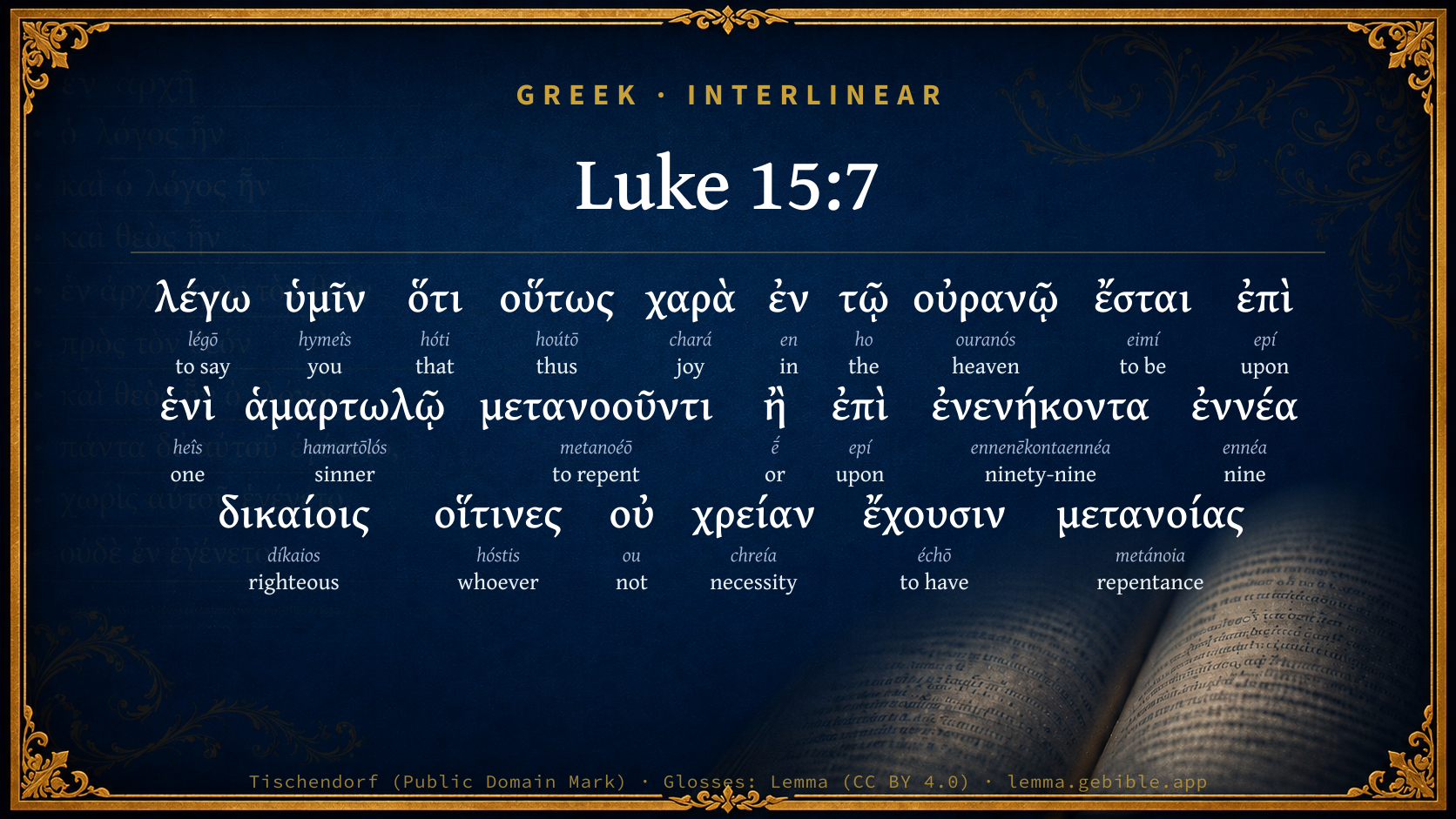
Greek (Tischendorf 8th ed.) Luke 15:7 appears in the Greek New Testament. The text above is from the Tischendorf 8th edition. Each word links to its Strong’s number and a concise gloss. Click any word for its full Thayer’s Greek Lexicon entry.
Download image
Cite this verse

Luke 15:7 (World English Bible). Public Domain. Lemma interlinear Bible study tool, https://lemma.gebible.app/v/luke/15/7.

Show BibTeX & RIS
BibTeX
RIS
English Translation
I tell you that even so there will be more joy in heaven over one sinner who repents, than over ninety-nine righteous people who need no repentance.
World English Bible · Public Domain
Download a study sheet

One document with this verse’s original text, its word-by-word gloss line, the meaning frame, cross-references with their text, attributed commentary, and full source and license credits — printable, and it pastes into notes with its structure intact.

This verse Autodidact and up

Study sheet (.html) Plain text (.txt)

A passage Seminary Student

Up to 50 verses in one chapter. A passage sheet keeps up to 6 commentary sources and 12 cross-references per verse, in the order this page ranks them, and says so on the sheet whenever that leaves anything out. Ask for a single verse and you get the Autodidact verse sheet above.

Everything on this page stays free to read, with no account — the sheet is a download of what is already on screen, not access to it.

Want to remove ads? Support Godless Engineer
Compare translations 3

The same verse in 3 English versions, stacked beneath the original-language interlinear above. Click any original word for its lexicon entry.

Each is an independent rendering of the whole verse — the interlinear is not word-aligned to these translations.

Highlighted words mark where these versions differ — a whole-verse word diff, not a word-by-word alignment.

  • World English Bible Public Domain
    I tell you that even so there will be more joy in heaven over one sinner who repents, than over ninety-nine righteous people who need no repentance.
  • King James Version Public Domain
    I say unto you, that likewise joy shall be in heaven over one sinner that repenteth, more than over ninety and nine just persons, which need no repentance.
  • unfoldingWord Literal Text CC BY-SA 4.0
    I say to you that in the same way, there will be joy in heaven over one sinner repenting, more than over 99 being righteous having no need of repentance.

unfoldingWord Literal Text — © unfoldingWord, licensed CC BY-SA 4.0. Word-aligned USFM3 via Door43 (git.door43.org/unfoldingWord/en_ult).

Versions to compare (up to 4)

3 of 4 selected

Show all 19 translations

Every available English version of this verse, each an independent rendering of the whole verse.

  • World English Bible Public Domain
    I tell you that even so there will be more joy in heaven over one sinner who repents, than over ninety-nine righteous people who need no repentance.
  • Berean Standard Bible Public Domain
    In the same way, I tell you that there will be more joy in heaven over one sinner who repents than over ninety-nine righteous ones who do not need to repent.
  • Majority Standard Bible Public Domain
    I tell you that in the same way there will be more joy in heaven over one sinner who repents than over ninety-nine righteous ones who do not need to repent.
  • King James Version Public Domain
    I say unto you, that likewise joy shall be in heaven over one sinner that repenteth, more than over ninety and nine just persons, which need no repentance.
  • American Standard Version (1901) Public Domain
    I say unto you, that even so there shall be joy in heaven over one sinner that repenteth, `more' than over ninety and nine righteous persons, who need no repentance.
  • Revised Version (1885) Public Domain
    I say unto you, that even so there shall be joy in heaven over one sinner that repenteth, more than over ninety and nine righteous persons, which need no repentance.
  • Geneva Bible (1599) Public Domain
    I say vnto you, that likewise ioy shall be in heauen for one sinner that conuerteth, more then for ninetie and nine iust men, which neede none amendment of life.
  • Douay-Rheims (1899) Public Domain
    I say to you, that even so there shall be joy in heaven upon one sinner that doth penance, more than upon ninety-nine just who need not penance.
  • Young's Literal Translation Public Domain
    `I say to you, that so joy shall be in the heaven over one sinner reforming, rather than over ninety-nine righteous men, who have no need of reformation.
  • Literal Standard Version CC BY-SA 4.0
    I say to you that [more] joy will be in Heaven over one sinner converting, rather than over ninety-nine righteous men who have no need of conversion.
  • Unlocked Literal Bible CC BY-SA 4.0
    I say to you that even so, there will be joy in heaven over one sinner who repents, more than over ninety-nine righteous persons who do not need to repent.
  • unfoldingWord Literal Text CC BY-SA 4.0
    I say to you that in the same way, there will be joy in heaven over one sinner repenting, more than over 99 being righteous having no need of repentance.
  • Darby Bible Public Domain
    I say unto you, that thus there shall be joy in heaven for one repenting sinner, [more] than for ninety and nine righteous who have no need of repentance.
  • World Messianic Bible Public Domain
    I tell you that even so there will be more joy in heaven over one sinner who repents, than over ninety-nine righteous people who need no repentance.
  • Webster's Bible Public Domain
    I say to you, that likewise joy shall be in heaven over one sinner that repenteth, more than over ninety and nine just persons, who need no repentance.
  • Free Bible Version CC BY-SA 4.0
    I tell you that there's more joy in heaven over a sinner that repents than over ninety-nine good people who don't need to repent.
  • Bible in Basic English Public Domain
    I say to you that even so there will be more joy in heaven when one sinner is turned away from his wrongdoing, than for ninety-nine good men, who have no need of a change of heart.
  • Text-Critical English NT CC BY 4.0
    I tell you, in the same way there will be more joy in heaven over one sinner who repents, than over ninety-nine righteous people who have no need of repentance.
  • Tyndale New Testament (1534) Public Domain
    I say vnto you that lyke wyse ioye shalbe in heven over one synner that repenteth moore then over nynety and nyne iuste persons whiche nede noo repentaunce.

Literal Standard Version (2020), Covenant Press — licensed CC BY-SA 4.0. Text via the HelloAO Bible API (eBible.org). Unlocked Literal Bible (unfoldingWord) — licensed CC BY-SA 4.0. Text via the HelloAO Bible API (eBible.org). unfoldingWord Literal Text — © unfoldingWord, licensed CC BY-SA 4.0. Word-aligned USFM3 via Door43 (git.door43.org/unfoldingWord/en_ult). Free Bible Version, Dr. Jonathan Gallagher — licensed CC BY-SA 4.0. Text via the HelloAO Bible API (eBible.org).

Word by word

More ways to search: Search by grammar → Find every occurrence → Compare this word →

Practice this passage: Drill this verse → Learn its vocabulary →

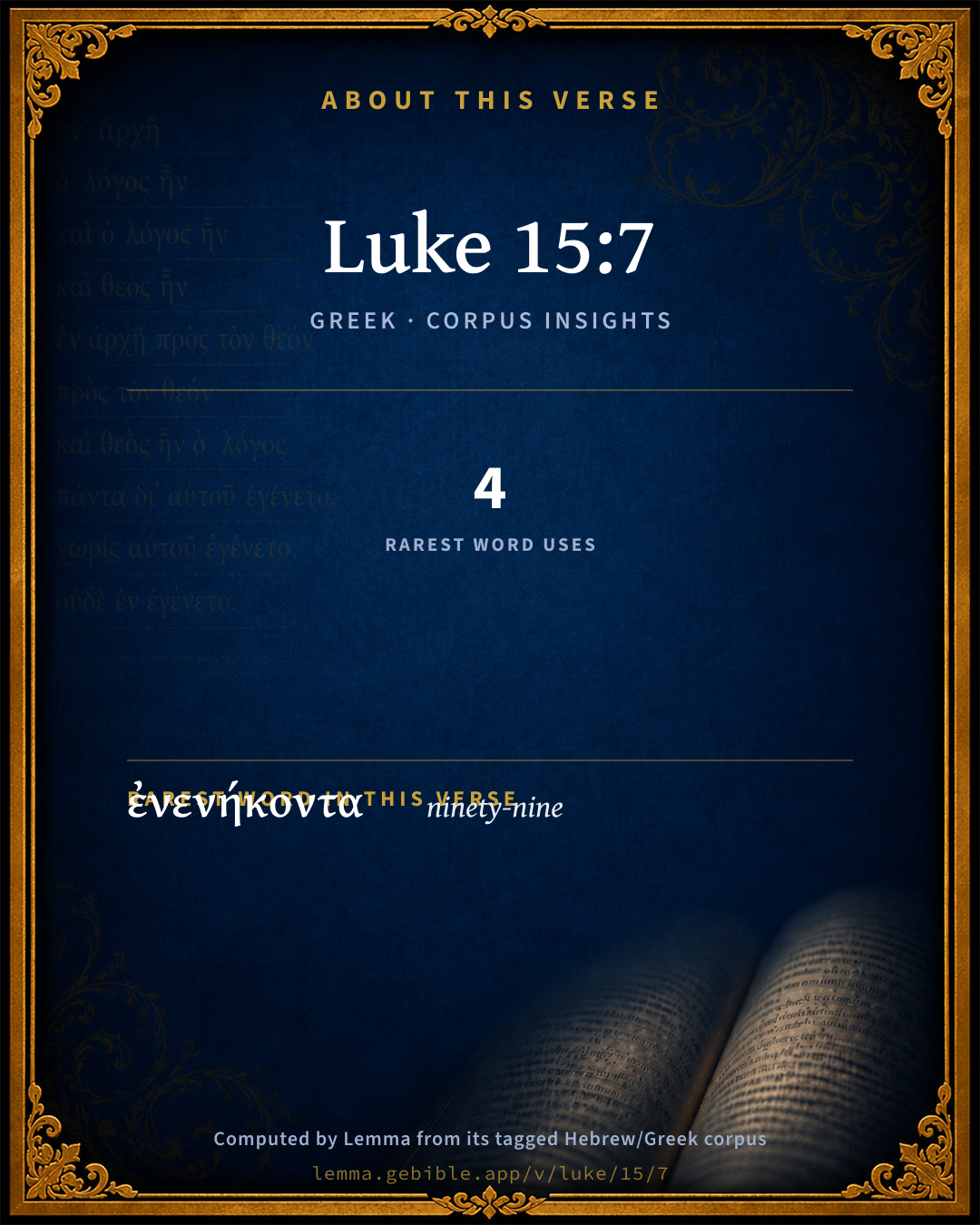
ἐνενήκοντα
ennenēkontaennéa
G1768
“ninety-nine”
Adjective, Numeral (indeclinable)
Part of Speech
Adjective · Numeral (indeclinable)
Full Thayer's Definition

Origin: "from a (tenth) multiple of G1767 ">1767) and 1767 itself"

TDNT: None

1. ninety nine
  1. λέγω légō G3004 “to say” Verb, Present, Active, Indicative, 1st person, Singular
  2. ὑμῖν hymeîs G5210 “you” Personal pronoun, 2nd person, Dative, Plural
  3. ὅτι hóti G3754 “that” Conjunction
  4. οὕτως hoútō G3779 “thus” Adverb
  5. χαρὰ chará G5479 “joy” Noun, Nominative, Singular, Feminine
  6. ἐν en G1722 “in” Preposition
  7. τῷ ho G3588 “the” Article, Dative, Singular, Masculine
  8. οὐρανῷ ouranós G3772 “heaven” Noun, Dative, Singular, Masculine
  9. ἔσται eimí G1510 “to be” Verb, Future, Middle deponent, Indicative, 3rd person, Singular
  10. ἐπὶ epí G1909 “upon” Preposition
  11. ἑνὶ heîs G1520 “one” Adjective, Dative, Singular, Masculine
  12. ἁμαρτωλῷ hamartōlós G268 “sinner” Adjective, Dative, Singular, Masculine
  13. μετανοοῦντι metanoéō G3340 “to repent” Verb, Present, Active, Participle, Dative, Singular, Masculine
  14. ἢ ḗ G2228 “or” Particle
  15. ἐπὶ epí G1909 “upon” Preposition
  16. ἐννέα ennéa G1767 “nine” Adjective, Numeral (indeclinable)
  17. δικαίοις díkaios G1342 “righteous” Adjective, Dative, Plural, Masculine
  18. οἵτινες hóstis G3748 “whoever” Relative pronoun, Nominative, Plural, Masculine
  19. οὐ ou G3756 “not” Particle, Negative
  20. χρείαν chreía G5532 “necessity” Noun, Accusative, Singular, Feminine
  21. ἔχουσιν échō G2192 “to have” Verb, Present, Active, Indicative, 3rd person, Plural
  22. μετανοίας metánoia G3341 “repentance” Noun, Genitive, Singular, Feminine

About this verse

These counts appear in no published source. They are computed here, from the morphology-tagged text and Lemma’s own curated glosses. What Lemma adds →

23
words
22
distinct lemmas
Gospels
section

Notable vocabulary

The rarest word here is ἐνενήκοντα ninety-nine G1768 — appearing just 4 times in the whole Greek New Testament.

Shared distinctive vocabulary

ἐνενήκοντα ninety-nine G1768 occurs in 4 verses of the Greek New Testament. Also found in:

Repetition

A word recurs within this verse:

  • ἐπὶ upon G1909 ×2

Cross-references

10

Topical passages linked to Luke 15:7 in the Treasury of Scripture Knowledge — connected by theme and wording, ordered by reader-vote popularity; previews shown in the World English Bible.

  • Luke 15:10 Even so, I tell you, there is joy in the presence of the angels of God over one sinner repenting."
  • Luke 5:32 I have not come to call the righteous, but sinners to repentance."
  • Luke 15:32 But it was appropriate to celebrate and be glad, for this, your brother, was dead, and is alive again. He was lost, and is found.'"
  • Matthew 18:13 If he finds it, most assuredly I tell you, he rejoices over it more than over the ninety-nine which have not gone astray.
  • Proverbs 30:12 There is a generation that is pure in their own eyes, Yet are not washed from their filthiness.
  • Luke 18:9–11 He spoke also this parable to certain people who were convinced of their own righteousness, and who despised all others.
  • Philippians 3:6–7 concerning zeal, persecuting the assembly; concerning the righteousness which is in the law, found blameless.
  • Luke 16:15 He said to them, "You are those who justify yourselves in the sight of men, but God knows your hearts. For that which is exalted among men is an abomination in the sight of God.
  • Romans 7:9 I was alive apart from the law once, but when the commandment came, sin revived, and I died.
  • Luke 15:29 But he answered his father, 'Behold, these many years I have served you, and I never disobeyed a commandment of yours, but you never gave me a goat, that I might celebrate with my friends.

Cross-references courtesy of OpenBible.info (CC BY 4.0).

Commentary

Notes on Luke 15:7 from classic Christian and Jewish commentators (each source and its license shown beneath its notes). The classic Christian expositions comment on the surrounding passage and are grouped to its opening verse, so a note may address several verses; the Jewish commentaries on the Tanakh (Rashi and others) are per-verse, so they appear only where the commentator wrote on this verse.

Lemma curates 59 commentaries, every one of them public domain or Creative Commons licensed, each selected and text-cleaned for this edition rather than reprinted as found. About our sources →

Bengel's Gnomon

Johann Albrecht Bengel

Luk 15:7. Ὑμῖν, to you) Most weightily (impressively) the ‘murmuring’ [Luk 15:2] of the Pharisees is refuted by this joy.—χαρὰ) Joy, solemn and festive, upon hearing the tidings of the work of salvation accomplished on the earth.—[ἔσται, shall be) Future; whereby the return of Jesus to His Fatherland seems to be intimated.—V. g.]—ἐν τῷ οὐρανῷ, in heaven) The Shepherd, Jesus Christ, has even especially the spirits of just men as His “friends and neighbours,” inasmuch as they are sharers in this joy the more in proportion as they have the stronger tie of connection with men. In the 10th verse there is a gradation made (an ascending climax) to angels, who are named in that passage rather than men, because there Christ is not regarded as man [in His human nature, but only as God: note, Luk 15:3]. Nor are the angels said to know the fact from their intercourse with the man: for they are not all with the one man; but from the revelation of the Lord, which is equally capable of being vouchsafed to the spirits of just men. Comp. Hainlin’s Sol. Temp. f. 80, and Ven. Weisemann, H. E. P. 1, p. 106. So the other inhabitants of heaven are put in contradistinction to the angels, in Rev 18:20; Rev 19:1; Rev 19:4; Rev 19:6.—ἑνὶ, one) and much more joy over many; see Luk 15:1.—ἢ,) that is, μᾶλλον ἤ. See ch. Luk 18:14 [δεδικαιωμένος ἢ ἐκεῖνον, i.e. (μᾶλλον ἢ. So [156][157][158]. But [159] Orige[160] and Vulg., ΠΑΡʼ ἘΚΕῖΝΟΝ]. LXX., Psalms 118 :(117) 8, 9, [ἈΓΑΘῸΝ ΠΕΠΟΙΘΈΝΑΙ ἘΠῚ ΚΎΡΙΟΝ Ἢ, (i.e. μᾶλλον ἢ) ΠΕΠΟΙΘΈΝΑΙ ἘΠʼ ἌΝΘΡΩΠΟΝ, etc.] This clause is not added in Luk 15:10.—Οὐ ΧΡΕΊΑΝ ἜΧΟΥΣΙ, have no need) inasmuch as they are with the Shepherd, and have long ago obtained repentance. The righteous is in the (right) way; the penitent returns to the way.

[156] the Alexandrine MS.: in Brit. Museum: fifth century: publ. by Woide, 1786–1819: O. and N. Test. defective.

[157] Guelpherbytana: libr. Wolfenbuttel: Gospels def.: sixth cent.: publ. by Knittel, 1763.

[158] Guelpherbytana: libr. Wolfenbuttel: Gospels def.: sixth cent.: publ. by Knittel, 1763.

[159] the Vatican MS., 1209: in Vat. Iibr., Rome: fourth cent.: O. and N. Test. def.

[160] rigen (born about 186 A.D., died 253 A.D., a Greek father: two-thirds of the N. Test. are quoted in his writings). Ed. Vinc. Delarue, Paris. 1733, 1740, 1759.

Bengel's Gnomon of the New Testament — English translation (T&T Clark, Edinburgh, 1860) — public domain. Text from a community e-Sword module.

Expositor's Greek Testament

ed. W. Robertson Nicoll

Luk 15:7 . ἐν τῷ οὐρανῷ , in heaven, that is, in the heart of God. Heaven is a synonym for God in Luk 15:18 ; Luk 15:21 . ἢ = more than, as if πλέον had preceded, so often in N.T. and in Sept [129] = Hebrew מִן . The comparison in the moral sphere is bold, but the principle holds true there as in the natural sphere, even if the ninety-nine be truly righteous men needing no repentance. It is rational to have peculiar joy over a sinner repenting, therefore God has it, therefore Christ might have it. This saying is the third great word of Christ’s apology for loving the sinful. For the other two vide on Mat 9:9-13 and Luk 7:36-50 .

[129] Septuagint.

The Expositor's Greek Testament, edited by W. Robertson Nicoll (1897–1910) — public domain. Text from a community e-Sword module.

Jamieson, Fausset & Brown

Robert Jamieson, A. R. Fausset & David Brown

ninety-nine just . . . needing no repentance--not angels, whose place in these parables is very different from this; but those represented by the prodigal's well-behaved brother, who have "served their Father" many years and not at any time transgressed His commandment (in the outrageous sense of the prodigal). (See on Luk 15:29; Luk 15:31). In other words, such as have grown up from childhood in the fear of God and as the sheep of His pasture. Our Lord does not say "the Pharisees and scribes" were such; but as there was undoubtedly such a class, while "the publicans and sinners" were confessedly the strayed sheep and the prodigal children, He leaves them to fill up the place of the other class, if they could.

Jamieson, Fausset & Brown — Commentary Critical and Explanatory on the Whole Bible (1871) — public domain (CC PDM 1.0). Text via the HelloAO Bible API.

Adam Clarke's Commentary

Verse 7. Just persons, which need no repentance.] Who do not require such a change of mind and purpose as these do - who are not so profligate, and cannot repent of sins they have never committed. Distinctions of this kind frequently occur in the Jewish writings. There are many persons who have been brought up in a sober and regular course of life, attending the ordinances of God, and being true and just in all their dealings; these most materially differ from the heathens mentioned, Lu 15:1, because they believe in God, and attend the means of grace: they differ also essentially from the tax-gatherers mentioned in the same place, because they wrong no man, and are upright in their dealings. Therefore they cannot repent of the sins of a heathen, which they have not practised; nor of the rapine of a tax-gatherer, of which they have never been guilty. As, therefore, these just persons are put in opposition to the tax-gatherers and heathens, we may at once see the scope and design of our Lord's words: these needed no repentance in comparison of the others, as not being guilty of their crimes. And as these belonged, by outward profession at least, to the flock of God, and were sincere and upright according to their light, they are considered as being in no danger of being lost; and at they fear God, and work righteousness according to their light, he will take care to make those farther discoveries to them, of the purity of his nature, the holiness of his law, and the necessity of the atonement, which he sees to be necessary. See the case of Cornelius, Ac 10:1, c. On this ground, the owner is represented as feeling more joy in consequence of finding one sheep that was lost, there having been almost no hope of its recovery, than he feels at seeing ninety and nine still safe under his care. "Men generally rejoice more over a small unexpected advantage, than over a much greater good to which they have been accustomed." There are some, and their opinion need not be hastily rejected, who imagine that by the ninety and nine just persons, our Lord means the angels-that they are in proportion to men, as ninety-nine are to one, and that the Lord takes more pleasure in the return and salvation of one sinner, than in the uninterrupted obedience of ninety-nine holy angels and that it was through his superior love to fallen man that he took upon him his nature, and not the nature of angels. I have met with the following weak objection to this: viz. "The text says just persons; now, angels are not persons, therefore angels cannot be meant." This is extremely foolish; there may be the person of an angel, as well as of a man; we allow persons even in the Godhead; besides, the original word, δικαιοις, means simply just ones, and may be, with as much propriety, applied to angels as to men. After all, our Lord may refer to the Essenes, a sect among the Jews, in the time of our Lord, who were strictly and conscientiously moral; living at the utmost distance from both the hypocrisy and pollutions of their countrymen. These, when compared with the great mass of the Jews, needed no repentance. The reader may take his choice of these interpretations, or make a better for himself. I have seen other methods of explaining these words; but they have appeared to me either too absurd or too improbable to merit particular notice.

Adam Clarke's Commentary on the Bible (1810–1826) — public domain. Text from a community e-Sword/MySword module.

Ellicott's Commentary for English Readers

(7) Ninety and nine just persons, which need no repentance.—As regards the men and women among whom our Lord carried on His work, we cannot see in these words anything but a grave and indignant protest, veiled under the form of an apparent concession, against the self-righteousness of the Pharisees. His call to repent had been addressed to all. That all offended in many things; that for a man to say he had not sinned was a lying boast—this was the first postulate of every preacher of the gospel, whatever school of thought he might represent (Rom_3:23; Jas_3:2; 1Jn_1:8). Once, indeed, the opposite thought had appeared in the devotional utterance of a penitent Israelite—“Thou therefore, O Lord, that art the God of ‘the just, hast not appointed repentance to the just, as to Abraham, and Isaac, and Jacob, which have not sinned against Thee” (Prayer of Manasses in the Apocrypha); but there it was accompanied by personal contrition and confession. The man felt in his humility, how unlike he was to those saints of God. It was reserved for the Pharisees to develop the thought into the conviction that they were the just persons who needed no repentance, and that all their worship should consist in thanksgiving that they were so. (See Note on Luk_18:11.)

A Bible Commentary for English Readers, edited by Charles John Ellicott (1878–1897) — public domain. Text from a community e-Sword module.

The Cambridge Bible for Schools and Colleges

gen. ed. J. J. S. Perowne

7. I say unto you] I—who know (Joh_1:51).

in heaven] See Luk_15:10; Mat_18:13.

just persons, which need no repentance] See Luk_5:32. The ‘Pharisees and scribes’ in an external sense were ‘just persons,’ for as a class their lives were regular, though we learn from Josephus and the Talmud that many individuals among them were guilty of flagrant sins. But that our Lord uses the description with a holy irony is clear from the parable of the Pharisee and the publican (see Luk_18:9). They trusted in themselves that they were righteous, and despised others. They did need repentance (carebant), but did not want it (non egebant). It was a fixed notion of the Jews that God had “not appointed repentance to the just, and to Abraham, and Isaac, and Jacob, which have not sinned against thee” (Prayer of Manasses).

The Cambridge Bible for Schools and Colleges (gen. ed. J. J. S. Perowne; Cambridge University Press, 1878–1918) — public domain. Text from a community e-Sword module.

John Gill's Exposition

I say unto you, that likewise joy shall be heaven,.... In the church below, and among the members of it; which is sometimes called heaven, especially in the book of the Revelations; or in heaven above, and among the angels there; see Luk 15:10

Over one sinner that repenteth; for the joy in heaven, is not over sinners as such; for as such, they are not grateful to God, nor to Christ, nor to the angels, nor to saints; only sinners delight in each other, as such; but as repenting sinners, who are truly so: and these are not such, who only legally and outwardly repent; nor all that declare a sense of sin; or that are externally sorry for it; or are terrified about it, and shed tears on account of it; or that cease from grosser sins of life, and outwardly reform: but such who repent in an evangelical way; who are turned to God, and are instructed by his Spirit; who believe in Christ, and have views, at least hopes, of pardon through his blood; and have the love of God and Christ shed abroad in their hearts; from whence arise a true sight and sense of sin, a godly sorrow for it, an hearty loathing of it, shame on account of it, an ingenuous confession, and a real forsaking of it. Now the reason why there is joy in heaven over such persons is, because, without such a repentance, they must perish; and by this they appear to be openly in a state of grace; and become proper subjects of the ordinances of Christ; and this repentance is unto life and salvation; or these are inseparably connected with it; and this joy is abundantly

more, than over ninety and nine just persons, which need no repentance; by whom are meant, either such who are really righteous persons; not naturally and of themselves, nor legally by the deeds of the law, but by the imputation of Christ's righteousness to them: and who need no repentance to be added to their righteousness, it being perfect of itself; nor the grace and principle of repentance, because they have it, and it cannot be lost; or change of life and manners, which is not to be seen in such: and the more joy over repenting sinners, than over these is, because the salvation of the one is before certain to them, and the other is unexpected: but to this sense it may be objected, that saints, even righteous persons, need frequent conversions, and the continual exercise of the grace of repentance; nor does it seem feasible, that there should be more joy over a repenting sinner, than over one, whose life, through grace, is a series of righteousness: rather therefore, such who seem to be just, or are so in their own opinion, are here meant; for only such sort of righteous persons and repenting sinners, are opposed to each other, as in Mat 9:13 moreover, the occasion and scope of the parable, determines this to be the sense; the Scribes and Pharisees, that murmured at Christ's receiving sinners, are the ninety and nine just persons, who were only outwardly righteous before men, and trusted in themselves that they were righteous, perfectly righteous, and without sin, and so stood in no need of repentance for it; now there is more joy in heaven over one repenting sinner, than over all these: hence learn, that a self-righteous person, is an impenitent one; that a repenting sinner is more regarded in heaven than a self-righteous man: our Lord here seems to have regard to a conceit of the Jews, who distinguish between penitents that were allowed to be righteous, and such who never were guilty of any notorious crime, and so were perfectly righteous, and needed no repentance, and were preferred to penitent sinners: some of them say (u), that

"the prophets did not prophesy (good things and comforts), but , "to penitents"; but as for , "the perfect righteous", to them belongs that, "eye hath not seen", O God, "besides thee".---But R. Abhu says, the place in which "penitents" stand, the "perfect righteous" do not stand.''

Though Maimonides seems (w) to understand this, as if it gave the preference to penitents; his words are these:

"let not a penitent man imagine that he is afar off from the excellency, or degree of the righteous, because of the sins and iniquities he has committed, the thing is not so; but he is beloved and desired before the Creator, as if he had never sinned; for his reward is great; for lo, he hath tasted the taste of sin, and hath separated from it, and hath subdued his evil imagination: the wise men say, the place where "penitents" stand, the "perfect righteous" cannot stand; which is as if it was said, their degree of excellency is greater, than those who never sinned, because they have subdued their imagination more than they.''

However, these instances, with others that might be produced, show that the Jews had a notion of some men being perfectly righteous and without sin; which they oppose to penitent sinners, and which our Lord here designs, and seems to describe in their own language, and serves to confirm the sense given; See Gill on Heb 12:23.

(u) T. Bab. Beracot, fol. 34. 2. & Sanhedrim, fol. 99. 1. (w) Hilchot Teshuba, c. 7. sect. 4. Vid. Kimchi in Isa. lvii. 10. & Jarchi in Isa. xliv. 5. & Zohar in Lev. fol. 7. 2.

John Gill's Exposition of the Whole Bible (1746–1763) — public domain (CC PDM 1.0). Text via the HelloAO Bible API.

Trapp's Complete Commentary

John Trapp

7 I say unto you, that likewise joy shall be in heaven over one sinner that repenteth, more than over ninety and nine just persons, which need no repentance.

Ver. 7. Joy shall be in heaven] Would we then put harps into the angels’ hands, ditties into their mouths? repent.

John Trapp, A Commentary or Exposition upon All the Books of the Old and New Testament (1647–1656) — public domain. Text from a community e-Sword module.

Albert Barnes' Notes on the Bible

Likewise joy ... - It is a principle of human nature that the “recovery” of an object in danger of being lost, affords much more intense joy than the quiet “possession” of many that are safe. This our Saviour illustrated by the case of the lost sheep and of the piece of silver. It might also be illustrated by many other things. Thus we rejoice most in our health when we recover from a dangerous disease; we rejoice over a child rescued from danger or disease more than over those who are in health or safety. We rejoice that property is saved from conflagration or the tempest more than over much more that has not been in danger. This feeling our Lord represents as existing in heaven. “Likewise,” in like manner, or on the same principle, there is joy.

In heaven - Among the angels of God. Compare Luk 15:10. Heavenly beings are thus represented as rejoicing over those who repent on earth. They see the guilt and danger of people; they know what God has done for the race, and they rejoice at the recovery of any from the guilt and ruins of sin.

One sinner - One rebel against God, however great may be his sins or however small. If a sinner, he must perish unless he repents; and they rejoice at his repentance because it recovers him back to the love of God, and because it will save him from eternal death.

That repenteth - See the notes at Mat 9:13.

Just persons - The word “persons” is not in the original. It means simply “just ones,” or those who have not sinned. The word may refer to angels as well as to people. There are no “just” people on earth who need no repentance, Ecc 7:20; Psa 14:2-3; Rom 3:10-18. Our Saviour did not mean to imply that there were any such. He was speaking of what took place “in heaven,” or among “angels,” and of “their” emotions when they contemplate the creatures of God; and he says that “they” rejoiced in the repentance of one “sinner” more than in the holiness of many who had not fallen. We are not to suppose that he meant to teach that there were just ninety-nine holy angels to one sinner. He means merely that they rejoice more over the “repentance” of one sinner than they do over many who have not fallen. By this he vindicated his own conduct. The Jews did not deny the existence of angels. They would not deny that their feelings were proper. If “they” rejoiced in this manner, it was not improper for “him” to show similar joy, and especially to seek their conversion and salvation. If they rejoice also, it shows how desirable is the repentance of a sinner. They know of how much value is an immortal soul. They see what is meant by eternal death; and they do not feel “too much,” or have “too much anxiety” about the soul that can never die. Oh that people saw it as “they” see it! and oh that they would make an effort, such as angels see to be proper, to save their own souls and the souls of others from eternal death!

Albert Barnes' Notes on the Bible (1834–1885) — public domain. Text from a community e-Sword/MySword module.

Haydock's Catholic Bible Commentary

Joy in heaven, &c. What incitement ought it not to be to us to practice virtue, when we reflect that our conversion causes joy to the troops of blessed spirits, whose protection we should always seek, and whose presence we should always revere. (St. Ambrose) --- There is greater joy for the conversion of a sinner, than for the perseverance of the just; but it frequently happens, that these being free from the chain of sin, remain indeed in the path of justice, but press not on eagerly to their heavenly country; whilst such as have been sinners, are stung with grief at the remembrance of their former transgressions, and calling to mind how they have forsaken their God, endeavour by present fervour to compensate for their past misconduct. But it must be remembered that there are many just, whose lives cause such joy to the heavenly court, that all the penitential exercises of sinners cannot be preferred before them. (St. Gregory, hom. xxxiv.)

George Leo Haydock (1774–1849), Haydock's Catholic Family Bible and Commentary, 1859 edition — public domain. Excludes Psalms (Douay-Rheims chapter numbering differs from Protestant) and Deuterocanonical books (Catholic canon only).

Whedon's Commentary on the Bible

Daniel D. Whedon

7. Joy shall be in heaven—A sweet and literal assurance that the inhabitants of heaven take a deep interest in the souls of our race, candidates as we are for a fellowship with them on high. Heaven is not in sight of earth, but earth is in sight of heaven. The Church above forever watches the Church below. When the children of God rejoice over a new convert saved by repentance and forgiveness from death, there is no vain joy. It is the only joy on earth with which we have proof that angels sympathize. Hence angels watched with interest while these Pharisees condemned our Saviour’s sympathy with these publicans and sinners.

One sinner—How much the joy of heaven then when whole scores and hundreds are converted. Truly he that winneth souls is wise.

Repenteth— The repentance here spoken of, it is important to note, is the repentance of a sinner, taking the first step in that course by which from a child of hell he becomes an heir of heaven. It is the repentance of a publican and of a (Gentile) sinner classified with him. It implies previous unregeneracy, impenitence, and a course of persistent sin; from which having turned, the man is justified, regenerate, and enrolled in the Lamb’s book of life. This has nothing to do with the repentance of a justified Christian, which is a constant abhorence of sin, and sorrow for his shortcomings, which produce indeed condemnation, but not entire loss of justification.

Just persons— Under the Jewish dispensation, those who were justified, like Zachariah and Elizabeth, as walking in all the ordinances of the law blameless. Many of these had never by apostacy lost the first grace sealed upon them at circumcision, and hence were never heirs of hell. And so, under the new dispensation, if the child before arriving at years of accountability is accepted of God, there is no reason why he should lose that grace and become a child of the devil. God has never made it necessary that any one should be at any time of life an heir of death.

Need no repentance—Who have never been unregenerate sinners. For the word repentance signifies here the same thing as in the former part of the verse. That the just persons, here, are the unfallen inhabitants of other worlds, would be a beautiful interpretation, but a far-fetched one. That Jesus did go forth to redeem our race alone is very probable; but is hardly asserted in this text.

God may have a vast flock, and our race may be the only wandering sheep. But what our Lord is here doing is, to show that he is performing the work over which angels rejoice with a joy in which these scribes and Pharisees should join rather than murmur. They should, with angels, rejoice when he goes after the wandering Jewish publican and Gentile sinner in order to bring them home through repentance to the fold of the Church. To this the fallen and unfallen worlds may be analogous; but they do not come within the actual purpose of the parable.

It is by no means meant that the soul of the sinner converted from his abandonment is any more precious in the sight of God than is that of the faithful walker in the paths of righteousness, who has never fallen from the justification of his childhood. God more truly loves a life of faithful obedience than of late repentance. The man who spends half his life in sin, is little likely to receive that rich reward in glory which he might have attained had all his days been days of service. His powers, indeed, of efficient service, during the remainder of his years, are likely to be much diminished; and he will have through life just reason to lament the loss of his best days in sin; a loss which eternity cannot repair. What our Lord does mean here is, that such is the danger which the repentant sinner has escaped, such is the immediate interest of his rescue, and such the new rapture of having gained a companion in glory, that a sudden burst of joy arises in heaven.

It is sometimes said that if the angels believed that a repentant sinner might apostatise and be lost, we can hardly suppose their joy would be great. We might as well say, that if the angels knew who were the eternally elected, we can hardly suppose they would be much interested in their conversion; as it would make their salvation no more certain. We do not find that Christians who believe in the possibility of apostacy, as a general thing, take less interest in the conversion of souls than those who deny it.

Daniel D. Whedon (gen. ed.), Commentary on the Old and New Testaments (1874–1909) — public domain. Text from a community e-Sword module.

The Pulpit Commentary

I say unto you, that likewise joy shall be in heaven over one sinner that repenteth, more than over ninety and nine just persons, which need no repentance. "But," the Master went on to say, "what I looked for in vain on earth, see, I have found in heaven. What men coldly refused me, the celestials have joyfully given. These understand me. They love both me and my work, do the holy angels." This coldness, even opposition, on the part of the Pharisees and the religious men of Israel to himself and his works, to his teachings of mercy and love, seems certainly to be the reason why Jesus emphasizes, both here and in the next parable, the sympathy which he receives, not on earth from men, but in heaven from beings, inhabitants of another world. Men, have, however, asked Why do these heavenly beings rejoice over the one more than over the ninety and nine? It is utterly insufficient to say that this joy is occasioned by the getting back something that was lost. Such a feeling is conceivable among men, though even here it would be an exaggerated sentiment, but in heaven, among the immortals, no such feeling could exist; it partakes too much of the sentimental, almost of the hysterical. This higher joy must be due to another cause. Now, the shepherd, when he found the wanderer, did not bring it back to the old fold, or replace it with the rest of the flock, but apparently (ver. 6) brought it to his own home. This would seem to indicate that sinners whom Jesus has come to save, and whom he has saved, are placed in a better position than that from which they originally wandered. This gives us the clue to the angels" joy over the "found one" more than over those who were safe in the old ibid. The Talmudists have taught and their teaching, no doubt, is but the reflection of what was taught in the great rabbinical schools of Jerusalem before its ruin that a man who had been guilty of many sins might, by repentance, raise himself to a higher degree of virtue than the perfectly righteous man who had never experienced his temptations. If this were so, well argues Professor Bruce, "surely it was reasonable to occupy one"s self in endeavouring to get sinners to start on this noble career of self-elevation, and to rejoice when in any instance he had succeeded. But it is one thing to have correct theories, and another to put them into practice... So they found fault with One (Jesus) who not only held this view as an abstract doctrine, but acted on it, and sought to bring those who had strayed furthest from the paths of righteousness to repentance, believing that, though last, they might yet be first."

The Pulpit Commentary (1880–1919), ed. H.D.M. Spence-Jones & Joseph S. Exell — public domain. Text from a community e-Sword module.

John Wesley's Explanatory Notes

Joy shall be - Solemn and festal joy, in heaven - First, in our blessed Lord himself, and then among the angels and spirits of just men, perhaps informed thereof by God himself, or by the angels who ministered to them. Over one sinner - One gross, open, notorious sinner, that repenteth - That is, thoroughly changed in heart and life; more than over ninety and nine just persons - Comparatively just, outwardly blameless: that need not such a repentance - For they need not, cannot repent of the sins which they never committed. The sum is, as a father peculiarly rejoices when an extravagant child, supposed to be utterly lost, comes to a thorough sense of his duty; or as any other person who has recovered what he had given up for gone, has a more sensible satisfaction in it, than in several other things equally valuable, but not in such danger: so do the angels in heaven peculiarly rejoice in the conversion of the most abandoned sinners. Yea, and God himself so readily forgives and receives them, that he may be represented as having part in the joy.

John Wesley, Explanatory Notes Upon the Whole Bible (1754–1765) — public domain. Text via the GEBible commentary corpus.

The People's New Testament

B. W. Johnson

7. There shall be joy in heaven. The Father rejoices and the Son and the angels with him. Over one sinner that repenteth. That “comes to himself,” decides to leave off sin and to serve God. Repentance means a change of mind or heart. Than over ninety and nine just persons. Over those who are already in Christ, safe, and need no repentance. It is the saving of the lost that brings the greatest joy.

B. W. Johnson's The People's New Testament with Notes (1889–1891) — public domain. Electronic text from the Christian Classics Ethereal Library (CCEL) ThML edition.

Cambridge Greek Testament for Schools and Colleges

7. λέγω ὑμῖν. I—who know (Joh 1:51).

χαρὰ … ἔσται … ἤ. ‘There shall be greater joy … than.’ ἢ sometimes follows a positive and not a comparative form, as in θέλω ἤ, 1Co 14:19, λυσιτελεῖ … ἤ, Luk 17:2, ἰσχύει οὗτος ἢ ἡμεῖς, Num 22:6, LXX[289], καλόν ἐστιν … ἤ, Mat 18:8. This construction is frequent in the LXX[290], being an imitation of the Hebrew מִן after an adjective. See Luk 15:10; Mat 18:13. St Luke’s report is the more tender and enthusiastic.

[289] LXX. Septuagint.

[290] LXX. Septuagint.

δικαίοις οἵτινες οὐ χρείαν ἔχουσιν μετανοίας. There is a shade of irony both in the words “just” and “repentance.” Neither word can be understood in its full and true sense; but only in the inadequate sense which the Pharisees attached to them. See Luk 5:32. The ‘Pharisees and scribes’ in an external sense were ‘just persons,’ for as a class their lives were regular, though we learn from Josephus and the Talmud that many individuals among them were guilty of flagrant sins. But that our Lord uses the description with a holy irony is clear from the parable of the Pharisee and the publican (see Luk 18:9). They trusted in themselves that they were righteous, and despised others. They did need repentance (carebant), but did not want it (non egebant). It was a fixed notion of the Jews that God had “not appointed repentance to the just, and to Abraham, and Isaac, and Jacob, which have not sinned against thee” (Prayer of Manasses).

Cambridge Greek Testament for Schools and Colleges (Cambridge University Press, 1896; 21 vols, various authors incl. Carr, Maclear, Plummer, Farrar, Lumby, Moule, M. R. James, Simcox) — public domain. Text from a community e-Sword module.

Alford’s Greek Testament

Henry Alford

7. λέγω ὑμῖν] In these words the Lord often introduces His revelations of the unseen world of glory: see Mat 18:10.

On these δίκαιοι, see note at Mat 9:12, Mat 9:13. They are the subjectively righteous, and this saying respects their own view of themselves. (Or if it be required that the words should be literally explained, seeing that these ninety-nine did not err,—then I see no other way but to suppose them, in the deeper meaning of the parable, to be the worlds that have not fallen;—and the one that has strayed, our human nature, in this our world.) But we have yet to enquire, what sort of sinner this parable represents: for each of the three sets before us a different type of the sinner sunk in his sin. Bengel, in distinguishing the three, says, ‘Ovis, drachma, filius perditus—peccator (1) stupidus,—(2) sui plane nescius,—(3) sciens et voluntarius.’ This one is the stupid and bewildered sinner, erring and straying away in ignorance and self-will from his Shepherd, but sought by the Shepherd, and fetched back with joy.

Henry Alford, The Greek Testament (1849–1861) — public domain. Text from a community e-Sword module.

International Critical Commentary

7. λέγω ὑμῖν. Mt. has the characteristic ἀμὴν λέγω ὑμῖν.

ἢ ἐπί. For ἤ without a previous comparative see small print on 17:2, and comp. Mat 18:8; Mar 9:43, Mar 9:45, Mar 9:47; Mar_1 Cor, 14:19. Win. xxv. 2. c, p. 302; Simcox p. 92. Perhaps ἤ may be said to imply μᾶλλον by a usage which was originally colloquial. It is freq. in LXX; Gen 49:12; Num 22:6, etc. In Mat 18:13 the μᾶλλον is expressed.

δικαίοις οἵτινες οὐ χρείαν ἔχουσιν μετανοίας. “Righteous who are of such a character as to have no need of repentance.” The οἵτινες does not prove that δικαίοις means those who are really righteous. It will fit any explanation of δικαίοις and οὐ χρείαν ἔχουσιν. If both expressions be taken literally, the ninety-nine represent a hypothetical class, an ideal which since the Fall has not been reached. But as Jesus is answering Pharisaic objections to intercourse with flagrant sinners, both expressions may be ironical and refer to the external propriety of those whose care about legal observances prevents them from feeling any need of repentance. Comp. 5:31.

Mt. here has τοῖς μὴ πεπλανημένοις. In any case the χαίρων, ver. 5, and the χαρά here are anthropomorphic, and must not be pressed. Insperata aut prope desperata magis nos afficiunt (Grotius); but such unlooked for results are impossible to Omniscience. We must hold to the main lesson of the parable, and not insist on interpreting all the details.1

Note the confidence with which Jesus speaks of what takes place in heaven, and compare it with the claims made upon His followers, 14:26, 33.

μετανοοῦντι … μετανοίας. Both verb and substantive are much more common in Lk. than in Mt. or Mk. Neither occurs in Mat 18:14 or anywhere in Jn. See on 5:32 and 3:3.

International Critical Commentary — older volumes (1896–1929), various authors — public domain. Text from a community e-Sword module.

Vincent's Word Studies in the New Testament

Marvin R. Vincent

Repenteth. See on Mt 3:2.

THE PARABLES OF THE LOST COIN AND OF THE PRODIGAL SON.

Peculiar to Luke. 8 - 32.

Marvin R. Vincent, Word Studies in the New Testament (1887–1900) — public domain. Text from a community e-Sword/MySword module.

Lesson kit

Teaching starters — assembled from the data on this page, not authored interpretation. Every prompt links to the verse data it draws on. Edit before teaching.

Luke, in the Gospels, opens this verse with 23 words (22 distinct Greek lemmas). Its most distinctive word is ennenēkontaennéa (“ninety-nine”). A historical commentator’s framing appears above. Read the whole chapter for the surrounding context.

Discussion questions

  1. How does “ninety-nine” (ennenēkontaennéa) shape what this verse is saying?
  2. Matthew 18:12 shares the word «ninety-nine» with this verse. How do the two illuminate each other?
  3. “upon” occurs 2× in this one verse. What is the effect of the repetition?
  4. These translations render this verse differently. What is at stake in choosing one wording over another?
  5. Reading how Bengel's Gnomon and Expositor's Greek Testament read this verse, where do the two commentators agree and where do they part?

Things to notice

Reading settings

Reading text

Shown beneath each verse's original-language words.

Old Testament
Old Testament edition

Read the OT as the Masoretic Hebrew (MT) or the Greek Septuagint (LXX).

English shown for the Greek Septuagint (in the Hebrew ↔ Greek comparison).

Comparing translations? Open the Compare panel on any verse page to stack up to four side by side.