
Acts 10:12

Greek (Tischendorf 8th ed.) Acts 10:12 appears in the Greek New Testament. The text above is from the Tischendorf 8th edition. Each word links to its Strong’s number and a concise gloss. Click any word for its full Thayer’s Greek Lexicon entry.
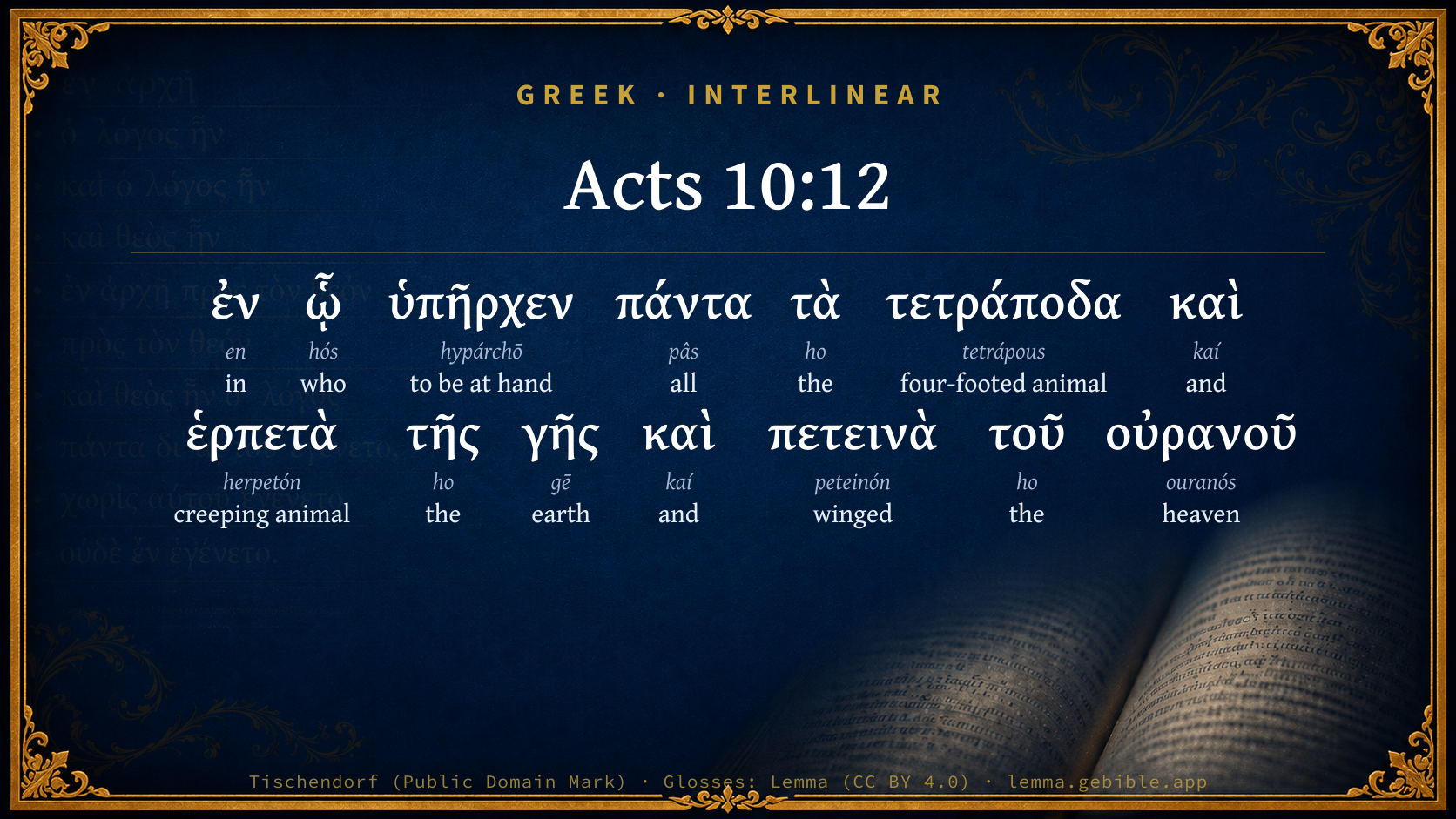
Download image
Cite this verse

Acts 10:12 (World English Bible). Public Domain. Lemma interlinear Bible study tool, https://lemma.gebible.app/v/acts/10/12.

Show BibTeX & RIS
BibTeX
RIS
English Translation
in which were all kinds of four-footed animals of the earth, wild animals, reptiles, and birds of the sky.
World English Bible · Public Domain
Highlights
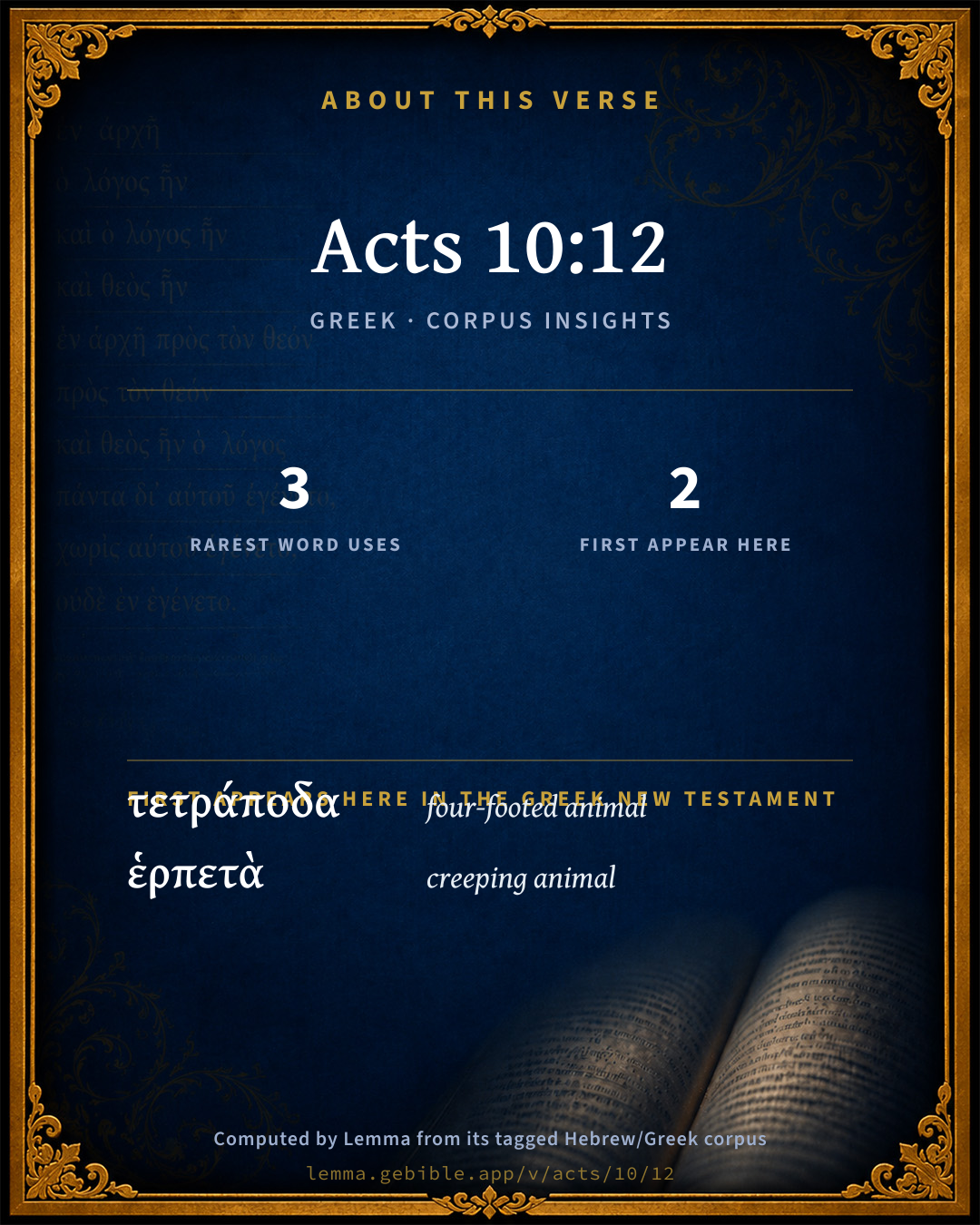
  • 2 first appearances in the Greek New Testament
Full analysis ↓
Download a study sheet

One document with this verse’s original text, its word-by-word gloss line, the meaning frame, cross-references with their text, attributed commentary, and full source and license credits — printable, and it pastes into notes with its structure intact.

This verse Autodidact and up

Study sheet (.html) Plain text (.txt)

A passage Seminary Student

Up to 50 verses in one chapter. A passage sheet keeps up to 6 commentary sources and 12 cross-references per verse, in the order this page ranks them, and says so on the sheet whenever that leaves anything out. Ask for a single verse and you get the Autodidact verse sheet above.

Everything on this page stays free to read, with no account — the sheet is a download of what is already on screen, not access to it.

Want to remove ads? Support Godless Engineer
Compare translations 3

The same verse in 3 English versions, stacked beneath the original-language interlinear above. Click any original word for its lexicon entry.

Each is an independent rendering of the whole verse — the interlinear is not word-aligned to these translations.

Highlighted words mark where these versions differ — a whole-verse word diff, not a word-by-word alignment.

  • World English Bible Public Domain
    in which were all kinds of four-footed animals of the earth, wild animals, reptiles, and birds of the sky.
  • King James Version Public Domain
    Wherein were all manner of fourfooted beasts of the earth, and wild beasts, and creeping things, and fowls of the air.
  • unfoldingWord Literal Text CC BY-SA 4.0
    in which were all the four-footed animals and reptiles of the earth and birds of the sky.

unfoldingWord Literal Text — © unfoldingWord, licensed CC BY-SA 4.0. Word-aligned USFM3 via Door43 (git.door43.org/unfoldingWord/en_ult).

Versions to compare (up to 4)

3 of 4 selected

Show all 19 translations

Every available English version of this verse, each an independent rendering of the whole verse.

  • World English Bible Public Domain
    in which were all kinds of four-footed animals of the earth, wild animals, reptiles, and birds of the sky.
  • Berean Standard Bible Public Domain
    It contained all kinds of four-footed animals and reptiles of the earth, as well as birds of the air.
  • Majority Standard Bible Public Domain
    It contained all kinds of four-footed animals of the earth, wild beasts, and reptiles, as well as birds of the air.
  • King James Version Public Domain
    Wherein were all manner of fourfooted beasts of the earth, and wild beasts, and creeping things, and fowls of the air.
  • American Standard Version (1901) Public Domain
    wherein were all manner of fourfooted beasts and creeping things of the earth and birds of the heaven.
  • Revised Version (1885) Public Domain
    wherein were all manner of fourfooted beasts and creeping things of the earth and fowls of the heaven.
  • Geneva Bible (1599) Public Domain
    Wherein were all maner of foure footed beastes of the earth, and wilde beastes and creeping things, and foules of the heauen.
  • Douay-Rheims (1899) Public Domain
    Wherein were all manner of fourfooted beasts, and creeping things of the earth, and fowls of the air.
  • Young's Literal Translation Public Domain
    in which were all the four-footed beasts of the earth, and the wild beasts, and the creeping things, and the fowls of the heaven,
  • Literal Standard Version CC BY-SA 4.0
    in which were all the four-footed beasts of the earth, and the wild beasts, and the creeping things, and the birds of the sky,
  • Unlocked Literal Bible CC BY-SA 4.0
    In it were all kinds of four-footed animals and things that crawled on the earth, and birds of the sky.
  • unfoldingWord Literal Text CC BY-SA 4.0
    in which were all the four-footed animals and reptiles of the earth and birds of the sky.
  • Darby Bible Public Domain
    in which were all the quadrupeds and creeping things of the earth, and the fowls of the heaven.
  • World Messianic Bible Public Domain
    in which were all kinds of four-footed animals of the earth, wild animals, reptiles, and birds of the sky.
  • Webster's Bible Public Domain
    In which were all manner of four-footed beasts of the earth, and wild beasts, and creeping animals, and fowls of the air.
  • Free Bible Version CC BY-SA 4.0
    Inside were all kinds of animals and reptiles and birds.
  • Bible in Basic English Public Domain
    In which were all sorts of beasts and birds.
  • Text-Critical English NT CC BY 4.0
    In it were all kinds of four-footed animals of the earth, as well as wild beasts, reptiles, and birds of the sky.
  • Tyndale New Testament (1534) Public Domain
    where in wer all maner of.iiii. foted beastes of the erth and vermen and wormes and foules of the ayer.

Literal Standard Version (2020), Covenant Press — licensed CC BY-SA 4.0. Text via the HelloAO Bible API (eBible.org). Unlocked Literal Bible (unfoldingWord) — licensed CC BY-SA 4.0. Text via the HelloAO Bible API (eBible.org). unfoldingWord Literal Text — © unfoldingWord, licensed CC BY-SA 4.0. Word-aligned USFM3 via Door43 (git.door43.org/unfoldingWord/en_ult). Free Bible Version, Dr. Jonathan Gallagher — licensed CC BY-SA 4.0. Text via the HelloAO Bible API (eBible.org).

Word by word

More ways to search: Search by grammar → Find every occurrence → Compare this word →

Practice this passage: Drill this verse → Learn its vocabulary →

About this verse

These counts appear in no published source. They are computed here, from the morphology-tagged text and Lemma’s own curated glosses. What Lemma adds →

14
words
11
distinct lemmas
Acts
section

Notable vocabulary

The rarest word here is τετράποδα four-footed animal G5074 — appearing just 3 times in the whole Greek New Testament.

First appearance in Scripture

These words make their first canonical appearance in the Greek New Testament here:

  • τετράποδα four-footed animal G5074
  • ἑρπετὰ creeping animal G2062

Shared distinctive vocabulary

τετράποδα four-footed animal G5074 occurs in 3 verses of the Greek New Testament. Also found in:
Repetition

Words recur within this verse:

Cross-references

5

Topical passages linked to Acts 10:12 in the Treasury of Scripture Knowledge — connected by theme and wording, ordered by reader-vote popularity; previews shown in the World English Bible.

  • Genesis 7:8–9 Clean animals, animals that are not clean, birds, and everything that creeps on the ground
  • Isaiah 11:6–9 The wolf shall dwell with the lamb, and the leopard shall lie down with the kid; and the calf and the young lion and the fattened calf together; and a little child shall lead them.
  • Isaiah 65:25 The wolf and the lamb shall feed together, and the lion shall eat straw like the ox; and dust shall be the serpent's food. They shall not hurt nor destroy in all my holy mountain, says Yahweh.
  • John 7:37 Now on the last and greatest day of the feast, Jesus stood and cried out, "If anyone is thirsty, let him come to me and drink!
  • 1 Corinthians 6:9–11 Or don't you know that the unrighteous will not inherit the Kingdom of God? Don't be deceived. Neither the sexually immoral, nor idolaters, nor adulterers, nor male prostitutes, nor homosexuals,

Cross-references courtesy of OpenBible.info (CC BY 4.0).

Where the printed editions differ

1 variant

Places in this verse where the major printed Greek editions disagree on the wording in a way that affects the translation — a comparison of editions, not a manuscript-by-manuscript collation. The editions are the modern critical texts (Nestlé-Aland 28/27, SBL, Westcott-Hort, Tregelles, Tyndale House) and the traditional texts behind the KJV (the Textus Receptus and the Byzantine/Majority text). It is not a claim about which reading is original.

  1. Extra text
    καὶ τὰ θηρία

    “and the beasts”

    In TRByz Not in NA28NA27TynSBLWHTreg

    καὶ τὰ θηρία (kai ta thēria) 'and the beasts' is only in traditional manuscripts (TR+Byz)

Textual data: Translators Amalgamated Greek New Testament (STEPBible TAGNT) · CC BY 4.0.

Commentary

Notes on Acts 10:12 from classic Christian and Jewish commentators (each source and its license shown beneath its notes). The classic Christian expositions comment on the surrounding passage and are grouped to its opening verse, so a note may address several verses; the Jewish commentaries on the Tanakh (Rashi and others) are per-verse, so they appear only where the commentator wrote on this verse.

Lemma curates 59 commentaries, every one of them public domain or Creative Commons licensed, each selected and text-cleaned for this edition rather than reprinted as found. About our sources →

Bengel's Gnomon

Johann Albrecht Bengel

Act 10:12. Πάντα τὰ τετράποδα καὶ τὰ ἑρπετὰ τῆς γῆς, all four-footed animals and creeping things of the earth) Under the name all four-footed animals Luke comprises wild beasts also, which however recent transcribers have inserted here, from ch. Act 11:6.[60] By these symbols not only was it signified, that Peter is allowed to eat all kinds of food (of every nation), but that the Gentile nations themselves, who had been heretofore designated as unclean animals, are now clean: Act 10:28.

[60] For this reason the reading καὶ τὰ θηρία, which the larger Ed. thought was not to be omitted, is deemed an inferior reading by Ed. 2, and is omitted also in the Germ. Vers.—E. B.

Ee support τὰ θηρία after τῆς γῆς. Orig. 1,249a has it before τῆς γῆς. Rec. Text, with later. Syr., reads τὰ θηρία before καὶ τὰ ἕρπετα. But ABC corrected, Vulg. Orig. 1,386b, 388b, omit τὰ θηρία.—E. and T.

Bengel's Gnomon of the New Testament — English translation (T&T Clark, Edinburgh, 1860) — public domain. Text from a community e-Sword module.

Expositor's Greek Testament

ed. W. Robertson Nicoll

Act 10:12 . τετράποδα κ . τ . λ .: fish are not mentioned, perhaps because the vessel was not represented as containing water (so Blass, Weiss, Wendt), although fish also were divided into clean and unclean, Lev 11:9 , Deu 14:9 .

The Expositor's Greek Testament, edited by W. Robertson Nicoll (1897–1910) — public domain. Text from a community e-Sword module.

Geneva Bible (1599)

Geneva Bible translators

That is, such as were meet for men’s use.

Here is this word (All) which is general, plainly put for an indefinite and uncertain, that is to say, for some of all sorts, not for all of every sort.

What is meant by the creeping things, see Lev. 11.

Geneva Bible (1599) marginal notes — public domain. Text via Bolls.life.

Jamieson, Fausset & Brown

Robert Jamieson, A. R. Fausset & David Brown

all manner of four-footed beasts, &c.--that is, the clean and the unclean (ceremonially) all mixed together.

Jamieson, Fausset & Brown — Commentary Critical and Explanatory on the Whole Bible (1871) — public domain (CC PDM 1.0). Text via the HelloAO Bible API.

Adam Clarke's Commentary

Verse 12. All manner of four-footed beasts, c.] Every species of quadrupeds, whether wild or domestic all reptiles, and all fowls. Consequently, both the clean and unclean were present in this visionary representation: those that the Jewish law allowed to be sacrificed to God, or proper for food; as well as those which that law had prohibited in both cases: such as the beasts that do not chew the cud; fish which have no scales; fowls of prey and such others as are specified in Le 11:1, &c., where see the notes.

Adam Clarke's Commentary on the Bible (1810–1826) — public domain. Text from a community e-Sword/MySword module.

John Calvin's Commentaries

12. If any man ask how he could see a great multitude of living creatures at once, the question is easily answered. For Luke saith, All manner, because there were there divers kinds mixed one with another. Therefore he beginneth not at the first kind, that he may prosecute the number unto the last. Again, we must not measure this seeing according to the manner of men, because the trance gave Peter other eyes. But before we go any farther we must know the end of the vision. Some dispute more subtilely about the same than the place requireth, in my judgment. Therefore, I think that it is generally showed to Peter that the difference which God had made in times past is now taken away. And as he had put difference between living creatures, so, having chosen to himself one people, he counted all nations unclean and profane.

Now the difference between living creatures being taken away, he teacheth by the consequent that there is no such disagreement among men any longer as there was in times past, and that there is no difference between the Jew and the Grecian. Hereby Peter is admonished that he do not abhor the Gentiles as being unclean. Undoubtedly, God meant to encourage Peter to come to Cornelius without fear; but he had separated one people to himself from the rest, as saith Moses in his song, when as the Most High did distribute the nations, he put his lot in Jacob, etc., (Deuteronomy 32:9;) therefore he called it his inheritance and peculiar people.

According to this order, it had not been lawful to Peter to bring the covenant of salvation unto the Gentiles; for that was to take the children’s bread and to cast it to dogs, (Matthew 15:26,) unless, peradventure, they would be circumcised, and embrace the Jewish religion; for it was lawful to receive such as did yield themselves. Wherefore, when as the apostles were sent before to preach the gospel, they were forbidden to turn in unto the Gentiles, (Matthew 10:5.) And forasmuch as the preaching of the gospel is a most holy and weighty matter, Peter ought not to have attempted any thing therein with a doubting and wavering mind. Therefore, to the end he may be assured of his calling, God showeth manifestly, as in a picture, that the legal difference between the clean and unclean is abolished; whence he may gather that the wall which was heretofore between the Jews and the Gentiles is now pulled down. And Paul saith, that it is a mystery hid from the beginning of the world, that the Gentiles are made partakers of the same salvation with the people of God, and ingrafted into one body, (Ephesians 2:16; Ephesians 3:6.)

Therefore Peter durst never have opened the gate of heaven unto the Gentiles, unless God himself had made a plain way and entrance for all men, by taking away the wall of separation. I said even now that there was no time wherein it was not lawful to admit the Gentiles unto the worship of God, so they were circumcised; but so long as they continued in uncircumcision they were strangers with God. But now God made the covenant of life common to all the whole world, which he had shut up in one nation, as in a treasure. Whence we gather that this vision is not a little profitable for us; for, when as it teacheth that the difference between Jews and Gentiles continued only for a season, it is as much as if God should pronounce from heaven that he receiveth all people of the world into favor, that he may be God over all. Finally, we have an evident proclamation from heaven, which putteth us in hope of eternal life.

But some men will object that Peter was taught before concerning this matter; for he and the rest were commanded to preach the gospel throughout the whole world, (Mark 16:15.) Therefore, he was either ignorant of his calling, or else this vision was superfluous. I answer, that there was such and so great difficulty in the novelty itself, that they could not acquaint themselves therewith by and by. They knew both the prophecies of the prophets, and the late commandment of Christ concerning the calling of the Gentiles by the gospel; but when they come to the push, they doubted nevertheless, being stricken with the strangeness of the thing. Wherefore, it is no marvel if the Lord confirm Peter with a new sign, concerning which thing we must also say somewhat as yet in the next chapter.

John Calvin's Commentaries (1540-1563) — public domain. Text from the Calvin Translation Society English edition (1840s-50s) via the Christian Classics Ethereal Library (ccel.org). Calvin's coverage is partial (roughly two-thirds of the Bible); uncommented books and verses are honest gaps, never fabricated. The 19th-century editor's footnotes and remarks are omitted so the notes are faithfully Calvin's own voice.

Ellicott's Commentary for English Readers

(12) All manner of four-footed beasts . . .—The classification seems to imply the sheep, the oxen, or the swine that were used as food by the Gentiles, as coming under this head, the deer and goats, and conies and hares under that of “wild beasts.” Stress in each case is laid upon there being “all manner” of each class, those that were allowed, and those also that were forbidden by the Jewish law.

A Bible Commentary for English Readers, edited by Charles John Ellicott (1878–1897) — public domain. Text from a community e-Sword module.

The Cambridge Bible for Schools and Colleges

gen. ed. J. J. S. Perowne

12. wherein were] i.e. appeared to be in the vision.

all manner of fourfooted beasts of the earth, and wild beasts] The oldest MSS. omit the last six words. They have been inserted here that the text might more exactly correspond with what St Peter says in Act_11:6 (see note on Act_10:6). The vision represented the whole animal creation. There were in it living creatures typical of each kind, not a multitude of the same sort of birds and beasts.

The Cambridge Bible for Schools and Colleges (gen. ed. J. J. S. Perowne; Cambridge University Press, 1878–1918) — public domain. Text from a community e-Sword module.

John Gill's Exposition

Wherein were all manner of four-footed beasts of the earth,.... Not as if they were painted upon it, and these were only pictures and representations of them made on the linen sheet; but as if they really add actually were upon it alive; since Peter is afterwards called upon to kill and eat: and these design four-footed beasts of every kind, that are tame, as distinct from the wild ones, after mentioned, as horses, camels, oxen, sheep, hogs, dogs, &c.

and wild beasts; lions, tigers, panthers, bears, &c. This clause is left out in the Alexandrian copy, and in the Vulgate Latin and Syriac versions:

and creeping things; the above copy and versions here add, "of the earth", which they omit in the first clause; these intend serpents, snakes, worms, &c:

and fowls of the air; birds of all sorts: now the whole of this signifies, that the church of Christ, under the Gospel dispensation, consists of all sorts of persons, of all nations, Jews and Gentiles, the one being reckoned clean, the other unclean; of men of all sorts of tempers and dispositions, comparable to wild or tame beasts; and of all sorts of sinners, who before conversion have been greater or lesser sinners; as well as denotes that the distinction of food under the ceremonial law was now ceased. This is not designed to represent that there are good and bad in Gospel churches, as there certainly are and much less that immoral persons are to be received and retained there; but that those who have been of the blackest character, if called by grace, should be admitted into them; and chiefly to show that Gentiles reckoned unclean, when converted, are not to be rejected.

John Gill's Exposition of the Whole Bible (1746–1763) — public domain (CC PDM 1.0). Text via the HelloAO Bible API.

Trapp's Complete Commentary

John Trapp

12 Wherein were all manner of fourfooted beasts of the earth, and wild beasts, and creeping things, and fowls of the air.

Ver. 12. Were all manner of fourfooted] Gr. παντα. All, that is, some of all sorts; so, omne animal, every living creature, is said to be in Noah’s ark; and in the like sense, Christ is said to die for all.

John Trapp, A Commentary or Exposition upon All the Books of the Old and New Testament (1647–1656) — public domain. Text from a community e-Sword module.

Albert Barnes' Notes on the Bible

Wherein ... - This particular vision was suggested by Peter’s hunger, Act 10:10. It was designed, however, to teach him an important lesson in regard to the introduction of all nations to the gospel. Its descending from heaven may have been an intimation that that religion which was about to abolish the distinction between the Jews and other nations was of divine origin. See Rev 21:2.

Albert Barnes' Notes on the Bible (1834–1885) — public domain. Text from a community e-Sword/MySword module.

Matthew Poole's English Annotations

As well unclean beasts, such as were forbidden by the law, as clean, such as by the law might be eaten.

Matthew Poole's English Annotations on the Holy Bible (1683–1685) — public domain. Text from a community e-Sword/MySword module.

Whedon's Commentary on the Bible

Daniel D. Whedon

12. All manner of—Greek, all, by which we are not to understand all that ever existed, nor every kind or manner; but all without any discrimination of clean or unclean, a sufficient universality for the purpose in hand.

Wild beasts—These words are rejected by the best authorities.

Creeping things—Insects, reptiles, testacea, and even, according to Jewish classification, fishes. For why Lechler should insist that the all means a universality because this is a trance, and so able to include an impossibility, and yet should say that fishes are excluded, it is difficult to guess. The sheet might to the so entranced eye as easily include an ocean with all its finny and finless tribes as an earth with all its animal tribes.

Daniel D. Whedon (gen. ed.), Commentary on the Old and New Testaments (1874–1909) — public domain. Text from a community e-Sword module.

The Pulpit Commentary

Beasts and creeping things of the earth for beasts of the earth, and wild beasts, and creeping things, A.V. and T.R.; heaven for air, A.V. The distinction between clean and unclean was very sharply drawn in the Levitical Law. (Le 11; see especially vers. 41-44 and 20:25; Deu_14:3-20) Peter"s astonishment must, therefore, have been exceeding great at the command to slay and eat. And so his answer in ver. 14 shows. And yet our Lord had taught him the same truth. (Mat_15:10-20, or still more distinctly Mar_8:14-23)

The Pulpit Commentary (1880–1919), ed. H.D.M. Spence-Jones & Joseph S. Exell — public domain. Text from a community e-Sword module.

Godbey's Commentary on the New Testament

William B. Godbey

12. “In which were all quadrupeds, creeping things of the earth, and fowls of the air.” This vision forever sweeps away all the restrictions of the Levitical law and the rigid fortifications of exclusive Judaism in the Mosaic economy, unfurling the gospel banner to the whole Gentile world, bidding them a hearty welcome to the redeeming cross, the cleansing fountain, and the glorious triumph of Pentecostal sanctification, perfect spiritual freedom, and illimitable gospel rights and privileges. The vision has nothing to do with the problem of edibles and potables. The signification is purely spiritual and evangelical, forever smashing the impregnable walls which had separated the Jews and Gentiles from the days of Abraham, thus completing the final elimination of the last vestige of the Mosaic dispensation, now and forever superseded by Christ, the glorious Antitype, in whom all the types and symbols converge and find their triumphant verification. Doubtless the sheet was circular, representing the world, and held up by four ropes, whose ends alone were seen, the one extending from the North, the other from the South, another from the East and a fourth from the West, thus representing the four cardinal points which constitute the world, and focalizing all nations at the gospel feast. Why was the manifestation repeated thrice? At the dispersion of Noah’s family from Mt. Ararat after the Flood, he divided his estate, the whole world. [Europe, Asia, and Africa; America, hidden behind the oceans, reserved for the enlargement of Europe in the latter days, and included with it.] In this distribution he gave Ham, Africa; Shem, Asia; and Japheth, Europe. In Hebrew, Ham means black, hence he became the ancestor of the black races. Shem means red, therefore he became the ancestor of the Mongolian races of Asia, from whom the American Indians also came, doubtless having crossed Behring Strait from Asia into America at an early day. Japheth means white, hence he became the ancestor of all the white races of Europe, who, in the last four hundred years, have spread out over the continent of America, pursuant to God’s promise to Noah:

“God shall enlarge Japheth and shall dwell in the tents of Shem;

and Canaan [Ham] shall be his servant.” (Gen 9:27)

This prophecy is now literally fulfilled in America, where the white man, Japheth, dwells in the tents of Shem [the Indians], and Ham [the colored people] is his servant. Hence you see the persistency of the triple gospel proclamation symbolized by the three repetitions of Jehovah’s call in this vision, forcefully indicative of the world’s triple evangelism as we carry the gospel to the children of the dark continent, to the Mongolian millions of Asia, and to all the white races of Europe and America.

William B. Godbey, Commentary on the New Testament (1896–1900) — public domain. Text from a community e-Sword module.

McGarvey & Pendleton's Commentaries

J. W. McGarvey

See notes on verse 9

J. W. McGarvey (with Philip Y. Pendleton), Commentaries on the New Testament (The Fourfold Gospel, 1914; Acts; and the epistles) — public domain. Text from a community e-Sword/MySword module.

Cambridge Greek Testament for Schools and Colleges

12. καὶ τὰ θηρία omitted with אABC. Unrepresented in Vulg.

12. ἐν ὧ ὑπῆρχεν, in which were, i.e. as it seemed in the vision.

πάντα τὰ τετράποδα κ.τ.λ., all manner of fourfooted beasts and creeping things of the earth and fowls of the air. The vision represented the entire animal creation. There were present living creatures typical of each kind, not a multitude of the same sort of birds and beasts.

Cambridge Greek Testament for Schools and Colleges (Cambridge University Press, 1896; 21 vols, various authors incl. Carr, Maclear, Plummer, Farrar, Lumby, Moule, M. R. James, Simcox) — public domain. Text from a community e-Sword module.

Alford’s Greek Testament

Henry Alford

12. πάντα τὰ τετ.] literally: not ‘many of each kind,’ nor ‘some of all kinds,’ in which case the art., the sense of which is carried on from τὰ τετρ. to the subsequent words (see ch. 11:6), would be omitted:—in the vision it seemed to Peter to be an assemblage of all creation.

τετρ., ἑρπ., πετ.] In ch. 11:6, from which our text has been corrected, Peter follows the more strictly Jewish division: see there.

Henry Alford, The Greek Testament (1849–1861) — public domain. Text from a community e-Sword module.

Vincent's Word Studies in the New Testament

Marvin R. Vincent

All manner of four - footed beasts [παντα τα τετραποδα] . Lit., all the four - footed beasts. Without exception, clean and unclean. Not, of very many kinds.

Wild beasts. The best texts omit.

Marvin R. Vincent, Word Studies in the New Testament (1887–1900) — public domain. Text from a community e-Sword/MySword module.

Lesson kit

Teaching starters — assembled from the data on this page, not authored interpretation. Every prompt links to the verse data it draws on. Edit before teaching.

Acts, in the Acts, opens this verse with 14 words (11 distinct Greek lemmas). Its most distinctive word is tetrápous (“four-footed animal”). A historical commentator’s framing appears above. Read the whole chapter for the surrounding context.

Discussion questions

  1. What does “four-footed animal” (tetrápous) contribute to the verse as a whole?
  2. 2 words make their first appearance in Scripture here. What does this debut establish?
  3. How does Acts 11:6, which shares the word «four-footed animal», read alongside this verse?
  4. What does the repetition of “the” (3× in this one verse) do in this verse?
  5. The translations on this page render this verse differently — a whole-verse word diff, not a word-by-word alignment. What might account for the different wordings?
  6. Compare how Bengel's Gnomon and Expositor's Greek Testament read this verse. Where do they agree or differ?

Things to notice

  • 2 words make their first canonical appearance in Scripture here.
  • These translations choose different wording for 16 words in this verse.
  • “the” occurs 3× in this single verse.
  • 11 distinct Greek lemmas span 14 words in this verse.

Reading settings

Reading text

Shown beneath each verse's original-language words.

Old Testament
Old Testament edition

Read the OT as the Masoretic Hebrew (MT) or the Greek Septuagint (LXX).

English shown for the Greek Septuagint (in the Hebrew ↔ Greek comparison).

Comparing translations? Open the Compare panel on any verse page to stack up to four side by side.