
Colossians 1:23

Greek (Tischendorf 8th ed.) Colossians 1:23 appears in the Greek New Testament. The text above is from the Tischendorf 8th edition. Each word links to its Strong’s number and a concise gloss. Click any word for its full Thayer’s Greek Lexicon entry.
Download image
Cite this verse

Colossians 1:23 (World English Bible). Public Domain. Lemma interlinear Bible study tool, https://lemma.gebible.app/v/colossians/1/23.

Show BibTeX & RIS
BibTeX
RIS
English Translation
if it is so that you continue in the faith, grounded and steadfast, and not moved away from the hope of the Gospel which you heard, which is being proclaimed in all creation under heaven; of which I, Paul, was made a servant.
World English Bible · Public Domain
Highlights
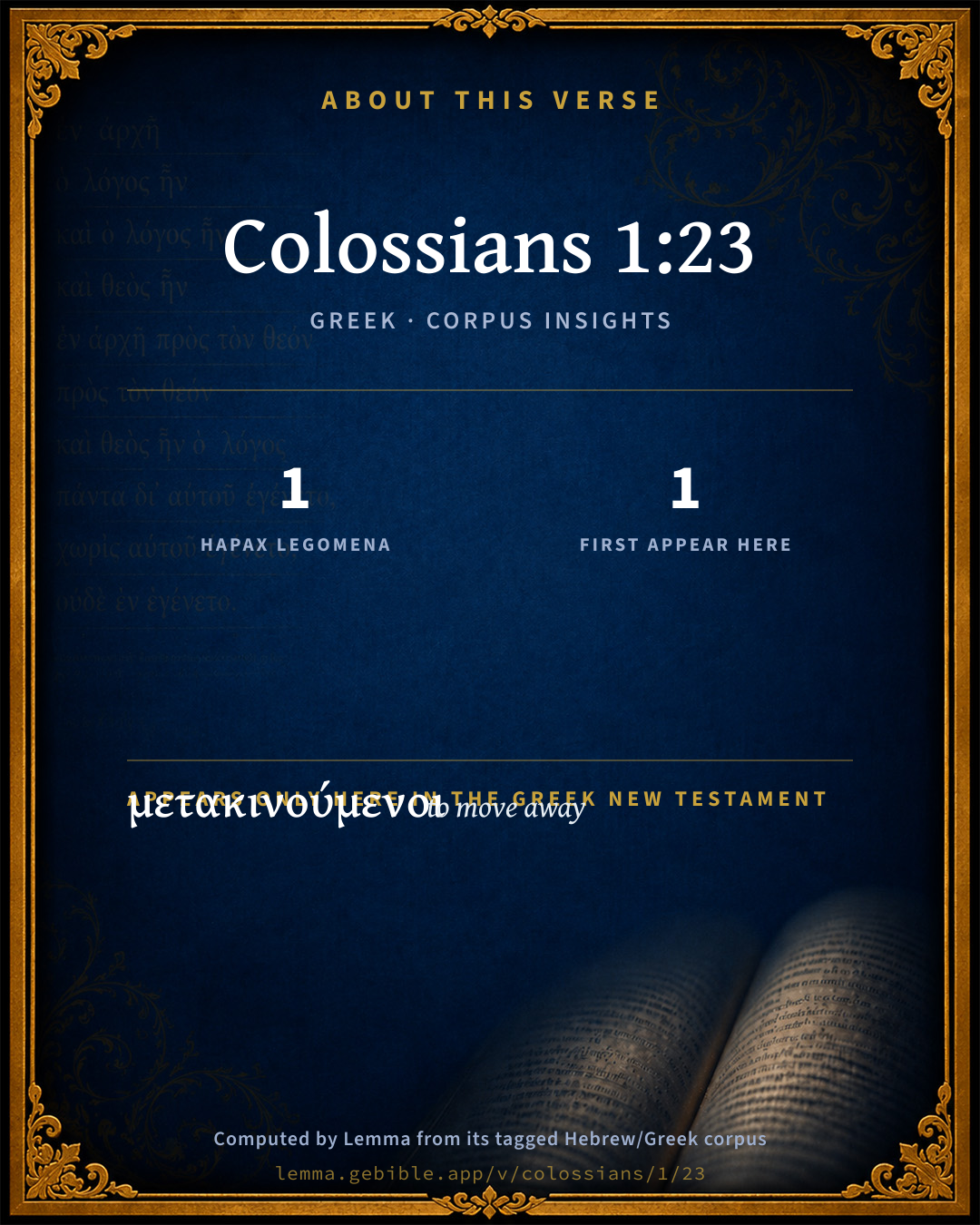
  • 1 hapax legomenon — only here in the Greek New Testament
  • 1 first appearance in the Greek New Testament
Full analysis ↓
Download a study sheet

One document with this verse’s original text, its word-by-word gloss line, the meaning frame, cross-references with their text, attributed commentary, and full source and license credits — printable, and it pastes into notes with its structure intact.

This verse Autodidact and up

Study sheet (.html) Plain text (.txt)

A passage Seminary Student

Up to 50 verses in one chapter. A passage sheet keeps up to 6 commentary sources and 12 cross-references per verse, in the order this page ranks them, and says so on the sheet whenever that leaves anything out. Ask for a single verse and you get the Autodidact verse sheet above.

Everything on this page stays free to read, with no account — the sheet is a download of what is already on screen, not access to it.

Want to remove ads? Support Godless Engineer
Compare translations 3

The same verse in 3 English versions, stacked beneath the original-language interlinear above. Click any original word for its lexicon entry.

Each is an independent rendering of the whole verse — the interlinear is not word-aligned to these translations.

Highlighted words mark where these versions differ — a whole-verse word diff, not a word-by-word alignment.

  • World English Bible Public Domain
    if it is so that you continue in the faith, grounded and steadfast, and not moved away from the hope of the Gospel which you heard, which is being proclaimed in all creation under heaven; of which I, Paul, was made a servant.
  • King James Version Public Domain
    If ye continue in the faith grounded and settled, and be not moved away from the hope of the gospel, which ye have heard, and which was preached to every creature which is under heaven; whereof I Paul am made a minister;
  • unfoldingWord Literal Text CC BY-SA 4.0
    if indeed you continue in the faith, founded and firm and not being moved from the hope of the gospel that you heard, the one having been proclaimed to every creature under heaven, of which I, Paul, became a servant.

unfoldingWord Literal Text — © unfoldingWord, licensed CC BY-SA 4.0. Word-aligned USFM3 via Door43 (git.door43.org/unfoldingWord/en_ult).

Versions to compare (up to 4)

3 of 4 selected

Show all 19 translations

Every available English version of this verse, each an independent rendering of the whole verse.

  • World English Bible Public Domain
    if it is so that you continue in the faith, grounded and steadfast, and not moved away from the hope of the Gospel which you heard, which is being proclaimed in all creation under heaven; of which I, Paul, was made a servant.
  • Berean Standard Bible Public Domain
    if indeed you continue in your faith, established and firm, not moved from the hope of the gospel you heard, which has been proclaimed to every creature under heaven, and of which I, Paul, have become a servant.
  • Majority Standard Bible Public Domain
    if you continue in your faith, established and firm, not moved from the hope of the gospel you heard, which has been proclaimed to every creature under heaven, and of which I, Paul, have become a servant.
  • King James Version Public Domain
    If ye continue in the faith grounded and settled, and be not moved away from the hope of the gospel, which ye have heard, and which was preached to every creature which is under heaven; whereof I Paul am made a minister;
  • American Standard Version (1901) Public Domain
    if so be that ye continue in the faith, grounded and stedfast, and not moved away from the hope of the gospel which ye heard, which was preached in all creation under heaven; whereof I Paul was made a minister.
  • Revised Version (1885) Public Domain
    if so be that ye continue in the faith, grounded and stedfast, and not moved away from the hope of the gospel which ye heard, which was preached in all creation under heaven; whereof I Paul was made a minister.
  • Geneva Bible (1599) Public Domain
    If ye continue, grounded and stablished in the faith, and be not moued away from the hope of the Gospel, whereof ye haue heard, and which hath bene preached to euery creature which is vnder heauen, whereof I Paul am a minister.
  • Douay-Rheims (1899) Public Domain
    If so ye continue in the faith, grounded and settled, and immoveable from the hope of the gospel which you have heard, which is preached in all the creation that is under heaven, whereof I Paul am made a minister.
  • Young's Literal Translation Public Domain
    if also ye remain in the faith, being founded and settled, and not moved away from the hope of the good news, which ye heard, which was preached in all the creation that `is' under the heaven, of which I became -- I Paul -- a ministrant.
  • Literal Standard Version CC BY-SA 4.0
    if you also remain in the faith, being founded and settled, and not moved away from the hope of the good news, which you heard, which was preached in all the creation that [is] under Heaven, of which I, Paul, became a servant.
  • Unlocked Literal Bible CC BY-SA 4.0
    if you continue in the faith, established and firm, not moved away from the certain hope of the gospel that you heard. This is the gospel that was proclaimed to every person created under heaven. This is the gospel of which I, Paul, became a servant.
  • unfoldingWord Literal Text CC BY-SA 4.0
    if indeed you continue in the faith, founded and firm and not being moved from the hope of the gospel that you heard, the one having been proclaimed to every creature under heaven, of which I, Paul, became a servant.
  • Darby Bible Public Domain
    if indeed ye abide in the faith founded and firm, and not moved away from the hope of the glad tidings, which ye have heard, which have been proclaimed in the whole creation which [is] under heaven, of which *I* Paul became minister.
  • World Messianic Bible Public Domain
    if it is so that you continue in the faith, grounded and steadfast, and not moved away from the hope of the Good News which you heard, which was proclaimed in all creation under heaven, of which I, Paul, was made a servant.
  • Webster's Bible Public Domain
    If ye continue in the faith grounded and settled, and are not moved away from the hope of the gospel, which ye have heard, and which hath been preached to every creature which is under heaven; of which I Paul am made a minister;
  • Free Bible Version CC BY-SA 4.0
    But your trust in him must continue rock-solid and immovable. Don't be shaken from the hope of the good news that you heard, the good news that's been shared throughout the world—that's the work that I Paul have been doing.
  • Bible in Basic English Public Domain
    If you keep yourselves safely based in the faith, not moved from the hope of the good news which came to you, and which was given to every living being under heaven; of which I, Paul, was made a servant.
  • Text-Critical English NT CC BY 4.0
    if indeed you continue in the faith, grounded and steadfast, without shifting away from the hope of the gospel that you heard. This gospel has been preached in all creation under heaven, and of this gospel I, Paul, have become a servant.
  • Tyndale New Testament (1534) Public Domain
    yf ye continue grounded and stablysshed in the fayth and be not moved awaye from the hope of the gospell wher of ye have herde howe that it is preached amonge all creatures which are vnder heven wher of I Paul am made a minister.

Literal Standard Version (2020), Covenant Press — licensed CC BY-SA 4.0. Text via the HelloAO Bible API (eBible.org). Unlocked Literal Bible (unfoldingWord) — licensed CC BY-SA 4.0. Text via the HelloAO Bible API (eBible.org). unfoldingWord Literal Text — © unfoldingWord, licensed CC BY-SA 4.0. Word-aligned USFM3 via Door43 (git.door43.org/unfoldingWord/en_ult). Free Bible Version, Dr. Jonathan Gallagher — licensed CC BY-SA 4.0. Text via the HelloAO Bible API (eBible.org).

Word by word

More ways to search: Search by grammar → Find every occurrence → Compare this word →

Practice this passage: Drill this verse → Learn its vocabulary →

μετακινούμενοι
metakinéō
G3334
“to move away”
Verb, Present, Passive, Participle, Nominative, Plural, Masculine
Part of Speech
Verb
Tense
Present
Voice
Passive
Mood
Participle
Case
Nominative
Number
Plural
Gender
Masculine
Full Thayer's Definition

Origin: from G3326 and G2795

TDNT: 15:00,4

1. to move from a place, to move away
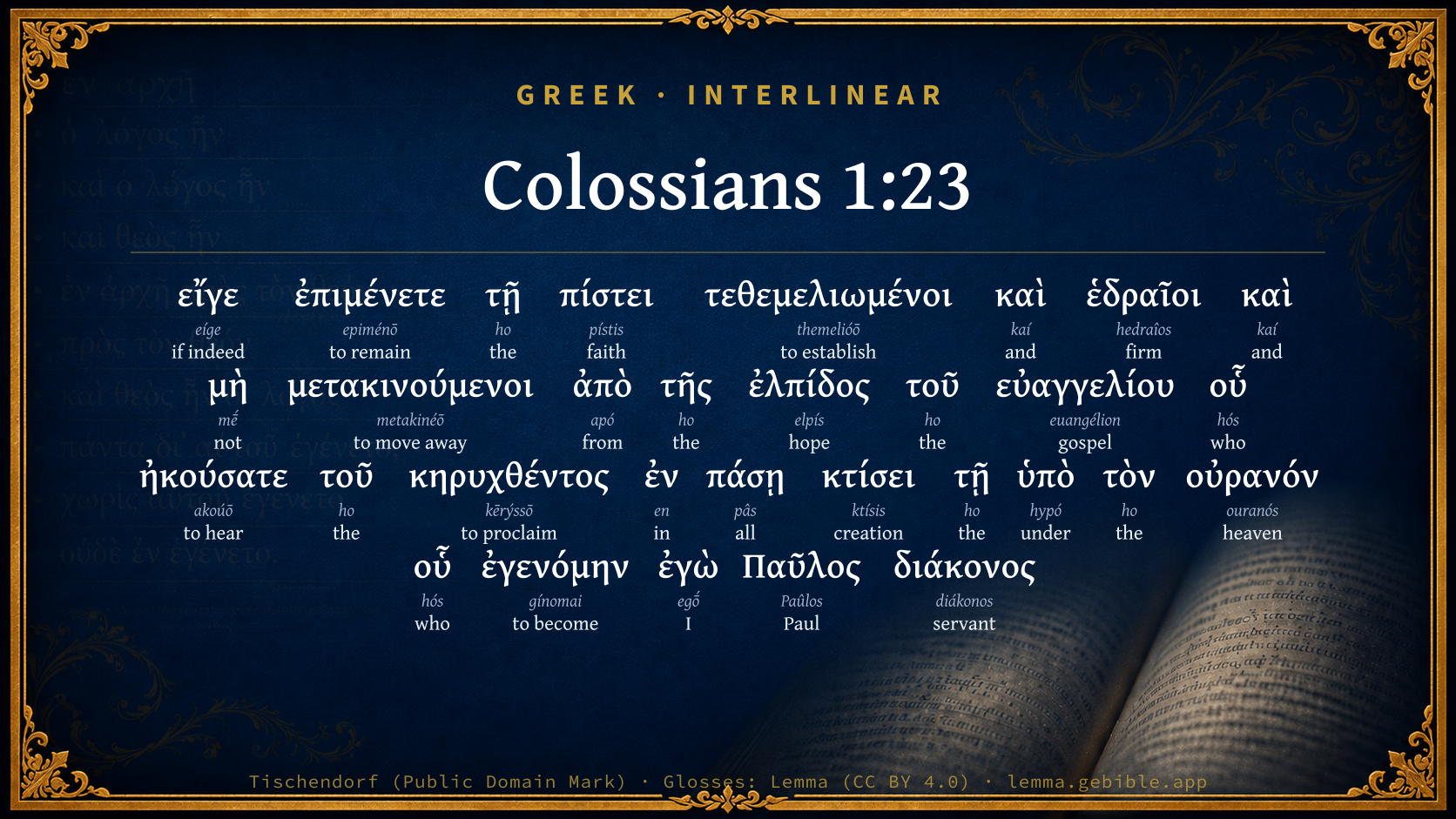
  1. εἴγε eíge G1489 “if indeed” Conditional
  2. ἐπιμένετε epiménō G1961 “to remain” Verb, Present, Active, Indicative, 2nd person, Plural
  3. τῇ ho G3588 “the” Article, Dative, Singular, Feminine
  4. πίστει pístis G4102 “faith” Noun, Dative, Singular, Feminine
  5. τεθεμελιωμένοι themelióō G2311 “to establish” Verb, Perfect, Passive, Participle, Nominative, Plural, Masculine
  6. καὶ kaí G2532 “and” Conjunction
  7. ἑδραῖοι hedraîos G1476 “firm” Adjective, Nominative, Plural, Masculine
  8. καὶ kaí G2532 “and” Conjunction
  9. μὴ mḗ G3361 “not” Particle, Negative
  10. ἀπὸ apó G575 “from” Preposition
  11. τῆς ho G3588 “the” Article, Genitive, Singular, Feminine
  12. ἐλπίδος elpís G1680 “hope” Noun, Genitive, Singular, Feminine
  13. τοῦ ho G3588 “the” Article, Genitive, Singular, Neuter
  14. εὐαγγελίου euangélion G2098 “gospel” Noun, Genitive, Singular, Neuter
  15. οὗ hós G3739 “who” Relative pronoun, Genitive, Singular, Neuter
  16. ἠκούσατε akoúō G191 “to hear” Verb, Aorist, Active, Indicative, 2nd person, Plural
  17. τοῦ ho G3588 “the” Article, Genitive, Singular, Neuter
  18. κηρυχθέντος kērýssō G2784 “to proclaim” Verb, Aorist, Passive, Participle, Genitive, Singular, Neuter
  19. ἐν en G1722 “in” Preposition
  20. πάσῃ pâs G3956 “all” Adjective, Dative, Singular, Feminine
  21. κτίσει ktísis G2937 “creation” Noun, Dative, Singular, Feminine
  22. τῇ ho G3588 “the” Article, Dative, Singular, Feminine
  23. ὑπὸ hypó G5259 “under” Preposition
  24. τὸν ho G3588 “the” Article, Accusative, Singular, Masculine
  25. οὐρανόν ouranós G3772 “heaven” Noun, Accusative, Singular, Masculine
  26. οὗ hós G3739 “who” Relative pronoun, Genitive, Singular, Neuter
  27. ἐγενόμην gínomai G1096 “to become” Verb, Aorist, Middle deponent, Indicative, 1st person, Singular
  28. ἐγὼ egṓ G1473 “I” Personal pronoun, 1st person, Nominative, Singular
  29. Παῦλος Paûlos G3972 “Paul” Noun, Nominative, Singular, Masculine
  30. διάκονος diákonos G1249 “servant” Noun, Nominative, Singular, Masculine

About this verse

These counts appear in no published source. They are computed here, from the morphology-tagged text and Lemma’s own curated glosses. What Lemma adds →

31
words
24
distinct lemmas
Pauline Epistles
section

Notable vocabulary

1 hapax legomenon — a word that appears only here in the entire Greek New Testament:

  • μετακινούμενοι to move away G3334

First appearance in Scripture

This word makes its first canonical appearance in the Greek New Testament here:

  • μετακινούμενοι to move away G3334

Shared distinctive vocabulary

ἑδραῖοι firm G1476 occurs in 3 verses of the Greek New Testament. Also found in:
Repetition

Words recur within this verse:

Cross-references

69

Topical passages linked to Colossians 1:23 in the Treasury of Scripture Knowledge — connected by theme and wording, ordered by reader-vote popularity; previews shown in the World English Bible.

  • Hebrews 3:14 For we have become partakers of Christ, if we hold fast the beginning of our confidence firm to the end:
  • Hebrews 3:6 but Christ is faithful as a Son over his house; whose house we are, if we hold fast our confidence and the glorying of our hope firm to the end.
  • Matthew 24:13–14 But he who endures to the end, the same will be saved.
  • Galatians 6:9 Let us not be weary in doing good, for we will reap in due season, if we don't give up.
  • Hebrews 10:38 But the righteous will live by faith. If he shrinks back, my soul has no pleasure in him."
  • Acts 14:22 confirming the souls of the disciples, exhorting them to continue in the faith, and that through many afflictions we must enter into the Kingdom of God.
  • Colossians 1:5–6 because of the hope which is laid up for you in the heavens, of which you heard before in the word of the truth of the Gospel,
  • Romans 10:18 But I say, didn't they hear? Yes, most assuredly, "Their sound went out into all the earth, Their words to the ends of the world."
  • Ephesians 3:17 that Christ may dwell in your hearts through faith; to the end that you, being rooted and grounded in love,
  • Hebrews 6:19 This hope we have as an anchor of the soul, a hope both sure and steadfast and entering into that which is within the veil;
  • John 15:6 If a man doesn't remain in me, he is thrown out as a branch, and is withered; and they gather them, throw them into the fire, and they are burned.
  • 1 Thessalonians 3:5 For this cause I also, when I couldn't stand it any longer, sent that I might know your faith, for fear that by any means the tempter had tempted you, and our labor would have been in vain.
  • Revelation 2:10 Don't be afraid of the things which you are about to suffer. Behold, the devil is about to throw some of you into prison, that you may be tested; and you will have oppression for ten days. Be faithful to death, and I will give you the crown of life.
  • John 8:30–32 As he spoke these things, many believed in him.
  • Acts 2:5 Now there were dwelling in Jerusalem Jews, devout men, from every nation under the sky.
  • Ephesians 1:18 having the eyes of your hearts enlightened, that you may know what is the hope of his calling, and what are the riches of the glory of his inheritance in the saints,
  • John 15:9–10 Even as the Father has loved me, I also have loved you. Remain in my love.
  • 2 Corinthians 3:6 who also made us sufficient as servants of a new covenant; not of the letter, but of the Spirit. For the letter kills, but the Spirit gives life.
  • Luke 8:13–15 Those on the rock are they who, when they hear, receive the word with joy; but these have no root, who believe for a while, then fall away in time of temptation.
  • Luke 22:32 but I prayed for you, that your faith wouldn't fail. You, when once you have turned again, establish your brothers."
  • 2 Peter 2:18–22 For, uttering great swelling words of emptiness, they entice in the lusts of the flesh, by licentiousness, those who are indeed escaping from those who live in error;
  • Matthew 7:24–25 "Everyone therefore who hears these words of mine, and does them, I will liken him to a wise man, who built his house on a rock.
  • Romans 2:7 to those who by patience in well-doing seek for glory and honor and incorruptibility, eternal life;
  • Colossians 1:25 of which I was made a servant, according to the stewardship of God which was given me toward you, to fulfill the word of God,
  • 1 Corinthians 15:58 Therefore, my beloved brothers, be steadfast, immovable, always abounding in the Lord's work, because you know that your labor is not in vain in the Lord.
  • 2 Corinthians 5:18–20 But all things are of God, who reconciled us to himself through Jesus Christ, and gave to us the ministry of reconciliation;
  • 2 Corinthians 6:1 Working together, we entreat also that you not receive the grace of God in vain,
  • Galatians 5:7 You were running well! Who interfered with you that you should not obey the truth?
  • Ephesians 3:7–8 of which I was made a servant, according to the gift of that grace of God which was given me according to the working of his power.
  • Hebrews 4:14 Having then a great high priest, who has passed through the heavens, Jesus, the Son of God, let us hold tightly to our confession.
  • 1 Peter 1:3 Blessed be the God and Father of our Lord Jesus Christ, who according to his great mercy became our father again to a living hope through the resurrection of Jesus Christ from the dead,
  • 1 Peter 1:5 who by the power of God are guarded through faith for a salvation ready to be revealed in the last time.
  • 1 John 3:1–3 Behold, how great a love the Father has bestowed on us, that we should be called children of God! For this cause the world doesn't know us, because it didn't know him.
  • Deuteronomy 2:25 This day will I begin to put the dread of you and the fear of you on the peoples who are under the whole sky, who shall hear the report of you, and shall tremble, and be in anguish because of you.
  • Deuteronomy 4:19 and lest you lift up your eyes to the sky, and when you see the sun and the moon and the stars, even all the host of the sky, you are drawn away and worship them, and serve them, which Yahweh your God has allotted to all the peoples under the whole sky.
  • Psalms 92:13–14 They are planted in Yahweh's house. They will flourish in our God's courts.
  • Psalms 125:5 But as for those who turn aside to their crooked ways, Yahweh will lead them away with the workers of iniquity. Peace be on Israel.
  • Lamentations 3:66 You will pursue them in anger, and destroy them from under the heavens of Yahweh.
  • Ezekiel 18:26 When the righteous man turns away from his righteousness, and commits iniquity, and dies therein; in his iniquity that he has done shall he die.
  • Hosea 6:3–4 Let us acknowledge Yahweh. Let us press on to know Yahweh. As surely as the sun rises, Yahweh will appear. He will come to us like the rain, Like the spring rain that waters the earth."
  • Zephaniah 1:6 those who have turned back from following Yahweh, and those who haven't sought Yahweh nor inquired after him.
  • Mark 16:15 He said to them, "Go into all the world, and preach the Gospel to the whole creation.
  • Luke 6:48 He is like a man building a house, who dug and went deep, and laid a foundation on the rock. When a flood arose, the stream broke against that house, and could not shake it, because it was founded on the rock.
  • Acts 1:17 For he was numbered with us, and received his portion in this ministry.
  • Acts 1:25 to take part in this ministry and apostleship from which Judas fell away, that he might go to his own place."
  • Acts 4:12 There is salvation in none other, for neither is there any other name under heaven, that is given among men, by which we must be saved!"
  • Acts 11:23 who, when he had come, and had seen the grace of God, was glad. He exhorted them all, that with purpose of heart they should remain near to the Lord.
  • Acts 20:24 But these things don't count; nor do I hold my life dear to myself, so that I may finish my race with joy, and the ministry which I received from the Lord Jesus, to fully testify to the Gospel of the grace of God.
  • 1 Corinthians 4:1–3 So let a man think of us as Christ's servants, and stewards of God's mysteries.
  • Acts 26:16 But arise, and stand on your feet, for I have appeared to you for this purpose: to appoint you a servant and a witness both of the things which you have seen, and of the things which I will reveal to you;
  • Romans 5:5 and hope doesn't disappoint us, because God's love has been poured out into our hearts through the Holy Spirit who was given to us.
  • Romans 15:16 that I should be a servant of Christ Jesus to the Gentiles, ministering as a priest the Gospel of God, that the offering up of the Gentiles might be made acceptable, sanctified by the Holy Spirit.
  • 1 Corinthians 3:5 Who then is Apollos, and who is Paul, but servants through whom you believed; and each as the Lord gave to him?
  • 2 Corinthians 4:1 Therefore seeing we have this ministry, even as we obtained mercy, we don't faint.
  • 2 Corinthians 11:23 Are they servants of Christ? (I speak as one beside himself) I am more so; in labors more abundantly, in prisons more abundantly, in stripes above measure, in deaths often.
  • Galatians 4:11 I am afraid for you, that I might have wasted my labor for you.
  • Galatians 5:5 For we, through the Spirit, by faith wait for the hope of righteousness.
  • Ephesians 2:21 in whom the whole building, fitted together, grows into a holy temple in the Lord;
  • Ephesians 4:16 from whom all the body, being fitted and knit together through that which every joint supplies, according to the working in measure of each individual part, makes the body increase to the building up of itself in love.
  • Colossians 2:7 rooted and built up in him, and established in the faith, even as you were taught, abounding in it in thanksgiving.
  • 1 Thessalonians 3:3 that no one be moved by these afflictions. For you know that we are appointed to this task.
  • 1 Thessalonians 5:8 But let us, since we belong to the day, be sober, putting on the breastplate of faith and love, and, for a helmet, the hope of salvation.
  • 2 Thessalonians 2:16 Now our Lord Jesus Christ himself, and God our Father, who loved us and gave us eternal comfort and good hope through grace,
  • 1 Timothy 1:12 And I thank him who enabled me, Christ Jesus our Lord, because he counted me faithful, appointing me to service;
  • 1 Timothy 2:7 to which I was appointed a preacher and an apostle (I am telling the truth in Christ, not lying), a teacher of the Gentiles in faith and truth.
  • 2 Timothy 1:11–12 For this, I was appointed as a preacher, an apostle, and a teacher of the Gentiles.
  • 2 Timothy 4:5–6 But you be sober in all things, suffer hardship, do the work of an evangelist, and fulfill your ministry.
  • Titus 3:7 that, being justified by his grace, we might be made heirs according to the hope of eternal life.
  • 1 John 2:27 As for you, the anointing which you received from him remains in you, and you don't need for anyone to teach you. But as his anointing teaches you concerning all things, and is true, and is no lie, and even as it taught you, you will remain in him.

Cross-references courtesy of OpenBible.info (CC BY 4.0).

Commentary

Notes on Colossians 1:23 from classic Christian and Jewish commentators (each source and its license shown beneath its notes). The classic Christian expositions comment on the surrounding passage and are grouped to its opening verse, so a note may address several verses; the Jewish commentaries on the Tanakh (Rashi and others) are per-verse, so they appear only where the commentator wrote on this verse.

Lemma curates 59 commentaries, every one of them public domain or Creative Commons licensed, each selected and text-cleaned for this edition rather than reprinted as found. About our sources →

The Biblical Illustrator

Joseph S. Exell

Col_1:23

If ye continue in the faith.

The condition of mans final blessedness

Mans final blessedness depends on--

I. His unswerving continuance in the faith. There is implied a continuance in--

1. The doctrines of the faith. What a man believes has a powerful influence in moulding his character. Unbelief lures the soul from its confidence, sets it adrift amidst the cross currents of doubt, and exposes it to moral shipwreck. The souls safety is ensured not by an in fatuated devotion to mere opinions, but by an intelligent and constant faith in Divine verities.

2. In the profession of the faith. The believer is a witness for the truth, and it is imperative that he should bear his testimony (Rom_10:9-10; Mat_10:32).

3. The practice of the faith. Faith supplies the motive and rule of all right conduct.

4. Continuance in the faith must be permanent. Grounded and settled. In order to permanency in the faith, the truth must be--

(1) Apprehended intelligently.

(2) Embraced cordially.

(3) Maintained courageously.

II. His unchanging adherence to the gospel hope.

1. The gospel reveals a bright future.

2. The gospel to be effectual must come in contact with individual mind. Which ye have heard. Epaphras had declared to them the Divine message.

3. The gospel is adapted to universal man. Which was preached to every creature which is under heaven.

4. The gospel invested the apostle with an office of high authority. Whereof I, Paul, am made a minister. There is an implied possibility of relinquishing our hold of gospel hope. The multiplicity and fulness of our blessings may prove a snare to us; prosperity tempts to relax watchfulness. Our retention of the gospel hope is rendered immovable--

(1) By constant prayer;

(2) Growing acquaintance with the Word of promise;

(3) Continual anticipation of future bliss. (G. Barlow.)

Our life-work

In the end of Col_1:22; Col_1:28 we learn the great object of salvation. We should be fellow-workers with God in this (Php_2:12). Like an artist student copying the work of a great master under his superintendence, we must work out the beauty of Christ in our lives, though the great Master Himself must give the finishing touch and make it perfect. Here we are told what the Christians course of conduct must be if this end is attained.

I. The foundation, the starting-point, the gospel.

1. From various expressions in the chapter we can learn what Paul means by Gospel.

(1) News of a personal Savior. (Col_1:20; Col_1:28, cf. 1Co_3:11).

(2) The blood of the Cross (Col_1:20; cf. Heb_9:22).

(3) An indwelling Saviour (Col_1:27). The searching medicine; the healing balm; the pledge and security of salvation.

2. The responsibility of the Colossians in connection with this gospel.

(1) Which ye have heard. The hearing has put them in a new position (Joh_15:24).

(2) It was preached universally. Every one now has the offer.

(3) Paul a minister of this gospel. The gospel you have heard from Epaphras your minister is mine. I got it by the revelation of Jesus Christ (Gal_1:12).

3. This gospel demands faith and hope. These, like light and heat, go together; the two poles on which Christian life turns. Faith fixes the lower end of the ladder on the Rock, and Hope rests the higher end in the promised glory.

II. Perseverance therein.

1. Faith must be kept in continual exercise. Religion is a life of faith.

(1) Continuance a necessary consequence of true faith. Three things are wanted for a good harvest--good seed, soil, sunshine, and shower. Having these the harvest is a necessity. So in spiritual things; the only thing We have to do with is the soil; the seed is good, and sunshine and shower are assured. If the soil receives and retains the Word, there must be first the blade, then the ear, etc.

(2) Here, then, is the test of faith. Is it the faith that continues and overcomes the world? That opens the soil, and draws down the roots into its bosom? That keeps the vessels filled with oil while the virgins wait? That draws the fruit-bearing sap from the True Vine?

(3) The connection of faith is not loose and wavering. Grounded like the foundation of Eddystone--a grip--an identification. Settled--seated, restful, satisfied, un-doubting.

2. Hope meanwhile is steadily maintained. We have the object of hope in two words--with Him, like Him. That consummation we are never to lose sight of. Faith helps here; it makes substantial the things hoped for, and makes evident the things not seen: the telescope which brings within the range of hopes vision the unseen. Conclusion:--

1. There is danger implied in this waning, and experience shows how real it is.

2. Steady progress inculcated. To move on the only way to keep from moving away. The unseen should act as a magnet drawing us to itself. Looking for and hasting unto. (J. J. Black, LL. D.)

Be not moved away from the hope of the gospel.

Standfast

It has cost many a soul a great struggle to obtain this hope, and when attained do not think that the conflict is over. It then becomes more fierce. Be not moved away, however--

I. From the subject of that hope. What is that? It is the hope--

1. Of full salvation, that we shall be presented holy, unblameable, etc. He that hath this hope in him purifieth himself, etc.

2. Of final perseverance, that He who has begun a good work in us will perform it until the day of Jesus Christ.

3. Of the resurrection. Christ brought not one-half, but the whole trinity of our manhood.

4. Of the second advent.

5. Of being, not in purgatory, but for ever with the Lord.

II. From the ground of that hope.

1. The rich, free, sovereign grace of God. He who could save the dying thief can save all.

2. The merit of Christ, which is the only ground on which God saves men.

3. The Divine pledge that whosoever believeth in Christ shall not perish, etc.

4. The immutability of God.

5. The infallibility of the Scriptures.

III. How we may be moved away from that hope.

1. By a conceit of ourselves. Let him that thinketh he standeth, etc.

2. By despondency. Satan does not mind whether you jump up or jump down from the rock. The least sin ought to make you humble, the greatest ought not to make you despair.

3. By false teaching. If you have been persuaded that Christ is not Divine, or not the only Priest, or that you have merit of your own, you are removed.

4. By hoping to live by feelings instead of faith.

5. By a dazzle of intellect and modern thought.

6. By persecution, sneers, and ridicule.

IV. Why we will not be moved away from that hope.

1. Because there is nothing to take its place.

2. Because if we did we should soon be in bondage.

3. Because we should become mean, miserable wretches who have deserted their Saviour.

4. Because it would be something like a soldier entrenched in an impregnable fortress accepting an invitation to come out. (C. H. Spurgeon.)

A good hope distinguished

I. Its distinguishing characteristics.

1. It is in harmony with Gods plan of salvation.

2. It springs from the work of the Holy Spirit in the heart.

3. It is grounded on the truth and power of God. Not upon impressions and feelings--no, but upon the declarations, promises, and Almighty power of Him who has laid up the hope for us in heaven.

II. Its invariable influence.

1. It produces holiness (1Jn_3:2-3).

2. It begets Christian resignation (Heb_6:18-19).

3. It enkindles pious zeal (1Th_1:3).

4. It lights up the valley of death.

Reflections:--

1. It is dismal to be without hope (Eph_2:12).

2. It is madness to deceive ourselves.

3. It is necessary to be watchful and persevering. (Congregational Pulpit.)

Changeful Christians

Oh, how many there are that are never settled. The tree which should be transplanted every week would soon die. Nay, if it were moved, no matter how skilfully, once every year, no gardener would expect fruit from it. How many Christians there be that are transplanting themselves constantly, even as to their doctrinal sentiments. There be some who believe according to the last speaker; and there be others who do not know what they do believe, but they believe almost anything that is told them. Men have come to believe that it does not matter what they do believe--who are like the weathercock upon the steeple, they will turn just as the wind blows. As good Mr. Whitfield said, You might as well measure the moon for a suit of clothes as tell their doctrinal sentiments, for they are ever changing. Now, I pray that this may be taken away from any of you, if this be your weakness, and that you may be settled. (C. H. Spurgeon.)

Immovable Christians

Cyprian, when on his road to suffer martyrdom, was told by the emperor that he would give him time to consider whether he had not better cast a grain of incense into the fire, in honour of idols, than die so degraded a death. The martyr nobly answered, There needs no deliberation in the case. John Huss was offered a pardon when at the stake, about to suffer for his attachment to Christ, if he would recant; his reply was, I am here ready to suffer death. Anne Askew when asked under similar circumstances to avoid the flames, answered, I came not here to deny my God and Master. Mr. Thomas Hawkes, an Essex gentleman, said, on a like occasion, If I had a hundred bodies, I would suffer them all to be torn in pieces, rather than recant. When the cruel Bonner told John Ardly of the pain connected with burning, and how hard it must be to endure it, with a view to leading the martyr to recant, he replied, If I had as many lives as I have hairs on my head, I would lose them all in the fire, before I would lose Christ. Galeazius, a gentleman of great wealth, who suffered martyrdom at St. Angelo, in Italy, being much entreated by his friends to recant, replied, Death is much sweeter to me with the testimony of truth, than life with its least denial. (Arrine.)

Which was preached to every creature.--There may be seven observations gathered out of this speech of the apostle.

1. That doctrine only is true which is agreeable to the doctrine of the apostles, by which the world was converted to God.

2. That no power is like the power of the Word of God. Here it converts a world in a short time. And our eyes have beheld that it hath almost in as short time restored a world of men from the power of antichrist.

3. That the words all and every one are not always in Scripture to be understood universally of all the singular persons in the world, as the universalists conceive.

4. They were but a few fishermen that did this great work, and they were much opposed and persecuted, and in some less matters they jarred sometime among themselves. Whence we may observe that doctrine may be exceeding effectual, though

(1) but few teach it;

(2) though they be but of mean estate and condition;

(3) though it be opposed by cross and contrary teaching;

(4) though it be persecuted;

(5) though the people be indisposed and nozzled in sin and superstition, as the Gentiles were;

(6) though the preacher be often restrained;

(7) though there be some dissension in less matters.

5. That in the conversion of sinners God is no respecter of persons; men of any age, nation, sex, condition, life or quality, may be converted by the gospel.

6. It is that preaching is the ordinary means to convert every creature, so as ordinarily there is none converted but by preaching.

7. If any one ask what shall become of those nations, or particular persons, that never yet heard of the gospel, I answer, the way of God in divers things is not revealed, and His judgments are a great deep. It belongs to us to look to ourselves to whom the gospel is come. (N. Byfield.)

The Biblical Illustrator, edited by Joseph S. Exell (c. 1880s–1900s) — public domain. Text from a community e-Sword module.

The Preacher's Complete Homiletical Commentary

Joseph S. Exell (gen. ed.)

CRITICAL AND EXPLANATORY NOTES

Col_1:23. Grounded and settled, and not moved away.—In that land of volcanic agency the readers would perceive only too readily the graphic force of this metaphor. Where stone buildings tumbled over like a house of cards, the figure of a faith, proof against all shocks, was effective (see Heb_12:28). Every creature under heaven.—The same rhetorical form of expression as in Col_1:6, affirming the universal fitness of the gospel as well as its wide dissemination. Whereof I Paul am made a minister.—Wonder that increases and unceasing gratitude are in these words—that the persecutor should serve the faith he once destroyed.

MAIN HOMILETICS OF Col_1:23

The Condition of Man’s Final Blessedness.

The ripest fruits can only be produced and gathered by careful and unremitting culture; so the enjoyment of the final blessings of reconciliation is conditioned upon continued allegiance to the gospel and the diligent practice of its precepts. We are taught in this verse that the ultimate presentation to God of a perfectly holy and blameless character depends upon the believer’s firm and persevering attachment to the gospel. Observe:—

I. Man’s final blessedness depends upon his unswerving continuance in the faith.—The faith is a comprehensive term; it is inclusive of all the great saving truths of the gospel, and of man’s many-sided relation to them. There is implied:

1. A continuance in the doctrines of the faith.—What a man believes has a powerful influence in moulding his character. The truths submitted to our faith shed light upon matters of transcendent import and worth. The baffled and inquiring mind, straining with painful eagerness after light, finds its satisfaction and rest amid the soothing radiance of revealed truth. “In returning and rest shall ye be saved” (Isa_30:15). Unbelief lures the soul from its restful confidence, sets it adrift amidst the cross currents of bewilderment and doubt, and exposes it to moral shipwreck and irrevocable loss. The soul’s eternal safety is ensured, not by an infatuated devotion to mere opinions about certain dogmas, but by an intelligent, firm, and constant faith in divine verities.

2. A continuance in the profession of the faith.—The believer is a witness for the truth; and it is an imperative duty to bear testimony for Christ before the world (Rom_10:9-10). This is done when we unite in fellowship and service with the external Church of Christ on earth. The Church, as the representative of Christ, witnesses for Him in the life and conduct of its individual members. There is nothing binding as to the special form this witness-bearing should take in each particular case; nor is any man compelled, for the sake of profession, to wed himself to any particular branch of the Church catholic. There may be reasons that render it justifiable, and even necessary, for a man to sever himself from any given religious community and join another; but on no conceivable ground can he be liberated from the duty of an open profession of his faith in Christ; his future acceptability to God hinges on his fidelity in this duty (Mat_10:32).

3. A continuance in the practice of the faith.—Faith supplies the motive and rule of all right conduct. The test of all preceptive enactment and profession is in the life. The Christian character is developed and perfected, not by believing or professing, but by doing the will of God. The rewards of the future will be distributed according to our deeds (Rom_2:6-10).

4. Continuance in the faith must be permanent.—“Grounded and settled.” The edifice, to be durable, must be well founded, that it may settle into a state of firmness and solidity; so faith, in order to survive the storms and temptations of this world, and participate in the promised good of the future, must be securely grounded and settled in the truth. In order to permanency in the faith, the truth must be—

(1) Apprehended intelligently.

(2) Embraced cordially.

(3) Maintained courageously.

II. Man’s final blessedness depends upon his unchanging adherence to the gospel hope.—

1. The gospel reveals a bright future. It inspires the hope of the resurrection of the body, and of the glorification of it and the soul together in the eternal life of the future. Faith and hope are inseparably linked together; they mutually succour and sustain each other; they rise or fall together. Hope is the unquestioning expectation of the fruition of those things which we steadily believe. It is compared to an anchor, which, cast within the veil, fastened and grounded in heaven, holds our vessel firm and steady amid the agitations and storms of life’s tempestuous sea. The gospel is the only source of genuine, deathless hope; all hopes grounded elsewhere wither and perish.

2. The gospel to be effectual must come in contact with the individual mind.—“Which ye have heard.” Epaphras had declared to them the divine message. It had been brought to them; they had not sought it. Having heard and received the gospel, to relinquish its blessings would be inexcusable and ungrateful. In some way, either by direct preaching or otherwise, the gospel must come to man. There is no power of moral reformation in the human heart itself; the germinant principle of a better life must come from without; it is conveyed in the gospel word.

3. The gospel is adapted to universal man.—“Which was preached to every creature which is under heaven.” Already it had spread into every part of the then known world, and its power was felt in every province of the Roman empire. The fine prophetic instinct of the apostle saw the universal tendency of the gospel, and, in spirit, anticipated the fulfilment of its generous mission. His motive is to emphasise the universality of the unchangeable gospel which is offered without reserve to all alike, and to appeal to its publicity and progress as the credential and guarantee of its truth. It is adapted to all men; it proclaims its message in all lands, and is destined to win the world to Christ. The faith and hope of the believer are based, not upon the uncertain declarations of false teachers, but upon that gospel, which is unchangeable in its character and universal in its appeal and adaptability to humanity; a strong reason is thus furnished for personal steadfastness.

4. The gospel invested the apostle with an office of high authority.—“Whereof I Paul am made a minister.” Paul participated in the blessings of the gospel; he had felt its transforming power, and from his personal experience of its preciousness could, with the greater assurance and force, exhort the Colossians to continue in the faith. But in addition to this the gospel was committed to the apostle as a sacred trust and for faithful ministration; and while dwelling on the broad charity of the gospel as involving the offer of grace to the Gentiles, he is impressed with the dignity and responsibility of his office as he interjects, somewhat abruptly, but with exquisite modesty, the words, “Whereof I Paul am made a minister.” It has been said of man that he is the priest and interpreter of nature; that it is his function to observe and test phenomena, and interpret the laws that govern the material world. Another writer has said that “man is the organ of revelation for the Godhead.” God can find no adequate form of revelation for Himself in the impersonal forces of nature; only through a being in His own image can He unfold to the universe His adorable character. But the highest office to which man can be elevated is to be a ministrant of gospel light and grace to his fellow-men.

5. There is an implied possibility of relinquishing our hold of the gospel hope.—“Be not moved away from the hope of the gospel.” The words do not necessarily imply doubt, but suggest the necessity for constant circumspection, vigilance, and care. The multiplicity and fulness of our blessings may prove a snare to us; prosperity tempts us to relax watchfulness, and we are in danger of becoming a prey to the wiles of the wicked one. Our retention of the gospel hope is rendered immovable by constant waiting upon God in fervent prayer, by a growing acquaintance with the word of promise, by continually anticipating in thought the bliss of the future.

Lessons.—

1. The gospel provides the surest basis for faith and hope.

2. Man’s ultimate blessedness depends on his continued fidelity.

The Preacher's Complete Homiletical Commentary (gen. ed. Joseph S. Exell; Funk & Wagnalls, c. 1892) — public domain (pre-1929). A full-Bible homiletical/sermon-outline anthology covering 65 of 66 books (2 John is absent from the source module). Text from a community e-Sword module.

Tyndale Open Study Notes

Tyndale Open Resources

1:23 preached all over the world (literally preached to every creature under heaven): The point of Paul’s hyperbole (exaggeration for emphasis) is that centers for preaching the Good News had been established in key cities throughout the Roman world (see also 1:6).

Tyndale Open Study Notes — © Tyndale Open Resources, licensed CC BY-SA 4.0. Text via the HelloAO Bible API.

Bengel's Gnomon

Johann Albrecht Bengel

Col 1:23. Εἴ γε, if indeed) This word depends on the finite verb, He hath reconciled, Col 1:21, rather than on the infinitive παραστῆσαι [Col 1:22]; and this παραστῆσαι, being the ultimate [final] object, is itself the most delightful fruit of reconciliation; whence it is not the truth of the reconciliation which has been accomplished, that is suspended [is made to depend] on the perseverance of the Colossians, but the most delightful fruit for the time to come, which is not to be obtained, unless the Colossians shall have persevered; comp. εἴ γε, Eph 4:21; ἐάνπερ, Heb 3:6.—τῇ πίστει) in faith, viz. in confidence; to which hope is usually joined.—τεθεμελιωμένοι) secured to the foundation [grounded]: ἑδραῖοι, stable [settled], firm within. The former is metaphorical, the latter less figurative; the one implies greater respect to the foundation, by which believers are supported; but ἑδραῖοι, stable (settled), suggests the idea of internal strength, which believers themselves possess; just as a building ought to lean (rest) uprightly and solidly on the foundation first of all, but afterwards to cohere securely, and firmly to stand together, even by its own mass [compact solidity of structure].—καὶ ἑδραῖοι καὶ, and stable and) 1Co 15:58, note; Eph 3:18.—τοῦ εὐαγγελίου, of the Gospel) by which reconciliation is declared.—πάσῃ, to every) Col 1:20; Mar 16:15, note.—διάκονος, minister) Col 1:25; Eph 3:7.

Bengel's Gnomon of the New Testament — English translation (T&T Clark, Edinburgh, 1860) — public domain. Text from a community e-Sword module.

Meyer's Critical & Exegetical Commentary

Heinrich August Wilhelm Meyer

Col_1:23. Requirement, with which is associated not, indeed, the being included in the work of reconciliation (Hofmann), but the attainment of its blessed final aim, which would otherwise be forfeited, namely the παραστῆσαι κ.τ.λ. above described: so far at any rate as ye, i. e. assuming, namely, that ye, etc. A confidence that the readers will fulfil this condition is not conveyed by the εἴγε in itself (see on 2Co_5:3; Gal_3:4; Eph_3:2), and is not implied here by the context; but Paul sets forth the relation purely as a condition certainly taking place, which they have to fulfil, in order to attain the παραστῆσαι κ.τ.λ.that fructus in posterum laetissimus of their reconciliation (Bengel).

τῇ πίστει] belonging to ἐπιμέν.: abide by the faith, do not cease from it.[59] See on Rom_6:1. The mode of this abiding is indicated by what follows positively (τεθεμ. κ. ἐδραῖοι), and negatively (Κ. ΜῊ ΜΕΤΑΚΙΝ. Κ.Τ.Λ.), under the figurative conception of a building, in which, and that with reference to the Parousia pointed at by παραστῆσαι κ.τ.λ., the hope of the gospel is conceived as the foundation, in so far as continuance in the faith is based on this, and is in fact not possible without it (Col_1:27). Spe amissa perseverantia concidit, Grotius. On τεθεμελ., which is not interjected (Holtzmann), comp. Eph_3:17; 1Pe_5:10; and on ἙΔΡΑῖΟΙ, 1Co_15:58. The opposite of ΤΕΘΕΜΕΛ. is ΧΩΡῚς ΘΕΜΕΛΊΟΥ, Luk_6:49; but it would be a contrast to the ΤΕΘΕΜΕΛ. ΚΑῚ ἙΔΡΑῖΟΙ, if they were ΜΕΤΑΚΙΝΟΎΜΕΝΟΙ Κ.Τ.Λ.; concerning ΜΉ, see Winer, p. 443 [E. T. 596]; Baeumlein, Part. p. 295.

μετακινούμ.] passively, through the influence of false doctrines and other seductive forces.

ἀπό] away … from, so as to stand no longer on hope as the foundation of perseverance in the faith. Comp. Gal_1:6.

The ἐλπὶς τοῦ εὐαγγ. (which is proclaimed through the gospel by means of its promises, comp. Col_1:5, and on Eph_1:18) is the hope of eternal life in the Messianic kingdom, which has been imparted to the believer in the gospel. Comp. Col_1:4-5; Col_1:27; Rom_5:2; Rom_8:24; Tit_1:2 f., Col_3:7.

ΟὟ ἨΚΟΎΣΑΤΕ Κ.Τ.Λ.] three definitions rendering the ΜῊ ΜΕΤΑΚΙΝΕῖΣΘΑΙ Κ.Τ.Λ. in its universal obligation palpably apparent to the readers; for such a μετακινεῖσθαι would, in the case of the Colossians, be inexcusable (ΟὟ ἨΚΟΎΣΑΤΕ, comp. Rom_10:18), would set at naught the universal proclamation of the gospel (ΤΟῦ ΚΗΡΥΧΘ. Κ.Τ.Λ.), and would stand in contrast to the personal weight of the apostles position as its servant (ΟὟ ἘΓΕΝ. Κ.Τ.Λ.). If, with Hofmann, we join ΤΟῦ ΚΗΡΥΧΘΈΝΤΟς as an adjective to ΤΟῦ ΕὐΑΓΓΕΛΊΟΥ, ΟὟ ἨΚΟΎΣΑΤΕ, we withdraw from the ΟὟ ἨΚΟΎΣΑΤΕ that element of practical significance, which it must have, if it is not to be superfluous. Nor is justice done to the third point, ΟὟ ἘΓΕΝΌΜΗΝ Κ.Τ.Λ., if the words (so Hofmann, comp. de Wette) are meant to help the apostle, by enforcing what he is thenceforth to write with the weight of his name, to come to his condition at that time. According to this, they would be merely destined as a transition. In accordance with the context, however, and without arbitrary tampering, they can only have the same aim with the two preceding attributives which are annexed to the gospel; and, with this aim, how appropriately and forcibly do they stand at the close![60] λοιπὸν γὰρ μέγα ἦν τὸ Παύλου ὄνομα, Oecumenius, comp. Chrysostom. Comp. on ἘΓῺ ΠΑῦΛΟς, with a view to urge his personal authority, 2Co_10:1; Gal_5:2; Eph_3:1; 1Th_2:18; Phm_1:19. It is to be observed, moreover, that if Paul himself had been the teacher of the Colossians, this relation would certainly not have been passed over here in silence.

ἘΝ ΠΆΣῌ ΚΤΊΣΕΙ (without Τῇ, see the critical remarks) is to be taken as: in presence of (coram, see Ast, Lex. Plat. I. p. 701; Winer, p. 360 [E. T. 481]) every creature, before everything that is created (κτίσις, as in Col_1:15). There is nothing created under the heaven, in whose sphere and environment (comp. Kühner, II. 1, p. 401) the gospel had not been proclaimed. The sense of the word must be left in this entire generality, and not limited to the heathen (Bähr). It is true that the popular expression of universality may just as little be pressed here as in Col_1:6. Comp. Herm. Past. sim. viii. 3; Ignatius, Romans 2. But as in Col_1:15, so also here πᾶσα κτίσις is not all creation, according to which the sense is assumed to be: on a stage embracing the whole world (Hofmann). This Paul would properly have expressed by ἐν πάσῃ τῇ κτίσει, or ἘΝ ΠΑΝΤῚ Τῷ ΚΌΣΜῼ, or ἘΝ ὍΛῼ Τῷ Κ.; comp. Col_1:6. The expression is more lofty and poetic than in Col_1:6, appropriate to the close of the section, not a fanciful reproduction betraying an imitator and a later age (Holtzmann). Omitting even ΟὟ ἨΚΟΎΣΑΤΕ (because it is not continued by ΟὟ ΚΑῚ ἘΓΏ), Holtzmann arrives merely at the connection between Col_1:23 and Col_1:25 : ΜΗ ̀ ΜΕΤΑΚΙΝ. ἈΠΟ ̀ ΤΟῦ ΕὐΑΓΓ. ΟὟ ἘΓΕΝ. ἘΓῺ Π. ΔΙΆΚ. ΚΑΤᾺ ΤῊΝ ΟἸΚΟΝ. Τ. ΘΕΟῦ ΤῊΝ ΔΟΘΕῖΣΆΝ ΜΟΙ ΕἸς ὙΜᾶς, just as he then would read further thus: ΠΛΗΡῶΣΑΙ Τ. ΛΌΓ. Τ. ΘΕΟῦ, ΕἸς Ὃ ΚΑῚ ΚΟΠΙῶ ἈΓΩΝΙΖΌΜ. ΚΑΤᾺ Τ. ἘΝΈΡΓ. ΑὐΤΟῦ ΤῊΝ ἘΝΕΡΓΟΥΜ. ἘΝ ἘΜΟΊ.

ΔΙΆΚΟΝΟς] See on Eph_3:7. Paul has become such through his calling, Gal_1:15 f.; Eph_3:7. Observe the aorist.

[59] In our Epistle faith is by no means postponed to knowing and perceiving (comp. Col_2:5; Col_2:7; Col_2:12), as Baur asserts in his Neut. Theol. p. 272. The frequent emphasis laid upon knowledge, insight, comprehension, and the like, is not to be put to the account of an intellectualism, which forms a fundamental peculiarity betokening the author and age of this Epistle (and especially of that to the Ephesians), as Holtzmann conceives, p. 216 ff.; on the contrary, it was owing to the attitude of the apostle towards the antagonistic philosophical speculations. Comp. also Grau, Entwickelungsgesch. d. N. T. II. p. 153 ff. It was owing to the necessary relations, in which the apostle, with his peculiarity of being all things to all men, found himself placed towards the interests of the time and place.

[60] According to Baur, indeed, such passages as the present are among those which betray the double personality of the author.

Meyer — Critical and Exegetical Commentary on the New Testament — English translation by Peter Christie, edited by Frederick Crombie (T&T Clark, 1880) — public domain. Text from a community e-Sword module.

Expositor's Greek Testament

ed. W. Robertson Nicoll

Col 1:23 . εἴ γε with the indicative expresses the Apostle’s confidence that the condition will be fulfilled. ἐπιμένετε . This abiding in faith is the only, as it is the sure way, to this presentation of themselves κατ . αὐτ . This is directed against the false teachers’ assurance that the gospel they had heard needed to be supplemented if they wished to attain salvation. It needs no supplementing, and it is at the peril of salvation that they lose hold of it. τεθεμελιωμένοι refers to the firm foundation, ἑδραῖοι to the stability of the building. μὴ μετακινούμενοι . The perfect participle here gives way to the present, expressing a continuous process. It may be passive or middle, probably the former. ἀπὸ τ . ἐλπίδος τοῦ εὐαγγελίου : to be taken with μετακιν . alone, not, assuming a zeugma, with the three co-ordinate expressions (Sod.), for it is not at all clear that the last of these keeps up the metaphor of a building. The hope of the Gospel is the hope given by or proclaimed in the Gospel. οὗ ἠκούσατε . Paul again sets his seal on the form of the Gospel which they had received, and again insists on the universality of its proclamation, its catholicity as guaranteeing its truth (see on Col 1:5-7 ). ἐν πασῇ κτίσει : “in presence of every creature”; π . κτ ., as in Col 1:15 , with the limitation τ . ὑ . τ . οὐρ . οὗ ἐγενόμην ἐγὼ Παῦλος διάκονος : cf. Eph 3:7 . This phrase contains a certain stately self-assertion; the Apostle urges the fact that he is a minister of this Gospel as a reason why they should remain faithful to it. His apostolic authority, so far from being impugned by the false teachers, was more probably invoked; so Paul throws it in the balance against them. It is also true that the Gentile mission was so bound up in his own mind with his apostleship that a reference to the one naturally suggested a reference to the other. By this clause Paul effects the transition to Col 1:24 .

The Expositor's Greek Testament, edited by W. Robertson Nicoll (1897–1910) — public domain. Text from a community e-Sword module.

Cambridge Greek Testament for Schools and Colleges

23. ἐγὼ Παῦλος διάκονος. For διάκονος, א*P read κῆρυξ καὶ ἀπόστολος (1Ti 2:7; 2Ti 1:11); Aethiop. κῆρυξ καὶ διάκονος; and characteristically A, with Harclean Syr.mg, κῆρυξ καὶ ἀπόστολος καὶ διάκονος

23. εἴ γε, “if only.” The addition of γέ lays emphasis on the importance of observing the condition, but determines nothing as to whether or not they will do so. Contrast the negative answer in Gal 3:4, with the positive in Eph 3:1-2, and Eph 4:21.

It is hard to see that the indicative “converts the hypothesis into a hope” (Lightfoot). Compare further Monro, Homeric Grammar, §§ 353, 354, quoted by Sanday-Headlam on Rom 3:30.

ἐπιμένετε, “ye stay on in.” So Php 1:24; Rom 6:1; Rom 11:22 and especially 23. The ἐπί “is not per se intensive, but appears to denote rest at a place” (Ell.).

τῇ πίστει, “faith,” or perhaps better “your faith.” Certainly with ἐπιμένετε (see examples quoted in preceding note) in spite of Col 2:7.

The force of the article is uncertain. It may denote

(1) “The Faith,” the body of doctrine delivered by your first teachers. So Jud 1:3; Jud 1:20; Act 6:7; Act 13:8, and sometimes in the Pastoral Epistles, e.g. 1Ti 4:1.

But in these passages the meaning is determined by the context, and here the immediately following reference to the hope suggests reality of personal religion rather than orthodox belief.

(2) “Faith” generally, without such stress on “faith” in itself as would be suggested by the absence of the article. Similarly Eph 3:17, κατοικῆσαι τὸν χριστὸν διὰ τῆς πίστεως ἐν ταῖς καρδίαις ὑμῶν ἐν ἀγάπῃ, Eph 3:12, Eph 6:16.

(3) “Your faith.” Such doubtless is the force of the article in Rom 11:28. He has already praised their faith in Col 1:4.

τεθεμελιωμένοι καὶ ἑδραῖοι, “founded and stedfast.” Both terms are used absolutely. For the figurative use, as regards believers, of terms that strictly belong to buildings cf. Col 2:7; Eph 3:18; Mat 7:25; and especially 1 Corinthians 3. It is perhaps derived ultimately from Isa 14:32; Isa 28:16; Isa 54:11.

καὶ ἑδραῖοι. While τεθεμελιωμένοι denotes that the Colossian believers have been laid once for all securely on something, or rather Someone, as their unfailing support, ἑδραῖος denotes the inner firmness of the structure, the steadiness of Christian character that ought to be found in them. So in 1Co 7:37; 1Co 15:58†.

On the probable quotation in Ignat. Eph. § 10, see Introd. p. xxxviii.

καὶ μὴ μετακινούμενοι†, “and not being moved away.” μὴ, not οὐ, the phrase “(in a sentence beginning with εἴγε) is put as a condition, consequently as a mere conception” (Winer, § 55. 1 b, p. 596, ed. 1870). But see Blass, p. 253, Moulton, Gram. Proleg. p. 170.

A close parallel is 1Co 15:58 (ἑδραῖοι γίνεσθε, ἀμετακίνητοι†), but that passage lacks the vividness of the present participle, with its suggestion of repeated attempts to dislodge them.

ἀπὸ τῆς ἐλπίδος τοῦ εὐαγγελίου. On ἐλπίς cf. Col 1:5. Here, as there, it is almost certainly the hope brought and held out by the Gospel, the sum of things promised by it, and therefore expected by believers. Cf. Gal 5:5, and especially Eph 1:18. Perhaps Col 1:22 b suggested this.

τοῦ εὐαγγελίου, (Col 1:5) οὗ ἠκούσατε.

This is the first of three statements appealing to them against being moved away by false teaching. (1) They themselves had heard the true message; (2) It was this, and no other, that had been proclaimed everywhere; (3) The Apostle himself could vouch for it, as a living example and witness of its power.

τοῦ κηρυχθέντος, “which was proclaimed,” aloud and openly as by a herald; cf. Gen 41:43, ἐκήρυξεν ἔμπροσθεν αὐτοῦ κήρυξ. In sharp contrast to the esoteric methods of most teachers of old time, heathen and Jewish alike.

The tense may be (1) timeless “which is proclaimed,” but (2) is probably to be taken strictly, i.e. as contemporaneous with the preceding ἠκούσατε, as though St Paul was going to say “which was proclaimed among many before you.”

(3) Another explanation is that the statement is “ideal.” “It ‘was’ done when the Saviour, in his accomplished victory, bade it be done, Mar 16:15” (Moule). Cf. 1Ti 3:16, Rom 8:30.

ἐν πάσῃ κτίσει, cf. Col 1:15 note.

Apparently “in every district of creation,” to which 1Pe 2:13 (ὑπο τάγητε πάσῃ ἀνθρωπίνῃ κτίσει) is the nearest parallel. But “in all creation” (R.V.) may be defended (see on Col 1:15).

Ell. and others would understand ἐν to here = coram (cf. 1Co 6:2, ἐν ὑμῖν κρίνεται ὁ κόσμος), and translate “in the hearing of every creature,” but such a meaning of ἐν especially suggests a tribunal, and a plural noun would therefore have been more natural.

P. Ewald conjectures ἐν πάσῃ κλίσει, region, clime, for which he refers to Dionysius Periegetes (c. 300 A.D.), p. 615, αἱ δʼ Ἀσίης, αἱ δʼ αὗτε περὶ κλίσιν Εὐρωπείης.

τῇ ὑπὸ τὸν οὐρανόν, “that is under the heaven,” i.e. on earth, Act 2:5, ἀπὸ παντὸς ἔθνους τῶν ὑπὸ τὸν οὐρανόν; cf. Ecc 1:13.

οὗ ἐγενόμην, “of which I Paul became a minister.” Perhaps he silently contrasts his former life (Gal 1:23). Compare Eph 3:7-8.

ἐγὼ Παῦλος. This emphatic phrase occurs elsewhere only in 2Co 10:1; Gal 5:2; Eph 3:1; 1Th 2:18; Phm 1:19.

He uses it here to further emphasize the fact that he who had before been a persecutor, and who was now what he was only by the grace of God (1Co 15:10), bore this witness.

διάκονος, Col 1:7. See notes on Textual Criticism.

No longer lifted up in pride against the Gospel, but a servant, and an active servant, in its cause.

Cambridge Greek Testament for Schools and Colleges (Cambridge University Press, 1896; 21 vols, various authors incl. Carr, Maclear, Plummer, Farrar, Lumby, Moule, M. R. James, Simcox) — public domain. Text from a community e-Sword module.

Geneva Bible (1599)

Geneva Bible translators

To all men: whereby we learn that the Gospel was not shut up within the corners of Judea alone.

He purchased authority to this doctrine by his Apostleship, and taketh a most sure proof thereof, of his afflictions which he suffereth for Christ’s Name to instruct the Churches with these examples of patience.

This second treatise of this part of the Epistle, wherein he exhorteth the Colossians not to suffer themselves by any means to be moved from this doctrine, showing and declaring that there is nowhere any other true Gospel.

Geneva Bible (1599) marginal notes — public domain. Text via Bolls.life.

Jamieson, Fausset & Brown

Robert Jamieson, A. R. Fausset & David Brown

If--"Assuming that," &c.: not otherwise shall ye be so presented at His appearing (Col 1:22).

grounded--Greek, "founded," "fixed on the foundation" (compare Note, see on Eph 3:17; Luk 6:48-49).

settled--"steadfast." "Grounded" respects the foundation on which believers rest; "settled," their own steadfastness (Pe1 5:10). Co1 15:58 has the same Greek.

not moved away--by the false teachers.

the hope of the gospel-- (Eph 1:18).

which ye have heard . . . which was preached to every creature . . . whereof I . . . am . . . a minister--Three arguments against their being "moved away from the Gospel": (1) Their having heard it; (2) The universality of the preaching of it; (3) Paul's ministry in it. For "to (Greek, 'in') every creature," the oldest manuscripts read, "in all creation." Compare "in all the world," Col 1:6; "all things . . . in earth," Col 1:20 (Mar 16:15): thus he implies that the Gospel from which he urges them not to be moved, has this mark of truth, namely, the universality of its announcement, which accords with the command and prophecy of Christ Himself (Mat 24:14). By "was preached," he means not merely "is being preached," but has been actually, as an accomplished fact, preached. PLINY, not many years subsequently, in his famous letter to the Emperor Trajan [Epistles, Book X., Epistle 97], writes, "Many of every age, rank, and sex, are being brought to trial. For the contagion of that superstition [Christianity] has spread over not only cities, but villages and the country."

whereof I Paul am--rather as Greek, "was made a minister." Respect for me, the minister of this world-wide Gospel, should lead you not to be moved from it. Moreover (he implies), the Gospel which ye heard from Epaphras, your "minister" (Col 1:7), is the same of which "I was made a minister" (Col 1:25; Eph 3:7): if you be moved from it, ye will desert the teaching of the recognized ministers of the Gospel for unauthorized false teachers.

Jamieson, Fausset & Brown — Commentary Critical and Explanatory on the Whole Bible (1871) — public domain (CC PDM 1.0). Text via the HelloAO Bible API.

Adam Clarke's Commentary

Verse 23. If ye continue in the faith] This will be the case if you, who have already believed in Christ Jesus, continue in that faith, grounded in the knowledge and love of God, and settled-made firm and perseveringly steadfast, in that state of salvation.

And be not moved away] Not permitting yourselves to be seduced by false teachers.

The hope of the Gospel] The resurrection of the body, and the glorification of it and the soul together, in the realms of blessedness. This is properly the Gospel HOPE.

To every creature which is under heaven] A Hebraism for the whole human race, and particularly referring to the two grand divisions of mankind, the Jews and Gentiles; to both of these the Gospel had been preached, and to each, salvation by Christ had been equally offered. And as none had been excluded from the offers of mercy, and Jesus Christ had tasted death for every man, and the Jews and Gentiles, in their great corporate capacity, had all been invited to believe the Gospel; therefore, the apostle concludes that the Gospel was preached to every creature under heaven, as being offered without restrictions or limitations to these two grand divisions of mankind, including the whole human race.

Adam Clarke's Commentary on the Bible (1810–1826) — public domain. Text from a community e-Sword/MySword module.

John Calvin's Commentaries

23. If ye continue. Here we have an exhortation to perseverance, by which he admonishes them that all the grace that had been conferred upon them hitherto would be vain, unless they persevered in the purity of the gospel. And thus he intimates, that they are still only making progress, and have not yet reached the goal. For the stability of their faith was at that time exposed to danger through the stratagems of the false apostles. Now he paints in lively colors assurance of faith when he bids the Colossians be grounded and settled in it. For faith is not like mere opinion, which is shaken by various movements, but has a firm steadfastness, which can withstand all the machinations of hell. Hence the whole system of Popish theology will never afford even the slightest taste of true faith, which holds it as a settled point, that we must always be in doubt respecting the present state of grace, as well as respecting final perseverance. He afterwards takes notice also of a relationship which subsists between faith and the gospel, when he says that the Colossians will be settled in the faith only in the event of their not falling back from the hope of the gospel; that is, the hope which shines forth upon us through means of the gospel, for where the gospel is, there is the hope of everlasting salvation. Let us, however, bear in mind, that the sum of all is contained in Christ. Hence he enjoins it upon them here to shun all doctrines which lead away from Christ, so that the minds of men are otherwise occupied.

Which ye have heard. As the false apostles themselves, who tear and rend Christ in pieces, are accustomed proudly to glory in the name of the gospel, and as it is a common artifice of Satan to trouble men’s consciences under a false pretext of the gospel, that the truth of the gospel may be brought into confusion, Paul, on this account, expressly declares, that that was the genuine, that the undoubted gospel, which the Colossians had heard, namely, from Epaphras, that they might not lend an ear to doctrines at variance with it. He adds, besides, a confirmation of it, that it is the very same as was preached over the whole world. It is, I say, no ordinary confirmation when they hear that they have the whole Church agreeing with them, and that they follow no other doctrine than what the Apostles had alike taught and was everywhere received.

It is, however, a ridiculous boasting of Papists, in respect of their impugning our doctrine by this argument, that it is not preached everywhere with approbation and applause, inasmuch as we have few that assent to it. For though they should burst, they will never deprive us of this — that we at this day teach nothing but what was preached of old by Prophets and Apostles, and is obediently received by the whole band of saints. For Paul did not mean that the gospel should be approved of by the consent of all ages in such a way that, if it were rejected, its authority would be shaken. He had, on the contrary, an eye to that commandment of Christ,

Go, preach the gospel to every creature; (Mark 16:15;)

which commandment depends on so many predictions of the Prophets, foretelling that the kingdom of Christ would be spread over the whole world. What else then does Paul mean by these words than that the Colossians had also been watered by those living streams, which, springing forth from Jerusalem, were to flow out through the whole world? (Zechariah 14:8.)

We also do not glory in vain, or without remarkable fruit and consolation, that we have the same gospel, which is preached among all nations by the commandment of the Lord, which is received by all the Churches, and in the profession of which all pious persons have lived and died. It is also no common help for fortifying us against so many assaults, that we have the consent of the whole Church — such, I mean, as is worthy of so distinguished a title. We also cordially subscribe to the views of Augustine, who refutes the Donatists by this argument particularly, that they bring forward a gospel that is in all the Churches unheard of and unknown. This truly is said on good grounds, for if it is a true gospel that is brought forward, while not ratified by any approbation on the part of the Church, it follows, that vain and false are the many promises in which it is predicted that the preaching of the gospel will be carried through the whole world, and which declare that the sons of God shall be gathered from all nations and countries, etc. (Hosea 1:10-11.) But what do Papists do? Having bid farewell to Prophets and Apostles, and passing by the ancient Church, they would have their revolt from the gospel be looked upon as the consent of the universal Church. Where is the resemblance? Hence, when there is a dispute as to the consent of the Church, let us return to the Apostles and their preaching, as Paul does here. Farther, lest any one should explain too rigidly the term denoting universality, Paul means simply, that it had been preached everywhere far and wide.

Of which I am made. He speaks also of himself personally, and this was very necessary, for we must always take care, that we do not rashly intrude ourselves into the office of teaching. He accordingly declares, that this office was appointed him, that he may secure for himself right and authority. And, indeed, he so connects his apostleship with their faith, that they may not have it in their power to reject his doctrine otherwise than by abandoning the gospel which they had embraced.

John Calvin's Commentaries (1540-1563) — public domain. Text from the Calvin Translation Society English edition (1840s-50s) via the Christian Classics Ethereal Library (ccel.org). Calvin's coverage is partial (roughly two-thirds of the Bible); uncommented books and verses are honest gaps, never fabricated. The 19th-century editor's footnotes and remarks are omitted so the notes are faithfully Calvin's own voice.

Ellicott's Commentary for English Readers

(23) If.—The word, as in Eph_3:2; Eph_4:21 (where see Notes), conveys a supposition hardly hypothetical—“If, as I presume;” “If, as I trust.” St. Paul cannot refrain from needful warning, but he refuses to anticipate failure.

Grounded.—Built on the foundation. Comp. Eph_2:20, “built on the foundation of the Apostles and Prophets, Jesus Christ Himself being the chief corner-stone.”

Settled.—The result of being so grounded. The word is used in the same sense, but without metaphorical association, in 1Co_15:58, “stedfast, unmoveable,” as here “settled and not being moved.”

The hope.—See Note on Col_1:5. Here, as there, great emphasis is laid on “hope.” But here there may possibly be reference to some ideas (like those spoken of in 2Ti_2:18) that “the resurrection was past already,” and that the hope of a true resurrection and a real heaven was either a delusion or a metaphor.

Every creature which is under heaven.—Comp. our Lord’s command, “Preach the gospel to every creature” (Mar_16:15). In idea and capacity the gospel is literally universal; although in actual reality such universality can only be claimed by a natural hyperbole.

[3. The Mission of St. Paul.

As APOSTLE OF THE GENTILES, a minister of the newly revealed mystery of their salvation, testifying to all alike by suffering and by preaching, in order “to present all perfect in Christ Jesus” (Col_1:24-29).]

A Bible Commentary for English Readers, edited by Charles John Ellicott (1878–1897) — public domain. Text from a community e-Sword module.

The Cambridge Bible for Schools and Colleges

gen. ed. J. J. S. Perowne

23. if] With a certain emphasis in the Greek, pressing on the saints the need of watching and prayer; a need which leaves untouched in their proper sphere the sure promises of the “final perseverance” of the saints.

“If we look to stand in the faith of the sons of God, we must hourly, continually, be providing and setting ourselves to strive … To our own safety our own sedulity is required. And then blessed for ever and ever be that mother’s child whose faith hath made him the child of God.” (Hooker, Sermon of Faith, at the end; see the whole Sermon.) See our notes on Php_3:11; Php_4:3.—The emphatic caution here has manifest reference to special dangers at Colossæ.

continue in] Abide by, adhere to. So Lightfoot, having regard to the special construction of the Greek.

the faith] So A.V. and R.V. Lightfoot says “perhaps ‘your faith’ rather than ‘the faith’.” And the contrast-parallel Rom_11:23 (“if they abide not still in unbelief”) is distinctly in favour of this. The Colossians were to persist, for their very life, in the Divine simplicity of believing.

grounded] Lit., founded, built on a foundation; a perfect participle. Cp. Eph_3:17, where the basis is “love;” and Mat_7:25, where it is “a rock,” the truth of Christ. Eph_3:17 offers an instructive parallel, connecting (as this passage does) “faith” with “foundation.” It is as believing that the Christian enjoys the fixity of the word, and of the love, of God.

settled] The Greek appears elsewhere only 1Co_7:37; 1Co_15:58. Usage suggests the special thought of settled purpose; resulting here from a settled rest on eternal truth. Cp. 1Pe_2:6-9.

be not moved away] Omit ‘be.” The Greek (“moved away”) is a present participle, and suggests a state of chronic or frequent unsettlement, as new allurements away from the truth beset them. Cp. Eph_4:14.

the hope] “That blissful hope, even the appearing of the glory, &c.” (Tit_2:13); “the hope of glory” (below, Col_1:27).

of the gospel, which ye have heard] So connect. “The hope” revealed in the message of apostolic truth, brought them by Epaphras in the power of the Spirit,—this, and no rival to it, was to be their anchorage. Better, which ye heard, when you were evangelized and converted.

and which was preached] Omit “and.” Which was proclaimed; lit., “heralded.”—Cp., for this verb with “the gospel,” e.g. Mat_4:23; Gal_2:2; 1Th_2:9.—The time-reference of “was” is, so to speak, ideal; it “was” done when the Saviour, in His accomplished victory, bade it be done (Mar_16:15).

to every creature which] More lit., in all the creation which, &c. “The expression … must not be limited to man,” says Lightfoot. But it is difficult to accept this. “All creation,” in the largest sense, shall indeed in its way share the blessings of our salvation (see e.g. Rom_8:19-22; and cp. Rev_5:13). But the thought here, and Mar_16:15, is of proclamation, and reception by faith; in view of which we cannot, in any intelligible sense, bring in “rocks and stones and trees.” Context surely limits the word to “our fellow-creatures,” in the human sense.

under heaven] An hyperbole, in the technical sense; a verbal but not therefore real exaggeration, the excess of the phrase being meant only to leave a just impression of the surprise of the fact. See above on Col_1:6 (“in all the world”).—After all, if our remark on “was preached,” just above, is right, this phrase like that is ideal, and in that respect not hyperbolical.

For the exact phrase cp. e.g. Gen_1:9; Gen_6:17; Gen_7:19; Deu_2:25; Act_2:5; Act_4:12.

whereof I Paul am made, &c.] Became, when the Lord called me to it. The same phrase occurs Eph_3:7. He emphasizes his own part and lot in the ministry of the Gospel, as he has just emphasized that Gospel itself as the veritable message of God, alone authentic amidst all false Gospels. So he asserts his own commission, authentic amidst all false evangelists. Cp. for instances of a similar emphatic Ego, 2Co_10:1; Gal_5:2; Eph_3:1 (with note in this Series); Phm_1:19.

a minister] Diâconos. See above on Col_1:7.

The Cambridge Bible for Schools and Colleges (gen. ed. J. J. S. Perowne; Cambridge University Press, 1878–1918) — public domain. Text from a community e-Sword module.

John Gill's Exposition

If ye continue in the faith,.... In the doctrine of faith which they had received and embraced; and in the grace of faith, and the exercise of it which was implanted in them; and in the profession of faith which they had made: not that the virtue and efficacy of Christ's blood, sufferings, and death, and reconciliation of their persons to God thereby, depended upon their faith, and abiding in it; but that faith and continuance in it were necessary means of their presentation in unblemished holiness and righteousness; for if they had not faith, or did not abide in it or if the good work of grace was not wrought upon their souls, and that performed until the day of Christ, they could not be presented holy and blameless: this shows the necessity of the saints' final perseverance in faith and holiness, and is mentioned with this view, to put them upon a concern about it, and to make use of all means, under divine grace, to enjoy it; and nothing could more strongly incline and move unto it, than the blessed effect of Christ's death, reconciliation and the end of it, to present the reconciled ones blameless; in order to which it is necessary they should hold on and out to the end: hence the Ethiopic version reads the words, not as a condition, but as an exhortation enforced by what goes before; "therefore be ye established in the faith": it follows,

grounded and settled; not on the sandy foundation of man's own righteousness, and peace made by his own performances; but upon the foundation and rock, Christ, against which the gates of hell cannot prevail; and so shall never finally and totally fall away, being rooted and built up in him, and established in the faith of him, in the doctrines of faith, respecting peace by his blood, justification by his righteousness, and life by his death; and so continue steadfast and immovable, always abounding in his work:

and be not moved away from the hope of the Gospel; the hope of eternal life and happiness, which as set before us in the Gospel; which that gives a good and solid ground and foundation of, in the person, blood, and righteousness of Christ; and is the instrumental means, in the hand of the Spirit, of begetting to it, and of encouraging and increasing it: the law gives no hopes of eternal life to a poor sinner; it works wrath, and ministers death; there is nothing but a fearful looking for of judgment by it; but the Gospel encourages to hope in the Lord, from the consideration of rich mercy and plenteous redemption in him; and this hope of the Gospel is an anchor of the soul, sure and steadfast, and not to be let go; this confidence and rejoicing of the hope is to be kept firm unto the end:

which ye have heard; that is, which Gospel they had heard from Epaphras their faithful minister, and that not only externally, but internally; they had heard it and believed it, and it had brought forth fruit in them; for it came to them not in word only, but in power; which is said in commendation of it, and to engage them to continue in it, and abide by it; as is also what follows:

and which was preached to every creature which is under heaven; and therefore since it was the same which was everywhere preached, they might depend upon the truth of it, should have the greater value for it, and by no means relinquish it. This must be understood not of every individual creature, even human and rational, that was then, or had been in, the world; but that it had been, and was preached far and near, in all places all over the world, to the Gentiles as well as to the Jews; who are sometimes styled "every creature", "the creature", "the whole creation", "all men", &c. see Mar 16:15 Tit 2:11; and of this, the first preaching of the Gospel by Peter after our Lord's resurrection, was an emblem and pledge, Act 2:14; and some time after that, the sound of all the apostles went into all the earth, and their words to the end of the world:

whereof I Paul am made a minister; by Jesus Christ, who appeared unto him, and called, qualified, and sent him forth as such; and this is mentioned to encourage the Colossians to abide by the truths of the Gospel, since what they had heard and received were what were everywhere preached by the faithful ministers of the word; and particularly by the apostle, who was ordained to be a teacher and preacher of it to the Gentiles. The Alexandrian copy reads, "a preacher and an apostle, and a minister"; see Ti1 2:7.

John Gill's Exposition of the Whole Bible (1746–1763) — public domain (CC PDM 1.0). Text via the HelloAO Bible API.

Trapp's Complete Commentary

John Trapp

23 If ye continue in the faith grounded and settled, and be not moved away from the hope of the gospel, which ye have heard, and which was preached to every creature which is under heaven; whereof I Paul am made a minister;

Ver. 23. If ye continue in the faith] All the promises are made to perseverance in grace. He that continueth to the end shall be saved. Be faithful to the death, and thou shalt have a crown of life. Mat 24:13; Rev 2:10. But fugitivo nulla corona; by fleeing this is no crown, if any withdraw he falleth into hell’s mouth, Heb 10:39.

Grounded and settled] When faith bears fruit upward, it will take root downward, and make a man as a tree by the river’s side, and not as the chaff in the fan, Psa 1:3-4, or as the boat without ballast.

Preached to every creature] That is, to every reasonable creature, Mar 16:15. Though to many we preach to no more purpose than Bede did when he preached to a heap of stones: these are unreasonable creatures, 2Th 3:2.

John Trapp, A Commentary or Exposition upon All the Books of the Old and New Testament (1647–1656) — public domain. Text from a community e-Sword module.

Albert Barnes' Notes on the Bible

If ye continue in the faith - In the belief of the gospel, and in holy living. If this were done, they would be presented unblameable be fore God; if not, they would not be. The meaning is, that it will be impossible to be saved unless we continue to lead lives becoming the gospel.

Grounded - On a firm foundation; see the notes at Eph 3:17, where the same word occurs.

And settled - Greek, “firm;” as a building is that is founded on a rock; compare Mat 7:25.

And be not moved away from the hope of the gospel - By the arts of philosophy, and the allurements of sin.

Which was preached to every creature which is under heaven - It cannot be supposed that it was literally true that every creature under heaven had actually heard the gospel. But this may mean:

(1) That it was designed to be preached to every creature, or that the commission to make it known embraced everyone, and that, so far as the provisions of the gospel are concerned, it may be said that it was a system proclaimed to all mankind; see Mar 16:15. If a vast army, or the inhabitants of a distant province, were in rebellion against a government, and a proclamation of pardon were issued, it would not be improper to say that it was made to every one of them, though, as a matter of fact, it might not be true that everyone in the remote parts of the army or province had actually heard of it.

(2) The gospel in the time of Paul seems to have been so extensively preached, that it might be said that it was proclaimed to everybody. All known countries appear to have been visited; and so zealous and laborious had been the heralds of salvation, that it might be said that the message had been proclaimed to all the world; see Col 1:6; compare the notes at Mat 24:14.

Whereof I Paul am made a minister - See the notes at Eph 3:1-7. Paul here pursues the same train of thought which he does in the Epistle to the Ephesians, where, having shown the exalted nature of the Redeemer, and the design of the gospel, he adverts to his own labors and sufferings in making it known. The object seems to be to show that he regarded it as the highest honor to be thus intrusted with the message of mercy to mankind, and considered it as a privilege to suffer in that cause.

Albert Barnes' Notes on the Bible (1834–1885) — public domain. Text from a community e-Sword/MySword module.

Matthew Poole's English Annotations

If ye continue in the faith grounded and settled: this if doth not import the believers’ continuance in faith to depend merely upon their own free-will, or a carnal doubting of being kept to salvation, 1Pe 1:5, but infers that they are then reconciled to God when they do indeed persevere in the faith; implying that by reason of the seducers amongst them all and every one might not really have that sound faith they would be thought to have. Wherefore the apostle engageth them to prove their faith, whereby only they can have peace with God, Rom 5:1, to be real, by taking care it be well founded and firm, Mat 13:23, as a house built on a sure foundation, a tree well rooted, Eph 3:17,18; Heb 13:9.

And be not moved away from the hope of the gospel; and be not as temporary believers which have no root, Luk 8:13, or as those who want anchorhold are tossed to and fro, Eph 4:14, and put off from that hope of eternal life, set before us in the gospel, which is sure and certain, Heb 6:18,19, built upon the foundation of the prophets and apostles, Eph 2:20, the sweet promises of eternal life.

Which ye have heard; not the works of vain philosophy which leave the minds of men unsettled, but the plain and solid doctrines of Christ, wherein the believers at Colosse had been instructed, Col 1:7.

And which was preached to every creature which is under heaven; and which the faithful apostles, according to the commission of Christ, had promulgated to every creature beneath the heavens, i.e. every rational creature here below, i.e. to all men, collectively, or nations in the world, as Col 1:6; Mat 28:19; Mar 16:15. Creature with the Hebrews doth eminently signify man, by an antonomasia, or a synecdeche, putting the general for a particular. In the original it is, in all the creature; and so it may be, in all the world, (creature being sometimes used for the system of the world, Rom 8:19-21), in opposition to Judea, i.e. in those other parts of the earth which the Greeks and Romans knew to be then inhabited: under heaven, which is a pleonasm, but of the greatest emphasis, as Act 4:12.

Whereof I Paul am made a minister; and the more to confirm them in what he had said, he adds of this gospel of reconciliation so spread, he was immediately called, Gal 1:1, and constituted to be a minister for the promulgation of it amongst the Gentiles, it being, with others, most notably committed to him, 2Co 5:19; 1Ti 1:11.

Matthew Poole's English Annotations on the Holy Bible (1683–1685) — public domain. Text from a community e-Sword/MySword module.

Whedon's Commentary on the Bible

Daniel D. Whedon

23. If ye continue—That is, assuming your persistence in the life of faith. A turning from the gospel to some substitute would work a forfeiture of its promised result.

Every creature—Not that all men had then actually heard it, but it is provided for all and proclaimed for all without limitation.

Daniel D. Whedon (gen. ed.), Commentary on the Old and New Testaments (1874–1909) — public domain. Text from a community e-Sword module.

The Pulpit Commentary

If at least ye are continuing in the faith, grounded and settled. (ver. 4; Col_2:6, Col_2:7; Eph_3:18 Eph_6:10-17; Php_1:27; 1Th_3:2; 2Th_2:15; 1Co_15:2, 1Co_15:58; Gal_1:6 Gal_5:1) All that Christ has done and will do for the Colossians, yet depends on their continued faith. Eige (only Pauline in New Testament; containing "the volatile particle ge") suggests, actually (Gal_3:4) or rhetorically, (Eph_3:2 Eph_4:21) a conceivable alternative; if as appears, as one hopes, or fears, or may assume. "Are continuing in" (ejpimenete) is both "abiding by" and "adhering to" (Rom_6:1; Php_1:24, R.V; 1Ti_4:16) As present indicative, it implies a (supposed) actual state. "The faith," as regularly in the New Testament, is the act and exercise of faith (subjective), not the content or matter of faith (objective). "Grounded" or "founded," perfect passive, implies a fixed condition (Col_2:7; Eph_3:18, coupled with "rooted". (1Co_3:10-12; Eph_2:20; 2Ti_2:19; also Luk_6:48) "Settled" (eJdraiov, from edra, a seat) is opposed to "moved away," just as in 1Co_15:58. The words, and not being moved away (or, letting yourselves be moved away) put the same assumption negatively, and more specifically as he adds, from the hope of the gospel; good tidings (vers. 5, 27; Col_3:15, Col_3:24; Eph_2:12; 1Th_1:3, 1Th_1:10; 2Ti_1:9-11; 1Co_15:58; 2Co_4:13-18; 2Co_5:1-8; Rom_8:17; Heb_3:6, 14 6:11, 18, 19 10:35, 36) that which is its peculiar property and glory, the crown of Christ"s redeeming work (ver. 22), the end of his servant"s labours (ver. 28), for which, by anticipation, he already gives thanks (ver. 5). but which was directly threatened and brought in question by Colossian error. (see notes on Col_2:18 Col_3:15) (The gospel) which you heard (vers. 5, 7: notes), which was preached in all creation that is under the heaven. (ver. 6; Mar_16:15; Mat_28:19, 20 24:14) The transition from "you" to "all creation" resembles that of vers. 5, 6 (comp. vers. 20, 21). "Preached" is literally" heralded," "loudly and officially announced;" so, frequently in St. Paul, (see 2Ti_1:11) also in Mar_16:15. Greek usage does not support the interpretation which makesktisiv ("creation") equivalent to "humanity." This sense of the word, which, even in Mark, such interpreters as Bengel, Lange, Alford, reject, is quite Hebraistic and exceptional. The phrase, "all creation," the writer has already used in ver. 15; here, as there (see here), without the article (Revised Text). The universal meaning it carries there is now limited by "under the heaven." The earthly creation subject as it is to Christ, is the sphere of this proclamation, the preaching room which is to resound everywhere with the glad tidings. (comp. Psa_1:1 Psa_98:7; Isa_52:7 Isa_55:12; Rev_10:2 Rev_14:6) And with this range it was proclaimed, for from the first it claimed universal audience. Whereof I became, I Paul, a minister. (vers. 24-29; Eph_3:1-13; 1Ti_1:11-14 1Ti_2:7; 2Ti_1:11; Rom_1:5 Rom_11:13 Rom_15:15-19; 1Co_3:5, 10 9:1, 2, 16, 17; 2Co_4:1-6 2Co_6:1-10; Gal_1:1, Gal_1:15, Gal_1:16; 1Th_2:4; Act_9:15 Act_26:16-18) (For "minister," see ver. 7.) The later Epistles betray a markedly heightened sense in the apostle of the unique dignity and importance of his own position, and those who question their authenticity press this fact against them. But the difference of tone is what one would expect in "such a one as Paul the aged, and now a prisoner also of Christ Jesus". (Phm_1:9) As the Gentile Churches grew, reverence for his person deepened; and the success of his life mission became more assured, especially now that the struggle with reactionary Judaism, signalized by the Epistles of the third missionary journey, was to a large extent decided in his favour. The false teachers he is now opposing did not, we should gather, attack the apostle personally; but may rather have claimed to be on his side.

The movement of thought we have followed in vers. 15-23 proceeds from Christ"s redeeming work to the experience of the Colossians in receiving it, and the labours of the apostle in publishing it; and is parallel to that of Eph 1:20-3:13. Here, however, the second of these topics has been made quite subordinate (vers. 21-23: comp. Ephesians it.). The third is the subject of our next section.

Vers. 23-29.

The ministry of the mystery:

In these words the apostle dwells on his own part in carrying out Christ"s work of reconciling men to God. That he does this in no boastful spirit goes without saying; but that he does so without any affectation of reserve or of modesty is equally plain. Indeed, he sets forth with unusual oral basis the glory of the Word the apostle has to proclaim, and the greatness of the work that proclamation involves: that Word, he shows, is a sublime mystery; that work a manifold ministry.

I THE WORK OF THE MINISTRY IS THE PROCLAIMING OF A BLESSED MYSTERY, The term "mystery," as Paul here twice uses it, and often in this Epistle, does not describe what is essentially incomprehensible, but rather what was hidden but is now revealed. The gospel is a mystery, but a mystery that is to be preached fully, as Bishop Lightfoot renders the word "fulfil;" a mystery that is made manifest, a mystery into which (as the word borrowed from the ancient mysteries, in ver. 28, suggests) every man may be initiated.

1. The gospel a mystery. All religion deals with mystery. Genuine mystery is the stamp of a religious divinity; false mystery is the counterfeit superstition stamps. In its aspect towards the vast, the infinite, the Divine, religion must always have some mystery to man.

2. The gospel a mystery that was long secret from man. "Hidden things belong to God." There are hidden facts and laws in nature that science has only gradually discovered or is now only gradually discovering; hidden moral meanings in nature and history that poet"s sight only can descry and poet"s song only describe. There were hidden things in religion that only holy men of old moved by the Holy Ghost could reveal.

3. The gospel is a mystery that is now fully revealed. Whatever may have been the guesses of nobler pagans, or the anticipations of patriarchs, or the predictions of prophets, all was only the pale light of very early dawn upon the hills of ancient time. It was noon when Christ lived, taught, died. The seal was broken, the secret was revealed. What secret?

4. The gospel is the revealed secret of God"s universal redeeming love.

Christ is fully proclaimed. And Christ is the Mystery. In him are all the treasures, all the wealth, of God stored away.

(1) All the mystery is revealed in Christ. As the rainbow has all possible colors in its wondrous arc, as the fabled music of the spheres has all possible tones in its chord, so in Christ is all the wisdom, all the righteousness, all the love, of God.

(2) All men may receive the blessings of this mystery. Christ, and Christ freely given to the Gentiles, and Christ freely given to be an indwelling Power in them, is the great Mystery, which, as Paul dwelt on it, made him proclaim it with newer and deepening joy. "Now," when I see the full extent of God"s mercy when I ponder his mighty, all-sufficient, all-embracing love, I rejoice, not only to proclaim, but to suffer untold sacrifices in proclaiming it to men. Anything, Paul felt and said, was worth doing, anything was worth suffering, if he might but preach the whole gospel without reserve, to all men without restriction. This leads us to notice

II THIS WORK INVOLVES COMPLETE CONSECRATION ON THE PART OF ITS MINISTERS. This consecration may, indeed often does, involve:

1. Intensity of suffering. Very bold does the assertion of the apostle seem about "filling up what is behind of the sufferings of Christ." Were his sufferings incomplete, then? No and yes. Yes; for he left work to be done that involves suffering. There must be suffering sympathy, suffering self denial, sometimes suffering death, in carrying on the work of bringing men to God. This consecration will involve:

2. Manifoldness of labour. There is the threefold function of the Christian worker denoted here. This consecration is the result of:

3. The highest constraint. U.R.T.

The Pulpit Commentary (1880–1919), ed. H.D.M. Spence-Jones & Joseph S. Exell — public domain. Text from a community e-Sword module.

John Wesley's Explanatory Notes

If ye continue in the faith - Otherwise, ye will lose all the blessings which ye have already begun to enjoy. And be not removed from the hope of the gospel - The glorious hope of perfect love. Which is preached - Is already begun to be preached to every creature under heaven.

John Wesley, Explanatory Notes Upon the Whole Bible (1754–1765) — public domain. Text via the GEBible commentary corpus.

Burkitt's Expository Notes on the New Testament

William Burkitt

Here our apostle declares to the Colossians, how they may know whether they were indeed of the number of those who were actually reconciled to God by the blood of his Son, namely, if they persevered in the faith, and continued grounded fast in their holy religion; If ye continue in the faith grounded and settled; implying, that it is the great duty of Christians, who have sat under the preaching of the gospel, to be well settled in the doctrine of faith, which they have heard and received, and that the best way to be settled, is to be well grounded; if we are not settled in religion, we can never grow in religion; an ungrounded Christian can never be a growing Christian; and if we are not well grounded in the faith, we can never suffer for the faith; for such as are sceptics in religion, will never prove martyrs for the sake of religion.

Observe, 2. The universality of that tender, which by the preaching of the gospel is made unto all sorts of sinners, of reconciliation with God, and acceptance through Christ; which gospel was preached to every creature under heaven; that is to lost mankind, to some of all sorts; not in Judea only, but amongst the Gentiles also; to every human creature, no person, no nation being refused or passed by; plainly intimating, that an indefinite and universal tender of reconciliation with God, and salvation by Jesus Christ, is made unto all person, by the preaching of the gospel.

Happy they, whose hearts are inclined and disposed to accept of, and comply with them, who in the day of the gospel’s visitation, do know the things of their peace.

William Burkitt's Expository Notes on the New Testament (1700–1703) — public domain. Text from a community e-Sword module.

The People's New Testament

B. W. Johnson

23. If ye continue in the faith. Their continued acceptance depends on their clinging to Christ who redeemed them. Grounded and settled. Having an immovable foundation, so that they could not be moved from the hope of the gospel by any wind of doctrine. Which was preached, etc. See note on verse 6 above.

B. W. Johnson's The People's New Testament with Notes (1889–1891) — public domain. Electronic text from the Christian Classics Ethereal Library (CCEL) ThML edition.

Alford’s Greek Testament

Henry Alford

23.] (condition of this presentation being realized: put in the form of an assumption of their firmness in the hope and faith of the Gospel)—if, that is (i.e. ‘assuming that,’ see note on 2Co 5:3), ye persist (more locally pointed than μένετε;—usually implying some terminus ad quem, or if not, perseverance to and rest in the end) in the faith (ref.: also Xen. Hell. iii. 4. 6, Ἀγησίλαος δὲ … ἐπέμεινε (al. ἐνέμ.) ταῖς σπονδαῖς: more frequently with ἐπί, see Rost u. Palm sub voce) grounded (see Eph 3:18, note: and on the sense, Luk 6:48, Luk 6:49) and stedfast (1Co 15:58, where the thought also of μὴ μετακιν. occurs), and not (the second of two correlative clauses, if setting forth and conditioned by the first, assumes a kind of subjective character, and therefore if expressed by a negative particle, regularly takes μή, not οὐ. So Soph. Electr. 380, μέλλουσι γάρ σε … ἐνταῦθα πέμψαι, ἔνθα μήποθʼ ἡλίου φέγγος προσόψει. See more examples in Hartung, ii. 113 f.) being moved away (better passive, than middle: cf. Xen. rep. Lac. xv. 1, τὰς δὲ ἄλλας πολιτείας εὕροι ἄν τις μετακεκινημένας κ. ἔτι νῦν μετακινουμένας: it is rather their being stirred (objective) by the false teachers, than their suffering themselves (subjective) to be stirred, that is here in question) from the hope (subjective, but grounded on the objective, see note on Eph 1:18) of (belonging to, see Eph. as above: the sense ‘wrought by’ (Mey., De W., Ellic.) is true in fact, but hardly expresses the construction) the Gospel, which ye heard (“three considerations enforcing the μὴ μετακινεῖσθαι: the μετακινεῖσθαι would be for the Colossians themselves inexcusable (οὗ ἠκούσ.), inconsistent with the universality of the Gospel (τοῦ κηρυχθ. &c.), and contrary to the personal relation of the Apostle to the Gospel.” Mey. This view is questioned by De W., but it certainly seems best to suit the context: and cf. Chrys. πάλιν αὐτοὺς φέρει μάρτυρας, εἶτα τὴν οἰκουμένην ἅπασαν, and see below),—which was preached (οὐ λέγει τοῦ κηρυττομένου, ἀλλʼ ἤδη πιστευθέντος κ. κηρυχθέντος, Chr.) in the whole creation (see Mar 16:15. On the omission of the article before κτίσει see above, ver. 15, note) which is under the heaven,—of which I Paul became a minister (κ. τοῦτο εἰς τὸ ἀξιόπιστον συντελεῖ. μέγα γὰρ αὐτοῦ ἦν τὸ ἀξίωμα λοιπὸν πανταχοῦ ᾀδομένου, κ. τῆς οἰκουμένης ὄντος διδασκάλου, Chrys.).

Henry Alford, The Greek Testament (1849–1861) — public domain. Text from a community e-Sword module.

International Critical Commentary

23. εἴ γε, “assuming that.” See Eph 3:2.

ἐπιμένετε, “ye abide, continue in,” a figurative use of ἐπιμένειν, occurring several times in St. Paul (only), and always with the simple dative; cf. Rom 6:1, Rom 6:11:22, Rom 6:23; 1Ti 4:16. (In Act 13:43 the genuine reading is προσμμένειν.) The ἐπι- is not intensive, as if ἐπιμένειν were stronger than μένειν (cf. 2Co 9:9; 2Ti 2:13; 1Ti 2:15; Act 18:20, Act 18:9:43, Act 18:28:12, Act 18:14). It adds the idea of locality.

τῇ πίστει, i.e. ὑμῶν, referring to 1:4.

τεθεμελιωμένοι καὶ ἑδραῖοι, the former word referring to the sure foundation (Eph 3:17), the latter to the firmness of the structure. ἑδραῖος occurs also in 1Co 7:37, ὅς δὲ ἔστηκεν ἐν τῇ καρδίᾳ αὐτοῦ ἑδραῖος, and in 1Co 15:58, ἑδραῖοι γίνεσθε, ἀμετακίνητοι.

μὴ μετακινούμενοι expresses the same idea on the negative side, but defined more precisely by the following words. It seems better taken as middle than passive, especially considering the present tense, “not constantly shifting.” The use of μή implies that this clause is conditioned by the preceding (Winer, § 55. 1a).

ἀπὸ τῆς ἐλπίδος. As the three preceding expressions involve the same figure, Soden regards these words as connected (by zeugma) with the first two as well as with the third.

τοῦ εὐαγγελίου, subjective genitive, the hope that belongs to the gospel. Comp. ἡ ἐλπὶς τῆς κλήσεως, Eph 1:18, Eph 4:4.

οὗ ἠκούσατε, κ.τ.λ., Three points to enforce the duty of not being moved, etc. They had heard this gospel; the same had been universally preached, and the apostle himself was a minister of it. πάλιν αὐτοὺς φέρει μάρτυρας, εἶτα τὴν οἰκουμένην ἅπασαν … καὶ τοῦτο εἰς τὸ ἀξιόπιστον συντελεῖ. … μὲγα γάρ αὐτοῦ ἦν τὸ ἀξίωμα λοιπὸν πανταχοῦ ᾀδομένου, καὶ τῆς οἰκουμένης ὄντος διδασκάλου, Chrys.

ἐν πάσῃ κτίσει, “in all creation,” RV., or “among every creature,” Coverdale, Lightfoot; cf. Mar 16:15 (where, however, κτίσις has the article), κηρύξατε τὸ εὐαγγελιον παισῃ τῇ κτίσει. In both places the thought is of proclamation and of reception by faith; and therefore we can hardly (with Lightfoot) bring in “all creation, animate and inanimate.”

The expression κηρυχθέντος is probably not to be regarded as hyperbolical, but ideal, “it ‘was’ done when the Saviour … bade it be done” (Moule).

After πάσῃ, τῇ is added in אc Dc K L P and most. It is absent from א* A B C D* G 17, etc.

οὖ ἐγενόμην ἐγὼ Παῦλος διάκονος. Returning to his introduction of himself in ver. 1, the apostle prepares to say some further words of introduction of himself and his calling, before entering on the main topic of the Epistle. It is not for the purpose of magnifying his office that he thus names himself, but to impress on his readers that the gospel which they had heard, and which was proclaimed in all the world, was the very gospel that he preached.

For διάκονος א* P read κῆρυξ Καὶ ἀπόστολος. A combines both readings.

International Critical Commentary — older volumes (1896–1929), various authors — public domain. Text from a community e-Sword module.

Vincent's Word Studies in the New Testament

Marvin R. Vincent

Continue in the faith [επιμενετε τη πιστει. ] . The verb means to stay at or with [επι] . So Phi 1:24, to abide by the flesh. See on Rom 6:1. The faith is not the gospel system (see on Act 6:7), but the Colossians' faith in Christ. Your faith would be better.

Grounded and settled [τεθελεωμενοι και εδραιοι] . For grounded, see on settle, 1Pe 5:10; compare Luk 6:48, 49; Eph 3:17. Settled, from edra a seat. Rev., steadfast. See 1Co 7:37; 1Co 14:58, the only other passages where it occurs. Compare eJdraiwma ground, 1Ti 3:15. Bengel says : "The former is metaphorical, the latter more literal. The one implies greater respect to the foundation by which believers are supported; but settled suggests inward strength which believers themselves possess."

Moved away [μετακινουμενοι] . The present participle signifying continual shifting. Compare 1Co 14:58.

To every creature [εν παση κτισει] . Rev, correctly, in all creation. See on 2Co 5:17, and compare ver. 15.

Marvin R. Vincent, Word Studies in the New Testament (1887–1900) — public domain. Text from a community e-Sword/MySword module.

Lightfoot's Colossians and Philemon

J. B. Lightfoot

παραστῆσαι] If the construction which I have adopted be correct, this is said of God Himself, as in 2 Cor. iv. 14 ὁ ἐγέιρας τὸν Κύριον Ἰησοῦν καὶ ἡμᾶς σὺν Ἰησοῦ ἐγερεῖ καὶ παραστήσει σὺν ὑμῖν. This construction seems in all respects preferable to connecting παραστῆσαι directly with ἀποκατηλλάγητε and interpreting the words, ‘Ye have been reconciled so that ye should present yourselves (ὑμᾶς) ... before Him.’ This latter interpretation leaves the καὶ ὑμᾶς ποτὲ ὄντας κ.τ.λ. without a government, and it gives to the second ὑμᾶς a reflexive sense (as if ὑμᾶς αὐτοὺς or ἑαυτούς), which is at least harsh.

ἀμώμους] ‘without blemish’ rather than ‘without blame,’ in the language of the New Testament; see the noteon Ephes. i. 4. It is a sacrificial word, like τέλειος, ὀλόκληρος, etc. The verb παριστάναι also is used of presenting a sacrifice in Rom. xii. 1 παραστῆσαι τὰ σώματα ὑμῶν θυσίαν ζῶσαν ἁγίαν κ.τ.λ., Lev. xvi. 7 (v. l.): comp. Luke ii. 22.

ἀνεγκλήτους] an advance upon ἀμώμους, ‘in whom not only no blemish is found, but against whom no charge is brought’: comp. 1 Tim. vi. 14 ἄσπιλον, ἀνεπίλημπτον. The word ἀνέγκλητος occurs again in 1 Cor. i. 8, 1 Tim. iii. 10, Tit. i. 6, 7.

κατενώπιον αὐτοῦ] ‘before Him,’ i.e. ‘Himself,’ as in the parallel passage, Ephes. i. 4; if the construction here adopted be correct. For this use of the personal pronoun instead of the reflexive see the note on εἰς αὐτόν, ver. 20. But does κατενώπιον αὐτοῦ refer to God’s future judgment or His present approbation? The latter seems more probable, both because the expression certainly has this meaning in the parallel passage, Ephes. i. 4, and because κατενώπιαν, ἐνώπιον, κατέναντι, etc., are commonly so used; e.g. Rom. xiv. 22, 1 Cor. i. 29, 2 Cor. ii. 17, iv. 2, vii. 12, xii. 19, etc. On the other hand, where the future judgment is intended, a different expression is found, 2 Cor. v. 10 ἔμπροσθεν τοῦ βήματος τοῦ Χριστοῦ. Thus God is here regarded, not as the judge who tries the accused, but as the μωμοσκόπος who examines the victims (Polyc. Phil. 4, see the note on Ephes. i. 4). Compare Heb. iv. 12, 13 for a closely allied metaphor. The passage in Jude 24, στῆσαι κατενώπιον τῆς δόξης αὐτοῦ ἀμώμους ἐν ἀγαλλιάσει, though perhaps referring to final approval, is too different in expression to influence the interpretation of Paul’s language here.

23. εἴ γε] On the force of these particles see Gal. iii. 4. They express a pure hypothesis in themselves, but the indicative mood following converts the hypothesis into a hope.

ἐπιμένετε] ‘ye abide by, ye adhere to,’ with a dative; the common construction of ἐπιμένειν in St Paul: see the note on Phil. i. 24. In this connexion τῇ πίστει is perhaps ‘your faith,’ rather than ‘the faith.’

τεθεμελιωμένοι κ.τ.λ.] ‘built on a foundation and so firm’; not like the house of the foolish man in the parable who built χωρὶς θεμελίου, Luke vi. 49. For τεθεμελιωμένοι comp. Ephes. iii. 17. The consequence of τεθεμελιωμένοι is ἑδραῖοι: Clem. Rom. 33 ἥδρασεν ἐπὶ τὸν ἀσφαλῆ τοῦ ἰδίου βουλήματος θεμέλιον . The words ἑδραῖος, ἑδράζω, etc., are not uncommonly applied to buildings, e.g. ἑδραίωμα 1 Tim. iii. 15. Comp. Ign. Ephes. 10 ὑμεῖς ἑδραῖοι τῇ πίστει.

μὴ μετακινούμενοι] ‘not constantly shifting,’ a present tense; the same idea as ἑδραῖοι expressed from the negative side, as in 1 Cor. xv. 58 ἑδραῖοι γίνεσθε, ἀμετακίνητοι, Polyc. Phil. 10 ‘firmi in fide et immutabiles.’

τῆς ἐλπίδος κ.τ.λ.] ‘the hope held out by the Gospel,’ τοῦ εὐαγγελίου being a subjective genitive, as in Ephes. i. 18 ἡ ἐλπὶς τῆς κλήσεως (comp. iv. 4).

ἐν πάσῃ κτίσει] ‘among every creature,’ in fulfilment of the Lord’s last command, Mark xvi. 15 κηρύξατε τὸ ευαγγέλιον πάσῃ τῇ κτίσει. Here however the definitive article, though found in the received text, ἐν πάσῃ τῇ κτίσει, must be omitted in accordance with the best authorities. For the meanings of πᾶσα κτίσις, πᾶσα ἡ κτίσις, see the note on ver. 15. The expression πᾶσα κτίσις must not be limited to man. The statement is given in the broadest form, all creation animate and inanimate being included, as in Rev. v. 13 πᾶν κτίσμα ... καὶ τὰ ἐν αὐτοῖς πάντα ἥκουσα λέγοντα κ.τ.λ. For the hyperbole ἐν πάσῃ κτίσει compare 1 Thess. i. 8 ἐν παντὶ τόπῳ. To demand statistical exactness in such a context would be to require what is never required in similar cases. The motive of the Apostle here is at once to emphasize the universality of the genuine Gospel, which has been offered without reserve to all alike, and to appeal to its publicity, as the credential and guarantee of its truth: see the notes on ver. 6 ἐν παντὶ τῷ κόσμῳ and on ver. 28 πάντα ἄνθρωπον.

οὖ ἐγενόμην κ.τ.λ.] Why does St Paul introduce this mention of himself so abruptly? His motive can hardly be the assertion of his Apostolic authority, for it does not appear that this was questioned; otherwise he would have declared his commission in stronger terms. We can only answer that impressed with the dignity of his office, as involving the offer of grace to the Gentiles, he cannot refrain from magnifying it. At the same time this mention enables him to link himself in bonds of closer sympathy with the Colossians, and he passes on at once to his relations with them: comp. Ephes. iii. 2–9, 1 Tim. i. 11 sq., in which latter passage the introduction of his own name is equally abrupt.

ἐγὼ Παῦλος] i.e. ‘weak and unworthy as I am’: comp. Ephes. iii. 8 ἐμοὶ τῷ ἐλαχιστοτέμω πάντων ἁγίων.

J. B. Lightfoot, St Paul's Epistles to the Colossians and Philemon: a revised text with introductions, notes and dissertations (London: Macmillan, 1875) — public domain. Electronic text from Project Gutenberg (ebook #50857). Covers Colossians and Philemon only (the verse-by-verse notes; introductions and dissertations are omitted); Lightfoot's companion Galatians and Philippians volumes are not included, as the available public-domain scans carry garbled Greek that cannot be faithfully reproduced.

Lesson kit

Teaching starters — assembled from the data on this page, not authored interpretation. Every prompt links to the verse data it draws on. Edit before teaching.

Colossians, in the Pauline Epistles, opens this verse with 31 words (24 distinct Greek lemmas). Its most distinctive word is metakinéō (“to move away”). A historical commentator’s framing appears above. Read the whole chapter for the surrounding context.

Discussion questions

  1. The word metakinéō carries the sense “to move away.” How does it shape the verse?
  2. This verse holds 1 word here found nowhere else in the Greek New Testament. What might the rare word draw attention to?
  3. The word “to move away” first appears here in Scripture. What is being introduced at this debut?
  4. 1 Corinthians 7:37 shares the word «firm» with this verse. How do the two illuminate each other?
  5. “the” occurs 6× in this one verse. What is the effect of the repetition?
  6. These translations render this verse differently. What is at stake in choosing one wording over another?
  7. Reading how The Biblical Illustrator and The Preacher's Complete Homiletical Commentary read this verse, where do the two commentators agree and where do they part?

Things to notice

  • 1 word in this verse appears nowhere else in the Greek New Testament.
  • 1 word makes its first canonical appearance in Scripture here.
  • These translations choose different wording for 25 words in this verse.
  • “the” occurs 6× in this single verse.
  • 24 distinct Greek lemmas span 31 words in this verse.

Reading settings

Reading text

Shown beneath each verse's original-language words.

Old Testament
Old Testament edition

Read the OT as the Masoretic Hebrew (MT) or the Greek Septuagint (LXX).

English shown for the Greek Septuagint (in the Hebrew ↔ Greek comparison).

Comparing translations? Open the Compare panel on any verse page to stack up to four side by side.