
Matthew 13:52

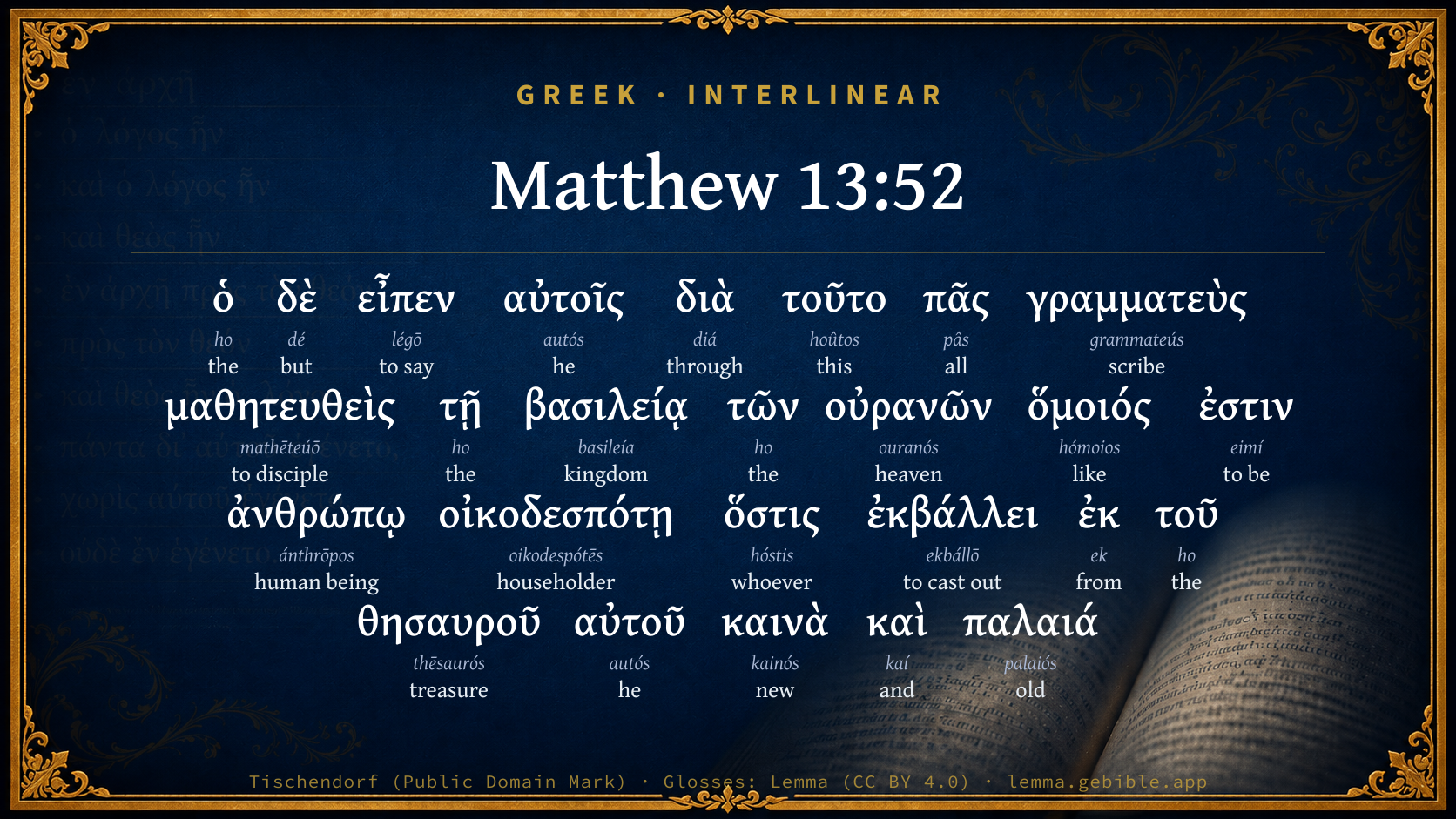
Greek (Tischendorf 8th ed.) Matthew 13:52 appears in the Greek New Testament. The text above is from the Tischendorf 8th edition. Each word links to its Strong’s number and a concise gloss. Click any word for its full Thayer’s Greek Lexicon entry.
Download image
Cite this verse

Matthew 13:52 (World English Bible). Public Domain. Lemma interlinear Bible study tool, https://lemma.gebible.app/v/matthew/13/52.

Show BibTeX & RIS
BibTeX
RIS
English Translation
He said to them, "Therefore, every scribe who has been made a disciple in the Kingdom of Heaven is like a man who is a householder, who brings out of his treasure new and old things."
World English Bible · Public Domain
Highlights
  • 1 first appearance in the Greek New Testament
Full analysis ↓
Download a study sheet

One document with this verse’s original text, its word-by-word gloss line, the meaning frame, cross-references with their text, attributed commentary, and full source and license credits — printable, and it pastes into notes with its structure intact.

This verse Autodidact and up

Study sheet (.html) Plain text (.txt)

A passage Seminary Student

Up to 50 verses in one chapter. A passage sheet keeps up to 6 commentary sources and 12 cross-references per verse, in the order this page ranks them, and says so on the sheet whenever that leaves anything out. Ask for a single verse and you get the Autodidact verse sheet above.

Everything on this page stays free to read, with no account — the sheet is a download of what is already on screen, not access to it.

Want to remove ads? Support Godless Engineer
Compare translations 3

The same verse in 3 English versions, stacked beneath the original-language interlinear above. Click any original word for its lexicon entry.

Each is an independent rendering of the whole verse — the interlinear is not word-aligned to these translations.

Highlighted words mark where these versions differ — a whole-verse word diff, not a word-by-word alignment.

  • World English Bible Public Domain
    He said to them, "Therefore, every scribe who has been made a disciple in the Kingdom of Heaven is like a man who is a householder, who brings out of his treasure new and old things."
  • King James Version Public Domain
    Then said he unto them, Therefore every scribe which is instructed unto the kingdom of heaven is like unto a man that is an householder, which bringeth forth out of his treasure things new and old.
  • unfoldingWord Literal Text CC BY-SA 4.0
    Now he said to them, “For this reason, every scribe having been discipled for the kingdom of the heavens is like a man, the master of the house, who brings forth new and old from his treasure.”

unfoldingWord Literal Text — © unfoldingWord, licensed CC BY-SA 4.0. Word-aligned USFM3 via Door43 (git.door43.org/unfoldingWord/en_ult).

Versions to compare (up to 4)

3 of 4 selected

Show all 19 translations

Every available English version of this verse, each an independent rendering of the whole verse.

  • World English Bible Public Domain
    He said to them, "Therefore, every scribe who has been made a disciple in the Kingdom of Heaven is like a man who is a householder, who brings out of his treasure new and old things."
  • Berean Standard Bible Public Domain
    Then He told them, “For this reason, every scribe who has been discipled in the kingdom of heaven is like a homeowner who brings out of his storeroom new treasures as well as old.”
  • Majority Standard Bible Public Domain
    Then He told them, “For this reason, every scribe who has been discipled in the kingdom of heaven is like a homeowner who brings out of his storeroom new treasures as well as old.”
  • King James Version Public Domain
    Then said he unto them, Therefore every scribe which is instructed unto the kingdom of heaven is like unto a man that is an householder, which bringeth forth out of his treasure things new and old.
  • American Standard Version (1901) Public Domain
    And he said unto them, Therefore every scribe who hath been made a disciple to the kingdom of heaven is like unto a man that is a householder, who bringeth forth out of his treasure things new and old.
  • Revised Version (1885) Public Domain
    And he said unto them, Therefore every scribe who hath been made a disciple to the kingdom of heaven is like unto a man that is a householder, which bringeth forth out of his treasure things new and old.
  • Geneva Bible (1599) Public Domain
    Then sayd hee vnto them, Therefore euery Scribe which is taught vnto the kingdome of heauen, is like vnto an householder, which bringeth foorth out of his treasure things both newe and olde.
  • Douay-Rheims (1899) Public Domain
    He said unto them: Therefore every scribe instructed in the kingdom of heaven, is like to a man that is a householder, who bringeth forth out of his treasure new things and old.
  • Young's Literal Translation Public Domain
    And he said to them, `Because of this every scribe having been discipled in regard to the reign of the heavens, is like to a man, a householder, who doth bring forth out of his treasure things new and old.'
  • Literal Standard Version CC BY-SA 4.0
    And He said to them, “Because of this, every scribe having been discipled in regard to the kingdom of the heavens is like to a man, a householder, who brings forth out of his treasure things new and old.”
  • Unlocked Literal Bible CC BY-SA 4.0
    Then Jesus said to them, “Therefore every scribe who has become a disciple to the kingdom of heaven is like a man who is the owner of a house, who draws out old and new things from his treasure.”
  • unfoldingWord Literal Text CC BY-SA 4.0
    Now he said to them, “For this reason, every scribe having been discipled for the kingdom of the heavens is like a man, the master of the house, who brings forth new and old from his treasure.”
  • Darby Bible Public Domain
    And he said to them, For this reason every scribe discipled to the kingdom of the heavens is like a man [that is] a householder who brings out of his treasure things new and old.
  • World Messianic Bible Public Domain
    He said to them, “Therefore every scribe who has been made a disciple in the Kingdom of Heaven is like a man who is a householder, who brings out of his treasure new and old things.”
  • Webster's Bible Public Domain
    Then said he to them, Therefore every scribe who is instructed to the kingdom of heaven, is like a man that is a householder, who bringeth forth out of his treasure things new and old.
  • Free Bible Version CC BY-SA 4.0
    “This is why every religious teacher who's learned about the kingdom of heaven is like a house-owner who brings out from his storeroom both new and old treasures,” Jesus said.
  • Bible in Basic English Public Domain
    And he said to them, For this reason every scribe who has become a disciple of the kingdom of heaven is like the owner of a house, who gives out from his store things new and old.
  • Text-Critical English NT CC BY 4.0
    Then he said to them, “Every scribe that has been trained as a disciple for the kingdom of heaven is like a master of a house who brings out of his treasure things new and old.”
  • Tyndale New Testament (1534) Public Domain
    Then sayde he vnto them: Therfore every scribe which is taught vnto the kyngdome of heven is lyke an housholder which bryngeth forth out of hys treasure thynges bothe new and olde.

Literal Standard Version (2020), Covenant Press — licensed CC BY-SA 4.0. Text via the HelloAO Bible API (eBible.org). Unlocked Literal Bible (unfoldingWord) — licensed CC BY-SA 4.0. Text via the HelloAO Bible API (eBible.org). unfoldingWord Literal Text — © unfoldingWord, licensed CC BY-SA 4.0. Word-aligned USFM3 via Door43 (git.door43.org/unfoldingWord/en_ult). Free Bible Version, Dr. Jonathan Gallagher — licensed CC BY-SA 4.0. Text via the HelloAO Bible API (eBible.org).

Word by word

More ways to search: Search by grammar → Find every occurrence → Compare this word →

Practice this passage: Drill this verse → Learn its vocabulary →

μαθητευθεὶς
mathēteúō
G3100
“to disciple”
Verb, Aorist, Passive, Participle, Nominative, Singular, Masculine
Part of Speech
Verb
Tense
Aorist
Voice
Passive
Mood
Participle
Case
Nominative
Number
Singular
Gender
Masculine
Full Thayer's Definition

Origin: from G3101

TDNT: 11:41,6

1. to be a disciple of one a. to follow his precepts and instructions 2. to make a disciple a. to teach, instruct
  1. ὁ ho G3588 “the” Article, Nominative, Singular, Masculine
  2. δὲ dé G1161 “but” Conjunction
  3. εἶπεν légō G3004 “to say” Verb, Aorist, Active, Indicative, 3rd person, Singular
  4. αὐτοῖς autós G846 “he” Personal pronoun, Dative, Plural, Masculine
  5. διὰ diá G1223 “through” Preposition
  6. τοῦτο hoûtos G3778 “this” Demonstrative pronoun, Accusative, Singular, Neuter
  7. πᾶς pâs G3956 “all” Adjective, Nominative, Singular, Masculine
  8. γραμματεὺς grammateús G1122 “scribe” Noun, Nominative, Singular, Masculine
  9. τῇ ho G3588 “the” Article, Dative, Singular, Feminine
  10. βασιλείᾳ basileía G932 “kingdom” Noun, Dative, Singular, Feminine
  11. τῶν ho G3588 “the” Article, Genitive, Plural, Masculine
  12. οὐρανῶν ouranós G3772 “heaven” Noun, Genitive, Plural, Masculine
  13. ὅμοιός hómoios G3664 “like” Adjective, Nominative, Singular, Masculine
  14. ἐστιν eimí G1510 “to be” Verb, Present, Active, Indicative, 3rd person, Singular
  15. ἀνθρώπῳ ánthrōpos G444 “human being” Noun, Dative, Singular, Masculine
  16. οἰκοδεσπότῃ oikodespótēs G3617 “householder” Noun, Dative, Singular, Masculine
  17. ὅστις hóstis G3748 “whoever” Relative pronoun, Nominative, Singular, Masculine
  18. ἐκβάλλει ekbállō G1544 “to cast out” Verb, Present, Active, Indicative, 3rd person, Singular
  19. ἐκ ek G1537 “from” Preposition
  20. τοῦ ho G3588 “the” Article, Genitive, Singular, Masculine
  21. θησαυροῦ thēsaurós G2344 “treasure” Noun, Genitive, Singular, Masculine
  22. αὐτοῦ autós G846 “he” Personal pronoun, Genitive, Singular, Masculine
  23. καινὰ kainós G2537 “new” Adjective, Accusative, Plural, Neuter
  24. καὶ kaí G2532 “and” Conjunction
  25. παλαιά palaiós G3820 “old” Adjective, Accusative, Plural, Neuter

About this verse

These counts appear in no published source. They are computed here, from the morphology-tagged text and Lemma’s own curated glosses. What Lemma adds →

26
words
22
distinct lemmas
Gospels
section

Notable vocabulary

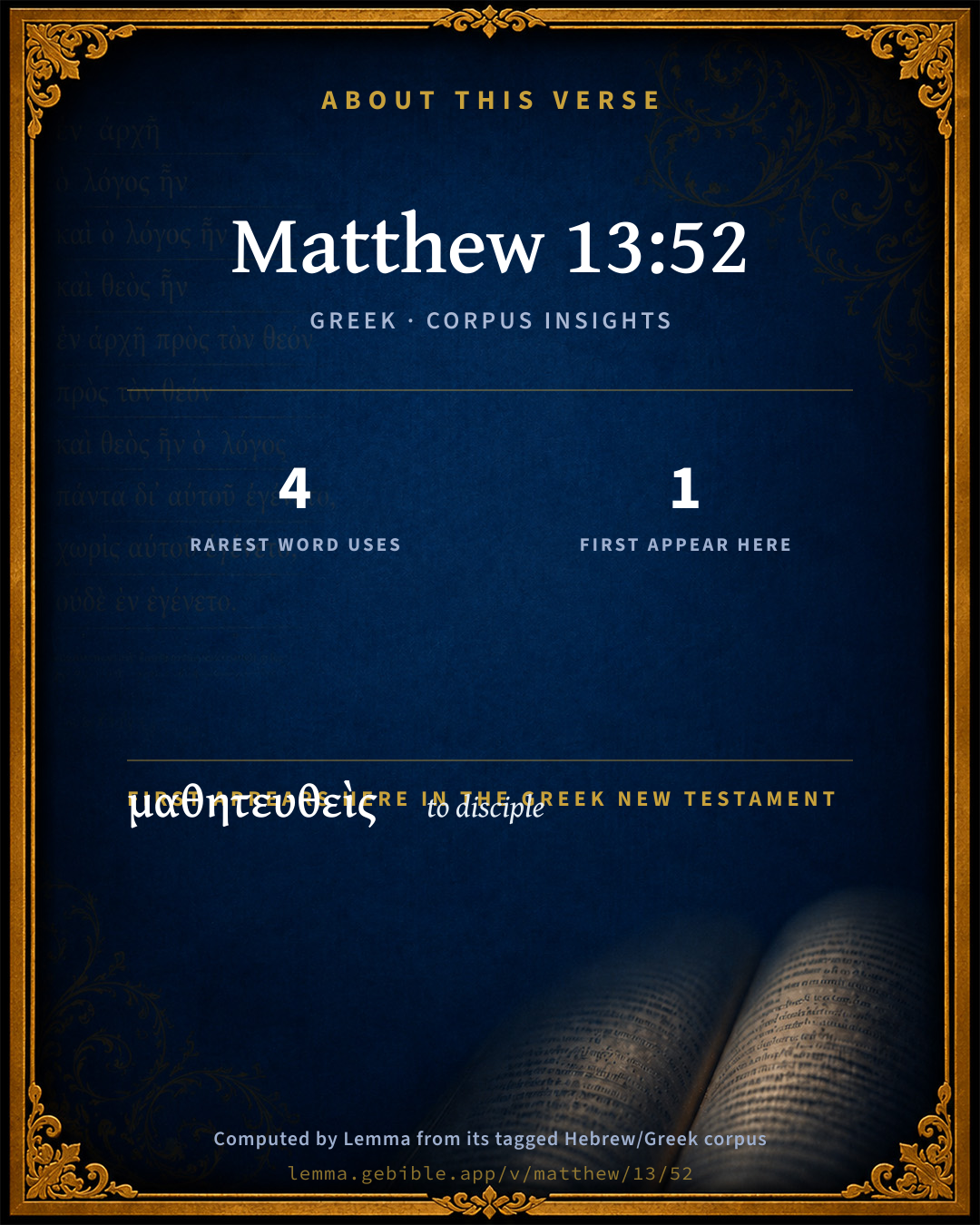
The rarest word here is μαθητευθεὶς to disciple G3100 — appearing just 4 times in the whole Greek New Testament.

First appearance in Scripture

This word makes its first canonical appearance in the Greek New Testament here:

  • μαθητευθεὶς to disciple G3100

Shared distinctive vocabulary

μαθητευθεὶς to disciple G3100 occurs in 4 verses of the Greek New Testament. Also found in:
Repetition

Words recur within this verse:

  • ὁ the G3588 ×4
  • αὐτοῖς he G846 ×2

Cross-references

28

Topical passages linked to Matthew 13:52 in the Treasury of Scripture Knowledge — connected by theme and wording, ordered by reader-vote popularity; previews shown in the World English Bible.

  • 1 John 2:7–8 Brothers, I write no new commandment to you, but an old commandment which you had from the beginning. The old commandment is the word which you heard from the beginning.
  • Titus 1:9 holding to the faithful word which is according to the teaching, that he may be able to exhort in the sound doctrine, and to convict those who contradict him.
  • 2 Timothy 3:16–17 Every writing inspired by God is profitable for teaching, for reproof, for correction, and for instruction which is in righteousness,
  • Matthew 12:35 The good man out of his good treasure brings out good things, and the evil man out of his evil treasure brings out evil things.
  • 2 Corinthians 3:4–6 Such confidence we have through Christ toward God;
  • Titus 2:6–7 Likewise, exhort the younger men to be sober-minded;
  • Ezra 7:10 For Ezra had set his heart to seek the law of Yahweh, and to do it, and to teach in Israel statutes and ordinances.
  • Proverbs 16:20–24 He who heeds the Word finds prosperity. Whoever trusts in Yahweh is blessed.
  • 1 Timothy 3:15–16 but if I wait long, that you may know how men ought to behave themselves in the house of God, which is the assembly of the living God, the pillar and ground of the truth.
  • Ezra 7:21 I, even I Artaxerxes the king, do make a decree to all the treasurers who are beyond the River, that whatever Ezra the priest, the scribe of the law of the God of heaven, shall require of you, it be done with all diligence,
  • Proverbs 15:7 The lips of the wise spread knowledge; Not so with the heart of fools.
  • Proverbs 18:4 The words of a man's mouth are like deep waters. The fountain of wisdom is like a flowing brook.
  • Matthew 23:34 Therefore, behold, I send to you prophets, wise men, and scribes. Some of them you will kill and crucify; and some of them you will scourge in your synagogues, and persecute from city to city;
  • Luke 11:49 Therefore also the wisdom of God said, 'I will send to them prophets and apostles; and some of them they will kill and persecute,
  • Ezra 7:6 this Ezra went up from Babylon: and he was a ready scribe in the law of Moses, which Yahweh, the God of Israel, had given; and the king granted him all his request, according to the hand of Yahweh his God on him.
  • Proverbs 10:20–21 The tongue of the righteous is like choice silver. The heart of the wicked is of little worth.
  • Proverbs 11:30 The fruit of the righteous is a tree of life. He who is wise wins souls.
  • Proverbs 22:17–18 Turn your ear, and listen to the words of the wise. Apply your heart to my teaching.
  • Ecclesiastes 12:9–11 Further, because the Preacher was wise, he still taught the people knowledge. Yes, he pondered, sought out, and set in order many proverbs.
  • Song of Solomon 7:13 The mandrakes give forth fragrance. At our doors are all kinds of precious fruits, new and old, Which I have stored up for you, my beloved.
  • John 13:34 A new commandment I give to you, that you love one another, just like I have loved you; that you also love one another.
  • Ephesians 3:8 To me, the very least of all saints, was this grace given, to preach to the Gentiles the unsearchable riches of Christ,
  • Colossians 1:7 even as you learned of Epaphras our beloved fellow servant, who is a faithful minister of Christ on our behalf,
  • Colossians 3:16 Let the word of Christ dwell in you richly; in all wisdom teaching and admonishing one another with psalms, hymns, and spiritual songs, singing with grace in your heart to the Lord.
  • 2 Corinthians 6:10 as sorrowful, yet always rejoicing; as poor, yet making many rich; as having nothing, and yet possessing all things.
  • Ephesians 3:4 by which, when you read, you can perceive my understanding in the mystery of Christ;
  • 1 Timothy 3:6 not a new convert, lest being puffed up he fall into the same condemnation as the devil.
  • 2 Corinthians 4:5–7 For we don't preach ourselves, but Christ Jesus as Lord, and ourselves as your servants for Jesus' sake;

Cross-references courtesy of OpenBible.info (CC BY 4.0).

Commentary

Notes on Matthew 13:52 from classic Christian and Jewish commentators (each source and its license shown beneath its notes). The classic Christian expositions comment on the surrounding passage and are grouped to its opening verse, so a note may address several verses; the Jewish commentaries on the Tanakh (Rashi and others) are per-verse, so they appear only where the commentator wrote on this verse.

Lemma curates 59 commentaries, every one of them public domain or Creative Commons licensed, each selected and text-cleaned for this edition rather than reprinted as found. About our sources →

The Biblical Illustrator

Joseph S. Exell

Mat_13:52

Out of his treasure things new and old.

Things new and old

I. The preacher should bring forth out of his treasure things new. His teaching should be living, and therefore have the characteristics of life, newness, and freshness.

II. The preacher should not forget to bring forth out of his treasure things old. Many have gone to as great an extreme in the direction of the old, as others in the direction of the new. It is not a trimming between the old and new that is expected. The old facts of the gospel must be brought out. The oldest truths of the gospel; Gods great love. (D. Longwill, M. A.)

Teaching that is new

No tree can long survive the period when it ceases to unfold fresh shoots, and make new growth. And no teaching, with however great ability it be maintained, can long survive the period when it shall cease to give fresh stimulus or furnish information that is new. (D. Longwill, M. A.)

A ready scribe

I. The subject of his study.

II. His proficiency in divine knowledge.

1. Correct.

2. Comprehending.

III. The means of his proficiency.

1. Diligent research.

2. Daily meditation.

3. Devout breathings.

IV. The usefulness of his life.

V. The benefits of remembering the life and labours of one who was a scribe instructed unto the kingdom of heaven.

1. To admire the dealings of God with His servant.

2. To exercise the spirit of patient continuance in well doing. (S. Eldridge.)

The parable of the scribe instructed unto the kingdom of heaven

Ministers are but stewards or deputy-householders.

1. They may be called householders in this sense, because as a deputy-householder chosen by his Lord to that office. So is every true and faithful minister or pastor of a Church chosen and called by the Lord to that holy office.

2. They may be called householders in respect of that great charge and trust which is committed to them.

3. A minister or pastor of a Church of Christ may be compared to a steward or deputyhouseholder, in respect of that faithfulness that he ought to manifest in the discharge of his great trust and office (1Co_4:2).

I showed you why they ought to be well stored.

1. They ought to be well provided, because Jesus Christ hath made plenteous provision for His spiritual family, which blessed food He hath committed to them to distribute.

2. Because their Master is a great King, and all His children are nobly descended.

3. Because the preciousness of the souls which they are to feed. (B. Keach.)

The instructed scribe

We should not account him a good and generous housekeeper who should not have always something of standing provision by him, so as never to be surprised, but that he should still be found able to treat his friend, at least, though perhaps not always presently to feast him. So the scribe here spoken of should have an inward lasting fulness and sufficiency to support and bear him up, especially when present performance urges, and actual preparation can be but short. Thus it is net the oil in the wick, but in the vessel, which must feed the lamp. The former, indeed, may form a present blaze, but it is the latter which must give a lasting blaze. It is not the spending money a man has in his pocket, but his hoards in the chest or in the bank, which must make him rich. A dying man has his breath in his nostrils, but to have it in the lungs is that which must preserve life. Nor will it suffice to have raked up a few notions here and there, or to rally all ones little utmost into one discourse, which can constitute a divine, or give a man stock enough to set up with, any more than a soldier who has filled his knapsack should thereupon set up for keeping house. No, a man would then quickly be drained; his short stock would serve but for one meeting in ordinary converse, and he would be in danger of meeting the same company twice. And therefore there must be a store, plenty, and a treasure, lest he turn broker in divinity, and, having run the round of a beaten, exhausted commonplace, be forced to stand still or go the same round over again, pretending to his auditors that it is profitable for them to hear the same truths often inculcated to them though I humbly conceive that to inculcate the same truths is not of necessity to report the same words. And therefore to avoid such beggarly pretences, there must be habitual preparation to the work we are now speaking of. (R. South, D. D.)

Things new and old

The new life cannot perform its functions without the presence and aid of that which has lived, but is alive no longer. The old furnishes the mould in which the new is fashioned: the support on which the new rests while it is coming into being. Apply this law to the spiritual life.

1. On its intellectual side. A creed that is not growing steadily is a dead creed, and ought to be buried. The old is not to be banished altogether, or all at once; the new must be grafted on to it.

2. On the side of conduct. The great elements of manhood are no novelties. Faith, hope, love, obedience, patience, fidelity, are all old-fashioned virtues; but nothing better has been invented yet. We have got to give new life and meaning to them by bringing them to bear upon our altered conditions. (Washington Gladden.)

Old and new in the formation of character

That which is old in our experience is that part of our life Which has become habitual. That ought to be the largest part of our moral and religious life. The formation of good habits-habits of devotion-such as church-going, Bible study, private meditation, secret prayer; habits of just and considerate and kindly speech; habits of careful and discriminating thought; habits of activity in all good work, and of fidelity in the discharge of every obligation we assume; habits of benevolence in giving and in serving; habits of courtesy and temperance, and manly dignity and womanly grace-this is a most important element in moral and religious culture … Yet the character thus formed needs to be continually reformed. New light, new truths, new relations new powers, call for new adjustments of our thoughts and new departures in our conduct. A religious life that is summed up in its habits; that is wholly formed and never renewed; into which no new motives, no new inspirations, no new endeavours enter, is a poor and barren life … While therefore the Christian character needs those elements of permanence and solidity which are furnished by good habits, it needs also fresh thinking, resolution, and endeavour every day. It thrives only upon the wise combination of things new and old. It joins the stead fastness and strength of new habits with the freshness and joy of daily inspirations. (Washington Gladden.)

The Biblical Illustrator, edited by Joseph S. Exell (c. 1880s–1900s) — public domain. Text from a community e-Sword module.

Tyndale Open Study Notes

Tyndale Open Resources

13:52 A teacher of religious law who becomes a disciple in the Kingdom has had his allegiance radically altered toward Jesus as the way of salvation. • new gems of truth as well as old: The sequence reflects the preeminence of the new covenant inaugurated in Jesus (5:17-20; 19:16-22) over the old covenant administered under Abraham and Moses.

Tyndale Open Study Notes — © Tyndale Open Resources, licensed CC BY-SA 4.0. Text via the HelloAO Bible API.

Bengel's Gnomon

Johann Albrecht Bengel

Mat 13:52. Πᾶς γραμματεὺς, every scribe) Jesus Himself is neither γραμματεὺς, a scribe, nor μαθητευθεὶς, discipled, i.e. instructed as or made a disciple (initiatus). He speaks therefore in the present instance of His disciples; and that which had previously been said to the disciples in plain words (Mat 13:12), is now (that they have made such advance in learning as to be styled even scribes) confirmed to them by a parable. A scribe is a man imbued with the doctrine, or even the letter, of the Old Testament; by παλαιά (old), therefore, are meant things known from Moses and the prophets. This is the genus: the species[645] is supplied by the clause μαθητευθείς, κ.τ.λ. i.e. a man instructed also in the doctrine of the New Testament: such is the force of καινὰ, new—things then first revealed; see Mat 13:35. New things are here mentioned before old, as the latter receive light and savour from the former, and are at length tempered together most harmoniously. See 1Jn 2:7-8.—μαθητευθεὶς, instructed) as βασιλεύω signifies both to make a king, and to act the king, so also μαθητεύω, to make disciples (expressed in Joh 4:1 by μαθητὰς ποιεῖν), and act or be a disciple; see ch. Mat 27:57. The former meaning obtains in this passage.—τῂ βασιλείᾳ, in the kingdom) Others[646] read εἰς τὴν βασιλείαν, unto the kingdom. In either reading, by metonymy or prosopopœia, Christ Himself is intimated, as in ch. Mat 11:12. If you accept the latter reading, cf. 2Co 11:3; if the former,[647] ch. Mat 27:57.—ἀνθρώπῳ, unto a man) Almost all the parables are taken from human affairs, for the sake of perspicuity.—ἐκβάλλει, bringeth forth) plentifully.—θησαυροῦ, treasure) store, sc. of corn.—καινὰ καὶ παλαιά, new and old) a proverbial mode of speaking of a great plenty from the last and the present year; see Son 7:13.—The new things, as from the treasures of the kingdom of heaven; the old things, as a scribe from the scriptures of the Old Testament; cf. Mat 13:35.[648]

[645] The words genus and species are here used in their logical sense. Bengel means to say that the character indicated is not only that of a “scribe,” generically (or universally), but of one who is “instructed to the kingdom of heaven.”—(I. B.)

[646] Such is the reading of E. M. In his App. Crit. Bengel writes: “εἰς τὴν βασιλείαν) edd. Bas. α. β. Stap. etc. Ex μαθητευθεὶς, εἰς facile iteratum. (τῆ βασιλεία) Bas. γ. Cypr. Par. 6, 8; Vsser, 2; Origenes constanter, sæpe; Cyrillus, Procopius. Placet Heinsio. Lectio media, unde ἐν τῆ βασιλεία, Med. Chrysost. Cyrillus alibi, Lat. Irenaeus, latine certe, Cant.—(I. B.)

[647] The margin of both Editions, as well as the Germ. Vers., prefer the Dative.—E. B.

[648] The new things already have the palm of superiority.—V. g.

Tischend. with BC Syr. Orig. 3, 459 f, reads τῇ βασιλείᾳ. Lachm. with Dbc Vulg. Iren. 237, Hil., reads ἐν τῂ βασιλείᾳ. Lachm. claims C for ἐν τῆ βας. in opposition to Tischend. Rec. Text, εἰς τ. βασιλείαν, is not supported by primary authorities. The shorter reading, τῇ βασιλείᾳ, is cœteris paribus preferable to the longer, as the shorter would be more likely to originate the other two, the longer ones, εἰς τ. βας. and ἐν τ. βας. (which look like glosses of the shorter), than either of them to originate it; ch. Mat 27:57 supports it. Besides, it is not simply members of the kingdom who are here spoken of, but those who, being already in it themselves, are qualified henceforth to be teachers for it. I prefer, with Olshausen and Storr, explaining it, “made a disciple for the kingdom,” i.e., for its benefit; one who, being instructed himself, is capable of labouring for the kingdom. But Beng. takes τῇ βασιλείᾳ as a Prosopopœia—the Kingdom meaning Jesus Christ, who is the embodiment of the Kingdom—“made a disciple to the Kingdom,” i.e. to Jesus Christ.—ED.

Bengel's Gnomon of the New Testament — English translation (T&T Clark, Edinburgh, 1860) — public domain. Text from a community e-Sword module.

Meyer's Critical & Exegetical Commentary

Heinrich August Wilhelm Meyer

Mat_13:52. Ταῦτα πάντα] that which has been addressed to the disciples since Mat_13:36. This ναὶ κύριε, this frank acknowledgment, calls forth from Jesus a gladsome διὰ τοῦτο, as much as to say, it is because of such understanding that every one, and so on (such as you are), resembles a householder, and so on. But for the understanding in question, this similitude would not have been made use of.

γραμματεύς] The ordinary conception of a Jewish scribe is here idealised and applied to the Christian teacher, comp. Mat_23:34. But in order specifically to distinguish the Christian γραμματεύς from the Jewish scribes, who were Moses disciples (Mat_23:2; Joh_9:28), he is significantly described as μαθητευθεὶς τῇ βασιλ. τ. οὑρ., i.e. made a disciple of the kingdom of heaven. μαθητεύειν τινι, to be a disciple of any one (Mat_27:57; Plut. Mor. p. 837 D), is here used transitively (discipulum, facere alicui), comp. Mat_28:19; Act_14:21. The kingdom of heaven is personified; the disciples of Christ are disciples of the kingdom of heaven, of which Christ is the representative (comp. Mat_12:28).

καινὰ καὶ παλαιά] is on no account to be restricted to any one thing in particular, but to be rendered: new and old, i.e. things hitherto unknown, and things already known, already taught in former ages, and that in regard both to the matter and the manner. Thus the predictions of the prophets, for example, belong to the things that are old, the evidences of their fulfilment to those that are new; the precepts of the law are to be ranked among the old, the developing and perfecting of them, in the way exemplified by Christ in Matthew 5, among the new; the form of parables and similitudes, already in use, is to be referred to the old, the Messianic teaching embodied in them is to be included under the new. The view that has been much in vogue since Irenaeus, Origen, Chrysostom, and Jerome, and which represents the words as referring to the Old and New Testament, or to the law and the gospel (Olshausen), is a dogmatic limitation. In the illustration the θησαυρός means the chest (Mat_2:11, Mat_12:35) in which the householder keeps his money and jewels (not the same thing as ἀποθήκη); in the interpretation it means the stores of knowledge which the teacher has at his disposal for the purposes of instruction.

ἐκβάλλει] throws out, thus describing the zeal with which he seeks to communicate instruction. Comp. Luk_10:35.

Meyer — Critical and Exegetical Commentary on the New Testament — English translation by Peter Christie, edited by Frederick Crombie (T&T Clark, 1880) — public domain. Text from a community e-Sword module.

Expositor's Greek Testament

ed. W. Robertson Nicoll

Mat 13:52 contains an important logion of Jesus preserved by Matthew only, nd connected by him with the parabolic teaching of Jesus. In this connection καινὰ καὶ παλαιά of course points to the use of the old familiar facts of nature to illustrate newly revealed truths of the kingdom. But we should not bind ourselves too strictly to this connection, keeping in mind Matthew’s habit of grouping; all the more that, as Wendt has pointed out ( Die Lehre Jesu , ii. 349), the idea expressed by γραμματεὺς does not get justice. It naturally points to acquaintance with the O. T., and combined with μαθητευθεὶς ε . τ . β . teaches that that knowledge may be usefully united with discipleship in the lore of the kingdom. In Wendt’s words: “One remains in possession of the old, recognised as of permanent value, yet is not restricted to it, but along with it possesses a precious new element”. μαθητεύειν is here used transitively as in Mat 28:19 , Act 14:21 . ἐκβάλλει points to free distribution of treasures by the householder. He gives out new or old according to the nature of the article. The mere scribe, Rabbinical in spirit, produces only the old and stale. The disciple of the kingdom, like the Master, is always fresh-minded, yet knows how to value all old spiritual treasures of Holy Writ or Christian tradition.

The Expositor's Greek Testament, edited by W. Robertson Nicoll (1897–1910) — public domain. Text from a community e-Sword module.

Jamieson, Fausset & Brown

Robert Jamieson, A. R. Fausset & David Brown

Then said he unto them, Therefore--or as we should say, "Well, then."

every scribe--or Christian teacher: here so called from that well-known class among the Jews. (See Mat 23:34).

which is instructed unto the kingdom of heaven--himself taught in the mysteries of the Gospel which he has to teach to others.

is like unto a man that is an householder which bringeth forth--"turneth" or "dealeth out."

out of his treasure--his store of divine truth.

things new and old--old truths in ever new forms, aspects, applications, and with ever new illustrations.

Jamieson, Fausset & Brown — Commentary Critical and Explanatory on the Whole Bible (1871) — public domain (CC PDM 1.0). Text via the HelloAO Bible API.

Adam Clarke's Commentary

Verse 52. Every scribe] Minister of Christ: who is instructed - taught of God; in the kingdom of heaven - in the mysteries of the Gospel of Christ: out of his treasury - his granary or store-house; things new and old - a Jewish phrase for great plenty. A small degree of knowledge is not sufficient for a preacher of the Gospel. The sacred writings should be his treasure, and he should properly understand them. His knowledge does not consist in being furnished with a great variety of human learning, (though of this he should acquire as much as he can;) but his knowledge consists in being well instructed in the things concerning the kingdom of heaven, and the art of conducting men thither. Again, it is not enough for a man to have these advantages in possession: he must bring them forth, and distribute them abroad. A good pastor will not, like a miser, keep these things to himself to please his fancy; nor, like a merchant, traffic with them, to enrich himself; but, like a bountiful father or householder, distribute them with a liberal through judicious hand, for the comfort and support of the whole heavenly family.

A preacher whose mind is well stored with Divine truths, and who has a sound judgment, will suit his discourses to the circumstances and states of his hearers. He who preaches the same sermon to every congregation, gives the fullest proof that, however well he may speak, he is not a scribe who is instructed in the kingdom of heaven. Some have thought that old and new things here, which imply the produce of the past and the produce of the present year, may also refer to the old and new covenants-a proper knowledge of the Old Testament Scriptures, and of the doctrines of Christ as contained in the New. No man can properly understand the Old Testament but through the medium of the New, nor can the New be so forcibly or successfully applied to the conscience of a sinner as through the medium of the Old. The law is still a schoolmaster to lead men to Christ-by it is the knowledge of sin, and, without it, there can be no conviction- where it ends, the Gospel begins, as by the Gospel alone is salvation from sin. See the whole of the comment on the Pentateuch.

Adam Clarke's Commentary on the Bible (1810–1826) — public domain. Text from a community e-Sword/MySword module.

Ellicott's Commentary for English Readers

(52) Therefore every scribe which is instructed unto the kingdom of heaven.—The verse is interesting as one of the very few passages in which our Lord compares His own work and that of the Apostles after Him to that of the scribes of the Jewish schools. That He was so regarded during His ministry—that men thought of Him as a Rabbi, no less than as a Prophet, or as the Christ—is clear from the facts that He was called by that name (or its equivalent, Master, or Teacher) both by His disciples and by others; that He assumed the office of a scribe, as interpreting the scriptures in the Sabbath services (Luk_4:16); that He questioned with the scribes after their own manner (“Have ye never read?” Mat_12:3; Mat_19:4; Mat_21:16, et al.) and as one of their order. And now He was training the disciples, “unlearned” as they were, to be His successors in that office. They too were sitting at the feet of a Gamaliel—of One greater than Gamaliel. But His method of training was altogether of another kind than that of the Masters of the Schools. It consisted, not in minute comments on the words of the Law, not in the subtleties of an intricate and often revolting casuistry, not in puerile and fantastic legends, but rather in the eternal laws of His Father’s kingdom, and the manifold parables of those laws in the visible universe; in this way it was that He was educating them to be scribes of the kingdom of heaven.

Things new and old.—Our Lord’s own teaching was, of course, the highest example of this union. There were the old eternal laws of righteousness, the proclamation of the true meaning of all that every true teacher had included in the idea of duty and religion, but there were also new truths, such as His own mission as the Head of the divine kingdom and the future Judge of all men, and the work of the Spirit as regenerating and sanctifying. As the years passed, and new facts, such as the Crucifixion, Resurrection, and Ascension, supplied the ground-work for new doctrines, these also took their place in the store-house of the well-instructed scribe. But the words applied also to the manner no less than to the substance of the teaching. Now the old familiar words of Lawgiver and Psalmist, now the gracious words such as man had never heard till then, now illustrations freely drawn, in proverbs or parable, from the world of nature or of men—these too were part of the treasure of the scribe. In that union the scribe of later times, every true teacher of the minds and hearts of men, may find the secret at once of reverence for the past and of courage for the future. So long as they bring forth out of their treasures “things new and old,” we may hope that religious conservatism will be more than the “froward retention” of a custom or a formula, and religious progress more than a reckless love of novelty for the sake of its newness.

A Bible Commentary for English Readers, edited by Charles John Ellicott (1878–1897) — public domain. Text from a community e-Sword module.

John Gill's Exposition

Is not this the carpenter's son?.... Meaning Joseph, who was by trade a carpenter, and whose son Jesus was supposed to be; and who very probably was now dead, which may be the reason he is not mentioned by name. The Greek word here used, signifies any mechanic, or artificer. The Syriac expresses it by a word, which signifies both a carpenter and a blacksmith; and Munster's Hebrew Gospel renders it, , "the blacksmith's son". But the generally received notion of the ancient Christians is, that he was a carpenter, and that Jesus was brought up to the same business, which lay in making ploughs and yokes (q). This also appears, from the answer the Christian schoolmaster at Antioch gave to Libanius the sophister; who being big with expectation of Julian the apostate's getting the victory, asked the schoolmaster, what he thought the carpenter's son was doing? To which, after a short pause, he replied; O sophister! the Creator of all things, whom thou callest the carpenter's son, is making a coffin for Julian; who accordingly died in a few days after (r). The Jews make mention of one Abba Joseph, "the builder", or carpenter (s); but whether the same, is not certain. What they here say, was no doubt by way of derision and contempt; and yet the same phrase is used by them of a person of great note and fame, for his wisdom and knowledge: thus speaking of a difficult point, they (t) say,

" .

"no carpenter", or smith, or a carpenter's son, can solve this: says R. Shesheth, I am neither a carpenter, nor a carpenter's son, and I can solve it.

The gloss upon it is,

"a wise man, the son of a wise man.

Is not his mother called Mary? Plain Mary, without any other title, or civil respect; a poor spinstress, that got her bread by her hand labour: the Jews say (u), she was a plaiter of women's hair, and treat her with the utmost scorn,

And his brethren; not strictly so, but either the sons of Joseph by a former wife; or Mary's, or Joseph's brothers or sisters sons, and so cousins to Christ; it being usual with the Jews to call such, and even more distant relations, brethren:

James; the son of Alphaeus, or Cleophas, one of Christ's disciples,

Mat 10:3 called the Lord's brother, Gal 1:19 and the same that wrote the epistle that bears his name:

and Joses; or Joseph, as the Vulgate Latin, and Munster's Hebrew Gospel read; and which two names are one and the same: hence, in Talmudic writings, we often read of R. Jose, who is the same with R. Joseph (w): this Joses is, by Dr. Lightfoot, conjectured to be the same with Joseph, called Barsabas, who was put in nomination for apostleship, after the death of Judas, Act 1:23.

And Simon; or Symeon, the son of Cleophas, who is said (x) to succeed James, as bishop of Jerusalem, and to be Christ's cousin, being son of Cleophas, the brother of Joseph, the supposed father of Christ:

and Judas; the same that is called Lebbaeus, and Thaddaeus,

Mat 10:3 and the brother of James, Luk 6:16 and the same that wrote the epistle that goes by his name. The Jews ought not to have made these remarks, since many of their great doctors were of mean parentage; as R. Zachariah was a butcher's son (y), and R. Jochanan a blacksmith's son (z); hence that advice of R. Juda ben Bethira (a),

"take heed that ye do not reproach the sons of the common people, for from them comes forth the law.

(q) Justin Martyr. Dialog. cum Tryph. p. 316. (r) Tripartit. Hist. 1. 6. c. 44. (s) Shemoth Rabba, sect. 13. fol. 99. 2. (t) T. Bab. Avoda Zara, fol. 50. 2. (u) T. Bab. Sabbat. fol. 104. 2. Chagiga, fol. 4. 2. Sanhedrim, fol. 67. 1. (w) Vid. Juchasin, fol. 61. & 62. (x) Euseb. Eccl. Hist. 1. 3. c. 11. (y) Misn. Sota, c. 5. sect. 1. (z) T. Bab. Sanhedrim, fol. 96. 1. (a) Ib.

John Gill's Exposition of the Whole Bible (1746–1763) — public domain (CC PDM 1.0). Text via the HelloAO Bible API.

Trapp's Complete Commentary

John Trapp

52 Then said he unto them, Therefore every scribe which is instructed unto the kingdom of heaven is like unto a man that is an householder, which bringeth forth out of his treasure things new and old.

Ver. 52. Therefore every scribe] i.e. Every teacher of the Church must be both learned and apt to teach. He must give attendance to reading first, and then to exhortation and doctrine, 1Ti 4:13. Bishop Latimer, notwithstanding both his years and other pains in preaching, was every morning ordinarily both winter and summer about two o’clock at his book most diligently. And as the Rabbis have a proverb, Lilmod lelaramed, men must therefore learn that they may teach, so did he. The Hebrew word Shachal signifieth, 1. To understand; 2. To teach; 3. To prosper. They that therefore learn that they may teach others, shall find that the pleasure of the Lord shall prosper in their hands, Isa 53:10.

That bringeth forth out of his treasury] Extrudit copiose et alacriter (εκβαλλει). That throweth out his store without spare, and dealeth forth his soul to the hungry hearer, desirous to spend and be spent for him. That hath a treasury of his own, and steals not all out of others. Non libro sacerdotis, sed labro conservatur scientia. He lays up good things into his heart, that therewith after they have been well fried for a while, he may feed many; according to that, Psa 45:1; "My heart is inditing (or frying) a good matter, my tongue shall be the pen of a ready writer." They are empty vines that bear fruit to themselves, Hos 10:1. A wholesome tongue is a tree of life, Pro 15:4. God hath purposely put honey and milk under their tongues, Son 4:11; Pro 24:13, that they may bring forth, as occasion requires, their new and old, that they may look to lip feeding, that they may be in company like full clouds or paps, that pain themselves with fulness till eased of their milk, or like aromatic trees that sweat out their sovereign oils.

John Trapp, A Commentary or Exposition upon All the Books of the Old and New Testament (1647–1656) — public domain. Text from a community e-Sword module.

Haydock's Catholic Bible Commentary

Every scribe; i.e. master or teacher. (Witham) --- Because you know how invaluable is the treasure, the pearl, the kingdom, here mentioned; you, who are scribes and teachers, should cultivate it yourselves, and communicate the same blessing to others. Thus imitating a father of a family, who draws from his treasure both new and old things, and distributes them to his children, according to their several wants and necessities. This was a proverbial expression with the Jews, to signify every thing useful or necessary for the provision of a family. (St. Jerome, St. Augustine, St. John Chrysostom, Ven. Bede, and Tirinus.) --- Thus also a pastor of souls throws light upon the mysteries of the New Testament, by the figures of the Old, and explains the workings of grace, by the operations of nature.

George Leo Haydock (1774–1849), Haydock's Catholic Family Bible and Commentary, 1859 edition — public domain. Excludes Psalms (Douay-Rheims chapter numbering differs from Protestant) and Deuterocanonical books (Catholic canon only).

Matthew Poole's English Annotations

Seeing you understand these things, communicate your knowledge of them unto others, do not know for yourselves alone.

Every scribe which is instructed unto the kingdom of heaven. The scribes amongst Jews were not only clerks, that were employed in writing, but teachers of the law; such a one was Ezra, Ezr 7:6. Our Saviour here by every scribe instructed unto the kingdom of God, understandeth every good minister of the gospel, fitted to promote the kingdom of God, to be employed in the church of God: should be like a good householder, that hath not his provision to seek when his guests come; but hath a full fraught storehouse, and hath nothing to do but out of his stock and storehouse to bring out all sort of provision, according to the various palates of his guests. Ministers of the gospel should not be novices, 1Ti 3:6, raw and ignorant men; but men mighty in the Scriptures, well acquainted with the writings of the Old and New Testament, and the sense of them; men that have a stock of spiritual knowledge, able readily to speak a word to the weary, and to speak to men and women’s particular cases and questions.

Matthew Poole's English Annotations on the Holy Bible (1683–1685) — public domain. Text from a community e-Sword/MySword module.

Whedon's Commentary on the Bible

Daniel D. Whedon

52. A householder — A master of a family. Bringeth forth — As a provider for the family. The most suitable emblem of the Christian scribe or minister, who provides food for his spiritual family, the Church. Treasure — His store, cellar, or granary. Things — Provisions. New and old — The products of both the old year and the new. So the minister should be able to repeat and reimpress the good old truths, which the people have heard a thousand times, varied with truths they never heard before. And the same truth may be both old and new; old, because often heard; but new, from the fresh form or colouring with which it is invested, or the new evidence or impressiveness with which it is received by the mind.

There is a natural and sort of historical advancement in the seven parables. First. The sower commences, as it were, the Church, by sowing his seed among the various moral classes of our race. Second. The struggle between good and evil, to be permanent to the final separation. Third. The moral triumph of the good, even in this state of mixture and struggle. Fourth. The parallel progress and triumph of good in the individual heart. Fifth. The value of the Gospel treasure, even in its obscured and hidden state. Sixth. The worthiness of the Gospel pearl above all price. Seventh. The final deliverance of the true Church from impure membership.

Daniel D. Whedon (gen. ed.), Commentary on the Old and New Testaments (1874–1909) — public domain. Text from a community e-Sword module.

The Pulpit Commentary

Then said he unto them, Therefore (dia touto); i.e. because you understand, I add this. Every scribe (pav grammateuv). The interpretation of the following clause, naturally suggested by this word in itself is that our Lord meant to indicate the possibilities that lay before a Jewish scribe if he were only converted; but for such a reference by our Lord to Jewish scribes there appears no reason in the context. The word must therefore be understood of Christian teachers, who by their study of the Gospel should hold a position in the Christian Church parallel to that of scribes among the Jews. It is possible that our Lord chose the term in order to accustom his disciples to the idea of carrying on the study of Divine things which the scribes were accustomed to make. Even if the disciples were not to follow their methods they might well imitate their devotion Dean Plumptre has an interesting note on our Lord"s comparison of his own work and that of the apostles after him, to the work of the scribes of the Jewish schools. In Mat_23:34 is found a wider application of the term than usual, hardly referring, however, to Christians, but rather to the Jewish scribes in their ideal character. Which is instructed; who hath been made a disciple (Revised Version, mayhteuyeiv). Though the correction is right, (cf. Mat_28:19) the word, nevertheless, implies much more than mere admission to the circle of disciples it includes also the thought of instruction having been really received. Unto (to, Revised Version) the kingdom of heaven (th basileia twn ouranwn , dative of reference; cf. Winer, The kingdom is not regarded as the teacher, but as the school, with reference to which discipleship is entered upon. Is like. In the preceding parables the general principles, etc., of the kingdom of heaven have been compared; here, only certain individuals belonging to it. Unto a man that is a householder, which bringeth forth out of his treasure. (cf. Mat_2:11, note) The thing signified is his experience and spiritual understanding. Mat_12:35 has a similar thought, but the treasure there is rather his personality as affecting his life; here, as affecting his intellect. It is curious that the thought of Mat_12:33, 34 should also resemble our vers. 47-50. Things new and old. The thought of the saying is that as a householder brings out from his stores food recently and long ago acquired, (cf. Son_7:13) so a Christian "scribe" brings out (primarily, if not solely, for the use of others) the new truths that he learns, and also old ones that he has long since known. It is thus a promise that the disciples shall (if they use their opportunities rightly) be able to do more than understand Christ"s teaching (as they have just claimed to have done); for they shall be able to teach (not merely to learn), and that not only new truths, but also old ones; they shall be able, that is to say, to understand the relation of the old to the new, and to bring out even the old in its true meaning, Hence old is mentioned after new, for it implies greater knowledge and skill. It will be observed that Irenaeus" interpretation (IV 9:1) of new and old as the New and Old Testaments is only partially right. With the disciples, it is true, the old would naturally be, in the first place, Old Testament truths, and the new, such truths as they learned from Christ; but these also would, after a few weeks or months, in their turn become old to them, and the fresh truths taught them as their life went on would be ever the new ones. The thought of 1Jn_2:7, 8 is very similar. Weiss" interpretation is different and even less right. According to him, new represents the truths about the kingdom of God, and old the long known arrangements of nature and human life, which, as the parables show, are drawn up on the same hues. Origen gives a beautiful application of Lev_26:10, Lev_26:11.

The Christian teacher.

Christ has a word for the scribe. It is not to be supposed that all the official teachers of Israel were unworthy men and unprofitable in their work. Some, doubtless, merited the description here set before us. But this description is also meant as the guide for the Christian teacher.

I THE TEACHER MUST BE TRAINED. He must be "a disciple to the kingdom of heaven." Secular training is valuable. As the Magi brought their wealth and poured it out before the infant Jesus, so the learned and the intellectual may well bring all their mental acquisitions to be used in the service of Christ. There is no merit in ignorance. Dulness is not devotion; stupidity is not sanctity. Nevertheless, it is not of the very valuable general training of which our Lord here speaks. It is possible to be highly cultivated in the schools and yet quite a tyro in the kingdom. The essential training of the Christian teacher must be a Christian training. As the lawyer must study law and the doctor medicine, so the Christian scribe must study Christianity. It is strange that any should think themselves fit to teach others the greatest of truths without first devoting especial attention to learning them. It is well that the Christian minister should know his Homer and his Cicero; but it is monstrous that he should be satisfied with an acquaintance with the pagan classics, without acquiring at least an equally familiar knowledge of the New Testament, which it is his life work to teach. Now, the discipleship of the kingdom is not a merely intellectual schooling. It is more than learning the letter of Scripture. Only that living grasp of spiritual truth which comes from a sympathetic study of it, interpreted by experience, can fit one to teach it to others.

II THE TEACHER MUST BRING FORTH NEW TREASURES. He must not be a mere machine grinding out exactly the same ideas year after year. Yet he is not to invent notions of his own and give them forth as Divine revelations. The treasury to which he is to go for his materials is the sacred Scriptures. How, then, can he find anything new?

1. By new insight. Each is to read for himself. There is always a freshness in what we perceive ourselves, even if others have perceived it before. To us, at least, it is new; and our own living apprehension of it gives it a new vitality for others.

2. With fresh applications. Truth is ever assuming new colours as it is reflected on fresh objects. The Christian teacher has to apply truths of the Bible to present circumstances. It is not his business to linger among the archaeological conditions of ancient Israel, but to show how the revelation of God concerns the England of today.

3. Because of the inexhaustible fulness of the Bible. There is always fresh light for earnest eyes.

III THE TEACHER MUST NOT NEGLECT OLD TREASURES. An idea does not cease to be valuable because it is old. Truth is eternal Facts remain. The great events of Bible history are always speaking to us; they have living lessons for our own day. The experiences of psalmist and apostle are true to the heart of man, and types of devotion for all time; we cannot afford to forget them. Above all, the revelation of Christ, though now old in centuries, is still fresh and living. We can never outgrow the gospel. Bethlehem and Calvary will always be the centres of our most helpful meditations. The new truth is only inspiring when it springs out of the old, which it does not obscure, which rather it explains and exalts. W.F.A.

The Pulpit Commentary (1880–1919), ed. H.D.M. Spence-Jones & Joseph S. Exell — public domain. Text from a community e-Sword module.

John Wesley's Explanatory Notes

Every scribe instructed unto the kingdom of heaven - That is, every duly prepared preacher of the Gospel has a treasure of Divine knowledge, out of which he is able to bring forth all sorts of instructions. The word treasure signifies any collection of things whatsoever, and the places where such collections are kept.

John Wesley, Explanatory Notes Upon the Whole Bible (1754–1765) — public domain. Text via the GEBible commentary corpus.

Cambridge Greek Testament for Schools and Colleges

52. τῇ βασιλείᾳ has the best authority and is the more difficult reading. εἰς τὴν βασιλείαν was probably a marginal note.

52. μαθητευθεὶς τῇ βασιλείᾳ. The new law requires a new order of Scribes who shall be instructed in the kingdom of heaven—instructed in its mysteries, its laws, its future—as the Jewish Scribes are instructed in the observances of the Mosaic law.

καινὰ καὶ παλαιά. (1) Just as the householder brings from his stores or treasury precious things which have been heir-looms for generations, as well as newly acquired treasures; the disciples following their master’s example will exhibit the true teaching of the old law, and add thereto the new lessons of Christianity. (2) Another interpretation finds a reference to Jewish sacrificial usage by which sometimes the newly-gathered fruit or corn, sometimes the produce of a former year furnished the offering. The wise householder was ready for all emergencies. So the Christian teacher will have an apt lesson on each occasion.

As applied to the teaching of Christ Himself καινὰ points to the fresh revelation, παλαιὰ to the Law and the Prophets on which the new truths rested and from which they were evolved. Instances are, the extended and deeper meaning given to the decalogue, and to the law of forgiveness, &c., the fresh light thrown on prophecy and on Rabbinical sayings, the confirmation of the ancient dealings of God combined with the revelation of entirely new truths, as that of the resurrection,—of the Christian Church,—of the Sacraments,—of the extension of the Gospel to the Gentiles.

Cambridge Greek Testament for Schools and Colleges (Cambridge University Press, 1896; 21 vols, various authors incl. Carr, Maclear, Plummer, Farrar, Lumby, Moule, M. R. James, Simcox) — public domain. Text from a community e-Sword module.

Alford’s Greek Testament

Henry Alford

52.] Solemn conclusion of the parables. When our Lord asks, ‘Have ye understood all these things?’ and they answer, ‘Yea, Lord,’ the reply must be taken as spoken from their then standing-point, from which but little could be seen of that inner and deeper meaning which the Holy Spirit has since unfolded. And this circumstance explains the following parabolic remark of our Lord: that every γραμματεύς (they, in their study of the Lord’s sayings, answering to the then γραμματεῖς in their study of the Law) who is μαθητευθείς, enrolled as a disciple and taught as such, is like an householder (the Great Householder being the Lord Himself, compare ch. 24:45), who puts forth from his store new things and old; i.e. ‘ye yourselves, scribes of the Kingdom of Heaven, instructed as ye shall fully be in the meaning of these sayings, are (shall be) like householders, from your own stores of knowledge respecting them hereafter bringing out, not only your present understanding of them, but ever new and deeper meanings.’

And this is true of πᾶς γρ. κ.τ.λ. Every real spiritually-learned scribe of the Kingdom of Heaven is able, from the increasing stores of his genuine experimental knowledge of the word (not merely from books or learning, or the Bible itself, but ἐκ τοῦ θησ. αὐτοῦ), to bring forth things new and old.

The διὰ τοῦτο is an expression of consequence, but not a strong one: answering nearly to our Well, then.

This is perhaps the fittest place to make a few general remarks on this wonderful cycle of Parables. We observe, (1) How naturally they are evolved from the objects and associations surrounding our Lord at the time (see on this the very interesting section of Stanley, Sinai and Palestine, ch. xiii. § 2, p. 420 ff., “On the Parables”). He sat in a boat in the sea, teaching the people who were on the land. His eye wandered over the rich plain of Gennesareth (where πᾶν πεφυτεύκασιν οἱ νεμόμενοι, Jos. B. J. iii. 10. 8, and Robinson, iii. 290):—the field-paths, the stony places, the neglected spots choked with wild vegetation (οὔτε γὰρ αὐτή τι φυτὸν ἀρνεῖται διὰ τὴν πιότητα, ib.), the plots of rich and deep soil, were all before him. The same imagery prevails in the parable of the tares of the field, and in that of the mustard seed; and the result of the tilling of the land is associated with the leaven in the lump. Then He quits the sea-shore and enters the house with the disciples. There the link to the former parable is the exposition of the tares of the field. From the working of the land for seed to finding a treasure in a field the transition is easy—from the finding without seeking to seeking earnestly and finding, easy again: from the seed to the buried treasure, from the treasure to the pearl,—the treasure of the deep,—again simple and natural. The pearl recalls the sea; the sea the fishermen with their net; the mixed throng lining the beach, the great day of separation on the further bank of Time. (2) The seven Parables compose in their inner depth of connexion, a great united whole, beginning with the first sowing of the Church, and ending with the consummation. We must not, as Stier well remarks, seek with Bengel, ., minutely to apportion the series prophetically, to various historical periods: those who have done so (see Trench, p. 142, edn. 4) have shewn caprice and inconsistency; and the parable, though in its manifold depths the light of prophecy sometimes glimmers, has for its main object to teach, not to foretell. More than a general outline, shewn by the prominence of those points to which the respective parables refer, in the successive periods of the Church, we can hardly expect to find. But as much we unquestionably do find. The apostolic age was (1) the greatest of all the seed times of the Church: then (2) sprang up the tares, heresies manifold, and the attempts to root them out, almost as pernicious as the heresies themselves: nay the so-called Church Catholic was for ages employed in rooting up the wheat also. Notwithstanding this (3) the little seed waxed onward—the kingdoms of the earth came gradually in—(4) the leaven was secretly penetrating and assimilating. Then is it, (5) during the period of dissensions, and sects, and denominations, that here and there by this man and that man the treasure shall be found: then is it, (6) during the increase of secular knowledge, and cultivation of the powers of the intellect, that merchantmen shall seek goodly pearls up and down the world, and many shall find, each for himself, the Pearl of Price. And thus we are carried on (7) through all the ages during which the great net has been gathering of every kind, to the solemn day of inspection and separation, which will conclude the present state.

Henry Alford, The Greek Testament (1849–1861) — public domain. Text from a community e-Sword module.

Vincent's Word Studies in the New Testament

Marvin R. Vincent

Which is instructed unto the kingdom of heaven. Instructed maqhteuqeiv. Rev., who hath been made a disciple to the kingdom, etc. The kingdom of heaven is personified. The disciples of Christ are disciples of that kingdom of which he is the representative.

Which [οστις] . The pronoun marks the householder as belonging to a class and exhibiting the characteristic of the class : a householder - one of those who bring forth, etc.

Bringeth forth [εκβαλλει] . Lit., flingeth forth. See on 12 35. Indicating his zeal in communicating instruction and the fulness out of which he speaks.

Marvin R. Vincent, Word Studies in the New Testament (1887–1900) — public domain. Text from a community e-Sword/MySword module.

Lesson kit

Teaching starters — assembled from the data on this page, not authored interpretation. Every prompt links to the verse data it draws on. Edit before teaching.

Matthew, in the Gospels, opens this verse with 26 words (22 distinct Greek lemmas). Its most distinctive word is mathēteúō (“to disciple”). A historical commentator’s framing appears above. Read the whole chapter for the surrounding context.

Discussion questions

  1. How does “to disciple” (mathēteúō) shape what this verse is saying?
  2. This is the first place “to disciple” appears in Scripture (first appears here). What does its debut here establish?
  3. How does Matthew 27:57, which shares the word «to disciple», read alongside this verse?
  4. What does the repetition of “the” (4× in this one verse) do in this verse?
  5. These translations render this verse differently. What is at stake in choosing one wording over another?
  6. Compare how The Biblical Illustrator and Tyndale Open Study Notes read this verse. Where do they agree or differ?

Things to notice

  • 1 word makes its first canonical appearance in Scripture here.
  • These translations choose different wording for 22 words in this verse.
  • “the” occurs 4× in this single verse.
  • 22 distinct Greek lemmas span 26 words in this verse.

Reading settings

Reading text

Shown beneath each verse's original-language words.

Old Testament
Old Testament edition

Read the OT as the Masoretic Hebrew (MT) or the Greek Septuagint (LXX).

English shown for the Greek Septuagint (in the Hebrew ↔ Greek comparison).

Comparing translations? Open the Compare panel on any verse page to stack up to four side by side.