Acts 7:55

Greek (Tischendorf 8th ed.) Acts 7:55 appears in the Greek New Testament. The text above is from the Tischendorf 8th edition. Each word links to its Strong’s number and a concise gloss. Click any word for its full Thayer’s Greek Lexicon entry.
Download image
Cite this verse

Acts 7:55 (World English Bible). Public Domain. Lemma interlinear Bible study tool, https://lemma.gebible.app/v/acts/7/55.

Show BibTeX & RIS
BibTeX
RIS
English Translation
But he, being full of the Holy Spirit, looked up steadfastly into heaven, and saw the glory of God, and Jesus standing on the right hand of God,
World English Bible · Public Domain
Download a study sheet

One document with this verse’s original text, its word-by-word gloss line, the meaning frame, cross-references with their text, attributed commentary, and full source and license credits — printable, and it pastes into notes with its structure intact.

This verse Autodidact and up

Study sheet (.html) Plain text (.txt)

A passage Seminary Student

Up to 50 verses in one chapter. A passage sheet keeps up to 6 commentary sources and 12 cross-references per verse, in the order this page ranks them, and says so on the sheet whenever that leaves anything out. Ask for a single verse and you get the Autodidact verse sheet above.

Everything on this page stays free to read, with no account — the sheet is a download of what is already on screen, not access to it.

Want to remove ads? Support Godless Engineer
Compare translations 3

The same verse in 3 English versions, stacked beneath the original-language interlinear above. Click any original word for its lexicon entry.

Each is an independent rendering of the whole verse — the interlinear is not word-aligned to these translations.

Highlighted words mark where these versions differ — a whole-verse word diff, not a word-by-word alignment.

  • World English Bible Public Domain
    But he, being full of the Holy Spirit, looked up steadfastly into heaven, and saw the glory of God, and Jesus standing on the right hand of God,
  • King James Version Public Domain
    But he, being full of the Holy Ghost, looked up stedfastly into heaven, and saw the glory of God, and Jesus standing on the right hand of God,
  • unfoldingWord Literal Text CC BY-SA 4.0
    But being full of the Holy Spirit, looking intently into heaven, he saw the glory of God and Jesus standing at the right of God.

unfoldingWord Literal Text — © unfoldingWord, licensed CC BY-SA 4.0. Word-aligned USFM3 via Door43 (git.door43.org/unfoldingWord/en_ult).

Versions to compare (up to 4)

3 of 4 selected

Show all 19 translations

Every available English version of this verse, each an independent rendering of the whole verse.

  • World English Bible Public Domain
    But he, being full of the Holy Spirit, looked up steadfastly into heaven, and saw the glory of God, and Jesus standing on the right hand of God,
  • Berean Standard Bible Public Domain
    But Stephen, full of the Holy Spirit, looked intently into heaven and saw the glory of God and Jesus standing at the right hand of God.
  • Majority Standard Bible Public Domain
    But Stephen, full of the Holy Spirit, looked intently into heaven and saw the glory of God and Jesus standing at the right hand of God.
  • King James Version Public Domain
    But he, being full of the Holy Ghost, looked up stedfastly into heaven, and saw the glory of God, and Jesus standing on the right hand of God,
  • American Standard Version (1901) Public Domain
    But he, being full of the Holy Spirit, looked up stedfastly into heaven, and saw the glory of God, and Jesus standing on the right hand of God,
  • Revised Version (1885) Public Domain
    But he, being full of the Holy Ghost, looked up stedfastly into heaven, and saw the glory of God, and Jesus standing on the right hand of God,
  • Geneva Bible (1599) Public Domain
    But he being full of the holy Ghost, looked stedfastly into heauen, and sawe the glory of God, and Iesus standing at the right hand of God,
  • Douay-Rheims (1899) Public Domain
    But he, being full of the Holy Ghost, looking up steadfastly to heaven, saw the glory of God, and Jesus standing on the right hand of God. And he said: Behold, I see the heavens opened, and the Son of man standing on the right hand of God.
  • Young's Literal Translation Public Domain
    and being full of the Holy Spirit, having looked stedfastly to the heaven, he saw the glory of God, and Jesus standing on the right hand of God,
  • Literal Standard Version CC BY-SA 4.0
    and being full of the Holy Spirit, having looked steadfastly to the sky, he saw the glory of God, and Jesus standing on the right hand of God,
  • Unlocked Literal Bible CC BY-SA 4.0
    But he, being full of the Holy Spirit, looked up intently into heaven and saw the glory of God; and he saw Jesus standing at the right hand of God.
  • unfoldingWord Literal Text CC BY-SA 4.0
    But being full of the Holy Spirit, looking intently into heaven, he saw the glory of God and Jesus standing at the right of God.
  • Darby Bible Public Domain
    But being full of [the] Holy Spirit, having fixed his eyes on heaven, he saw [the] glory of God, and Jesus standing at the right hand of God,
  • World Messianic Bible Public Domain
    But he, being full of the Holy Spirit, looked up steadfastly into heaven and saw the glory of God, and Yeshua standing on the right hand of God,
  • Webster's Bible Public Domain
    But he, being full of the Holy Spirit, looked up steadfastly into heaven, and saw the glory of God, and Jesus standing on the right hand of God,
  • Free Bible Version CC BY-SA 4.0
    But Stephen, full of the Holy Spirit, gazed up into heaven and saw God's glory, with Jesus standing at God's right hand.
  • Bible in Basic English Public Domain
    But he was full of the Holy Spirit, and looking up to heaven, he saw the glory of God and Jesus at the right hand of God.
  • Text-Critical English NT CC BY 4.0
    But Stephen, full of the Holy Spirit, gazed into heaven and saw the glory of God and Jesus standing at the right hand of God.
  • Tyndale New Testament (1534) Public Domain
    But he beynge full of the holy goost loked vp stedfastlye with his eyes into heven and sawe the glorie of God and Iesus stondynge on the ryght honde of God

Literal Standard Version (2020), Covenant Press — licensed CC BY-SA 4.0. Text via the HelloAO Bible API (eBible.org). Unlocked Literal Bible (unfoldingWord) — licensed CC BY-SA 4.0. Text via the HelloAO Bible API (eBible.org). unfoldingWord Literal Text — © unfoldingWord, licensed CC BY-SA 4.0. Word-aligned USFM3 via Door43 (git.door43.org/unfoldingWord/en_ult). Free Bible Version, Dr. Jonathan Gallagher — licensed CC BY-SA 4.0. Text via the HelloAO Bible API (eBible.org).

Word by word

More ways to search: Search by grammar → Find every occurrence → Compare this word →

Practice this passage: Drill this verse → Learn its vocabulary →

ἀτενίσας
atenízō
G816
“to gaze upon”
Verb, Aorist, Active, Participle, Nominative, Singular, Masculine
Part of Speech
Verb
Tense
Aorist
Voice
Active
Mood
Participle
Case
Nominative
Number
Singular
Gender
Masculine
Full Thayer's Definition

Origin: from a compound of G1 (as a particle of union) and teino (to stretch)

TDNT: None

1. to fix the eyes on, gaze upon 2. to look into anything 3. metaph. to fix one's mind on one as an example
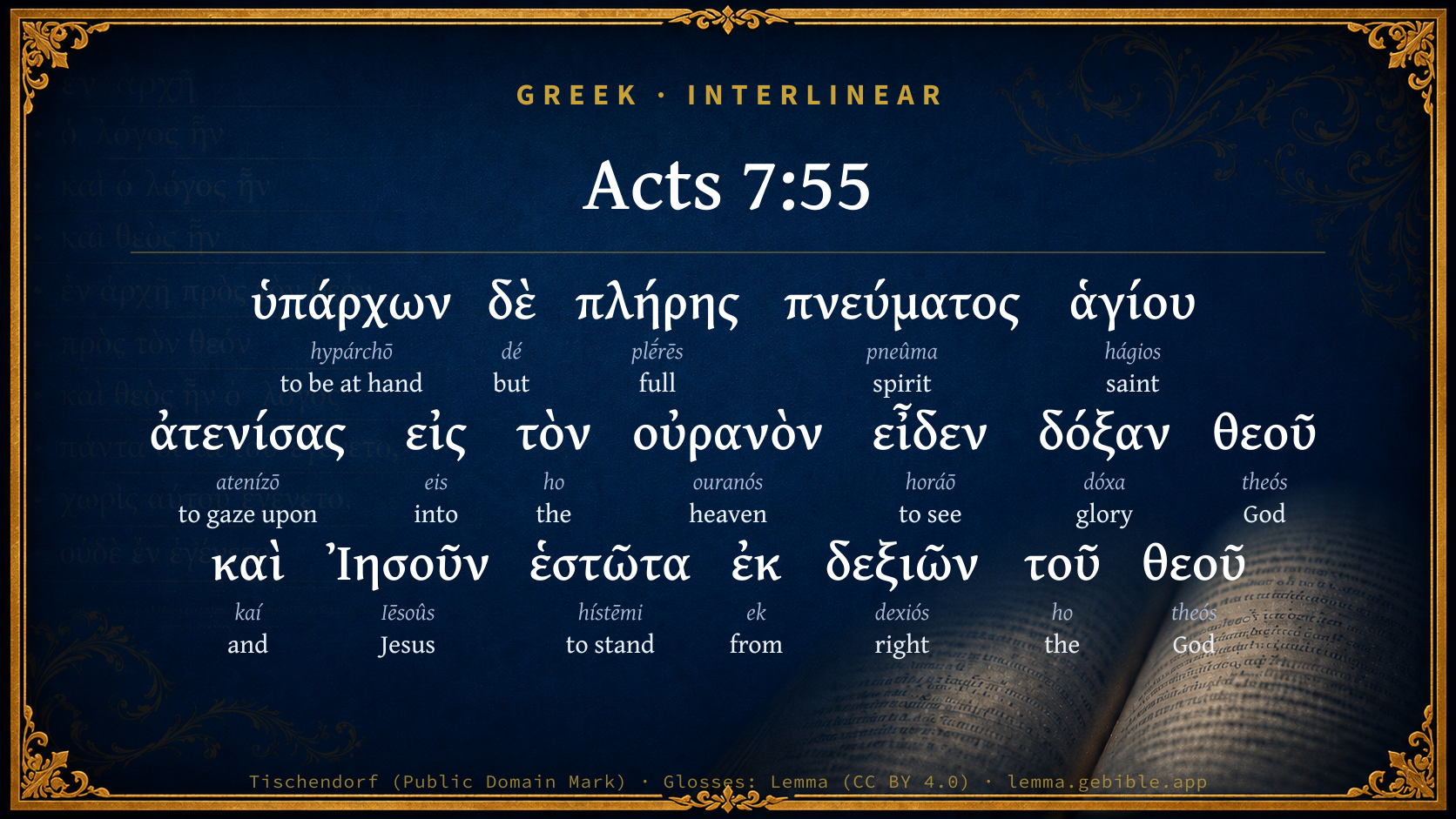
  1. ὑπάρχων hypárchō G5225 “to be at hand” Verb, Present, Active, Participle, Nominative, Singular, Masculine
  2. δὲ dé G1161 “but” Conjunction
  3. πλήρης plḗrēs G4134 “full” Adjective, Nominative, Singular, Masculine
  4. πνεύματος pneûma G4151 “spirit” Noun, Genitive, Singular, Neuter
  5. ἁγίου hágios G40 “saint” Adjective, Genitive, Singular, Neuter
  6. εἰς eis G1519 “into” Preposition
  7. τὸν ho G3588 “the” Article, Accusative, Singular, Masculine
  8. οὐρανὸν ouranós G3772 “heaven” Noun, Accusative, Singular, Masculine
  9. εἶδεν horáō G3708 “to see” Verb, Aorist, Active, Indicative, 3rd person, Singular
  10. δόξαν dóxa G1391 “glory” Noun, Accusative, Singular, Feminine
  11. θεοῦ theós G2316 “God” Noun, Genitive, Singular, Masculine
  12. καὶ kaí G2532 “and” Conjunction
  13. Ἰησοῦν Iēsoûs G2424 “Jesus” Noun, Accusative, Singular, Masculine
  14. ἑστῶτα hístēmi G2476 “to stand” Verb, Perfect, Active, Participle, Accusative, Singular, Masculine
  15. ἐκ ek G1537 “from” Preposition
  16. δεξιῶν dexiós G1188 “right” Adjective, Genitive, Plural, Masculine
  17. τοῦ ho G3588 “the” Article, Genitive, Singular, Masculine
  18. θεοῦ theós G2316 “God” Noun, Genitive, Singular, Masculine

About this verse

These counts appear in no published source. They are computed here, from the morphology-tagged text and Lemma’s own curated glosses. What Lemma adds →

19
words
17
distinct lemmas
Acts
section

Notable vocabulary

The rarest word here is ἀτενίσας to gaze upon G816 — appearing just 14 times in the whole Greek New Testament.

Shared distinctive vocabulary

ἀτενίσας to gaze upon G816 occurs in 14 verses of the Greek New Testament. Also found in:

Repetition

Words recur within this verse:

Cross-references

25

Topical passages linked to Acts 7:55 in the Treasury of Scripture Knowledge — connected by theme and wording, ordered by reader-vote popularity; previews shown in the World English Bible.

  • Mark 16:19 So then the Lord Jesus, after he had spoken to them, was received up into heaven, and sat down at the right hand of God.
  • Hebrews 1:3 His Son is the radiance of his glory, the very image of his substance, and upholding all things by the word of his power, when he had by himself made purification for our sins, sat down on the right hand of the Majesty on high;
  • 2 Corinthians 4:6 seeing it is God who said, "Light will shine out of darkness," who has shone in our hearts, to give the light of the knowledge of the glory of God in the face of Jesus Christ.
  • Psalms 109:31–110:1 For he will stand at the right hand of the needy, To save him from those who judge his soul.
  • Acts 6:5 These words pleased the whole multitude. They chose Stephen, a man full of faith and of the Holy Spirit, Philip, Prochorus, Nicanor, Timon, Parmenas, and Nicolaus, a proselyte of Antioch;
  • Acts 6:8 Stephen, full of faith and power, performed great wonders and signs among the people.
  • Acts 6:10 They weren't able to withstand the wisdom and the Spirit by which he spoke.
  • Hebrews 8:1 Now in the things which we are saying, the main point is this. We have such a high priest, who sat down on the right hand of the throne of the Majesty in the heavens,
  • Revelation 4:1–3 After these things I looked and saw a door opened in heaven, and the first voice that I heard, like a trumpet speaking with me, was one saying, "Come up here, and I will show you the things which must happen after this."
  • John 12:41 Isaiah said these things when he saw his glory, and spoke of him.
  • Acts 2:4 They were all filled with the Holy Spirit, and began to speak with other languages, as the Spirit gave them the ability to speak.
  • Isaiah 6:1–3 In the year that king Uzziah died, I saw the Lord sitting on a throne, high and lifted up; and his train filled the temple.
  • Ezekiel 10:4 The glory of Yahweh mounted up from the cherub, [and stood] over the threshold of the house; and the house was filled with the cloud, and the court was full of the brightness of Yahweh's glory.
  • Ezekiel 10:18 The glory of Yahweh went forth from over the threshold of the house, and stood over the cherubim.
  • Ezekiel 11:23 The glory of Yahweh went up from the midst of the city, and stood on the mountain which is on the east side of the city.
  • Micah 3:8 But as for me, I am full of power by the Spirit of Yahweh, And of judgment, and of might, To declare to Jacob his disobedience, And to Israel his sin.
  • John 14:3 If I go and prepare a place for you, I will come again, and will receive you to myself; that where I am, you may be there also.
  • Acts 6:3 Therefore select from among you, brothers, seven men of good report, full of the Holy Spirit and of wisdom, whom we may appoint over this business.
  • Acts 13:9–10 But Saul, who is also called Paul, filled with the Holy Spirit, fastened his eyes on him,
  • 2 Corinthians 12:2–4 I know a man in Christ, fourteen years ago (whether in the body, I don't know, or whether out of the body, I don't know; God knows), such a one caught up into the third heaven.
  • Ezekiel 1:26–28 Above the expanse that was over their heads was the likeness of a throne, as the appearance of a sapphire stone; and on the likeness of the throne was a likeness as the appearance of a man on it above.
  • Acts 1:10–11 While they were looking steadfastly into the sky as he went, behold, two men stood by them in white clothing,
  • Acts 4:8 Then Peter, filled with the Holy Spirit, said to them, "You rulers of the people, and elders of Israel,
  • 2 Peter 1:17 For he received from God the Father honor and glory, when the voice came to him from the Majestic Glory, "This is my beloved Son, in whom I am well pleased."
  • Revelation 21:11 having the glory of God. Her light was like a most precious stone, as if it was a jasper stone, clear as crystal;

Cross-references courtesy of OpenBible.info (CC BY 4.0).

Commentary

Notes on Acts 7:55 from classic Christian and Jewish commentators (each source and its license shown beneath its notes). The classic Christian expositions comment on the surrounding passage and are grouped to its opening verse, so a note may address several verses; the Jewish commentaries on the Tanakh (Rashi and others) are per-verse, so they appear only where the commentator wrote on this verse.

Lemma curates 59 commentaries, every one of them public domain or Creative Commons licensed, each selected and text-cleaned for this edition rather than reprinted as found. About our sources →

The Biblical Illustrator

Joseph S. Exell

Act_7:55-56

He being full of the Holy Ghost.

The work of the Spirit in the proto-martyr

Note how explicitly the character, attainments, and triumph of Stephen are ascribed to the Holy Spirit. In the first notice of him he is called a man full of faith and the Holy Ghost. So here in his death. Bearing this in mind, observe--

I. He looked up steadfastly into heaven, where his heart and treasure had long been. Where else could he look? Everything urged him to look away from earth and invited him to look up to heaven. He had no sympathy below, but there was all sympathy above. There were the redeemed who had gone before him, the angels, Jesus, his heavenly Father, all waiting to welcome him. So good is brought out of evil, and mans violence made to hasten the saints blessedness. As thy days so shall thy strength be. When earth casts us out, heaven waits to receive us.

II. As he looked he saw the glory of God.

1. In Isa_6:1-13. we may see the meaning of this glory, especially as interpreted by John. These things, said Esaias, when he saw Christs glory. The seraphim saw in Christ the glory of God--His mercy and His holiness, how He could be just and yet forgiving. So Stephen saw the Divine honour secured by that redemption for which he was called upon to die.

2. He saw Jesus standing, and the glory of God softened in the Person of his Saviour. He saw Jesus--

(1) Glorious after His humiliation.

(2) Accepted by the Father, and in that the proof that His work was accomplished.

(3) Standing, to import that He was interceding, giving the Spirit, and that human nature was indeed exalted in His Person.

III. In full harmony with these views he said, Lord Jesus, receive my spirit.

1. He had a clear apprehension of the souls independence of the body.

2. He knew that as soon as his enemies had despatched him his soul would be admitted into glory.

3. He realised the sufficiency of Christ for his salvation.

IV. How was he exercised towards his enemies? He prayed, Lord, lay not this sin to their charge.

1. What just views of Christ these prayers discover.

2. What a view does his conduct give of the power of Christianity.

V. It was while he expressed such a spirit that he fell asleep. Learn from the example of Stephen--

1. How to die in peace.

2. That the Spirit has brought great glory to Christ from the death of His people.

3. What shall be the glory of the martyr in heaven? (J. Morgan, D. D.)

The true conception of worship

I. Its nature.

1. Negatively. It does not consist in--

(1) Mere external ceremony.

(2) The mere utterance of any prescribed forms of prayer.

(3) Any special attitudes of devotion.

(4) Mere devotional feeling.

2. Positively. The true conception of worship is realised only in the vision of Jesus.

This view--

1. Respects His Divine-human character.

2. Is centred in Jesus as Mediator.

3. Is directed to Christ in His position of official dignity.

III. Its characteristics. Stephen--

1. Looked. This was--

(1) Personal.

(2) Present.

(3) Anxious.

(4) Intelligent.

(5) Glorious.

2. Steadfastly. The soul was in the act. It was no mere vacant stare; no idle, curious glance.

3. Into heaven. He entered within the veil and worshipped with the spirits before the throne. He was not content to look merely at its burnished gates.

4. Saw the glory of God. The instrument of vision was the eye of the soul. He saw by faith not the outer, but the inner, glory, of the temple of God.

IV. Its moral condition. He was full of the Holy Ghost. It is the power of the Holy Ghost that purifies the heart, spiritualises the conceptions, and develops the true worshipping faculty in man. Worship is a dead letter without such power. (John Tesseyman.)

Looked up steadfastly into heaven and saw the glory of God, and Jesus standing.

The rapture of Stephen

Let us regard this as--

I. A ravishing glimpse into heavenly realities. Divine manifestations usually fasten on something in the fortunes or thoughts of those who receive them. To Joshua, about to besiege Jericho, the angel of the Lord appears as a captain; to the wise men, whose study was astronomy, the revelation of Christs birth was made by a star; to St. Peter and his fellow-fishermen, a sign of Christs power is given in a miraculous draught of fishes. Stephen was now in the temple, and was familiar with the history of the shekinah of its holy place. He was before the high priest, with whose function on the day of atonement he was also familiar. With, then, this imagery in his mind he sees the shekinah of the heavenly sanctuary, and the great High Priest standing before God to intercede for the human race.

II. A confession of Christ before those who had crucified Him. Stephens mind was full of his Masters words when placed in similar circumstances, Hereafter shall ye see the Son of Man sitting at the right hand of power, and his declaration is tantamount to Lo, His words are fulfilled. I see your late Victim crowned with glory at the right hand of God.

III. A consolation and support to himself. Our Lord had warned the Jews that they would see Him sitting; Stephen sees Him standing. The difference is significant. To the Jews He will sit as Judge; to Stephen He stands--

1. As ready to assist him. A person who sits while contemplating the sufferings of another gives an impression of indifference. One who rises and advances towards us shows that he hears our cry and is willing to help.

2. As ready to plead for him. The earthly high priest sat before him as judge, fury on his countenance, and condemned him. The heavenly High Priest stands as his Advocate with the Father.

3. As ready to receive him in fulfilment of His own gracious words (Joh_14:2-3).

IV. Conforming the martyr to the image of his Lord. At Christs baptism the heavens were opened, and in Gethsemane there appeared an angel from heaven, strengthening Him. Thus was He prepared for the two great conflicts of the temptation and the passion. Now that the disciples might be made like Him it pleased God, in the first martyrdom, to vouchsafe the support of a heavenly vision, It was otherwise with James. He had no vision, but what had passed in Stephens case must have given him support. He who welcomed Stephen will welcome me. These different circumstances of the two martyrdoms open up the general plan of Gods administration of His Church. We walk by faith, not by sight. If every believer had such a vision there would he no longer any trial of character in faith, and the great object of our probation would be seriously interfered with. Gods plan, therefore, is to give glimpses into the heavenly world only at the outset of a dispensation. But if our privileges are less high in this respect, we have the opportunity of exercising a nobler faith. Blessed are they who have not seen, and yet have believed.

V. Throwing into relief the obtuseness of the Jews. Blinded by their malicious fury, they can no more see Christ than Balaam could the angel. In this there is something very awful. A transaction was going on in the spiritual world, which intimately concerned them, of which they were totally unconscious. So it may be with us; and there is but one thing which can make the spiritual world a reality to us, and that is the faculty which penetrates into the unseen--faith. (Dean Goulburn.)

Stephens outlook and vision

The eye of man is the window of his soul. Through it, he himself looks out; and if any one stands high enough in his confidence, through it he may likewise look in. The direction of just one glance sometimes exhibits a whole character in a single flash of revelation: and this may be drawn forth by the same object. Lot looked down towards Sodom; thus he displayed his avarice. Lots wife looked back towards Sodom; thus she disclosed her disobedience. Abraham looked forth on Sodom; thus he showed his faith after prayer. Note--

I. Stephens outlook.

1. Its expectancy. He looked. He was now in search of help in his extremity; it was nowhere to be found in that neighbourhood. He looked off from everything earthly, sent his mind backward after some old promise, forward for some fresh revealing of hope, and upward beyond all pain and worry for himself or the young Church he loved. Our lesson is this: Give up all responsibility for the worlds history into the hands of a faithful God. How some people distress themselves about the future of their children; forgetting that they lived somehow after their parents died. God lives always.

2. Its intelligence. He looked up. He might have, in some way, sought help from the Roman government, or sympathy from his fellow-believers, but up was the only way in which to look, for one who had read the Old Testament as he had (Isa_31:1). So we must rest for living help, and for dying grace, upon Jesus Christ (Heb_12:2).

3. Its tranquillity. He looked up steadfastly. There is here no quailing of the coward, no cringing of the captive, no weak sympathy for those who would mourn his death. Is it not strange that the one person in all the world who would fitly express his exact feelings was at the time standing? (Act_20:24). And any sincere believer may depend upon his covenant-keeping God to give him perfect peace in dying, even under the most dreadful circumstances.

4. Its triumph. Into heaven. True faith, eminent and dauntless, has an eyesight of its own, which will prove gloriously serviceable at the final moment of life.

II. The vision. When Stephen looked up, what did he see? Two years afterwards, the young man Saul saw the same grand spectacle (chap. 9:3-5). It made him an apostle (1Co_9:1).

1. The glory of God. Moses and Elijah appeared in glory with Christ (Luk_9:31). When Moses and Aaron saw it, it was like a pavement of sapphires (Exo_24:10). The dying martyr saw an unutterable splendour. He sprang towards it with an impulsive gesticulation of discovery. He forgot where he was, and even ceased to think how unsympathetic an audience he had.

2. The Son of Man. Our Lord called Himself by that name often, but no one else till this martyr died. The Son of God is still the Son of Man. Conclusion: Heaven is--

1. The only real thing in the universe.

2. The only hope worth cherishing.

3. The only end worth striving for. (C. S. Robinson, D. D.)

Stephen

We get the keynote of Stephens life and character in the text--He, being full of the Holy Ghost, looked up steadfastly unto heaven. That was not a mere outward gesture, a solitary act, but expressed the constant habit, the normal attitude of his soul. Habitually he looked through the things that are seen to the things that are not seen, and saw life in the light of God. He saw the glory of God--the one perfect revelation of the character of God--in the face of Jesus Christ. He looked through all the changes and.through all the apparent moral confusion of this world to the Divine reality behind.

I. First of all, it is said, he was full of grace and power. In the same chapter it is said he was full of faith and of the Holy Ghost. Practically it is the same thing. Full of faith and of the Holy Ghost, and full of grace and power: the one is the condition of the other. The one points to the inward fact, the thing which made him what he was; the other to the manifestation of that, the impression which he left upon those who came into contact with him.

1. He was full of grace. The expression suggests a type of character with qualities of its own, which not only calls forth our admiration, but which leads our thoughts upwards to God. There are persons who, in a special way, make us think of the Lord Jesus Christ. We recognise the character I am pointing at when we meet with it, although we may feel that we can only very inadequately describe it. It is a character partly like that of Christ Himself, but also in some essential particulars unlike it; like it in the presence of simple trust in God, and purity of heart, and prompt faithfulness of loving obedience; like it in the pain and indignation caused by falsehood and cruelty and meanness; like it in the love that seeketh not her own, that is not easily provoked, that beareth all things and hopeth all things; but also unlike it, not only in the imperfection that belongs to human goodness at its best, but in the profound humility which accompanies deep consciousness of sin, and the grateful love which springs from sin forgiven. Yes, we know very well that there is a character which has in it something distinctive, something peculiarly its own, even when it is very imperfectly developed, something that we recognise, and we know whence it is and how it cometh. We know whence it is, for it is grace; and we know how it cometh, for it cometh by that faith which realises the unseen and lives as in the presence of Him who is unseen, which habitually looks up into heaven, which has learned to see the glory of God in the face of Jesus Christ, and which, as the result of beholding the glory of the Lord, reflects it, and is changed into the same image.

2. And being full of grace, he was full of power. The power here indicated was not simply that of working miracles, nor was it even intellectual force--the wisdom with which he selected from a memory well-stored with Old Testament Scripture, and the cogency with which he drove home his arguments, though that was part of it; but it was above all moral force of character, the power which always goes along with grace, and suffers no life where that is to be resultless. For grace in itself is power. We -an understand that Stephen was full of power when he was pressing his antagonists in debate with arguments which they were unable to answer, and they retreated step by step, baffled and silenced, and at last slunk away abashed. We can understand it when we perceive how, while professedly dealing with the past, he was really holding up history before them as a mirror, in which they could see themselves, and observe that in one respect at least they were proving themselves to be the children of the fathers, by doing after their deeds; and we can understand it again, when his pent-up feeling at last finds vent in a burst of indignant denunciation, which must have made those men who held his life in their hands quail in his presence. We recognise that there was a power there; and perhaps it is not that in us which is most akin to the spirit of Christ, which is most quick to appreciate that kind of power; but how slow we are to realise that there was perhaps greater, wider, and more lasting power in the daily round of common duty, in the unnoticed ministries of charity, as he daily wended his way through the lanes and closes of the city among the poor committed to his charge, in his example of patience and self-mastery, in the help he gave by friendly counsel, in the silent influence of his ordinary life. It is good to covet earnestly the best gifts; but it is well to remember that there is something more excellent, for greater--greater in power--than all these is love, the love which is quickened and sustained by looking up steadfastly into heaven and beholding Jesus.

II. It is in harmony with what we are told of Stephen--that he was full of grace--that we read of that glory upon his face in the great crisis of his life. For grace is the inner beauty of the soul; this was the shining through of that inner beauty. Who cares to stop to discuss the question whether this was, in the commonly accepted sense of the word, miraculous? Does not that which is inward ever tend to find for itself outward expression? Do not the habitual emotions and cherished thoughts of the soul record themselves upon the countenance? And if the evil dispositions write themselves upon the face, do not the best feelings of the heart--does not grace--tend to do the same? Is there not something unmistakably its own in the eye of guilelessness and transparent openness? Does not the habitual trustfulness which rests on God come at last to reflect itself in serene placidity of expression? Does not love in its purest, intensest, self-sacrificing forms--the love of a mother, for instance--almost glorify?

III. The inward likeness to Christ, which comes by steadfastly looking to Him, which was manifest in the life of Stephen, making it full of grace and power, was also conspicuous in his death. He is like his Lord in faith and in love.

1. He is like Him in faith. There is similar confidence, yet with a significant difference. Our Lord in dying had said, Father, into Thy hands I commend My spirit. Stephen, in his last agony, commits his spirit not directly to the Father, but to Jesus, who has bought it with His blood, knowing in whom he has believed, and that He is able to keep that which is committed to Him against that day.

2. And, once more, in his dying hour, in showing himself strong in love, Stephen reveals how full his mind and heart are of the thought of his Saviour, and how deeply he has drunk of His Spirit. While the blinding volleys of stones are flying round him, crashing upon body and brain, the last effort of his yet clear consciousness is an act of prayer; and the prayer of Jesus for those who were nailing Him to the Cross is echoed in his expiring appeal--Lord, lay not this sin to their charge. We can scarcely help tninking of a wonderful contrast. In the days of King Joash, Zechariah the son of Jehoiada, the faithful friend and counsellor of the king, stood forth to rebuke the corruption of the popular worship. Like Stephens, his warning provoked an outburst of popular fury; and like him, he received the earthly recompense of his faithfulness in being stoned to death, the king, with shameful ingratitude, being a party to it; and when he died, he said, the Lord look upon it and require it. In what a different strain does the first Christian martyr plead. Since the old prophets time a new revelation of Divine love had been given to men; a new example of human love had been set before them; a new motive of love had begun to work within them; a new spirit of love, the Spirit of Christ Himself, had been imparted to them; and of that Spirit Stephen was full--full of the Holy Ghost.

IV. This is the only narrative with any fulness of detail of any death in the New Testament, save One. Is it wrong to infer from this that in the New Testament greater importance is attached to the manner of a mans life than to the manner of a mans death; that in his conquering temptation in living, even more than in his triumphing over fear in dying, is the power of the grace of Christ displayed? At any rate, for once we are asked to contemplate a Christian in the hour of his departure. His was a stormy passage to the heavenly rest; but this is what we have to remember--what was true in his case is true as to the main things in all who have obtained like precious faith. There may be no brightness like the reflection of the heavenly glory lighting up the face; there may be no telling of a -vision of the opened heavens; there may be only pain and weakness, dull unconscious stupor, or a clouded mind; but none the less it is true that as here, so over every dying believer the Lord Jesus Christ stands to succour and to receive the spirit he commits to Him then, or has committed long before. Precious in the sight of the Lord is the death of all His saints. Like Stephen they fall asleep, and awake to behold His face in righteousness, and shall be satisfied with His likeness. (A. O. Johnston, M. A.)

Stephens vision

Notice--

I. The glorious scene that exists in the world above--the glory of God, and Jesus standing on the right hand of God. This Stephen saw; but it did not come into existence then; it was in existence before; it is in existence now. We find it difficult to give reality in our minds to distant and unseen things, My friend in some remote land is a really existing being, though I cannes realise his presence. None of us doubts the existence of countries on the other side of the globe. They are as real as though we beheld them. So of heavenly things.

II. Those distressing scenes that often occur in our world below. Scenes like that are often acted in our world. They seem to be a part of our fallen worlds sad inheritance. To some of us the injustice, cruelty, and evil tempers of those we live with, have embittered our lives. We must not murmur at this. It is to be endured patiently, just as sickness or any other calamity. Let us, as one fruit of it, long more for a world where we and all admitted shall be creatures of another mind--all happy one in another, as well as happy in our God.

III. The conduct of the faithful Christian amid the distressing scenes of life. They gnashed on him with their teeth. They were becoming wild in their rage against him: yet what does he? Strive to mollify their rage? Appeal for protection to the judges? Look round to find some one less violent than the rest, to interpose in his behalf? No; great as his danger appears, he looks above his danger. Full of the Holy Ghost, he looks up steadfastly into heaven. The expression implies that he felt sure that there was help for him there. Here is the secret of bearing trouble well--it is not to keep our eyes on our trouble, anxious for any and ready to catch at the first alleviation of it; it is to look above our troubles, to get our whole soul riveted on Christ in the heavens.

IV. The manifestation which the Lord sometimes makes of Himself to His expecting servants. Our Lord had promised His disciples that if they loved Him and kept His commandments, He will still manifest Himself to them. Now to draw our attention to this promise, and to assure us of the fulfilment of it, we may conceive to be the design of this wonderful vision. At this time most certainly he was loving his Lord, and proving his affection to Him by the danger in which he had placed himself for His sake. Here, then, was an opportunity for the Lord to show how precious to Him are the people that love Him, and how mindful He is of His own word. (C. Bradley, M. A.)

Seeing the glory of Christ

Dr. Owen, just previous to his death, said, I am going to Him whom nay soul has loved--or, rather, who has loved me with an everlasting love--which is the sole ground of all my consolation. On Mr. Payne saying to him, Doctor, I have just been putting your book on The Glory of Christ to the press, he answered, I am glad to hear it. But oh, brother Payne, the long-looked-for day is come at last, in which I shall see that glory in another manner than I have ever done yet, or was capable of doing in this world.

The presence of Christ in the dying hour

Robert Glover, mentioned by Mr. Foxe in the Book of Martyrs, though he was a man very gracious and holy, faithfully bearing witness to the truth, yet it pleased God to withdraw Himself and presence from him, insomuch that he was greatly distressed while he was in prison, and, opening himself to his friend; told him bow God had left and deserted him. His friend exhorted him still to wait on God, which he laboured to do, and the night before his execution spent much of that time in prayer; yet no comfort came, no manifestations of the presence of Christ. The next day he was drawn out to the stake to die for the truth, and as he went he mourned much for the presence of Christ; but when he came in sight of the stake it pleased God so to fill his heart and soul with comfort, and the incomes of His love, that he cried out unto his friend, Oh, Austin, He is come! He is come! He is come! The good man was in the dark a great while, but when in the darkest time then Christ came. (C. H. Spurgeon.)

The martyrs gaze on his ascended Lord

But twice, so far as we know, since Christs ascension has the cloud which received Him out of the sight of those first loving gazers opened its blinding folds--once for the conversion of the persecuting Saul, once for the support of the suffering Stephen. It was a great crisis in the history of the new faith. How much depended on the faithful endurance of that young champion! To him tortured men and women would look back from many a scene of agony, and take courage. But he had no example. To him, therefore, most fitly was this support vouchsafed. And mark the mode of its bestowal: Stephen, being full of the Holy Ghost, looked up steadfastly into heaven. What a gaze was that! What faith, desire, love, need, supplication was gathered into it! And as he gazes, lo, the cloud melts away; being full of the Holy Ghost, the power of intuition, so weakened in us fallen men, is supernaturally strengthened, and he sees Jesus standing, because it is the priestly attitude of the great Intercessor, and because the attitude of His intercession is the attitude of His help. And so He showed Himself as reaching out from the eternal shore into the billows of this bitter storm the pierced hand to be the stay of His martyr. And that sight changed all things to him. The lights of earth paled beneath its lustre; the sounds of earth were hushed by its ineffable harmony; the mighty throb which shot through his spirit deadened the power of marking any lower sensation, as he saw that sight of glory, and knew that contenance of love which was bent full upon him. He saw Gods kingdom in its strength, its vastness, and its repose, and he was safe. How can the ripple around their darkened base stir those adamantine foundations? How can the hate of man pluck him out of that hand pierced by love and full of omnipotence? The Son of Man--the sharer of my nature. And as the shadow of the great Intercessor falls upon him, transforming him into its own likeness, the dying martyr pleads for his murderers. And then, not as one shrinking back from pain, but as a soul in rapture, thirsting for its full fruition, he calls upon his manifested Lord to receive his spirit; until amidst that storm of murdering violence, calm as the hushed infant upon its mothers breast, he sinks into a rest sweeter than that of peaceful infancy, and falls indeed asleep in Jesus. For the sake of its great practical lessons--

I. We have here a notable instance of the way in which the whole of our holy religion rests on facts. We see what it was amongst its first confessors in a time of crucial experiment. It was not a set of beneficent maxima which leavened, and raised the tone of, society; not a set of lofty ideas which, gradually, with the help of time and distance, formed a highly-coloured medium through which reverence and affection could look back to the form of their first promulger, and gaze upon it with a wonder which at last invested him with the fancied attribute of a god. No! from the very first it was faith in a Person, Divine and human, beside His follower, and able and willing to hold him up in every struggle. Stephens spirit did not cast itself upon sublime abstractions. No! he looks up steadfastly into heaven with the earnest, longing, searching glance of undoubting expectation, following the ascended form to where the cloud had received Him out of their sight; and before such a gaze the cloud melted, and he saw the heavens opened, and Jesus standing at the right hand of God.

II. If thus the word of God was a set of facts, any attempt to resolve it into a set of ideas subverts its very foundations, and destroys the whole edifice. For--

1. This is to take a position altogether at variance with that occupied by the first believers, and thus to shake utterly their credit, inasmuch as, in this view, either they were so ignorant as to be misled, or so false as to mislead. Nor is this all; the great Teacher Himself appealed to these facts as the proofs of His commission (Joh_10:38; Joh_15:24). Either, therefore, the facts were real, or the Teacher was a deceiver.

2. It is not possible, consistently with any rules of reasoning, to make a selection from the facts, and yet seek to retain the ideas. A philosophy, being a speculation, may contain a multitude of great and true ideas, mixed with phantasies and fictions; and it is the office of higher intelligences to separate the precious from the vile. But in a system of alleged facts resting upon evidence, the presence of one falsehood shakes the truth of the whole fabric. This is the very issue to which St. Paul brings the whole question, If Christ be not risen, then is our preaching vain, and your faith is also vain.

III. The light thrown hereby upon difficulties as to gospel miracles.

1. These difficulties rest mainly on the supposed existence of a contradiction between the universally observed law of causes and effects, and the interposition of any intervening power to suspend or to invert those laws. Such pretended interruptions, we are told, no evidence could establish, and that a miracle therefore is impossible. The same conclusion is more gently insinuated by those who would have us think that miraculous power was nothing more than a deeper acquaintance with nature, enabling the operator to work a trick and to call it a miracle; to do, as some have done by savages, when they called to their aid the secrets of science to astonish by pretended portents the ignorance of the uncivllised.

2. But cast upon all these difficulties the brightness of St. Stephens vision, and they are scattered in a moment; for it lifts us at once out of the dull level of naturalism into the new lights and shadows of the mountain of God. If one of these recorded facts be true and real, it is of itself enough to prove that the Lord of nature has for His wise purposes resolved to manifest to us, through our sensible faculties, His peculiar presence and His direct working; and this once admitted, the probability is in favour of the truth of any other well-attested miracles. For just as one flash of lightning evinces the existence of such conditions of the atmosphere as may be expected to produce a second, and so makes the coming of that second as probable then as at another time it would be improbable; so does one such direct proof of the manifested working of the Masters hand make it even probable that according to His wise purpose it may be followed by another. One such fact, therefore, proves that, we are not under a dispensation of nature but of grace; that we are introduced into a new atmosphere, to which we cannot apply the laws which governed that from which we have been transported; that we can no more argue as to what can and cannot be from the data of mere naturalism, than we could measure the laws of light by knowledge gathered from the darkness.

3. Here, then, we are led to the real cause of such difficulties. It is to be found in a want of hearty belief of the spiritual world. To any one of such a habit of mind all difficulties multiply spontaneously after their kind. It is with such spirits as with the bodies of men who live beside open drains, or are encompassed in the malaria of a marsh; they imbibe unconsciously at every pore the lurking poison: you must lift them up to higher grounds and purer airs if you would give health to their fever-stricken limbs. To heal these troubled spirits you must place them with St. Stephen on the mountain of God. If that eye, so diseasedly minute in its small criticisms; if that apprehension, so ready but so shallow in its power; if that reason, so feverishly captious in its questions; if that bent, narrow, trembling soul could but be lifted to those heights--could but be led to look up steadfastly into heaven--its difficulties would pass even unconsciously from it, and its cure be certain.

4. Here, then, is the true mode of meeting these difficulties: not by shutting our eyes feebly to them, not by turning away from them as though we were afraid of them; but by looking at them, not in the purblind darkness of a carping petulance, but in the light of these spiritual verities. To live in this light is our Christian birthright. We need not be with St. Stephen in the agony of martyrdom to attain to it. God has so made us that common life gives us daily opportunities, if we will but use them, of gaining this insight. To every soul so seeking Him He reveals Himself; the cloud opens; the form of the Son of Man is seen; and then belief is comparatively easy, and the difficulties which must remain, whilst they keep our faith humble and watchful, cease to be perplexing to the soul.

5. If this be so, then what becomes of the supposed morality of encouraged doubts in any Christian man? Surely we can see the utter falsehood of representing them as the patient reachings forth of an inquiring spirit for the light for which he longs Rather, assuredly, are they the wilful turning, through some fault of the flesh or of the spirit, away from the light; and instead of bearing the noble titles of reasonable and faithful inquiry, they should by every true heart be degraded to the discreditable category of suspicions nourished in cankered hearts against a fathers truthfulness or a mothers honour. Dark and sad is the history of such a course. Its steps lead surely down from the mountain of light. The one only Sun which lighteth every man that cometh into the world, sinks for him who treads it in the mists which gather ever thicker and thicker round his blackening horizon. Worship in its fervour, prayer in its reality, and then trust, and love, and peace one by one are all extinguished--peak after peak loses the last lingering ray of the daylight--until all is dark (Isa_59:9-11).

6. It is not on the difficulties of belief alone, but upon all the struggles through which the life of God is maintained within our souls, that this vision of St. Stephen casts its light. Never cap the impetuous tyranny of appetite be subdued, and the soul and body kept in purity, save by these powers of the world to come. When the flesh is strong within, what shall aid us in the strife like looking up steadfastly into heaven and seeing the Son of Man as our helper? Or, again, as years go on, and these impetuous temptations of earlier life being somewhat past, new ones of a soberer, heavier, and more stupefying worldliness have taken their place, what else can so guard us against sinking into the dull, respectable, commonplace conformity with evil which, like the white ashes after the conflagration, succeeds so naturally to the burst of youthful indulgence, as the ever-living sense of our nearness to the Lord and of His perpetual presence with us? What can arouse watchfulness, keep prayer alive, kindle love, deepen humility, renew contrition, quicken zeal, minister support in sorrow, or awaken praises in the soul which God is graciously keeping, like the perpetual realisation by the eye of faith of what is now going on within the veil? (Bp. S. Wilberforce.)

The exaltation of Christ

I. To understand the nature and extent of that honour and glory to which the Redeemer is now exalted, first direct your thoughts to that state of humiliation to which He was once subjected upon earth.

II. As the sufferings of the Redeemer had been severe beyond example, so is His triumph over every enemy complete beyond the power of description. It commenced at that moment when He broke asunder the chains of death, and rose triumphant from the tomb; and it was still more conspicuously displayed at the hour of His ascension to heaven.

III. Consider the improvement to be made of this subject. The doctrines of the gospel either excite us to avoid the paths of sin by showing us the dangers with which they are beset, or they stimulate us to lives of faith on the Son of Man by displaying the rich rewards that await the righteous.

1. Of the latter description is the doctrine of our Lords exaltation; and the first obvious inference that flows from it is, that it furnishes a theme of joy and exultation to the true Christian.

2. Another lesson to be learnt from this doctrine is a firm reliance on the promises of the gospel. Of the truth of these promises, the history of our Saviours sufferings and triumph affords the most ample evidence.

3. This doctrine affords a noble and most powerful encouragement to a life of faith on the Son of Man. Our blessed Redeemer ascended to the bosom of His heavenly Father, not less to prepare a place for His faithful followers than to enter Himself into His glory.

4. Consider the exaltation of Christ as teaching us to set a just and proper value on the things that belong to our eternal salvation, and as conveying to us the important lesson of placing our affection on things above, and not on things below. For what are the honours, the riches, and the pleasures of this world, in comparison of that glory which is at the right hand of God? (James Bryce.)

Christ appears for His people in time of danger

A little child in white was playing in the park. As long as she ran about on the grass, the nurse took little notice of her--she was safe. Presently the little feet chose a path leading down to the water, and the good nurse was after the little one in a moment--she was in danger. While we lie down in the green pasture of the 23rd Psalm, the Good Shepherd may not seem to notice us--we are safe; but when the sheep are among the wolves of Mat_10:16, the Good Shepherd will run to their help--they are in danger.

The Biblical Illustrator, edited by Joseph S. Exell (c. 1880s–1900s) — public domain. Text from a community e-Sword module.

Tyndale Open Study Notes

Tyndale Open Resources

7:55-56 Jesus standing . . . at God’s right hand: Usually Jesus is described as seated in heaven at God’s right hand (2:33-34; 5:31; Luke 20:42; 22:69; Rom 8:34; Eph 1:20; Col 3:1; Heb 1:3, 13; 10:12). One possible explanation is that Jesus was welcoming Stephen, the first martyr, to heaven with honor. Stephen had confessed his Lord faithfully on earth, and now his Lord honored his promise to confess his faithful servant in heaven, standing as a witness to defend him (Matt 10:32; Luke 12:8). • the Son of Man standing: Cp. Dan 7:13-14. The Jewish leaders understood that Stephen was speaking of Jesus as the divine Son of Man (Acts 7:57), a title that speaks of Jesus’ power and authority (cp. Rev 1:12-15).

Tyndale Open Study Notes — © Tyndale Open Resources, licensed CC BY-SA 4.0. Text via the HelloAO Bible API.

Bengel's Gnomon

Johann Albrecht Bengel

Act 7:55. Πλήρης, full) As the fury of his enemies increases, the strength of spirit in Stephen increases, as also every fruit of the Spirit.—ἀτενίσας, having looked stedfastly) By an earnest look to heaven, the mind of those dying by a violent death may be raised up.—εἶδε, he saw) Jesus is not said to have addressed Stephen.—δόξαν Θεοῦ, the glory of God) the ineffable splendour which shines forth in the third heaven.—ἐστῶτα, standing) as if to meet Stephen. Comp. Act 7:59. For everywhere else he is said to sit. Arator well writes,—

“Lumina cordis habens cœlos conspexit apertos

Ne lateat, quid Christus aget: pro martyre surgit.

Quem tunc stare videt, confessio nostra sedentem

Cum soleat celebrare magis. Caro juncta Tonanti

In Stephano favet ipsa sibi: Dux præscius armat

Quos ad dona vocat.”

“By the light that shone into his heart he beheld the heavens opened, so that it does not escape his glance what Christ is doing there: He rises for the martyr, whom the latter at that time sees standing; whereas our confession (creed) is wont rather to celebrate Him as sitting. The flesh itself, assumed by the Thunderer, favours, in the case of Stephen, its own self. The prescient Captain of our salvation arms those, whom He calls to gifts.”

Bengel's Gnomon of the New Testament — English translation (T&T Clark, Edinburgh, 1860) — public domain. Text from a community e-Sword module.

Expositor's Greek Testament

ed. W. Robertson Nicoll

Act 7:55 . ἀτενίσας , cf. Act 1:10 , εἰς τὸν οὐρανόν , cf. Joh 17:1 , “ubi enim est oculus, ibi est cor et amor”. In the power of the Holy Ghost, with which Stephen is represented as being full, as in life so in death, he saw δόξαν Θεοῦ , in which He had appeared to Abraham, cf. Act 7:2 , πλήρης , “crescente furore hostium, in Stephano crescit robur spiritus, omnisque fructus Spiritus,” Bengel. Ἰησοῦν ἑστῶτα : elsewhere He is represented as sitting, Act 2:34 . If St. Luke had placed this saying in the mouth of St. Stephen in imitation of the words of Jesus, 21:64, Mar 16:19 , Luk 22:69 , he would, without doubt, have described Him as sitting, cf. also the expression “Son of Man,” only here outside the Gospels, and never in the Epistles (Rev 1:13 , a doubtful instance), a noteworthy indication of the primitive date and truthfulness of the expression and the report. See especially Wendt’s note on p. 194 (1888). Standing, as if to succour and to receive His servant, ἵνα δείξῃ τὴν ἀντίληψιν τὴν εἰς αὐτόν (Oecum., and so Chrys.); “quasi obvium Stephano,” Bengel, so Zöckler, and see Alford’s note and Collect for St. Stephen’s day. St. Augustine represents Christ as standing: “ut Stephano stanti, patienti, et reo, ipse quoque stans, quasi patiens et reus compatiatur”. Alford supposes reference in the vision to that of Zec 3:1 . ἐκ δεξιῶν : as the place of honour, cf. 1Ki 2:19 , Mat 20:21 . The Sanhedrin would recall the words “the Son of Man,” as they had been spoken by One Who was Himself the Son of Man, and in Whom, as in His follower, they had seen only a blasphemer. On the expression “Son of Man” cf. Charles, Book of Enoch , Appendix B, p. 312 ff., and Witness of the Epistles , p. 286 1892).

The Expositor's Greek Testament, edited by W. Robertson Nicoll (1897–1910) — public domain. Text from a community e-Sword module.

Geneva Bible (1599)

Geneva Bible translators

Ready to confirm him in the confession of the truth, and to receive him to him.

The nearer that the Martyrs approach to death, the nearer they beholding Christ, do rise up even into heaven.

Geneva Bible (1599) marginal notes — public domain. Text via Bolls.life.

Jamieson, Fausset & Brown

Robert Jamieson, A. R. Fausset & David Brown

But he, being full of the Holy Ghost, looked up steadfastly into heaven, and saw the glory of God--You who can transfer to canvas such scenes as these, in which the rage of hell grins horribly from men, as they sit condemned by a frail prisoner of their own, and see heaven beaming from his countenance and opening full upon his view--I envy you, for I find no words to paint what, in the majesty of the divine text, is here so simply told. "But how could Stephen, in the council-chamber, see heaven at all? I suppose this question never occurred but to critics of narrow soul, one of whom [MEYER] conjectures that he saw it through the window! and another, of better mould, that the scene lay in one of the courts of the temple" [ALFORD]. As the sight was witnessed by Stephen alone, the opened heavens are to be viewed as revealed to his bright beaming spirit.

and Jesus standing on the right hand of God--Why "standing," and not sitting, the posture in which the glorified Saviour is elsewhere represented? Clearly, to express the eager interest with which He watched from the skies the scene in that council chamber, and the full tide of His Spirit which He was at that moment engaged in pouring into the heart of His heroical witness, till it beamed in radiance from his very countenance.

Jamieson, Fausset & Brown — Commentary Critical and Explanatory on the Whole Bible (1871) — public domain (CC PDM 1.0). Text via the HelloAO Bible API.

Adam Clarke's Commentary

Verse 55. Saw the glory of God] The Shekinah, the splendour or manifestation of the Divine Majesty.

And Jesus standing on the right hand of God] In his official character, as Mediator between God and man.

Stephen had this revelation while in the Sanhedrin; for as yet he had not been forced out of the city. See Ac 7:58.

Adam Clarke's Commentary on the Bible (1810–1826) — public domain. Text from a community e-Sword/MySword module.

John Calvin's Commentaries

55. Forasmuch as he was full. We cannot almost express into what straits the servant of Christ was brought, when he saw himself beset round with raging enemies; the goodness of his cause was oppressed, partly with false accusations and malice, partly with violence and outrageous outcries; he was environed with stern countenances on every side; he himself was haled unto a cruel and horrible kind of death; he could espy succor and ease no where. Therefore, being thus destitute of man’s help, he turneth himself toward God. We must first note this, that Stephen did look unto God, who is the judge of life and death, (turning his eyes from beholding the world,) when he was brought into extreme despair of all things, whilst that there is nothing but death before his eyes. This done, we must also add this, that his expectation was not in vain, because Christ appeared to him by and by. Although Luke doth signify, that he was now armed with such power of the Spirit as could not be overcome, so that nothing could hinder him from beholding the heavens; therefore Stephen looketh up toward heaven, that he may gather courage by beholding Christ; that dying he may triumph gloriously, having overcome death. But as for us, it is no marvel if Christ do not show himself to us, because we are so set and tied upon the earth. Hereby it cometh to pass, that our hearts fail us at every light rumor of danger, and even at the falling of a leaf. And that for good causes; for where is our strength but in Christ? But we pass over the heavens, as if we had no help any where else, save only in the world, Furthermore, this vice can be redressed by no other means than if God lift us up by his Spirit, being naturally set upon the earth. Therefore, Luke assigneth this cause, why Stephen looked up steadfastly toward heaven, because he was full of the Spirit. We must also ascend into heaven, having this Spirit to be our director and guide, so often as we are oppressed with troubles. And, surely, until such time as he illuminate us, our eyes are not so quick of sight, that they can come unto heaven. Yea, the eyes of the flesh are so dull, that they cannot ascend into heaven.

He saw the glory of God. Luke signifieth, as I have said, that Christ appeared forthwith to Stephen so soon as he lifted up his eyes towards heaven. But he telleth us before, that he had other eyes given him than the fleshly eyes, seeing that with the same he flieth up unto the glory of God. Whence we must gather a general comfort, that God will be no less present with us, if, forsaking the world, all our senses strive to come to him; not that he appeareth unto us by any external vision, as he did to Stephen, but he will so reveal himself unto us within, that we may indeed feel his presence. And this manner of seeing ought to be sufficient for us, when God doth not only, by his power and grace, declare that he is nigh at hand, but doth also prove that he dwelleth in us.

John Calvin's Commentaries (1540-1563) — public domain. Text from the Calvin Translation Society English edition (1840s-50s) via the Christian Classics Ethereal Library (ccel.org). Calvin's coverage is partial (roughly two-thirds of the Bible); uncommented books and verses are honest gaps, never fabricated. The 19th-century editor's footnotes and remarks are omitted so the notes are faithfully Calvin's own voice.

Ellicott's Commentary for English Readers

(55) Being full of the Holy Ghost.—There is something suggestive in the fact that this description comes at the close, as at the beginning, of the record of St. Stephen’s work (Act_6:8). From first to last he had been conspicuous as manifesting the power of the higher life which had, as it were, illumined and transfigured his whole being. The Greek “being full” implies, not a sudden inspiration, but a permanent state.

And saw the glory of God.—Stephen had begun with speaking of “the God of glory” (Act_7:2). He ends with the vision of that glory as belonging to the Son of Man. The fact was inferred partly, we may believe, from the rapt, fixed expression of the martyr’s face, partly from the words that followed, interpreting that upward gaze. On the word for “looked up steadfastly,” see Note on Act_3:4.

A Bible Commentary for English Readers, edited by Charles John Ellicott (1878–1897) — public domain. Text from a community e-Sword module.

The Cambridge Bible for Schools and Colleges

gen. ed. J. J. S. Perowne

55. saw the glory of God] Some visible sign of God’s presence such as the Shechinah had been to the Jews of old. See Exo_16:10; Exo_24:17, in the latter of which passages it is described as like devouring fire. It is defined by the Jews as the concentration of God’s omnipresence.

and Jesus standing on the right hand of God] i.e. he was permitted to behold Jesus triumphing in the flesh in which He had been crucified. The position of standing rather than that of sitting as described elsewhere (Mat_26:64, &c.) may have been to indicate the readiness of Jesus to strengthen and help His martyr.

The Cambridge Bible for Schools and Colleges (gen. ed. J. J. S. Perowne; Cambridge University Press, 1878–1918) — public domain. Text from a community e-Sword module.

John Gill's Exposition

Then they cried out with a loud voice,.... These were not the sanhedrim, but the common people; the Ethiopic version reads, "the Jews cried out"; which, they did, in a very clamorous way, either through rage and madness, or in a show of zeal against blasphemy; and cried out, either to God to avenge the blasphemy, or rather to the sanhedrim to pass a sentence on him, or, it may be, to excite one another to rise up at once, and kill him, as they did:

and stopped their ears; with their fingers, pretending they could not bear the blasphemy that was uttered. This was their usual method; hence they say, (o).

"if a man hears anything that is indecent, (or not fit to be heard,) let him put his fingers in his ears hence the whole ear is hard, and the tip of it soft, that when he hears anything that is not becoming, he may bend the tip of the ear within it.''

By either of these ways these men might stop their ears; either by putting in their fingers, or by turning the tip of the ear inward.

And ran upon him with one accord; without any leave of the sanhedrim, or waiting for their determination, in the manner the zealots did; See Gill on Mat 10:4, Joh 16:2.

(o) T. Bab. Cetubot, fol. 5. 1. 2.

John Gill's Exposition of the Whole Bible (1746–1763) — public domain (CC PDM 1.0). Text via the HelloAO Bible API.

Trapp's Complete Commentary

John Trapp

55 But he, being full of the Holy Ghost, looked up stedfastly into heaven, and saw the glory of God, and Jesus standing on the right hand of God,

Ver. 55. And Jesus standing] As ready to revenge the injuries done to his proto-martyr. Christus stat ut Vindex, sedet ut Iudex. Christ stands as a defender, and sits as a judge.

John Trapp, A Commentary or Exposition upon All the Books of the Old and New Testament (1647–1656) — public domain. Text from a community e-Sword module.

Albert Barnes' Notes on the Bible

Full of the Holy Ghost - See the notes on Act 2:4.

Looked up stedfastly - Fixed his eyes intently on heaven. Foreseeing his danger, and the effect his speech had produced; seeing that there was no safety in the Great Council of the nation, and no prospect of justice at their hands, he cast his eyes to heaven and sought protection there. When dangers threaten us, our hope of safety lies in heaven. When people threaten our persons, reputation, or lives, it becomes us to fix our eyes on the heavenly world; and we shall not look in vain.

And saw the glory of God - This phrase is commonly used to denote the visible symbols of God. It means some magnificent representation; a splendor, or light, that is the appropriate exhibition of the presence of God, Mat 16:27; Mat 24:30. See the notes on Luk 2:9. In the case of Stephen there is every indication of a vision or supernatural representation of the heavenly objects; something in advance of mere “faith” such as dying Christians now have. What was its precise nature we have no means of ascertaining. Objects were often represented to prophets by “visions”; and probably something similar is intended here. It was such an elevation of view - such a representation of truth and of the glory of God, as to be denoted by the word “see”; though it is not to be maintained that Stephen really saw the Saviour with the bodily eye.

On the right hand of God - That is, exalted to a place of honor and power in the heavens. See the Mat 26:64 note; Act 2:25 note.

Albert Barnes' Notes on the Bible (1834–1885) — public domain. Text from a community e-Sword/MySword module.

Haydock's Catholic Bible Commentary

This is the comfort of all martyrs. (Bristow) --- This the support of every Christian under the severest trials of either mind or body: this the sweetener of every burthen and cross.

George Leo Haydock (1774–1849), Haydock's Catholic Family Bible and Commentary, 1859 edition — public domain. Excludes Psalms (Douay-Rheims chapter numbering differs from Protestant) and Deuterocanonical books (Catholic canon only).

Matthew Poole's English Annotations

Full of the Holy Ghost; filled with grace suitable to his present trial and suffering.

The glory of God; the glorious God, or so much of the throne and glory of God as mortal eyes are capable for to see.

Jesus standing on the right hand of God; being justified by God, though condemned by Pilate; and

standing ready to assist and comfort all that should suffer for his sake.

Matthew Poole's English Annotations on the Holy Bible (1683–1685) — public domain. Text from a community e-Sword/MySword module.

Whedon's Commentary on the Bible

Daniel D. Whedon

55. Saw the glory of God—Saw the Shekinah, for in Jewish phraseology the glory and the Shekinah are convertible terms. The martyr, like Moses, was for the moment permitted to see God face to face, even before quitting his veil of flesh. He was filled with the Holy Spirit, and thereby the eyes of his own spirit were so quickened that no material object and no distance could prevent him from beholding, as through an opening heaven, the very presence of the Ancient of Days. He who in the first clause of his speech affirms in effect that Abraham beheld the God of glory now beholds that glory himself!

Right hand of God—If Stephen saw one at the right hand of God, he must have seen the God at whose right hand he was. Now it is abundantly said in Scripture that “No man hath seen God at any time,” Joh_1:18. God is dwelling in the light which no man can approach unto, whom no man hath seen nor can see,” 1Ti_6:16. And yet, on the other hand, it is said of the elders of Israel “they saw the God of Israel,” “they saw God,” Exo_24:9-11. So Exo_19:11; Deu_4:12; Exo_33:11; Isa_6:1; Isa_6:5. By this class of passages must be meant that the Shekinah, the glory, was the “face of God,” was his “Presence,” was in symbol or fact himself.

If, then, Stephen saw God, he must have seen him so identified and located that one could be at his right hand. He must have beheld the glory condensed to a center, or at any rate there must have been some local symbol which he recognised as God. Daniel, in Act_7:9, recognised him enthroned as “the Ancient of Days” with the “Son of man” not beside him but before him.

Daniel D. Whedon (gen. ed.), Commentary on the Old and New Testaments (1874–1909) — public domain. Text from a community e-Sword module.

The Pulpit Commentary

Looked up steadfastly (ajtenisav); see Act_6:15 Act_3:4, and note. The glory of God; i.e. the visible glory which surrounds and proclaims God"s near presence. (see Exo_24:10, Exo_24:16, Exo_24:17; Eze_1:28; Rev_21:14, Rev_21:23, etc.) Jesus standing. Sitting at the right hand of God is the usual attitude ascribed to our Lord in token of his victorious rest, and waiting for the day of judgment. Here he is seen standing, as rising to welcome his faithful martyr, and to place on his head the crown of life. (Rev_2:10) Whether Stephen saw these glorious things in the flesh or out of the flesh he probably knew not himself.

Vers. 55-60. The glory of the martyr.

It is not impossible that the foregoing defense of Stephen may own to some slight ellipses; if so, to be accounted for partly by the fact of his immediate martyrdom, which prevented his rehearsal of it to any penman. But if it be not so, and if we have here in due connection all that Stephen said that is material to a right apprehension of the exact position of things, then his outburst recorded in vers. 51-53 is indeed full of suggestion, hints at much that lay behind, and invests itself with great additional interest. For we must suppose that his discernment, all on fire at that moment, enabled him to see, both in the eyes of the council of judges and in some of their movements, perhaps of the most unconscious and involuntary character, that the crisis had arrived when, without another minute"s delay, he should deliver himself of truth"s scathing rebuke. And this superior illumination and quickened intelligence was, perhaps, but the stealing on, and with no very stealthy pace either, of the dawn of heavenly light itself. Whatever might be coming upon the enraged persecutors, to the brave and dignified persecuted was near at band the luster of the perfect day, the perfect truth, the perfect love. Let it be that the "age of miracles" has passed, how often all along up to the present have last moments of the servants of Christ, specially of his suffering ones, been visited in sight and sound by quickened perceptions of the eternal realities. With those realities Stephen is already in company in a degree beyond, possibly not in a manner altogether different from, manifestations vouchsafed in later days. The circumstances surrounding the death of Stephen have ever attracted special attention. The death is a martyrdom; it is the first distinct martyrdom for the name of Jesus. It is in some aspects of it not an altogether unworthy or unfaithful copy from the great original, and it is, on the other side, a type of many a close to earthly life which should hereafter come to pass. The surroundings of the death of Stephen well justify the gaze of all who pass by the way, the breathless listening of all who have an ear to hear, the deeper inquiry of all who are moved to deeper faith. And they reward these, abundantly reward them. There can be no mistake as to where the closing scene began. It began from the point at which the enemies of Stephen "gnashed their teeth on him." And from this beginning of what may well be called here "the pain, the bliss of dying," we may notice the things which shall seem chiefly to distinguish the death of the first Christian martyr a death which is plainly offered for an open vision to all the world.

I THE "FULL" POSSESSION "OF THE HOLY GHOST" ON THE PART OF THE MARTYR. This had long commanded life for Stephen and for his work. This had made him "full of faith" and "full of power," and able to "work great wonders and miracles among the people." This commands all Christian life, energy, and usefulness. It is the secret of life, but, more than that, the strong, sure force of it. And as the Holy Ghost had been the mighty Quickener of spiritual life and "work and wonder for Stephen while he lived, so he is with him the strong Director and Supporter when he must face death, None can tell all the force of the Holy Spirit. He who has most only knows up to what he has; but is it not very plain, as the more a man has of him so he is the more strong and the more full of spiritual life and work, that we may therefore safely conclude that with him rests the complete transforming of our nature, no doubt, as well body as soul and spirit? Well may it be that we need not to "fear them who kill the body ony," when we have with us One, the Holy Spirit, who can, who does vanquish their killing work, even while they are yet in the act, himself pouring fuller streams of life into the soul. Is it not greatly to be feared that the modern Church is guilty (though unconsciously, yet guilty in that very thing) of dishonoring the Spirit? We dishonor the Spirit

(1) in not owning our entire dependence on him for spiritual life;

(2) in not taking far higher views than we generally do of the circle of his influence and of the degree of it; and

(3) in not obeying, and that both sensitively and trustingly, such impulses as he does graciously vouchsafe.

II A POWER OF THE EYE TO SEE BEYOND THE USUAL HUMAN POWER OF SIGHT. Glorious is the contrast, and surely it must have been all designed, when Stephen can turn away his saddened gaze from the vision of malignant, hostile, and infuriate faces, to what an opened heaven now proffers to his sight. But even a more essential glory than the substituted objects of vision may be said to have been found in the newborn or all but new-born realization of the power itself that lay sleeping there so long sleeping and confined beneath the eyelid of flesh all life"s length, till the moment had come before "the last trump" to startle it into proving its unknown gift. So we live daily amid the presence of most momentous realities, nor know by how fine a veil, how frail a partition, they are separated from our sight, while any moment may do one or both of these same things for us rend open the veil or give the piercing sight to see through, past, and far, far above all the hindrances of sense and matter, let them be what they may. Glory now dawns on the horizon for Stephen; while he is yet in the strangest place and with a repulsive foreground, the distance is most radiant. It is far less of a miracle than a very simple fulfillment of assertions of Scripture and assurances of spiritual natures. The pure blessed arc the pure in heart: for they shall see God." He "looked up steadfastly into heaven, and saw the glory of God.

III THE SIGHT OF REALITIES MOST SIGNIFICANTLY APPROPRIATE TO STEPHEN. It may be observed that, alike, the historian affirms the resplendent objects that Stephen"s elevated gaze beheld, and also gives in quotation the words of his lips, uttered while yet his eyes beheld the ecstatic sight. We cannot err in understanding that what Stephen said he saw was keenly noticed and thought of by the historian and many a contemporary devout brother. Nor can we miss for ourselves the point the less that this is the only occasion on which we find Jesus Christ directly styled "the Son of man" by any one but himself. (but see Rev_1:13) For announcing, defending, advocating these facts; for preaching them with a zeal and faith in them that would not be silenced and could not be gainsaid, it was that Stephen was in his present place and position. The facts were these exactly: that

(1) the Jesus, whom they were none of them unwilling to call Son of Man," and who called himself so, was, though "betrayed and murdered," not only "Son of man;" and

(2) that he now stood, manifest in the opened heaven, in a position that offered no doubtful evidence of all the rest. This had been the preaching of Peter and the rest of the apostles and of Stephen that the Jesus whom the Jews had slain was "exalted to the right hand of God." Yes; is Stephen going to seal his testimony with his blood? before that shall be, God will seal his testimony, and give to Stephen the vision of what is close awaiting his sacrifice. The "everlasting gates" are already flung "open." The "King of glory" has already gone through. Glory in all its effulgence is there, for God and Jesus, the Light and Glory, the Strength and Love of the universe, are there; and "an abundant entrance" is about to be given to Stephen. Oh what a sight for Stephen! What a contrast! What an infinite reward! What supreme grace of Heaven! And what a thought for us is Jesus is there, and he is "standing" there, to take at the first possible moment the hand of Stephen, and welcome his feet to the golden floor. The correspondence between the work of Stephen and the peril into which he had been brought by it, and the gracious manifestations now made to him, tells its own tale.

IV A FAITHFUL AND EMPHATIC FULFILMENT UP TO THE LAST MOMENT OF THE RIGHT PARTS OF EARTHLY DUTY. NOW literally hurried away by force by his enemies, we are not told. of any struggle whatever on his part, nor of any murmur, nor of any expression of instinctive horror and dread. But we are told:

1. How, when the first storm of stones gave him the clear signal of what was to be expected for earth, he "calls upon God," and, by no means forgetting the full meaning of his own "preaching and faith," cries, "Lord Jesus, receive my sprat. The care of his own soul is ever the first duty of any man.

2. And how, with marvelous memory, he

(1) does not omit to pray for his murderers; nor

(2) omits to" kneel down," as he prays," Lord, lay not this sin to their charge." We have in all this, not the signs of an enthusiast merely or a fanatic. Here is something very different a man with the splendor of the glory of God and the realities of heaven and the exalted Jesus bursting on his vision, and yet, amid storms of stones, recalled to prayer for himself and the trustful committing of his soul to the charge of Jesus, and to intercession on bended knees for his murderers. To disregard the suggestions of the patience of Stephen, the dying charge of his spirit, and the prayer for those who kill him, in their power to recall the temper and the trust and the forgivingness of his great Master and Savior, were to disregard Christ"s own grandest achievements. Of such achievements his force, his word, his Spirit, have now wrought in Stephen so early an illustrious and ever-enduring monument. Nor, amid all the rest of the splendor of the surroundings of Stephen"s departing from this world, was there any more intrinsic mark of what it all meant than the copy which he himself exhibited of a character and a portrait "after the Master the Master Jesus.

V A WORD APPLIED IN THE NARRATIVE TO DESCRIBE THE DEATH OF THE MARTYR AS SINGULARLY IN HARMONY WITH THE WHOLE WORLD"S IRRESISTIBLE CONVICTION OF THE PERFECT PEACE OF THE SPIRIT, AS IT WOULD SEEM INAPPROPRIATE TO THE SUFFERINGS OF THE BODY. "And when he had said this, he fell asleep. " The beautiful expression was not unknown nor unused before Christians used it; but men may be pardoned if they felt (perhaps against strict letter of fact) it could never be appropriately drawn upon without Christian revelation. But its use now, its use in the circumstances presented here, is a sign and a mark indeed. This is not some occasion where truth is complimentarily sacrificed, and facts dragged in disgraceful chains in the train of words. On the contrary, facts, in spite of all appearances, deeper facts, despite the sight and the sounds and stones that are flying about, facts that insist on giving expression to themselves, triumph over words and over all opposing forces, and demand that, as the last thing we know of Stephen in this world, we shall know this that his death was as though a "sleep," and his yielding to it as though he yielded to Heaven"s gracious remedy for nature"s deepest need sleep! "He fell asleep in Jesus. (1Th_4:14) "Well done, good and faithful servant unto death." And in death also faithful a faithful witness of the Lord"s faithfulness to his own.

He fell asleep in Christ his Lord; He gave to him to keep The soul his great love had redeemed, Then calmly went to sleep. And as a tired bird folds its wing Sure of the morning light, He laid him down in trusting faith, And dreaded not the night. B.

Vers. 55, 56. Visions of the risen Christ.

It is hardly to be doubted that St. Paul preserved the record of these incidents; and we may realize how such a cry from the persecuted Nazarene, as we have in the text, would fix itself in the thought and memory of one so religious and so impulsive as St. Paul. It would be most vividly recalled to mind when he too was smitten down with the glory on the Damascus road, and himself heard the voice of Jesus, the risen and exalted One. Evidently the thing that most impressed St. Patti was Stephen"s firm conviction that the crucified Jesus was risen, living, exalted, glorified, Divine. However intensely St. Paul resisted this conviction at first, it had more power on him than he estimated. And the scene is a most impressive one. The howling mob; the reverend officials, borne away from all their proprieties by fanatical excitement; the young Pharisee, too aristocratic to take any actual part in carrying off the victim, or throwing the stones, helping to raise the excitement with stirring words; and amidst all the noise and the violence, the man of God, calm, rapt beyond present scenes, seeing the unseen, and uttering a last splendid testimony: to the one truth he had labored to declare. Say what men may of the Impostor of Nazareth, who was shamefully crucified, Stephen saw him living, and "standing on the right hand of God." We need not think that there was any "external spectacle;" the vision was that kind of internal vision men have had when in a state of ecstasy. The fact of the vision was "inferred partly, we may believe, from the rapt, fixed expression of the martyr"s face, partly from the words that followed, interpreting that upward gaze." The vision may be treated as

I A COMFORT TO THE PERSECUTED ONE. Recall the promises of the Savior"s presence always with his people, but especially when they should be brought before kings and governors for his Name"s sake. Even making due account of the excitement produced by the surroundings of martyrdom, and its power to raise a heroic spirit, it has never been found an easy thing to face torture and death. But the story of the martyrs provides abundant illustration of the varied ways in which Christ has comforted his witnesses. Stephen was comforted by the vision in three ways.

1. It assured him that what he had testified was true. Christ was living and exalted.

2. It declared that he was not suffering alone. The Christ was in fullest sympathy with him.

3. And it encouraged him to full trust in all his Lord"s promises of strength and grace for the enduring and final triumph over his foes. The vision seemed to say, "When thou passest through the waters, I will be with thee.

II A CONFIRMATION OF THE CHRISTIAN TRUTH. At different times different parts of the Christian truth have been the citadel or the redan round which the chief fighting has raged, and on which the issue of battle has depended. In the early Church the conflict was mainly over the question of our Lord"s resurrection from the dead. Two things were seen to depend on this resurrection.

1. Our Lord"s claim to Messiahship.

2. The spiritual character of our Lord"s mission. If risen and exalted, his kingly authorities are declared to be no coarse earthly dominion; he is King of souls, Deliverer of sinners, the living One who saves.

III A WITNESS AGAINST STEPHEN"S PERSECUTORS. And that the witness was effective is shown in its increasing their rage. A dying testimony that was more effective than anything he had spoken in life. But the hated name, spoken of as being at God"s right hand in the glory, let loose the tide of rage which awe had for a moment frozen, and with illegal tumult, councilors and bystanders, turned through sheer passion into a mob, swept him from the chamber with a rush, and hurried him for execution beyond the northern city gate.

The times have brought round again the most serious conflict over the truth of the Resurrection. Show the importance of Stephen"s life-testimony to this fact, especially as being given when men would have refuted it if they could, and could if it had not been true. Show how the dying testimony sealed the witness of Stephen"s life. R.T.

The Pulpit Commentary (1880–1919), ed. H.D.M. Spence-Jones & Joseph S. Exell — public domain. Text from a community e-Sword module.

John Wesley's Explanatory Notes

But he looking steadfastly up to heaven, saw the glory of God - Doubtless he saw such a glorious representation, God miraculously operating on his imagination, as on Ezekiel's, when he sat in his house at Babylon, and saw Jerusalem, and seemed to himself transported thither, chap. viii, 1-4. And probably other martyrs, when called to suffer the last extremity, have had extraordinary assistance of some similar kind.

John Wesley, Explanatory Notes Upon the Whole Bible (1754–1765) — public domain. Text via the GEBible commentary corpus.

Godbey's Commentary on the New Testament

William B. Godbey

55. “And being full of the Holy Ghost and looking up to heaven, he saw the glory of heaven, and Jesus standing on the right hand of God.” The normal posture of Jesus in heaven is sitting on the mediatorial throne. This is an extraordinary occasion; heaven enjoys the exquisite privilege of witnessing the death of the first Christian martyr. Now see Jesus vacate the throne, walk out to the heavenly battlements, calling the attention of the enraptured hosts. Archangels ceased to play on their golden harps, the cherubim hushed their triumphant song, the seraphim paused amid the triumphant shouts, while all heaven with Jesus look down and see how His martyr can die. The judgment hall, where Jesus, the apostles and Stephen were tried for their lives, stands on Mt. Zion, about six hundred yards from the city wall on the mountain brow, which is there entered by David’s Gate. As a criminal must not die in the holy city, and they have condemned him unanimously, under charge of blasphemy, because he said he saw heaven open and Jesus standing at the right hand of God, which was true, but they did not believe it, in a similar manner the magnates of the fallen churches at the present day accuse the holiness people of blasphemy and are awfully shocked at our testimonies, and we would really fare like Stephen if the stars and stripes did not float over our heads, and gunboats roar from the seas. Therefore, laying violent hands on Stephen and dragging him out through the gate to the brow of Mt. Zion, beyond the wall, as the Greek says, “they continued to cast stones on him.” Pursuant to the law against blasphemers (Deuteronomy 17), the witnesses must testify against him and cast the first stones. Thereafter the people indiscriminately continued to cast stones on the poor victim. There is a striking double significance in the laying down of the clothes at the feet of this young man called Saul. They only saw in it the fact of his leadership in the martyrdom of Stephen, which was true, arising from the simple fact of his constitutional pre-eminence among men, since he was in every way an extraordinary character, born to rule, whether in the kingdom of Satan or God. We have a most striking secondary meaning, legitimately attachable to this notable transaction, i. e., the succession of the dying martyr, of which no one present had the slightest dream, Saul himself of all most alien from such a Conception. Oh, how strikingly prophetical was this laying down of their garments at the feet of Saul, destined in the miraculous providence of God to take the place of the dying martyr, receive the converting grace and sanctifying power which flooded Stephen’s countenance with an unearthly radiance, misunderstood and falsely interpreted by Saul and his clerical comrades as vile contrariness and devilish stubbornness; even to come back to Jerusalem, enter those Hellenistic synagogues, there preach and witness precisely as Stephen had done, and only escape the same bloody fate at the hands of that identical murderous rabble by providential intervention, which simply prolonged his life till he could finish his work and then die, like Stephen, a martyr for Jesus.

William B. Godbey, Commentary on the New Testament (1896–1900) — public domain. Text from a community e-Sword module.

McGarvey & Pendleton's Commentaries

J. W. McGarvey

See notes on verse 54

J. W. McGarvey (with Philip Y. Pendleton), Commentaries on the New Testament (The Fourfold Gospel, 1914; Acts; and the epistles) — public domain. Text from a community e-Sword/MySword module.

The People's New Testament

B. W. Johnson

55. Looked up stedfastly into heaven. The Lord who had promised his presence was with him. His faith was so strengthened that, by faith, he saw the Savior in Heaven, through the opened heavens. The scene was revealed to his soul, instead of his eyes.

B. W. Johnson's The People's New Testament with Notes (1889–1891) — public domain. Electronic text from the Christian Classics Ethereal Library (CCEL) ThML edition.

Cambridge Greek Testament for Schools and Colleges

55. δόξαν θεοῦ, the glory of God. Some visible sign of God’s presence, such as the Shechinah had been to the Jews of old. See Exo 16:10; Exo 24:17, in the latter of which passages it is described as like devouring fire. It is defined by the Jews as some concentration of God’s omnipresence.

καὶ Ἰησοῦν ἑστῶτα, and Jesus standing. Stephen was permitted to behold Jesus triumphing in the flesh in which He had been crucified. The position of standing rather than that of sitting as described elsewhere (Mat 26:64, &c.) may have been to indicate the readiness of Jesus to strengthen and help His martyr.

Cambridge Greek Testament for Schools and Colleges (Cambridge University Press, 1896; 21 vols, various authors incl. Carr, Maclear, Plummer, Farrar, Lumby, Moule, M. R. James, Simcox) — public domain. Text from a community e-Sword module.

Alford’s Greek Testament

Henry Alford

55.] Certainly, in so far as the vision of Stephen was supernatural, it was not necessary that the material heavens should have been visible to him; but from the words ἀτενίσας εἰς τὸν οὐρανόν it would seem that they were. We are not told where the Sanhedrim were assembled. It does not seem as if they were convened in the ordinary session room: it may have been in one of the courts of the temple, which would give room for more than the members of the Sanhedrim to be present, as seems to have been the case.

ἑστῶτα] A reason why the glorified Saviour was seen standing, and not sitting, has been pleasingly given by Chrysostom (in Cramer’s Catena): τί οὖν ἑστῶτα καὶ οὐχὶ καθήμενον; ἵνα δείξῃ τὴν ἀντίληψιν τὴν εἰς τὸν μάρτυρα· καὶ γὰρ περὶ τοῦ πατρὸς λέγεται “ἀνάστα ὁ θεός.” Similarly Gregory the Great, Hom. ii. 29, vol. i. p. 1572, ‘Stephanus stantem vidit, quem adjutorem habuit.’ So also Arator, i. 611 ff. p. 124, ed. Migne, ‘pro martyre surgit, Quem tunc stare videt; confessio nostra sedentem Cum soleat celebrare magis.’ (See also the collect for St. Stephen’s day.) But not perhaps correctly: for ‘help’ does not seem here to be the applicable idea, but the confirmation of his faith by the ecstatic vision of the Saviour’s glory at God’s right hand.

I should be rather disposed to think that there was reference in the vision to that in Zec 3:1, where Zech. sees Ἰησοῦν τὸν ἱερέα τὸν μέγαν, ἑστῶτα πρὸ προσώπου ἀγγέλου κυρίου. Stephen, under accusation of blaspheming the earthly temple, is granted a sight of the heavenly temple; being cited before the Sadducee High Priest who believed neither angel nor spirit, he is vouchsafed a vision of the heavenly High Priest, standing and ministering at the throne amidst the angels and just men made perfect.

Henry Alford, The Greek Testament (1849–1861) — public domain. Text from a community e-Sword module.

Vincent's Word Studies in the New Testament

Marvin R. Vincent

Being [υπαρχων] . See on Jas 2:15.

Looked up steadfastly. Compare ch. 1 10; Act 3:4, 12; Act 6:15; and see on Luk 4:20.

Standing. Rising from the throne to protect and receive his servant. Usually Jesus is represented in the New Testament as seated at the Father 's right hand. See Eph 1:20; Col 3:1; Heb 1:3.

Marvin R. Vincent, Word Studies in the New Testament (1887–1900) — public domain. Text from a community e-Sword/MySword module.

Lesson kit

Teaching starters — assembled from the data on this page, not authored interpretation. Every prompt links to the verse data it draws on. Edit before teaching.

Acts, in the Acts, opens this verse with 19 words (17 distinct Greek lemmas). Its most distinctive word is atenízō (“to gaze upon”). A historical commentator’s framing appears above. Read the whole chapter for the surrounding context.

Discussion questions

  1. What does “to gaze upon” (atenízō) contribute to the verse as a whole?
  2. Luke 4:20 shares the word «to gaze upon» with this verse. How do the two illuminate each other?
  3. “God” occurs 2× in this one verse. What is the effect of the repetition?
  4. These translations render this verse differently; the difference is in the English rendering, not the original. What questions does that raise?
  5. Reading how The Biblical Illustrator and Tyndale Open Study Notes read this verse, where do the two commentators agree and where do they part?

Things to notice

Reading settings

Reading text

Shown beneath each verse's original-language words.

Old Testament
Old Testament edition

Read the OT as the Masoretic Hebrew (MT) or the Greek Septuagint (LXX).

English shown for the Greek Septuagint (in the Hebrew ↔ Greek comparison).

Comparing translations? Open the Compare panel on any verse page to stack up to four side by side.