
Matthew 24:31

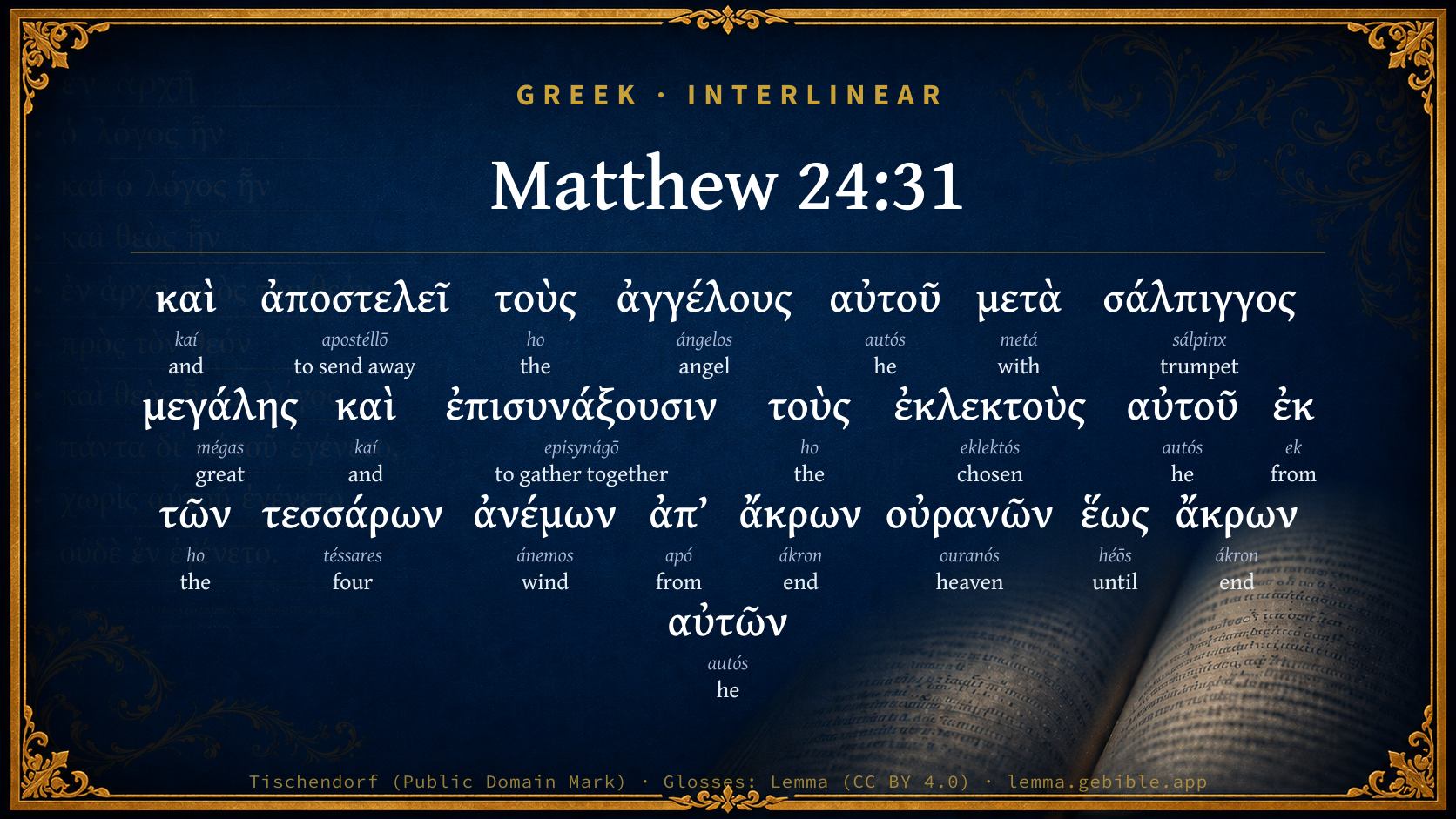
Greek (Tischendorf 8th ed.) Matthew 24:31 appears in the Greek New Testament. The text above is from the Tischendorf 8th edition. Each word links to its Strong’s number and a concise gloss. Click any word for its full Thayer’s Greek Lexicon entry.
Download image
Cite this verse

Matthew 24:31 (World English Bible). Public Domain. Lemma interlinear Bible study tool, https://lemma.gebible.app/v/matthew/24/31.

Show BibTeX & RIS
BibTeX
RIS
English Translation
He will send out his angels with a great sound of a trumpet, and they will gather together his chosen ones from the four winds, from one end of the sky to the other.
World English Bible · Public Domain
Highlights
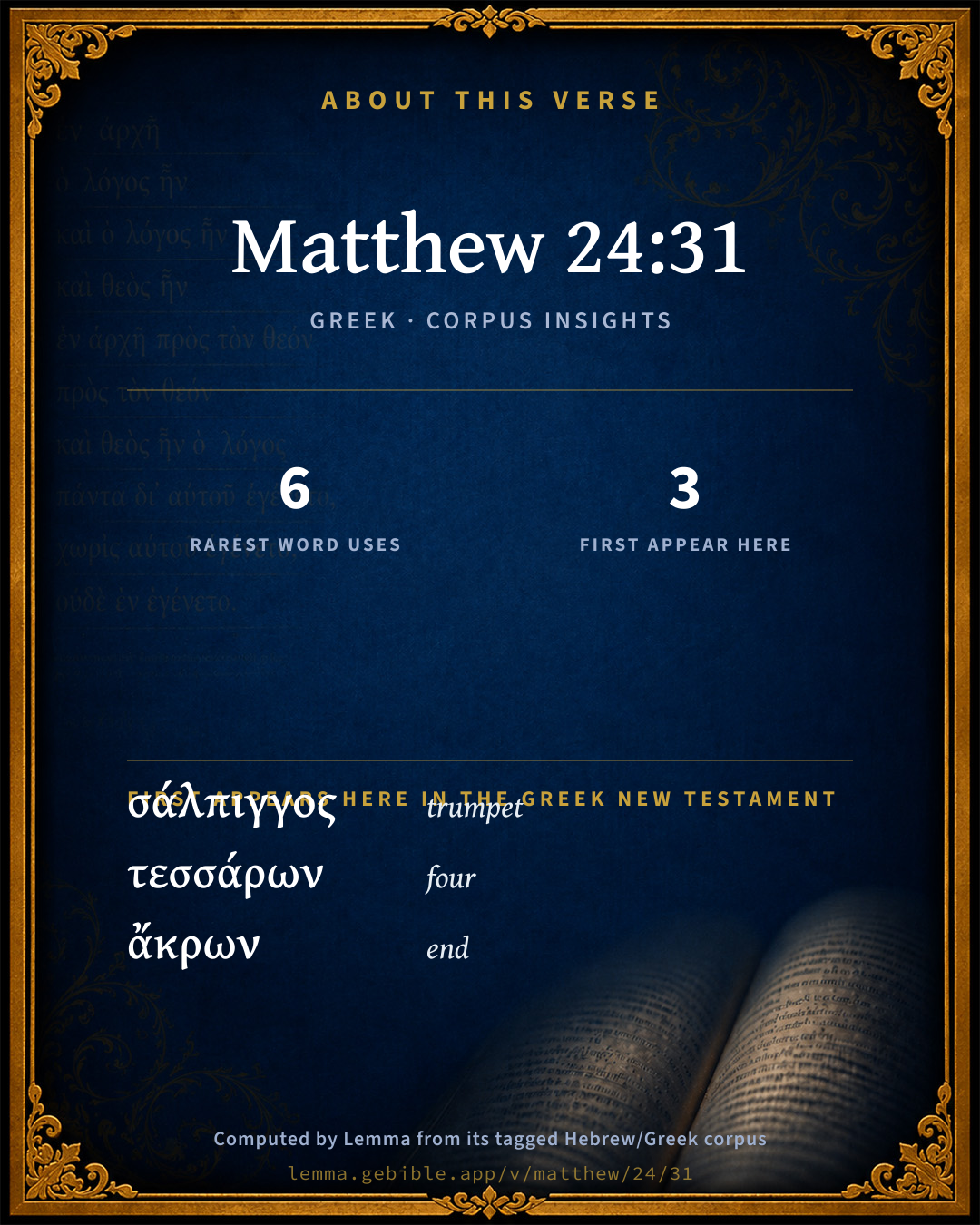
  • 3 first appearances in the Greek New Testament
Full analysis ↓
Download a study sheet

One document with this verse’s original text, its word-by-word gloss line, the meaning frame, cross-references with their text, attributed commentary, and full source and license credits — printable, and it pastes into notes with its structure intact.

This verse Autodidact and up

Study sheet (.html) Plain text (.txt)

A passage Seminary Student

Up to 50 verses in one chapter. A passage sheet keeps up to 6 commentary sources and 12 cross-references per verse, in the order this page ranks them, and says so on the sheet whenever that leaves anything out. Ask for a single verse and you get the Autodidact verse sheet above.

Everything on this page stays free to read, with no account — the sheet is a download of what is already on screen, not access to it.

Want to remove ads? Support Godless Engineer
Compare translations 3

The same verse in 3 English versions, stacked beneath the original-language interlinear above. Click any original word for its lexicon entry.

Each is an independent rendering of the whole verse — the interlinear is not word-aligned to these translations.

Highlighted words mark where these versions differ — a whole-verse word diff, not a word-by-word alignment.

  • World English Bible Public Domain
    He will send out his angels with a great sound of a trumpet, and they will gather together his chosen ones from the four winds, from one end of the sky to the other.
  • King James Version Public Domain
    And he shall send his angels with a great sound of a trumpet, and they shall gather together his elect from the four winds, from one end of heaven to the other.
  • unfoldingWord Literal Text CC BY-SA 4.0
    And he will send his angels with a great trumpet, and they will gather together his elect from the four winds, from the ends of the heavens to the ends of them.

unfoldingWord Literal Text — © unfoldingWord, licensed CC BY-SA 4.0. Word-aligned USFM3 via Door43 (git.door43.org/unfoldingWord/en_ult).

Versions to compare (up to 4)

3 of 4 selected

Show all 19 translations

Every available English version of this verse, each an independent rendering of the whole verse.

  • World English Bible Public Domain
    He will send out his angels with a great sound of a trumpet, and they will gather together his chosen ones from the four winds, from one end of the sky to the other.
  • Berean Standard Bible Public Domain
    And He will send out His angels with a loud trumpet call, and they will gather His elect from the four winds, from one end of the heavens to the other.
  • Majority Standard Bible Public Domain
    And He will send out His angels with a loud trumpet call, and they will gather His elect from the four winds, from one end of the heavens to the other.
  • King James Version Public Domain
    And he shall send his angels with a great sound of a trumpet, and they shall gather together his elect from the four winds, from one end of heaven to the other.
  • American Standard Version (1901) Public Domain
    And he shall send forth his angels with a great sound of a trumpet, and they shall gather together his elect from the four winds, from one end of heaven to the other.
  • Revised Version (1885) Public Domain
    And he shall send forth his angels with a great sound of a trumpet, and they shall gather together his elect from the four winds, from one end of heaven to the other.
  • Geneva Bible (1599) Public Domain
    And he shall send his Angels with a great sound of a trumpet, and they shall gather together his elect, from the foure windes, and from the one ende of the heauens vnto the other.
  • Douay-Rheims (1899) Public Domain
    And he shall send his angels with a trumpet, and a great voice: and they shall gather together his elect from the four winds, from the farthest parts of the heavens to the utmost bounds of them.
  • Young's Literal Translation Public Domain
    and he shall send his messengers with a great sound of a trumpet, and they shall gather together his chosen from the four winds, from the ends of the heavens unto the ends thereof.
  • Literal Standard Version CC BY-SA 4.0
    and He will send His messengers with a great sound of a trumpet, and they will gather together His chosen from the four winds, from the ends of the heavens to the ends thereof.
  • Unlocked Literal Bible CC BY-SA 4.0
    He will send his angels with a great sound of a trumpet, and they will gather together his elect from the four winds, from one end of the sky to the other.
  • unfoldingWord Literal Text CC BY-SA 4.0
    And he will send his angels with a great trumpet, and they will gather together his elect from the four winds, from the ends of the heavens to the ends of them.
  • Darby Bible Public Domain
    And he shall send his angels with a great sound of trumpet, and they shall gather together his elect from the four winds, from [the one] extremity of [the] heavens to [the other] extremity of them.
  • World Messianic Bible Public Domain
    He will send out his angels with a great sound of a shofar, and they will gather together his chosen ones from the four winds, from one end of the sky to the other.
  • Webster's Bible Public Domain
    And he will send his angels with a great sound of a trumpet, and they will gather his elect from the four winds, from one end of heaven to the other.
  • Free Bible Version CC BY-SA 4.0
    With a blast from a trumpet he will send his angels to gather his chosen ones from every place, from one end of heaven and earth to the other.
  • Bible in Basic English Public Domain
    And he will send out his angels with a great sound of a horn, and they will get his saints together from the four winds, from one end of heaven to the other.
  • Text-Critical English NT CC BY 4.0
    And he will send his angels with a loud trumpet call, and they will gather together his chosen from the four winds, from one end of the heavens to the other.
  • Tyndale New Testament (1534) Public Domain
    And he shall sende his angeles with the greate voyce of a trope and they shall gader to gether his chosen from the fower wyndes and from the one ende of the worlde to the other.

Literal Standard Version (2020), Covenant Press — licensed CC BY-SA 4.0. Text via the HelloAO Bible API (eBible.org). Unlocked Literal Bible (unfoldingWord) — licensed CC BY-SA 4.0. Text via the HelloAO Bible API (eBible.org). unfoldingWord Literal Text — © unfoldingWord, licensed CC BY-SA 4.0. Word-aligned USFM3 via Door43 (git.door43.org/unfoldingWord/en_ult). Free Bible Version, Dr. Jonathan Gallagher — licensed CC BY-SA 4.0. Text via the HelloAO Bible API (eBible.org).

Word by word

More ways to search: Search by grammar → Find every occurrence → Compare this word →

Practice this passage: Drill this verse → Learn its vocabulary →

ἄκρων
ákron
G206
“end”
Noun, Genitive, Plural, Neuter
Part of Speech
Noun
Case
Genitive
Number
Plural
Gender
Neuter
Full Thayer's Definition

Origin: neuter of an adj. probably akin to the base of G188

TDNT: None

1. the farthest bounds, uttermost parts, end, highest, extreme a. of the earth b. of heaven
  1. καὶ kaí G2532 “and” Conjunction
  2. ἀποστελεῖ apostéllō G649 “to send away” Verb, Future, Active, Indicative, 3rd person, Singular
  3. τοὺς ho G3588 “the” Article, Accusative, Plural, Masculine
  4. ἀγγέλους ángelos G32 “angel” Noun, Accusative, Plural, Masculine
  5. αὐτοῦ autós G846 “he” Personal pronoun, Genitive, Singular, Masculine
  6. μετὰ metá G3326 “with” Preposition
  7. σάλπιγγος sálpinx G4536 “trumpet” Noun, Genitive, Singular, Feminine
  8. μεγάλης mégas G3173 “great” Adjective, Genitive, Singular, Feminine
  9. καὶ kaí G2532 “and” Conjunction
  10. ἐπισυνάξουσιν episynágō G1996 “to gather together” Verb, Future, Active, Indicative, 3rd person, Plural
  11. τοὺς ho G3588 “the” Article, Accusative, Plural, Masculine
  12. ἐκλεκτοὺς eklektós G1588 “chosen” Adjective, Accusative, Plural, Masculine
  13. αὐτοῦ autós G846 “he” Personal pronoun, Genitive, Singular, Masculine
  14. ἐκ ek G1537 “from” Preposition
  15. τῶν ho G3588 “the” Article, Genitive, Plural, Masculine
  16. τεσσάρων téssares G5064 “four” Adjective, Genitive, Plural, Masculine
  17. ἀνέμων ánemos G417 “wind” Noun, Genitive, Plural, Masculine
  18. ἀπ’ apó G575 “from” Preposition
  19. οὐρανῶν ouranós G3772 “heaven” Noun, Genitive, Plural, Masculine
  20. ἕως héōs G2193 “until” Adverb
  21. ἄκρων ákron G206 “end” Noun, Genitive, Plural, Neuter
  22. αὐτῶν autós G846 “he” Personal pronoun, Genitive, Plural, Masculine

About this verse

These counts appear in no published source. They are computed here, from the morphology-tagged text and Lemma’s own curated glosses. What Lemma adds →

23
words
17
distinct lemmas
Gospels
section

Notable vocabulary

The rarest word here is ἄκρων end G206 — appearing just 6 times in the whole Greek New Testament.

First appearance in Scripture

These words make their first canonical appearance in the Greek New Testament here:

  • σάλπιγγος trumpet G4536
  • τεσσάρων four G5064
  • ἄκρων end G206

Shared distinctive vocabulary

ἄκρων end G206 occurs in 4 verses of the Greek New Testament. Also found in:
Repetition

Words recur within this verse:

  • ἄκρων end G206 ×2
  • τοὺς the G3588 ×3
  • αὐτοῦ he G846 ×3
  • καὶ and G2532 ×2

Cross-references

37

Topical passages linked to Matthew 24:31 in the Treasury of Scripture Knowledge — connected by theme and wording, ordered by reader-vote popularity; previews shown in the World English Bible.

  • 1 Thessalonians 4:16 For the Lord himself will descend from heaven with a shout, with the voice of the archangel, and with God's trumpet. The dead in Christ will rise first,
  • Mark 13:27 Then he will send out his angels, and will gather together his chosen ones from the four winds, from the ends of the earth to the ends of the sky.
  • Isaiah 27:13 It shall happen in that day, that a great trumpet shall be blown; and they shall come who were ready to perish in the land of Assyria, and those who were outcasts in the land of Egypt; and they shall worship Yahweh in the holy mountain at Jerusalem.
  • 1 Corinthians 15:52 in a moment, in the twinkling of an eye, at the last trumpet. For the trumpet will sound, and the dead will be raised incorruptible, and we will be changed.
  • Isaiah 11:12 He will set up an ensign for the nations, and will assemble the outcasts of Israel, and gather together the dispersed of Judah from the four corners of the earth.
  • Matthew 13:41 The Son of Man will send out his angels, and they will gather out of his Kingdom all things that cause stumbling, and those who do iniquity,
  • 2 Thessalonians 2:1 Now, brothers, concerning the coming of our Lord Jesus Christ, and our gathering together to him, we ask you
  • Psalms 22:27 All the ends of the earth shall remember and turn to Yahweh. All the relatives of the nations shall worship before you.
  • Isaiah 43:6 I will tell the north, Give up; and to the south, Don't keep back; bring my sons from far, and my daughters from the end of the earth;
  • Isaiah 45:22 Look to me, and be you saved, all the ends of the earth; for I am God, and there is none else.
  • Isaiah 60:4 Lift up your eyes round about, and see: they all gather themselves together, they come to you; your sons shall come from far, and your daughters shall be carried in the arms.
  • Matthew 25:31 "But when the Son of Man comes in his glory, and all the holy angels with him, then he will sit on the throne of his glory.
  • Ephesians 1:10 to an administration of the fullness of the times, to sum up all things in Christ, the things in the heavens, and the things on the earth, in him;
  • Isaiah 13:5 They come from a far country, from the uttermost part of heaven, even Yahweh, and the weapons of his indignation, to destroy the whole land.
  • Isaiah 49:18 Lift up your eyes round about, and see: all these gather themselves together, and come to you. As I live, says Yahweh, you shall surely clothe you with them all as with an ornament, and gird yourself with them, like a bride.
  • Zechariah 2:6 Come! Come! Flee from the land of the north,' says Yahweh; 'for I have spread you abroad as the four winds of the sky,' says Yahweh.
  • John 11:52 and not for the nation only, but that he might also gather together into one the children of God who are scattered abroad.
  • Revelation 14:6–9 I saw an angel flying in mid heaven, having an eternal Gospel to proclaim to those who dwell on the earth, and to every nation, tribe, language, and people.
  • Deuteronomy 30:4 If [any of] your outcasts are in the uttermost parts of the heavens, from there will Yahweh your God gather you, and from there will he bring you back:
  • Zechariah 9:14 Yahweh will be seen over them; And his arrow will go flash like lightning; And the Lord Yahweh will blow the trumpet, And will go with whirlwinds of the south.
  • Revelation 7:1 After this, I saw four angels standing at the four corners of the earth, holding the four winds of the earth, so that no wind would blow on the earth, or on the sea, or on any tree.
  • Numbers 10:1–10 Yahweh spoke to Moses, saying,
  • Psalms 67:7 God will bless us. All the ends of the earth shall fear him.
  • Psalms 81:3 Blow the trumpet at the New Moon, At the full moon, on our feast day.
  • Isaiah 42:10 Sing to Yahweh a new song, and his praise from the end of the earth; you who go down to the sea, and all that is therein, the isles, and the inhabitants of it.
  • Daniel 7:2 Daniel spoke and said, I saw in my vision by night, and, behold, the four winds of the sky broke forth on the great sea.
  • Zechariah 14:5 You shall flee by the valley of my mountains; for the valley of the mountains shall reach to Azel; yes, you shall flee, just like you fled from before the earthquake in the days of Uzziah king of Judah. Yahweh my God will come, and all the holy ones with you.
  • Matthew 24:22 Unless those days had been shortened, no flesh would have been saved. But for the sake of the chosen ones, those days will be shortened.
  • Matthew 28:18 Jesus came to them and spoke to them, saying, "All authority has been given to me in heaven and on earth.
  • Romans 10:18 But I say, didn't they hear? Yes, most assuredly, "Their sound went out into all the earth, Their words to the ends of the world."
  • Revelation 8:2 I saw the seven angels who stand before God, and seven trumpets were given to them.
  • Zechariah 9:10 I will cut off the chariot from Ephraim, And the horse from Jerusalem; And the battle bow will be cut off; And he will speak peace to the nations: And his dominion will be from sea to sea, And from the River to the ends of the earth.
  • Mark 16:15–16 He said to them, "Go into all the world, and preach the Gospel to the whole creation.
  • Luke 24:47 and that repentance and remission of sins should be preached in his name to all the nations, beginning at Jerusalem.
  • Acts 26:19–20 "Therefore, King Agrippa, I was not disobedient to the heavenly vision,
  • Revelation 11:15 The seventh angel sounded, and great voices in heaven followed, saying, "The kingdom of the world has become the Kingdom of our Lord, and of his Christ. He will reign forever and ever!"
  • Revelation 1:20–2:1 the mystery of the seven stars which you saw in my right hand, and the seven golden lampstands. The seven stars are the angels of the seven assemblies. The seven lampstands are seven assemblies.

Cross-references courtesy of OpenBible.info (CC BY 4.0).

Commentary

Notes on Matthew 24:31 from classic Christian and Jewish commentators (each source and its license shown beneath its notes). The classic Christian expositions comment on the surrounding passage and are grouped to its opening verse, so a note may address several verses; the Jewish commentaries on the Tanakh (Rashi and others) are per-verse, so they appear only where the commentator wrote on this verse.

Lemma curates 59 commentaries, every one of them public domain or Creative Commons licensed, each selected and text-cleaned for this edition rather than reprinted as found. About our sources →

Tyndale Open Study Notes

Tyndale Open Resources

24:31 Many believe that the rapture of God’s people through angels (13:41; 16:27; 25:31) is predicted here. Others believe that angels (Greek angeloi, “messengers”) here are human messengers (11:10; Luke 7:24; 9:52; Jas 2:25) and that Jesus is describing the expansion of the Good News among Gentiles (see Matt 21:33-46; 22:1-14; Deut 30:1-10; Isa 27:13; Zech 2:6-13).

Tyndale Open Study Notes — © Tyndale Open Resources, licensed CC BY-SA 4.0. Text via the HelloAO Bible API.

Bengel's Gnomon

Johann Albrecht Bengel

Mat 24:31. Τοῦς ἀγγελους Αὐτοῦ, His angels) It is likely enough that a certain number of angels may be called peculiarly the angels of Christ, although all are subject to Him.—σάλπιγγος, of a trumpet) Trumpets are employed to call multitudes together; that trumpet will have a loud voice [Eng. Vers, great sound].—ἐπισυνάξουσι, they shall gather together) Cf. 2Th 2:1.—ἀπʼ ἄκρων οὐρανῶν, from the extremities of the heavens) In Mar 13:27, We have ἀπʼ ἄκρου γῆς from the uttermost part of the earth.—ἄκρον signifies any extremity. Where the earth ends, there the heaven begms: whence it happens, that the mountains and the heavens also sometimes represent each other in parallel passages. Cf. 2Sa 22:8 with Psa 18:8 (7). It corresponds with the Hebrew (extremity). In Deu 30:4, the LXX. have ἀπʼ ἄκρου τοῦ οὐρανοῦ ἕως ἄκρου τοὐ οὐρανοῦ,” from [the one] extremity of the heaven to [the other] extremity of the heaven;” and thus also in Deu 4:32.

Bengel's Gnomon of the New Testament — English translation (T&T Clark, Edinburgh, 1860) — public domain. Text from a community e-Sword module.

Meyer's Critical & Exegetical Commentary

Heinrich August Wilhelm Meyer

Mat_24:31. Καὶ ἀποστελεῖ] And He will send forth, i.e. from the clouds of heaven, 1Th_4:16-17.

τοὺς ἀγγέλους αὐτοῦ] the angels specially employed in His service.

μετὰ σάλπιγγος φωνῆς μεγάλ.] with (having as an accompaniment) a trumpet of a loud sound. The second genitive qualifies and is governed by the first; see Buttmann, Neut. Gr. p. 295 [E. T. 343]. The idea is not that the individual angels blow trumpets, but what is meant (Isa_27:13) is the last trumpet (1Co_15:52), the trumpet of God (1Th_4:16), which is sounded while the Messiah is sending forth the angels. The resurrection of believers is also to be understood as taking place on the sound of this trumpet being heard (1 Cor. as above; 1 Thess. as above).

ἐπισυνάξουσι] gather together (Mat_23:27; 2Th_2:1; 2Ma_1:27; 2Ma_2:18), namely, toward the place where He is in the act of appearing upon earth. This gathering together of the elect, which is to be a gathering from every quarter (comp. Rev_1:7), and from the whole compass of the earth, is an act and accompaniment of the second advent (in answer to Cremers distinction, see Hoelemann, p. 171). But the ἁρπάζεσθαι εἰς ἀέρα, to meet the Lord as He approaches (1Th_4:17), is to be regarded as taking place after this gathering together has been effected.

τοὺς ἐκλεκτ. αὐτοῦ] the elect belonging to Him (chosen by God for the Messianic kingdom, as in Mat_24:22). Comp. Rom_1:6.

ἀπὸ ἄκρων οὐραν.] ab extremitatibus coelorum usque ad extremitates eorum, i.e. from one horizon to the other (for οὐρανῶν without the article, see Winer, p, 115 [E. T. 150]), therefore from the whole earth (Mat_24:14), on which the extremities of the sky seem to rest. Deu_4:32; Deu_30:4; Psa_19:7.

As showing the exegetical abuses to which this grand passage has been subjected, take the following, Lightfoot: emittet filius homines ministros suos cum tuba evangelica, etc.; Kuinoel (comp. Wetstein): in tanta calamitate Judaeis, adversariis religionis Christianae, infligenda, ubivis locorum Christi sectatores per dei providentiam illaesi servabuntur, etc.; Olshausen: he will send out men armed with the awakening power of the Spirit of God, for the purpose of assembling believers at a place of safety. This is substantially the view of Tholuck also.

It may be observed, moreover, that this passage forbids the view of Köstlin, p. 26, that our Gospel does not contain a specifically Christian, but merely an ethical universalism (as contrasted with Jewish obduracy). See, on the other hand, especially Mat_8:11, Mat_22:9 f., Mat_25:31 ff., Mat_28:19, etc.

Meyer — Critical and Exegetical Commentary on the New Testament — English translation by Peter Christie, edited by Frederick Crombie (T&T Clark, 1880) — public domain. Text from a community e-Sword module.

Expositor's Greek Testament

ed. W. Robertson Nicoll

Mat 24:31 . μετὰ σάλπιγγος φ . μ ., with a trumpet of mighty sound, another stock phrase of prophetic imagery (Isa 27:13 ). καὶ ἐπισυνάξουσι τοὺς ἐκλεκτοὺς α ., and they (the angels or messengers) shall collect the elect (as in Mat 24:22 ; Mat 24:24 ), showing that the advent is described in terms suited to the situation previously depicted. The Christ comes for the comfort of those preserved from the general ruin. ἐκ τῶν τ . ἀνέμων : not merely from the mountains east of the Jordan, but from every quarter of the arth where faithful souls are found; tho of Isa 27:13 again audible here.- ἀπʼ ἄκρων , etc., echo of phrases in Deu 30:4 , Psa 19:7 . This Parusialogion is not to be regarded as a didactic statement, but simply as a λόγος παρακλήσεως for the comfort of anxious spirits. With that aim it naturally places the Parusia within the reach of those it is designed to comfort. After the ruin of Israel there is no history; only the wind-up. Jerusalem destroyed, the curtain falls. Christ’s didactic words suggest another aspect, a delayed Parusia, vide on Mat 16:28 . From the foregoing exposition it appears that the coming of the Son of Man is not to be identified with the judgment of Jerusalem, but rather forms its preternatural background.

The Expositor's Greek Testament, edited by W. Robertson Nicoll (1897–1910) — public domain. Text from a community e-Sword module.

Geneva Bible (1599)

Geneva Bible translators

From the four quarters of the world.

Geneva Bible (1599) marginal notes — public domain. Text via Bolls.life.

Adam Clarke's Commentary

Verse 31. He shall send his angels] τους αγγελους, his messengers, the apostles, and their successors in the Christian ministry.

With a great sound of a trumpet] Or, a loud-sounding trumpet - the earnest affectionate call of the Gospel of peace, life, and salvation.

Shall gather together his elect] The Gentiles, who were now chosen or elected, in place of the rebellious, obstinate Jews, according to Our Lord's prediction, Mt 8:11-12, and Lu 13:28-29. For the children of the kingdom, (the Jews who were born with a legal right to it, but had now finally forfeited that right by their iniquities) should be thrust out. It is worth serious observation, that the Christian religion spread and prevailed mightily after this period: and nothing contributed more to the success of the Gospel than the destruction of Jerusalem happening in the very time and manner, and with the very circumstances, so particularly foretold by our Lord. It was after this period that the kingdom of Christ began, and his reign was established in almost every part of the world.

To St. Matthew's account, St. Luke adds, Lu 21:24, They shall fall by the edge of the sword, and shalt be led away captive into all nations; and Jerusalem shall be trodden down by the Gentiles, till the times of the Gentiles be fulfilled. The number of those who fell by the sword was very great. ELEVEN HUNDRED THOUSAND perished during the siege. Many were slain at other places, and at other times. By the commandment of Florus, the first author of the war, there were slain at Jerusalem 3,600, Jos. WAR, b. ii. c. 14. By the inhabitants of Caesarea, above 20,000. At Scythopolis, above 13,000. At Ascalon, 2,500. At Ptolemais, 2,000. At Alexandria, 50,000. At Joppa, when taken by Cestius Gallus, 8,400. In a mountain called Asamon, near Sepporis, above 2,000. At Damascus, 10,000. In a battle with the Romans at Ascalon, 10,000. In an ambuscade near the same place, 8,000. At Japha, 15,000. Of the Samaritans, on Mount Gerizim, 11,600. At Jotapa, 40,000. At Joppa, when taken by Vespasian, 4,200. At Tarichea, 6,500. And after the city was taken, 1,200. At Gamala, 4,000, besides 5,000 who threw themselves down a precipice. Of those who fled with John, of Gischala, 6,000. Of the Gadarenes, 15,000 slain, besides countless multitudes drowned. In the village of Idumea, above 10,000 slain. At Gerasa, 1,000. At Machaerus, 1,700. In the wood of Jardes, 3,000. In the castle of Masada, 960. In Cyrene, by Catullus the governor, 3,000. Besides these, many of every age, sex, and condition, were slain in the war, who are not reckoned; but, of those who are reckoned, the number amounts to upwards of 1,357,660, which would have appeared incredible, if their own historian had not so particularly enumerated them. See Josephus, WAR, book ii. c. 18, 20; book iii. c. 2, 7, 8, 9; book iv. c. 1, 2, 7, 8, 9; book vii. c. 6, 9, 11; and Bp. Newton, vol. ii. p. 288-290.

Many also were led away captives into all nations. There were taken at Japha, 2,130. At Jotapa, 1,200. At Tarichea, 6,000 chosen young men, who were sent to Nero; others sold to the number of 30,400, besides those who were given to Agrippa. Of the Gadarenes were taken 2,200. In Idumea above 1,000. Many besides these were taken in Jerusalem; so that, as Josephus says, the number of the captives taken in the whole war amounted to 97,000. Those above seventeen years of age were sent to the works in Egypt; but most were distributed through the Roman provinces, to be destroyed in their theatres by the sword, and by the wild beasts; and those under seventeen years of age were sold for slaves. Eleven thousand in one place perished for want. At Caesarea, Titus, like a thorough-paced infernal savage, murdered 2,500 Jews, in honour of his brother's birthday; and a greater number at Berytus in honour of his father's. See Josephus, WAR, b. vii. c. 3. s. 1. Some he caused to kill each other; some were thrown to the wild beasts; and others burnt alive. And all this was done by a man who was styled, The darling of mankind! Thus were the Jews miserably tormented, and distributed over the Roman provinces; and continue to be distressed and dispersed over all the nations of the world to the present day. Jerusalem also was, according to the prediction of our Lord, to be trodden down by the Gentiles. Accordingly it has never since been in the possession of the Jews. It was first in subjection to the Romans, afterwards to the Saracens, then to the Franks, after to the Mamalukes, and now to the Turks. Thus has the prophecy of Christ been most literally and terribly fulfilled, on a people who are still preserved as continued monuments of the truth of our Lord's prediction, and of the truth of the Christian religion. See more in Bp. Newton's Dissert. vol. ii. p. 291, &c.

Adam Clarke's Commentary on the Bible (1810–1826) — public domain. Text from a community e-Sword/MySword module.

Ellicott's Commentary for English Readers

(31) He shall send his angels.—The words are memorable as the formal expansion of what had been, as it were, hinted before in the parables of the Tares (Mat_13:41) and the Net (Mat_13:49).

With a great sound of a trumpet.—The better MSS. omit “sound:” With a great trumpet. We know not, and cannot know, what reality will answer to this symbol, but it is interesting to note how deeply it impressed itself on the minds not only of the disciples who heard it, but of those who learnt it from them. When St. Paul speaks of the “trumpet” that shall “sound” (1Co_15:52), of “the voice of the archangel and the trump of God” (1Th_4:16), we feel that he was reproducing what had been thus proclaimed, and that his eschatology, or doctrine of the last things, was based on a knowledge of, at least, the substance of the great prophetic discourse recorded in the Gospels.

They shall gather together his elect.—The “elect” are the same in idea, though not necessarily the same individuals, as those for whom the days were to be shortened in Mat_24:22; and the work of the angels is that of gathering them, wherever they may be scattered, into the one fold. As with so many of the pregnant germs of thought in this chapter, the work of the angels is expanded by the visions of the Apocalypse, when the seer beheld the angels come and seal the hundred and forty-four thousand in their foreheads before the work of judgment should begin (Rev_7:2). In each case the elect are those who are living on the earth at the time of the second Advent. In these chapters there is, indeed, no distinct mention of the resurrection of the dead, though they, as well as the living, are implied in the parable of judgment with which the discourse ends.

A Bible Commentary for English Readers, edited by Charles John Ellicott (1878–1897) — public domain. Text from a community e-Sword module.

The Cambridge Bible for Schools and Colleges

gen. ed. J. J. S. Perowne

31. with a great sound of a trumpet] Omit “sound” on high MS. authority, translate with a great trumpet. The image would be suggestive to the Jews, who were called together in the camp by silver trumpets (Num_10:2 foll.). Moreover, the great festivals, the commencement of the year, and other celebrations were announced by trumpets.

The Cambridge Bible for Schools and Colleges (gen. ed. J. J. S. Perowne; Cambridge University Press, 1878–1918) — public domain. Text from a community e-Sword module.

John Gill's Exposition

Now learn a parable of the fig tree,.... Take a similitude, or comparison from the fig tree, which was a tree well known in Judea; and the putting forth of its branches, leaves, and fruit, fell under the observation of everyone:

when its branch is yet tender; through the influence of the sun, and the motion of the sap, which was bound up, and congealed in the winter season:

and putteth forth leaves; from the tender branches, which swell, and open, and put forth buds, leaves, and fruit:

ye know the summer is nigh; spring being already come: the fig tree putting forth her green figs, is a sign that the winter is past, the spring is come, and summer is at hand; see Sol 2:11.

John Gill's Exposition of the Whole Bible (1746–1763) — public domain (CC PDM 1.0). Text via the HelloAO Bible API.

Trapp's Complete Commentary

John Trapp

31 And he shall send his angels with a great sound of a trumpet, and they shall gather together his elect from the four winds, from one end of heaven to the other.

Ver. 31. And he shall send his angels] As his apparitors (heralds) and executioners. David went otherwise attended when he went against Nabal than when against Goliath; so Christ shall come, when he shall come again with his troops and trumpets.

With a great sound of a trumpet] Christ shall put forth his own mighty voice Joh 5:28; 1Th 4:16, ministered by his angels, as in the text, and set forth by the sound of a trumpet, in allusion, belike, to Num 10:1-11, where the people were congregated and called together by the sound of a trumpet to the door of the tabernacle. "The lion of the tribe of Judah shall roar from above, and thrust out his voice from his holy habitation, when he entereth into judgment with all flesh," Jer 25:30-31. As the lion roareth over his whelps, brought forth dead at first, and raiseth them from death to life, as Pliny reporteth.

And they shall gather together his elect] How shall they know them from reprobates? By God’s saving mark set fairly in their foreheads, Eze 9:9. {a} And by their blithe and merry countenances, cleared and cheered in the apprehension and approach of their full redemption, now drawing nigh. Besides, as servants know their master’s harvest from another’s, and can easily discern the corn from the cockle, so can the good angels soon single out the elect, about whom they have been familiarly conversant here on earth, as ministering spirits sent forth to minister to the heirs of salvation, ready pressed to any good office about them, Heb 1:14.

{a} Signo salutari. Tremel.

John Trapp, A Commentary or Exposition upon All the Books of the Old and New Testament (1647–1656) — public domain. Text from a community e-Sword module.

Albert Barnes' Notes on the Bible

And he shall send his angels - “Angels” signify, literally, “messengers,” Luk 7:24; Luk 9:52. The word is often applied to inanimate objects, or to anything that God employs to rescue his people from danger Psa 104:4; but it most commonly refers to the race of intelligent beings more exalted than man, who are employed often in the work of man’s rescue from ruin, and aiding his salvation, Heb 1:14. In either of these senses it might here refer to deliverance granted to his people in the calamities of Jerusalem. It is said that there is reason to believe that not one Christian perished in the destruction of that city, God having in various ways secured their escape, so that they fled to Pella, where they lived when the city was destroyed. But the language seems to refer rather to the end of the world, and, no doubt, its principal application was intended to be to the gathering of his elect at the day of judgment:

With a great sound of a trumpet - The Jewish assemblies used to be called together by the sound of a trumpet, as ours are by bells, Lev 25:9; Num 10:2; Jdg 3:27. Hence, when they spoke of convening an assembly, they spoke also of doing it by sounding a trumpet. Our Saviour, speaking to Jews, used language to which they were accustomed, and described the assembling of the people at the last day in language which they were accustomed to use in calling assemblies together. It is not certain, however, that he meant that this would be literally so, but it may be designed only to denote the certainty that the “world would be assembled together.” Similar language is often used when speaking of the judgment, 1Th 4:16; 1Co 15:52. A trump, or trumpet, was a wind instrument, made at first from the horns of oxen, and afterward of rams’ horns, cut off at the smaller extremity. In some instances it was made of brass, in the form of a horn. The common trumpet was straight, made of brass or silver, a cubit in length, the larger extremity shaped so as to resemble a small bell. In times of peace, in assembling the people, this was sounded softly. In times of calamity, or war, or any great commotion, it was sounded loud. Perhaps this was referred to when our Saviour said, with a great sound of a trumpet.

They shall gather together his elect - Elect. See the notes at Mat 24:22. The word means Christians - the chosen of God. If this refers to the destruction of Jerusalem, it means, “God shall send forth his messengers - whatever he may choose to employ for that purpose: signs, wonders, human messengers, or the angels themselves - and gather Christians into a place of safety, so that they shall not be destroyed with the Jews.” If it refers to the last judgment, as it doubtless in a primary or secondary sense does, then it means that he will send his angels to gather his chosen, his elect, together from all places, Mat 13:39, Mat 13:41-43. This shall be done before the living shall be changed, 1Co 15:51-52; 1Th 4:16-17.

From the four winds - That is, from the four quarters of the globe - east, west, north, and south. The Jews expressed those quarters by the winds blowing from them See Eze 37:9. See also Isa 43:5-6. “From one end of heaven, etc.” Mark says Mar 13:27, from the uttermost part of the earth to the uttermost part of heaven. The expression denotes that they shall be gathered from all parts of the earth where they are scattered. The word “heaven” is used here to denote the “visible” heavens or the sky, meaning that through “the whole world” he would gather them. See Psa 19:1-7; Deu 4:32.

Albert Barnes' Notes on the Bible (1834–1885) — public domain. Text from a community e-Sword/MySword module.

Whedon's Commentary on the Bible

Daniel D. Whedon

31. Send his angels — To call the nations before his throne, where on different sides they all appear before him. 25-32. Angels are ever described as attending the judgment presence. Mat_13:40; Rev_1:7 : 1Th_4:16. Gather… his elect — Separately, in a glorious resurrection order, both living and dead, at Christ’s right hand. Afterward the wicked are in like manner taken, perhaps by evil angels, to the left of the judge. The separation will be awfully sudden, as described in Mat_24:40-41. From the four winds — The ancient mode of describing the entire globe was by the number four; as the earth was held to consist of four quarters, to be subject to the four points of compass, from which the four winds blowing are so called.

Thus the grand prelude is prepared, to be continued and consummated at Mat_25:31-46.

But before proceeding to that finishing of the picture, our Lord pauses to illustrate what he has given, by parabolic images. In the remainder of this chapter, in contrast with the slow approach of the destruction of Jerusalem, he illustrates the unexpectedness of the advent to a revelling world by the parallel of the flood; its suddenness to the revelling individual by the parable of the drunken servant. In the next chapter he illustrates its inflexible suddenness to the sleeping dead by the slumbering virgins; its graduated justice to each man’s character by the talents; and then, closing chapter 25, does the END come.

Daniel D. Whedon (gen. ed.), Commentary on the Old and New Testaments (1874–1909) — public domain. Text from a community e-Sword module.

The Pulpit Commentary

His angels. As the executors of his will, to bring before his throne all who have to be judged. They have the same office in the parable of the tares and the wheat. (Mat_13:41) With a great sound of a trumpet (meta salpiggov fwnhv megalhv , which may also mean, with a trumpet of great sound). Some manuscripts, with the Vulgate, read, "with a trumpet and a great voice;" others, "with a great trumpet," omitting "voice." All, however, agree in asserting the employment of the trumpet on this momentous occasion. (comp. 1Co_15:52 1Th_4:16) The term may be metaphorical for a voice exceeding loud; (comp. Rev_1:10 Rev_4:1) but it is more probably to be taken in the obvious sense, with a reference to its use among the Jews in calling the assembly and giving the alarm. Of course, the occurrence is supernatural. It is, indeed, as great a miracle for a sound to be heard simultaneously in both hemispheres as it is for Christ to be seen at the same moment by all dwellers on the globe. This is a matter to be believed, not explained. Shall gather together his elect. The angels will infallibly select these from the mass of men, either by spiritual insight or Divine direction. The elect are not Israelites alone, but true believers of all nations. (see ver. 14 and Joh_17:20, Joh_17:21) These are first collected, and then the reprobate are summoned, according to Mat_25:41. From the four winds. The four cardinal points, i.e. from every quarter of the earth. Four is the number of the world or the universe. From one end...the other; literally , from the ends of the heavens unto their end, as Deu_4:32 a parallel to the preceding clause. From horizon to horizon, thoughthis expression, taken literally, is not extensive enough.

The Pulpit Commentary (1880–1919), ed. H.D.M. Spence-Jones & Joseph S. Exell — public domain. Text from a community e-Sword module.

John Wesley's Explanatory Notes

They shall gather together his elect - That is, all that have endured to the end in the faith which worketh by love.

John Wesley, Explanatory Notes Upon the Whole Bible (1754–1765) — public domain. Text via the GEBible commentary corpus.

Scofield Reference Notes

C. I. Scofield

angels

(See Scofield "Heb 1:4")

The Scofield Reference Bible (1917 edition), notes by C. I. Scofield — public domain. Text from a community e-Sword module.

The People's New Testament

B. W. Johnson

31. With a great sound of a trumpet. Compare 1 Thess. 4:16. Shall gather his elect. Before the judgment on the world. The believers will be in all countries, mingled with the population of earth, and then shall be separated. Four winds. The four quarters of the earth.

B. W. Johnson's The People's New Testament with Notes (1889–1891) — public domain. Electronic text from the Christian Classics Ethereal Library (CCEL) ThML edition.

Cambridge Greek Testament for Schools and Colleges

31. μετὰ σάλπιγγος φωνῆς μεγάλης. The image would be suggestive to the Jews, who were called together in the camp by silver trumpets (Num 10:2 foll.). Moreover, the great festivals, the commencement of the year, and other celebrations were announced by trumpets. There will be once again a marshalling of the host of Jehovah, of God’s Church.

ἐπισυνάξουσιν. Cp. ch. Mat 23:37 and 2Th 2:1, ἐρωτῶμεν δὲ ὑμᾶς, ἀδελφοί, ὑπὲρ τῆς παρουσίας τοῦ κυρίου ἡμῶν Ἰησοῦ Χριστοῦ καὶ ἡμῶν ἐπισυναγωγῆς ἐπʼ αὐτόν.

Cambridge Greek Testament for Schools and Colleges (Cambridge University Press, 1896; 21 vols, various authors incl. Carr, Maclear, Plummer, Farrar, Lumby, Moule, M. R. James, Simcox) — public domain. Text from a community e-Sword module.

Alford’s Greek Testament

Henry Alford

31.] In 1 Thess., as above, the voice of the Archangel and the trump of God are distinguished from one another, which seems to favour the reading which inserts καί here. This is not the great Trumpet of the general Resurrection (ref. 1 Cor.), except in so far as that may be spoken of as including also the first resurrection: see on this verse the remarkable opening of Ps. 50., which is itself a prophecy of these same times.

32, 33,

Henry Alford, The Greek Testament (1849–1861) — public domain. Text from a community e-Sword module.

International Critical Commentary

(M) 31. And He shall send His angels with a great trumpet, and they shall gather His elect from the four winds, from the ends of heavens to their ends.] Mk. has: “And then shall He send the angels, and gather His elect from the end of earth to the end of heaven”.—ἀποστελεῖ τοὺς ἀγγέλους αὐτοῦ] cf. 13:41. For the trumpet as the signal for the gathering of the elect, cf. Ps.-Sol. 11:1-3, Isa 27:13, Apok. Abrahams 31. Schemoneh Esreh 10: “Blow the great trumpet for our freedom, and raise a signal for the gathering of our dispersion.”

31. σάλπιγγος] add φωνῆς, B X al; καὶ φωνῆς, D al. Cf. 1Th 4:16.

International Critical Commentary — older volumes (1896–1929), various authors — public domain. Text from a community e-Sword module.

Vincent's Word Studies in the New Testament

Marvin R. Vincent

With a great sound of a trumpet [μετα σαλπιγγος φωνης μεγαλης] . Some read with a great trumpet. The blowing of trumpets was anciently the signal for the host of Israel on their march through the desert. I summoned to war, and proclaimed public festivals, and marked the beginnings of months; Num 10:1 - 10; Psa 81:3. Hence the symbolism of the New Testament. Jehovah 's people shall be summoned before their king by sound of trumpet. Compare the proclamation of Christ as king at the trumpet of the seventh angel, Rev 11:15.

Marvin R. Vincent, Word Studies in the New Testament (1887–1900) — public domain. Text from a community e-Sword/MySword module.

Lesson kit

Teaching starters — assembled from the data on this page, not authored interpretation. Every prompt links to the verse data it draws on. Edit before teaching.

Matthew, in the Gospels, opens this verse with 23 words (17 distinct Greek lemmas). Its most distinctive word is ákron (“end”). A historical commentator’s framing appears above. Read the whole chapter for the surrounding context.

Discussion questions

  1. The word ákron carries the sense “end.” How does it shape the verse?
  2. 3 words here appear for the first time in Scripture. What is being introduced at this debut?
  3. Mark 13:27 shares the word «end» with this verse. How do the two illuminate each other?
  4. “end” occurs 2× in this one verse. What is the effect of the repetition?
  5. These translations render this verse differently. What is at stake in choosing one wording over another?
  6. Reading how Tyndale Open Study Notes and Bengel's Gnomon read this verse, where do the two commentators agree and where do they part?

Things to notice

  • 3 words make their first canonical appearance in Scripture here.
  • These translations choose different wording for 14 words in this verse.
  • “end” occurs 2× in this single verse.
  • 17 distinct Greek lemmas span 23 words in this verse.

Reading settings

Reading text

Shown beneath each verse's original-language words.

Old Testament
Old Testament edition

Read the OT as the Masoretic Hebrew (MT) or the Greek Septuagint (LXX).

English shown for the Greek Septuagint (in the Hebrew ↔ Greek comparison).

Comparing translations? Open the Compare panel on any verse page to stack up to four side by side.