
Mark 13:31

Greek (Tischendorf 8th ed.) Mark 13:31 appears in the Greek New Testament. The text above is from the Tischendorf 8th edition. Each word links to its Strong’s number and a concise gloss. Click any word for its full Thayer’s Greek Lexicon entry.
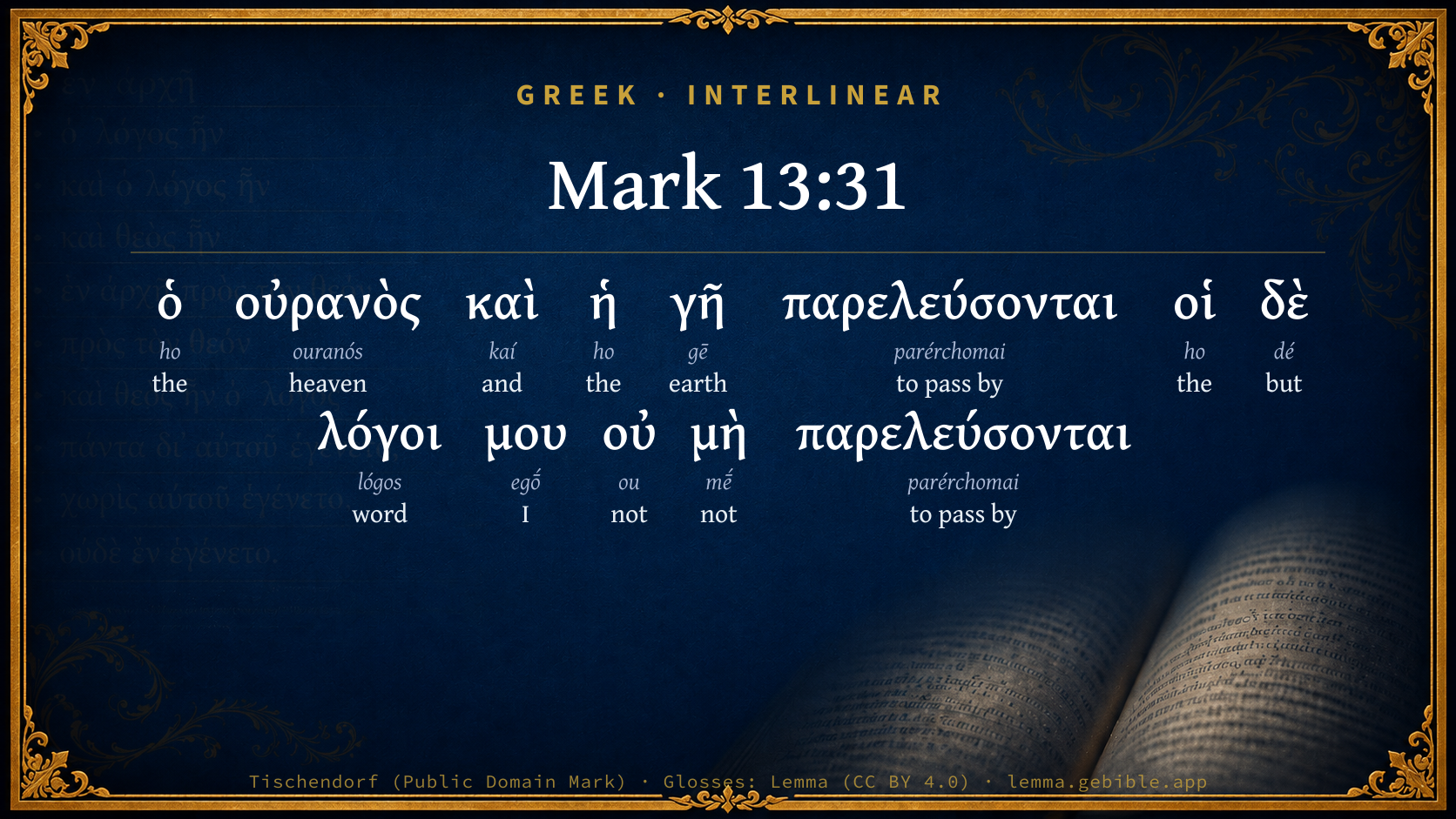
Download image
Cite this verse

Mark 13:31 (World English Bible). Public Domain. Lemma interlinear Bible study tool, https://lemma.gebible.app/v/mark/13/31.

Show BibTeX & RIS
BibTeX
RIS
English Translation
Heaven and earth will pass away, but my words will not pass away.
World English Bible · Public Domain
Download a study sheet

One document with this verse’s original text, its word-by-word gloss line, the meaning frame, cross-references with their text, attributed commentary, and full source and license credits — printable, and it pastes into notes with its structure intact.

This verse Autodidact and up

Study sheet (.html) Plain text (.txt)

A passage Seminary Student

Up to 50 verses in one chapter. A passage sheet keeps up to 6 commentary sources and 12 cross-references per verse, in the order this page ranks them, and says so on the sheet whenever that leaves anything out. Ask for a single verse and you get the Autodidact verse sheet above.

Everything on this page stays free to read, with no account — the sheet is a download of what is already on screen, not access to it.

Want to remove ads? Support Godless Engineer
Compare translations 3

The same verse in 3 English versions, stacked beneath the original-language interlinear above. Click any original word for its lexicon entry.

Each is an independent rendering of the whole verse — the interlinear is not word-aligned to these translations.

Highlighted words mark where these versions differ — a whole-verse word diff, not a word-by-word alignment.

  • World English Bible Public Domain
    Heaven and earth will pass away, but my words will not pass away.
  • King James Version Public Domain
    Heaven and earth shall pass away: but my words shall not pass away.
  • unfoldingWord Literal Text CC BY-SA 4.0
    The heaven and the earth will pass away, but my words will certainly not pass away.

unfoldingWord Literal Text — © unfoldingWord, licensed CC BY-SA 4.0. Word-aligned USFM3 via Door43 (git.door43.org/unfoldingWord/en_ult).

Versions to compare (up to 4)

3 of 4 selected

Show all 19 translations

Every available English version of this verse, each an independent rendering of the whole verse.

  • World English Bible Public Domain
    Heaven and earth will pass away, but my words will not pass away.
  • Berean Standard Bible Public Domain
    Heaven and earth will pass away, but My words will never pass away.
  • Majority Standard Bible Public Domain
    Heaven and earth will pass away, but My words will never pass away.
  • King James Version Public Domain
    Heaven and earth shall pass away: but my words shall not pass away.
  • American Standard Version (1901) Public Domain
    Heaven and earth shall pass away: but my words shall not pass away.
  • Revised Version (1885) Public Domain
    Heaven and earth shall pass away: but my words shall not pass away.
  • Geneva Bible (1599) Public Domain
    Heauen and earth shall passe away, but my woordes shall not passe away.
  • Douay-Rheims (1899) Public Domain
    Heaven and earth shall pass away, but my word shall not pass away.
  • Young's Literal Translation Public Domain
    the heaven and the earth shall pass away, but my words shall not pass away.
  • Literal Standard Version CC BY-SA 4.0
    the heaven and the earth will pass away, but My words will not pass away.
  • Unlocked Literal Bible CC BY-SA 4.0
    Heaven and earth will pass away, but my words will never pass away.
  • unfoldingWord Literal Text CC BY-SA 4.0
    The heaven and the earth will pass away, but my words will certainly not pass away.
  • Darby Bible Public Domain
    The heaven and the earth shall pass away, but my words shall in no wise pass away.
  • World Messianic Bible Public Domain
    Heaven and earth will pass away, but my words will not pass away.
  • Webster's Bible Public Domain
    Heaven and earth shall pass away: but my words shall not pass away.
  • Free Bible Version CC BY-SA 4.0
    Heaven and earth will come to an end, but my teachings will not.
  • Bible in Basic English Public Domain
    Heaven and earth will come to an end, but my words will not come to an end.
  • Text-Critical English NT CC BY 4.0
    Heaven and earth will pass away, but my words will certainly not pass away.
  • Tyndale New Testament (1534) Public Domain
    Heven and erth shall passe but my wordes shall not passe.

Literal Standard Version (2020), Covenant Press — licensed CC BY-SA 4.0. Text via the HelloAO Bible API (eBible.org). Unlocked Literal Bible (unfoldingWord) — licensed CC BY-SA 4.0. Text via the HelloAO Bible API (eBible.org). unfoldingWord Literal Text — © unfoldingWord, licensed CC BY-SA 4.0. Word-aligned USFM3 via Door43 (git.door43.org/unfoldingWord/en_ult). Free Bible Version, Dr. Jonathan Gallagher — licensed CC BY-SA 4.0. Text via the HelloAO Bible API (eBible.org).

Word by word

More ways to search: Search by grammar → Find every occurrence → Compare this word →

Practice this passage: Drill this verse → Learn its vocabulary →

παρελεύσονται
parérchomai
G3928
“to pass by”
Verb, Future, Middle deponent, Indicative, 3rd person, Plural
Part of Speech
Verb
Tense
Future
Voice
Middle deponent
Mood
Indicative
Person
3rd person
Number
Plural
Full Thayer's Definition

Origin: from G3844 and G2064

TDNT: 13:21,3

1. to go past, pass by a. of persons moving forward 1. to pass by b. of time 1. an act continuing for a time c. metaph. 1. to pass away, perish 2. to pass by (pass over), that is, to neglect, omit, (transgress) 3. to be led by, to be carried past, be averted 2. to come near, come forward, arrive
  1. ὁ ho G3588 “the” Article, Nominative, Singular, Masculine
  2. οὐρανὸς ouranós G3772 “heaven” Noun, Nominative, Singular, Masculine
  3. καὶ kaí G2532 “and” Conjunction
  4. ἡ ho G3588 “the” Article, Nominative, Singular, Feminine
  5. γῆ gē G1093 “earth” Noun, Nominative, Singular, Feminine
  6. οἱ ho G3588 “the” Article, Nominative, Plural, Masculine
  7. δὲ dé G1161 “but” Conjunction
  8. λόγοι lógos G3056 “word” Noun, Nominative, Plural, Masculine
  9. μου egṓ G1473 “I” Personal pronoun, 1st person, Genitive, Singular
  10. οὐ ou G3756 “not” Particle, Negative
  11. μὴ mḗ G3361 “not” Particle, Negative
  12. παρελεύσονται parérchomai G3928 “to pass by” Verb, Future, Middle deponent, Indicative, 3rd person, Plural

About this verse

These counts appear in no published source. They are computed here, from the morphology-tagged text and Lemma’s own curated glosses. What Lemma adds →

13
words
10
distinct lemmas
Gospels
section

Shared distinctive vocabulary

παρελεύσονται to pass by G3928 occurs in 25 verses of the Greek New Testament. Also found in:
Repetition

Words recur within this verse:

  • παρελεύσονται to pass by G3928 ×2
  • ὁ the G3588 ×3

Cross-references

13

Topical passages linked to Mark 13:31 in the Treasury of Scripture Knowledge — connected by theme and wording, ordered by reader-vote popularity; previews shown in the World English Bible.

  • Isaiah 40:8 The grass withers, the flower fades; but the word of our God shall stand forever.
  • Isaiah 51:6 Lift up your eyes to the heavens, and look on the earth beneath; for the heavens shall vanish away like smoke, and the earth shall wax old like a garment; and those who dwell therein shall die in like manner: but my salvation shall be forever, and my righteousness shall not be abolished.
  • Matthew 24:35 Heaven and earth will pass away, but my words will not pass away.
  • Luke 21:33 Heaven and earth will pass away, but my words will by no means pass away.
  • Matthew 5:18 For most assuredly, I tell you, until heaven and earth pass away, not even one smallest letter or one tiny pen stroke shall in any way pass away from the law, until all things are accomplished.
  • Psalms 102:25–27 Of old, you laid the foundation of the earth. The heavens are the work of your hands.
  • Hebrews 1:10–12 And, "You, Lord, in the beginning, laid the foundation of the earth. The heavens are the works of your hands.
  • Numbers 23:19 God is not a man, that he should lie, Neither the son of man, that he should repent: Has he said, and will he not do it? Or has he spoken, and will he not make it good?
  • Psalms 19:7 Yahweh's law is perfect, restoring the soul. Yahweh's testimony is sure, making wise the simple.
  • 2 Timothy 2:13 If we are faithless, He remains faithful. He can't deny himself.
  • Joshua 23:14–15 Behold, this day I am going the way of all the earth: and you know in all your hearts and in all your souls, that not one thing has failed of all the good things which Yahweh your God spoke concerning you; all are happen to you, not one thing has failed of it.
  • Zechariah 1:6 But my words and my decrees, which I commanded my servants the prophets, didn't they overtake your fathers? "Then they repented and said, 'Just as Yahweh of Hosts determined to do to us, according to our ways, and according to our practices, so he has dealt with us.'"
  • Titus 1:2 in hope of eternal life, which God, who can't lie, promised before eternal times;

Cross-references courtesy of OpenBible.info (CC BY 4.0).

Commentary

Notes on Mark 13:31 from classic Christian and Jewish commentators (each source and its license shown beneath its notes). The classic Christian expositions comment on the surrounding passage and are grouped to its opening verse, so a note may address several verses; the Jewish commentaries on the Tanakh (Rashi and others) are per-verse, so they appear only where the commentator wrote on this verse.

Lemma curates 59 commentaries, every one of them public domain or Creative Commons licensed, each selected and text-cleaned for this edition rather than reprinted as found. About our sources →

The Biblical Illustrator

Joseph S. Exell

Mar_13:31

But My words shall not pass away.

The perpetuity of Christs words

Contrast the apparent transitoriness of words with the solid earth and the eternal heavens. Yet when these shall have faded away the words of Christ will still endure.

I. In a literal sense the text reminds us that the words which Jesus spake while on earth are permanently associated with our whole life.

II. All our literature is enriched by these words.

III. That which is spiritual must always be more permanent than the material.

IV. Yet the material prepares the way for the spiritual application.

1. A lesson of warning, since we are in danger of attaching too much importance to the form, and too little to the truth, which the form embodies.

2. A lesson of encouragement; opinions may change and interpretations differ; but the truth remains always the same. (F. Wagstaff.)

The Biblical Illustrator, edited by Joseph S. Exell (c. 1880s–1900s) — public domain. Text from a community e-Sword module.

Tyndale Open Study Notes

Tyndale Open Resources

13:31 Jesus personally guaranteed what he had said. My words include specifically what Jesus said in the whole discourse of Mark 13:1-37. Mark’s readers would have understood this as guaranteeing the truth of all Jesus’ teachings known to them (Luke 1:2). Like the Old Testament Scriptures (see Isa 40:8), Jesus’ words are eternal. His teachings are more abiding than the fundamental elements of creation. The basic elements of creation will pass away (see also Ps 102:25-26; Isa 40:6-8; 51:6; Matt 5:18; Luke 16:17; 2 Pet 3:7, 10; Rev 20:11), but Jesus’ words will never disappear.

Tyndale Open Study Notes — © Tyndale Open Resources, licensed CC BY-SA 4.0. Text via the HelloAO Bible API.

The Cambridge Bible for Schools and Colleges

gen. ed. J. J. S. Perowne

31. but my words shall not pass away] Never did the Speaker seem to stand more utterly alone than when He uttered this majestic utterance. Never did it seem more improbable that it should be fulfilled. But as we look across the centuries we see how it has been realised. His words have passed into laws, they have passed into doctrines, they have passed into proverbs, they have passed into consolations, but they have never “passed away.” What human teacher ever dared to claim an eternity for his words?

The Cambridge Bible for Schools and Colleges (gen. ed. J. J. S. Perowne; Cambridge University Press, 1878–1918) — public domain. Text from a community e-Sword module.

John Gill's Exposition

Take ye heed, watch and pray,.... This seems to be the principal reason why the day and hour of Jerusalem's destruction, though known by the Father, were not made known to any man, neither to the angels, nor by them; nor to the son of man in the days of his flesh, nor by him when on earth; that his people might be upon their guard, against false Christs, and prophets, and their deception; and watch unto prayer, and in it, lest they fell into temptation, and that day should come upon them unawares:

for ye know not when the time is; the exact and precise time: for though the people of God had notice of it, and were sensible it was at hand, and did make their escape out of Jerusalem; yet they knew not the exact time, but that it might be sooner or later; and the unbelieving Jews were blinded, and in the dark about it to the very last; See Gill on Mat 24:42.

John Gill's Exposition of the Whole Bible (1746–1763) — public domain (CC PDM 1.0). Text via the HelloAO Bible API.

The Pulpit Commentary

Heaven and earth shall pass away: but my words shall not pass away. Here is a distinct prediction that the present structure of the universe will pass away; that is, that it will be changed, that it will perish, as far as its present state and condition are concerned; but only that it may be refashioned in a more beautiful form. "We look for new heavens and a new earth, wherein dwelleth righteousness". (2Pe_3:13) With this declaration of our blessed Lord all the discoveries of science coincide. Astronomy and geology alike concur in the conclusion that the whole system of the universe is moving onwards to its change. Our blessed Lord did but affirm that which is demonstrated by science. But my words shall not pass away; not merely the words which with his full self-consciousness he had just uttered respecting Jerusalem, but all his other words all the revelation of God, all the words of him who is the Truth.

The words of Christ and the world-revolution with which they were associated.

I A PREDICTION OF IT. The date of these utterances and their authorship beyond all reasonable question. A daring forecast, identifying the fortunes of Christianity with vast cosmical movements. Insight such as this more than human; dependent upon perception of unseen principles and absolute faith in God. The immediate effect of the changes predicted is acknowledged to be adverse to the outward circumstances of his followers; yet inwardly and ultimately the result is regarded as beyond question, and declared with unfaltering authority. This predictive element in the gospel not accidental, but essential; its entire credibility as a word of God to man being made to depend upon its fulfillment as a prophecy.

II A SUSTAINING PRINCIPLE THROUGH IT. The faith of Christians is fostered:

1. By the fact that all things were foretold: "I have told you all things beforehand.

2. By their intelligent. perception of the signs, the method, and the outline of God"s working.

3. By their experience of special Divine grace

(1) in guidance and indwelling of the Holy Ghost;

(2) in experience or" special Divine favors, e.g. the shortening of the days of tribulation; and

(3) in the inward spiritual comfort and edification of the precepts and promises of the gospel.

III A CAUSE OF IT. As representing the eternal moral principles which underlie and determine the historic evolution of the race. An exciting cause of the hatred to Divine things which was the motive of so much that was done. A directive influence in shaping the destinies of the new institutions and movements which were evolved from the chaos of the old world.

IV A SURVIVAL FROM IT. Not one has passed away. The great doctrines of Christendom have slowly but surely formulated themselves in sympathetic relation to the experience and progress with which they have been associated. As a system of truth, they can be more comprehensively grasped now than at any previous time. The fulfillment of its predictions did not exhaust the moral fullness and depth of Christian truth, or its applicability to the extant problems of future ages. The gospel is thus seen to be, not only for a time, but for all time, the central principle of progress and destiny for the human race. M.

The Pulpit Commentary (1880–1919), ed. H.D.M. Spence-Jones & Joseph S. Exell — public domain. Text from a community e-Sword module.

Cambridge Greek Testament for Schools and Colleges

31. παρελεύσονται ([2984][2985][2986][2987][2988][2989]) rather than παρελεύσεται ([2990][2991][2992][2993][2994]). [2995][2996][2997] omit μή after οὐ, but it may be retained with [2998][2999][3000][3001][3002][3003][3004]. After οὐ μή read παρελεύσονται ([3005][3006][3007] rather than παρέλθωσιν ([3008][3009][3010][3011][3012][3013][3014]). After οὐ μή copyists often correct fut. indic, to aor. subj. Mat 15:5; Luk 21:33; etc.

[2984] Codex Sinaiticus. 4th cent. Discovered by Tischendorf in 1859 at the Monastery of St Katharine on Mount Sinai. Now at St Petersburg. The whole Gospel, ending at Mar 16:8. Photographic facsimile, 1911.

[2985] Codex Vaticanus. 4th cent., but perhaps a little later than א. In the Vatican Library almost since its foundation by Pope Nicolas V., and one of its greatest treasures. The whole Gospel, ending at Mar 16:8. Photographic facsimile, 1889.

[2986] Codex Bezae. 6th cent. Has a Latin translation (d) side by side with the Greek text, and the two do not quite always agree. Presented by Beza to the University Library of Cambridge in 1581. Remarkable for its frequent divergences from other texts. Contains Mark, except Mar 16:15-20, which has been added by a later hand. Photographic facsimile, 1899.

[2987] Codex Monacensis. 10th cent. Contains Mar 6:47 to Mar 16:20. Many verses in 14, 15, 16 are defective.

[2988] Codex Oxoniensis. 9th cent. Contains Mark, except Mar 3:35 to Mar 6:20.

[2989] Codex Petropolitanus. 9th cent. Gospels almost complete. Mar 16:18-20 is in a later hand.

[2990] Codex Alexandrinus. 5th cent. Brought by Cyril Lucar, Patriarch of Constantinople, from Alexandria, and afterwards presented by him to King Charles I. in 1628. In the British Museum. The whole Gospel. Photographic facsimile, 1879.

[2991] Codex Ephraemi. 5th cent. A palimpsest: the original writing has been partially rubbed out, and the works of Ephraem the Syrian have been written over it; but a great deal of the original writing has been recovered; of Mark we have Mar 1:17 to Mar 6:31, Mar 8:5 to Mar 12:29, Mar 13:19 to Mar 16:20. In the National Library at Paris.

[2992] Codex Regius. 8th cent. An important witness. At Paris. Contains Mar 1:1 to Mar 10:15; Mar 10:30 to Mar 15:1; Mar 15:20 to Mar 16:20, but the shorter ending is inserted between Mar 16:8 and Mar 16:9, showing that the scribe preferred it to the longer one.

[2993] Codex Monacensis. 10th cent. Contains Mar 6:47 to Mar 16:20. Many verses in 14, 15, 16 are defective.

[2994] Codex Sangallensis. 9th or 10th cent. Contains the Gospels nearly complete, with an interlinear Latin translation. The text of Mark is specially good, agreeing often with CL. At St Gall.

[2995] Codex Vaticanus. 4th cent., but perhaps a little later than א. In the Vatican Library almost since its foundation by Pope Nicolas V., and one of its greatest treasures. The whole Gospel, ending at Mar 16:8. Photographic facsimile, 1889.

[2996] Codex Bezae. 6th cent. Has a Latin translation (d) side by side with the Greek text, and the two do not quite always agree. Presented by Beza to the University Library of Cambridge in 1581. Remarkable for its frequent divergences from other texts. Contains Mark, except Mar 16:15-20, which has been added by a later hand. Photographic facsimile, 1899.

[2997] An asterisk denotes that the word is not found elsewhere in N.T., and such words are included in the index, even if there is no note on them in the commentary.

[2998] Codex Sinaiticus. 4th cent. Discovered by Tischendorf in 1859 at the Monastery of St Katharine on Mount Sinai. Now at St Petersburg. The whole Gospel, ending at Mar 16:8. Photographic facsimile, 1911.

[2999] Codex Alexandrinus. 5th cent. Brought by Cyril Lucar, Patriarch of Constantinople, from Alexandria, and afterwards presented by him to King Charles I. in 1628. In the British Museum. The whole Gospel. Photographic facsimile, 1879.

[3000] Codex Ephraemi. 5th cent. A palimpsest: the original writing has been partially rubbed out, and the works of Ephraem the Syrian have been written over it; but a great deal of the original writing has been recovered; of Mark we have Mar 1:17 to Mar 6:31, Mar 8:5 to Mar 12:29, Mar 13:19 to Mar 16:20. In the National Library at Paris.

[3001] Codex Regius. 8th cent. An important witness. At Paris. Contains Mar 1:1 to Mar 10:15; Mar 10:30 to Mar 15:1; Mar 15:20 to Mar 16:20, but the shorter ending is inserted between Mar 16:8 and Mar 16:9, showing that the scribe preferred it to the longer one.

[3002] Codex Oxoniensis. 9th cent. Contains Mark, except Mar 3:35 to Mar 6:20.

[3003] Codex Sangallensis. 9th or 10th cent. Contains the Gospels nearly complete, with an interlinear Latin translation. The text of Mark is specially good, agreeing often with CL. At St Gall.

[3004] Codex Petropolitanus. 9th cent. Gospels almost complete. Mar 16:18-20 is in a later hand.

[3005] Codex Sinaiticus. 4th cent. Discovered by Tischendorf in 1859 at the Monastery of St Katharine on Mount Sinai. Now at St Petersburg. The whole Gospel, ending at Mar 16:8. Photographic facsimile, 1911.

[3006] Codex Vaticanus. 4th cent., but perhaps a little later than א. In the Vatican Library almost since its foundation by Pope Nicolas V., and one of its greatest treasures. The whole Gospel, ending at Mar 16:8. Photographic facsimile, 1889.

[3007] Codex Regius. 8th cent. An important witness. At Paris. Contains Mar 1:1 to Mar 10:15; Mar 10:30 to Mar 15:1; Mar 15:20 to Mar 16:20, but the shorter ending is inserted between Mar 16:8 and Mar 16:9, showing that the scribe preferred it to the longer one.

[3008] Codex Alexandrinus. 5th cent. Brought by Cyril Lucar, Patriarch of Constantinople, from Alexandria, and afterwards presented by him to King Charles I. in 1628. In the British Museum. The whole Gospel. Photographic facsimile, 1879.

[3009] Codex Ephraemi. 5th cent. A palimpsest: the original writing has been partially rubbed out, and the works of Ephraem the Syrian have been written over it; but a great deal of the original writing has been recovered; of Mark we have Mar 1:17 to Mar 6:31, Mar 8:5 to Mar 12:29, Mar 13:19 to Mar 16:20. In the National Library at Paris.

[3010] Codex Bezae. 6th cent. Has a Latin translation (d) side by side with the Greek text, and the two do not quite always agree. Presented by Beza to the University Library of Cambridge in 1581. Remarkable for its frequent divergences from other texts. Contains Mark, except Mar 16:15-20, which has been added by a later hand. Photographic facsimile, 1899.

[3011] Codex Monacensis. 10th cent. Contains Mar 6:47 to Mar 16:20. Many verses in 14, 15, 16 are defective.

[3012] Codex Oxoniensis. 9th cent. Contains Mark, except Mar 3:35 to Mar 6:20.

[3013] Codex Sangallensis. 9th or 10th cent. Contains the Gospels nearly complete, with an interlinear Latin translation. The text of Mark is specially good, agreeing often with CL. At St Gall.

[3014] Codex Petropolitanus. 9th cent. Gospels almost complete. Mar 16:18-20 is in a later hand.

31. ὁ οὐρανὸς καὶ ἡ γῆ. The saying is proverbial for what stands for ever. The material universe will one day come to an end, but Christ’s words will always hold good. Cf. 2Pe 3:10; Heb 1:11-12; Rev 20:11; Rev 21:1; Psa 102:25-27; Psa 104:29-31; Isa 51:6.

οἱ δὲ λόγοι μου. Not merely this prediction, but the whole of His teaching. Cf. οἱ ἐμοὶ λόγοι (Mar 8:38) and ὁ ἐμὸς λόγος (Joh 8:31). The great revelation of the Father’s love to His children holds good for ever.

Cambridge Greek Testament for Schools and Colleges (Cambridge University Press, 1896; 21 vols, various authors incl. Carr, Maclear, Plummer, Farrar, Lumby, Moule, M. R. James, Simcox) — public domain. Text from a community e-Sword module.

International Critical Commentary

31. A proverbial statement of the inevitableness of his words. The most stable and enduring of all physical things, in fact the whole physical frame of things, will pass away, i.e. will perish and come to naught; but his words are imperishable.

παρελεύσονται, instead of παρελθῶσι, Tisch. Treg. WH. א BL. Omit μὴ, WH. BD *.

International Critical Commentary — older volumes (1896–1929), various authors — public domain. Text from a community e-Sword module.

Lesson kit

Teaching starters — assembled from the data on this page, not authored interpretation. Every prompt links to the verse data it draws on. Edit before teaching.

Mark, in the Gospels, opens this verse with 13 words (10 distinct Greek lemmas). Its most distinctive word is parérchomai (“to pass by”). A historical commentator’s framing appears above. Read the whole chapter for the surrounding context.

Discussion questions

  1. What does “to pass by” (parérchomai) contribute to the verse as a whole?
  2. How does Matthew 5:18, which shares the word «to pass by», read alongside this verse?
  3. What does the repetition of “to pass by” (2× in this one verse) do in this verse?
  4. These translations render this verse differently; the difference is in the English rendering, not the original. What questions does that raise?
  5. Compare how The Biblical Illustrator and Tyndale Open Study Notes read this verse. Where do they agree or differ?

Things to notice

  • These translations choose different wording for 3 words in this verse.
  • “to pass by” occurs 2× in this single verse.
  • 10 distinct Greek lemmas span 13 words in this verse.

Reading settings

Reading text

Shown beneath each verse's original-language words.

Old Testament
Old Testament edition

Read the OT as the Masoretic Hebrew (MT) or the Greek Septuagint (LXX).

English shown for the Greek Septuagint (in the Hebrew ↔ Greek comparison).

Comparing translations? Open the Compare panel on any verse page to stack up to four side by side.