Matthew 28:18

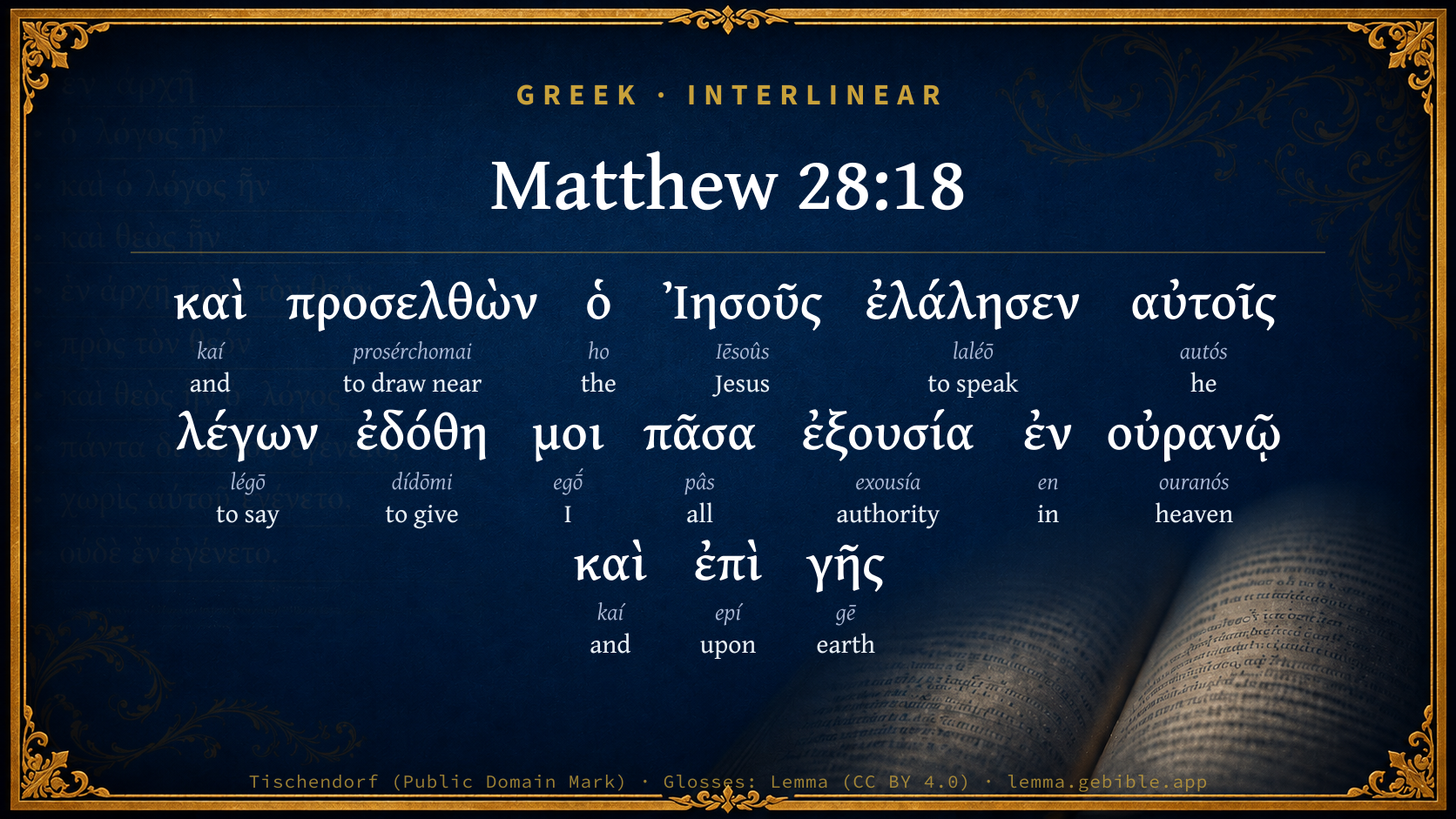
Greek (Tischendorf 8th ed.) Matthew 28:18 appears in the Greek New Testament. The text above is from the Tischendorf 8th edition. Each word links to its Strong’s number and a concise gloss. Click any word for its full Thayer’s Greek Lexicon entry.
Download image
Cite this verse

Matthew 28:18 (World English Bible). Public Domain. Lemma interlinear Bible study tool, https://lemma.gebible.app/v/matthew/28/18.

Show BibTeX & RIS
BibTeX
RIS
English Translation
Jesus came to them and spoke to them, saying, "All authority has been given to me in heaven and on earth.
World English Bible · Public Domain
Download a study sheet

One document with this verse’s original text, its word-by-word gloss line, the meaning frame, cross-references with their text, attributed commentary, and full source and license credits — printable, and it pastes into notes with its structure intact.

This verse Autodidact and up

Study sheet (.html) Plain text (.txt)

A passage Seminary Student

Up to 50 verses in one chapter. A passage sheet keeps up to 6 commentary sources and 12 cross-references per verse, in the order this page ranks them, and says so on the sheet whenever that leaves anything out. Ask for a single verse and you get the Autodidact verse sheet above.

Everything on this page stays free to read, with no account — the sheet is a download of what is already on screen, not access to it.

Want to remove ads? Support Godless Engineer
Compare translations 3

The same verse in 3 English versions, stacked beneath the original-language interlinear above. Click any original word for its lexicon entry.

Each is an independent rendering of the whole verse — the interlinear is not word-aligned to these translations.

Highlighted words mark where these versions differ — a whole-verse word diff, not a word-by-word alignment.

  • World English Bible Public Domain
    Jesus came to them and spoke to them, saying, "All authority has been given to me in heaven and on earth.
  • King James Version Public Domain
    And Jesus came and spake unto them, saying, All power is given unto me in heaven and in earth.
  • unfoldingWord Literal Text CC BY-SA 4.0
    And having approached, Jesus spoke to them, saying, “All authority was given to me in heaven and on the earth.

unfoldingWord Literal Text — © unfoldingWord, licensed CC BY-SA 4.0. Word-aligned USFM3 via Door43 (git.door43.org/unfoldingWord/en_ult).

Versions to compare (up to 4)

3 of 4 selected

Show all 19 translations

Every available English version of this verse, each an independent rendering of the whole verse.

  • World English Bible Public Domain
    Jesus came to them and spoke to them, saying, "All authority has been given to me in heaven and on earth.
  • Berean Standard Bible Public Domain
    Then Jesus came to them and said, “All authority in heaven and on earth has been given to Me.
  • Majority Standard Bible Public Domain
    Then Jesus came to them and said, “All authority in heaven and on earth has been given to Me.
  • King James Version Public Domain
    And Jesus came and spake unto them, saying, All power is given unto me in heaven and in earth.
  • American Standard Version (1901) Public Domain
    And Jesus came to them and spake unto them, saying, All authority hath been given unto me in heaven and on earth.
  • Revised Version (1885) Public Domain
    And Jesus came to them and spake unto them, saying, All authority hath been given unto me in heaven and on earth.
  • Geneva Bible (1599) Public Domain
    And Iesus came, and spake vnto them, saying, All power is giuen vnto me, in heauen, and in earth.
  • Douay-Rheims (1899) Public Domain
    And Jesus coming, spoke to them, saying: All power is given to me in heaven and in earth.
  • Young's Literal Translation Public Domain
    And having come near, Jesus spake to them, saying, `Given to me was all authority in heaven and on earth;
  • Literal Standard Version CC BY-SA 4.0
    And having come near, Jesus spoke to them, saying, “All authority in Heaven and on earth was given to Me;
  • Unlocked Literal Bible CC BY-SA 4.0
    Jesus came to them and spoke to them and said, “All authority has been given to me in heaven and on earth.
  • unfoldingWord Literal Text CC BY-SA 4.0
    And having approached, Jesus spoke to them, saying, “All authority was given to me in heaven and on the earth.
  • Darby Bible Public Domain
    And Jesus coming up spoke to them, saying, All power has been given me in heaven and upon earth.
  • World Messianic Bible Public Domain
    Yeshua came to them and spoke to them, saying, “All authority has been given to me in heaven and on earth.
  • Webster's Bible Public Domain
    And Jesus came, and spoke to them, saying, All power is given to me in heaven and upon earth.
  • Free Bible Version CC BY-SA 4.0
    Jesus came to them and told them, “All power in heaven and on earth has been given to me.
  • Bible in Basic English Public Domain
    And Jesus came to them and said, All authority has been given to me in heaven and on earth.
  • Text-Critical English NT CC BY 4.0
    Then Jesus came and said to them, “All authority in heaven and on earth has been given to me.
  • Tyndale New Testament (1534) Public Domain
    And Iesus came and spake vnto them sayinge: All power ys geve vnto me in heven and in erth.

Literal Standard Version (2020), Covenant Press — licensed CC BY-SA 4.0. Text via the HelloAO Bible API (eBible.org). Unlocked Literal Bible (unfoldingWord) — licensed CC BY-SA 4.0. Text via the HelloAO Bible API (eBible.org). unfoldingWord Literal Text — © unfoldingWord, licensed CC BY-SA 4.0. Word-aligned USFM3 via Door43 (git.door43.org/unfoldingWord/en_ult). Free Bible Version, Dr. Jonathan Gallagher — licensed CC BY-SA 4.0. Text via the HelloAO Bible API (eBible.org).

Word by word

More ways to search: Search by grammar → Find every occurrence → Compare this word →

Practice this passage: Drill this verse → Learn its vocabulary →

προσελθὼν
prosérchomai
G4334
“to draw near”
Verb, Aorist, Active, Participle, Nominative, Singular, Masculine
Part of Speech
Verb
Tense
Aorist
Voice
Active
Mood
Participle
Case
Nominative
Number
Singular
Gender
Masculine
Full Thayer's Definition

Origin: from G4314 and G2064 (including its alternate)

TDNT: 13:23,3

1. to come to, approach 2. draw near to 3. to assent to
  1. καὶ kaí G2532 “and” Conjunction
  2. ὁ ho G3588 “the” Article, Nominative, Singular, Masculine
  3. Ἰησοῦς Iēsoûs G2424 “Jesus” Noun, Nominative, Singular, Masculine
  4. ἐλάλησεν laléō G2980 “to speak” Verb, Aorist, Active, Indicative, 3rd person, Singular
  5. αὐτοῖς autós G846 “he” Personal pronoun, Dative, Plural, Masculine
  6. λέγων légō G3004 “to say” Verb, Present, Active, Participle, Nominative, Singular, Masculine
  7. ἐδόθη dídōmi G1325 “to give” Verb, Aorist, Passive, Indicative, 3rd person, Singular
  8. μοι egṓ G1473 “I” Personal pronoun, 1st person, Dative, Singular
  9. πᾶσα pâs G3956 “all” Adjective, Nominative, Singular, Feminine
  10. ἐξουσία exousía G1849 “authority” Noun, Nominative, Singular, Feminine
  11. ἐν en G1722 “in” Preposition
  12. οὐρανῷ ouranós G3772 “heaven” Noun, Dative, Singular, Masculine
  13. καὶ kaí G2532 “and” Conjunction
  14. ἐπὶ epí G1909 “upon” Preposition
  15. γῆς gē G1093 “earth” Noun, Genitive, Singular, Feminine

About this verse

These counts appear in no published source. They are computed here, from the morphology-tagged text and Lemma’s own curated glosses. What Lemma adds →

16
words
15
distinct lemmas
Gospels
section

Repetition

A word recurs within this verse:

Cross-references

29

Topical passages linked to Matthew 28:18 in the Treasury of Scripture Knowledge — connected by theme and wording, ordered by reader-vote popularity; previews shown in the World English Bible.

  • John 3:35 The Father loves the Son, and has given all things into his hand.
  • 1 Peter 3:22 who is at the right hand of God, having gone into heaven, angels and authorities and powers being made subject to him.
  • Matthew 11:27 All things have been delivered to me by my Father. No one knows the Son, except the Father; neither does anyone know the Father, except the Son, and he to whom the Son desires to reveal him.
  • Ephesians 1:20–22 which he worked in Christ, when he raised him from the dead, and made him to sit at his right hand in the heavenly places,
  • Hebrews 2:8 You have put all things in subjection under his feet." For in that he subjected all things to him, he left nothing that is not subject to him. But now we don't see all things subjected to him, yet.
  • Daniel 7:13–14 I saw in the night-visions, and, behold, there came with the clouds of the sky one like a son of man, and he came even to the ancient of days, and they brought him near before him.
  • 1 Corinthians 15:27 For, "He put all things in subjection under his feet." But when he says, "All things are put in subjection," it is evident that he is excepted who subjected all things to him.
  • John 17:2 even as you gave him authority over all flesh, he will give eternal life to all whom you have given him.
  • John 13:3 Jesus, knowing that the Father had given all things into his hands, and that he came forth from God, and was going to God,
  • Isaiah 9:6–7 For to us a child is born, to us a son is given; and the government shall be on his shoulder: and his name shall be called Wonderful, Counselor, Mighty God, Everlasting Father, Prince of Peace.
  • Philippians 2:9–11 Therefore God also highly exalted him, and gave to him the name which is above every name;
  • Hebrews 1:2 has at the end of these days spoken to us by his Son, whom he appointed heir of all things, through whom also he made the worlds.
  • Colossians 2:10 and in him you are made full, who is the head of all principality and power;
  • Luke 10:22 Turning to the disciples, he said, "All things have been delivered to me by my Father. No one knows who the Son is, except the Father, and who the Father is, except the Son, and he to whomever the Son desires to reveal him."
  • Revelation 19:16 He has on his garment and on his thigh a name written, "KING OF KINGS, AND LORD OF LORDS."
  • Romans 14:9 For to this end Christ died, rose, and lived again, that he might be Lord of both the dead and the living.
  • Matthew 26:64 Jesus said to him, "You have said it. Nevertheless, I tell you, henceforth you will see the Son of Man sitting at the right hand of Power, and coming on the clouds of the sky."
  • Colossians 1:16–19 For by him were all things created, in the heavens and on the earth, things visible and things invisible, whether thrones or dominions or principalities or powers; all things have been created through him, and for him.
  • Revelation 17:14 These will war against the Lamb, and the Lamb will overcome them, for he is Lord of lords, and King of kings. They also will overcome who are with him, called and chosen and faithful."
  • Luke 1:32–33 He will be great, and will be called the Son of the Most High. The Lord God will give him the throne of his father, David,
  • John 5:22–27 For the Father judges no one, but he has given all judgment to the Son,
  • Revelation 11:15 The seventh angel sounded, and great voices in heaven followed, saying, "The kingdom of the world has become the Kingdom of our Lord, and of his Christ. He will reign forever and ever!"
  • Psalms 89:27 I will also appoint him my firstborn, The highest of the kings of the earth.
  • Acts 2:36 "Let all the house of Israel therefore know assuredly that God has made him both Lord and Christ, this Jesus whom you crucified."
  • Psalms 110:1–3 Yahweh says to my Lord, "Sit at my right hand, Until I make your enemies your footstool for your feet."
  • Psalms 2:6–9 "Yet I have set my king on my holy hill of Zion."
  • Acts 10:36 The word which he sent to the children of Israel, preaching good news of peace by Jesus Christ--he is Lord of all--
  • Psalms 89:19 Then you spoke in vision to your saints, And said, "I have bestowed strength on the warrior. I have exalted a young man from the people.
  • Matthew 16:28 Most assuredly I tell you, there are some standing here who will in no way taste of death, until they see the Son of Man coming in his Kingdom."

Cross-references courtesy of OpenBible.info (CC BY 4.0).

Commentary

Notes on Matthew 28:18 from classic Christian and Jewish commentators (each source and its license shown beneath its notes). The classic Christian expositions comment on the surrounding passage and are grouped to its opening verse, so a note may address several verses; the Jewish commentaries on the Tanakh (Rashi and others) are per-verse, so they appear only where the commentator wrote on this verse.

Lemma curates 59 commentaries, every one of them public domain or Creative Commons licensed, each selected and text-cleaned for this edition rather than reprinted as found. About our sources →

The Biblical Illustrator

Joseph S. Exell

Mat_28:18

All power is given unto Me in heaven and in earth.

The prerogative of the Saviour

I. The prerogative itself.

1. Its nature-power. This means authority and ability.

2. Its extent-all.

3. Its acquisition-given.

II. View it in reference to his personal character. When an individual obtains elevation we are anxious to know something of his qualities. We would not wish an ignorant, unfaithful, impatient, unmerciful man to possess power. Christ gave Himself for us; power in good hands.

III. His prerogative in reference to his enemies.

IV. In reference to the saints. (W. Jay.)

Christs power beneficent

Had Cornelius Winter obtained an income of ten thousand a year, he would not have been the better for it. But many others would; and I know-being then under his care-that when he had an addition of two hundred a-year to his small income, it was no advantage to him; he never added one article to his dress, or one dish to his table, or one ornament to his dwelling. If Howard-the apostle of compassion-had obtained all the power of the late Napoleon, oh! how many millions would have been blessed! How grievous it is to see a cold-blooded, selfish wretch rising up in life, and prospering I for you know that his power will be only a capacity to insult, to strip, to oppress, to grind the faces of the poor. But how delightful it is to see a man of tenderness and generosity rising! for you know that his increased power will be a capacity to teach the ignorant, to feed the hungry, to clothe the naked, to cause the widows heart to sing for joy, and to bring down blessings upon the heads of those who are ready to perish. But what was a Winter, and what was a Howard, to the Friend of sinners! Their hearts were no better than ice or iron, compared to His. Ah! Christians, we here find that power, absolute power, is placed just where it should be placed-where it is safe, where it is beneficent, where it will be glorious. (W. Jay.)

The power and authority of Christ

I. An account of the extent of our Saviours power; that He is invested with all power, both in heaven and earth.

II. A declaration of the original of that unlimited power and authority. All power, saith He, is given Me, that is, from the Father.

III. The commission He thereupon grants His disciples-Go ye, therefore, and teach all nations.

IV. The doctrine which all nations were to be taught, and into which they were to be baptized.

V. The practice of those who were to be baptized into this faith-teaching, them to observe all things, whatsoever I have commanded you.

VI. The promise of effectual assistance to the disciples sent forth upon this commission-And lo! I am with you always, even unto the end of the world. (S. Clarke.)

The undelegated rule and perpetual presence of Christ in His Church

I. The Lord Jesus Christ is the source of all authority.

II. The duty of those commissioned by Christ. To teach, not to sacrifice. To baptize.

III. The special promise which is to animate Christs true disciples. (R. Hibbs, M. A.)

Spiritual power the great want of the Church

Oh I how we want all power now. We all have our theories of the condition of the Church just now. I do not know what yours may be. Mine is not very bright, but I have this one belief in my soul, that what is wanted most of all is one great revival of spiritual life-one wonderful downpour of the grace of God from heaven to flood all the churches. It seems to me we get something like the barges and the vessels down yonder at London Bridge when the tide is out. There they lie in the mud. There are gangs of men, but they cannot get at these vessels and barges. What is to be done? Now, will you great engineers tell me how much horse power, how much steam power you want? There is nothing wanted but the tide. When the tide rises every barge begins to walk like a thing of life, and every vessel can readily receive its cargo and go out to sea in due time. When the heavenly tides of spiritual blessing begin to come up nothing can withstand them. What a glorious time it was when Mr. Whitefield and Mr. Wesley were going up and down this land like twin seraphim, burning everywhere with the Divine flame, and carrying everywhere the Divine life. Can this be done again? Can the masses of the people be raised? Can we raise those that are sunk in ignorance and degradation? Do you think it cannot be done? It must be done. It shall be done. And this is the reason why we expect it: All power is given unto Me in heaven and in earth. He can find another student in Oxford; He can find another potboy in Gloucester; He can find some one somewhere upon whom He can pour out His Holy Spirit, and send Him forth to preach with a tongue of fire that shall wake up the churches, and startle the world. Let us cry to God that it may be so. But we must first deeply feel the necessity of it, and rejoice that this necessity is met by the text: All power is given unto Me in heaven and in earth. (R. Hibbs, M. A.)

Power on earth

What do we mean by power on earth? The politician will answer you, the statesman, the preacher, the orator. It is influence, the ability to turn men to ones own will, to check, curb, turn, and use them, change their natures, and make them subjects and servants in body, soul, and spirit. That is power; something very different from the brute-force of a Samson or a Caesar, and far higher. Still, Caesar, in the organized government of Rome, did possess very considerable power, to which the world was obedient, whether through love or fear. And another such power there was-the ancient idol-worship of Rome and Greece. By these Satan held empire over the world. Two powers they were; yet in our Lords time so closely connected as to be almost one and the same. The Roman Emperor was the universal ruler. The religions of Roman, Greek, and Barbarian differed in little but the names of their false gods. The Jew alone, though subject to the Roman, maintained his belief in the One God, Creator, and Almighty. Thus the Roman empire and the Roman heathenism were but as one power against all other religions. And who was coming forward, thus claiming a new power, to be alone supreme in the world? Who came to overthrow the ancient, mighty, all-but-universal idolatry-the very perfection of empire to the statesman of that day, the very perfection of religion to the lovers of a gorgeous ceremonial, and the indulgers of human pride and selfish passion? Who came to be King and God? One whose public execution was written in the Roman records. One who preached humility as the only true greatness, who substituted penitence and self-denial for the indulgence of flesh and spirit. A Jew, too, of all races the most despised by Roman and Barbarian alike … The cause of Christ to the shrewdest human calculation must have looked simply hopeless; His claim to any power whatever a silly boast. Force His followers could not, might not, use. Argument they might; and then they came at once face to face with death. Yet the disciples went forth preaching Christ crucified, and risen again as the life of the world. It was not an attractive doctrine, nor an easy morality, that they preached. There was offered no earthly gain, or pleasure, or honour. And yet old Rome left her idols to worship Jesus; her emperors became Christians; the power of the world fell; the religion of the world was changed. (W. Michell, M. A.)

Christs universal dominion

I. The grounds upon which Christ administers this providential government.

1. It pertains to Him as the Eternal Word, by whose immediate agency the worlds were produced.

2. As the second Adam-both Son of man and Son of God.

3. By virtue of His Fathers grant.

4. Acquired through suffering and death.

5. Necessary to His government of the Church.

II. The consequences which flow from this momentous truth,

1. It gives unity to history.

2. It explains to us the intermingling of mercy with providence.

3. It gives wealth of consolation to the Christian. (B. M. Palmer, D. D.)

The universal dominion of Christ, the foundation of the commission which His ministers receive, and His promised presence their encouragement in fulfilling it

I. The universal dominion of Christ here asserted-All power, etc. The word power in our language is ambiguous. Sometimes it signifies ability or capacity, and sometimes rightful authority. In both these senses it is true of Christ; He has both the ability to act and the authority to warrant His acting.

1. That as a Divine Person the Saviour has all power inherent in Himself.

2. In virtue of office, the power here spoken of is delegated to Christ-All power is given, etc.

3. This power and authority extend to universal nature.

4. This power is deposited in Christ as the Head of the Church, and to be exercised for her benefit.

5. This power is to be exercised in the destruction of all who do not submit to it.

II. The commission given by Christ to his ministers in virtue of that power with which he is invested.

1. That it is only to those who are called by God, and qualified for His service, that this commission is given.

2. This commission extends to all nations as regards the persons to be benefited by it.

3. It embraces all that the Saviour has made known in His word.

III. To consider the encouragements afforded to the ambassadors of Christ in the discharge of their duty.

1. Christ is with His Church and people always; not His essential but gracious presence.

2. A particular call to notice this truth, I am with you always. How highly is Jesus exalted. (R. McIndoe.)

The Biblical Illustrator, edited by Joseph S. Exell (c. 1880s–1900s) — public domain. Text from a community e-Sword module.

Joseph Benson's Commentary

Mat 28:18. And Jesus came and spake unto them — Even unto those mentioned in the last clause, who at first doubted, but whose doubts were afterward fully removed, and probably by his drawing near, and speaking familiarly with them. “It tended much to the honour of Christ,” says Henry, “that [some of] the disciples doubted before they believed, for, in consequence of this, it cannot be said that they were credulous, and willing to be imposed upon, inasmuch as they first questioned and proved all things, and then embraced and held fast that which they found to be true.” Christ, however, on this occasion, came and spake, not only to them that had doubted, but to all the disciples then assembled, and particularly to the apostles, whom it especially concerned to be fully satisfied of his resurrection, of which they were to be witnesses to mankind, and their knowledge of the truth of which they were to seal with their blood, and to whom the following commission was chiefly given. He therefore did not stand at a distance, but came near and gave them all such convincing proofs of his resurrection, as both turned the wavering scale of such as were slow of heart to believe, making their faith to triumph over their doubts, and gave perfect and lasting confirmation to the faith of the rest, particularly of his chosen witnesses, who certainly from this time never called in question in any degree, either the resurrection of their Lord, or the nature and importance of the commission he now gave them. Saying, All power is given unto me — Gr. πασα εξουσια, all authority. It is manifest, as Beza observes, that “authority and power differ from each other; for many are not able to perform those things which they have a right to do; and, on the contrary, many have power to do those things which they have no right to do.” Our Lord’s authority, however, implies power also. It is the exaltation of our Lord’s human nature that is here chiefly intended, in union, however, with the divine. His meaning is fully explained in the following words: Because he humbled himself, and became obedient unto death, even the death of the cross: therefore God also hath highly exalted him, and given him a name which is above every name; that at his name every knee should bow, of those in heaven, and in earth, and under the earth, and that every tongue should confess him Lord, to the glory of God the Father, Php 2:7-11. God hath raised him from the dead, and set him at his own right hand in heavenly places, far above all principality, and power, and might, and dominion, and every name that is named, not only in this world, but also in that which is to come, and put all things under his feet, and given him to be the head over all things to (that is, for the benefit of) the church, which is his body, the fulness of him that filleth all in all, Eph 1:20-23. See the notes on these passages, and also on Joh 5:26-27; and Rom 14:9. The authority and power intended is that which Christ exercises as Son of man and Mediator; but it is evident, if he did not possess all divine perfections, he could not exercise it. Thus Dr. Whitby, “He to whom any office is duly committed, must have sufficient power and wisdom to discharge that office. Now to govern all things in heaven and earth belongs only to him who is the Lord and Maker of them, and therefore is known by this title, both in Scripture and by the heathen. To have power over death, and to be able to raise the dead, is to have that power which is proper to God alone: and to have power over the souls of men, and the knowledge of all hearts, belongs to God alone.” Our Lord, therefore, is invested with, and exercises this authority and power, although as the Son of man, yet not as a mere man, for as such it would have been impossible for him to exercise it, but as a man in whom dwelleth the fulness of the Godhead bodily.

Now Christ being about to send out his apostles as his ambassadors to the nations, with authority to propose to them terms of peace and reconciliation; being about to deliver to them the great charter of his kingdom in the world, and commission them to go forth and gather subjects to him everywhere, and to give laws to and govern those subjects; or to feed and rule his flock; and being about to do these things as Son of man; he first, with great propriety, shows them by what authority he acts, and who gave him that authority. He had indeed said, in effect, more than once before, all he now says, (see Mat 11:27; Joh 5:20-29,) namely, that all things were delivered unto him of his Father; that the Father had given him authority to execute judgment; yea, had committed all judgment unto him, that all men should honour him, the Son, even as they honour the Father. But though he had a right to, and was invested with, this power before, even during the whole time of his personal ministry; yet, he was not in a condition to exercise it, nor could he have exercised it with propriety, while he was in his state of humiliation, and bore the form of a servant; as he was to exercise it now, being raised from the dead, clothed with immortality and glory, and immediately to be exalted to the right hand of the throne of the divine Majesty in the heavens, Heb 8:1.

Joseph Benson's Commentary on the Old and New Testaments (1811–1818) — public domain. Text from a community e-Sword module.

Tyndale Open Study Notes

Tyndale Open Resources

28:18 Jesus’ authority is power delegated from the Father (see 7:29; 9:6-8; 21:23-27; 26:64; John 3:35).

Tyndale Open Study Notes — © Tyndale Open Resources, licensed CC BY-SA 4.0. Text via the HelloAO Bible API.

Bengel's Gnomon

Johann Albrecht Bengel

Mat 28:18. Προσελθὼν, having come unto) And by that very circumstance, producing faith even in those who doubted.—αὐτοῖς, to them) i.e. addressing them.—ἐδόθη Μοι, has been to Me) especially to Me, risen and ascending. This passage contains the sum of those things which the Lord declared afterwards more fully in the Apocalypse, concerning His possession of all authority, and His presence with His own; see Rev 1:18; Rev 1:13.—πᾶσα, κ.τ.λ., all, etc.) This is the reason why Jesus sends His disciples into all the world, and why the whole world ought to worship Him, and why He institutes baptism;[1231] see Ephesians cited below.—ἐν οὐρανῷ καὶ ἐπὶ γῆς, in heaven and on earth) see ch. Mat 9:16, Mat 16:1. Hitherto He had been on earth, now He ascends to heaven: He fills all things; see Eph 4:10, with the, preceding and following verses.

[1231] For the salvation of men, to be converted on earth, and conducted to heaven.—B. G. V.

Bengel's Gnomon of the New Testament — English translation (T&T Clark, Edinburgh, 1860) — public domain. Text from a community e-Sword module.

Meyer's Critical & Exegetical Commentary

Heinrich August Wilhelm Meyer

Mat_28:18.[41] Προσελθών] From feelings of modesty and reverence, the eleven had not ventured to go quite close to Him.

ἘΔΌΘΗ] with all the emphasis of the conviction that He was triumphant at last: was given to me, etc., was practically given, that is, when the Father awoke me out of death. Thereby His state of humiliation came to an end, and the resurrection was the turning-point at which Christ entered into the heavenly glory, in which He is to reign as κύριος πάντων till the time of the final surrender of His sway into the hands of the Father (1Co_15:28). It is true, no doubt, that when first sent forth by God He was invested with the ἘΞΟΥΣΊΑ over all things (Mat_11:27; Joh_13:3); but in His state of ΚΈΝΩΣΙς it would, of necessity, come to be limited by the conditions of that human life into which He had descended. With His resurrection, however, this limitation was removed, and His ἘΞΟΥΣΊΑ fully and absolutely restored, so that He once more came into complete possession of His premundane ΔΌΞΑ (Joh_17:5; Luk_24:26; Php_2:9 f.; Rom_14:9; Eph_1:20 ff; Eph_4:10; 1Co_15:25 ff.), the ΔΌΞΑ in which He had existed as the ΛΌΓΟς ἌΣΑΡΚΟς, and to which He was again exalted as the glorified Son of man. Comp. on Joh_1:14.

ΠᾶΣΑ ἘΞΟΥΣΊΑ] all authority, nothing being excepted either in heaven or earth which can be referred to the category of ἐξουσία. Some, unwarrantably interpreting in a rationalistic sense, have understood this to mean the potestas animis hominum per doctrinam imperandi (Kuinoel),or, as Keim expresses it, the handing over to Him of all spirits to be His instruments in carrying out His purposes in the world,or absolute power to make all necessary arrangements for the establishment of the Messianic theocracy (Paulus), or power over the whole world of humanity with a view to its redemption (Volkmar), and such like. What is really meant, however, is the munus regium of Christ, free from all limitation, without, however, compromising in any way the absolute supremacy of the Father; Joh_14:28; 1Co_15:27; 1Co_11:3.

[41] Comp. for ver. 18 ff., Theod. Schott in the Luther. Zeitschr. 1871, p. 1 ff.

Meyer — Critical and Exegetical Commentary on the New Testament — English translation by Peter Christie, edited by Frederick Crombie (T&T Clark, 1880) — public domain. Text from a community e-Sword module.

Expositor's Greek Testament

ed. W. Robertson Nicoll

Mat 28:18-20 . he final commission .

Mat 28:18 . προσελθὼν , approaching; the speech of Jesus is majestic, but His bearing is friendly, meant to set them free from doubt and fear. ἐλάλησε : this may seem a word not sufficiently dignified for the communication made. But it is often used, especially in Hebrews, in reference to divine revelations ( vide , e.g. , chap. Mat 1:1 ). ἐδόθη μοι , there was given to me; the aorist as in Mat 11:27 , the thought of which earlier text this utterance reiterates and amplifies. The reference may be to the resurrection, and the meaning that that event ipso facto placed Jesus in a position of power. Cf. Rom 1:4 . πᾶσα ἐξουσία , every form of authority; command of all means necessary for the advancement of the Kingdom of God. ἐν οὐρανῷ : this points to session on His celestial throne at the right hand of God. Jesus speaks as one already in heaven. There is no account of the ascension in Mt. It is conceived as involved in the resurrection. ἐπὶ γῆς : upon earth, the whole earth. The two phrases together point to a universal cosmic dominion. But so far as earth is concerned, the dominion is only a matter of right or theory, a problem to be worked out. Hence what follows.

The Expositor's Greek Testament, edited by W. Robertson Nicoll (1897–1910) — public domain. Text from a community e-Sword module.

Adam Clarke's Commentary

Verse 18. And Jesus came and spake unto them] It is supposed by some that the reason why any doubted was, that when they saw Jesus at first, he was at a distance; but when he came up, drew near to them, they were fully persuaded of the identity of his person.

All power is given unto me] Or, All authority in heaven and upon earth is given unto me. One fruit of the sufferings and resurrection of Christ is represented to be, his having authority or right in heaven to send down the Holy Spirit - to raise up his followers thither - and to crown them in the kingdom of an endless glory: in earth, to convert sinners; to sanctify, protect, and perfect his Church; to subdue all nations to himself; and, finally, to judge all mankind. If Jesus Christ were not equal with the Father, could he have claimed this equality of power, without being guilty of impiety and blasphemy? Surely not; and does he not, in the fullest manner, assert his Godhead, and his equality with the Father, by claiming and possessing all the authority in heaven and earth? - i.e. all the power and authority by which both empires are governed?

Adam Clarke's Commentary on the Bible (1810–1826) — public domain. Text from a community e-Sword/MySword module.

Ellicott's Commentary for English Readers

(18) All power is given unto me.—Literally, all authority was given, the tense used being that in which men speak of something that occurred at a given point of time. We may possibly connect it with St. Paul’s use of the same tense in the Greek of Php_2:8. The exaltation came, the authority was given, as at the moment of the Resurrection, and as the crown of His obedience unto death.

A Bible Commentary for English Readers, edited by Charles John Ellicott (1878–1897) — public domain. Text from a community e-Sword module.

The Cambridge Bible for Schools and Colleges

gen. ed. J. J. S. Perowne

18–20. The Last Charge to the Apostles

18. came] Rather, came up to them, near to them.

power] Rather, authority.

is given] Properly, was given, cp. ch. Mat_11:27, and Php_2:8-10. These words, in which the infallible King Himself announces His eternal possession of the Kingdom, St Matthew, who is essentially the historian of the Kingdom, alone records.

The Cambridge Bible for Schools and Colleges (gen. ed. J. J. S. Perowne; Cambridge University Press, 1878–1918) — public domain. Text from a community e-Sword module.

John Gill's Exposition

And Jesus came and spake unto them,.... To the eleven disciples and apostles; for though there might be so large a number as before observed, yet the following words were only spoken to the apostles:

saying, all power is given unto me in heaven and in earth; which is to be understood of him, not as God, who has the same original and underived power and authority over all creatures, and things in heaven and earth, as the Father has; but as mediator, to whom all things are delivered by the Father; and not of a power of doing this, or the other thing, or of omnipotence, being the Almighty; nor of doing miracles, and forgiving sins, which he had, and exercised before his death and resurrection, but of governing: he was king before, but his kingdom was not with observation; but now he was declared, and made manifest, to be both Lord and Christ; he had "all" power and authority for the settling the affairs of his church and kingdom, to appoint offices and officers in it, and, to bestow gifts upon men, to qualify them for the same, and to institute ordinances to be observed till his second coming: and this power of his reached to things in heaven; he having the angels in heaven subject to him, as ministering spirits to be sent forth by him at his pleasure; and all the gifts of the Spirit to dispose of as he thought good; and to things on earth, not only to the saints, whose King he is, and who are made willing to serve him; but to all flesh, to kings and princes, who rule and reign by him; and even to all the wicked of the world, who in some shape or another are made to subserve the ends of his mediatorial kingdom and government: and this is not usurped power, but what is given him, and what he has a right to exercise; having finished sin, abolished death, overcome the world, and destroyed the devil; and must reign till all enemies are subject to him: and this he says, and it was necessary to say it at this time, partly on account of his late sufferings and death, which were attended with weakness and reproach; and partly on account of the following commission he gives to his disciples, that it might be seen and believed, he had power and authority sufficient to give them such an one; as also to animate and encourage them under all the weakness, contempt, and persecution that should attend them in their ministry. The Syriac and Persic versions add, "as the Father hath sent me, even so I send you", as in Joh 20:21, from whence these words seem to be taken.

John Gill's Exposition of the Whole Bible (1746–1763) — public domain (CC PDM 1.0). Text via the HelloAO Bible API.

Trapp's Complete Commentary

John Trapp

18 And Jesus came and spake unto them, saying, All power is given unto me in heaven and in earth.

Ver. 18. All power is given to me] Christ premiseth his power, and promiseth his presence, the better to persuade them to set upon his work, his great work of subduing the world to the obedience of the faith. Better may this King of kings say, than that king of Spain, Sol mihi semper lucet: The sun shines always for me: for he is Catholic Monarch; "the kingdoms of this world" (and of the other too) "are become the kingdoms of our Lord and of his Christ, and he shall reign for ever and ever," Rev 11:15. As for the saints, how can they be but in an all-sufficiency, since all is theirs, they being Christ’s, and Christ being God’s? What boldness may they take to go to Christ, as Jacob did to Joseph, when he understood that the sway of the whole land was in his hand, &c. {See Trapp on "Mat 11:27"}

John Trapp, A Commentary or Exposition upon All the Books of the Old and New Testament (1647–1656) — public domain. Text from a community e-Sword module.

Albert Barnes' Notes on the Bible

All power is given unto me in heaven and in earth - The “Son of God,” as “Creator,” had an original right to all things, to control them and dispose of them. See Joh 1:3; Col 1:16-17; Heb 1:8. But the universe is put under him more particularly as Mediator, that he might redeem his people; that he might gather a church; that he might defend his chosen; that he might subdue all their enemies, and bring them off conquerors and more than conquerors, Eph 1:20-23; 1Co 15:25-27; Joh 5:22-23; Phi 2:6-11. It is in reference to this, doubtless, that he speaks here power or authority committed to him over all things, that he might redeem, defend, and save the church purchased with his own blood. His mediatorial government extends, therefore, over the material world, over angels, over devils, over wicked men, and over his own people.

Albert Barnes' Notes on the Bible (1834–1885) — public domain. Text from a community e-Sword/MySword module.

Haydock's Catholic Bible Commentary

All power is given to me. The Arians object that the power which Christ had, is said to be given him by another. The Catholics answer, that Christ, as man, received this power from God. 2ndly. It may also be said, that the eternal Son, though he be equal, and be the same God with the Father, yet he proceeds and receives all from the Father. (Witham) --- See here the warrant and commission of the apostles and their successors, the bishops and pastors of Christ’s Church. He received from his Father, all power in heaven and in earth: and in virtue of this power he sends them (even as his Father sent him, St. John xx. 21.) to teach and disciple, Greek: matheteuein, not one, but all nations, and instruct them in all truths: and that he may assist them effectually in the execution of this commission, he promises to be with them, (not for three or four hundred years only) but all days, even to the consummation of the world. How then could the Catholic Church go astray? having always with her pastors, as is here promised, Christ himself, who is the way, the truth, and the life. (St. John xiv. 6.) (Challoner) --- Some hence infer that Jesus Christ, according to his human nature, was sovereign Lord of the whole world; but more properly this may be taken of his spiritual power, such as regards the salvation of souls. For Jesus Christ says to Pilate, my kingdom is not of this world. This spiritual power, Jesus Christ communicated in part to his apostles and their successors in the ministry, as to his vicars: As my Father hath sent me, so I send you. Whatsoever you shall loose upon earth, shall be loosed also in heaven: behold here the power both in heaven and earth. (Estius)

George Leo Haydock (1774–1849), Haydock's Catholic Family Bible and Commentary, 1859 edition — public domain. Excludes Psalms (Douay-Rheims chapter numbering differs from Protestant) and Deuterocanonical books (Catholic canon only).

Matthew Poole's English Annotations

Mark saith, Mar 16:15-18, And he said unto them, Go ye into all the world, and preach the gospel to every creature. He that believeth and is baptized shall be saved; but he that believeth not shall be damned. And these signs shall follow them that believe; In my name they shall cast out devils; they shall speak with new tongues; they shall take up serpents; and if they drink any deadly thing, it shall not hurt them; they shall lay hands on the sick, and they shall recover. Our blessed Lord in these three last verses:

1. Asserts his power and authority.

2. He delegates a power.

3. He subjoins a promise.

The power and authority which he asserts to himself is, All power both in heaven and earth, Act 10:36,42; Eph 1:20-22; power of remission of sins, Luk 24:47, of congregating, teaching, and governing his church; a power to give eternal life to whomsoever he pleased. This was inherent in him as God blessed for ever, given to him as our Mediator and Redeemer, given him when he came into the world, but more especially confirmed to him and manifested to be given him at his resurrection and ascension, Phi 2:9,10. Having declared his power, he delegates it:

Go ye therefore, and teach all nations; the Greek is μαθητευσατε, make disciples all nations; but that must be first by preaching and instructing them in the principles of the Christian faith, and Mark expounds it, telling us our Saviour said, Go ye into all the world, and preach the gospel to every creature, that is, to every reasonable creature capable of hearing and receiving it. I cannot be of their mind, who think that persons may be baptized before they are taught; we want precedents of any such baptism in Scripture, though indeed we find precedents of persons baptized who had but a small degree of the knowledge of the gospel; but it should seem that they were all first taught that Jesus Christ was the Son of God, and were not baptized till they professed such belief, Act 8:37, and John baptized them in Jordan, confessing their sins, Mat 3:6. But it doth not therefore follow, that children of such professors are not to be baptized, for the apostles were commanded to baptize all nations: children are a great part of any nation, if not the greatest part, and although amongst the Jews those that were converted to the Jewish religion were first instructed in the law of God before they were circumcised, yet the fathers being once admitted, the children were circumcised at eight days old; nor were they under any covenant different from us, though we be under a more clear manifestation of the same covenant of grace, of which circumcision was a sign and seal to them, as baptism is to us. Infants are capable of the obligations of baptism, for the obligation ariseth from the equity of the thing, not from the understanding and capacity of the person; they are also capable of the same privileges, for of such is the kingdom of God, as our Saviour hath taught us.

All nations: the apostles were by this precept obliged to go up and down the world preaching the gospel, but not presently. So it is plain that the apostles understood their commission, from Act 1:8; 3:26; 13:46; 18:6,7; Ga 2:7. They were first to preach and to baptize amongst the Jews, and then thus to disciple all nations. Pastors and teachers who succeeded the apostles were not under this obligation, but were to be fixed in churches gathered, as we learn from the Acts of the Apostles, and the Epistles of the apostles. They by this commission have authority in any place to preach and to baptize, but are not under an obligation to fix no where, but to go up and down preaching in all nations.

Baptizing them in the name of the Father, and of the Son, and of the Holy Ghost. Baptizing them is no more than washing them with water. We read of the baptism of pots and cups, Mar 7:8, (we translate it washing, ) which we know may be by dipping them in water, or by pouring or sprinkling of water upon them. It is true, the first baptisms of which we read in holy writ were by dippings of the persons baptized. It was in a hot country, where it might be at any time without the danger of persons’ lives. Where it may be, we judge it reasonable, and most resembling our burial with Christ by baptism into death; but we cannot think it necessary, for God loveth mercy rather than sacrifice, and the thing signified by baptism, viz. the washing away of the soul’s sins with the blood of Christ, is in Scripture expressed to us by pouring and sprinkling, Eze 36:25; Heb 12:24; 1Pe 1:2.

In the name of the Father, &c.; in the Greek it is, εις το ονομα, into the name. In the name doth not only import the naming of the names of the Father, Son, and Holy Ghost upon them, but, in the authority, or (which is indeed the chief) into the profession of the trinity of the persons in the one Divine Being: dedicating the persons baptized to God the Father, Son, and Holy Ghost, and thereby obliging them to worship and serve God the Father, Son, and Holy Ghost; for in baptism there is both a solemn dedication of the person to God, and a solemn stipulation: the person baptized either covenanting for himself that he will be the Lord’s, or his parents covenanting for him that he shall be the Lord’s; which covenant doth both oblige the parents to do what in them lieth in order to that end, and also the child, the parents covenanting for no more than the child was under a natural and religious obligation to perform, if such covenant had never been made by its parents on its behalf.

Teaching them to observe all things whatsoever I have commanded you. There is a teaching must go before baptism of persons grown up; and this was the constant practice of the apostles. It is fit men should act as rational creatures, understanding what they do. And there is a teaching which must follow baptism; for baptism without obedience, and a living up to that covenant in which we are engaged, will save no soul, but lay it under a greater condemnation. The apostles might teach nothing but what Christ had commanded them, and they were bound to teach whatsoever Christ had commanded them. Here now is the rule of the baptized person’s obedience. We are bound to no obedience but of the commands of Christ, and to a perfect obedience of them, under the penalty of eternal condemnation. When Mark saith, He that believeth and is baptized shall be saved, it doth not imply that baptism is absolutely necessary to salvation, or in the same order with faith in Christ; but that the contempt of it is damnable, as being a piece of presumptuous disobedience; and such a faith is to be understood there, under the notion of believing, as worketh by love.

And, lo, I am with you alway, even unto the end of the world: I am and I will be with you, and those who succeed you in the work of the ministry, being called of me thereunto. I will be with you, protecting you, and upholding that ordinance, and blessing you, and all others of my faithful ministers that labour for making me and my gospel known, with success.

Unto the end of the world; not of this age only, but of the world: my ministry begun in you shall not fail, nor shall the adding of souls to the number of them who shall be saved (as a token of my gracious presence with you) fail, till the world shall be determined, and the new heavens and the new earth shall appear. What Mark addeth concerning the signs that should follow those that believed, had a particular reference to the times immediately following Christ’s ascension into heaven, and is to be understood of those miraculous operations which were to be wrought by the apostles, and others, for a further confirmation of the doctrine of the gospel by them preached. Matthew says nothing of them here. There is no promise of Christ’s presence with his ministers to enable to such operations to the end of the world; but with his ministers preaching, baptizing, and teaching men to observe and to do whatsoever he hath commanded them, he hath promised to be, till time shall be no more.

Matthew Poole's English Annotations on the Holy Bible (1683–1685) — public domain. Text from a community e-Sword/MySword module.

Whedon's Commentary on the Bible

Daniel D. Whedon

18. And Jesus came and spake — And as he came and spake in the fulness of his power, all shadow of doubt disappeared from every mind.

All power is given unto me — His death had finished the old dispensation. It had brought in the new. Thereby the kingdom of God had come with power. Jesus, returning from paradise, came in the glory of his kingdom. All power is given unto him. Eleven disciples had not tasted death until they had seen him come in his kingdom, endowed with “all power.” See note on Mat_16:28. This was the completion of the First Coming, or Advent. The second will be his Advent to judge the world. See on Mat_10:23; Mat_16:27. But the coming seen in vision by Daniel (chapter vii) is not his coming to our world. It is a scenic picture of his endowment with “all power” by his Father in heaven. His ascension put him in complete possession of that kingdom; or, rather, this his coming as seen by his apostles, and that his coming as seen in vision by Daniel, are different glimpses of the same great coming. Of that coming the part seen by the apostles is rather at or after his resurrection, when he came from hades and the grave to the world. That seen by Daniel is rather the completing part at his ascension to the presence and right hand of God. As Paul says: “He raised him from the dead, and set him… far above all principality,” etc. Eph_1:20-21. “He became obedient unto death… wherefore God hath highly exalted him, and given him a name which is above every name,” etc. Php_2:8-9. “Peter standing up with the eleven… said… Let all the house of Israel know assuredly that God hath made that same Jesus, whom ye have crucified, both Lord and Christ.” Act_2:14; Act_2:36. “To this end Christ both died, and rose, and revived, that he might be Lord both of the dead and living.” Rom_14:9. “He hath raised him from the dead and set him at his own right hand in the heavenly places far above all principality, and power, and might, and dominion, and every name that is named, not only in this world, but also in that which is to come,” etc. Eph_1:19-20. Of this last passage, Dan_7:13, is a visionary, pictorial, prophetic representation. These and other texts prove that Christ’s resurrection and ascension were a full coming in his kingdom.

It seems to me the plain doctrine of Scripture, that at the death of Christ his kingdom came with power, and by his resurrection, he came in his kingdom. Mat_16:28.

Daniel D. Whedon (gen. ed.), Commentary on the Old and New Testaments (1874–1909) — public domain. Text from a community e-Sword module.

The Pulpit Commentary

Jesus came. Some medieval exegetes have deemed that this verse refers to the time of the ascension; but there is no valid reason for dissociating this portion from the rest of the account. If we do this, we lose the great reason for the oft-enjoined meeting on the Galilaean mountain, which seems to have been expressly and with much care arranged to notify at large the fact of Christ"s Resurrection and of his supreme authority, and to convey the Lord"s commission to the apostles in the presence of many witnesses. We may suppose that Jesus, who had been standing apart, now drew near to the company, so that all, especially the doubting, might see him closely and hear his familiar voice. Spake unto them (elalhsen autoiv , talked unto them). Doubtless he said much more than is here recorded, resolving doubts, confirming faith, infusing comfort. "Thus it is even now; we worship him, and then he draws near, and, by his nearer approaches and secret manifestation of himself to our hearts, we are confirmed in the faith, and see in him God and man" (I Williams). All power (exiusia) is given (edoyh , was given) unto me in heaven and in earth. Jesus here asserts that he, as Son of man, has received from the Father supreme authority in heaven and earth, over the whole kingdom of God in its fullest extent. This is net given to him as Son o! God; for, as God, naught can be added to him or taken from him; it is a power which he has merited by his incarnation, death, and Passion, (Php_2:8-10) which was foretold in the Old Testament, by psalmist (Psa_2:8 Psa_8:5-8) and prophet, (Dan_7:13, Dan_7:14) and with which he was indued on the day that he rose victorious from the grave. So the verb "was given" is in the past tense, because it refers to the dotation arranged in God"s eternal purpose, and to the actual investiture at the Resurrection. The power is exercised in his mediatorial kingdom, and will continue to be exercised till he hath put all enemies under his feet, and destroyed death itself; (1Co_15:24-27) but his absolute kingdom is everlasting; as God and Man he reigns forever and ever. This mediatorial authority extends not only over men, so that he governs and protects the Church, disposes bureau events, controls hearts and opinions; but the forces of heaven also are at his command, the Holy Spirit is bestowed by him, the angels are in his employ as ministering to the members of his body.

Vers. 18-20. The great commission.

This is the grand missionary charter. Here is more than our justification for urging on missionary work, more than our encouragement for maintaining it; here is our positive duty to evangelize the world. Let us look at the source, the object, and the encouragement of this great commission.

I ITS SOURCE. The authority and commandment of Christ.

1. The authority of Christ. Jesus speaks these words after his resurrection. He is now to be exalted to the right hand of God. But his exaltation is not to a place of idle honours. It is to a throne of power. The authority which he has won by his triumph over sin and death he will now use in conquering the world.

(1) This is authority in heaven; therefore it will involve heavenly blessings pardon, regeneration, eternal life.

(2) It is also on earth; therefore it will bring numberless blessings, and will help men here and now

2. The command of Christ. He uses his authority by commissioning his disciples to preach his gospel. The first claim of missionary work does not come from the misery and need of the heathen; it does not come from the blessings of the gospel, which it would be so well for all to share in; though here are two powerful motives. It springs from the direct command of Christ. The Church that neglects missions is disregarding the express orders of her Lord.

II ITS OBJECT.

1. To go. The disciples are to become apostles; Christians are to be missionaries. When it is possible, the Church is to spread abroad. We are not to wait for the world to come to Christ; we are to go out into the world to preach Christ. Christianity must be aggressive, and Christians must be active in carrying the gospel to all who, have not yet received it.

2. To make disciples. It is not enough to live among the heat, hen. Many do this for purely selfish reasons. The gospel is spread by teaching. There is a teaching of great power in the true living of a Christian life. But we must add definite instruction in the truths of our faith. The kingdom of heaven rests on truth, it finds its way best through the making known of its facts and principles. It does not dread the light; it welcomes it and spreads it. Evangelistic appeals in which there is no teaching, unless they follow on good sober instruction, must vanish in the smoke of shapeless emotions.

3. To baptize. Not merely is the truth to be preached; Christ requires a confession of discipleship. He expects his people to be bound together in Church fellowship. The great central revelation about the Father, the Son, and the Holy Spirit, is to be the foundation of our teaching and the bond of our union. This does not mean that we must comprehend the Trinity; it means that we must know the Fatherhood of God, the Divinity and saving power of Christ, and the gracious influences of the Holy Spirit.

4. To discipline. "Teaching them to observe," etc. Mission converts must be taught the will and commandments. of Christ trained in Christian ethics.

III THE ENCOURAGEMENT.

1. The living presence of Christ. We do not preach a dead or an absent Christ. We have not only to do with the Jesus of ancient history. The living Christ is with us. But that is not all. It is a mistake to detach this verse from the preceding verse, as is often the case in popular discourse. Christ is with us in our missionary work. We have no right to expect the encouragement of his presence if we do not fulfil the condition he lays down. The missionary Church is the Church that has most of Christ. The power and inspiration of missionary work is his presence in our midst.

2. The abiding presence of Christ. He is with his people in their missionary work to the end of the world.

(1) Then missionary work is to be continuous.

(2) Then Christ is with us now in this work as truly as he was with the apostles. We cannot fail with such a presence. We are to preach to all nations, and in the end all nations will be won, and "the earth shall be full of the knowledge of the Lord as the waters cover the sea. W.F.A.

Vers. 18-20. The commission.

The angel at the sepulchre directed the women to announce the resurrection of Christ to his disciples and summon them to meet him in Galilee. Jesus himself afterwards appeared to them and repeated this instruction. The eleven accordingly repaired to the appointed place, and with them probably the five hundred brethren. (see 1Co_15:6) "Some" of this number some of those who had not seen him, like Thomas of the reality of the Resurrection, until they were convinced by the evidence of sense. In the words he addressed to them we have:

1. The commission he received from God.

2. The commission he gave to his disciples.

3. The promise of his presence with them. The commission to the disciples includes three particulars:

a. The universal publication of the gospel.

b. The baptizing of such as should embrace it.

c. Their instruction in its doctrines and precepts. We shall now direct particular attention to two points, viz.

I CONSIDER BAPTISM AS A SIGN OF CHRISTIAN DISCIPLESHIP.

1. This is evinced in its history.

(1) The Israelites were recognized as disciples of Moses when they were baptized "in the cloud and in the sea". (see 1Co_1:2) From that period, amidst all their rebellions, they never called in question the Divinity of his mission. In this baptism also they were separated from the abominations of the Egyptians, and initiated into the pure precepts and blessed promises delivered to them by the hand of Moses.

(2) Those baptized by John are called his disciples. So far convertible are the terms "baptism" and "disciple" that John"s doctrine is called his "baptism". (cf. Mat_3:1, 2 Luk_3:3 Act_19:4)

(3) Jesus made disciples by baptism after John was cast into prison. (see Joh_4:1)

(4) Baptism is clearly made a sign of Christian discipleship in the terms of the commission. The Greek term here translated "teach" differs from that afterwards rendered "teaching," and literally signifies "to disciple," and is accordingly in the margin construed "make disciples" or "Christians" of all nations. (cf. Act_11:26) "Make disciples" is the reading of our New Version in the text.

(5) This is recognized in the practice of the apostles. (see Act_2:37, 41 10:48 19:1-7)

2. Persons are baptized in order to being taught.

(1) This follows from what has been advanced. A disciple is simply a learner. Men are not baptized because they are instructed, though a preliminary instruction may be necessary. The Church, to which baptism introduces us, is a school in which the sons of God are educated for heaven. This discipleship continues to the end of life.

(2) The commission sets forth the subjects of our learning. "Teaching theme" etc. (ver. 20). The teaching is doctrinal and practical also. Life lessons in all good senses.

(3) Since Christian teaching is to follow baptism rather than to precede it, and since holy teaching cannot be begun too early, there is great propriety in the baptism of infants. Preliminary confession of faith is necessary for adults who have errors to renounce, but infants are happily not in this evil case.

(4) Hence because baptism replaces circumcision as the sign of God"s covenant, baptism is called "the circumcision of Christ," i.e. of Christianity. (see Col_2:11, Col_2:12) If baptism be not regarded as taking the place of circumcision, then the covenant has now no initiatory rite. The Lord"s Supper is not initiatory, but of regular habitual observance, as the Passover formerly was.

II CONSIDER THE NATURE OF THE CHURCH OF THE BAPTIZED.

1. It is a unity.

(1) Disciples are all baptized into one faith: "Into the Name," etc. The discipleship of the faith. Whatever diversity there may be in non-essentials, there must be unity in cardinals. (see Eph_4:5)

(2) The baptized constitute one mystical body. (see 1Co_12:12, 13 Gal_3:27, 28 Eph_4:5, Eph_4:6) Hence schism is represented as a setting up of human names in competition with the one great Name. (see 1Co_1:12-15)

(3) Love is the badge of Christian discipleship. (see Joh_13:34, Joh_13:35)

2. It is catholic.

(1) The commission to baptize overarches ethnic distinctions. "All nations." This may have been at first understood to refer to the Jews, wherever dispersed among the nations; but it was soon taken in the wider meaning. (Gal_3:27, Gal_3:28) We are Christians first, then Britons, or Franks, or Germans.

(2) It connects heaven and earth. "All power," etc.; "therefore," etc. (see Eph_3:14, Eph_3:15) "One family we dwell in him, One Church above, beneath, Though now divided by the stream, The narrow stream of death.

(3) It extends throughout the ages. It is not strictly correct to speak of the patriarchal, Jewish, and Christian Churches. The Church of God is one under the successive dispensations so distinguished. (see Gal_3:16, Gal_3:29) We are grafted into the olive that grew in Abraham"s garden.

3. It has visible and invisible parts.

(1) There is no visible Catholic Church. We find no Scripture warrant for the idea. It would necessitate a division in the unity of the Church. It would introduce the monstrosity of two bodies to the one Head.

(2) The major part of the one Church is the invisible part. Disembodied saints from all the ages are in it. Hence it takes its name from its headquarters in heaven. (see Heb_12:23) The spiritual members of it here on earth are the permanent members from amongst those that are visible. (see Rom_2:28, Rom_2:29) But they cannot be certainly known until the judgment.

(3) The Church of the baptized is a very noble corporation. It is a great honour to be connected with it. To be permanently so connected, we must have vital union with Christ.

(4) This is that Church so built by a true faith in the Son of God, that the gates of Hades cannot prevail against it. (Mat_16:18) For the weeding out of the tares, at death, is a benefit, not an injury to it. The dissolution of the body does not for an instant interrupt the life of faith in Christ. J.A.M. (see Joh_11:26)

Power in the risen Christ"s hands.

I No one of us needs proofs of the fact of our Lord"s resurrection from the dead. Yet that resurrection remains an unsolved mystery. No one can explain it, but we inquire concerning its significance. One point only now engages our attention. Everybody who dies lives after death. Our dead friends are not dead. We never think of them as dead. They are dead in the sense of ceasing to respond to their present environment, but they are not passed out of existence. Moses and Elias passed away from mortal scenes ages before, but they spake with Jesus in the holy mount. What is true of man is also true of the Divine Man. If never a word had been spoken about his resurrection, we should have known that Jesus lived after and beyond death. That cross could not end Jesus; it only liberated a human spirit. Have we learned the lesson which our Lord almost in vain. tried to teach Martha? She cried, in her blinding agony, "Lord, if thou hadst been here, my brother had not died." He answered, "Thy brother shall rise again." She misunderstood his reply, and away went her thoughts, coursing down the ages, until they came up against a great resurrection and judgment day. We need not so misunderstand our Lord. He did but wrap up his meaning in the usual figurative fashion. What he said was this, "Lazarus lives; is living now. What you really want, is not requickening of life, but restored relations of the living Lazarus to the body of Lazarus.

II There is a marked difference between our Lord"s living after death, and everybody else"s living after death. When a man dies his life work is done. He lives, but he cannot carry on his work. Moses dies on Mount Nebo; nay, Moses lives; but he cannot carry on his work, and lead Israel through into the Promised Land. The artist is visited by the angel of death with the half-finished picture on his easel. The artist lives, but he cannot perfect the picture. Charles Dickens died with his work "Edwin Drood" half written, and the plot undisclosed. Sir Edgar Boehm was caught away from his studio with the part-moulded statue before him. They live, but they cannot touch and finish their incomplete work. If the dead are active in some unknown sphere, they are certainly dormant in relation to all their earth work. For them death ends all enterprise. But it was not so with Christ. Death did not end all. His redemptive mission was not closed with his death. He resumed his earth work. After death he took it up again. Call it a picture, Jesus worked again at the picture. Call it a book, Jesus wrote on at the book. Call it the redemption of man from sin. Call it the sanctification of men unto righteousness. Jesus, living after death, goes on redeeming, goes on sanctifying. And the full convincement of this fact is the real meaning and purpose of our Lord"s resurrection. It was forty days of showing us that he was at work again; of helping us to realize what his work was, and what his work would be forever. Our dead Lord is not only alive, he is active in relation to his lifework. "Alive forevermore;" his power is thus symbolized, "He has the keys of hell and of death.

III The text declares the renewal of our Lord"s commission. All power is given into the hands of Christ, but the only power Christ knows of or cares for is spiritual power. What the world calls "power" was to Christ illusion, mockery, play. To be Earth-King of humanity presented no attraction to him. The power given to Christ is the spiritual power, for which alone he cared. It is power on the souls that we are, and not mere power over the bodies that we have, and the relations that our bodies can sustain.

IV How did Jesus come to have this spiritual power? It is easy to say that God gave it to him; but there must be some good reason why God gave it to him, and to no one but him. And it seems that God"s giving was really this sealing to him the power which Jesus himself had won; and putting Jesus in the place or office where his power could have free, full exercise. Christ"s life on the earth was the moral discipline, the varied testing, the range of experiences, which prepared him for the trust of power to save which he now holds. Moral forces on moral beings are gained only through moral experiences. He who would save man must be man, must know man, must go at least a representative round of human experiences. R.T.

The Pulpit Commentary (1880–1919), ed. H.D.M. Spence-Jones & Joseph S. Exell — public domain. Text from a community e-Sword module.

John Wesley's Explanatory Notes

All power is given to me - Even as man. As God, he had all power from eternity.

John Wesley, Explanatory Notes Upon the Whole Bible (1754–1765) — public domain. Text via the GEBible commentary corpus.

Burkitt's Expository Notes on the New Testament

William Burkitt

Observe here, 1. A power asserted. 2. An authority delegated. 3. A command enjoined. 4. A promise subjoined.

Observe, 1. A power and authority asserted by our Saviour, as belonging to himself; All power is given unto me both in heaven and in earth.

1. In heaven; which comprehends a power of sending the Holy Ghost; a power over the angels, and all the host of heaven, and a power to dispose of heaven to all that shall believe in him.

2. In earth: which comprehends a power to gather a church out of all nations, and authority to rule, govern, and defend the same against all it enemies.

Learn hence, That all power and authority concerning the church of God, was given unto Christ and conferred upon him upon the account of his meritorious death and triumphant resurrection. All power is given unto me: that is, as Mediator; but this power was inherent in him as God from all eternity.

Observe, 2. This power delegated by Christ to his apostles; Go ye therefore and teach and baptize all nations; instructing them to observe all things whatsoever I command you.

Here is a threefold power delegated by Christ to his apostles;

1. To congregate and gather a church, a Christian church, out of all the heathen nations throughout the world. Before, he had confined them only to Israel; now, they must travel from country to country, and proselyte the heathen nations, which before had been taught of the devil, and were led away by his oracles and delusions. Go, and disciple all nations, without any distinction of country, sex, or age whatsoever, and make the gospel church as large as you can.

Thence note, That the apostles and first planters of the gospel had a commission from Christ to go amongst the pagan Gentiles, without limitation; and were not to take up their settled residence in any one nation, but to travel from country to country, instructing them in the mysteries of the gospel.

The second branch of their power was to baptize in the name of the whole Trinity; Baptizing in the name of the Father, and of the Son, and of the Holy Ghost.

Where observe, That all adult and grown persons are to be first taught and instructed, before they be baptized. But it follows not from hence, that the children of such parents may not be baptized before they are taught: for the apostles were to baptize all nations, of which children are a chief if not the chiefest part. Besides, those that were proselyted to the Jewish religion, though before they were circumcised themselves they were instructed in the law of God; yet when they were circumcised themselves, their children were not denied circumcision at eight days old. In like manner, we have no reason to deny the children of baptized parents, who are in a covenant themselves, the sign and the seal of the covenant, which is baptism. God having assured his people, that he will be the God of them, and of their seed. If this privilege be denied, the children of Christian parents are in a worse condition than the children of the Jews; and consequently infants are in a worse condition since Christ’s coming, than they were before, and the privileges of those that lived under the law.

Observe farther, In whose name persons are to be baptized; In the name of the Father, Son, and Holy Ghost. Where we have a profession of our belief in the Holy Trinity, a dedication of the person to the worship and service of the Father, Son, and Holy Spirit, to our lives end.

The third branch of the power which Christ delegated to his apostles, was, by their ministry to press upon all their converts an universal of, and obedience to, all his commands; Teaching them to observe all things whatsoever I command you.

Where note, 1. That preaching is the ordinary and instituted means to convert nations unto God.

2. That preaching must not only go before baptism, but follow after it. Obedience must be pressed upon, and practiesed by all those that enter into covenant with God; otherwise they lie under a great condemnation.

3. That preaching of gospel is a chief part of the minister’s work, and no apostle thought himself above that duty.

4. As the apostles did not, so the ministers of Christ ought not to teach anything but what Christ commands them, so they are to teach all things whatsoever Christ commands them: Teaching them to observe all things whatsoever I command you.

Lastly, Observe the promised enjoined; Lo, I am with you always, to the end of the world. This is, I am, and will be, with you and you successors, lawfully called by my power and authority, by the blessing and assistance of my Holy Spirit. I will be with you, to uphold my own ordinance, to protect, encourage, and reward you, and all your successors, in the faithful discharge of your trust; and this is not for a day, a year, or an age, but to the end and consummation of all ages.

Learn hence, That the ministry of the word, and administration of the sacraments, are a standing and perpetual ordinance, to continue in the Christian church thoughout all ages.

Learn 2. That all the faithful ministers of Christ, in what part of the world soever God shall cast their lot, and in what time soever they shall happen to live, may comfortably expect Christ’s gracious presence with their persons, and his blessing upon their endeavours. Lo, I am with you, I am always with you, and to the end of the world I will be with you. Thanks be to Christ, for the gracious promise of his spiritual and perpetual presence with his ministers to the end of the world. May this promise cause us to gird up the loins of our mind, increase our diligence, zeal, and fervour, accounting no labour too great, no service too much, no sufferings too severe, so that we may but finish our course with joy, and fulfil the ministry we are engaged in. Amen. Amen.

William Burkitt's Expository Notes on the New Testament (1700–1703) — public domain. Text from a community e-Sword module.

McGarvey & Pendleton's Commentaries

J. W. McGarvey

J. W. McGarvey's The Fourfold Gospel [CXLII. The Great Commission Given].

CXLII. THE GREAT COMMISSION GIVEN. (Time and place same as last section.) aMATT. XXVIII. 18-20; bMARK XVI. 15-18; cLUKE XXIV. 46, 47.

a18 And Jesus came to them and spake unto them, saying, All authority hath been given unto me in heaven and on earth. b15 And he said unto them, Go ye atherefore, binto all the world, and preach the gospel to the whole creation. aand make disciples of all the nations, baptizing them into the name of the Father and of the Son and of the Holy Spirit: 20 teaching them to observe all things whatsoever I commanded you: b16 He that believeth and is baptized shall be saved; but he that disbelieveth shall be condemned. cThus it is written, that the Christ should suffer, and rise again from the dead the third day; 47 and that repentance and remission of sins should be preached in his name unto all the nations, beginning from Jerusalem. [The verses from Luke are taken from a later conversation, which will be handled in our Psa_8:6, 1Co_15:27, 1Co_15:28, magnifies instead of detracting from their wonderful import, for he deems its necessary to state that the Father himself is not subject to the Son. Surely in connection with this marvelous celestial power, his dominion over out tiny earth would not need to be mentioned if it were not that we, its inhabitants, are very limited in our conception of things, and require exceedingly plain statements. The command calls for the Christianizing of all nations. If we realized better that authority with which Christ prefaces his commission, the conquest of the nations in his name would seem to us a small matter indeed, and we should set about it expecting to witness its speedy accomplishment. The structure of the sentence in the original Greek shows that it is the disciples and not the nations who are to be baptized; according to the commission, therefore, one must be made a disciple before he can be baptized. Baptism brings us into divine relation to God. Being a part of the process of adoption, it is called a birth ( Joh_3:5). The baptized Christian bears the name into which he is baptized ( Rom_2:24, Jam_2:7). Luke sums up the whole commission by recording the words of Christ, wherein he states that he suffered that it might be preached to all nations that if men would repent, God could now forgive ( Rom_3:26). From Luke's record we also learn that the preaching of these glad tidings was to begin at Jerusalem.] b17 And these signs shall accompany them that believe: in my name shall they cast out demons; they shall speak with new tongues; 18 they shall take up serpents, and if they drink any deadly thing, it shall in no wise hurt them; they shall lay hands on the sick, and they shall recover. [The Book of Acts gives examples of each one of these except the fourth, and though we have no record of a disciple escaping the effects of drinking poison, [763] there is little doubt that in the many persecutions such cases did occur.] aand lo, I am with you always, even unto the end of the world. [This is a promise not of bare companionship, but of full sympathy and support ( Isa_43:2, Exo_33:15, Jos_1:5). The duration of this promise shows that it is intended for all disciples.]

[FFG 762-764]

J. W. McGarvey (with Philip Y. Pendleton), Commentaries on the New Testament (The Fourfold Gospel, 1914; Acts; and the epistles) — public domain. Text from a community e-Sword/MySword module.

The People's New Testament

B. W. Johnson

18. Spake unto them. To the whole assembly of five hundred brethren (1 Cor. 15:6). A commission had been given long before to the twelve apostles (Matt. 10:1–15), and also to the seventy, but it differed widely from the one now given. It confined the preaching to the Jews, and announced the kingdom of heaven as yet in the future. Now the preachers of Christ are sent, by the authority of the King, to make disciples of all nations. The old dispensation had ended with the cross. The new one had begun with the resurrection. All authority. Henceforth he was the King and Judge of the nations. The word “is given” denotes the source from whence he obtained his power, and implies that it was not inherent in the Son. Phil. 2:9 indicates that it was given to him after, and in consequence of, his voluntary humiliation; and 1 Cor. 15:27, shows that it held in subjection to the Father. It was because the authority to rule the world had been placed in his hands that he issued his commands that it should be conquered.

B. W. Johnson's The People's New Testament with Notes (1889–1891) — public domain. Electronic text from the Christian Classics Ethereal Library (CCEL) ThML edition.

unfoldingWord translationNotes

Door43 World Missions Community

All authority has been given to me

This can be stated in active form. AT: "My Father has given me all authority" (See: Active or Passive)

in heaven and on earth

Here "heaven" and "earth" are used together to mean everyone and everything in heaven and earth. (See: Merism)

of all the nations

Here "nations" refers to the people. AT: "of all the people in every nation" (See: Metonymy)

into the name

Here "name" refers to authority. AT: "by the authority" (See: Metonymy)

Father ... Son

These are important titles that describe the relationship between God and Jesus. (See: Translating Son and Father)

translationWords

authority

heaven

earth

baptize

God the Father

Son of God

Holy Spirit

unfoldingWord translationNotes — © Distant Shores Media and the Door43 World Missions Community, licensed CC BY-SA 4.0. Source: git.door43.org/Door43/en_tn.

Cambridge Greek Testament for Schools and Colleges

18–20. THE LAST CHARGE TO THE APOSTLES

18. προσελθὼν ἐλάλησεν. Came up to them, near to them, and spake.

Ἐδόθη, ‘was given,’—the aorist of an eternal fact, so undefined and independent of time-notion, cp. ch. Mat 3:17 and Mat 11:27, and Php 2:8-10. These words, in which the infallible King Himself announces His eternal possession of the Kingdom, St Matthew, who is essentially the historian of the Kingdom, alone records.

Cambridge Greek Testament for Schools and Colleges (Cambridge University Press, 1896; 21 vols, various authors incl. Carr, Maclear, Plummer, Farrar, Lumby, Moule, M. R. James, Simcox) — public domain. Text from a community e-Sword module.

Alford’s Greek Testament

Henry Alford

18. προσελθ.] They appear to have first seen Him at a distance, probably on the top of the mountain. This whole introduction, προσελθ. ἐλάλ. αὐτ. λέγ., forbids us to suppose that the following words are a mere compendium of what was said on various occasions. Like the opening of ch. 5, it carries with it a direct assertion that what follows was spoken then, and there.

ἐδόθη μοι κ.τ.λ.] The words are a reference to ref. Dan. (LXX), which compare. Given,—by the Father, in the fulfilment of the Eternal Covenant, in the Unity of the Holy Spirit. Now first is this covenant, in its fulness, proclaimed upon earth. The Resurrection was its last seal—the Ascension was the taking possession of the Inheritance. But the Inheritance is already won; and the Heir is only remaining on earth for a temporary purpose—the assuring His joint-heirs of the verity of his possession. ‘All power in heaven and earth;’ see Eph 1:20-23: Col 2:10: Heb 1:6: Rom 14:9: Php 2:9-11:1Pe 3:22.

Henry Alford, The Greek Testament (1849–1861) — public domain. Text from a community e-Sword module.

International Critical Commentary

18. And Jesus came and spake to them, saying, All power was given to Me in heaven and upon earth.]—προσελθών] See on 4:3.—ἐδόθη] See on 11:27 and cf. Dan 7:14.

(M?)

International Critical Commentary — older volumes (1896–1929), various authors — public domain. Text from a community e-Sword module.

Vincent's Word Studies in the New Testament

Marvin R. Vincent

Came to. Verse 17 evidently describes the impression made by seeing him at a distance. Possibly from feeling of modesty they had not ventured close to him. Jesus now approaches and addressed them.

Spake - saying [ελαλησενλεγων] . Two different words are here used to express speech, with a nice distinction which can hardly be conveyed without paraphrase. The verb lalein is used of speaking, in contrast with or as a breaking of silence, voluntary or imposed. Thus the dumb man, after he was healed, spake [ελαλησεν] ; and Zacharias, when his tongue was loosed, began to speak [ελαλει] . In the use of the word the writer contemplates the fact rather than the substance of speech. Hence it is used of God (Heb 1:1), the point being, not what God said, but the fact that he spake to men. On the contrary, legein refers to the matter of speech. The verb originally means to pick out, and hence to use words selected as appropriate expressions of thought, and to put such words together in orderly discourse. Here, then, we have Jesus first breaking silence [ελαλησεν] , and then discoursing [λεγων] .

Power [εξουσια] . Better, authority, as Rev.

Is given [εδοθη] . Lit., was given, by the divine decree.

Marvin R. Vincent, Word Studies in the New Testament (1887–1900) — public domain. Text from a community e-Sword/MySword module.

Lesson kit

Teaching starters — assembled from the data on this page, not authored interpretation. Every prompt links to the verse data it draws on. Edit before teaching.

Matthew, in the Gospels, opens this verse with 16 words (15 distinct Greek lemmas). Its most distinctive word is prosérchomai (“to draw near”). A historical commentator’s framing appears above. Read the whole chapter for the surrounding context.

Discussion questions

  1. What does “to draw near” (prosérchomai) contribute to the verse as a whole?
  2. How does John 3:35, which shares this passage’s theme, read alongside this verse?
  3. What does the repetition of “and” (2× in this one verse) do in this verse?
  4. These translations render this verse differently; the difference is in the English rendering, not the original. What questions does that raise?
  5. Compare how The Biblical Illustrator and Joseph Benson's Commentary read this verse. Where do they agree or differ?

Things to notice

Reading settings

Reading text

Shown beneath each verse's original-language words.

Old Testament
Old Testament edition

Read the OT as the Masoretic Hebrew (MT) or the Greek Septuagint (LXX).

English shown for the Greek Septuagint (in the Hebrew ↔ Greek comparison).

Comparing translations? Open the Compare panel on any verse page to stack up to four side by side.