
Genesis 6:7

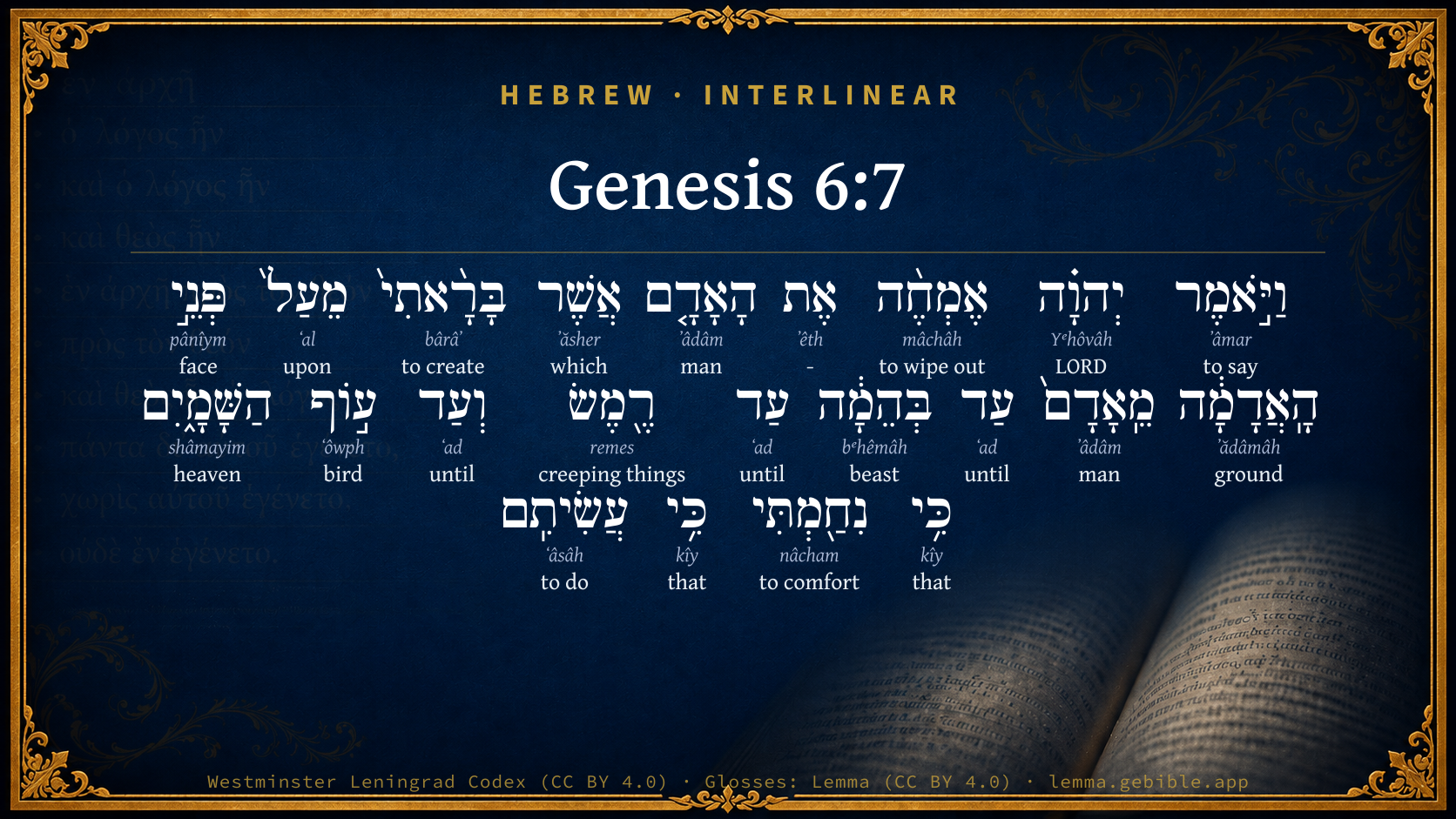
Hebrew (Westminster Leningrad Codex) Genesis 6:7 appears in the Hebrew Old Testament. The text above is from the Westminster Leningrad Codex. Each word links to its Strong’s number, a concise gloss, and parsing drawn from the Open Scriptures Hebrew Bible morphology. Click any word for its full Brown-Driver-Briggs (BDB) entry.
Download image
Cite this verse

Genesis 6:7 (World English Bible). Public Domain. Lemma interlinear Bible study tool, https://lemma.gebible.app/v/genesis/6/7.

Show BibTeX & RIS
BibTeX
RIS
English Translation
Yahweh said, "I will destroy man whom I have created from the surface of the ground; man, along with animals, creeping things, and birds of the sky; for I am sorry that I have made them."
World English Bible · Public Domain
Highlights
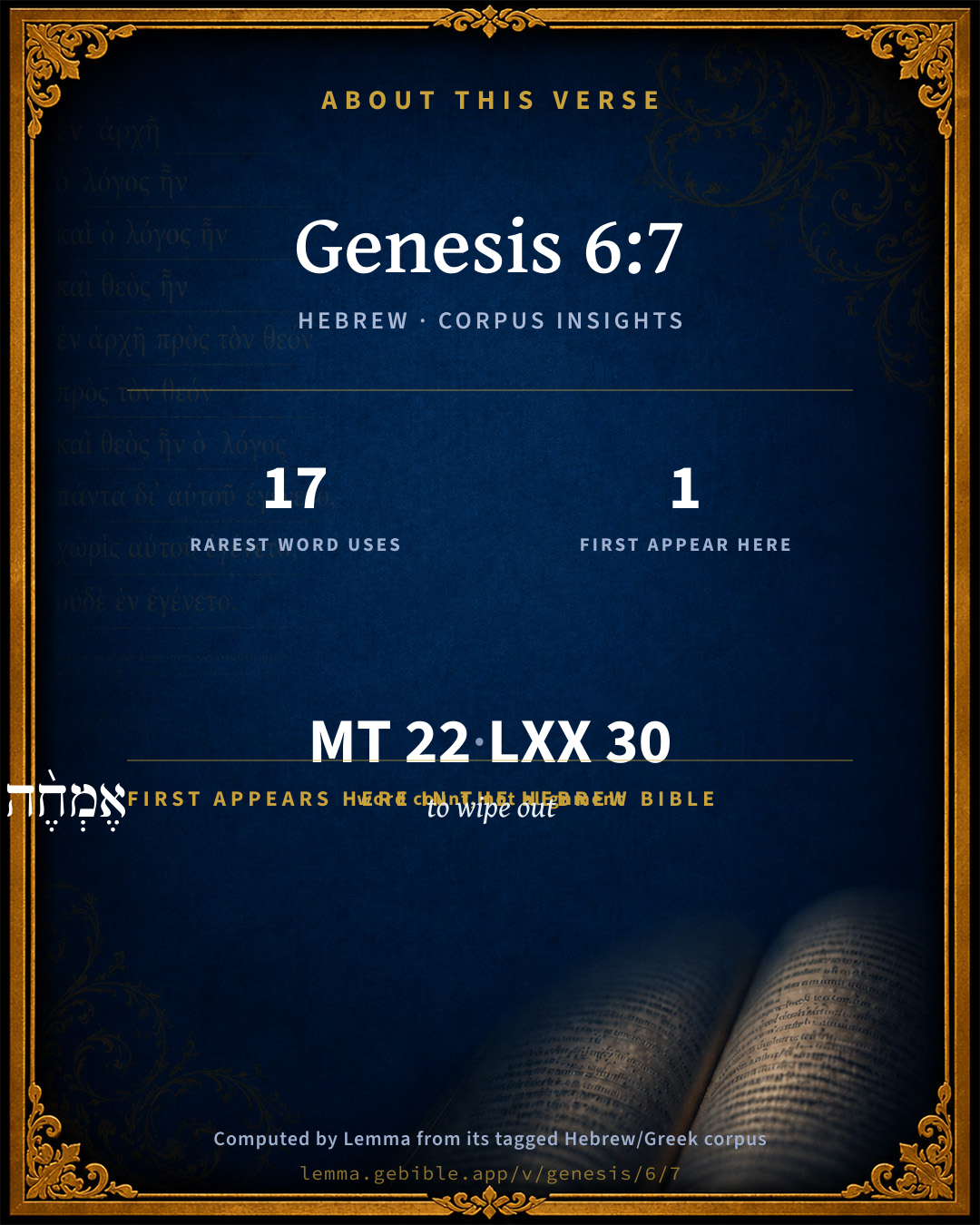
  • 1 first appearance in the Hebrew Bible
Full analysis ↓
Download a study sheet

One document with this verse’s original text, its word-by-word gloss line, the meaning frame, cross-references with their text, attributed commentary, and full source and license credits — printable, and it pastes into notes with its structure intact.

This verse Autodidact and up

Study sheet (.html) Plain text (.txt)

A passage Seminary Student

Up to 50 verses in one chapter. A passage sheet keeps up to 6 commentary sources and 12 cross-references per verse, in the order this page ranks them, and says so on the sheet whenever that leaves anything out. Ask for a single verse and you get the Autodidact verse sheet above.

Everything on this page stays free to read, with no account — the sheet is a download of what is already on screen, not access to it.

Want to remove ads? Support Godless Engineer
Compare translations 3

The same verse in 3 English versions, stacked beneath the original-language interlinear above. Click any original word for its lexicon entry.

Each is an independent rendering of the whole verse — the interlinear is not word-aligned to these translations.

Highlighted words mark where these versions differ — a whole-verse word diff, not a word-by-word alignment.

  • World English Bible Public Domain
    Yahweh said, "I will destroy man whom I have created from the surface of the ground; man, along with animals, creeping things, and birds of the sky; for I am sorry that I have made them."
  • King James Version Public Domain
    And the LORD said, I will destroy man whom I have created from the face of the earth; both man, and beast, and the creeping thing, and the fowls of the air; for it repenteth me that I have made them.
  • unfoldingWord Literal Text CC BY-SA 4.0
    Then Yahweh said, “I will wipe away mankind whom I created off the surface of the ground, both mankind and animals, and crawling creatures and the birds of the sky, because I am sorry that I made them.”

unfoldingWord Literal Text — © unfoldingWord, licensed CC BY-SA 4.0. Word-aligned USFM3 via Door43 (git.door43.org/unfoldingWord/en_ult).

Versions to compare (up to 4)

3 of 4 selected

Show all 18 translations

Every available English version of this verse, each an independent rendering of the whole verse.

  • World English Bible Public Domain
    Yahweh said, "I will destroy man whom I have created from the surface of the ground; man, along with animals, creeping things, and birds of the sky; for I am sorry that I have made them."
  • Berean Standard Bible Public Domain
    So the LORD said, “I will blot out man, whom I have created, from the face of the earth—every man and beast and crawling creature and bird of the air—for I am grieved that I have made them.”
  • Majority Standard Bible Public Domain
    So the LORD said, “I will blot out man, whom I have created, from the face of the earth—every man and beast and crawling creature and bird of the air—for I am grieved that I have made them.”
  • King James Version Public Domain
    And the LORD said, I will destroy man whom I have created from the face of the earth; both man, and beast, and the creeping thing, and the fowls of the air; for it repenteth me that I have made them.
  • American Standard Version (1901) Public Domain
    And Jehovah said, I will destroy man whom I have created from the face of the ground; both man, and beast, and creeping things, and birds of the heavens; for it repenteth me that I have made them.
  • Revised Version (1885) Public Domain
    And the LORD said, I will destroy man whom I have created from the face of the ground; both man, and beast, and creeping thing, and fowl of the air; for it repenteth me that I have made them.
  • Geneva Bible (1599) Public Domain
    Therefore ye Lord said, I will destroy from the earth the man, whom I haue created, from man to beast, to the creeping thing, and to the foule of the heauen: for I repent that I haue made them.
  • Douay-Rheims (1899) Public Domain
    He said: I will destroy man, whom I have created, from the face of the earth, from man even to beasts, from the creeping thing even to the fowls of the air, for it repenteth me that I have made them.
  • Young's Literal Translation Public Domain
    And Jehovah saith, `I wipe away man whom I have prepared from off the face of the ground, from man unto beast, unto creeping thing, and unto fowl of the heavens, for I have repented that I have made them.'
  • Literal Standard Version CC BY-SA 4.0
    And YHWH says, “I wipe away man whom I have created from off the face of the ground, from man to beast, to creeping thing, and to bird of the heavens, for I have regretted that I have made them.”
  • Unlocked Literal Bible CC BY-SA 4.0
    So Yahweh said, “I will wipe away mankind whom I have created from the surface of the earth; both mankind and the larger animals, and creeping things and birds of the heavens, for I am sorry that I have made them.”
  • unfoldingWord Literal Text CC BY-SA 4.0
    Then Yahweh said, “I will wipe away mankind whom I created off the surface of the ground, both mankind and animals, and crawling creatures and the birds of the sky, because I am sorry that I made them.”
  • Darby Bible Public Domain
    And Jehovah said, I will destroy Man, whom I have created, from the earth -- from man to cattle, to creeping things, and to fowl of the heavens; for I repent that I have made them.
  • World Messianic Bible Public Domain
    The LORD said, “I will destroy man whom I have created from the surface of the ground—man, along with animals, creeping things, and birds of the sky—for I am sorry that I have made them.”
  • Webster's Bible Public Domain
    And the LORD said, I will destroy man whom I have created, from the face of the earth, both man and beast, and the creeping animal, and the fowls of the air; for I repent that I have made them.
  • Free Bible Version CC BY-SA 4.0
    So the Lord said, “I'm going to wipe out these people I created from the earth, and not only them but also the animals, the creatures that run along the ground, and the birds, because I'm sorry I made them.”
  • Bible in Basic English Public Domain
    And the Lord said, I will take away man, whom I have made, from the face of the earth, even man and beast and that which goes on the earth and every bird of the air; for I have sorrow for having made them.
  • JPS Tanakh (1917) Public Domain
    And the LORD said: 'I will blot out man whom I have created from the face of the earth; both man, and beast, and creeping thing, and fowl of the air; for it repenteth Me that I have made them.'

Literal Standard Version (2020), Covenant Press — licensed CC BY-SA 4.0. Text via the HelloAO Bible API (eBible.org). Unlocked Literal Bible (unfoldingWord) — licensed CC BY-SA 4.0. Text via the HelloAO Bible API (eBible.org). unfoldingWord Literal Text — © unfoldingWord, licensed CC BY-SA 4.0. Word-aligned USFM3 via Door43 (git.door43.org/unfoldingWord/en_ult). Free Bible Version, Dr. Jonathan Gallagher — licensed CC BY-SA 4.0. Text via the HelloAO Bible API (eBible.org).

Word by word

More ways to search: Search by grammar → Find every occurrence → Compare this word →

Practice this passage: Drill this verse → Learn its vocabulary →

רֶ֖מֶשׂ
remes
H7431
“creeping things”
Noun, Common, Masculine, Singular, Absolute
Part of Speech
Noun
Type
Common
Gender
Masculine
Number
Singular
State
Absolute
Full BDB Definition

Origin: from H7430

TWOT: 2177a

creeping things, moving things, creeping organism - creeping things - gliding things (of sea animals) - moving things (of all animals)
  1. וַיֹּ֣אמֶר ʼâmar H559 “and · to say” Conjunction + Verb, Qal, Sequential Imperfect, 3rd Person, Masculine, Singular
  2. יְהוָ֗ה Yᵉhôvâh H3068 “LORD” Noun, Proper
  3. אֶמְחֶ֨ה mâchâh H4229 “to wipe out” Verb, Qal, Imperfect, 1st Person, Common, Singular
  4. אֶת ʼêth H853 “-” Particle, Direct Object
  5. הָאָדָ֤ם ʼâdâm H120 “the · man” Particle, Definite Article + Noun, Common, Masculine, Singular, Absolute
  6. אֲשֶׁר ʼăsher H834 “which” Particle, Relative
  7. בָּרָ֨אתִי֙ bârâʼ H1254 “to create” Verb, Qal, Perfect, 1st Person, Common, Singular
  8. מֵעַל֙ ʻal H5921 “from · upon” Preposition + Preposition
  9. פְּנֵ֣י pânîym H6440 “face(s) of” Noun, Common, Both, Plural, Construct
  10. הָֽאֲדָמָ֔ה ʼădâmâh H127 “the · ground” Particle, Definite Article + Noun, Common, Feminine, Singular, Absolute
  11. מֵֽאָדָם֙ ʼâdâm H120 “from · man” Preposition + Noun, Common, Masculine, Singular, Absolute
  12. עַד ʻad H5704 “until” Preposition
  13. בְּהֵמָ֔ה bᵉhêmâh H929 “beast” Noun, Common, Feminine, Singular, Absolute
  14. עַד ʻad H5704 “until” Preposition
  15. וְעַד ʻad H5704 “and · until” Conjunction + Preposition
  16. ע֣וֹף ʻôwph H5775 “bird of” Noun, Common, Masculine, Singular, Construct
  17. הַשָּׁמָ֑יִם shâmayim H8064 “the · heaven(s)” Particle, Definite Article + Noun, Common, Masculine, Plural, Absolute
  18. כִּ֥י kîy H3588 “that” Conjunction
  19. נִחַ֖מְתִּי nâcham H5162 “to comfort” Verb, Niphal, Perfect, 1st Person, Common, Singular
  20. כִּ֥י kîy H3588 “that” Conjunction
  21. עֲשִׂיתִֽם ʻâsâh H6213 “to do · them” Verb, Qal, Perfect, 1st Person, Common, Singular + Suffix, Personal, 3rd Person, Masculine, Plural

About this verse

These counts appear in no published source. They are computed here, from the morphology-tagged text and Lemma’s own curated glosses. What Lemma adds →

22
words
18
distinct lemmas
Pentateuch
section

Notable vocabulary

The rarest word here is רֶ֖מֶשׂ creeping things H7431 — appearing just 17 times in the whole Hebrew Bible.

First appearance in Scripture

This word makes its first canonical appearance in the Hebrew Bible here:

  • אֶמְחֶ֨ה to wipe out H4229

Shared distinctive vocabulary

רֶ֖מֶשׂ creeping things H7431 occurs in 17 verses of the Hebrew Bible. Also found in:

Grammatical profile

  • 5 verbs
  • 9 nouns
  • 4 prepositions
  • 2 conjunctions
  • 2 particles

Verb forms

  • וַיֹּ֣אמֶר Qal · Sequential Imperfect
  • אֶמְחֶ֨ה Qal · Imperfect
  • בָּרָ֨אתִי֙ Qal · Perfect
  • נִחַ֖מְתִּי Niphal · Perfect
  • עֲשִׂיתִֽם Qal · Perfect

Repetition

Words recur within this verse — often emphatic in Hebrew:

  • עַד until H5704 ×3
  • הָאָדָ֤ם man H120 ×2
  • כִּ֥י that H3588 ×2

Hebrew & Septuagint length

In English translation the verse runs 36 words from the Hebrew and 39 from the Septuagint (LXX English) — closely comparable.

A rough comparison of the two English renderings, which tokenize alike — not a word-level alignment.

Word counts can differ between the Hebrew and the Greek without any difference in meaning — e.g. the Hebrew direct-object marker אֵת has no separate Greek word, and Greek often adds the article ὁ.

In the original languages it is 22 Hebrew tokens and 30 Greek tokens — but the two are counted differently (Hebrew bundles its prefixes and suffixes into one token; the Greek is in lemma form), so that isn’t a like-for-like length.

Cross-references

9

Topical passages linked to Genesis 6:7 in the Treasury of Scripture Knowledge — connected by theme and wording, ordered by reader-vote popularity; previews shown in the World English Bible.

  • Zephaniah 1:3 I will sweep away man and animal. I will sweep away the birds of the sky, the fish of the sea, and the heaps of rubble with the wicked. I will cut off man from the surface of the earth, says Yahweh.
  • Psalms 37:20 But the wicked shall perish. The enemies of Yahweh shall be like the beauty of the fields. They will vanish-- Vanish like smoke.
  • Romans 3:20–22 Because by the works of the law, no flesh will be justified in his sight. For through the law comes the knowledge of sin.
  • Psalms 24:1–2 The earth is Yahweh's, with its fullness; The world, and those who dwell therein.
  • Proverbs 10:27 The fear of Yahweh prolongs days, But the years of the wicked shall be shortened.
  • Proverbs 16:4 Yahweh has made everything for its own end-- Yes, even the wicked for the day of evil.
  • Jeremiah 12:3–4 But you, Yahweh, know me; you see me, and try my heart toward you: pull them out like sheep for the slaughter, and prepare them for the day of slaughter.
  • Jeremiah 4:22–27 For my people are foolish, they don't know me; they are foolish children, and they have no understanding; they are wise to do evil, but to do good they have no knowledge.
  • Hosea 4:3 Therefore the land will mourn, And everyone who dwells therein will waste away. All living things in her, Even the animals of the field and the birds of the sky; Yes, the fish of the sea also die.

Cross-references courtesy of OpenBible.info (CC BY 4.0).

Hebrew and Greek witnesses Masoretic Hebrew ↔ Greek Septuagint

The same verse in the two great witnesses to the Old Testament, shown verse-for-verse.

These are two independent witnesses, not word-aligned to each other, and the Septuagint is shown in lemma (dictionary) form.

Hebrew Genesis 6:7 Masoretic · Westminster Leningrad Codex

וַיֹּ֣אמֶר יְהוָ֗ה אֶמְחֶ֨ה אֶת הָאָדָ֤ם אֲשֶׁר בָּרָ֨אתִי֙ מֵעַל֙ פְּנֵ֣י הָֽאֲדָמָ֔ה מֵֽאָדָם֙ עַד בְּהֵמָ֔ה עַד רֶ֖מֶשׂ וְעַד ע֣וֹף הַשָּׁמָ֑יִם כִּ֥י נִחַ֖מְתִּי כִּ֥י עֲשִׂיתִֽם

Yahweh said, "I will destroy man whom I have created from the surface of the ground; man, along with animals, creeping things, and birds of the sky; for I am sorry that I have made them."

World English Bible · Public Domain

Greek LXX Genesis 6:7 Septuagint · lemma form

καί εἶπον ὁ θεός ἀποἀλείφω ὁ ἄνθρωπος ὅς ποιέω ἀπό πρόσωπον ὁ γῆ ἀπό ἄνθρωπος ἕως κτῆνος καί ἀπό ἑρπετόν ἕως ὁ πετεινόν ὁ οὐρανός ὅτι θυμόω ὅτι ποιέω αὐτός

And God said, I will blot out man whom I have made from the face of the earth, even man with cattle, and reptiles with flying creatures of the sky, for I am grieved that I have made them.

LXX2012 (modern English Septuagint) · Public Domain

On this verse, The Cambridge Bible for Schools and Colleges discusses the Septuagint’s reading. Read the note in Commentary ↓

Hebrew: Westminster Leningrad Codex (CC BY 4.0). Greek: Septuagint (public domain); English from LXX2012 (modern English Septuagint) (Public Domain). How the Septuagint differs from the Hebrew →

Targum (Aramaic paraphrase)

2

The Targum is the ancient Jewish Aramaic paraphrase of the Hebrew Scriptures — an interpretive translation, not the Hebrew text itself. Onkelos (literal) and Pseudo-Jonathan (expansive) render the Torah, and Jonathan the Prophets. Coverage is partial: where no permissively-licensed English translation exists for a verse, only the Aramaic is shown. This is verse-level text, not a word-by-word alignment to the Hebrew.

  1. Targum Onkelos Torah (Genesis–Deuteronomy)
    וַאֲמַר יְיָ אֶמְחֵי יָת אֲנָשָׁא דִּי בְרֵאתִי מֵעַל אַפֵּי אַרְעָא מֵאֱנָשָׁא עַד בְּעִירָא עַד רִיחֲשָׁא וְעַד עוֹפָא דִּשְׁמַיָּא אֲרֵי תָבִית בְּמֵימְרִי אֲרֵי עֲבַדְתִּנוּן

    And the Lord said, Man whom I have made will I blot out from the face of the earth;‑from man to the beast, to the reptile, and to the fowls of heaven; because it repenteth Me in My Word that I have made them.

    Targum Onkelos — Aramaic: “Onkelos Genesis” (public domain); “Onkelos Exodus” (public domain); “Onkelos Leviticus” (public domain); “Onkelos Numbers” (public domain); “Onkelos Deuteronomy” (public domain). English: “Sefaria Community Translation” (CC0 1.0 (public-domain dedication)); “J.W. Etheridge. The Targums of Onkelos and Jonathan Ben Uzziel on the Pentateuch. London: Longmans, Green, 1862” (public domain). Text via Sefaria.

  2. Targum Pseudo-Jonathan Torah (Genesis–Deuteronomy)
    וַאֲמַר יְיָ אַבְטִיל אֱנָשָׁא בְּמֵימְרִי דִבְרֵיתִי מֵעַל אַנְפֵּי אַרְעָא מֵאֱנָשָׁא עַד בְּעִירָא עַד רִיחֲשָׁא וְעַד עוֹפָא דִשְׁמַיָא אַרוּם תָּבִית בְּמֵימְרִי אֲרוּם עֲבַדְתִּינוּן

    And the Lord said, I will abolish by My Word man, whom I have created upon the face of the earth, from man to cattle, to the reptile, and to the fowl of the heavens; because I have repented in My Word that I have made them.

    Targum Pseudo-Jonathan — Aramaic: “Targum Jonathan on Genesis” (public domain); “Targum Jonathan on Exodus” (public domain); “Targum Jonathan on Leviticus” (public domain); “Targum Jonathan on Numbers” (public domain); “Targum Jonathan on Deuteronomy” (public domain). English: “The Targum of Jonathan ben Uzziel, trans. J. W. Etheridge, London, 1862” (public domain). Text via Sefaria.

Commentary

Notes on Genesis 6:7 from classic Christian and Jewish commentators (each source and its license shown beneath its notes). The classic Christian expositions comment on the surrounding passage and are grouped to its opening verse, so a note may address several verses; the Jewish commentaries on the Tanakh (Rashi and others) are per-verse, so they appear only where the commentator wrote on this verse.

Lemma curates 59 commentaries, every one of them public domain or Creative Commons licensed, each selected and text-cleaned for this edition rather than reprinted as found. About our sources →

Trapp's Complete Commentary

John Trapp

Gen 6:7 And the LORD said, I will destroy man whom I have created from the face of the earth; both man, and beast, and the creeping thing, and the fowls of the air; for it repenteth me that I have made them.

Ver. 7. I will destroy man.] See here the venemous and mischievous nature of sin. It causeth God to make a world, and again to unmake it: it sets him against man his masterpiece, and makes him, though he be φιλανθρωπος, not only to devise, but to delight in the destruction of his own creature, to "mock at," and make merry in his "calamity," {Pro 1:26} to deliver "the beloved of his soul into the hands of the destroyer". {Jer 12:7} Time was, when Christ, being by at the creation, "rejoiced in this habitable part of God’s earth, and his delights were with the sons of men". {Pro 8:31} But since the fall, it is far otherwise; for he is "of more pure eyes than to behold sin" {Hab 1:13} with patience. He hates it worse than he hates the devil: for he hates the devil for sin’s sake, and not sin for the devil’s sake. Now the natural and next effect of hatred is revenge. Hence he resolves, "I will destroy man."

Both man and beast, the creeping thing, &c.] Why, "what have those poor sheep done?" {2Sa 24:17} They are all undone by man’s sin, and are, for his punishment, to perish with him, as they were created for him. This is a piece of that bondage they are still subject to; and grievously groan under, waiting deliverance. {Rom 8:21-22}

John Trapp, A Commentary or Exposition upon All the Books of the Old and New Testament (1647–1656) — public domain. Text from a community e-Sword module.

Joseph Benson's Commentary

Gen 6:7. I will destroy man — The original word is very significant, I will wipe off man; from off the earth — As dirt is wiped off from a place which should be clean, and thrown to the dunghill. Or, I will blot out man from the earth, as those lines are blotted out of a book which displease the author, or as the name of a citizen is blotted out of the rolls of the freemen when he is disfranchised. Both man and beast, the creeping thing, and the fowls of the air — These were made for man, and therefore destroyed with man. It repenteth me that I have made them — For the end of their creation also was frustrated: they were made that man might serve and honour God with them; and therefore were destroyed, because he had served his lusts with them, and made them subject to vanity.

Joseph Benson's Commentary on the Old and New Testaments (1811–1818) — public domain. Text from a community e-Sword module.

Tyndale Open Study Notes

Tyndale Open Resources

6:7 wipe . . . from the . . . earth: As Adam and Eve were banished from the garden-sanctuary (3:23), all of humankind would be expunged from God’s good creation. • every living thing: Human sin had so corrupted the earth that judgment fell on the animals and birds over which they had dominion (see 1:28 and study note). The special role of humans in the created order (1:28-30) means that nature is affected by human moral choices (see 8:1; Job 38:41; Hos 4:3; Rom 8:19-22).

Tyndale Open Study Notes — © Tyndale Open Resources, licensed CC BY-SA 4.0. Text via the HelloAO Bible API.

Geneva Bible (1599)

Geneva Bible translators

God declareth how much he detesteth sin, seeing the punishment thereof extendeth to the brute beasts.

Geneva Bible (1599) marginal notes — public domain. Text via Bolls.life.

John Calvin's Commentaries

7. And the Lord said, I will destroy man whom I have created from the face of the earth, both man and beast, etc. He again introduces God as deliberating, in order that we may the better know that the world was not destroyed without mature counsel on the part of God. For the Spirit of the Lord designed that we should be diligently admonished on this point, in order that he might cut off occasion for those impious complaints, into which we should be otherwise too ready to break forth. The word said here means decreed ; because God utters no voice, without having inwardly determined what he would do. Besides, he had no need of new counsel, according to the manner of men, as if he were forming a judgment concerning something recently discovered. But all this is said in consideration of our infirmity; that we may cleverly think of the deluge, but it shall immediately occur to us that the vengeance of God was just. Moreover, God, not content with the punishment of man, proceeds even to beasts, and cattle, and fowls and every kind of living creatures. In which he seems to exceed the bounds of moderation: for although the impiety of men is hateful to him, yet to what purpose is it to be angry with unoffending animals? But it is not wonderful that those animals, which were created for man’s sake, and lived for his use, should participate in his ruin: neither asses, nor oxen, nor any other animals, had done evil; yet being in subjection to man when he fell, they were drawn with him into the same destruction. The earth was like a wealthy house, well supplied with every kind of provision in abundance and variety. Now, since man has defiled the earth itself with his crimes, and has vilely corrupted all the riches with which it was replenished, the Lord also designed that the monument of his punishment should there be placed: just as if a judge, about to punish a most wicked and nefarious criminal, should, for the sake of greater infamy, command his house to be razed to the foundation. And this all tends to inspire us with a dread of sin; for we may easily infer how great is its atrocity, when the punishment of it is extended even to the brute creation.

John Calvin's Commentaries (1540-1563) — public domain. Text from the Calvin Translation Society English edition (1840s-50s) via the Christian Classics Ethereal Library (ccel.org). Calvin's coverage is partial (roughly two-thirds of the Bible); uncommented books and verses are honest gaps, never fabricated. The 19th-century editor's footnotes and remarks are omitted so the notes are faithfully Calvin's own voice.

Ellicott's Commentary for English Readers

(7) I will destroy.—Heb., delete, rub out.

From the face of the earth.—Heb., the adâmâh, the tilled ground which man had subdued and cultivated.

Both man, and beast.—Heb., from man unto cattle, unto creeping thing, and unto fowl of the air, The animal world was to share in this destruction, because its fate is bound up with that of man (Rom_8:19-22); but the idea of the total destruction of all animals by the flood, so far from being contained in the text, is contradicted by it, as it only says that it is to reach to them. Wild beasts are not mentioned in this enumeration, probably because the domestic cattle would be the chief sufferers.

Creeping thing.—Not necessarily reptiles. (See Note on Gen_1:24.)

A Bible Commentary for English Readers, edited by Charles John Ellicott (1878–1897) — public domain. Text from a community e-Sword module.

The Cambridge Bible for Schools and Colleges

gen. ed. J. J. S. Perowne

7. destroy] R.V. marg. Heb. blot out. LXX ἀπαλείψω, Lat. delebo. A characteristic word in J, cf. Gen_7:4; Gen_7:23; and different from the word for “destroy” in Gen_6:13. (LXX καταφθείρω, Lat. disperdam.)

both man, and beast, &c.] No reference is here made to any preservation of life.

The Cambridge Bible for Schools and Colleges (gen. ed. J. J. S. Perowne; Cambridge University Press, 1878–1918) — public domain. Text from a community e-Sword module.

John Gill's Exposition

And the Lord said,.... Not to the angels, nor to Noah, but within himself, on observing to what a height the sin of man had got, and what a spread it made on the earth:

I will destroy man, whom I have created, from the face of the earth; though he is my creature, the work of my hands, I have made him out of the earth, and made him lord of it; I am now determined to show my detestation of his wickedness, and for the honour of my justice to destroy him from off it; just as a potter takes a vessel he dislikes, when he has made it, and dashes it to pieces: or "I will wipe men off of the earth" (s); like so much dust; man was made of the dust of the earth, he is dust, yea, sinful dust and ashes; and God resolved to send a flood of waters on the earth, which should wash off man from it, like so much dust upon it, just as dust is carried off by a flood of water, see Kg2 21:13 or "I will blot out man" (t), as most render the words; that is, out of the book of the living, he shall no longer live upon the earth; out of the book of creation, or of the creatures, he shall have no more a being, or be seen among them, any more than what is blotted out of a book:

both man and beast; or "from man to beast" (u); even every living creature upon the earth, from man to beast, one as well as another, and one for the sake of the other, the beasts for the sake of man; these were made for his use and benefit, but he sinning against God, and abusing his mercies, they are to be taken away, and destroyed for his sake, and as a punishment for his sins:

and the creeping things, and the fowls of the air; not the creeping things in the great and wide sea, for the fishes died not in the deluge, but the creeping things on the earth, Gen 6:20.

for it repenteth me that I have made them; man, male and female, whom he created; Adam and Eve, and their posterity, and particularly the present inhabitants of the earth: but though it may respect men principally, yet is not to be restrained to them, but takes in all the creatures before mentioned, made for the use of man; and the ends not being answered by them, God repented that he had made them, as well as man. Some think the repentance, attributed to God in this and the preceding verse, is not to be understood of him in himself, but of his Spirit in good men, particularly Noah, producing grief, sorrow, and repentance in him, who wished that man had never been, than to be so wicked as he was; but for such a sense there seems to be no manner of foundation in the text.

(s) "abstergam; verbum Hebraeum" "significat aqua aliquid extergere", Pareus. (t) Delebo, V. L. Pagninus, Montanus, &c. (u) "ab homine usque ad jumentum", Pagninus, Montanus, &c.

John Gill's Exposition of the Whole Bible (1746–1763) — public domain (CC PDM 1.0). Text via the HelloAO Bible API.

Matthew Poole's English Annotations

Both man and beast; for as the beasts were made for man’s use and service, so they are destroyed for man’s punishment, and to discover the malignity of sin, and God’s deep abhorrency thereof, by destroying those innocent creatures that had been made instrumental to it.

Matthew Poole's English Annotations on the Holy Bible (1683–1685) — public domain. Text from a community e-Sword/MySword module.

Whedon's Commentary on the Bible

Daniel D. Whedon

7. I will destroy — Literally, I will wipe out man. When God destroys his own creature, the creature must have made itself fearfully guilty and corrupt.

Both man, and beast — Heb, from man unto beast; that is, beginning at man, the destruction shall descend to beasts, man’s subjects and servants. It is one of the deep mysteries of this life that the lower orders of animate beings rejoice and suffer in sympathy with man, and are, therefore, involved in the calamities which result from human sin. But they are also a part of the whole creation, (πασα η κτισις,) which groans and travails together with sinning and suffering man, waiting “for the manifestation of the sons of God.” Rom_8:19-21. What and how much the apostle means by these wondrous words we cannot conceive, but it is something ineffably glorious.

Daniel D. Whedon (gen. ed.), Commentary on the Old and New Testaments (1874–1909) — public domain. Text from a community e-Sword module.

The Pulpit Commentary

And the Lord said, weird (doom) there"s word: Northern Proverb" (Bonar)I will destroy literally, blot or wipe out by washing (cf. Num_5:23; 2Ki_21:13; Pro_30:20; Isa_25:8) "The idea of destroying by washing away is peculiarlyappropriate to the Deluge, and the word is chosen on account of its significance" (Quarry) man whom I have created from the face of the earth. An indirect refutation of the angel hypothesis (Keil, Lange). If the angels were the real authors of the moral corruption of the race, why are they not sentenced as the serpent was in Gen_3:14? Both man, and beast, and the creeping thing. Literally, from man unto beast, &c. The lower creatures were involved in the punishment of man neither because of any moral corruption which had entered into them, nor as sharing in the atonement for human sins (Knobel) but rather on the ground of man"s sovereignty over the animal world, and its dependence on him (Keil, Lange), and in exemplification of that great principle of Divine government by which the penal consequences of moral evil are allowed to extend beyond the immediate actor ; (cf. Rom_8:20) For it repenteth me that I have made them. Vide supra on ver. 6.

The Pulpit Commentary (1880–1919), ed. H.D.M. Spence-Jones & Joseph S. Exell — public domain. Text from a community e-Sword module.

John Wesley's Explanatory Notes

I will destroy man - The original word is very significant. I will wipe off man from off the earth; as dirt is wiped off from a place which should be clean, and thrown to the dunghill. Or, I will blot out man from the earth, as those lines are blotted out of a book which displease the author, or as the name of a citizen is blotted out of the rolls of the freemen when he is disfranchised. Both man and beast the creeping thing, and the fowls of the air - These were made for man, and therefore must be destroyed with man. It repenteth me that I have made them - For the end of their creation also was frustrated: they were made that man might serve and honour God with them and therefore were destroyed, because he had served his lusts with them, and made them subject to vanity.

John Wesley, Explanatory Notes Upon the Whole Bible (1754–1765) — public domain. Text via the GEBible commentary corpus.

unfoldingWord translationNotes

Door43 World Missions Community

I will wipe away mankind ... from the surface of the earth

The writer speaks of God killing people as if God were wiping dirt off a flat surface. AT: "I will destroy mankind ... so that there will not be any people on the earth" (See: Metaphor)

I will wipe away mankind whom I have created

Some languages would need to translate this as two sentences. AT: "I created mankind. I will wipe them away" (See: Distinguishing versus Informing or Reminding)

wipe away

"completely destroy." Here "wipe away" is used in a negative sense, for God is talking about destroying the people because of their sin.

Noah found favor in the eyes of Yahweh

The phrase "found favor" is an idiom which means to be approved of by someone. Also, the eyes represent seeing, and seeing represents thoughts or judgment. AT: "Yahweh looked favorably on Noah" or "Yahweh was pleased with Noah" (See: Idiom and Metaphor)

translationWords

Yahweh

Noah

unfoldingWord translationNotes — © Distant Shores Media and the Door43 World Missions Community, licensed CC BY-SA 4.0. Source: git.door43.org/Door43/en_tn.

Rashi

Rabbi Shlomo Yitzchaki (Rashi)

ויאמר ה' אמחה את האדם AND GOD SAID I WILL BLOT OUT THE MAN — He is dust and I shall bring water upon him and blot him out: that is why this root מחה is used (it expresses the idea of sponging out by means of wet or dampness) (Genesis Rabbah 28:2).

מאדם ועד בהמה — FROM MAN, TO BEAST — These also corrupted their way (Genesis Rabbah 28:8). Another explanation is: All things were created on man’s account; when he ceases to be, what need of them? (Sanhedrin 108a)

כי נחמתי כי עשיתים means for I have thought out what to do because I have made them. (Cf. this with Rashi’s second explanation of וינחם 5:6).

Rashi on the Tanakh — English translations: “The Judaica Press complete Tanach with Rashi, translated by A. J. Rosenberg” (CC BY 4.0); “Pentateuch with Rashi's commentary by M. Rosenbaum and A.M. Silbermann, 1929-1934” (public domain); “The Metsudah Tanach series, Lakewood, N.J” (CC BY 4.0); and “The Book of Joshua, Metsudah Publications, 1997” (CC BY 4.0). Text via Sefaria.

Radak

Rabbi David Kimhi (Radak)

'ויאמר ה, G’d either said this to Himself, or to Noach.

אמחה את האדם אשר בראתי, the prefix ה before the word אדם is meant to tell us that G’d did not mean to wipe out the human species, אדם, but only האדם, seeing that some humans were allowed to survive. In supplying a rationale why the means used to wipe out all these people was the water, Rabbi Berechyah in Bereshit Rabbah 28,2 describes G’d as saying to Himself, that seeing He had made man out of earth, the only element (of the four that man is made of) which could neutralise earth is water. The words מאדם עד בהמה, included the free roaming beasts on earth, חיה, whereas the word רמש refers to the small creatures as we explained already on 1,25-26. Why were all these creatures wiped out also? What had they done to deserve this? They had only been created for the sake of man. If there was no purpose for man on earth, neither was there a purpose for all of these living creatures. Furthermore, seeing that the waters would cover the habitat of all these creatures they would die unless saved by a special miracle. The concern of G’d for all those creatures does not extend to each of them individually, but only to the survival of each of their species. G’d ensured that the species would survive by commanding Noach to take them into the ark with him, or at least to accept all those that came to the ark voluntarily, in pairs. If you were to ask why the deluge had to cover the entire surface of the earth and not only the areas inhabited by man, if G’d had done this, man could have escaped to uninhabited regions and survived thus foiling G’d’s plan. This is why even the highest mountains had to be covered by the waters to prevent anyone from escaping to the mountain peaks. Some of our sages (Sanhedrin 108) claim that the animals had become corrupt, copying man’s corrupt ways, so that they too deserved to die in their own right. They had become guilty of mating with species not their own, thus frustrating G’d’s plan that each species remain pure. Other sages (on the same folio) agree with the first opinion we offered, i.e. that in the absence of man on earth there was no purpose in the earth being populated by animals.

Radak on the Tanakh — English translations: “Sefaria Community Translation” (CC0 1.0 (public-domain dedication)); “Eliyahu Munk, HaChut Hameshulash” (CC BY 4.0); “Rabbi Mike Feuer, Jerusalem Anthology” (CC BY 4.0); and “R. David Kimhi on the first book of Psalms, Translated by R.G. Finch, London, 1919” (public domain). Text via Sefaria.

Lesson kit

Teaching starters — assembled from the data on this page, not authored interpretation. Every prompt links to the verse data it draws on. Edit before teaching.

Genesis, in the Pentateuch, opens this verse with 22 words (18 distinct Hebrew lemmas). Its most distinctive word is remes (“creeping things”). A historical commentator’s framing appears above. Read the whole chapter for the surrounding context.

Discussion questions

  1. The word remes carries the sense “creeping things.” How does it shape the verse?
  2. This is the first place “to wipe out” appears in Scripture (first appears here). What does its debut here establish?
  3. How does Genesis 1:24, which shares the word «creeping things», read alongside this verse?
  4. What does the repetition of “until” (3× in this one verse) do in this verse?
  5. These translations render this verse differently. What is at stake in choosing one wording over another?
  6. «וַיֹּ֣אמֶר» is a Qal Sequential Imperfect verb. How does that grammatical form shape the action described?
  7. Compare how Trapp's Complete Commentary and Joseph Benson's Commentary read this verse. Where do they agree or differ?

Things to notice

Reading settings

Reading text

Shown beneath each verse's original-language words.

Old Testament
Old Testament edition

Read the OT as the Masoretic Hebrew (MT) or the Greek Septuagint (LXX).

English shown for the Greek Septuagint (in the Hebrew ↔ Greek comparison).

Comparing translations? Open the Compare panel on any verse page to stack up to four side by side.